| Citation: | CHEN Baojia, GUO Kaimin, CHEN Fafa, et al. Prediction of remaining useful life of aero-engine based on residual NLSTM neural network and attention mechanism[J]. Journal of Aerospace Power, 2023, 38(5):1176-1184 doi: 10.13224/j.cnki.jasp.20210728

|
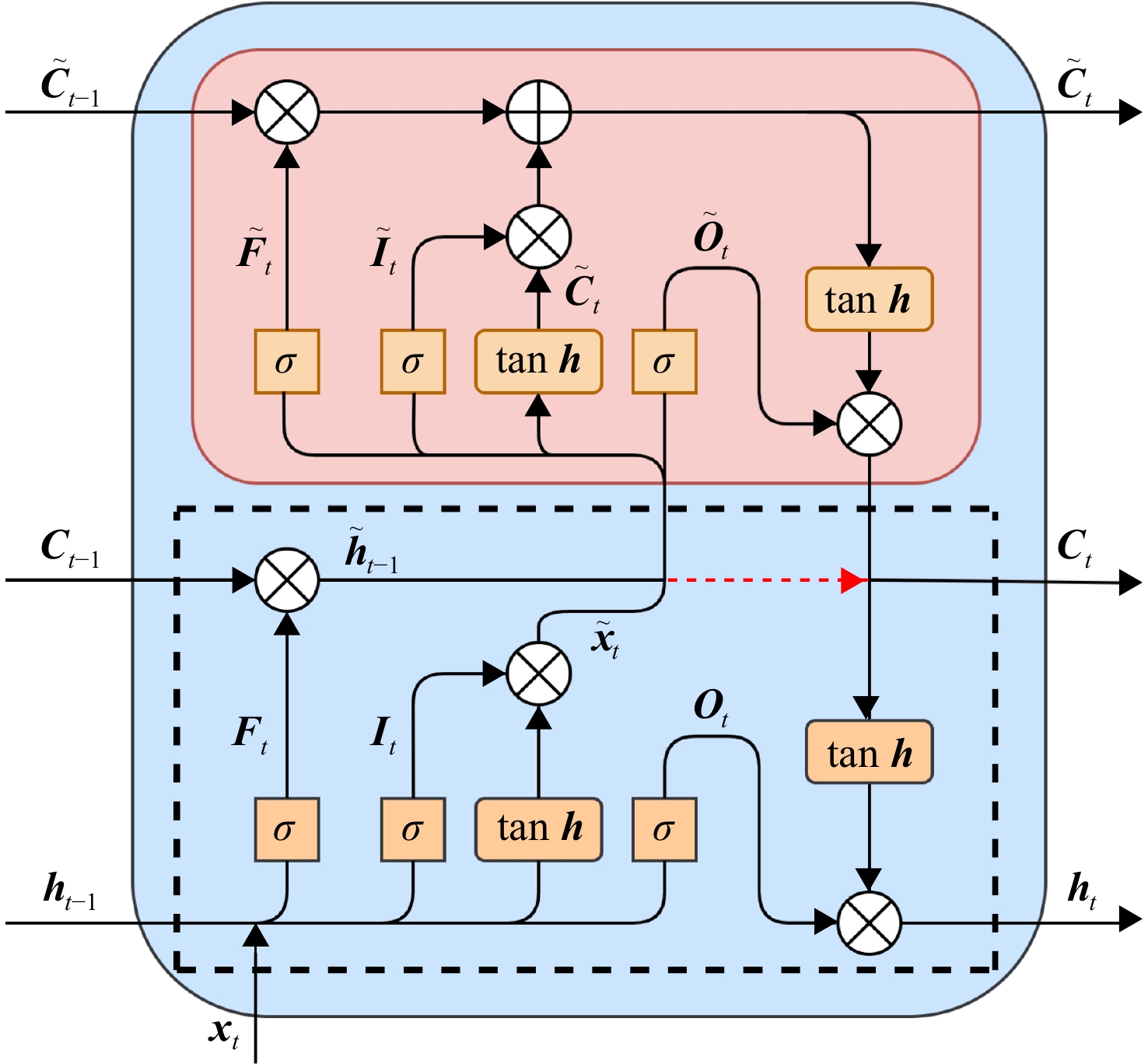
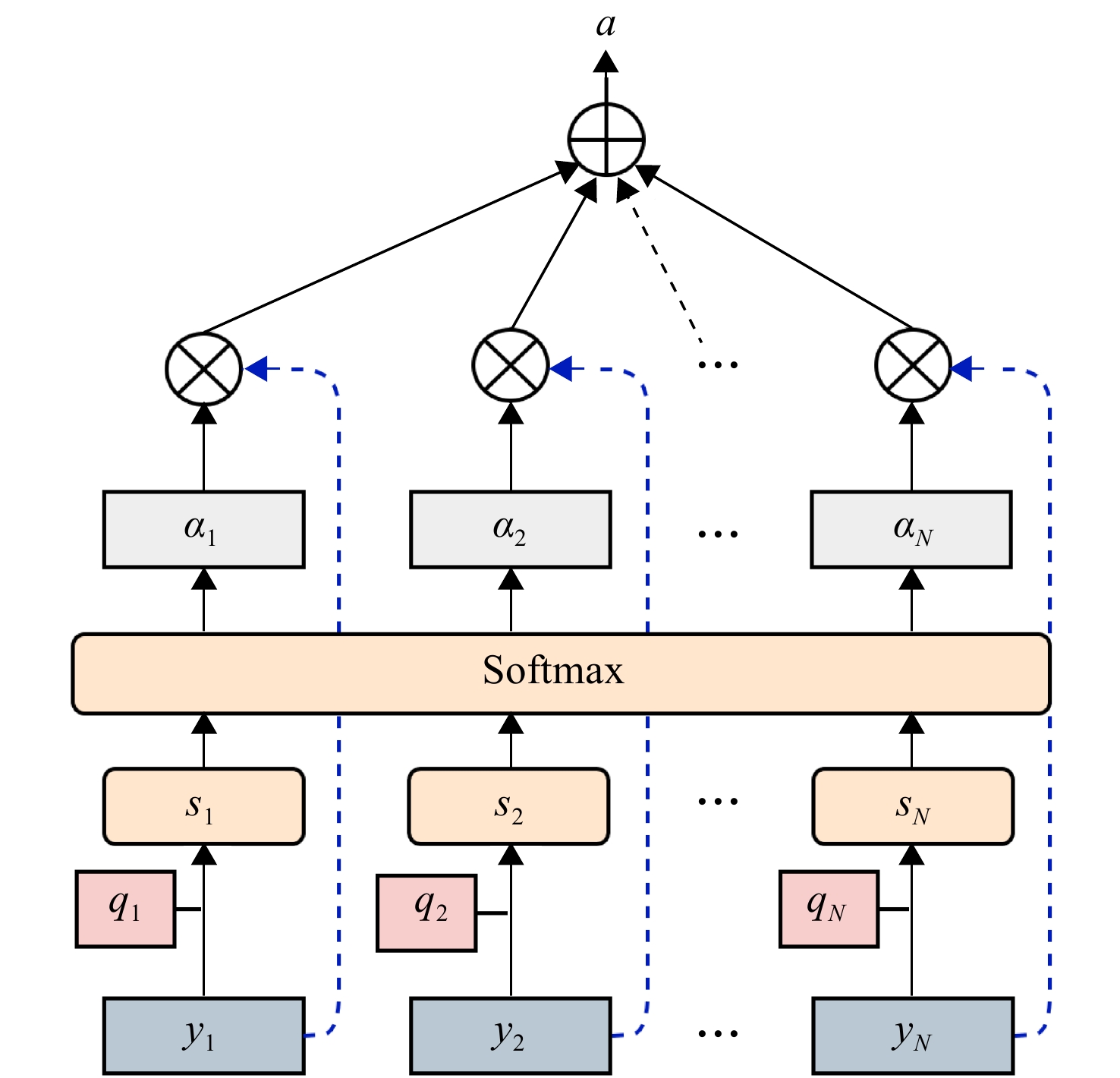
The remaining useful life prediction method based on attention mechanism and residual nested long-short-term memory (NLSTM) neural network was employed to address the shortcomings of traditional long-short-term memory (LSTM) neural network in the recognition and extraction of multi-dimensional data features. Two NLSTM neural network layers were used to replace the main structure of the residual block, and the shortcut connection of the one-dimensional convolutional network in the residual block was retained, which can fully extract the temporal feature and use the jump layer to transfer useful data in the network layer. The method also added the attention mechanism to construct multilayer network, and the important information influencing the result of prediction can be chosen to improve the prediction accuracy by the attention mechanism. The proposed method was verified by experiments in the aero-engines degradation dataset. The results showed that the method can effectively establish the relationship between the monitoring data and the engines health. The prediction error was reduced by 10.8% compared with the method without residual structure and reduced 18.9% compared with the method without attention mechanism, which improved the prediction accuracy effectively.

| [1] |
彭宇,刘大同. 数据驱动故障预测和健康管理综述[J]. 仪器仪表学报,2014,35(3): 481-495. doi: 10.19650/j.cnki.cjsi.2014.03.001
PENG Yu,LIU Datong. Data-driven prognostics and health management: a review of recent advances[J]. Chinese Journal of Scientific Instrument,2014,35(3): 481-495. (in Chinese) doi: 10.19650/j.cnki.cjsi.2014.03.001
|
| [2] |
LEI Yaguo,LI Naipeng,GUO Liang,et al. Machinery health prognostics: a systematic review from data acquisition to RUL prediction[J]. Mechanical Systems and Signal Processing,2018,104(5): 799-834.
|
| [3] |
BABU G S, ZHAO Peilin, LI Xiaoli. Deep convolutional neural network based regression approach for estimation of remaining useful life[C]// International Conference on Database Systems for Advanced Applications. Cham, Switzerland: Springer, 2016: 214-228.
|
| [4] |
ZHENG Shuai, RISTOVSKI K, FARAHAT A, et al. Long short-term memory network for remaining useful life estimation[C]// IEEE International Conference on Prognostics and Health Management (ICPHM). Dallas, US: IEEE, 2017: 88-95.
|
| [5] |
WANG Jiujian, WEN Guilin, YANG Shaopu, et al. Remaining useful life estimation in prognostics using deep bidirectional lstm neural network[C]// Prognostics and System Health Management Conference (PHM-Chongqing). Chongqing, China: IEEE, 2018: 1037-1042.
|
| [6] |
ELLEFSEN A L,BJORLYKHAUG E,AESOY V,et al. Remaining useful life predictions for turbofan engine degradation using semi-supervised deep architecture[J]. Reliability Engineering and System Safety,2019,183(3): 240-251.
|
| [7] |
YU W,KIM I I Y,MECHEFSKE C. Remaining useful life estimation using a bidirectional recurrent neural network based autoencoder scheme[J]. Mechanical Systems and Signal Processing,2019,129(8): 764-780.
|
| [8] |
朱霖,宁芊,雷印杰,等. 基于遗传算法选优的集成手段与时序卷积网络的涡扇发动机剩余寿命预测[J]. 计算机应用,2020,40(12): 3534-3540.
ZHU Lin,NING Qian,LEI Yinjie,et al. Remaining useful life prediction for turbofan engines by genetic algorithm-based selective ensembling and temporal convolutional network[J]. Journal of Computer Applications,2020,40(12): 3534-3540. (in Chinese)
|
| [9] |
牟含笑, 郑建飞, 胡昌华, 等. 基于CDBN与BiLSTM 的多元退化设备剩余寿命预测[J/OL]. [2022-06-27]. http://kns.cnki.net/kcms/detail/11.1929.v.20210510.1354.004.html.
|
| [10] |
叶瑞达,王卫杰,何亮,等. 基于残差自注意力机制的航空发动机RUL预测[J]. 光学精密工程,2021,29(6): 1482-1490. doi: 10.37188/OPE.20212906.1482
YE Ruida,WANG Weijie,HE Liang,et al. RUL prediction of aero-engine based on residual self-attention mechanism[J]. Optics and Precision Engineering,2021,29(6): 1482-1490. (in Chinese) doi: 10.37188/OPE.20212906.1482
|
| [11] |
CAI Yongping,CEN Yuefeng,CEN Gang,et al. Temperature prediction of PMSMs using pseudo-siamese Nested LSTM[J]. World Electric Vehicle Journal,2021,12(2): 57-71. doi: 10.3390/wevj12020057
|
| [12] |
MONIZ J R A, KRUEGER D. Nested LSTMS[C]// Asian Conference on Machine Learning. Seoul, Korea: The Journal of Machine Learning Research, 2017: 530-544.
|
| [13] |
HE K, ZHANG X, REN S, et al. Identity mappings in deep residual networks[C]// European Conference on Computer Vision. Cham, Switzerland: Springer, 2016: 630-645.
|
| [14] |
VASWANI A, SHAZEER N, PARMAR N, et al. Attention is all you need[C]// Proceedings of the 31st Conference on Neural Information Processing Systems. Long Beach, US: Curran Associates Inc, 2017: 5998-6008.
|
| [15] |
SAXENA A, GOEBEL K, SIMON D, et al. Damage propagation modeling for aircraft engine run-to-failure simulation[C]// 2008 international Conference on Prognostics and Health Management. Denver, US: IEEE, 2008: 1-9.
|
| [16] |
WU Yuting,YUAN Mei,DONG Shaopeng,et al. Remaining useful life estimation of engineered systems using vanilla LSTM neural networks[J]. Neurocomputing,2018,275(1): 167-179.
|
| [17] |
HEIMES F O. Recurrent neural networks for remaining useful life estimation[C]// 2008 International Conference on Prognostics and Health Management. Denver, US: IEEE, 2008: 6-12.
|
| [18] |
CHONG Z,LIM P,QIN A K,et al. Multiobjective deep belief networks ensemble for remaining useful life estimation in prognostics[J]. Transactions on Neural Networks and Learning Systems,2017,28(10): 2306-2318. doi: 10.1109/TNNLS.2016.2582798
|
| [19] |
LI Xiang,DING Qian,SUN Jianqiao. Remaining useful life estimation in prognostics using deep convolution neural networks[J]. Reliability Engineering and System Safety,2018,172(4): 1-11.
|
| [20] |
YU W,KIM I Y,MECHEFSKE C. An improved similarity-based prognostic algorithm for RUL estimation using an RNN autoencoder scheme[J]. Reliability Engineering and System Safety,2020,199(7): 1-12.
|
| [21] |
XU Xin,WU Qianhui,LI Xiu,et al. Dilated convolution neural network for remaining useful life prediction[J]. Journal of Computing and Information Science in Engineering,2019,20(2): 1-14.
|







 DownLoad: