| Citation: | LI Yongxin, HE Yongqing, DAI Feng, et al. Calculation of the dry-out heat flux of a horizontal microcolumn evaporator under hot spot conditions[J]. Journal of Aerospace Power, 2025, 40(10):20230530 doi: 10.13224/j.cnki.jasp.20230530

|
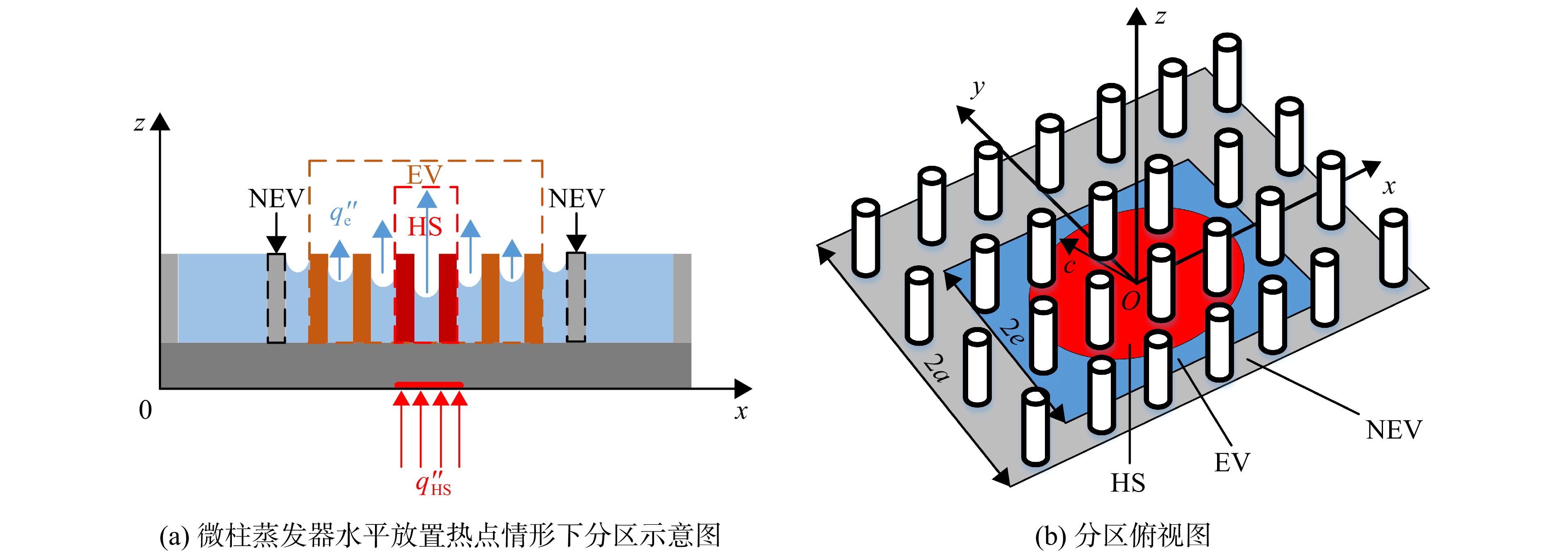
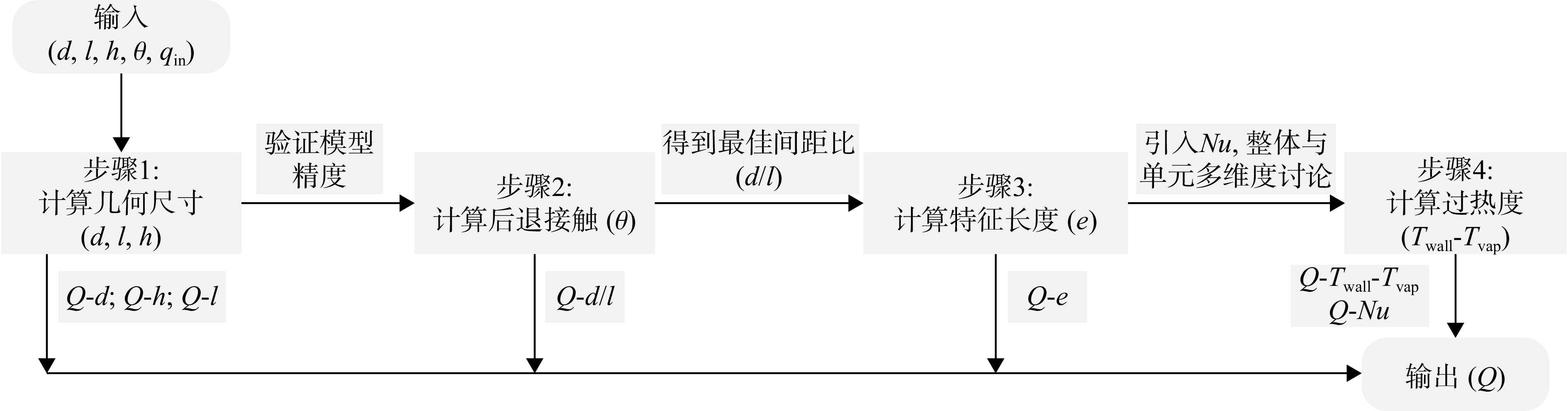
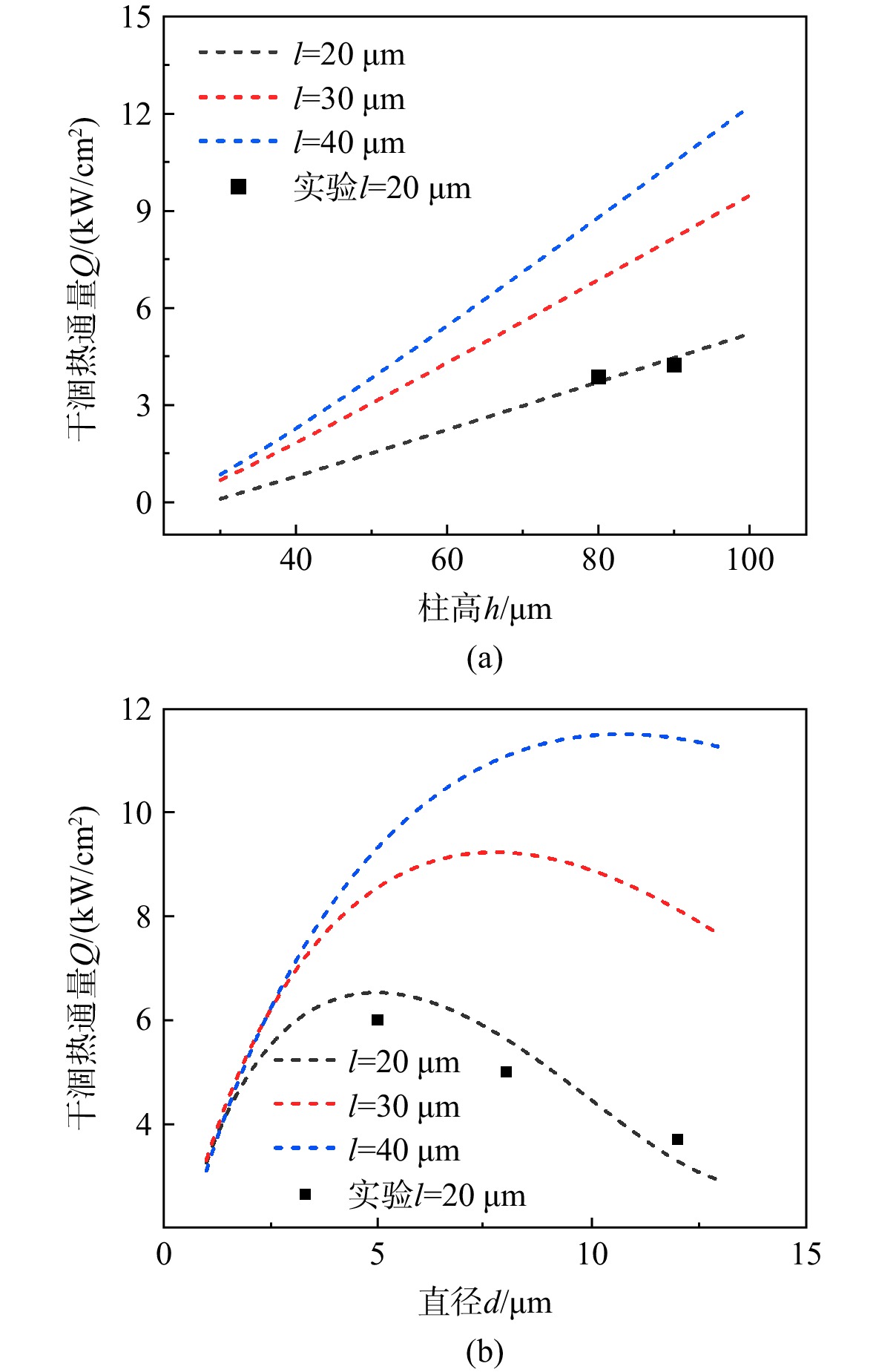
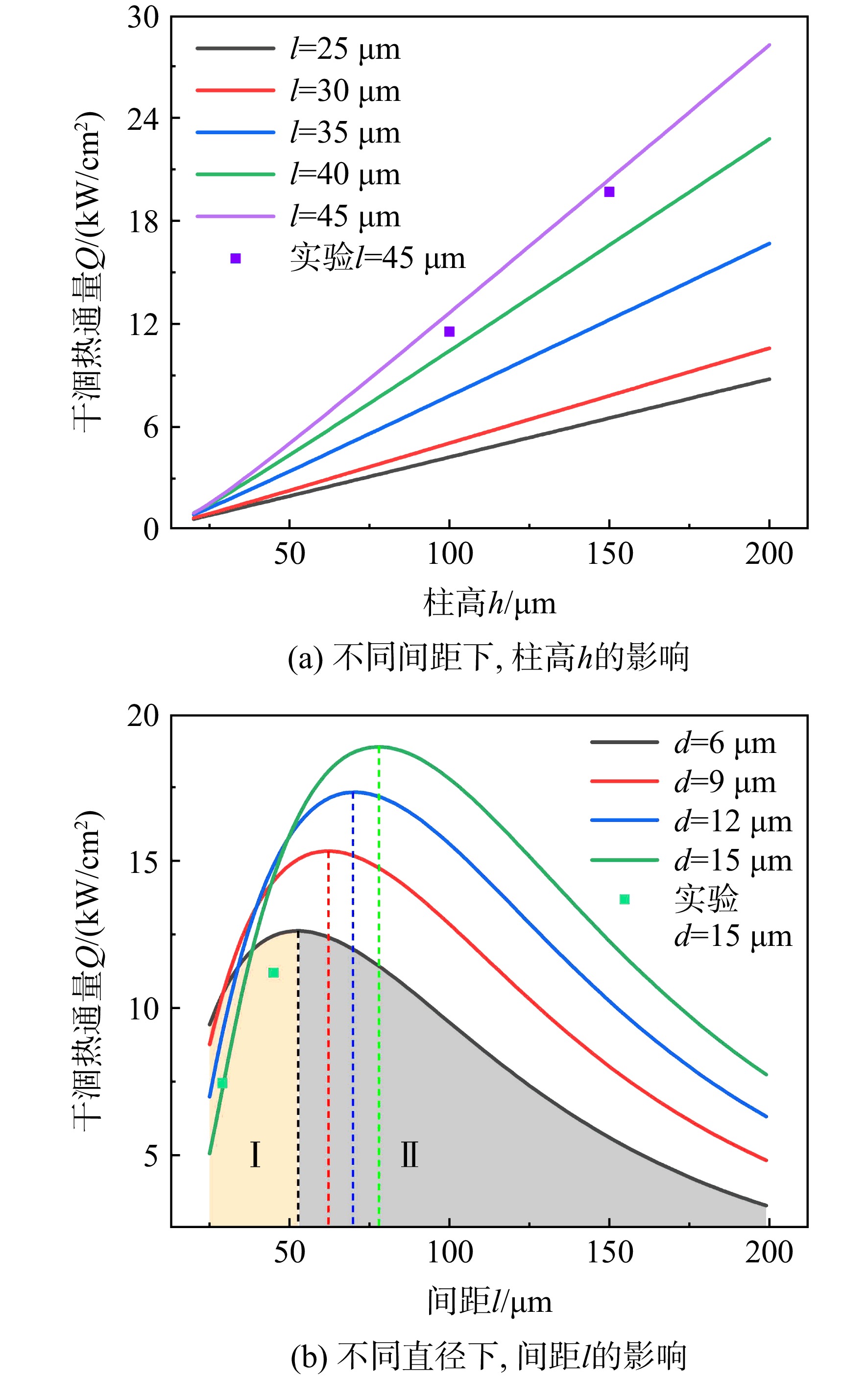
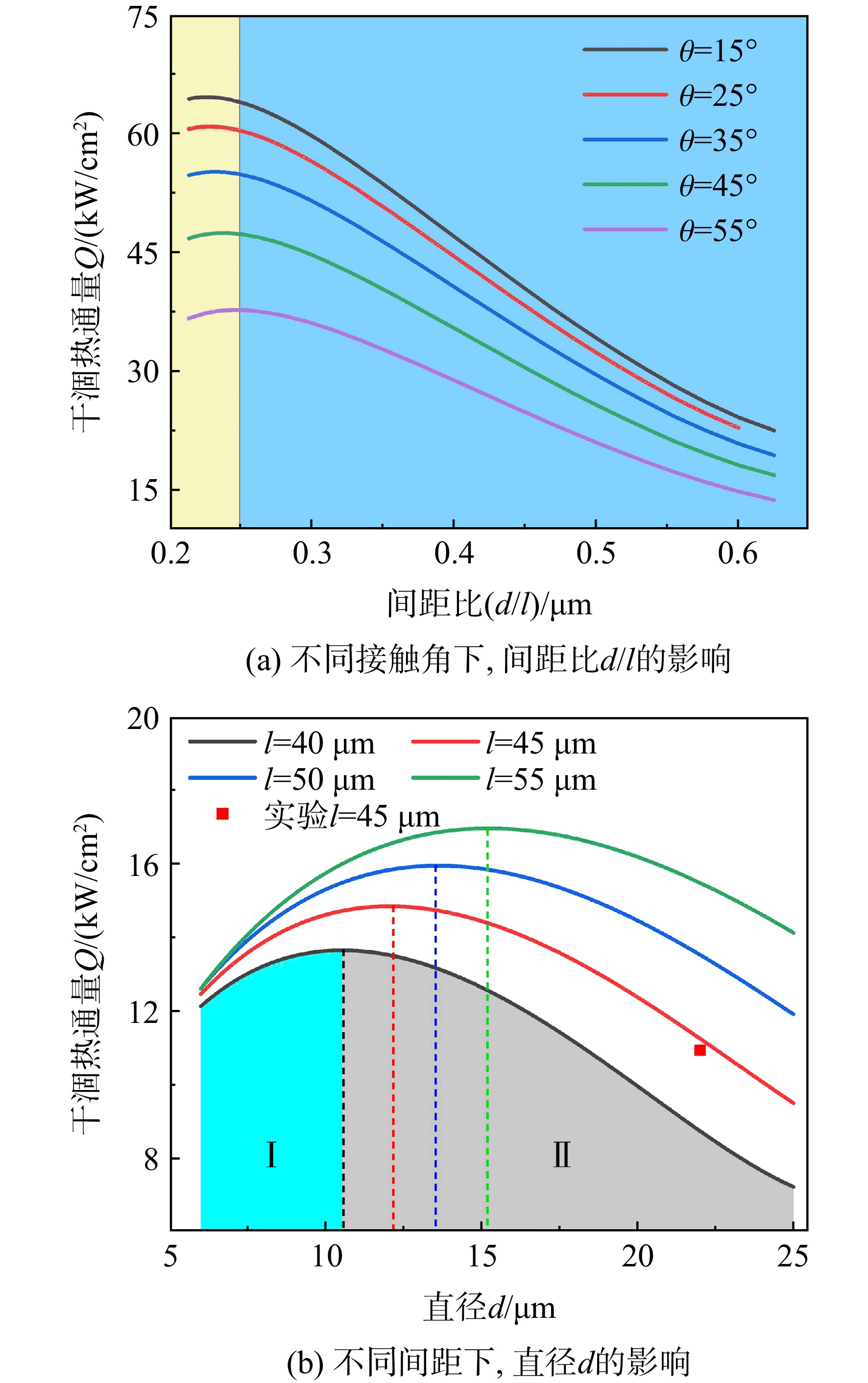
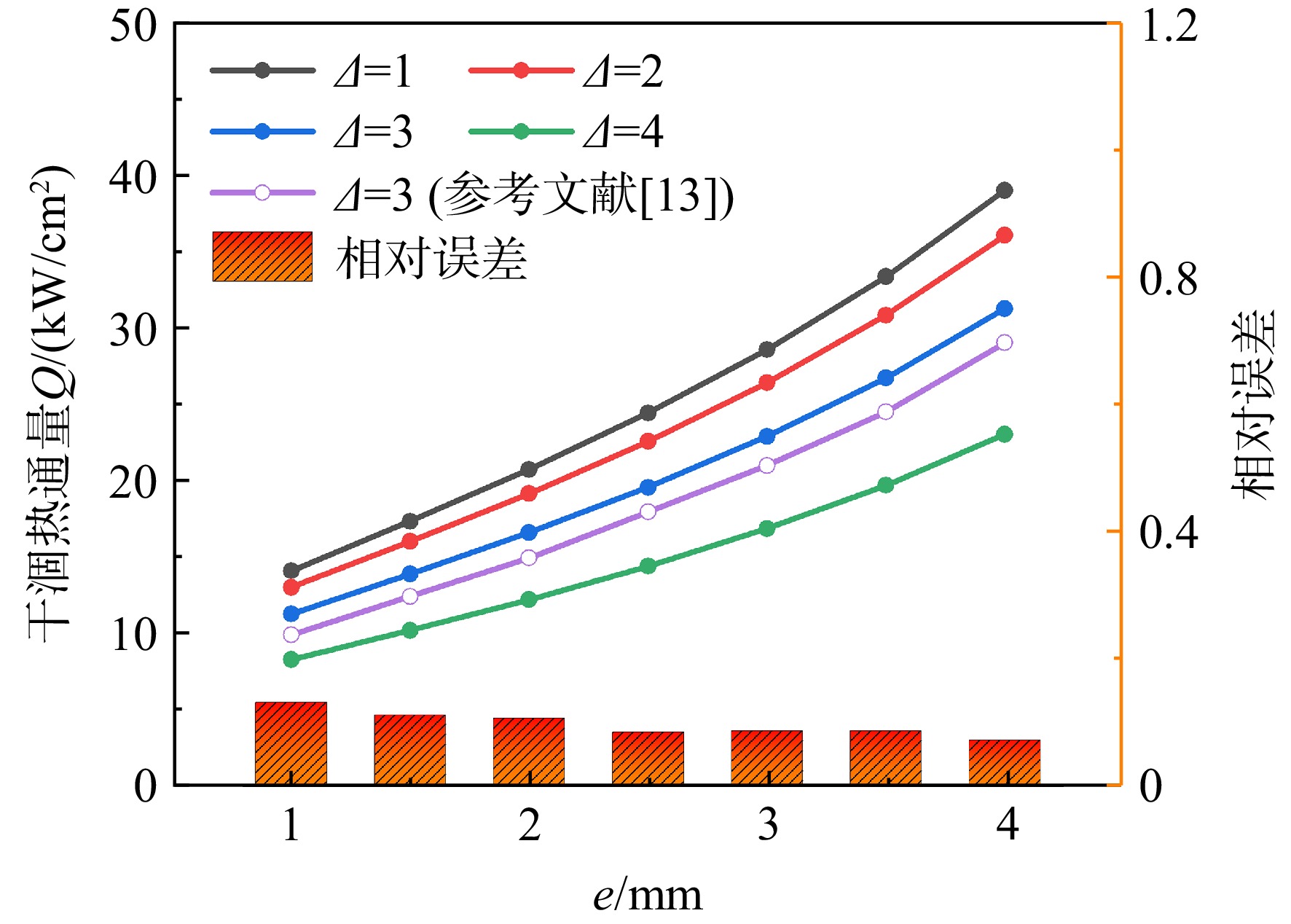
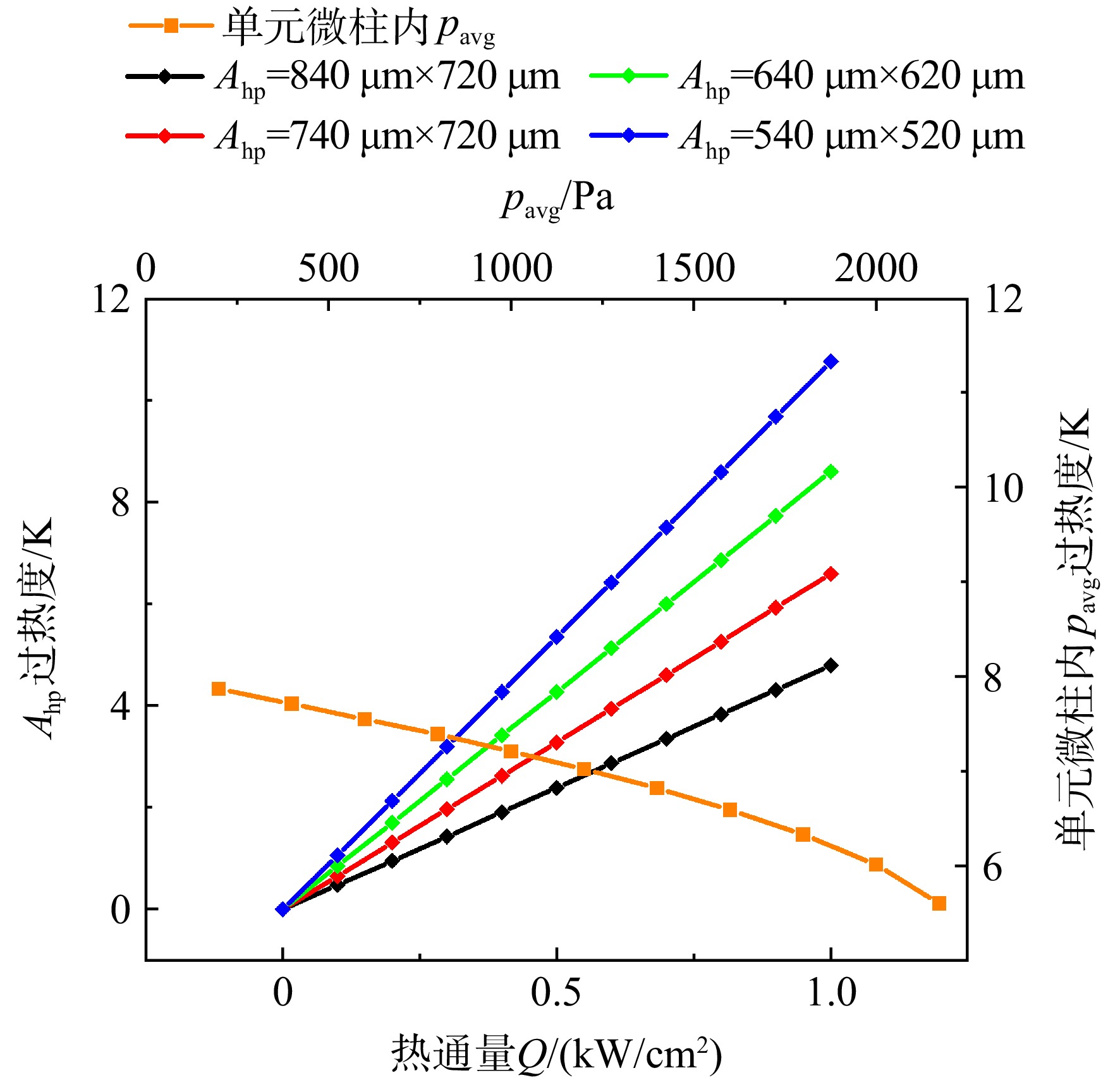
Based on existing dry-out heat flux model, the research model of dry-out heat flux of horizontal microcolumn evaporator with a relative error of about 7.6% was obtained by combining the capillary pressure and permeability calculation methods under the hot spot effects. The evaporator surface was divided into evaporative, non-evaporative and hot spot areas, and the effects of evaporator geometry, hot spot area and superheat on the heat flux to dryness were investigated. Calculated results showed that the maximum heat transfer capacity depended on the equilibrium relationship between capillary pressure and permeability; microcolumns with geometries close to the optimal pitch ratio (~0.25) and higher corresponded to better heat dissipation, and microcolumns with the smallest receding contact angle corresponded to an enhancement of the heat flux of desiccation by a factor of about two. The modelled superheat was negatively correlated with the hotspot area, with larger hotspot areas corresponding to smaller superheat, and larger local pressures corresponding to larger

| [1] |
HUANG Wei, GHOSH S, VELUSAMY S, et al. HotSpot: a compact thermal modeling methodology for early-stage VLSI design[J]. IEEE Transactions on Very Large Scale Integration (VLSI) Systems, 2006, 14(5): 501-513.
|
| [2] |
ADERA S, ANTAO D, RAJ R, et al. Hotspot thermal management via thin-film evaporation[C]//2016 15th IEEE Intersociety Conference on Thermal and Thermomechanical Phenomena in Electronic Systems. Las Vegas, US, IEEE, 2016: 364-371.
|
| [3] |
张暘, 赵剑锋, 韩崇巍, 等. 远地点发动机热防护模型[J]. 航空动力学报, 2021, 36(8): 1594-1604. ZHANG Yang, ZHAO Jianfeng, HAN Chongwei, et al. Thermal protection model of apogee engine[J]. Journal of Aerospace Power, 2021, 36(8): 1594-1604. (in Chinese
ZHANG Yang, ZHAO Jianfeng, HAN Chongwei, et al. Thermal protection model of apogee engine[J]. Journal of Aerospace Power, 2021, 36(8): 1594-1604. (in Chinese)
|
| [4] |
LOWE A, FU H, LEWE J, et al. Architecture analysis for regenerative energy management in an electromechanical actuation system design: AIAA 2011-7063[R].Virginia Beach,US:AIAA,2011.
|
| [5] |
牛文敬, 连文磊, 林灵矫, 等. 基于热管技术的飞机电作动机构散热特性[J]. 航空动力学报, 2020, 35(4): 711-721. NIU Wenjing, LIAN Wenlei, LIN Lingjiao, et al. Cooling performance of electric actuating mechanism on aircrafts based on heat pipes[J]. Journal of Aerospace Power, 2020, 35(4): 711-721. (in Chinese
NIU Wenjing, LIAN Wenlei, LIN Lingjiao, et al. Cooling performance of electric actuating mechanism on aircrafts based on heat pipes[J]. Journal of Aerospace Power, 2020, 35(4): 711-721. (in Chinese)
|
| [6] |
SHARMA C S, SCHLOTTIG G, BRUNSCHWILER T, et al. A novel method of energy efficient hotspot-targeted embedded liquid cooling for electronics: an experimental study[J]. International Journal of Heat and Mass Transfer, 2015, 88: 684-694. doi: 10.1016/j.ijheatmasstransfer.2015.04.047
|
| [7] |
DRUMMOND K P, WEIBEL J A, GARIMELLA S V, et al. Evaporative intrachip hotspot cooling with a hierarchical manifold microchannel heat sink array[C]//2016 15th IEEE Intersociety Conference on Thermal and Thermomechanical Phenomena in Electronic Systems. Las Vegas, US, IEEE, 2016: 307-315.
|
| [8] |
WANG Peng, BAR-COHEN A. On-chip hot spot cooling using silicon thermoelectric microcoolers[J]. Journal of Applied Physics, 2007, 102(3): 034503. doi: 10.1063/1.2761839
|
| [9] |
KIM T, PARK C, KIM M, et al. Highly nanotextured nickel-electroplated bismuth vanadate micropillars for hotspot removal via air- and spray-cooling[J]. International Journal of Heat and Mass Transfer, 2020, 156: 119731. doi: 10.1016/j.ijheatmasstransfer.2020.119731
|
| [10] |
HU Y, SARVEY T, BAKIR M, et al. Single phase liquid cooling of hotspots in a heterogeneous pin-fin-enhanced microgap with non-uniform fin array[C]//2017 16th IEEE intersociety conference on thermal and thermomechanical phenomena in electronic systems (ITherm). Orlando, US: IEEE, 2017: 500-504.
|
| [11] |
HAN Yong, LEE Y J, LAU B L, et al. Thermal management of hotspots using upstream laminar micro-jet impinging array[C]//2013 IEEE 15th Electronics Packaging Technology Conference. Singapore City, Singapore: IEEE, 2013: 83-87.
|
| [12] |
ADERA S, ANTAO D S, RAJ R, et al. Hotspot thermal management via thin-film evaporation: Part Ⅰ experimental characterization[J]. IEEE Transactions on Components, Packaging and Manufacturing Technology, 2018, 8(1): 88-98.
|
| [13] |
ADERA S, ANTAO D S, RAJ R, et al. Hotspot thermal management via thin-film evaporation: Part Ⅱ modeling[J]. IEEE Transactions on Components, Packaging and Manufacturing Technology, 2018, 8(1): 99-112.
|
| [14] |
高申宝, 焦凤, 何永清. 垂直微柱蒸发器干涸阈值模型求解及尺寸优化[J]. 航空动力学报, 2024, 39(9): 20220723. GAO Shenbao, JIAO Feng, HE Yongqing. Model solving and size optimization of dryout threshold for vertical micropillar evaporators[J]. Journal of Aerospace Power, 2024, 39(9): 20220723. (in Chinese
GAO Shenbao, JIAO Feng, HE Yongqing. Model solving and size optimization of dryout threshold for vertical micropillar evaporators[J]. Journal of Aerospace Power, 2024, 39(9): 20220723. (in Chinese)
|
| [15] |
YUAN Zihao, VAARTSTRA G, SHUKLA P, et al. Two-phase vapor chambers with micropillar evaporators: a new approach to remove heat from future high-performance chips[C]//2019 18th IEEE Intersociety Conference on Thermal and Thermomechanical Phenomena in Electronic Systems. Las Vegas, US. IEEE, 2019: 456-464.
|
| [16] |
ROJO G, DARABI J. Copper-carbon nanotube micropillars for passive thermal management of high heat flux electronic devices[C]//Heat Transfer Summer Conference. American Society of Mechanical Engineers, 2020, 83709: V001T12A009.
|
| [17] |
KARIYA H A, PETERS T B, CLEARY M, et al. Development and characterization of an air-cooled loop heat pipe with a wick in the condenser[J]. Journal of Thermal Science and Engineering Applications, 2014, 6(1): 011010. doi: 10.1115/1.4025049
|
| [18] |
WEIBEL J A, GARIMELLA S V, NORTH M T. Characterization of evaporation and boiling from sintered powder wicks fed by capillary action[J]. International Journal of Heat and Mass Transfer, 2010, 53(19/20): 4204-4215.
|
| [19] |
NAM Y, SHARRATT S, BYON C, et al. Fabrication and characterization of the capillary performance of superhydrophilic Cu micropost arrays[J]. Journal of Microelectromechanical Systems, 2010, 19(3): 581-588. doi: 10.1109/JMEMS.2010.2043922
|
| [20] |
ZHU Yangying, ANTAO D S, LU Zhengmao, et al. Prediction and characterization of dry-out heat flux in micropillar wick structures[J]. Langmuir, 2016, 32(7): 1920-1927. doi: 10.1021/acs.langmuir.5b04502
|
| [21] |
PUJAHARI A, DASGUPTA S, BHATTACHARYA A. Electro-osmosis aided thin-film evaporation from a micropillar wick structure[J]. Langmuir, 2022, 38(27): 8442-8455. doi: 10.1021/acs.langmuir.2c01048
|
| [22] |
JAYANTI S, VALETTE M. Calculation of dry out and post-dry out heat transfer in rod bundles using a three field model[J]. International Journal of Heat and Mass Transfer, 2005, 48(9): 1825-1839. doi: 10.1016/j.ijheatmasstransfer.2004.11.005
|
| [23] |
ANTAO D S, ADERA S, ZHU Yangying, et al. Dynamic evolution of the evaporating liquid-vapor interface in micropillar arrays[J]. Langmuir, 2016, 32(2): 519-526. doi: 10.1021/acs.langmuir.5b03916
|
| [24] |
RAVI S, HORNER D, MOGHADDAM S. Monoporous micropillar wick structures: Ⅰ mass transport characteristics[J]. Applied Thermal Engineering, 2014, 73(1): 1371-1377. doi: 10.1016/j.applthermaleng.2014.04.057
|
| [25] |
CHAN C W, SIQUEIROS E, Ling-CHIN J, et al. Heat utilisation technologies: a critical review of heat pipes[J]. Renewable and Sustainable Energy Reviews, 2015, 50: 615-627.
|
| [26] |
HORNER D, RAVI S, MOGHADDAM S. Monoporous micropillar wick structures: Ⅱ optimization & theoretical limits[J]. Applied Thermal Engineering, 2014, 73(1): 1378-1386. doi: 10.1016/j.applthermaleng.2014.04.055
|
| [27] |
SOMASUNDARAM S, ZHU Yangying, LU Zhengmao, et al. Thermal design optimization of evaporator micropillar wicks[J]. International Journal of Thermal Sciences, 2018, 134: 179-187. doi: 10.1016/j.ijthermalsci.2018.07.036
|
| [28] |
WEI Mengyao, HE Bin, LIANG Qian, et al. Optimization and thermal characterization of uniform silicon micropillar based evaporators[J]. International Journal of Heat and Mass Transfer, 2018, 127: 51-60. doi: 10.1016/j.ijheatmasstransfer.2018.06.128
|
| [29] |
HAO Xiaohong, PENG Bei, XIE Gongnan, et al. Efficient on-chip hotspot removal combined solution of thermoelectric cooler and mini-channel heat sink[J]. Applied Thermal Engineering, 2016, 100: 170-178. doi: 10.1016/j.applthermaleng.2016.01.131
|
| [30] |
AL-WAALY A A Y, PAUL M C, DOBSON P. Liquid cooling of non-uniform heat flux of a chip circuit by subchannels[J]. Applied Thermal Engineering, 2017, 115: 558-574. doi: 10.1016/j.applthermaleng.2016.12.061
|
| [31] |
SHARMA C S, TIWARI M K, ZIMMERMANN S, et al. Energy efficient hotspot-targeted embedded liquid cooling of electronics[J]. Applied Energy, 2015, 138: 414-422. doi: 10.1016/j.apenergy.2014.10.068
|
| [32] |
RYU J H, CHOI D H, KIM S J. Three-dimensional numerical optimization of a manifold microchannel heat sink[J]. International Journal of Heat and Mass Transfer, 2003, 46(9): 1553-1562. doi: 10.1016/S0017-9310(02)00443-X
|
| [33] |
ANSARI D, KIM K Y. Hotspot management using a hybrid heat sink with stepped pin-fins[J]. Numerical Heat Transfer, Part A: Applications, 2019, 75(6): 359-380. doi: 10.1080/10407782.2019.1599272
|
| [34] |
ANSARI D, KIM K Y. Hotspot thermal management using a microchannel-pinfin hybrid heat sink[J]. International Journal of Thermal Sciences, 2018, 134: 27-39. doi: 10.1016/j.ijthermalsci.2018.07.043
|
| [35] |
HE Ziqiang, YAN Yunfei, ZHANG Zhien. Thermal management and temperature uniformity enhancement of electronic devices by micro heat sinks: a review[J]. Energy, 2021, 216: 119223. doi: 10.1016/j.energy.2020.119223
|
| [36] |
CHENG Xin, YANG Guang, WU Jingyi. Recent advances in the optimization of evaporator wicks of vapor chambers: from mechanism to fabrication technologies[J]. Applied Thermal Engineering, 2021, 188: 116611. doi: 10.1016/j.applthermaleng.2021.116611
|







 DownLoad: