| Citation: | DUAN Zhengliang, GUI Tao, FANG Renlin, et al. Characteristics of fuel spray field in central staged combustor at idle condition[J]. Journal of Aerospace Power, 2023, 38(2):298-311 doi: 10.13224/j.cnki.jasp.20210199

|
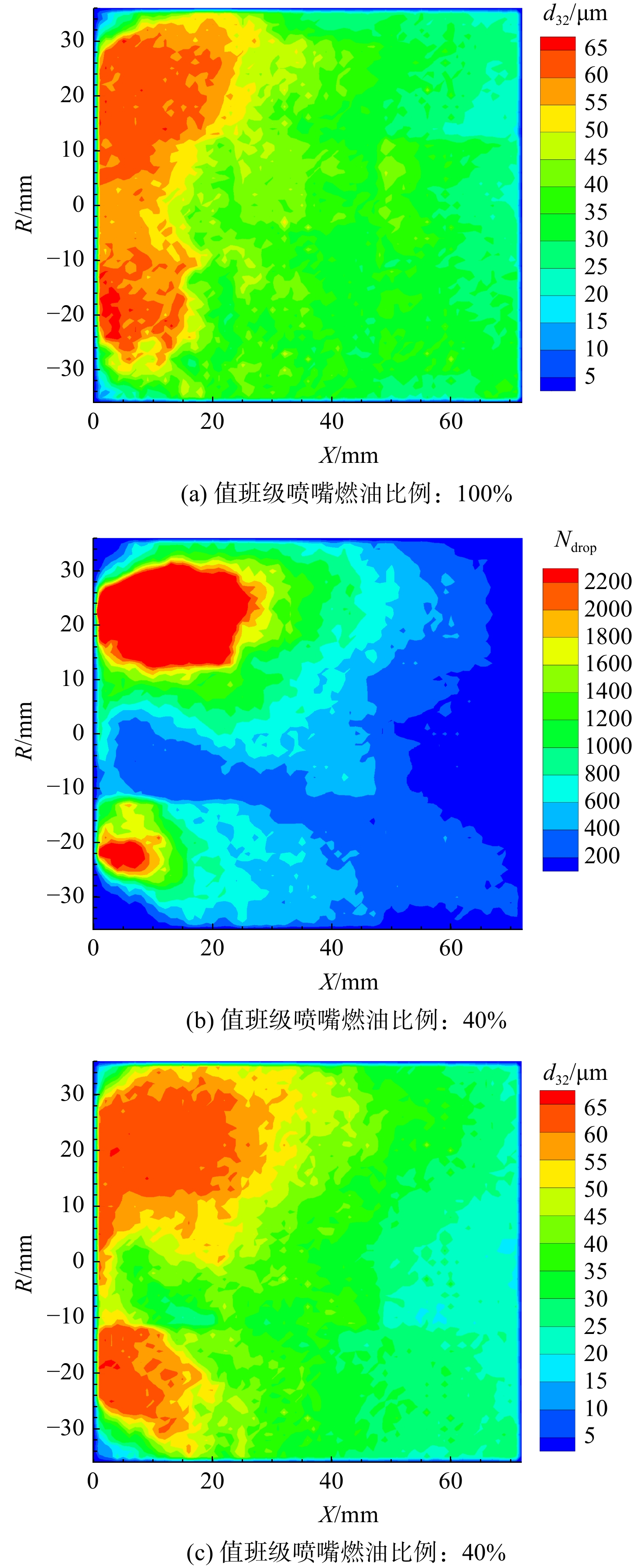
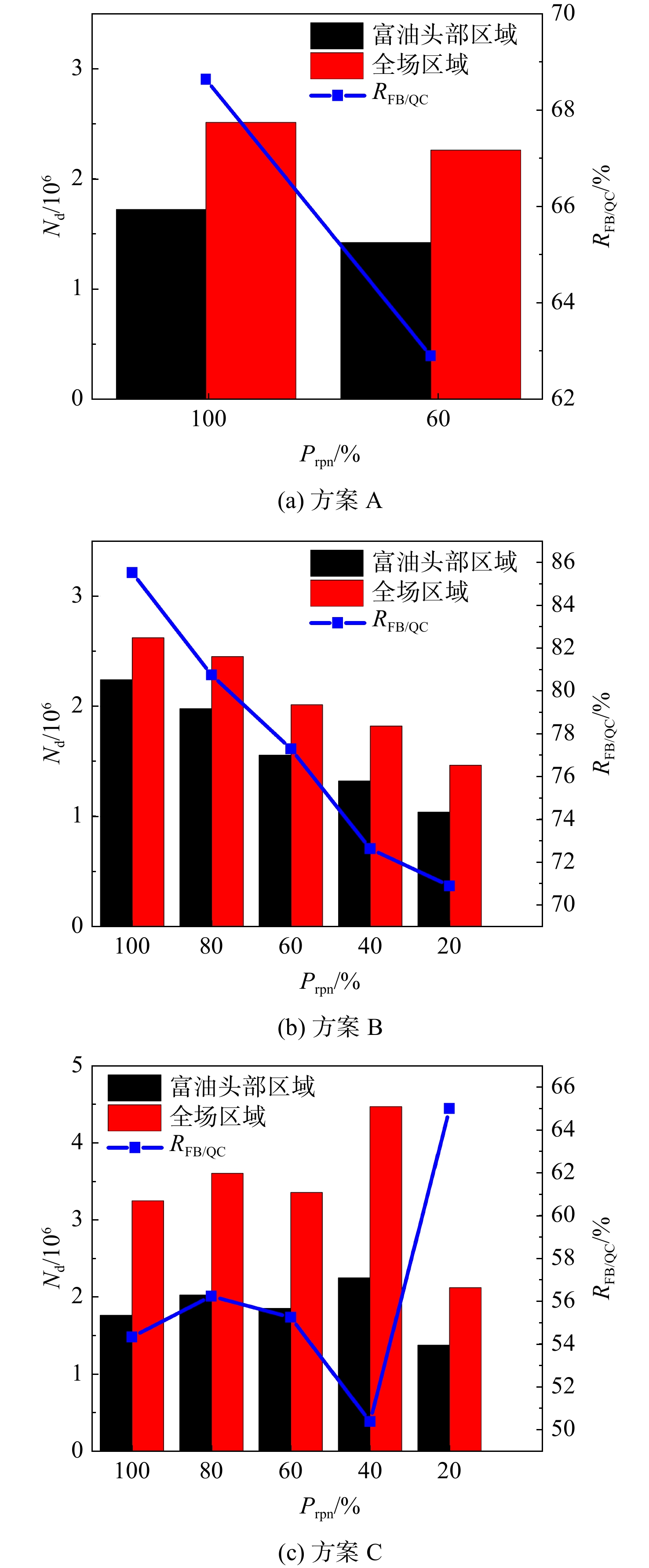
In order to obtain the characteristics of spray field of main stage nozzle and pilot nozzle of central staged combustor at idle condition, the particle image velocimetry (PIV) was used to measure the spray field of single-tube combustion chamber with different head schemes and different nozzle fuel ratios. And the post-processing software of spray field image was developed, the spatial distribution of the spray field was obtained by extracting oil droplets on raw pictures in the central graded combustion chamber. The research of spray field under idle condition indicated that: large-size droplets were distributed in a conical shape in the fuel-rich head area of the combustion chamber, while the Sauter mean diameter (SMD) was distributed in a V-shaped radial direction, namely, small in the middle and large on both sides. The reduction of the expansion angle of the baffle made the number of droplets concentrated in the fuel-rich head area of the combustion chamber and the average SMD was larger. When the incoming flow conditions and the fuel-air ratio were kept constant, changing the fuel ratio had little effect on the atomization effect. The particle size with the largest number of droplets in the spray field under idle conditions was 25 μm, and the particle size range with the largest volume ratio was 30−50 μm.

| [1] |
刘大响,金捷,彭友梅,等. 大型飞机发动机的发展现状和关键技术分析[J]. 航空动力学报,2008,23(6): 976-980.
LIU Daxiang,JIN Jie,PENG Youmei,et al. Summarization of development status and key technologies for large airplane engines[J]. Journal of Aerospace Power,2008,23(6): 976-980. (in Chinese)
|
| [2] |
BAHR W W, GLEASON C C. Experiment clean combustor program: phase 1 final report[R]. NACA-CR-134737, 1975.
|
| [3] |
金如山, 索建秦.先进燃气轮机燃烧室[M]. 北京: 航空工业出版社, 2016
|
| [4] |
刘富强,穆勇,刘存喜,等. 燃油分级对中心分级燃烧室NOx排放的影响[J]. 燃烧科学与技术,2013,19(3): 254-260.
LIU Fuqiang,MU Yong,LIU Cunxi,et al. Influence of fuel stage proportion on NOx emission from central stage combustor[J]. Journal of Combustion Science and Technology,2013,19(3): 254-260. (in Chinese)
|
| [5] |
张峥. 燃烧室燃油喷雾场特性研究[D]. 南京: 南京航空航天大学, 2009.
ZHANG Zheng. Experimental study on fuel spray characteristics in model combustor[D]. Nanjing: Nanjing University of Aeronautics and Astronautics, 2009. (in Chinese)
|
| [6] |
朱嘉伟. LPP低污染燃烧室头部方案研究[D]. 南京: 南京航空航天大学, 2013.
ZHU Jiawei. Research on the heads projects of LPP low emission combustor[D]. Nanjing: Nanjing University of Aeronautics and Astronautics, 2013. (in Chinese)
|
| [7] |
金仁瀚,刘勇,冯志鹏,等. 双旋流燃烧室单头部油雾特性实验[J]. 航空动力学报,2014,29(2): 250-258.
JIN Renhan,LIU Yong,FENG Zhipeng,et al. Experiment on spray characteristic of single head of dual-swirl cup combustor[J]. Journal of Aerospace Power,2014,29(2): 250-258. (in Chinese)
|
| [8] |
党龙飞,颜应文,徐榕,等. 双油路离心喷嘴油雾特性试验研究[J]. 南京航空航天大学学报,2013,45(4): 453-460. doi: 10.3969/j.issn.1005-2615.2013.04.003
DANG Longfei,YAN Yingwen,XU Rong,et al. Experimental Study on fuel spray characteristics of pressure-swirl atomizer[J]. Journal of Nanjing University of Aeronautics & Astrunautics,2013,45(4): 453-460. (in Chinese) doi: 10.3969/j.issn.1005-2615.2013.04.003
|
| [9] |
刘易安,郭志辉,张漫. 中心分级燃烧室雾化特性试验研究[J]. 推进技术,2019,40(8): 1824-1831. doi: 10.13675/j.cnki.tjjs.180490
LIU Yian,GUO Zhihui,ZHANG Man. Experimental investigation on spray characteristics of internally-staged combustor[J]. Journal of Propulsion Technology,2019,40(8): 1824-1831. (in Chinese) doi: 10.13675/j.cnki.tjjs.180490
|
| [10] |
王家俊,桂韬,邱伟,等. 燃油温度对离心喷嘴雾化特性影响的试验[J]. 航空动力学报,2020,35(8): 1634-1654.
WANG Jiajun,GUI Tao,QIU Wei,et al. Experiment on the influence of fuel temperature on the atomization characteristics of centrifugal nozzles[J]. Journal of Aerospace Power,2020,35(8): 1634-1654. (in Chinese)
|
| [11] |
傅江坤,周建华,郭志辉. 中心分级燃烧室预燃级的喷雾特性研究[J]. 推进技术,2020,41(6): 1305-1313. doi: 10.13675/j.cnki.tjjs.190372
FU Jiangkun,ZHOU Jianhua,GUO Zhihui. Experimental investigation on pilot spray characteristics of internally-staged combustorp[J]. Journal of Propulsion Technology,2020,41(6): 1305-1313. (in Chinese) doi: 10.13675/j.cnki.tjjs.190372
|
| [12] |
陈登炳. 中心分级燃烧室头部油雾场试验研究[D]. 南京: 南京航空航天大学, 2019
CHEN Dengbing. Experimental study on fuel spray field of the central-staged combsutor head[D]. Nanjing: Nanjing University of Aeronautics and Astronautics, 2019. (in Chinese)
|
| [13] |
CAI J, JENG S M, TACINA R. The structure of a swirl-stabilized reacting spray issued from an axial swirler[C]// 43rd AIAA Aerospace Sciences Meeting & Exhibit. Reston : AIAA, 2005: 14-24.
|
| [14] |
FELDEN A. Development of analytically reduced chemistries (ARC) and applications in large eddy simulations (LES) of turbulent combustion[D]. France: Institut National Polytechnique de Toulouse, 2017.
|
| [15] |
FAN Xiongjie,XU Gang,LIU Cunxi,et al. Experimental investigations of the flow field structure and interactions between sectors of a double-swirl low-emission combustor: effects of main stage swirl intensity and venturi angle[J]. Journal of Thermal Science,2020,29(1): 813-819.
|
| [16] |
YAN Yingwen,WANG Yajun,DENG Yuanhao,et al. Fuel spray characteristics investigation in LPP combustor[J]. Aircraft Engineering and Aerospace Technology,2016,88(4): 498-507. doi: 10.1108/AEAT-10-2014-0157
|
| [17] |
LUCAS E,MA P C,MAYHEW E,et al. Fuel effects on lean blow-out in a realistic gas turbine combustor[J]. Combustion and Flame,2017,181: 82-99. doi: 10.1016/j.combustflame.2017.02.035
|
| [18] |
WOOD E J, MCGANN B, MOTILY A, et al. Impact of fuel properties on combusting jet fuel spray breakup, analyzed using high-speed phase contrast imaging[R]. AIAA 2020-0522, 2020.
|
| [19] |
OPACICH K C, HEYNE J S, PEIFFER E, et al. Analyzing the relative impact of spray and volatile fuel properties on gas turbine combustor ignition in multiple rig geometries[R]. AIAA 2019-1434, 2019.
|
| [20] |
李继保,胡正义. 高温升高热容燃烧室设计技术分析[J]. 燃气涡轮试验与研究,2000,13(4): 5-8. doi: 10.3969/j.issn.1672-2620.2000.04.002
LI Jibao,HU Zhengyi. Design technology for high-temperature rise and high-heat capacity combustor[J]. Gas Turbine Experiment and Research,2000,13(4): 5-8. (in Chinese) doi: 10.3969/j.issn.1672-2620.2000.04.002
|
| [21] |
LEFEBVRE A H. Fuel effects on gas turbine combustion: ignition, stability, and combustion efficiency[J]. Journal of Engineering for Gas Turbine and Power,1984,107(24): 23-37.
|
| [22] |
《航空发动机设计手册》总编委会. 航空发动机设计手册: 第9册 主燃烧室设计[M]. 北京: 航空工业出版社, 2000: 189-190.
|






 DownLoad: