| Citation: | YANG Xiaojun, LIU Xiaohan, LIU Wenbo, et al. Numerical simulation and experimental validation for erosion wear of TC4 plates[J]. Journal of Aerospace Power, 2023, 38(9):2193-2203 doi: 10.13224/j.cnki.jasp.20210647

|
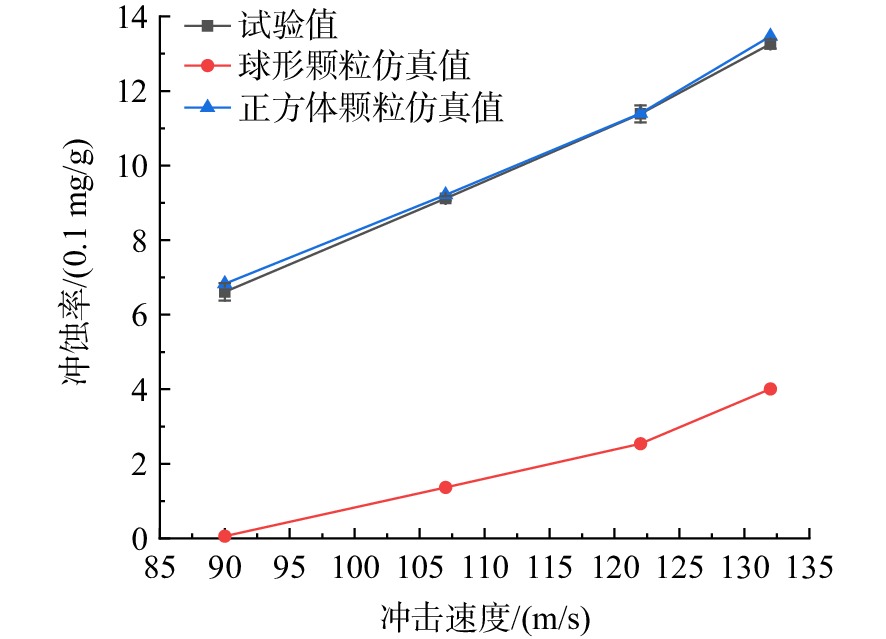
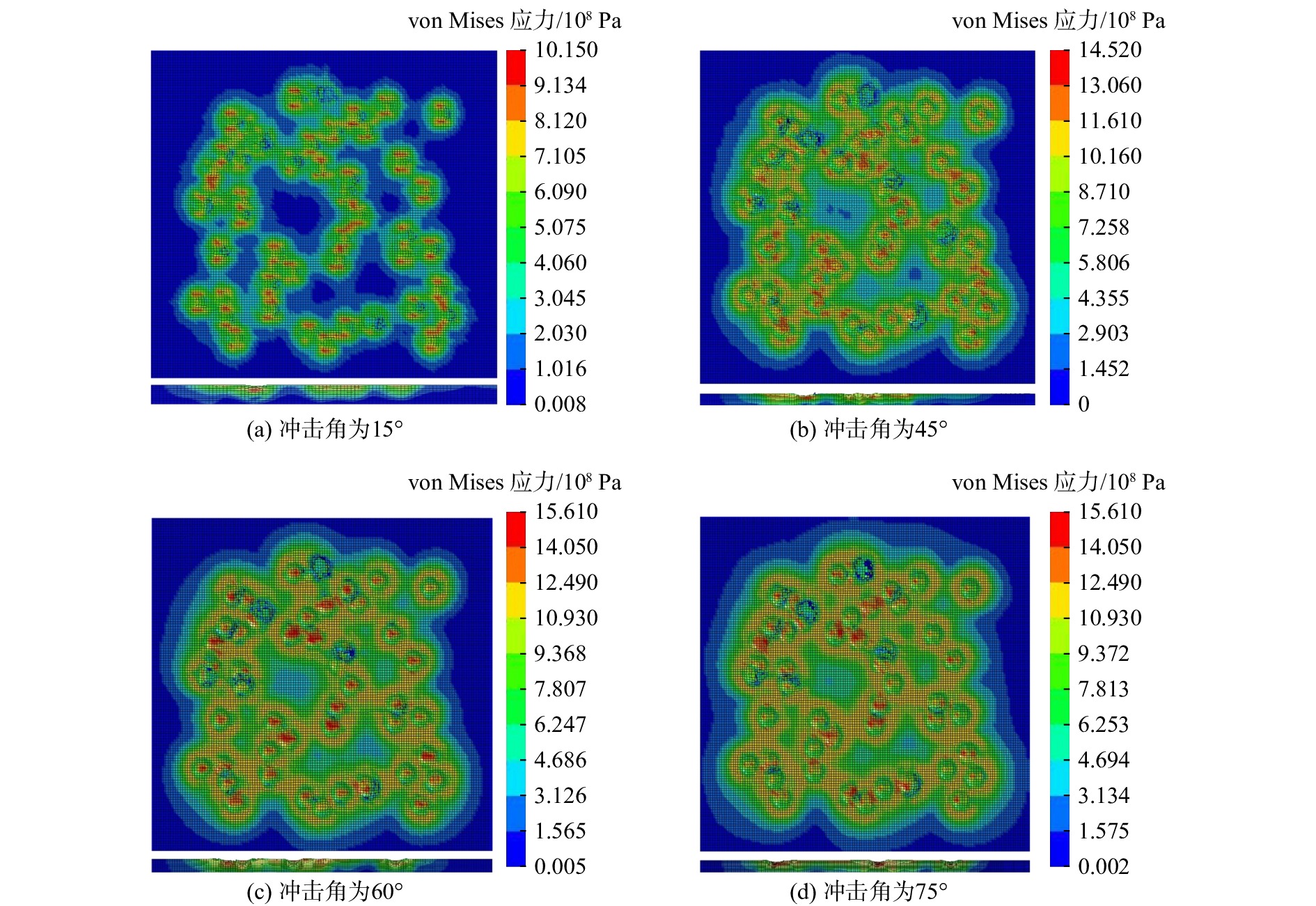
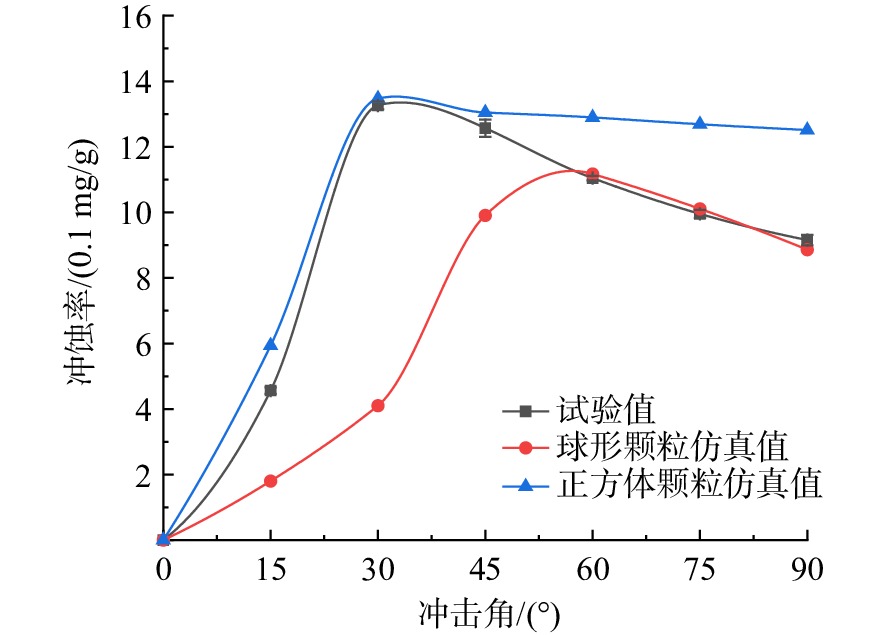
In order to accurately predict the erosion rate of TC4 material under different erosion mechanisms, a multi-particle random erosion model was established by finite element method, and the erosion mechanism and erosion rate of TC4 plate under the erosion of Al2O3 particles with different particle shapes, impact angles and impact velocities were studied. Compared with the erosion rate obtained by erosion test under the same conditions, the rationality and authenticity of the numerical simulation model were verified. Results showed that cubic particles should be used in the simulation of low-angle erosion at 30 degrees, and the relative movement between edges and materials was more in line with the cutting process. Spherical particles should be used in the simulation of 90 degrees high-angle erosion, which can reflect the shearing and squeezing effects on the contact surface of pits during erosion. Under the same conditions, the greater the impact velocity of particles was, the faster the erosion rate increased, the faster the erosion rate increased at 30 degrees, and the more gentle the erosion rate increased at 90 degrees.

| [1] |
HAMED A,TABAKOFF W C,WENGLARZ R V. Erosion and deposition in turbomachinery[J]. Journal of Propulsion and Power,2006,22(2): 350-360. doi: 10.2514/1.18462
|
| [2] |
FINNIE I,MCFADDEN D H. On the velocity dependence of the erosion of ductile metals by solid particles at low angles of incidence[J]. Wear,1978,48(1): 181-190. doi: 10.1016/0043-1648(78)90147-3
|
| [3] |
BITTER J G A. A study of erosion phenomena: Part Ⅰ[J]. Wear,1963,6(1): 5-21. doi: 10.1016/0043-1648(63)90003-6
|
| [4] |
BITTER J G A. A study of erosion phenomena: Part Ⅱ[J]. Wear,1963,6(1): 169-190. doi: 10.1016/0043-1648(63)90073-5
|
| [5] |
ELTOBGY M S,NG E,ELBESTAWI M A. Finite element modeling of erosive wear[J]. International Journal of Machine Tools and Manufacture,2005,45(11): 1337-1346. doi: 10.1016/j.ijmachtools.2005.01.007
|
| [6] |
WANG Yufei,YANG Zhenguo. Finite element model of erosive wear on ductile and brittle materials[J]. Wear,2008,265(5/6): 871-878. doi: 10.1016/j.wear.2008.01.014
|
| [7] |
AZIMIAN M,SCHMITT P,BART H J. Numerical investigation of single and multi-impacts of angular particles on ductile surfaces[J]. Wear,2015,342/343: 252-261. doi: 10.1016/j.wear.2015.08.022
|
| [8] |
马松林,赵振华,颜诚,等. 不同形状砂尘高速冲蚀TC4平板的数值仿真[J]. 航空动力学报,2019,34(2): 321-330. doi: 10.13224/j.cnki.jasp.2019.02.008
MA Songlin,ZHAO Zhenhua,YAN Cheng,et al. Numerical simulation of TC4 plates with high speed erosion of sand dust with different shapes[J]. Journal of Aerospace Power,2019,34(2): 321-330. (in Chinese) doi: 10.13224/j.cnki.jasp.2019.02.008
|
| [9] |
杜明超,李增亮,董祥伟,等. 菱形颗粒冲击材料表面冲蚀磨损特性分析[J]. 摩擦学学报,2020,40(1): 1-11. doi: 10.16078/j.tribology.2019066
DU Mingchao,LI Zengliang,DONG Xiangwei,et al. Analysis of material surface erosion characteristics due to rhomboid-shaped particle impact[J]. Tribology,2020,40(1): 1-11. (in Chinese) doi: 10.16078/j.tribology.2019066
|
| [10] |
王光存. 离心压缩机叶轮冲蚀磨损机理和规律的研究[D]. 济南: 山东大学, 2015.
WANG Guangcun. Study on erosion wear mechanism and law of impeller in centrifugal compressor[D]. Jinan: Shandong University, 2015. (in Chinese)
|
| [11] |
JOHNSON G R,COOK W H. A constitutive model and data for materials subjected to large strains, high strain rates, and high temperatures[J]. Engineering Fracture Mechanics,1983,21: 541-548.
|
| [12] |
GREGORY K. Failure modeling of titanium 6Al-4V and aluminum 2024-T3 with the Johnson-cook material model[R]. Washington DC: Department of Transportation Federal Aviation Administration, 2003.
|
| [13] |
ZHANG Yancheng,OUTEIRO J C,MABROUKI T. On the selection of Johnson-Cook constitutive model parameters for Ti-6Al-4 V using three types of numerical models of orthogonal cutting[J]. Procedia CIRP,2015,31: 112-117. doi: 10.1016/j.procir.2015.03.052
|
| [14] |
唐长刚. LS-DYNA有限元分析及仿真[M]. 北京: 电子工业出版社, 2014.
|
| [15] |
WOYTOWITZ P J,RICHMAN R H. Modeling of damage from multiple impacts by spherical particles[J]. Wear,1999,233/234/235: 120-133.
|
| [16] |
YERRAMAREDDY S,BAHADUR S. Effect of operational variables, microstructure and mechanical properties on the erosion of Ti-6Al-4V[J]. Wear,1991,142(2): 253-263. doi: 10.1016/0043-1648(91)90168-T
|
| [17] |
PEPI M,SQUILLACIOTI R,PFLEDDERER L,et al. Solid particle erosion testing of helicopter rotor blade materials[J]. Journal of Failure Analysis and Prevention,2012,12(1): 96-108. doi: 10.1007/s11668-011-9531-3
|
| [18] |
EVSTIFEEV A,KAZARINOV N,PETROV Y,et al. Experimental and theoretical analysis of solid particle erosion of a steel compressor blade based on incubation time concept[J]. Engineering Failure Analysis,2018,87: 15-21. doi: 10.1016/j.engfailanal.2018.01.006
|
| [19] |
董刚. 材料冲蚀行为及机理研究[D]. 杭州: 浙江工业大学, 2004.
DONG Gang. Study on the erosion wear behaviors and mechanisms of several materials[D]. Hangzhou: Zhejiang University of Technology, 2004. (in Chinese)
|
| [20] |
American Society of Testing Materials (ASTM). Standard test method for conducting erosion tests by solid particle impingement using gas jets: ASTM G76-13 [S]. West Conshohocken: ASTM, 2013: 1-6.
|






 DownLoad: