| Citation: | LI Xiang, CHI Zhidong, WANG Shimin, et al. Influence of riblet structure on loss and stall of cascade at low Reynolds numbers[J]. Journal of Aerospace Power, 2025, 40(9):20240373 doi: 10.13224/j.cnki.jasp.20240373

|
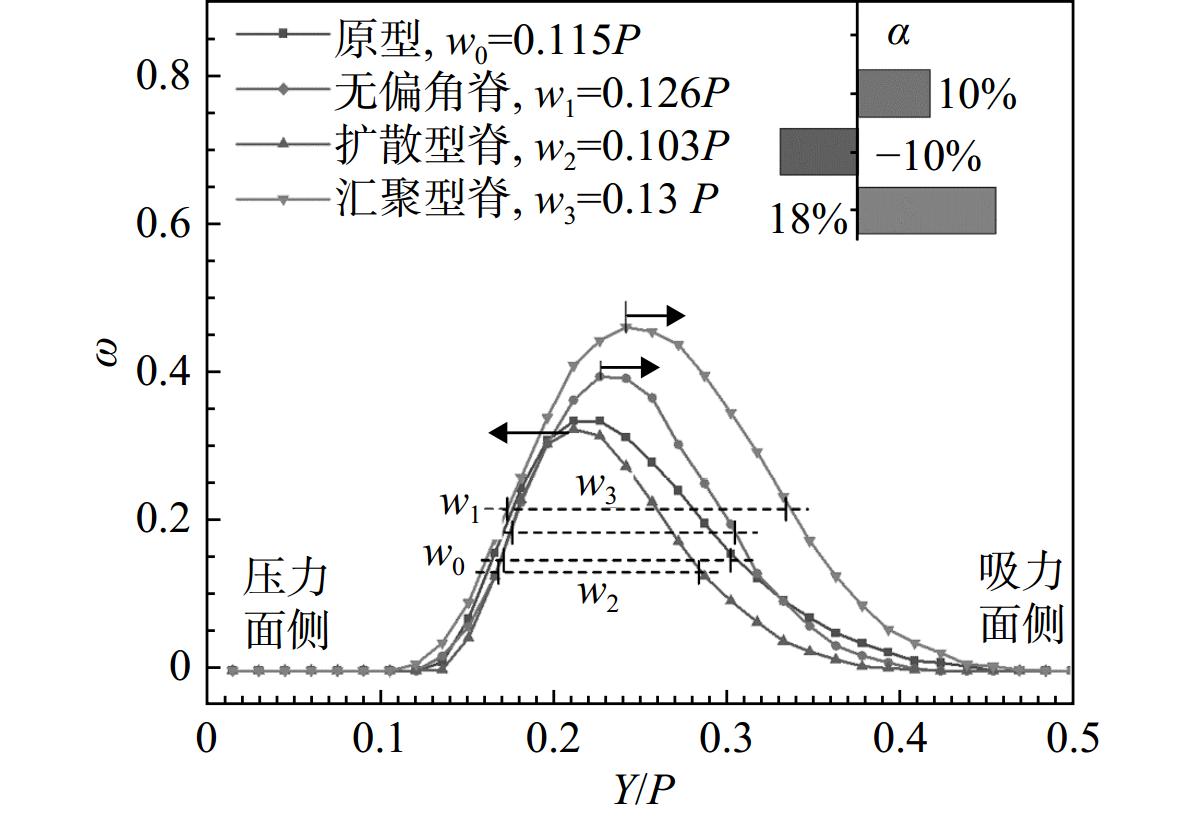
To broaden the effective attack angle range of the blade cascade under the influence of low Reynolds number and achieve the purpose of blade cascade expansion and loss reduction, numerical and experimental researches on a small deflection angle diffuser blade cascade were conducted. Three riblet-structures with different angles were selected to control it by studying the main characteristics of turbulence after blade stall. The research results indicated that diffusion type surface ridges are an effective means to expand the effective attack angle of the blade cascade and reduce losses. Its characteristic was represented by expanding the positive stall boundary without sacrificing the loss of the design angle of attack, with a maximum reduction of 17.7%. No-angle riblets achieved reduction at a high angle of attack, with a maximum reduction rate of 19.58%. Overall, the reduction effect of diffusion type riblets was better than that of non-angle riblets and better than that of convergence type riblets. In addition, it was found that the width and peak loss of the wake decreased after reduction, and the diffusion line of the wake shifted towards the pressure surface side.

| [1] |
吴介之, 马晖扬, 周明德. 涡动力学引论[M]. 北京: 高等教育出版社, 1993. WU Jiezhi, MA Huiyang, ZHOU Mingde. Introduction to vorticity and vortex dynamics[M]. Beijing: Higher Education Press, 1993. (in Chinese
WU Jiezhi, MA Huiyang, ZHOU Mingde. Introduction to vorticity and vortex dynamics[M]. Beijing: Higher Education Press, 1993. (in Chinese)
|
| [2] |
KIM J. Physics and control of wall turbulence for drag reduction[J]. Philosophical Transactions of the Royal Society A: Mathematical, Physical and Engineering Sciences, 2011, 369(1940): 1396-1411. doi: 10.1098/rsta.2010.0360
|
| [3] |
MARTIN S, BHUSHAN B. Fluid flow analysis of a shark-inspired microstructure[J]. Journal of Fluid Mechanics, 2014, 756: 5-29.
|
| [4] |
GARCÍA-MAYORAL R, JIMÉNEZ J. Hydrodynamic stability and breakdown of the viscous regime over riblets[J]. Journal of Fluid Mechanics, 2011, 678: 317-347. doi: 10.1017/jfm.2011.114
|
| [5] |
KEVIN K, MONTY J P, BAI H L, et al. Cross-stream stereoscopic particle image velocimetry of a modified turbulent boundary layer over directional surfacepattern[J]. Journal of Fluid Mechanics, 2017, 813: 412-435. doi: 10.1017/jfm.2016.879
|
| [6] |
BECHERT D, BRUSE M, HAGE W, et al. Biological surfaces and their technological application-Laboratory and flight experiments on drag reduction and separation control[R]: Reston, US: AIAA, 1997.
|
| [7] |
WU Y, CHRISTENSEN K T. Population trends of spanwise vortices in wall turbulence[J]. Journal of Fluid Mechanics, 2006, 568: 55-76.
|
| [8] |
LI Weipeng, LIU Hong. Two-point statistics of coherent structures in turbulent flow over riblet-mounted surfaces[J]. Acta Mechanica Sinica, 2019, 35(3): 457-471. doi: 10.1007/s10409-018-0828-2
|
| [9] |
WU Di, WANG Jinjun, CUI Guangyao, et al. Effects of surface shapes on properties of turbulent/non-turbulent interface in turbulent boundary layers[J]. Science China Technological Sciences, 2020, 63(2): 214-222. doi: 10.1007/s11431-018-9434-5
|
| [10] |
KOELTZSCH K, DINKELACKER A, GRUNDMANN R. Flow over convergent and divergent wall riblets[J]. Experiments in Fluids, 2002, 33(2): 346-350. doi: 10.1007/s00348-002-0446-3
|
| [11] |
CHEN Huawei, RAO Fugang, SHANG Xiaopeng, et al. Flow over bio-inspired 3D herringbone wall riblets[J]. Experiments in Fluids, 2014, 55(3): 1698. doi: 10.1007/s00348-014-1698-4
|
| [12] |
LI Xiang, ZHENG Qun, LI Hefei, et al. Numerical study of transition process in different zones of a compressor cascade channel[J]. International Journal of Turbo & Jet-Engines, 2024, 40(Suppl.1): s657-s669.
|
| [13] |
LI Xiang, ZHENG Qun, CHI Zhidong, et al. Research on the influence of spanwise cross-flow on the boundary layer transition of compressor cascade[J]. Physics of Fluids, 2024, 36(1): 014127. doi: 10.1063/5.0176640
|
| [14] |
潘文全. 工程流体力学[M]. 北京: 清华大学出版社, 1988. PAN Wenquan. Engineering fluid mechanics[M]. Beijing: Tsinghua University Press, 1988. (in Chinese
PAN Wenquan. Engineering fluid mechanics[M]. Beijing: Tsinghua University Press, 1988. (in Chinese)
|
| [15] |
许春晓. 壁湍流相干结构和减阻控制机理[J]. 力学进展, 2015, 45(1): 111-140. XU Chunxiao. Coherent structures and drag-reduction mechanism in wall turbulence[J]. Advances in Mechanics, 2015, 45(1): 111-140. (in Chinese doi: 10.6052/1000-0992-15-006
XU Chunxiao. Coherent structures and drag-reduction mechanism in wall turbulence[J]. Advances in Mechanics, 2015, 45(1): 111-140. (in Chinese) doi: 10.6052/1000-0992-15-006
|
| [16] |
LEE S J, LEE S H. Flow field analysis of a turbulent boundary layer over a riblet surface[J]. Experiments in Fluids, 2001, 30(2): 153-166. doi: 10.1007/s003480000150
|
| [17] |
XU Fang, ZHONG Shan, ZHANG Shanying. Experimental study on secondary flow in turbulent boundary layer over spanwise heterogeneous microgrooves[J]. Physics of Fluids, 2020, 32(3): 035109. doi: 10.1063/1.5142727
|
| [18] |
WANG Xinwei, FAN Ziye, TANG Zhanqi, et al. Drag reduction and hairpin packets of the turbulent boundary layer over the superhydrophobic-riblets surface[J]. Journal of Hydrodynamics, 2021, 33(3): 621-635. doi: 10.1007/s42241-021-0057-1
|
| [19] |
LIU Qiang, ZHONG Shan, LI Lin. Effects of bio-inspired micro-scale surface patterns on the profile losses in a linear cascade[J]. Journal of Turbomachinery, 2019, 141(12): 121006. doi: 10.1115/1.4044612
|
| [20] |
崔光耀, 潘翀, 高琪, 等. 沟槽方向对湍流边界层流动结构影响的实验研究[J]. 力学学报, 2017, 49(6): 1201-1212. CUI Guangyao, PAN Chong, GAO Qi, et al. Flow structure in the turbulent boundary layer over directional riblets surfaces[J]. Chinese Journal of Theoretical and Applied Mechanics, 2017, 49(6): 1201-1212. (in Chinese doi: 10.6052/0459-1879-17-252
CUI Guangyao, PAN Chong, GAO Qi, et al. Flow structure in the turbulent boundary layer over directional riblets surfaces[J]. Chinese Journal of Theoretical and Applied Mechanics, 2017, 49(6): 1201-1212. (in Chinese) doi: 10.6052/0459-1879-17-252
|







 DownLoad: