






Study on drag reduction of bottom cavity with side hole
-
摘要:
为了研究高速来流下底部凹腔加侧开孔的减阻效果,采用数值计算对带有底部凹腔及侧开孔的旋成体进行了模拟。研究了侧开孔的孔径、孔倾斜角、开孔位置、开孔数量几个因素对减阻效果的影响规律。结果表明:孔径的影响规律非线性且存在最优解,随孔径增大,减阻效果先增强后减弱。孔倾斜角越小,减阻效果越差。开孔位置离凹腔底部越近,越有利于流动再附于底部,减阻效果越好。周向位置对减阻效果影响较小。开孔数量越多,本质上相当于总的开孔面积增大,减阻效果越差。由于进入开孔的流动仍为超声速,即使被小孔改变了流动方向,也仍然没有得到充分减速。在来流马赫数为6的情况下,底部凹腔加侧开孔的减阻效果存在一定的局限性。
Abstract:In order to study the drag reduction effect of bottom cavity with side hole under high speed free stream, numerical simulation was carried out for the spin-formed body with bottom cavity and side hole. The effects of hole diameter, hole inclination angle, hole position and hole number on drag reduction are studied. The results show that the effect of hole diameter is nonlinear and there is an optimal solution. With the increase of hole diameter, and drag reduction increases first and then decreases. The smaller the hole inclination angle, the worse the drag reduction effect. The closer the hole is to the bottom of the cavity, the more favorable it is for the flow to adhere to the bottom, and the better the drag reduction effect. The circumferential position of the hole has little effect on the drag reduction effect. The larger the number of holes is, the larger the total hole area is, and the worse the drag reduction effect is. Since the flow into the hole is still supersonic, even if the flow direction is changed by the hole, it is still not sufficiently decelerated. Under the free stream of Mach number 6, the drag reduction effect of bottom cavity with side hole has certain limitations.
-
Key words:
- drag reduction /
- high speed /
- bottom /
- cavity /
- side hole
-
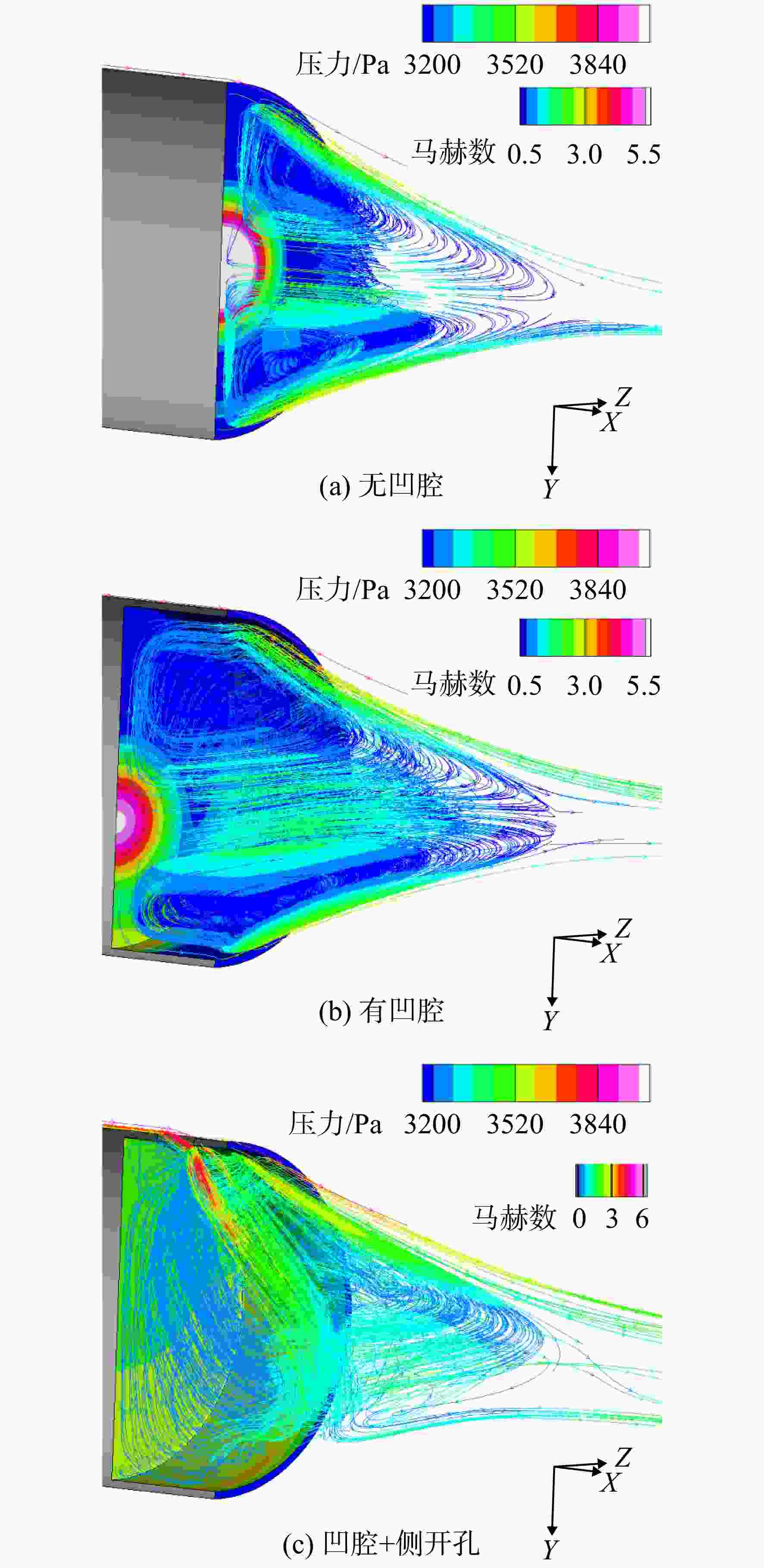
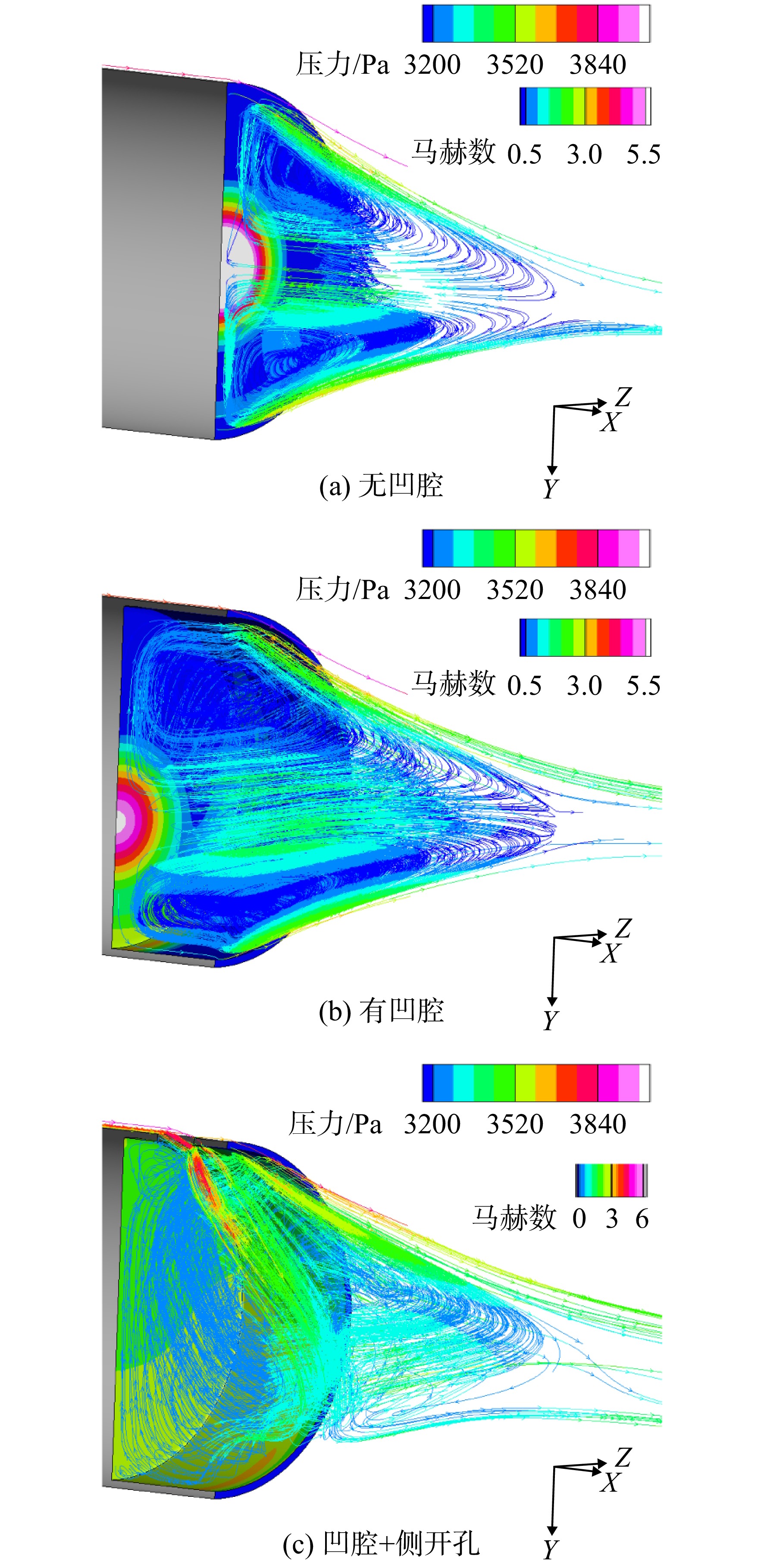
图 7 无凹腔与有凹腔不加侧开孔、有凹腔加侧开孔的三维流线及表面压力分布
Figure 7. Three dimensional flow line and surface pressure of non bottom cavity and bottom cavity without side hole and bottom cavity with side hole
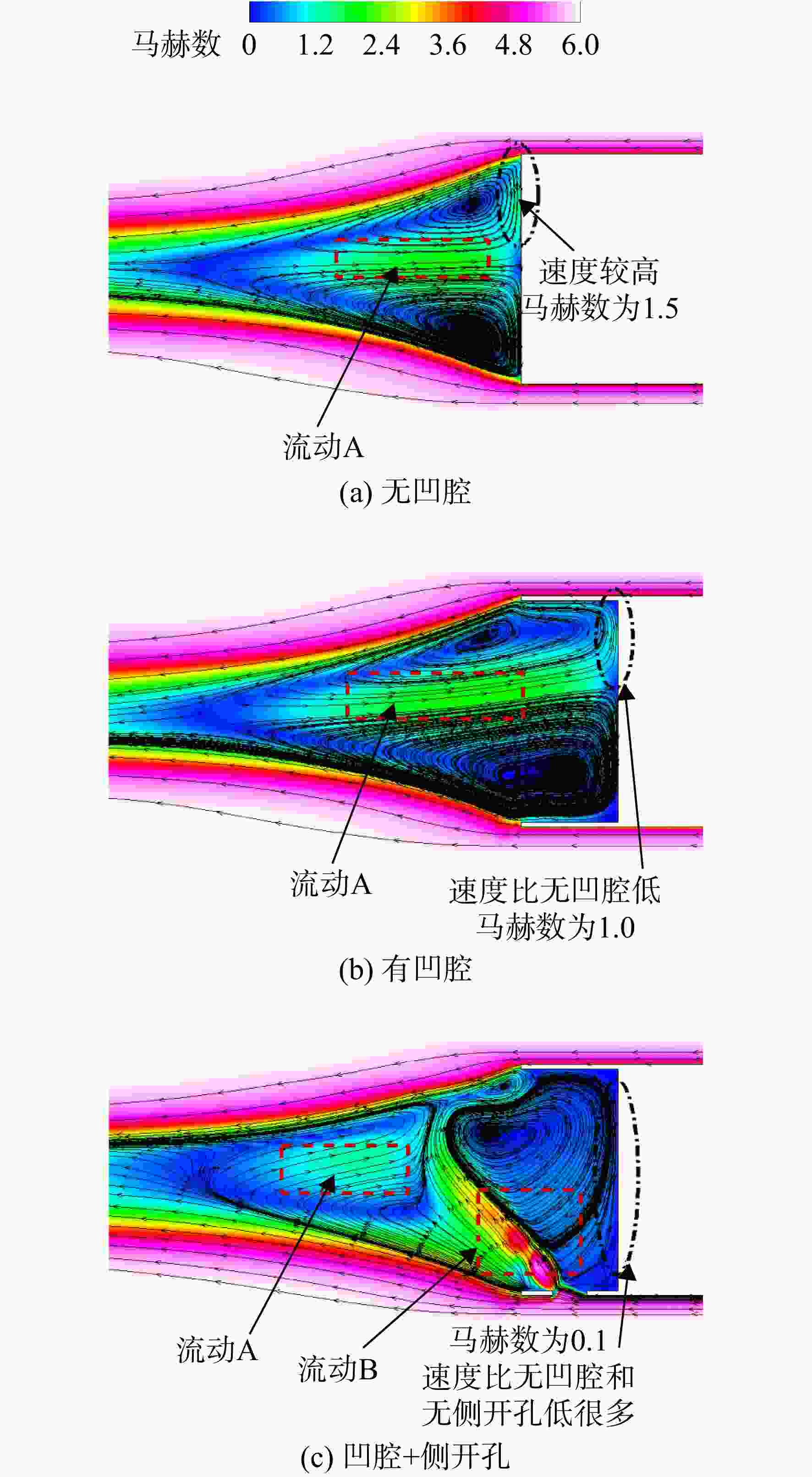
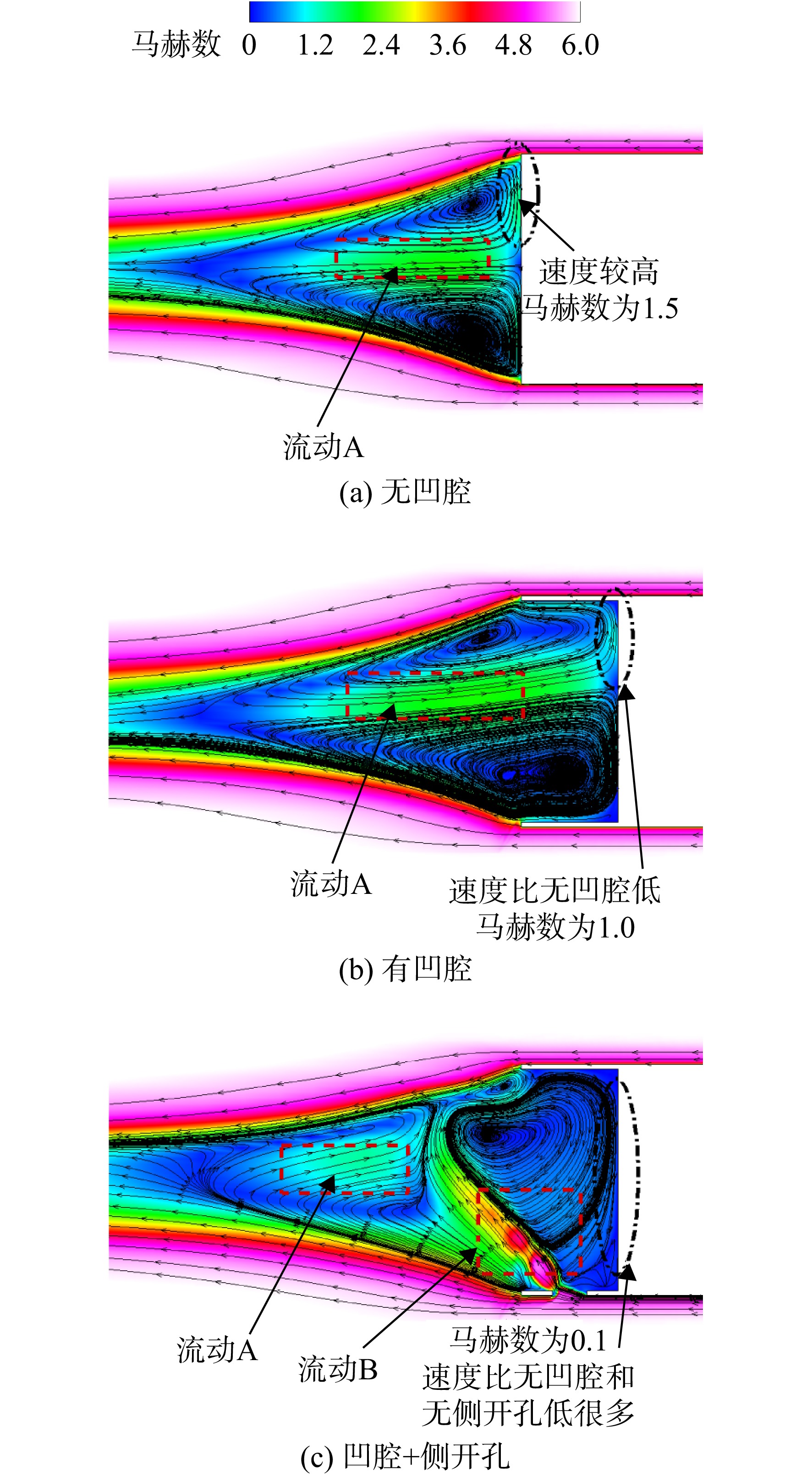
图 8 无凹腔与有凹腔不加侧开孔、有凹腔加侧开孔的对称面马赫数云图和二维流线
Figure 8. Mach number and two-dimensional streamlines of symmetric surfaces of non bottom cavity and bottom cavity without side hole and bottom cavity with side hole
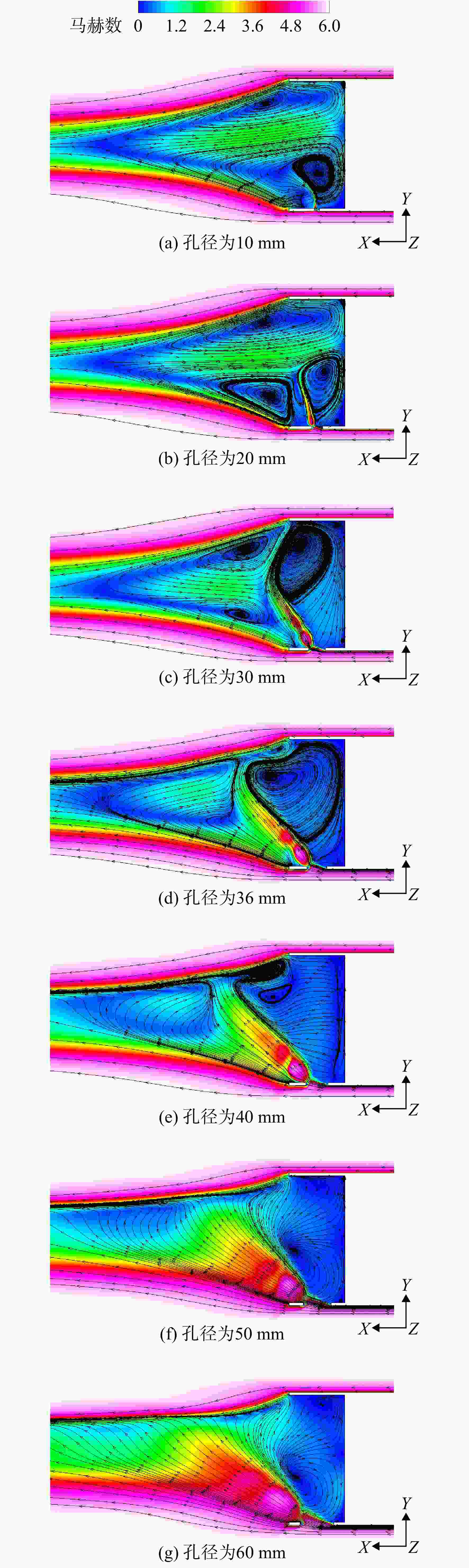
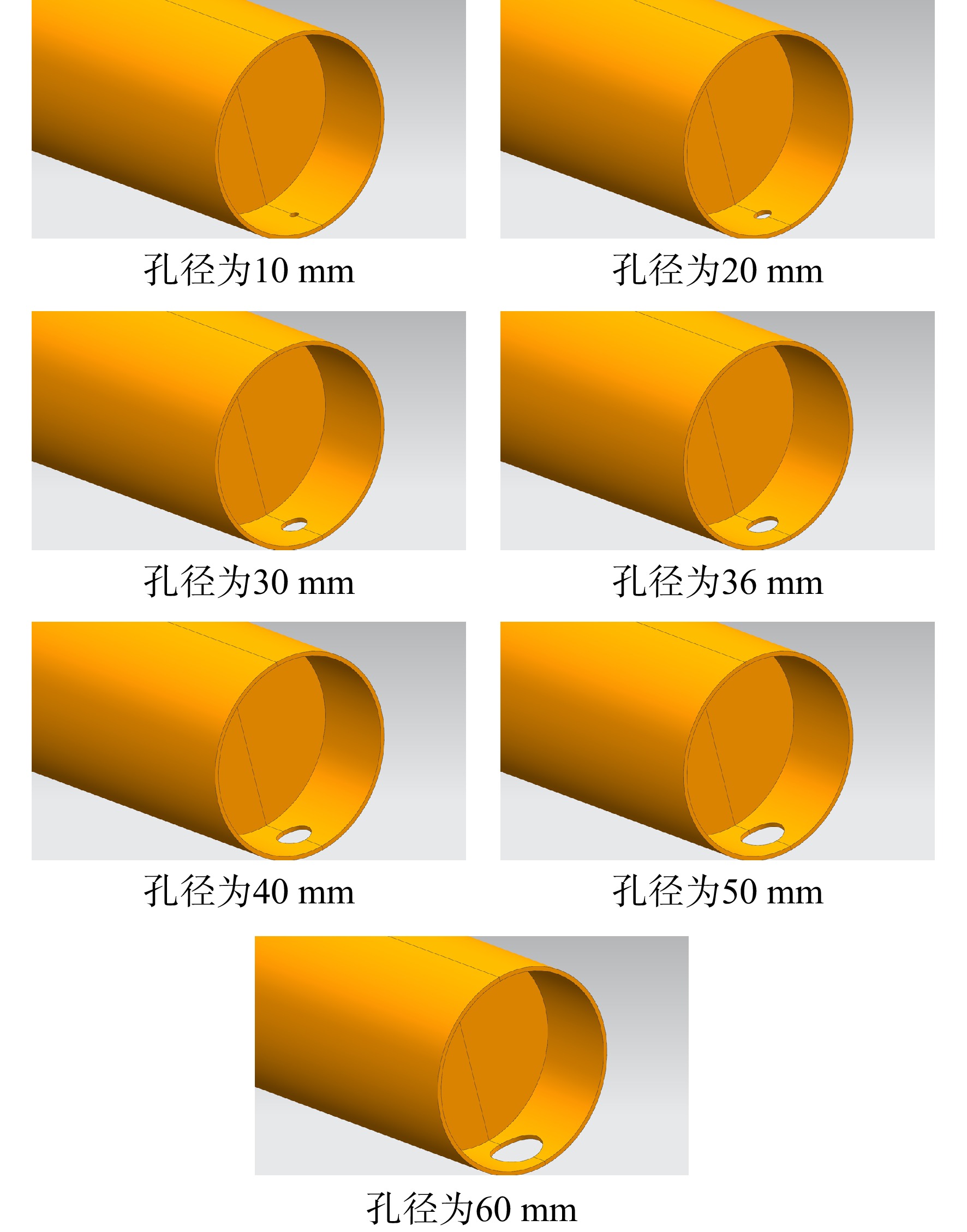
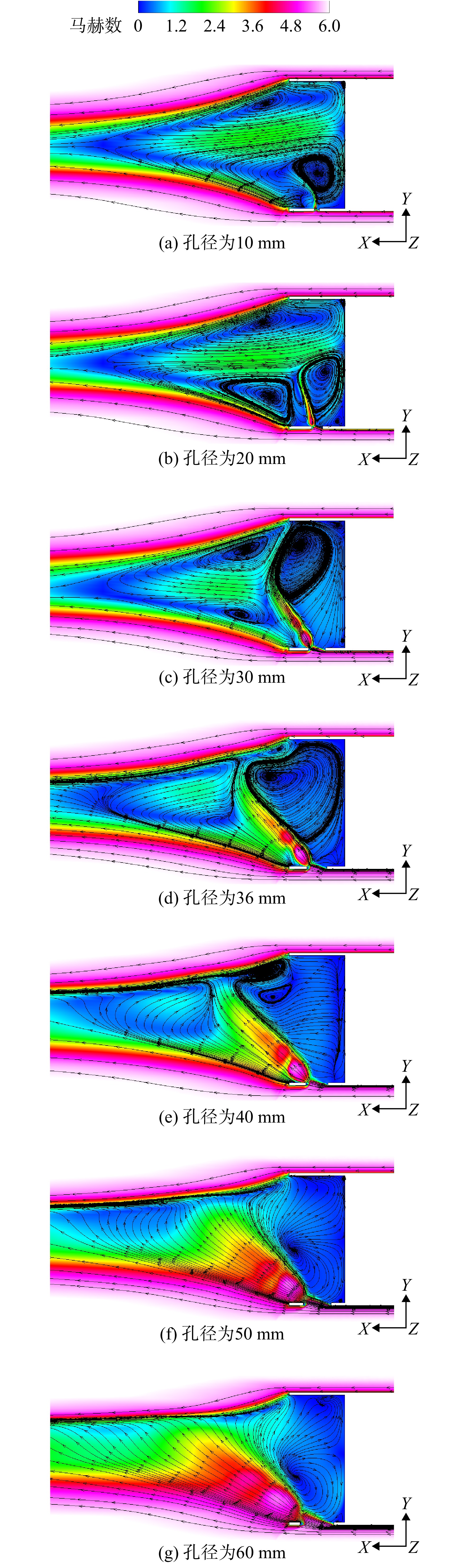
图 11 不同开孔直径的对称面马赫数云图和流线
Figure 11. Mach number and streamlines of symmetric surfaces with different hole diameters
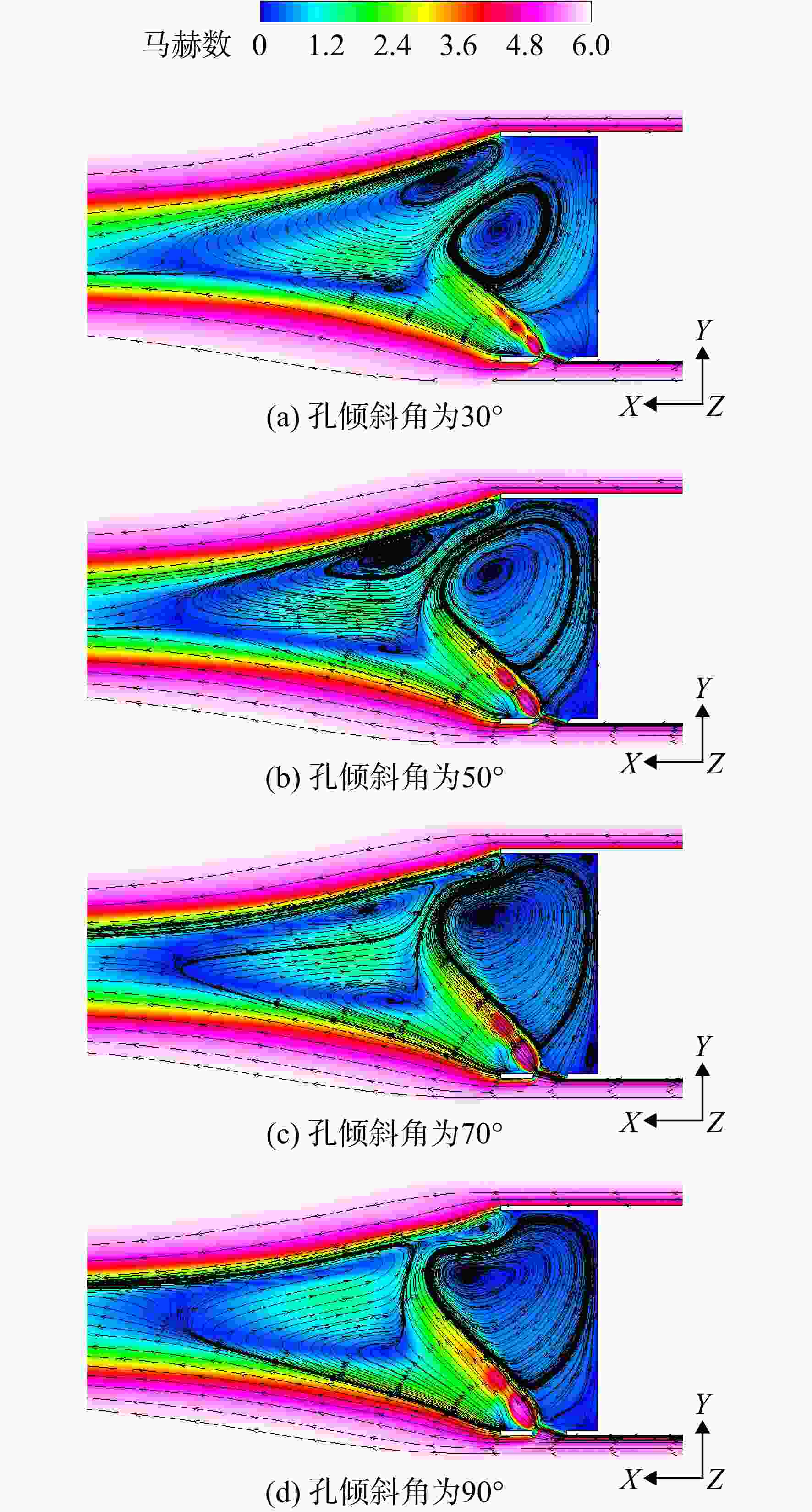
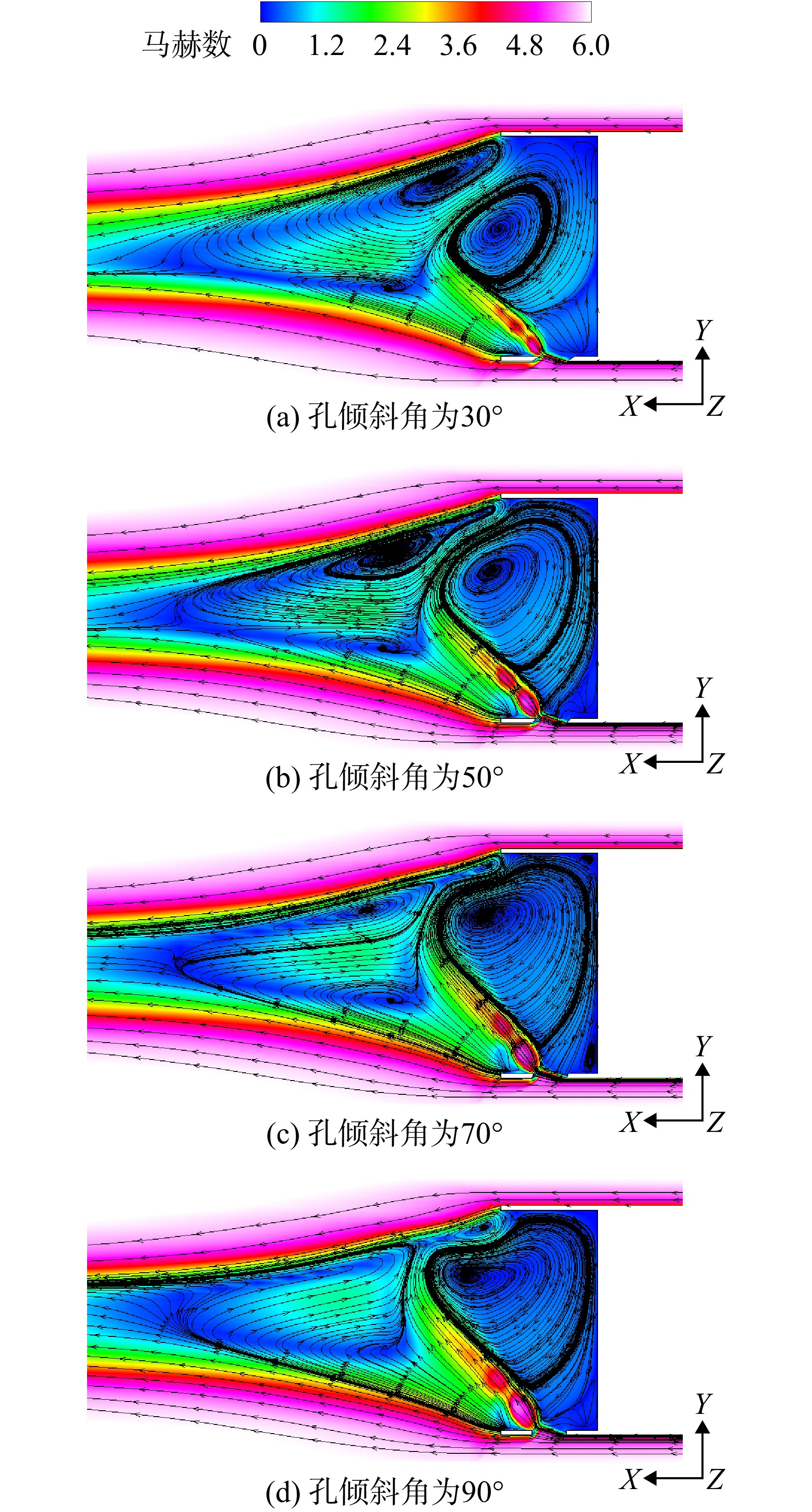
图 15 不同开孔倾斜角的对称面马赫数云图和流线
Figure 15. Mach number and streamlines of symmetric surfaces with different hole inclination angles
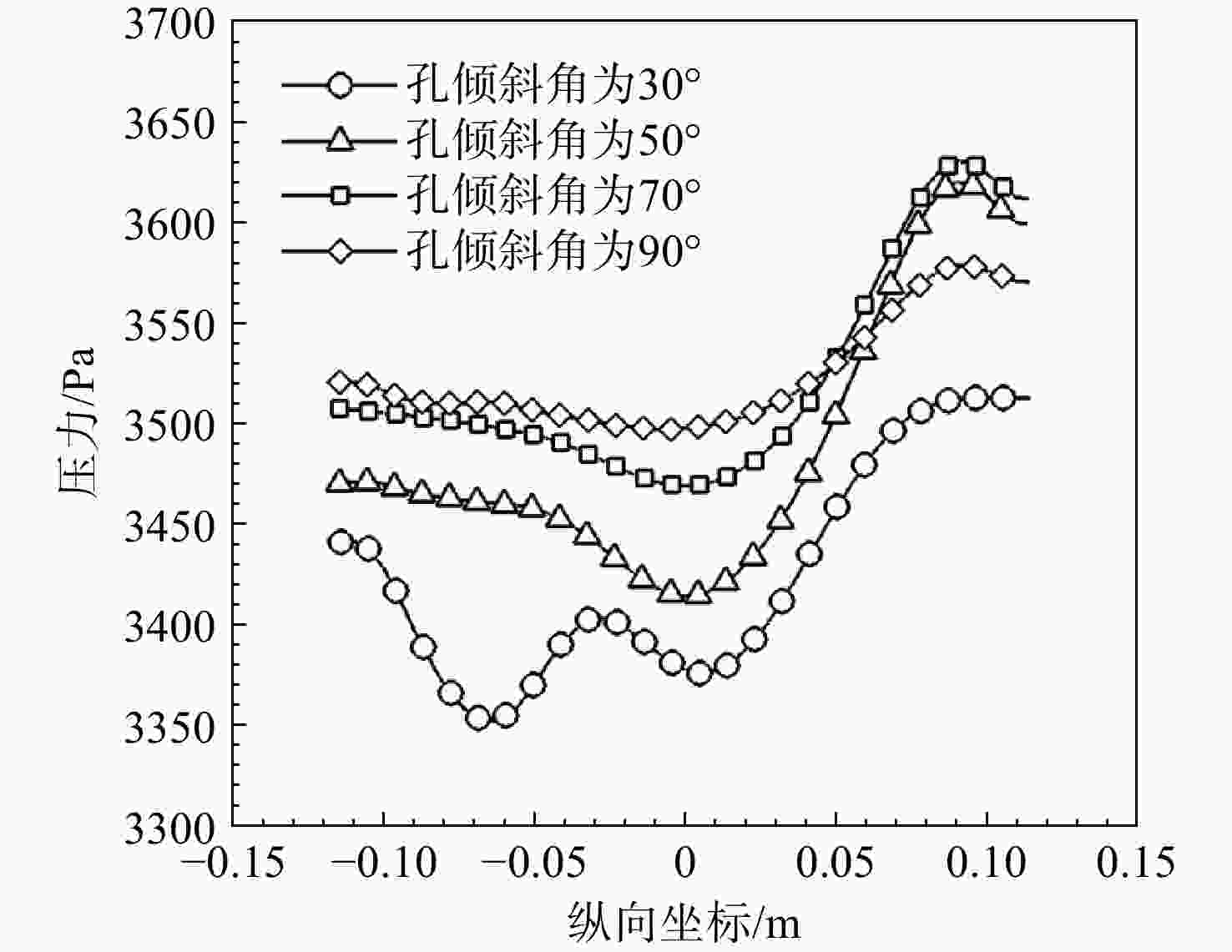
图 16 不同开孔倾斜角底部中心线压力曲线
Figure 16. Bottom centerline pressure curve for different hole inclination angles
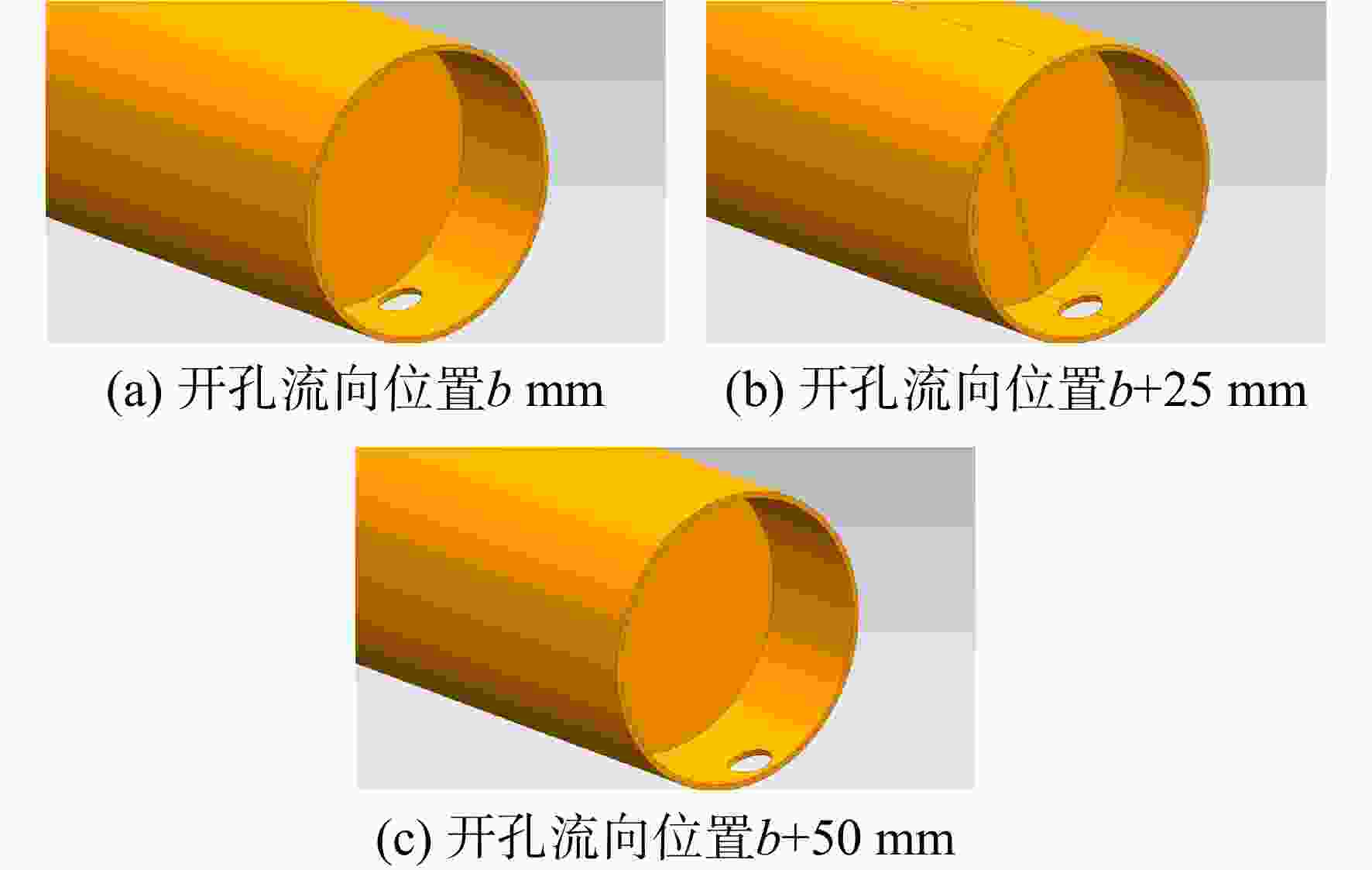
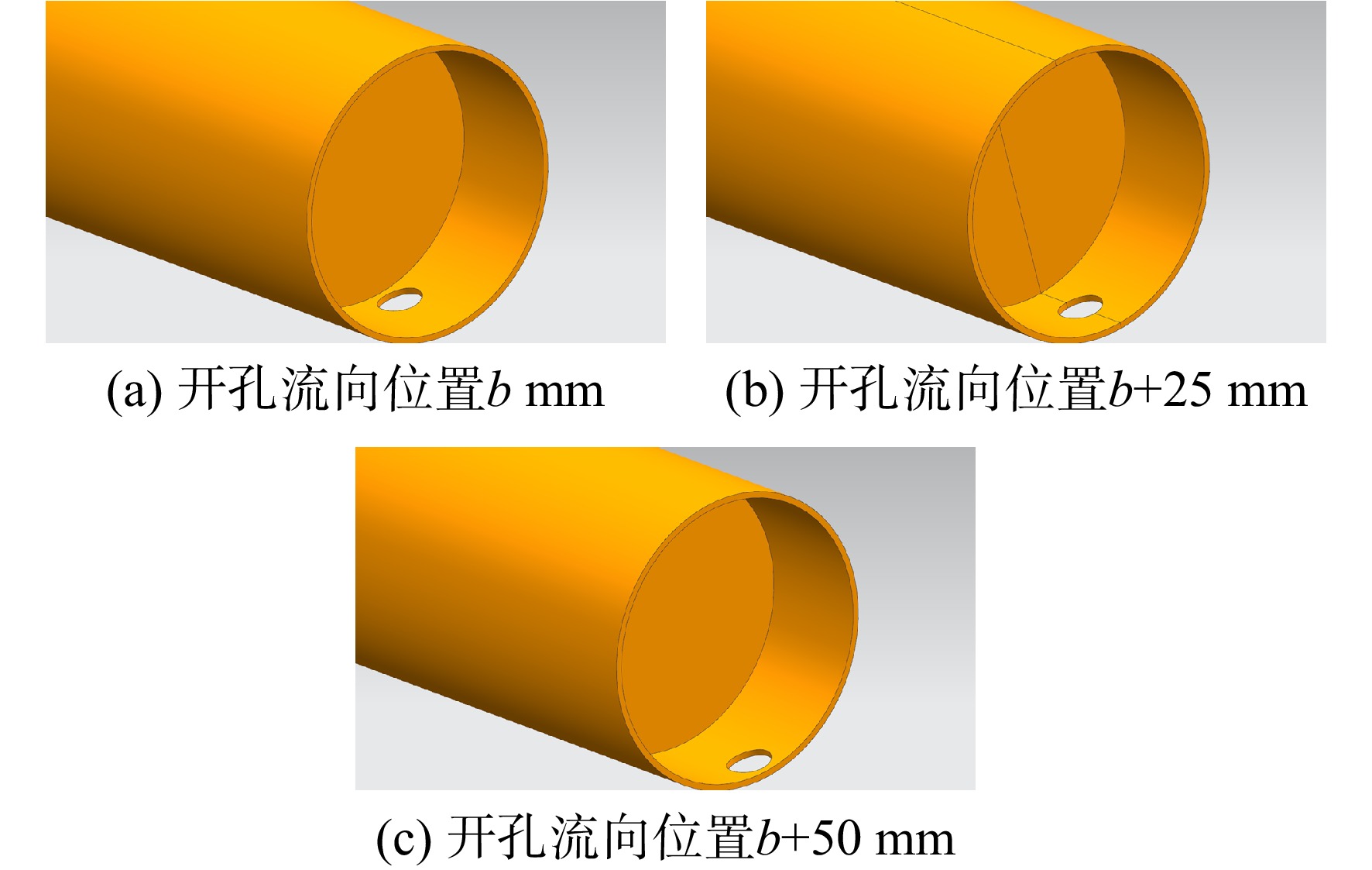
图 17 不同开孔流向位置的底部凹腔
Figure 17. Bottom cavity with different hole positions on flow direction
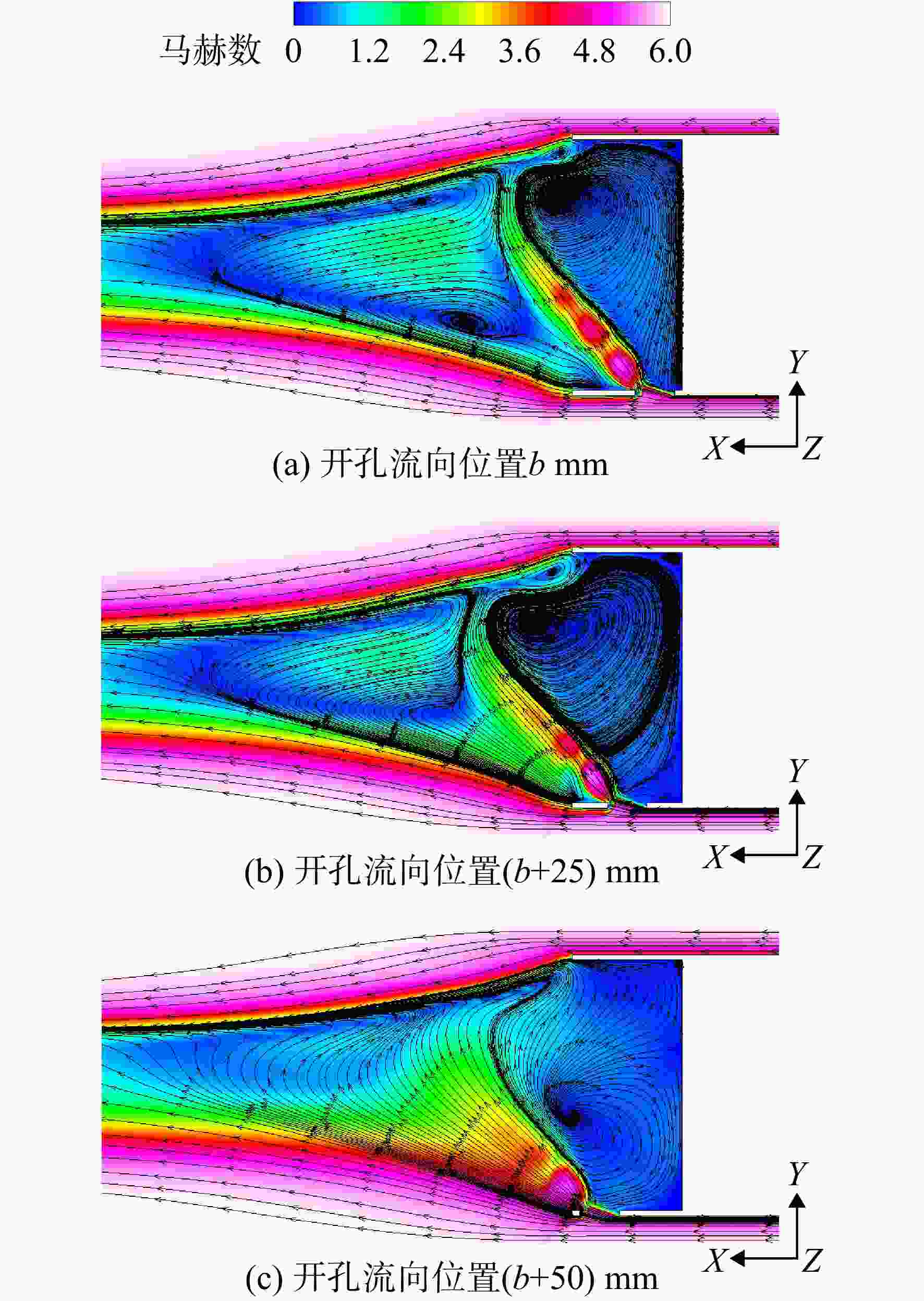
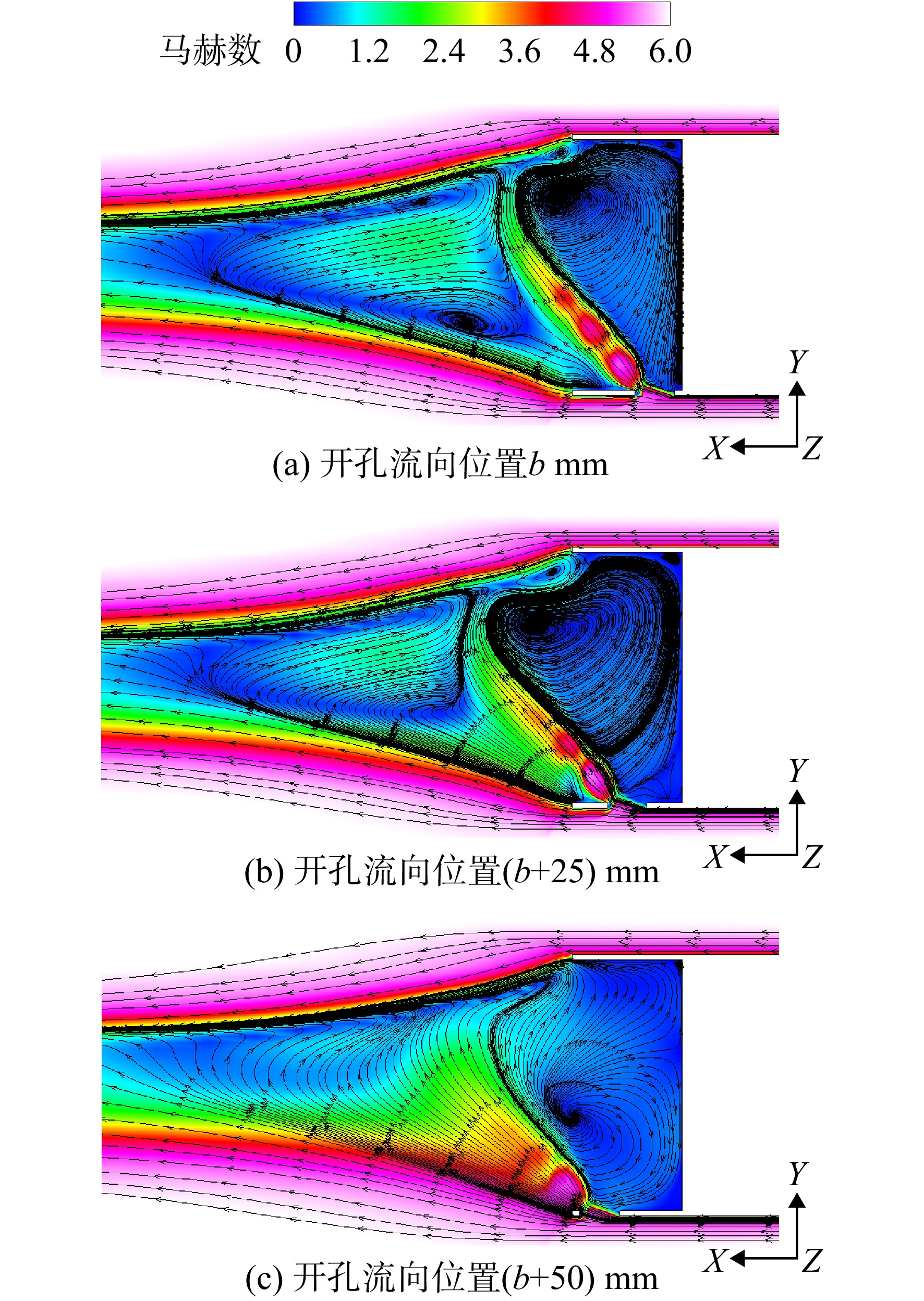
图 19 不同开孔流向位置的对称面马赫数云图及表面压力
Figure 19. Mach number and streamlines of symmetric surfaces and surface pressure with different hole inclination angles
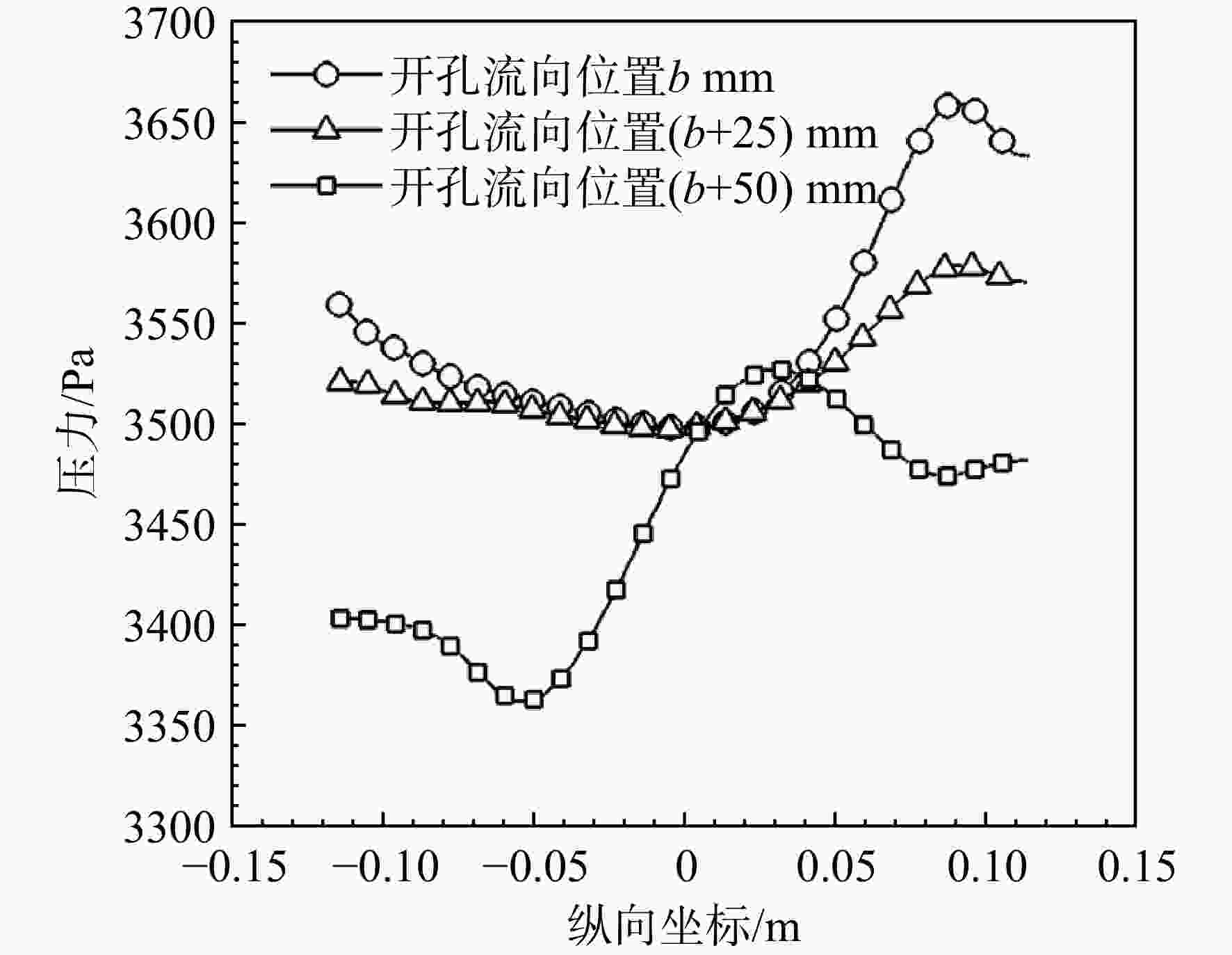
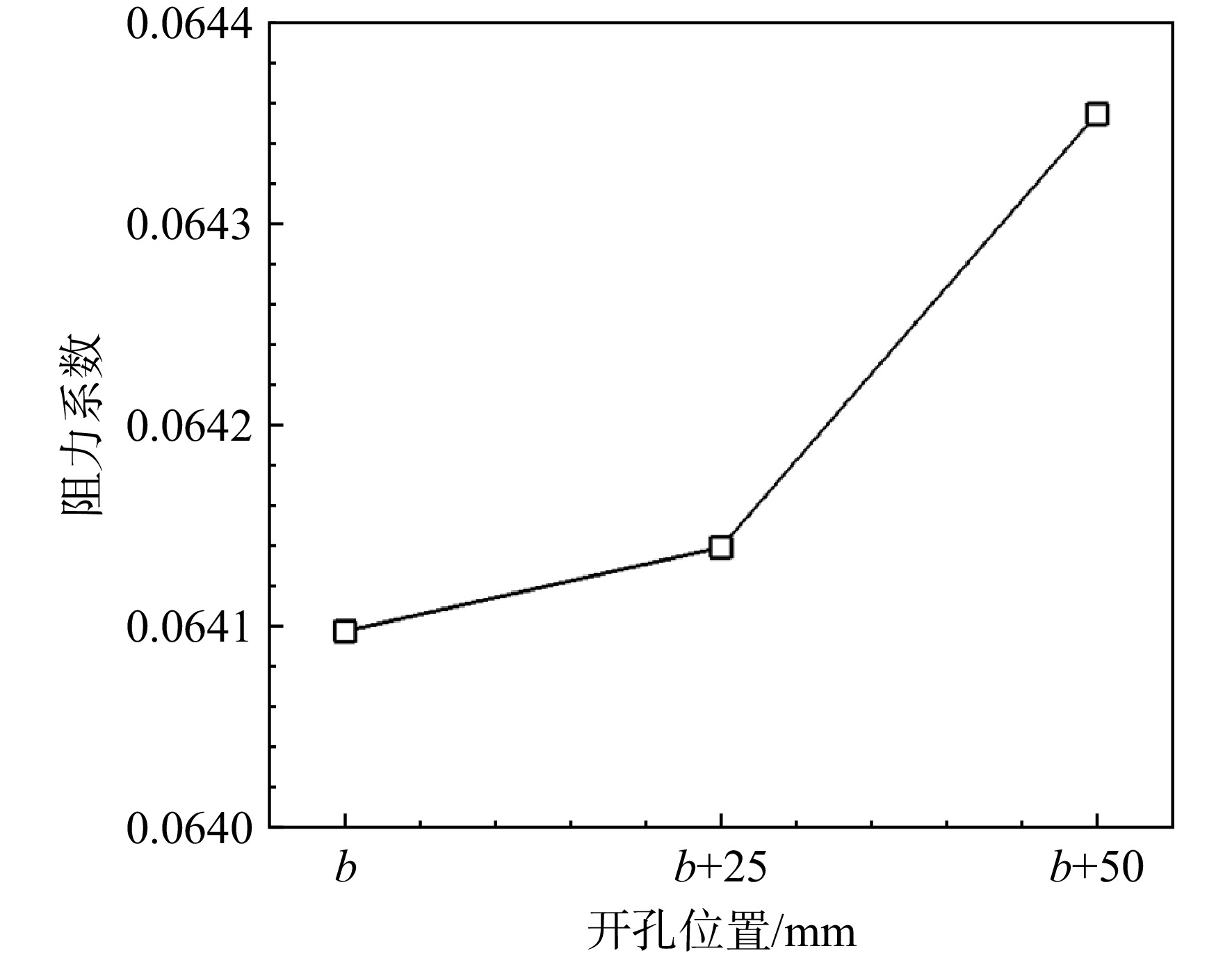
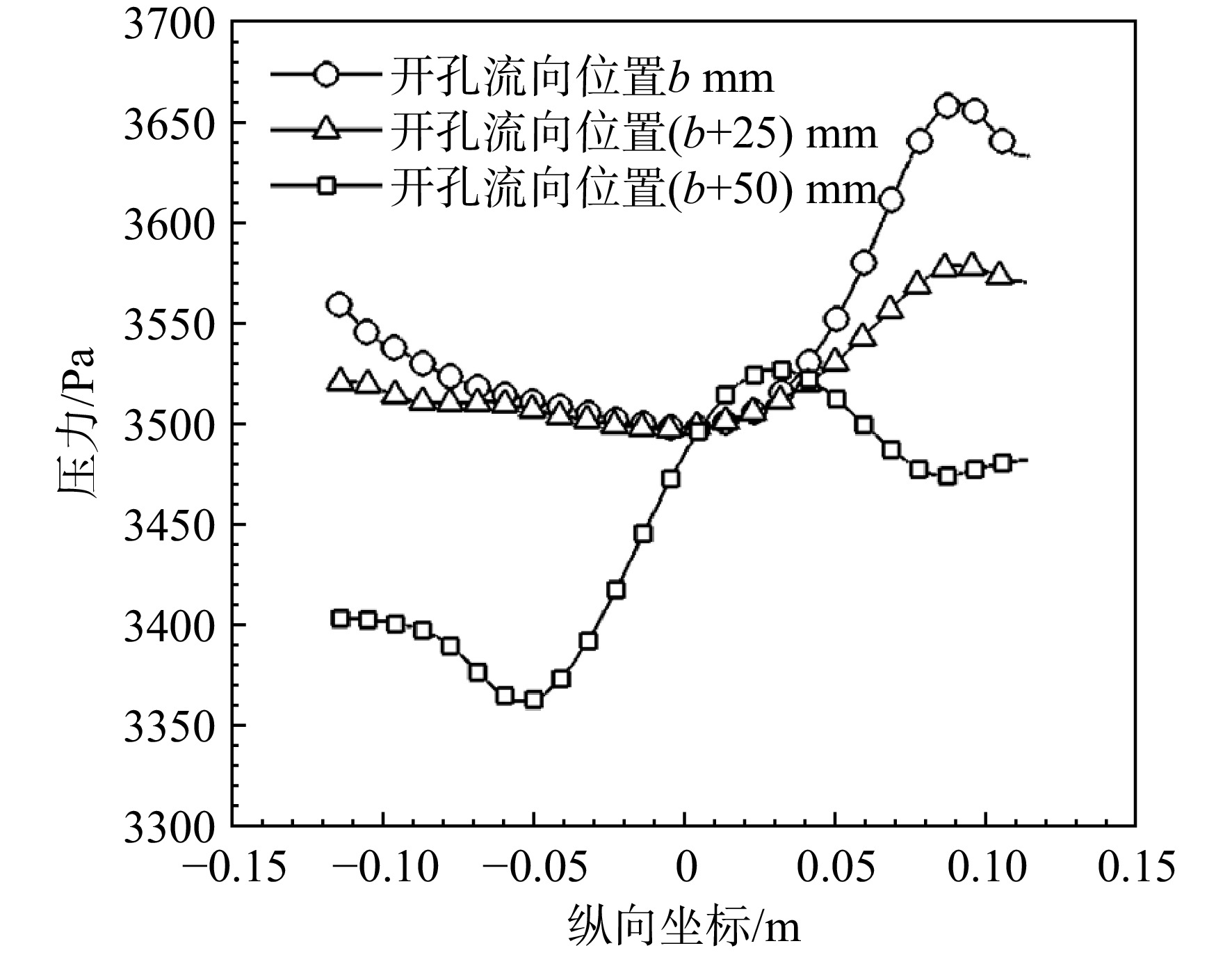
图 20 不同开孔流向位置底部中心线压力曲线
Figure 20. Bottom centerline pressure curve for different hole positions on flow direction
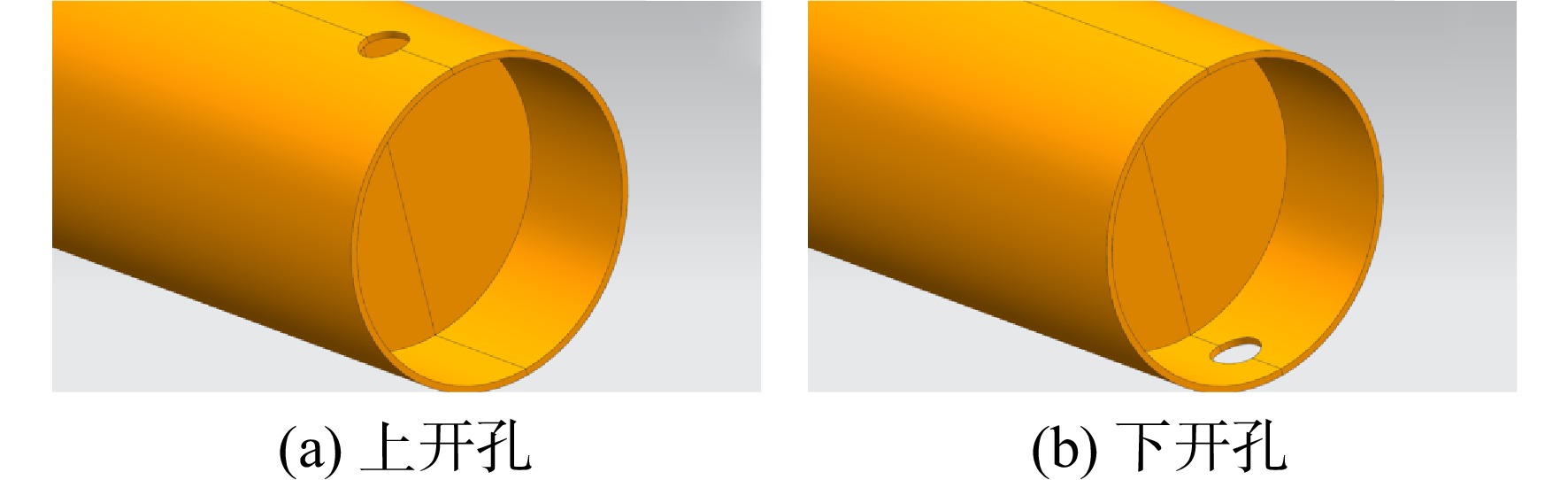
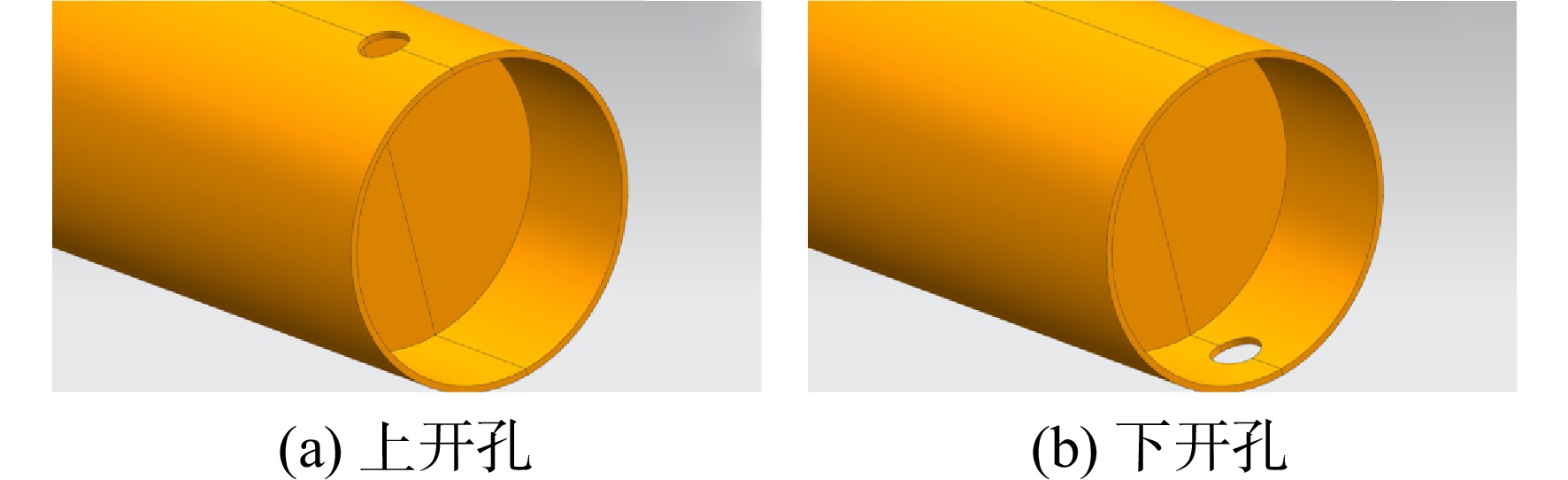
图 21 不同开孔周向位置的底部凹腔
Figure 21. Bottom cavity with different hole circumferential positions
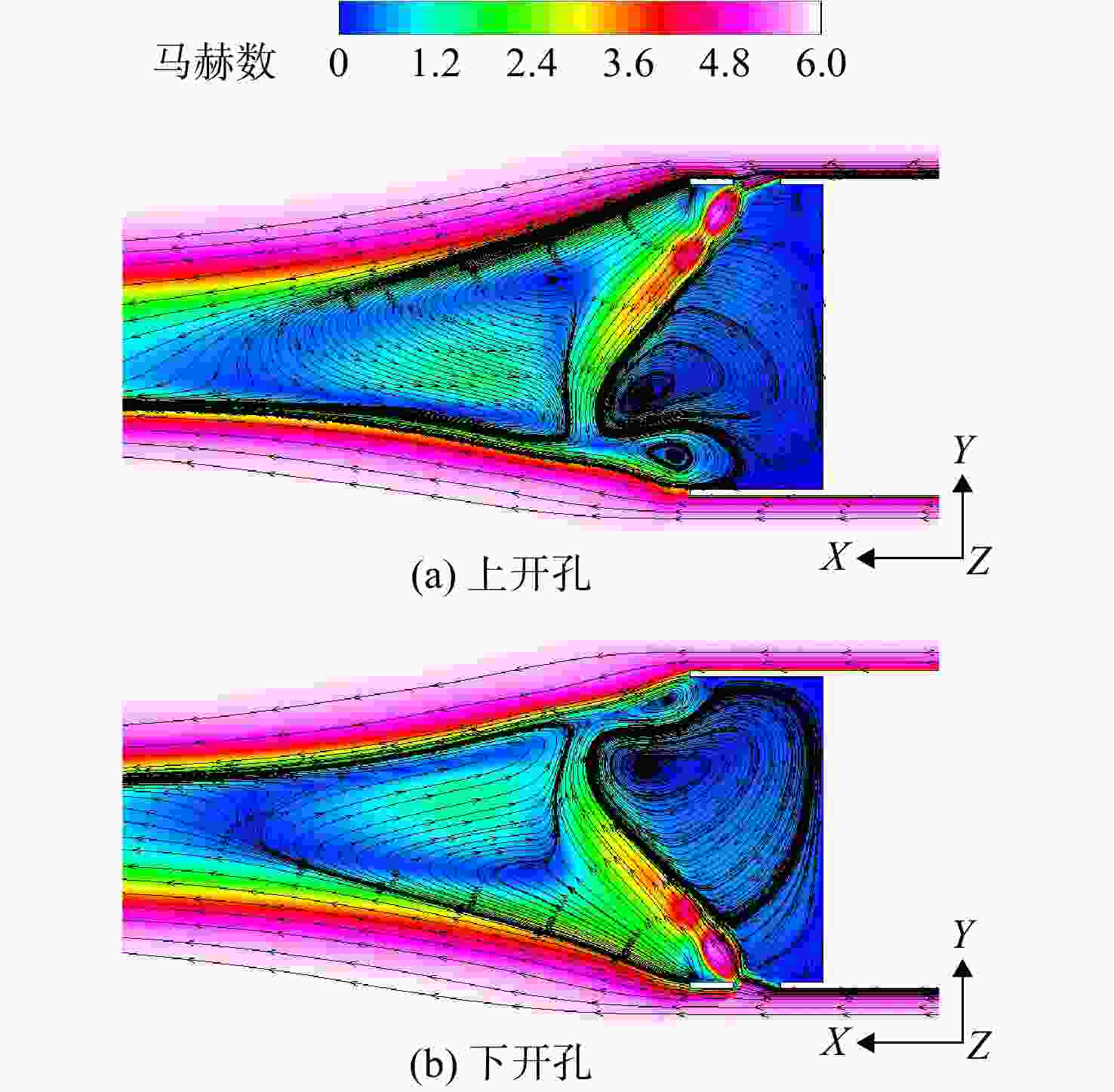
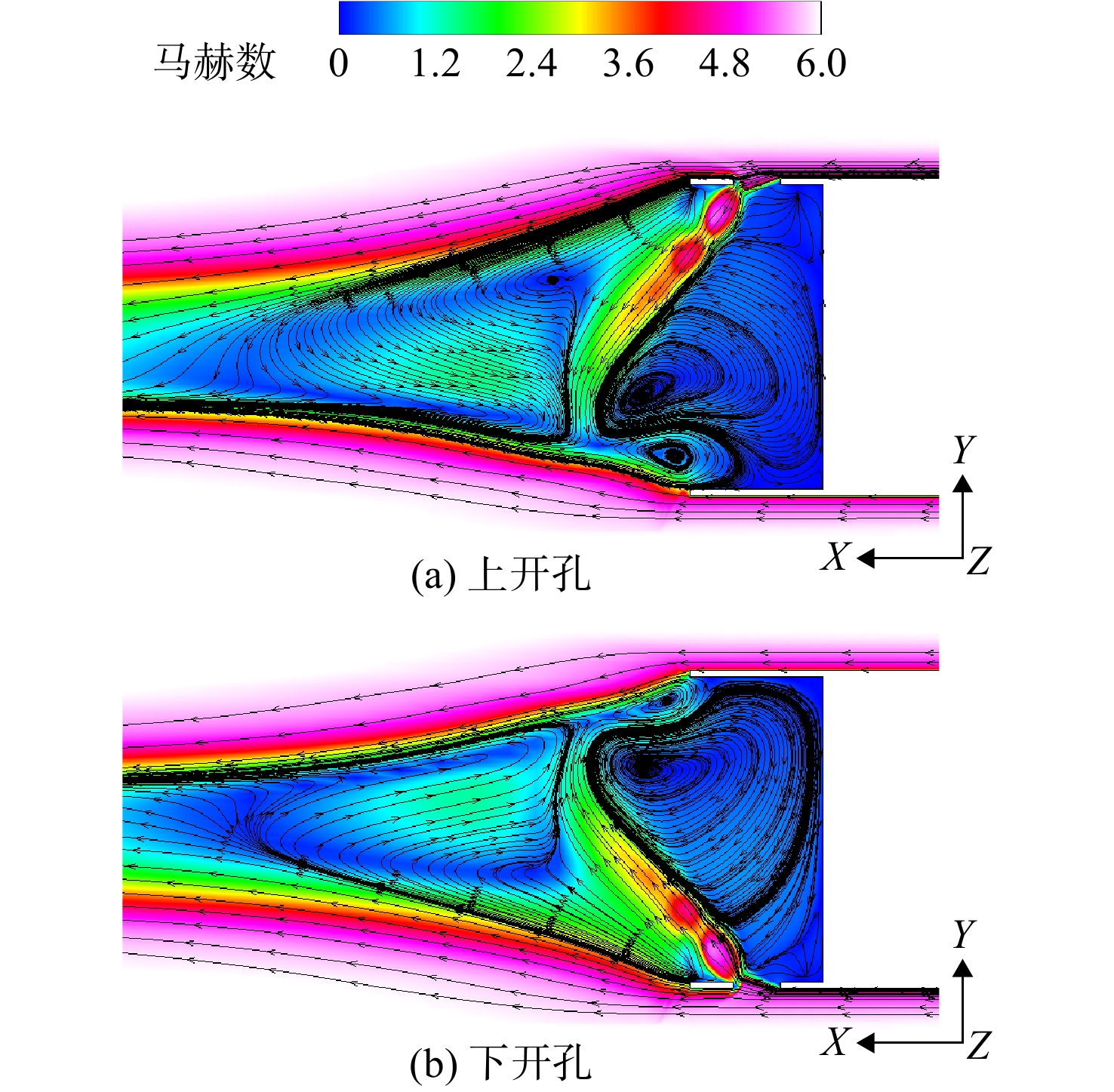
图 22 不同开孔周向位置的对称面马赫数云图和流线
Figure 22. Mach number and streamlines of symmetric surfaces with different hole circumferential positions
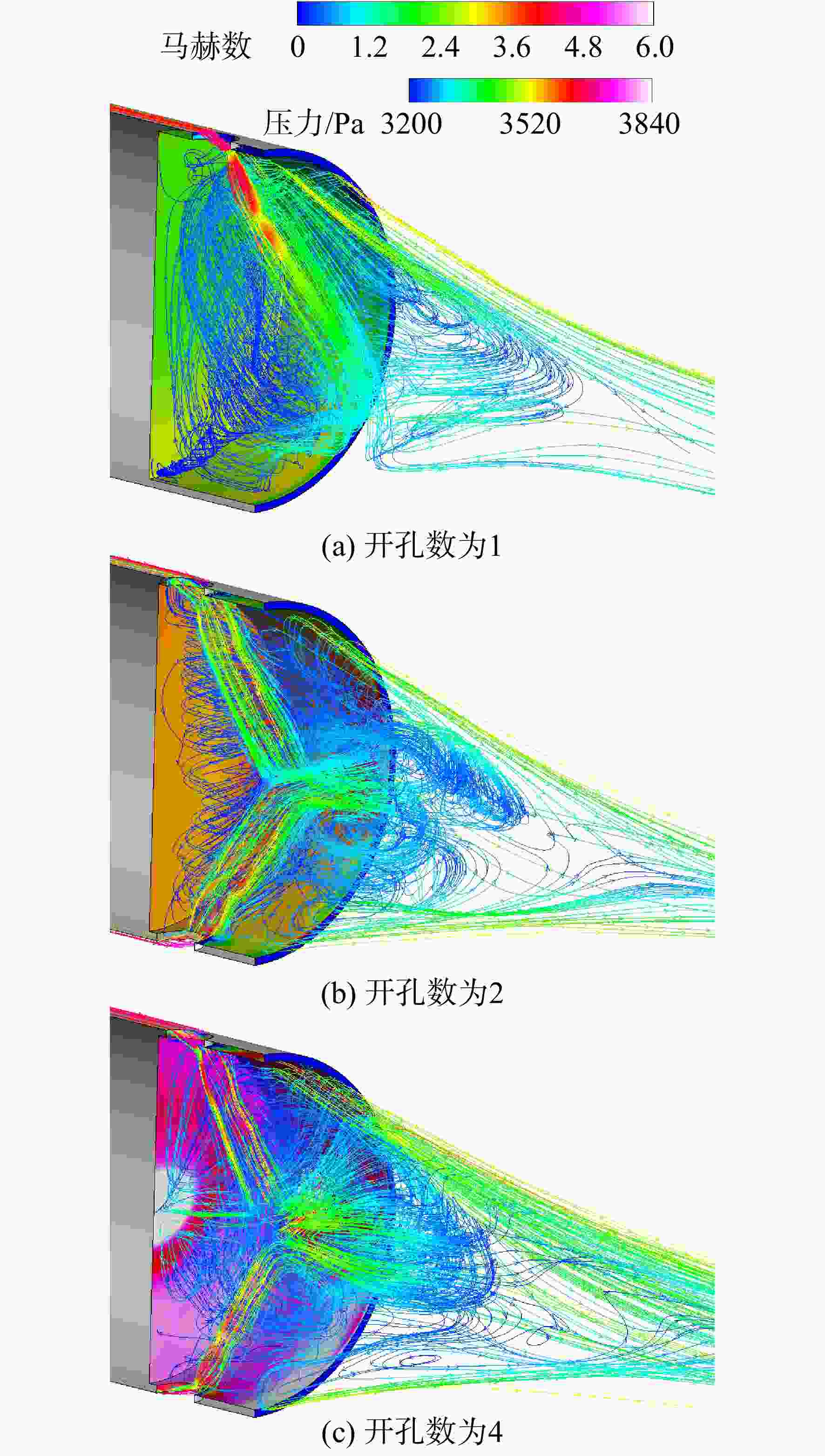
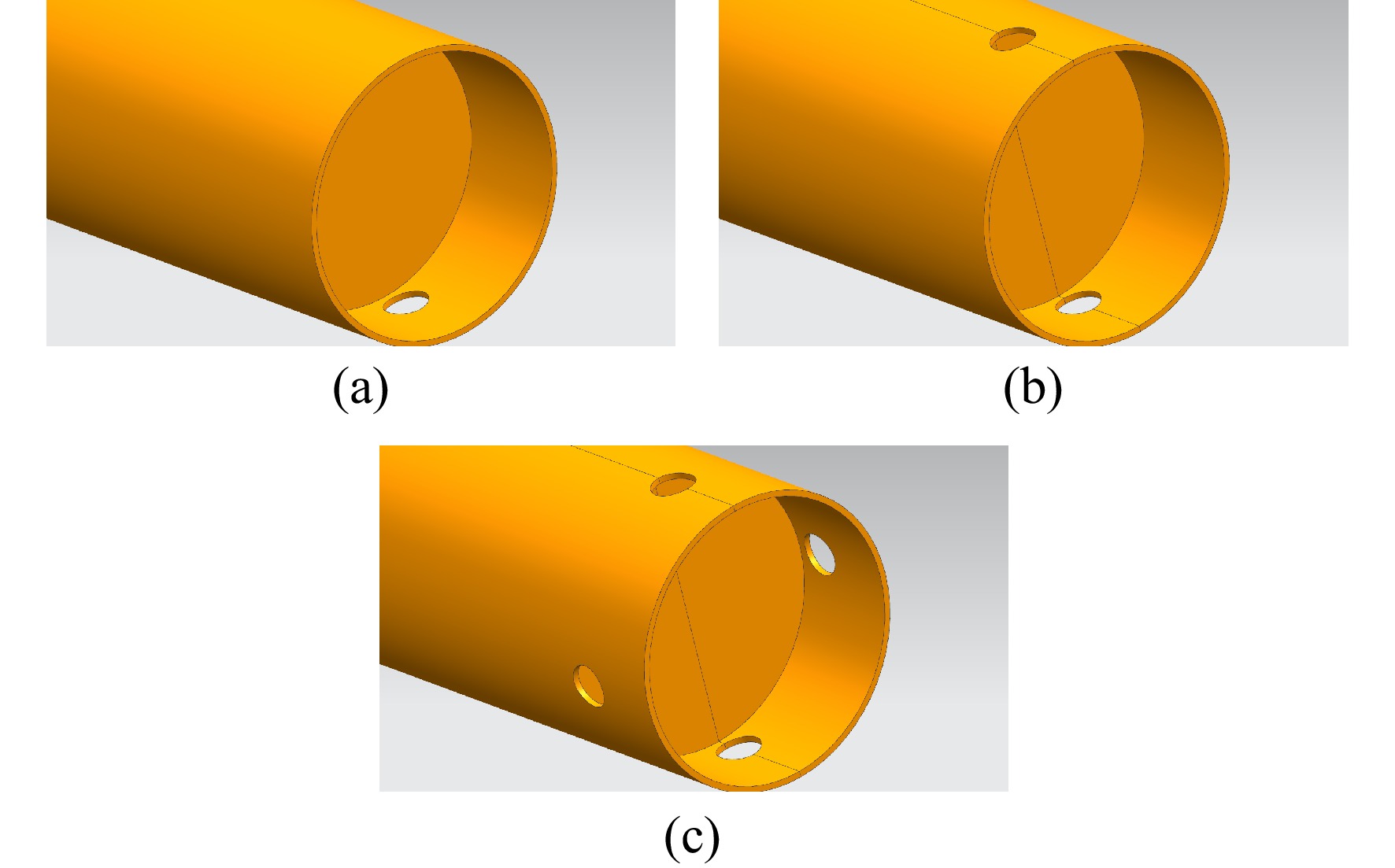
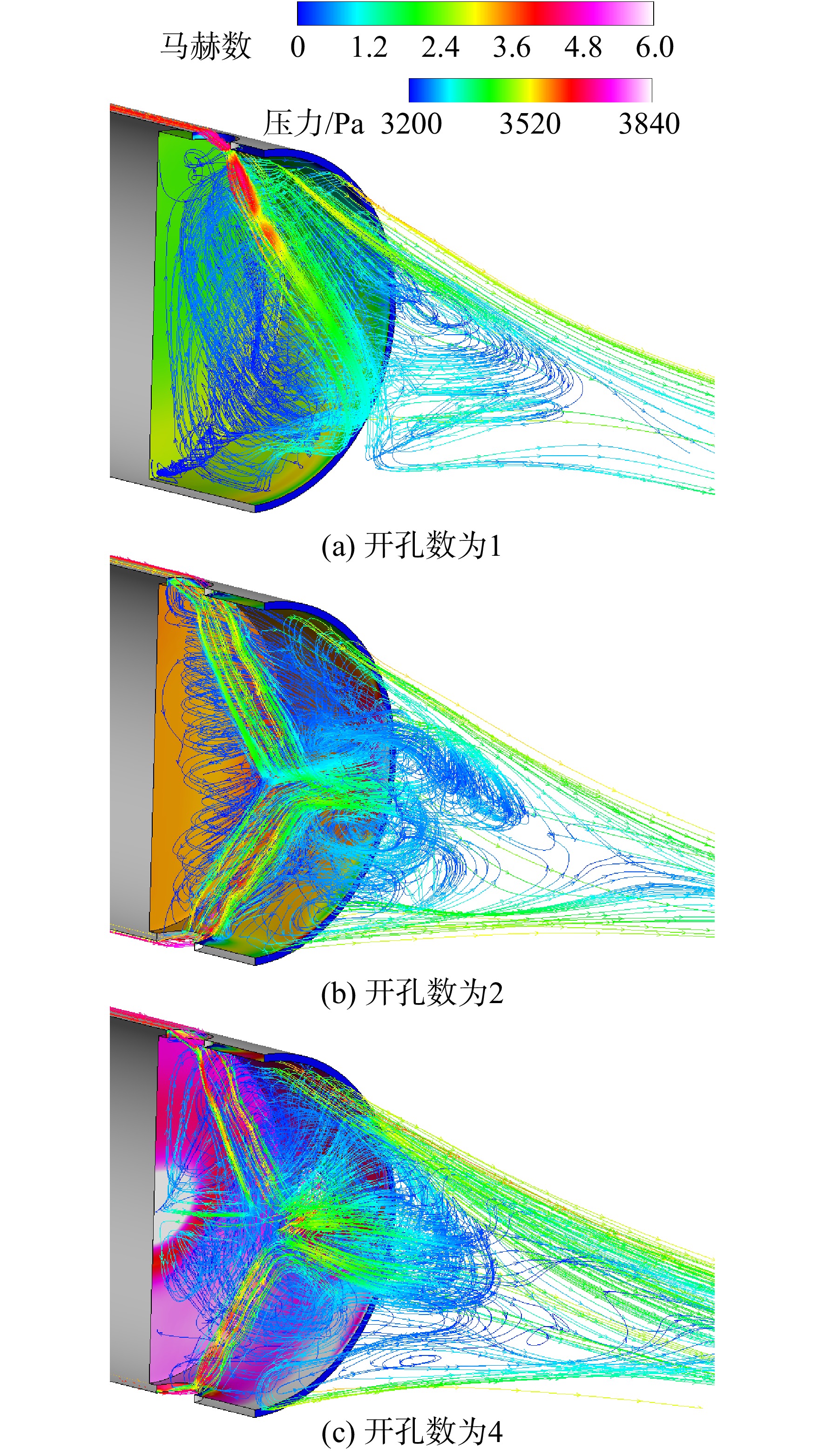
图 25 不同开孔数量表面压力及三维流线(流线用马赫数着色)
Figure 25. Surface pressure with different number of holes and three-dimensional streamlines (streamlines colored by Mach number)
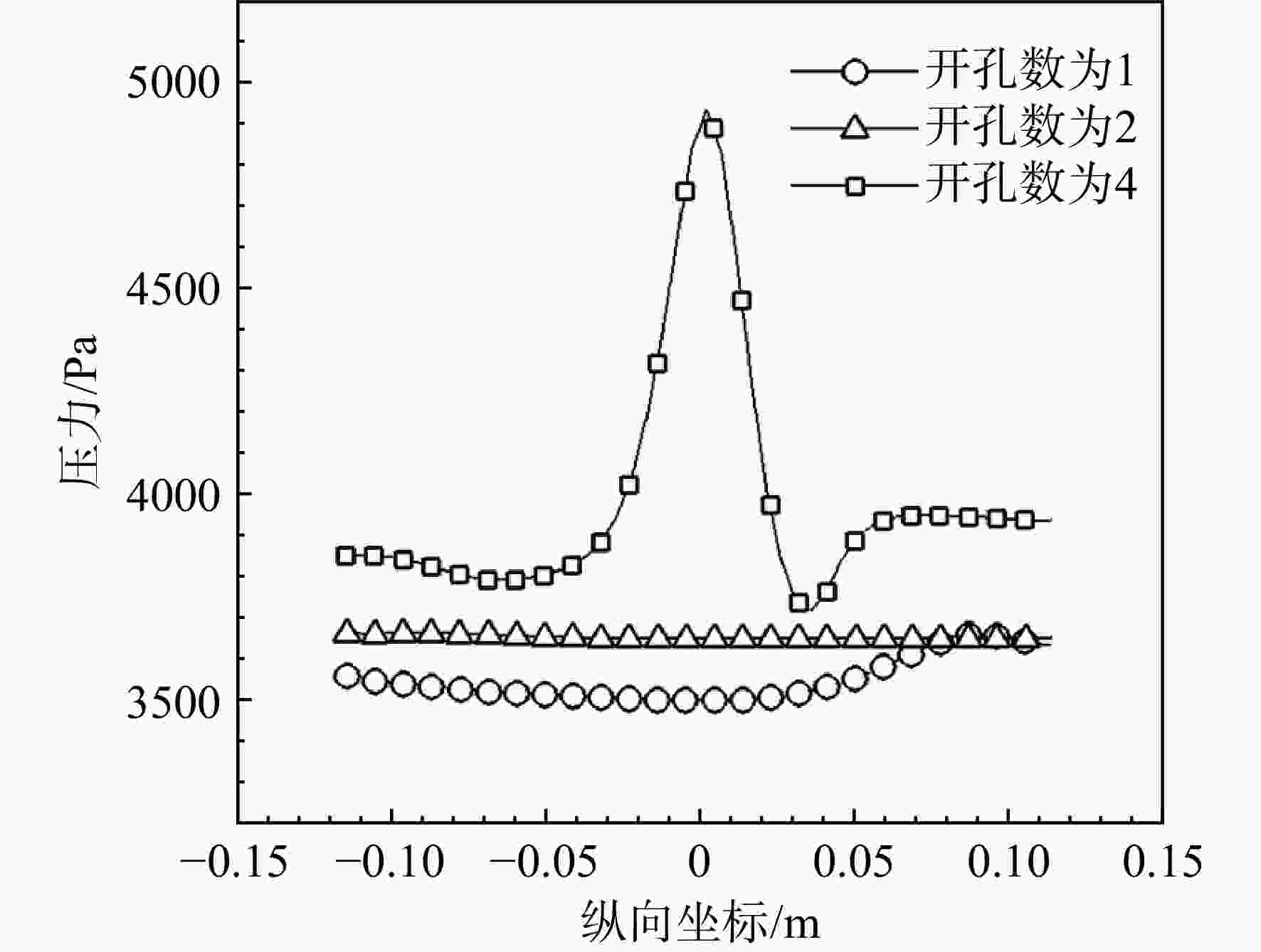
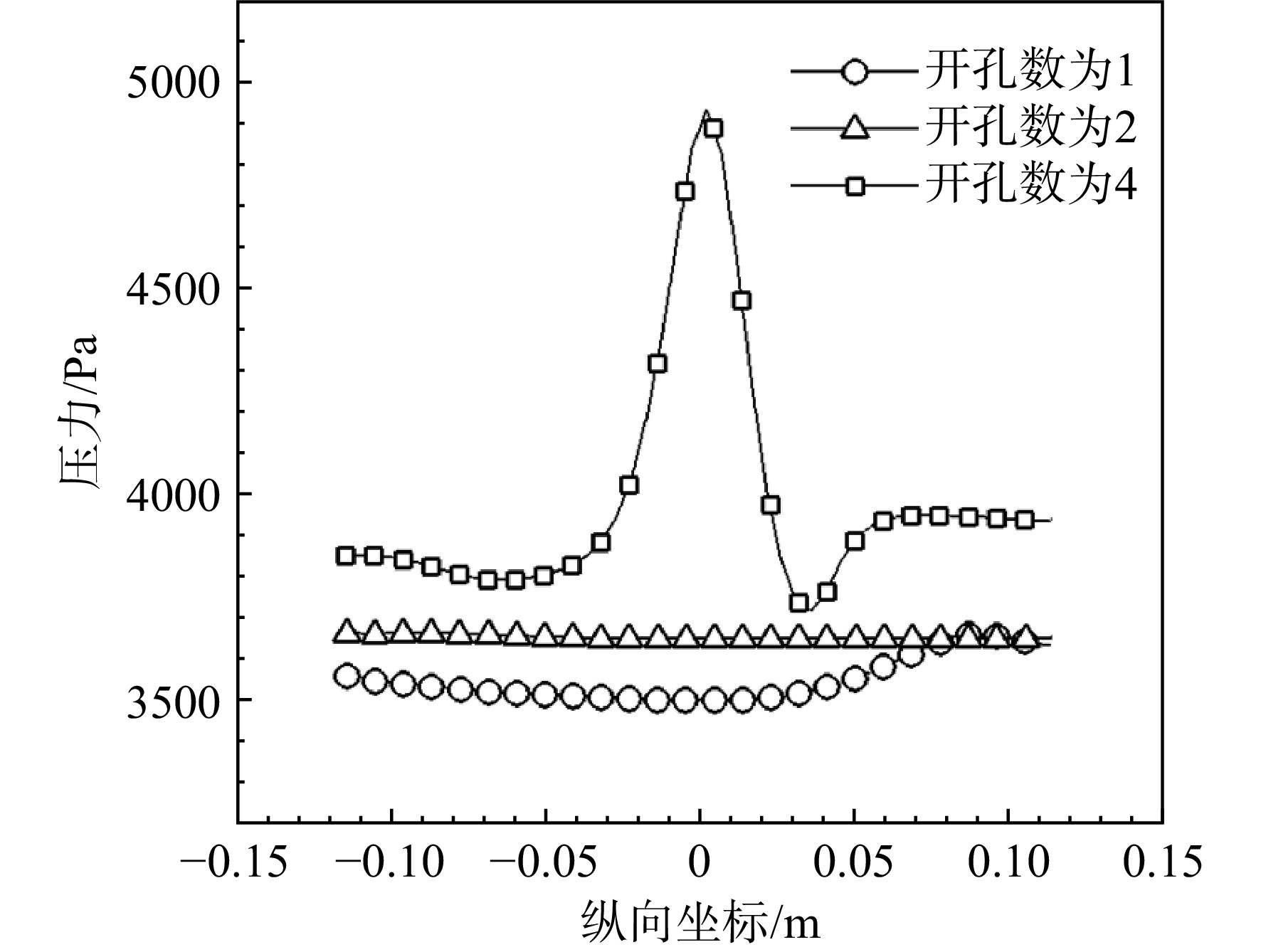
图 26 不同开孔数量底部中心线压力曲线
Figure 26. Bottom centerline pressure curve for different hole numbers
表 1 来流条件
Table 1. Free stream condition
Ma α/(°) β/(°) p∞/Pa T∞/K U∞/(m/s) 6 0 0 12111.8 216.65 1770.02  下载: 导出CSV
表 2 网格无关性验证
Table 2. Grid independence verification
网格数 阻力系数C 1159101 0.064793655 1818576 0.064796465 2884286 0.064587351
下载: 导出CSV
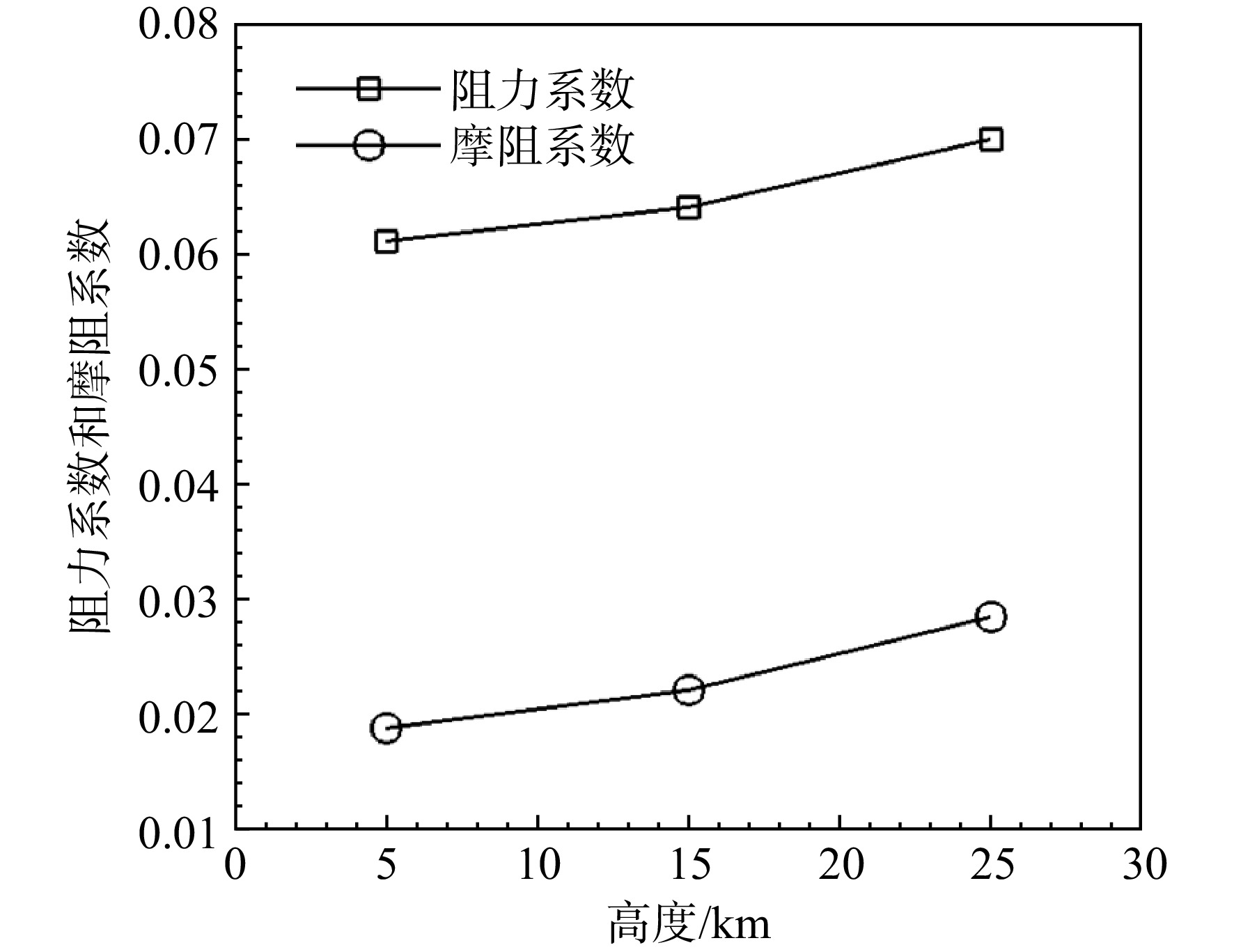
表 3 飞行高度对阻力和摩阻的影响
Table 3. Effect of flight height on drag and friction
高度/km 马赫数 攻角 阻力系数C 摩阻系数f 5 6 0 0.061209 0.018834 15 6 0 0.064139 0.022170 25 6 0 0.070003 0.028516
下载: 导出CSV
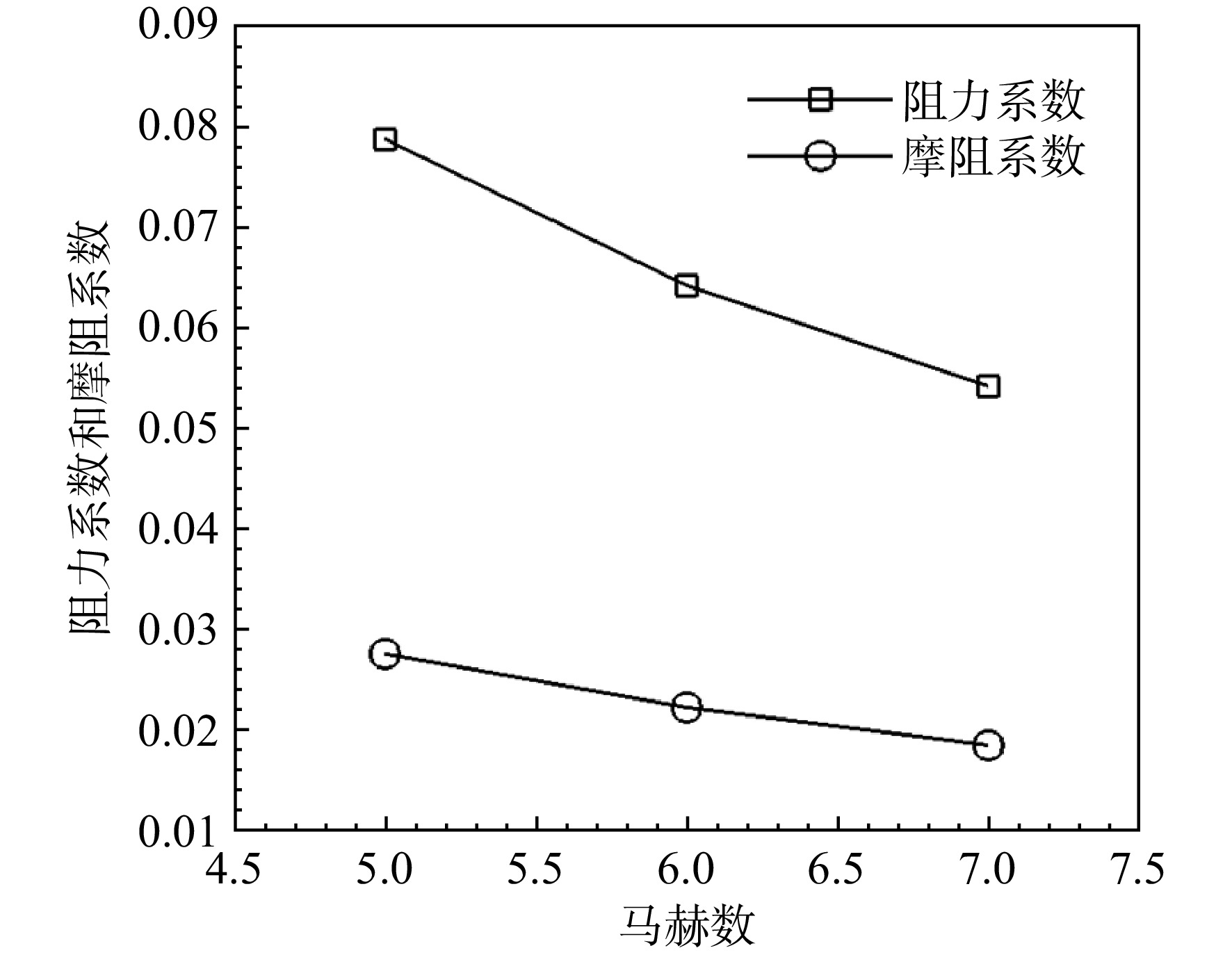
表 4 马赫数对阻力和摩阻的影响
Table 4. Effect of Mach number on drag and friction
高度/km 马赫数 攻角 阻力系数C 摩阻系数f 15 5 0 0.078748 0.027485 15 6 0 0.064139 0.022170 15 7 0 0.054189 0.018367
下载: 导出CSV
表 5 攻角对阻力和摩阻的影响
Table 5. Effect of angle of attack on drag and friction
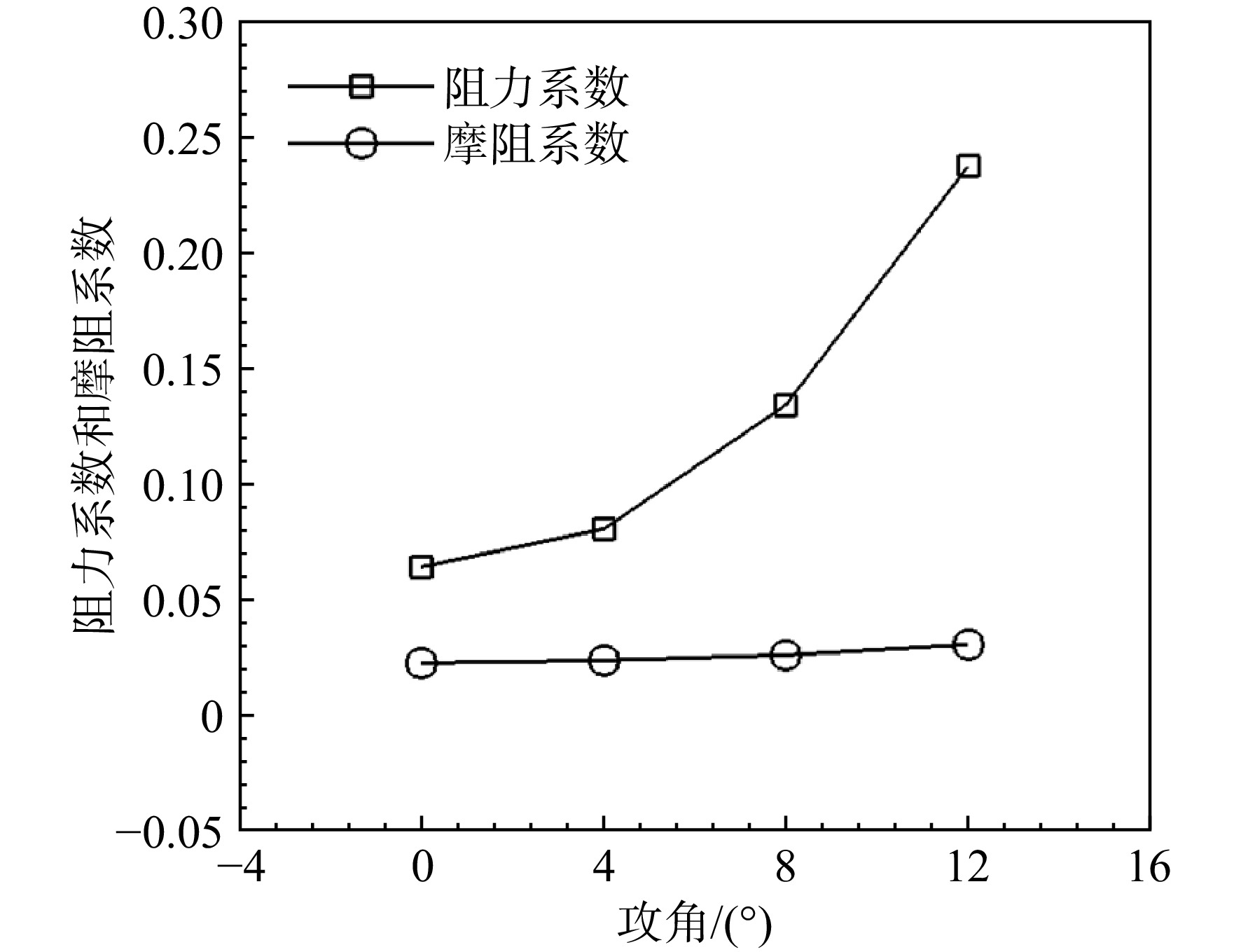
高度/km 马赫数 攻角 阻力系数C 摩阻系数f 15 6 0 0.064139 0.022170 15 6 4 0.080879 0.023282 15 6 8 0.133978 0.025888 15 6 12 0.237403 0.030520
下载: 导出CSV
表 6 不同开孔直径的减阻效果
Table 6. Rag reduction of different hole diameter
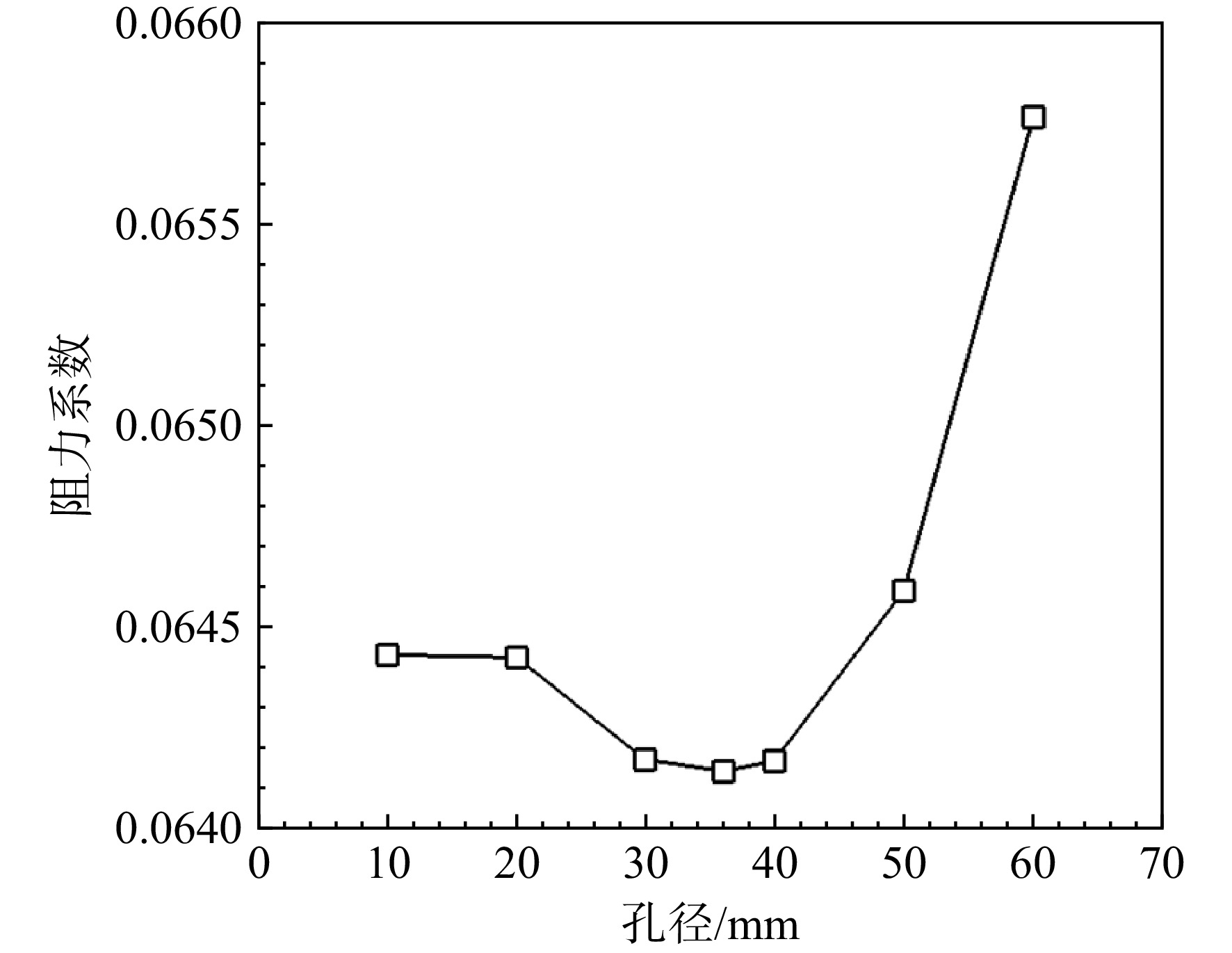
φ/mm C ∆C/% u/(m/s) v/(m/s) δ/(°) 0 0.064587 10 0.064431 −0.24 58.57 763.58 85.61 20 0.064423 −0.26 132.92 405.87 71.87 30 0.064171 −0.65 409.24 584.78 55.02 36 0.064139 −0.69 571.57 591.35 45.97 40 0.064167 −0.65 610.46 520.41 40.45 50 0.064589 0 619.59 417.07 33.95 60 0.065767 1.83 787.05 513.89 33.14
下载: 导出CSV
表 7 不同开孔倾斜角的减阻效果
Table 7. Rag reduction of different hole inclination angles
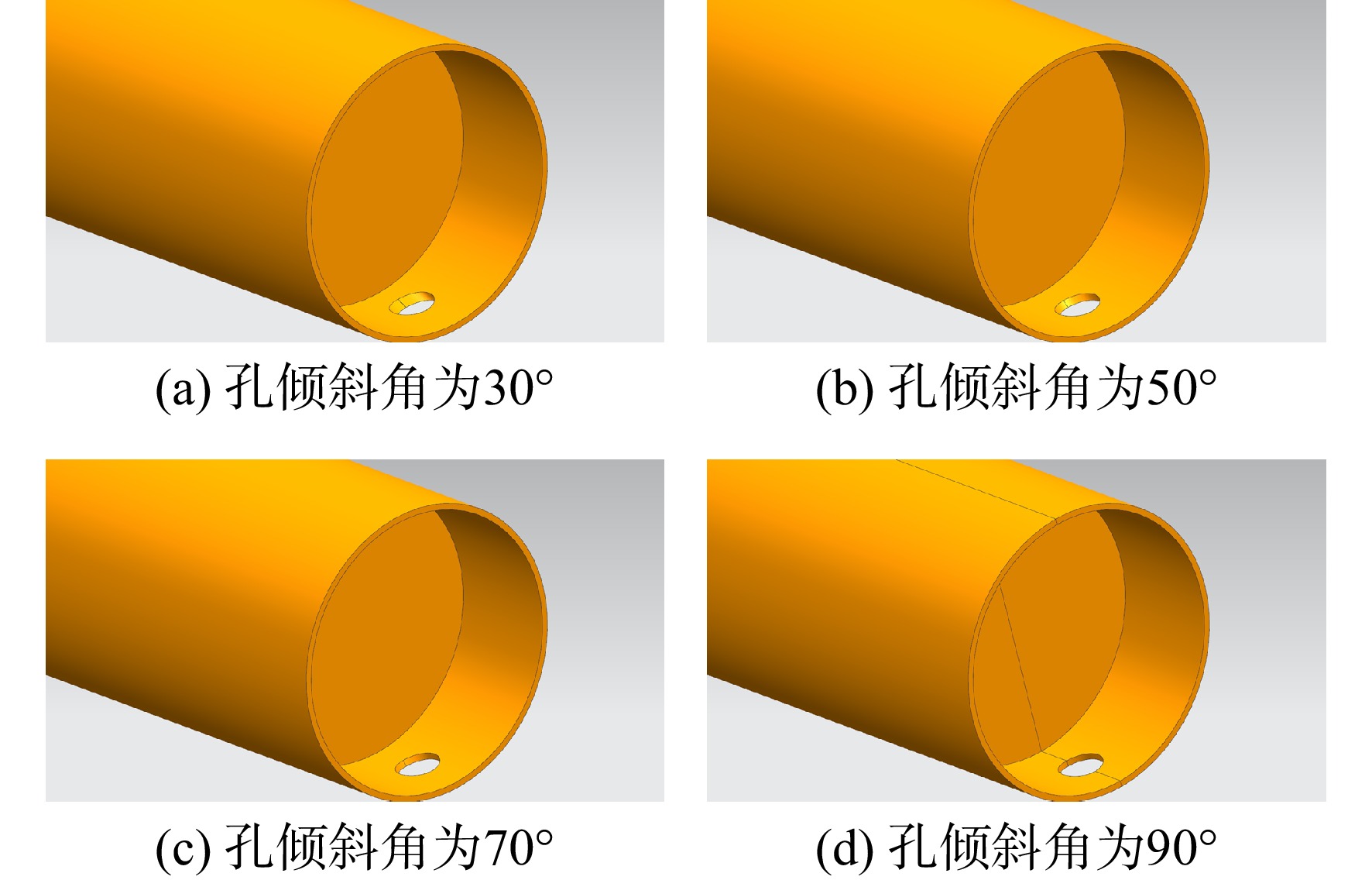
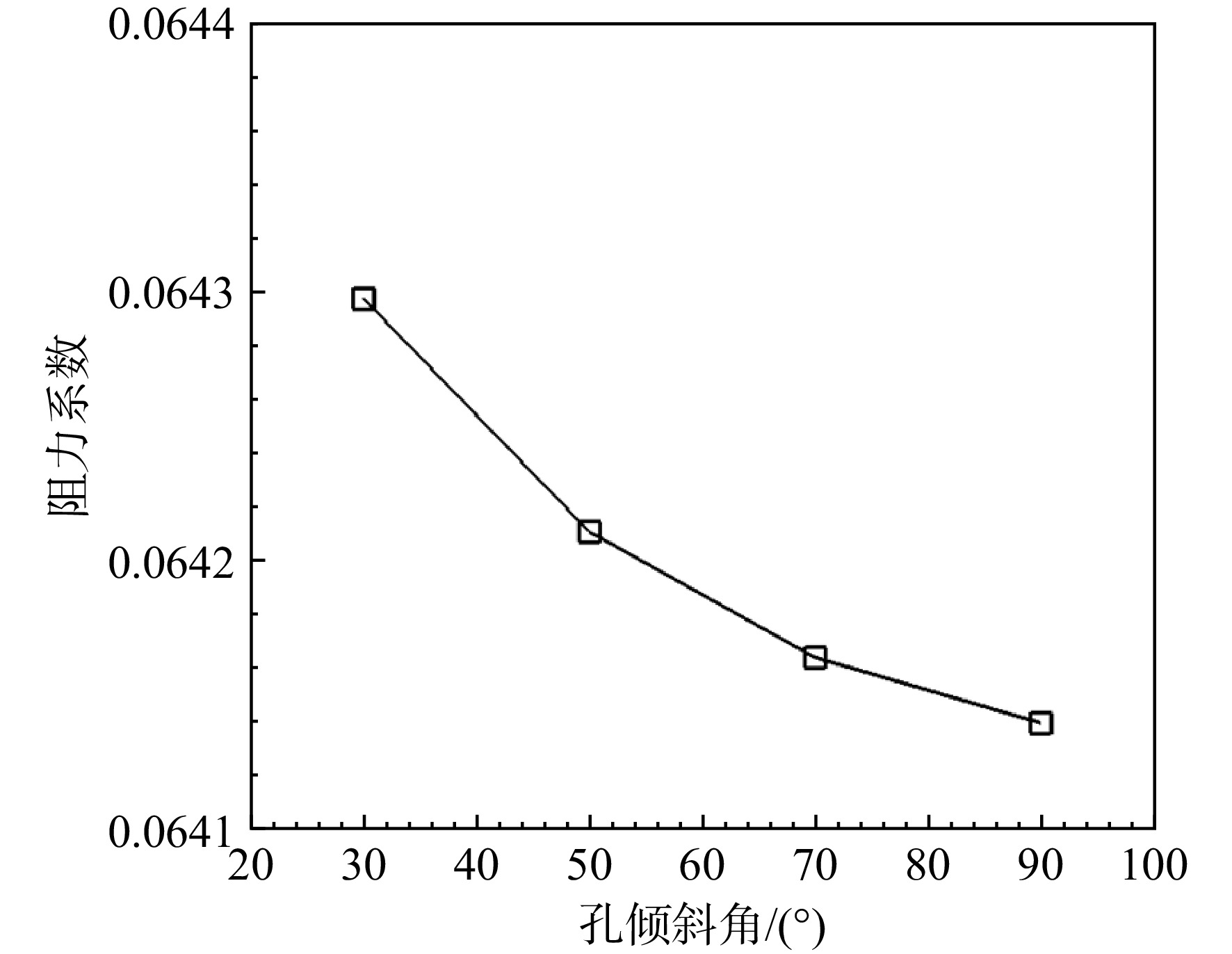
θ/(°) C ∆C/% u/(m/s) v/(m/s) δ/(°) 0 0.064587 30 0.064297 −0.45 768.31 478.66 31.92 50 0.064211 −0.58 750.96 512.18 34.29 70 0.064164 −0.66 621.75 580.23 43.02 90 0.064139 −0.69 571.57 591.35 45.97
下载: 导出CSV
表 8 不同开孔流向位置的减阻效果
Table 8. Rag reduction of different hole positions on flow direction
x/mm ∆C C/% 涡核位置x/mm 涡核位置y/mm 0 0.064587 b 0.064097 −0.76 2.81279 0.062699 b+25 0.064139 −0.69 2.83739 0.046927 b+50 0.064354 −0.36 2.79967 − 0.02857
下载: 导出CSV
表 9 不同开孔周向位置的减阻效果
Table 9. Rag reduction of different hole circumferential positions
周向位置 C ∆C/% u/(m/s) v/(m/s) δ/(°) 0 0.064587 上 0.06417 −0.65 606.11 −735.46 −50.51 下 0.064139 −0.69 571.57 591.35 45.97
下载: 导出CSV
表 10 不同开孔数量的减阻效果
Table 10. Rag reduction of different hole numbers
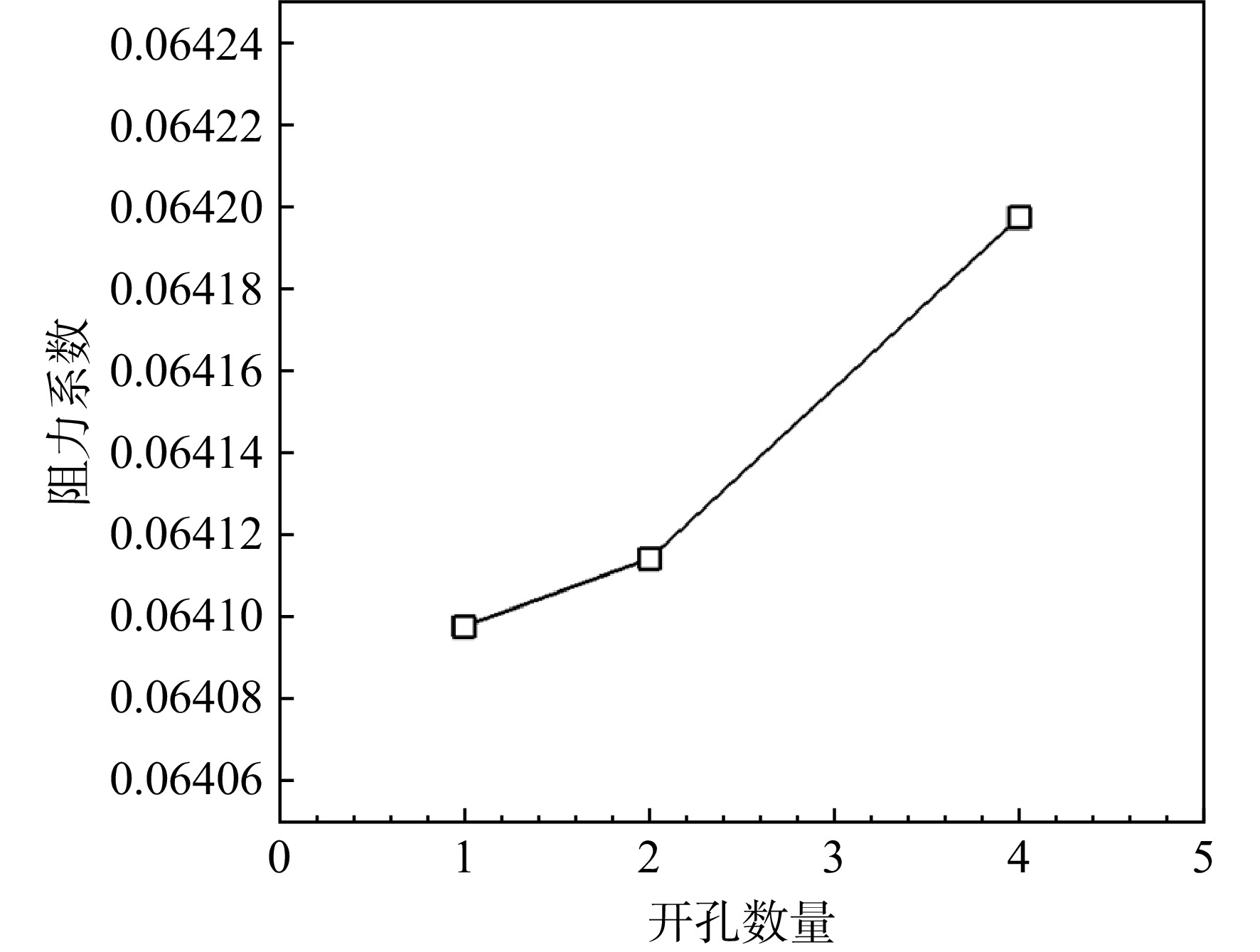
开孔数量 C ∆C/% Ck 0 0.064587 1 0.064097 −0.76 0.000338583 2 0.064114 −0.73 0.000660505 4 0.064197 −0.60 0.001362261
下载: 导出CSV
-
[1] 张帅. 高速飞行器防热减阻新概念构型的气动性能[J]. 航空动力学报, 2021, 36(11): 2292-2305. ZHANG Shuai. Aerodynamic performance of new conceptual configuration of high speed vehicle. s heat flux and drag reduction[J]. Journal of Aerospace Power, 2021, 36(11): 2292-2305. (in Chinese doi: 10.13224/j.cnki.jasp.20200477ZHANG Shuai. Aerodynamic performance of new conceptual configuration of high speed vehicle. s heat flux and drag reduction[J]. Journal of Aerospace Power, 2021, 36(11): 2292-2305. (in Chinese) doi: 10.13224/j.cnki.jasp.20200477 [2] 张帅. 高速稀薄流域防热减阻概念构型气动性能[J]. 航空动力学报, 2022, 37(1): 124-141. ZHANG Shuai. Conceptual configuration aerodynamic performance of heat flux and drag reduction in high speed rarefied flow[J]. Journal of Aerospace Power, 2022, 37(1): 124-141. (in Chinese doi: 10.13224/j.cnki.jasp.20200541ZHANG Shuai. Conceptual configuration aerodynamic performance of heat flux and drag reduction in high speed rarefied flow[J]. Journal of Aerospace Power, 2022, 37(1): 124-141. (in Chinese) doi: 10.13224/j.cnki.jasp.20200541 [3] 张帅, 郭建, 戴梧叶. 高速飞行器减阻杆槽道组合构型减阻防热特性研究[J]. 航空动力学报, 2023, 38(12): 3063-3072. ZHANG Shuai, GUO Jian, DAI Wuye. Investigation on drag and heat flux reduction induced by a novel combinational spike and channel concept for high speed vehicles[J]. Journal of Aerospace Power, 2023, 38(12): 3063-3072. (in ChineseZHANG Shuai, GUO Jian, DAI Wuye. Investigation on drag and heat flux reduction induced by a novel combinational spike and channel concept for high speed vehicles[J]. Journal of Aerospace Power, 2023, 38(12): 3063-3072. (in Chinese) [4] 张露, 李杰. 基于RANS/LES方法的超声速底部流场数值模拟[J]. 航空学报, 2017, 38(1): 120102. ZHANG Lu, LI Jie. Numerical simulations of supersonic base flow field based on RANS/LES approaches[J]. Acta Aeronautica et Astronautica Sinica, 2017, 38(1): 120102. (in ChineseZHANG Lu, LI Jie. Numerical simulations of supersonic base flow field based on RANS/LES approaches[J]. Acta Aeronautica et Astronautica Sinica, 2017, 38(1): 120102. (in Chinese) [5] 臧国才, 李树常. 弹箭空气动力学[M]. 北京: 兵器工业出版社, 1989. [6] 卓长飞, 武晓松, 封锋. 超声速流动中底部排气形式对减阻性能的影响[J]. 航空学报, 2014, 35(8): 2144-2155. ZHUO Changfei, WU Xiaosong, FENG Feng. Effect of base bleed type on drag reduction performance in supersonic flow[J]. Acta Aeronautica et Astronautica Sinica, 2014, 35(8): 2144-2155. (in ChineseZHUO Changfei, WU Xiaosong, FENG Feng. Effect of base bleed type on drag reduction performance in supersonic flow[J]. Acta Aeronautica et Astronautica Sinica, 2014, 35(8): 2144-2155. (in Chinese) [7] 李彪, 王良明, 杨志伟. 底凹结构减阻效应数值分析[J]. 北京航空航天大学学报, 2022, 48(4): 682-690. LI Biao, WANG Liangming, YANG Zhiwei. Numerical analysis on drag reduction effect of base cavity[J]. Journal of Beijing University of Aeronautics and Astronautics, 2022, 48(4): 682-690. (in Chinese doi: 10.13700/j.bh.1001-5965.2020.0623LI Biao, WANG Liangming, YANG Zhiwei. Numerical analysis on drag reduction effect of base cavity[J]. Journal of Beijing University of Aeronautics and Astronautics, 2022, 48(4): 682-690. (in Chinese) doi: 10.13700/j.bh.1001-5965.2020.0623 [8] 谷嘉锦. 底凹弹丸的风洞实验研究[J]. 南京航空航天大学学报, 1979, 11(1): 243-253. Gou Carkin. The study of wind tunnel experiments of a ball with hollow base[J]. Journal of Nanjing University of Aeronautics & Astronautics, 1979, 11(1): 243-253. (in ChineseGou Carkin. The study of wind tunnel experiments of a ball with hollow base[J]. Journal of Nanjing University of Aeronautics & Astronautics, 1979, 11(1): 243-253. (in Chinese) [9] KRUISWYK R W, DUTTON J C. Effects of a base cavity on subsonic near-wake flow[J]. AIAA Journal, 1990, 28(11): 1885-1893. doi: 10.2514/3.10495 [10] HERRIN J L, DUTTON J C. Supersonic base flow experiments in the near wake of a cylindrical afterbody[J]. AIAA Journal, 1994, 32(1): 77-83. doi: 10.2514/3.11953 [11] CLEMENTS R R. Computer models of separated flows behind two dimensional bluff bodies[D]. Cambridge, East of England, UK: University of Cambridge, 1973. [12] MOLEZZI M J, DUTTON J C. Study of subsonic base cavity flowfield structure using particle image velocimetry[J]. AIAA Journal, 1995, 33(2): 201-209. doi: 10.2514/3.12390 [13] KRUISWYK R, DUTTON J. An experimental investigation of the effects of a base cavity on thenear-wake flowfield of a body at subsonic and transonic speeds[C]//27th Aerospace Sciences Meeting. Reno, US: AIAA, 2013: 67-77. [14] 陆海波, 颛孙世周, 孙凤文, 等. 不同形状底凹结构对火炮弹丸飞行阻力影响研究[J]. 弹箭与制导学报, 2016, 36(5): 112-114, 141. LU Haibo, ZHUANSUN Shizhou, SUN Fengwen, et al. Research on influence of base cavity with different shape on aerodynamic drag of projectile[J]. Journal of Projectiles, Rockets, Missiles and Guidance, 2016, 36(5): 112-114, 141. (in Chinese doi: 10.15892/j.cnki.djzdxb.2016.05.029LU Haibo, ZHUANSUN Shizhou, SUN Fengwen, et al. Research on influence of base cavity with different shape on aerodynamic drag of projectile[J]. Journal of Projectiles, Rockets, Missiles and Guidance, 2016, 36(5): 112-114, 141. (in Chinese) doi: 10.15892/j.cnki.djzdxb.2016.05.029 [15] 陆海波, 崔国亮, 张海涛, 等. 火炮弹丸底凹结构流场仿真及其减阻机理分析[J]. 兵器装备工程学报, 2016, 37(9): 1-4, 31. LU Haibo, CUI Guoliang, ZHANG Haitao, et al. Flow field simulation and drag reducing mechanism analysis of projectile with base cavity[J]. Journal of Ordnance Equipment Engineering, 2016, 37(9): 1-4, 31. (in ChineseLU Haibo, CUI Guoliang, ZHANG Haitao, et al. Flow field simulation and drag reducing mechanism analysis of projectile with base cavity[J]. Journal of Ordnance Equipment Engineering, 2016, 37(9): 1-4, 31. (in Chinese) [16] 陆海波, 高洁. 侧倾底凹结构对火炮弹丸阻力的影响[J]. 兵器装备工程学报, 2019, 40(6): 5-9. LU Haibo, GAO Jie. Research on shrinkage shape of base cavity upon aerodynamic drag of projectile[J]. Journal of Ordnance Equipment Engineering, 2019, 40(6): 5-9. (in ChineseLU Haibo, GAO Jie. Research on shrinkage shape of base cavity upon aerodynamic drag of projectile[J]. Journal of Ordnance Equipment Engineering, 2019, 40(6): 5-9. (in Chinese) [17] 王中原. 底凹弹侧壁斜孔减小底阻分析[J]. 南京理工大学学报, 1997, 21(1): 17-20. WANG Zhongyuan. Analysis of base drag reduced by side holes in the projectile with base cavity[J]. Journal of Nanjing University of Science and Technology, 1997, 21(1): 17-20. (in Chinese doi: 10.14177/j.cnki.32-1397n.1997.01.005WANG Zhongyuan. Analysis of base drag reduced by side holes in the projectile with base cavity[J]. Journal of Nanjing University of Science and Technology, 1997, 21(1): 17-20. (in Chinese) doi: 10.14177/j.cnki.32-1397n.1997.01.005 [18] 鞠玉涛, 周长省, 李坚. 底凹弹绕流流场波谱规律数值分析[J]. 弹箭与制导学报, 2003, 23(增刊4): 144-146. JU Yutao, ZHOU Changsheng, LI Jian. Numerical analysis of wave spectrum law of flow field around concave projectile[J]. Journal of Projectiles, Rockets, Missiles and Guidance, 2003, 23(Suppl.4): 144-146. (in Chinese doi: 10.15892/j.cnki.djzdxb.2003.s4.012JU Yutao, ZHOU Changsheng, LI Jian. Numerical analysis of wave spectrum law of flow field around concave projectile[J]. Journal of Projectiles, Rockets, Missiles and Guidance, 2003, 23(Suppl.4): 144-146. (in Chinese) doi: 10.15892/j.cnki.djzdxb.2003.s4.012 [19] 王芳, 郎田, 魏志芳. 底凹装置对弹丸阻力系数的影响[J]. 兵工自动化, 2014, 33(11): 1-3, 13. WANG Fang, LANG Tian, WEI Zhifang. Effect of base cavity to projectile drag coefficient[J]. Ordnance Industry Automation, 2014, 33(11): 1-3, 13. (in ChineseWANG Fang, LANG Tian, WEI Zhifang. Effect of base cavity to projectile drag coefficient[J]. Ordnance Industry Automation, 2014, 33(11): 1-3, 13. (in Chinese) [20] 朱安迪, 成佳敏, 陆毅, 等. 轨道炮高速动能射弹的底凹减阻特性研究[J]. 科技与创新, 2020(23): 32-34, 39. ZHU Andi, CHENG Jiamin, LU Yi, et al. Study on drag reduction characteristics of rail Gun high-speed kinetic energy projectile with concave bottom[J]. Science and Technology & Innovation, 2020(23): 32-34, 39. (in Chinese doi: 10.15913/j.cnki.kjycx.2020.23.012ZHU Andi, CHENG Jiamin, LU Yi, et al. Study on drag reduction characteristics of rail Gun high-speed kinetic energy projectile with concave bottom[J]. Science and Technology & Innovation, 2020(23): 32-34, 39. (in Chinese) doi: 10.15913/j.cnki.kjycx.2020.23.012 [21] 轩海彬, 张文洁, 于勇, 等. 亚跨声速流动中底凹减阻的数值模拟[J]. 兵器装备工程学报, 2017, 38(11): 1-8. XUAN Haibin, ZHANG Wenjie, YU Yong, et al. Numerical study on drag reduction of projectile in subsonic and transonic speed[J]. Journal of Ordnance Equipment Engineering, 2017, 38(11): 1-8. (in ChineseXUAN Haibin, ZHANG Wenjie, YU Yong, et al. Numerical study on drag reduction of projectile in subsonic and transonic speed[J]. Journal of Ordnance Equipment Engineering, 2017, 38(11): 1-8. (in Chinese) -



 点击查看大图

计量
- 文章访问数: 1273
- HTML浏览量: 563
- PDF量: 50
- 被引次数: 0