






Modeling approach for turbofan engines based on intelligent multi-feature extraction and interval type-2 fuzzy sets
-
摘要:
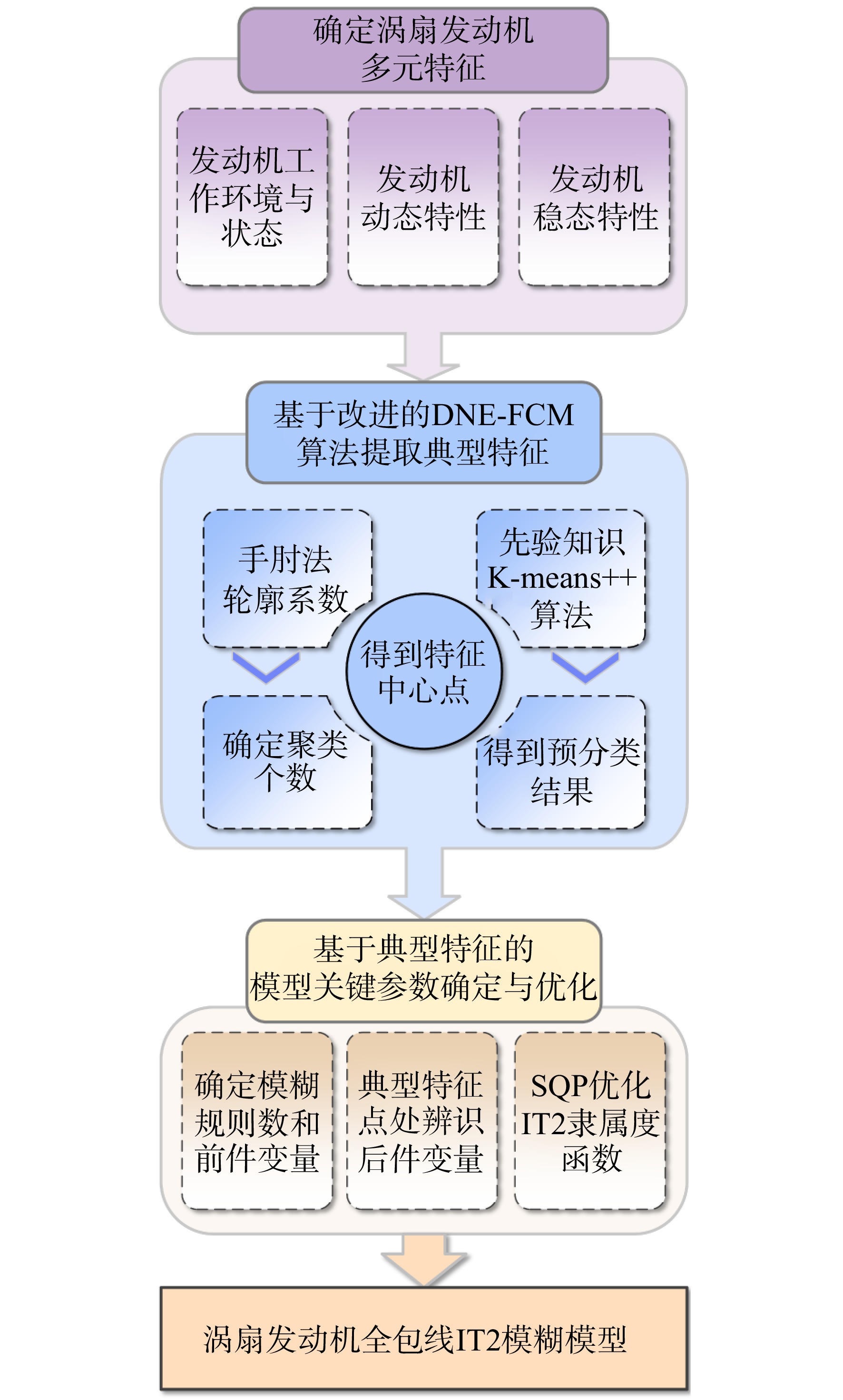
考虑涡扇发动机在包线内大范围工况变化下的强非线性、强不确定性特点,提出一种基于多元特征智能提取的涡扇发动机全包线区间二型(IT2)模糊模型建模方法。设计并提取涡扇发动机全包线多元特征参数,利用改进的判别邻域嵌入算法(IDNE)对多元特征参数降维处理,并结合模糊C均值算法(FCM)求取典型特征,避免传统聚类算法在高维空间失效。在典型特征点处辨识模糊规则后件变量模型。优化获得IT2型隶属度函数,提高存在不确定性时模糊模型精度,最终建立了小涵道比涡扇发动机IT2模糊模型。开展了全包线内模型性能验证,结果表明IT2模糊模型与部件级模型输出相比,平均方均根误差(ARMSE)小于0.20%,具有较高精度;在退化等不确定性作用下,IT2模糊模型精度变化小于0.05%,显著优于一型模糊模型,具有更强的不确定性表征能力;IT2模糊模型单次计算平均耗时为3.9 ms,具有良好的实时性。
-
关键词:
- 涡扇发动机 /
- 区间二型模糊模型 /
- 特征参数提取 /
- 改进判别邻域嵌入算法 /
- 模糊C均值算法
Abstract:Considering turbofan engine’s strong nonlinearity and significant uncertainty within wide operational ranges, a new modeling approach for turbofan engines in the full flight envelope was proposed based on multi-feature extraction and interval type-2 (IT2) fuzzy sets. The engine multi-feature parameters were designed and extracted. To avoid the failure of traditional clustering algorithms in high-dimensional spaces, an improved discriminant neighborhood embedding algorithm (IDNE) was developed for dimensionality reduction of multi-feature parameters and collaborated with the fuzzy C-means algorithm (FCM) to extract the typical features. The consequent models were identified at typical feature points. The IT2 membership functions were optimized to improve the accuracy of the fuzzy model under uncertainty. Finally, an IT2 fuzzy model for a low bypass ratio turbofan engine was established. Model performance within the flight envelope was validated. The results showed that the model had high accuracy as the average root mean square error (ARMSE) was less than 0.20%. Under degradation uncertainties, the IT2 fuzzy model’s accuracy variation was less than 0.05%, significantly better than the type-1 fuzzy model, which showed a better uncertainty representation capability. The resulting model demonstrated an excellent real-time performance with around 3.9 ms for its average computation time per instance.
-
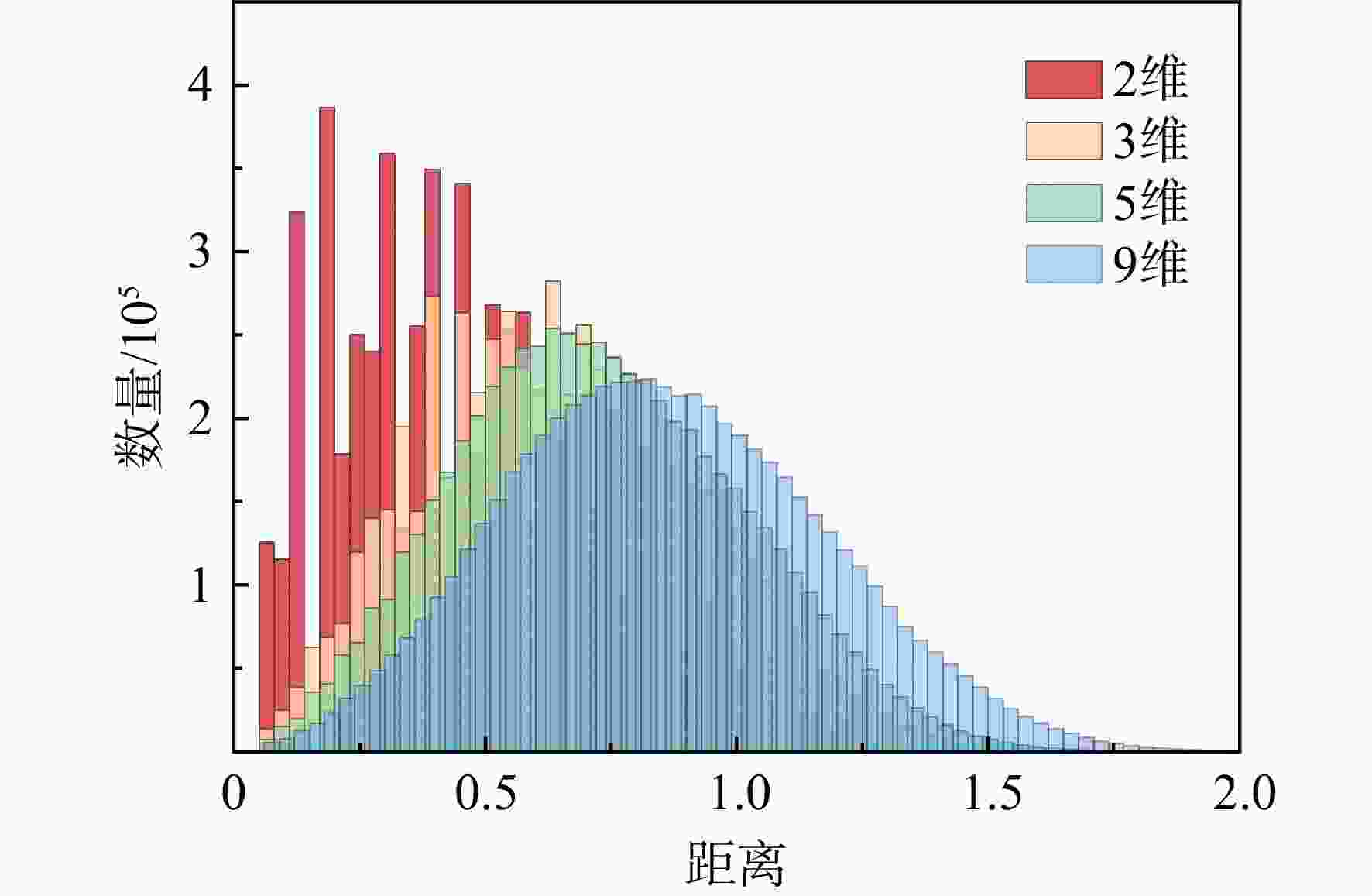
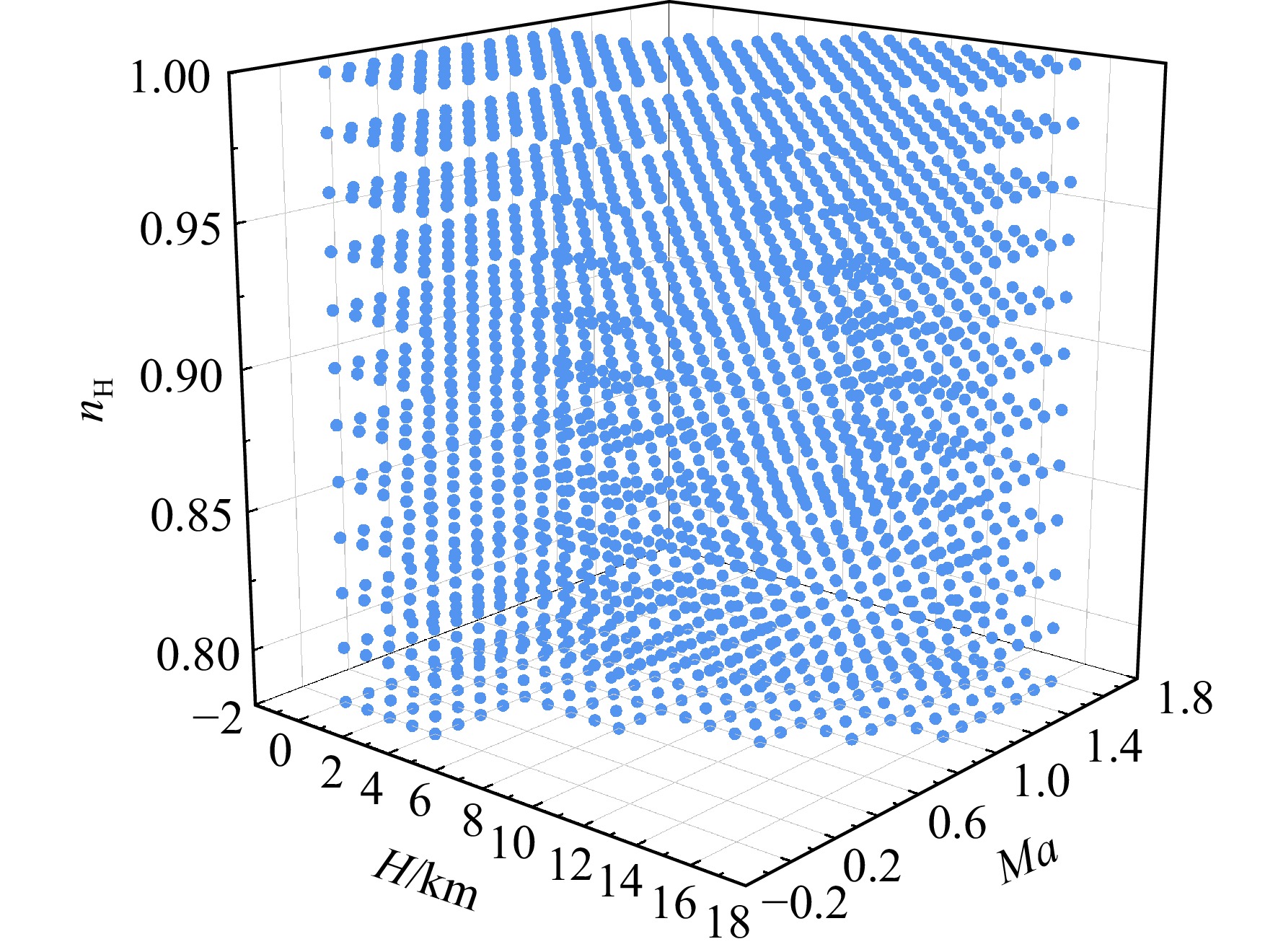
图 4 不同维度多元特征点间的距离分布
Figure 4. Distribution of distances between multi-feature parameters with different dimensions
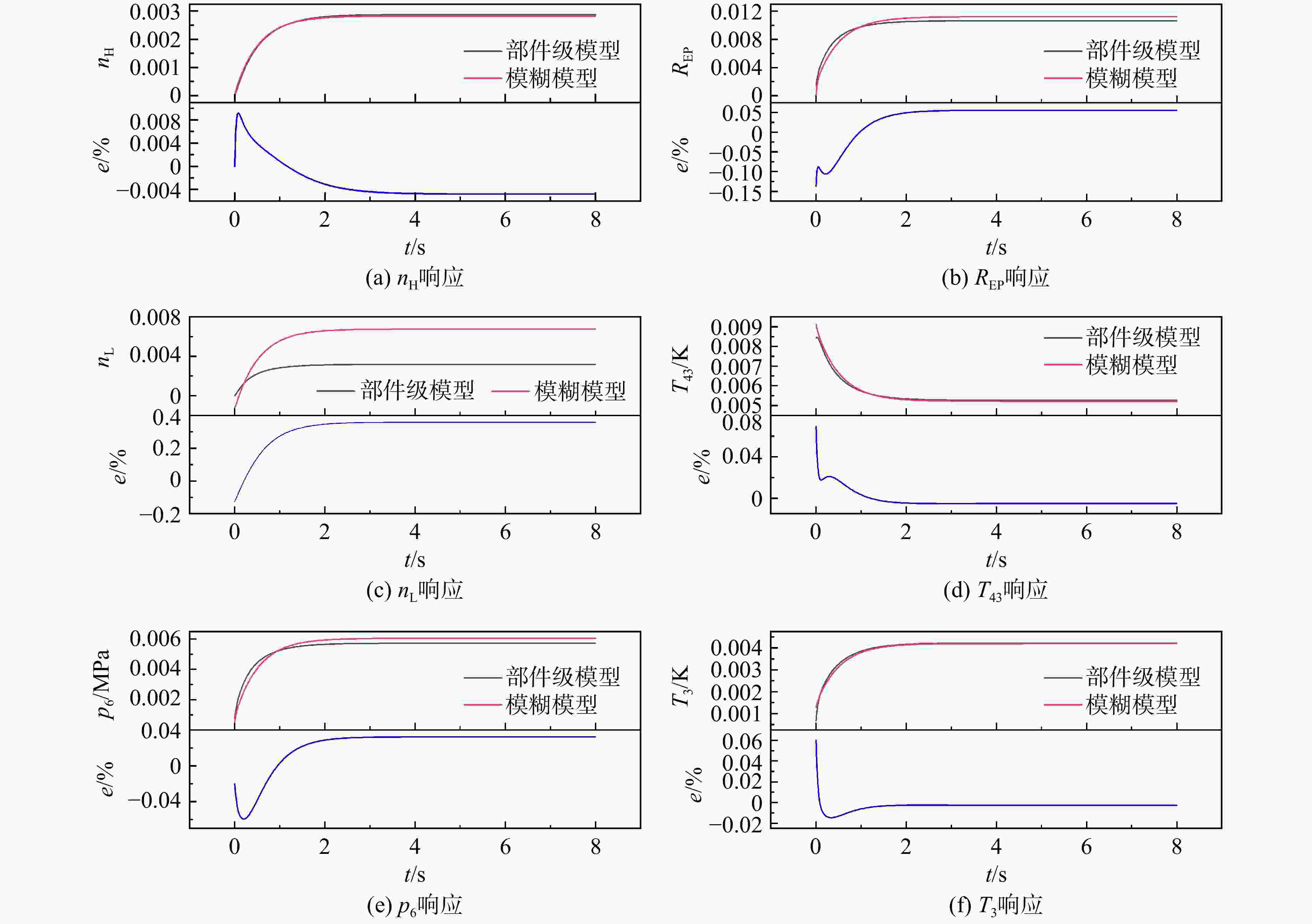
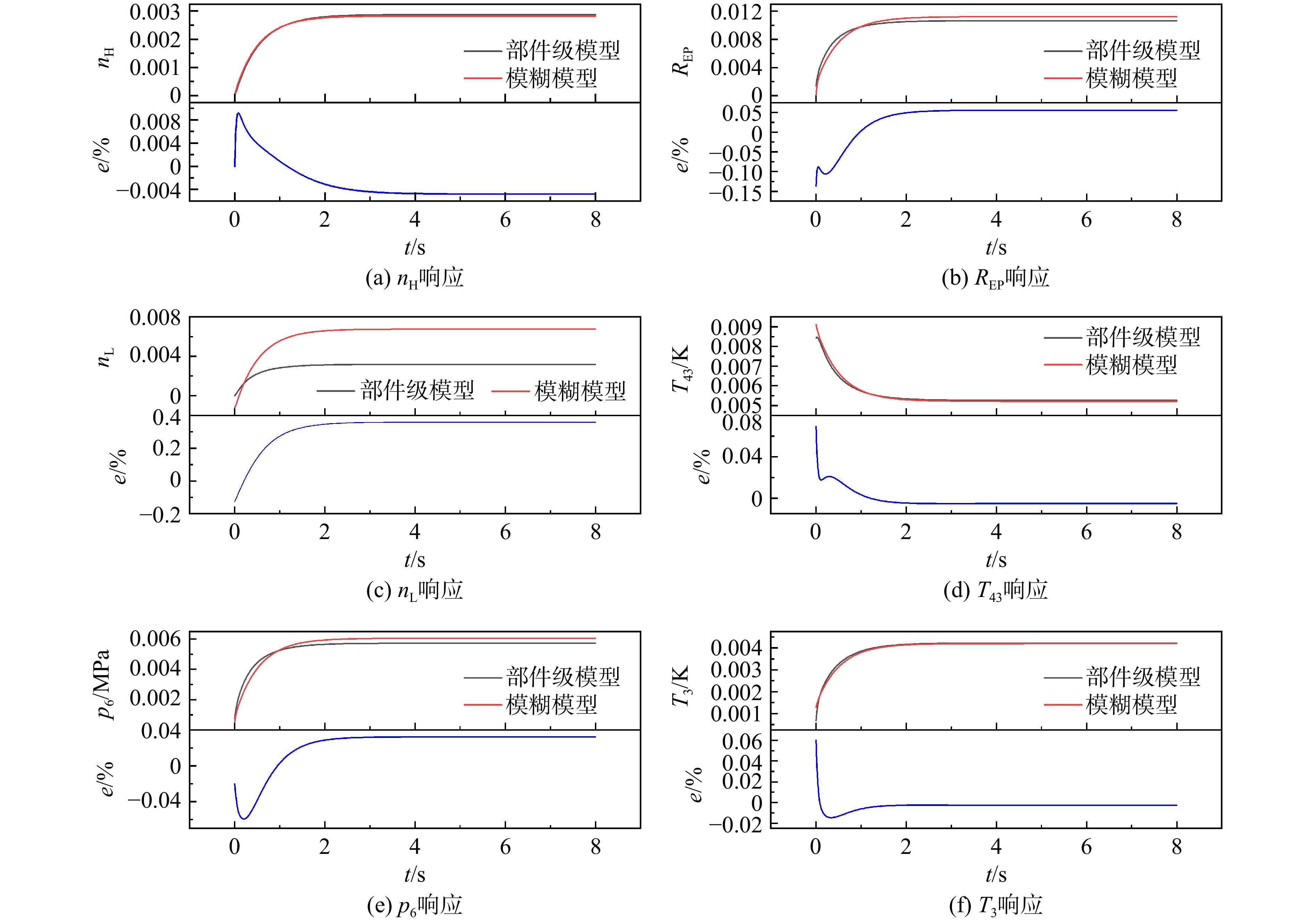
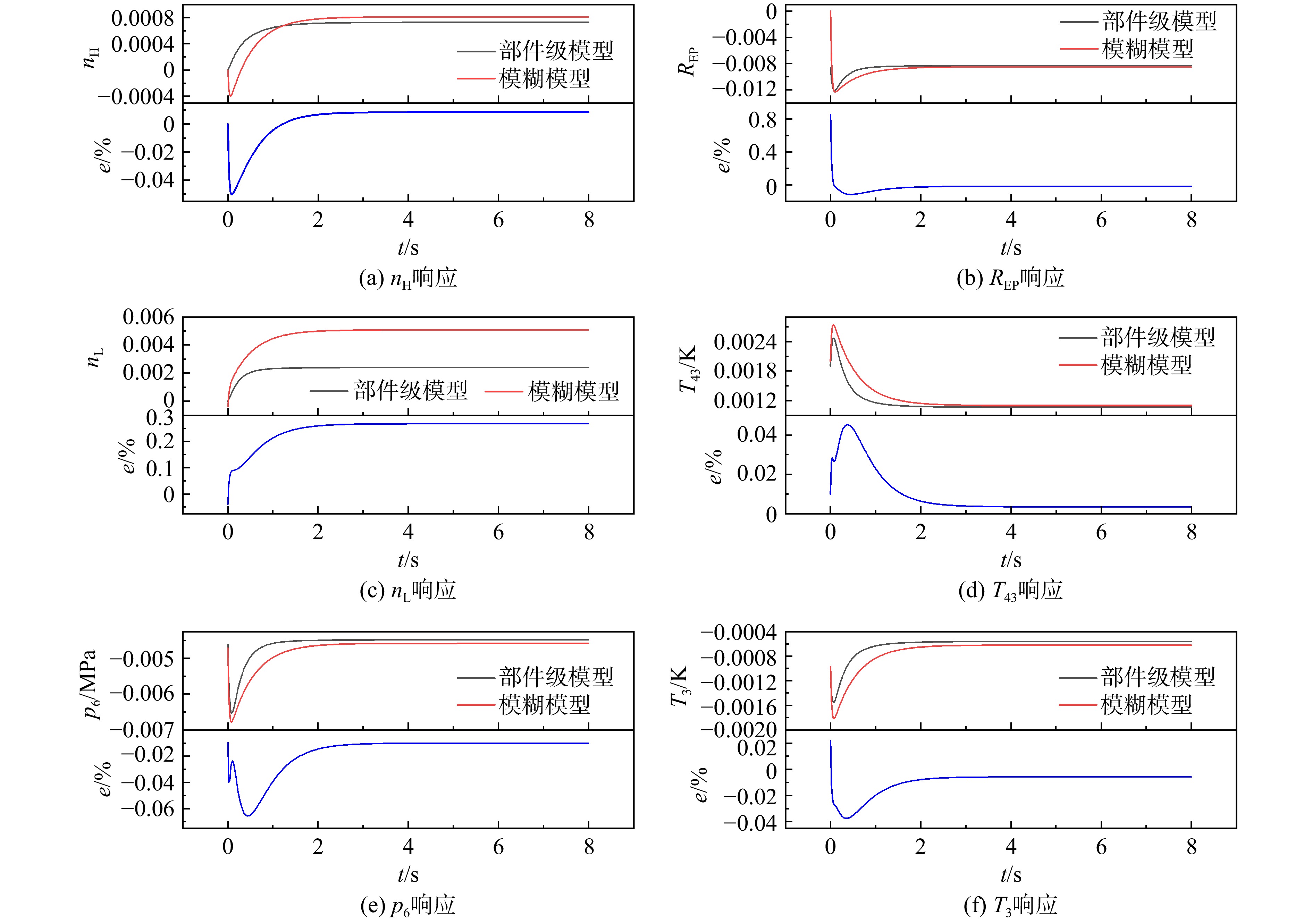
图 10 $ H $=11 km,$ Ma $=1.2,$ {n}_{\mathrm{H}} $=94%,$ {W}_{\mathrm{fb}} $做2%阶跃响应
Figure 10. Responses on $ H $=11 km,$ Ma $=1.2,$ {n}_{\mathrm{H}} $=94% with 2% $ {W}_{\mathrm{fb}} $ step
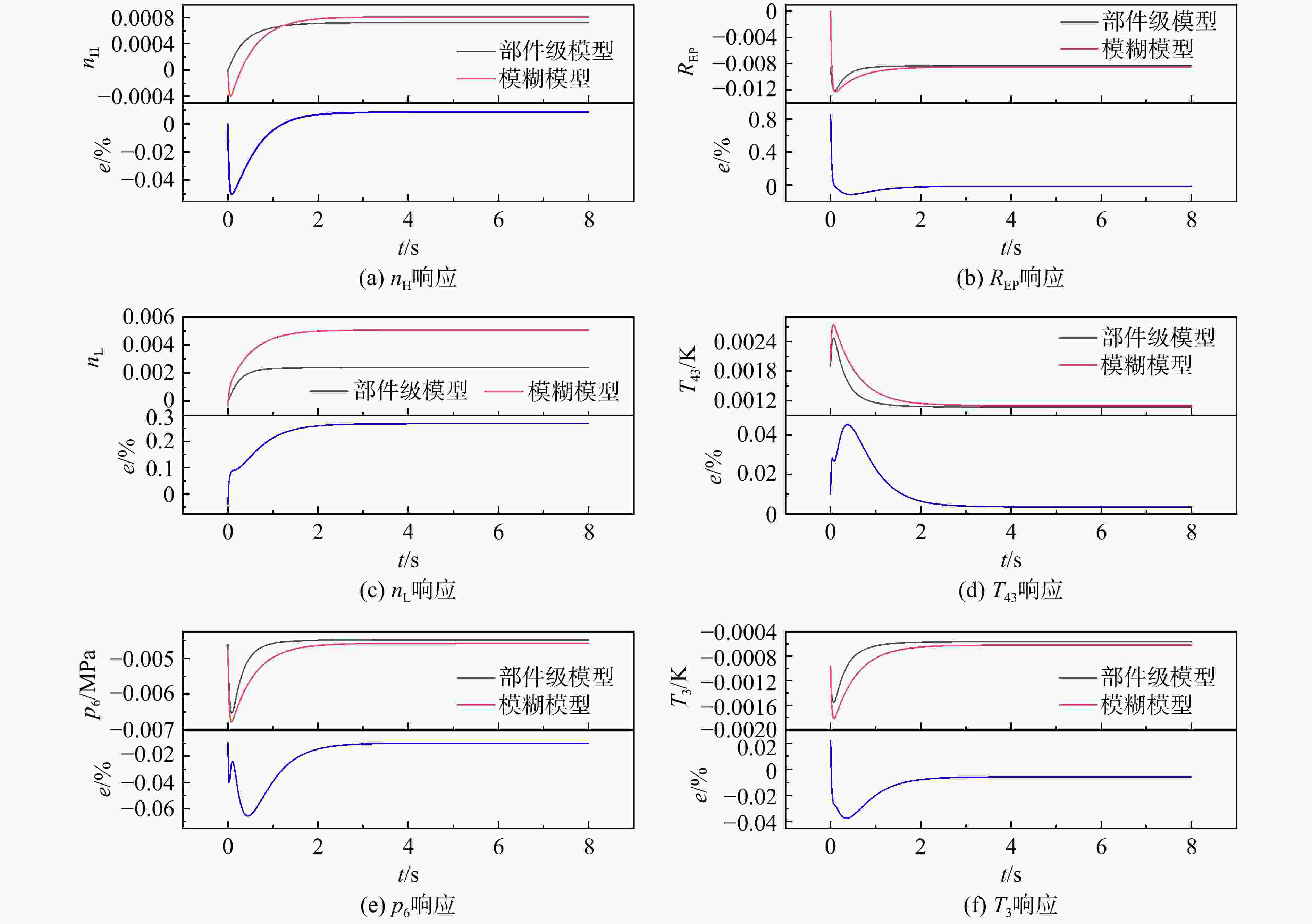
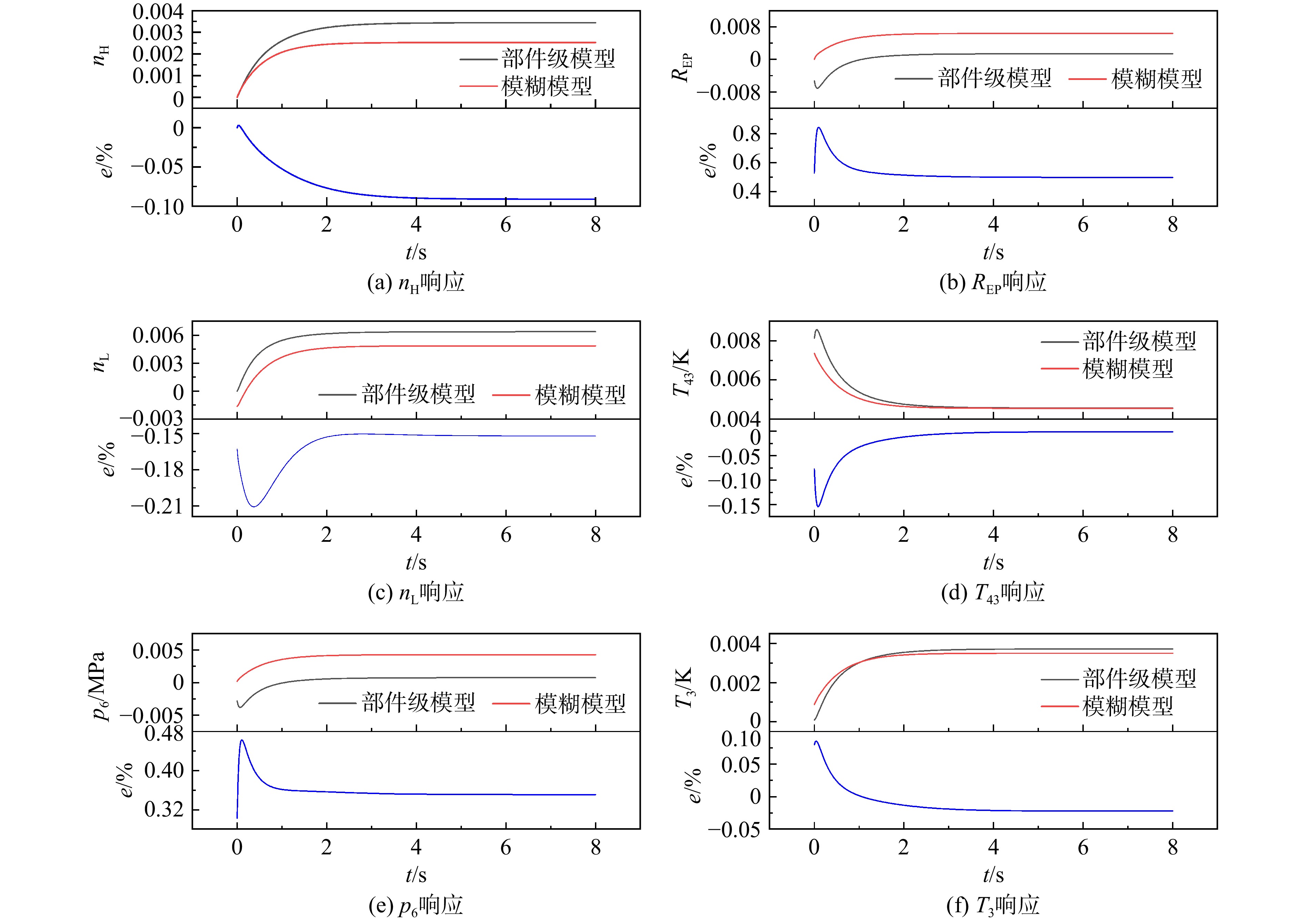
图 11 $ H $=11 km,$ Ma $=1.2,$ {n}_{\mathrm{H}} $=94%,$ {A}_{8} $做2%阶跃响应
Figure 11. Responses on $ H $=11 km,$ Ma $=1.2,$ {n}_{\mathrm{H}} $=94% with 2% $ {A}_{8} $ step
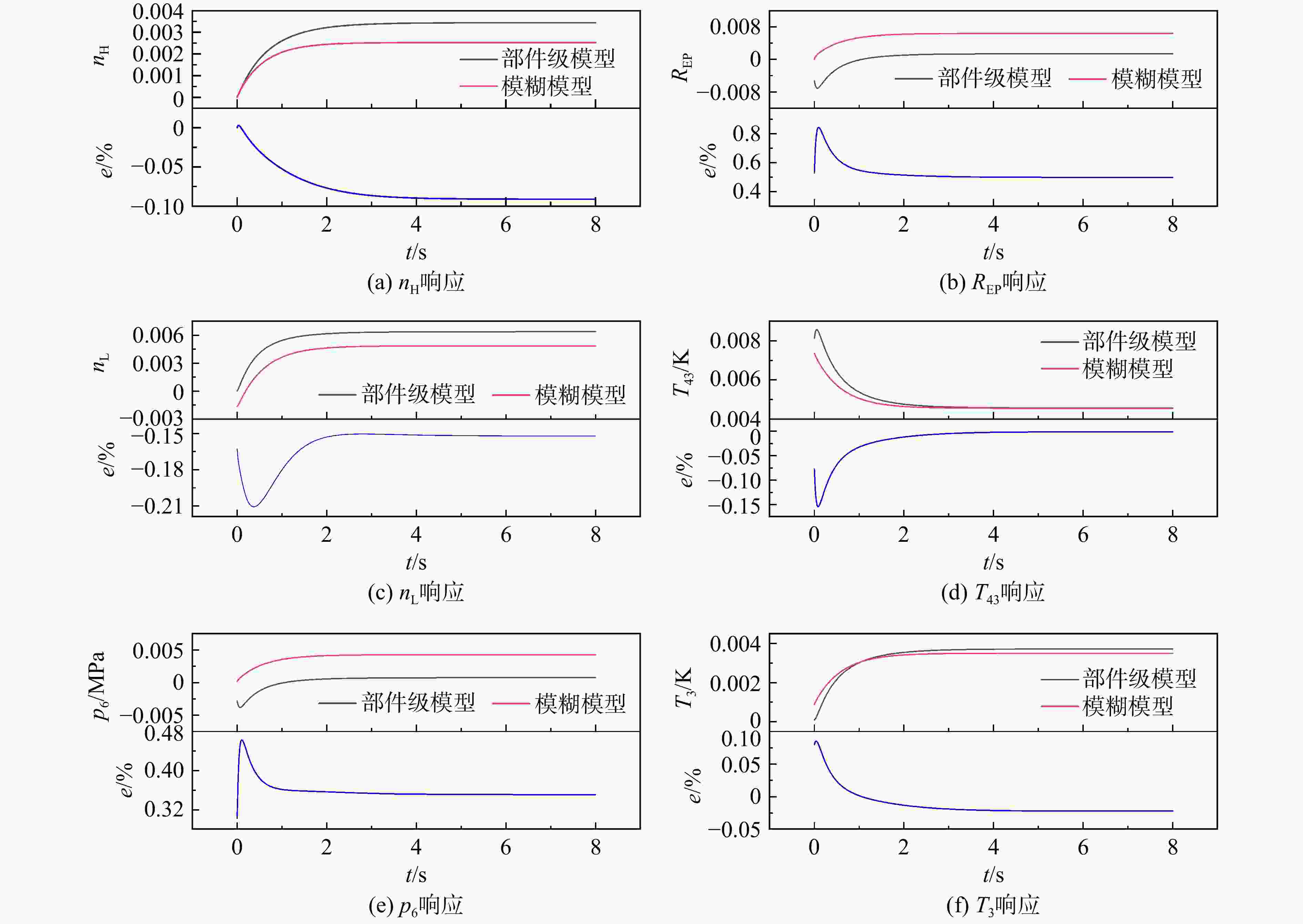
图 12 $ H $=8 km,$ Ma $=0.8,$ {n}_{\mathrm{H}} $=84%,$ {W}_{\mathrm{fb}} $和$ {A}_{8} $做2%阶跃响应
Figure 12. Responses on $ H $=8 km, $ Ma $=0.8, $ {n}_{\mathrm{H}} $=84% with 2% $ {W}_{\mathrm{fb}} $ and $ {A}_{8} $ step
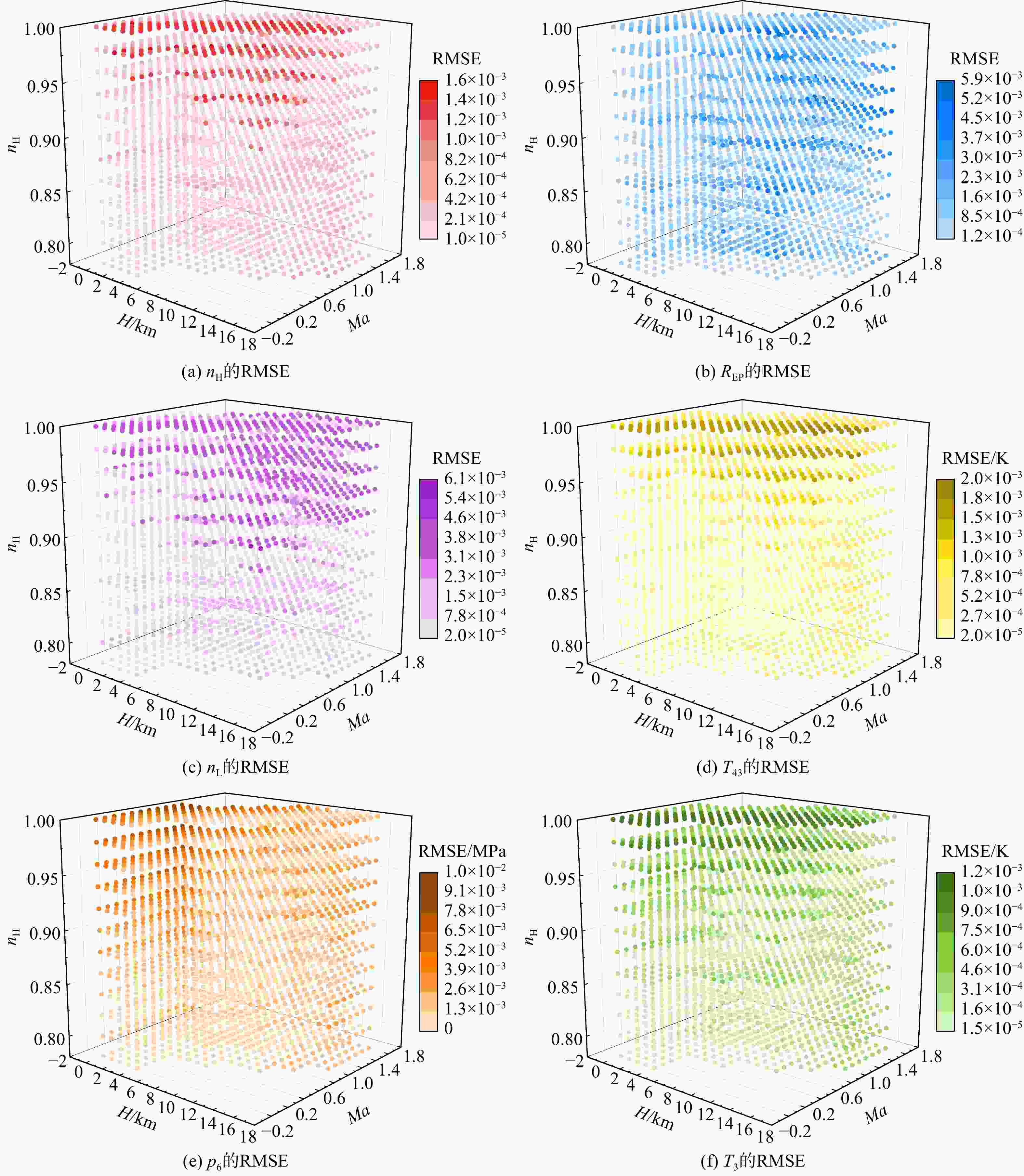
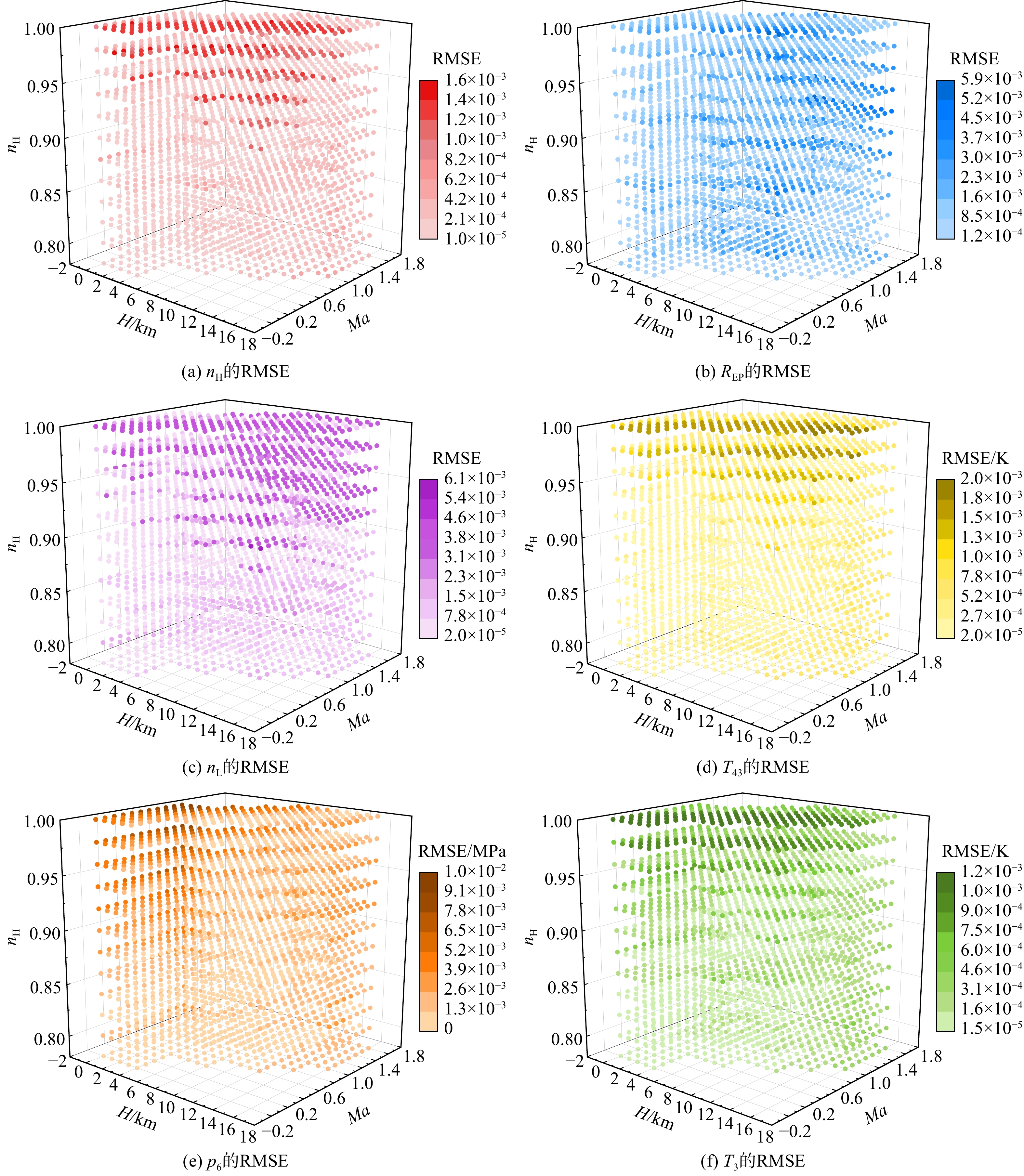
图 13 $ {W}_{\mathrm{fb}} $做2%阶跃响应各输出全包线的RMSE
Figure 13. Full envelope RMSE of responses with 2% $ {W}_{\mathrm{fb}} $ step
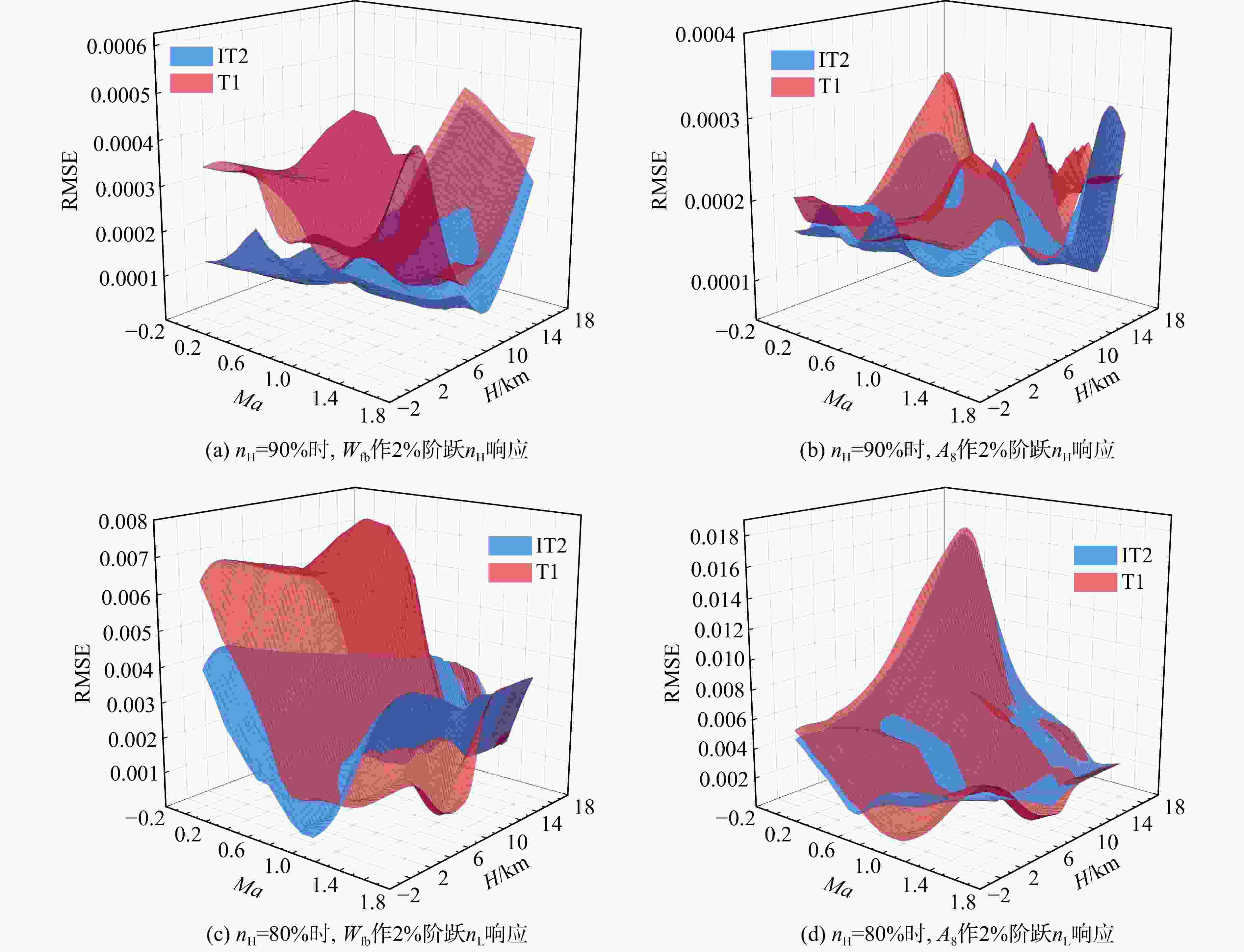
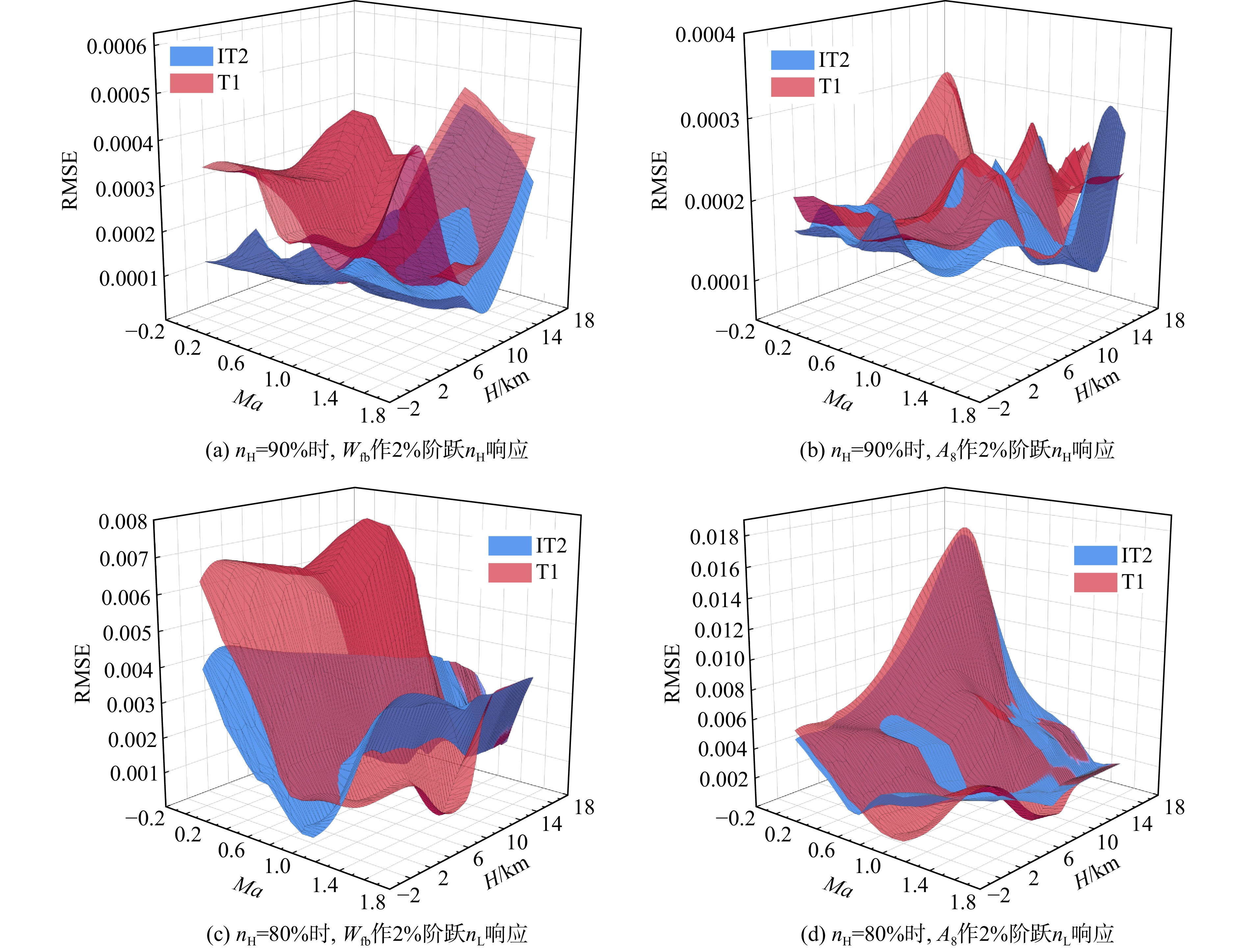
图 14 $ {A}_{8} $和$ {W}_{\mathrm{fb}} $做2%阶跃响应模糊模型输出RMSE对比
Figure 14. Fuzzy model output RMSE comparison with 2% $ {A}_{8} $ and $ {W}_{\mathrm{fb}} $ step
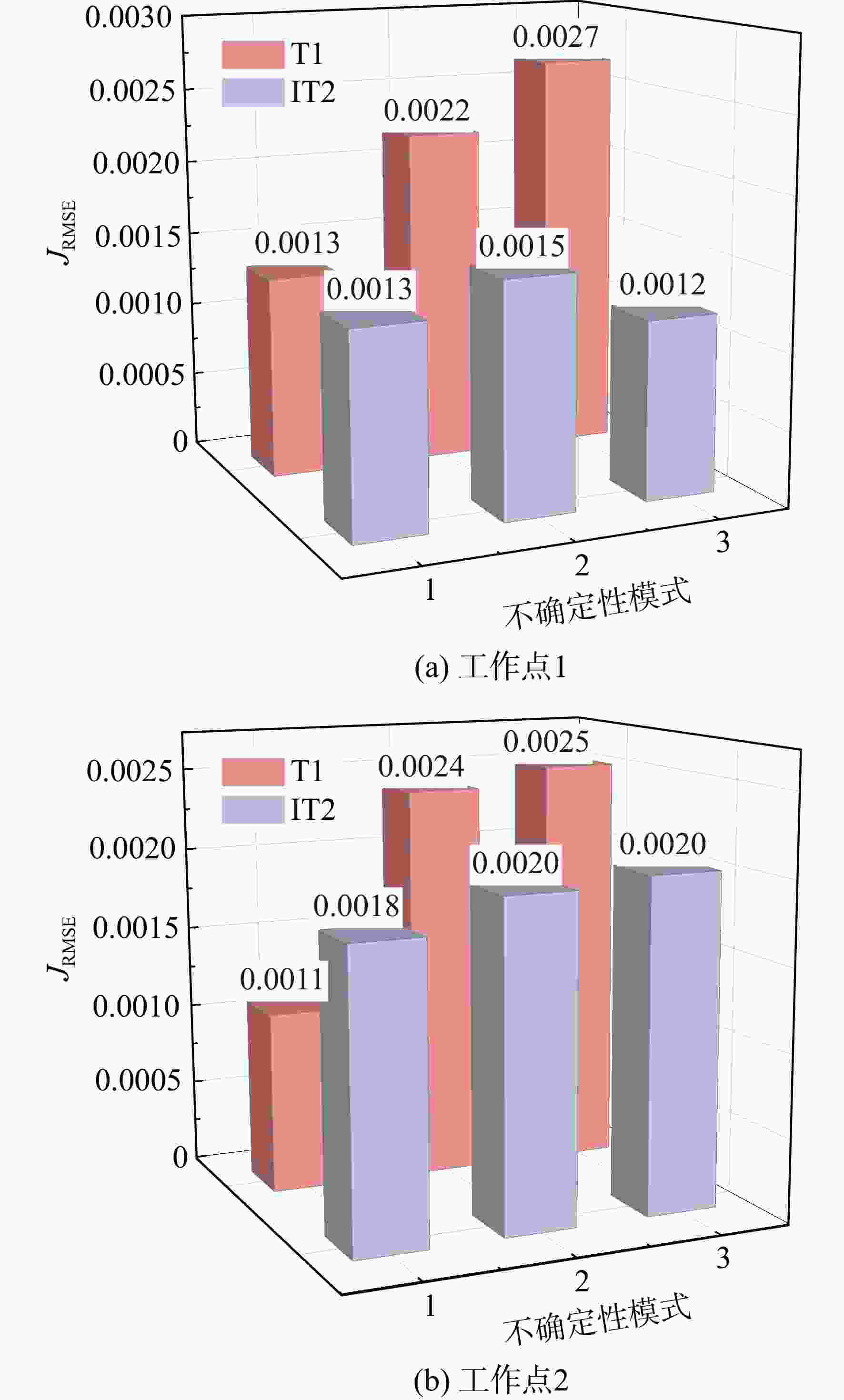
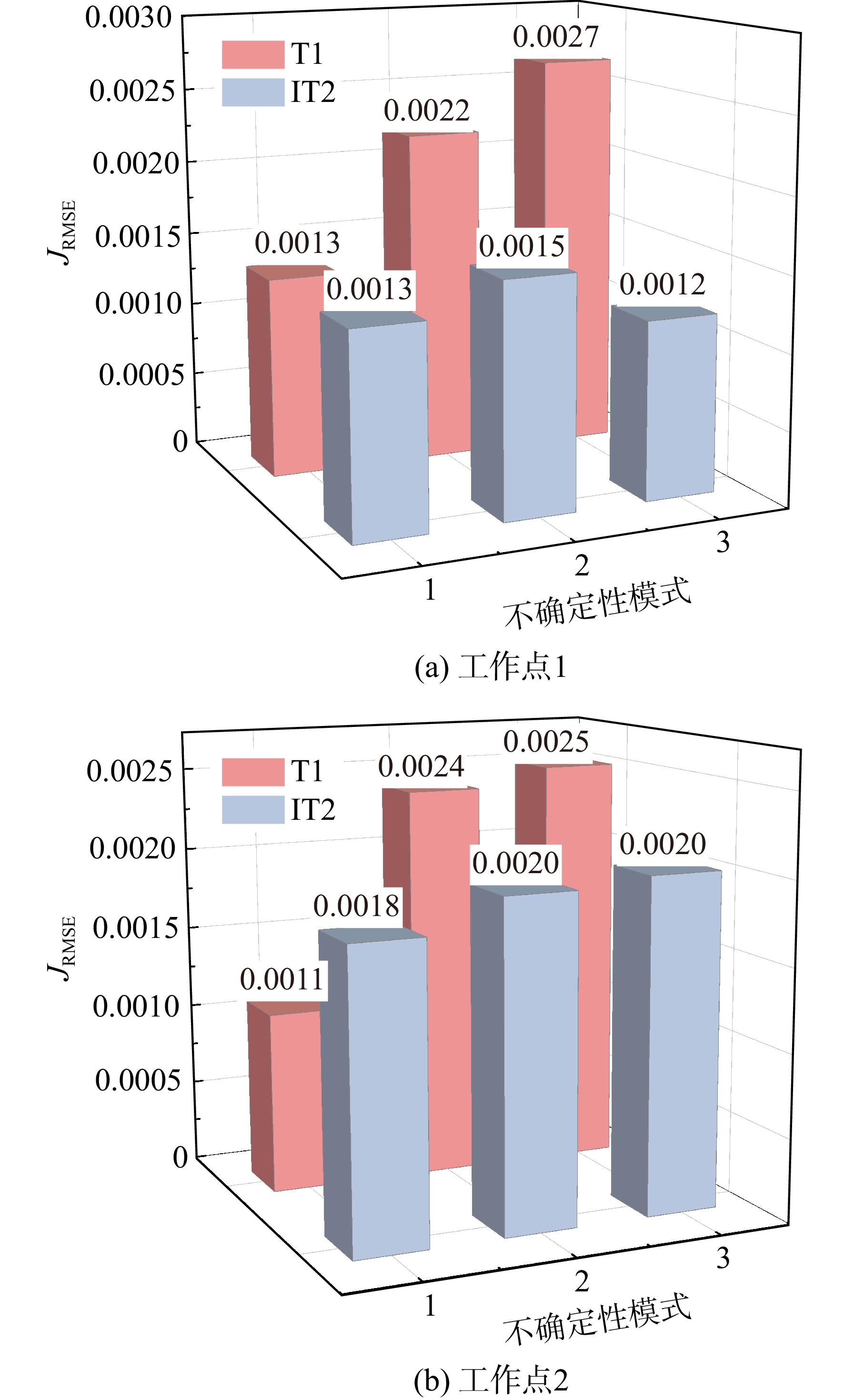
图 15 不同不确定性模式下模糊模型的$ {J}_{\text{RMSE}} $
Figure 15. Fuzzy model $ {J}_{\text{RMSE}} $ of different uncertainty modes
$ \boldsymbol {\psi } $ 前件变量 $ \tau $ 作用力设计参数 $ {\boldsymbol {M}}_{i} $ 第i条规则对应的前件区间二型模糊集合 $ \rho $ 多元参数间的距离 $ \boldsymbol {x} $ 系统状态变量 $ {\lambda }_{i} $ P矩阵第i个列向量对应的拉格朗日乘子 $ \boldsymbol {u} $ 系统控制变量 $ \boldsymbol {F} $ 作用力矩阵 $ \boldsymbol {y} $ 系统输出变量 $ \boldsymbol {S} $ 求和后对角作用力矩阵 $ {f}_{\text{UMF}} $ 上隶属度函数 $ {\boldsymbol {P}}^{*} $ 最优转换矩阵 $ {f}_{\text{LMF}} $ 下隶属度函数 $ s $ 转换前特征参数维度 $ {f}_{\text{EFS}} $ 嵌入T1模糊集 $ d $ 转换后特征参数维度 $ {h}_{i} $ 第$ i $条规则的激活强度 $ {N}_{\text{C}} $ 聚类个数 $ {\underline{\mu }}_{j,i} $ 第$ i $条规则的第$ j $个前件变量的下隶属度函数 $ \boldsymbol {U} $ 隶属度矩阵 $ {\overline{\mu }}_{j,i} $ 第$ i $条规则的第$ j $个前件变量的上隶属度函数 $ \boldsymbol {V} $ 聚类中心点的集合 $ {\delta }_{j,i} $ 第$ i $条规则的第$ j $个前件变量的隶属度设计参数 $ m $ 模糊权重系数 $ H $ 高度 $ {E}_{\text{SS}} $ 误差平方和(SSE) $ Ma $ 马赫数 $ {{\boldsymbol{\varTheta }}}_{\text{C}i} $ 第i类的聚类中心点 $ {n}_{\mathrm{H}} $ 高压转速 $ {\kappa }_{\text{SC}} $ 轮廓系数 $ {\lambda }_{\mathrm{R}} $ 主导极点的实部 $ \overline{{E}_{\text{RMS}}} $ 平均方均根误差(ARMSE) $ {\lambda }_{\mathrm{I}} $ 主导极点的虚部 $ {R}_{\text{EP}} $ 发动机落压比(EPR) $ \boldsymbol {K} $ 系统稳态增益矩阵 $ {W}_{\mathrm{fb}} $ 主燃油流量 $ {\boldsymbol{\varTheta }} $ 多元特征参数 $ {A}_{8} $ 尾喷口喉道面积 $ \boldsymbol {P} $ DNE算法转换矩阵 $ {n}_{\mathrm{L}} $ 低压转子转速 $ \Delta (\boldsymbol {P}) $ 类内紧度 $ {T}_{43} $ 涡轮间总温 $ \delta (\boldsymbol {P}) $ 类间散度 $ {p}_{6} $ 低压涡轮出口总压 $ {f}_{ij} $ 第i个和第j个特征参数之间的作用力 $ {T}_{3} $ 压气机出口总温  下载: 导出CSV
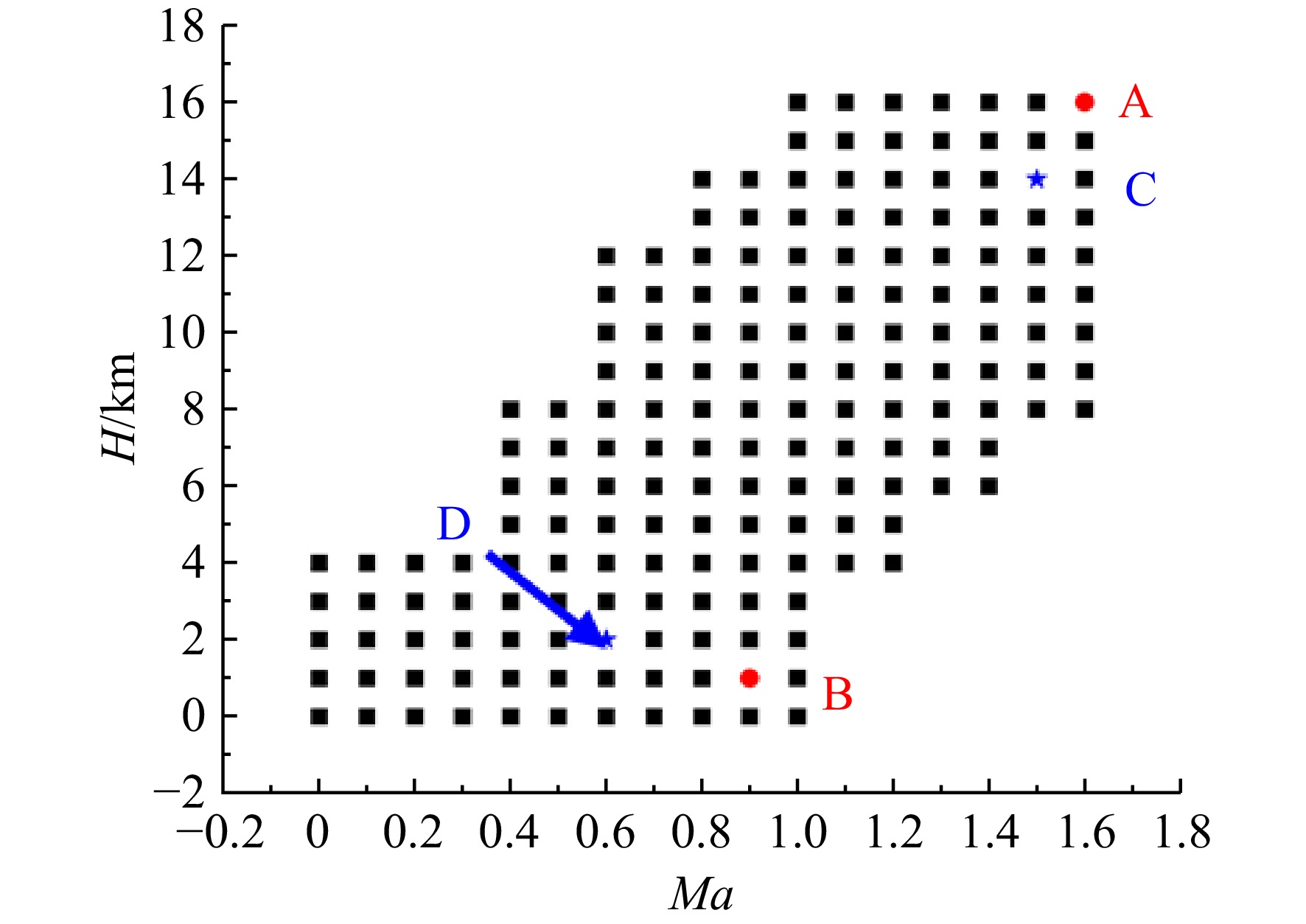
表 1 工作点A和工作点B动态特性对比
Table 1. Comparison of dynamic characteristic between operating points A and B
工作点 $ {\lambda }_{\mathrm{R}} $ $ {\lambda }_{\mathrm{I}} $ A 1.79 0 B 1.78 0
下载: 导出CSV
表 2 工作点C和工作点D稳态特性对比
Table 2. Comparison of steady-state characteristics between operating points C and D
工作点 $ {k}_{11} $ $ {k}_{12} $ $ {k}_{21} $ $ {k}_{22} $ C 7.74 5.66 −4.05 −2.79 D 7.74 5.66 −4.18 −2.78
下载: 导出CSV
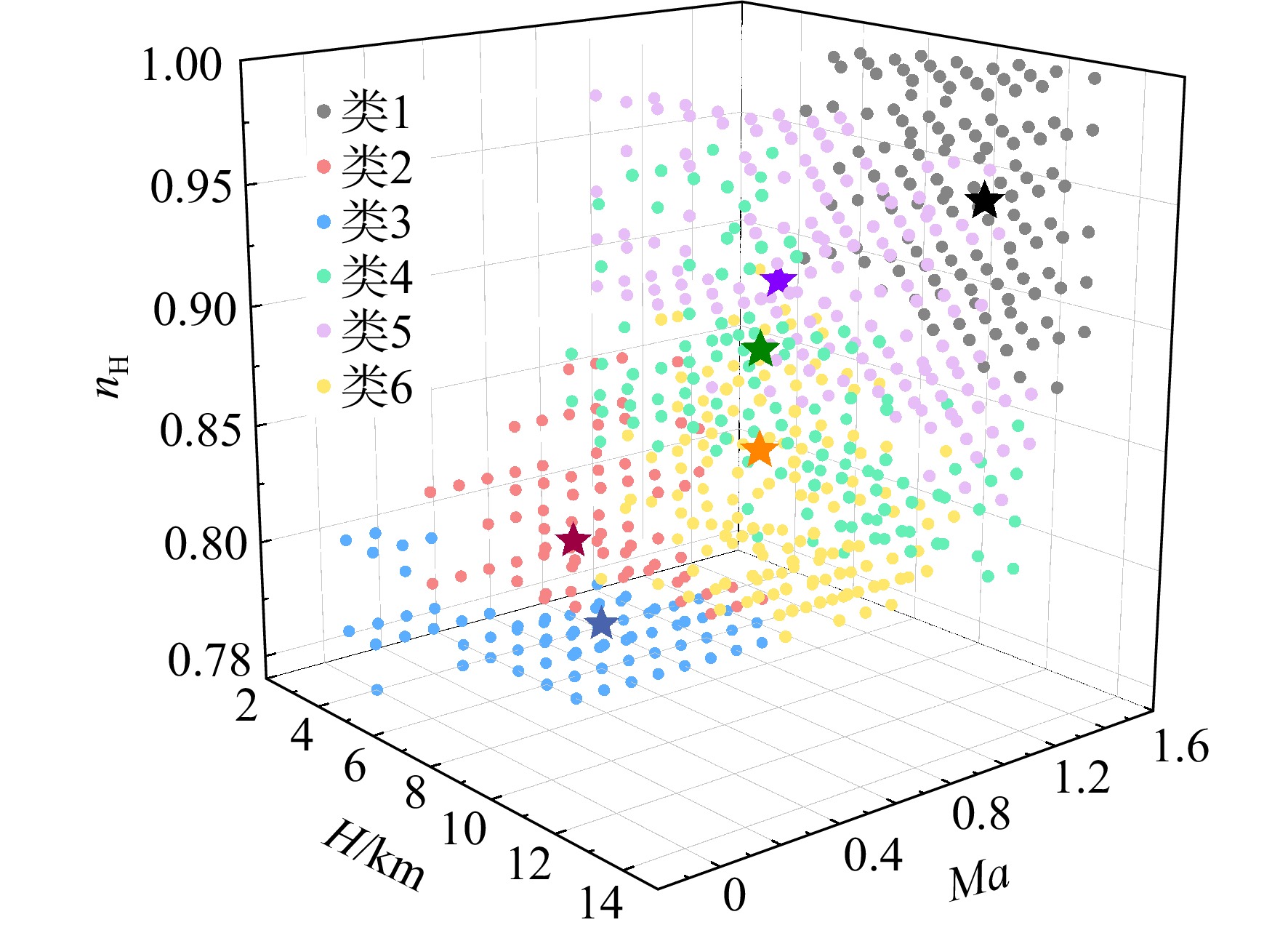
表 3 改进的DNE-FCM算法聚类结果
Table 3. Clustering results of improved DNE-FCM algorithm
典型特征点 $ H/\mathrm{km} $ $ Ma $ $ {n}_{\mathrm{H}}/\text{%} $ 1 7.90 0.86 88 2 5.77 0.74 79 3 4.58 0.71 82 4 8.56 0.96 91 5 7.02 0.88 84 6 11.89 1.19 95
下载: 导出CSV
表 4 模糊模型后件变量
Table 4. Fuzzy model consequence variables
典型特征点 后件变量 1 $ {\boldsymbol {A}}_{1}=\left[\begin{matrix}5.3\text{3} & -2.9\text{1}\\123.\text{50} & -51.4\text{7}\end{matrix}\right]\quad\quad {\boldsymbol {B}}_{1}=\left[\begin{matrix}0.\text{50} & -1.1\text{2}\\4.79 & -20.71\end{matrix}\right] $
$ {\boldsymbol {C}}_{1}={\left[\begin{matrix}1 & 0 & 2.170\;7 & -1.414\;3 & 1.393\;1 & 1.075\;3\\0 & 1 & -0.370\;7 & 0.093\;0 & 0.035\;6 & -0.024\;5\end{matrix}\right]}^{\mathrm{T}} $
$ {\boldsymbol {D}}_{1}={\left[\begin{matrix}0 & 0 & 0.014\;2 & 0.397\;3 & 0.037\;0 & 0.053\;6\\0 & 0 & -0.033\;1 & 0.079\;5 & -0.219\;6 & -0.048\;2\end{matrix}\right]}^{\mathrm{T}} $$ \vdots $ $ \vdots $ 6 $ {\boldsymbol {A}}_{6}=\left[\begin{matrix}5.\text{30} & -2.0\text{8}\\159.4\text{9} & -47.8\text{7}\end{matrix}\right] \quad\quad {\boldsymbol {B}}_{6}=\left[\begin{matrix}0.4\text{2} & -1.10\\4.3\text{2} & -26.8\text{6}\end{matrix}\right] $
$ {\boldsymbol {C}}_{6}={\left[\begin{matrix}1 & 0 & 3.910\;3 & -1.306\;7 & 1.460\;0 & 0.870\;2\\0 & 1 & -0.270\;7 & -0.019\;3 & 0.124\;1 & 0.042\;2\end{matrix}\right]}^{\mathrm{T}} $
$ {\boldsymbol {D}}_{6}={\left[\begin{matrix}0 & 0 & -0.062\;3 & 0.456\;0 & 0.026\;6 & 0.063\;3\\0 & 0 & -0.020\;1 & 0.099\;8 & -0.235\;4 & -0.048\;4\end{matrix}\right]}^{\mathrm{T}} $
下载: 导出CSV
表 5 各输出变量$ {{\boldsymbol{E}}}_{\bf{RMSmax}} $和$ \overline{{{\boldsymbol{E}}}_{\bf{RMS}}} $
Table 5. $ {{\boldsymbol{E}}}_{\bf{RMSmax}} $ and $ \overline{{{\boldsymbol{E}}}_{\bf{RMS}}} $ of output variables
输出
变量$ {W}_{\mathrm{fb}} $2%阶跃 $ {A}_{8} $2%阶跃 $ {E}_{\text{RMS}}{}_{\max } $/% $ \overline{{E}_{\text{RMS}}} $/% $ {E}_{\text{RMS}}{}_{\max } $/% $ \overline{{E}_{\text{RMS}}} $/% $ {n}_{\mathrm{H}} $ 0.16 0.03 0.41 0.03 $ {R}_{\text{EP}} $ 0.59 0.14 1.6 0.17 $ {n}_{\mathrm{L}} $ 0.61 0.15 1.8 0.20 $ {T}_{43} $/K 0.20 0.04 0.54 0.07 $ {p}_{6} $/MPa 1.04 0.18 0.83 0.17 $ {T}_{3} $/K 0.12 0.03 0.23 0.03
下载: 导出CSV
表 6 IT2与T1模糊模型各输出变量$ \overline{{{\boldsymbol{E}}}_{\bf{RMS}}} $
Table 6. $ \overline{{{\boldsymbol{E}}}_{\bf{RMS}}} $ of the IT2 and T1 fuzzy model output variables
输出
变量$ {W}_{\mathrm{fb}} $2%阶跃$ \overline{{E}_{\text{RMS}}} $/% $ {A}_{8} $2%阶跃$ \overline{{E}_{\text{RMS}}} $/% IT2 T1 IT2 T1 $ {n}_{\mathrm{H}} $ 0.03 0.04 0.05 0.06 $ {R}_{\text{EP}} $ 0.14 0.31 0.17 0.29 $ {n}_{\mathrm{L}} $ 0.15 0.22 0.20 0.23 $ {T}_{43} $/K 0.04 0.07 0.07 0.11 $ {p}_{6} $/MPa 0.18 0.27 0.17 0.22 $ {T}_{3} $/K 0.03 0.06 0.03 0.05
下载: 导出CSV
表 7 旋转部件性能变化程度
Table 7. Degree of performance variation of rotating parts
部件 健康参数 效率系数 变化程度/% 流量系数 变化程度/% Fan $ {C}_{\text{SE1}} $ −3 $ {C}_{\text{SW1}} $ −4 HPC $ {C}_{\text{SE2}} $ −6 $ {C}_{\text{SW2}} $ −8 HPT $ {C}_{\text{SE3}} $ −3 $ {C}_{\text{SW3}} $ 2 LPT $ {C}_{\text{SE4}} $ −2 $ {C}_{\text{SW4}} $ 1
下载: 导出CSV
表 8 不同不确定性模式中的部件性能变化
Table 8. Variation in component performance under different uncertainty modes
不确定性模式 性能变化部件 1 标称状态(无部件性能变化) 2 HPC和HPT性能变化 3 全部部件性能变化
下载: 导出CSV
表 9 模糊模型计算时间
Table 9. Fuzzy model calculation time
模糊
模型模型计算耗时/ms 工作点1 工作点2 $ \cdots $ 工作点 2478 平均耗时 T1 5.5 4.1 $ \cdots $ 3.8 3.9 IT2 5.5 4.0 $ \cdots $ 3.9 3.9
下载: 导出CSV
-
[1] Mattingly J D. Aircraft engine design[M]. Reston, US: AIAA, 2002. [2] 胡明辉, 高金吉, 江志农, 等. 航空发动机振动监测与故障诊断技术研究进展[J]. 航空学报, 2024, 45(4): 630194. Hu Minghui, Gao Jinji, Jiang Zhinong, et al. Research progress on vibration monitoring and fault diagnosis for aero-engine[J]. Acta Aeronautica et Astronautica Sinica, 2024, 45(4): 630194. (in ChineseHu Minghui, Gao Jinji, Jiang Zhinong, et al. Research progress on vibration monitoring and fault diagnosis for aero-engine[J]. Acta Aeronautica et Astronautica Sinica, 2024, 45(4): 630194. (in Chinese) [3] 赵万里, 郭迎清, 徐柯杰, 等. 航空发动机多电分布式控制系统故障诊断与容错关键技术综述[J]. 航空学报, 2023, 44(10): 027519. Zhao Wanli, Guo Yingqing, Xu Kejie, et al. Review of key technologies for fault diagnosis and accommodation for multi-electric distributed engine control system[J]. Acta Aeronautica et Astronautica Sinica, 2023, 44(10): 027519. (in ChineseZhao Wanli, Guo Yingqing, Xu Kejie, et al. Review of key technologies for fault diagnosis and accommodation for multi-electric distributed engine control system[J]. Acta Aeronautica et Astronautica Sinica, 2023, 44(10): 027519. (in Chinese) [4] Sugiyama N. Derivation of system matrices from nonlinear dynamic simulation of jet engines[J]. Journal of Guidance, Control, and Dynamics, 1994, 17(6): 1320-1326. doi: 10.2514/6.1992-3319 [5] Chen Hongyi, Li Qiuhong, Pang Shuwei, et al. A state space modeling method for aero-engine based on AFOS-ELM[J]. Energies, 2022, 15(11): 3903. doi: 10.3390/en15113903 [6] Kajiwara H, Apkarian P, Gahinet P. LPV techniques for control of an inverted pendulum[J]. IEEE Control Systems Magazine, 1999, 19(1): 44-54. doi: 10.1109/37.745767 [7] Reberga L, Henrion D, Bernussou J, et al. LPV modeling of a turbofan engine[J]. IFAC Proceedings Volumes, 2005, 38(1): 526-531. [8] 张增辉, 杨凌宇, 申功璋. 高超声速飞行器大包线切换LPV控制方法[J]. 航空学报, 2012, 33(9): 1706-1716. Zhang Zenghui, Yang Lingyu, Shen Gongzhang. Switching LPV control method in wide flight envelope for hypersonic vehicles[J]. Acta Aeronautica et Astronautica Sinica, 2012, 33(9): 1706-1716. (in ChineseZhang Zenghui, Yang Lingyu, Shen Gongzhang. Switching LPV control method in wide flight envelope for hypersonic vehicles[J]. Acta Aeronautica et Astronautica Sinica, 2012, 33(9): 1706-1716. (in Chinese) [9] 肖地波, 陆宇平, 刘燕斌, 等. 应用保护映射理论的高超声速飞行器自适应控制律设计[J]. 航空学报, 2015, 36(10): 3327-3337. Xiao Dibo, Lu Yuping, Liu Yanbin, et al. Adaptive control law design using guardian maps theory for hypersonic vehicles[J]. Acta Aeronautica et Astronautica Sinica, 2015, 36(10): 3327-3337. (in Chinese doi: 10.7527/S1000-6893.2015.0030Xiao Dibo, Lu Yuping, Liu Yanbin, et al. Adaptive control law design using guardian maps theory for hypersonic vehicles[J]. Acta Aeronautica et Astronautica Sinica, 2015, 36(10): 3327-3337. (in Chinese) doi: 10.7527/S1000-6893.2015.0030 [10] Wang Yangjing, Huang Jinquan, Zhou Wenxiang, et al. Neural network-based model predictive control with fuzzy-SQP optimization for direct thrust control of turbofan engine[J]. Chinese Journal of Aeronautics, 2022, 35(12): 59-71. doi: 10.1016/j.cja.2022.04.012 [11] Zadeh L A. Fuzzy sets[J]. Information and Control, 1965, 8(3): 338-353. [12] Takagi T, Sugeno M. Fuzzy identification of systems and its applications to modeling and control[M]//Readings in Fuzzy Sets for Intelligent Systems. San Francisco, US: Morgan Kaufmann Publishers, 1993: 387-403. [13] Fantuzzi C, Rovatti R. On the approximation capabilities of the homogeneous Takagi-Sugeno model[C]//Proceedings of IEEE 5th International Fuzzy Systems. Piscataway, US: IEEE, 2002: 1067-1072. [14] Zeng Ke, Zhang Naiyao, Xu Wenli. A comparative study on sufficient conditions for Takagi-Sugeno fuzzy systems as universal approximators[J]. IEEE Transactions on Fuzzy Systems, 2000, 8(6): 773-780. doi: 10.1109/91.890337 [15] Johansen T A, Shorten R, Murray-smith R. On the interpretation and identification of dynamic Takagi-Sugeno fuzzy models[J]. IEEE Transactions on Fuzzy Systems, 2000, 8(3): 297-313. doi: 10.1109/91.855918 [16] Mendel J M. Explaining the performance potential of rule-based fuzzy systems as a greater sculpting of the state space[J]. IEEE Transactions on Fuzzy Systems, 2018, 26(4): 2362-2373. doi: 10.1109/TFUZZ.2017.2774190 [17] 梁帅, 杨林, 杨朝旭, 等. 基于Kalman滤波的变体飞行器T-S模糊控制[J]. 航空学报, 2020, 41(增刊2): 724274. Liang Shuai, Yang Lin, Yang (Chao| Zhao)(Xu), et al. Kalman filter based T-S fuzzy control for morphing aircraft[J]. Acta Aeronautica et Astronautica Sinica, 2020, 41(Suppl. 2): 724274. (in ChineseLiang Shuai, Yang Lin, Yang (Chao| Zhao)(Xu), et al. Kalman filter based T-S fuzzy control for morphing aircraft[J]. Acta Aeronautica et Astronautica Sinica, 2020, 41(Suppl. 2): 724274. (in Chinese) [18] Zhang Zhina, Niu Yugang, Karimi H R. Sliding mode control of interval type-2 fuzzy systems under round-robin scheduling protocol[J]. IEEE Transactions on Systems, Man, and Cybernetics: Systems, 2021, 51(12): 7602-7612. doi: 10.1109/TSMC.2019.2956714 [19] Sun Jiayue, Zhang Huaguang, Wang Yingchun, et al. Fault-tolerant control for stochastic switched IT2 fuzzy uncertain time-delayed nonlinear systems[J]. IEEE Transactions on Cybernetics, 2022, 52(2): 1335-1346. doi: 10.1109/TCYB.2020.2997348 [20] Teng Long, Wang Youyi, Cai Wenjian, et al. Robust fuzzy model predictive control of discrete-time Takagi-Sugeno systems with nonlinear local models[J]. IEEE Transactions on Fuzzy Systems, 2018, 26(5): 2915-2925. doi: 10.1109/TFUZZ.2018.2815521 [21] 郑新前, 王钧莹, 黄维娜, 等. 航空发动机不确定性设计体系探讨[J]. 航空学报, 2023, 44(7): 027099. Zheng Xinqian, Wang Junying, Huang Weina, et al. Uncertainty-based design system for aeroengines[J]. Acta Aeronautica et Astronautica Sinica, 2023, 44(7): 027099. (in ChineseZheng Xinqian, Wang Junying, Huang Weina, et al. Uncertainty-based design system for aeroengines[J]. Acta Aeronautica et Astronautica Sinica, 2023, 44(7): 027099. (in Chinese) [22] Mendel J M, Hagras H, Tan W W, et al. Introduction to type-2 fuzzy logic control: theory and applications[M]. Hoboken, US: Wiley-IEEE Press, 2014. [23] Mendel J M. Type-2 fuzzy sets and systems: an overview[J]. IEEE Computational Intelligence Magazine, 2007, 2(1): 20-29. doi: 10.1109/MCI.2007.380672 [24] 许允, 潘慕绚, 黄金泉. 基于智能特征提取的模糊建模及鲁棒控制[J]. 航空动力学报, 2021, 36(7): 1545-1555. Xu Yun, Pan (Mu)(Xuan| Xun), Huang Jinquan. Fuzzy modeling and robust control based on intelligent feature extraction method[J]. Journal of Aerospace Power, 2021, 36(7): 1545-1555. (in Chinese doi: 10.13224/j.cnki.jasp.20210802Xu Yun, Pan (Mu)(Xuan| Xun), Huang Jinquan. Fuzzy modeling and robust control based on intelligent feature extraction method[J]. Journal of Aerospace Power, 2021, 36(7): 1545-1555. (in Chinese) doi: 10.13224/j.cnki.jasp.20210802 [25] 仇小杰, 陈杰, 范白清. 基于动态特性分析的涡扇发动机T-S模糊建模[J]. 推进技术, 2023, 44(1): 22010038. Qiu Xiaojie, Chen Jie, Fan Baiqing. A method based on dynamic characteristic analysis for turbofan engine T-S fuzzy model[J]. Journal of Propulsion Technology, 2023, 44(1): 22010038. (in Chinese doi: 10.13675/j.cnki.tjjs.22010038Qiu Xiaojie, Chen Jie, Fan Baiqing. A method based on dynamic characteristic analysis for turbofan engine T-S fuzzy model[J]. Journal of Propulsion Technology, 2023, 44(1): 22010038. (in Chinese) doi: 10.13675/j.cnki.tjjs.22010038 [26] 曾山. 模糊聚类算法研究[D]. 武汉: 华中科技大学, 2012. Zeng Shan. Research on fuzzy clustering algorithm[D]. Wuhan: Huazhong University of Science and Technology, 2012. (in ChineseZeng Shan. Research on fuzzy clustering algorithm[D]. Wuhan: Huazhong University of Science and Technology, 2012. (in Chinese) [27] Zhang Wei, Xue Xiangyang, Lu Hong, et al. Discriminant neighborhood embedding for classification[J]. Pattern Recognition, 2006, 39(11): 2240-2243. doi: 10.1016/j.patcog.2006.05.011 [28] Li Bo, Lei Lei, Zhang Xiaoping. Constrained discriminant neighborhood embedding for high dimensional data feature extraction[J]. Neurocomputing, 2016, 173: 137-144. doi: 10.1016/j.neucom.2015.01.099 [29] 路梅, 李凡长. 邻域嵌入的张量学习[J]. 计算机科学与探索, 2017, 11(7): 1102-1113. Lu Mei, Li Fanchang. Neighborhood-embedded tensor learning[J]. Journal of Frontiers of Computer Science & Technology, 2017, 11(7): 1102-1113. (in Chinese doi: 10.3778/j.issn.1673-9418.1605038Lu Mei, Li Fanchang. Neighborhood-embedded tensor learning[J]. Journal of Frontiers of Computer Science & Technology, 2017, 11(7): 1102-1113. (in Chinese) doi: 10.3778/j.issn.1673-9418.1605038 [30] Gou Jianping, Yi Zhang. Locality-based discriminant neighborhood embedding[J]. The Computer Journal, 2013, 56(9): 1063-1082. doi: 10.1093/comjnl/bxs113 [31] Zhang Wei, Xue Xiangyang, Sun Zichen, et al. Metric learning by discriminant neighborhood embedding[J]. Pattern Recognition, 2008, 41(6): 2086-2096. doi: 10.1016/j.patcog.2007.11.023 [32] Mittal K, Jain A, Vaisla K S, et al. A comprehensive review on type 2 fuzzy logic applications: Past, present and future[J]. Engineering Applications of Artificial Intelligence, 2020, 95: 103916. doi: 10.1016/j.engappai.2020.103916 [33] Mendel J M, John R I B. Type-2 fuzzy sets made simple[J]. IEEE Transactions on Fuzzy Systems, 2002, 10(2): 117-127. doi: 10.1109/91.995115 [34] 伍冬睿, 曾志刚, 莫红, 等. 区间二型模糊集和模糊系统: 综述与展望[J]. 自动化学报, 2020, 46(8): 1539-1556. Wu Dongrui, Zeng Zhigang, Mo Hong, et al. Interval type-2 fuzzy sets and systems: overview and outlook[J]. Acta Automatica Sinica, 2020, 46(8): 1539-1556. (in Chinese doi: 10.16383/j.aas.c200133Wu Dongrui, Zeng Zhigang, Mo Hong, et al. Interval type-2 fuzzy sets and systems: overview and outlook[J]. Acta Automatica Sinica, 2020, 46(8): 1539-1556. (in Chinese) doi: 10.16383/j.aas.c200133 [35] Franklin G F, Powell J D, Emami-naeini A. Feedback control of dynamic systems[M]. 8th ed. Hoboken, US: Pearson, 2015. [36] Aggarwal C C, Reddy C K. Data clustering: algorithms and applications[M]. New York: Chapman & Hall/CRC, 2014. [37] Pedregosa F, Varoquaux G, Gramfort A, et al. Scikit-learn: machine learning in Python[J]. Journal of Machine Learning Research, 2011, 12: 2825-2830. [38] 李志虎. 变循环发动机机载实时模型研究[D]. 南京: 南京航空航天大学, 2021. Li Zhihu. On-board real time model for variable cycle engine[D]. Nanjing: Nanjing University of Aeronautics and Astronautics, 2021. (in ChineseLi Zhihu. On-board real time model for variable cycle engine[D]. Nanjing: Nanjing University of Aeronautics and Astronautics, 2021. (in Chinese) [39] 罗兴华, 耿佳, 李明, 等. 航空发动机机载模型迭代计算优化方法研究[J]. 系统仿真学报, 2022, 34(12): 2649-2658. Luo Xinghua, Geng Jia, Li Ming, et al. Research on iterative calculation and optimization methods of aero-engine on-board model[J]. Journal of System Simulation, 2022, 34(12): 2649-2658. (in Chinese doi: 10.16182/j.issn1004731x.ioss.22-FZ0905Luo Xinghua, Geng Jia, Li Ming, et al. Research on iterative calculation and optimization methods of aero-engine on-board model[J]. Journal of System Simulation, 2022, 34(12): 2649-2658. (in Chinese) doi: 10.16182/j.issn1004731x.ioss.22-FZ0905 -





 点击查看大图

计量
- 文章访问数: 312
- HTML浏览量: 302
- PDF量: 44
- 被引次数: 0