






Coupled two-phase flow solver based on entropy viscosity within DGSEM framework
-
摘要:
在可压缩两相流数值模拟中为解决激波、物质界面等间断问题导致的精度下降和Gibbs等现象,实现间断的精确解析,提出一种基于间断谱元法(discontinuous Galerkin spectral element method,DGSEM)框架的耦合方法。该方法通过熵黏性模型自动区分激波与接触间断,自适应地添加人工黏性解决单相间断问题;并基于DGSEM方法离散水平集(level-set)方程,结合虚拟流体方法实现了两相界面的准确追踪以及与流场的耦合求解。结果表明该方法在光滑区域可以达到设计精度,相比变量阶跃型人工黏性和5阶weighted essentially non-oscillatory-Z(WENO-Z)格式,减少了过耗散得到了更多流场细节;在仅使用1/4网格密度的情况下,得到的监测点数据与实验结果的误差比同样采用间断有限元但使用耗散类型界面模型的计算结果最多降低了6.4%,证明该方法有效提升了间断捕捉和与物质界面追踪的精度。
Abstract:To deal with the issues of accuracy degradation and Gibbs phenomena caused by discontinuities such as shock waves, contact discontinuities, and free interfaces in the numerical simulation of compressible two-phase flows, a coupled solution method was developed based on the discontinuous Galerkin spectral element method (DGSEM) framework. To address the issue of discontinuities in single phase, an entropy viscosity model that can automatically distinguish shocks from contact discontinuities and adaptively add artificial viscosity was introduced. The solution method was also coupled with the level-set method, which was discretized by the DGSEM framework and combined with the ghost fluid approach to accurately track the material interface and solve the flow field simultaneously. Numerical results showed that this method can achieve the designed accuracy in smooth regions. Compared with the variable-step artificial viscosity and the fifth-order weighted essentially non-oscillatory-Z (WENO-Z) scheme, it reduced over-dissipation and obtained more flow-field details. Compared with calculations using the same discontinuous Galerkin method but with dissipative interface models, this method reduced the error at monitoring points by up to 6.4% compared with experimental results when using only one-fourth of the grid density. This proved that the method can effectively improve the accuracy of discontinuity capture and material interface tracking.
-
Key words:
- multiphase flow /
- shock capturing /
- DGSEM /
- entropy viscosity /
- level-set method /
- ghost fluid method
-
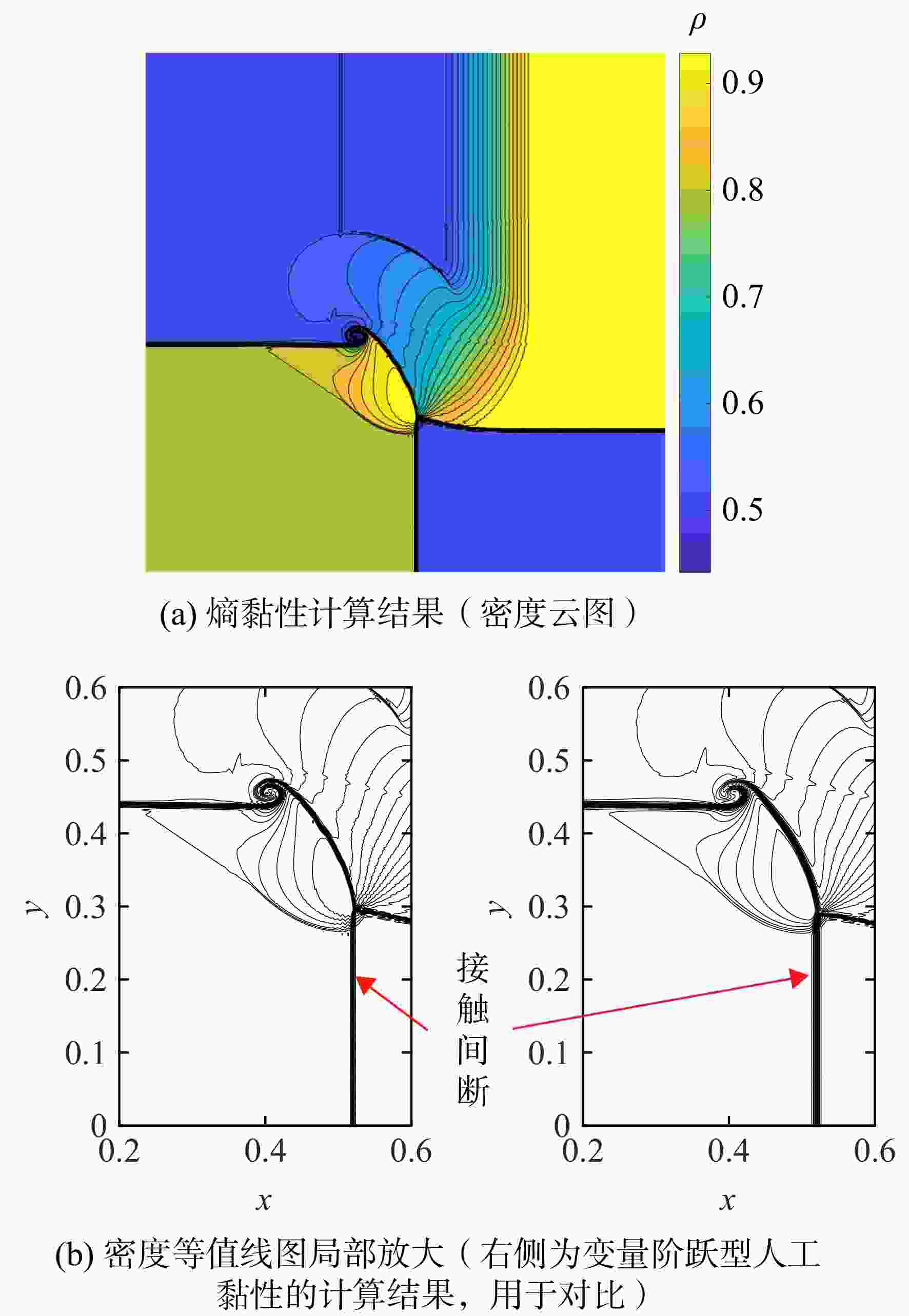
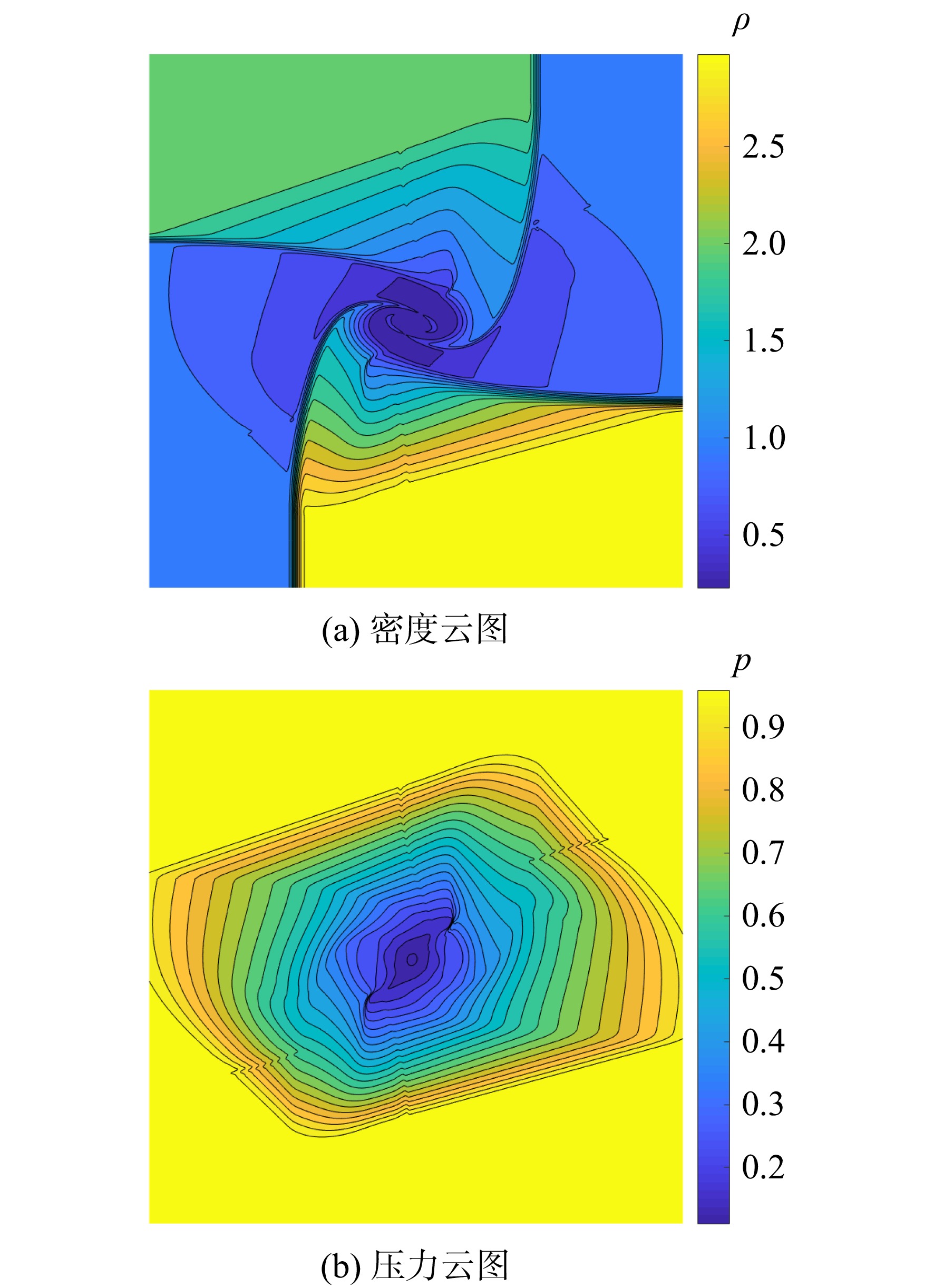
图 3 二维Riemann问题2计算结果(t=0.2)
Figure 3. Result of two-dimensional Riemann problem 2 (t=0.2)
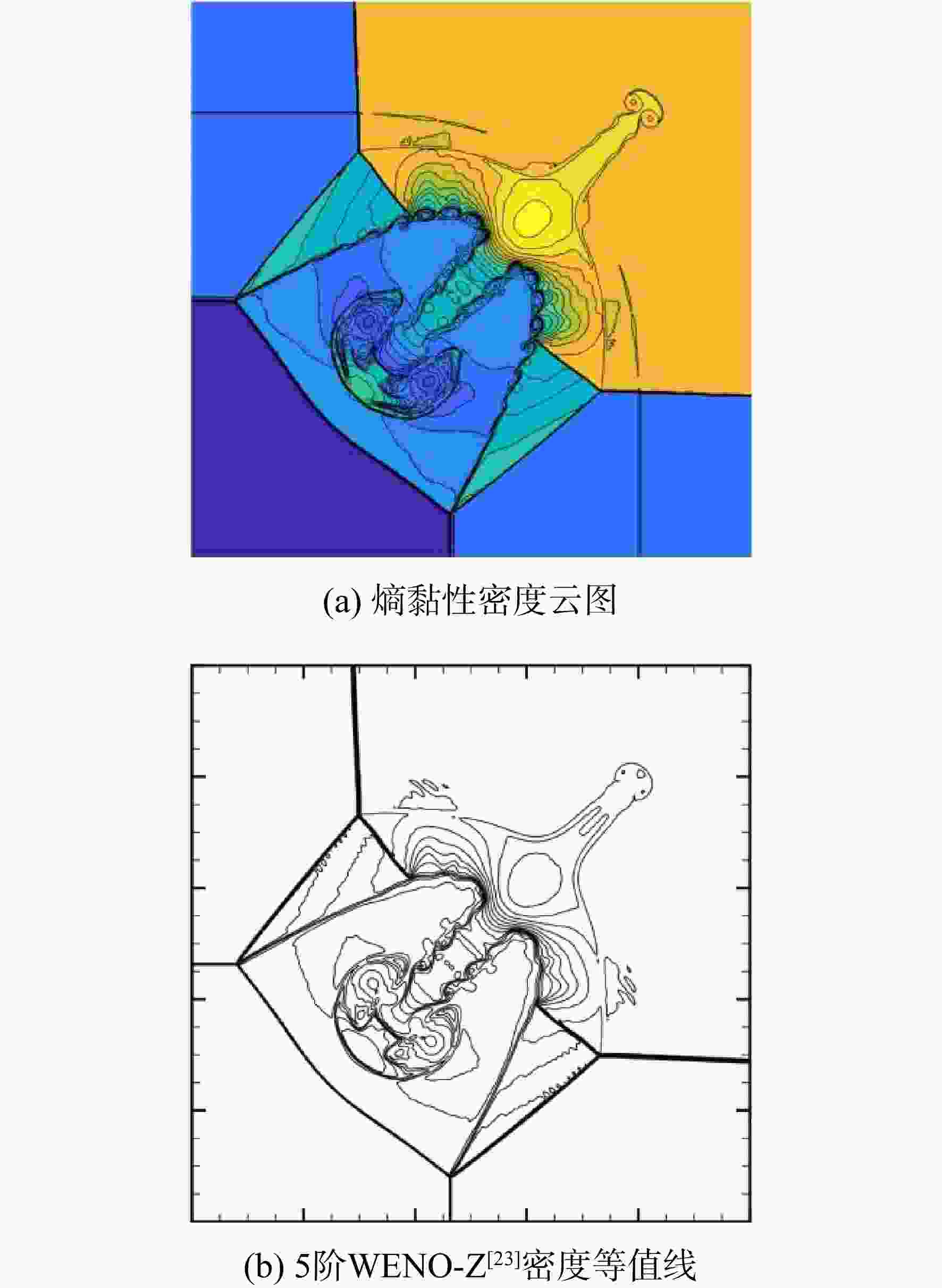
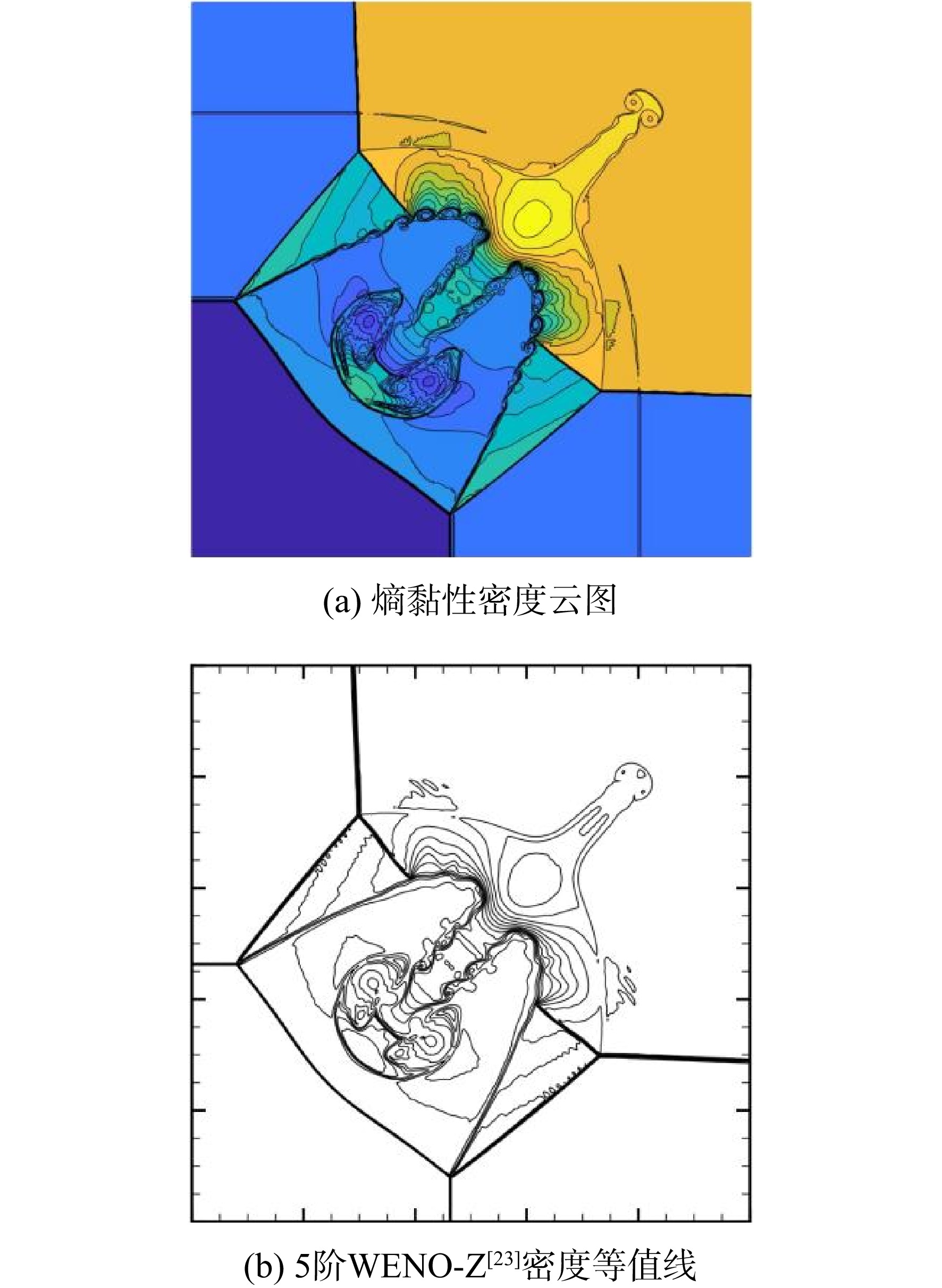
图 4 二维Riemann问题3计算结果(t=0.8)
Figure 4. Result of two-dimensional Riemann problem 3(t=0.8)
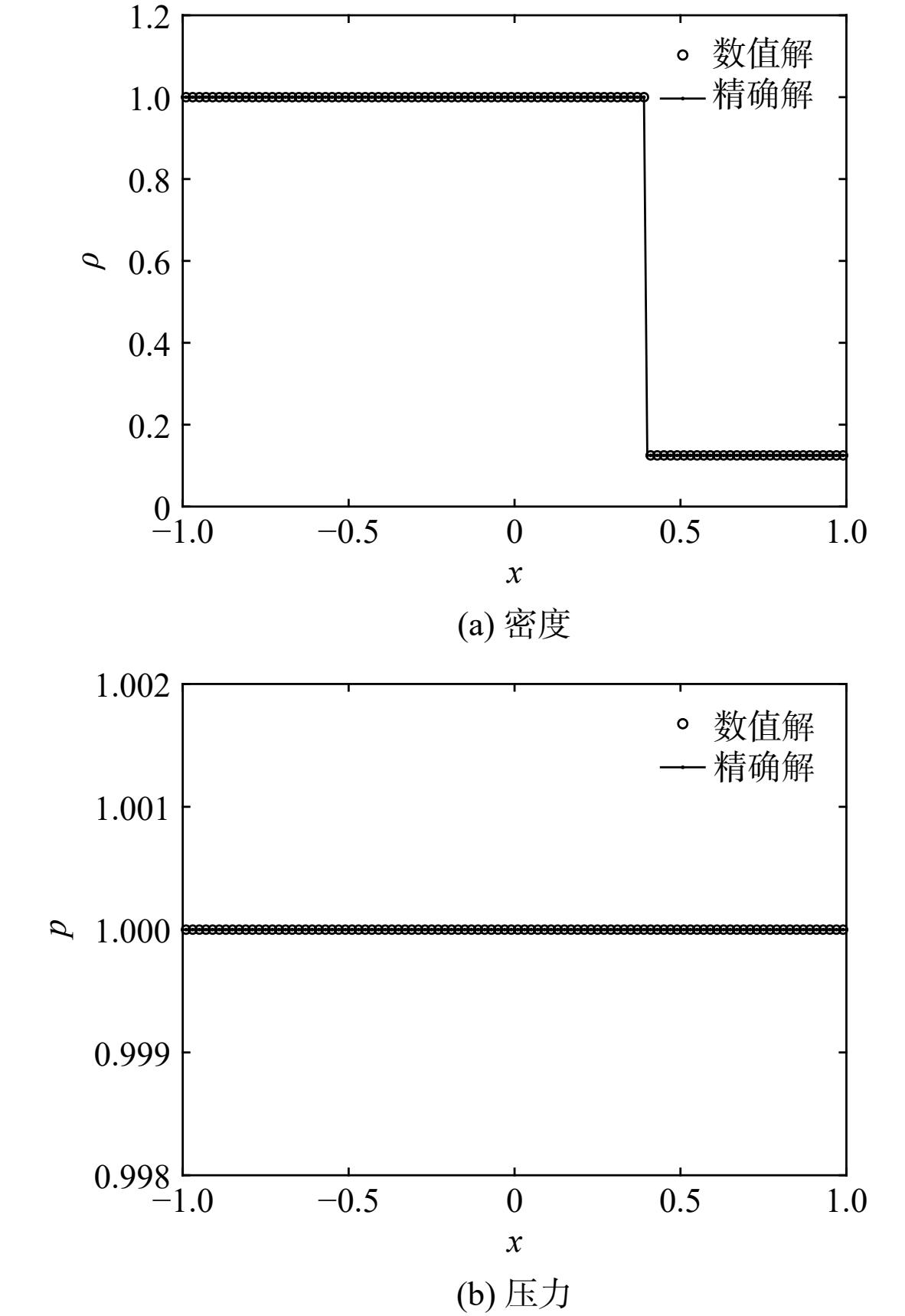
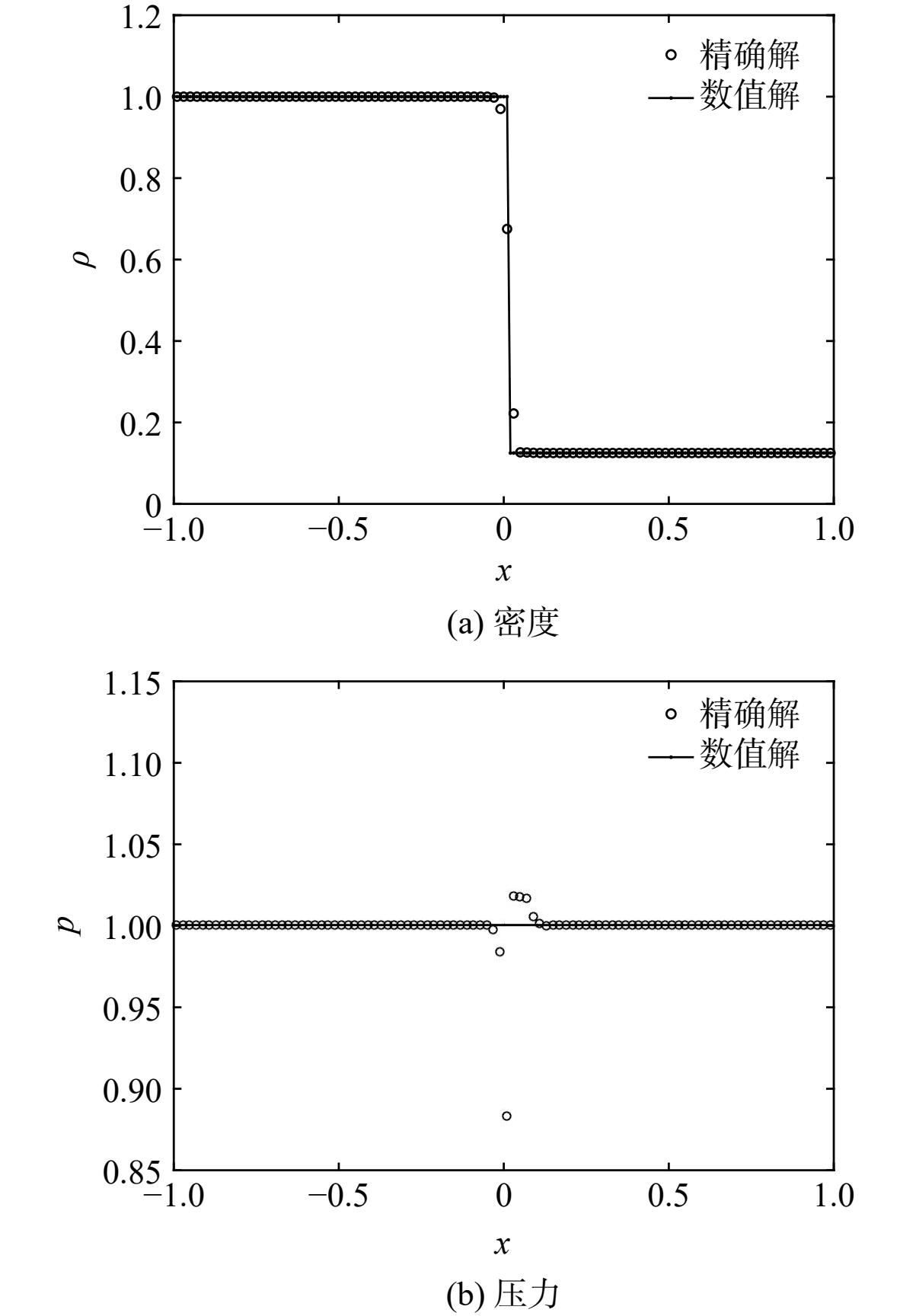
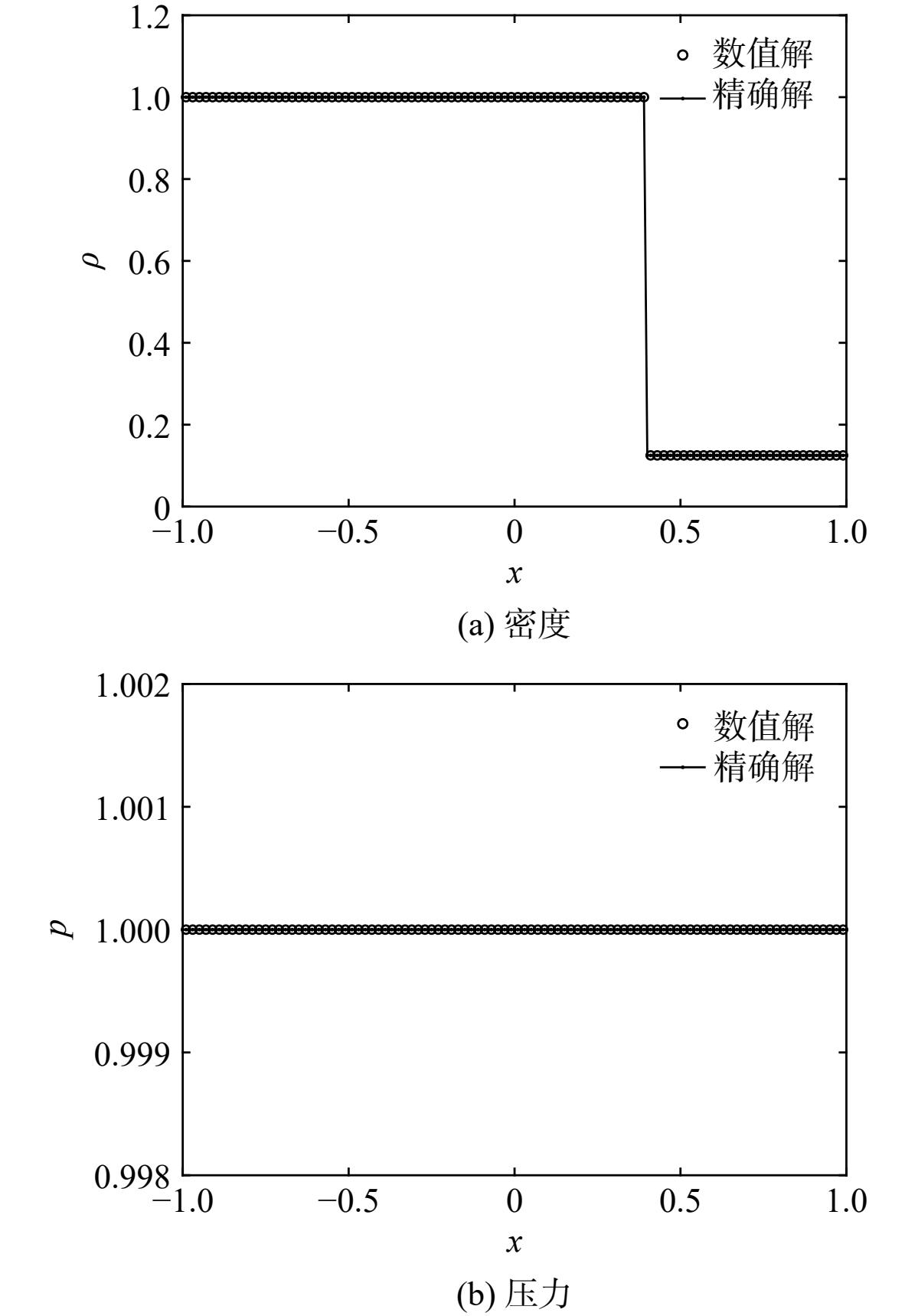
图 7 虚拟流体方法求解移动界面问题(t=0.4)
Figure 7. Translate interface solved by ghost fluid method (t=0.4)
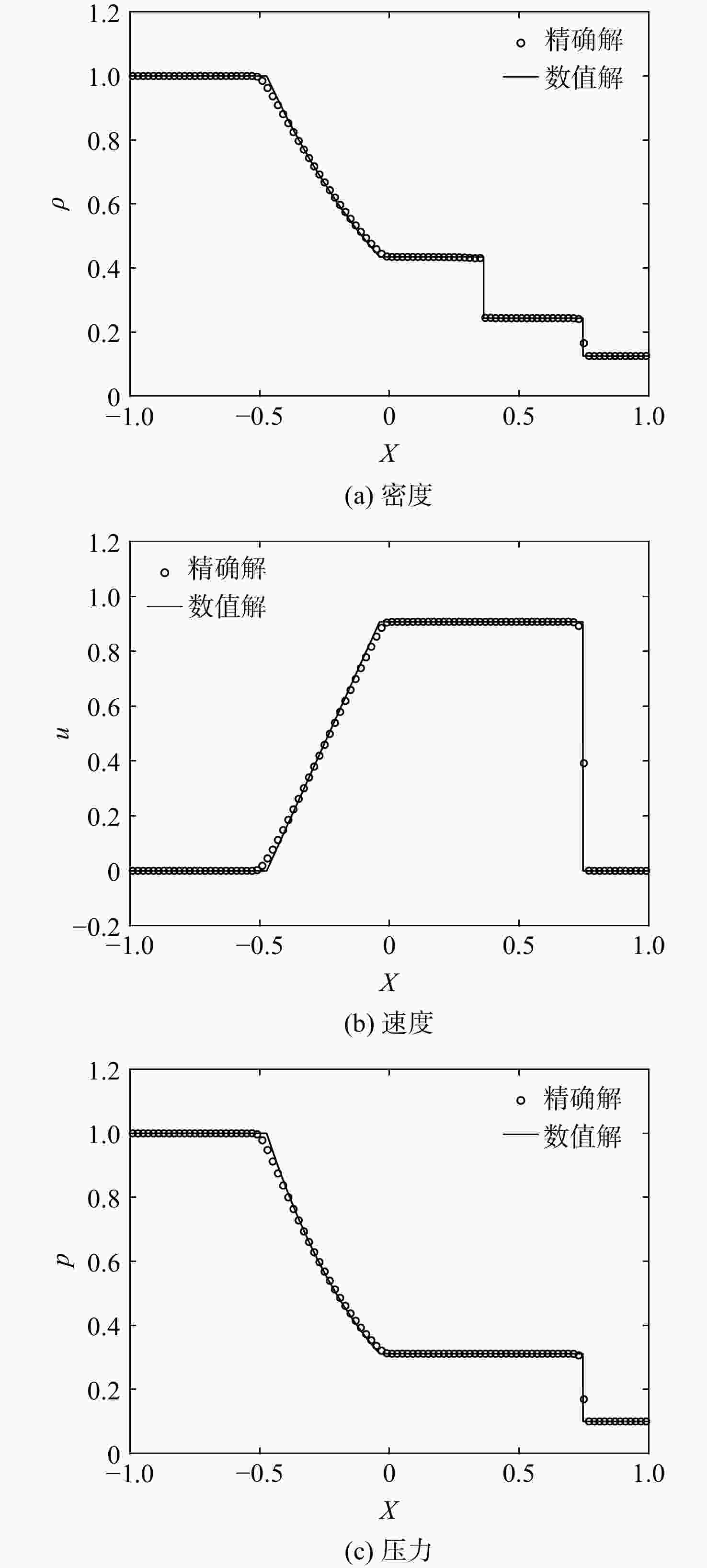
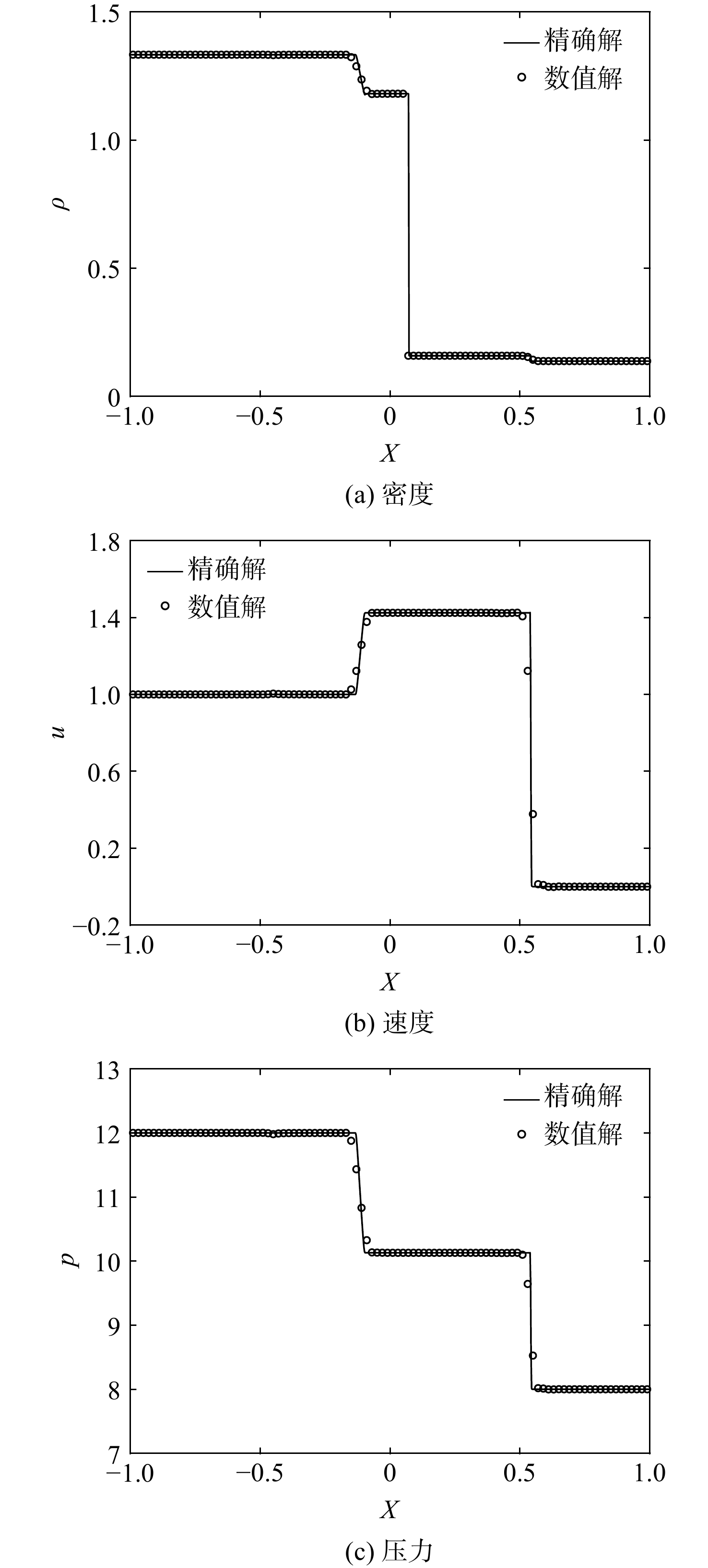
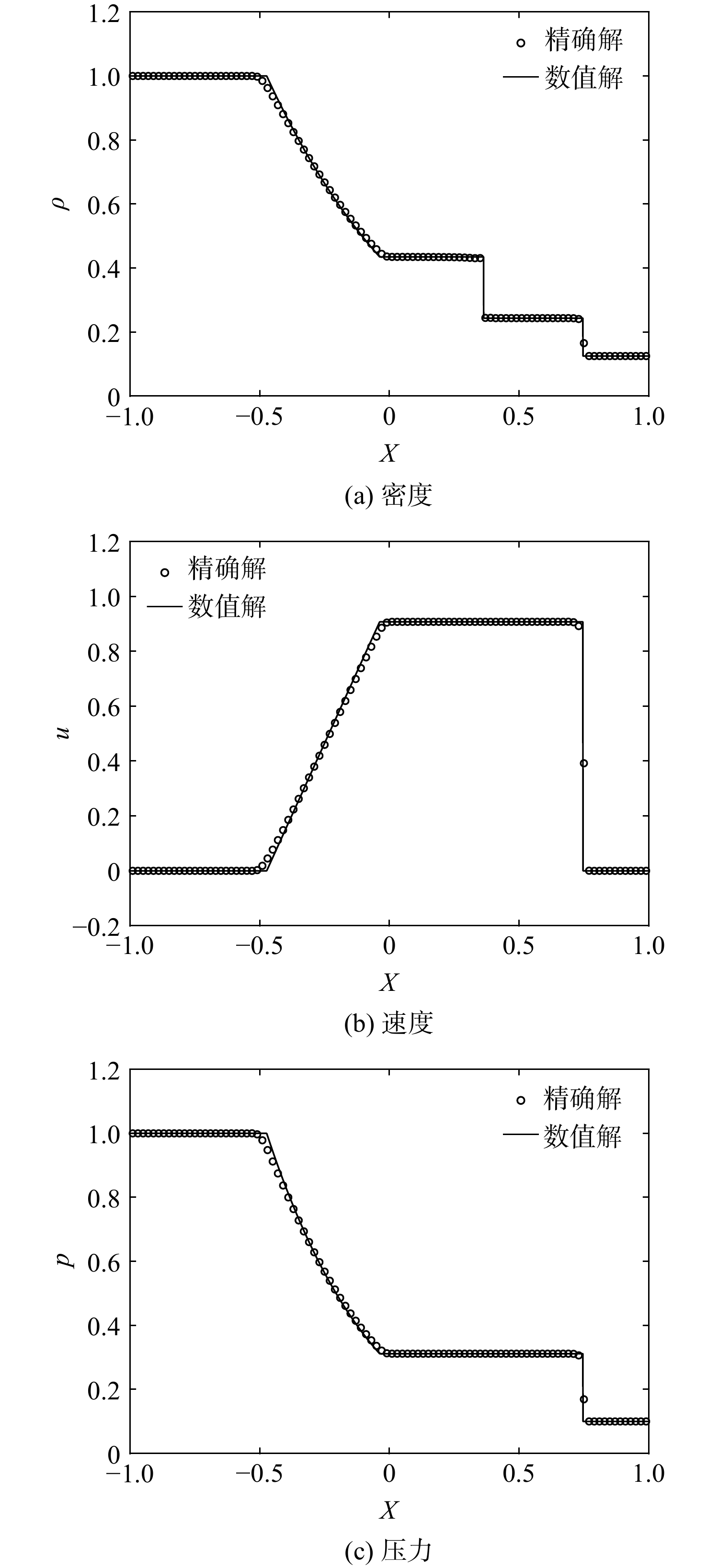
图 9 虚拟流体方法求解两相Sod问题(t=0.4)
Figure 9. Sod’s problem with double phase solved by ghost fluid method (t=0.4)
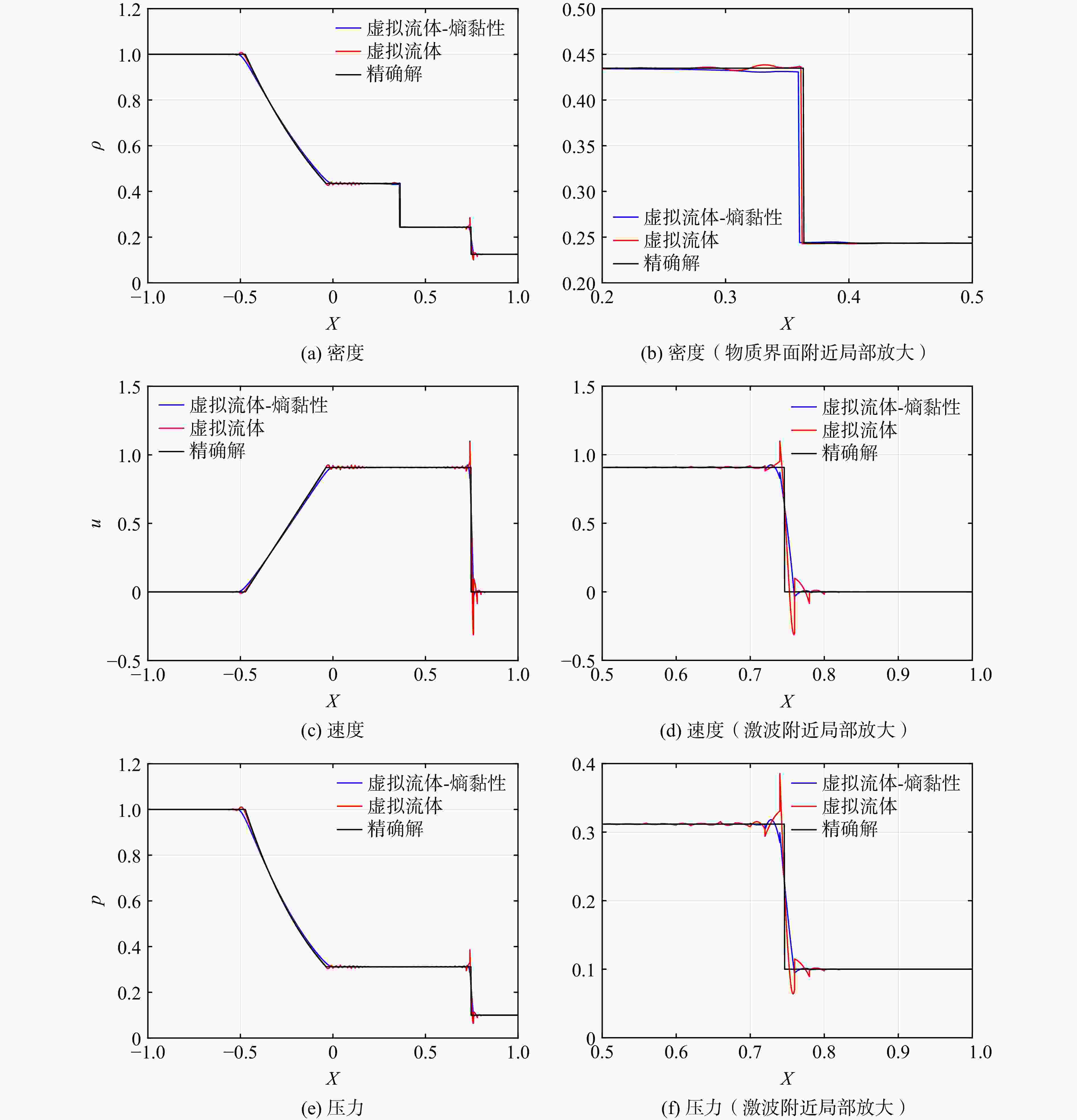
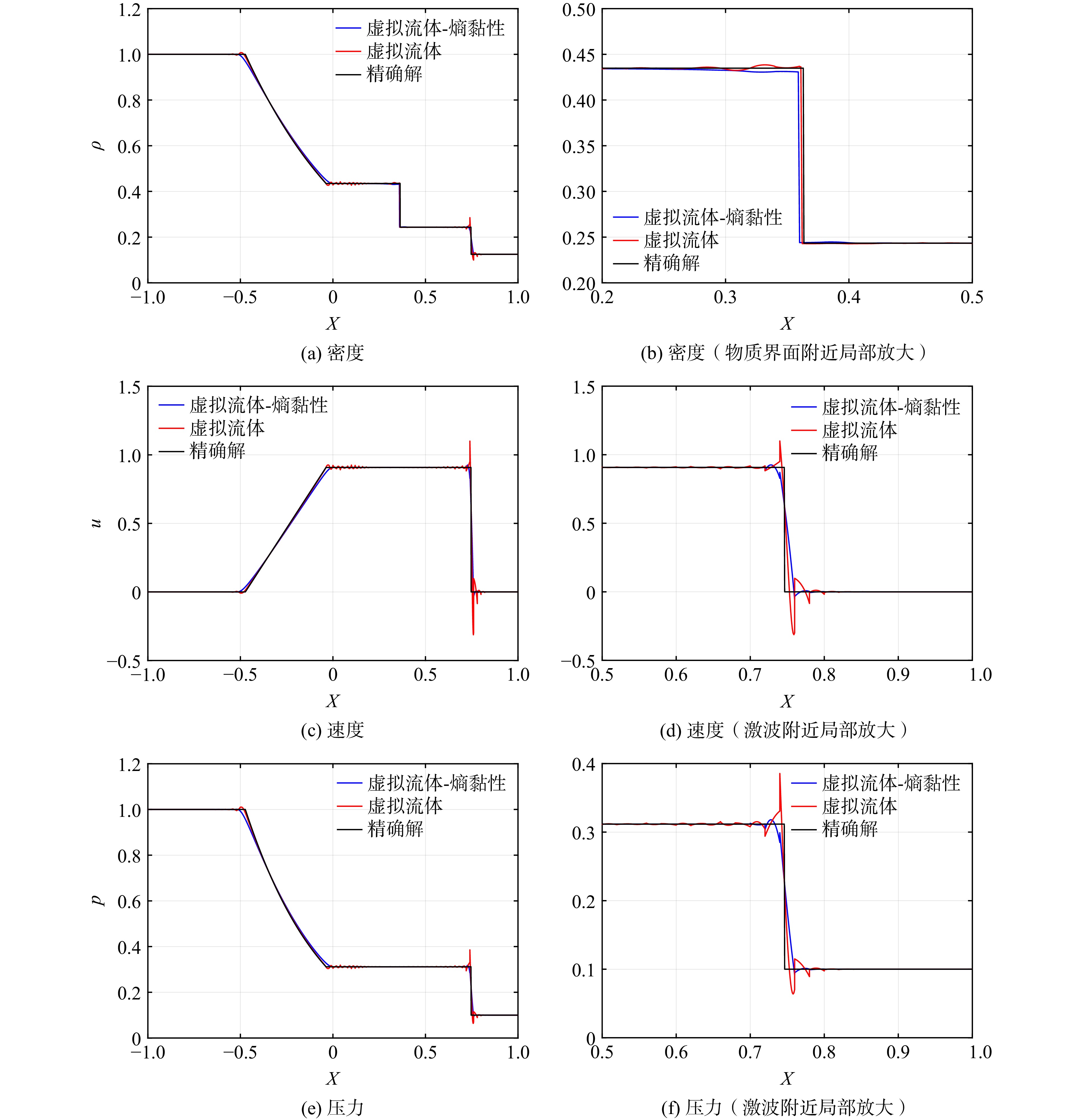
图 10 有无熵黏性的两相Sod问题(t=0.4)
Figure 10. Sod’s problem with double phase with and without entropy viscosity (t=0.4)
表 1 正弦波测试算例(有人工黏性)
Table 1. Sine wave test case (with artificial viscosity)
网格量 k=3 k=4 $ {L}_{2} $误差 收敛率 $ {L}_{2} $误差 收敛率 20 9.98199 ×10−42.24598 ×10−540 1.26448 ×10−42.98 1.24348 ×10−64.18 80 1.57069 ×10−53.00 7.59415 ×10−84.03 160 1.95116 ×10−63.02 4.7153 ×10−94.00  下载: 导出CSV
表 2 正弦波测试算例(无人工黏性)
Table 2. Sine wave test case(without artificial viscosity)
网格量 k=3 k=4 $ {L}_{2} $误差 收敛率 $ {L}_{2} $误差 收敛率 20 9.24106 ×10−42.01887 ×10−540 1.22672 ×10−42.91 1.20678 ×10−64.06 80 1.55342 ×10−52.98 7.54001 ×10−84.00 160 1.94273 ×10−63.00 4.70908 ×10−94.00
下载: 导出CSV
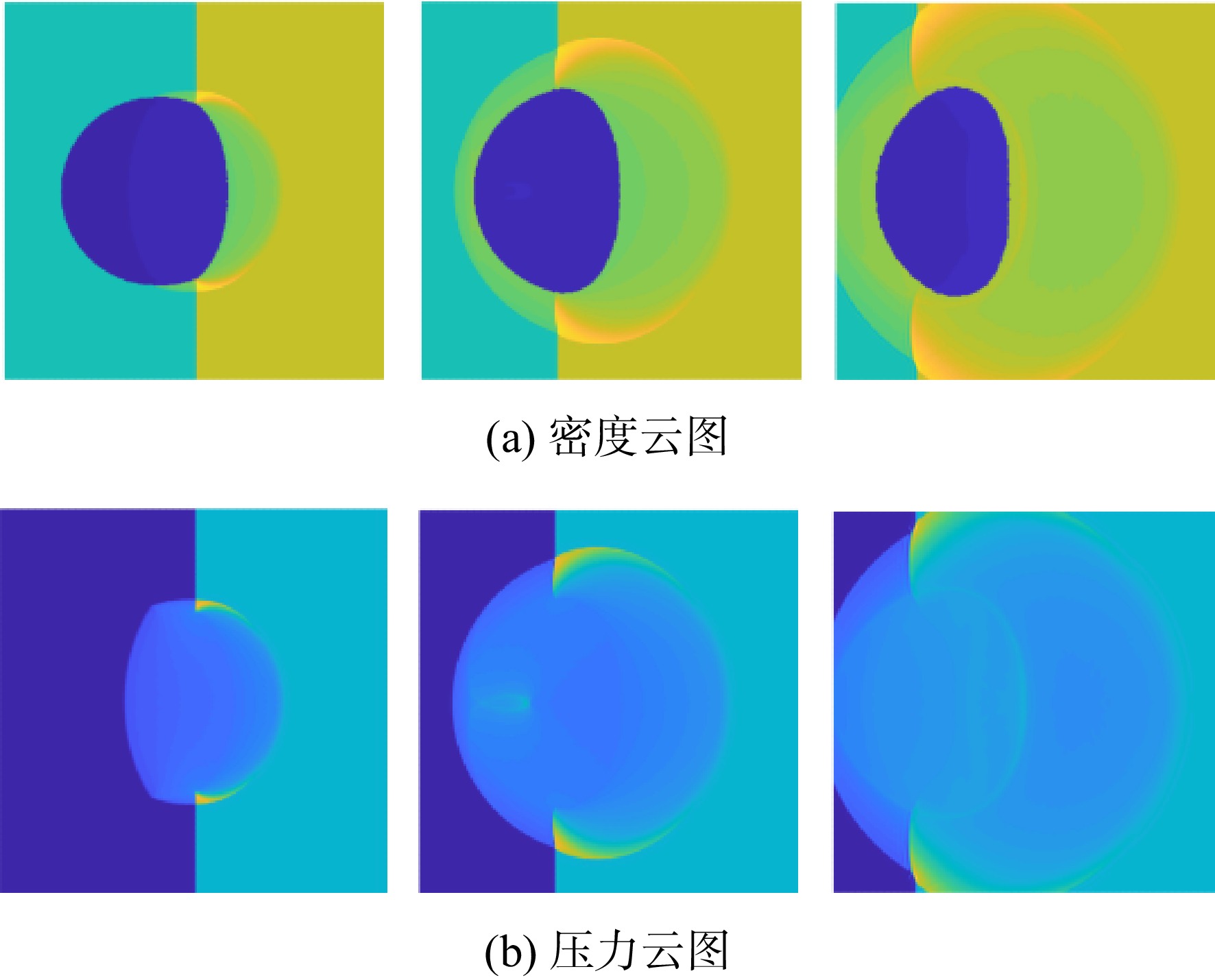
表 3 二维激波-气泡算例初值设置
Table 3. Initial condition setup of two-dimensional shock-bubble interaction
气体 $ \gamma $ $ \rho $ $ u $ $ v $ $ p $ 波前空气 1.4 1.40000 0 0 1.00000 波后空气 1.4 1.92691 0.33361 0 1.56980 氦气 1.648 0.25463 0 0 1.00000 R22 1.249 4.41540 0 0 1.00000
下载: 导出CSV
-
[1] Reed W H, Hill T R. Triangular mesh methods for the neutron transport equation[R]. Los Alamos, US: Los Alamos Scientific Laboratory, 1973. [2] Kopriva D A. Implementing spectral methods for partial differential equations: algorithms for scientists and engineers[M]. Dordrecht, Netherlands: Springer Netherlands, 2009. [3] Bassi F, Franchina N, Ghidoni A, et al. Spectral p-multigrid discontinuous Galerkin solution of the Navier–Stokes equations[J]. International Journal for Numerical Methods in Fluids, 2011, 67(11): 1540-1558. doi: 10.1002/fld.2430 [4] Shu C W. Discontinuous Galerkin methods: general approach and stability[R]. Newport, US: the First International Symposium on Discontinuous Galerkin Methods, 1999. [5] 何志伟, 田保林, 李理, 等. 可压缩多介质流动问题的高精度数值模拟方法[J]. 空气动力学学报, 2021, 39(1): 177-190. He Zhiwei, Tian Baolin, Li Li, et al. High-order numerical simulation method for compressible multi-material flow problems[J]. Acta Aerodynamica Sinica, 2021, 39(1): 177-190. (in Chinese doi: 10.7638/kqdlxxb-2020.0165He Zhiwei, Tian Baolin, Li Li, et al. High-order numerical simulation method for compressible multi-material flow problems[J]. Acta Aerodynamica Sinica, 2021, 39(1): 177-190. (in Chinese) doi: 10.7638/kqdlxxb-2020.0165 [6] 丁岩, 袁礼. 虚拟流体方法中界面处Riemann问题定义方式的改进[J]. 计算物理, 2010, 27(4): 501-508. Ding Yan, Yuan Li. Improvements on definition of interficial Riemann problem in real ghost fluid method[J]. Chinese Journal of Computational Physics, 2010, 27(4): 501-508. (in ChineseDing Yan, Yuan Li. Improvements on definition of interficial Riemann problem in real ghost fluid method[J]. Chinese Journal of Computational Physics, 2010, 27(4): 501-508. (in Chinese) [7] Cockburn B, Shu Chiwang. Runge–kutta discontinuous Galerkin methods for convection-dominated problems[J]. Journal of Scientific Computing, 2001, 16(3): 173-261. doi: 10.1023/A:1012873910884 [8] 赵雅甜, 阎超, 孙迪, 等. 新型三阶TVD限制器性能分析[J]. 北京航空航天大学学报, 2017, 43(4): 800-805. Zhao Yatian, Yan Chao, Sun Di, et al. Performance analysis of a new-type third-order TVD limiter[J]. Journal of Beijing University of Aeronautics and Astronautics, 2017, 43(4): 800-805. (in ChineseZhao Yatian, Yan Chao, Sun Di, et al. Performance analysis of a new-type third-order TVD limiter[J]. Journal of Beijing University of Aeronautics and Astronautics, 2017, 43(4): 800-805. (in Chinese) [9] Cockburn B, Shu Chiwang. TVB Runge-Kutta local projection discontinuous Galerkin finite element method for conservation laws II: general framework[J]. Mathematics of Computation, 1989, 52(186): 411. doi: 10.2307/2008474 [10] Krivodonova L. Limiters for high-order discontinuous Galerkin methods[J]. Journal of Computational Physics, 2007, 226(1): 879-896. doi: 10.1016/j.jcp.2007.05.011 [11] Bassi F, Rebay S, Mariotti G, et al. A high-order accurate discontinuous finite element method for inviscid and viscous turbomachinery flows[C]//Proceedings of the 2nd European Conference on Turbomachinery Fluid Dynamics and Thermodynamics. Antwerp, Belgium: Technological Institute, 1997: 99-109. [12] Yu Jian, Hesthaven J S. A study of several artificial viscosity models within the discontinuous Galerkin framework[J]. Communications in Computational Physics, 2025, 27(5): 1309-1343. doi: 10.4208/cicp.oa-2019-0118 [13] Guermond J L, Pasquetti R. Entropy-based nonlinear viscosity for Fourier approximations of conservation laws[J]. Comptes Rendus Mathématique, 2008, 346(13/14): 801-806. doi: 10.1016/j.crma.2008.05.013 [14] Hirt C W, Nichols B D. Volume of fluid (VOF) method for the dynamics of free boundaries[J]. Journal of Computational Physics, 1981, 39(1): 201-225. doi: 10.1016/0021-9991(81)90145-5 [15] Afkhami S, Zaleski S, Bussmann M. A mesh-dependent model for applying dynamic contact angles to VOF simulations[J]. Journal of Computational Physics, 2009, 228(15): 5370-5389. doi: 10.1016/j.jcp.2009.04.027 [16] Osher S, Sethian J A. Fronts propagating with curvature-dependent speed: Algorithms based on Hamilton-Jacobi formulations[J]. Journal of Computational Physics, 1988, 79(1): 12-49. doi: 10.1016/0021-9991(88)90002-2 [17] Wang Yaguang, Kang Zhan. A velocity field level set method for shape and topology optimization[J]. International Journal for Numerical Methods in Engineering, 2018, 115(11): 1315-1336. doi: 10.1002/nme.5845 [18] Fedkiw R P, Aslam T, Merriman B, et al. A non-oscillatory eulerian approach to interfaces in multimaterial flows (the ghost fluid method)[J]. Journal of Computational Physics, 1999, 152(2): 457-492. doi: 10.1006/jcph.1999.6236 [19] Zingan V, Guermond J L, Morel J, et al. Implementation of the entropy viscosity method with the discontinuous Galerkin method[J]. Computer Methods in Applied Mechanics and Engineering, 2013, 253: 479-490. doi: 10.1016/j.cma.2012.08.018 [20] Zhang Qiang, Shu Chiwang. Error estimates to smooth solutions of runge: kutta discontinuous Galerkin methods for scalar conservation laws[J]. SIAM Journal on Numerical Analysis, 2004, 42(2): 641-666. doi: 10.1137/S0036142902404182 [21] Sod G A. A survey of several finite difference methods for systems of nonlinear hyperbolic conservation laws[J]. Journal of Computational Physics, 1978, 27(1): 1-31. doi: 10.1016/0021-9991(78)90023-2 [22] Lax P D, Liu Xudong. Solution of two-dimensional Riemann problems of gas dynamics by positive schemes[J]. SIAM Journal on Scientific Computing, 1998, 19(2): 319-340. doi: 10.1137/S1064827595291819 [23] Tang Shujiang. Improvements of the fifth-order WENO-JS-type scheme with normalized smoothing factor for gas dynamic Euler equations[J]. Applied Numerical Mathematics, 2023, 184: 301-324. doi: 10.1016/j.apnum.2022.10.010 [24] Mikula K, Ševčovič D. A level set method using the signed distance function[J]. Computing and Visualization in Science, 2004, 6(4): 211-223. [25] Naber J. A Runge-Kutta discontinuous-Galerkin level-set method for unsteady compressible two-fluid flow[D]. Delft, Netherlands: Delft University of Technology, 2005. [26] Haas J F, Sturtevant B. Interaction of weak shock waves with cylindrical and spherical gas inhomogeneities[J]. Journal of Fluid Mechanics, 1987, 181: 41-76. doi: 10.1017/S0022112087002003 [27] Quirk J J, Karni S. On the dynamics of a shock-bubble interaction[R]. Hampton, US: NASA Langley Research Center, 1994. [28] Wackers J, Koren B. Five-equation model for compressible two-fluid flow[R]. MAS-E0414, 2004. -

 点击查看大图

计量
- 文章访问数: 229
- HTML浏览量: 271
- PDF量: 37
- 被引次数: 0