






Numerical simulation of oblique detonation engine performance based on kerosene fuel
-
摘要:
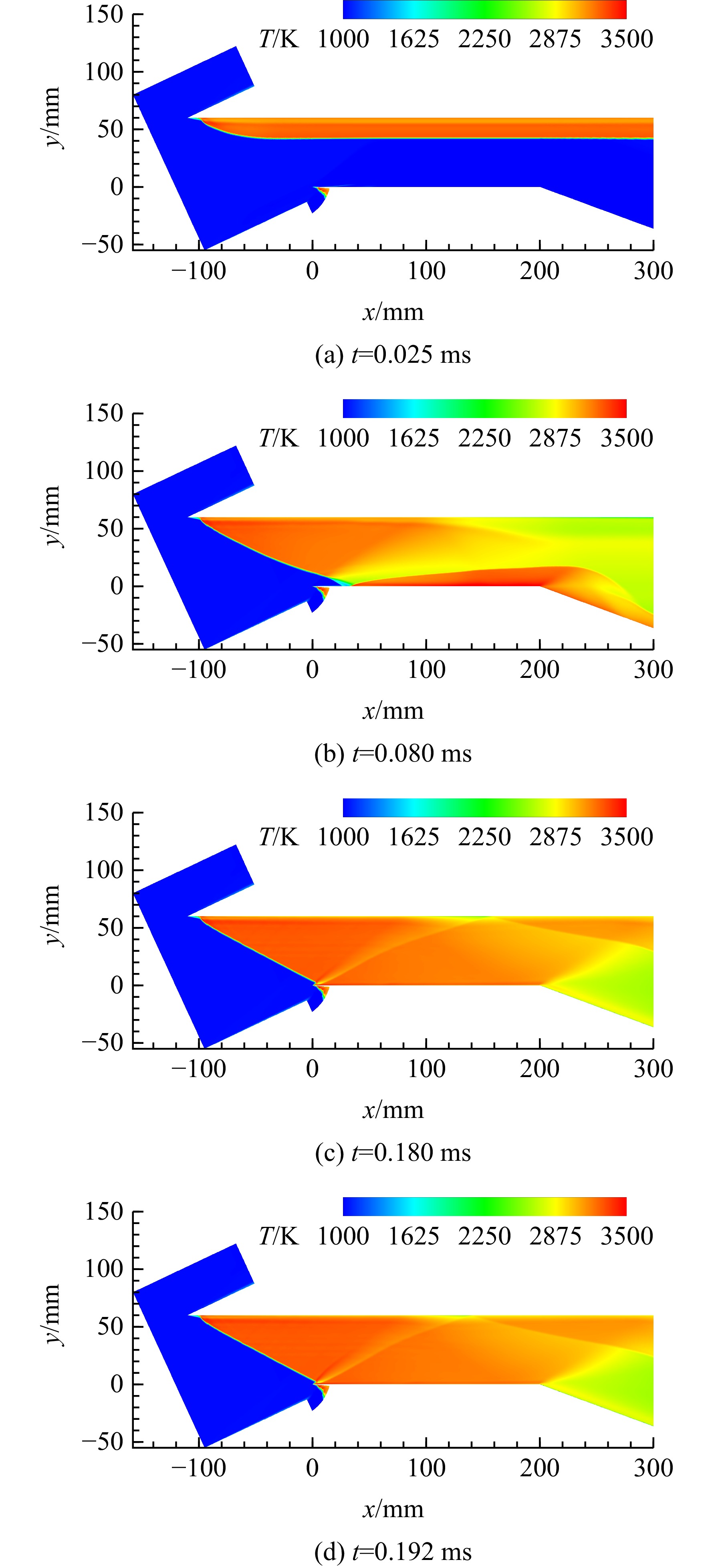
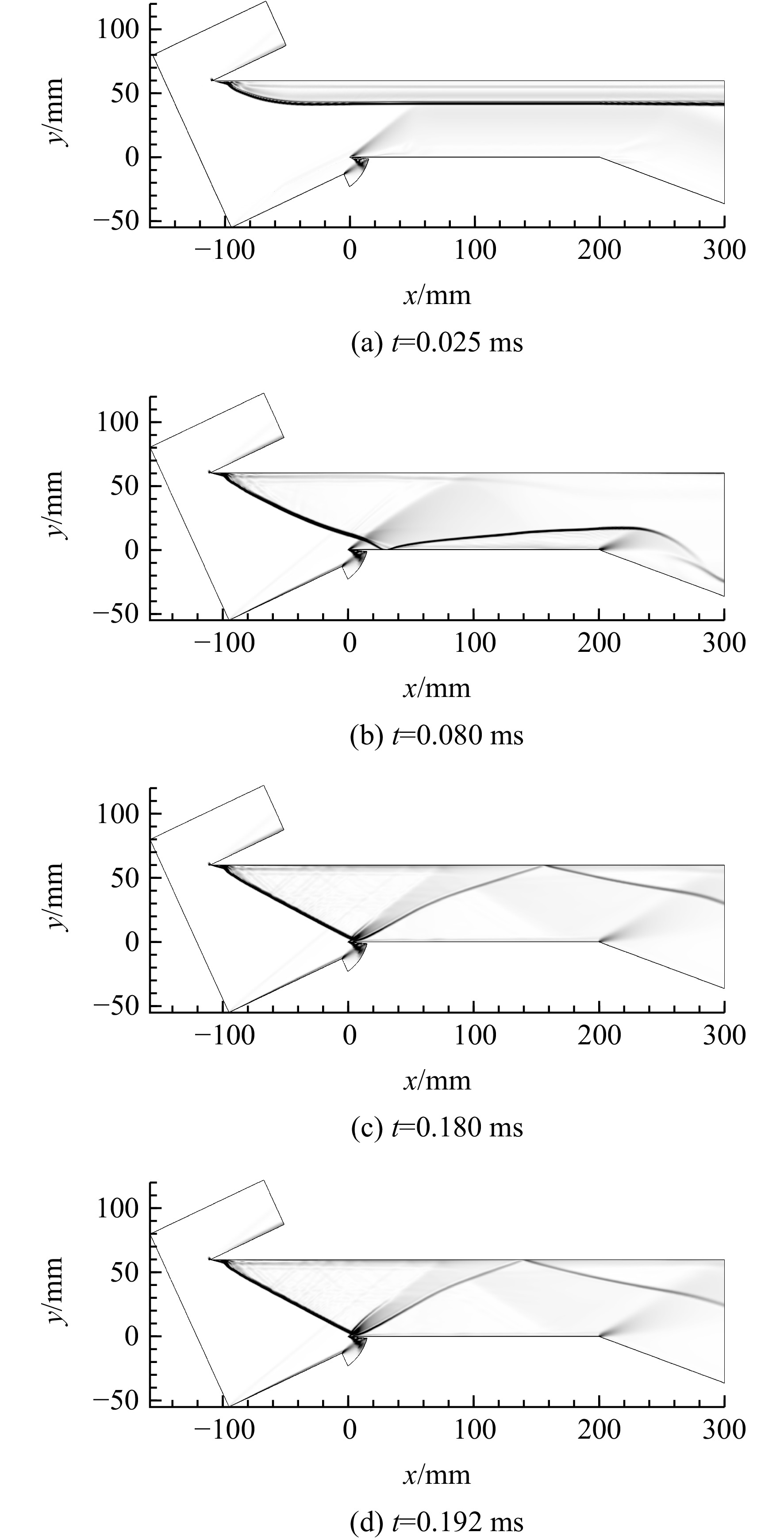
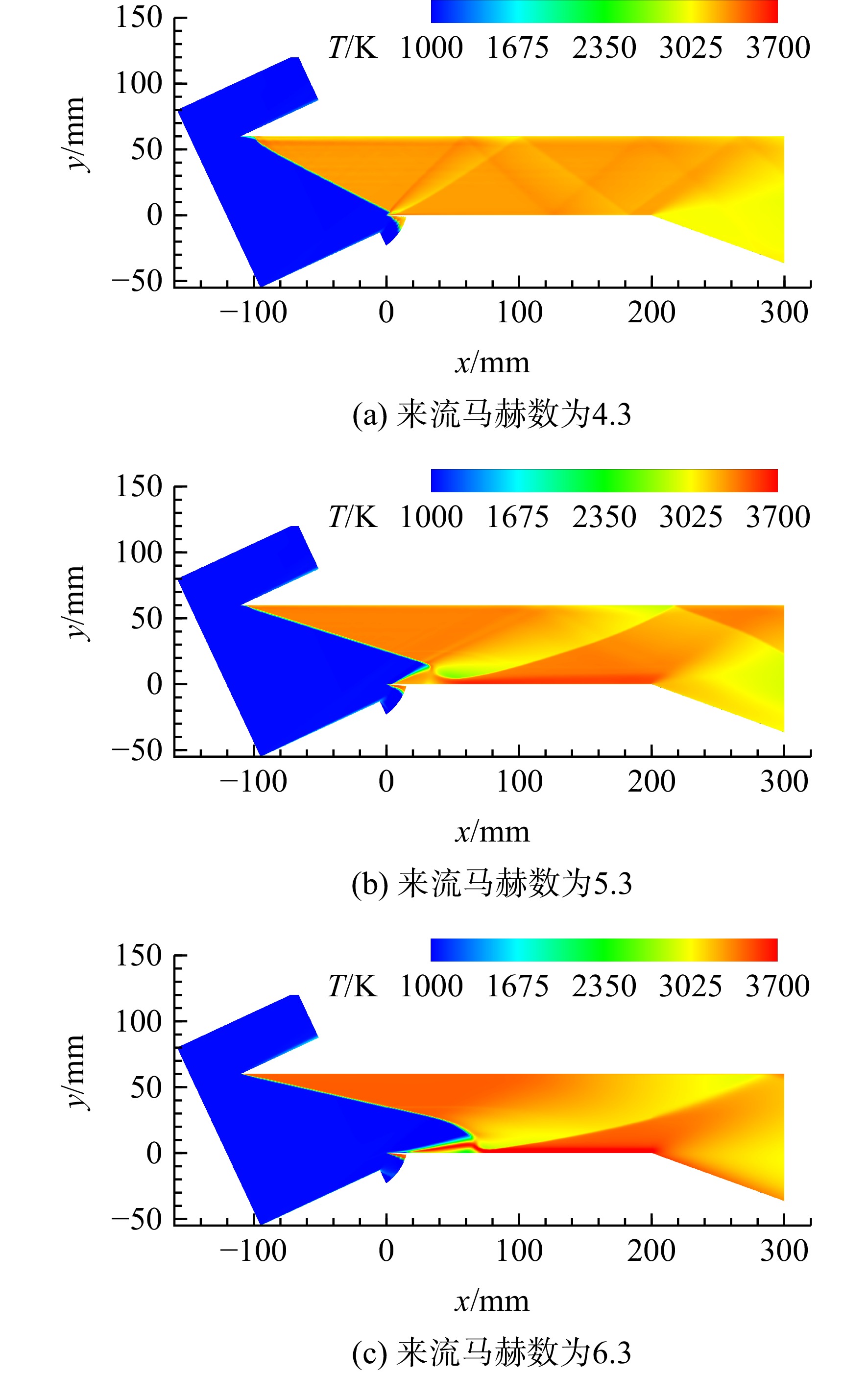
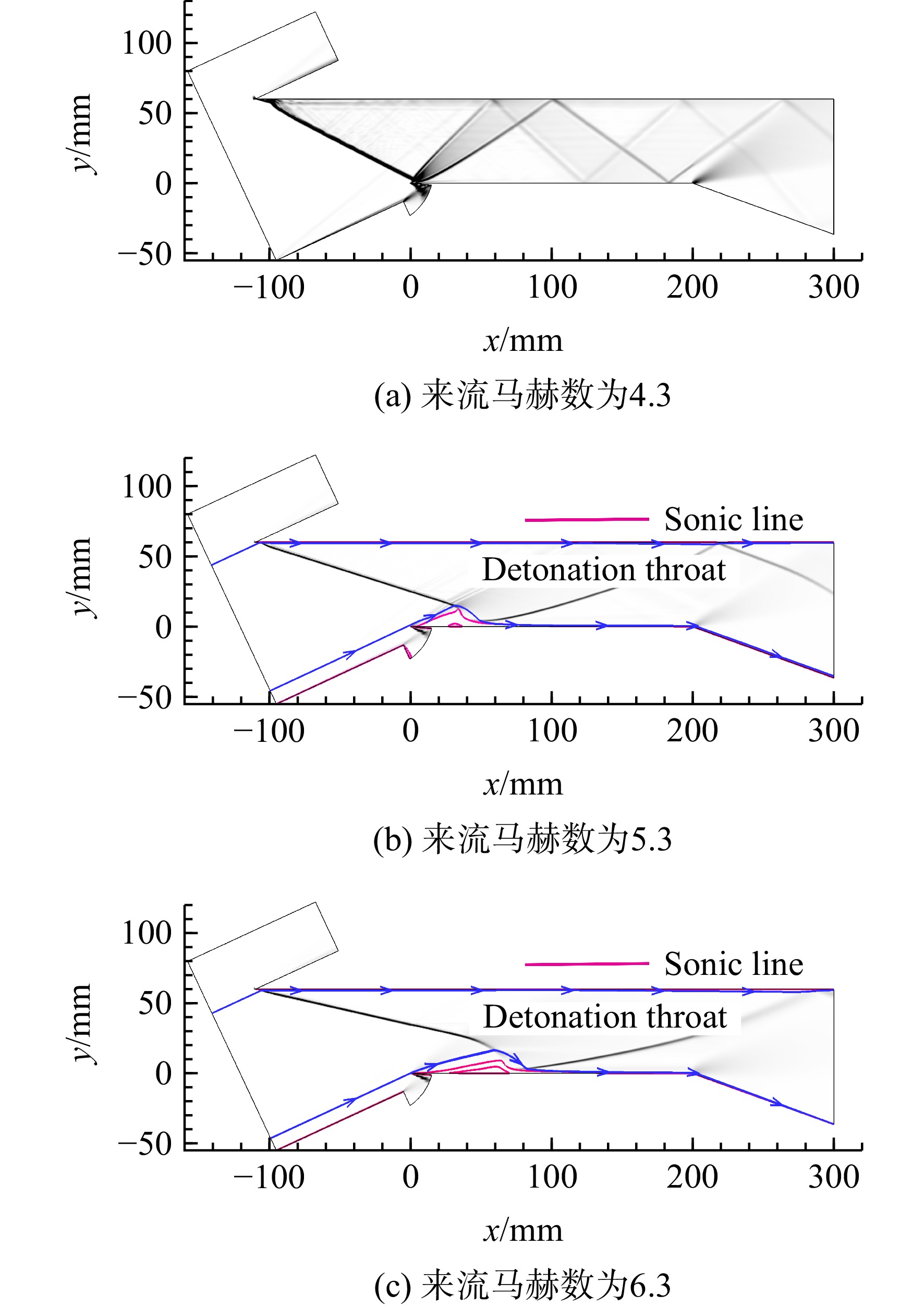
针对马赫数为8以上高超声速飞行器的应用问题,采用11组分-10反应步的煤油/空气化学反应动力学模型,对不同来流及燃料喷注条件下的斜爆轰模型发动机进行数值研究,获得其对燃烧室内起爆驻定、爆轰波波面结构及推进性能的影响规律。研究结果表明:燃烧室入口马赫数为4.3时,超声速来流与壁面边界层作用加速了点火起爆过程,爆轰波在短时间内驻定。随着来流速度增大,爆轰波驻定位置更靠近燃烧室下游,爆轰波与边界层相互作用产生分离泡导致斜爆轰发动机推力显著降低。燃料当量比的变化直接影响爆轰波波面结构,减小当量比使得斜爆轰波稳定性降低,光滑的波面转变为“锯齿”状结构,具有该结构的爆轰波流场会显著降低发动机推进性能。
Abstract:According to the application problem of hypersonic vehicles above Mach number of 8, the 11 component/10-reaction steps kerosene chemical reaction kinetics model was adopted to perform numerical simulations about the two-dimensional model of oblique detonation engines under different inlet and fuel injection conditions. The effect of incoming Mach number on initiation and stabilization of detonation waves in the combustor, and the effect of fuel equivalent ratio on detonation wave surface structures, and the engine propulsion performance were obtained. The results showed that the effect of the supersonic flow and the wall boundary layer accelerated the detonation initiation process, and the detonation wave stabilization was completed shortly when the inlet Mach number of the combustor was 4.3. Continuing to increase the incoming Mach number made the stabilization position of the detonation wave closer to the downstream. The separation bubble generated by the interaction of the detonation wave and the boundary layer caused the thrust of the oblique detonation engine to be significantly reduced. The fuel equivalent ratio directly affected the detonation wave surface structure. Reducing the equivalence ratio reduced the stabilization of the oblique detonation wave, and the smooth wave surface was transformed into a sawtooth structure. The detonation wave flow field with this structure could significantly reduce its propulsion performance.
-
Key words:
- oblique detonation engine /
- kerosene /
- detonation wave /
- initiation /
- supersonic combustor
-
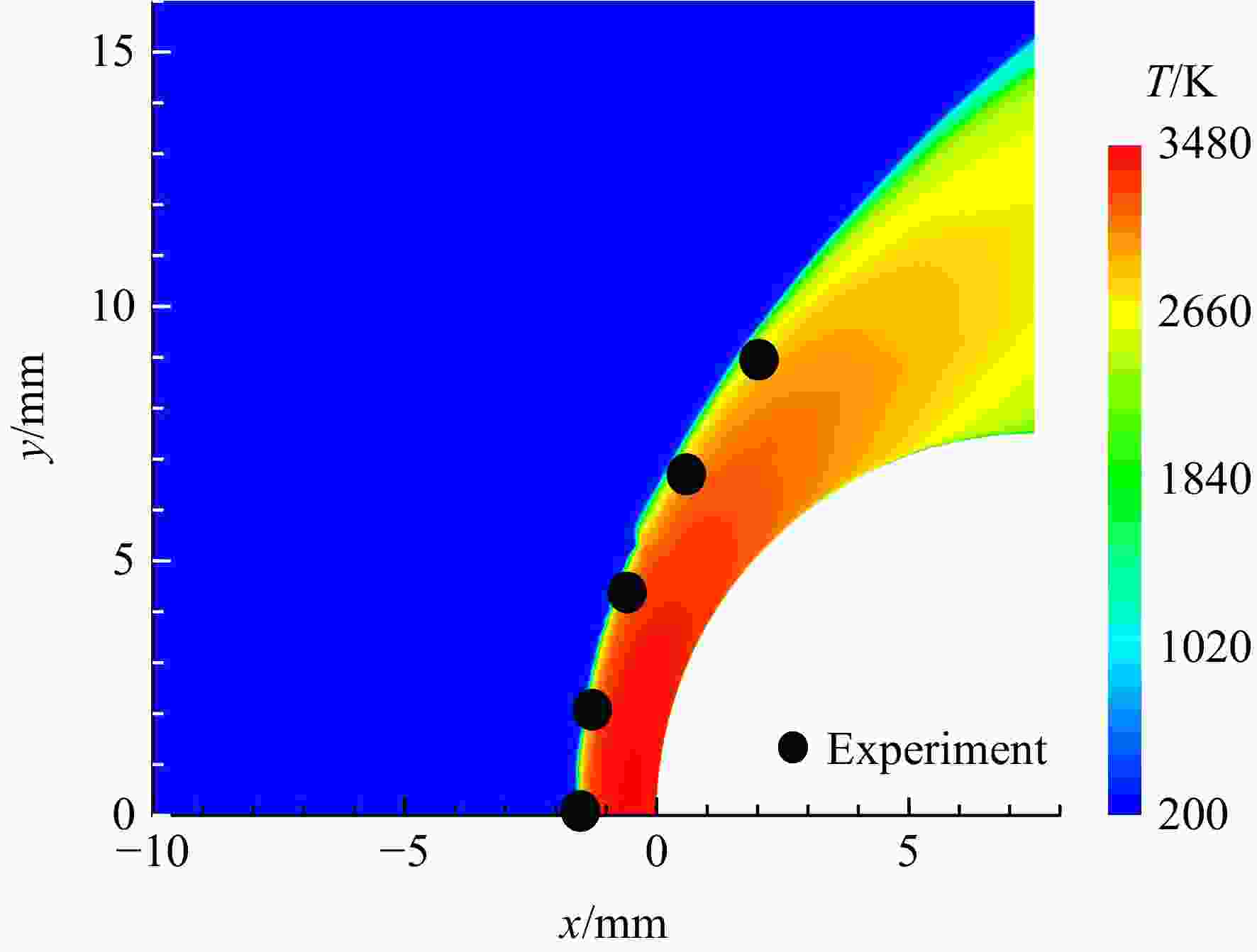
图 1 高速射弹诱导爆轰波温度分布
Figure 1. Temperature contours of the detonation waves induced by a high-speed projectile
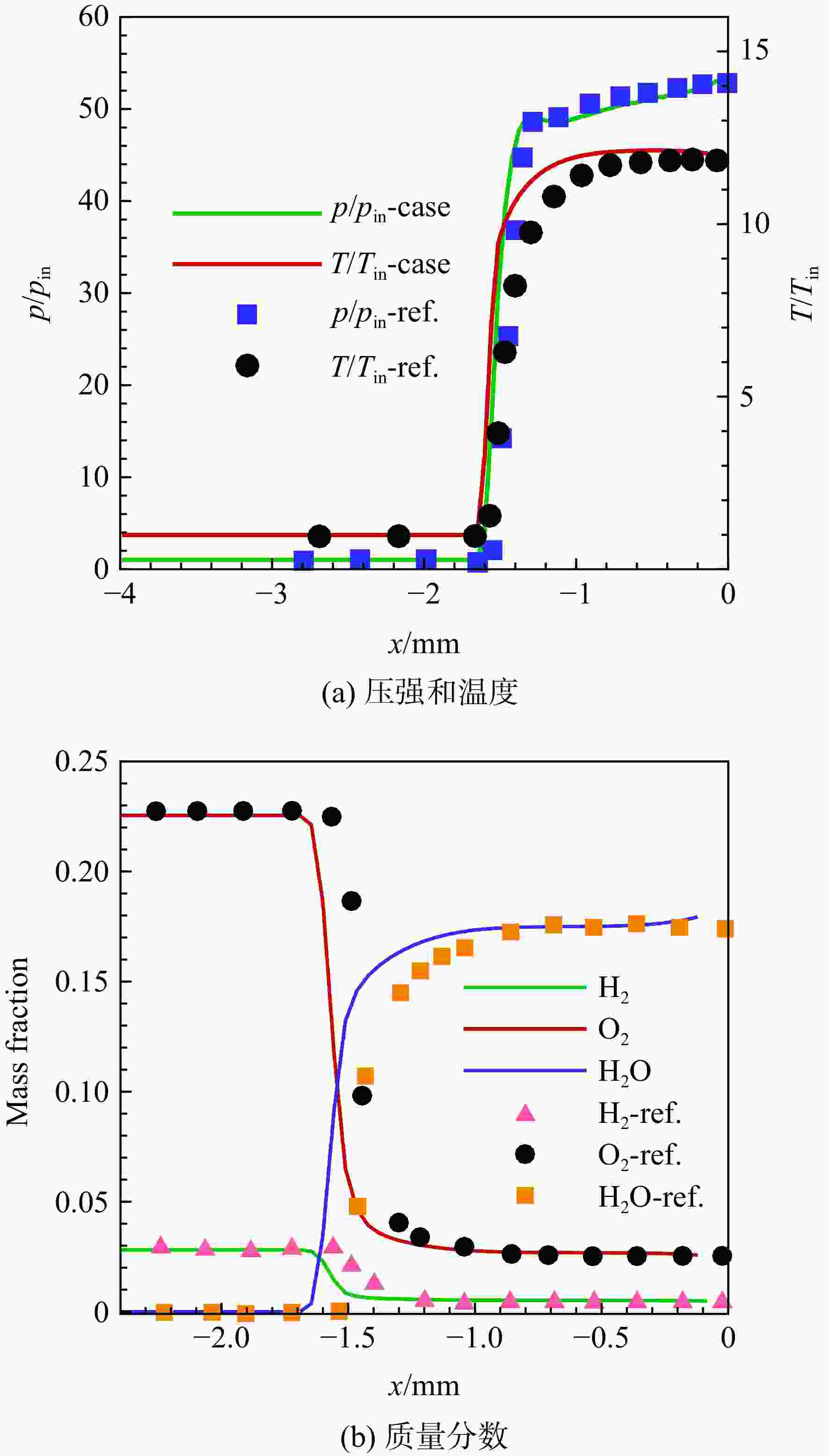
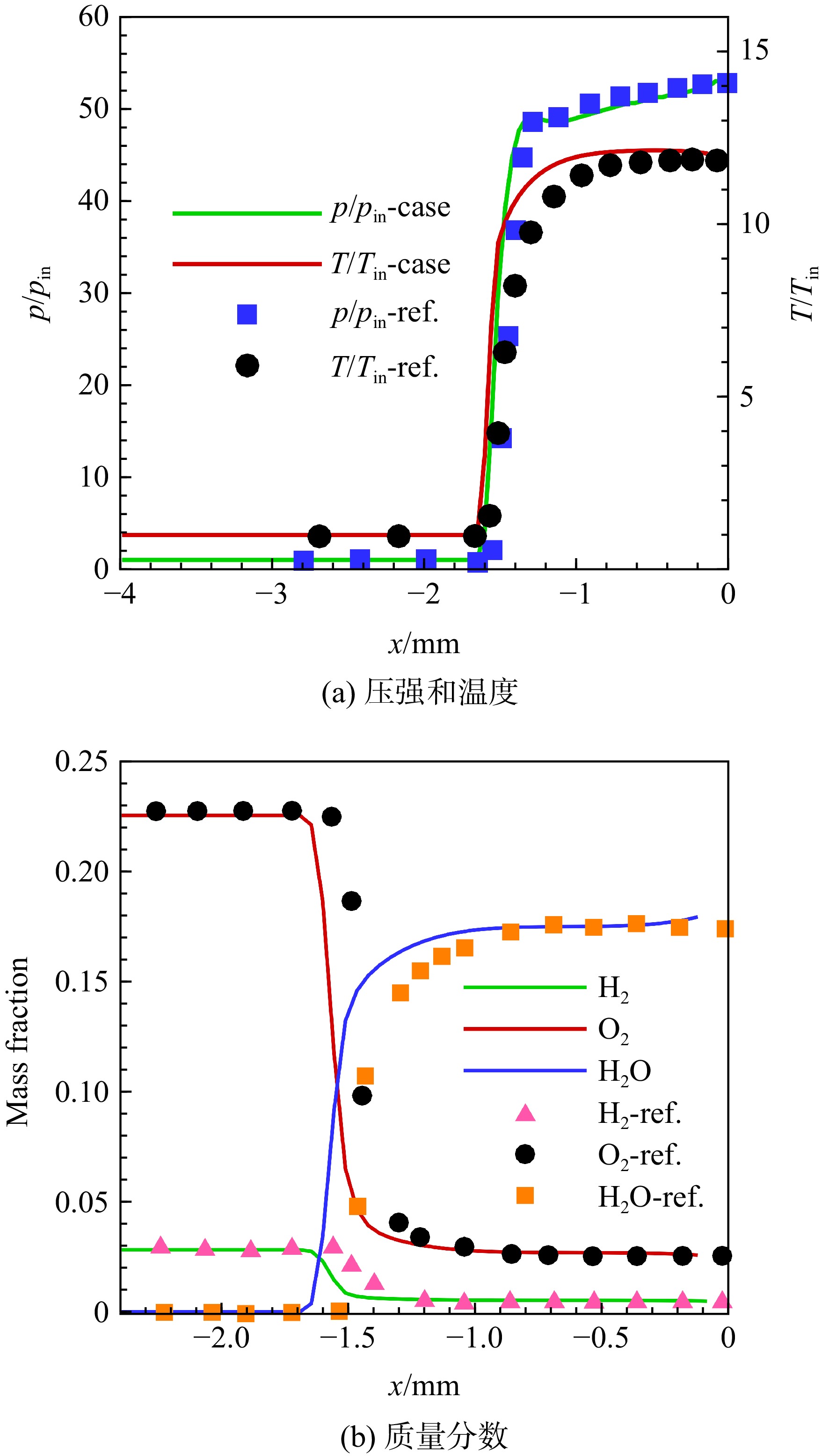
图 2 沿y=0 mm热力学参数分布校验
Figure 2. Verification of thermodynamic parameter distribution along y=0 mm
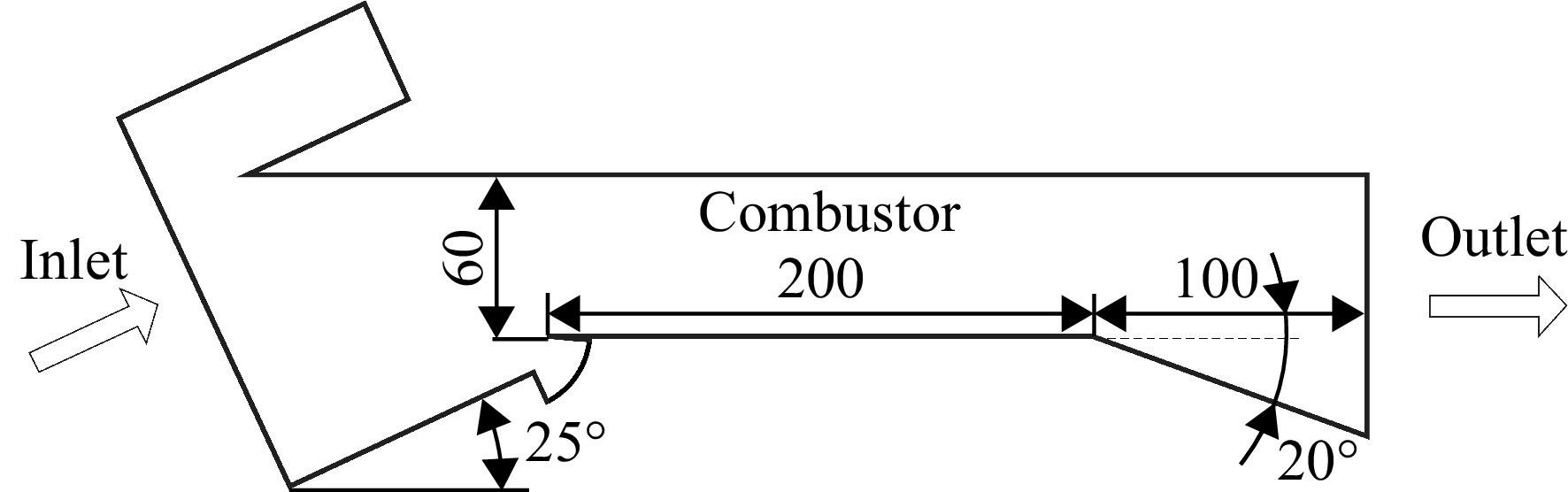
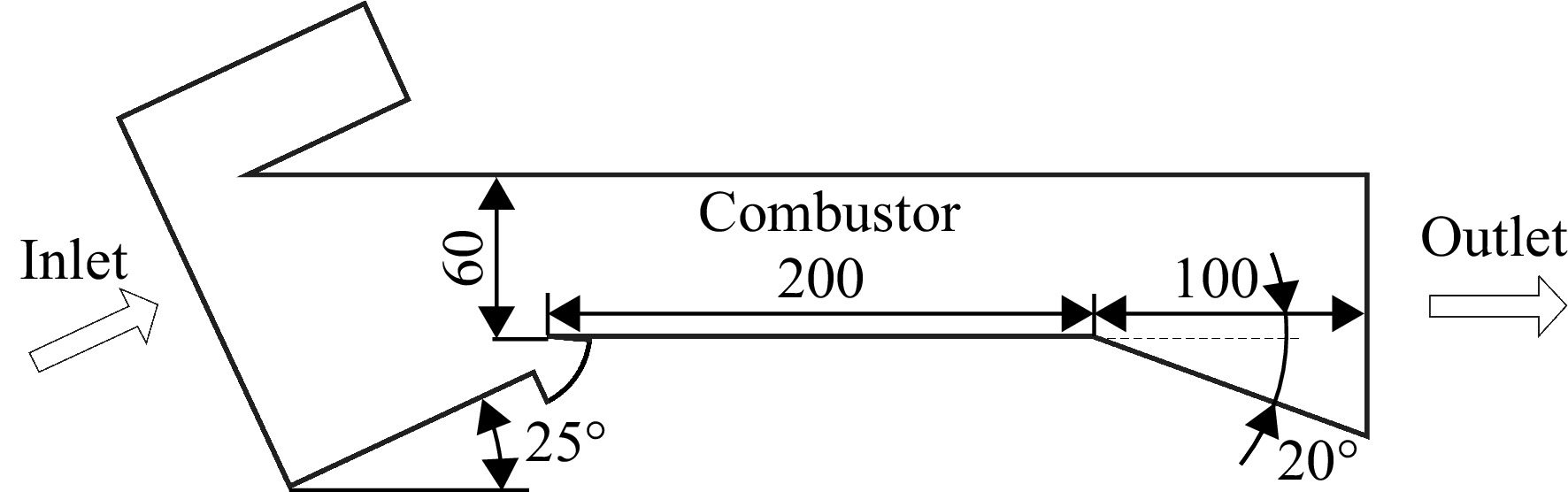
图 3 斜爆轰发动机构型尺寸(单位:mm)
Figure 3. Dimensions of oblique detonation engine model (unit:mm)
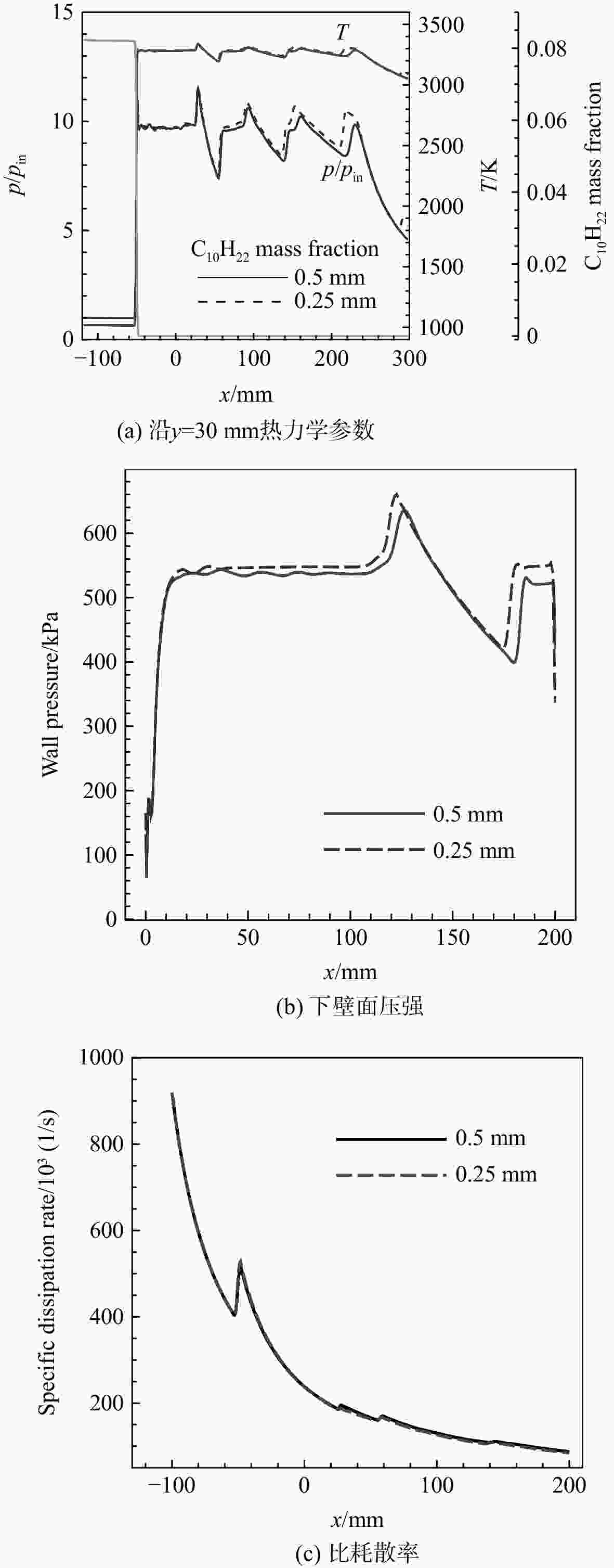
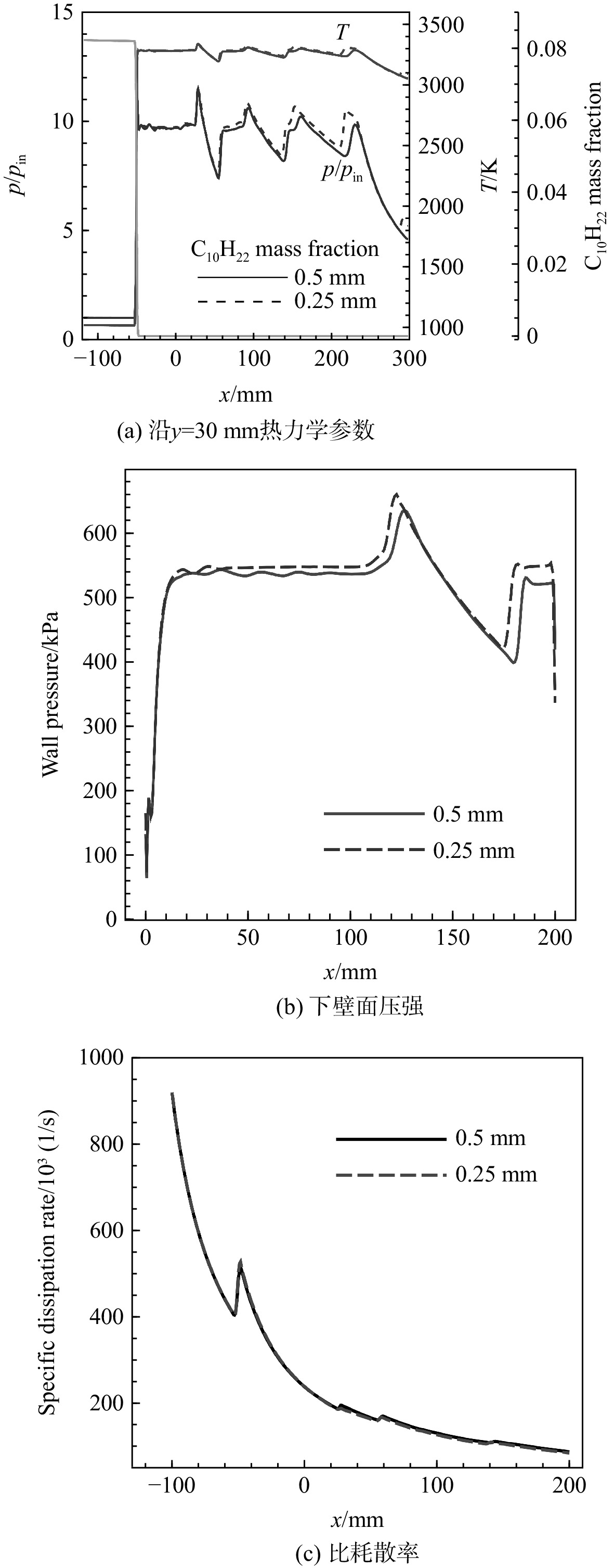
图 5 网格尺寸为0.25 mm和0.5 mm的网格无关性验证
Figure 5. Grid independence verification for grid sizes of 0.25 mm and 0.5 mm
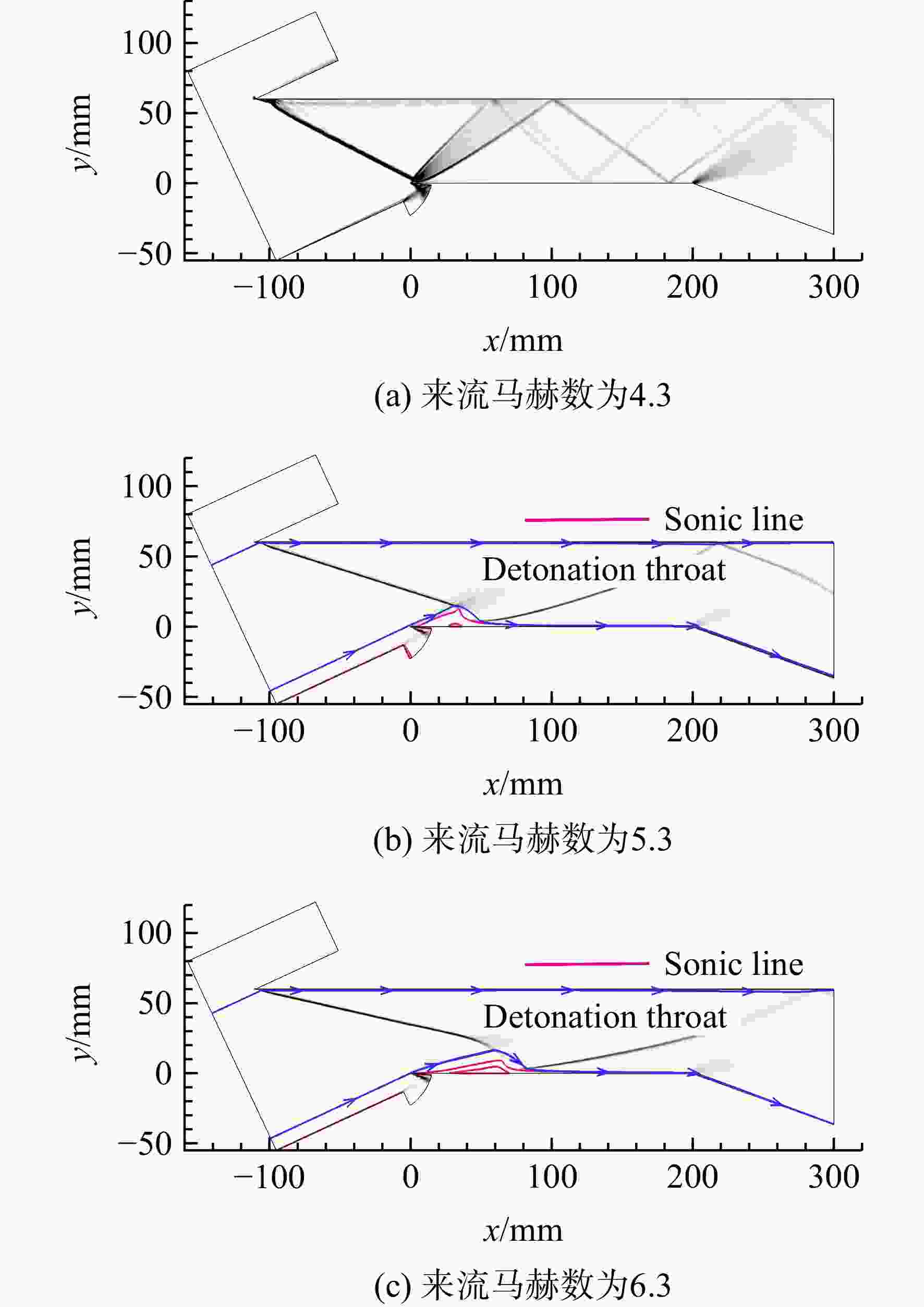
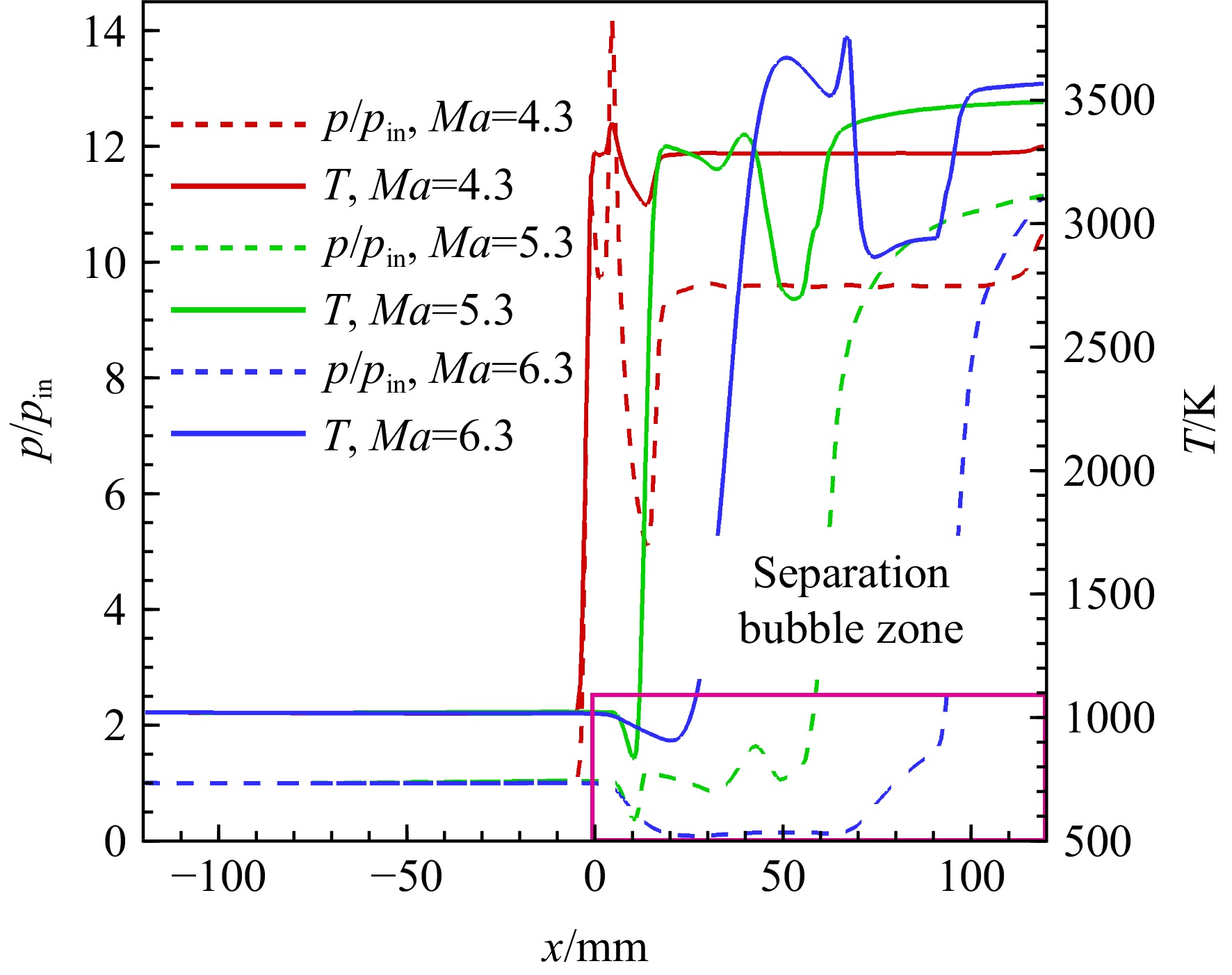
图 9 不同来流马赫数下的数值纹影
Figure 9. Numerical schlieren contours at different incoming Mach numbers
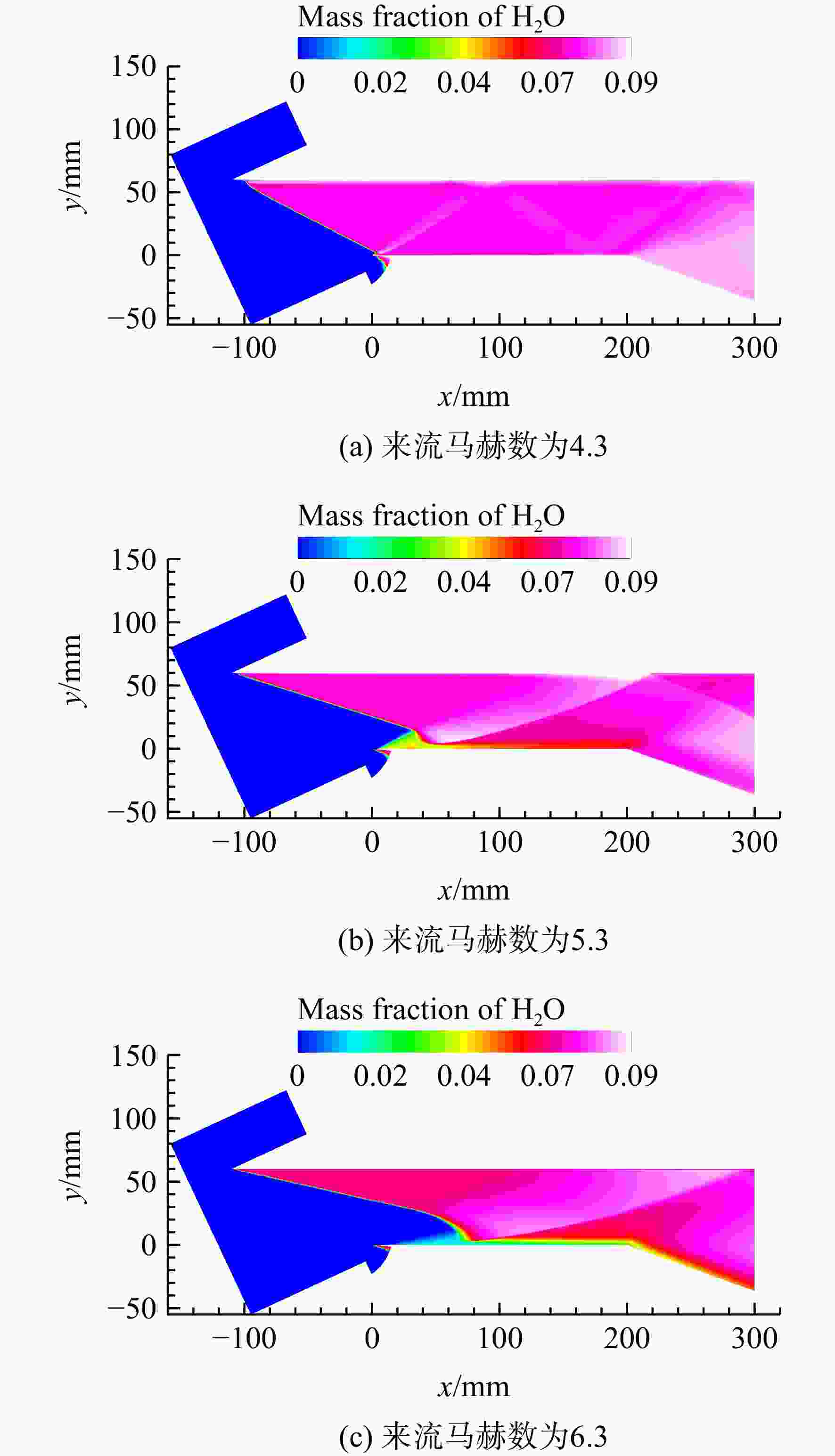
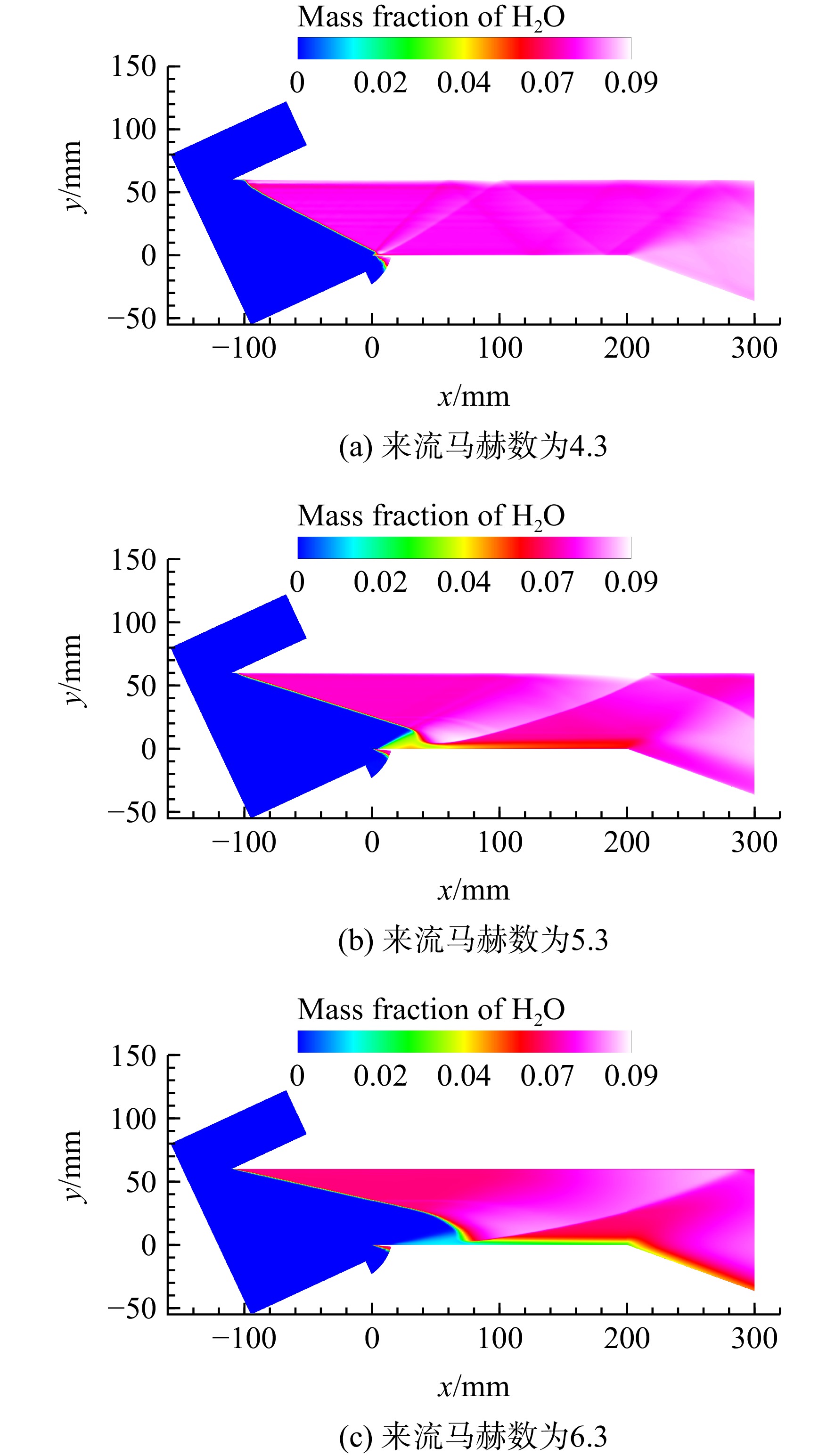
图 10 不同来流马赫数下的H2O质量分数分布
Figure 10. Mass fraction of H2O at different incoming Mach numbers
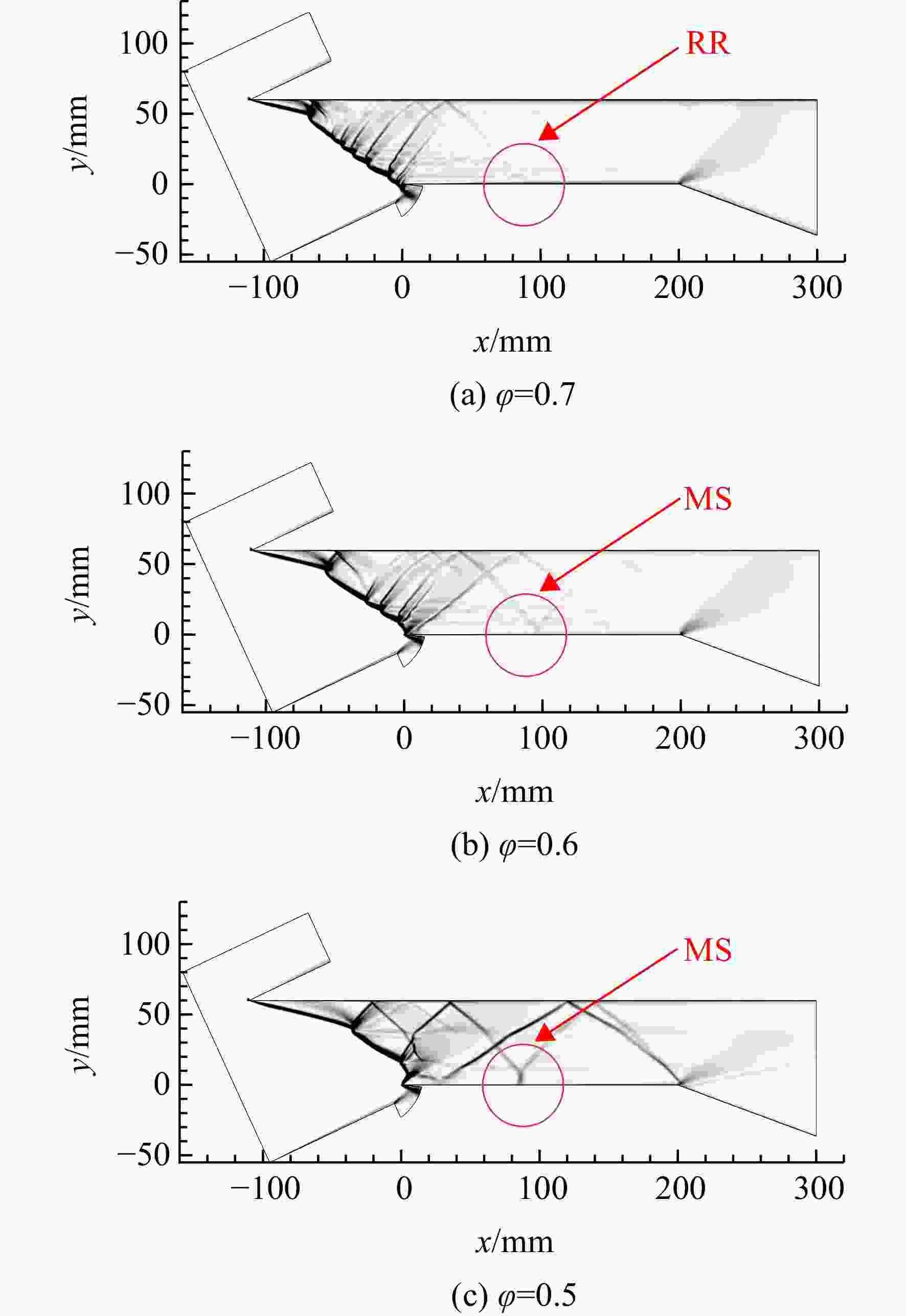
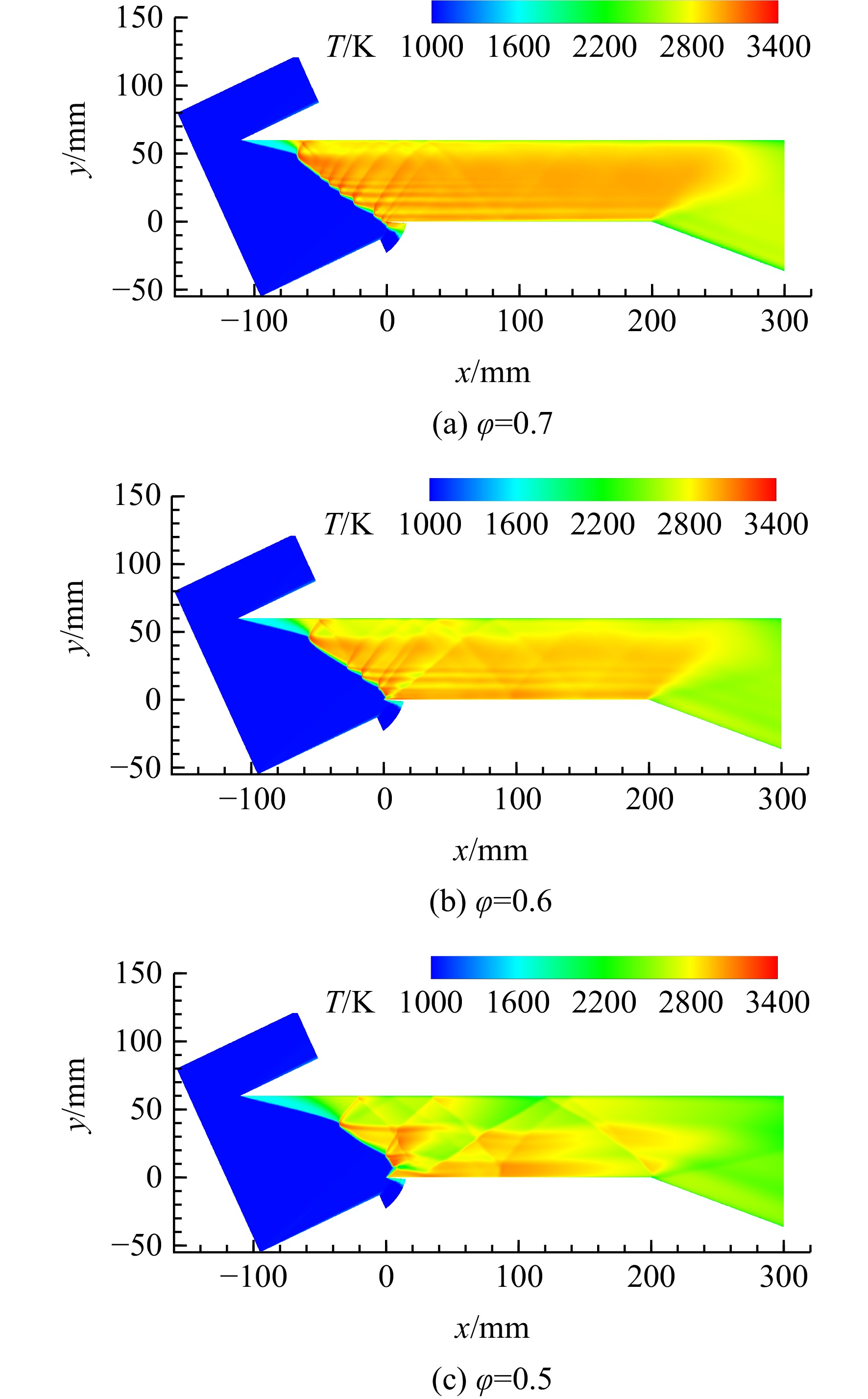
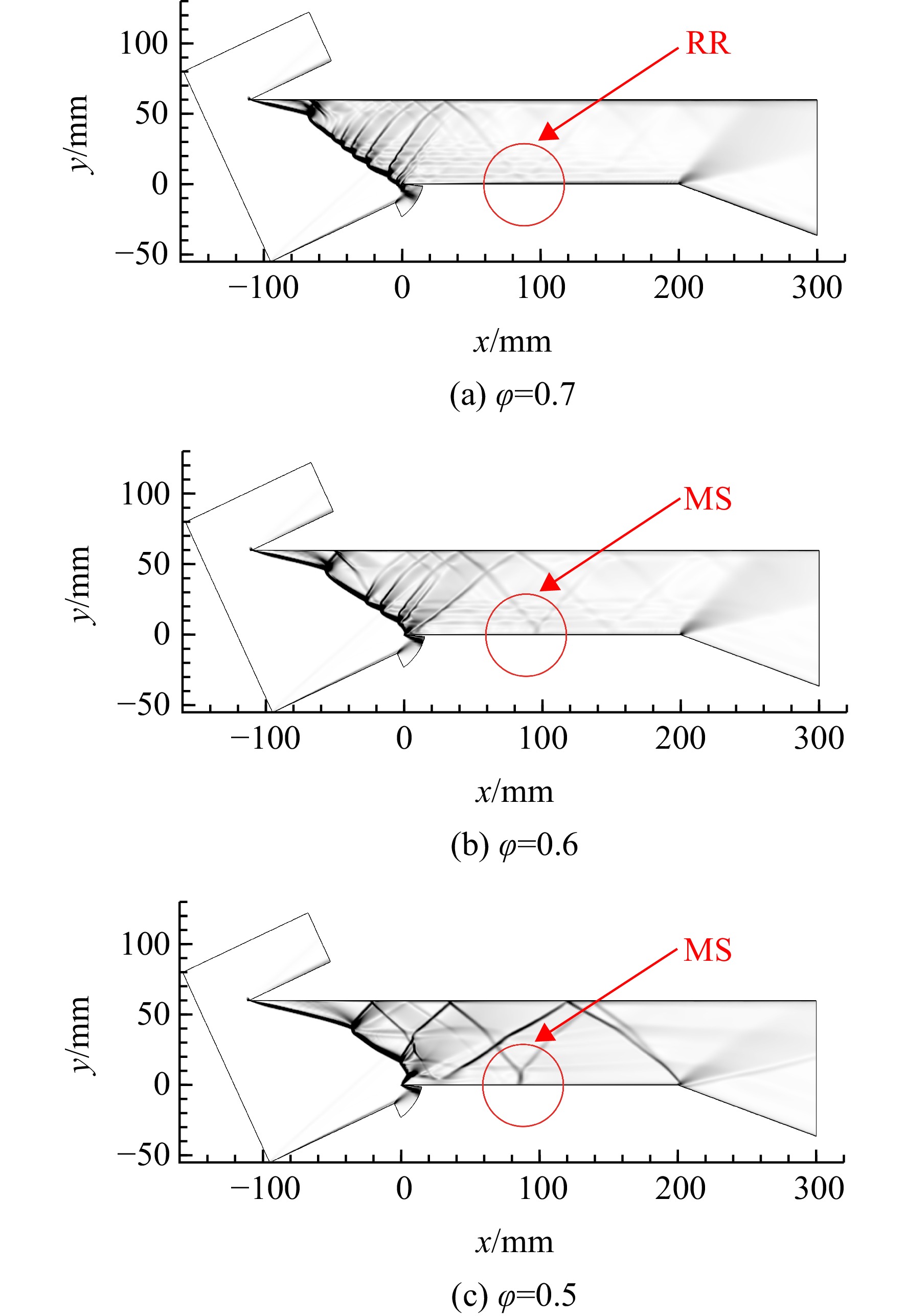
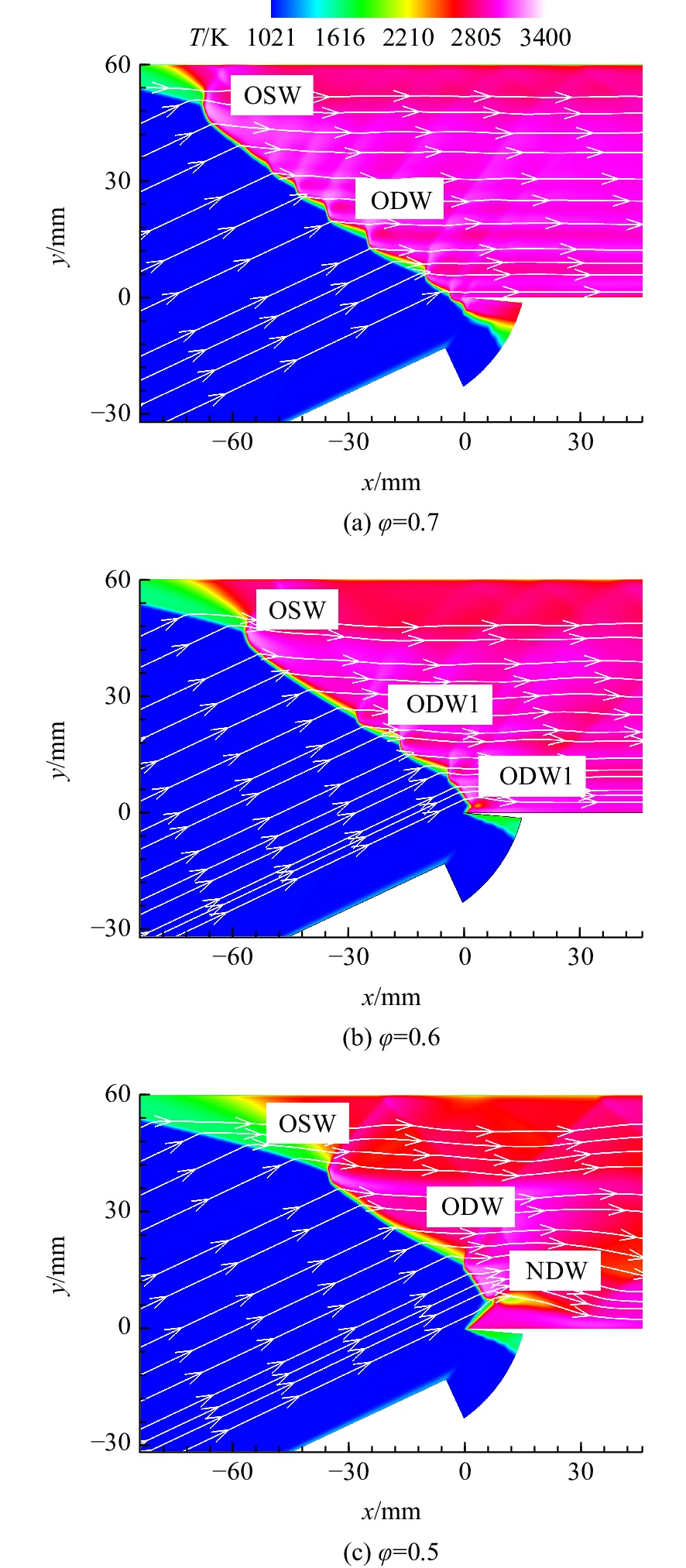
图 13 不同燃料当量比下的数值纹影
Figure 13. Numerical schlieren contours at different equivalence ratios
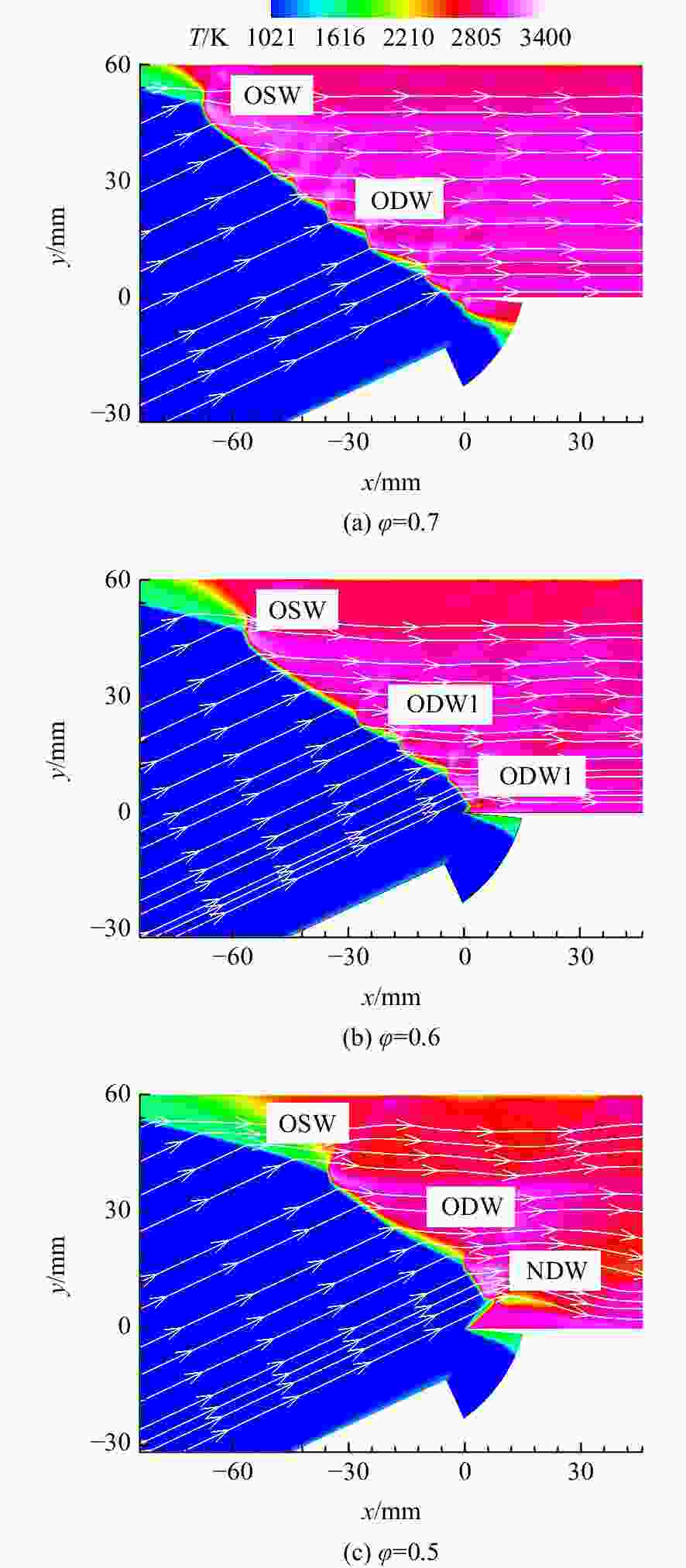
图 14 不同燃料当量比下的流线方向与爆轰波面角度对比
Figure 14. Comparison of angle between streamline direction and wave surfaces at different equivalence ratios
表 1 煤油11组分10步化学反应机理
Table 1. Rate constants for 11 species 10-step chemical kinetics of kerosene
反应式 A/(1/s) B E/(J/kmol) ${ {\text{C} }_{ {\text{10} } } }{ {\text{H} }_{ {\text{22} } } } + { {\text{O} }_{\text{2} } } = = {\text{10CH} } + {\text{12H} } + { {\text{O} }_{\text{2} } }$ 1.00×10¹² 0 3.10×10⁴ ${\text{CH} } + { {\text{O} }_{\text{2} } }= = {\text{CO} } + {\text{OH} }$ 2.00×10¹⁵ 0 3.00×10³ ${\text{CH} } + {\text{O} } = = {\text{CO} } + {\text{H} }$ 3.00×10¹² 1.00 0 ${ {\text{H} }_{\text{2} } } + { {\text{O} }_{\text{2} } }= = { {\text{H} }_2}{\text{O} } + {\text{O} }$ 3.98×10¹¹ 1.00 4.80×10⁴ ${ {\text{H} }_2} + {\text{O} } = = {\text{H} } + {\text{OH} }$ 3.00×10¹⁴ 0 6.00×10³ ${\text{H} } + { {\text{O} }_2} = = {\text{O} } + {\text{OH} }$ 4.00×10¹⁴ 0 1.80×10⁴ ${ {\text{H} }_{\text{2} } }{\text{O} } + { {\text{O} }_{\text{2} } } = = 2{\text{O} } + { {\text{H} }_{\text{2} } }{\text{O} }$ 3.17×10¹² 2.00 1.12×10⁵ ${\text{CO} } + {\text{OH} } = = {\text{C} }{ {\text{O} }_{\text{2} } } + {\text{H} }$ 5.51×10⁷ 1.27 −7.58×10² $ {\text{CO}} + {{\text{H}}_{\text{2}}}{\text{O}} = {\text{C}}{{\text{O}}_{\text{2}}} + {{\text{H}}_{\text{2}}} $ 5.50×10⁴ 1.28 −1.00×10³ ${\text{CO} } + { {\text{H} }_{\text{2} } } + { {\text{O} }_{\text{2} } } = = {\text{C} }{ {\text{O} }_{\text{2} } } + { {\text{H} }_{\text{2} } }{\text{O} }$ 1.60×10¹⁴ 1.60 1.80×10⁴  下载: 导出CSV
表 2 入口来流条件
Table 2. Inlet conditions
Case p/kPa T/K Ma φ 1 56 1021 4.3 1.35 2 56 1021 5.3 1.35 3 56 1021 6.3 1.35 4 56 1021 3.63 0.5 5 56 1021 3.63 0.6 6 56 1021 3.63 0.7
下载: 导出CSV
表 3 不同来流速度下发动机净推力对比
Table 3. Comparison of engine net thrust at different inflow velocities
Ma F0/N Fμ /N Fthrust/N 4.3 7606.1 −2954.4 4651.7 5.3 6597.1 −3213.4 3383.7 6.3 6579.5 −5384.3 1195.2
下载: 导出CSV
表 4 不同燃料当量比发动机比冲对比
Table 4. Specific impulse of engine at different equivalent ratios
φ Fthrust/N $\dot m$/(kg/s) $ {I_{{\text{sp}}}} $/(N·s/kg) 0.7 5247.74 1.932 2716.2 0.6 5163.84 1.688 3059.1 0.5 5103.51 1.394 3661.1
下载: 导出CSV
-
[1] 俞刚,范学军. 超声速燃烧与高超声速推进[J]. 力学进展,2013,43(5): 449-472.YU Gang,FAN Xuejun. Supersonic combustion and hypersonic propulsion[J]. Advances in Mechanics,2013,43(5): 449-472. (in Chinese) [2] 王振国,梁剑寒,丁猛,等. 高超声速飞行器动力系统研究进展[J]. 力学进展,2009,39(6): 716-739. doi: 10.3321/j.issn:1000-0992.2009.06.011WANG Zhenguo,LIANG Jianhan,DING Meng,et al. A review on hypersonic airbreathing propulsion system[J]. Advances in Mechanics,2009,39(6): 716-739. (in Chinese) doi: 10.3321/j.issn:1000-0992.2009.06.011 [3] URZAY J. Supersonic combustion in air-breathing propulsion systems for hypersonic flight[J]. Annual Review of Fluid Mechanics,2018,50: 593-627. doi: 10.1146/annurev-fluid-122316-045217 [4] CURRAN E T,HEISER W H,PRATT D T. Fluid phenomena in scramjet combustion systems[J]. Annual Review of Fluid Mechanics,1996,28: 323-360. doi: 10.1146/annurev.fl.28.010196.001543 [5] ANDREWS E. Scramjet development and testing in the United States[R]. AIAA-2001-1927, 2001. [6] JENSEN J, BRAENDLEIN B. Review of the Marquardt dual mode Mach 8 scramjet development[R]. AIAA-1996-3037, 1996. [7] KAILASANATH K. Review of propulsion applications of detonation waves[J]. AIAA Journal,2000,38(9): 1698-1708. doi: 10.2514/2.1156 [8] POWERS J M,STEWART D S. Approximate solutions for oblique detonations in the hypersonic limit[J]. AIAA Journal,1992,30(3): 726-736. doi: 10.2514/3.10978 [9] 王兵,谢峤峰,闻浩诚,等. 爆震发动机研究进展[J]. 推进技术,2021,42(4): 721-737, 716. doi: 10.13675/j.cnki.tjjs.210109WANG Bing,XIE Qiaofeng,WEN Haocheng,et al. Research progress of detonation engines[J]. Journal of Propulsion Technology,2021,42(4): 721-737, 716. (in Chinese) doi: 10.13675/j.cnki.tjjs.210109 [10] WOLAŃSKI P. Detonative propulsion[J]. Proceedings of the Combustion Institute,2013,34(1): 125-158. doi: 10.1016/j.proci.2012.10.005 [11] PEACE J T,LU F K. Performance modeling of pulse detonation engines using the method of characteristics[J]. Aerospace Science and Technology,2019,88: 51-64. doi: 10.1016/j.ast.2019.03.015 [12] 李晓丰,肖俊峰,王玮,等. 脉冲爆震燃烧室出口燃气能量分布特性[J]. 航空动力学报,2020,35(11): 2356-2363. doi: 10.13224/j.cnki.jasp.2020.11.012LI Xiaofeng,XIAO Junfeng,WANG Wei,et al. Energy distribution characteristics of gas at outlet of pulse detonation combustor[J]. Journal of Aerospace Power,2020,35(11): 2356-2363. (in Chinese) doi: 10.13224/j.cnki.jasp.2020.11.012 [13] MURRAY A P,SMITH T L,PITTMAN E D,et al. Frequency and spark timing effects on thrust for pulse detonation engine[J]. Journal of Propulsion and Power,2020,37(2): 242-251. [14] PRAKASH S,FIÉVET R,RAMAN V,et al. Analysis of the detonation wave structure in a linearized rotating detonation engine[J]. AIAA Journal,2019,58(12): 5063-5077. [15] 马虎,张义宁,杨成龙,等. 燃料分布对旋转爆震波传播特性影响[J]. 航空动力学报,2019,34(3): 513-520. doi: 10.13224/j.cnki.jasp.2019.03.001MA Hu,ZHANG Yining,YANG Chenglong,et al. Effects of fuel distribution on propagation of rotating detonation wave[J]. Journal of Aerospace Power,2019,34(3): 513-520. (in Chinese) doi: 10.13224/j.cnki.jasp.2019.03.001 [16] 王元帅,谭晓茗,田佳,等. 旋转爆震发动机燃烧室气膜出流影响数值研究[J]. 航空动力学报,2021,36(11): 2353-2362. doi: 10.13224/j.cnki.jasp.20200403WANG Yuanshuai,TAN Xiaoming,TIAN Jia,et al. Numerical study on effect of film ejections in rotating detonation engine combustor[J]. Journal of Aerospace Power,2021,36(11): 2353-2362. (in Chinese) doi: 10.13224/j.cnki.jasp.20200403 [17] 张子健,韩信,马凯夫,等. 斜爆轰发动机燃烧机理试验研究[J]. 推进技术,2021,42(4): 786-794. doi: 10.13675/j.cnki.tjjs.200828ZHANG Zijian,HAN Xin,MA Kaifu,et al. Experimental research on combustion mechanism of oblique detonation engines[J]. Journal of Propulsion Technology,2021,42(4): 786-794. (in Chinese) doi: 10.13675/j.cnki.tjjs.200828 [18] ZHANG G Q,GAO S F,XIANG G X. Study on initiation mode of oblique detonation induced by a finite wedge[J]. Physics of Fluids,2021,33(1): 016102. doi: 10.1063/5.0035960 [19] BACHMAN C L,GOODWIN G B. Ignition criteria and the effect of boundary layers on wedge-stabilized oblique detonation waves[J]. Combustion and Flame,2021,223: 271-283. doi: 10.1016/j.combustflame.2020.10.007 [20] PRATT D T,HUMPHREY J W,GLENN D E. Morphology of standing oblique detonation waves[J]. Journal of Propulsion and Power,1991,7(5): 837-845. doi: 10.2514/3.23399 [21] ZHANG Yining,YANG Pengfei,TENG Honghui,et al. Transition between different initiation structures of wedge-induced oblique detonations[J]. AIAA Journal,2018,56(10): 4016-4023. doi: 10.2514/1.J056831 [22] 陈楠,SEYED A E,SUDIP B,等. 当量比对斜爆轰波诱导区特性影响的数值模拟研究[J]. 推进技术,2018,39(12): 2798-2805. doi: 10.13675/j.cnki.tjjs.2018.12.019CHEN Nan,SEYED A E,SUDIP B,et al. Numerical study on effects of equivalence ratio on initiation characteristics of oblique detonation waves[J]. Journal of Propulsion Technology,2018,39(12): 2798-2805. (in Chinese) doi: 10.13675/j.cnki.tjjs.2018.12.019 [23] MIAO Shikun,ZHOU Jin,LIN Zhiyong,et al. Numerical study on thermodynamic efficiency and stability of oblique detonation waves[J]. AIAA Journal,2018,56(8): 3112-3122. doi: 10.2514/1.J056887 [24] BACHMAN C L, GOODWIN G B, AHMED K. Wedge-stabilized oblique detonation waves in a hypersonic hydrogen-air premixed freestream[R]. AIAA-2019-4044, 2019. [25] ZHANG Zijian,WEN C,ZHANG Wenshuo,et al. Formation of stabilized oblique detonation waves in a combustor[J]. Combustion and Flame,2021,223: 423-436. doi: 10.1016/j.combustflame.2020.09.034 [26] GONG Jishuang, ZHANG Yining, PAN Hu, et al. Experimental investigation on initiation of oblique detonation waves[R]. AIAA-2017-2350, 2017. [27] JIANG Zonglin,ZHANG Zijian,LIU Yunfeng,et al. Criteria for hypersonic airbreathing propulsion and its experimental verification[J]. Chinese Journal of Aeronautics,2021,34(3): 94-104. doi: 10.1016/j.cja.2020.11.001 [28] ORAN E S,GAMEZO V N. Origins of the deflagration-to-detonation transition in gas-phase combustion[J]. Combustion and Flame,2007,148(1/2): 4-47. [29] LEHR H F. Experiments on shock-induced combustion[J]. Acta Astronautica,1972,17: 589-597. [30] MARINOV N M, WESTBROOK C K, PITZ W J. Detailed and global chemical kinetics model for hydrogen[R]. San Francisco, US: 8th International Symposium on Transport Properties, 1995. [31] ZHUO Changfei,FENG Feng,WU Xiaosong. Development process of muzzle flows including a Gun-launched missile[J]. Chinese Journal of Aeronautics,2015,28(2): 385-393. doi: 10.1016/j.cja.2015.02.001 [32] 童秉纲, 孔祥言, 邓国华. 气体动力学[M]. 2版. 北京: 高等教育出版社, 2012. [33] TENG Hong,JIANG Zong. On the transition pattern of the oblique detonation structure[J]. Journal of Fluid Mechanics,2012,713: 659-669. doi: 10.1017/jfm.2012.478 [34] YU Moyao,MIAO Shikun. Initiation characteristics of wedge-induced oblique detonation waves in turbulence flows[J]. Acta Astronautica,2018,147: 195-204. doi: 10.1016/j.actaastro.2018.04.022 -

 点击查看大图

计量
- 文章访问数: 957
- HTML浏览量: 648
- PDF量: 132
- 被引次数: 0