






Load characteristics of thrust reverser based on fluid-structure coupling method
-
摘要:
反推力装置负载特性是其运动机构及驱动作动器强度设计的基础, 其中阻流门所受气动载荷及其应力分布计算是核心。以叶栅式反推力装置为对象,采用重叠网格方法实现阻流门和滑动整流罩的旋转以及平移运动网格划分,在STAR-CCM+软件环境下确定了流固耦合交界面的数据映射与交换关系,由此建立了反推力装置流固耦合数值分析模型。对反推力装置在飞机降落时正常打开和起飞滑跑紧急终止时应急打开两种动态过程进行仿真,结果表明:随阻流门旋转,阻流门所受气动载荷与等效应力快速增加,并在旋转角度为50°附近达到最大,且在应急终止起飞状态下打开反推力装置,阻流门承受的最大气动载荷是正常打开过程的3倍以上。
Abstract:The load characteristics of the thrust reverser are the basis of the strength design of its kinematic mechanism and drive actuator, in which the calculation of the aerodynamic load and stress distribution on the blocker door is the core. Taking the cascade thrust reverser as the object, the overlapping grid method was used to achieve the movement of the boundary grid of the translating sleeve and blocker door components, at the same time, the data mapping and exchange relationship of the fluid-structure coupling interface was formed in the STAR-CCM+ software environment. Based on these, the fluid-structure coupling numerical analysis model of the thrust reverser was established. The two dynamic processes of the thrust reverser normal opening during landing and emergency opening during takeoff were simulated. Results showed that with the rotation of the blocker door, the aerodynamic load and equivalent stress on the blocker door increased rapidly, and reached the maximum near the rotation angle of 50°. Moreover, the maximum aerodynamic load on the blocker door was more than 3 times of the normal opening process when the thrust reverser was opened under emergency termination takeoff state.
-
Key words:
- thrust reverser /
- blocker door /
- fluid-structure coupling /
- aerodynamic load /
- stress distribution
-

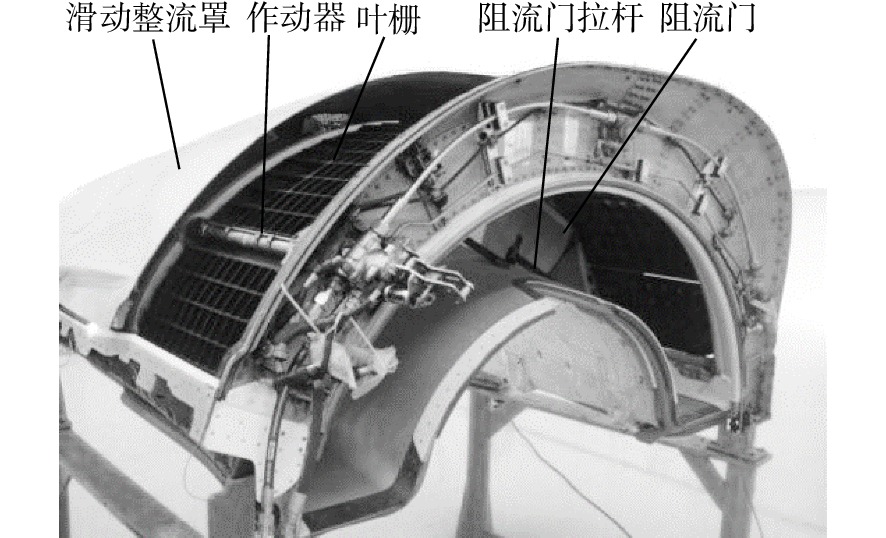
图 2 叶栅式反推力装置工作原理示意图
Figure 2. Working principle schematic diagram of cascade thrust reverser

图 3 叶栅式反推力装置三维几何模型
Figure 3. Three-dimensional geometric model of cascade thrust reverser

图 8 打开状态下流场流线与压力云图
Figure 8. Flow field streamline and pressure cloud chart on opening state

图 9 阻流门正面速度矢量及压力云图
Figure 9. Front velocity vector and pressure cloud chart of blocker door

图 11 反推力装置正常打开状态时流场流线图
Figure 11. Flow field streamline diagram of thrust reverser on normal opening state

图 12 反推力装置正常打开时流场压力云图
Figure 12. Flow field pressure cloud chart of thrust reverser on normal opening state

图 13 反推力装置正常打开时阻流门正面压力分布
Figure 13. Blocker door front pressure distribution of thrust reverser on normal opening state

图 14 反推力装置正常打开过程阻流门气动载荷变化
Figure 14. Variation of aerodynamic load on blocker door during thrust reverser normal opening process

图 15 反推力装置正常打开时阻流门正面等效应力分布
Figure 15. Equivalent stress distribution on the front of blocker door on thrust reverser normal opening state

图 16 反推力装置正常打开时阻流门背面等效应力分布
Figure 16. Equivalent stress distribution on the back of blocker door on thrust reverser normal opening state

图 17 反推力装置应急打开时流场流线图
Figure 17. Flow field streamline diagram of thrust reverser on emergency opening state

图 18 反推力装置应急打开时流场压力云图
Figure 18. Flow field pressure cloud chart of thrust reverser on emergency opening state

图 19 反推力装置应急打开时阻流门正面压力分布
Figure 19. Blocker door front pressure distribution of thrust reverser on emergency opening state

图 21 反推力装置应急打开时阻流门正面等效应力分布
Figure 21. Equivalent stress distribution on the front of blocker door on thrust reverser emergency opening state
-
[1] YETTER J A. Why do airlines want and use thrust reversers? [R]. NASA TM-109158, 1995. [2] 靳宝林,邢伟红,刘殿春. 飞机/发动机推进系统反推力装置[J]. 航空发动机,2004,30(4): 48-52, 58. doi: 10.3969/j.issn.1672-3147.2004.04.014JIN Baolin,XING Weihong,LIU Dianchun. Reverse thrust device of aircraft/engine propulsion system[J]. Aeroengine,2004,30(4): 48-52, 58. (in Chinese) doi: 10.3969/j.issn.1672-3147.2004.04.014 [3] 左志成,钱瑞战. 民机反推力装置对发动机进气口流场畸变影响数值模拟研究[J]. 飞机设计,2007,27(5): 60-64. doi: 10.3969/j.issn.1673-4599.2007.05.013ZUO Zhicheng,QIAN Ruizhan. Numerical simulation investigation of effect of thrust-reverser oerating on engine inlet flow distortion for civilian transport[J]. Aircraft Design,2007,27(5): 60-64. (in Chinese) doi: 10.3969/j.issn.1673-4599.2007.05.013 [4] 饶祺,盛鸣剑,韩涛锋,等. 发动机反推力装置研究[J]. 科技广场,2014(2): 91-94. doi: 10.3969/j.issn.1671-4792.2014.02.021RAO Qi,SHENG Mingjian,HAN Taofeng,et al. Research on engine thrust reverser[J]. Science Mosaic,2014(2): 91-94. (in Chinese) doi: 10.3969/j.issn.1671-4792.2014.02.021 [5] ANDRADE F O D, FERREIRA S B, SILVA L F F D, et al. Study of the influence of aircraft geometry on the computed flowfield during thrust reversers operation[R]. AIAA 2006-3673, 2006. [6] 邵万仁, 叶留增, 沈锡钢, 等. 反推力装置关键技术及技术途径初步探讨[R]. 广东 深圳: 大型飞机关键技术高层论坛暨中国航空学会学术年会, 2007. [7] 陈著,单勇,沈锡钢,等. 叶栅式反推力装置开启过程的三维非稳态数值模拟与分析[J]. 航空动力学报,2017,32(9): 2132-2138.CHEN Zhu,SHAN Yong,SHEN Xigang,et al. Three-dimensional unsteady numerical simulation and analysis of deployment for cascade thrust reverser[J]. Journal of Aerospace Power,2017,32(9): 2132-2138. (in Chinese) [8] 张少军,王汉平,何江军,等. 叶栅式反推装置的受载与传力[J]. 四川兵工学报,2015,36(3): 56-59.ZHANG Shaojun,WANG Hanping,HE Jiangjun,et al. Load and force transmission of cascade thrust reverser[J]. Journal of Sichuan Ordnance,2015,36(3): 56-59. (in Chinese) [9] 陈永琴,何杰,苏三买. 反推力装置运动学与动力学仿真[J]. 航空动力学报,2019,34(11): 2316-2323. doi: 10.13224/j.cnki.jasp.2019.11.002CHEN Yongqin,HE Jie,SU Sanmai. Kinematics and dynamics simulation of thrust reverser[J]. Journal of Aerospace Power,2019,34(11): 2316-2323. (in Chinese) doi: 10.13224/j.cnki.jasp.2019.11.002 [10] 高吴浩,陈永琴,苏三买,等. 反推力装置结构优化设计[J]. 航空动力学报,2022,37(8): 1724-1731. doi: 10.13224/j.cnki.jasp.20210282GAO Wuhao,CHEN Yongqin,SU Sanmai,et al. Structural optimization design of thrust reverser[J]. Journal of Aerospace Power,2022,37(8): 1724-1731. (in Chinese) doi: 10.13224/j.cnki.jasp.20210282 [11] HEGEN G H, KOOI J W. Investigation of aircraft performance with deployed thrust reversers in DNW[R]. AIAA 2005-3702, 2005 [12] DIETRICH D, LUIDENS R W. Experimental performance of cascade thrust reversers at forward velocity[R]. NASA TM X-2665, 1973. [13] 王福军. 计算流体动力学分析: CFD软件原理与应用[M]. 北京: 清华大学出版社, 2004 [14] 李鹏,高振勋,蒋崇文. 重叠网格方法的研究进展[J]. 力学与实践,2014,36(5): 551-565. doi: 10.6052/1000-0879-14-011LI Peng,GAO Zhenxun,JIANG Chongwen. The progress of the overlapping grid techniques[J]. Mechanics in Engineering,2014,36(5): 551-565. (in Chinese) doi: 10.6052/1000-0879-14-011 [15] 李明, 李明高. STAR-CCM+与流场计算[M]. 北京: 机械工业出版社, 2011 [16] 唐伟,刘启国,汪东. 军用反推力装置通用规范技术要素的确定[J]. 航空标准化与质量,2013(5): 7-10, 18. doi: 10.3969/j.issn.1003-6660.2013.05.003TANG Wei,LIU Qiguo,WANG Dong. Determination of technical elements of general specification for military reverse thrust device[J]. Aeronautic Standardization and Quality,2013(5): 7-10, 18. (in Chinese) doi: 10.3969/j.issn.1003-6660.2013.05.003 [17] 何杰. 飞机反推力装置动力学分析及结构优化[D]. 西安: 西安电子科技大学, 2020.HE Jie. Dynamic analysis and structure optimum of aircraft thrust reverser[D]. Xi’an: Xidian University, 2020. (in Chinese) [18] NOBEL T, WOODEN P, ARLEDGE R. Experimental thrust reverser design with computational analysis[R]. AIAA 94-0021, 1994. [19] Boeing 737-800 flight crew operations manual[M]. Chicago, US: Boeing Commercial Airplane Group, 2012. [20] 王志强,沈锡钢,胡骏. 反推状态下大涵道比涡扇发动机气动稳定性预测与评估[J]. 航空学报,2017,38(2): 120202.1-120202.11.WANG Zhiqiang,SHEN Xigang,HU Jun. Prediction and evaluation of aerodynamic stability of high bypass ratio turbofan engine deployed with thrust reverser[J]. Acta Aeronautica et Astronautica Sinica,2017,38(2): 120202.1-120202.11. (in Chinese) -

 下载:
下载:


 点击查看大图
计量
- 文章访问数: 827
- HTML浏览量: 422
- PDF量: 62
- 被引次数: 0