






Study on fluid-solid-thermal coupling leakage characteristics of graphite seal and formula construction
-
摘要:
分析了石墨密封流固热多物理场耦合理论,建立了考虑石墨环变形的石墨密封流固热多物理场耦合数值求解模型,在验证模型准确性基础上,研究了碳石墨、浸锑石墨材料的石墨密封在不同压比、温度下的流场特性、结构力学特性以及泄漏特性,比较分析了石墨环变形前后密封泄漏量,并基于传统圆周石墨密封泄漏量公式构造了考虑石墨环变形的石墨密封泄漏量理论公式。结果表明:建立的石墨密封流固热多物理场耦合模型考虑了石墨环变形,可准确计算其泄漏流动特性与力学特性。流体在周向剪切流的作用下进入浅槽,并在浅槽内经挤压形成局部高压区。高压侧石墨环变形显著,其中碳石墨材料在高压比作用下变形明显,浸锑材料在高温作用下变形明显。当温度为400 K、压比为2~4时,碳石墨密封环变形量相较于浸锑材料平均减小了12.99%,密封泄漏量相比于浸锑石墨材料最大减小了6.89%。所构造的泄漏量理论公式可准确计算考虑石墨环变形的泄漏量,为石墨密封泄漏特性分析提供理论依据。
Abstract:The fluid-solid-thermal multi-physics coupling theory of graphite seal was analyzed, and a numerical solution model of graphite seal fluid-solid-thermal multi-physics coupling considering the deformation of graphite ring was established. On the basis of verifying the accuracy of the model, carbon graphite and antimony-impregnated graphite materials were studied. The flow field characteristics, the structural mechanical characteristics and leakage characteristics of the graphite seal at different pressure ratios and temperatures were compared and analyzed. The leakage of the graphite ring before and after the deformation was compared and analyzed, and based on the traditional circumferential graphite seal leakage formula, a theoretical formula for graphite seal leakage considering the deformation of the graphite ring was constructed. Results showed that the established graphite seal fluid-solid-thermal multi-physics coupling model considered the deformation of the graphite ring, and can accurately calculate the leakage flow characteristics and mechanical characteristics. The fluid entered the shallow groove under the action of the circumferential shear flow, and formed a local high pressure area by extrusion in the shallow groove. The deformation of the graphite ring on the high pressure side was obvious, of which the carbon-graphite material deformed significantly under the action of high pressure ratio, and the antimony impregnated material deformed significantly under the action of high temperature. When the temperature was 400 K and the pressure ratio was 2—4, the deformation of the carbon-graphite sealing ring was reduced by 12.99% on average compared with the antimony-impregnated material, and the seal leakage was reduced by 6.89% compared with the antimony-impregnated graphite material. The constructed leakage theoretical formula can accurately calculate the leakage considering the deformation of the graphite ring, thus providing a theoretical basis for the analysis of the leakage characteristics of the graphite seal.
-
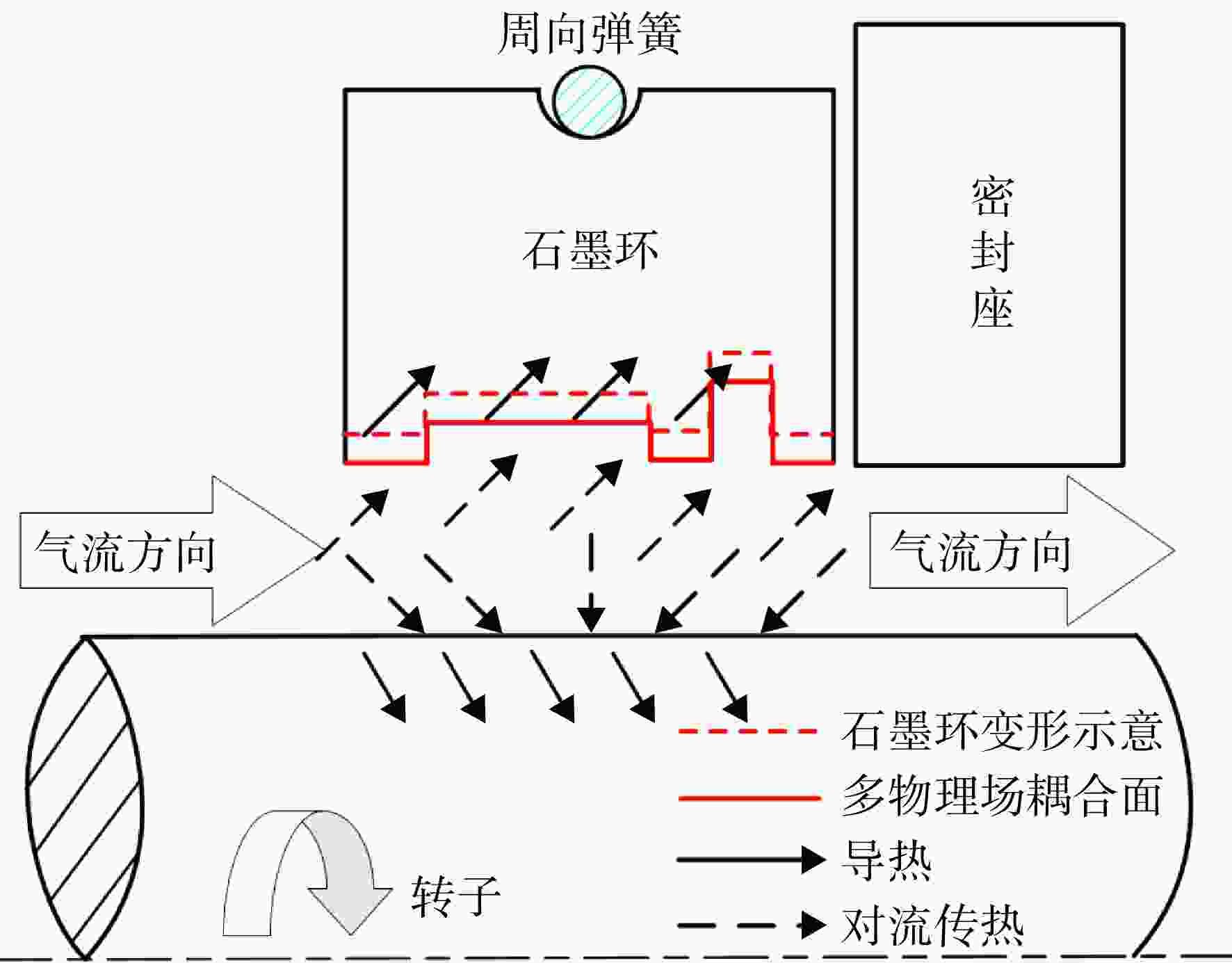
图 1 石墨密封流固热多物理场耦合示意图
Figure 1. Schematic diagram of graphite seal fluid-solid-thermal multiphysics coupling
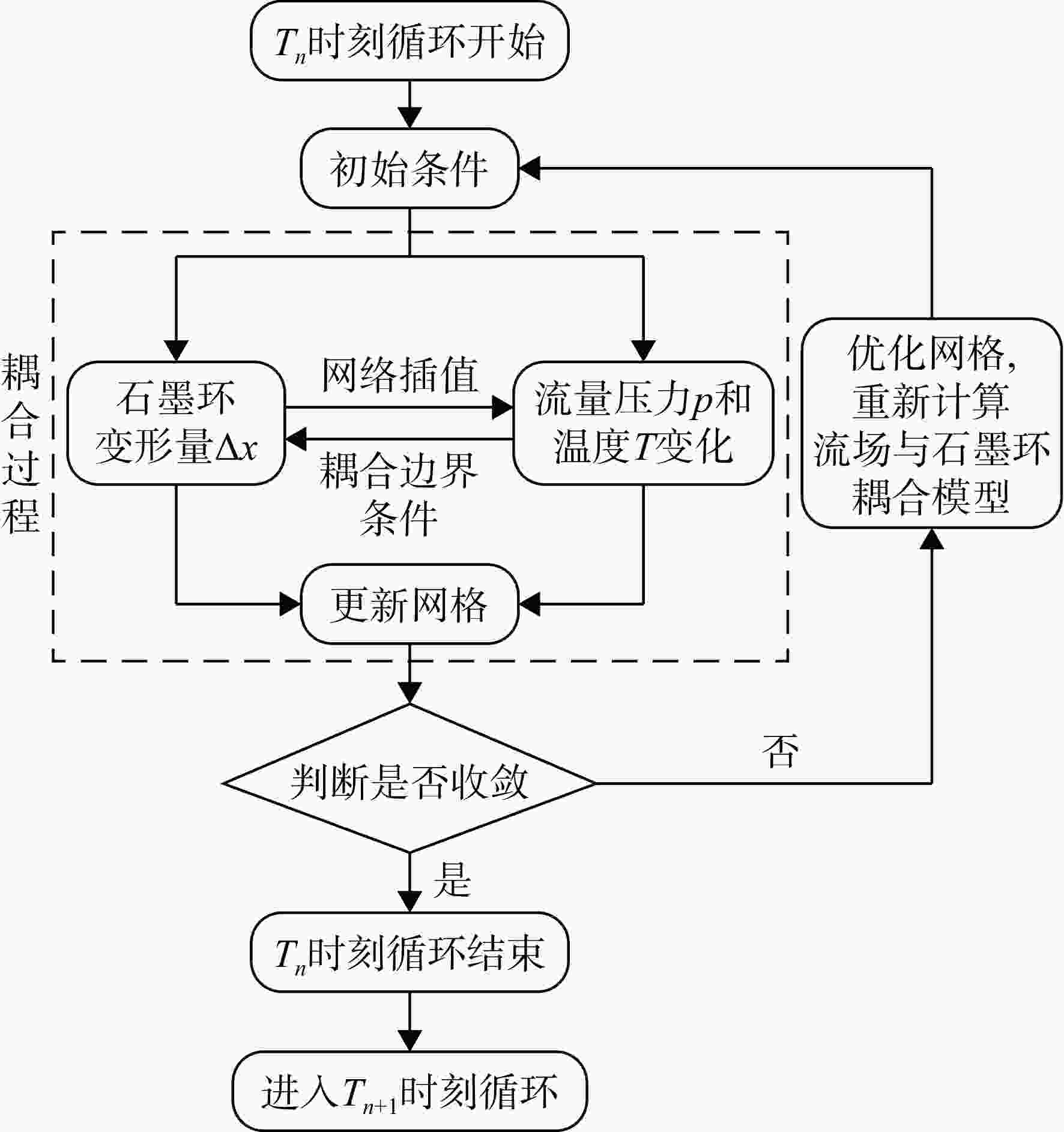
图 2 石墨密封流固热多物理场耦合计算流程图
Figure 2. Flow chart of graphite seal fluid-solid-thermal multiphysics coupling calculation
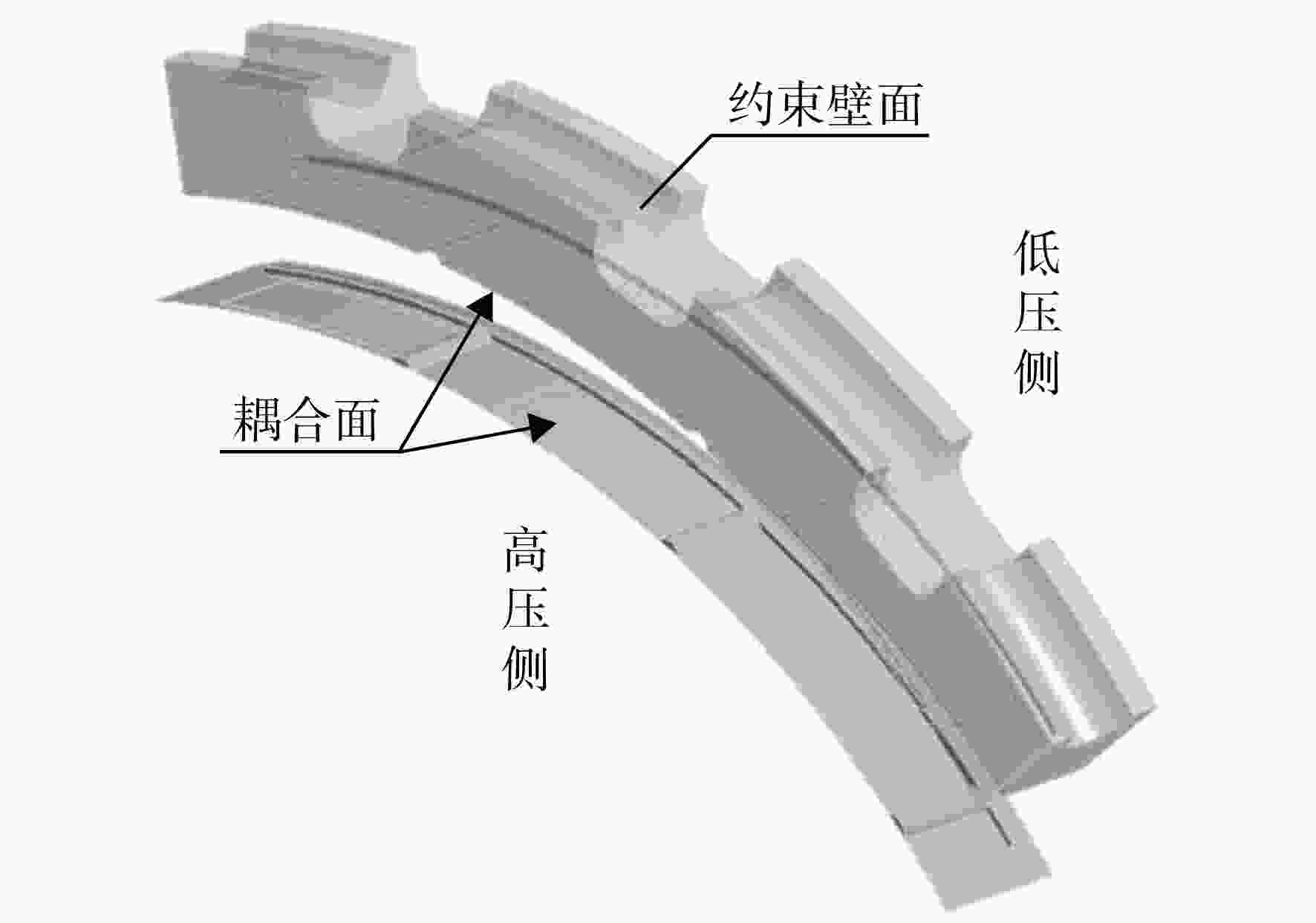
图 6 石墨密封耦合边界条件示意图
Figure 6. Schematic diagram of graphite seal coupling boundary conditions
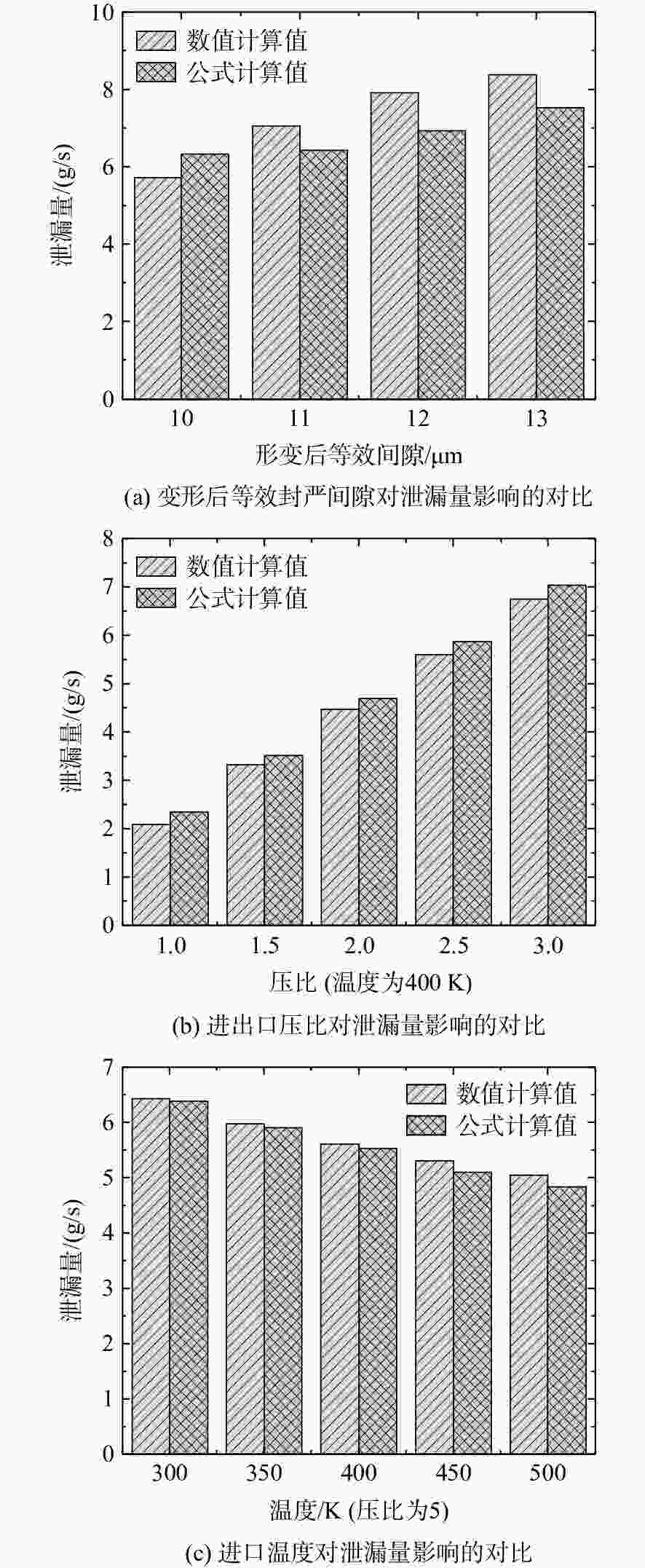
图 13 考虑石墨环变形的石墨密封泄漏量结果对比
Figure 13. Comparison of the leakage rate results of graphite seals considering the deformation of the graphite ring
表 1 石墨环材料属性
Table 1. Graphite ring material properties
参数 碳石墨 浸锑石墨 弹性模量/GPa 14 30 密度/(kg/m3) 1930 2330 比热容/(J/(kg·K)) 900 690 导热系数/(W/(m·K)) 60 140 泊松比 0.25 0.21 热膨胀系数/10−6 K−1 5 7.2  下载: 导出CSV
表 2 石墨密封工况参数
Table 2. Graphite seal working condition parameters
参数 数值及详情 参数 数值及详情 流体属性 理想空气 湍流模型 RNG k-$ \varepsilon $ 转速/(r/min) 12000 浅槽深/μm 20 出口压力/MPa 0.5 进出口压比 2~6 石墨温度/K 298 入口温度/K 300~500
下载: 导出CSV
表 3 石墨密封泄漏量对比结果
Table 3. Comparison results of graphite seal leakage rate
浅槽槽深/μm 泄漏量/(g/s) 相对误差/% 本文 文献[5] 15 2.74 2.70 1.48 20 3.86 3.78 2.12
下载: 导出CSV
表 4 两种材料石墨环在不同方向的变形量
Table 4. Deformation of graphite rings of two materials in different directions
mm 参数 碳石墨 浸锑石墨 径向变形量 0.0038 0.0037 轴向变形量 0.0073 0.0064
下载: 导出CSV
表 5 变形前后网格数量对比
Table 5. Comparison of grid quantity before and after deformation
变形情况 网格数量/万 未考虑变形 340 考虑变形 碳石墨 340~350 浸锑石墨 340~345
下载: 导出CSV
-
[1] 闫玉涛,魏荣,胡广阳,等. 考虑热流固多物理场耦合的圆周密封特性[J]. 航空动力学报,2020,35(2): 305-317. doi: 10.13224/j.cnki.jasp.2020.02.010YAN Yutao,WEI Rong,HU Guangyang,et al. Circumferential seal characteristics with thermal-fluid-structure multi-physics field coupling[J]. Journal of Aerospace Power,2020,35(2): 305-317. (in Chinese) doi: 10.13224/j.cnki.jasp.2020.02.010 [2] 闫玉涛,张博,胡广阳,等. 石墨圆周密封热-结构耦合分析[J]. 航空动力学报,2018,33(2): 273-281. doi: 10.13224/j.cnki.jasp.2018.02.003YAN Yutao,ZHANG Bo,HU Guangyang,et al. Analysis on thermal-structure coupling for graphite circumferential seal[J]. Journal of Aerospace Power,2018,33(2): 273-281. (in Chinese) doi: 10.13224/j.cnki.jasp.2018.02.003 [3] ALLEN G P. Self-acting lift-pad geometry for circu-mferential seals-a noncontacting concept[R]. NASA-1980-1583, 1980. [4] BURCHAM R E. High-speed cryogenic self-acting shaft seals for liquid rocket turbopumps[R]. NASA-1983-168194, 1983. [5] ARGHIR M,MARIOT A. Theoretical analysis of the static characteristics of the carbon segmented seal[J]. Journal of Tribology,2017,139(6): 062202.1-062202.11. [6] 运睿德,陈志英,刘勇,等. 周向弹簧力分布对圆周密封装置密封性能的影响[J]. 推进技术,2021,42(6): 1361-1371. doi: 10.13675/j.cnki.tjjs.190781YUN Ruide,CHEN Zhiying,LIU Yong,et al. Effects of circumferential spring force distribution on sealing performance of circumferential seal[J]. Journal of Propulsion Technology,2021,42(6): 1361-1371. (in Chinese) doi: 10.13675/j.cnki.tjjs.190781 [7] 苏令. 新型浅槽环瓣型浮动环密封综合性能分析及软件开发[D]. 北京: 清华大学, 2006.SU Ling. Performance analysis and software development of a new shallow-slot split floating ring seal[D]. Beijing: Tsinghua University, 2006. (in Chinese) [8] 胡广阳,闫玉涛,郑利胜,等. 航空发动机石墨圆周密封接触特性分析[J]. 润滑与密封,2018,43(11): 102-107. doi: 10.3969/j.issn.0254-0150.2018.11.018HU Guangyang,YAN Yutao,ZHENG Lisheng,et al. Analysis of contact characteristics for graphite circumferential seal in aeroengine[J]. Lubrication Engineering,2018,43(11): 102-107. (in Chinese) doi: 10.3969/j.issn.0254-0150.2018.11.018 [9] 张博. 接触式圆周密封性能分析与参数化设计[D]. 沈阳: 东北大学, 2017.ZHANG Bo. Performance analysis and parametric design of contact circumferential seal[D]. Shenyang: Northeastern University, 2017. (in Chinese) [10] MARTIN H M. Labyrinth packings[J]. Engineering,1908,85(3): 35-36. [11] EGLI A. The leakage of gases through narrow channels[J]. Journal of Applied Mechanics,1937,4(2): 63-68. doi: 10.1115/1.4008769 [12] VERMES G. A fluid mechanics approach to the labyrinth seal leakage problem[J]. Journal of Engineering for Power,1961,83(2): 161-169. doi: 10.1115/1.3673158 [13] 王伟,赵宗坚,张振生. 单环圆周密封装置设计和应用研究[J]. 航空发动机,2009,35(4): 7-11. doi: 10.3969/j.issn.1672-3147.2009.04.002WANG Wei,ZHAO Zongjian,ZHANG Zhensheng. Design and application of single circumferential seal[J]. Aeroengine,2009,35(4): 7-11. (in Chinese) doi: 10.3969/j.issn.1672-3147.2009.04.002 [14] 《航空发动机设计手册》总编委会编. 航空发动机设计手册: 第12册 传动及润滑系统[M]. 北京: 航空工业出版社, 2002. [15] 周敏,孙丹,赵欢,等. 基于流固热耦合的非金属迷宫密封泄漏特性与公式构造[J]. 航空动力学报,2021,36(8): 1783-1792.ZHOU Min,SUN Dan,ZHAO Huan,et al. Leakage characteristics and formula establishment of nonmetallic labyrinth seal based on fluid-solid-thermal coupling[J]. Journal of Aerospace Power,2021,36(8): 1783-1792. (in Chinese) [16] 王福军. 计算流体动力学分析: CFD软件原理与应用[M]. 北京: 清华大学出版社, 2004. [17] YAN Yu, QIAN Xiao, HU Guang, et al. Analysis on circumferential seal ring in engine under different conditions[J]. Advanced Materials Research, 2014, 945/946/947/948/949: 343-346. [18] AHMED Y,ELBATRAN A. Numerical study of the flow field characteristics over a backward facing step using k-kl-ω turbulence model: comparison with different models[J]. World Journal of Engineering,2018,15(1): 173-180. doi: 10.1108/WJE-01-2017-0011 [19] 陈永辉,王强,朴明波. 湍流模型的发展及其研究现状[J]. 能源与环境,2009(2): 4-6, 21. doi: 10.3969/j.issn.1672-9064.2009.02.002CHEN Yonghui,WANG Qiang,PIAO Mingbo. Development and research status of turbulence model[J]. Energy and Environment,2009(2): 4-6, 21. (in Chinese) doi: 10.3969/j.issn.1672-9064.2009.02.002 [20] 张小伟,王延荣,张潇,等. 涡轮机械叶片的流固耦合数值计算方法[J]. 航空动力学报,2009,24(7): 1622-1626.ZHANG Xiaowei,WANG Yanrong,ZHANG Xiao,et al. Numerical method for fluid-structure interaction in turbomachinery bladings[J]. Journal of Aerospace Power,2009,24(7): 1622-1626. (in Chinese) [21] 魏炫宇,马咏梅,丁万,等. 机械密封摩擦副界面热流固耦合分析[J]. 机械设计与制造工程,2017,46(6): 89-94. doi: 10.3969/j.issn.2095-509X.2017.06.021WEI Xuanyu,MA Yongmei,DING Wan,et al. The thermal fluid and solid coupling analysis on the friction surface of mechanical seal[J]. Machine Design and Manufacturing Engineering,2017,46(6): 89-94. (in Chinese) doi: 10.3969/j.issn.2095-509X.2017.06.021 [22] 马灵童,孟庆睿. 液黏传动摩擦副流固耦合传热分析[J]. 润滑与密封,2019,44(10): 98-103. doi: 10.3969/j.issn.0254-0150.2019.10.015MA Lingtong,MENG Qingrui. Analysis of fluid-solid coupled heat transfer of friction pairs on hydro-viscous drive[J]. Lubrication Engineering,2019,44(10): 98-103. (in Chinese) doi: 10.3969/j.issn.0254-0150.2019.10.015 -


 点击查看大图

计量
- 文章访问数: 714
- HTML浏览量: 317
- PDF量: 83
- 被引次数: 0