






Investigation on drag and heat flux reduction induced by a novel combinational spike and channel concept for high speed vehicles
-
摘要:
针对高速飞行器减阻防热问题,提出了一种减阻杆头部开槽进气、中部侧向排气的减阻杆槽道组合构型。基于SST
k -ω 湍流模型,采用有限体积法求解了二维轴对称雷诺平均Navier-Stokes方程,对组合构型的流场进行了数值模拟,并分析了减阻防热特性以及其影响因素。数值结果表明:相较于单一减阻杆,引入槽道后,侧向排气将分离激波推离减阻杆,飞行器主体再附激波强度明显减弱,组合构型减阻防热特性显著提高;槽道收敛半角越大,侧向排气孔位置越靠近减阻杆中部,构型减阻防热效果越好;随着飞行动压的增加,构型减阻防热性能不断提高。在研究范围内,收敛半角为60°,侧向排气孔位于减阻杆中部的组合构型减阻防热总体效果最好,并且在动压在30.15 kPa时达到最佳,相比单一减阻杆,飞行器主体壁面热流峰值降低33.84%,总阻力降低14.44%。Abstract:For the drag and heat flux reduction of high speed vehicles, a novel combinational spike and channel concept was proposed. The high pressure air behind the bow shock flowed into the channel at the head of the spike, and then sprayed out through the lateral jet near the middle of the spike. Based on the SST
k -ω turbulence model, the two-dimensional axisymmetric Reynolds average Navier-Stokes equations were solved by the finite volume method, and the flow field of the combinational configuration was numerically simulated. Compared with the single spike, with the introduction of the channel, the lateral jet pushed the separated shock wave away from the spike, and the intensity of the reattachment shock wave was significantly weakened, thus improving the drag and heat flux reduction efficiency. The influencing factors of the combined configuration were analyzed; the larger convergent half angle of the channel indicated the closer location of the lateral jet to the middle of the spike, and the better overall drag and heat flux reduction result of this configuration. With the increase of dynamic pressure, the drag and heat flux reduction performance of the configuration was continually improved. In the research range, the combined configuration in which the convergent half angle was 60° and the lateral jet was located at the middle of the spike had the best overall result of drag and heat flux reduction, and the result reached the best when the dynamic pressure was 30.15 kPa. Compared with the spike, the peak value of heat flux along the blunt body wall was reduced by 33.84% and the total drag of the configuration was reduced by 14.44%.-
Key words:
- high speed flight /
- aerodynamic drag reduction /
- aerodynamic heat flux reduction /
- spike /
- channel
-

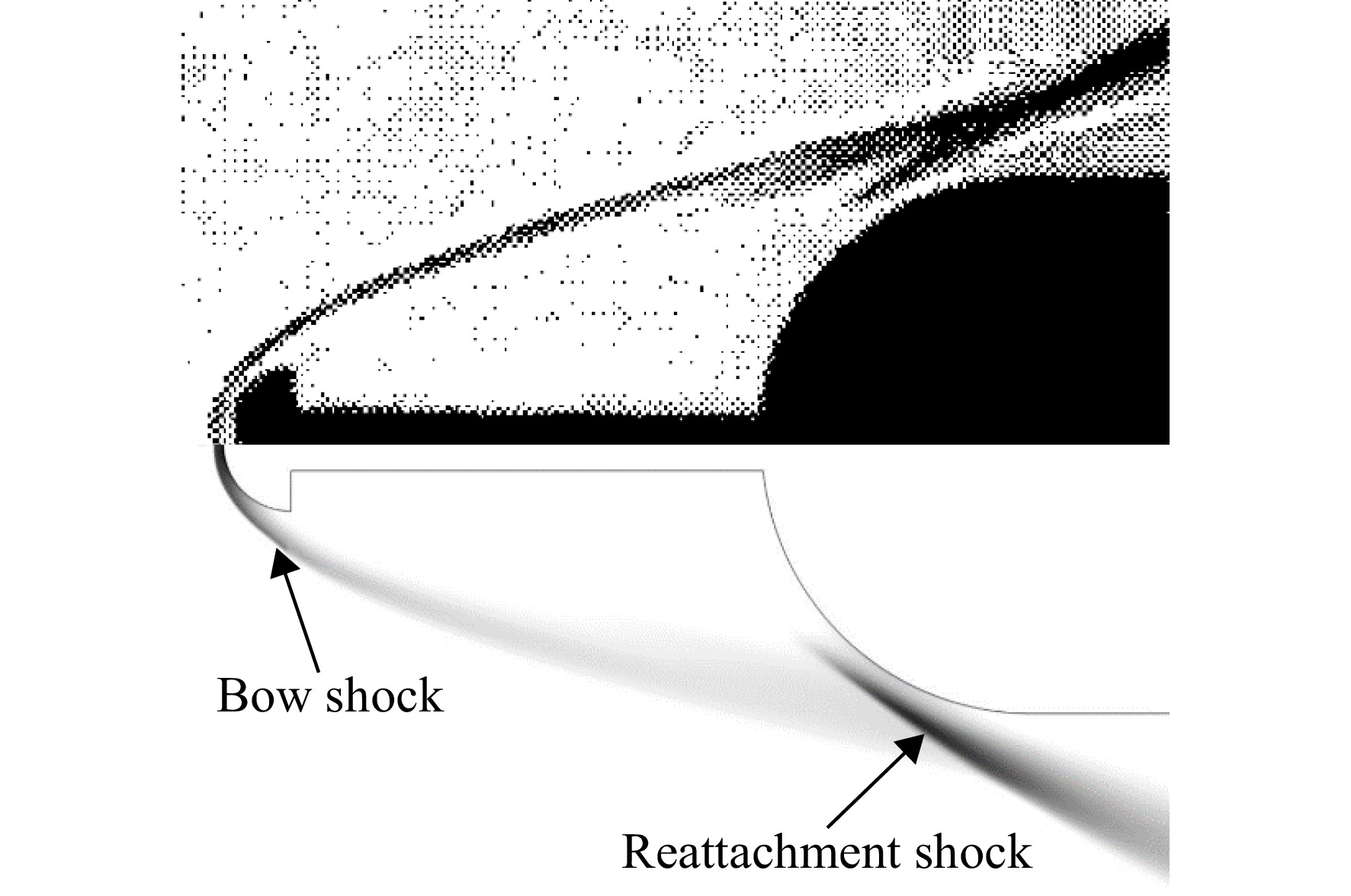
图 2 实验纹影图与数值模拟密度云图对比
Figure 2. Comparison of experimental schlieren image and computational density contour

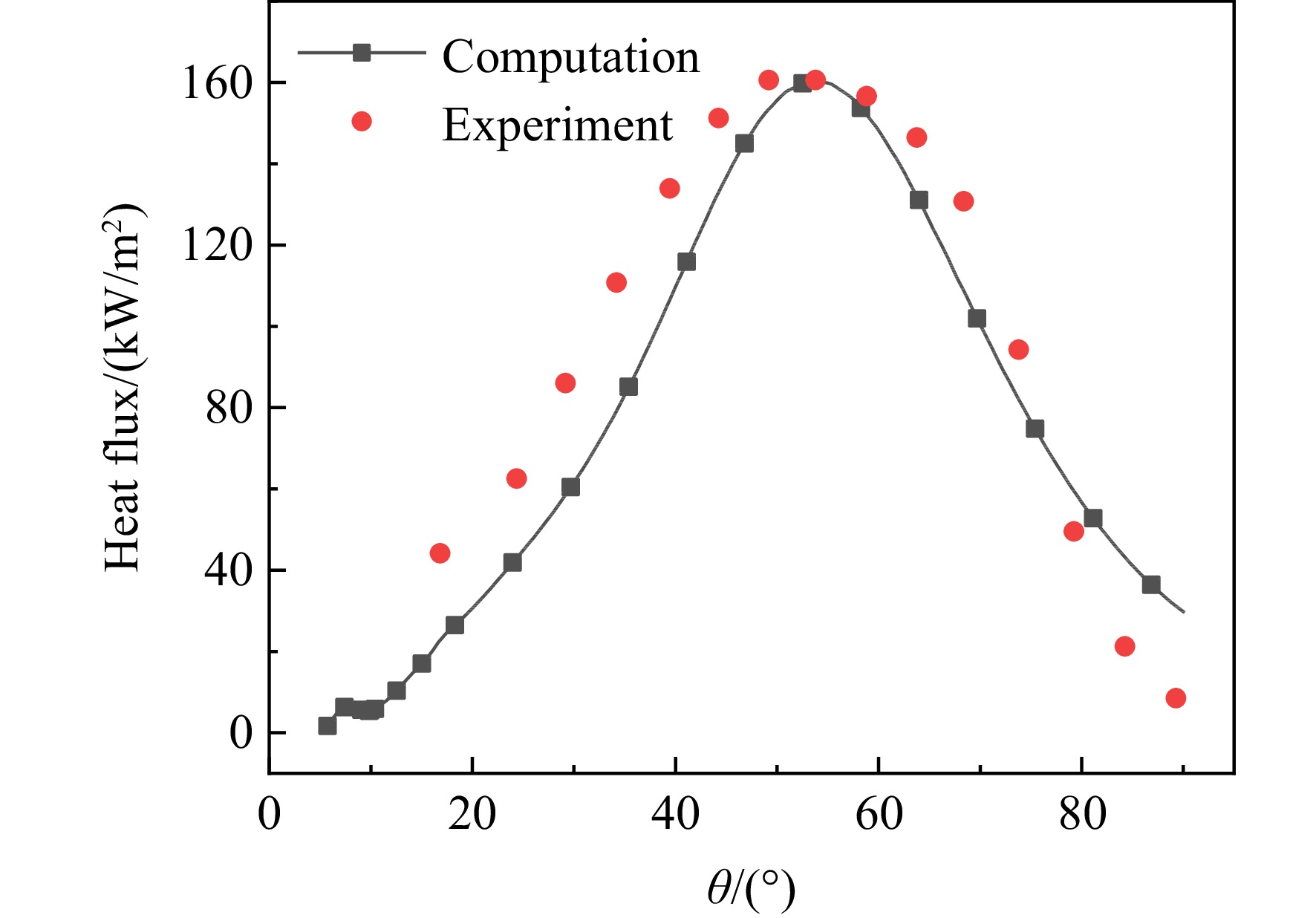
图 3 数值模拟壁面热流数据与实验数据对比
Figure 3. Comparison of heat flux along the model surface between computational and experimental results

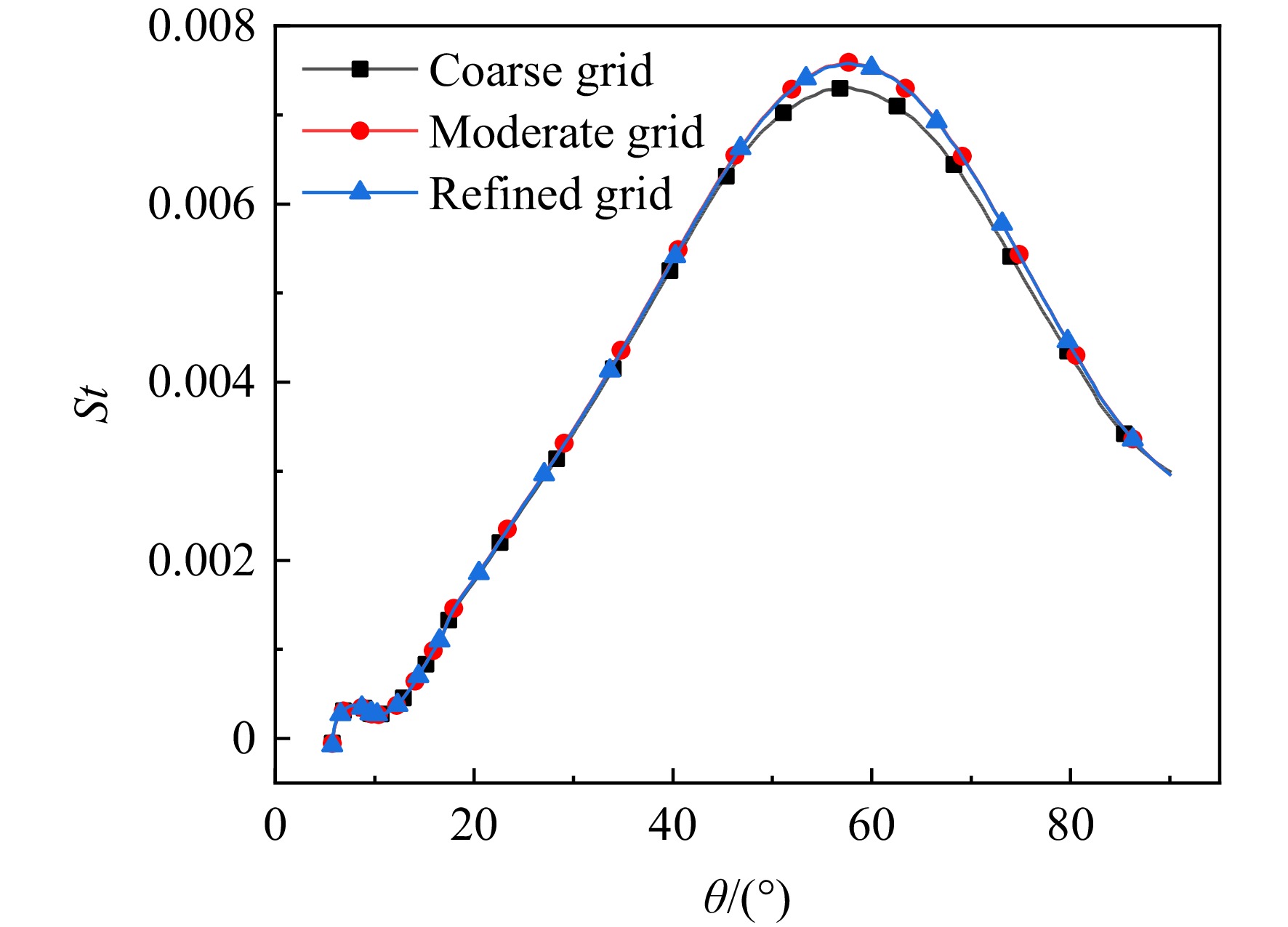
图 5 不同网格系统计算壁面斯坦顿数
Figure 5. Stanton number distributions along the model surface for different grids system

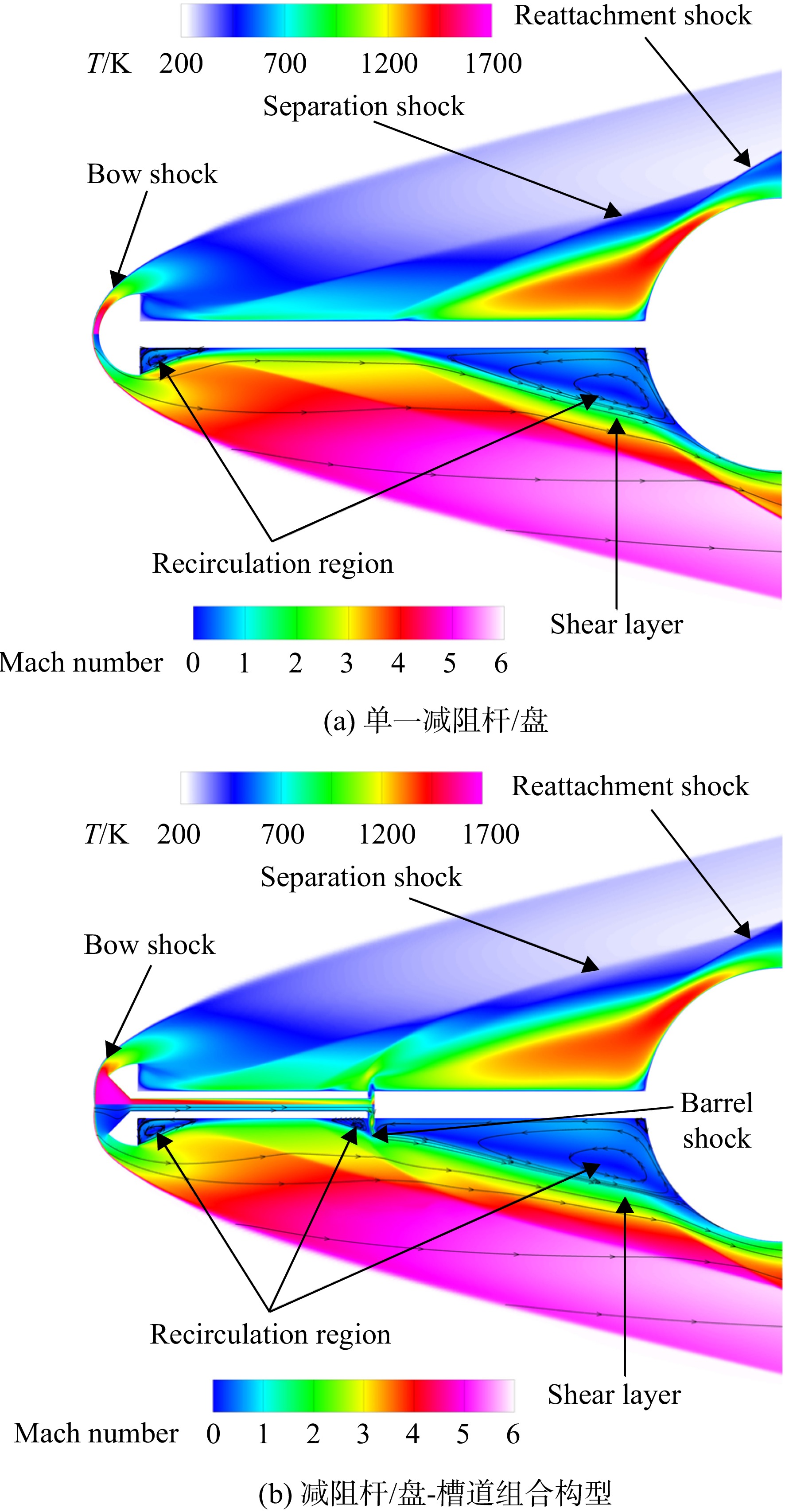
图 6 携带槽道与不携带槽道减阻杆构型流场结构对比图
Figure 6. Comparison of flow field structure around spike with and without channel

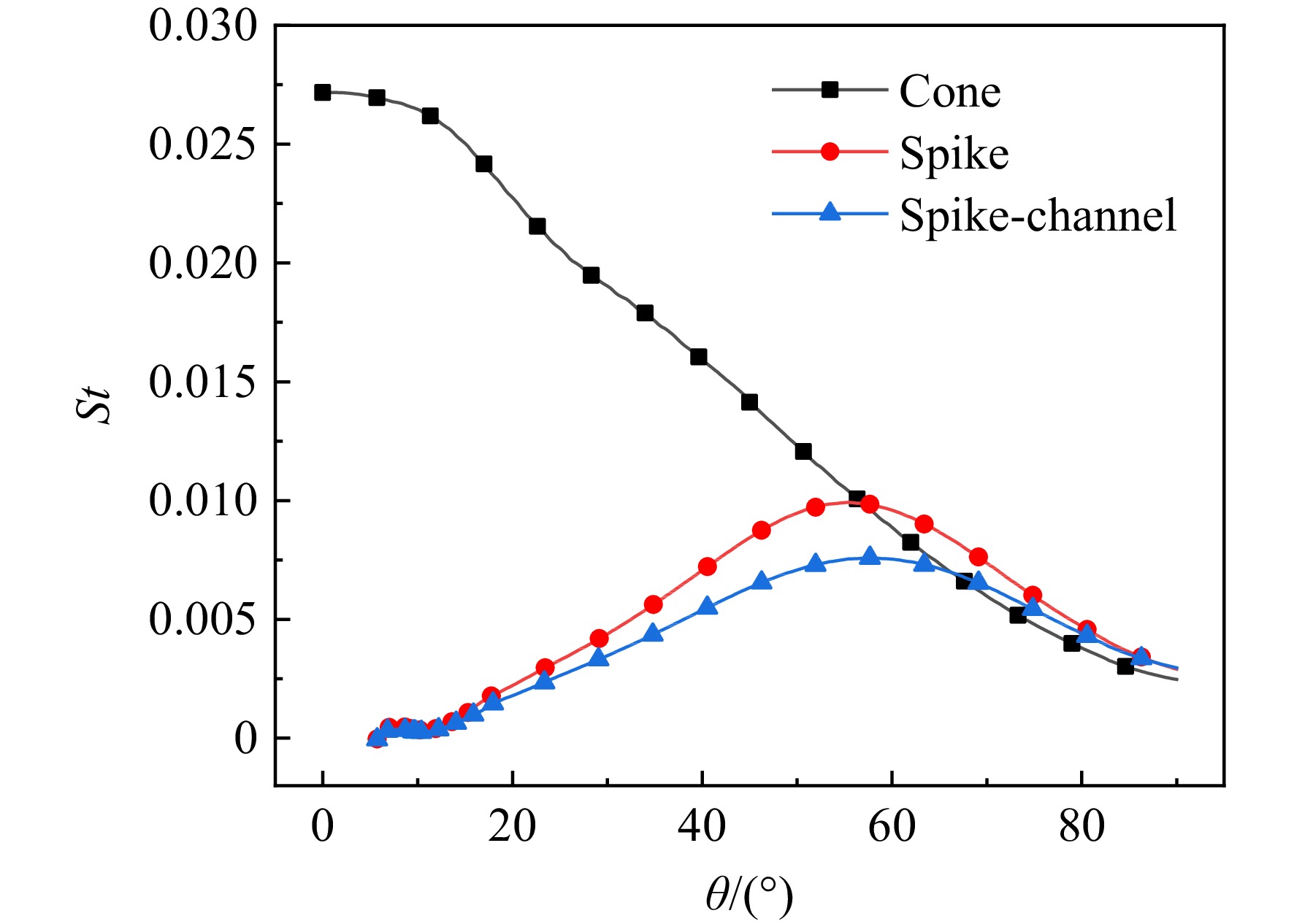
图 7 不同模型壁面斯坦顿数
Figure 7. Stanton number distributions along the model surface for different models

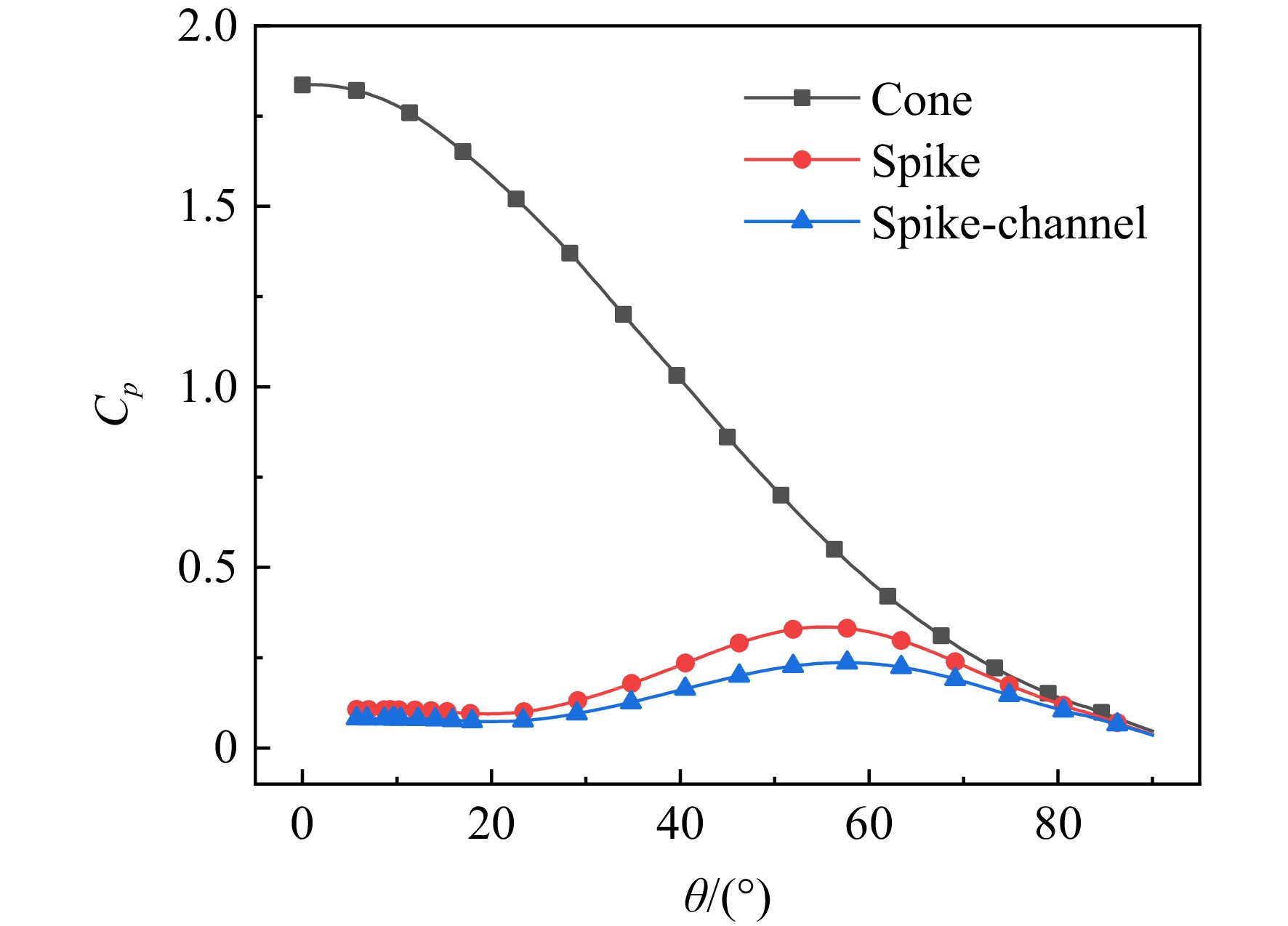
图 8 不同模型壁面压力系数
Figure 8. Pressure coefficient distributions along the model surface for different models

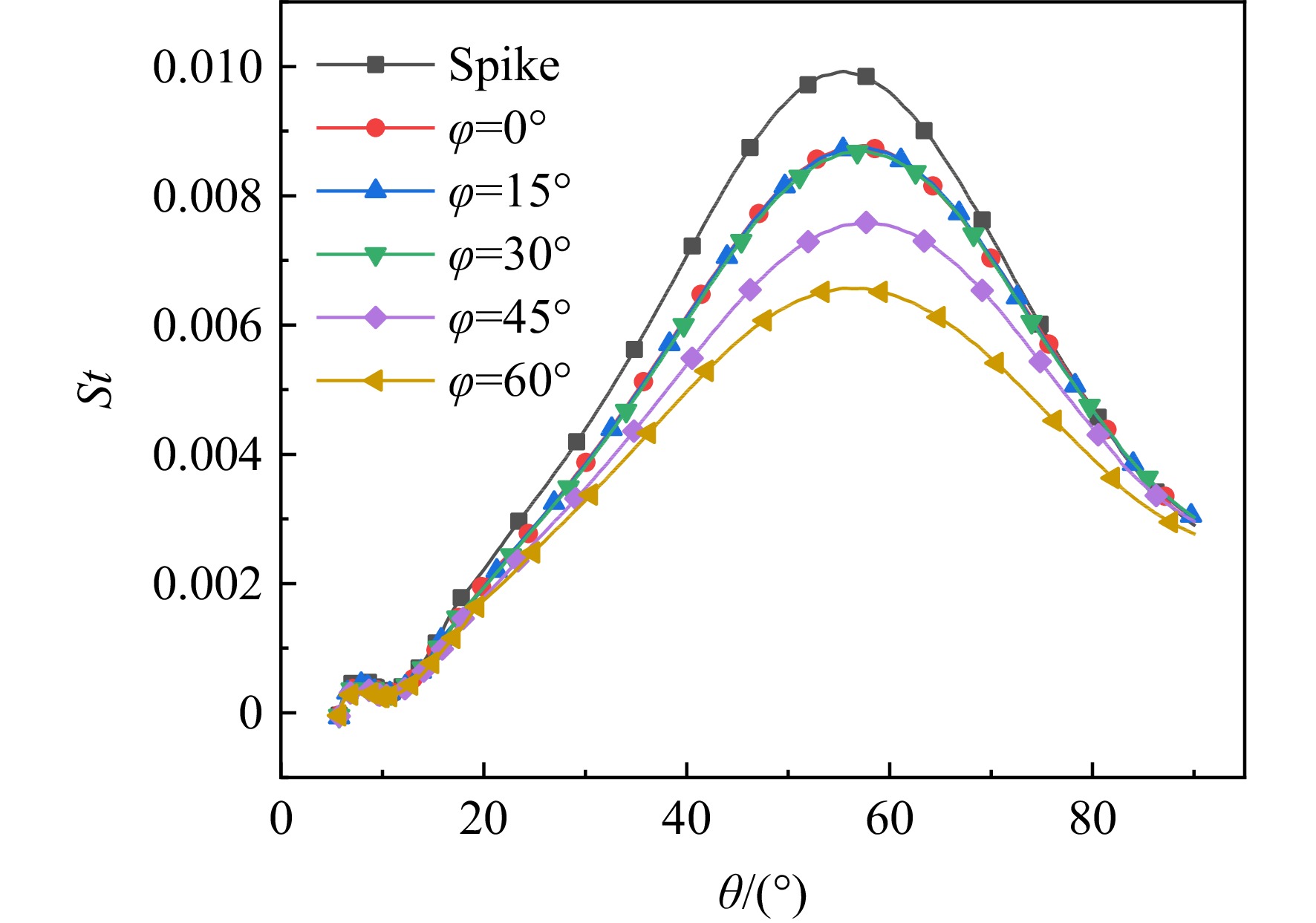
图 9 不同槽道收敛半角模型壁面斯坦顿数
Figure 9. Stanton number distributions along the model surface for different convergent half angles of the channel

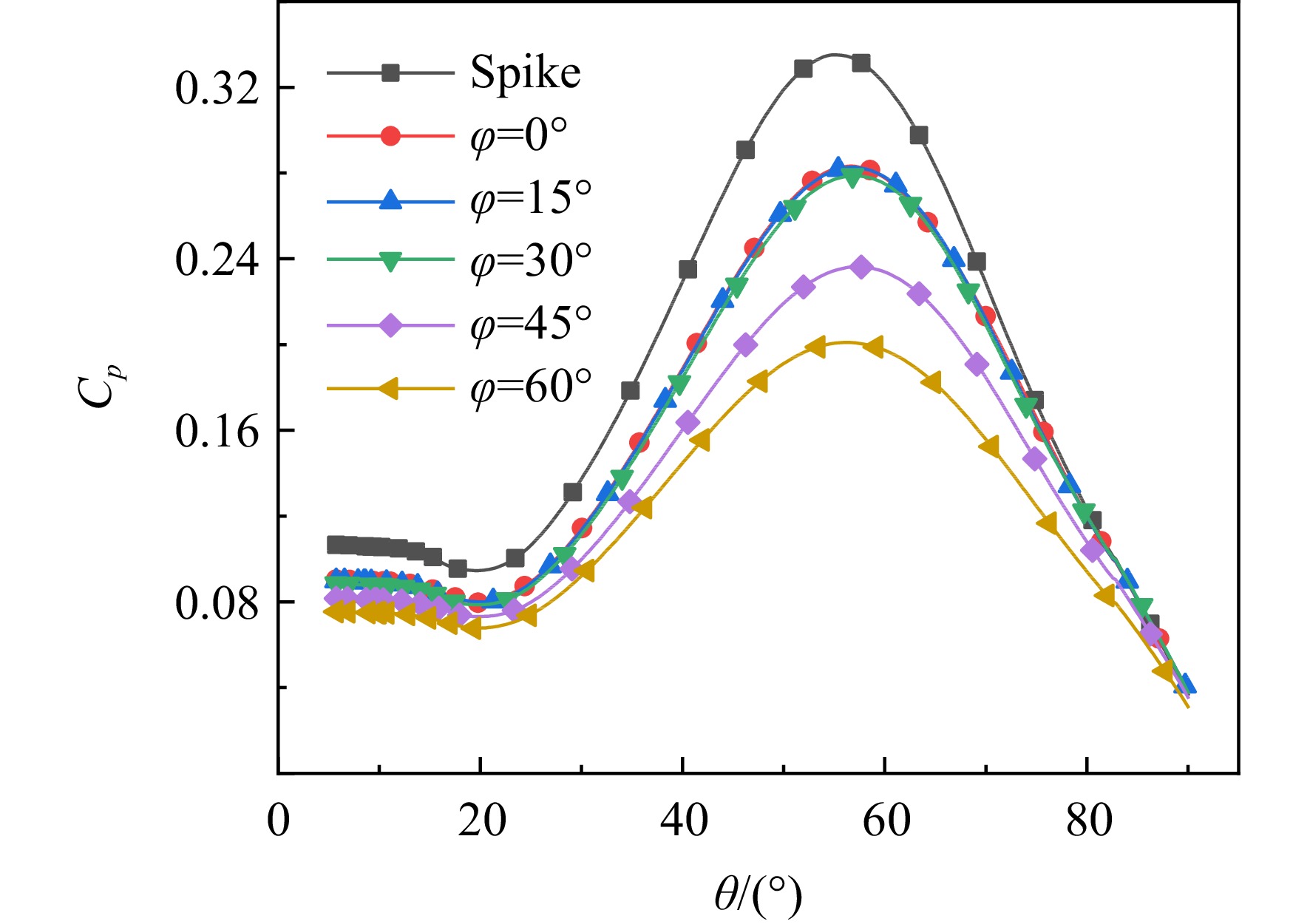
图 10 不同槽道收敛半角模型壁面压力系数
Figure 10. Pressure coefficient distributions along the model surface for different convergent half angles of the channel

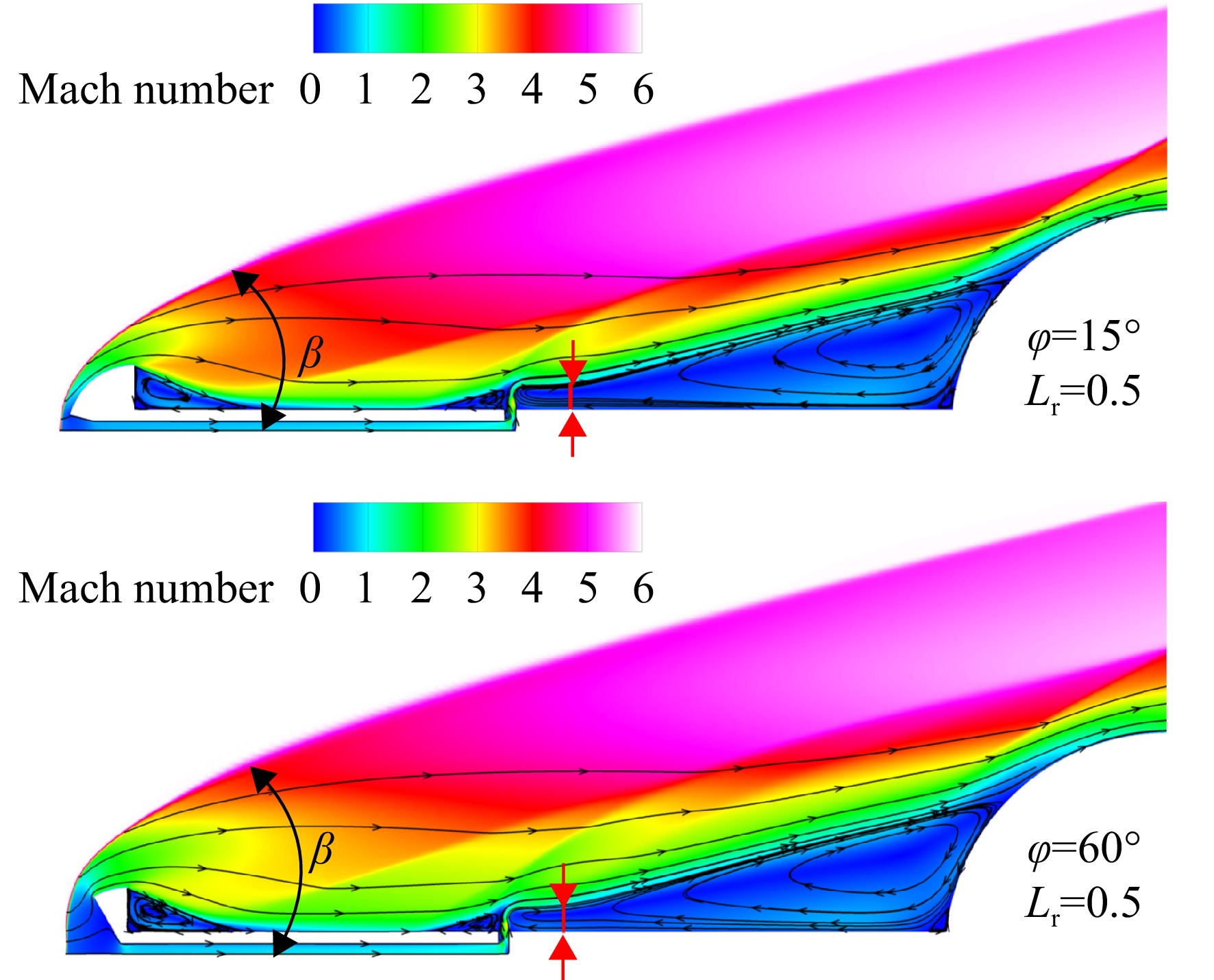
图 11
$\varphi $ =15°和$\varphi $ =60°模型马赫数云图与流线图Figure 11. Mach contours and streamlines for models of
$\varphi $ =15° and$\varphi $ =60°
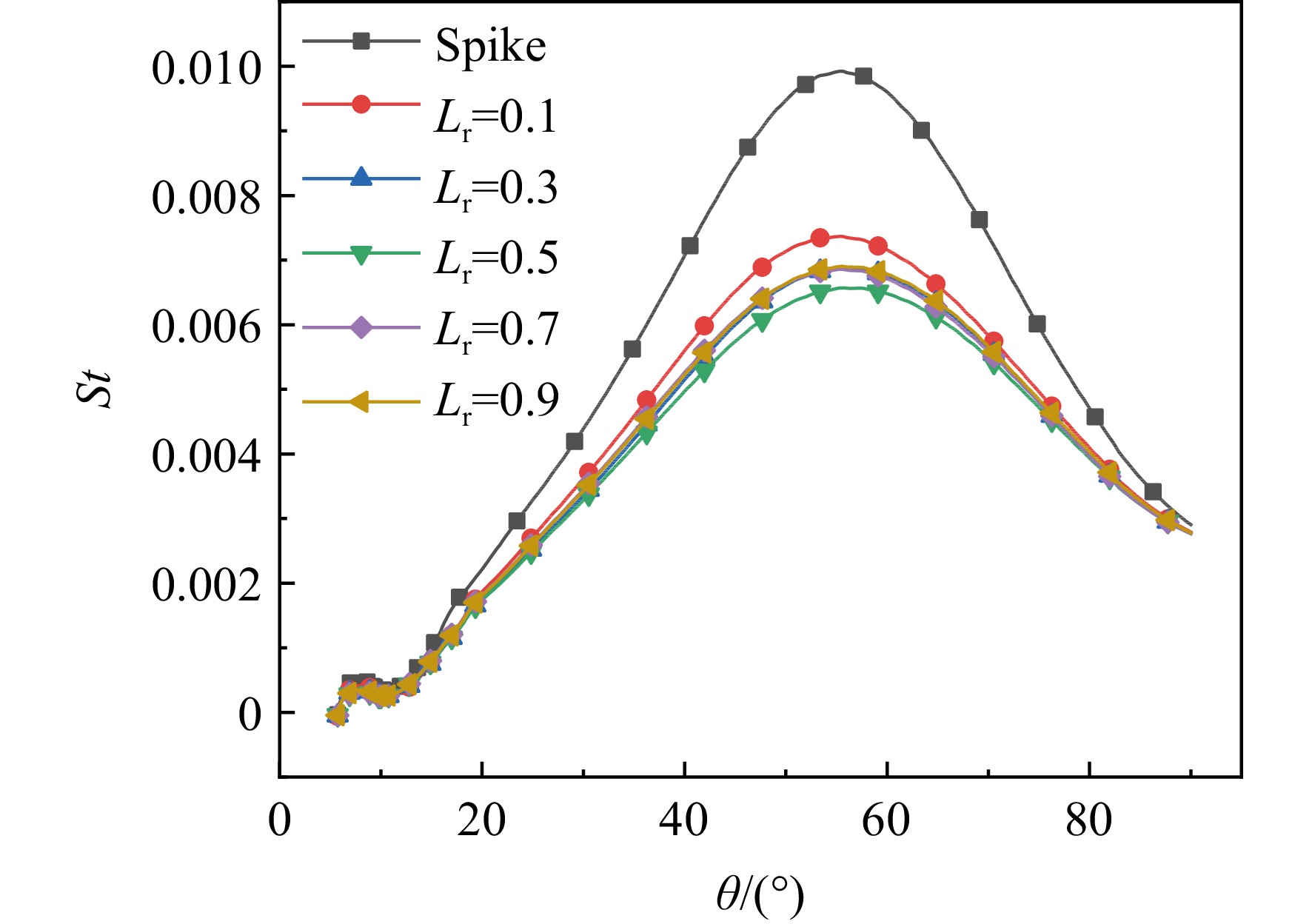
图 12 侧向喷流位置模型壁面斯坦顿数分布
Figure 12. Stanton number distributions along the model surface for different lateral jet locations of the model

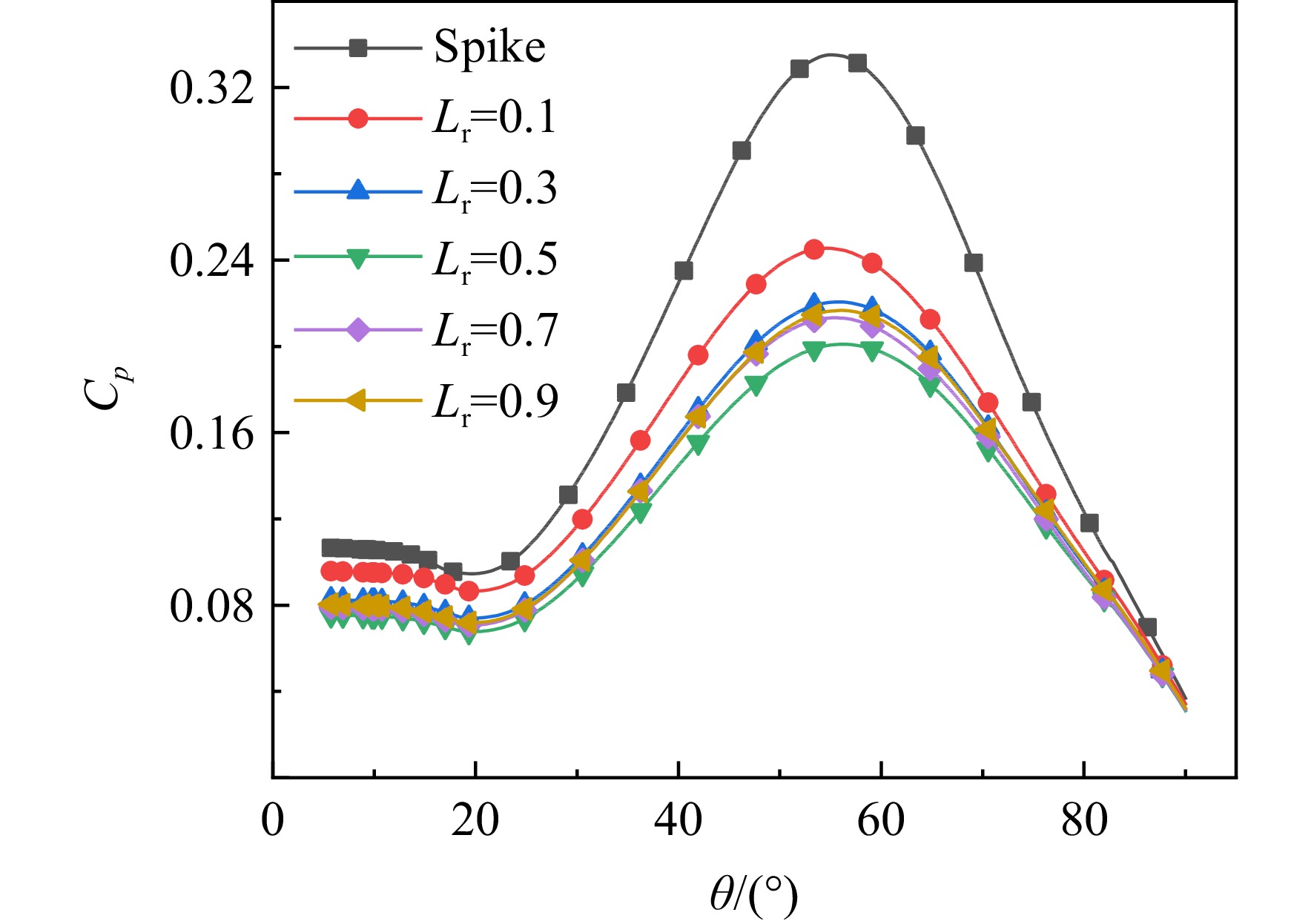
图 13 侧向喷流位置模型壁面压力系数分布
Figure 13. Pressure coefficient distributions along the modelsurface for different lateral jet locations of the model

图 14 不同侧向排气孔位置模型马赫数云图及流线图
Figure 14. Mach contours and streamlines for different lateral jet locations of the model
表 1 槽道收敛半角对阻力系数的影响
Table 1. Effect of the convergent half angle of the channel on drag coefficient
模型 Cd ΔCd/% 单一减阻杆 0.26849 0 $\varphi $=0° 0.23962 10.75 $\varphi $=15° 0.23935 10.85 $\varphi $=30° 0.23631 11.99 $\varphi $=45° 0.22382 16.64 $\varphi $=60° 0.22973 14.44  下载: 导出CSV
表 2 侧向喷流位置对阻力系数的影响
Table 2. Effect of the lateral jet location on drag coefficient
模型 Cd ΔCd/% 单一减阻杆 0.26849 0 Lr=0.1 0.26176 2.51 Lr=0.3 0.24283 9.56 Lr=0.5 0.22973 14.44 Lr=0.7 0.23668 11.85 Lr=0.9 0.23610 12.06
下载: 导出CSV
表 3 飞行动压对最大热流的影响
Table 3. Effect of flight dynamic pressure on maximum heat flux
Qbar/kPa Qms/(kW/m2) Qmsc/(kW/m2) ΔQm/% 7.54 70.08 59.88 14.55 13.40 171.03 132.03 22.80 20.94 319.70 226.98 29.00 30.15 521.21 344.81 33.84
下载: 导出CSV
表 4 飞行动压对阻力的影响
Table 4. Effect of flight dynamic pressure on drag
Qbar/kPa Fxs/N Fxsc/N ΔFx/% 7.54 2.46 2.17 11.79 13.40 4.72 4.05 14.19 20.94 7.23 6.19 14.38 30.15 10.18 8.71 14.44
下载: 导出CSV
-
[1] SUN Xiwan,HUANG Wei,OU Min,et al. A survey on numerical simulations of drag and heat reduction mechanism in supersonic/hypersonic flows[J]. Chinese Journal of Aeronautics,2019,32(4): 771-784. doi: 10.1016/j.cja.2018.12.024 [2] KARIMI M S,OBOODI M J. Investigation and recent developments in aerodynamic heating and drag reduction for hypersonic flows[J]. Heat and Mass Transfer,2019,55(2): 547-569. doi: 10.1007/s00231-018-2416-1 [3] 李倩,金星,曹正蕊,等. 激光等离子体点源减阻技术中入射能量对气动阻力的影响[J]. 推进技术,2010,31(3): 377-380.LI Qian,JIN Xing,CAO Zhengrui,et al. Effects on aerodynamic drag of incident laser energy in technology of laser plasma point source drag reduction[J]. Journal of Propulsion Technology,2010,31(3): 377-380. (in Chinese) [4] SPERBER D,ECKEL H A,STEIMER S,et al. Objectives of laser-induced energy deposition for active flow control[J]. Contributions to Plasma Physics,2012,52(7): 636-643. doi: 10.1002/ctpp.201210060 [5] ASHWIN GANESH M,JOHN B. Concentrated energy addition for active drag reduction in hypersonic flow regime[J]. Acta Astronautica,2018,142: 221-231. doi: 10.1016/j.actaastro.2017.11.003 [6] SARAVANAN S,JAGADEESH G,REDDY K P J. Investigation of missile-shaped body with forward-facing cavity at Mach 8[J]. Journal of Spacecraft and Rockets,2009,46(3): 577-591. doi: 10.2514/1.38914 [7] 张帅,方蜀州,郭建. 头部钝化的无翼航天器气动性能研究[J]. 飞行力学,2020,38(6): 56-62, 69. doi: 10.13645/j.cnki.f.d.20200618.001ZHANG Shuai,FANG Shuzhou,GUO Jian. Study on aerodynamic performance of wingless spacecraft with head blunted[J]. Flight Dynamics,2020,38(6): 56-62, 69. (in Chinese) doi: 10.13645/j.cnki.f.d.20200618.001 [8] 张帅,方蜀州,许阳. 稀薄流航天器鼻锥迎风凹腔气动力和气动热性能研究[J]. 推进技术,2021,42(9): 2002-2010.ZHANG Shuai,FANG Shuzhou,XU Yang. Aerodynamics and aerothermodynamics analyses of space vehicle nose with forward-facing cavity in rarefied flow[J]. Journal of Propulsion Technology,2021,42(9): 2002-2010. (in Chinese) [9] JIANG Peixue,HUANG Gan,ZHU Yinhai,et al. Experimental investigation of combined transpiration and film cooling for sintered metal porous struts[J]. International Journal of Heat and Mass Transfer,2017,108: 232-243. doi: 10.1016/j.ijheatmasstransfer.2016.12.014 [10] LI Shibin,WANG Zhenguo,HUANG Wei,et al. Analysis of flowfield characteristics for equal polygon opposing jet on different freeflow conditions[J]. Acta Astronautica,2017,133: 50-62. doi: 10.1016/j.actaastro.2017.01.011 [11] 冉景洪,刘子强,胡静,等. 减阻杆气动阻尼研究[J]. 力学学报,2014,46(4): 636-641. doi: 10.6052/0459-1879-13-419RAN Jinghong,LIU Ziqiang,HU Jing,et al. Research of aero-damping for blunt with spike[J]. Chinese Journal of Theoretical and Applied Mechanics,2014,46(4): 636-641. (in Chinese) doi: 10.6052/0459-1879-13-419 [12] 陆海波,刘伟强. 凹腔尺寸对迎风凹腔与逆向喷流组合热防护系统性能的影响[J]. 航空动力学报,2012,27(12): 2666-2673.LU Haibo,LIU Weiqiang. Effect of cavity physical dimension on forward-facing cavity and opposing jet thermal protection system cooling efficiency[J]. Journal of Aerospace Power,2012,27(12): 2666-2673. (in Chinese) [13] ESFEH M K,TAJALLI S M,LIU Pengfei. Evaluation of aerospike for drag reduction on a blunt nose using experimental and numerical modeling[J]. Acta Astronautica,2019,160: 656-671. doi: 10.1016/j.actaastro.2019.03.010 [14] BARZEGAR GERDROODBARY M,IMANI M,GANJI D D. Heat reduction using conterflowing jet for a nose cone with aerodisk in hypersonic flow[J]. Aerospace Science and Technology,2014,39: 652-665. doi: 10.1016/j.ast.2014.07.005 [15] MEHTA R C. Numerical heat transfer study over spiked blunt bodies at Mach 6.8[J]. Journal of Spacecraft and Rockets,2000,37(5): 700-703. doi: 10.2514/2.3622 [16] KALIMUTHU R,MEHTA R C,RATHAKRISHNAN E. Experimental investigation on spiked body in hypersonic flow[J]. The Aeronautical Journal,2008,112(1136): 593-598. doi: 10.1017/S0001924000002554 [17] KHARATI-KOOPAEE M,GAZOR H. Assessment of the aerodisk size on drag reduction and thermal protection of high-bluntness vehicles at hypersonic speeds[J]. Journal of Aerospace Engineering,2017,30(4): 04017008. doi: 10.1061/(ASCE)AS.1943-5525.0000707 [18] ZHONG Kang,YAN Chao,CHEN Shusheng,et al. Aerodisk effects on drag reduction for hypersonic blunt body with an ellipsoid nose[J]. Aerospace Science and Technology,2019,86: 599-612. doi: 10.1016/j.ast.2019.01.027 [19] JIANG Zonglin,LIU Yunfeng,HAN Guilai,et al. Experimental demonstration of a new concept of drag reduction and thermal protection for hypersonic vehicles[J]. Acta Mechanica Sinica,2009,25(3): 417-419. doi: 10.1007/s10409-009-0252-8 [20] LIU Yunfeng,JIANG Zonglin. Concept of non-ablative thermal protection system for hypersonic vehicles[J]. AIAA Journal,2013,51(3): 584-590. doi: 10.2514/1.J051875 [21] 朱亮,陈雄,周长省,等. 侧向喷流对超声速流动中支杆减阻降热特性影响的研究[J]. 推进技术,2018,39(2): 326-334.ZHU Liang,CHEN Xiong,ZHOU Changsheng,et al. Research on effects of lateral jet on drag and heat reduction characteristics of spike in supersonic flows[J]. Journal of Propulsion Technology,2018,39(2): 326-334. (in Chinese) [22] ZHU Liang,CHEN Xiong,LI Yingkun,et al. Investigation of drag and heat reduction induced by a novel combinational lateral jet and spike concept in supersonic flows based on conjugate heat transfer approach[J]. Acta Astronautica,2018,142: 300-313. doi: 10.1016/j.actaastro.2017.11.001 [23] ZHU Liang,LI Yingkun,CHEN Xiong,et al. Hypersonic flow characteristics and relevant structure thermal response induced by the novel combined spike-aerodome and lateral jet strategy[J]. Aerospace Science and Technology,2019,95: 105459. doi: 10.1016/j.ast.2019.105459 [24] ZHU Liang,LI Yingkun,CHEN Xiong,et al. Novel combinational aerodisk and lateral jet concept for drag and heat reduction in hypersonic flows[J]. Journal of Aerospace Engineering,2019,32(1): 04018133. doi: 10.1061/(ASCE)AS.1943-5525.0000966 [25] 黄杰,姚卫星. 高超声速飞行器激波控制减阻技术[J]. 宇航学报,2020,41(10): 1280-1287.HUANG Jie,YAO Weixing. Drag reduction of hypersonic vehicles by shock control[J]. Journal of Astronautics,2020,41(10): 1280-1287. (in Chinese) [26] GUPTA A,MARSHALL D,RUFFIN S M. Supersonic channel airfoils for reduced drag[J]. AIAA Journal,2000,38: 480-486. doi: 10.2514/2.985 [27] GUPTA A,RUFFIN S M,NEWFIELD M E,et al. Aerothermodynamic performance enhancement of sphere-cones using the artificially blunted leading-edge concept[J]. Journal of Spacecraft and Rockets,2000,37(2): 235-241. doi: 10.2514/2.3551 [28] 张帅. 高速稀薄流域防热减阻概念构型气动性能[J]. 航空动力学报,2022,37(1): 124-141.ZHANG Shuai. Conceptual configuration aerodynamic performance of heat flux and drag reduction in high speed rarefied flow[J]. Journal of Aerospace Power,2022,37(1): 124-141. (in Chinese) [29] 张帅. 高速飞行器防热减阻新概念构型的气动性能[J]. 航空动力学报,2021,36(11): 2292-2305.ZHANG Shuai. Aerodynamic performance of new conceptual configuration of high speed vehicle’s heat flux and drag reduction[J]. Journal of Aerospace Power,2021,36(11): 2292-2305. (in Chinese) [30] 耿云飞,闫超. 曲形槽道ABLE概念在超声速翼型减阻中的应用[J]. 空气动力学学报,2010,28(1): 70-75.GENG Yunfei,YAN Chao. Application of curved channel ABLE conception to supersonic airfoil drag reduction[J]. Acta Aerodynamica Sinica,2010,28(1): 70-75. (in Chinese) [31] 金亮,谢攀,黄伟,等. 高超声速再入飞行器的多孔流动控制[J]. 航空动力学报,2018,33(3): 696-702. doi: 10.13224/j.cnki.jasp.2018.03.023JIN Liang,XIE Pan,HUANG Wei,et al. Flow control of hypersonic reentry vehicle based on multi-jets interaction[J]. Journal of Aerospace Power,2018,33(3): 696-702. (in Chinese) doi: 10.13224/j.cnki.jasp.2018.03.023 [32] MOTOYAMA N, MIHARA K, MIYAJIMA R, et al. Thermal protection and drag reduction with use of spike in hypersonic flow[R]AIAA 2001-1828, 2001. [33] PAN Jingsong, YAN Chao, GENG Yunfei, et al. Aerothermodynamics of the waveriders applying artificially blunted leading edge concept[R]. AIAA-2009-748, 2009. -




 点击查看大图
计量
- 文章访问数: 686
- HTML浏览量: 412
- PDF量: 91
- 被引次数: 0