






Analysis on transient test of thermal conductivity of anisotropic materials based on laser heating
-
摘要:
针对激光加热试样的瞬态过程,建立各向异性材料的传热模型,讨论不同激光功率及试样厚度下,加热时长、光斑直径等参数对典型材料温升的影响,通过分析确定激光参数及样件尺寸的合理范围。进一步,结合基于温升的导热系数反演辨识模型,对该瞬态测试方法的敏感性及影响因素进行分析。结果表明:不考虑实验中温度测试误差时,对导热系数、加热功率及表面发射率同时反演辨识,反演偏差均小于2%。而在实际测试过程中,初始温度场均匀性和发射率的影响较大。当测试温度800 K、测温误差为1%时,导热系数反演精度高(小于2%),表面发射率偏差较大。而当材料发射率已知,材料初始温度场非均匀性为0.13%时,对导热系数及初始温度场修正系数同时反演,轴向及径向导热系数的反演偏差可明显降低。
Abstract:Considering the transient process of laser heating sample, the heat transfer model of anisotropic material was established. The influences of heating time, spot diameter and other parameters on the temperature rise of typical materials under different laser power and sample thickness were discussed. The reasonable range of laser parameters and sample size was determined by analysis. Furthermore, the sensitivity and influencing factors of the transient test method were analyzed by combining the identification model of thermal conductivity inversion based on temperature rise. The results showed that the inversion errors of thermal conductivity, heating power and surface emissivity were less than 2% without considering the temperature test error in the experiment. In the actual test process, the initial temperature field uniformity and emissivity had a greater impact. When the test temperature was 800 K and the error was 1%, the inversion accuracy of thermal conductivity was high ( less than 2% ) and the deviation of surface emissivity was large. When the emissivity of material was obtained and the non-uniformity of initial temperature field was 0.13%, the deviations of axial and radial thermal conductivity can be reduced obviously by simultaneous inversion of thermal conductivity and correction coefficient of initial temperature field.
-
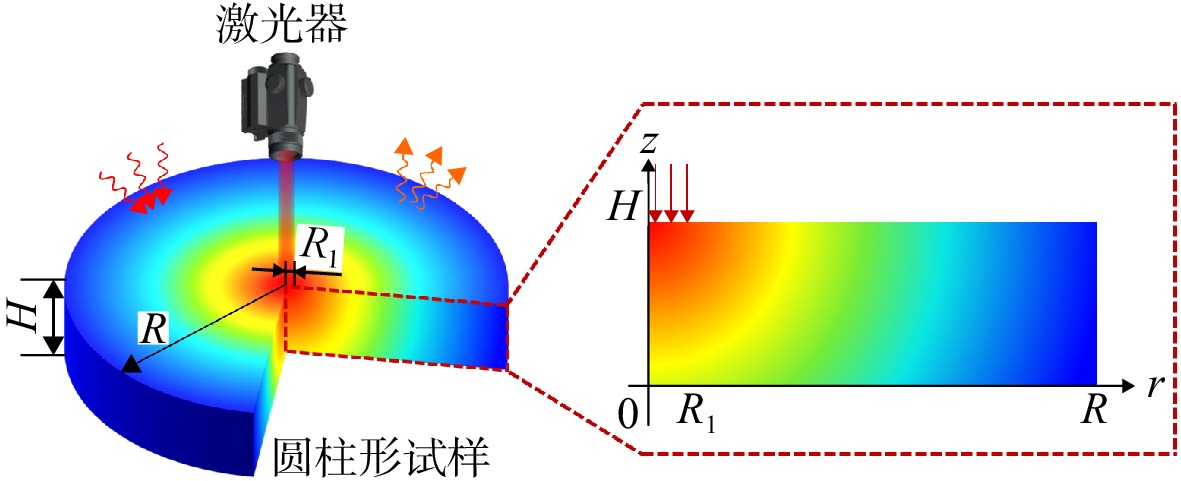
图 2 圆柱形试样二维轴对称传热模型
Figure 2. Two-dimensional axisymmetric heat transfer model of cylindrical specimen
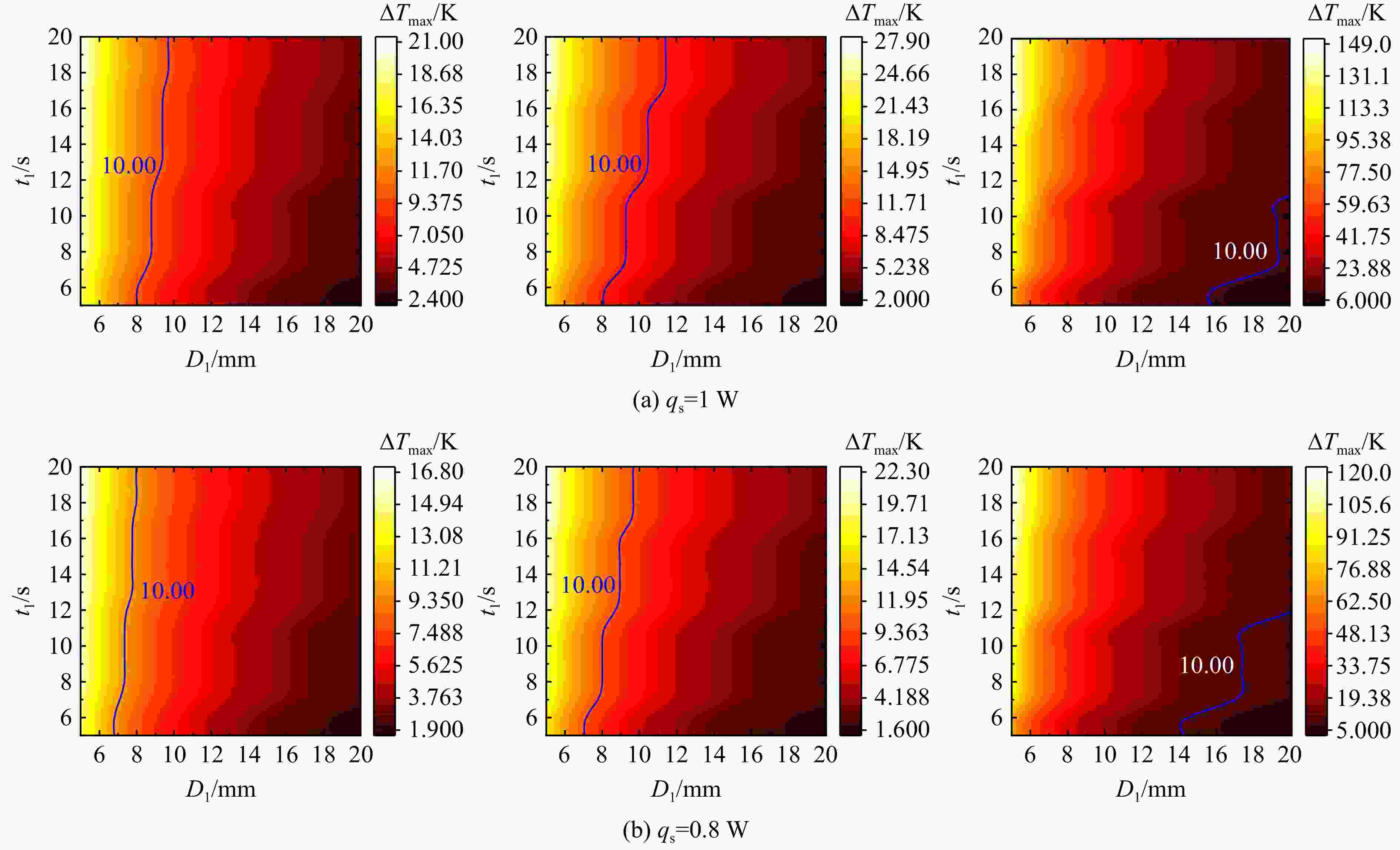
图 5 激光功率不同时材料表面的最大温升云图
Figure 5. The maximum temperature rise of the material surface at different laser power
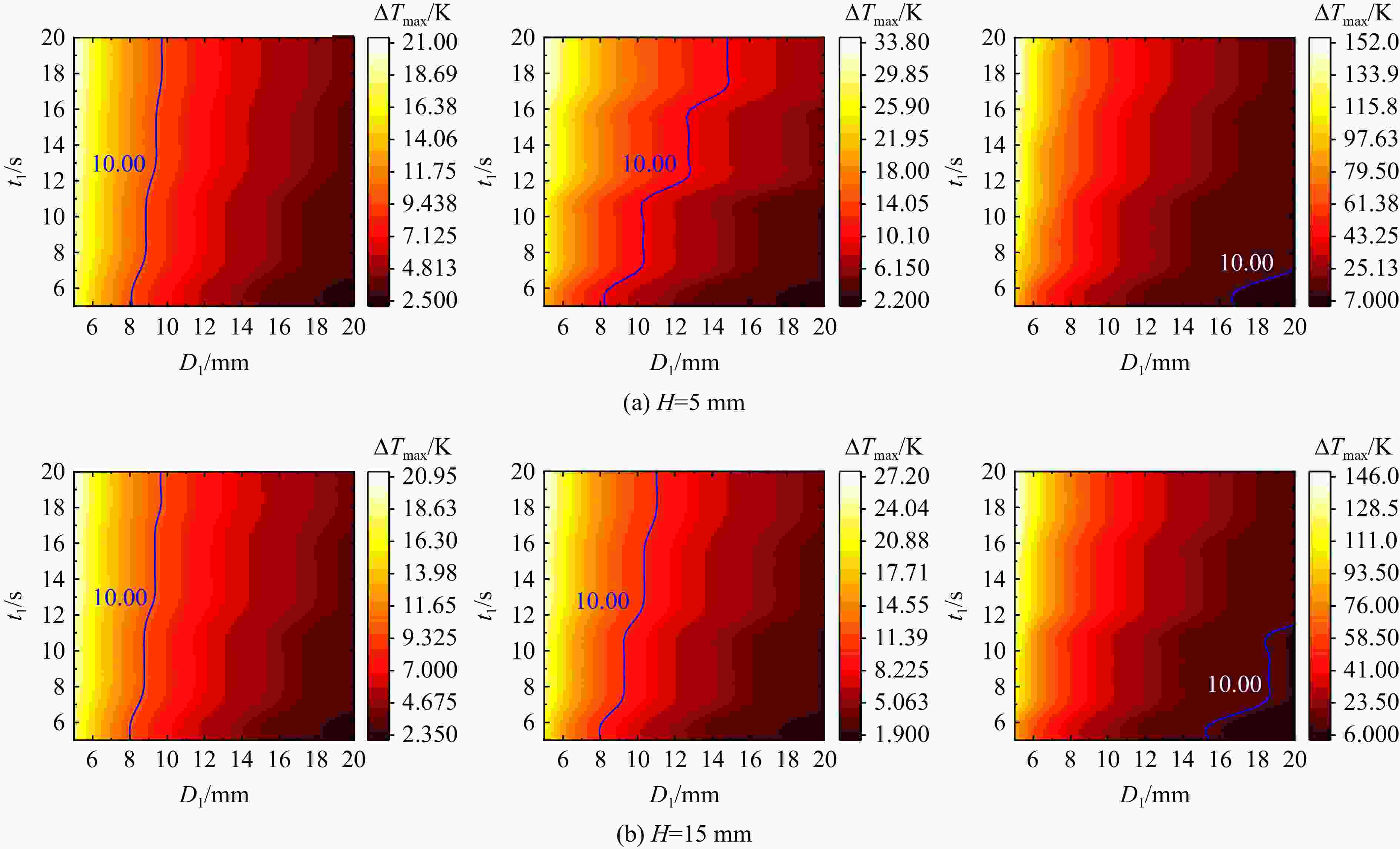
图 6 试样厚度不同时材料表面的最大温升云图
Figure 6. Maximum temperature rise of the material surface with different sample thicknesses
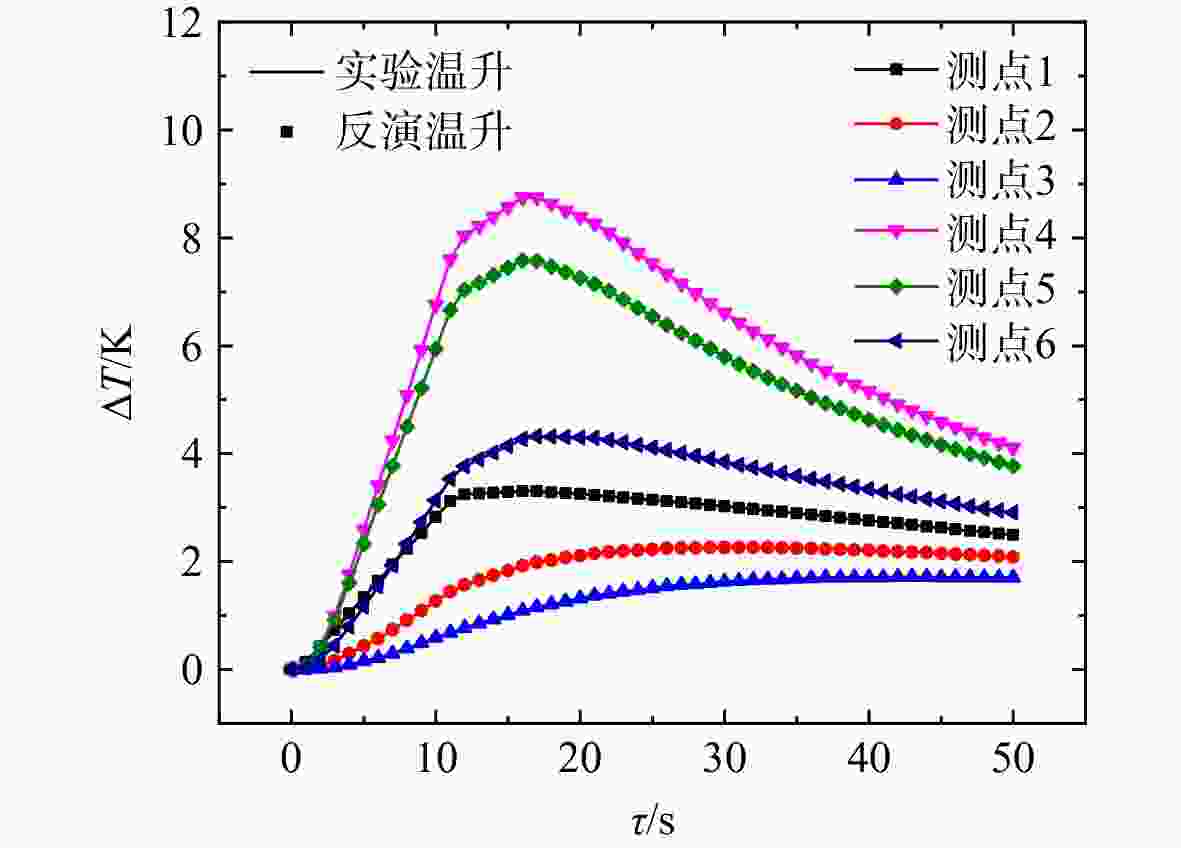
图 8 反演最优解对应温度场偏差示意图
Figure 8. Inverted optimal solution corresponding to temperature field deviation diagram
材料 λz/
(W/(m·K))λr/
(W/(m·K))ε1 c/
(J/(kg·K))ρ/
(kg/m3)1 1.94 16.10 0.86 1178.00 2239.00 2 7.81 2.00 0.86 800.00 1770.00 3 0.80 0.40 0.86 661.03 1806.44  下载: 导出CSV
表 2 不同激光功率下不同材料的最大温升和ξl
Table 2. Maximum temperature rise and ξl of different materials under different laser power
材料 最大温升/K ξl/% ∆ξl/% qs=1 qs=0.8 qs=1 qs=0.8 1 20.97 16.77 72.94 83.13 10.19 2 27.82 22.26 66.36 76.12 9.76 3 148.77 119.65 4.33 9.80 5.47
下载: 导出CSV
表 3 不同试样厚度下不同材料的最大温升和ξl
Table 3. Maximum temperature rise and ξl of different materials under different sample thickness
材料 最大温升/ K ξl/% ∆ξl/% H=5 mm H=15 mm H=5 mm H=15 mm 1 20.99 20.92 72.54 73.17 0.63 2 33.75 27.19 53.76 67.48 13.72 3 151.86 145.88 2.11 6.09 3.98
下载: 导出CSV
表 4 测温点坐标
Table 4. Coordinates of temperature measuring points
测温点 (r, z)/mm 测温点 (r, z)/mm 1 (12, 10) 4 (0, 0) 2 (14, 10) 5 (5, 0) 3 (16, 10) 6 (10, 0)
下载: 导出CSV
表 5 反演结果及误差
Table 5. Inversion results and errors
参数 真实值 反演结果 误差/% λz/(W/(m·K)) 7.81 7.72 1.15 λr/(W/(m·K)) 2.00 1.99 0.50 ε1 0.86 0.87 1.16 qs/W 5.00 5.01 0.20
下载: 导出CSV
表 6 考虑测温偏差后的反演结果及误差
Table 6. Inversion results and errors considering temperature deviation
参数 真实值 反演结果 误差/% 发射率
未知发射率
已知发射率
未知发射率
已知λz/(W/(m·K)) 7.81 7.90 7.78 1.15 0.38 λr/(W/(m·K)) 2.00 2.01 2.01 0.50 0.50 ε1 0.86 0.72 16.28 qs/W 5.00 4.99 5.02 0.20 0.40
下载: 导出CSV
表 7 考虑初始温度场非均匀的反演结果及误差
Table 7. Inversion results and errors considering inhomogeneous initial temperature field
参数 真值 反演结果 误差/% 初始温度场未修正 初始温度场已修正 初始温度场未修正 初始温度场已修正 λz/(W/(m·K)) 7.81 10.80 8.47 38.28 8.45 λr/(W/(m·K)) 2.00 1.49 1.93 25.50 3.50 qs/W 5.00 3.79 4.83 24.20 3.40
下载: 导出CSV
-
[1] GUPTA R K,RAMKUMAR P. Titanium aluminides for metallic thermal protection system of reusable space transportation vehicle: a review[J]. Frontiers in Aerospace Engineering,2015,4(1): 14-19. doi: 10.12783/fae.2015.0401.02 [2] ZHAO Yan,MENG Tian,JING Chengjun,et al. Experimental and numerical investigation on thermal performance of PV-driven aluminium honeycomb solar air collector[J]. Solar Energy,2020,204: 294-306. doi: 10.1016/j.solener.2020.04.047 [3] PATEL V K. An efficient optimization and comparative analysis of ammonia and methanol heat pipe for satellite application[J]. Energy Conversion and Management,2018,165: 382-395. doi: 10.1016/j.enconman.2018.03.076 [4] 左可军,闻洁. 预测平纹编织C/SiC复合材料等效导热系数的三维纤维随机模型[J]. 航空动力学报,2018,33(6): 1326-1335. ZUO Kejun,WEN Jie. Three-dimensional fiber random model to predict effective thermal conductivity of plain braided C/SiC composites[J]. Journal of Aerospace Power,2018,33(6): 1326-1335. (in ChineseZUO Kejun, WEN Jie. Three-dimensional fiber random model to predict effective thermal conductivity of plain braided C/SiC composites[J]. Journal of Aerospace Power, 2018, 33(6): 1326-1335. (in Chinese) [5] 江华,毛军逵,屠泽灿,等. 基于微结构识别的单向复合材料导热系数预估[J]. 航空动力学报,2016,31(11): 2641-2651. JIANG Hua,MAO Junkui,TU Zecan,et al. Thermal conductivity prediction of unidirectional composites based on microstructure identification[J]. Journal of Aerospace Power,2016,31(11): 2641-2651. (in ChineseJIANG Hua, MAO Junkui, TU Zecan, et al. Thermal conductivity prediction of unidirectional composites based on microstructure identification[J]. Journal of Aerospace Power, 2016, 31(11): 2641-2651. (in Chinese) [6] 刘华. 纳米复合隔热材料高温耦合传热实验测量及物性参数辨识[D]. 哈尔滨: 哈尔滨工业大学,2017. LIU Hua. Experiment on coupled heat transfer and thermal property identification of nanocomposite insulation at high temperature[D]. Harbin: Harbin Institute of Technology,2017. (in ChineseLIU Hua. Experiment on coupled heat transfer and thermal property identification of nanocomposite insulation at high temperature[D]. Harbin: Harbin Institute of Technology, 2017. (in Chinese) [7] 张涛,卢玫,陶亮,等. 基于粒子群优化算法的寻源导热反问题研究[J]. 上海理工大学学报,2013,35(4): 377-381. ZHANG Tao,LU Mei,TAO Liang,et al. Seeking heat source in inverse heat conduction problem by using particle swarm optimization[J]. Journal of University of Shanghai for Science and Technology,2013,35(4): 377-381. (in Chinese doi: 10.3969/j.issn.1007-6735.2013.04.014ZHANG Tao, LU Mei, TAO Liang, et al. Seeking heat source in inverse heat conduction problem by using particle swarm optimization[J]. Journal of University of Shanghai for Science and Technology, 2013, 35(4): 377-381. (in Chinese) doi: 10.3969/j.issn.1007-6735.2013.04.014 [8] 文斌,吴青柏,蒋观利,等. 模拟退火优化算法的冻土热传导参数反分析[J]. 岩土力学,2013,34(8): 2401-2408. WEN Bin,WU Qingbai,JIANG Guanli,et al. Back analysis of frozen soil thermal properties based on simulated annealing optimization algorithm[J]. Rock and Soil Mechanics,2013,34(8): 2401-2408. (in ChineseWEN Bin, WU Qingbai, JIANG Guanli, et al. Back analysis of frozen soil thermal properties based on simulated annealing optimization algorithm[J]. Rock and Soil Mechanics, 2013, 34(8): 2401-2408. (in Chinese) [9] ZHANG Hu,WU Kefan,XIAO Guangming,et al. Experimental study of the anisotropic thermal conductivity of 2D carbon-fiber/epoxy woven composites[J]. Composite Structures,2021,267: 113870. doi: 10.1016/j.compstruct.2021.113870 [10] JANNOT Y,DEGIOVANNI A,SCHICK V,et al. Apparent thermal conductivity measurement of anisotropic insulating materials at high temperature by the parallel hot-wire method[J]. International Journal of Thermal Sciences,2021,160: 106672. doi: 10.1016/j.ijthermalsci.2020.106672 [11] KUSIAK A,MARTAN J,BATTAGLIA J L,et al. Using pulsed and modulated photothermal radiometry to measure the thermal conductivity of thin films[J]. Thermochimica Acta,2013,556: 1-5. doi: 10.1016/j.tca.2013.01.010 [12] ZHU Jie,WU Xuewang,LATTERY D M,et al. The ultrafast laser pump-probe technique for thermal characterization of materials with micro/nanostructures[J]. Nanoscale and Microscale Thermophysical Engineering,2017,21(3): 177-198. doi: 10.1080/15567265.2017.1313343 [13] TKADLETZ M,LECHNER A,SCHALK N,et al. Reactively sputtered TiN/SiO2 multilayer coatings with designed anisotropic thermal conductivity–From theoretical conceptualization to experimental validation[J]. Surface and Coatings Technology,2020,393: 125763. doi: 10.1016/j.surfcoat.2020.125763 [14] KIM G,KIM D,KANG S,et al. Research on measuring thermal conductivity of quartz and sapphire glass using rear-side photothermal deflection method[J]. Applied Sciences,2021,11(4): 1535. doi: 10.3390/app11041535 [15] JEON P S,KIM J H,KIM H J,et al. Thermal conductivity measurement of anisotropic material using photothermal deflection method[J]. Thermochimica Acta,2008,477(1/2): 32-37. [16] HEADLEY A,HILEMAN M,ROBBINS A,et al. A thermal conductivity model for microporous insulations in gaseous environments[J]. International Journal of Heat and Mass Transfer,2019,135: 1278-1285. doi: 10.1016/j.ijheatmasstransfer.2019.02.073 [17] ZHANG Hu,LI Yueming,TAO Wenquan. Theoretical accuracy of anisotropic thermal conductivity determined by transient plane source method[J]. International Journal of Heat and Mass Transfer,2017,108: 1634-1644. doi: 10.1016/j.ijheatmasstransfer.2017.01.025 [18] RODRIGO O,BERTRAND G. Radial thermal conductivity of a PAN type carbon fiber using the 3 omega method[J]. International Journal of Thermal Sciences,2022,172: 107321. doi: 10.1016/j.ijthermalsci.2021.107321 [19] ROTTMANN M,BEIKIRCHER T,EBERT H P. Thermal conductivity of evacuated expanded perlite measured with guarded-hot-plate and transient-hot-wire method at temperatures between 295 K and 1 073 K[J]. International Journal of Thermal Sciences,2020,152: 106338. doi: 10.1016/j.ijthermalsci.2020.106338 [20] ZHENG Qiye,KAUR S,DAMES C,et al. Analysis and improvement of the hot disk transient plane source method for low thermal conductivity materials[J]. International Journal of Heat and Mass Transfer,2020,151: 119331. doi: 10.1016/j.ijheatmasstransfer.2020.119331 [21] ZHAO Wenli,YANG Yi,BAO Zewei,et al. Methods for measuring the effective thermal conductivity of metal hydride beds: a review[J]. International Journal of Hydrogen Energy,2020,45(11): 6680-6700. doi: 10.1016/j.ijhydene.2019.12.185 [22] ZHANG C,BI Kedong,WANG Jianli,et al. Measurement of thermal boundary conductance between metal and dielectric materials using femtosecond laser transient thermoreflectance technique[J]. Science China Technological Sciences,2012,55(4): 1044-1049. doi: 10.1007/s11431-012-4754-4 [23] HOPKINS P E,SERRANO J R,PHINNEY L M. Comparison of thermal conductivity and thermal boundary conductance sensitivities in continuous-wave and ultrashort-pulsed thermoreflectance analyses[J]. International Journal of Thermophysics,2010,31(11): 2380-2393. [24] ZHU Jie,TANG Dawei,WANG Wei,et al. Ultrafast thermoreflectance techniques for measuring thermal conductivity and interface thermal conductance of thin films[J]. Journal of Applied Physics,2010,108(9): 371-379. [25] TANG Lei,DAMES C. Anisotropic thermal conductivity tensor measurements using beam-offset frequency domain thermoreflectance (BO-FDTR) for materials lacking in-plane symmetry[J]. International Journal of Heat and Mass Transfer,2021,164: 120600. doi: 10.1016/j.ijheatmasstransfer.2020.120600 [26] CHANDA S,BALAJI C,VENKATESHAN S P,et al. Estimation of principal thermal conductivities of layered honeycomb composites using ANN–GA based inverse technique[J]. International Journal of Thermal Sciences,2017,111: 423-436. doi: 10.1016/j.ijthermalsci.2016.09.011 [27] 侯亚东,单勇,李江宁,等. 各向异性复合材料平板气膜冷却特性实验和数值研究[J]. 航空动力学报,2017,32(10): 2384-2393. HOU Yadong,SHAN Yong,LI Jiangning,et al. Experimental and numerical studies on the film cooling characteristics of anisotropic composite plates[J]. Journal of Aerospace Power,2017,32(10): 2384-2393. (in ChineseHOU Yadong, SHAN Yong, LI Jiangning, et al. Experimental and numerical studies on the film cooling characteristics of anisotropic composite plates[J]. Journal of Aerospace Power, 2017, 32(10): 2384-2393. (in Chinese) [28] ADAMCZYK W P,PAWLAK S,OSTROWSKI Z. Determination of thermal conductivity of CFRP composite materials using unconventional laser flash technique[J]. Measurement,2018,124: 147-155. doi: 10.1016/j.measurement.2018.04.022 [29] ADAMCZYK W P,OSTROWSKI Z,RYFA A. Development of a non-destructive technique for measuring thermal conductivity of material with small anisotropy based on application of the reduced order technique[J]. Measurement,2020,165: 108078. doi: 10.1016/j.measurement.2020.108078 [30] SANS M,SCHICK V,PARENT G,et al. Experimental characterization of the coupled conductive and radiative heat transfer in ceramic foams with a flash method at high temperature[J]. International Journal of Heat and Mass Transfer,2020,148: 119077. doi: 10.1016/j.ijheatmasstransfer.2019.119077 [31] ERCHIQUI F,ANNASABI Z. 3D hybrid finite element enthalpy for anisotropic thermal conduction analysis[J]. International Journal of Heat and Mass Transfer,2019,136: 1250-1264. doi: 10.1016/j.ijheatmasstransfer.2019.02.096 [32] 廖云丹. 纤维增强SiO2气凝胶隔热复合材料的可控制备及性能优化研究[D]. 广州: 广州大学,2012. LIAO Yundan. Controllable preparation and performance optimization of fiber-reinforced SiO2Aerogel composites for thermal insulation[D]. Guangzhou: Guangzhou University,2012. (in ChineseLIAO Yundan. Controllable preparation and performance optimization of fiber-reinforced SiO2Aerogel composites for thermal insulation[D]. Guangzhou: Guangzhou University, 2012. (in Chinese) [33] BREUER S,SCHWOTZER M,SPEZIALE S,et al. Thermoelastic properties of synthetic single crystal portlandite Ca(OH)2 - Temperature-dependent thermal diffusivity with derived thermal conductivity and elastic constants at ambient conditions[J]. Cement and Concrete Research,2020,137: 106199. doi: 10.1016/j.cemconres.2020.106199 [34] 徐中,殷复振,崔健超. 陶瓷热障涂层隔热效果以及导热系数的研究[C]//第六届全国表面工程学术会议暨首届青年表面工程学术论坛. 甘肃 兰州: 青年表面工程学术论坛,2006: 241-244. XU Zhong,YIN Fuzhen,CUI Jianchao. Study on thermal insulation effect and thermal conductivity of ceramic thermal barrier coatings[C]//The 6th National Conference on Surface Engineering and the 1st Youth Academic Forum on Surface Engineering. Lanzhou Gansu: Youth Surface Engineering Academic Forum,2006: 241-244.XU Zhong, YIN Fuzhen, CUI Jianchao. Study on thermal insulation effect and thermal conductivity of ceramic thermal barrier coatings[C]//The 6th National Conference on Surface Engineering and the 1st Youth Academic Forum on Surface Engineering. Lanzhou Gansu: Youth Surface Engineering Academic Forum, 2006: 241-244. [35] 毋克凡,Nuanyai Pontarit,张虎,等. 树脂基碳纤维复合材料各向异性导热系数研究[J]. 工程热物理学报,2021,42(5): 1282-1287. WU Kefan,NUANYAI Pontarit,ZHANG Hu,et al. Anisotropic thermal conductivity of carbon-fiber/epoxy composites[J]. Journal of Engineering Thermophysics,2021,42(5): 1282-1287. (in ChineseWU Kefan, NUANYAI Pontarit, ZHANG Hu, et al. Anisotropic thermal conductivity of carbon-fiber/epoxy composites[J]. Journal of Engineering Thermophysics, 2021, 42(5): 1282-1287. (in Chinese) -


 点击查看大图

计量
- 文章访问数: 553
- HTML浏览量: 435
- PDF量: 50
- 被引次数: 0