






Investigation of kerosene droplet evaporation model based on machine learning
-
摘要:
基于厚交换层液滴蒸发理论以及煤油的实验数据,通过机器学习理论中的线性回归、随机森林、支持向量机、极致梯度提升回归和全连接神经网络方法构建煤油液滴的蒸发模型,检验新构建模型的适用范围和精度。对比实验数据和传统模型、机器学习蒸发模型的预测结果,发现随机森林方法和极致梯度提升回归方法生成的蒸发模型不能合理外推,支持向量机方法的外推效果欠佳。线性回归的厚交换层模型和全连接神经网络模型的整体效果更好,与训练数据的均方误差分别为2.71×10⁻²和1.81×10⁻³。基于深度学习模型良好的预测效果,可以构建基于实验数据的、可以合理外推的“数字蒸发模型”,可能有更好的现实适应能力。机器学习液滴蒸发模型丰富了现有液滴蒸发模型,为机器学习液滴蒸发模型研究打基础。
Abstract:Based on the droplet evaporation theory of Thick Exchange layer and experimental data of kerosene, a kerosene droplet evaporation model was constructed by using linear regression, random-forest, support vector machine, extreme gradient boosting, and fully-connected neural network methods in machine learning theory to test the applicability and accuracy of the newly constructed model. Comparing the experimental data with the prediction results of traditional models and machine learning evaporation models, it was found that the evaporation models generated by the random-forest method and extreme gradient boosting method cannot be reasonably extrapolated. The extrapolation effect of support vector machine method was not good. The overall effect of the linear regression thick exchange layer model and the fully-connected neural network model was superior to others, with a mean square error of 2.71×10⁻² and 1.81×10⁻³ compared with the training data, respectively. Based on the prediction consequences of the deep learning model, it is feasible to construct a “digital evaporation model” stemmed from experimental data that can be reasonably extrapolated, and may have better realistic adaptability. Machine learning droplet evaporation model enriched extant droplet evaporation models, laying the foundation for machine learning droplet evaporation model research.
-
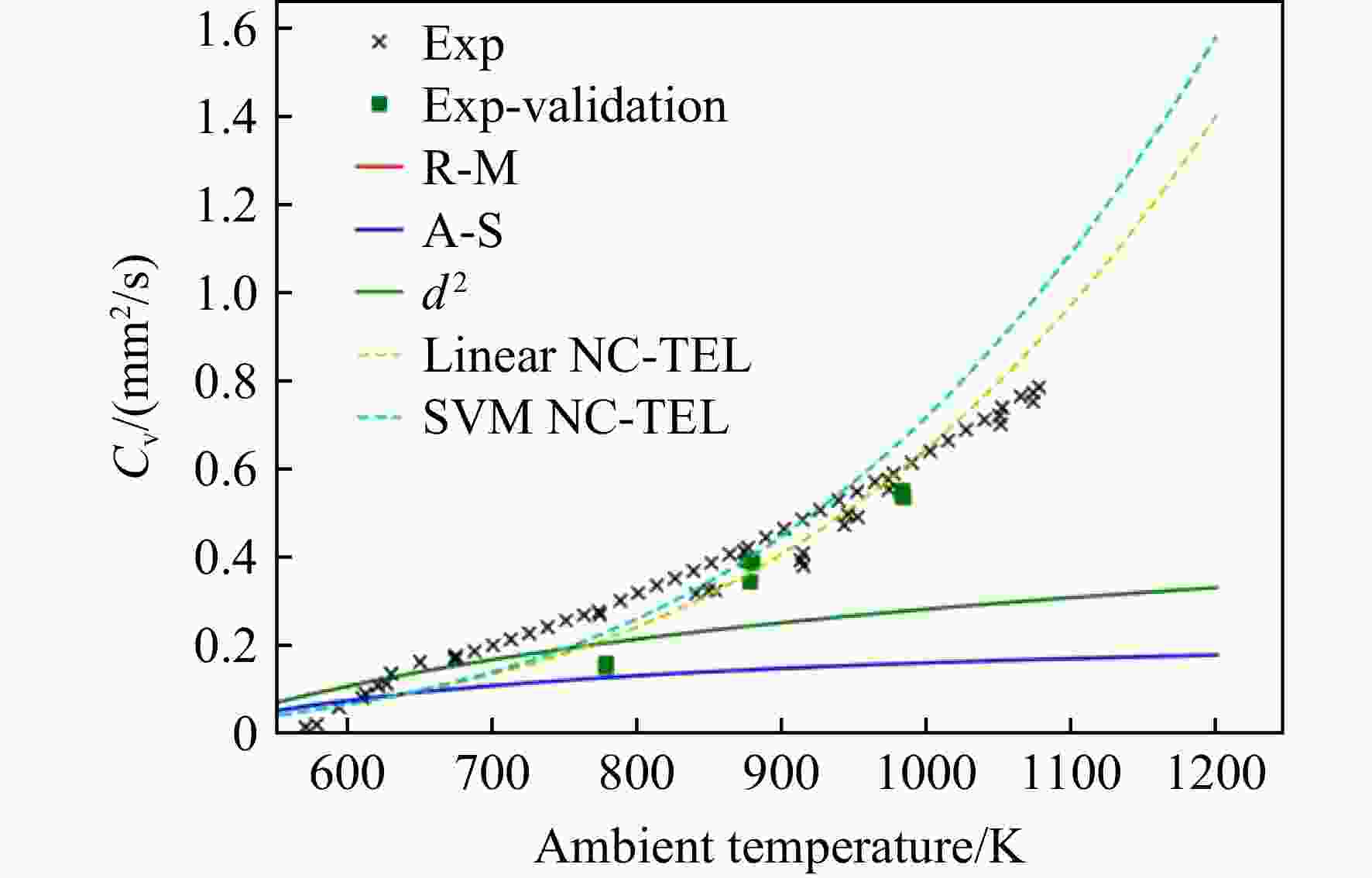
图 5 液滴静止时不同环境温度下各模型的预测值
Figure 5. Predictions of models under different ambient temperatures when the droplet is stationary
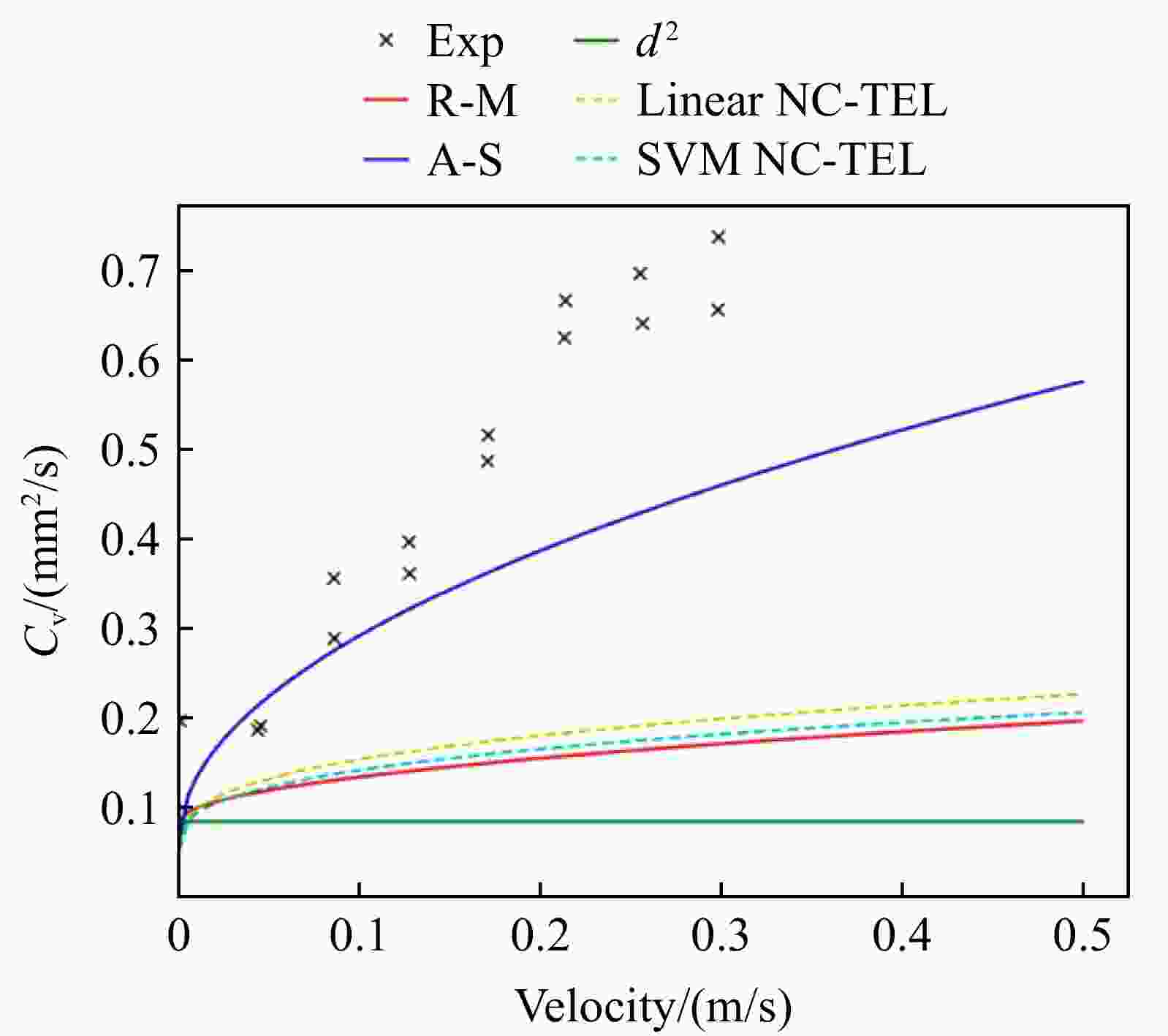
图 6 环境温度为573 K下各模型的预测值
Figure 6. Predictions of models when the ambient temperature is 573 K
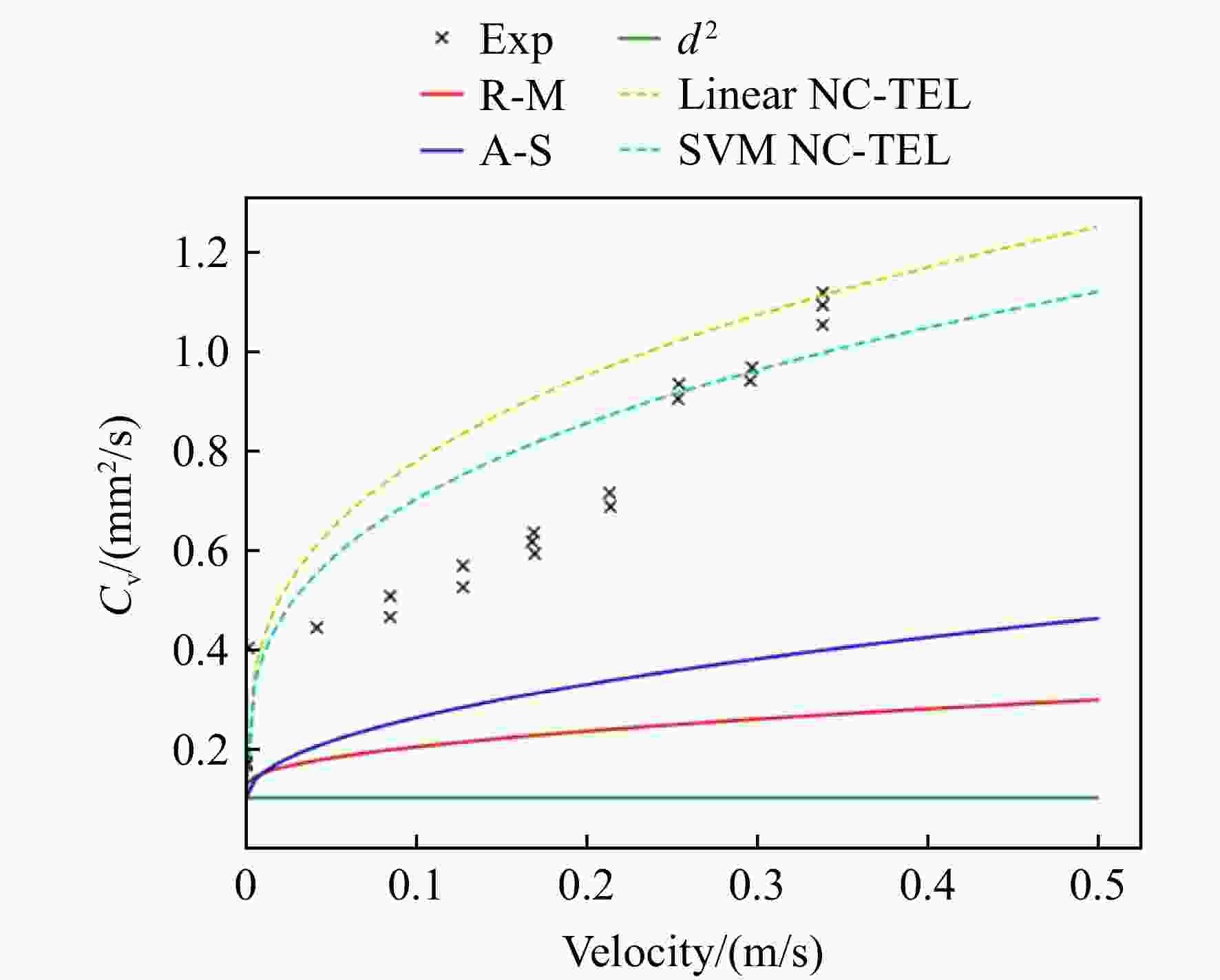
图 7 环境温度为673 K下各模型的预测值
Figure 7. Predictions of models when the ambient temperature is 673 K

图 8 采用独热编码的机器学习模型对煤油蒸发常数的预测结果
Figure 8. Prediction of evaporation constant of kerosene using a machine learning model with unique heat coding
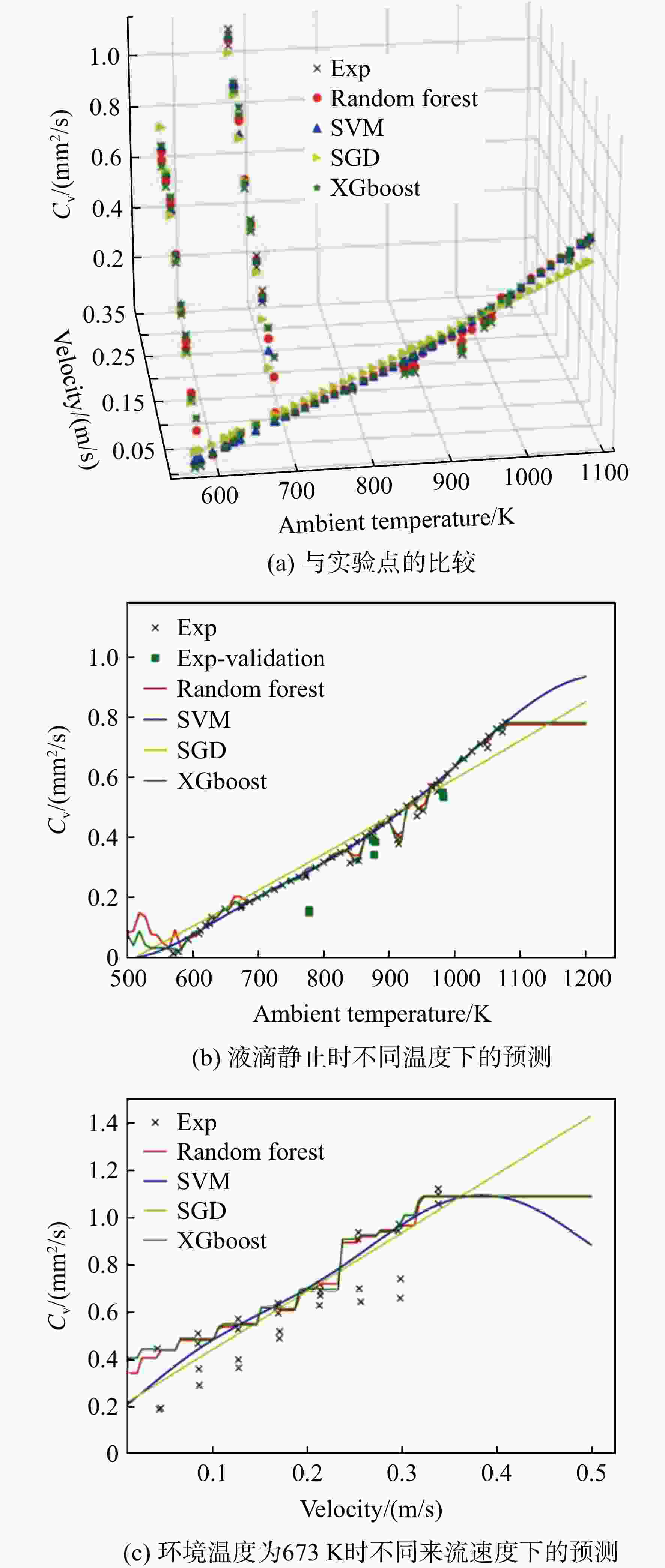
图 10 增加物性特征的机器学习模型对煤油蒸发常数的预测结果
Figure 10. Kerosene evaporation constant predictions of machine learning models with more physical properties
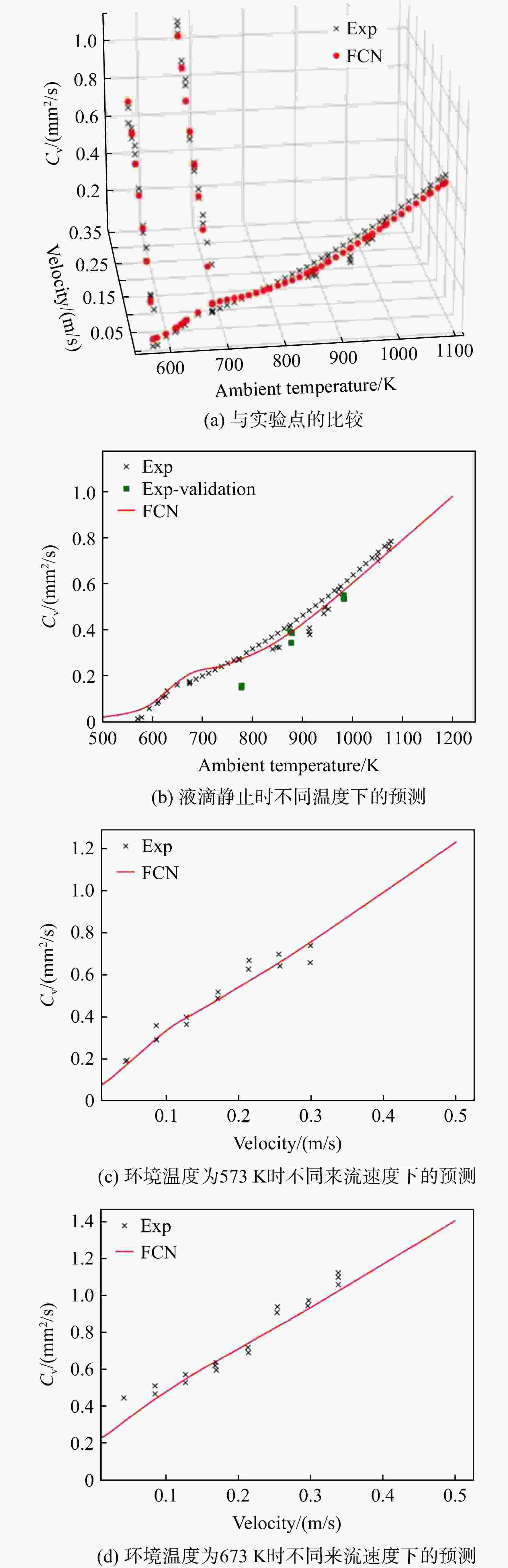
图 12 深度学习模型对煤油蒸发常数的预测结果
Figure 12. Prediction results of kerosene evaporation constant using deep learning models
表 1 NC-TEL拟合结果与误差
Table 1. Performance of NC-TEL regression
模型 $\hat{\zeta }$ $\hat{\delta }$ 训练组
MSE/$ {10}^{-2} $验证组
MSE/$ {10}^{-3} $线性回归 0.158 6.27 $ 2.71 $ $ 2.33 $ 线性SVM回归 0.246 5.47 $ 3.16 $ $ 7.48 $  下载: 导出CSV
表 2 机器学习模型误差
Table 2. Errors of machine learning models
模型 MSE/$ {10}^{-3} $ 独热编码
训练独热编码
验证增加物性
训练增加物性
验证随机森林 $ 0.264 $ $ 6.05 $ $ 0.282 $ $ 5.91 $ SVM $ 2.00 $ $ 6.00 $ $ 1.47 $ $ 6.92 $ XGBoost $0.048\;6$ $ 9.69 $ $0.044\;6$ $ 9.29 $ SGD $ 5.09 $ $ 5.98 $ $ 3.15 $ $ 6.07 $
下载: 导出CSV
表 3 模型预测结果总结
Table 3. Summary of model prediction results
模型 训练组
MSE/$ {10}^{-3} $验证组
MSE/$ {10}^{-3} $外推能力 线性回归 $ 27.1 $ $ 2.33 $ 好 随机森林 $ 0.282 $ $ 5.91 $ 无 SVM $ 1.47 $ $ 6.92 $ 差 XGBoost $0.044\;6$ $ 9.29 $ 无 SGD $ 3.15 $ $ 6.07 $ 一般 全连接网络 $ 1.81 $ $ 4.19 $ 好
下载: 导出CSV
-
[1] GODSAVE G A E. Studies of the combustion of drops in a fuel spray: the burning of single drops of fuel[J]. Symposium (International) on Combustion,1953,4(1): 818-830. doi: 10.1016/S0082-0784(53)80107-4 [2] SPALDING D B. Combustion of liquid fuels[J]. Nature,1950,165: 160. doi: 10.1038/165160a0 [3] NOBLE W S. What is a support vector machine?[J]. Nature Biotechnology,2006,24(12): 1565-1567. doi: 10.1038/nbt1206-1565 [4] ABRAMZON B,SIRIGNANO W A. Droplet vaporization model for spray combustion calculations[J]. International Journal of Heat and Mass Transfer,1989,32(9): 1605-1618. doi: 10.1016/0017-9310(89)90043-4 [5] PENG F, AGGARWAL S K. A review of droplet dynamics and vaporization modeling for engineering calculations[R]. ASME 94-GT-215,1994. [6] RANZ W E. Evaporation from drops: Part Ⅱ[J]. Chemical Engineering Progress,1952,48(4): 173-180. [7] 周力行. 燃烧理论和化学流体力学[M]. 北京: 科学出版社, 1986. [8] WANG Fang,LIU Rui,LI Min,et al. Kerosene evaporation rate in high temperature air stationary and convective environment[J]. Fuel,2018,211: 582-590. doi: 10.1016/j.fuel.2017.08.062 [9] GHASSEMI H,BAEK S W,KHAN Q S. Experimental study on evaporation of kerosene droplets at elevated pressures and temperatures[J]. Combustion Science and Technology,2006,178(9): 1669-1684. doi: 10.1080/00102200600582392 [10] SVETNIK V,LIAW A,TONG C,et al. Random forest: a classification and regression tool for compound classification and QSAR modeling[J]. Journal of Chemical Information and Computer Sciences,2003,43(6): 1947-1958. doi: 10.1021/ci034160g [11] BOTTOU L. Large-scale machine learning with stochastic gradient descent[R]. Paris, France: 19th International Conference on Computational Statistics, 2010. [12] GLOROT X, BENGIO Y. Understanding the difficulty of training deep feedforward neural networks[R]. Sardinia, Italy: 13th International Conference on Artificial Intelligence and Statistics, 2010. [13] SAZHIN S S. Advanced models of fuel droplet heating and evaporation[J]. Progress in Energy and Combustion Science,2006,32(2): 162-214. doi: 10.1016/j.pecs.2005.11.001 [14] Ansys Inc. Ansys fluent theory guide[M]. Canonsburg, US: Ansys Inc. , 2020. [15] CHEN T, GUESTRIN C. XGBoost: a scalable tree boosting system[R]. San Francisco, US: 22nd ACM SIGKDD International Conference on Knowledge Discovery and Data Mining, 2016. [16] KHAN Q, BAEK S W, LEE S Y. Effect of droplet initial diameter on droplet vaporization regimes for kerosene fuel droplet[R]. Reno, US: 45th AIAA Aerospace Sciences Meeting and Exhibit, 2007. [17] WANG Fang,YAO Jie,YANG Shaofeng,et al. A new stationary droplet evaporation model and its validation[J]. Chinese Journal of Aeronautics,2017,30(4): 1407-1416. doi: 10.1016/j.cja.2017.06.012 [18] PINHEIRO A P,VEDOVOTO J M,NETO A D S,et al. Ethanol droplet evaporation: effects of ambient temperature, pressure and fuel vapor concentration[J]. International Journal of Heat and Mass Transfer,2019,143: 118472.1-118472.12. [19] HASHIMOTO N,NOMURA H,SUZUKI M,et al. Evaporation characteristics of a palm methyl ester droplet at high ambient temperatures[J]. Fuel,2015,143: 202-210. doi: 10.1016/j.fuel.2014.11.057 -


 点击查看大图

计量
- 文章访问数: 671
- HTML浏览量: 589
- PDF量: 79
- 被引次数: 0