






Optimization of compressor blade profile based on ResNet data drive
-
摘要:
为提高用于叶型优化设计ResNet深度学习模型的泛化性,对一种适用于亚声速和跨声速的压气机叶型进行了参数化设计。叶型基于Matlab进行几何模型构建,设计变量为叶型最大厚度、最大厚度位置、栅距和叶型尾缘与轴向的夹角,几何模型通过Pointwise软件进行批量网格划分,网格量级为30万,通过OpenFOAM流体仿真软件进行批量计算。最终通过4个设计变量参数化建模后进行仿真得到了叶型流场仿真数据集,该数据集包含22331个叶型仿真算例,可为ResNet深度学习模型提供训练集和测试题,有助于提高模型的泛化性。
-
关键词:
- 机器学习 /
- 压气机叶型 /
- Matlab /
- 计算流体力学(CFD) /
- OpenFOAM
Abstract:To improve the generalizability of the ResNet deep learning model used for optimal design of the blade profile, a parametric design of a compressor blade profile suitable for subsonic and transonic speeds was carried out. The blade profile was constructed based on the geometric model in Matlab, and the design variables included the maximum thickness of the blade profile, the position of the maximum thickness, the mesh distance and the angle between the trailing edge of the blade profile and the axial direction, and the geometric model was meshed in batch by Pointwise software with a mesh size of 300 000, and simulation was carried out by OpenFOAM fluid simulation. The final simulation was performed by parametric modeling of 4 design variables to obtain the fluid simulation dataset of blade profile, which contained 22331 simulation cases of blade profile and can provide training and test datasets for ResNet deep learning models, helping to improve the generalization of the model.
-
Key words:
- machine learning /
- compressor blade profile /
- Matlab /
- computational fluid dynamics (CFD) /
- OpenFOAM
-
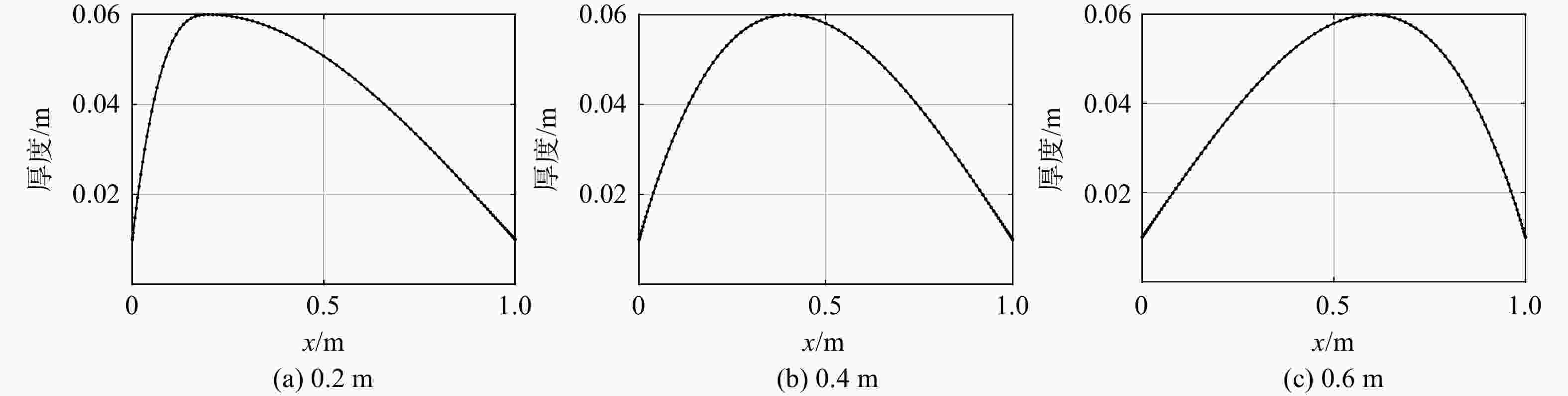
图 5 3种不同最大厚度位置的叶型厚度分布曲线图
Figure 5. Blade profile thickness distribution curves for three different maximum thickness positions
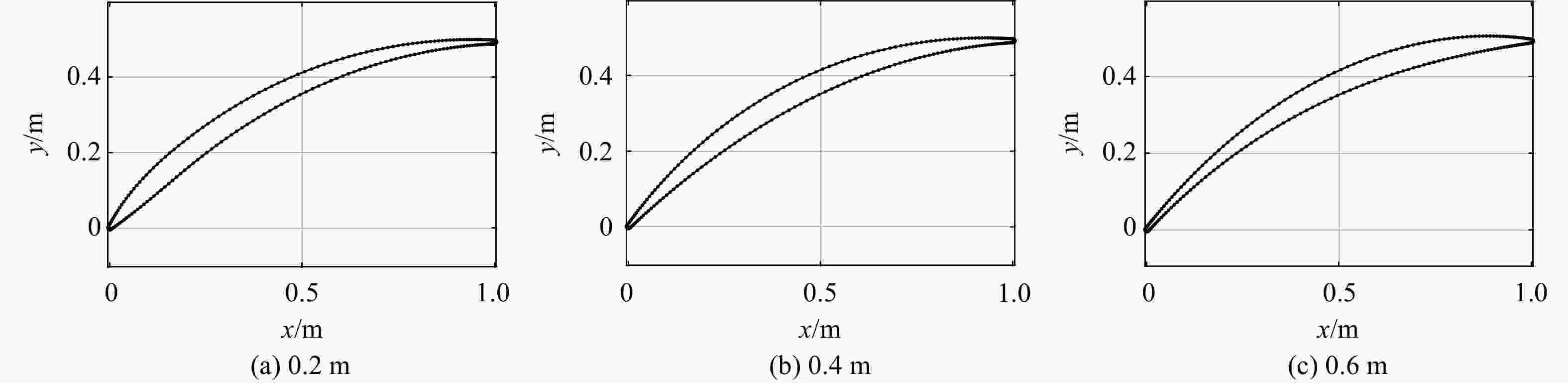
图 6 3种不同最大厚度位置的叶型轮廓图
Figure 6. Blade profile for three different maximum thickness positions
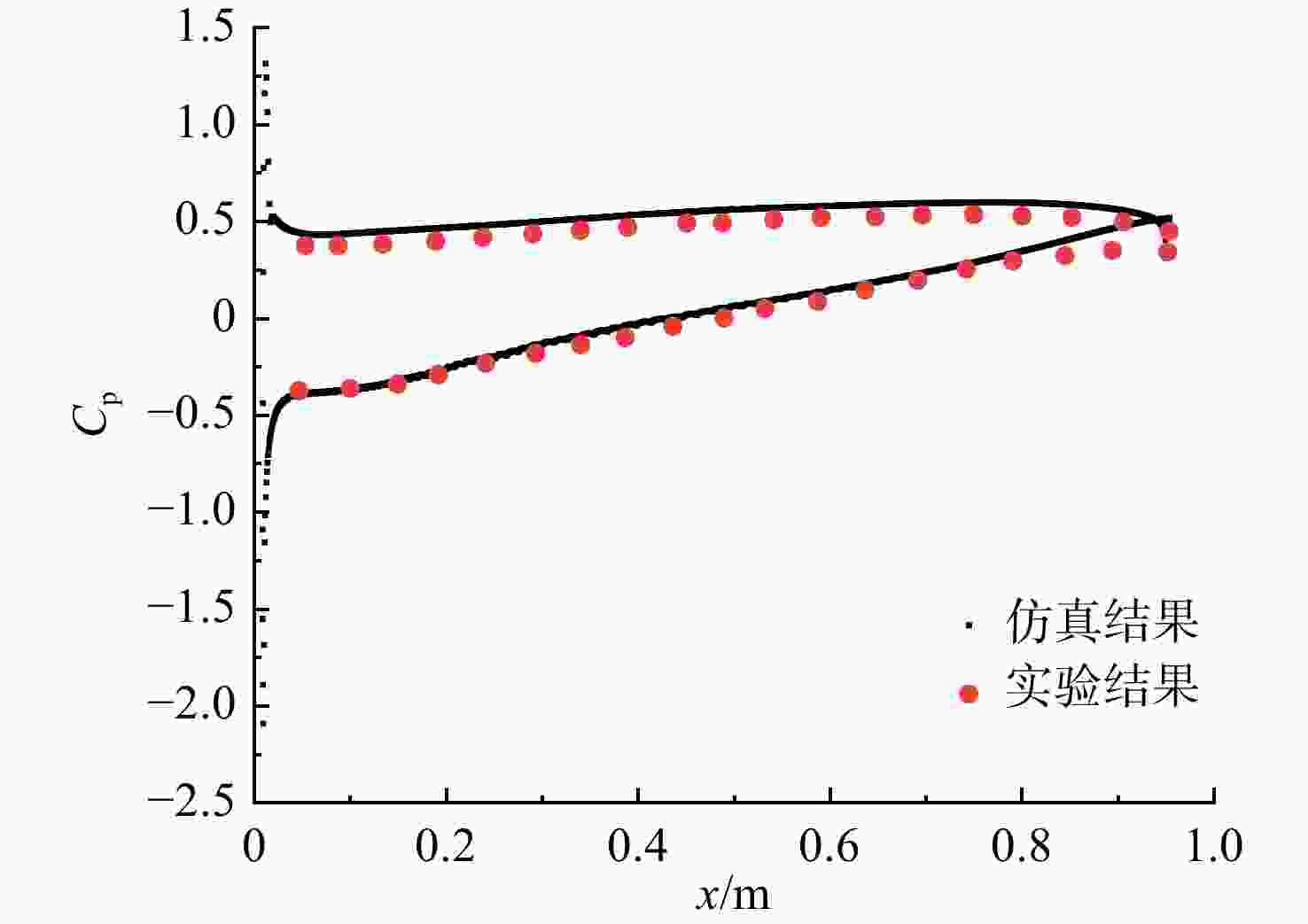
图 15 CA-2叶型OpenFOAM仿真结果和实验结果的Cp对比
Figure 15. Cp comparison of OpenFOAM simulation results and experimental results of CA-2 blade profile
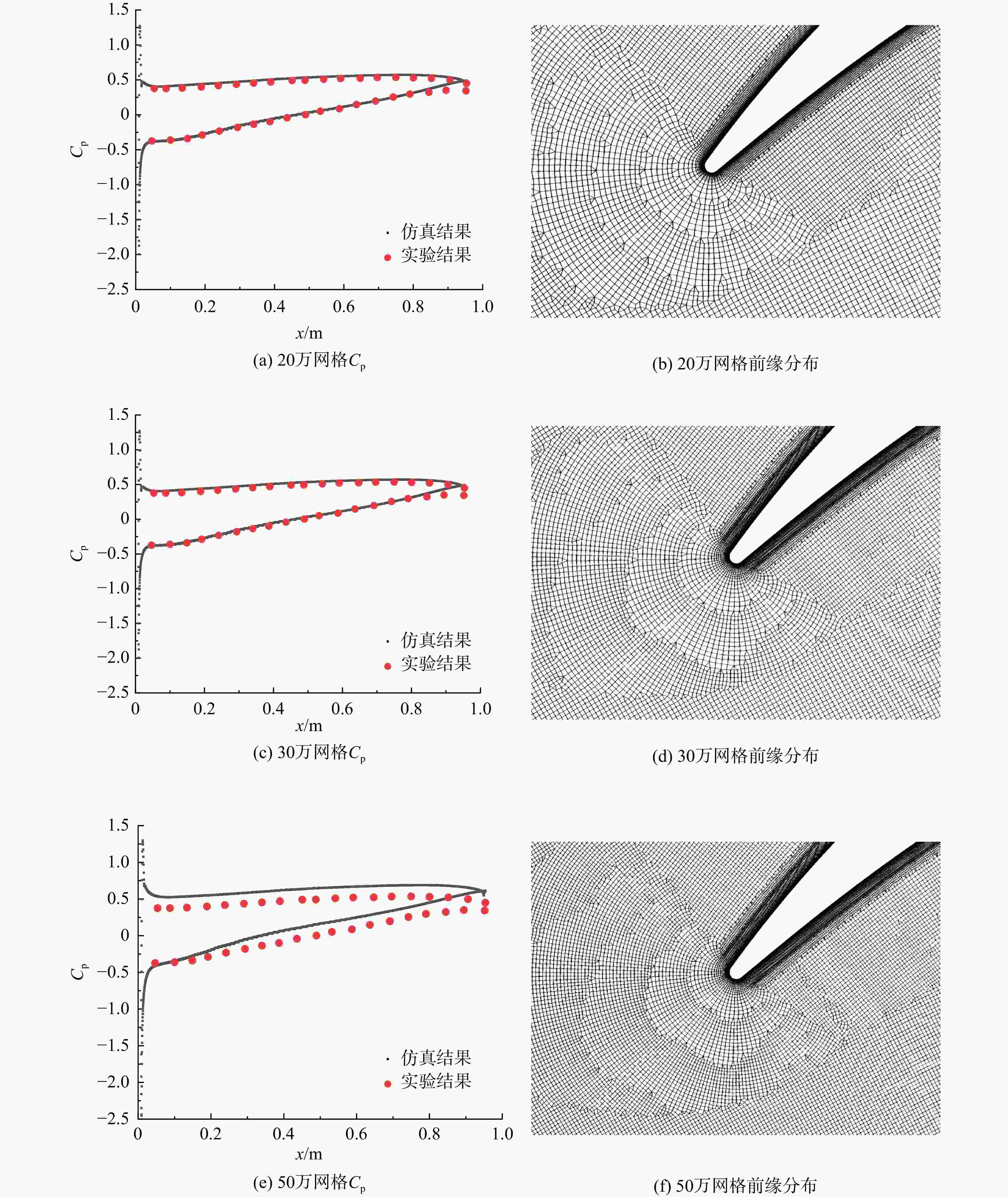
图 16 3种网格数的叶型Cp分布与网格前缘分布
Figure 16. Blade profile Cp distributions and mesh leading edge distributions of three meshes
表 1 算例变量统计
Table 1. Example variable statistics
变量 最小值 最大值 区间 间断点个数 叶片尾缘角/(°) −10 10 1 21 最大厚度/m 0.04 0.08 0.005 9 最大厚度位置/m 0.2 0.6 0.05 9 栅距/m 0.4 1 0.05 13  下载: 导出CSV
-
[1] 秦鹏. 轴流压气机气动设计[M]. 北京: 国防工业出版社, 1975. [2] 胡骏. 航空叶片机原理[M]. 北京: 国防工业出版社, 2014. [3] 阎军,许琦,张起,等. 人工智能在结构拓扑优化领域的现状与未来趋势[J]. 计算力学学报,2021,38(4): 412-422. doi: 10.7511/jslx20210517401YAN Jun,XU Qi,ZHANG Qi,et al. Current and future trends of artificial intelligence in the field of structural topology optimization[J]. Chinese Journal of Computational Mechanics,2021,38(4): 412-422. (in Chinese) doi: 10.7511/jslx20210517401 [4] 张伟伟,寇家庆,刘溢浪. 智能赋能流体力学展望[J]. 航空学报,2021,42(4): 524689.1-524689.46.ZHANG Weiwei,KOU Jiaqing,LIU Yilang. Prospect of artificial intelligence empowering fluid mechanics[J]. Acta Aeronautica et Astronautica Sinica,2021,42(4): 524689.1-524689.46. (in Chinese) [5] 尹宇辉, 杨普, 张宇飞. 基于机器学习的湍流建模研究[R]. 杭州: 中国力学大会, 2019. [6] 张伟伟,朱林阳,刘溢浪,等. 机器学习在湍流模型构建中的应用进展[J]. 空气动力学学报,2019,37(3): 444-454.ZHANG Weiwei,ZHU Linyang,LIU Yilang,et al. Progresses in the application of machine learning in turbulence modeling[J]. Acta Aeronamica Sinica,2019,37(3): 444-454. (in Chinese) [7] 徐启华,师军. 基于支持向量机的航空发动机故障诊断[J]. 航空动力学报,2005,20(2): 298-302. doi: 10.3969/j.issn.1000-8055.2005.02.025XU Qihua,SHI Jun. Aero-engine fault diagnosis based on support vector machine[J]. Journal of Aerospace Power,2005,20(2): 298-302. (in Chinese) doi: 10.3969/j.issn.1000-8055.2005.02.025 [8] 金东海,梁栋,刘晓恒,等. 航空发动机整机周向平均稳态仿真方法[J]. 航空动力学报,2022,37(11): 2598-2616. doi: 10.13224/j.cnki.jasp.20220279JIN Donghai,LIANG Dong,LIU Xiaoheng,et al. Steady state simulation method of whole aero-engine based on circumferentially averaged method[J]. Journal of Aerospace Power,2022,37(11): 2598-2616. (in Chinese) doi: 10.13224/j.cnki.jasp.20220279 [9] 谢寿生,樊思齐. 自适应变结构神经网络在航空发动机故障诊断上的应用[J]. 航空动力学报,1997,12(4): 367-370. doi: 10.13224/j.cnki.jasp.1997.04.008XIE Shousheng,FAN Siqi. Application of adaptive variable neural network to aeroengine failure diagnosis[J]. Journal of Aerospace Power,1997,12(4): 367-370. (in Chinese) doi: 10.13224/j.cnki.jasp.1997.04.008 [10] FONT B,WEYMOUTH G D,NGUYEN V T,et al. Deep learning of the spanwise-averaged Navier-Stokes equations[J]. Journal of Computational Physics,2021,434(10): 110199.1-110199.25. [11] 陈海,钱炜祺,何磊. 基于深度学习的翼型气动系数预测[J]. 空气动力学学报,2018,36(2): 294-299.CHEN Hai,QIAN Weiqi,HE Lei. Aerodynamic coefficient prediction of airfoils based on deep learning[J]. Acta Aerodynamica Sinica,2018,36(2): 294-299. (in Chinese) [12] 姚琳. 机器学习在翼型优化问题中的应用[J]. 航天标准化,2020,179(1): 43-47. doi: 10.3969/j.issn.1009-234X.2020.01.013YAO Lin. Application of machine learning in airfoil optimization problem[J]. Aerospace Standardization,2020,179(1): 43-47. (in Chinese) doi: 10.3969/j.issn.1009-234X.2020.01.013 [13] 廖鹏,姚磊江,白国栋,等. 基于深度学习的混合翼型前缘压力分布预测[J]. 航空动力学报,2019,34(8): 1751-1758. doi: 10.13224/j.cnki.jasp.2019.08.014LIAO Peng,YAO Leijiang,BAI Guodong,et al. Prediction of hybrid airfoil leading edge pressure distribution based on deep learning[J]. Journal of Aerospace Power,2019,34(8): 1751-1758. (in Chinese) doi: 10.13224/j.cnki.jasp.2019.08.014 [14] 陈海昕,邓凯文,李润泽. 机器学习技术在气动优化中的应用[J]. 航空学报,2019,40(1): 52-68.CHEN Haixin,DENG Kaiwen,LI Runze. Utilization of machine learning technology in aerodynamic optimization[J]. Acta Aeronautica et Astronautica Sinica,2019,40(1): 52-68. (in Chinese) [15] HE K, ZHANG X, REN S, et al. Deep residual learning for image recognition[R]. Las Vegas, US: IEEE Conference on Computer Vision and Pattern Recognition, 2016. [16] 杜周, 徐全勇, 宋振寿, 等. 基于深度学习的压气机叶型气动特性预测[EB/OL]. [2022-09-23].https: //kns.cnki.net/kcms2/article/abstract?v=3uoqIhG8C45S0n9fL2suRadTyEVl2pW9UrhTDCdPD656v2WvdV0bJ853b6ZyauyhzTAJGro7r6jl6zgN3sn11UPTzegKJzp9&uniplatform=NZKPT. [17] AUNGIER R. Axial-flow compressors: a strategy for aerodynamic design and analysis[M]. New York: The American Society of Mechanical Engineers, 2003. [18] WENNERSTROM A J. Design of highly loaded axial-flow fans and compressors[M]. Wilder, US: Concepts ETI Incorporation, 2000. [19] KULFAN B M. Universal parametric geometry representation method[J]. Journal of Aircraft,2008,45(1): 142-158. doi: 10.2514/1.29958 [20] FOTTNER L. Test cases for computation of internal flows in aero engine components[M]. Paris, France: Advisory Group for Aerospace Research and Development, 1990. [21] STARK U,HOHEISEL H. The combined effect of axial velocity density ratio and aspect ratio on compressor cascade performance[J]. Journal of Engineering for Gas Turbines and Power,1981,103(1): 247-255. -


 点击查看大图

计量
- 文章访问数: 1346
- HTML浏览量: 402
- PDF量: 165
- 被引次数: 0