






Convective heat transfer coefficient prediction of pin-fin channel based on neural network
-
摘要:
针对扰流柱通道结构的流动传热过程进行了仿真研究,构建了该结构内部表面传热系数的快速预测模型。该预测模型首先构建了若干流阻元件用于冷气质量流量预测,之后根据质量流量预测结果计算通道内的流动雷诺数。将雷诺数与几何结构参数组合并输入基于遗传算法优化的反向传播神经网络,分别预测通道内不同结构的平均表面传热系数。最后建立基于肋化传热模型的扰流柱导热等效表面传热系数换算方法,以便将预测模型应用于实际双层壁涡轮叶片的冷效预测。经数值仿真验证,该模型对通道内冷气质量流量和表面传热系数进行组合预测,相对误差控制在5%以内。
Abstract:The heat transfer process of pin-fin channel was studied by simulation, and a prediction model of the internal convective heat transfer coefficient was constructed. Firstly, several flow resistance elements were constructed to predict the cooling air flow rate, and then the Reynolds number in the channel was calculated according to the flow rate. Secondly, the Reynolds number and geometric parameters were combined and fed into a genetic algorithm and back propagation neural network to predict the average convective heat transfer coefficient of elements in the pin-fin channel respectively. Finally, a conversion method of equivalent heat transfer coefficient of pin-fin heat conduction was established based on ribbed heat transfer model, so as to apply the model to the cooling effect prediction of actual double-wall turbine blades. Numerical simulation results showed that the model can predict the flow rate of cool air and the convective heat transfer coefficient in the channel, and the relative error was controlled within 5%.
-
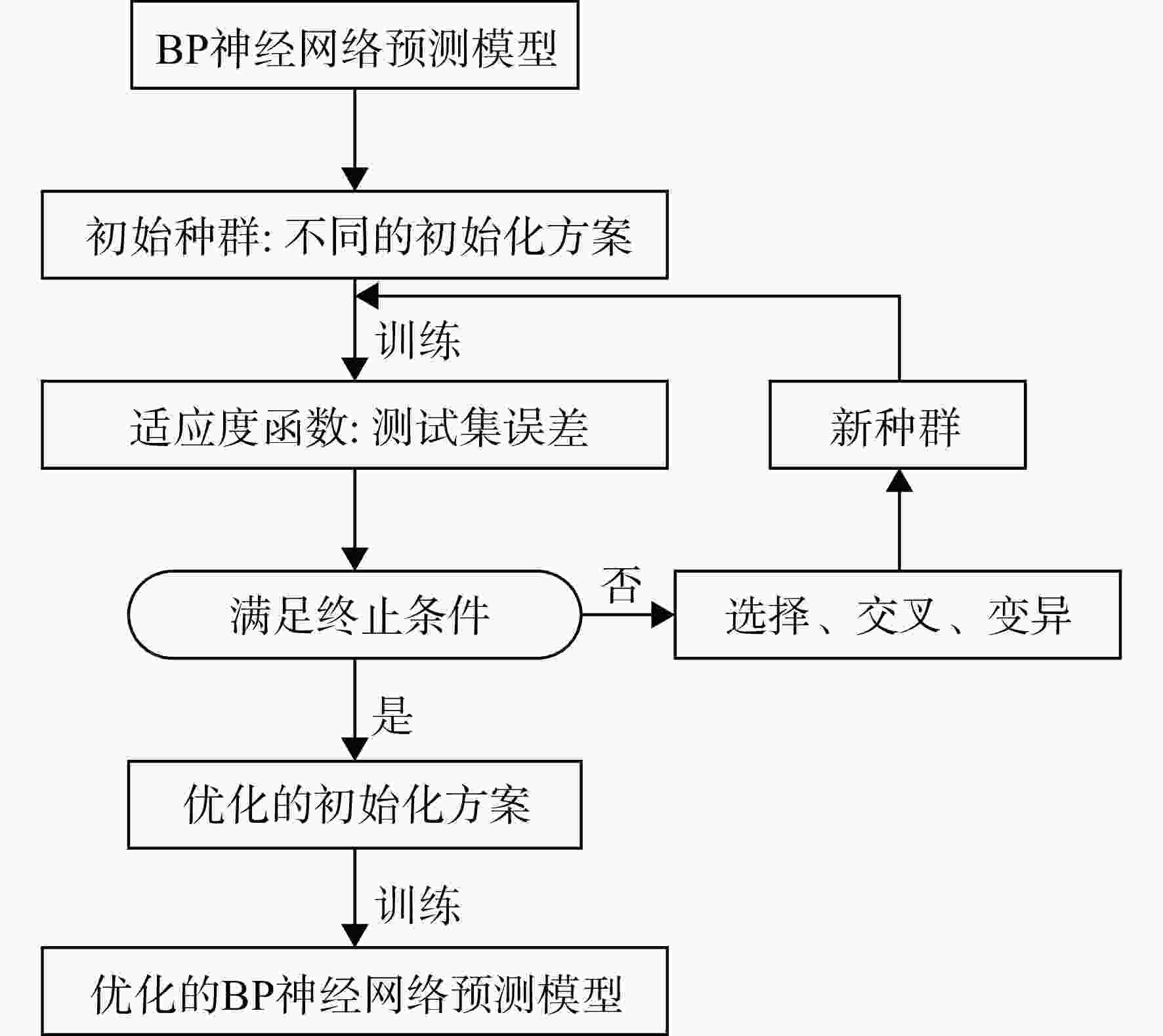
图 2 遗传算法优化BP神经网络流程图
Figure 2. Optimization of BP neural network flow chart by genetic algorithm
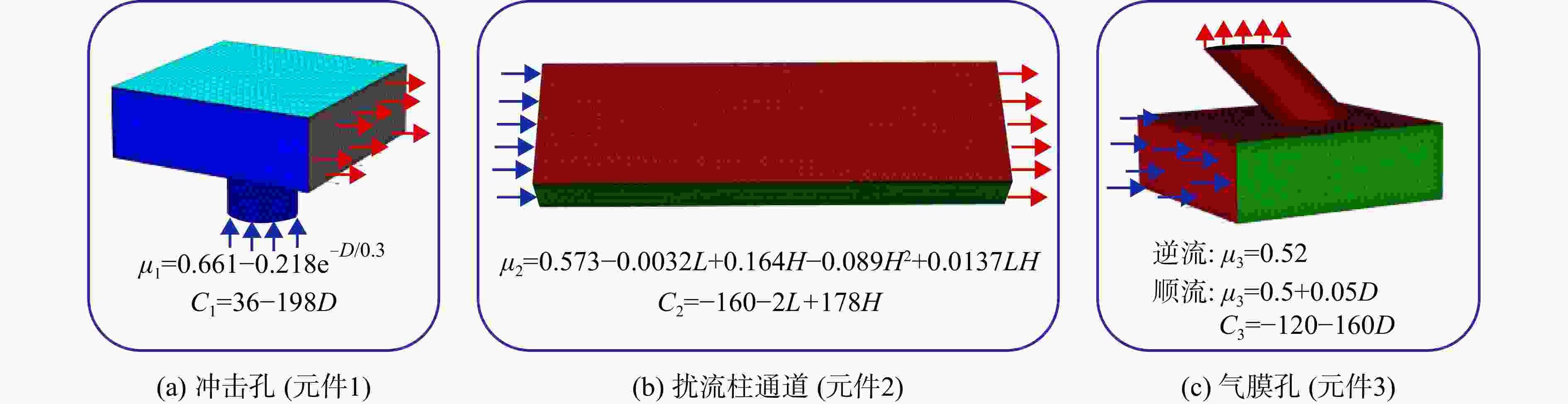
图 3 通道结构质量流量预测数据集几何模型示意图
Figure 3. Schematic diagram of geometric model of channel structure mass flow prediction dataset
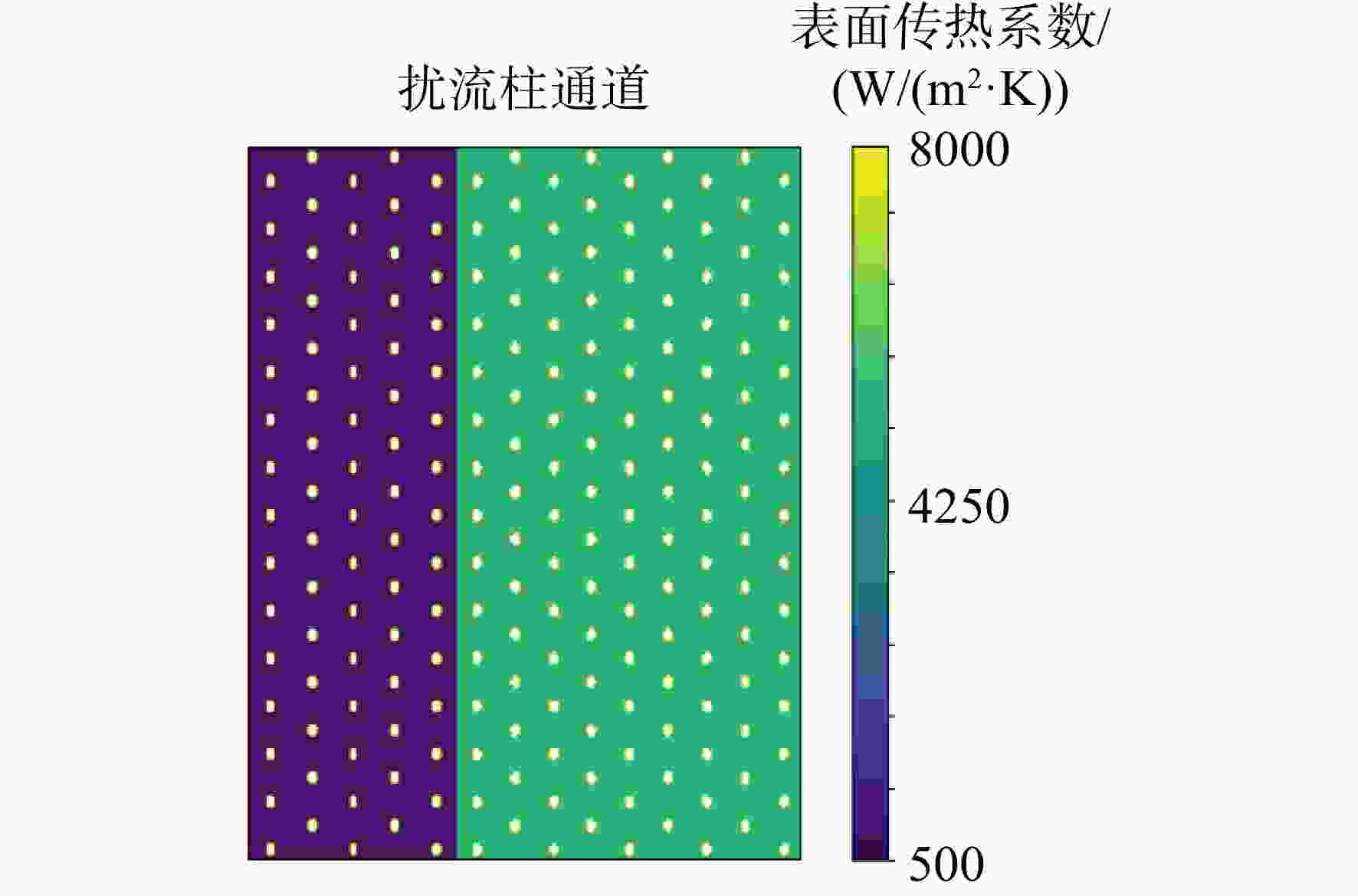
图 10 表面传热系数分布预测结果
Figure 10. Prediction results of convective heat transfer coefficient distribution
表 1 数据集参数方案
Table 1. Parameter scheme of dataset
参数 取值 雷诺数/103 2,5,10,15,20,25 高径比 0.8,1.0,1.2 无量纲流向间距 3,4,5 无量纲横向间距 3,4,5  下载: 导出CSV
表 2 质量流量预测效果测试
Table 2. Mass flow prediction test
结构 质量流量/(kg/s) 相对误差/% 预测结果 仿真结果 气膜孔出口 0.005197 0.005143 1.04 劈缝出口 0.05243 0.05201 0.81
下载: 导出CSV
表 3 表面传热系数预测效果测试
Table 3. Convective heat transfer coefficient prediction test
Re/104 表面传热系数/(W/(m2·K)) 相对误差/% 预测结果 仿真结果 1.1 3451 3596 4.2 1.9 6170 6466 4.8
下载: 导出CSV
-
[1] 卫海洋,徐敏,刘晓曦. 涡轮叶片冷却技术的发展及关键技术[J]. 飞航导弹,2012(2): 61-64.WEI Haiyang,XU Min,LIU Xiaoxi. Development and key technology of turbine blade cooling technology[J]. Flying Missiles,2012(2): 61-64. (in Chinese) [2] 倪萌,朱惠人,裘云,等. 航空发动机涡轮叶片冷却技术综述[J]. 燃气轮机技术,2005(4): 25-33, 38.NI Meng,ZHU Huiren,QIU Yun,et al. Review of aero engine turbine blade cooling technology[J]. Gas Turbine Technology,2005(4): 25-33, 38. (in Chinese) [3] 郭文,王鹏飞. 涡轮叶片冷却技术分析[J]. 航空动力,2020(6): 55-58.GUO Wen,WANG Pengfei. Analysis of turbine blade cooling technology[J]. Aerospace Power,2020(6): 55-58. (in Chinese) [4] CHYU M K, SIW S C, MOON H K. Effects of height-to-diameter ratio of pin element on heat transfer from staggered pin-fin arrays[R]. Orlando, US: ASME Turbo Expo: Power for Land, Sea, and Air, 2009. [5] WON S Y,MAHMOOD G I,LIGRANI P M. Spatially-resolved heat transfer and flow structure in a rectangular channel with pin fins[J]. International Journal of Heat and Mass Transfer,2004,47(8/9): 1731-1743. [6] LEE H L,CHOU H M,YANG Y C. The function estimation in predicting heat flux of pin fins with variable heat transfer coefficients[J]. Energy Conversion and Management,2004,45(11/12): 1749-1758. [7] MONTELPARE S,RICCI R. An experimental method for evaluating the heat transfer coefficient of liquid-cooled short pin fins using infrared thermography[J]. Experimental Thermal and Fluid Science,2004,28(8): 815-824. doi: 10.1016/j.expthermflusci.2003.10.007 [8] LAWSON S A,THRIFT A A,THOLE K A,et al. Heat transfer from multiple row arrays of low aspect ratio pin fins[J]. International Journal of Heat and Mass Transfer,2011,54(17/18): 4099-4109. [9] BAILEY J C, BUNKER R S. Heat transfer and friction in channels with very high blockage 45° staggered turbulators[R]. Atlanta, US: ASME Turbo Expo 2003, Collocated with the 2003 International Joint Power Generation Conference, 2003. [10] 人工智能已嵌入航空发动机产业全流程[J]. 计测技术, 2019, 39(1): 33. [11] ZHU Linyang,ZHANG Weiwei,KOU Jiaqing,et al. Machine learning methods for turbulence modeling in subsonic flows around airfoils[J]. Physics of Flids,2019,31: 015105.1-015105.14. [12] LI Zuobiao, SU Liangjun, WEN Fengbo. Deep learning method for fast prediction of film cooling performance[J]. Physics of Fluids, 34: 047111.1-047111.21. [13] YANG Li,MIN Zheng,YUE Tianwei,et al. High resolution cooling effectiveness reconstruction of transpiration cooling using convolution modeling method[J]. International Journal of Heat and Mass Transfer,2019,133: 1134-1144. doi: 10.1016/j.ijheatmasstransfer.2019.01.010 [14] 丁水汀,魏霞,陶智,等. 基于神经网络的带肋回转通道换热性能的预测[J]. 北京航空航天大学学报,2007,33(4): 401-404.DING Shuiting,WEI Xia,TAO Zhi,et al. Prediction of heat transfer performance of ribbed rotary channel based on neural network[J]. Journal of Beijing University of Aeronautics and Astronautics,2007,33(4): 401-404. (in Chinese) [15] 吴丁杰,温立书. 一种基于哈里斯鹰算法改进的BP神经网络[J]. 网络安全技术与应用,2022(1): 38-40.WU Dingjie,WEN Lishu. An improved BP neural network based on Harris eagle algorithm[J]. Network Security Technology and Application,2022(1): 38-40. (in Chinese) [16] 惠阳,王永岗,彭辉,等. 基于优化PSO-BP算法的耦合时空特征下地铁客流预测[J]. 交通运输工程学报,2021,21(4): 210-222.HUI Yang,WANG Yonggang,PENG Hui,et al. Subway passenger flow prediction based on optimized PSO-BP algorithm[J]. Journal of Transportation Engineering,2021,21(4): 210-222. (in Chinese) [17] 李松,刘力军,解永乐. 遗传算法优化BP神经网络的短时交通流混沌预测[J]. 控制与决策,2011,26(10): 1581-1585.LI Song,LIU Lijun,XIE Yongle. Short-term traffic flow chaotic prediction based on BP neural network optimized by genetic algorithm[J]. Control and Decision,2011,26(10): 1581-1585. (in Chinese) [18] 陈磊. F119发动机的设计特点与关键技术[J]. 航空发动机,2011,37(3): 65.CHEN Lei. Design characteristics and key technologies of F119 engine[J]. Aero Engine,2011,37(3): 65. (in Chinese) -


 点击查看大图

计量
- 文章访问数: 593
- HTML浏览量: 304
- PDF量: 110
- 被引次数: 0