






Serial collaborative simulation method for aero-engine components based on test data
-
摘要:
为探究整机与部件仿真数据和测试数据的匹配性,基于MATLAB/SIMULINK、Python和通用商业CFD软件,开发了数据驱动的部件串行协同仿真技术,主要由航空发动机整机的集成仿真平台和部件串行协同仿真平台组成。其中,集成仿真平台采用模块化的方法对发动机部件建模,结合共同工作方程及边界约束条件,实现了发动机整机和部件特性的迭代模拟;发动机部件串行协同仿真平台采用自编程序结合底层求解程序,提出了重叠区域的交界面数据传递与处理方法,实现了部件间的串行仿真和边界迭代求解,完成了零维、三维仿真的耦合求解过程。以某小型涡喷发动机为研究对象,基于已有试验数据进行案例验证,计算结果最大误差不超过5%,表明集成仿真平台与串行协同仿真平台的准确性及工程应用价值。
Abstract:To explore the matching between the simulation data and test data of the engine and components, a data-driven serial collaborative simulation technology for aero-engine components was developed based on MATLAB/SIMULINK, Python and general commercial CFD software, which mainly consists of an integrated simulation platform for aero-engine components and a serial collaborative simulation platform. The integrated simulation platform adopted a modular approach to model the engine components, combined the cooperating equations and boundary constraints, and implemented the simulation of the whole engine characteristics; the serial collaborative simulation platform of engine components adopted a self-developed program combined with the underlying solver, proposed the data transfer and processing method of the intersection interface in the overlap region, finally implemented the serial simulation and boundary iterative solution between components, and completed the coupled solution of 0D and 3D simulation. Taking a small turbojet engine as the research object, the case verification was carried out based on available test data, the maximum error of calculation was less than 5%, indicating the accuracy and engineering application value of the integrated simulation platform and serial collaborative simulation platform.
-
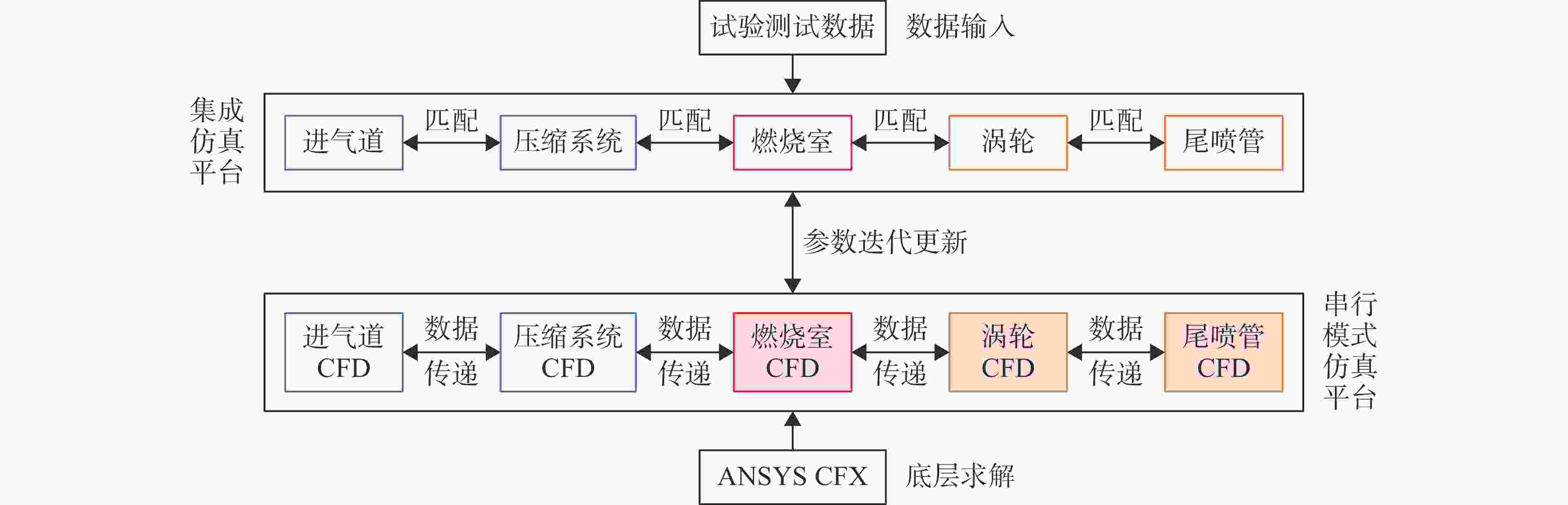
图 1 基于试验数据驱动的串行协同仿真框架
Figure 1. Serial collaborative simulation framework based on test data driven
表 1 涡喷发动机试验点参数
Table 1. Turbojet engine test point parameters
部件 关键参数 数值 压气机 流量/(kg/s) 2.15 总压比 4.2 等熵效率 0.78 物理转速/(r/min) 59000 燃烧室 燃油流量/(kg/s) 0.04268 燃烧效率 0.95 总压恢复系数 0.97 进口总压/Pa 425565 涡轮 进口总温/K 1167 效率 0.83  下载: 导出CSV
表 2 集成仿真平台误差
Table 2. Errors in integrated simulation platform
参数 集成仿真平台 试验点 误差/% 进口流量/(kg/s) 2.168 2.15 0.8 压气机压比 4.4 4.2 4.7 压气机等熵效率 0.75 0.78 3.8 燃烧室进口总压/Pa 445979 425565 4.7 燃烧室出口总压/Pa 433651 412798 5 燃烧室进口总温/K 492.3 474.11 3.8 燃烧室出口总温/K 1211 1167 3.7 涡轮落压比 2.066 2.075 0.4 涡轮等熵效率 0.82 0.83 0.7 涡轮出口总温/K 1040.57 1011.23 2.9
下载: 导出CSV
表 3 串行协同仿真误差
Table 3. Errors in serial collaborative simulation
参数 串行协同仿真 试验点 误差/% 进口流量/(kg/s) 2.147 2.15 0.2 压气机压比 4.22 4.2 0.4 压气机等熵效率 0.76 0.78 2.5 燃烧室流量/(kg/s) 2.1893 2.1927 0.2 燃烧室进口总压/Pa 427902 425565 1 燃烧室总压恢复系数 0.94 0.97 3 燃烧效率 0.94 0.95 1.3 涡轮流量/(kg/s) 2.1719 2.1927 0.9 涡轮落压比 2.167 2.075 4.5 涡轮等熵效率 0.82 0.83 0.7
下载: 导出CSV
-
[1] LYTLE J, FOLLEN G, NAIMAN C, et al. Numerical propulsion system simulation (NPSS) 1999 industry review[R]. Cleveland, Ohio: NASA Glenn Research Center, NASA/TM-2000-209795, 2000. [2] LAWRENCE C. An overview of three approaches to multidisciplinary aeropropulsion simulations[R]. Cleveland, US: NASA Lewis Research Center, NASA TM-107443, 1997. [3] GREGORY F, MIRA A. Numerical zooming between a npss engine system simulation and a one-dimensional high compressor analysis code[R]. Cleveland, US: NASA Glenn Research Center, NASA/TM-2000-209913, 2000. [4] LYTLE J K. The numerical propulsion system simulation: an overview[R]. Cleveland, US: NASA Glenn Research Center, NASA/TM-2000-209915, 2000. [5] 江义军. 推进系统数值仿真综述[J]. 燃气涡轮试验与研究,2000,13(4): 56-58.JIANG Yijun. A review of numerical simulation of propulsion systems[J]. Gas Turbine Experiment and Research,2000,13(4): 56-58. (in Chinese) [6] 金捷. 美国推进系统数值仿真(NPSS)计划综述[J]. 燃气涡轮试验与研究,2003,16(1): 57-62.JIN Jie. A summary of numerical propulsion simulation system (NPSS) by NASA[J]. Gas Turbine Experiment and Research,2003,16(1): 57-62. (in Chinese) [7] KOOP W E. The integrated high performance turbine engine technology (IHPTET) program[R]. Chattanooga, US: 13th International Symposiumon Air Breathing Engines, ISABE-97-7175, 1997. [8] SIMONEAU R J, HUDSON D A. CFD in the context of IHPTET-the integrated high performance turbine engine technology program[R]. Monterey, US: AIAA, AIAA-89-2904, 1989. [9] 蒋洪德,方昌德. 美国高性能涡轮发动机技术计划[J]. 国际航空,1989(11): 1-3.JIANG Hongde,FANG Changde. American high performance turbine engine technology program[J]. International Aviation,1989(11): 1-3. (in Chinese) [10] AIAA Air Breathing Propulsion Technical Committee. The versatile affordable advanced turbine engines (VAATE) initiative[R]. Reston, US: AIAA, 2006. [11] TURNER M, RYDER R, CELESTINA M, et al. High fidelity 3D turbofan engine simulation with emphasis on turbomachinery-combustor coupling[C]//38th AIAA/ASME/SAE/ASEE Joint Propulsion Conference & Exhibit. Indiana: US. AIAA, 2002: 1-13. [12] TURNER M, NORRIS A, VERES J. High fidelity 3D simulation of the GE90 (invited)[C]//33rd AIAA Fluid Dynamics Conference and Exhibit. Orlando, US: AIAA, 2003: 1-13. [13] LYTLE J, FOLLEN G, NAIMAN C, et al. 2001 numerical propulsion system simulation review[R]. Cleveland, US: NASA Glenn Research Center, NASA/TM-2002-211197, 2002. [14] MEDIC G, YOU D, KALITZIN G, et al. Integrated computations of an entire jet engine[R]. ASME Paper GT2007-27094, 2007. [15] 张世铮,逯根寿. 燃气轮机设计点和非设计点性能计算方法和计算机程序[J]. 工程热物理学报,1983(4): 321-323.ZHANG Shizheng,LU Genshou. Gas turbine design point and non-design point performance calculation methods and computer programs[J]. Journal of Engineering Thermophysics,1983(4): 321-323. (in Chinese) [16] SELLERS J F, DANIELE C J. DYNGEN-a program for calculating steady state and transient performance of turbojet and turbofan engines[R]. Cleveland, US: NASA Lewis Research Center, NASA TN D-7901, 1975. [17] KOENIG R W, FISHBACH L H. GENENG-a program for calculating design and off-design performance for turbojet and turbofan engines[R]. Cleveland, US: NASA Lewis Research Center, NASA TN D-6552, 1972. [18] FISHBACH L H, KOENIG R W. GENENG Ⅱ-a program for calculating design and off-design performance of two- and three-spool turbofans with as many as three nozzles[R]. Cleveland, US: NASA Lewis Research Center, NASA TN D-6553, 1972. [19] 倪维斗. 某型双轴航空发动机的混合实时仿真[J]. 航空动力学报,1992,7(4): 1-9.NI Weidou. Hybrid real-time simulation of a type of two-axis aero-engine[J]. Journal of Aerospace Power,1992,7(4): 1-9. (in Chinese) [20] 李松林,孙健国,李健民,等. 求解涡扇发动机数学模型的有限域搜索方法[J]. 航空动力学报,1997,12(3): 276-278,331-332.LI Songlin,SUN Jianguo,LI Jianmin,et al. A limited domain searching method for solution of nonlinear mathematical model for turbofan engine[J]. Journal of Aerospace Power,1997,12(3): 276-278,331-332. (in Chinese) [21] 郑严. 弹用涡喷发动机启动加速过程试验[J]. 推进技术,2000,21(4): 5-8.ZHENG Yan. Starting and accelarating the missle turbojet engine by ground test[J]. Journal of Propulsion Technology,2000,21(4): 5-8. (in Chinese) [22] PREECE A, BDEIWI H, JORGENS C. CFD simulation of internal flow within the electric motor powered aero-engine simulator (EMPAS) assembly[R]. AIAA 2021-2472, 2021. [23] 徐全勇,吴锋. 航空发动机整机性能仿真中的功率平衡方法[J]. 航空动力学报,2022,37(12): 2707-2718.XU Quanyong,WU Feng. Power balancing method in aero-engine whole-engine performance simulation[J]. Journal of Aerospace Power,2022,37(12): 2707-2718. (in Chinese) [24] 张漫,王铮钧,王晶,等. 航空发动机内流全场流动的大涡模拟[J]. 航空动力,2021(2): 57-60.ZHANG Man,WANG Zhengjun,WANG Jing,et al. Large eddy simulation on internal flow of aero engine[J]. Aerospace Power,2021(2): 57-60. (in Chinese) [25] 温泉,李义进,刘婷,等. 航空发动机整机三维气动仿真研究进展[J]. 航空动力,2021(2): 46-51.WEN Quan,LI Yijin,LIU Ting,et al. Advances in the research of 3D full engine aerodynamics simulation[J]. Aerospace Power,2021(2): 46-51. (in Chinese) [26] 赵运生. 航空发动机气动稳定性分析系统研究[D]. 南京: 南京航空航天大学, 2013.ZHAO Yunsheng. Research on aerodynamic stability analysis system for aero-engine[D]. Nanjing: Nanjing University of Aeronautics and Astronautics, 2013. (in Chinese) -


 点击查看大图

计量
- 文章访问数: 670
- HTML浏览量: 208
- PDF量: 79
- 被引次数: 0