






Surrogate model for deviation angle and total pressure loss prediction of compressor based on machine learning methods
-
摘要:
为了提高压气机特性预测的精度,基于机器学习方法构建预测落后角与总压损失的代理模型。以一台两级压气机为研究对象,基于多个转速工况下的流场实验数据和叶片几何参数建立了基元叶型数据库。通过灵敏度分析方法筛选出对落后角和总压损失影响最大的输入参数,分别采用高斯过程回归和人工神经网络两种机器学习算法建立落后角与总压损失模型,并引入贝叶斯优化算法搜索最佳模型超参数。对于人工神经网络面临的优化问题和泛化问题,调整模型学习率和修正参数梯度以加速收敛,同时采用正则化方法增强模型泛化能力。模型训练过程采用交叉验证策略以降低过拟合风险,并将优化后的代理模型整合到通流程序中对压气机进行特性预测验证。对比表明,低转速工况代理模型的压比特性预测误差显著低于经验模型,其中人工神经网络建模改善最明显,相比经验模型预测误差降低了0.1。通过代理模型横向对比,基于人工神经网络建立的代理模型比基于高斯过程的代理模型预测精度更高且鲁棒性更强。
Abstract:In order to improve the prediction accuracy of compressor performance, a surrogate model of deviation angle and total pressure loss based on machine learning methods was built. A two-stage compressor was used as the research object, and the elementary cascade database was established using experimental data of the flow field and the geometric parameters under multiple rotation speed conditions. The sensitivity analysis method was used to screen out the input parameters that have the greatest impact on the deviation angle and total pressure loss. Two machine learning algorithms, i.e.: Gaussian process regression and artificial neural network, were used to establish the deviation angle and total pressure loss model, and Bayesian optimization algorithm was introduced to search for the best hyperparameters of the model. For the optimization iteration and generalization problems faced by artificial neural networks, the Adam algorithm was introduced to adjust the model learning rate and modify the parameter gradient to accelerate the convergence. At the same time, the regularization method was used to enhance the generalization of the model. The cross validation scheme was used in model training process to reduce the risk of overfitting, and the optimal surrogate models were integrated into the throughflow program. The comparison of the calculation results showed, the total pressure ratio prediction error of the surrogate model on low speed conditions was significantly lower than that of the empirical model, among which the artificial neural network modeling had the most significant improvement, and the prediction error was reduced by 0.1 compared with the empirical model. Through comparison of surrogate models, the surrogate model based on artificial neural network had higher prediction accuracy and stronger robustness than the surrogate model based on Gaussian process.
-
Key words:
- deviation angle /
- loss model /
- surrogate model /
- machine learning /
- artificial neural network
-
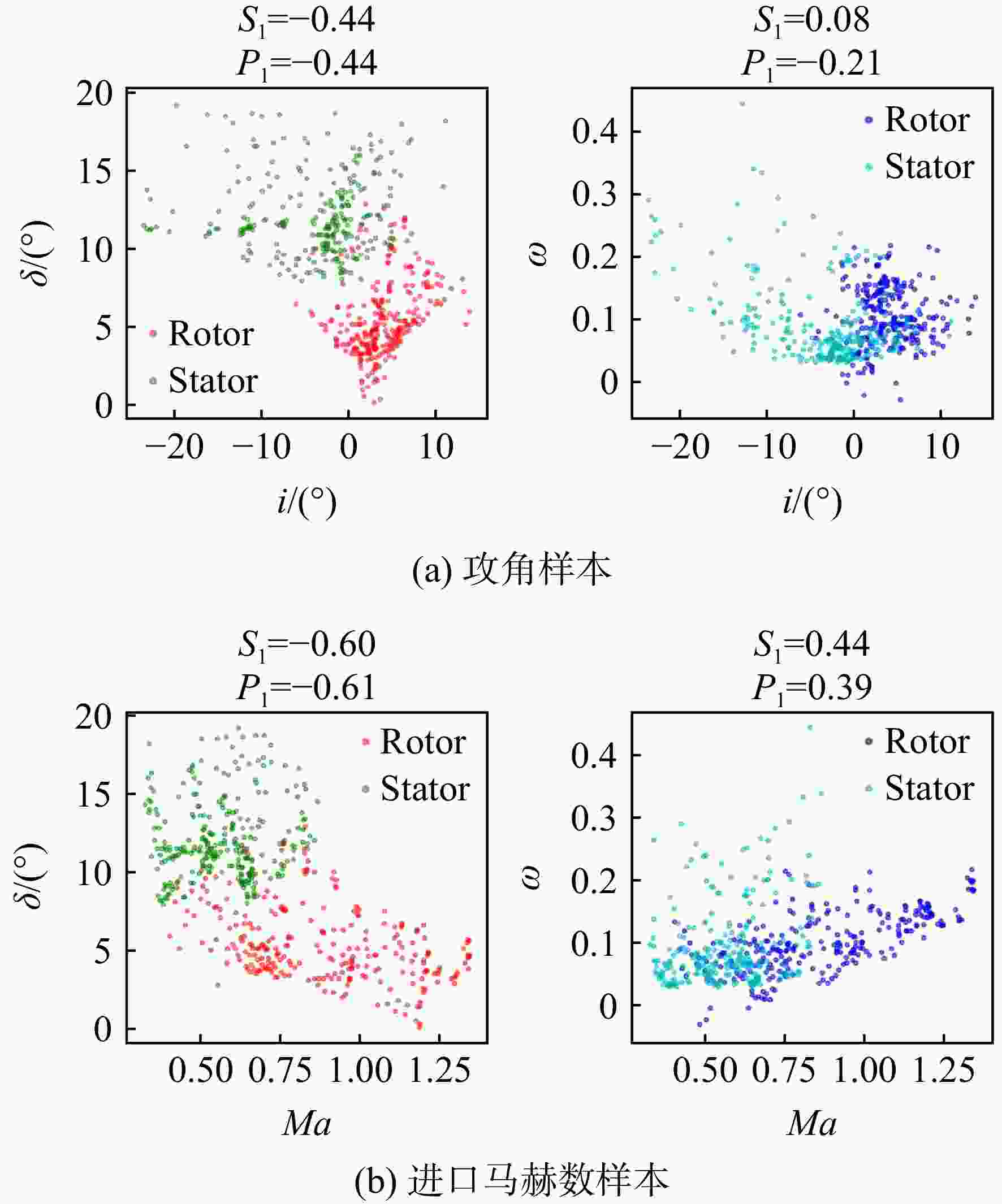
图 2 TP1314 压气机基元叶型实验数据库
Figure 2. Elementary airfoil experimental database of the compressor TP1314
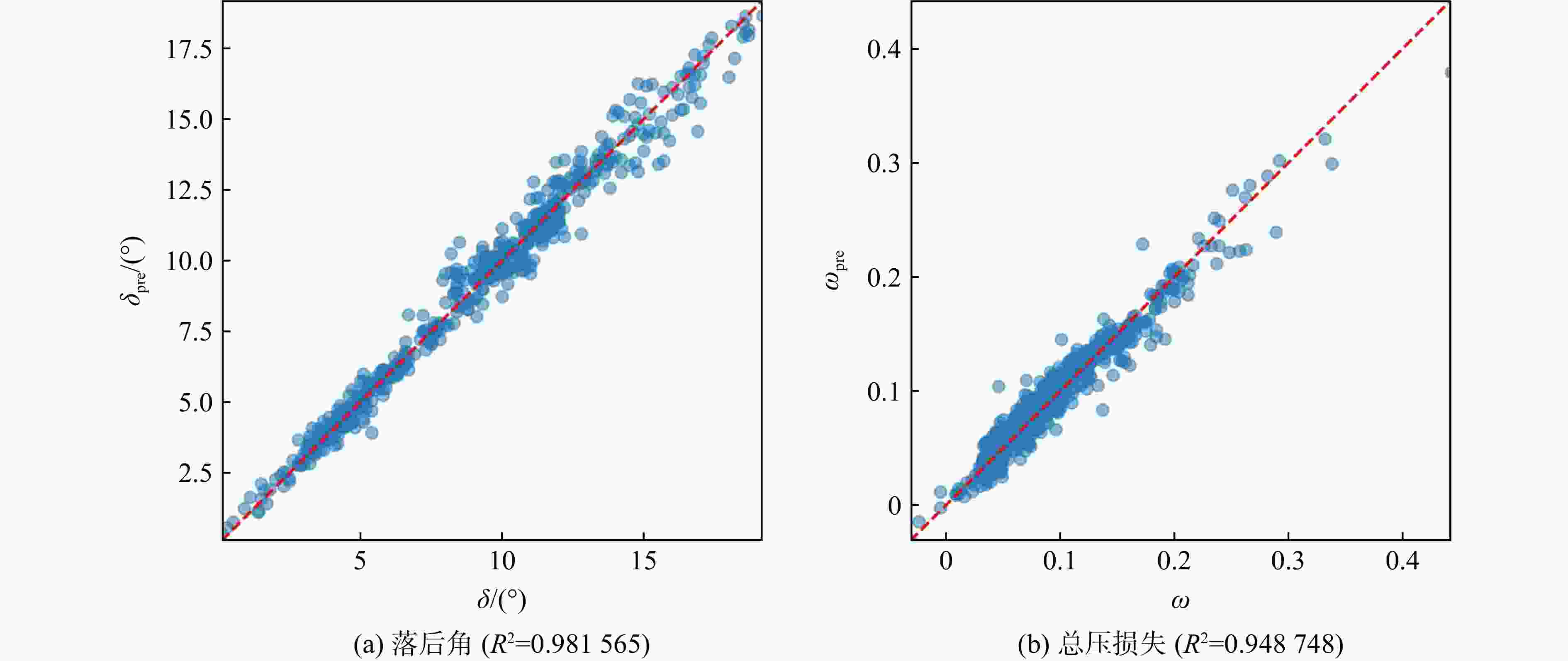
图 11 GPR模型在整个样本集上的验证结果
Figure 11. Validation results of GPR model on the whole sample set
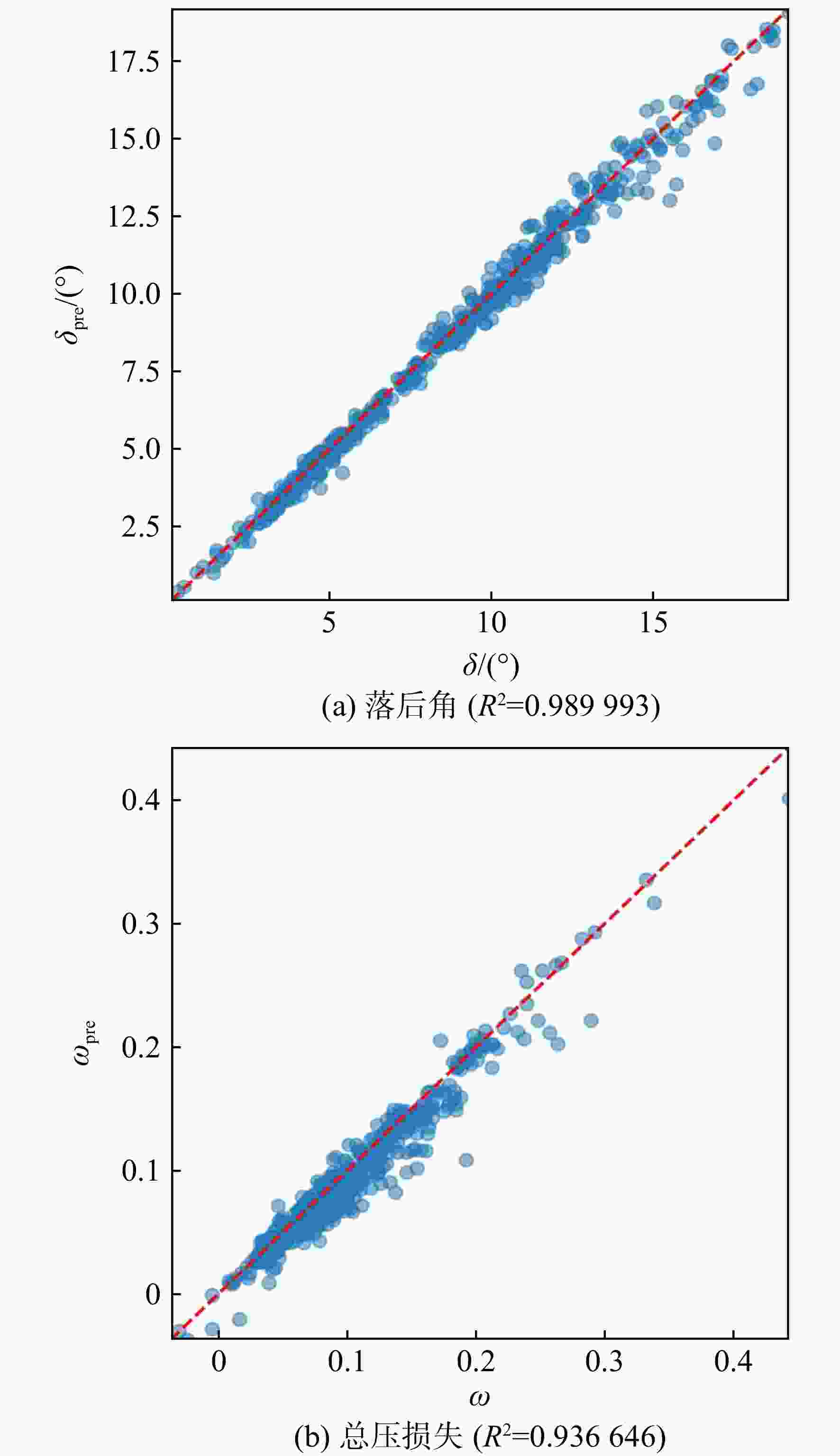
图 14 ANN模型在整个样本集上的验证结果
Figure 14. Validation results of ANN model on the whole sample set
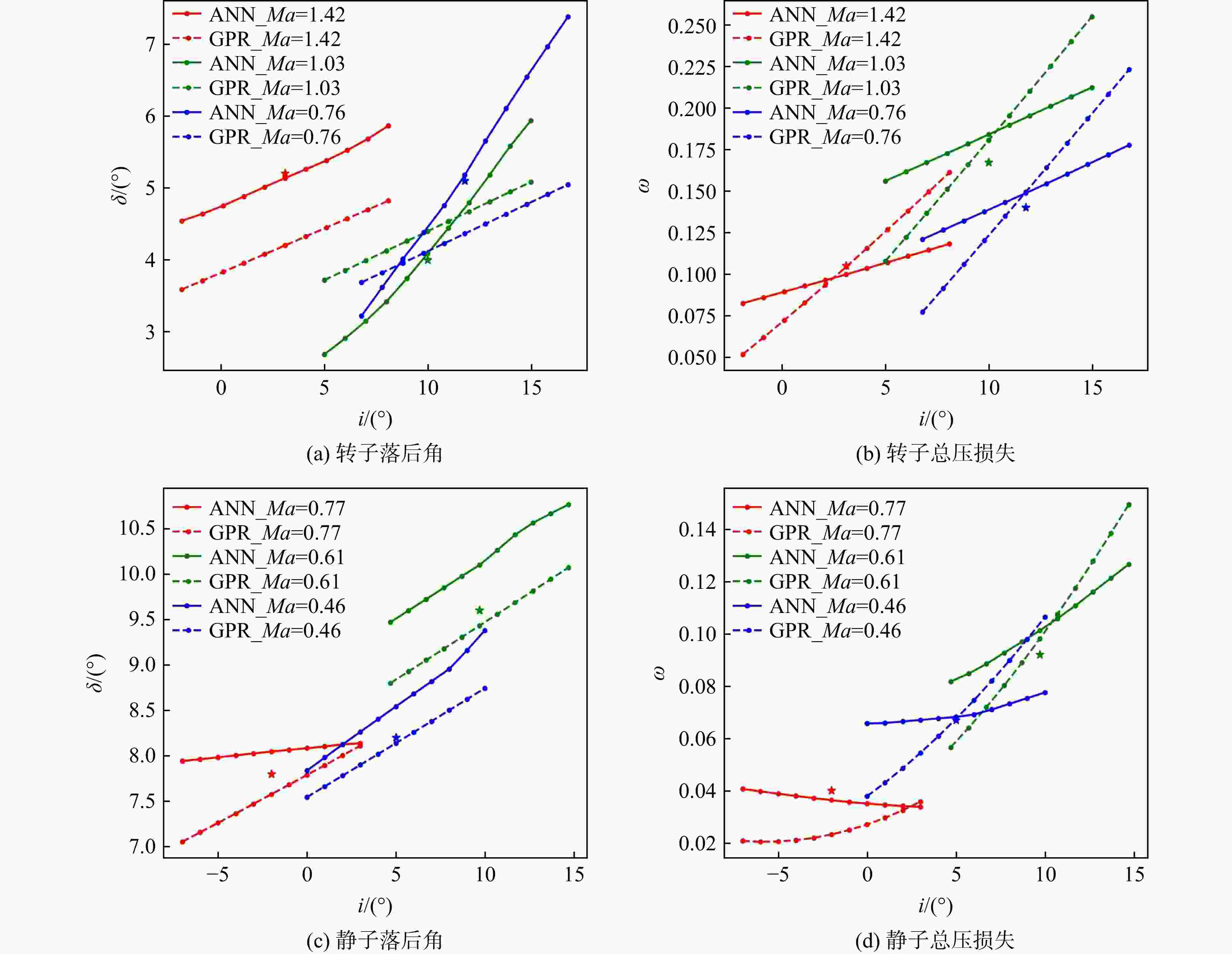
图 15 代理模型落后角与总压损失计算结果随攻角的变化
Figure 15. Results of deviation angle and total pressure loss of surrogate model changes with attack angle

图 16 两级压气机特性计算结果
Figure 16. Calculation results of two-stage compressor characteristics
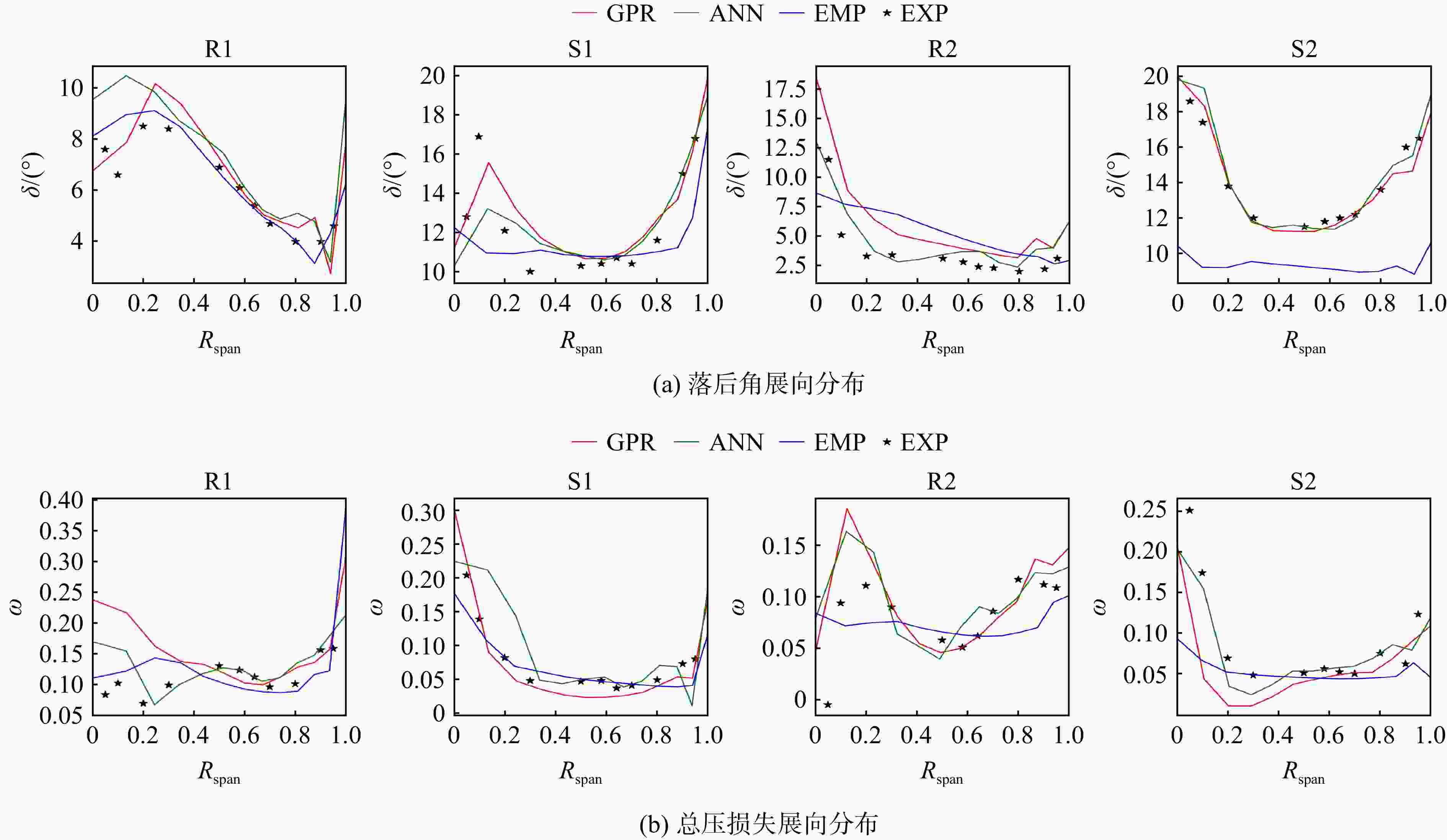
图 18 工况A落后角与总压损失计算与实验值对比
Figure 18. Calculation and experimental comparison of deviation angle and total pressure loss in working condition A
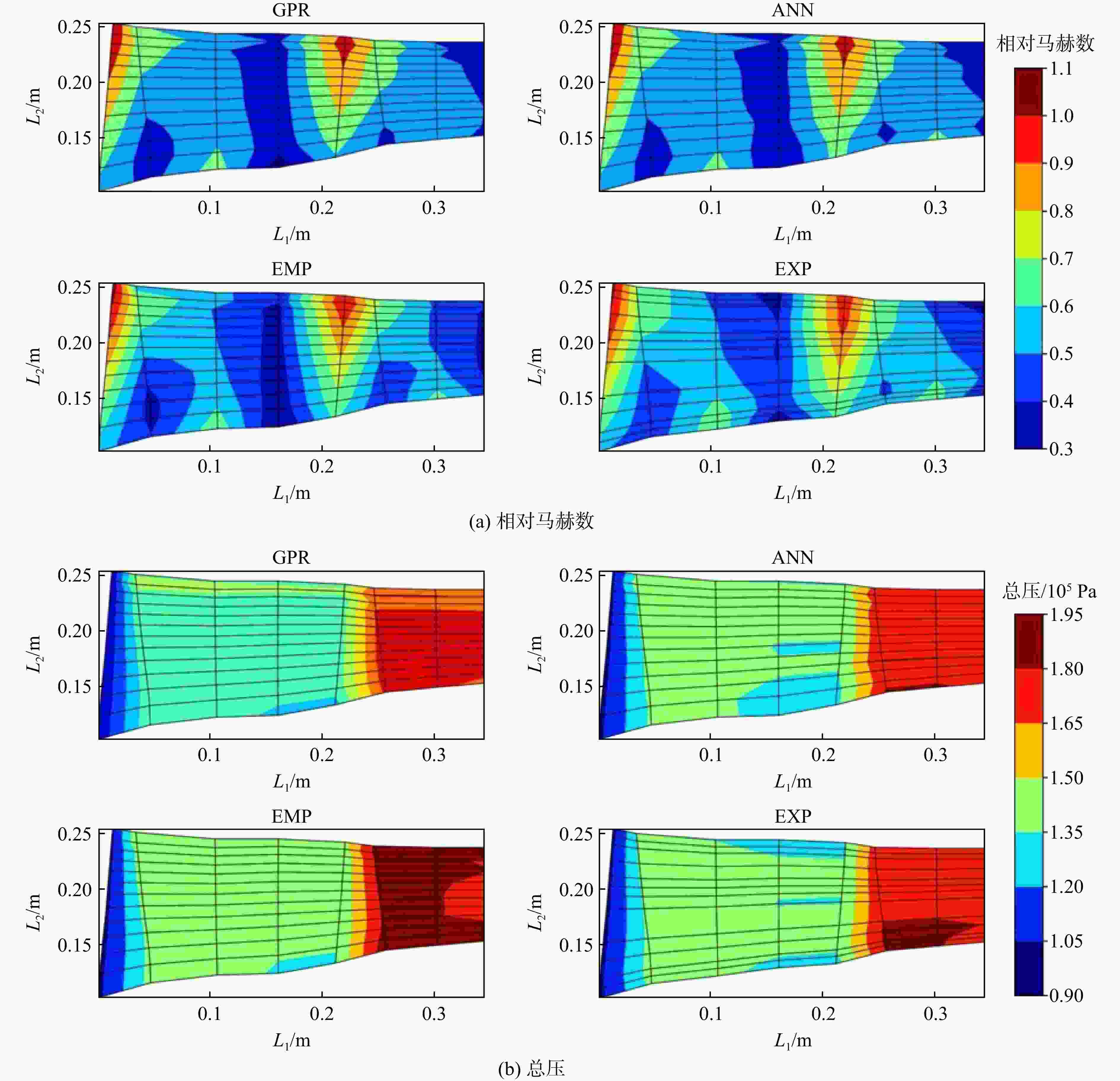
图 19 工况A模型预测结果子午面云图与实验对比
Figure 19. Comparison of meridional contour between prediction and experiment in working condition A
表 1 TP1314两级风扇设计参数
Table 1. Design parameters of a two-stage fan TP1314
设计变量 数值 总压比 2.4 绝热效率 0.846 设计流量/(kg/s) 33.248 转速/(r/min) 16042.8 转子叶尖速度/(m/s) 405.3  下载: 导出CSV
表 2 代理模型输入参数
Table 2. Input parameters of surrogate model
模型 输入参数 ω $w, D, \beta_1, Ma, \theta, i, t_{\rm{b}}/c, r_{{\rm{le}}} /c, Re$ $ \delta $ $i, t, \gamma, \beta_1, w, \theta, t_{\rm{b}}/c, a/c, Ma, r_{{\rm{le}}}/c, Re$
下载: 导出CSV
表 3 GPR模型超参数搜索空间和最优超参数
Table 3. Hyperparameter search space and optimal hyperparameter of GPR model
超参数 下限 上限 落后角模型 总压损失模型 $\sigma _{\rm{f}}^2$ $1 \times {10^{ - 6}}$ $1 \times {10^4}$ 6.7904 8.274×10⁻⁶ $l$ $1 \times {10^{ - 4}}$ $1 \times {10^4}$ 8.8496 823.17 $\sigma _{\rm{n}}^2$ $1 \times {10^{ - 7}}$ $1 \times {10^2}$ 0.8195 6.723×10⁻⁴
下载: 导出CSV
表 4 ANN模型超参数搜索空间和最优超参数
Table 4. Hyperparameter search space and optimal hyperparameter of ANN model
超参数 下限 上限 落后角模型 总压损失模型 $ \alpha $ $1 \times {10^{ - 5}}$ $1 \times {10^{ - 2}}$ 6.777×10⁻⁴ 3.832×10⁻³ $ \lambda $ $1 \times {10^{ - 5}}$ $1 \times {10^{ - 1}}$ 6.811×10⁻³ 7.131×10⁻³ $L$ $1$ $4$ 4 3 ${M_l}$ 32 128 [90, 95, 46, 100] [124, 69, 106]
下载: 导出CSV
表 5 模型在各转速工况特性预测误差
Table 5. Prediction error of model characteristics at different speed conditions
转速/% EMP GPR ANN $ \pi $ $ \eta $ $ \pi $ $ \eta $ $ \pi $ $ \eta $ 100 0.5140 0.0900 0.5522 0.1147 0.5433 0.1066 80 0.1594 0.0334 0.1136 0.0614 0.0512 0.0206 60 0.1304 0.0403 0.0193 0.0396 0.0323 0.0495
下载: 导出CSV
表 6 工况A总压比和效率预测相对误差
Table 6. Relative error of total pressure ratio and efficiency prediction in working condition A
方法 π 相对误差/% $ \eta $/% 相对误差/% 实验 1.726 82.4 GPR 1.685 −2.38 81.2 −1.46 ANN 1.706 −1.16 80.85 −1.88 EMP 1.7805 3.16 84.85 2.97
下载: 导出CSV
-
[1] KOCH C,SMITH L. Loss sources and magnitudes in axial-flow compressors[J]. Journal of Engineering for Power,1976,98(3): 411-424. doi: 10.1115/1.3446202 [2] CARTER A D S. The low speed performance of related aerofoils in cascade[J]. British NGTE Report No. R.55, 1949. [3] DUNHAM J. Compressor off-design performance prediction using an endwall model[R]. ASME Paper 96-GT-62, 1996. [4] KOENIG M W,HENNECKE D,FOTTNER L. Improved blade profile loss and deviation angle models for advanced transonic compressorbladings: Part Ⅱ a model for supersonic flow[J]. Journal of Turbomachinery,1996,118(1): 81-87. doi: 10.1115/1.2836610 [5] BLOCH G, COPENHAVER W, O’BRIEN W. A shock loss model for supersonic compressor cascades[J]. Journal of Turbomachinery, 1999, 121(1): 28-35. [6] 徐纲,刘红,李军,等. 一种适用于超跨音叶型的非设计点损失和落后角模型[J]. 航空动力学报,1996,11(1): 4-6.XU Gang,LIU Hong,LI Jun,et al. A loss and deviation model for transonic axial compressor performance prediction[J]. Journal of Aerospace Power,1996,11(1): 4-6. (in Chinese) [7] SWAN W C. A practical method of predicting transonic-compressor performance[J]. Journal of Engineering for Power,1961,83(3): 322-330. doi: 10.1115/1.3673194 [8] 刘波, 马乃行, 杨小东, 等. 适应较大叶型弯角范围的轴流压气机落后角模型 [J]. 航空动力学报, 2014, 29(8): 1824-1831LIU Bo, MA Naixing, YANG Xiaodong, et al. Deviation angle models suitable for wider range of blade profile camber in axial-flow compressor[J]. Journal of Aerospace Power, 2014, 29(8): 1824-1831. (in Chinese) [9] 陶慧卿,徐宁,李润泽,等. 基于多元非线性回归损失及落后角模型研究[J]. 热能动力工程,2022,37(12): 38-46.TAO Huiqing,XU Ning,LI Runze,et al. Research on loss and deviation angle model based on multivariate nonlinear regression[J]. Journal of Engineering for Thermal Energy and Power,2022,37(12): 38-46. (in Chinese) [10] WU Dongrun,TENG Jinfang,QIANG Xiaoqing,et al. Development of an off-design deviation angle prediction model for full blade span in axial flow compressors[J]. Proceedings of the Institution of Mechanical Engineers: Part G Journal of Aerospace Engineering,2019,233(9): 3170-3183. doi: 10.1177/0954410018793265 [11] 费腾,季路成,周玲. 神经网络模型在压气机通流特性分析中的应用[J]. 航空动力学报,2022,37(6): 1260-1272.FEI Teng,JI Lucheng,ZHOU Ling. Application of neural network model in compressor through-flow analysis[J]. Journal of Aerospace Power,2022,37(6): 1260-1272. (in Chinese) [12] CUNNAN W S, STEVANS W, URASEK D C. Design and performance of a 427-meter-per-second-tip-speed two-stage fan having a 2.40 pressure ratio[R]. NASA TP-1314, 1978. [13] MORRIS M D. Factorial sampling plans for preliminary computational experiments[J]. Technometrics,1991,33(2): 161-174. doi: 10.1080/00401706.1991.10484804 [14] FORRESTER A, SOBESTER A, KEANE A. Engineering design via surrogate modelling: a practical guide[M]. Hoboken, US: John Wiley & Sons, 2008. [15] RASMUSSEN C E. Gaussian processes in machine learning[C]//Proceedings of the Summer School on Machine Learning. Berlin: Springer, 2003: 63-71. [16] HASSOUN M H. Fundamentals of artificial neural networks [M]. Cambridge, US: MIT Press, 1995. [17] TIELEMAN T,HINTON G. Lecture 6.5-rmsprop: divide the gradient by a running average of its recent magnitude[J]. COURSERA:Neural Networks for Machine Learning,2012,4(2): 26-31. [18] LIANG Minfei,LI Zhenming,HE Shan,et al. Stress evolution in restrained GGBFS concrete due to autogenous deformation: bayesian optimization of aging creep[J]. Construction and Building Materials,2022,324: 126690.1-126690.18. doi: 10.1016/j.conbuildmat.2022.126690 [19] BERGSTRA J,BENGIO Y. Random search for hyper parameter optimization[J]. Journal of Machine Learning Research,2012,13(2): 281-305. [20] BERGSTRA J, YAMINS D, COX D. Making a science of model search: Hyperparameter optimization in hundreds of dimensions for vision architectures[C]//International Conference on Machine Learning. New York: PMLR, 2013: 115-123. . [21] HUTTER F. Automated configuration of algorithms for solving hard computational problems[D]. Vancouver, Canada: University of British Columbia, 2009. [22] HUTTER F, HOOS H H, LEYTON-BROWN K. Sequential model-based optimization for general algorithm configuration[C]//Proceedings of the International Conference on Learning and Intelligent Optimization. Berlin: Springer, 2011: 507-523.. [23] KOHAVI R. A study of cross-validation and bootstrap for accuracy estimation and model selection[C]// International joint conference on Artificial intelligence. Burlington: Morgan Kaufmann Publishers Inc. 1995: 1137-1145. [24] WU C H. A general theory of three-dimensional flow in subsonic and supersonic turbomachines of axial, radial, and mixed-flow types[J]. Transactions of the American Society of Mechanical Engineers,1952,74(8): 1363-1380. [25] NOVAK R A. Streamline curvature computing procedures for fluid-flow problems[J]. Journal of Engineering for Power,1967,89(4): 478-490. doi: 10.1115/1.3616716 [26] 巫骁雄,刘波,唐天全. 流线曲率法在多级跨声速轴流压气机特性预测中的应用[J]. 推进技术,2017,38(10): 2235-2245. doi: 10.13675/j.cnki.tjjs.2017.10.009WU Xiaoxiong,LIU Bo,TANG Tianquan. Application of streamline curvature method for multistage transonic axial compressor performance prediction[J]. Journal of Propulsion Technology,2017,38(10): 2235-2245. (in Chinese) doi: 10.13675/j.cnki.tjjs.2017.10.009 [27] CREVELING H F, CARMODY R H. Axial-flow compressor computer program for calculating off-design performance[R]. NASA CR-72472. [28] PACHIDIS V. Gas turbine advanced performance simulation[D]. Cranfield, UK: Cranfield University, 2006. [29] BOYER K M,O’BRIEN W F. An improved streamline curvature approach for off-design analysis of transonic axial compression systems[J]. Journal of Turbomachinery,2003,125(3): 475-481. doi: 10.1115/1.1565085 -


 点击查看大图

计量
- 文章访问数: 1152
- HTML浏览量: 548
- PDF量: 137
- 被引次数: 0