






Physics-informed neural networks based cascade loss model
-
摘要:
为解决传统的叶栅损失经验模型在构建过程中对于强非线性函数关系总结能力不足,导致其适用局限性、可修正性不好等问题。在一般端到端人工神经网络的基础上,进一步发展了物理嵌入神经网络方法,通过将叶栅表面压力分布引入神经网络建立叶栅损失模型,对叶栅压力分布和性能进行预测。经验证,相对于经验模型,端到端神经网络模型总体损失预测误差降低22.3%,物理嵌入神经网络模型总体损失预测误差下降37.9%。
Abstract:It is difficult to modify and broaden the scope of application for empirical models because of its inadequate ability to fit strong nonlinear function relationship. In order to solve these problems, a physics-informed deep learning cascade loss model of embedding the pressure distribution of cascade into neural networks was proposed. The loss prediction error decreased by 22.3% compared with empirical model for end-to-end neural networks and 37.9% compared with physics-informed model.
-
Key words:
- surrogate model /
- loss prediction /
- deep learning /
- neural networks /
- physics-informed
-
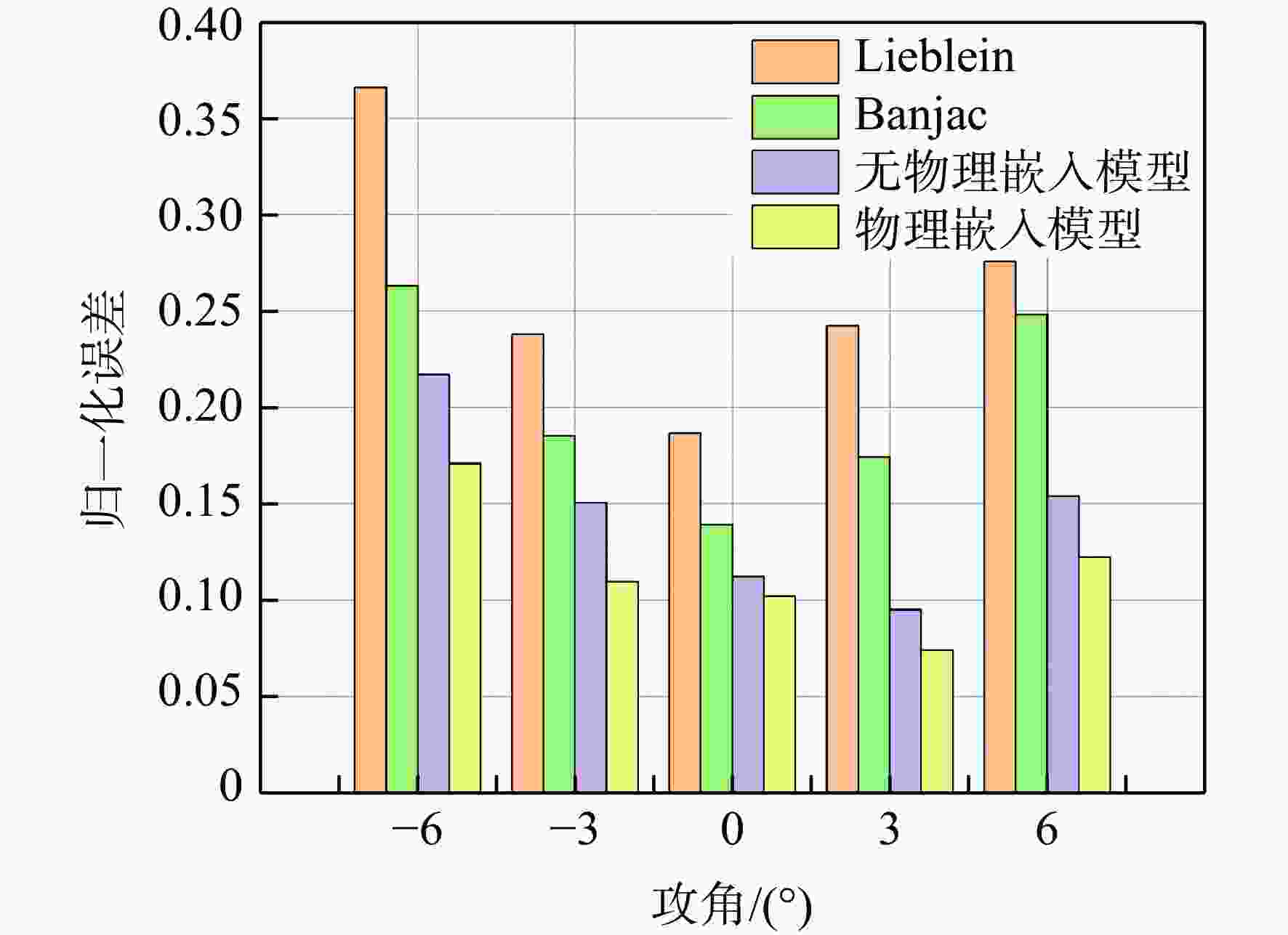
图 8 不同攻角下模型预测误差
Figure 8. Normalized predicting error of models at different incidences
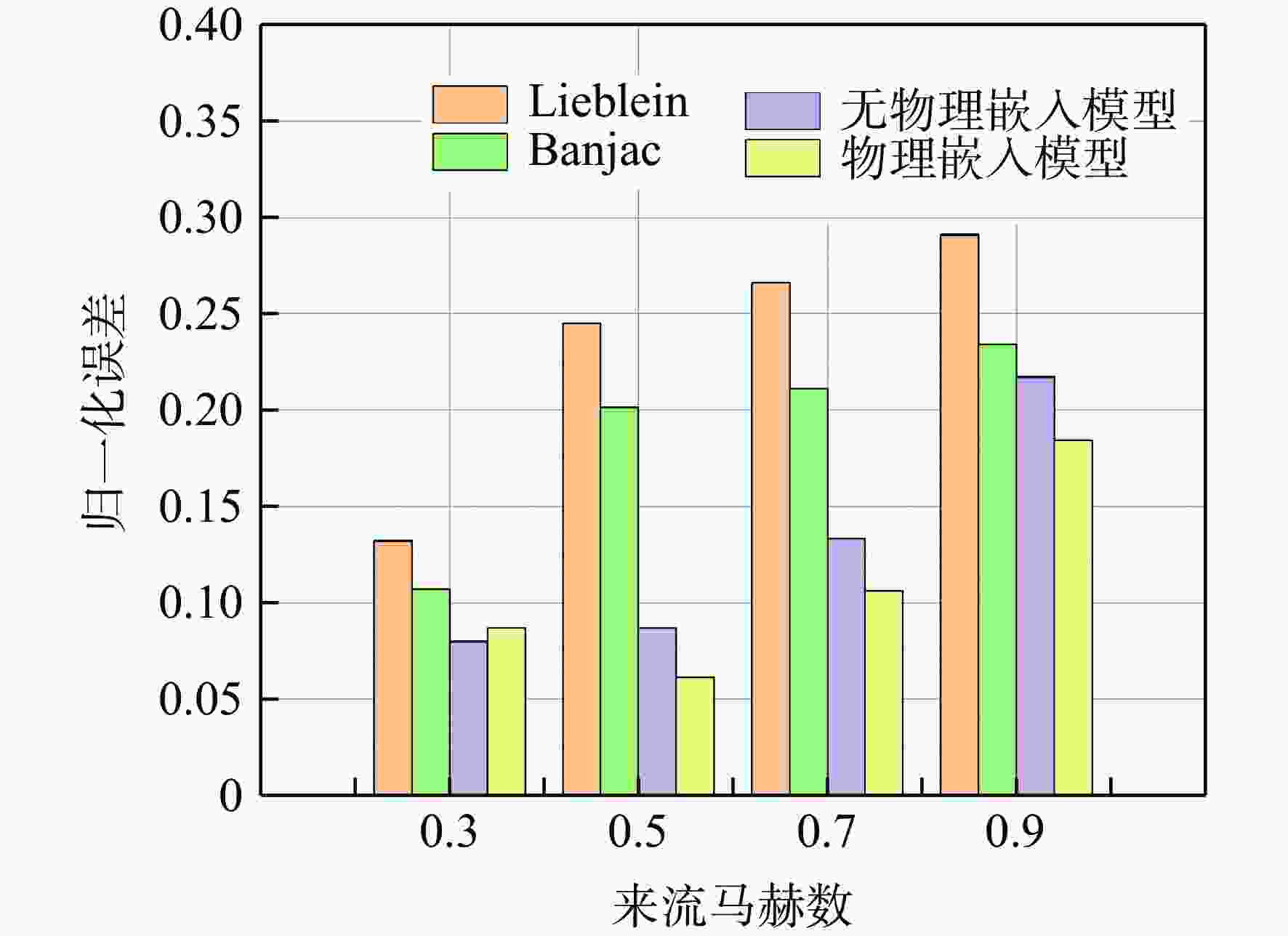
图 9 不同来流马赫数下模型预测误差
Figure 9. Normalized predicting error of models at different inflow Mach numbers
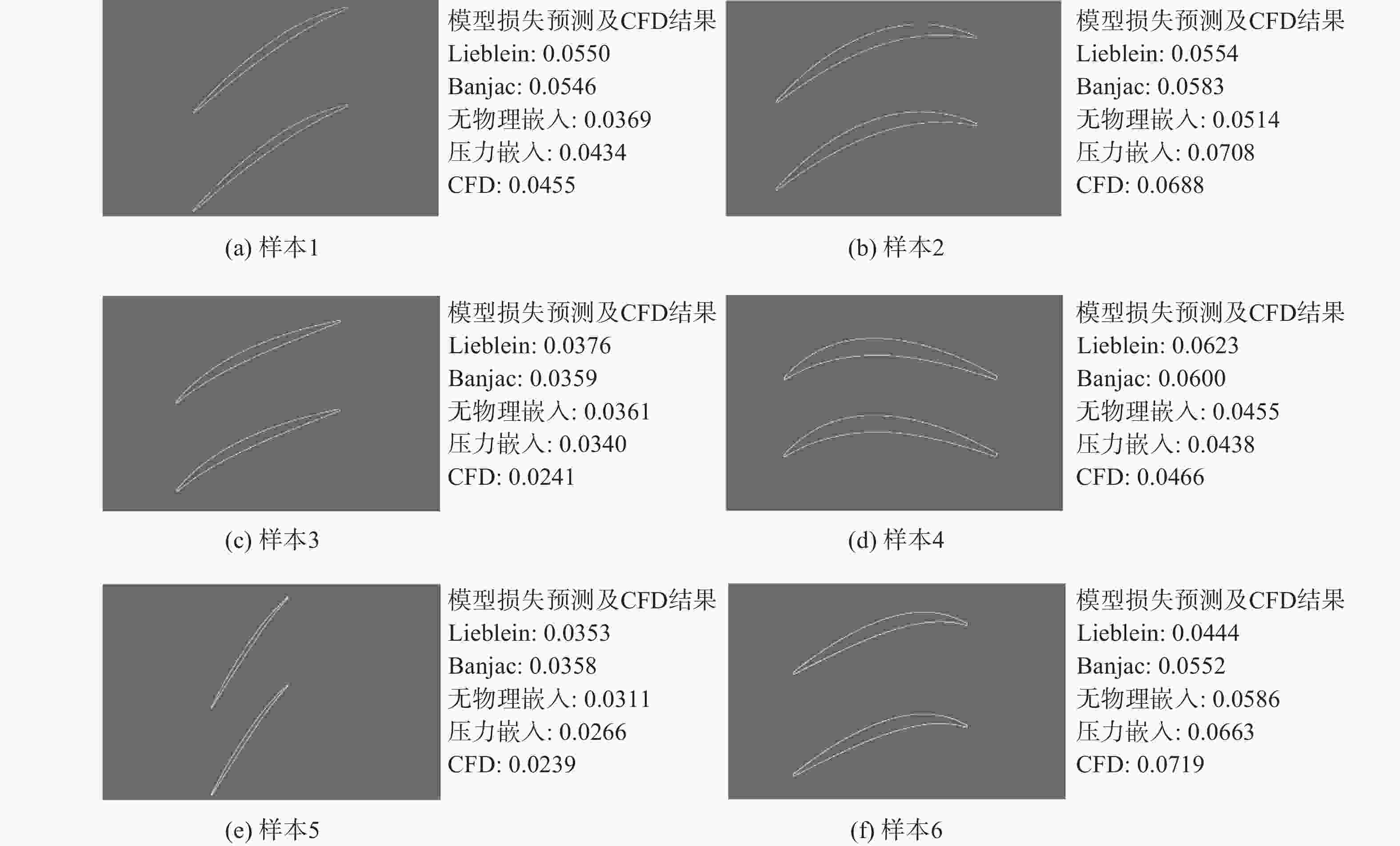
图 10 各模型样本损失预测及数值模拟结果对比
Figure 10. Loss predictions of different models and loss from CFD results
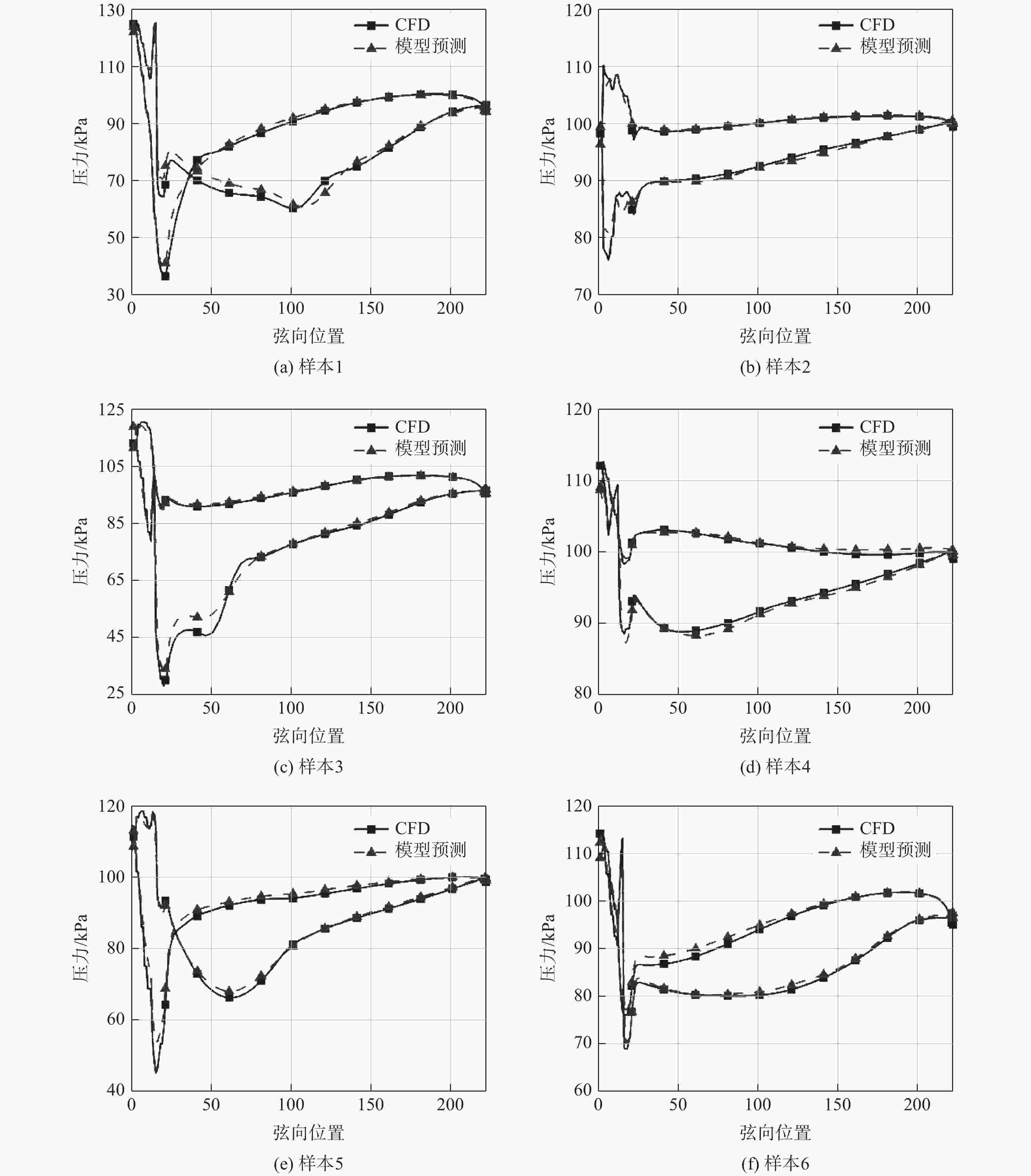
图 11 叶栅壁面压力分布物理嵌入模型预测与数值模拟结果对比(每20个数据点显示1个点)
Figure 11. Comparison of cascade wall pressure distribution between physics-informed model prediction and CFD (1 scatter is displayed for every 20 points)
表 1 部分叶栅几何参数取值范围
Table 1. Value ranges of geometry parameter of cascade
叶栅几何参数 取值范围 稠度$\delta$ (1, 3.3) 安装角$ \gamma $/(°) (0, 55) 弯角$\varphi$/(°) (0, 65) 最大相对厚度$ t/C $ (0.025, 0.15) 最大厚度位置$\bar{e}$ (0.25, 0.75) 最大挠度位置$\bar{f}$ (0.25, 0.75)  下载: 导出CSV
表 2 各模型归一化误差
Table 2. Normalized errors of different models
模型名称 归一化误差 Lieblein模型 0.2496 Banjac模型 0.2014 无物理嵌入模型 0.1564 物理嵌入模型 0.1251
下载: 导出CSV
表 3 特殊测试集上各模型预测误差
Table 3. Normalized predicting errors of different models on conventional sections
模型名称 归一化误差 Lieblein模型 0.184 0 Banjac模型 0.169 0 无物理嵌入模型 0.1628 物理嵌入模型 0.131 0
下载: 导出CSV
表 4 样本几何参数及来流条件
Table 4. Geometry parameters and inlet conditions for samples
样本编号 几何参数 来流条件 稠度 安装角/(°) 弯角/(°) 最大厚度 马赫数 攻角/(°) 1 1.930 38.04 25.02 0.048 0.862 0 2 1.460 53.85 10.00 0.038 0.553 3 3 1.750 34.32 27.90 0.045 0.928 6 4 2.500 0.50 56.32 0.073 0.447 −3 5 2.188 27.87 31.34 0.058 0.711 −6 6 2.090 36.08 37.35 0.054 0.660 3
下载: 导出CSV
-
[1] CUMPSTY N A. Compressor aerodynamics[M]. London: Longman Group, 1989. [2] CUMPSTY N A,GREITZER E M. Ideas and methods of turbomachinery aerodynamics: a historical view[J]. Journal of Propulsion and Power,2004,20(1): 15-26. doi: 10.2514/1.9176 [3] AUNGIER R H. Axial-flow compressors[M]. New York: ASME Press, 2003. [4] LIEBLEIN S. Loss and stall analysis of compressor cascades[J]. Journal of Basic Engineering,1959,81(3): 387-397. doi: 10.1115/1.4008481 [5] LIEBLEIN S. Incidence and deviation-angle correlations for compressor cascade[J]. Journal of Fluids Engineering,1960,82(3): 575-584. [6] KUS U, CHAUVIN J. A rapid method for predicting global and local performance of cascades with special emphasis on the calculation of the transition region[R]. ASME Paper 94-GT-256, 1994. [7] BANJAC M,PETROVIC M V,WIEDERMANN A. A new loss and deviation model for axial compressor inlet guide vanes[J]. Journal of Turbomachinery,2014,136(7): 071011.1-071011.13. [8] LENGANI D,SIMONI D,UBALDI M,et al. Accurate estimation of profile losses and analysis of loss generation mechanisms in a turbine cascade[J]. Journal of Turbomachinery,2017,139(12): 121007.1-121007.9. [9] NIELSEN M A. Neural networks and deep learning[M]. Cambridge, US: Determination Press, 2015. [10] WERBOS P. Beyond regression: new tools for prediction and analysis in the behavioral sciences[D]. Cambridge, US: Harvard University, 1974. [11] LECUN Y, BOSER B, DENKER J S, et al. Handwritten digit recognition with a back-propagation network[C]//Proceedings of Advances in Neural Information Processing Systems. San Francisco, US: MIT Press, 1990: 396-404. [12] SUTSKEVER I, MARTENS J, HINTON G E. Generating text with recurrent neural networks[C]// Proceedings of 28th International Conference on Machine Learning. Washington DC: PMLR, 2011: 1017-1024. [13] GOODFELLOW I J, POUGET-ABADIE J, MIRZA M, et al. Generative adversarial nets[C]//Proceedings of Neural Information Processing Systems 2014. Montréal, US: MIT Press, 2014: 1-9. [14] MIRZA M, OSINDERO S. Conditional generative adversarial nets[EB/OL][2022-09-29].https://arxiv.org/abs/1411.1784. [15] WANG Shuyue,SUN Gang,CHEN Wanchun,et al. Database self-expansion based on artificial neural network: an approach in aircraft design[J]. Aerospace Science and Technology,2018,72: 77-83. doi: 10.1016/j.ast.2017.10.037 [16] GAO Wenbo,ZHOU Xin,PAN Muxuan,et al. Acceleration control strategy for aero-engines based on model-free deep reinforcement learning method[J]. Aerospace Science and Technology,2022,120: 107248.1-107248.10. [17] MAGALHÃES J M,HALIL L O,KIM Y,et al. Intelligent data-driven aerodynamic analysis and optimization of morphing configurations[J]. Aerospace Science and Technology,2022,121: 107388.1-107388.15. [18] RENGANATHAN S A,MAULIK R,AHUJA J. Enhanced data efficiency using deep neural networks and Gaussian processes for aerodynamic design optimization[J]. Aerospace Science and Technology,2021,111: 106522.1-106522.15. [19] LI Jichao, ZHANG Mengqi. On deep-learning-based geometric filtering in aerodynamic shape optimization[J]. Aerospace Science and Technology, 2021, 112, 106603.1-106603.13. [20] UELSCHEN M, LAWERENZ M. Design of axial compressor airfoils with artificial neural networks and genetic algorithms[R]. AIAA 2000-2546, 2000. [21] SEKAR V,ZHANG Mengqi,SHU Chang,et al. Inverse design of airfoil using a deep convolutional neural network[J]. AIAA Journal,2019,57(3): 993-1003. doi: 10.2514/1.J057894 [22] LEE S,YOU D. Data-driven prediction of unsteady flow fields over a circular cylinder using deep learning[J]. Journal of Fluid Mechanics,2019,879: 217-254. doi: 10.1017/jfm.2019.700 [23] WU Jinlong,KASHINATH K,ALBERT A,et al. Enforcing statistical constraints in generative adversarial networks for modeling chaotic dynamical systems[J]. Journal of Computational. Physics,2020,406: 109209.1-109209.26. [24] ZHU Weiqiang, XU Kailai, DARVE E, et al. A general approach to seismic inversion with automatic differentiation[EB/OL].[2022-09-29].https: //arxiv.org/abs/2003.06027. [25] YOUSIF M Z,YU L,LIM H C. Physics-guided deep learning for generating turbulent inflow conditions[J]. Journal of Fluid Mechanics,2022,936: 1-25. [26] SIRIGNANO J,MACART J F,FREUND J B. DPM: a deep learning PDE augmentation method with application to large-eddy simulation[J]. Journal of Computational Physics,2020,423: 1-21. [27] RAISSI M,PERDIKARIS P,KARNIADAKIS G E. Physics-informed neural networks: a deep learning framework for solving forward and inverse problems involving nonlinear partial differential equations[J]. Journal of Computational Physics,2019,378: 686-707. doi: 10.1016/j.jcp.2018.10.045 [28] KARNIADAKIS G E,KEVREKIDIS I G,LU L,et al. Physics-informed machine learning[J]. Nature Reviews: Physics,2021,3: 422-440. [29] HERRIG L J, EMERY J C, ERWIN J R. Systematic two-dimensional cascade tests of NACA 65-Series compressor blades at low speeds[R]. NACA-TN-3916, 1957. [30] BANJAC M, PETROVIC M V. Development of method and computer program for multistage axial compressor design: Part Ⅰ mean line design and example cases[R]. ASME Paper GT2018-75410, 2018. -


 点击查看大图

计量
- 文章访问数: 664
- HTML浏览量: 311
- PDF量: 101
- 被引次数: 0