






Meshless computing method for thermal conductivity problem based on physical-informed neural networks
-
摘要:
建立了物理神经网络(PINNs)求解导热问题的通用框架,描述了三维非稳态问题、初始条件和三类边界条件及曲面边界的处理方法。使用PINNs求解了一个一维导热问题。求解结果与理论解的最大相对误差为0.0017%,平均相对误差为0.0011%。使用一个简化叶片的导热问题作为案例,将PINNs与传统有限元方法进行对比,探究了PINNs不同的网络架构和超参数对结果的影响。对于简化叶片的导热问题,有限元方法求解时间为11.7 s,PINNs平均求解时间为8.96 s,求解结果的最大误差为1.03%,平均误差为0.139%。微调实心叶片的内冷源强度,在训练收敛的PINNs基础上重新采样计算,新的计算收敛时间为1.41 s,证明了PINNs方法具有设计条件微调时的快速计算能力。
Abstract:A general framework for solving thermal conductivity problems by physics-informed neural networks (PINNs) was developed and the treatment methods of three-dimensional unsteady problems, initial conditions, three types of boundary conditions, and surface boundaries were described. A one-dimensional thermal conductivity problem was solved by PINNs. The maximum relative error and average relative error between the solution and the theoretical solution were 0.0017% and 0.0011%, respectively. Using a simplified blade thermal conductivity problem as a case study, PINNs was compared with conventional finite element methods and the effects of different network architectures and hyperparameters of PINNs on the results were explored. The results showed that for the thermal con-ductivity problem of a simplified blade, the finite element method solved the problem in 11.7 s and PINNs solved in 8.96 s, with a maximum error of 1.03% and an average error of 0.139%. The internal cold source intensity of the solid blade was adjusted slightly, and the new convergence time was 1.41 s based on the PINNs training convergence, proving that PINNs method has the ability of fast calculation in case of minor change of the design condition.
-

图 1 针对导热问题的PINNs示意图
Figure 1. Schematic diagram of PINNs for thermal conductivity problems
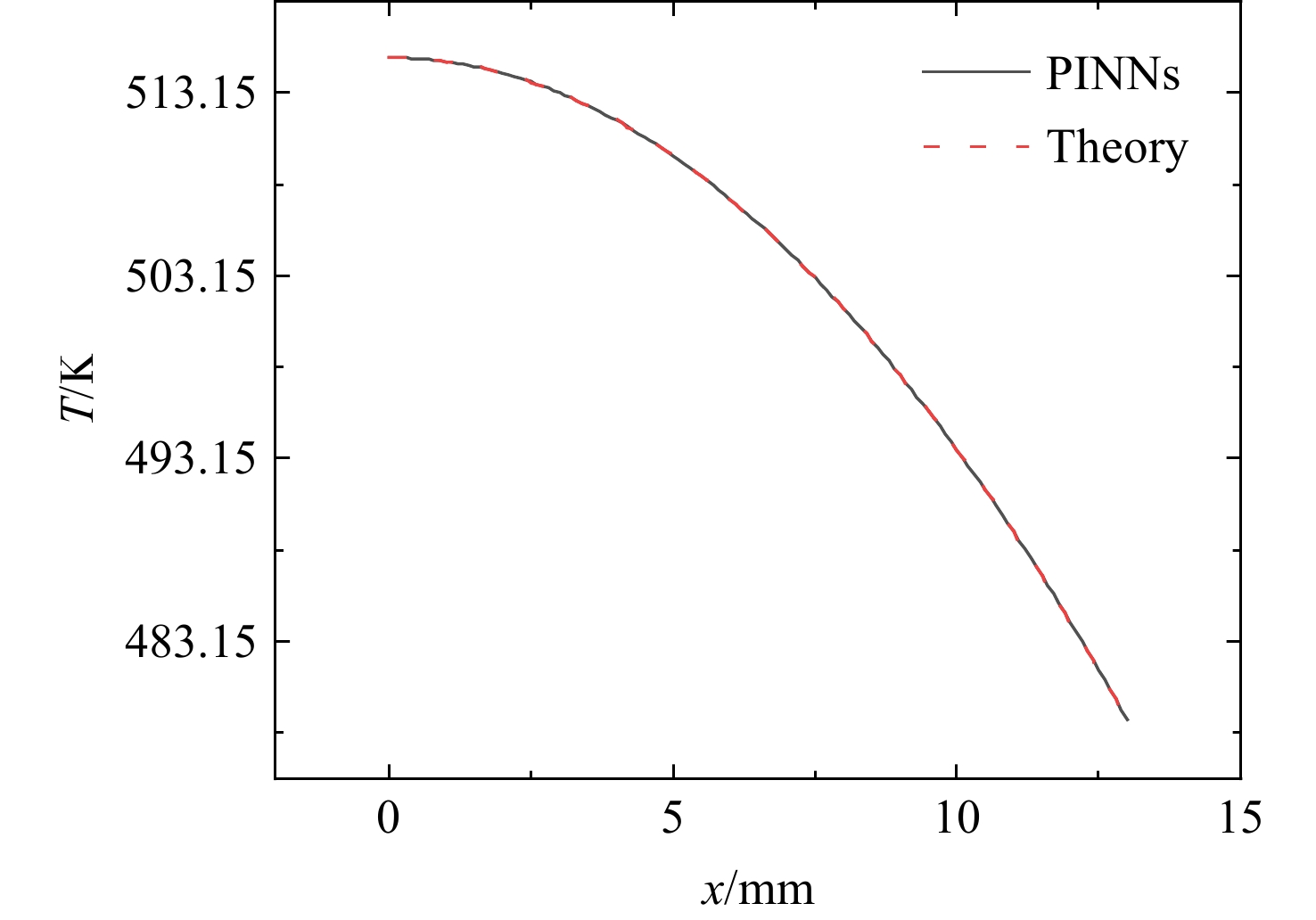
图 3 PINNs求解结果与理论解结果对比
Figure 3. Comparison of PINNs solution results with theoretical solutions
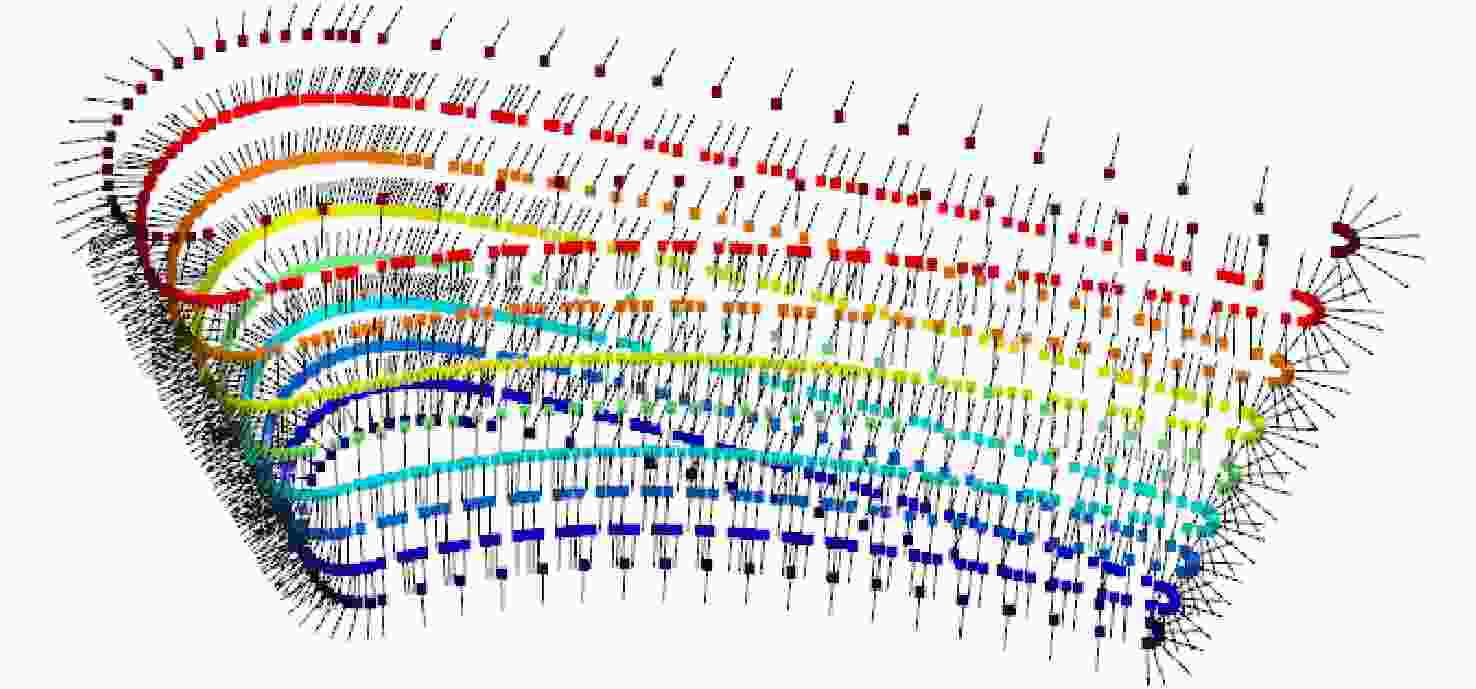
图 6 叶片表面的采样点及外法线向量
Figure 6. Sampling points and external normal vectors of blade surface

图 7 解决实心叶片导热问题的PINNs结构
Figure 7. PINNs structure to solve the thermal conductivity problem of solid blades
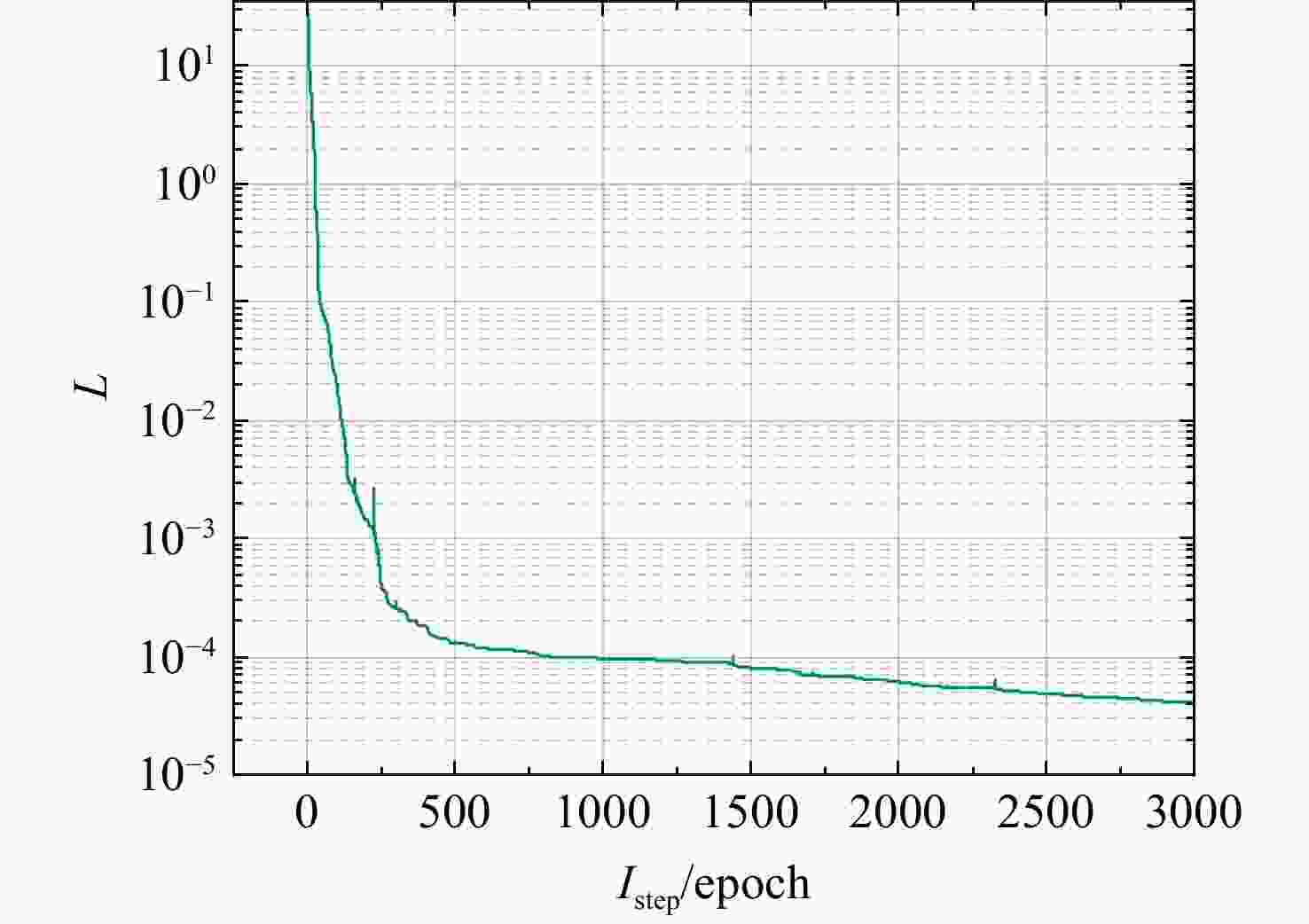
图 8 损失函数和相对误差随迭代步数的变化
Figure 8. Loss function and relative error varying with the iteration steps
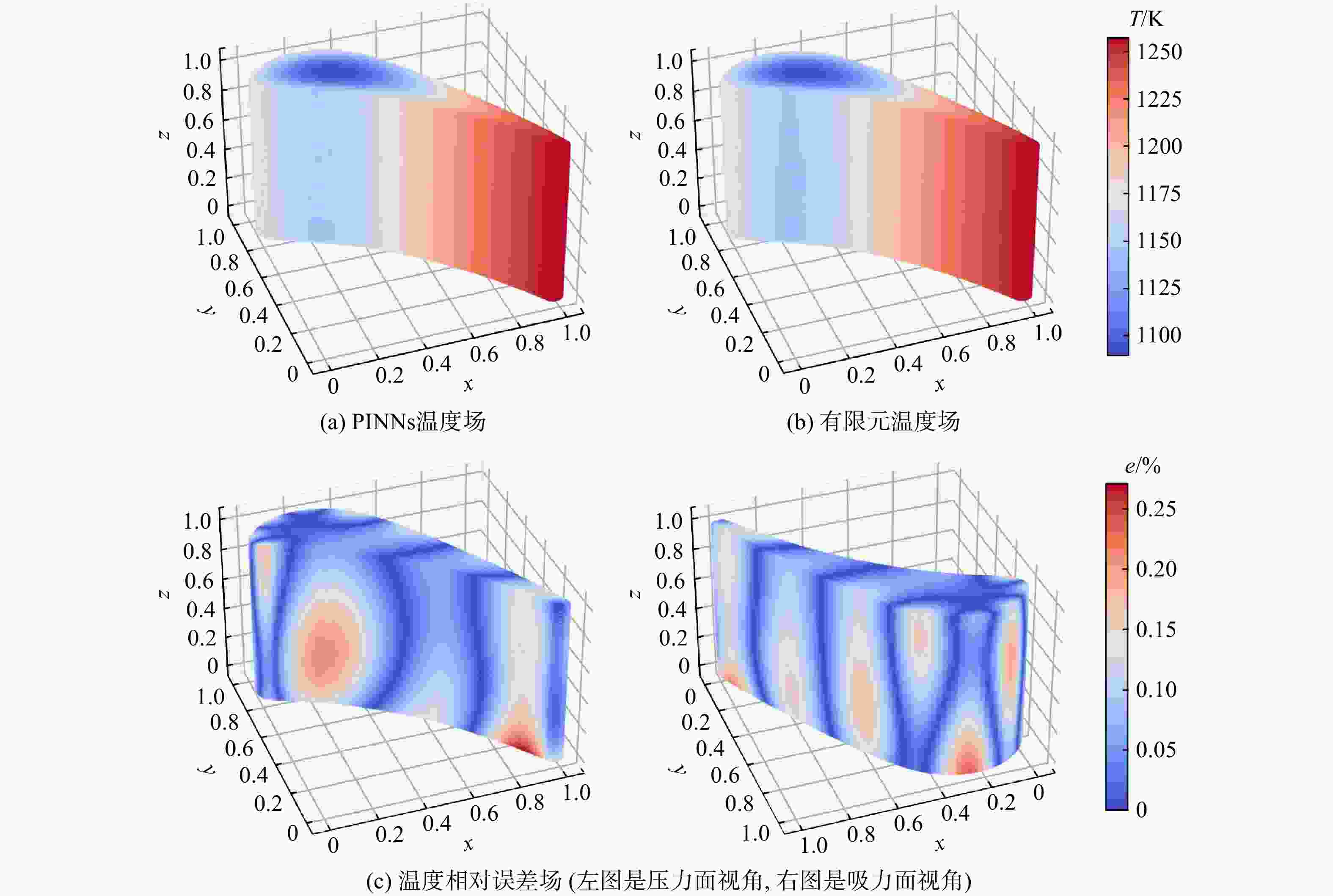
图 9 PINNs三维温度场求解结果和误差可视化
Figure 9. PINNs three-dimensional temperature field solution results and error visualization
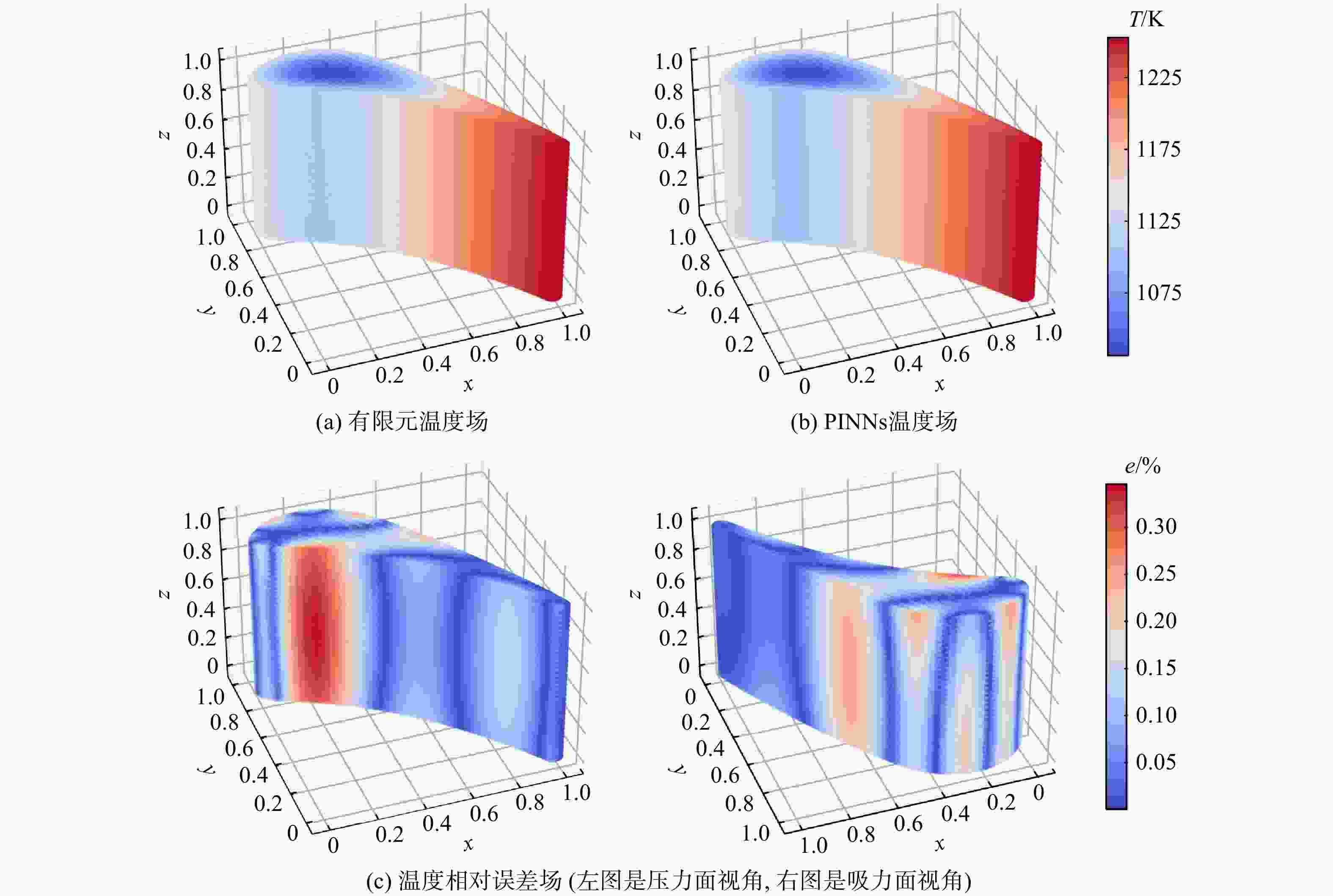
图 10 内冷源微调后PINNs三维温度场求解结果和误差可视化
Figure 10. PINNs three-dimensional temperature field solution results and error visualization after the minor change of the internal cold sourse
表 1 初始化对于计算时间和计算精度的影响
Table 1. Effect of initialization on computation time and accuracy
实验 计算时间/s 迭代步数 最大误差/% 平均误差/% 第1次 11.63 1053 0.27 0.07 第2次 6.86 553 0.31 0.12 第3次 11.58 948 0.41 0.13 第4次 12.97 1036 0.31 0.09 第5次 8.85 664 0.29 0.09 平均值 10.38 1053 0.32 0.10  下载: 导出CSV
表 2 不同深度及宽度网络的计算收敛时间
Table 2. Convergence time for different depth and width networks
网络宽度 计算收敛时间/s 10 20 40 80 2层 10.30 10.38 20.90 47.44 4层 21.27 25.37 40.75 93.36 6层 22.85 48.97 55.59 144.07
下载: 导出CSV
表 3 不同深度及宽度网络的计算收敛步数
Table 3. Convergence steps for different depth and width networks
网络宽度 计算收敛参数 10 20 40 80 2层 799 1053 1288 1396 4层 796 1237 1505 1598 6层 766 1355 1539 1694
下载: 导出CSV
表 4 不同深度及宽度网络计算结果的最大相对误差
Table 4. Maximum relative error of the results calculated for different depth and width networks
网络宽度 最大相对误差/% 10 20 40 80 2层 0.30 0.32 0.39 0.36 4层 0.36 0.25 0.38 0.32 6层 0.28 0.28 0.23 0.59
下载: 导出CSV
表 5 不同深度及宽度网络计算结果的平均相对误差
Table 5. Average relative error of the results calculated for different depth and width networks
网络宽度 平均相对误差/% 10 20 40 80 2层 0.088 0.096 0.111 0.104 4层 0.104 0.074 0.102 0.091 6层 0.057 0.055 0.062 0.133
下载: 导出CSV
表 6 不同采样点数量下的网络计算时间和计算精度
Table 6. Computation time and accuracy under different number of sampling points
实验 $ {N}_{0} $ $ {N}_{\mathrm{u}\mathrm{d}} $ $ {N}_{\mathrm{s}} $ 平均计算
时间/s平均计算
步数最大
误差/%平均
误差/%1 100 10 30 8.96 711 1.03 0.139 2 1000 50 300 9.21 708 0.66 0.142 3 10000 500 3000 10.30 799 0.30 0.088 4 50000 2300 15000 26.77 1235 0.29 0.076
下载: 导出CSV
-
[1] RAISSI M,PERDIKARIS P,KARNIADAKIS G E. Physics-informed neural networks: a deep learning framework for solving forward and inverse problems involving nonlinear partial differential equations[J]. Journal of Computational Physics,2019,378: 686-707. doi: 10.1016/j.jcp.2018.10.045 [2] NABIAN M A,GLADSTONE R J,MEIDANI H. Efficient training of physics-informed neural networks via importance sampling[J]. Computer-Aided Civil and Infrastructure Engineering,2021,36(8): 962-977. doi: 10.1111/mice.12685 [3] WIGHT C L,ZHAO Jia. Solving Allen-Cahn and Cahn-Hilliard equations using the adaptive physics informed neural networks[J]. Communications in Computational Physics,2021,29(3): 930-954. doi: 10.4208/cicp.OA-2020-0086 [4] LU Lu,MENG Xuhui,MAO Zhiping. DeepXDE: a deep learning library for solving differential equations[J]. SIAM Review,2021,63(1): 208-228. doi: 10.1137/19M1274067 [5] JAGTAP A D,KARNIADAKIS G E. Extended physics-informed neural networks (XPINNs): a generalized space-time domain decomposition based deep learning framework for nonlinear partial differential equations[J]. Communications in Computational Physics,2020,28(5): 2002-2041. doi: 10.4208/cicp.OA-2020-0164 [6] JAGTAP A D,KHARAZMI E,KARNIADAKIS G E. Conservative physics-informed neural networks on discrete domains for conservation laws: applications to forward and inverse problems[J]. Computer Methods in Applied Mechanics and Engineering,2020,365: 113028.1-113028.27. [7] MENG Xuhui,LI Zhen,ZHANG Dongkun. PPINN: parareal physics-informed neural network for time-dependent PDEs[J]. Computer Methods in Applied Mechanics and Engineering,2020,370: 113250.1-113250.16. [8] FANG Zhiwei,ZHAN J. A physics-informed neural network framework for PDEs on 3D surfaces: time independent problems[J]. IEEE Access,2020,8: 26328-26335. doi: 10.1109/ACCESS.2019.2963390 [9] GAO Han,SUN Luning,WANG Jianxun. PhyGeoNet: physics-informed geometry-adaptive convolutional neural networks for solving parameterized steady-state pdes on irregular domain[J]. Journal of Computational Physics,2021,428: 110079.1-110079.27. [10] HAGHIGHAT E,JUANES R. SciANN: a keras/tensorflow wrapper for scientific computations and physics-informed deep learning using artificial neural networks[J]. Computer Methods in Applied Mechanics and Engineering,2021,373: 113552.1-113552.17. [11] BAI Xiaodong,WANG Yong,ZHANG Wei. Applying physics informed neural network for flow data assimilation[J]. Journal of Hydrodynamics,2020,32(6): 1050-1058. doi: 10.1007/s42241-020-0077-2 [12] CHENG Chen,ZHANG Guangtao. Deep learning method based on physics informed neural network with resnet block for solving fluid flow problems[J]. Water,2021,13(4): 423.1-423.17. [13] FLORIO M D,SCHIASSI E,GANAPOL B,et al. Physics-informed neural networks for rarefied-gas dynamics: thermal creep flow in the Bhatnagar-Gross-Krook approximation[J]. Physics of Fluids,2021,33(4): 047110.1-047110.14. [14] ZHU Qiming,LIU Zeliang,YAN Jinhui. Machine learning for metal additive manufacturing: predicting temperature and melt pool fluid dynamics using physics-informed neural networks[J]. Computational Mechanics,2021,67(2): 619-635. doi: 10.1007/s00466-020-01952-9 [15] HAGHIGHAT E,RAISSI M,MOURE A,et al. A physics-informed deep learning framework for inversion and surrogate modeling in solid mechanics[J]. Computer Methods in Applied Mechanics and Engineering,2021,379: 113741.1-113741.22. [16] FANG Zhiwei,ZHAN J. Deep physical informed neural networks for metamaterial design[J]. IEEE Access,2020,8: 24506-24513. doi: 10.1109/ACCESS.2019.2963375 [17] 陆至彬,瞿景辉,刘桦,等. 基于物理信息神经网络的传热过程物理场代理模型的构建[J]. 化工学报,2021,72(3): 1496-1503.LU Zhibin,QU Jinghui,LIU Hua,et al. Surrogate modeling for physical fields of heat transfer processes based on physics-informed neural network[J]. CIESC Journal,2021,72(3): 1496-1503. (in Chinese) [18] 赵暾,周宇,程艳青,等. 基于内嵌物理机理神经网络的热传导方程的正问题及逆问题求解[J]. 空气动力学学报,2021,39(5): 19-26. doi: 10.7638/kqdlxxb-2020.0176ZHAO Tun,ZHOU Yu,CHENG Yanqing,et al. Solving forward and inverse problems of partial differential equations of heat conduction using physics-informed neural networks[J]. Acta Aerodynamica Sinica,2021,39(5): 19-26. (in Chinese) doi: 10.7638/kqdlxxb-2020.0176 -


 点击查看大图

计量
- 文章访问数: 771
- HTML浏览量: 676
- PDF量: 181
- 被引次数: 0