






Three-dimensional thermal stress prediction method in double-wall structure using convolutional neural networks
-
摘要:
为实现三维物理场的预测,提出一种利用卷积神经网络(CNN)对双层壁冷却结构外壁三维热应力快速评估方法。针对双层壁冷却结构外壁平板状的结构特征,沿壁厚方向将温度场切分为多个切片。将温度作为卷积网络输入张量的基本元素,不同厚度位置的切片对应输入张量的通道维度,从而实现将三维温度场输入进网络,并输出在热载荷作用下的三维等效应力场。结果表明:训练收敛后的网络在测试集上的平均绝对误差为1.23 MPa,平均相对误差为15.10%,对峰值应力的平均绝对误差为16.10 MPa,平均相对误差为11.81%。对于双层壁冷却结构的热应力预测问题,CNN能够很好地完成温度到应力的映射。使用深度学习方法探究热弹性问题的潜在机理有望实现。
Abstract:To realize the prediction of 3D physical field, a method for rapid evaluation of 3D thermal stress on the outer wall of double-wall cooling structure using convolutional neural network (CNN) was presented. For the structural characteristics of the flat plate shape of the double-wall cooling structure outer wall, the temperature field was sliced into multiple sections along the wall thickness direction. The temperature was used as the basic element of the input tensor of the CNN, and the sections at different thickness positions corresponded to channel dimensions of the input tensor. The 3D temperature field was input into the CNN for output of the 3D von-Mises stress field under thermal load. The average absolute error of the trained converged network on the testing set was 1.23 MPa, with an average relative error of 15.10%, and the average absolute error for peak stresses was 16.10 MPa, with an average relative error of 11.81%. Results showed that for the thermal stress prediction problem of double-wall cooling structures, CNN can complete the temperature-to-stress mapping well. Exploring potential mechanisms of the thermoelasticity problems by using deep learning methods is expected to be realized.
-
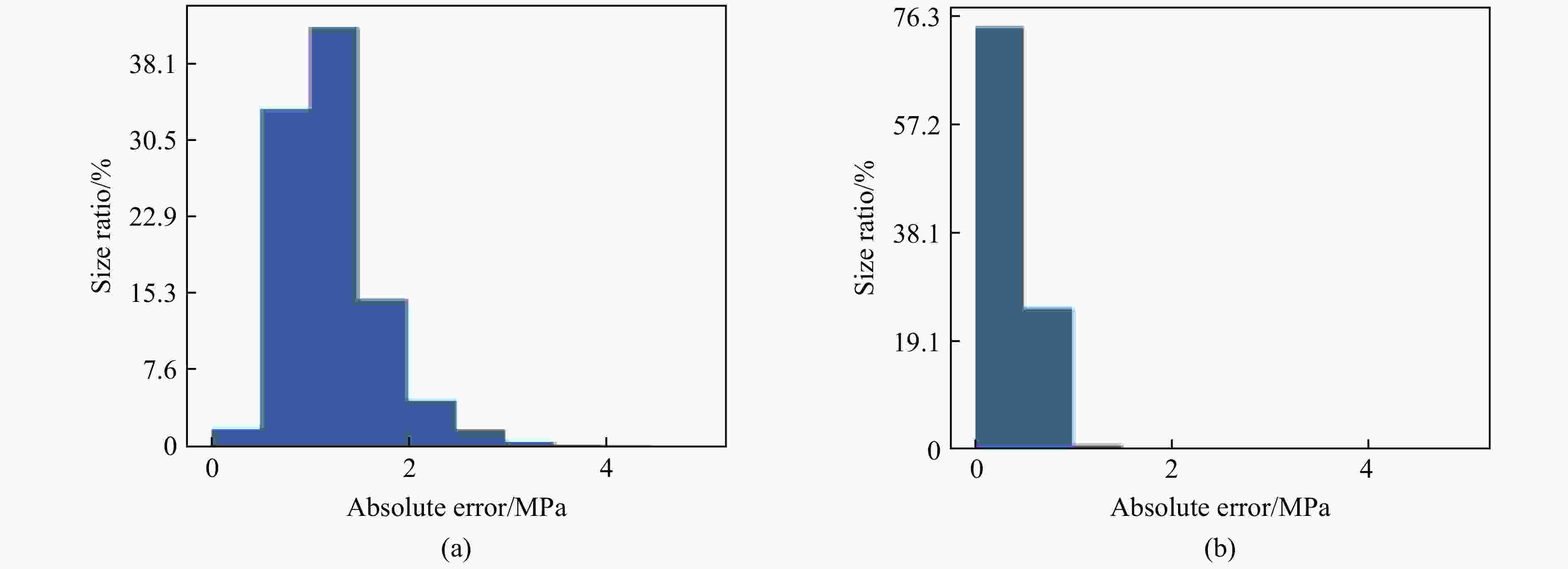
图 10 训练集和测试集上的绝对误差分布
Figure 10. Absolute error distribution on the training set and testing set
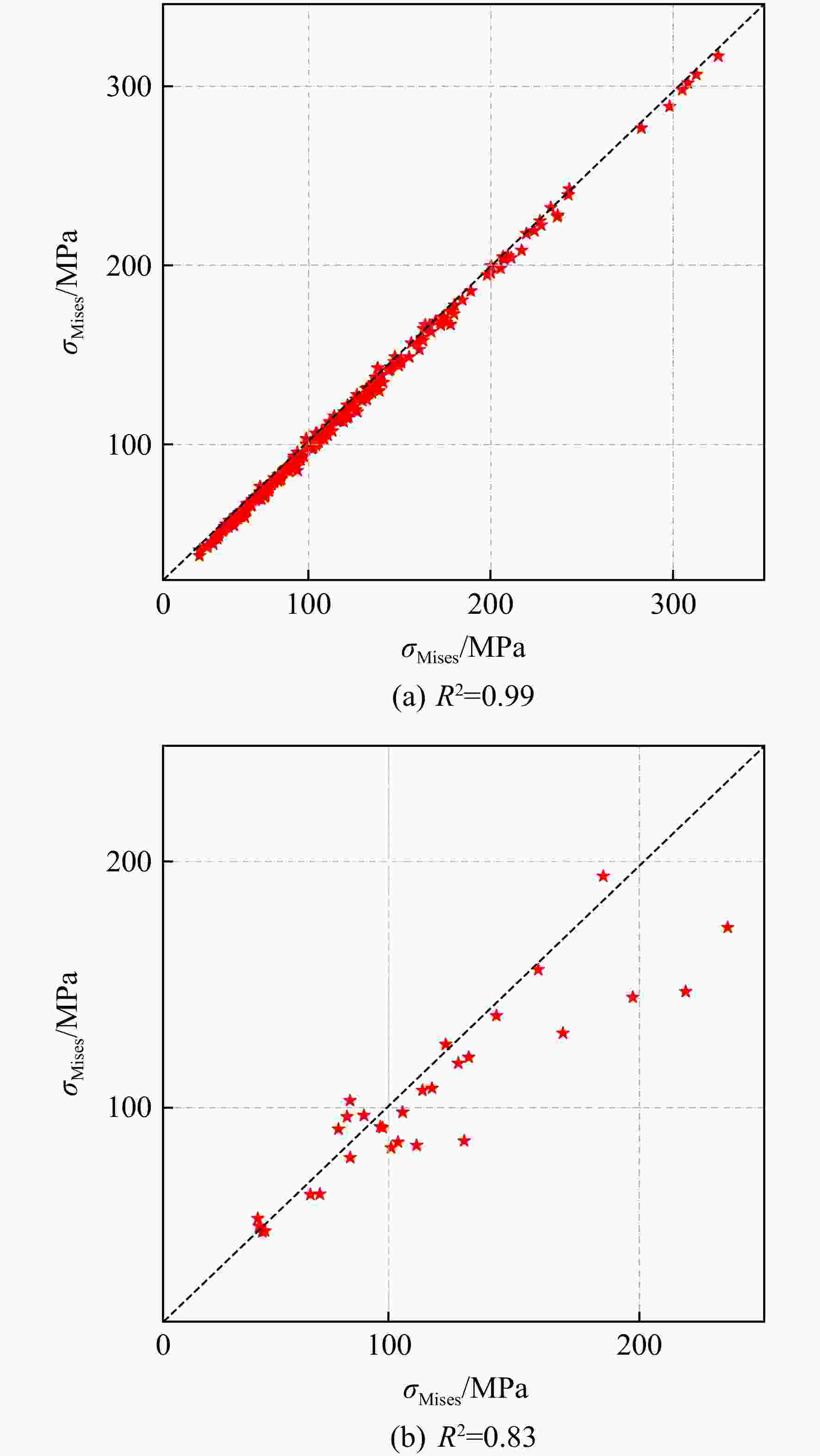
图 11 训练集和测试集上预测应力场峰值应力回归分析
Figure 11. Peak stress regression analysis of predicted stress field on training set and testing set
表 1 变量参数范围
Table 1. Range of variable parameters
参数 数值 气膜孔直径Df /mm 0.4~0.9 气膜孔倾斜角α/(°) 20~70 气膜孔展向间距P/mm 3Df~5Df 气膜孔流向间距S/mm 3Df~13Df 外壁厚度Ho/mm 0.7~1.2 冲击距离H/mm 0.7~1.2 主流燃气温度Tm/K 1 700, 1 900, 2 100 主流燃气速度Vm/(m/s) 400, 800 吹风比M 0.75, 1.25  下载: 导出CSV
表 2 训练集和测试集各项指标结果
Table 2. Indexes results of the training set and testing set
参数 训练集 测试集 EMSE/MPa2 0.40 3.49 EMAE/MPa 0.43 1.23 EMRE/% 6.75 15.10 EPMAE/MPa 2.63 16.10 EPMRE/% 2.39 11.81
下载: 导出CSV
表 3 样本各项变量的具体取值
Table 3. Values of each variable in the sample
样本 训练集样本
ID1-CD1测试集样本
ID1-CD7Df/mm 0.85 α/(°) 30.16 P/mm 4.09Df S/mm 12.84Df Ho/mm 0.75 Tm/K 1700 Vm/(m/s) 400 M 0.75 1.25
下载: 导出CSV
-
[1] CHANG S W,CHIANG P A,CAI W L. Thermal performance of impinging jet-row onto trapezoidal channel with different effusion and discharge conditions[J]. International Journal of Thermal Sciences,2021,159: 106590.1-106590.21. [2] LIU Yuyang,RAO Yu,YANG Li,et al. Flow and heat transfer characteristics of double-wall cooling with multi-row short film cooling hole arrangements[J]. International Journal of Thermal Sciences,2021,165: 106878.1-106878.13. [3] MOON M A,KIM K Y. Analysis and optimization of fan-shaped pin-fin in a rectangular cooling channel[J]. International Journal of Heat and Mass Transfer,2014,72: 148-162. doi: 10.1016/j.ijheatmasstransfer.2013.12.085 [4] WANG S,ZHANG Z. Failure mechanism of turbine guide vane and oxide composition analysis on the surface of failure vane cracks[J]. Engineering Failure Analysis,2020,117: 104763.1-104763.8. [5] GUO Zixu,SONG Ziyuan,FAN Jun,et al. Experimental and analytical investigation on service life of film cooling structure for single crystal turbine blade[J]. International Journal of Fatigue,2021,150: 106318.1-106318.13. [6] KIM K M,MOON H,PARK J S,et al. Optimal design of impinging jets in an impingement/effusion cooling system[J]. Energy,2014,66: 839-848. doi: 10.1016/j.energy.2013.12.024 [7] ELMUKASHFI E,MURRAY A V,IRELAND P T,et al. Analysis of the thermomechanical stresses in double-wall effusion cooled systems[J]. Journal of Turbomachinery,2020,142(5): 051002.1-051002.13. [8] SKAMNIOTIS C,COCKS A C F. Minimizing stresses in double wall transpiration cooled components for high temperature applications[J]. International Journal of Mechanical Sciences,2021,189: 105983.1-105983.13. [9] GUO Zixu,HUANG Dawei,YAN Xiaojun,et al. A damage coupled elastic-plastic constitutive model and its application on low cycle fatigue life prediction of turbine blade[J]. International Journal of Fatigue,2020,131: 105298.1-105298.12. [10] HONG Hui,WANG Weizhe,LIU Yingzheng. High-temperature fatigue behavior of a steam turbine rotor under flexible operating conditions with variable loading amplitudes[J]. International Journal of Mechanical Sciences,2019,163: 105121.1-105121.13. [11] GIANNELLA V,VIVO E,MAZZEO M,et al. FEM-DBEM approach to simulate crack propagation in a turbine vane segment undergoing a fatigue load spectrum[J]. Procedia Structural Integrity,2018,12: 479-491. doi: 10.1016/j.prostr.2018.11.070 [12] CUNHA F J,DAHMER M T,CHYU M K. Thermal-mechanical life prediction system for anisotropic turbine components[J]. Journal of Turbomachinery,2006,128(2): 240-250. doi: 10.1115/1.2137740 [13] BANASZKIEWICZ M. Numerical investigations of crack initiation in impulse steam turbine rotors subject to thermo-mechanical fatigue[J]. Applied Thermal Engineering,2018,138: 761-773. doi: 10.1016/j.applthermaleng.2018.04.099 [14] MURRAY A V, IRELAND P T, RAWLINSON A J. An integrated conjugate computational approach for evaluating the aerothermal and thermomechanical performance of double-wall effusion cooled systems[R]. ASME Paper GT2017-64711, 2017. [15] RONNEBERGER O, FISCHER P, BROX T. U-net: convolutional networks for biomedical image segmentation[C]//Proceedings of the 18th Medical Image Computing and Computer-Assisted Intervention(MICCAI) International Conference. Munich, Germany: Springer, 2015: 234-241. [16] HU Jie, SHEN Li, SUN Gang. Squeeze-and-excitation networks[C]//Proceedings of the IEEE conference on Computer Vision and Pattern Recognition. Salt Lake City, US: IEEE, 2018: 7132-7141. [17] LIU Peirong, TIAN Lin, ZHANG Yubo, et al. Discovering hidden physics behind transport dynamics[C]//Proceedings of the Institute of Electrical and Electronics Engineers/ Computer Vision Foundation (IEEE/CVF) Conference on Computer Vision and Pattern Recognition. Nashville, US: IEEE, 2021: 10082-10092. [18] BADARINATH P V,CHIERICHETTI M,KAKHKI F D. A machine learning approach as a surrogate for a finite element analysis: status of research and application to one dimensional system[J]. Sensors,2021,21(5): 1654.1-1654.18. [19] LIANG L,LIU M,MARTIN C,et al. A deep learning approach to estimate stress distribution: a fast and accurate surrogate of finite-element analysis[J]. Journal of The Royal Society Interface,2018,15(138): 20170844.1-20170844.10. [20] HERATH S,HAPUTHANTHRI U. Topologically optimal design and failure prediction using conditional generative adversarial networks[J]. International Journal for Numerical Methods in Engineering,2021,122(23): 6867-6887. doi: 10.1002/nme.6814 [21] YANG Zhenze,YU Chihua,BUEHLER M J. Deep learning model to predict complex stress and strain fields in hierarchical composites[J]. Science Advances,2021,7(15): 7416.1-7416.11. [22] NING L,CAI Z,LIU Y,et al. Conditional generative adversarial network driven approach for direct prediction of thermal stress based on two-phase material SEM images[J]. Ceramics International,2021,47(24): 34115-34126. doi: 10.1016/j.ceramint.2021.08.322 -


 点击查看大图

计量
- 文章访问数: 784
- HTML浏览量: 285
- PDF量: 137
- 被引次数: 0