






A data-driven based hub region loss model of fan rotor under complex inflow condition
-
摘要:
发展了一种基于数据驱动的复杂进气下风扇转子叶根损失预测方法。提取了影响风扇转子叶根损失的关键气动参数作为输入变量,熵损失系数作为输出参数;采用计算耗时小的单叶片通道定常模型,通过给定不同边界条件并进行组合来构建样本数据库,使得数据库中样本点尽可能覆盖更广的复杂进气工况;采用径向基神经网络训练并构建输入变量与输出参数之间的映射,实现叶根损失的快速预测。计算结果表明:该损失模型能够准确捕捉叶根损失的径向分布趋势,并且相比于传统损失模型能够大幅提升预测精度。在不同流量、进气旋流以及畸变强度工况下,叶根流动损失平均预测误差基本小于10%。
Abstract:A data-driven based hub loss prediction model was developed for the fan rotor under complex inflow conditions. The key aerodynamic parameters were extracted as input parameters and the entropy loss as output parameter. The sample database was constructed based on computation-efficient single-blade-passage steady computational method. Different boundary conditions were set and combined to make the database samples cover a wide range of complex inflows as far as possible. The RBF neural network was used to construct the mapping between input and output parameters to realize rapid prediction of hub loss. Results showed that the loss model can accurately capture the radial distributions of hub loss and significantly improve the prediction accuracy. Meanwhile, the averaged loss prediction error in the rotor hub region was mostly lower than 10% under different inlet mass flow, inlet swirl angle and inflow distortion conditions.
-
Key words:
- data-driven /
- loss model /
- neural network /
- complex inflow condition /
- transonic fan
-
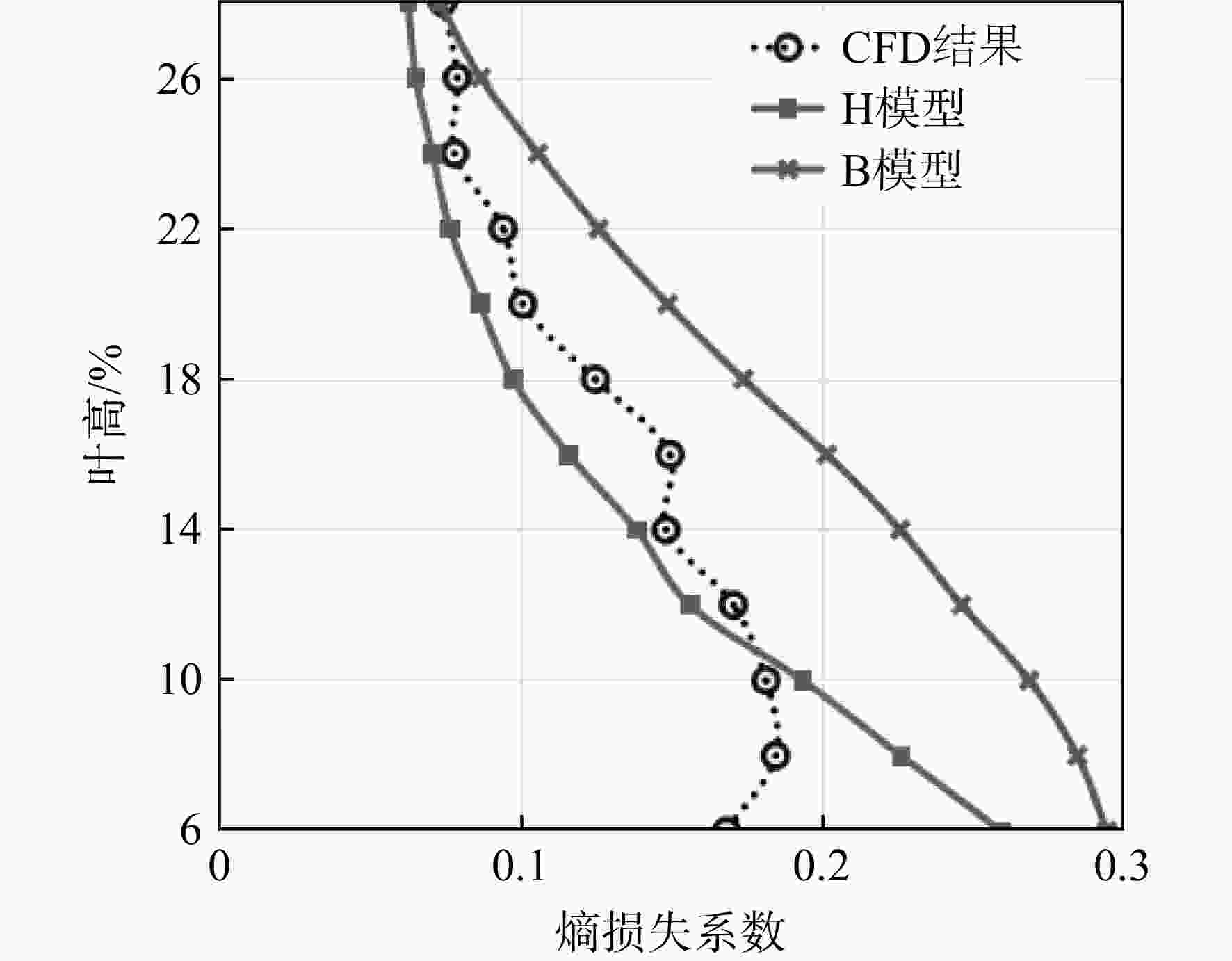
图 1 复杂进气下压气机近最高效率点叶根损失的传统损失模型预测结果
Figure 1. Predicted hub flow loss by physics-based loss models at peak efficiency point under complex inflow conditions
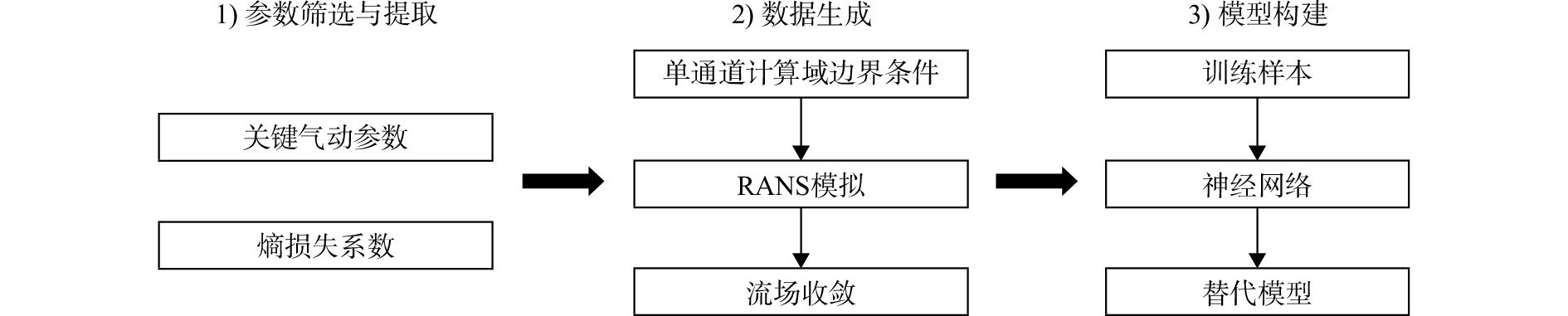
图 2 基于数据驱动的损失预测模型构建流程图
Figure 2. Framework of data-driven hub flow loss prediction model
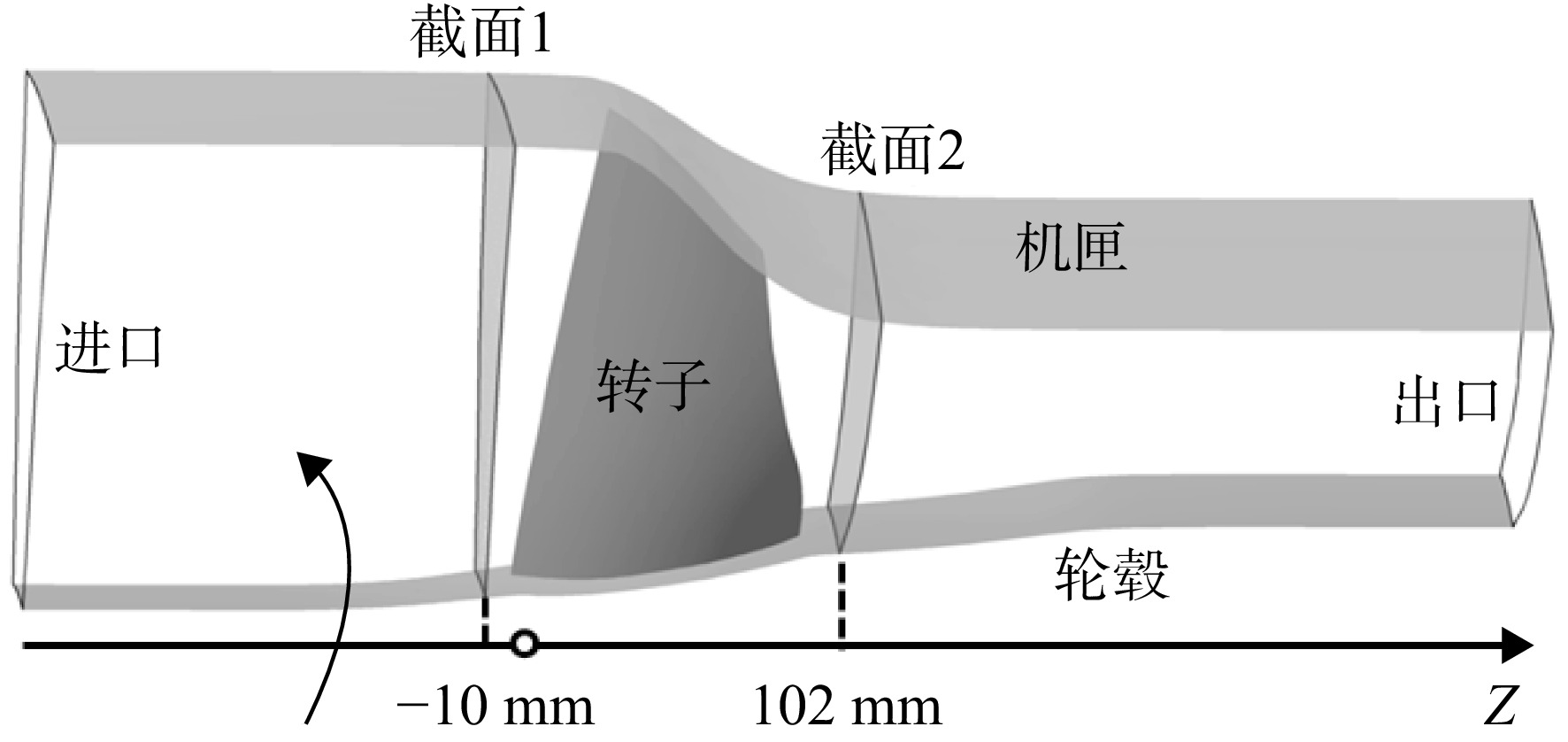
图 3 跨声速风扇转子NASA Rotor 67单通道计算域
Figure 3. Computational domain of the single-passage model of transonic fan rotor NASA Rotor 67
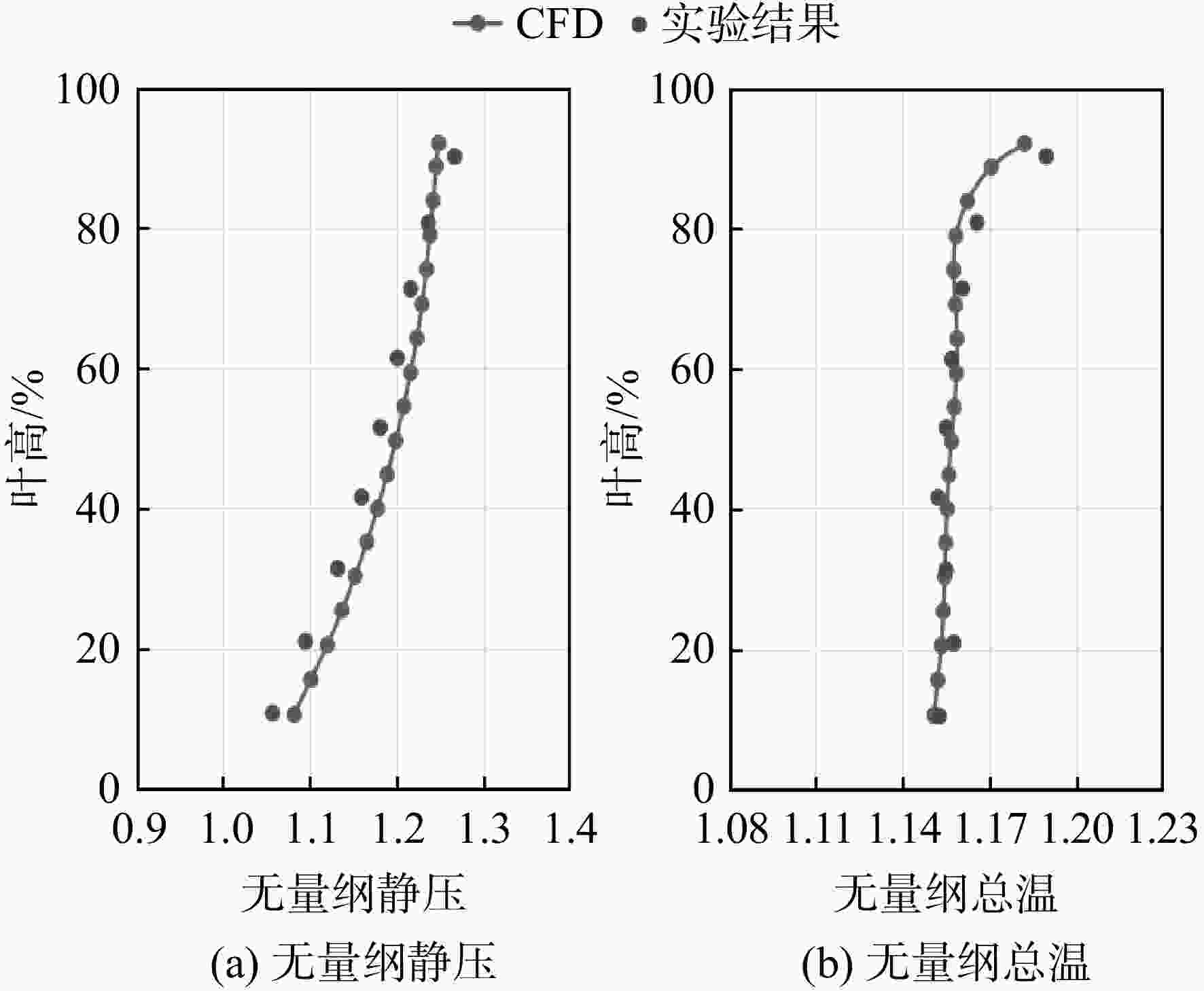
图 6 风扇转子出口静压和总温的径向分布对比
Figure 6. Radial distribution comparison of static pressure and total temperature at the fan rotor outlet

图 8 径向基(RBF)神经网络示意图
Figure 8. Schematic diagram of radial basis function (RBF)neural network
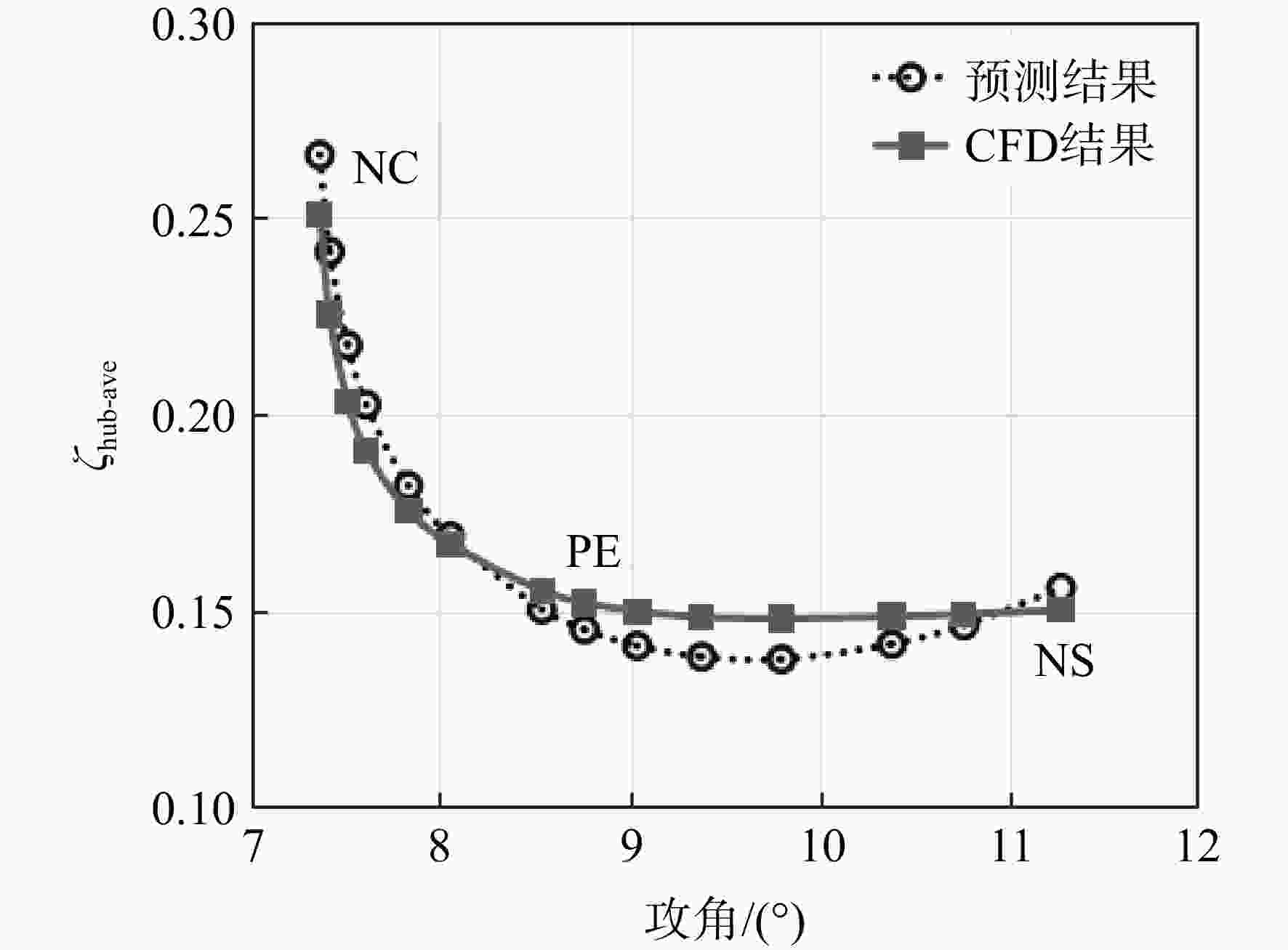
图 10 均匀进气时不同流量工况下损失模型预测结果与CFD结果对比
Figure 10. Comparison between predicted results and CFD results of loss model at different mass flow conditions under clean inflow
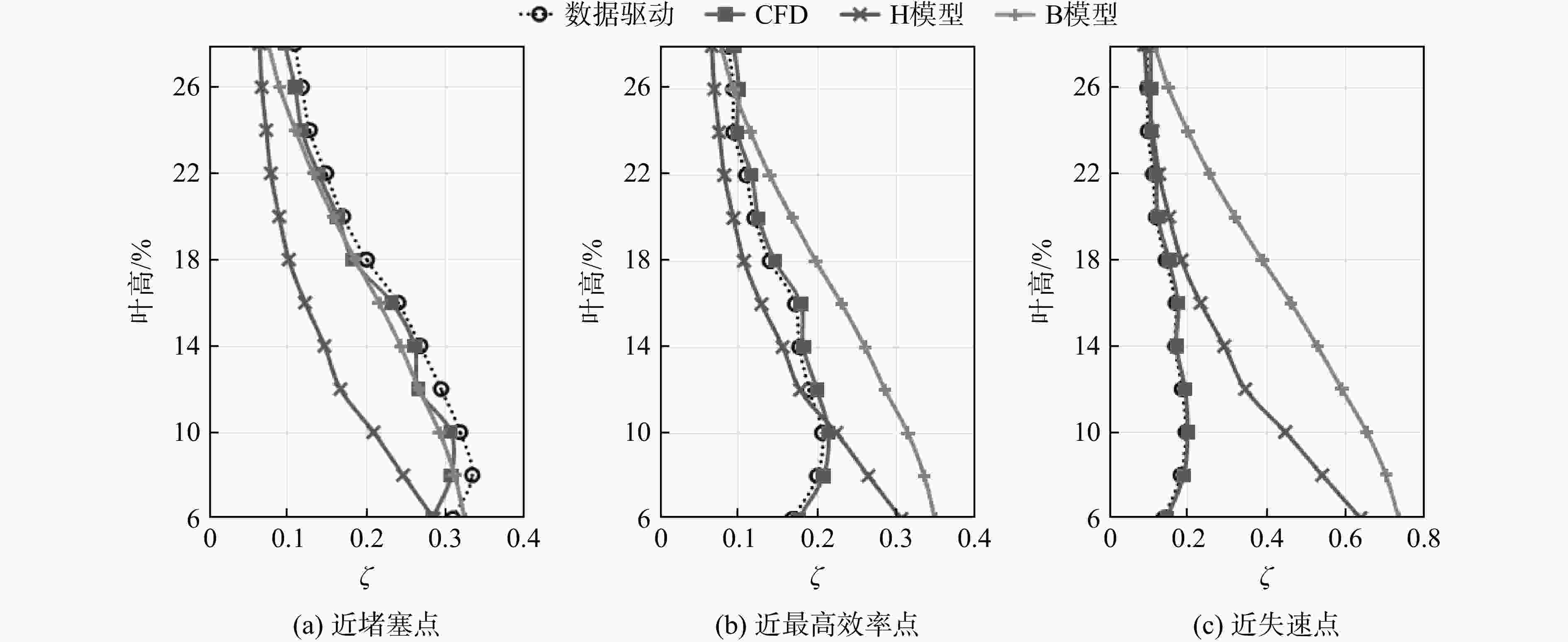
图 11 不同典型流量工况下熵损失系数径向分布
Figure 11. Radial distributions of entropy loss coefficient at different mass flow conditions
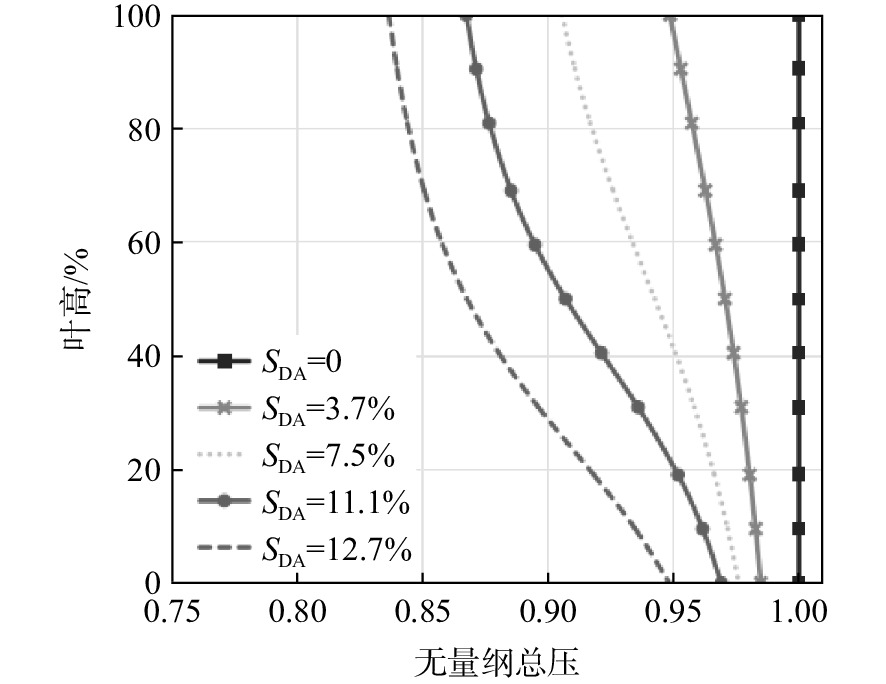
图 12 不同进口径向总压畸变分布
Figure 12. Radial distributions of different total pressure inflow distortions
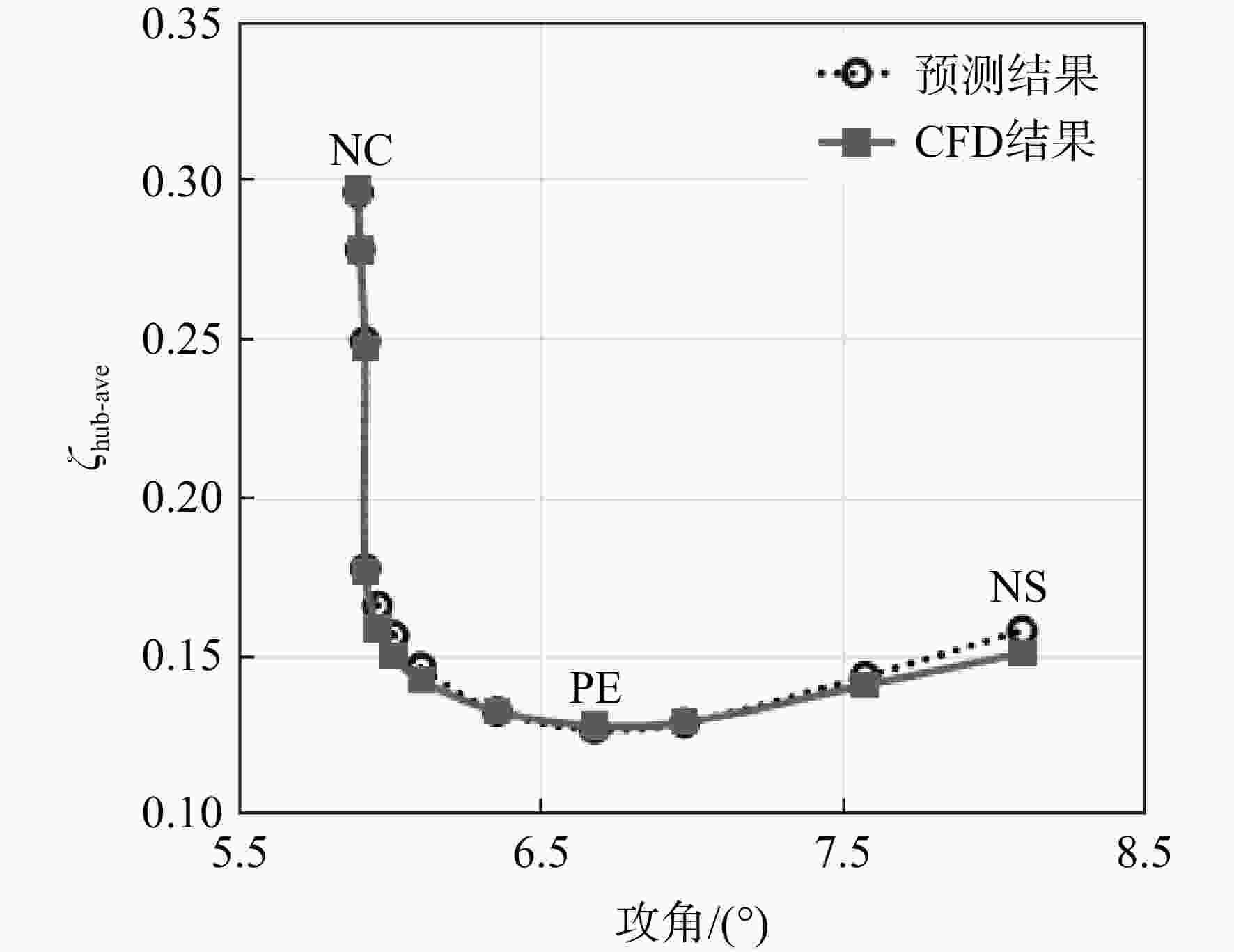
图 13 畸变进气(SDA=7.5%)不同流量工况下损失系数对比
Figure 13. Comparison of loss coefficient at different mass flow conditions with inflow distortion (SDA=7.5%)
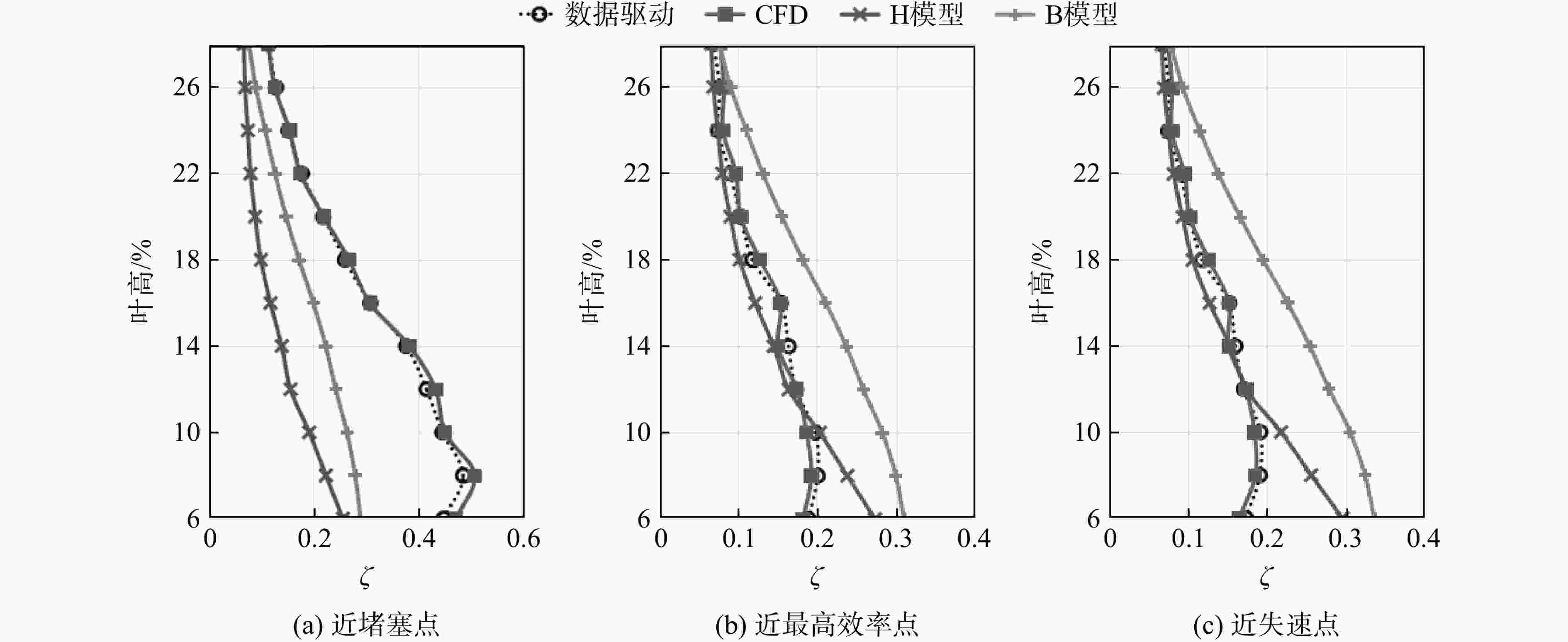
图 14 畸变进气(SDA =7.5%)典型流量工况下损失系数径向分布对比
Figure 14. Radial distributions comparison of loss coefficient at typical mass flow conditions with inflow distortion (SDA =7.5%)
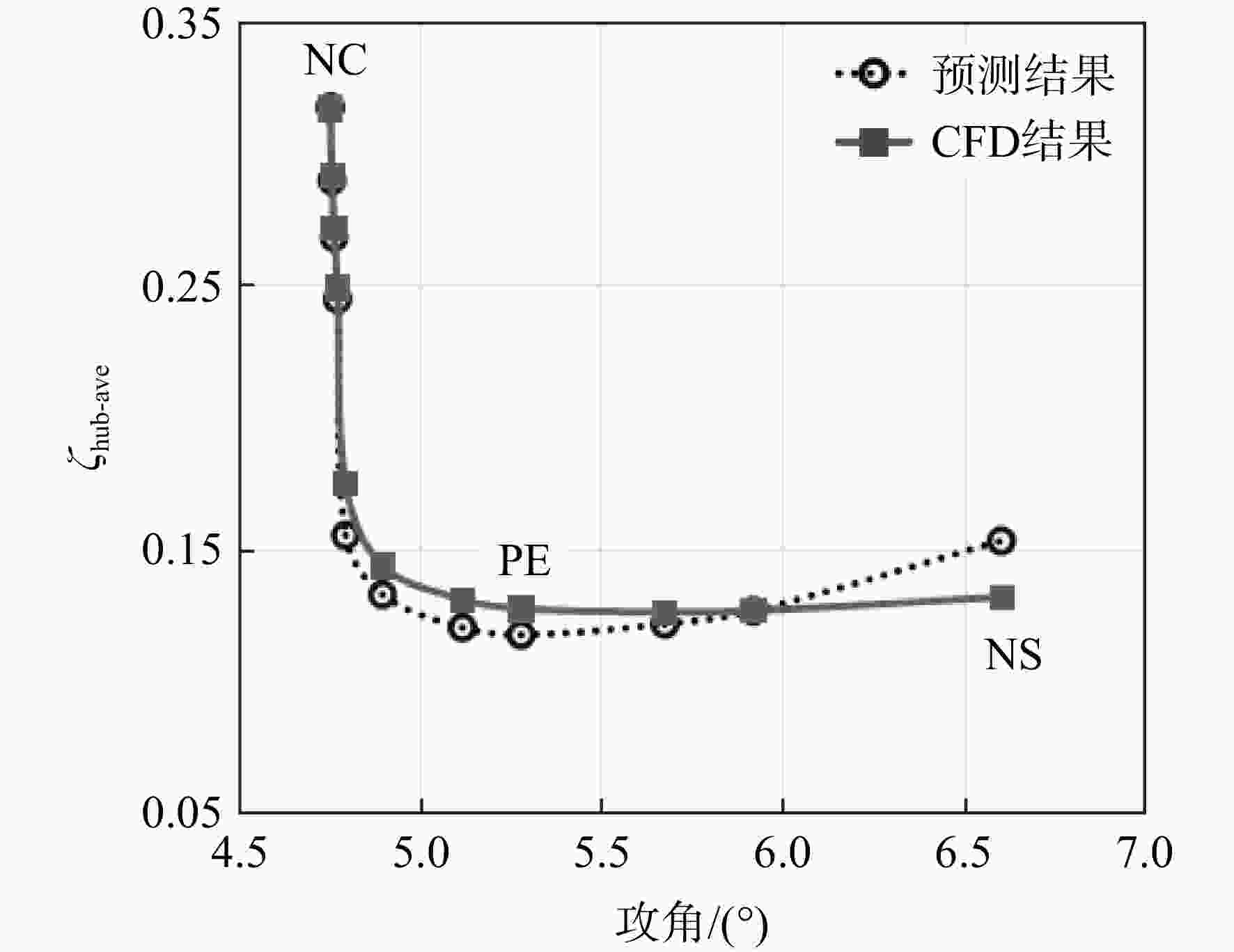
图 15 畸变进气(SDA=12.7%)不同流量工况下损失系数对比
Figure 15. Comparison of loss coefficient at different mass flow conditions with inflow distortion (SDA=12.7%)
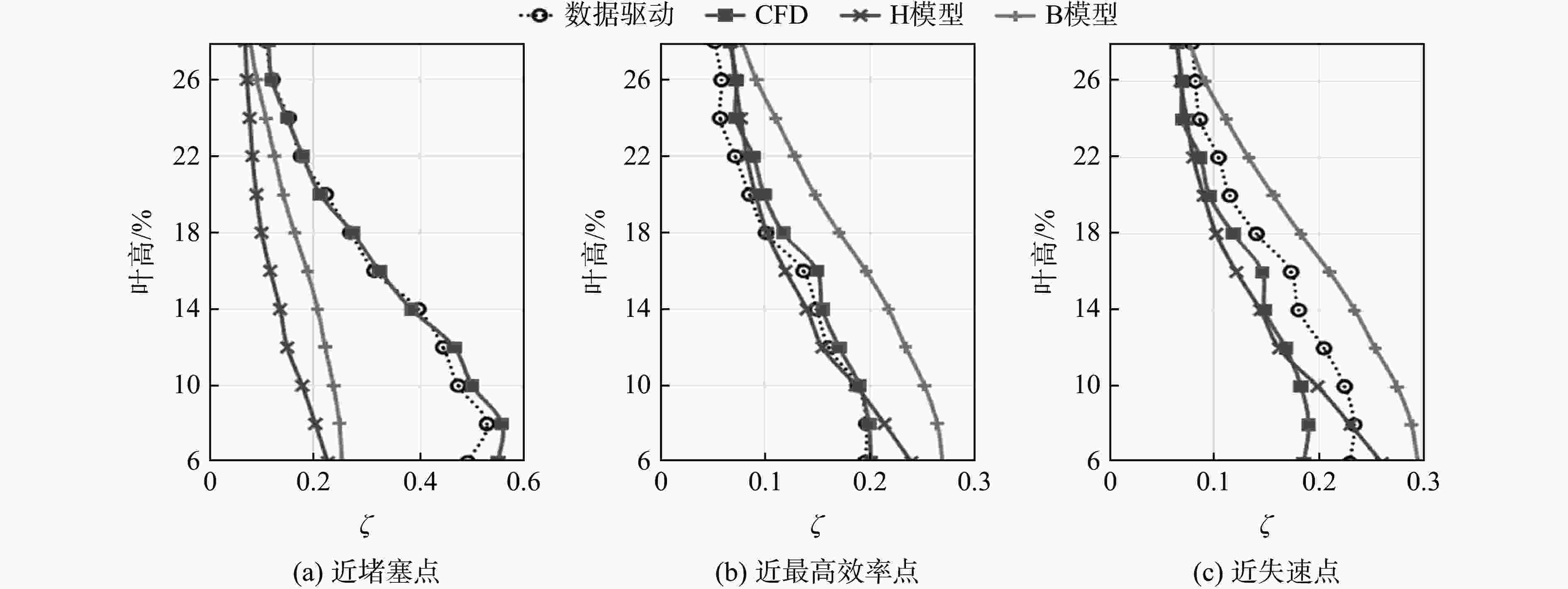
图 16 畸变进气(SDA=12.7%)典型流量工况下损失系数径向分布对比
Figure 16. Radial distributions comparison of loss coefficient at typical mass flow conditions with inflow distortion (SDA=12.7%)
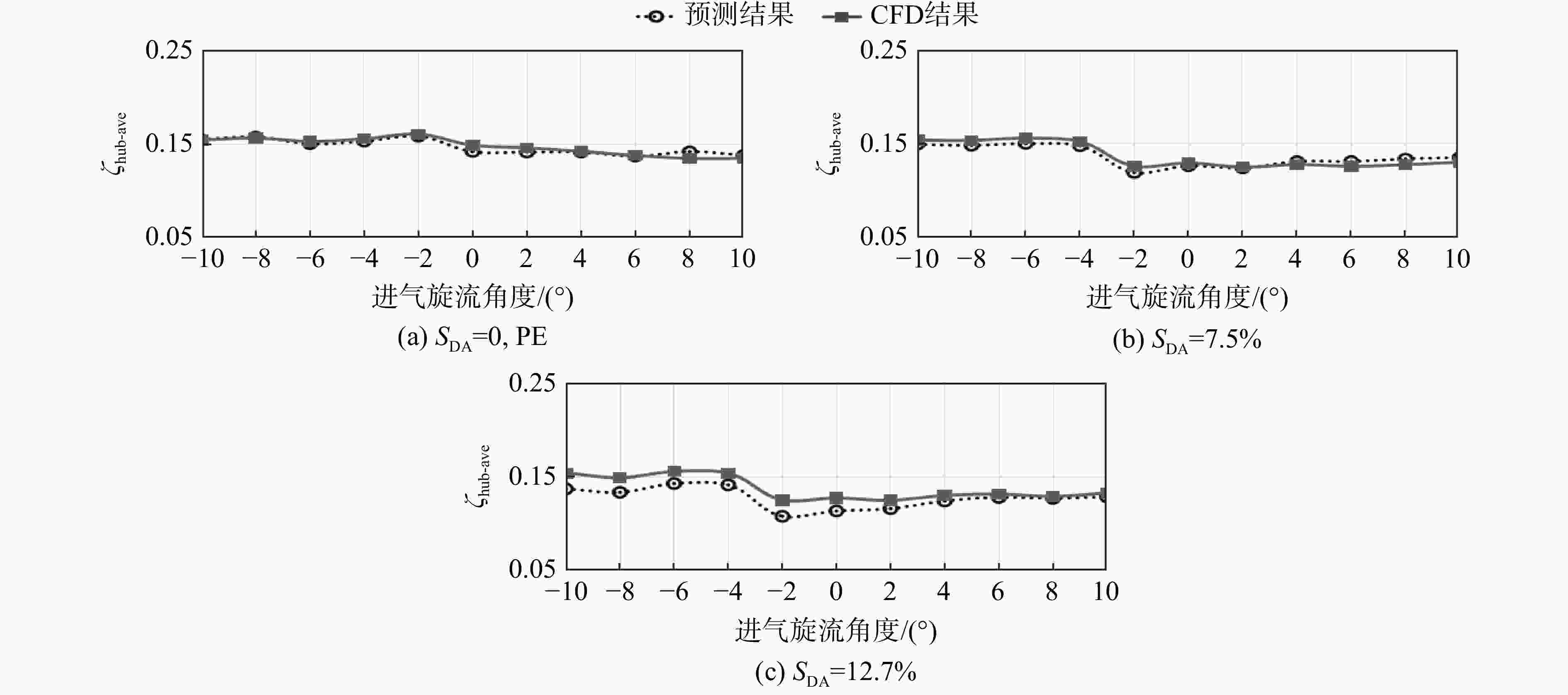
图 17 3种畸变强度不同进气旋流下本文损失模型预测结果与CFD结果对比
Figure 17. Comparisons of predicted results and CFD results of loss model in this paper under different inlet swirl flows for three distortion intensities
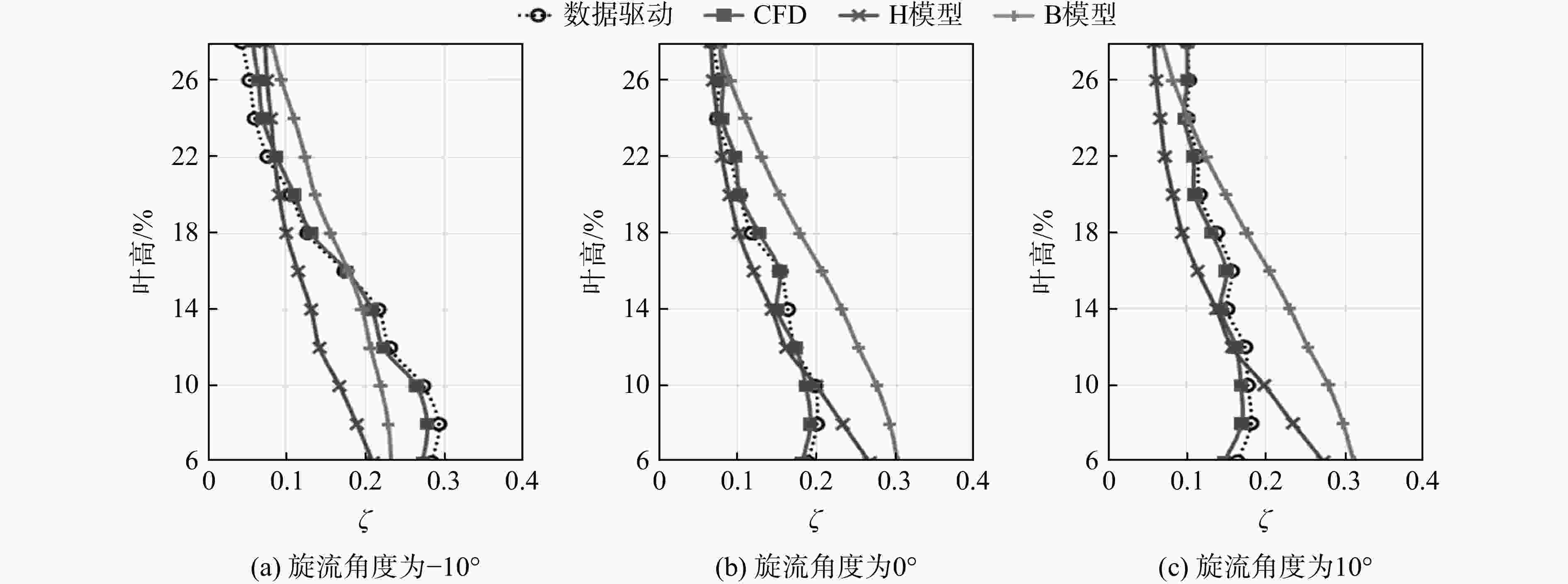
图 18 畸变强度SDA =7.5%近最高效率点工况不同旋流角条件下叶根损失的径向分布对比
Figure 18. Comparisons of radial distributions of hub loss for different swirl flow angles at peak efficiency point under inflow distortion intensity SDA =7.5%
-
[1] KO A, LEIFSSON L, SCHETZ J, et al. MDO of a blended-wing-body transport aircraft with distributed propulsion[R]. AIAA-2003-6732, 2003. [2] KIM H, LIOU M S. Flow simulation of N2B hybrid wing body configuration[R]. AIAA-2013-0221, 2003. [3] LIU Lei, CHEN Fu, CHEN Huanlong, et al. Numerical investigation on impact of a flush-mounted air intake exit distortion to the rear fan performance[C]//Proceedings of ASME Turbo Expo. Düsseldorf, Germany: ASME, 2014: 1-9. [4] VUNNAM K, HOOVER R. Modeling of inlet distortion using a combined turbofan and nacelle inlet model during crosswind and low speed forward operation[C]//Proceedings of ASME Turbo Expo. Vancouver, Canada: ASME, 2011: 371-380. [5] BEN SGHAIER T, MEHDI A, PACHIDIS V, et al. A parametric numerical study of the effects of inlet swirl distortion on a transonic compressor stage[C]//Proceedings of ASME Turbo Expo. San Antonio, US: ASME, 2013: 1-11. [6] LONGLEY J P, GREITZER E M. Inlet distortion effects in aircraft propulsion system integration[R]. Neubiberg, Germany: NASA Steady and Transient Performance Prediction of Gas Turbine Engines, 1992. [7] 李茂义,陆亚钧,弓志强,等. 进口畸变条件下轴流压气机转子内流的PIV研究[J]. 航空动力学报,2006,21(3): 461-466. doi: 10.13224/j.cnki.jasp.2006.03.005LI Maoyi,LU Yajun,GONG Zhiqiang,et al. PIV investigation of the internal flow in an axial flow compressor rotor under inlet distortion[J]. Journal of Aerospace Power,2006,21(3): 461-466. (in Chinese) doi: 10.13224/j.cnki.jasp.2006.03.005 [8] SUN Peng, GAO Haiyang, ZHONG Jingjun, et al. Study on the influence of total pressure distortion on end wall flow field in a supersonic compressor[C]//Proceedings of ASME Turbo Expo. San Antonio, US: ASME, 2013: 1-8. [9] PAGE J H, HIELD P, TUCKER P G. Effect of inlet distortion features on transonic fan rotor stall[J]. Journal of Turbomachinery, 2018, 140(7): 071008.1-071008.11. [10] VALENCIA E,HIDALGO V,NALIANDA D,et al. Discretized Miller approach to assess effects on boundary layer ingestion induced distortion[J]. Chinese Journal of Aeronautics,2017,30(1): 235-248. doi: 10.1016/j.cja.2016.12.005 [11] HALL D K,GREITZER E M,URANGA A,et al. Inlet flow distortion in an advanced civil transport boundary layer ingesting engine installation[J]. Journal of Turbomachinery,2022,144(10): 101002.1-101002.11. [12] HALL D K,GREITZER E M,TAN C S. Analysis of fan stage conceptual design attributes for boundary layer ingestion[J]. Journal of Turbomachinery,2017,139(7): 071012.1-071012.10. [13] LIEBLEIN S. Loss and stall analysis of compressor cascades[J]. Journal of basic engineering,1959,81(3): 387-397. doi: 10.1115/1.4008481 [14] AUNGIER R H. Axial-flow compressors: a strategy for aerodynamic design and analysis[M]. New York: ASME Press, 2003. [15] BLOCH G S,COPENHAVER W W,O’BRIEN W F. A shock loss model for supersonic compressor cascades[J]. Journal of Turbomachinery,1999,121(1): 28-35. doi: 10.1115/1.2841231 [16] BOYER K M,O’BRIEN W F. An improved streamline curvature approach for off-design analysis of transonic axial compression systems[J]. Journal of Turbomachinery,2003,125(3): 475-481. doi: 10.1115/1.1565085 [17] BANJAC M,PETROVIC M V,WIEDERMANN A. Secondary flows, endwall effects, and stall detection in axial compressor design[J]. Journal of Turbomachinery,2015,137(5): 051004.1-051004.12. [18] HEARSEY R M. Program HT0300[R]. Chicago, US: the Boeing Company, 1994. [19] LAKSHMINARAYANA B. Methods of predicting the tip clearance effects in axial flow turbomachinery[J]. Journal of Basic Engineering,1970,92(3): 467-480. [20] DENTON J D. Loss mechanisms in turbomachines[J]. Journal of Turbomachinery,1993,115(4): 621-656. doi: 10.1115/1.2929299 [21] HUI Xinyu,BAI Junqiang,WANG Hui,et al. Fast pressure distribution prediction of airfoils using deep learning[J]. Aerospace Science and Technology,2020,105: 105949.1-105949.12. doi: 10.1016/j.ast.2020.105949 [22] PAZIREH S,DEFOE J J. A new loss generation body force model for fan/compressor blade rows: an artificial-neural-network based methodology[J]. International Journal of Turbomachinery, Propulsion and Power,2021,6(1): 1-23. doi: 10.3390/ijtpp6010001 [23] FEI Jingzhou,ZHAO Ningbo,SHI Yong,et al. Compressor performance prediction using a novel feed-forward neural network based on Gaussian kernel function[J]. Advances in Mechanical Engineering,2016,8(1): 1-14. [24] ZHAO Yongping,HU Qiankun,XU Jianguo,et al. A robust extreme learning machine for modeling a small-scale turbojet engine[J]. Applied Energy,2018,218: 22-35. doi: 10.1016/j.apenergy.2018.02.175 [25] LEI V M,SPAKOVSZKY Z S,GREITZER E M. A criterion for axial compressor hub-corner stall[J]. Journal of Turbomachinery,2008,130(3): 031006.1-031006.10. [26] BENNER M W,SJOLANDER S A,MOUSTAPHA S H. An empirical prediction method for secondary losses in turbines: Part Ⅱ a new secondary loss correlation[J]. Journal of Turbomachinery,2006,128(2): 281-291. doi: 10.1115/1.2162594 [27] YANG Zhe,LU Hanan,PAN Tianyu,et al. Numerical investigation on the influences of boundary layer ingestion on tip leakage flow structures and losses in a transonic axial-flow fan[J]. Journal of Fluids Engineering,2021,143(11): 111207.1-111207.14. [28] STRAZISAR A J, WOOD J R, HATHAWAY M D, et al. Laser anemometer measurements in a transonic axial-flow fan rotor[R]. NASA-TP-2879, 1989. [29] 阮晓钢. 神经计算科学: 在细胞的水平上模拟脑功能[M]. 北京: 国防工业出版社, 2006. -

 下载:
下载:


 点击查看大图

计量
- 文章访问数: 568
- HTML浏览量: 368
- PDF量: 105
- 被引次数: 0