






Applicability of inverse method of characteristics
-
摘要:
使用逆特征线法(iMoC)由给定激波形状求解轴对称流场,并研究其适用性。比较左右特征线交织和左特征线流线交织推进这两种推进方式,发现使用逆向左特征线和流线交织的方法求未知解点,操作比较简单,而且稳定性更好。将激波形状分为凹曲线和凸曲线,分别分析逆特征线法的适用性:对于凹激波形状,结合斜激波关系式证明,使用逆特征线法一般是可以求解波后流场的;对于凸激波形状,当激波角沿轴向减小过多时会发生左行特征线交叉,导致逆特征线法不适用,并进而提出在不适用的凸激波形状段,可以使用一段膨胀流代替。最后结合计算流体力学技术验证本文的方法和结论,为推进逆特征线法在乘波体和进气道设计中的应用提供理论支撑。
Abstract:The inverse method of characteristics (iMoC) was employed to simulate the axisymmetric flow behind a predefined shock wave. Its applicability was also analyzed. Firstly, two marching schemes in iMoC were compared: by the interaction of the left-running and right-running characteristic lines and the interaction of the left-running characteristic line and stream line. It was found that the scheme of interacting the left-running characteristic line and stream line was simpler and more stable. The applicability of iMoC was then analyzed for the concave and convex shock shape, respectively. It was proved that iMoC can compute the flow behind the concave shock wave based on the oblique shock relations. For the convex shock wave, when the shock wave angle declined too much along the axial coordinate, the clusters of left-running characteristic lines may interact, leading to the failure of marching in iMoC. Furthermore, an expansion flow can be placed to deal with the infeasible segment on the convex shock wave. The computational fluid dynamics techniques were applied to verify this method and analysis result. This study provides a theoretical support to propel the application of iMoC in waverider and inward inlet design.
-
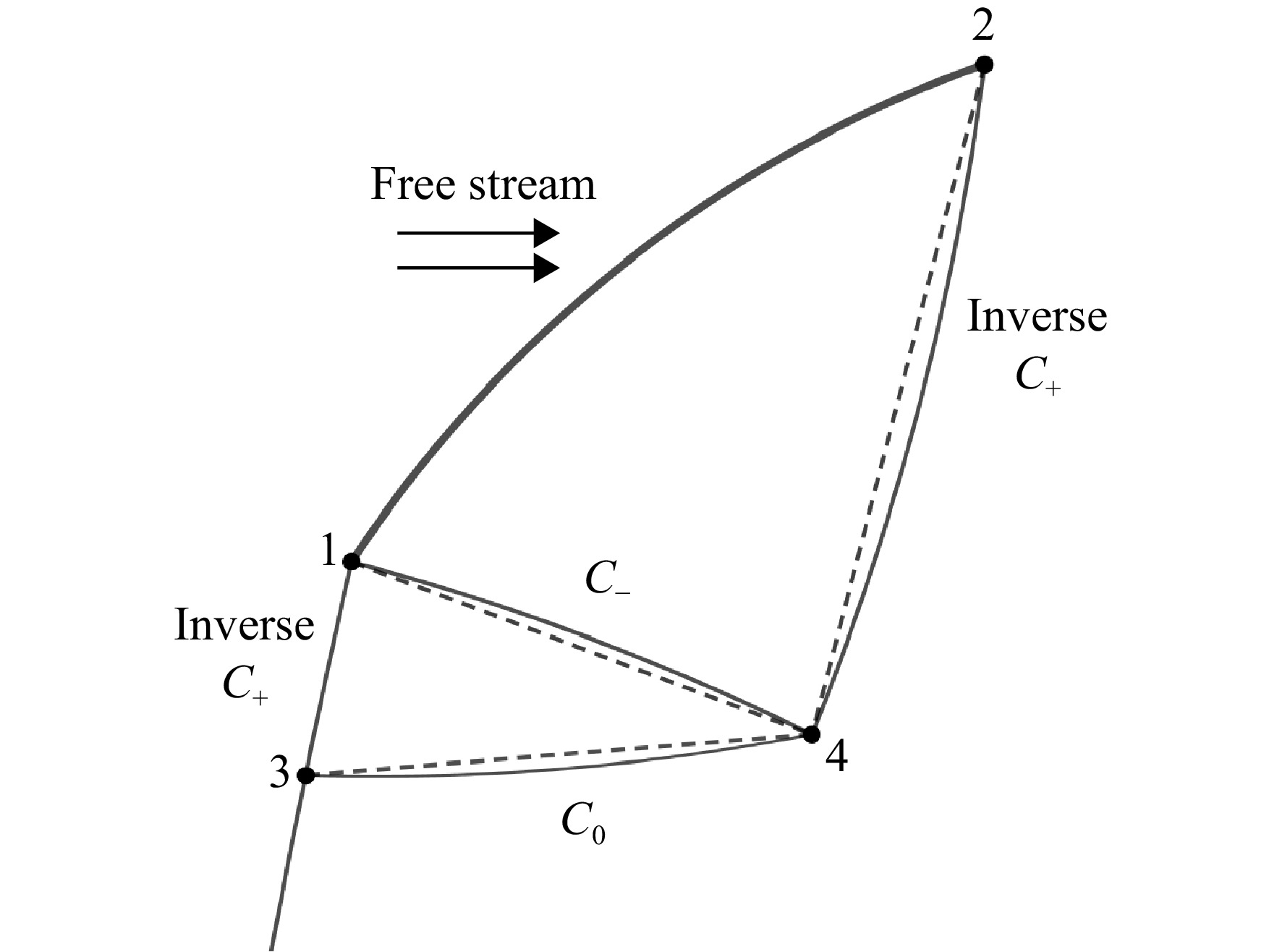

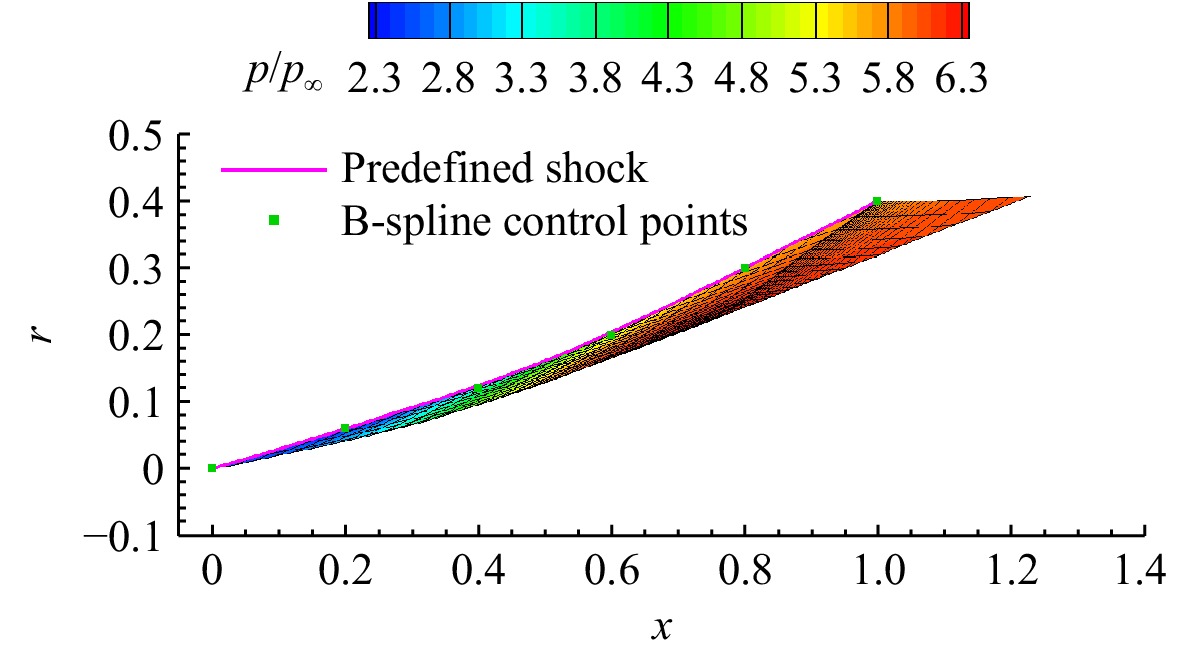
图 8 凹激波流场的网格和压力分布
Figure 8. Mesh and pressure distribution of flows with concave shock wave
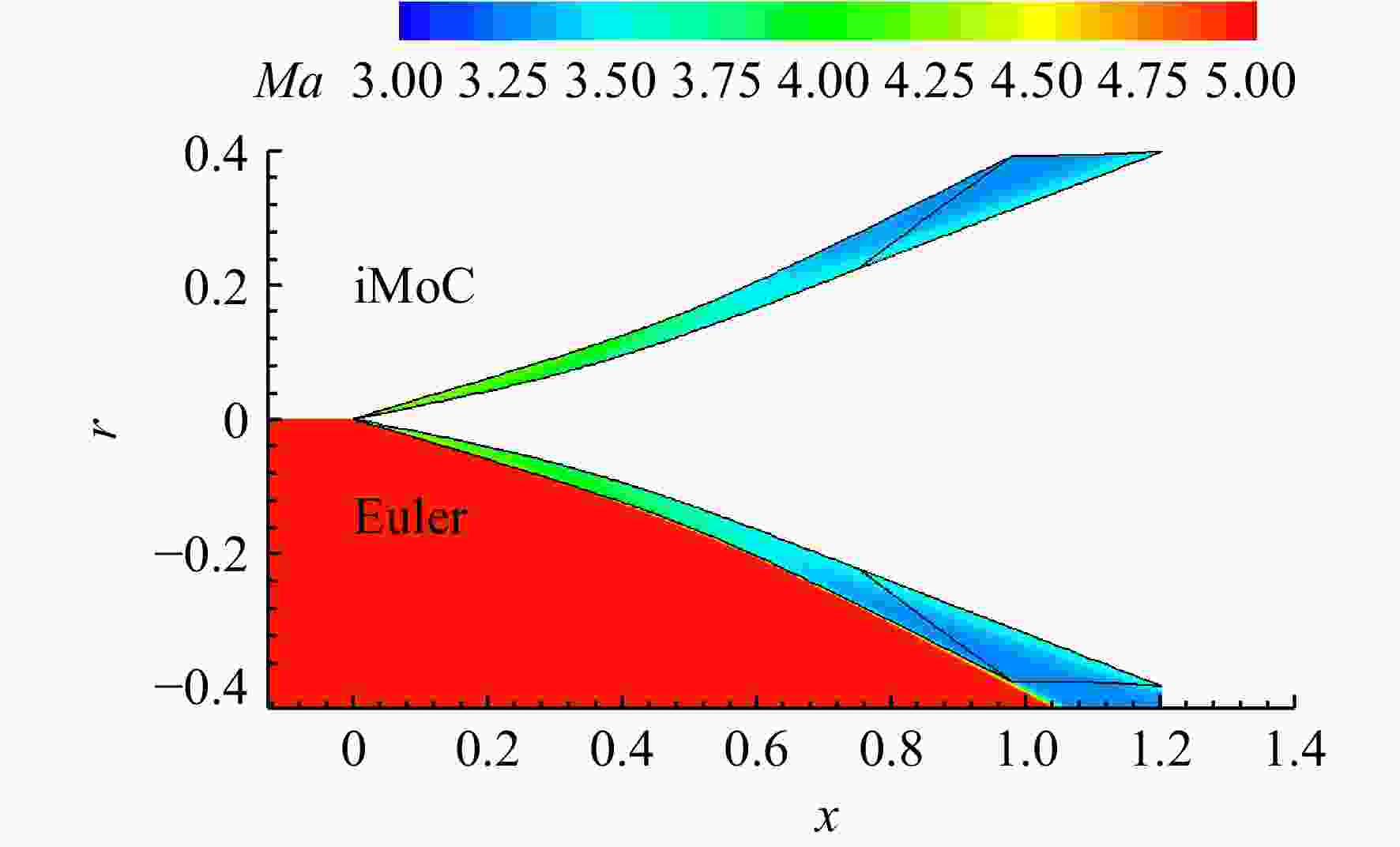
图 9 iMoC和CFD计算的凹激波流场马赫数对比
Figure 9. Mach number comparison of flows with concave shock wave simulated using iMoC and CFD
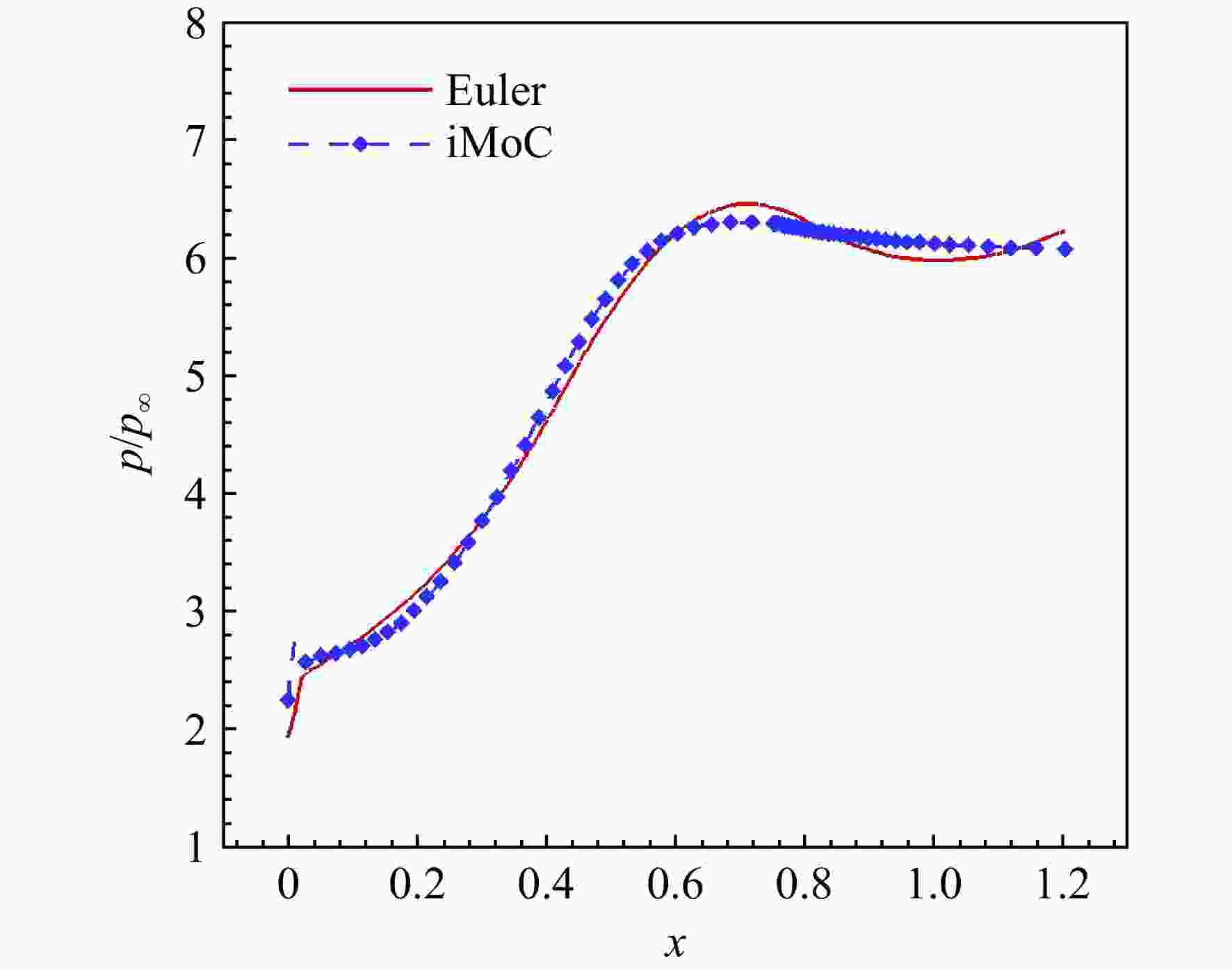
图 10 凹激波流场沿物面的压力对比
Figure 10. Comparison of pressure distribution along wall boundary in flows with concave shock
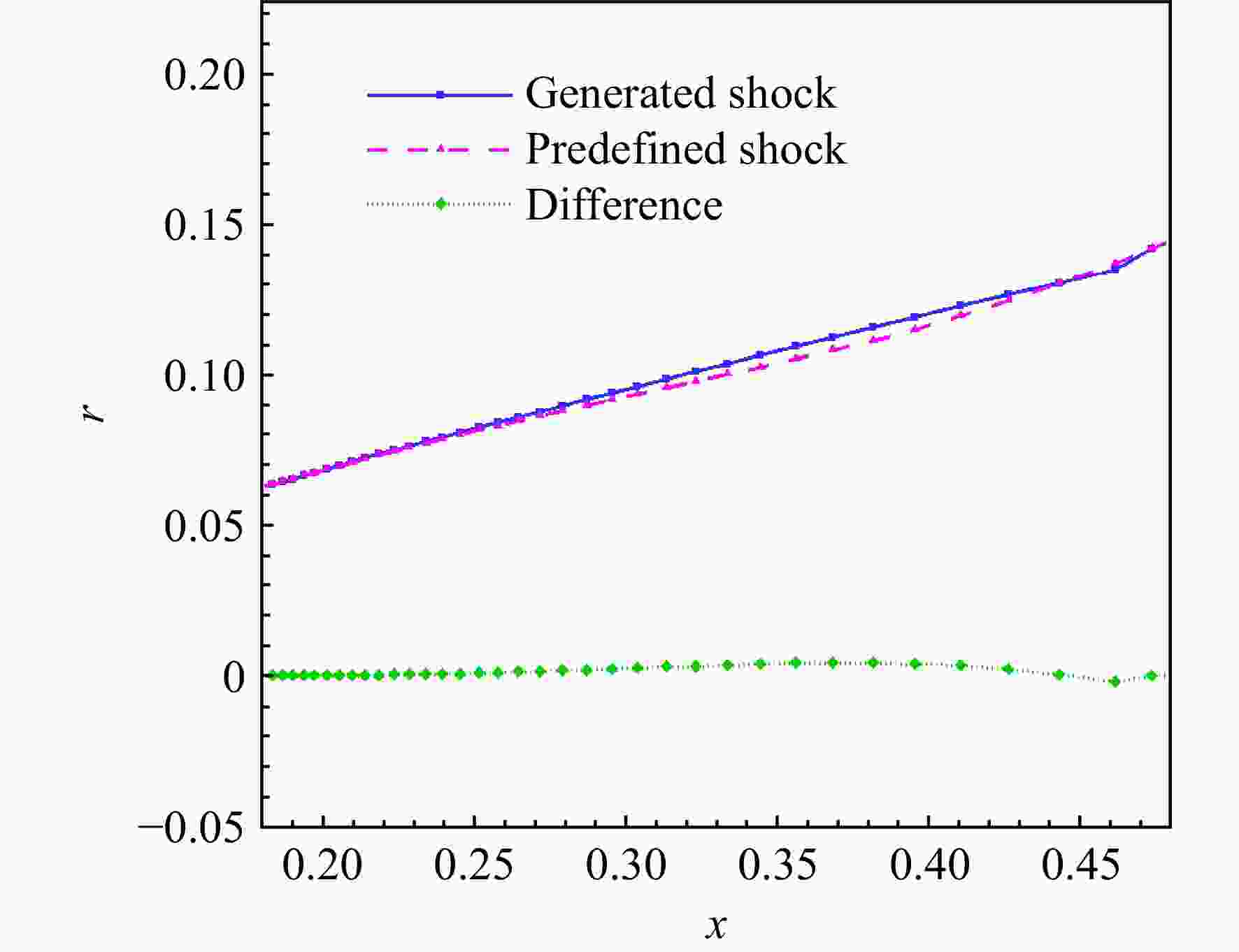
图 12 凸激波流场的激波形状局部对比
Figure 12. Part comparison of shock wave shape in flow with convex shock
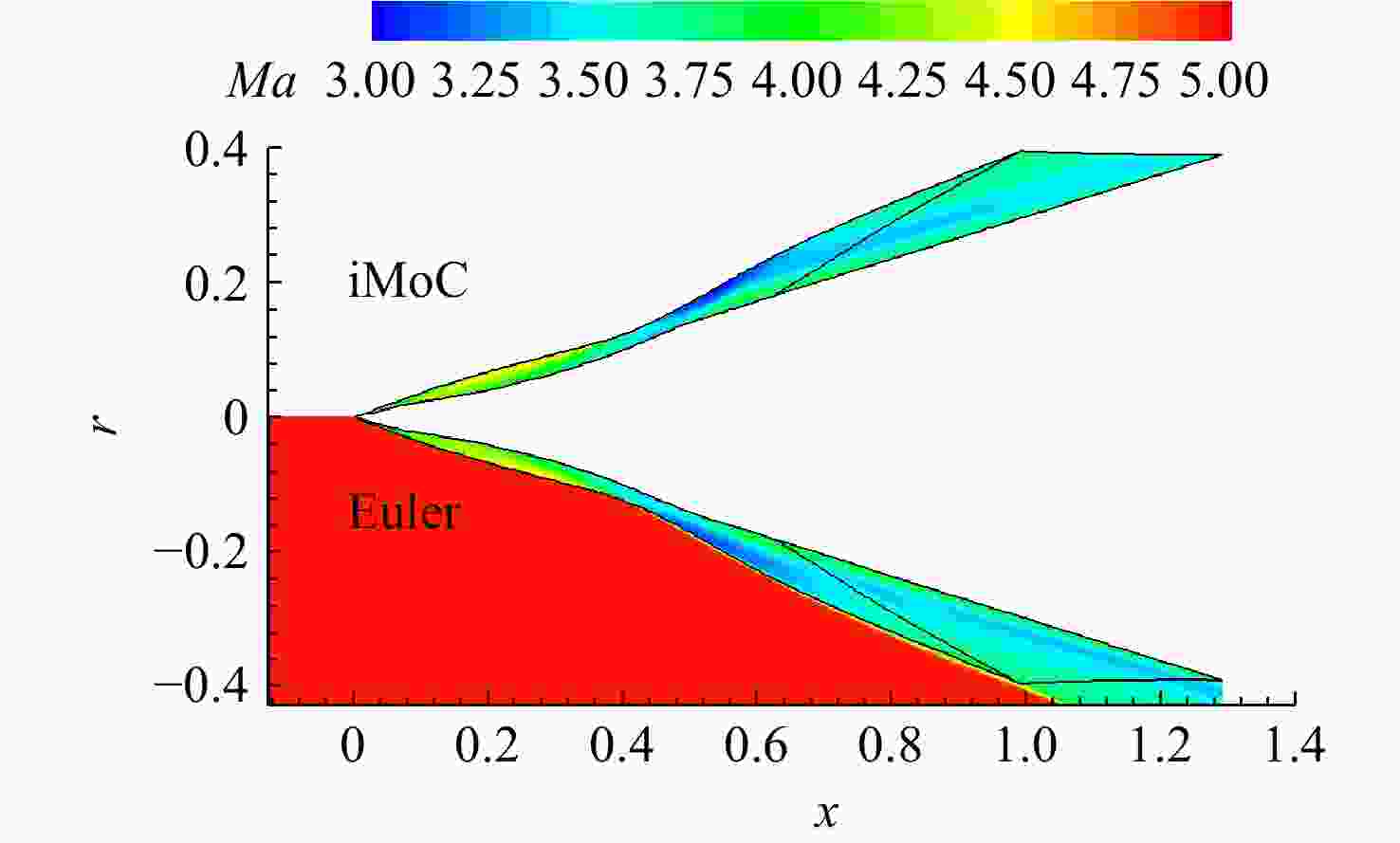
图 13 iMoC和CFD计算的凸激波流场马赫数对比
Figure 13. Mach number comparison of flows with convex shock wave simulated using iMoC and CFD
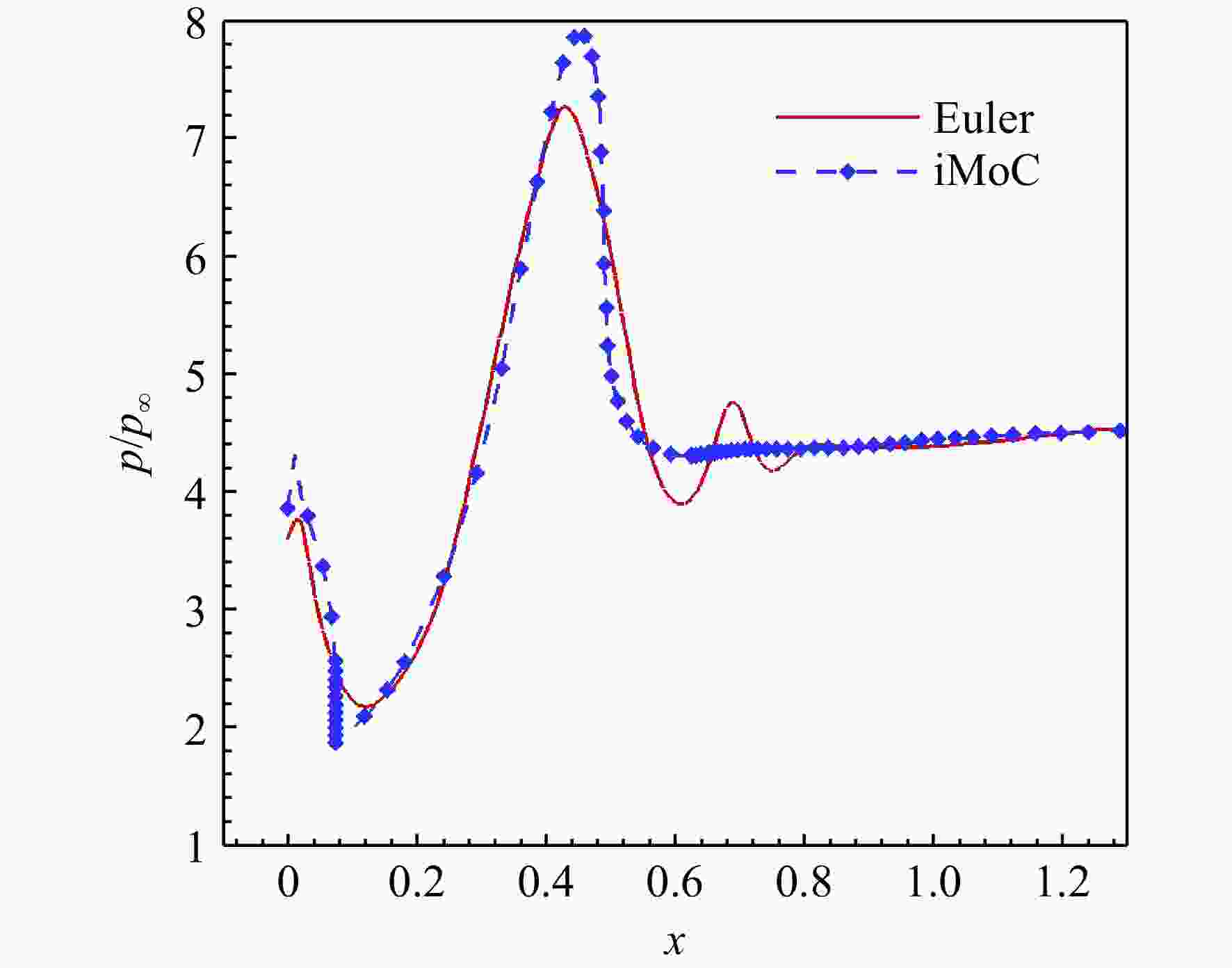
图 14 凸激波流场沿物面的压力对比
Figure 14. Comparison of pressure distribution along wall boundary in flows with convex shock wave
表 1 凹激波曲线的B样条控制点
Table 1. Control points of B-spline for concave shock curve
坐标 控制点 P0 P1 P2 P3 P4 P5 x 0 0.2 0.4 0.6 0.8 1.0 r 0 0.06 0.12 0.20 0.30 0.40  下载: 导出CSV
表 2 凸激波曲线的B样条控制点
Table 2. Control points of B-spline for convex shock curve
坐标 控制点 P0 P1 P2 P3 P4 P5 x 0.0 0.2 0.4 0.6 0.8 1.0 r 0.0 0.08 0.10 0.20 0.32 0.40
下载: 导出CSV
-
[1] CUI Kai,ZHAO Dongxu,YANG Guowei. Waverider configurations derived from general conical flowfields[J]. Acta Mechanica Sinica,2007,23(3): 247-255. doi: 10.1007/s10409-007-0069-2 [2] MANGIN B,BENAY R,CHANETZ B,et al. Optimization of viscous waveriders derived from axisymmetric power-law blunt body flows[J]. Journal of Spacecraft and Rockets,2006,43(5): 990-998. doi: 10.2514/1.20079 [3] DING Feng,LIU Jun,SHEN Chibing,et al. Novel approach for design of a waverider vehicle generated from axisymmetric supersonic flows past a pointed von Karman ogive[J]. Aerospace Science and Technology,2015,42: 297-308. doi: 10.1016/j.ast.2015.01.025 [4] LIU Wen,ZHANG Chenan,WANG Xiaopeng,et al. Parametric study on lateral-directional stability of hypersonic waverider[J]. AIAA Journal,2021: 1-18. [5] SOBIECZKY H,ZORES B,WANG Z,et al. High speed flow design using osculating axisymmetric flows[R]. Xi’an,China: 3rd Pacific International Conference on Aerospace Science and Technology 1997. [6] RODI P. The osculating flowfield method of waverider geometry generation[R]. AIAA2005-511,2005. [7] RODI P,GENOVESI D. Engineering-based performance comparisons between osculating cone and osculating flowfield waveriders[R]. AIAA2007-4344,2007. [8] WANG Xudong,WANG Jiangfeng,LYU Zhenjun. A new integration method based on the coupling of mutistage osculating cones waverider and Busemann inlet for hypersonic airbreathing vehicles[J]. Acta Astronautica,2016,126: 424-438. doi: 10.1016/j.actaastro.2016.06.022 [9] LIU Zhen,LIU Jun,DING Feng,et al. Influence of surface pressure distribution of basic flowfield on osculating axisymmetric waverider[J]. AIAA Journal,2019,57(10): 4560-4568. doi: 10.2514/1.J058140 [10] MIZENER A R,LU F K,RODI P E. Performance sensitivities of rotating detonation engines installed onto waverider forebodies[J]. Journal of Propulsion and Power,2019,35(2): 289-302. doi: 10.2514/1.B37033 [11] ZHOU Hang,JIN Zhiguang. A novel approach for inverse design of three-dimensional shock waves under non-uniform flows[J]. Acta Astronautica,2020,176: 324-331. doi: 10.1016/j.actaastro.2020.06.050 [12] 南向军,张堃元,金志光,等. 压升规律可控的高超声速内收缩进气道设计[J]. 航空动力学报,2011,26(3): 518-523. NAN Xiangjun,ZHANG Kunyuan,JIN Zhiguang,et al. Investigation on hypersonic inward turning inlets with controlled pressure gradient[J]. Journal of Aerospace Power,2011,26(3): 518-523. (in ChineseNAN Xiangjun, ZHANG Kunyuan, JIN Zhiguang, et al. Investigation on hypersonic inward turning inlets with controlled pressure gradient[J]. Journal of Aerospace Power, 2011, 26(3): 518-523. (in Chinese) [13] 李永洲,张堃元,南向军. 基于马赫数分布规律可控概念的高超声速内收缩进气道设计[J]. 航空动力学报,2012,27(11): 2484-2491. LI Yongzhou,ZHANG Kunyuan,NAN Xiangjun. Design of hypersonic inward turning inlets base on concept of controllable Mach number distribution[J]. Journal of Aerospace Power,2012,27(11): 2484-2491. (in ChineseLI Yongzhou, ZHANG Kunyuan, NAN Xiangjun. Design of hypersonic inward turning inlets base on concept of controllable Mach number distribution[J]. Journal of Aerospace Power, 2012, 27(11): 2484-2491. (in Chinese) [14] YOU Yancheng,LIANG Dewang. Design concept of three-dimensional section controllable internal waverider hypersonic inlet[J]. Science in China Series E: Technological Sciences,2009,52(7): 2017-2028. doi: 10.1007/s11431-009-0125-1 [15] 贺旭照,周正,倪鸿礼. 密切内锥乘波前体进气道一体化设计和性能分析[J]. 推进技术,2012,33(4): 510-515. HE Xuzhao,ZHOU Zheng,NI Hongli. Integrated design methods and performance analyses of osculating inward turning cone waverider forebody inlet(OICWI)[J]. Journal of Propulsion Technology,2012,33(4): 510-515. (in ChineseHE Xuzhao, ZHOU Zheng, NI Hongli. Integrated design methods and performance analyses of osculating inward turning cone waverider forebody inlet(OICWI)[J]. Journal of Propulsion Technology, 2012, 33(4): 510-515. (in Chinese) [16] HUANG Guoping,ZUO Fengyuan,QIAO Wenyou. Design method of internal waverider inlet under non-uniform upstream for inlet/forebody integration[J]. Aerospace Science and Technology,2018,74: 160-172. doi: 10.1016/j.ast.2018.01.012 [17] 曲俐鹏,曾学军,余安远,等. 一体化乘波进气道改进设计和流动特征分析[J]. 航空动力学报,2018,33(4): 865-873. QU Lipeng,ZENG Xuejun,YU Anyuan,et al. Improving design and flow characteristics analysis of an integrated wave-rider inlet[J]. Journal of Aerospace Power,2018,33(4): 865-873. (in ChineseQU Lipeng, ZENG Xuejun, YU Anyuan, et al. Improving design and flow characteristics analysis of an integrated wave-rider inlet[J]. Journal of Aerospace Power, 2018, 33(4): 865-873. (in Chinese) [18] 刘亚洲,李平,陈宏玉,等. 不同延伸段压力分布的双钟形喷管设计[J]. 航空动力学报,2022,37(2): 424-432. LIU Yazhou,LI Ping,CHEN Hongyu,et al. Design of dual-bell nozzles with different extension pressure distributions[J]. Journal of Aerospace Power,2022,37(2): 424-432. (in ChineseLIU Yazhou, LI Ping, CHEN Hongyu, et al. Design of dual-bell nozzles with different extension pressure distributions[J]. Journal of Aerospace Power, 2022, 37(2): 424-432. (in Chinese) [19] 乔文友,黄国平,夏晨,等. 发展用于高速飞行器前体/进气道匹配设计的逆特征线法[J]. 航空动力学报,2014,29(6): 1444-1452. QIAO Wenyou,HUANG Guoping,XIA Chen,et al. Development of inverse characteristic method for matching design of high-speed aircraft forebody/inlet[J]. Journal of Aerospace Power,2014,29(6): 1444-1452. (in ChineseQIAO Wenyou, HUANG Guoping, XIA Chen, et al. Development of inverse characteristic method for matching design of high-speed aircraft forebody/inlet[J]. Journal of Aerospace Power, 2014, 29(6): 1444-1452. (in Chinese) [20] YU Kaikai,XU Jinglei,GONG Hao,et al. Inverse design methodology of cone-derived waverider based on pre-defined shock wave under strong geometric constraints[J]. Acta Astronautica,2019,159: 527-539. doi: 10.1016/j.actaastro.2019.02.011 [21] 郭善广,王振国,赵玉新,等. 高超声速二元进气道前体曲线激波逆向设计[J]. 航空学报,2014,35(5): 1246-1256. GUO Shanguang,WANG Zhenguo,ZHAO Yuxin,et al. Inverse design of the fore-body curved shock wave of the hypersonic planar inlet[J]. Acta Aeronautica et Astronautica Sinica,2014,35(5): 1246-1256. (in ChineseGUO Shanguang, WANG Zhenguo, ZHAO Yuxin, et al. Inverse design of the fore-body curved shock wave of the hypersonic planar inlet[J]. Acta Aeronautica et Astronautica Sinica, 2014, 35(5): 1246-1256. (in Chinese) [22] JONES K,DOUGHERTY F,SEEBASS A,et al. Waverider design for generalized shock geometries[R]. AIAA1993-774,1993. [23] LI H,BEN-DOR G. Oblique-shock/expansion-fan interaction-analytical solution[J]. AIAA Journal,1996,34(2): 418-421. doi: 10.2514/3.13081 [24] 周建伟. 轴对称体外部流场的有旋特征线法[J]. 上海航天,1999,16(6): 24-29,41. ZHOU Jianwei. The theory of the viscid characteristics for the flow field of the axisymmetric body[J]. Aerospace Shanghai,1999,16(6): 24-29,41. (in ChineseZHOU Jianwei. The theory of the viscid characteristics for the flow field of the axisymmetric body[J]. Aerospace Shanghai, 1999, 16(6): 24-29, 41. (in Chinese) [25] LES P,WAYNE T. The NURBS book (second edition) [M]. Heidelberg,Germany: Springer-Verlag,1997. -


 点击查看大图

计量
- 文章访问数: 333
- HTML浏览量: 265
- PDF量: 40
- 被引次数: 0