






Influence of helium cycle flow ratio on SABRE4 design point hydrogen flow rate
-
摘要:
针对协同吸气式火箭发动机(synergistic air-breathing rocket engine,SABRE),建立了基于部件法的发动机设计点热力学计算模型,分析了SABRE循环所需的最少氢质量流量(简称流量)。以节省氢流量为目的,分别在SABRE3发动机构型基础上增加了两个氦循环支路,提出了两个SABRE4简化方案,结合两种简化方案,提出了SABRE4整体方案,分析了各氦循环支路分流比对发动机设计点重要参数以及设计点氢流量的影响。结果表明:最小氢流量与通过换热器3的氦流量成正比,要减小所需氢流量,需要减少通过换热器3的氦流量;较低的氦循环支路分流比一有利于氢流量的降低,但同时增大了氦压气机设计压比,较低的氦循环支路分流比二有利于氢流量的降低,且有利于降低氦压气机设计压比,分流比一、分流比二的降低都会导致换热器接近换热限制边界;在换热器1前氦气总温不超过310 K,且氦压气机压比不大于11.0的情况下,SABRE4方案最小氢流量为SABRE3氢流量的83.3%。
Abstract:The thermodynamic calculation model based on component method for synergistic air-breathing rocket engine (SABRE) design point was established. The minimum hydrogen flow rate required by the engine was analyzed. To save the hydrogen flow rate, two simplified schemes of SABRE4 were proposed by adding two helium branches based on the SABRE3 configuration. Combining two simplified schemes, SABRE4 scheme was proposed. The influences of the helium branches flow ratios on engine design point parameters and hydrogen flow rate were analyzed. The results showed that: the minimum hydrogen flow rate was proportional to the helium flow rate through Heat Exchanger 3. The less helium flow rate through Heat Exchanger 3 indicated the less hydrogen flow rate required. A smaller branch one flow ratio one was conductive to reducing the hydrogen flow rate, meanwhile the required helium compressor pressure ratio was increased. A smaller branch two flow ratio two was conductive to reducing the hydrogen flow rate and the required helium compressor pressure ratio. The decrease of flow ratio one and flow ratio two caused heat exchangers to approach their limits. When the Heat Exchanger 1 inlet helium temperature was lower than 310 K and the pressure ratio of helium compressor was lower than 11.0, the minimum hydrogen flow rate of SABRE4 was 83.3% of SABRE3.
-
Key words:
- SABRE /
- hydrogen flow rate /
- impulse /
- flow ratio /
- design point
-
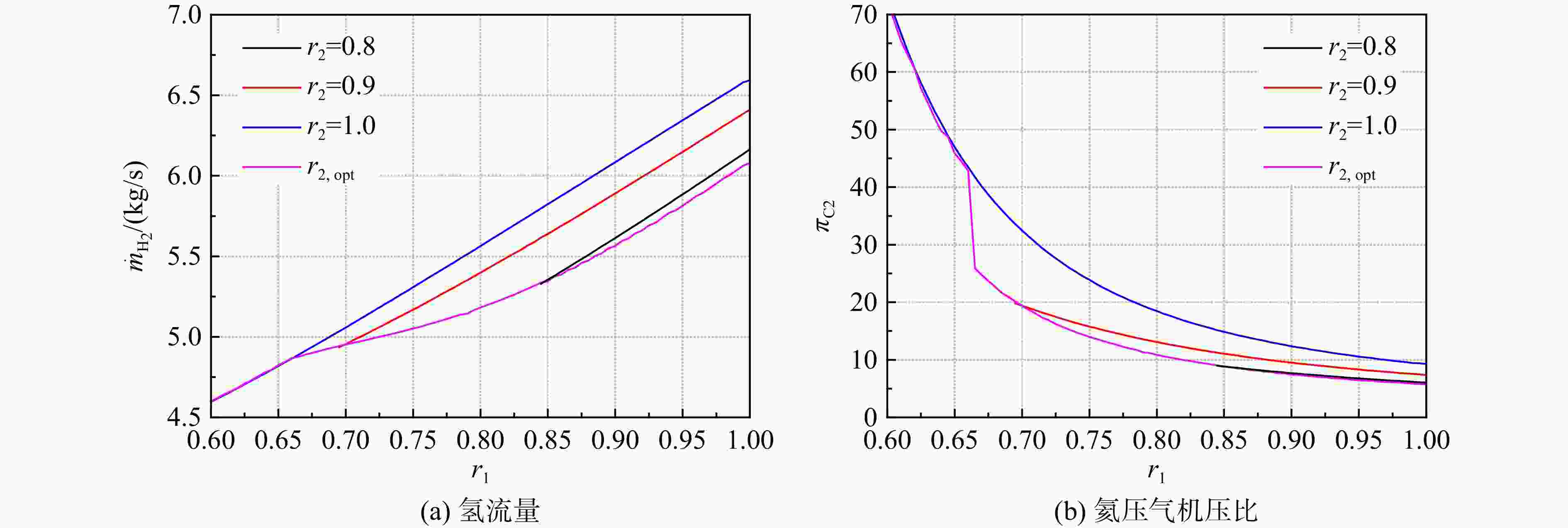
图 8 T272=200 K时氢流量与氦压气机压比
Figure 8. Hydrogen flow rate and helium compressor pressure ratio at T272=200 K
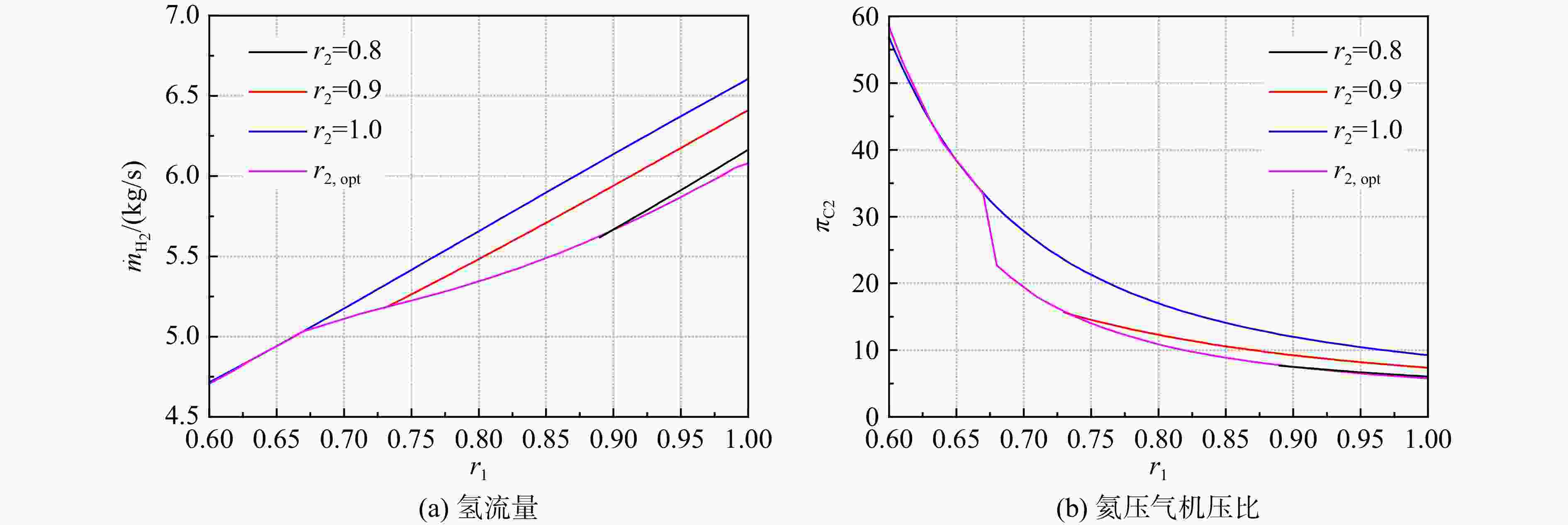
图 9 T272=300 K时氢流量与氦压气机压比
Figure 9. Hydrogen flow rate and helium compressor pressure ratio at T272=300 K
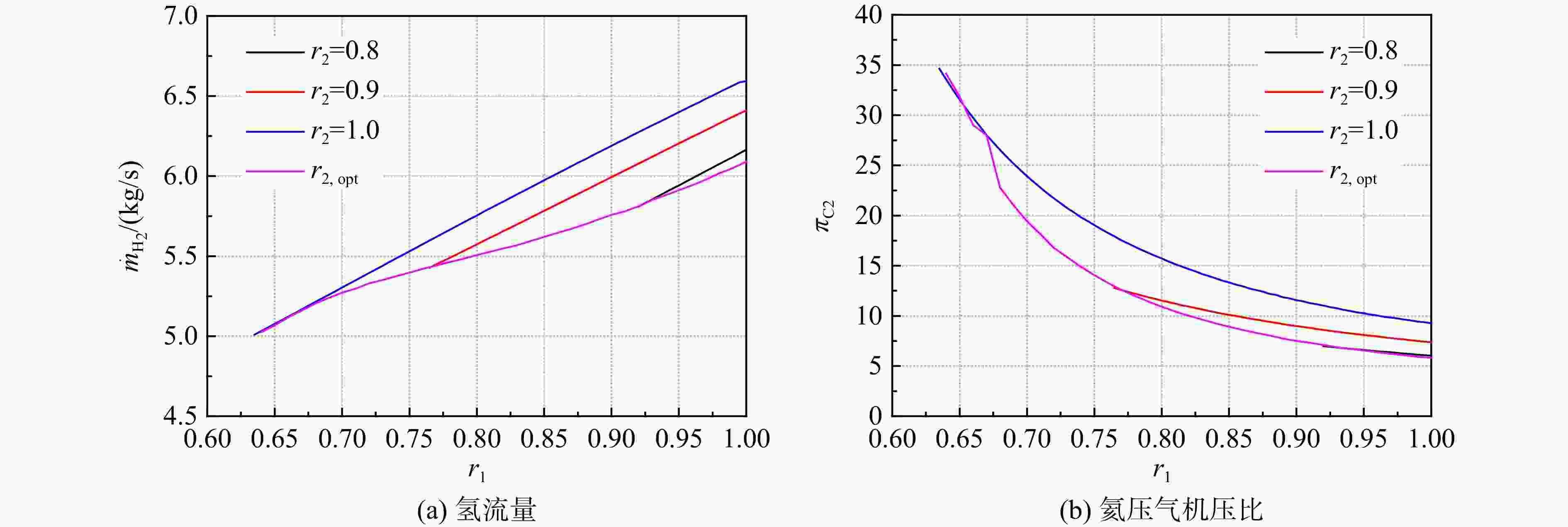
图 10 T272=400 K时氢流量与氦压气机压比
Figure 10. Hydrogen flow rate and helium compressor pressure ratio at T272=400 K
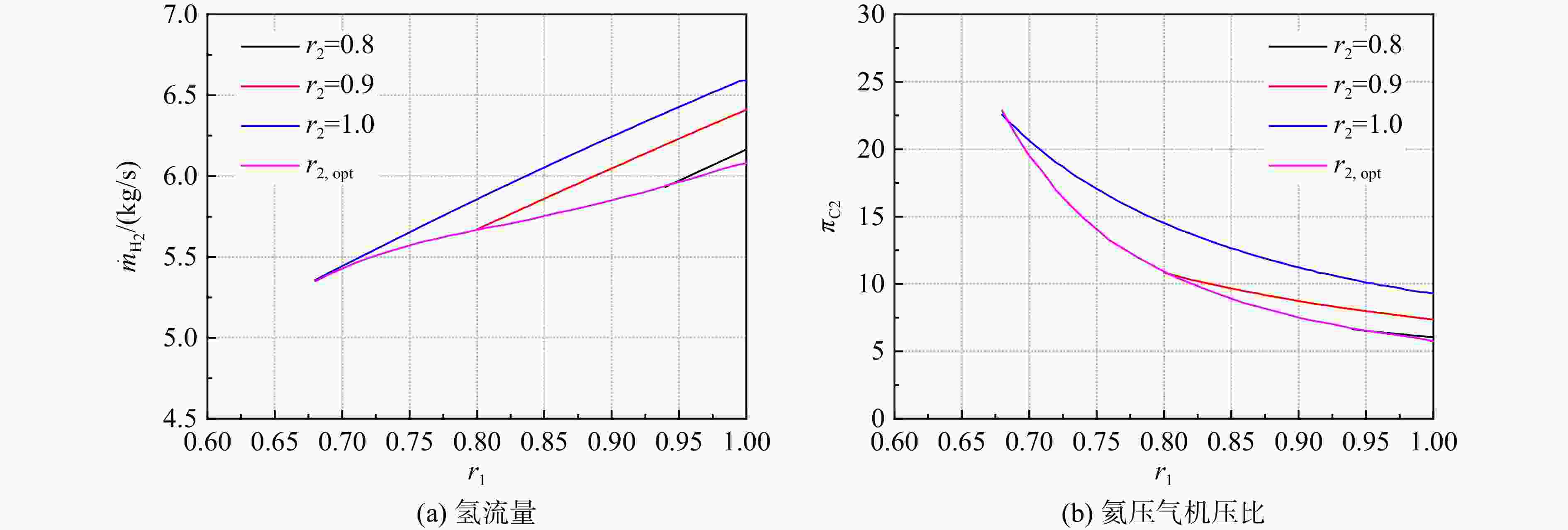
图 11 T272=500 K时氢流量与氦压气机压比
Figure 11. Hydrogen flow rate and helium compressor pressure ratio at T272=500 K
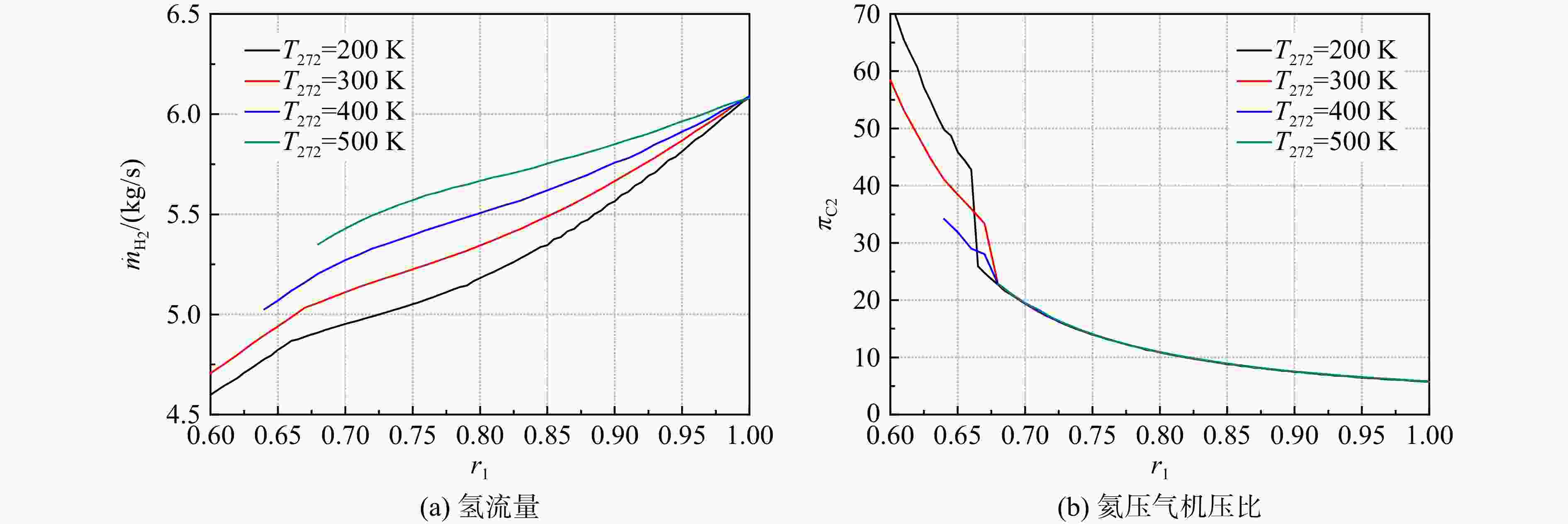
图 12 最佳分流比r2,opt下的氢流量与氦压气机压比
Figure 12. Hydrogen flow rate and helium compressor pressure ratio at optimal flow ratio r2,opt
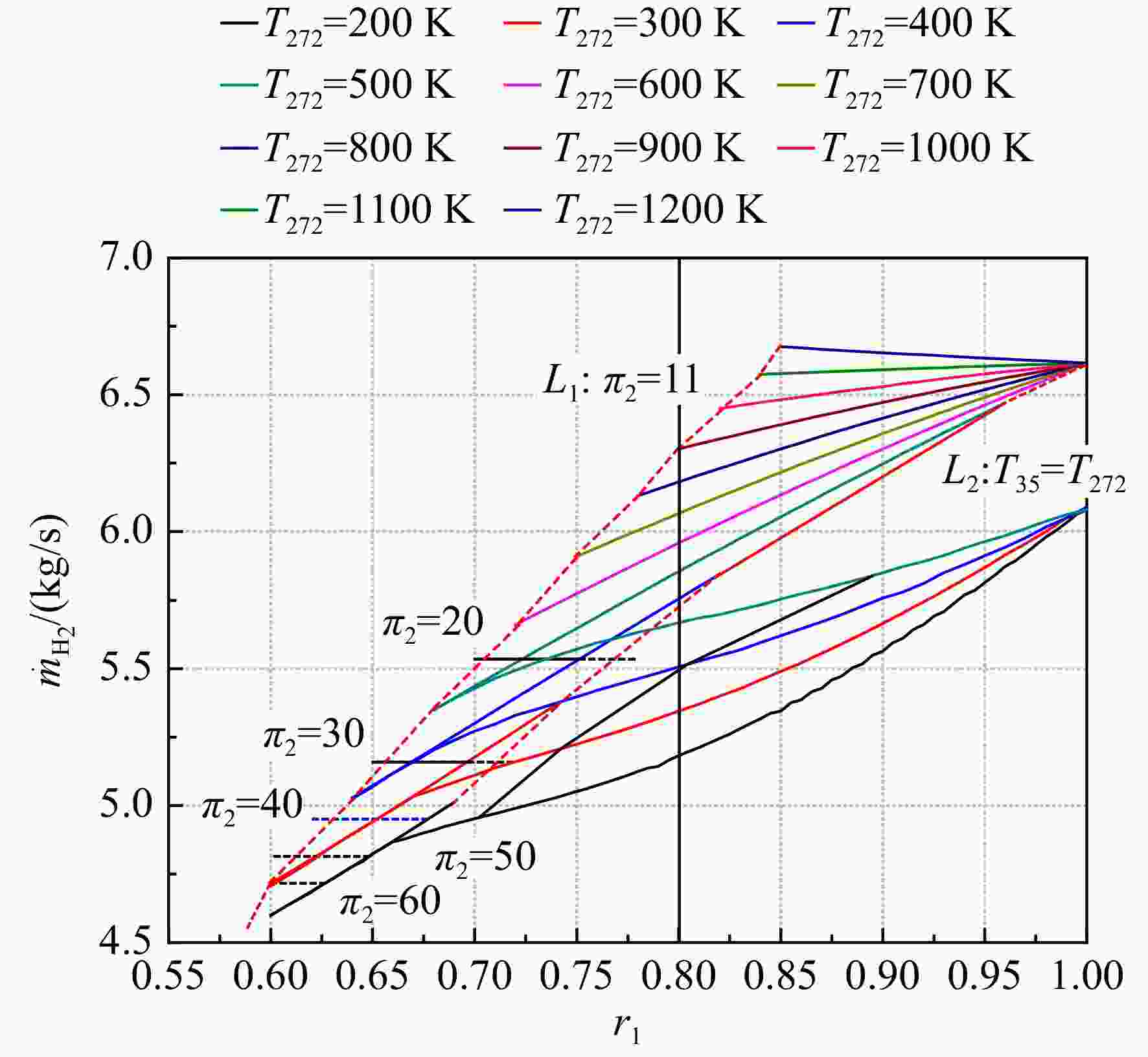
图 13 SABRE4与SABRE4简化方案1的氢流量比较
Figure 13. Hydrogen flow rate comparison between SABRE4 and simplified scheme 1 of SABRE4
表 1 SABRE4简化方案1省氢流量收益对比
Table 1. Hydrogen benefits of SABRE4 simplified scheme 1
πC2 r1 $ {\dot m_{{{\text{H}}_{\text{2}}}}} $/(kg/s) $ ({\dot m_{{{\text{H}}_{\text{2}}}{\text{,S4}}}}/{\dot m_{{{\text{H}}_{\text{2}}}{\text{,S3}}}}) $/% 20 0.705 5.535 83.7 30 0.656 5.158 78.0 40 0.630 4.950 75.0 50 0.613 4.815 72.8 60 0.600 4.760 71.9  下载: 导出CSV
-
[1] CONCHIE P. The HOTOL space transportation system[R]. AIAA1986-786,1986. [2] HEMPSELL M,BOND A,BOND R,et al. Progress on the SKYLON and SABRE development programme[R]. Cape Town,South Africa: 62nd International Astronautical Congress. 2011. [3] HEMPSELL M. Progress on the SKYLON and SABRE[R]. Beijing,China: 64th International Astronautical Congress,2013. [4] HEMPSELL M,BOND A. SKYLON: an example of commercial launch system development[R]. Napoli,Italy: XXII Conference Presented at the Italian Association of Aeronautics and Astronautics (AIDAA),2013. [5] VARVILL R,BOND A. The SKYLON spaceplane: progress to realisation[J]. Journal of the British Interplanetary Society,2008,61: 412-418. [6] MURRAY J,HEMPSELL C,BOND A. An experimental precooler for airbreathing rocket engines[J]. Journal of the British Interplanetary Society,2001,54(5/6): 199-209. [7] 牛文,李文杰. SKYLON飞行器与SABRE发动机研究[J]. 飞航导弹,2013(3): 70-75. NIU Wen,LI Wenjie. Research on SKYLON aircraft and SABRE engine[J]. Aerodynamic Missile Journal,2013(3): 70-75. (in ChineseNIU Wen, LI Wenjie. Research on SKYLON aircraft and SABRE engine[J]. Aerodynamic Missile Journal, 2013(3): 70-75. (in Chinese) [8] 张志刚,陈静敏,李志永,等. SABRE发动机吸气模式下氦气闭式循环特性分析[J]. 战术导弹技术,2016(2): 57-62. ZHANG Zhigang,CHEN Jingmin,LI Zhiyong,et al. Characteristic analysis of the helium closed cycle of SABRE in air-breathing mode[J]. Tactical Missile Technology,2016(2): 57-62. (in ChineseZHANG Zhigang, CHEN Jingmin, LI Zhiyong, et al. Characteristic analysis of the helium closed cycle of SABRE in air-breathing mode[J]. Tactical Missile Technology, 2016(2): 57-62. (in Chinese) [9] 杨新垒,聂万胜,刘晓慧. SABRE吸气模式热力循环及预冷器性能分析[J]. 战术导弹技术,2018(1): 104-110. YANG Xinlei,NIE Wansheng,LIU Xiaohui. Performance analysis of thermodynamic cycle and pre-cooler in SABRE air-breathing mode[J]. Tactical Missile Technology,2018(1): 104-110. (in ChineseYANG Xinlei, NIE Wansheng, LIU Xiaohui. Performance analysis of thermodynamic cycle and pre-cooler in SABRE air-breathing mode[J]. Tactical Missile Technology, 2018(1): 104-110. (in Chinese) [10] YU Xuanfei,YU Wenli,WANG Cong,et al. Thermodynamic analysis of the influential mechanism of fuel properties on the performance of an indirect precooled hypersonic airbreathing engine and vehicle[J]. Energy Conversion and Management,2019,196: 1138-1152. doi: 10.1016/j.enconman.2019.06.049 [11] YU Xuanfei,WANG Cong,YU Daren. Minimization of entropy generation of a closed Brayton cycle based precooling-compression system for advanced hypersonic airbreathing engine[J]. Energy Conversion and Management,2020,209: 112548. doi: 10.1016/j.enconman.2020.112548 [12] YU X,WANG C,QIN J,et al. Thermodynamic analysis of precooled airbreathing engine[J]. Journal of Engineering Thermophysics,2018,39: 31-37. [13] YU Xuanfei,WANG Cong,YU Daren. Thermodynamic design and optimization of the multi-branch closed Brayton cycle based precooling-compression system for a novel hypersonic aeroengine[J]. Energy Conversion and Management,2020,205: 112412. doi: 10.1016/j.enconman.2019.112412 [14] 高远,陈玉春,王治华,等. 深冷组合循环发动机吸气模态循环分析与设计可行域研究[J]. 推进技术,2020,41(6): 1217-1226. GAO Yuan,CHEN Yuchun,WANG Zhihua,et al. Cycle analysis and design feasible region research of deeply precooled combined cycle engine in airbreathing mode[J]. Journal of Propulsion Technology,2020,41(6): 1217-1226. (in ChineseGAO Yuan, CHEN Yuchun, WANG Zhihua, et al. Cycle analysis and design feasible region research of deeply precooled combined cycle engine in airbreathing mode[J]. Journal of Propulsion Technology, 2020, 41(6): 1217-1226. (in Chinese) [15] 高远,陈玉春,史新兴. 深冷组合发动机吸气模态最大状态控制规律研究[J]. 推进技术,2020,41(12): 2659-2669. GAO Yuan,CHEN Yuchun,SHI Xinxing. Maximum state control schedule research on deeply precooled combined cycle engine in airbreathing mode[J]. Journal of Propulsion Technology,2020,41(12): 2659-2669. (in ChineseGAO Yuan, CHEN Yuchun, SHI Xinxing. Maximum state control schedule research on deeply precooled combined cycle engine in airbreathing mode[J]. Journal of Propulsion Technology, 2020, 41(12): 2659-2669. (in Chinese) [16] 唐靖博,杨庆春,徐旭. 预冷组合循环发动机吸气式模态建模与性能分析[J]. 推进技术,2022,43(9): 20-33. TANG Jingbo,YANG Qingchun,XU Xu. Modeling and performance analysis of precooled combined cycle engine in air-breathing mode[J]. Journal of Propulsion Technology,2022,43(9): 20-33. (in ChineseTANG Jingbo, YANG Qingchun, XU Xu. Modeling and performance analysis of precooled combined cycle engine in air-breathing mode[J]. Journal of Propulsion Technology, 2022, 43(9): 20-33. (in Chinese) [17] 廉筱纯,吴虎. 航空发动机原理[M]. 西安: 西北工业大学出版社,2005. [18] 杨世铭,陶文铨. 传热学. 第4版[M]. 北京: 高等教育出版社,2006. [19] 黄兴. 超燃冲压发动机特性计算与一体化设计技术研究[D]. 西北工业大学,2014. HUANG Xing. The characteristic simulation of scramjet and the integration design research[D]. Xi’an: Northwestern Polytechnical University,2014. (in ChineseHUANG Xing. The characteristic simulation of scramjet and the integration design research[D]. Xi’an: Northwestern Polytechnical University, 2014. (in Chinese) [20] 航空发动机手册总编委会. 航空发动机设计手册: 第15分册[M]. 北京: 航空工业出版社,2000. [21] 关醒凡. 现代泵理论与设计[M]. 北京: 中国宇航出版社,2011. [22] CHASE JR M W. NIST-JANAF Thermochemical Tables[M]. Fourth Edition. Melville,US: American Institute of Physics,1998. [23] Fernández-Villacé V. Simulation,design and analysis of air-breathing combined-cycle engines for high speed propulsion[D]. Brussels,Belgium: Von Karman Institute for Fluid Dynamics,2013. -


 点击查看大图

计量
- 文章访问数: 522
- HTML浏览量: 305
- PDF量: 37
- 被引次数: 0