






Research on the aerodynamic performance optimization of dragonfly-inspired tandem flapping wing based on neural network and CFD
-
摘要:
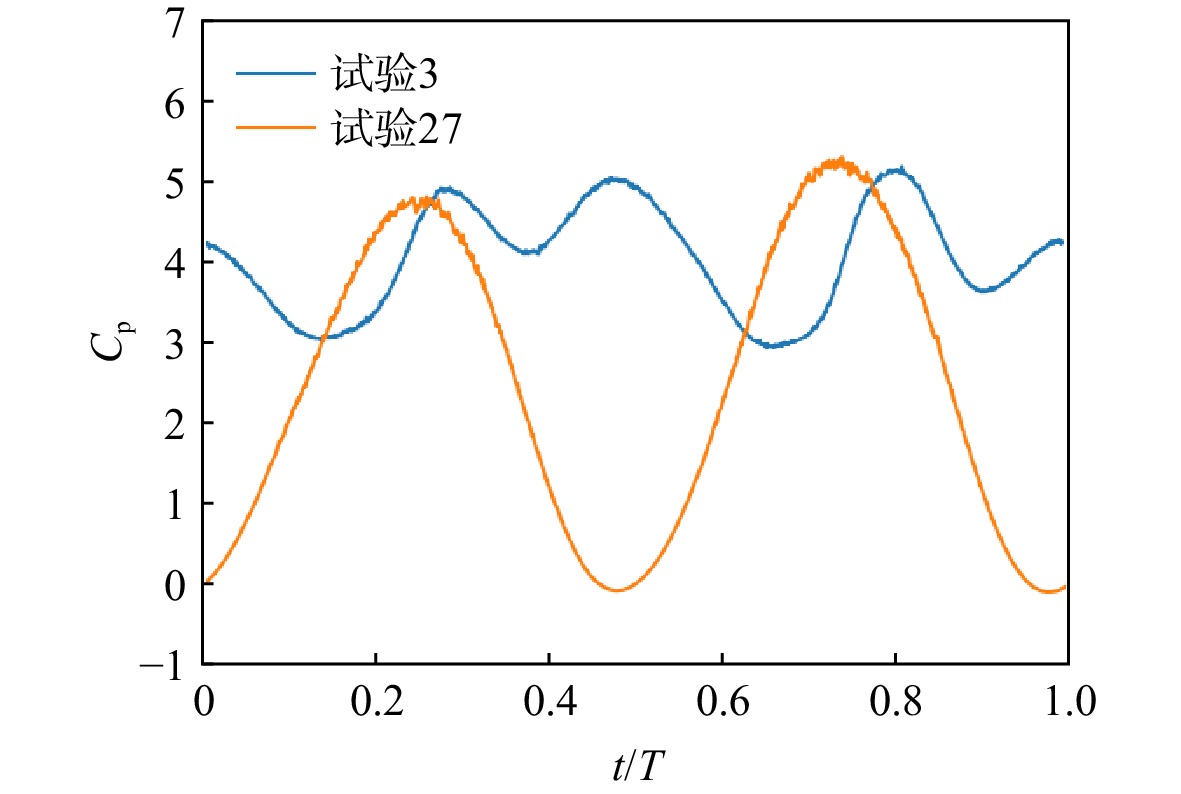
为了提升仿蜻蜓串联扑翼的气动性能,采用神经网络与CFD相结合的方法,系统分析了扭转角幅值,翼间距和前后翼相位差变化对仿蜻蜓串联扑翼升举效率的影响。研究结果表明:扭转角幅值,翼间距和前后翼相位差变化对仿蜻蜓串联扑翼的气动性能具有重要影响。就所研究的参数范围,通过神经网络优化后,最优和最差参数组合扑翼的升举效率相差90.33%。进一步通过对不同参数组合仿蜻蜓串联扑翼的流场分析,发现优化参数组合的串联扑翼前翼脱落的尾涡可以重新附着在后翼表面,减弱后翼上冲程时的涡旋强度,降低扑翼的能量消耗,从而使扑翼获得更好的气动性能。
Abstract:In order to improve the aerodynamic performance of dragonfly-inspired tandem flapping wings, the influences of three parameters, i.e. pitching amplitude, wing spacing and phase difference between forewing and hindwing, on the lifting efficiency of dragonfly-inspired tandem flapping wing were systematically analyzed by the combination of the neural network and CFD. The results showed that pitching amplitude, wing spacing and phase difference between forewing and hindwing had important influence on the aerodynamic performance of dragonfly-inspired tandem flapping wings. In the analysis parameter range, compared with the flapping wing with worst parameter combination, the lifting efficiency of the flapping wing with the best parameter combinations increased 90.33% by using neural network optimization. Furthermore, through the analysis of flow field of dragonfly-inspired tandem flapping wing with different parameter combinations, it was found that the trailing vortices shedding from the forewing can be reattached to the surface of the hindwing for the tandem flapping wing with the optimal combination of parameter, which can weaken the vortex intensity during the upstroke of the hindwing and reduce the energy consumption of the flapping wing, so that the flapping wing can generate better aerodynamic performance.
-
Key words:
- tandem flapping wing /
- neural network /
- lifting efficiency /
- CFD numerical simulation /
- taguchi method
-

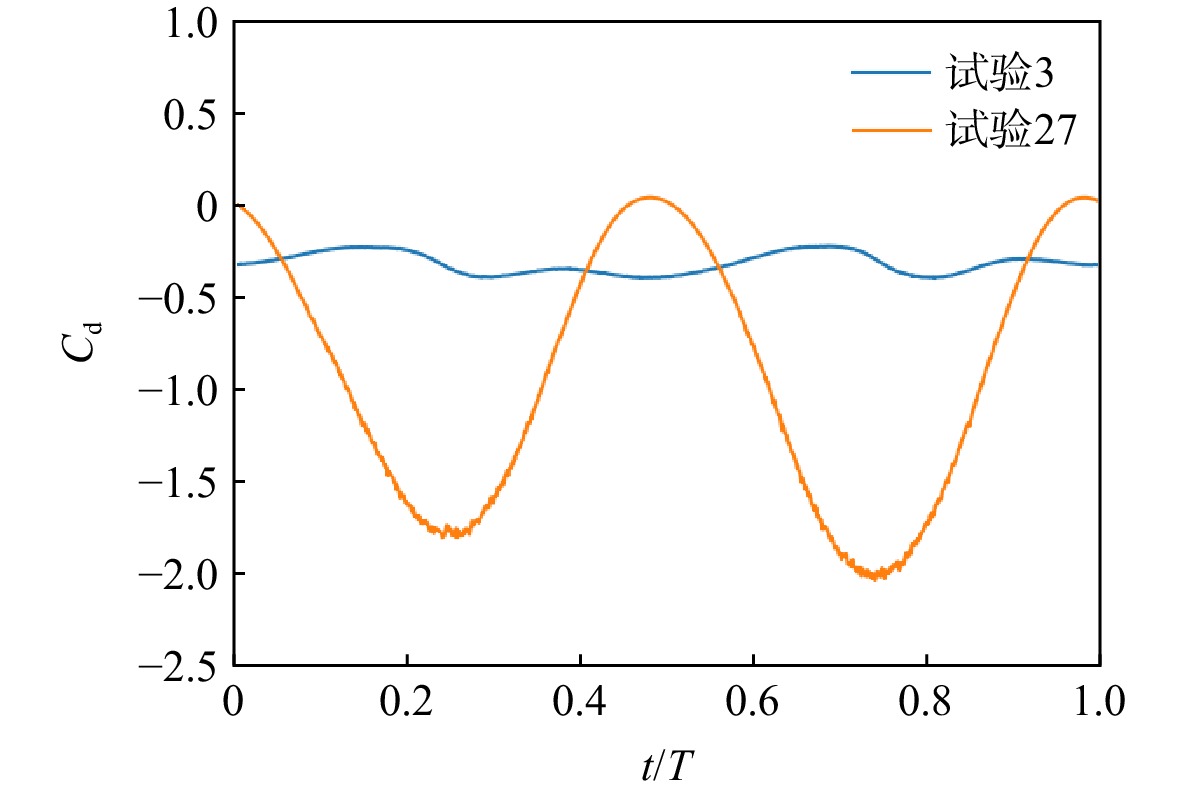
图 4 不同网格密度下的扑翼升力和阻力系数
Figure 4. Evolution of lift and drag coefficient of double flapping wings for different grid densities

图 5 不同时间步长下的扑翼升力和阻力系数
Figure 5. Evolution of lift and drag coefficient of double flapping wings for different time steps

图 6 本文数值方法计算的升力和推力与文献数据的对比
Figure 6. Comparison of the lift and thrust of the wing obtained by the literature data and present numerical method

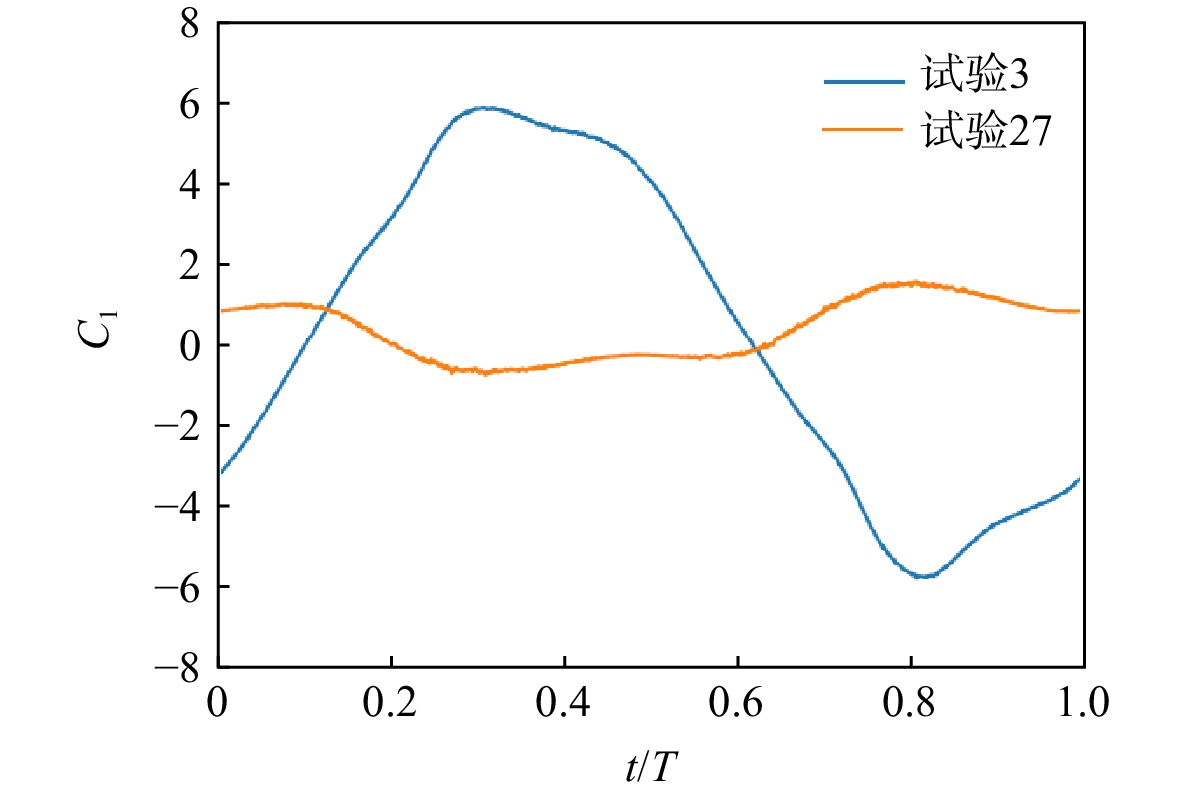
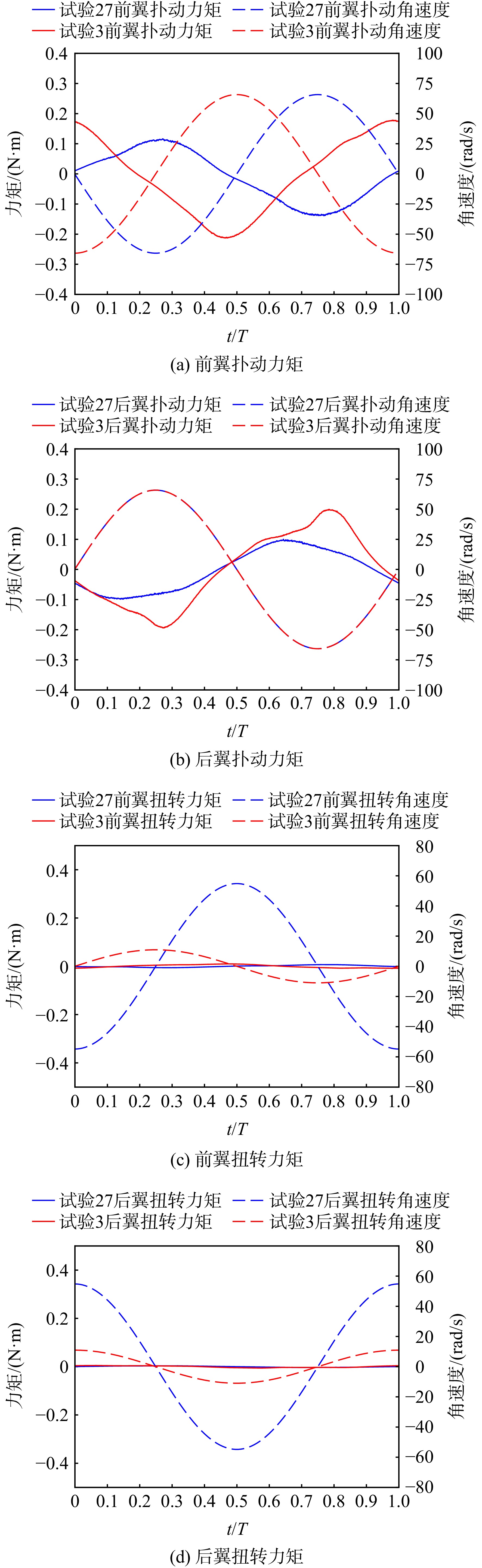
图 14 试验3和试验27扑动和扭转运动产生的力矩
Figure 14. Moment produced by flapping and pitching motion in trial 3 and trial 27
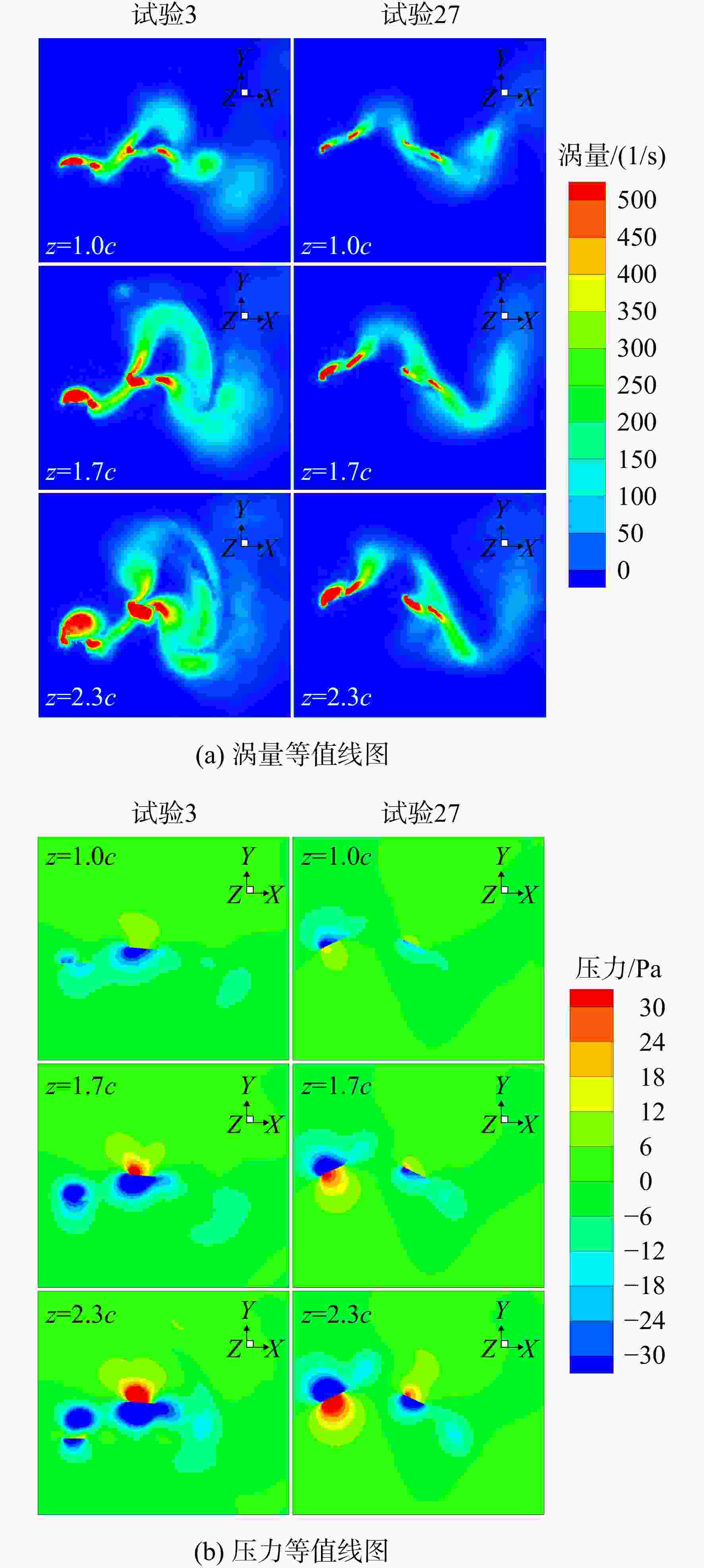
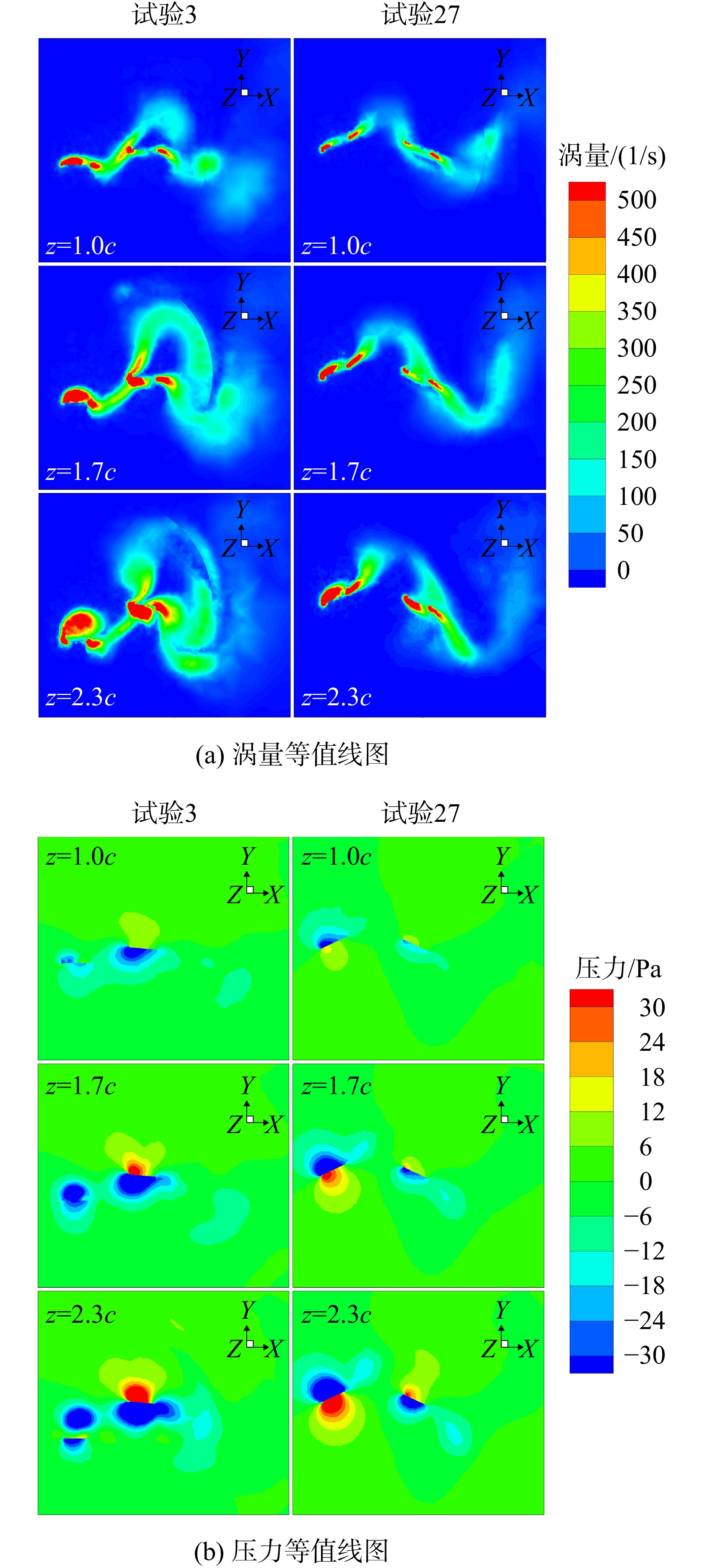
图 15 试验3和试验27在t=0.75T, z=1.0c, 1.7c, 2.3c处的涡量、压力等值线图
Figure 15. Contour plots of vorticity and pressure for trial 3 and trial 27 at t=0.75T, z=1.0c, 1.7c, 2.3c

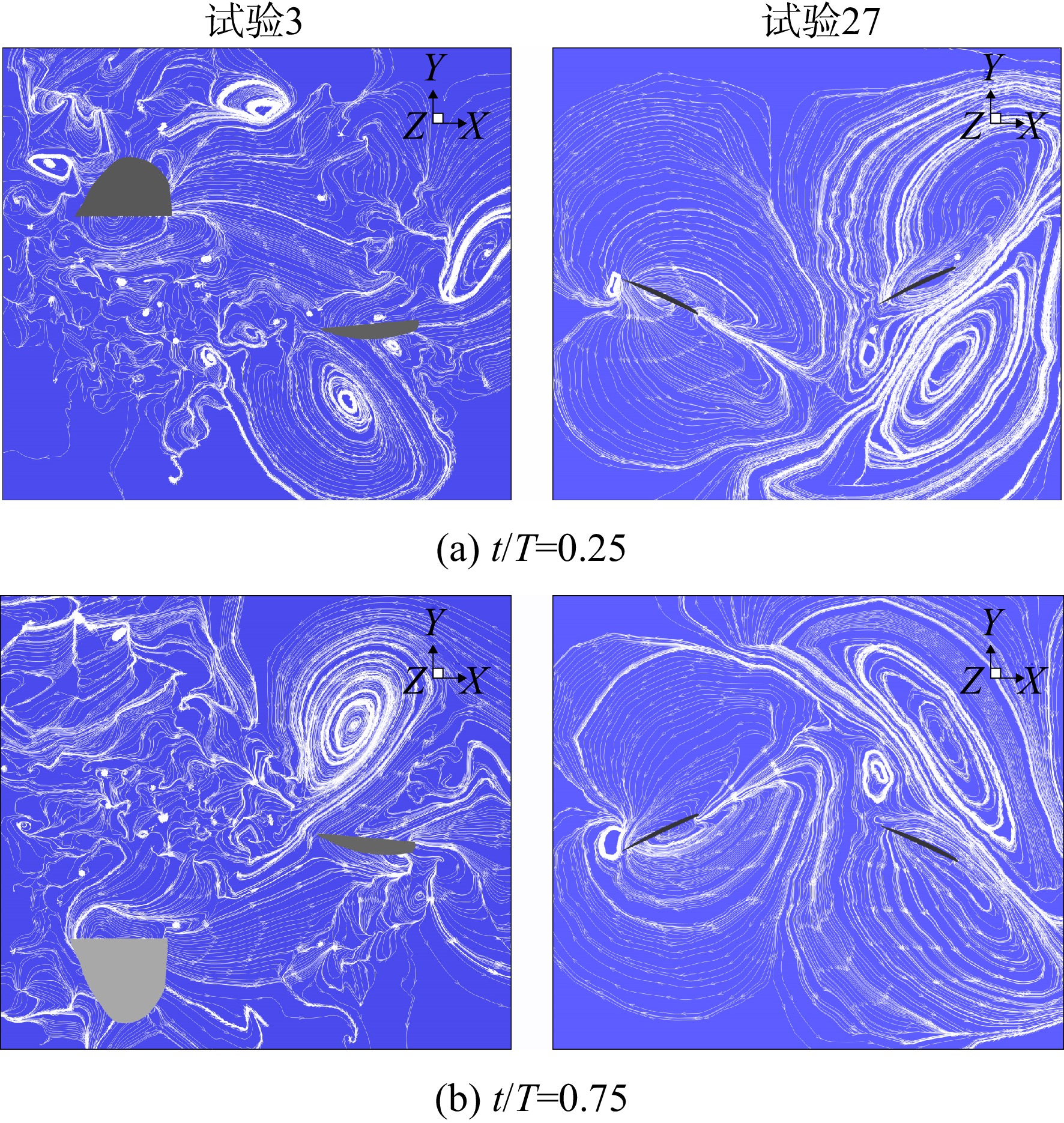
图 16 试验3和试验27在不同时刻的流线图
Figure 16. Streamline chart of the trial 3 and trial 27 at different times

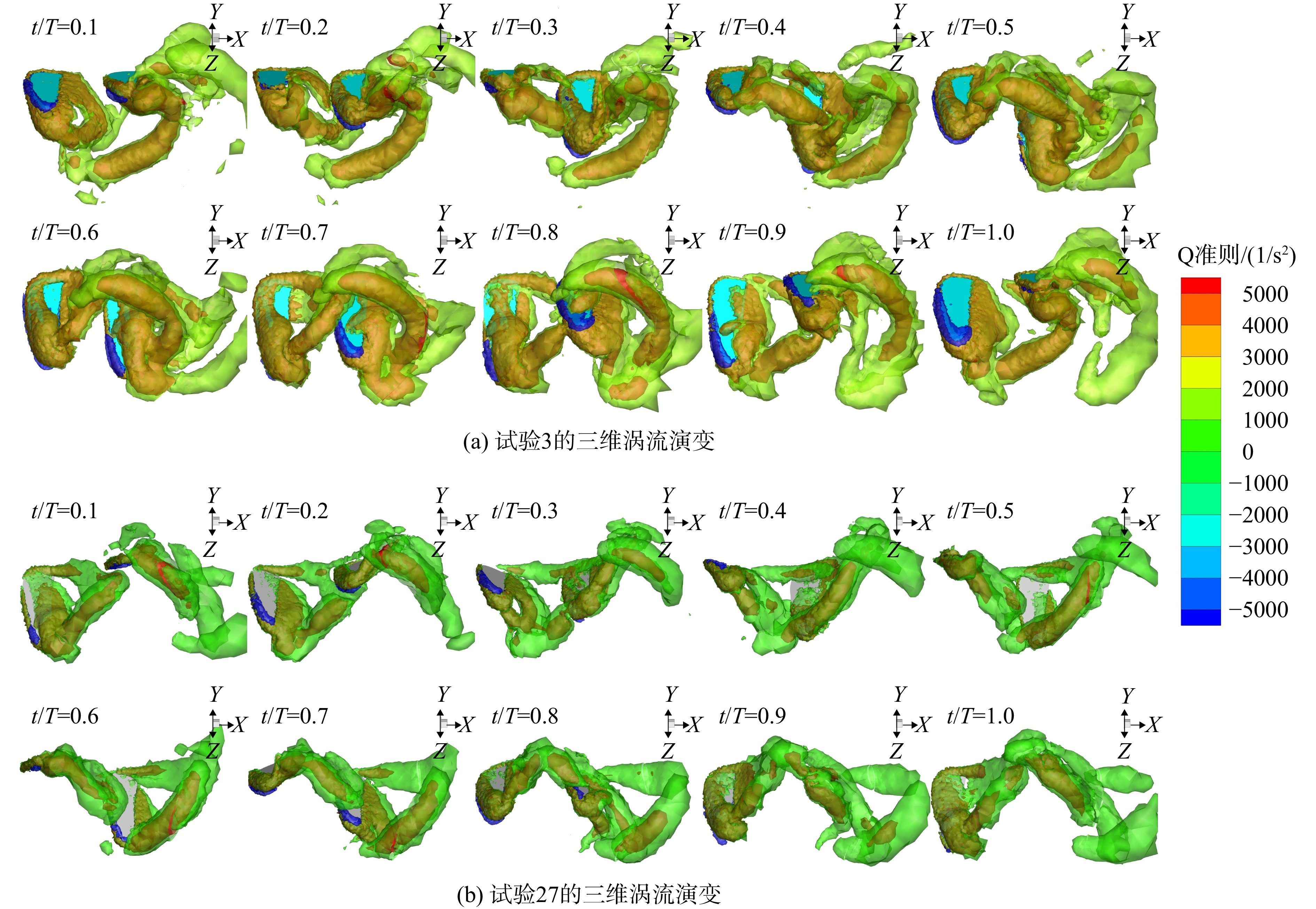
图 17 试验3和试验27在一个运动周期内的三维涡流结构
Figure 17. Three-dimensional vortex structures in the flow for the trial 3 and trial 27 in one motion period
表 1 扑翼几何参数
Table 1. Geometric parameters of flapping wing
参数 数值 b/m 0.2 c/m 0.06 br/m 0.014 S/m2 0.010673  下载: 导出CSV
表 2 网格密度细节
Table 2. Details of grid density
网格
组号扑翼表面第1层
网格高度内球域
网格数/105总网格数/
105Grid 1 b/33 1.19 2.47 Grid 2 b/44 2.09 4.37 Grid 3 b/54 3.07 6.45
下载: 导出CSV
表 3 因素水平表
Table 3. Factors and levels
因素 水平 1 2 3 4 5 φ/(°) 0 45 90 135 180 l 0.5c 1.0c 1.5c 2.0c 2.5c βm 5 10 15 20 25
下载: 导出CSV
表 4 田口试验正交表
Table 4. Orthogonal table of Taguchi test
试验序号 φ/(°) l βm/(°) 1 0 0.5 5 2 45 1.0 5 3 90 1.5 5 4 135 2.0 5 5 180 2.5 5 6 45 0.5 10 7 90 1.0 10 8 135 1.5 10 9 180 2.0 10 10 0 2.5 10 11 90 0.5 15 12 135 1.0 15 13 180 1.5 15 14 0 2.0 15 15 45 2.5 15 16 135 0.5 20 17 180 1.0 20 18 0 1.5 20 19 45 2.0 20 20 90 2.5 20 21 180 0.5 25 22 0 1.0 25 23 45 1.5 25 24 90 2.0 25 25 135 2.5 25
下载: 导出CSV
表 5 试验结果
Table 5. Test results
试验序号 $ \overline {{C_{\mathrm{l}}}} $ $ - \overline {{C_{\mathrm{d}}}} $ $\overline {{C_{\mathrm{p}}}} $ ηl/% (S/N)/dB 1 0.4246 0.4046 5.0860 8.35 18.43 2 0.3765 0.4087 5.0700 7.43 17.42 3 0.2892 0.3146 4.0503 7.14 17.07 4 0.2888 0.2622 3.4968 8.26 18.34 5 0.3575 0.3257 4.1704 8.57 18.66 6 0.4195 0.7743 4.8484 8.65 18.74 7 0.3377 0.6711 4.2677 7.91 17.97 8 0.3237 0.4982 3.2905 9.84 19.86 9 0.3271 0.5101 3.3418 9.79 19.81 10 0.3101 0.6155 3.9363 7.88 17.93 11 0.3977 1.0058 4.2796 9.29 19.36 12 0.3151 0.7655 3.3842 9.31 19.38 13 0.3048 0.6311 2.8240 10.79 20.66 14 0.3480 0.9431 4.0389 8.62 18.71 15 0.3160 0.7340 3.2314 9.78 19.80 16 0.3513 1.0565 3.4840 10.08 20.07 17 0.3105 0.7727 2.6365 11.78 21.42 18 0.3948 1.2062 3.8859 10.16 20.14 19 0.3229 0.9798 3.2528 9.93 19.94 20 0.3028 0.8068 2.7241 11.11 20.92 21 0.3204 0.9509 2.6204 12.23 21.75 22 0.4107 1.3274 3.4496 11.91 21.52 23 0.3650 1.1998 3.2072 11.38 21.12 24 0.3120 0.9111 2.5082 12.44 21.90 25 0.3106 0.9154 2.4569 12.64 22.04
下载: 导出CSV
表 6 寻优试验结果
Table 6. Test of optimization results
编号 βm l φ 仿真值/% 预测值/% 误差/% 26 25 1.5 180 13.36 13.35 0.06 27 25 2.0 180 13.59 13.45 1.03 28 25 2.5 180 12.95 13.24 2.22
下载: 导出CSV
-
[1] 谢鹏,姜洪利,周超英. 一种仿生扑翼飞行器的设计及动力学分析[J]. 航空动力学报,2018,33(3): 703-710. XIE Peng,JIANG Hongli,ZHOU Chaoying. Design and dynamic analysis of a flapping wing air vehicle[J]. Journal of Aerospace Power,2018,33(3): 703-710. (in ChineseXIE Peng, JIANG Hongli, ZHOU Chaoying. Design and dynamic analysis of a flapping wing air vehicle[J]. Journal of Aerospace Power, 2018, 33(3): 703-710. (in Chinese) [2] TRUONG Q T,ARGYOGANENDRO B W,PARK H C. Design and demonstration of insect mimicking foldable artificial wing using four-bar linkage systems[J]. Journal of Bionic Engineering,2014,11(3): 449-458. doi: 10.1016/S1672-6529(14)60057-3 [3] CHEN Chen,ZHANG Tianyu. A review of design and fabrication of the bionic flapping wing micro air vehicles[J]. Micromachines,2019,10(2): 144. doi: 10.3390/mi10020144 [4] HAIDER N,SHAHZAD A,MUMTAZ QADRI M N,et al. Recent progress in flapping wings for micro aerial vehicle applications[J]. Proceedings of the Institution of Mechanical Engineers,Part C: Journal of Mechanical Engineering Science,2021,235(2): 245-264. doi: 10.1177/0954406220917426 [5] VIIERU D,TANG Jian,LIAN Yongsheng,et al. Flapping and flexible wing aerodynamics of low Reynolds number flight vehicles[R]Reno,US: 44th AIAA Aerospace Sciences Meeting and Exhibit,2006. [6] XU Wenfu,PAN Erzhen,LIU Juntao,et al. Flight control of a large-scale flapping-wing flying robotic bird: system development and flight experiment[J]. Chinese Journal of Aeronautics,2022,35(2): 235-249. doi: 10.1016/j.cja.2021.03.009 [7] ALEXANDER D E. Unusual phase relationships between the forewings and hindwings in flying dragonflies[J]. Journal of Experimental Biology,1984,109(1): 379-383. doi: 10.1242/jeb.109.1.379 [8] LI Qiushi,ZHENG Mengzong,PAN Tianyu,et al. Experimental and numerical investigation on dragonfly wing and body motion during voluntary take-off[J]. Scientific Reports,2018,8: 1011. doi: 10.1038/s41598-018-19237-w [9] AZUMA A,WATANABE T. Flight performance of a dragonfly[J]. Journal of Experimental Biology,1988,137(1): 221-252. doi: 10.1242/jeb.137.1.221 [10] WANG Z J,RUSSELL D. Effect of forewing and hindwing interactions on aerodynamic forces and power in hovering dragonfly flight[J]. Physical Review Letters,2007,99(14): 148101. doi: 10.1103/PhysRevLett.99.148101 [11] BIE Dawei,LI Daochun. Numerical analysis of the wing-wake interaction of tandem flapping wings in forward flight[J]. Aerospace Science and Technology,2022,121: 107389. doi: 10.1016/j.ast.2022.107389 [12] BROERING T M,LIAN Yongsheng. The effect of phase angle and wing spacing on tandem flapping wings[J]. Acta Mechanica Sinica,2012,28(6): 1557-1571. doi: 10.1007/s10409-012-0210-8 [13] GONG Wuqi,JIA Bobo,XI Guang. Experimental study on instantaneous thrust and lift of two plunging wings in tandem[J]. Experiments in Fluids,2015,57(1): 8. [14] NAGAI H,FUJITA K,MUROZONO M. Experimental study on forewing-hindwing phasing in hovering and forward flapping flight[J]. AIAA Journal,2019,57(9): 3779-3790. doi: 10.2514/1.J058335 [15] WARKENTIN J,DELAURIER J. Experimental aerodynamic study of tandem flapping membrane wings[J]. Journal of Aircraft,2007,44(5): 1653-1661. doi: 10.2514/1.28160 [16] HO S,NASSEF H,PORNSINSIRIRAK N,et al. Unsteady aerodynamics and flow control for flapping wing flyers[J]. Progress in Aerospace Sciences,2003,39(8): 635-681. doi: 10.1016/j.paerosci.2003.04.001 [17] TONG L I,SU C T. Optimizing multi-response problems in the taguchi method by fuzzy multiple attribute decision making[J]. Quality and Reliability Engineering International,1997,13(1): 25-34. doi: 10.1002/(SICI)1099-1638(199701)13:1<25::AID-QRE59>3.0.CO;2-B [18] ZHU Jianyang,ZHU Mingkang,ZHANG Tao,et al. Improvement of the power extraction performance of a semi-active flapping airfoil by employing two-sided symmetric slot airfoil[J]. Energy,2021,227: 120458. doi: 10.1016/j.energy.2021.120458 [19] HORNIK K,STINCHCOMBE M,WHITE H. Multilayer feedforward networks are universal approximators[J]. Neural Networks,1989,2(5): 359-366. doi: 10.1016/0893-6080(89)90020-8 [20] 张立明. 人工神经网络的模型及其应用[M]. 上海: 复旦大学出版社,1993. ZHANG Liming. Models and applications of artificial neural networks[M]. Shanghai: Fudan Press,1993. (in ChineseZHANG Liming. Models and applications of artificial neural networks[M]. Shanghai: Fudan Press, 1993. (in Chinese) -


 点击查看大图

计量
- 文章访问数: 1117
- HTML浏览量: 352
- PDF量: 89
- 被引次数: 0