






Calculation of thermophysical properties of supercritical RP-3 based on artificial neural network model
-
摘要:
为准确得到超临界压力下RP-3的热物性,基于人工神经网络(ANN)方法建立超临界RP-3的密度、黏度、比定压热容和导热系数的计算模型。以广义对应态法则计算得到的RP-3热物性结果训练神经网络,并耦合了实验误差模型得到修正后的ANN模型。计算温度变化范围为300~800 K,压力变化范围为3~6 MPa。结果表明:ANN模型能准确地预测超临界RP-3的热物性,且计算精度比广义对应态法则计算得到的结果提高了16.3%。在压力为5 MPa的工况下,ANN模型预测的密度、黏度、比定压热容和导热系数的回归系数均大于0.99,与实验结果平均相对误差分别为1.5%、4.1%、0.9%和0.7%。
Abstract:In order to accurately obtain the thermophysical properties of RP-3 under supercritical pressure, the calculation models of density, viscosity, specific heat capacity at constant pressure and thermal conductivity of supercritical RP-3 were established based on artificial neural network (ANN) method. The RP-3 thermophysical properties obtained by the extended corresponding state were used to train the neural network, and the modified ANN model was obtained by coupling the experimental error model. The calculated temperature range was 300−800 K, and the pressure range was 3−6 MPa. The results showed that the ANN model can accurately predict the thermophysical properties of supercritical RP-3, and the calculation accuracy was 16.3% higher than that of the extended corresponding state. At the pressure of 5 MPa, the regression coefficients of density, viscosity, specific heat capacity at constant pressure and thermal conductivity predicted by the ANN model were all greater than 0.99. The mean relative errors with the experimental results were 1.5%, 4.1%, 0.9% and 0.7%, respectively.
-
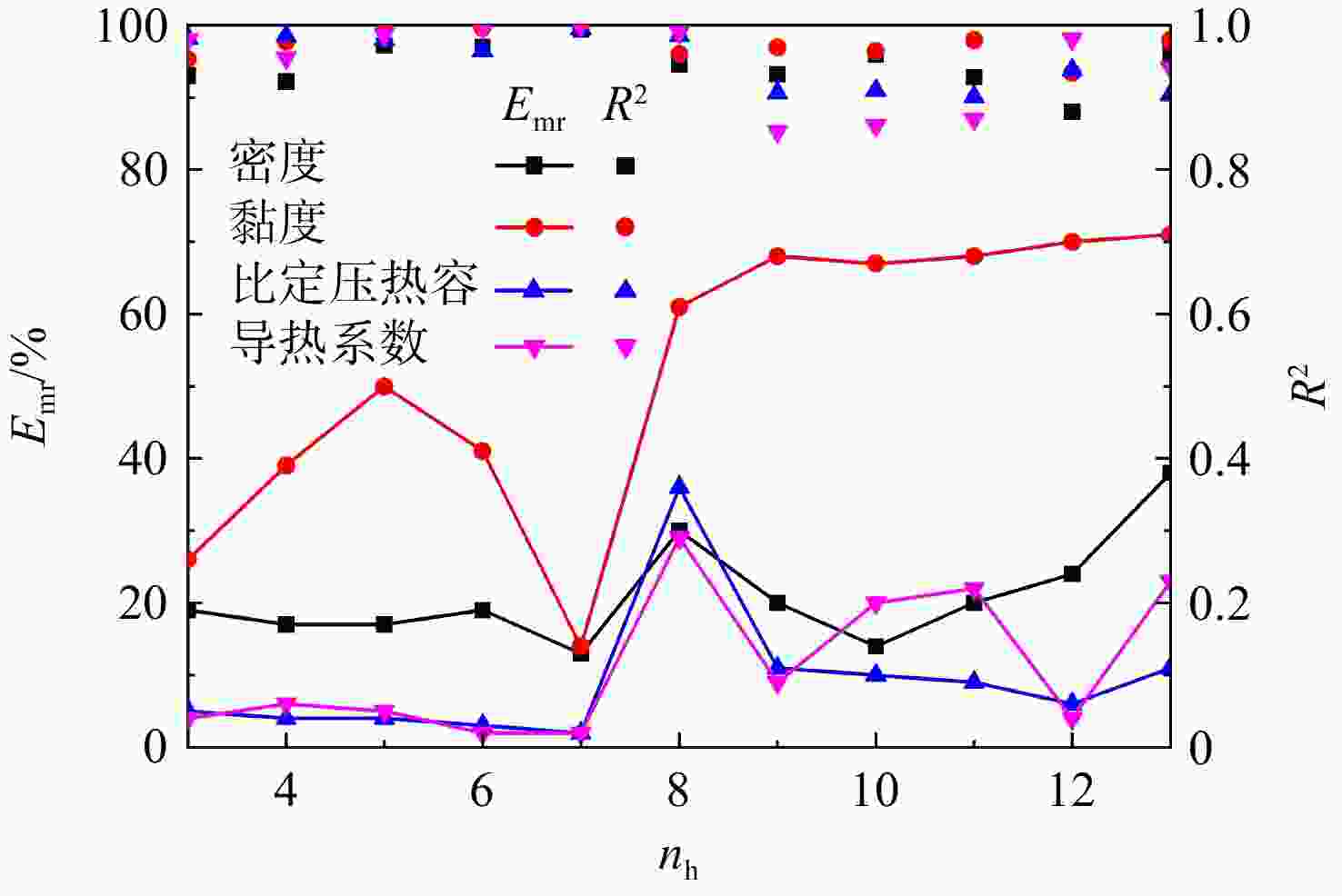
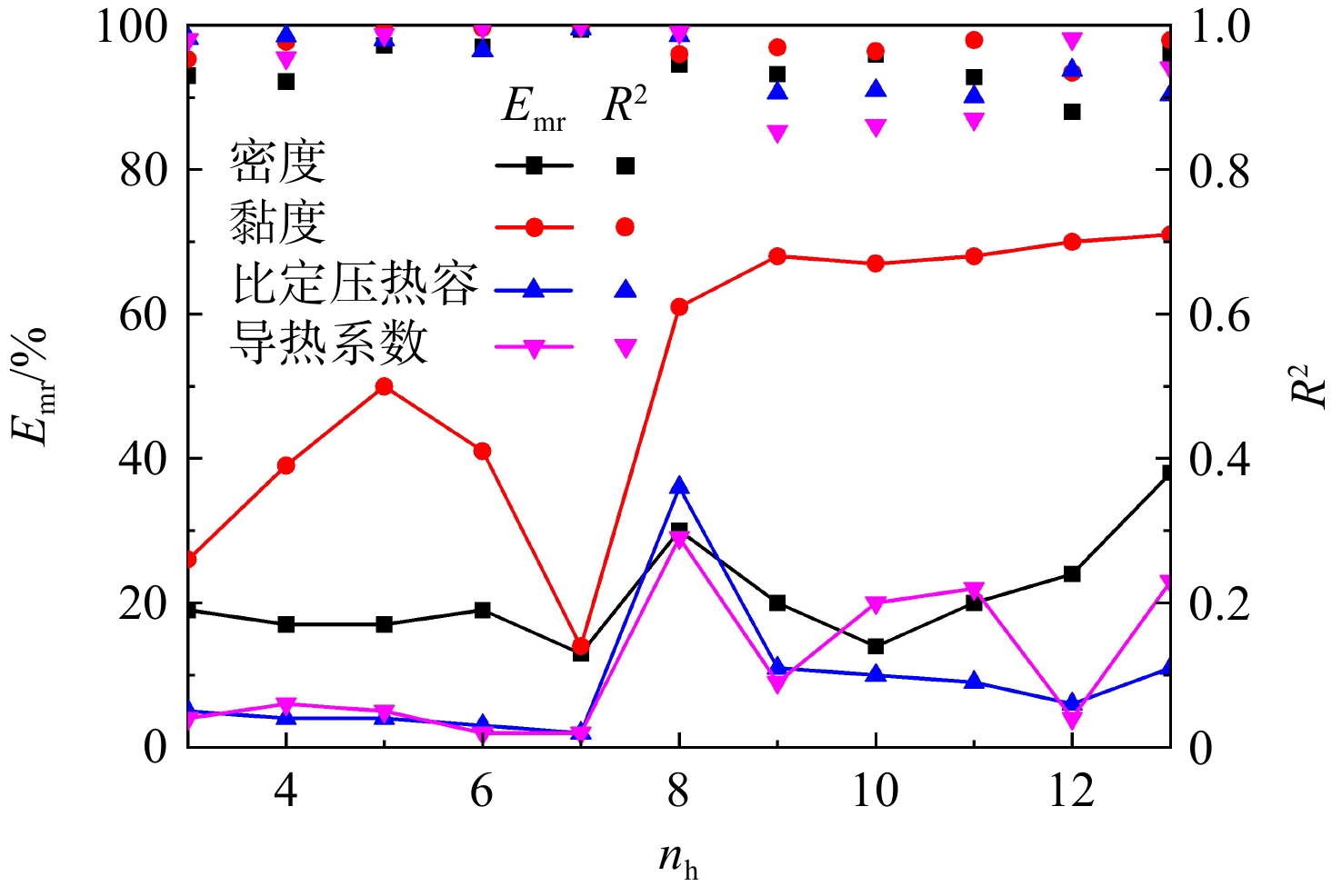
图 2 隐藏层节点个数对模型精度的影响
Figure 2. Influence of the number of hidden layer nodes on the model accuracy
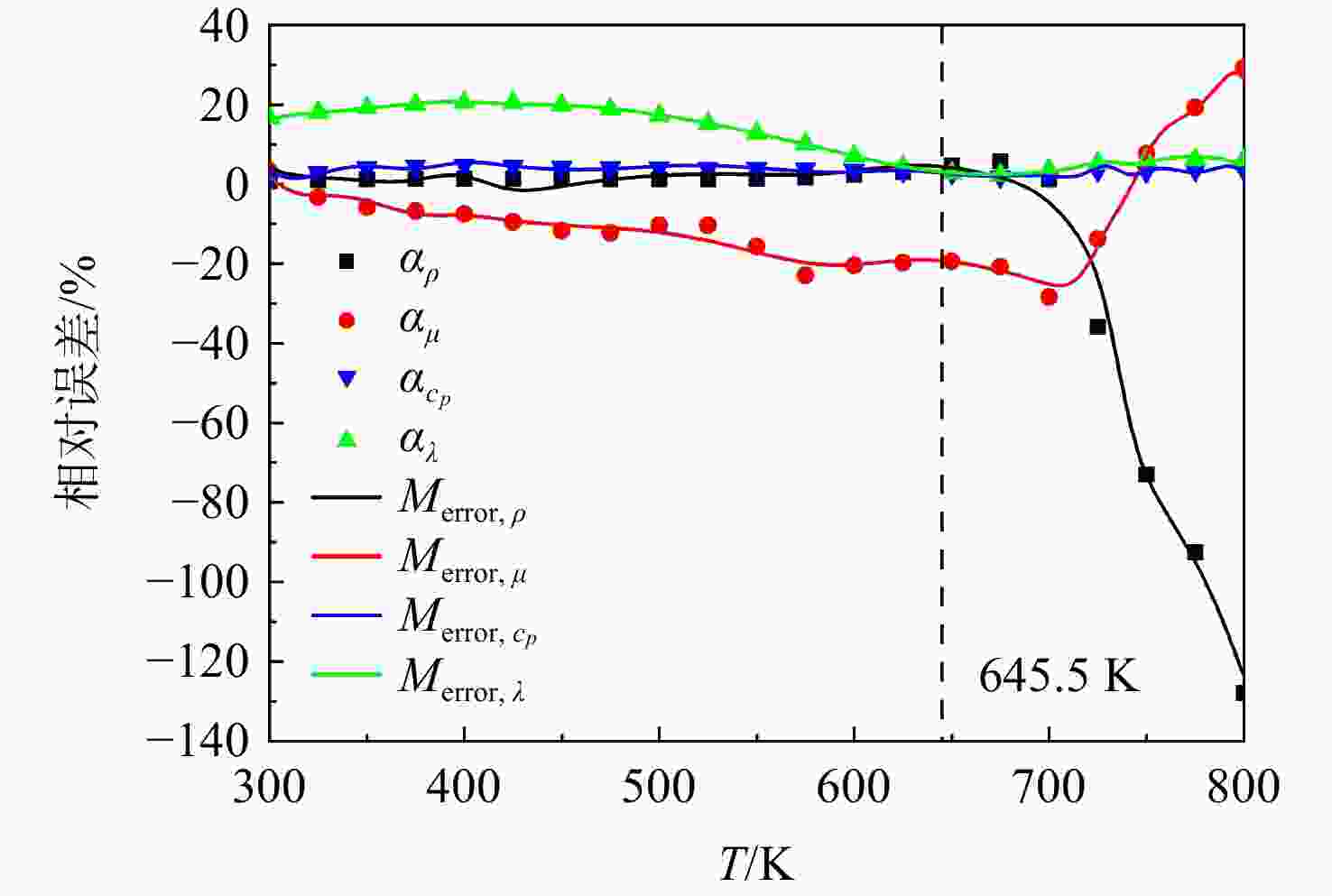
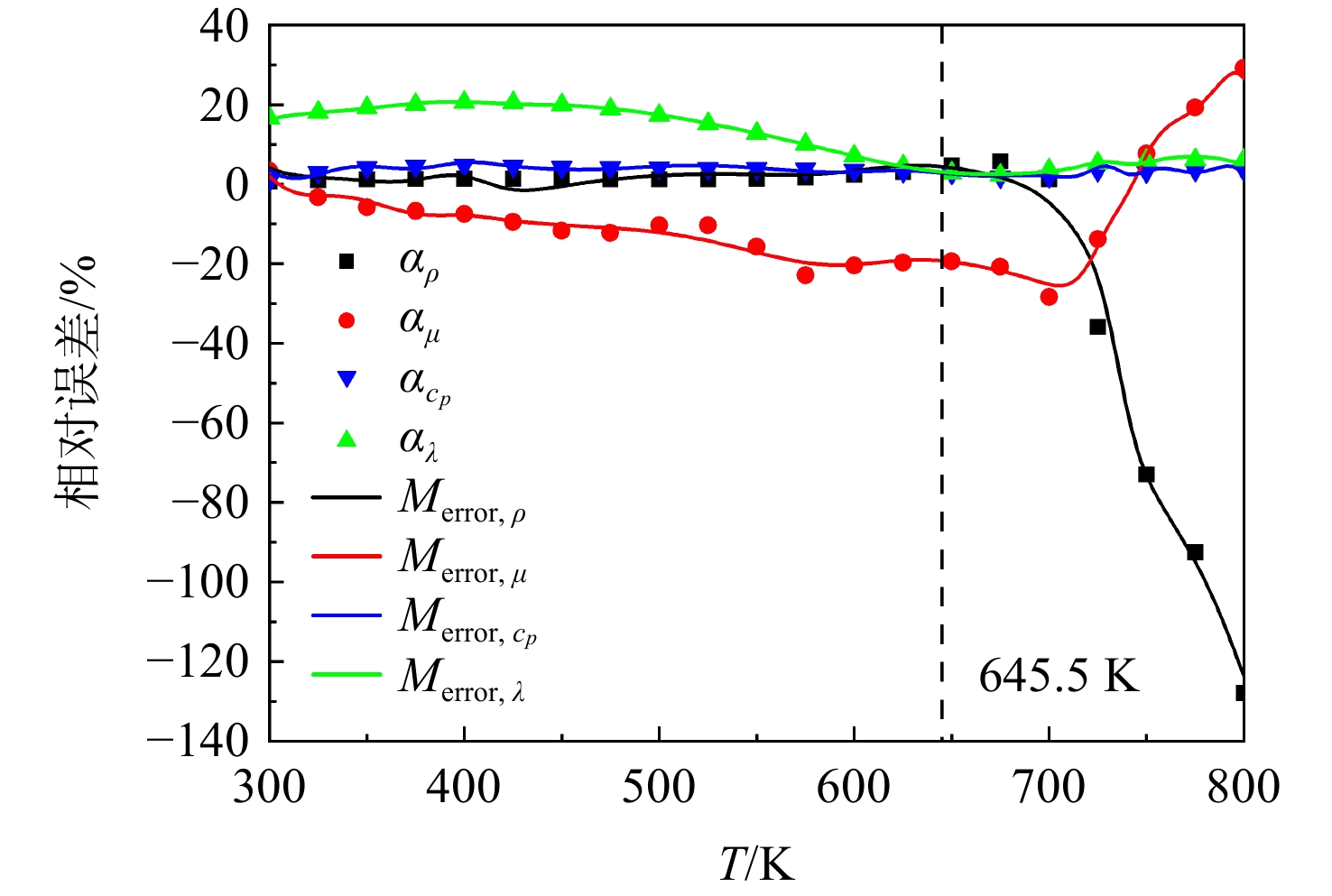
图 4 5 MPa压力下热物性参数相对误差与Merror模型预测值的对比
Figure 4. Comparison between the relative error of thermo-physical parameters and the predicted value of Merror model at pressure of 5 MPa
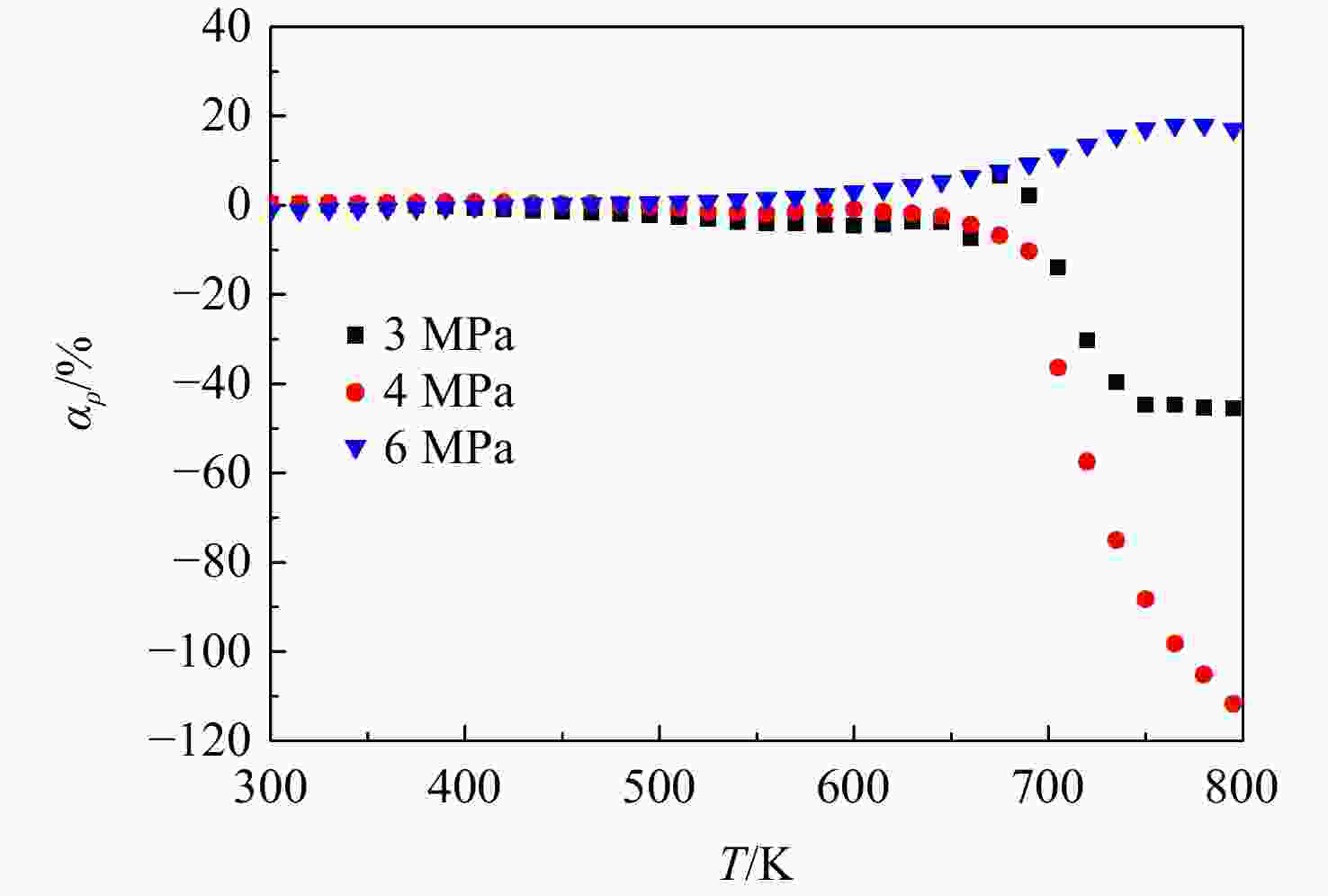
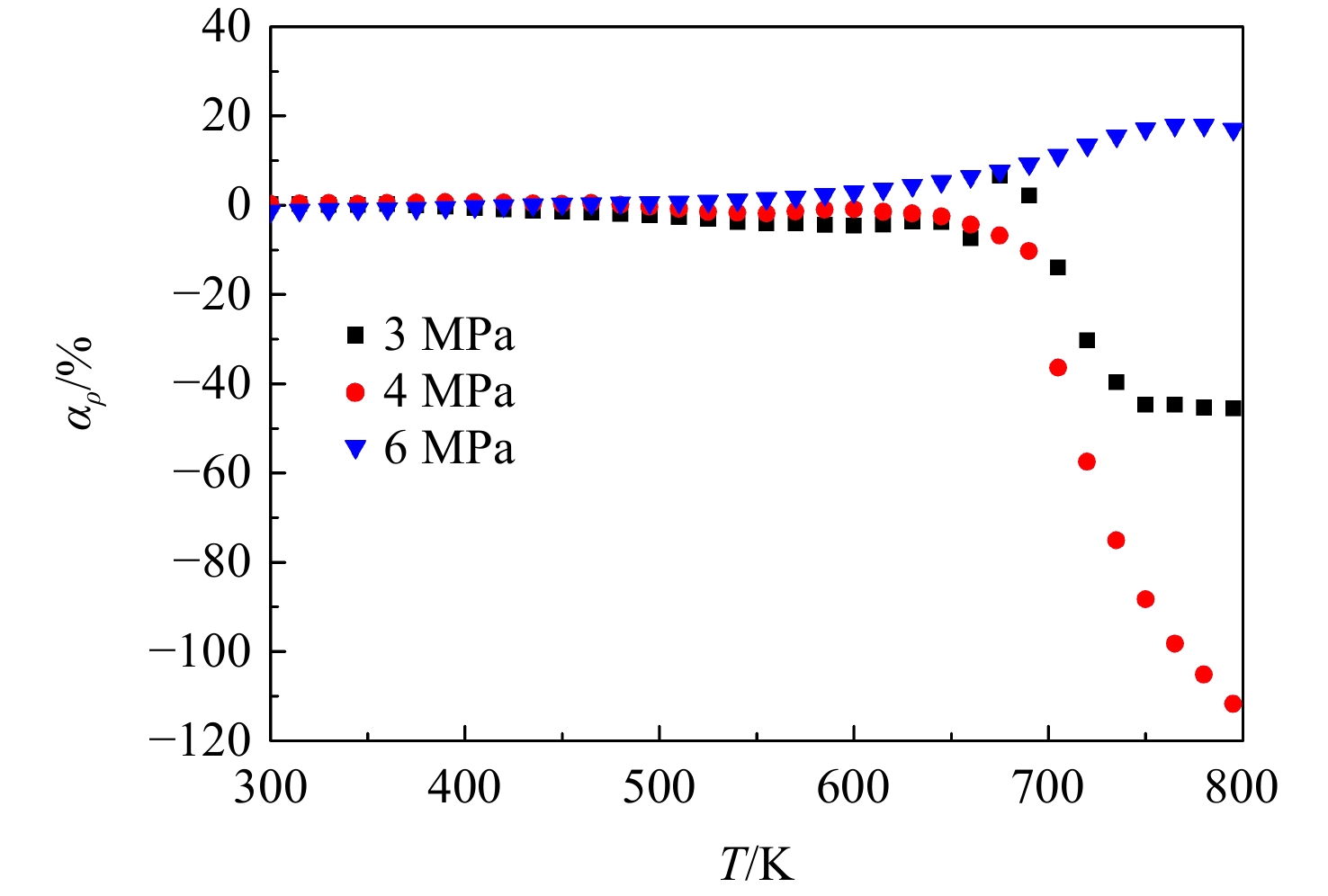
图 5 RP-3密度在3、4、6 MPa压力下的相对误差曲线
Figure 5. Relative error curves of RP-3 density at pressure of 3, 4, 6 MPa

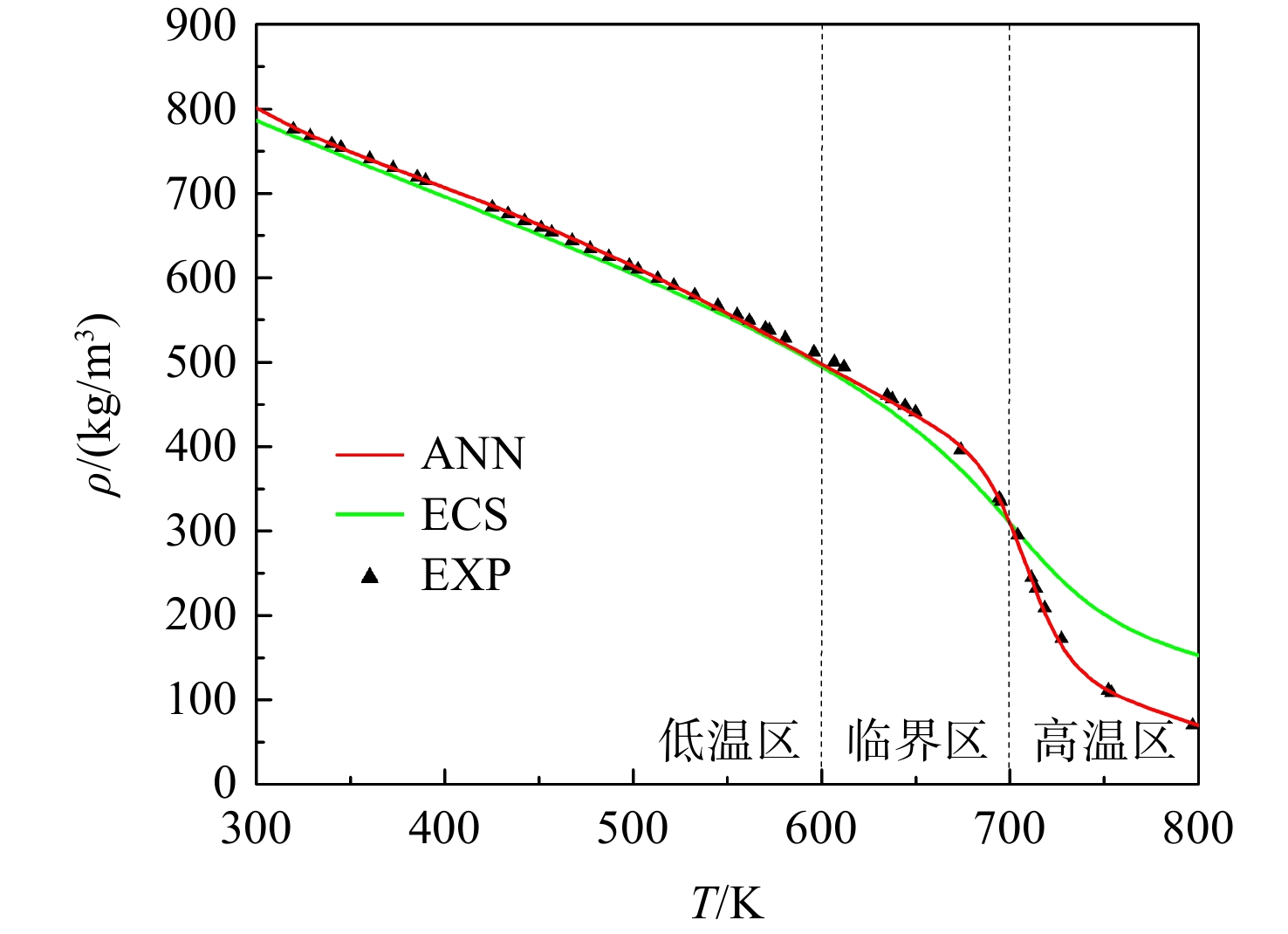
图 6 5 MPa压力下ANN模型、ECS模型预测RP-3密度与实验值的对比
Figure 6. Comparison of ANN model,ECS model and experimental value of RP-3 density at pressure of 5 MPa
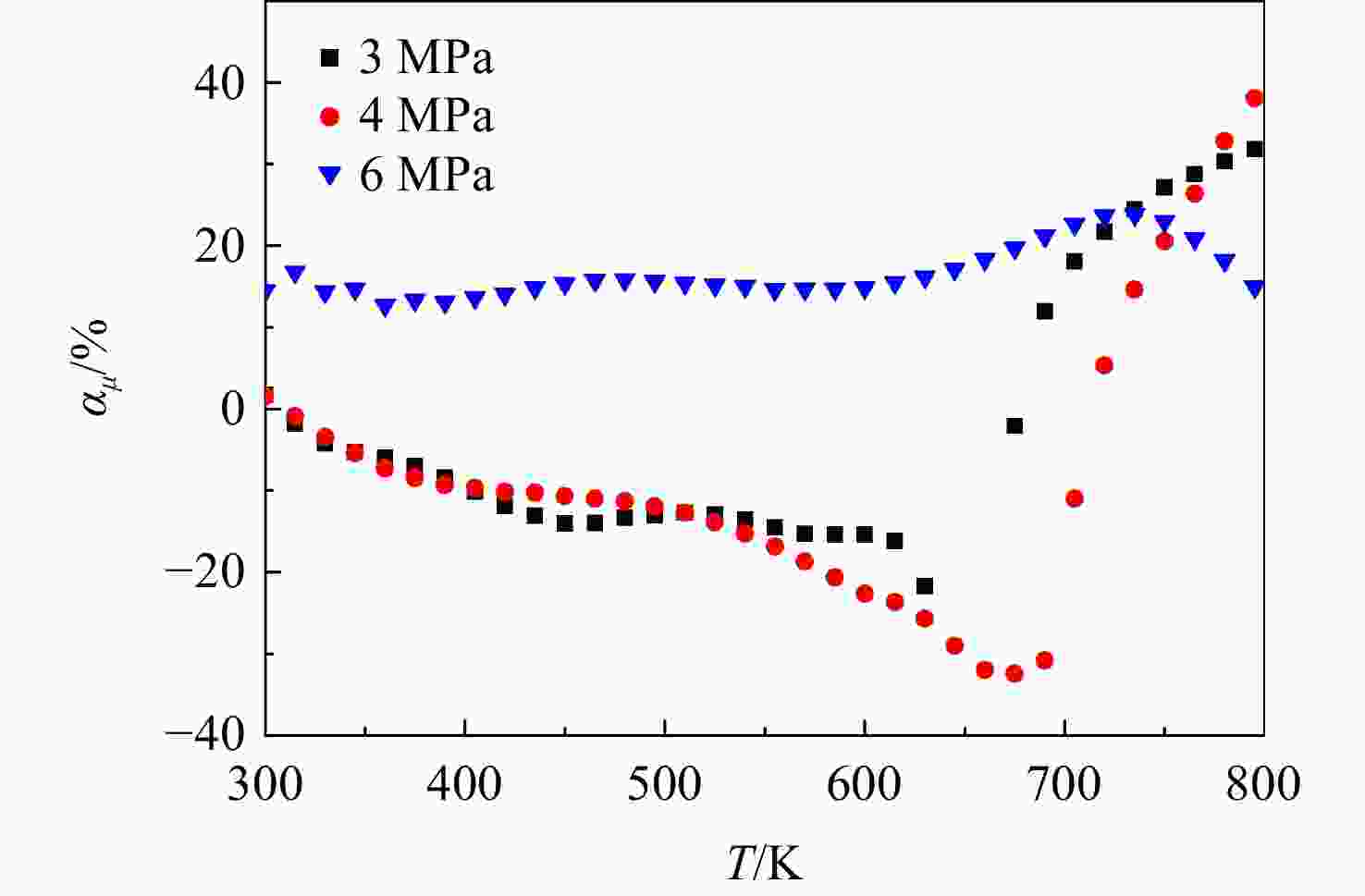
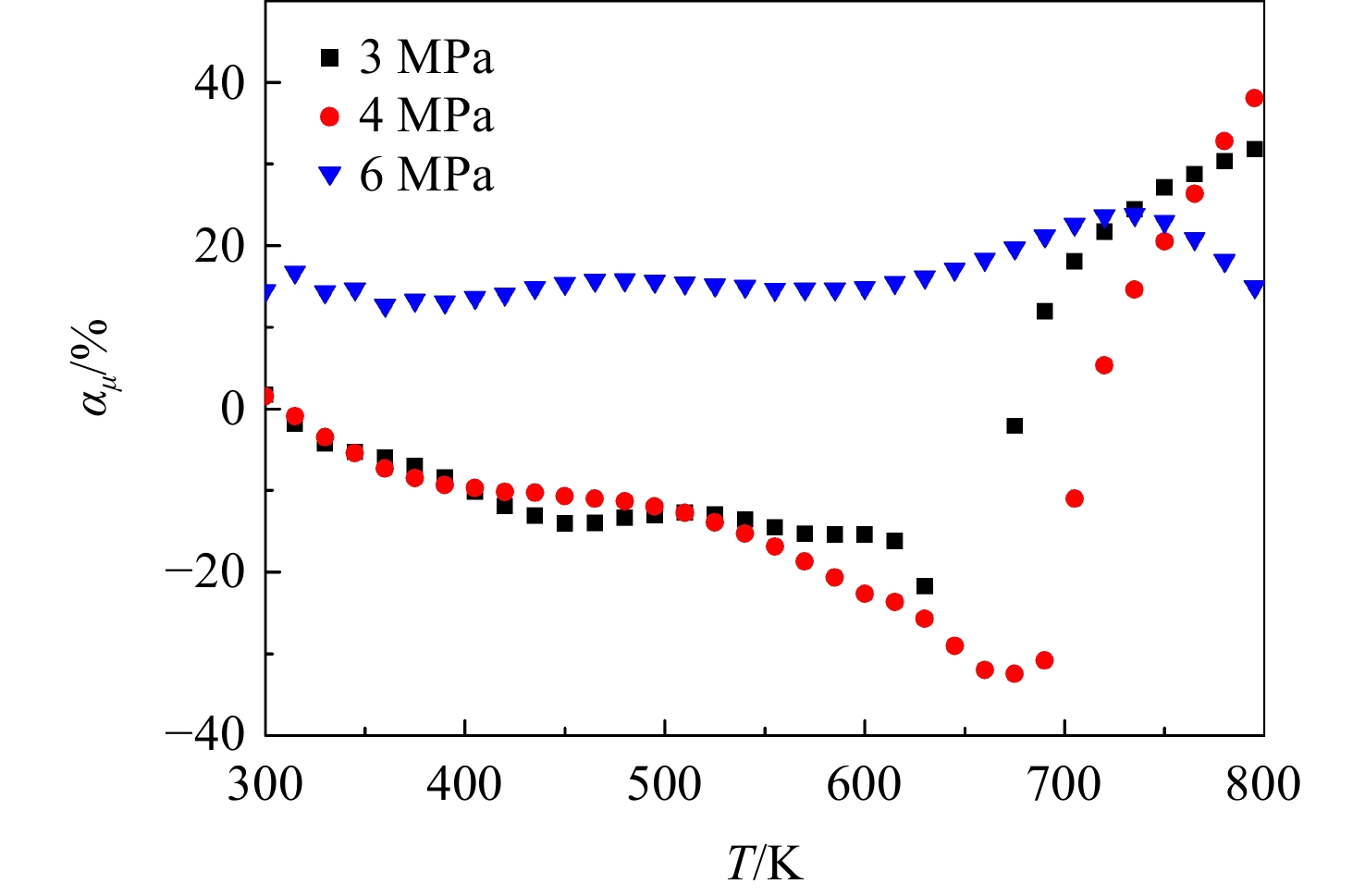
图 7 RP-3黏度在3、4、6 MPa下的相对误差曲线
Figure 7. Relative error curves of RP-3 viscosity at pressure of 3, 4, 6 MPa
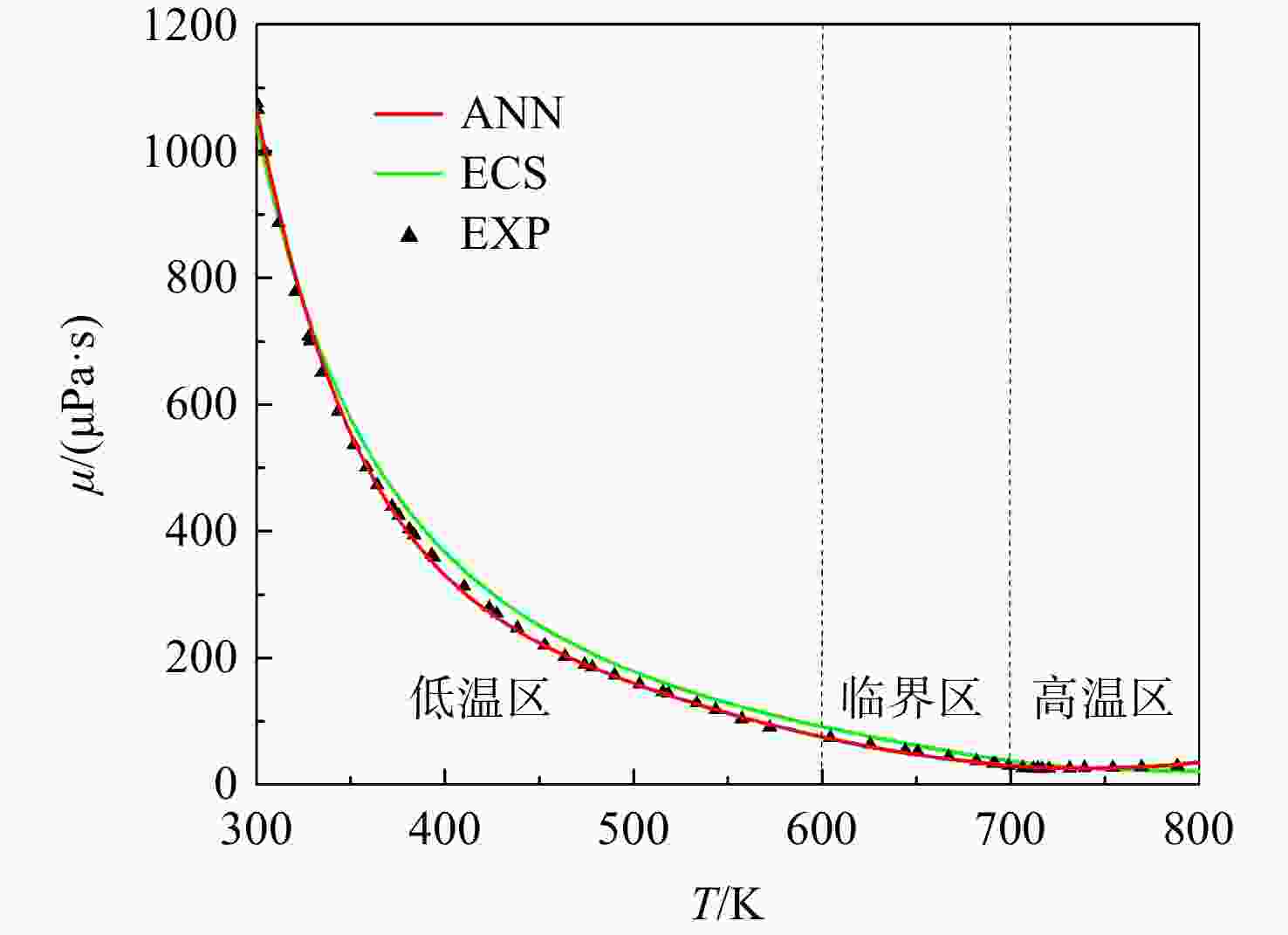
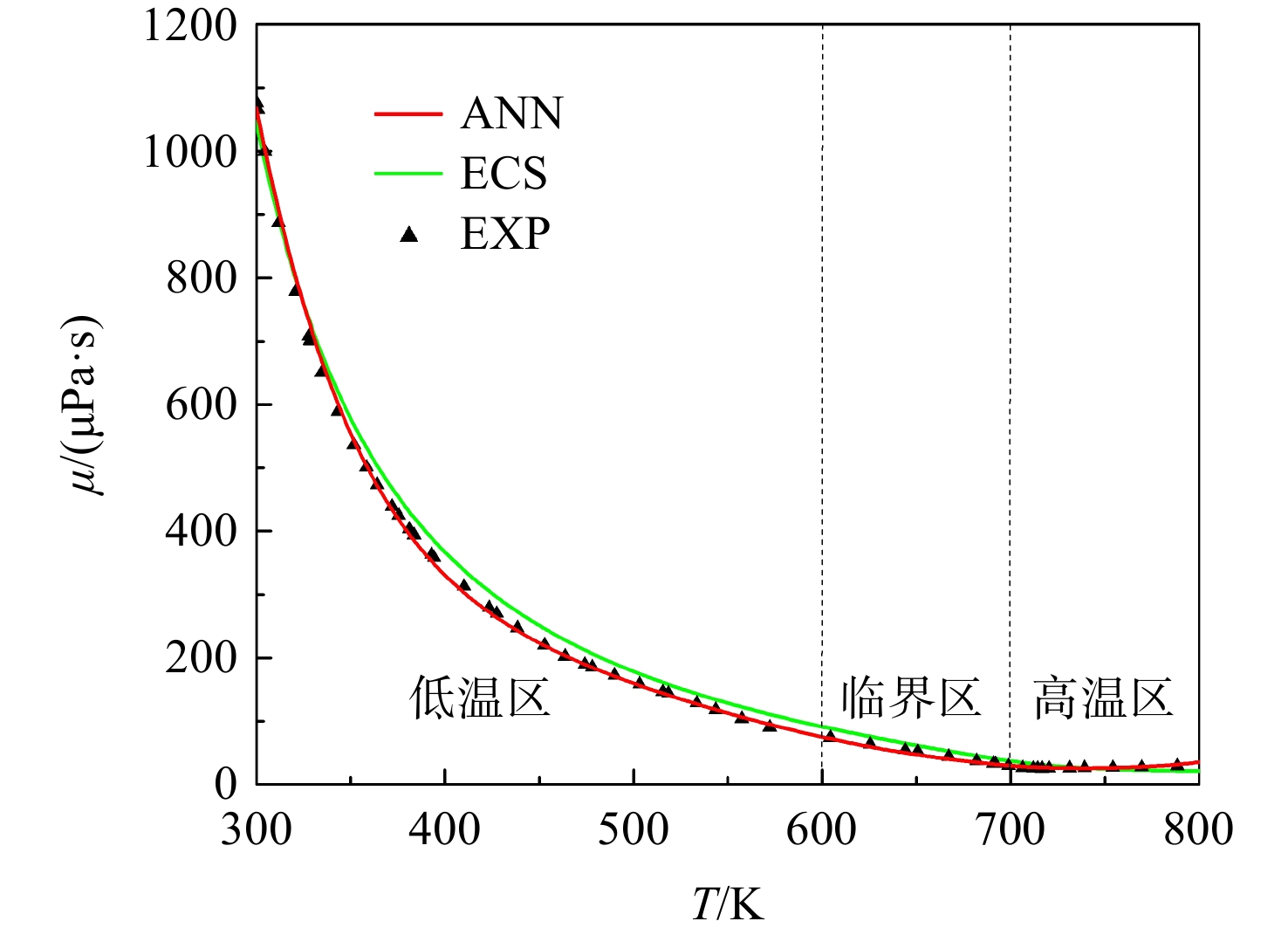
图 8 5 MPa下ANN模型、ECS模型预测RP-3黏度与实验值的对比
Figure 8. Comparison of ANN model, ECS model andexperimental value of RP-3 viscosity at pressure of 5 MPa
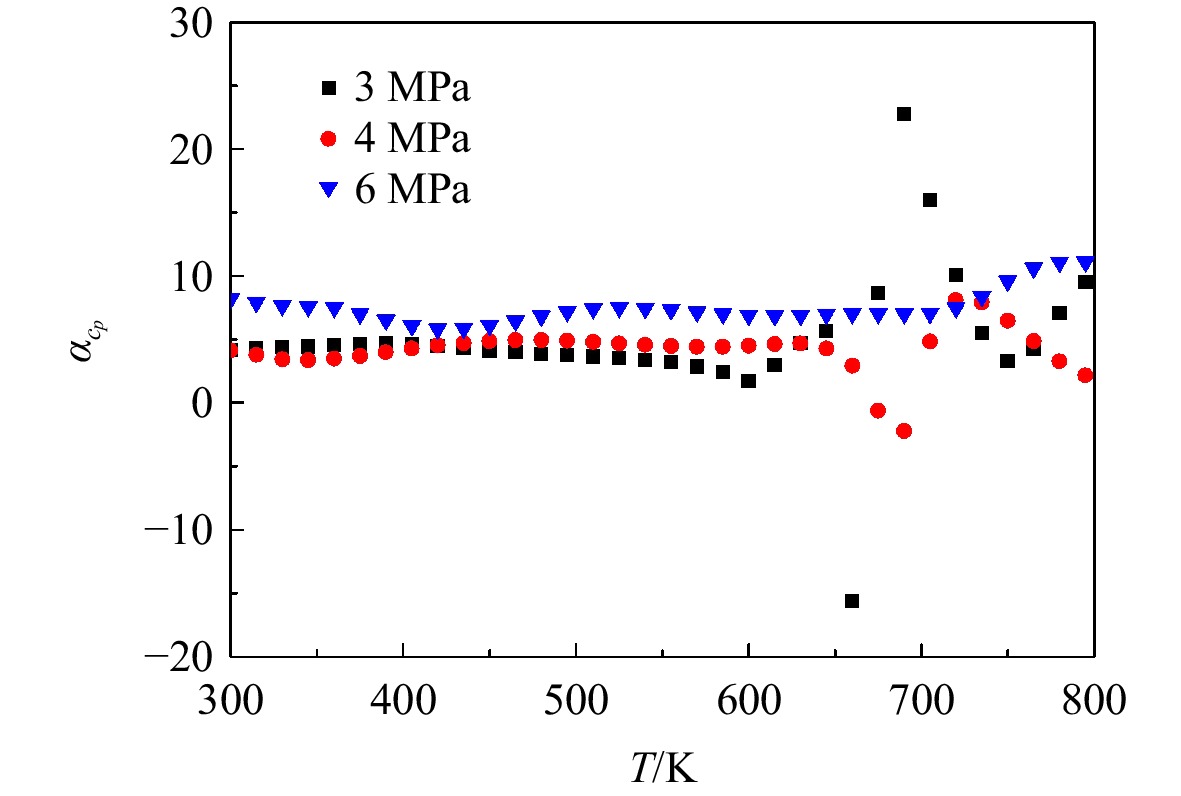
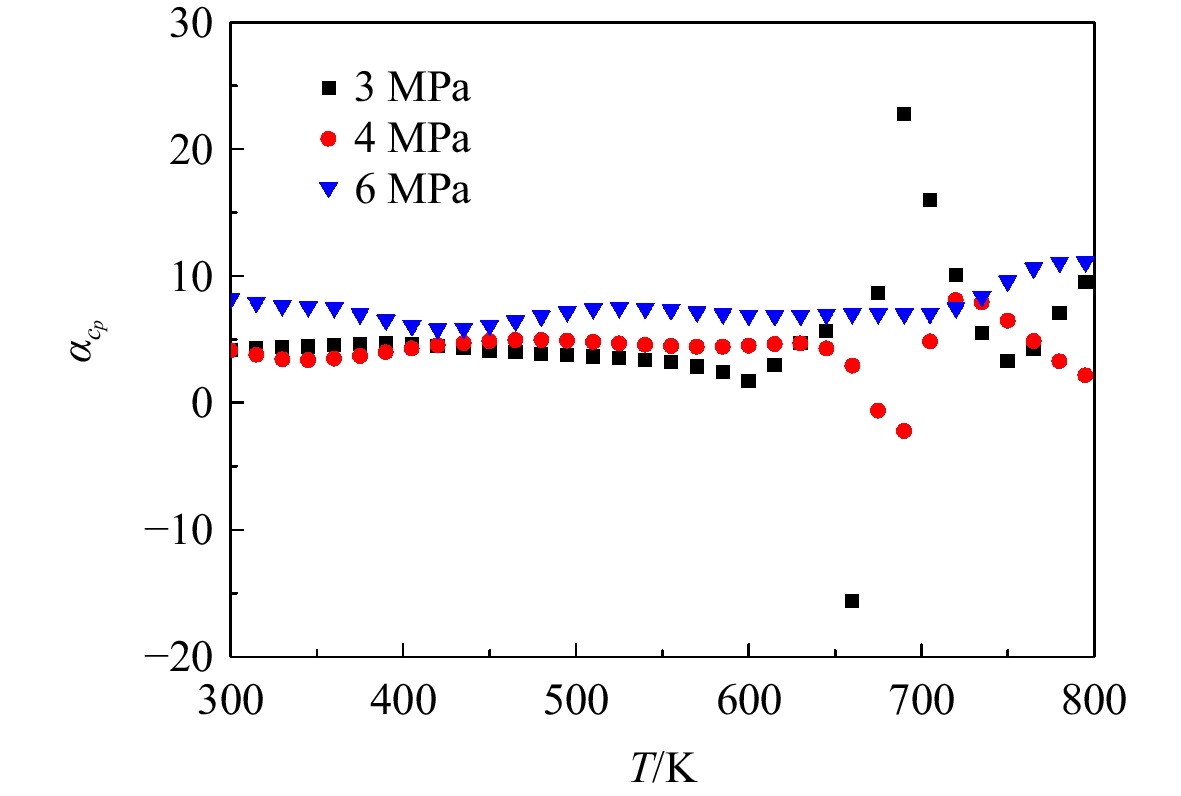
图 9 RP-3比定压热容在3、4、6 MPa下的相对误差曲线
Figure 9. Relative error curves of RP-3 specific heat capacity at constant pressure at pressure of 3, 4, 6 MPa
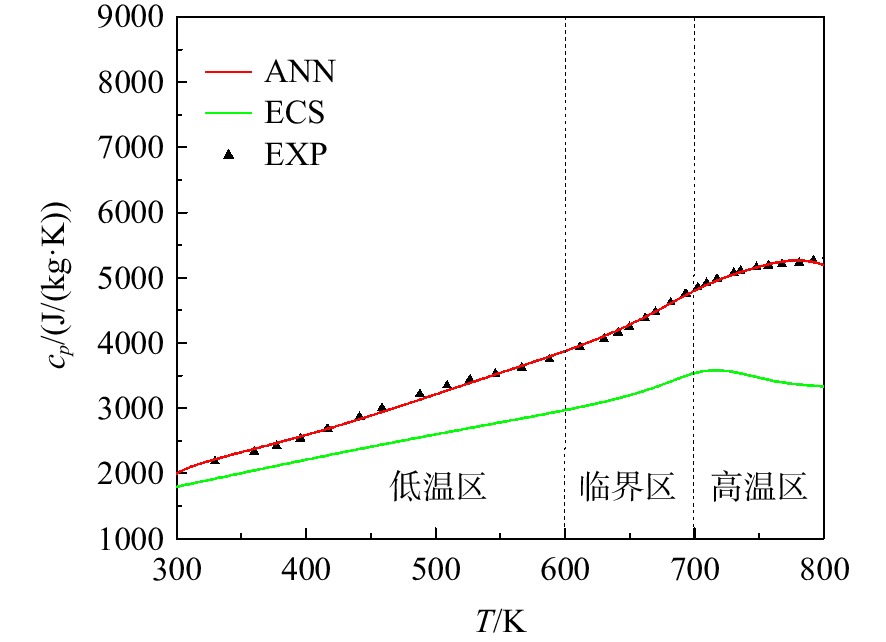
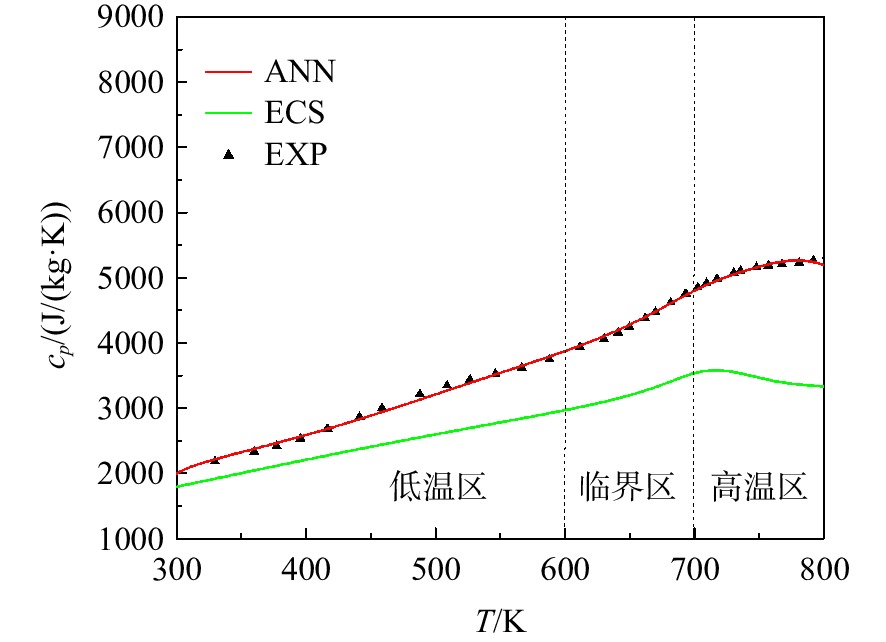
图 10 5 MPa下ANN模型、ECS模型预测RP-3比定压热容与实验值的对比
Figure 10. Comparison of ANN model,ECS model and experimental value of RP-3 specific heat capacity at constant pressure at pressure of 5 MPa
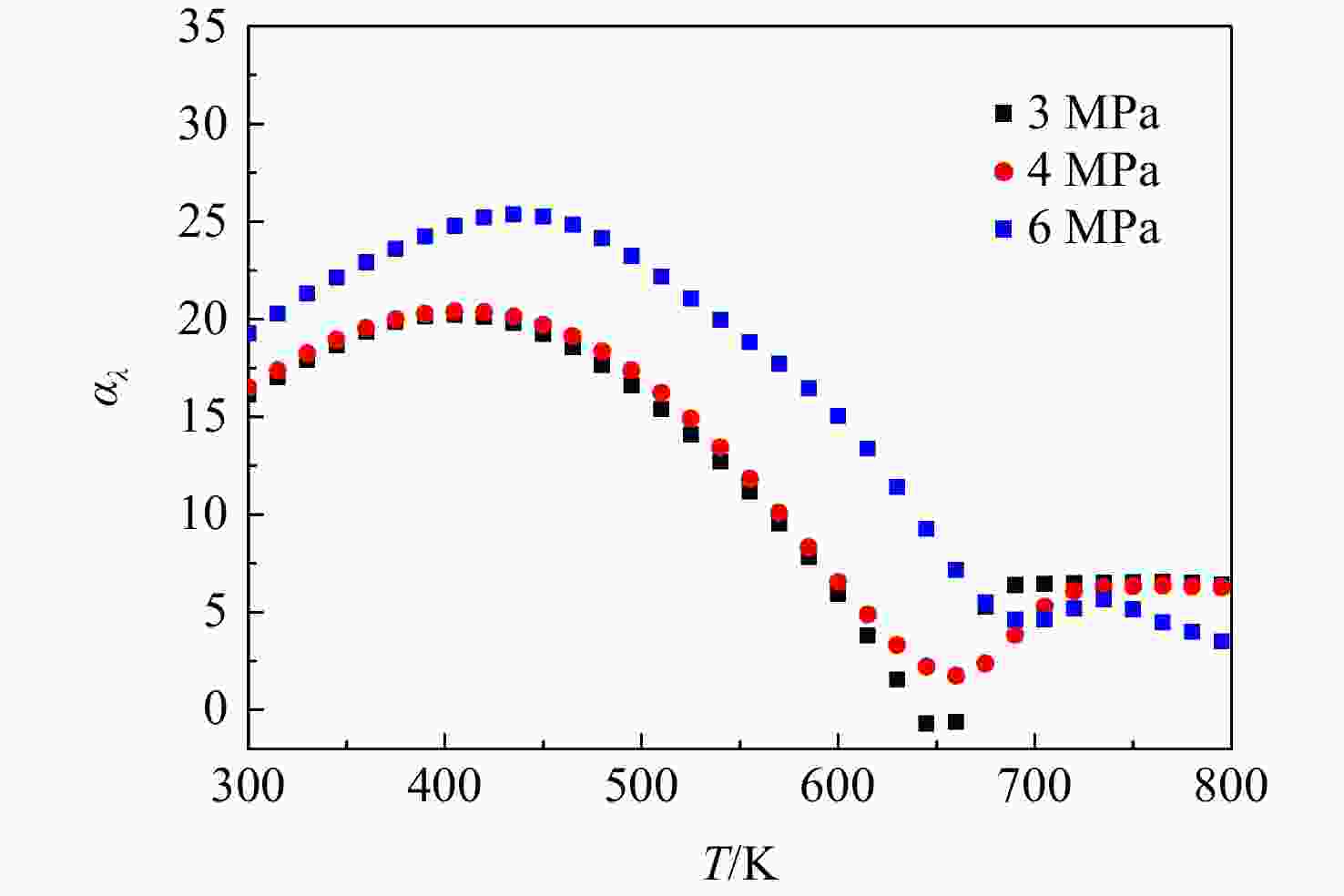
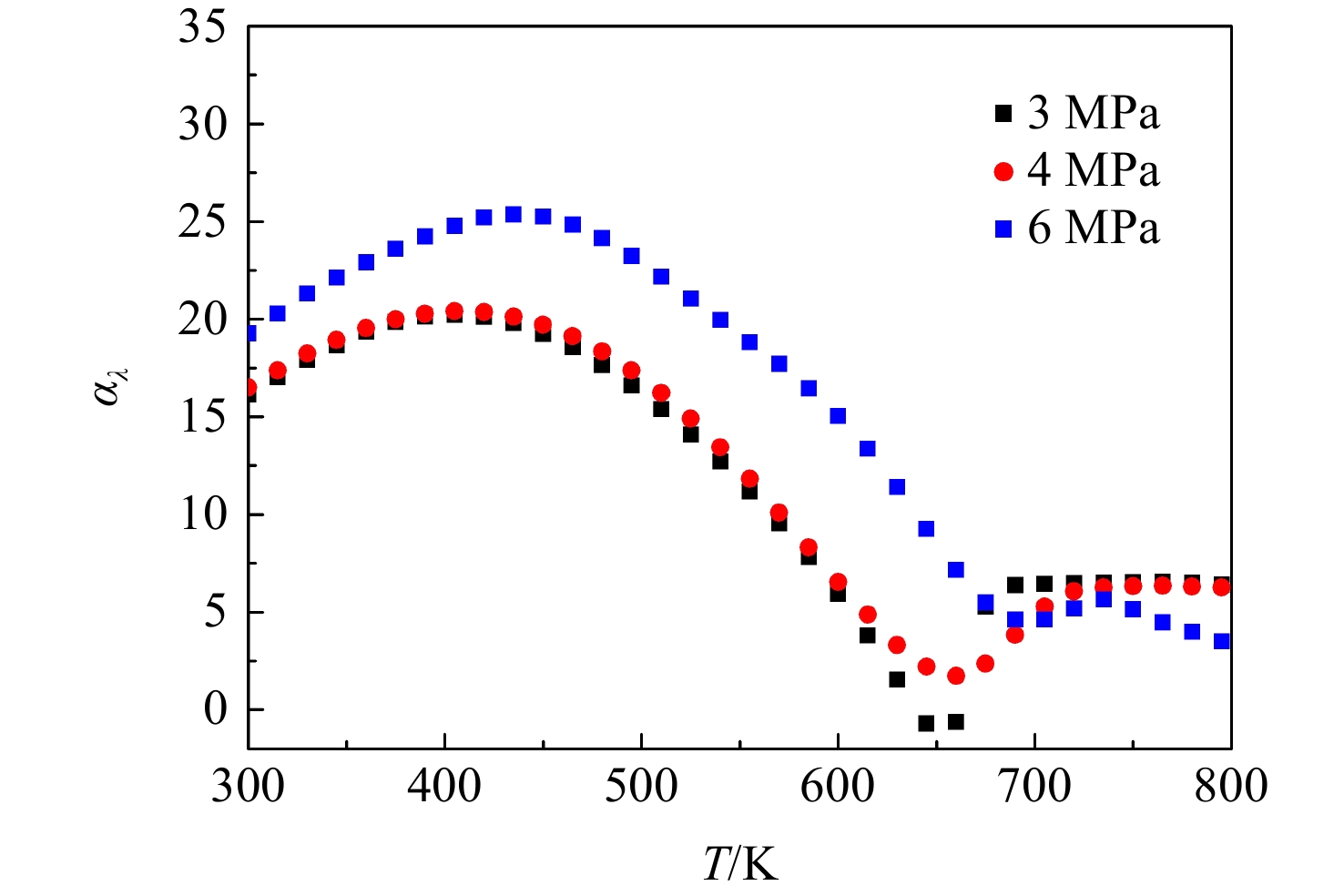
图 11 RP-3导热系数在3、4、6 MPa下的相对误差曲线
Figure 11. Relative error curves of RP-3 thermal conductivity at pressure of 3, 4, 6 MPa
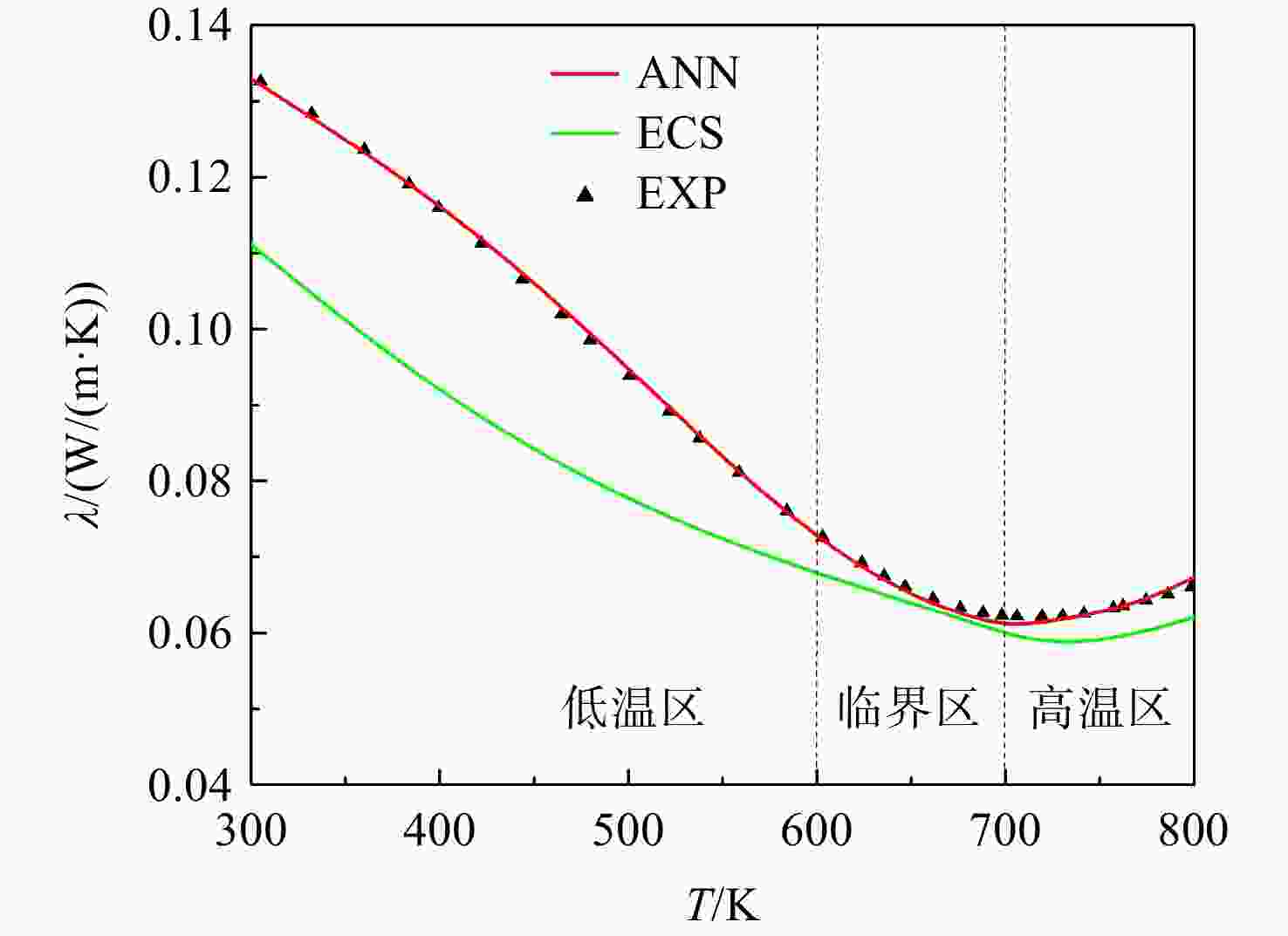
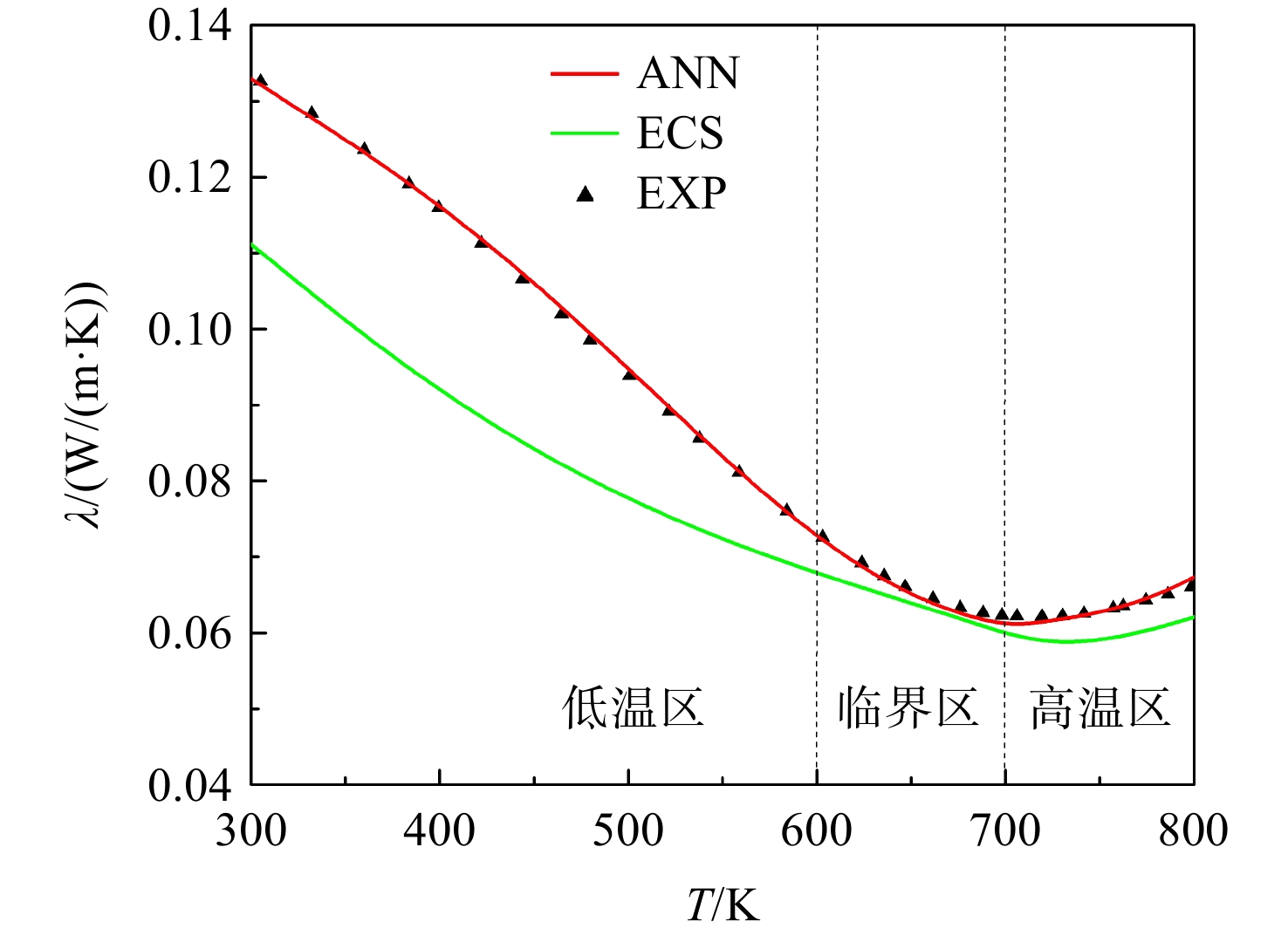
图 12 5 MPa下ANN模型、ECS模型预测RP-3导热系数与实验值的对比
Figure 12. Comparison of ANN model、ECS model and experimental value of RP-3 thermal conductivity at pressure of 5 MPa
表 1 数据集划分方式
Table 1. Database partition mode
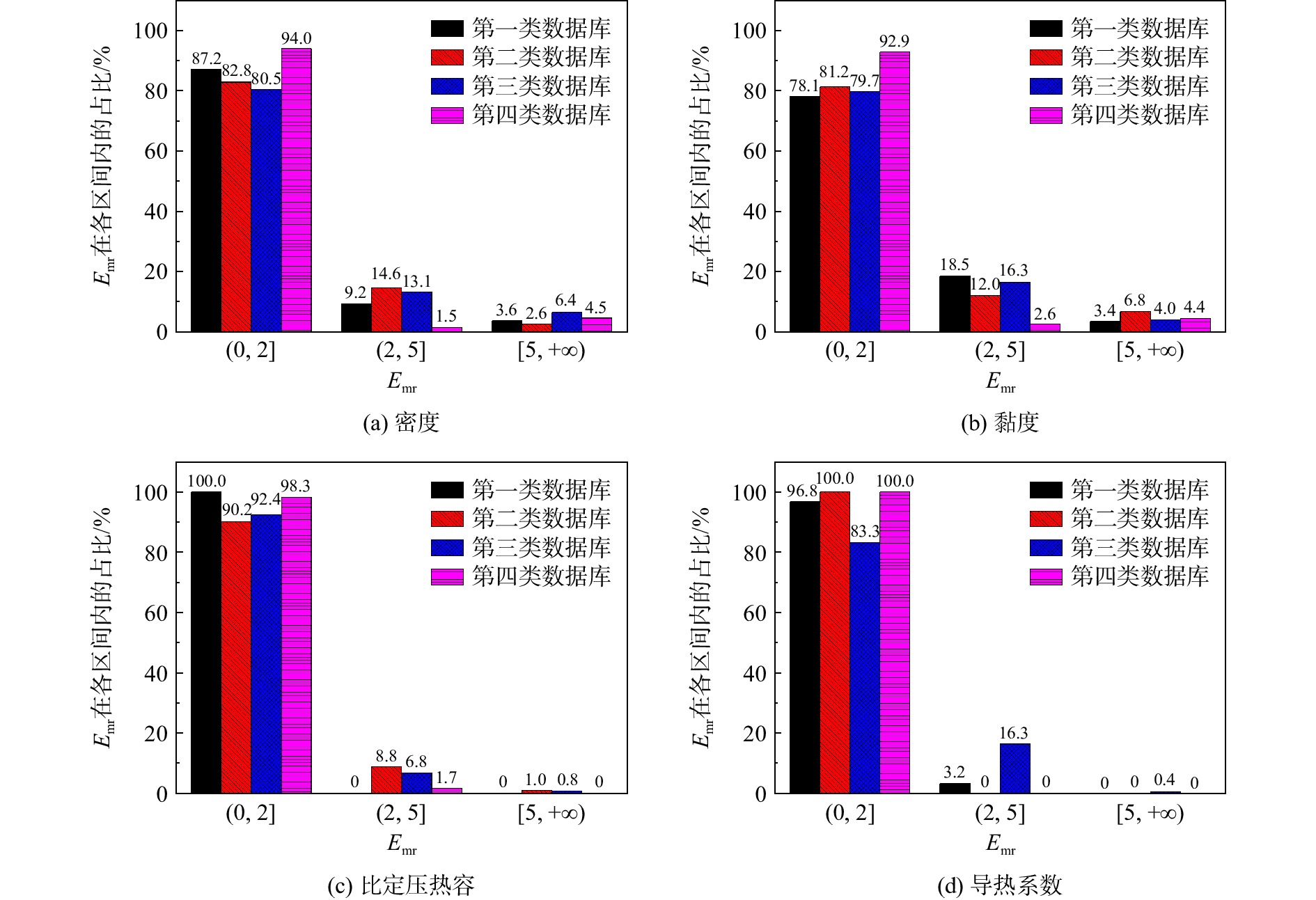
编号 温度范围/K 温度间隔/K 压力/MPa 集合 数量 1 300~800 0.1 3、4、6 训练集 15000 5 测试集 5000 2 300~800 1 3、4、6 训练集 1500 5 测试集 500 3 300~800 2 3、4、6 训练集 750 5 测试集 250 4 300~600600~700700~800 10.11 3、4、6 训练集 4200 5 测试集 1400  下载: 导出CSV
表 2 600~700 K范围内预测值平均相对误差小于2%的比例与模型收敛的迭代步长
Table 2. Proportion of mean relative error of predicted value less than 2% at temperature of 600−700 K and model convergence step
编号 平均相对误差小于2%的占比/% 迭代步长 密度 黏度 比定压热容 导热系数 1 100 100 100 100 602 2 83 81 76 100 98 3 63 59 92 100 44 4 100 100 100 100 239
下载: 导出CSV
表 3 ECS模型和ANN模型预测密度的结果
Table 3. Results of predicted density of ECS model and ANN model
区间 模型 Emr/% Emax/% 低温区
(300~600 K)ECS 1.3 2.4 ANN 0.4 1.8 临界区
(600~700 K)ECS 4.0 5.9 ANN 1.3 2.2 高温区(700~800 K) ECS 65.7 127.9 ANN 2.7 8.0 全区间 ECS 23.7 127.9 ANN 1.5 8.0
下载: 导出CSV
表 4 ECS模型和ANN模型预测黏度的结果
Table 4. Results of predicted viscosity of ECS model and ANN model
区间 模型 Emr/% Emax/% 低温区
(300~600 K)ECS 10.5 23.2 ANN 1.8 5.4 临界区
(600~700 K)ECS 20.8 28.4 ANN 5.9 9.0 高温区(700~800 K) ECS 17.3 31.2 ANN 4.7 18.5 全区间 ECS 16.2 31.2 ANN 4.1 18.5
下载: 导出CSV
表 5 ECS模型和ANN模型预测比定压热容的结果
Table 5. Results of predicted specific heat capacity at constant pressure of ECS model and ANN model
区间 模型 Emr/% Emax/% 低温区
(300~600 K)ECS 17.2 22.6 ANN 1.4 2.2 临界区
(600~700 K)ECS 24.8 26.7 ANN 0.6 1.0 高温区(700~800 K) ECS 32.4 37.2 ANN 0.6 2.6 全区间 ECS 24.8 37.2 ANN 0.9 2.6
下载: 导出CSV
表 6 ECS模型和ANN模型预测导热系数的结果
Table 6. Results of predicted thermal conductivity of ECS model and ANN model
区间 模型 Emr/% Emax/% 低温区
(300~600 K)ECS 17.1 20.6 ANN 0.5 0.9 临界区
(600~700 K)ECS 3.6 7.1 ANN 0.9 1.6 高温区(700~800 K) ECS 5.6 6.2 ANN 0.8 1.9 全区间 ECS 8.8 20.6 ANN 0.7 1.9
下载: 导出CSV
-
[1] CURRAN E T. Scramjet engines: the first forty years[J]. Journal of Propulsion and Power,2001,17(6): 1138-1148. doi: 10.2514/2.5875 [2] 孙青梅,米镇涛,张香文. 吸热型碳氢燃料RP-3仿JP-7临界性质(tc, pc)的测定[J]. 燃料化学学报,2006,34(4): 466-470. doi: 10.3969/j.issn.0253-2409.2006.04.017SUN Qingmei,MI Zhentao,ZHANG Xiangwen. Determination of critical properties (tc, pc) of heat-absorbing hydrocarbon fuel RP-3 imitation JP-7[J]. Journal of Fuel Chemistry,2006,34(4): 466-470. (in Chinese) doi: 10.3969/j.issn.0253-2409.2006.04.017 [3] DENG H W,ZHANG C B,XU G Q,et al. Density measurement of endothermic hydrocarbon fuel at sub- and supercritical conditions[J]. Journal of Chemical and Engineering Data,2011,56(6): 2980-2986. doi: 10.1021/je200258g [4] DENG H W,ZHANG C B,XU G Q,et al. Viscosity measurement of endothermic hydrocarbon fuel from (398 to 788 K) under supercritical pressure conditions[J]. Journal of Chemical and Engineering Data,2012,57(2): 358-365. doi: 10.1021/je200901y [5] DENG H W,ZHU K,XU G Q,et al. Isobaric specific heat capacity measurement for kerosene RP-3 in the near-critical and supercritical region[J]. Journal of Chemical and Engineering Data,2012,57(2): 263-268. doi: 10.1021/je200523a [6] XU G Q,JIA Z X,WEN J,et al. Thermal-conductivity measurements of aviation kerosene RP-3 from (285 to 513 K) at supercritical pressures[J]. International Journal of Thermophysics,2015,36: 620-632. doi: 10.1007/s10765-015-1840-4 [7] 张志强,郝毓雅,陈战斌. 航空喷气燃料RP-3运动黏度特性研究[J]. 现代机械,2020,215(1): 38-40.ZHANG Zhiqiang,HAO Yuya,CHEN Zhanbin. Study on the kinematic viscosity characteristics of aviation jet fuel RP-3[J]. Modern Machinery,2020,215(1): 38-40. (in Chinese) [8] 严俊杰,刘耘州,闫帅,等. 超临界压力下碳氢燃料在竖直圆管内对流换热实验研究[J]. 工程热物理学报,2016,37(11): 2385-2392.YAN Junjie,LIU Yunzhou,YAN Shuai,et al. Experimental study of convective heat transfer of hydrocarbon fuel in a vertical circular tube under supercritical pressure[J]. Journal of Engineering Thermophysics,2016,37(11): 2385-2392. (in Chinese) [9] HEMPERT F,BOBLEST S,ERTL T,et al. Simulation of real gas effects in supersonic methane jets using a tabulated equation of state with a discontinuous Galerkin spectral element method[J]. Computers and Fluids,2017,145: 167-179. doi: 10.1016/j.compfluid.2016.12.024 [10] 范学军,俞刚. 大庆RP-3航空煤油热物性分析[J]. 推进技术,2006,27(2): 187-192. doi: 10.3321/j.issn:1001-4055.2006.02.021FAN Xuejun,YU Gang. Analysis of thermophysical properties of Daqing RP-3 aviation kerosene[J]. Journal of Propulsion Technology,2006,27(2): 187-192. (in Chinese) doi: 10.3321/j.issn:1001-4055.2006.02.021 [11] ZHONG F Q,FAN X J,YU G,et al. Heat transfer of aviation kerosene at supercritical conditions[J]. Journal of Thermophysics and Heat Transfer,2009,23(3): 543-550. doi: 10.2514/1.41619 [12] 姚长鑫,禹进. RP-3航空煤油物理替代燃料模型及应用研究[J]. 推进技术,2020,41(4): 934-941. doi: 10.13675/j.cnki.tjjs.190203YAO Changxin,YU Jin. A physical surrogate fuel model for RP-3 aviation kerosene and applications[J]. Journal of Propulsion Technology,2020,41(4): 934-941. (in Chinese) doi: 10.13675/j.cnki.tjjs.190203 [13] 程泽源,朱剑琴,金钊. 吸热型碳氢燃料RP-3替代模型研究[J]. 航空动力学报,2016,31(2): 391-398. doi: 10.13224/j.cnki.jasp.2016.02.018CHENG Zeyuan,ZHU Jianqin,JIN Zhao. Study of RP-3 substitution model for heat-absorbing hydrocarbon fuel[J]. Journal of Aerospace Power,2016,31(2): 391-398. (in Chinese) doi: 10.13224/j.cnki.jasp.2016.02.018 [14] 郝爽. 基于人工神经网络模型的燃油物性预测与敏感性分析研究[D]. 辽宁 大连: 大连理工大学, 2021.HAO Shuang. Research on fuel physical properties prediction and sensitivity analysis based on artificial neural network model[D]. Dalian Liaoning: Dalian University of Technology, 2021. (in Chinese) [15] 向鹏程,申江. 基于BP神经网络的R404A物性参数计算[J]. 冷藏技术,2018,41(4): 45-49. doi: 10.3969/j.issn.1674-0548.2018.04.012XIANG Pengcheng,SHEN Jiang. BP neural network-based calculation of physical properties parameters of R404A[J]. Refrigeration Technology,2018,41(4): 45-49. (in Chinese) doi: 10.3969/j.issn.1674-0548.2018.04.012 [16] KANAT Z E,OZDIL N. Application of artificial neural network (ANN) for the prediction of thermal resistance of knitted fabrics at different moisture content[J]. Journal of the Textile Institute,2018,109(3): 1-7. [17] ZHAO N,LI Z. Experiment and artificial neural network prediction of thermal conductivity and viscosity for alumina-water nanofluids[J]. Materials,2017,10(5): 552.1-552.16. [18] LI B,LEE Y C,YAO W,et al. Development and application of ANN model for property prediction of supercritical kerosene[J]. Computers and Fluids,2020,209: 104665.1-104665.18. [19] RUMELHART D E, MCCLELLAND J L, GROUP T P. Parallel distributed processing: Vol. 1[M]. Bradford, UK: Encyclopedia of Database Systems, 1987. [20] HORNIK K. Approximation capabilities of multilayer feedforward networks[J]. Neural Networks,1991,4(2): 251-257. doi: 10.1016/0893-6080(91)90009-T [21] 张春本,邓宏武,徐国强,等. 超临界压力下航空煤油RP-3焓值的测量及换热研究[J]. 航空动力学报,2010,25(2): 331-335. doi: 10.13224/j.cnki.jasp.2010.02.021ZHANG Chunben,DENG Hongwu,XU Guoqiang,et al. Measurement of RP-3 enthalpy and heat transfer of aviation kerosene at supercritical pressure[J]. Journal of Aerospace Power,2010,25(2): 331-335. (in Chinese) doi: 10.13224/j.cnki.jasp.2010.02.021 [22] 焦斌,叶明星. BP神经网络隐藏层单元数确定方法[J]. 上海电机学院学报,2013,16(3): 113-116. doi: 10.3969/j.issn.2095-0020.2013.03.002JIAO Bin,YE Mingxing. Method for determining the number of hidden layer units in BP neural networks[J]. Journal of Shanghai Institute of Electrical Engineering,2013,16(3): 113-116. (in Chinese) doi: 10.3969/j.issn.2095-0020.2013.03.002 [23] MAJUMDAR A K,SINGHAL A K,SPALDING D B. Numerical modeling of wet cooling tower:Part 1 mathematical and physical models[J]. Journal of Heat and Mass Transfer,1983,105(4): 728-735. -

 点击查看大图
计量
- 文章访问数: 1092
- HTML浏览量: 417
- PDF量: 168
- 被引次数: 0