






Ablation mechanism and coupling pyrolysis/conduction model of a silicone rubber matrix thermal protection coating
-
摘要:
采用同步热分析仪,开展了热失重实验,确定了防热涂层热分解反应的温度区间、活化能和反应机理函数。利用石英灯辐射加热平台,开展了高温环境考核实验,揭示了防热涂层高温环境下的微结构演化规律和能量耗散机理。基于能量守恒原理,充分考虑热解反应吸热、热解气体扩散换热以及质量引射效应等引起的能量转换关系,建立了防热涂层的热解/传导耦合模型,预报了典型热环境工况下硅橡胶基防热涂层的质量烧蚀率及温度响应规律。烧蚀后涂层表面基本保持平整,背面温度为151.4 ℃,质量烧蚀率为0.28 g/s。质量烧蚀率的模型计算值与实验测量值的偏差仅为7.1%,满足实际工程中热防护设计需求。研究表明,硅橡胶基防热涂层中等热流环境下具有良好的耐烧蚀和隔热性能,是航空航天装备大面积防热区域的理想候选方案。
Abstract:Thermogravimetric analysis was carried out by using synchronous thermal analyzer. The temperature range, activation energy and reaction mechanism function for the thermal decomposition reaction of the coating were determined. Thermal exposure experimental tests were conducted using a quartz lamp radiant heating platform. The mechanism of microstructure evolution and energy dissipation of thermal protection coating at high temperatures were revealed. Based on the principle of energy conservation, a coupling model for predicting the pyrolysis and thermal conduction of the thermal protection coating was established. The energy conversion relationships, which were caused by pyrolysis reaction, thermal diffusion of decomposition gas and mass ejection effect, were considered. The mass loss and temperature response of the silicone rubber matrix thermal protection coating under a typical thermal environment were calculated. After thermal exposure, the specimen surface remained basically flat, and the temperature at back surface was 151.4 ℃ while the mass loss rate was 0.28 g/s. The deviation between the calculated mass loss rate and its measured value was only 7.1%. This can meet the requirements of thermal protection design in engineering applications. The results showed that the silicone rubber matrix thermal protection coating has good ablation resistance and thermal insulation properties in medium heat flux environment, so it has excellent potential for the large area thermal protection application of aerospace vehicles.
-
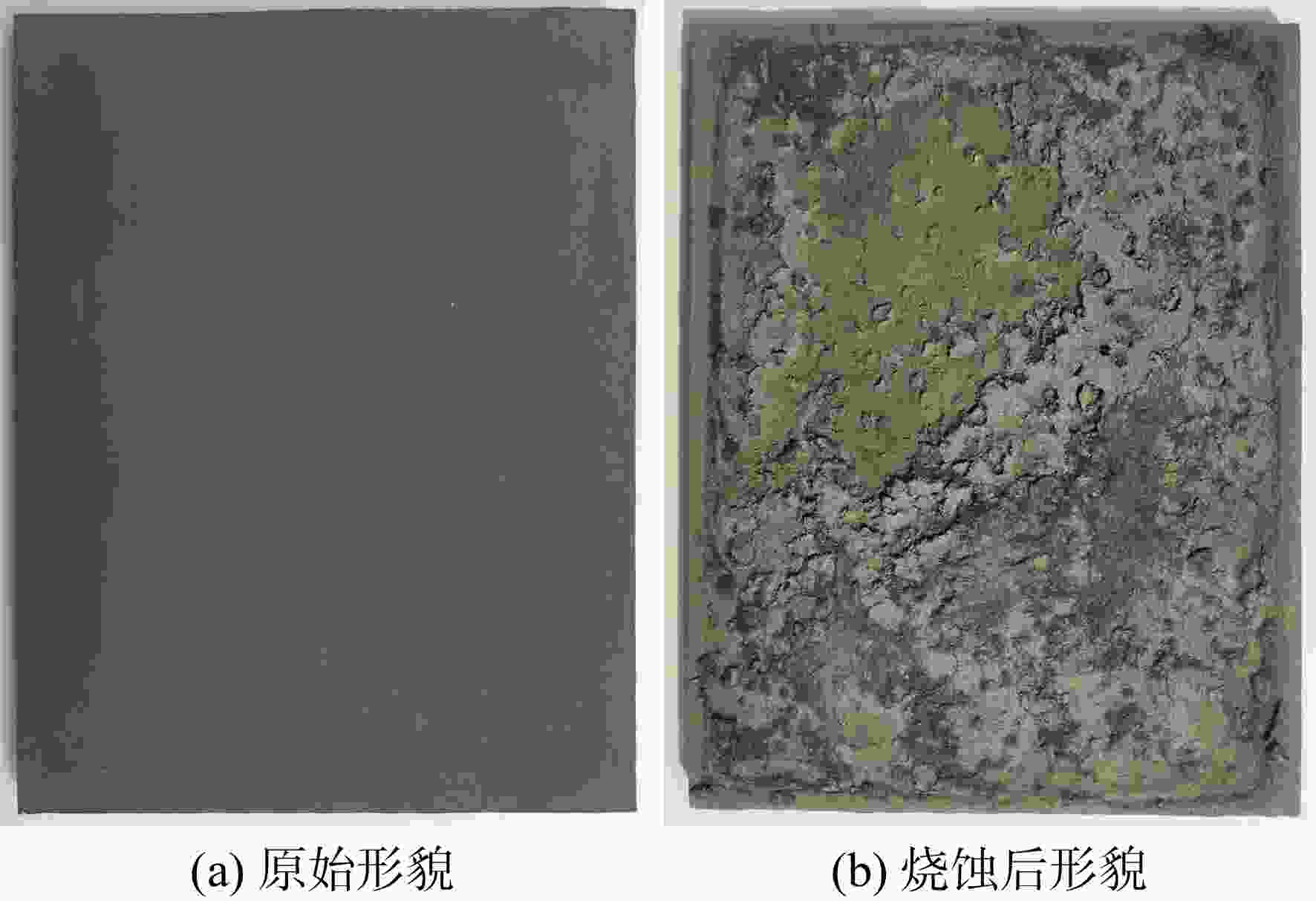
图 1 硅橡胶基防热涂层样件热暴露前后宏观形貌
Figure 1. Specimen photographs of silicone rubber matrix thermal protection coating before and after thermal exposure
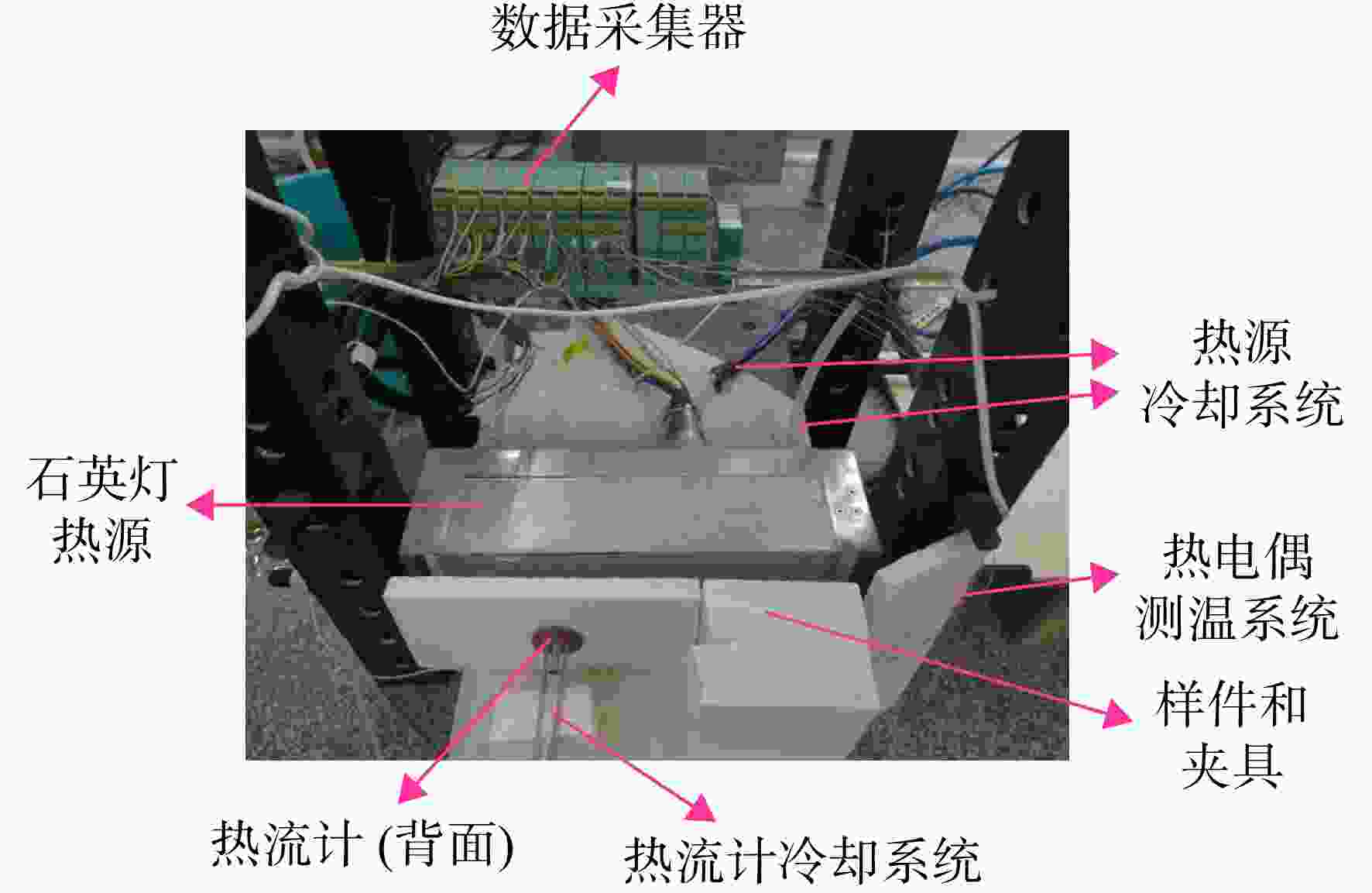
图 2 石英灯辐射加热实验平台
Figure 2. Photograph of quartz lamp radiation heating experiment platform
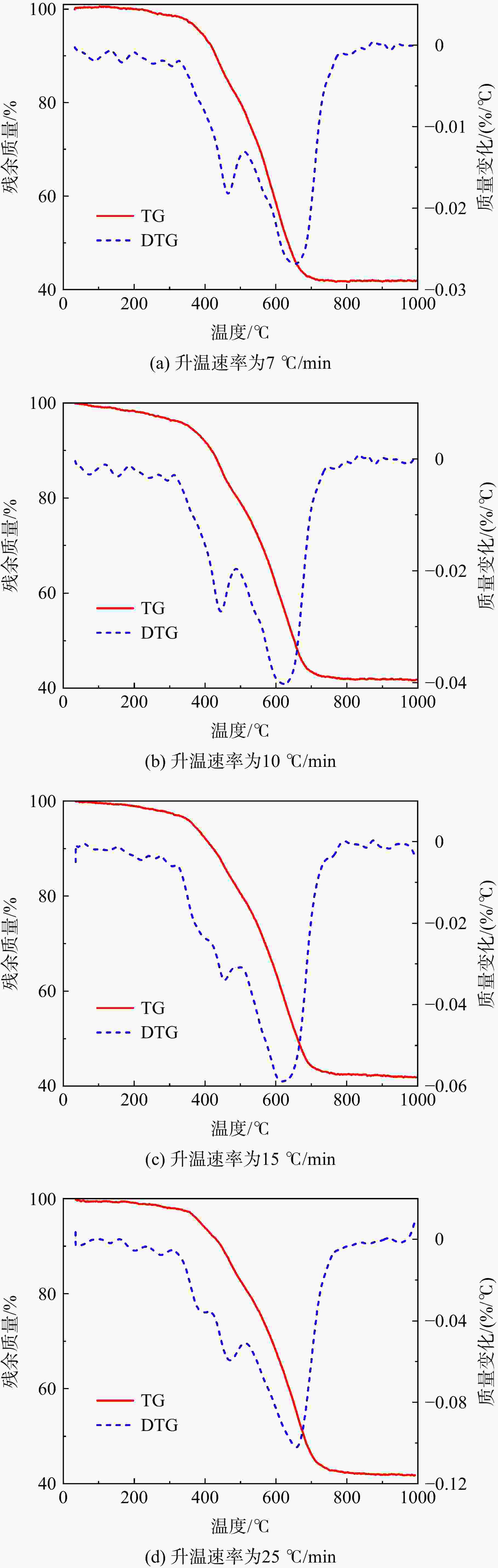
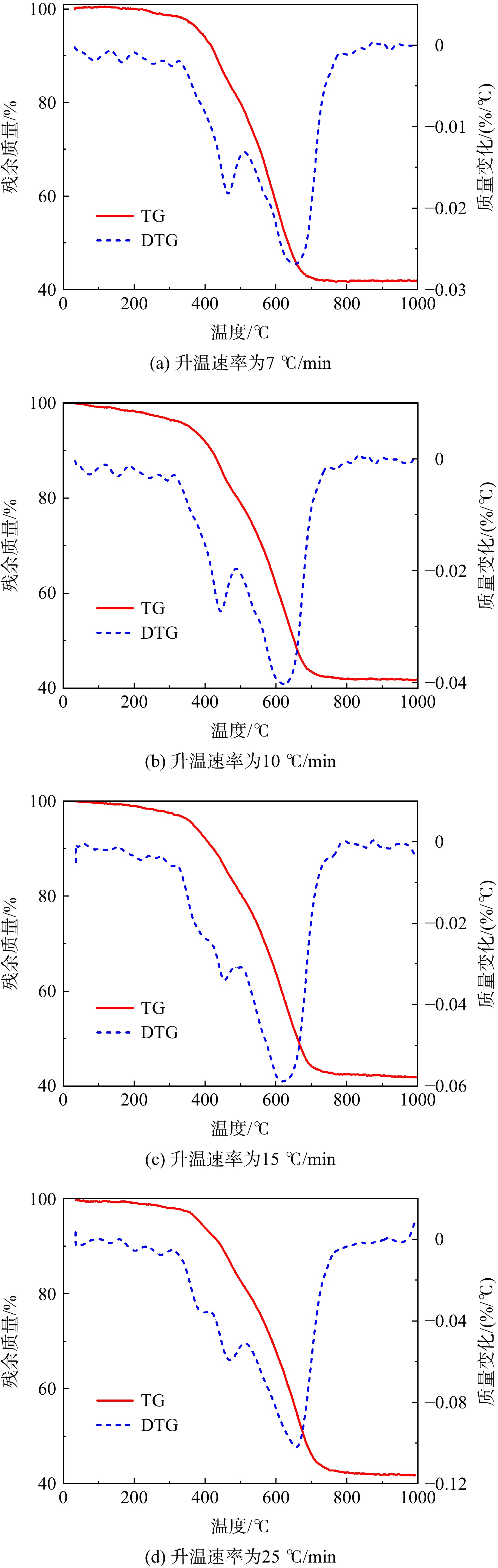
图 3 硅橡胶基防热涂层惰性气体不同升温速率条件下的热失重规律
Figure 3. Thermogravimetric laws of silicone rubber matrix thermal protection coating under inert gas environment at different heating rates
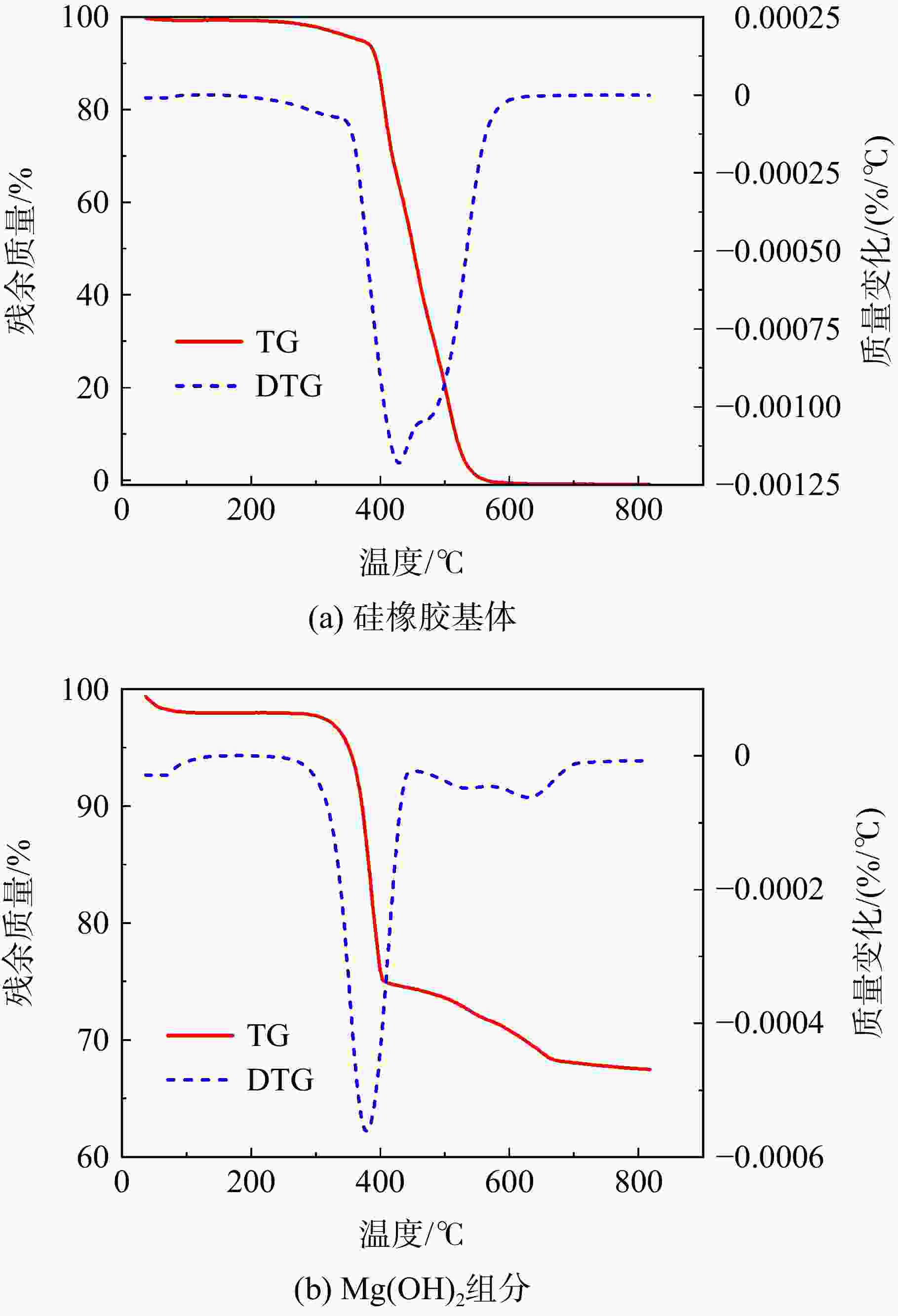
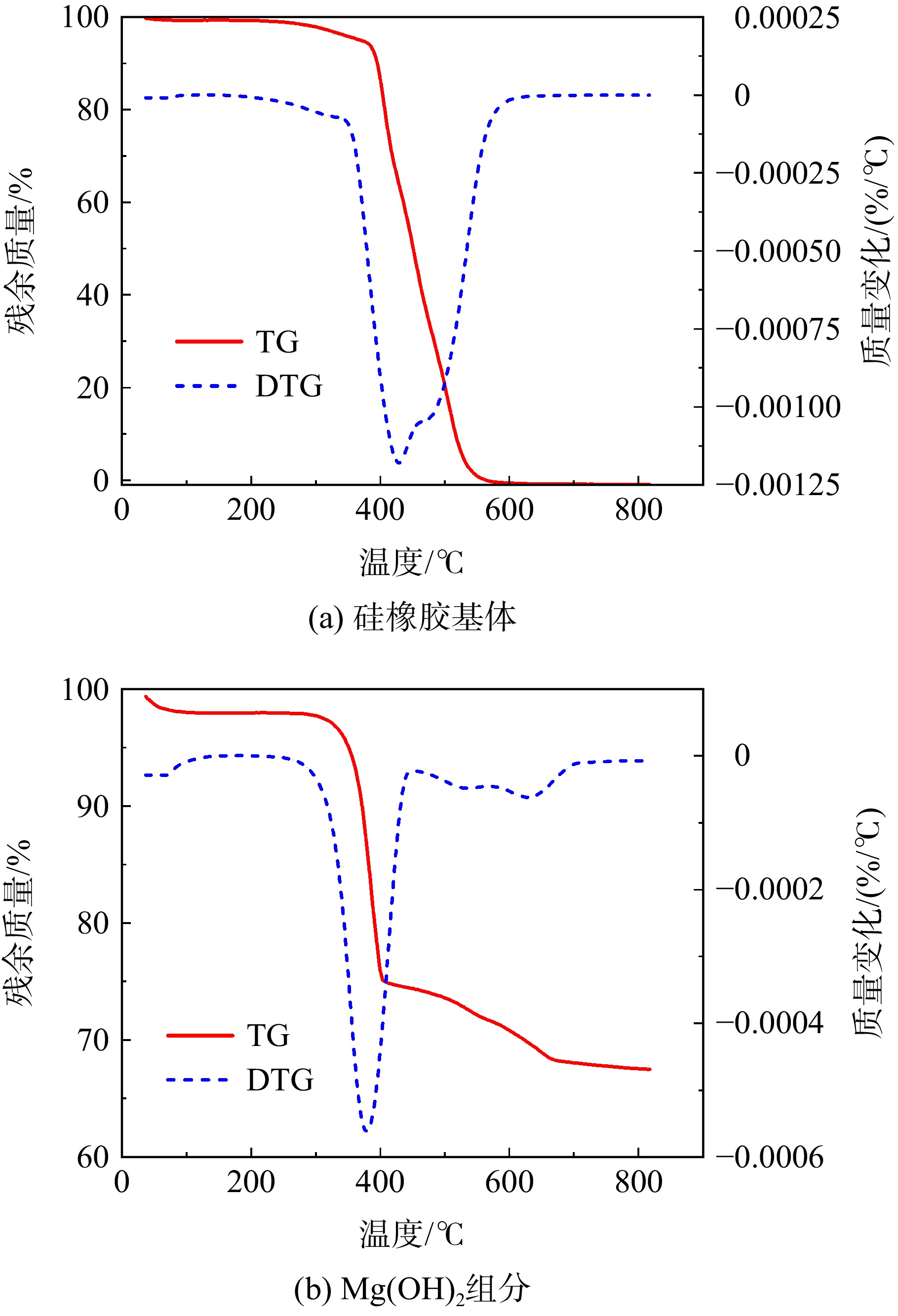
图 4 硅橡胶基体和Mg(OH)2组元惰性气体在10 ℃/min升温速率条件下的热失重规律
Figure 4. Thermogravimetric laws of silicone rubber matrix and Mg(OH)2 under inert gas environment at the heating rate of 10 ℃/min
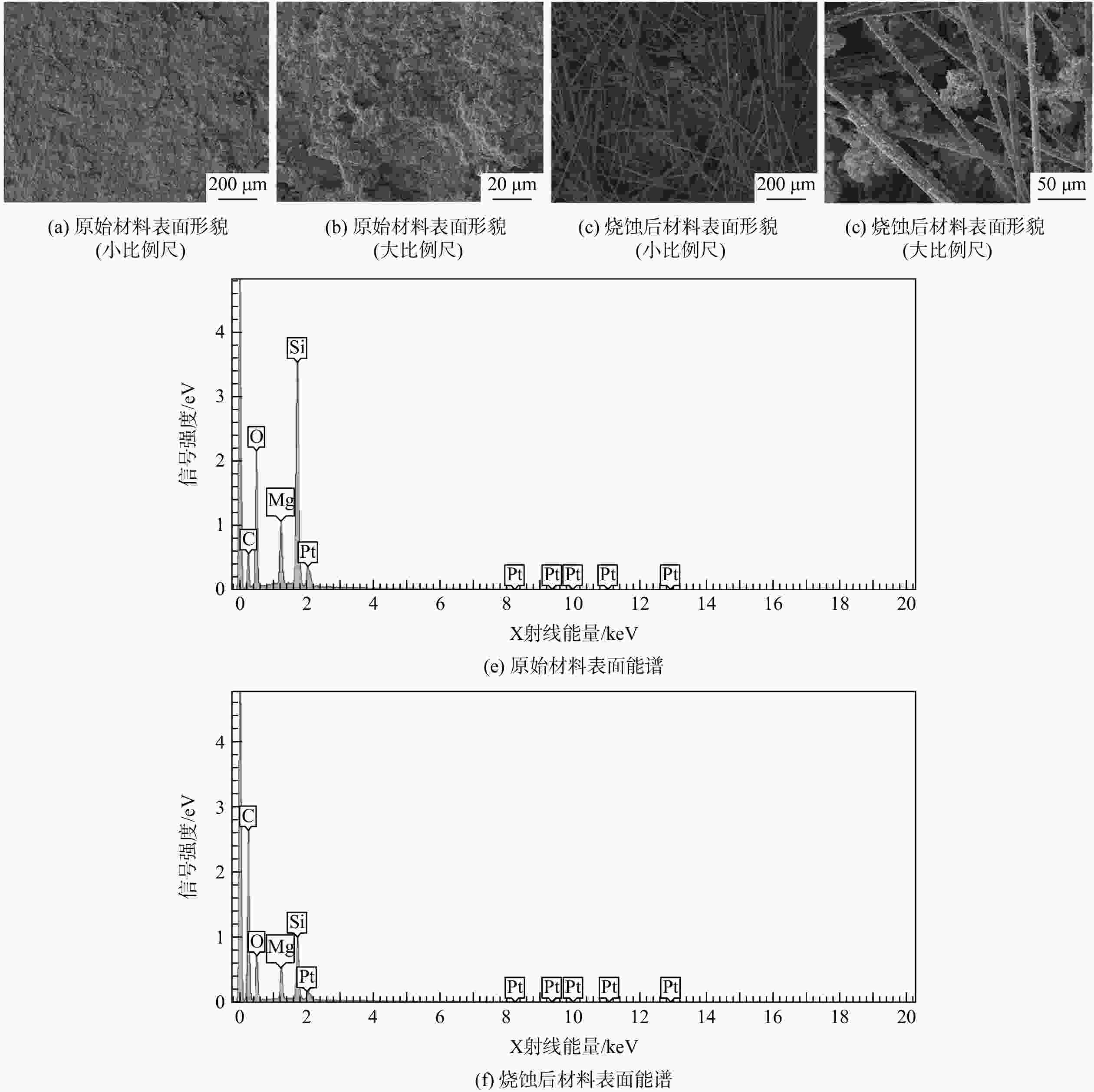
图 5 硅橡胶基防热涂层样件热暴露前后微观形貌照片与能谱
Figure 5. Micromorphology photographs and energy spectrum of silicone rubber matrix thermal protection coating specimens before and after thermal exposure
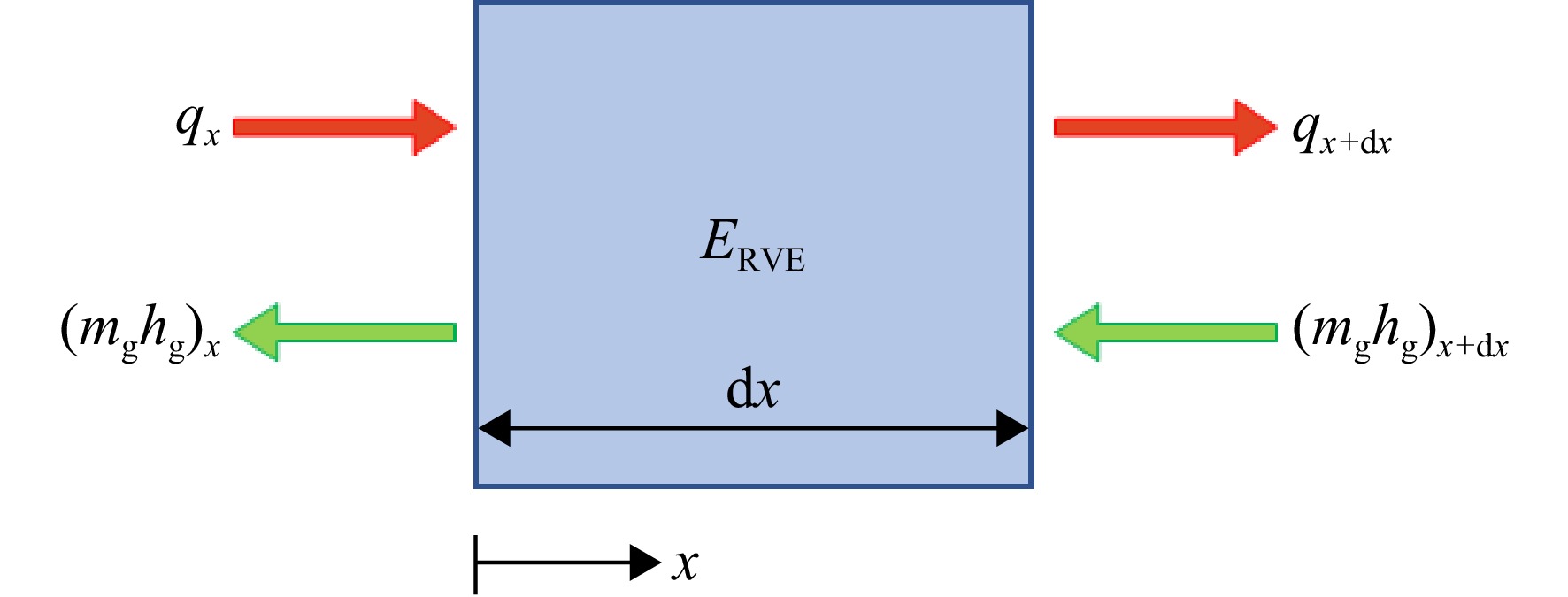
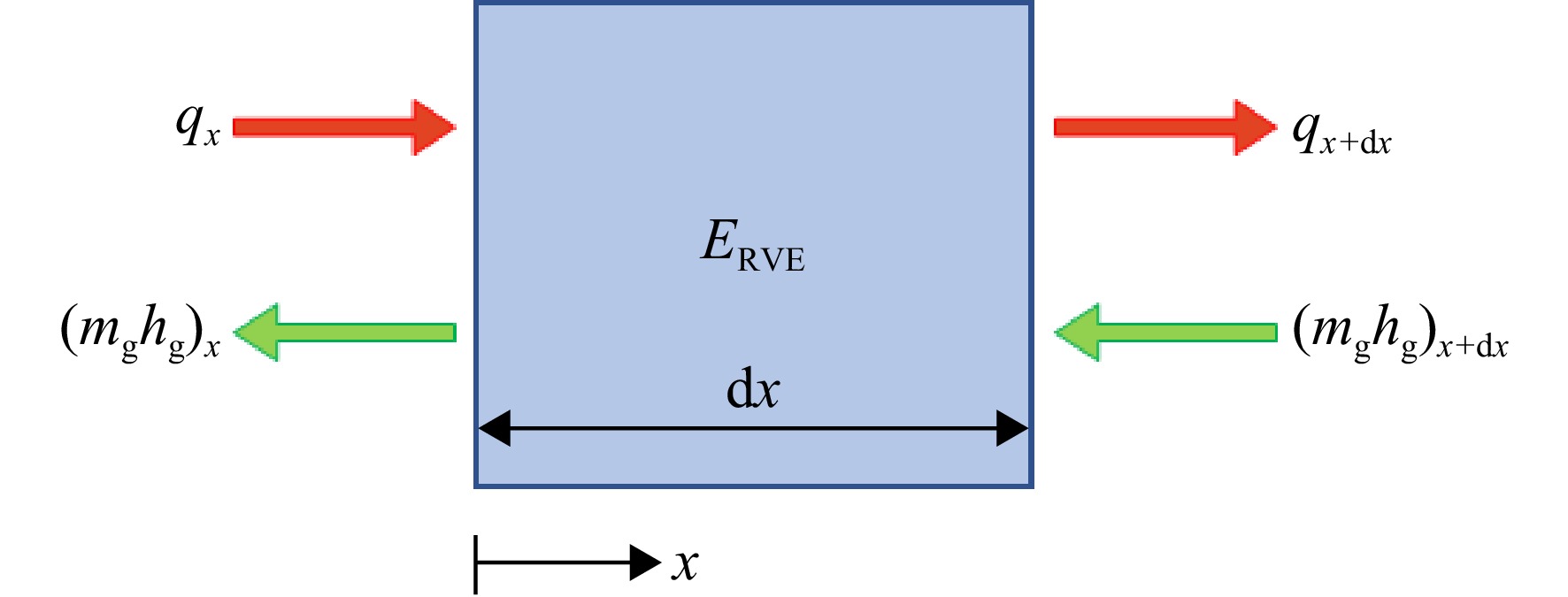
图 6 硅橡胶基防热涂层样件内部代表性控制体单元的能量转换关系
Figure 6. Energy conversion relationships of representative volume element in the internal silicone rubber matrix thermal protection coating specimen
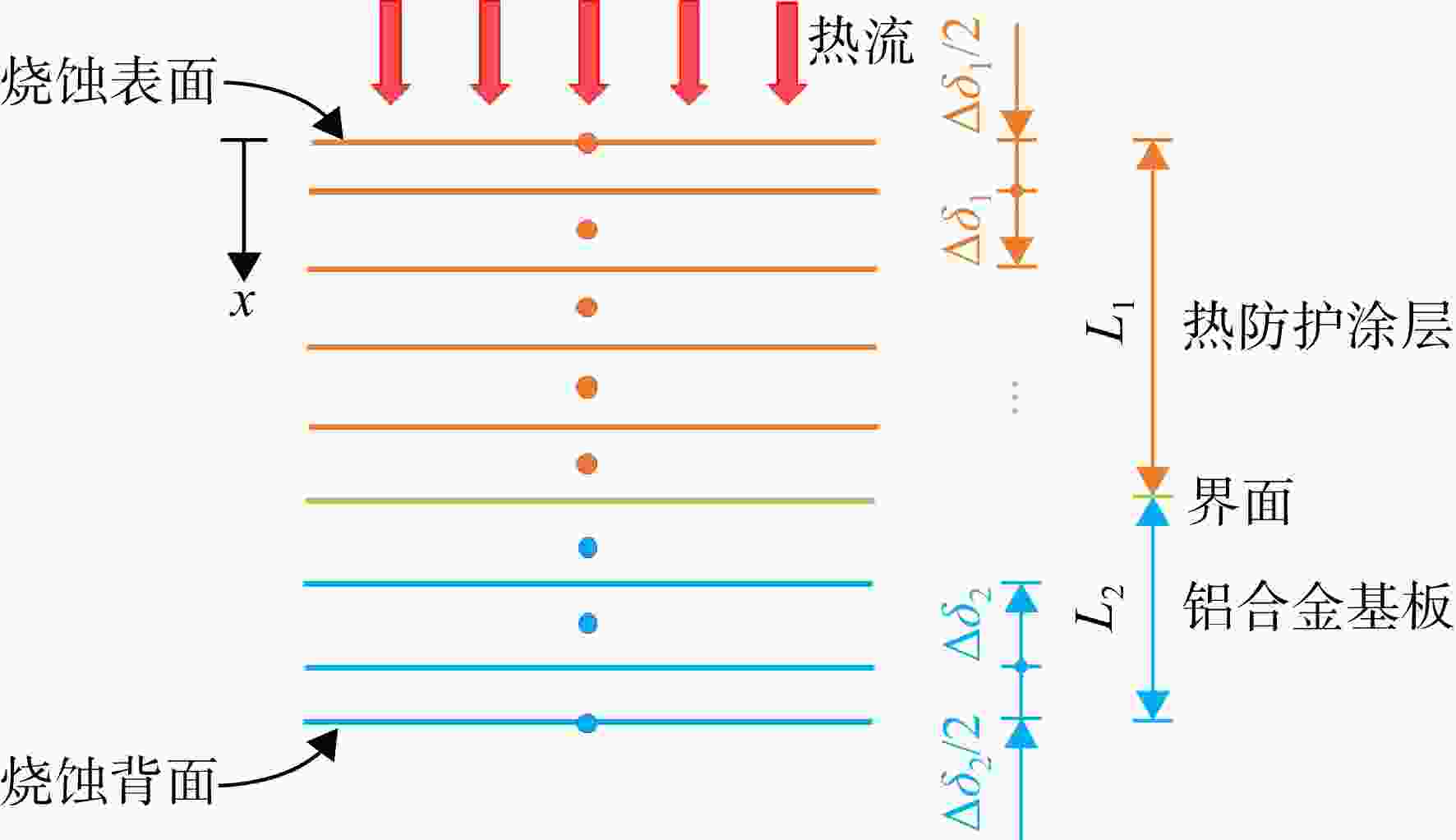
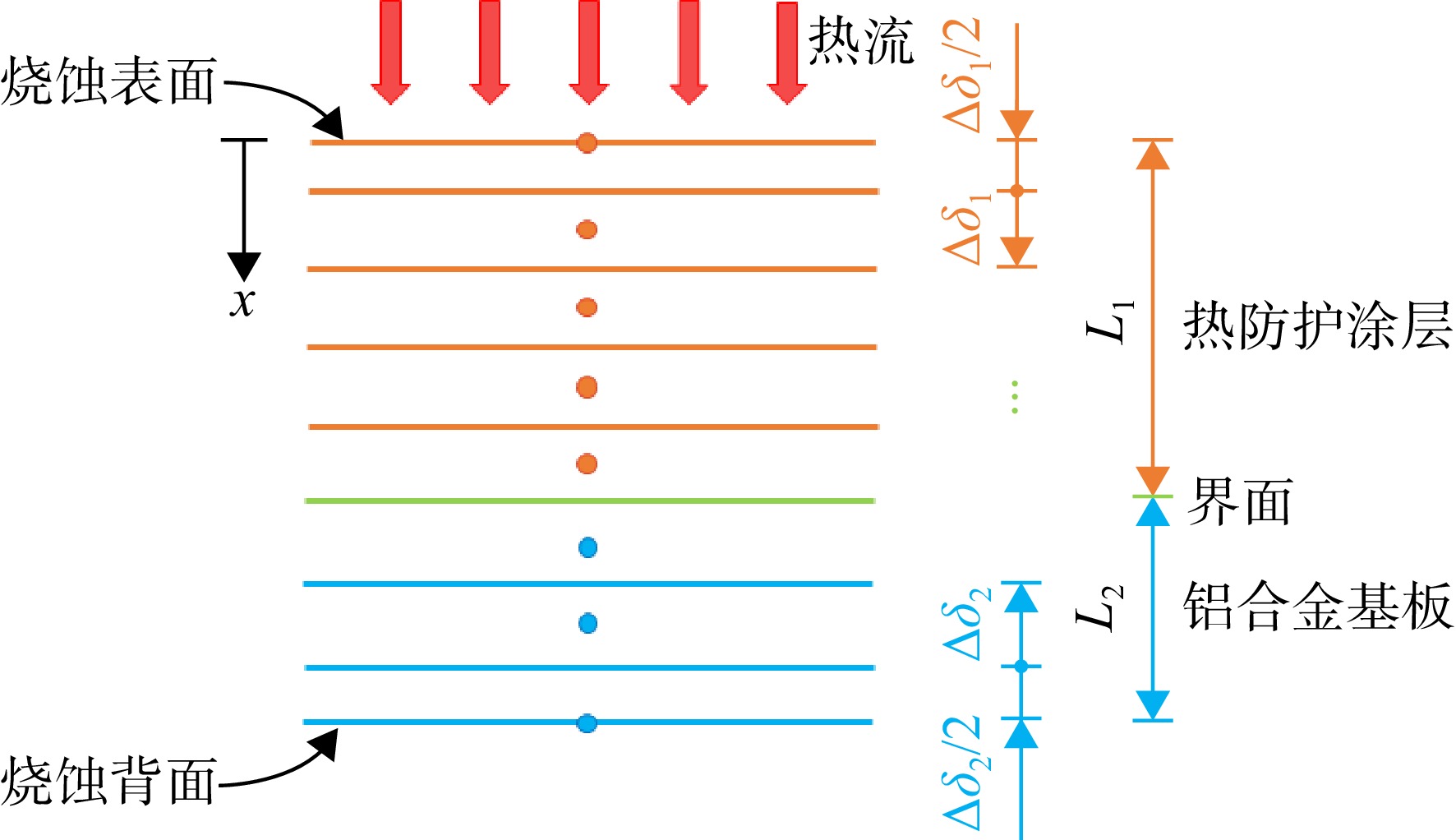
图 7 硅橡胶基防热涂层样件空间区域离散示意图
Figure 7. Schematic diagram of spatial discretization of silicone rubber matrix thermal protection coating specimen
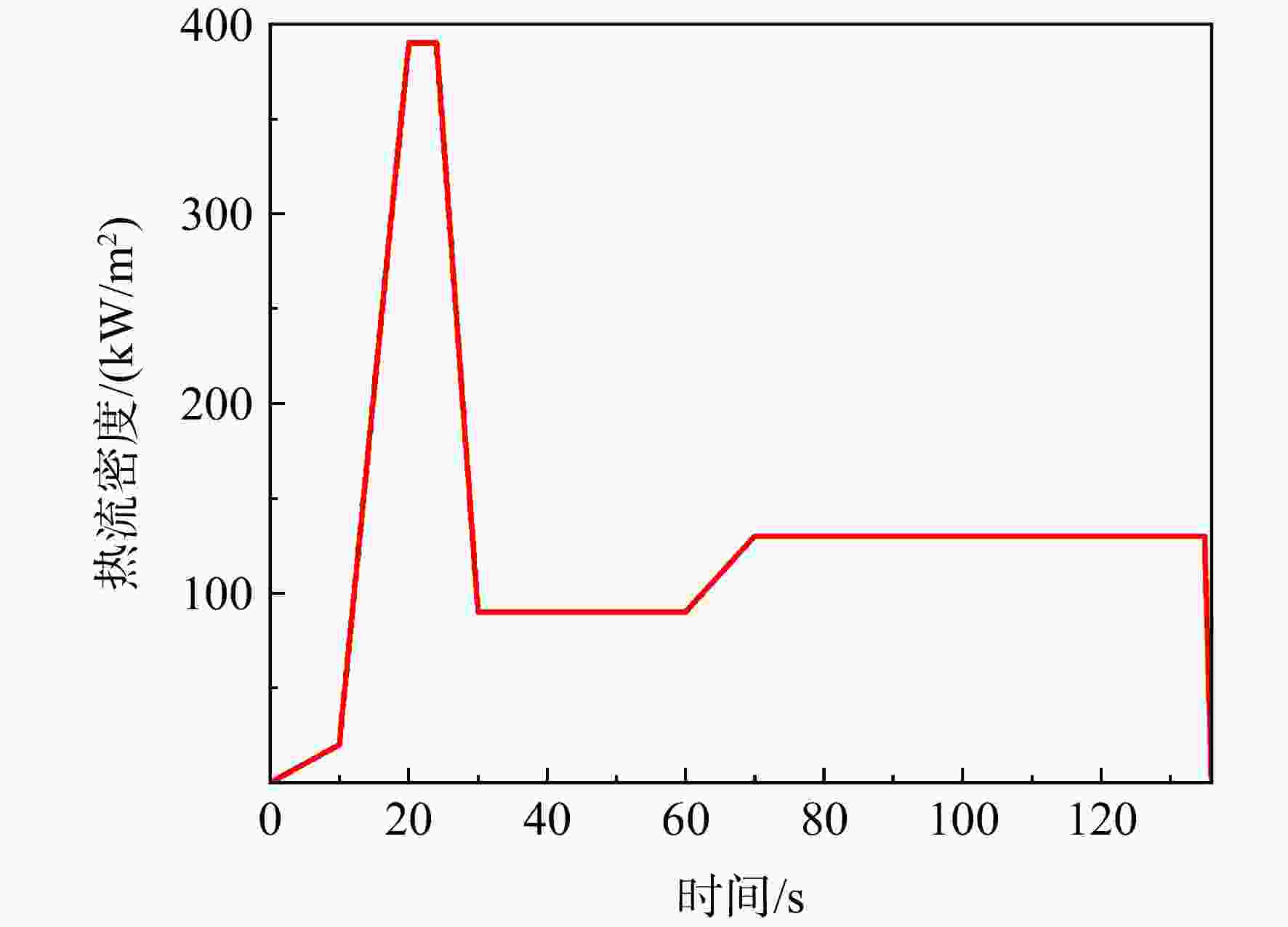
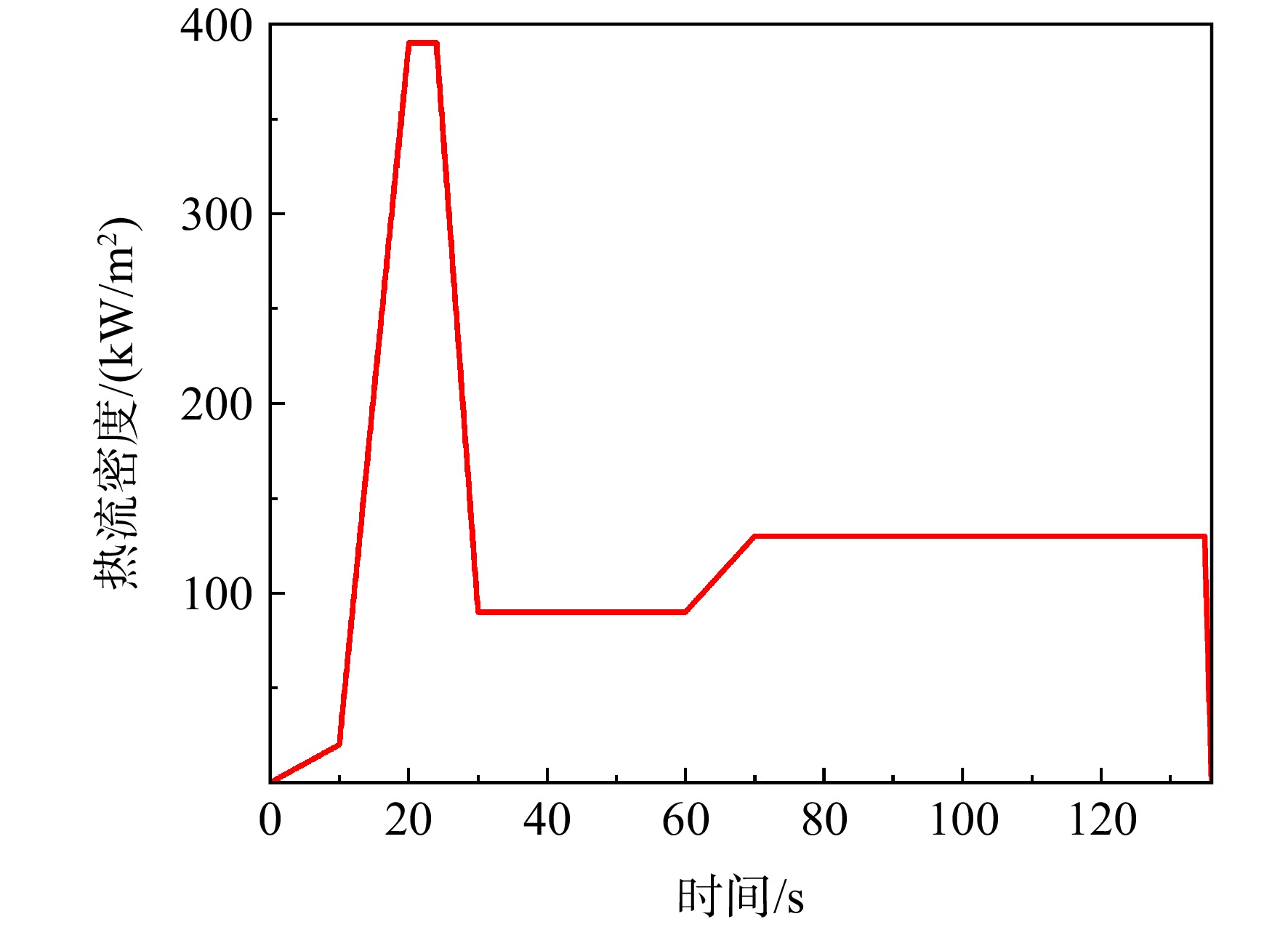
图 8 石英灯辐射加热实验中加载的热流密度-加热时间变化曲线
Figure 8. The curve of heat flux with heating time from quartz lamp radiant heating experiment test
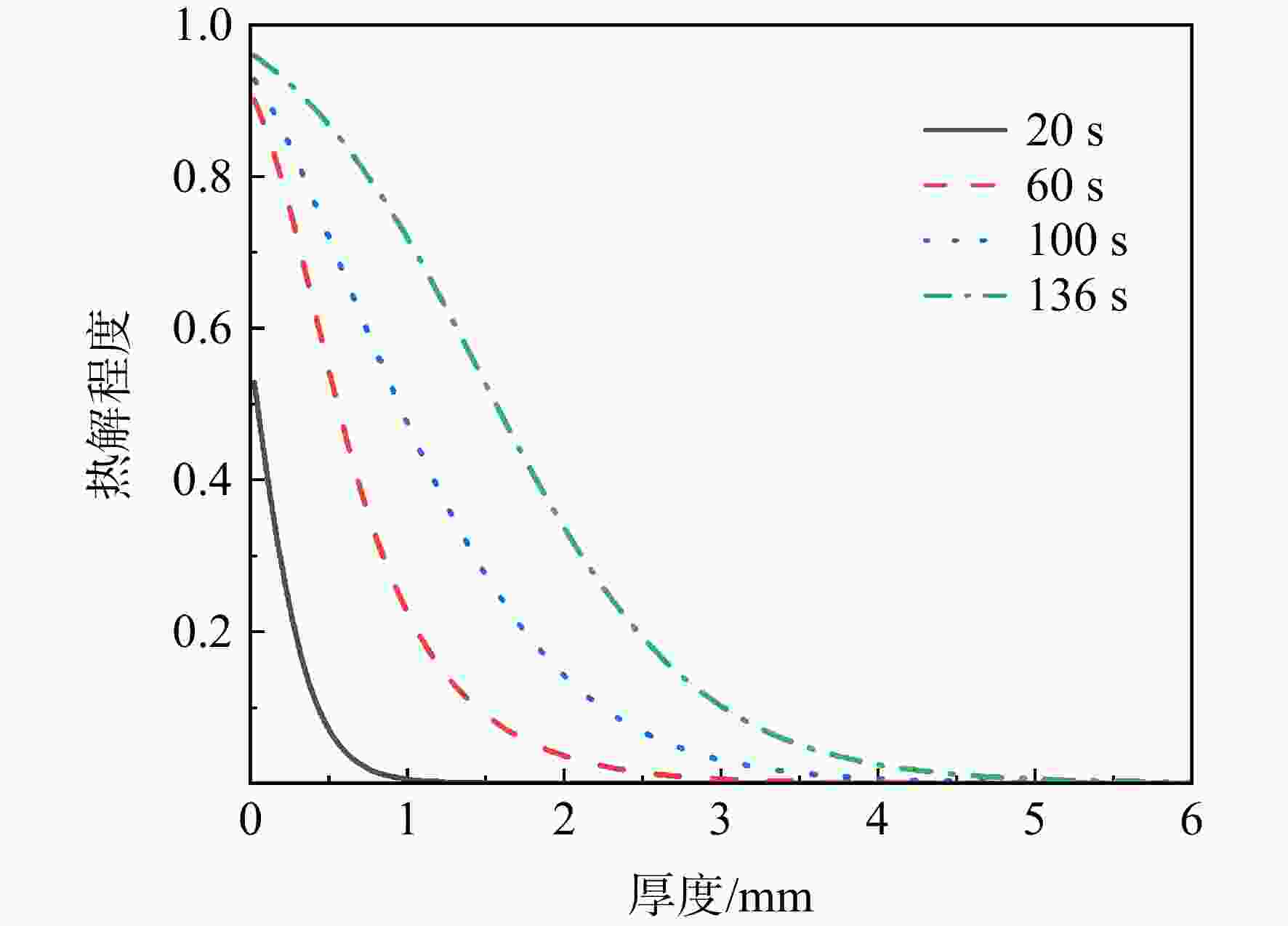
图 9 硅橡胶基防热涂层不同加热时刻厚度方向的热解反应进行程度变化规律
Figure 9. Variation of conversion rate of pyrolysis reactions versus distance from the heating surface for silicone rubber matrix thermal protection coating at different heating times
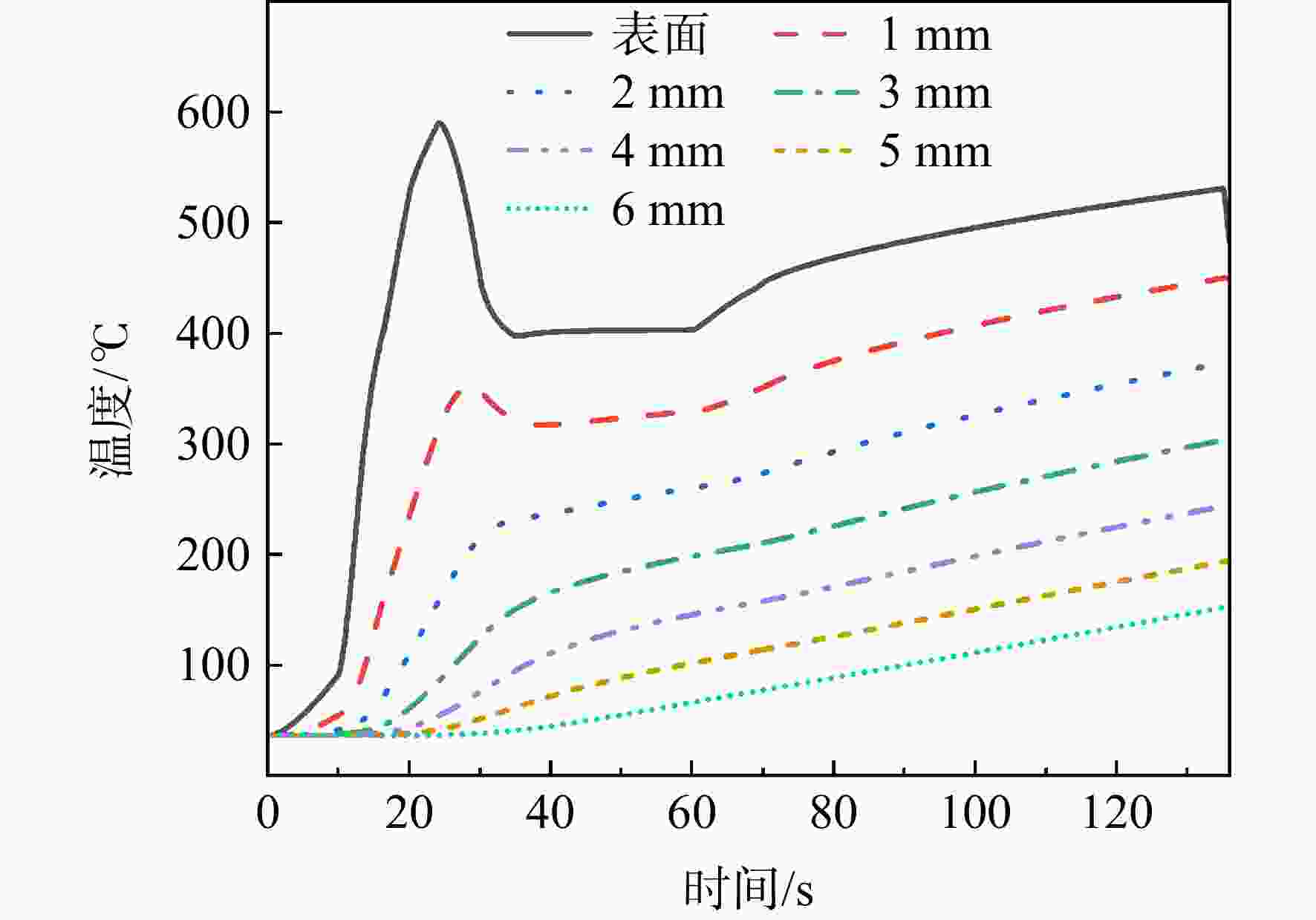
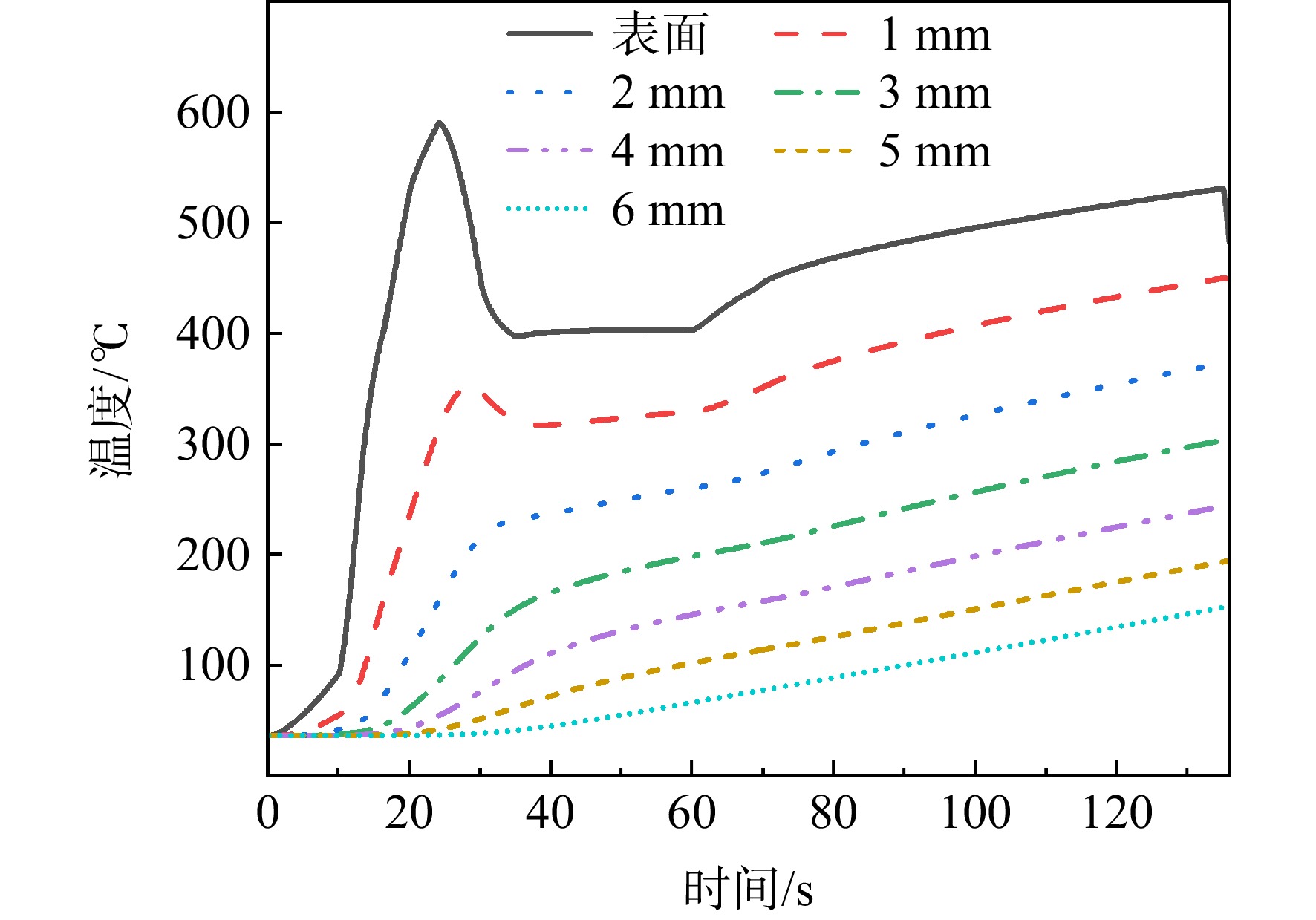
图 10 硅橡胶基防热涂层不同厚度处温度-时间变化过程
Figure 10. The curves of temperature with heating time at different thicknesses of silicone rubber matrix thermal protection coating
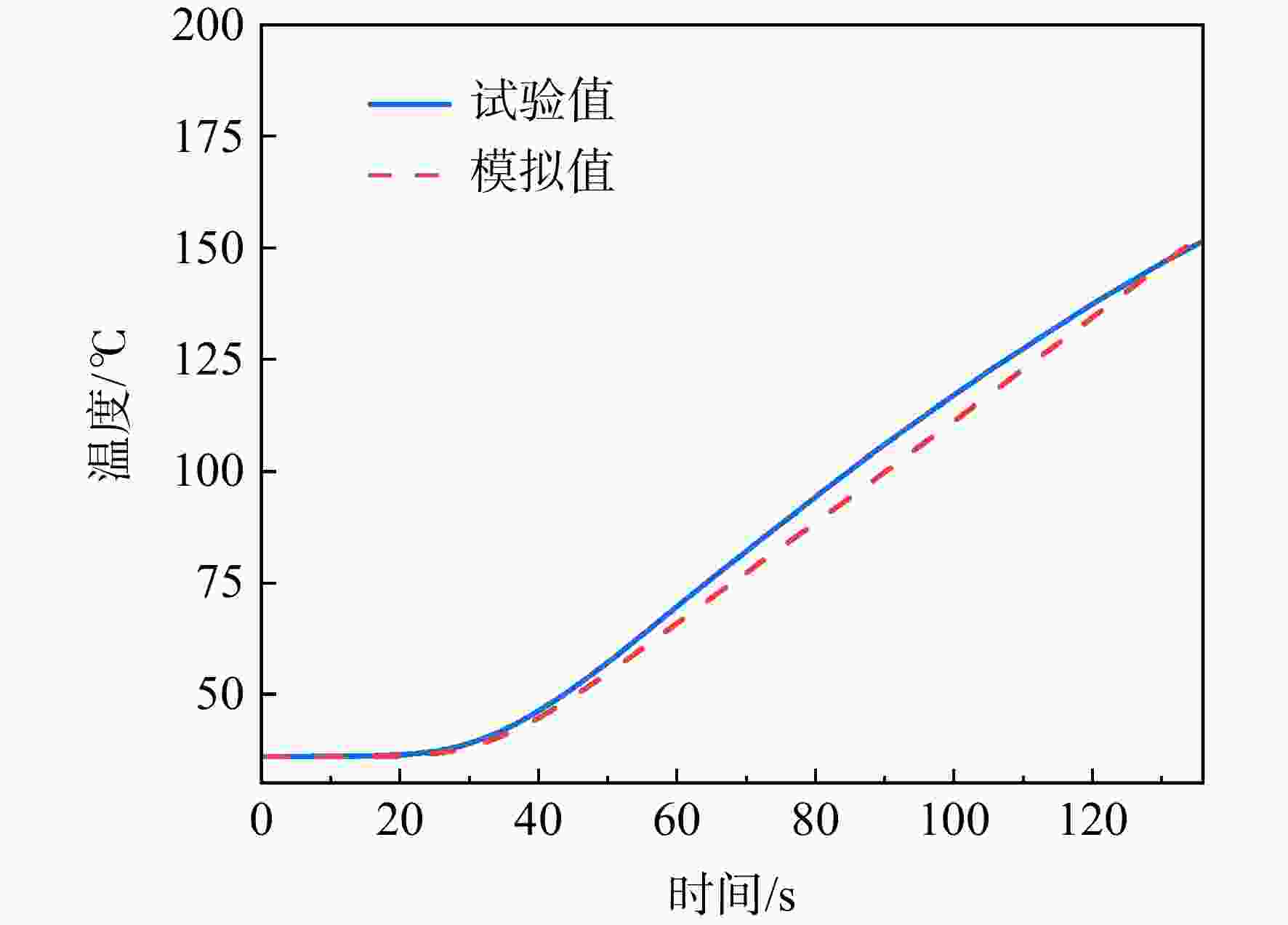
图 11 硅橡胶基防热涂层样件背面温度-时间变化过程
Figure 11. The curves of temperature at back surface versus heating time of silicone rubber matrix thermal protection coating specimen
$ A $ 热解反应指前因子(1/s) ${k_{\text{s}}}$ 任意炭化度材料的热导率(W/(m·℃)) $ {C_{{\text{pc}}}} $ 炭化材料比热容(J/(kg·℃)) $ {m_{\text{g}}} $ 热解气体质量流量(kg/s) $ {C_{{\text{pg}}}} $ 热解气体比热容(J/(kg·℃)) $ \dot m_{\text{g}}^{} $ 热解气体的质量流率(kg/(m2·s)) $ {C_{{\text{pv}}}} $ 原始材料比热容(J/(kg·℃)) $ {m_{{\text{RVE}}}} $ 控制体单元的质量(kg) $ {C_{{\text{ps}}}} $ 任意炭化度材料比热容(J/(kg·℃)) $ \dot Q $ 控制体单元的能量变化率(J/s) $ {\text{d}}x $ 控制体单元厚度(m) $ q $ 单位时间传导的热量(J/s) $ {E_{{\text{RVE}}}} $ 控制体单元的能量(J) $ {\dot q_{{\text{ent}}}} $ 进入防热层的净热流密度(W/m2) $ {\dot E_{{\text{in}}}} $ 单位时间进入控制体单元的能量(J/s) $ \dot q_x^{} $ 热流密度(W/m2) $ {\dot E_{{\text{out}}}} $ 单位时间控制体单元输出的能量(J/s) $ R $ 理想气体常数(J/(mol·℃)) $ {E_{\text{a}}} $ 热解反应活化能(J/mol) $ S $ 面积(m2) $ f $ 热解反应微分形式动力学机理函数 $ T $ 温度(℃) $ h $ 控制体单元的比焓(J/kg) $ t $ 时间(s) $ {h_{\text{c}}} $ 炭化材料的比焓(J/kg) $ \alpha $ 热解反应的进行程度,无量纲 $ {h_{\text{g}}} $ 热解气体的比焓(J/kg) $ {\varphi _{\text{c}}} $ 残余碳组分相的体积分数,无量纲 $ {h_{\text{s}}} $ 任意炭化度材料的比焓(J/kg) $ {\varphi _{\text{v}}} $ 原始材料的体积分数,无量纲 $ {h_{\text{v}}} $ 原始材料的比焓(J/kg) $ \rho $ 控制体单元的密度(kg/m3) $ \Delta {H_{\text{g}}} $ 涂层热解反应的分解热(J/kg) $ {\rho _{\text{c}}} $ 炭化材料的密度(kg/m3) ${k_{\text{c}}}$ 炭化材料的热导率(W/(m·℃)) $ {\rho _{\text{v}}} $ 原始材料的密度(kg/m3) ${k_{\text{v}}}$ 原始材料的热导率(W/(m·℃)) $ {\rho _{\text{s}}} $ 任意炭化度材料的密度(kg/m3) 下标 Al 铝合金基板 out 离开控制体 c 完全炭化后材料 $ {\text{RVE}} $ 代表性控制体单元 g 热解气体相 s 任意炭化度防热材料 in 进入控制体 v 原始材料 j 空间离散变量 $ x $ 控制体单元厚度方向 缩略词 TGA 热失重分析 DTG 微分热失重曲线 DSC 差示扫描量热仪  下载: 导出CSV
表 1 硅橡胶基防热涂层的基本材料性能参数
Table 1. Basic material parameters of silicone rubber matrix thermal protection coating
参数 数值 原始材料密度ρv/(kg/m3) 1200 炭化材料密度ρc/(kg/m3) 480 原始材料比热容Cpv/(J/(kg·℃)) 1300+3T 炭化材料比热容Cpc/(J/kg·℃) 1000+1.02T 原始材料热导率kv/(W/(m·℃)) 0.299 炭化材料热导率kc/(W/(m·℃)) 0.55 分解热ΔHg/106 (J/kg) 1.0 热解气体比热容Cpg/(J/kg·℃) 2676.8+1.05T
下载: 导出CSV
表 2 硅橡胶基防热涂层典型热环境下关键烧蚀性能的实验值与计算值比较
Table 2. Comparison of experimental and calculated ablation properties of silicone rubber matrix thermal protection coating under a typical thermal environment
项目 质量损失量/g 质量烧蚀率/(g/s) 1号试件 45.07 0.33 2号试件 41.86 0.31 3号试件 28.22 0.21 实验平均值 38.38 0.28 计算值 35.02 0.26 偏差/% 8.75 7.1
下载: 导出CSV
-
[1] 王飞,王秦阳,孙创,等. 一种耐高温多层热防护结构的优化设计与性能[J]. 航空动力学报,2023,38(5): 1075-1082. doi: 10.13224/j.cnki.jasp.20210601WANG Fei,WANG Qinyang,SUN Chuang,et al. Optimization design and performance for multi-layer thermal protection structure at high temperature[J]. Journal of Aerospace Power,2023,38(5): 1075-1082. (in Chinese) doi: 10.13224/j.cnki.jasp.20210601 [2] 许巍,赵俊伟,袁本立,等. 飞行器热防护与利用一体化系统实验与模拟[J]. 航空动力学报,2022,37(3): 555-563.XU Wei,ZHAO Junwei,YUAN Benli,et al. Experiment and simulation on aircraft thermal protection and utilization integrated system[J]. Journal of Aerospace Power,2022,37(3): 555-563. (in Chinese) [3] POOVATHINGAL S,STERN E C,NOMPELIS I,et al. Nonequilibrium flow through porous thermal protection materials: Part Ⅱ oxidation and pyrolysis[J]. Journal of Computational Physics,2019,380: 427-441. doi: 10.1016/j.jcp.2018.02.043 [4] UYANNA O,NAJAFI H. Thermal protection systems for space vehicles: a review on technology development, current challenges and future prospects[J]. Acta Astronautica,2020,176: 341-356. doi: 10.1016/j.actaastro.2020.06.047 [5] 杨光,檀妹静,聂春生,等. 平板空气舵干扰区烧蚀凹陷对热环境影响[J]. 航空动力学报,2021,36(6): 1145-1155.YANG Guang,TAN Meijing,NIE Chunsheng,et al. Effect on heating environment of ablation recession in plate-rudder interaction region[J]. Journal of Aerospace Power,2021,36(6): 1145-1155. (in Chinese) [6] 查柏林,石易昂,王金金,等. 固体火箭冲压发动机补燃室绝热层烧蚀试验方法[J]. 航空动力学报,2018,33(4): 936-943.ZHA Bailin,SHI Yiang,WANG Jinjin,et al. Ablation experimental method for insulation of secondary combustion chamber in solid ducted rocket[J]. Journal of Aerospace Power,2018,33(4): 936-943. (in Chinese) [7] 贺晨,苏峘,卢鹉,等. 环氧有机硅韧性烧蚀防热涂层制备[J]. 表面技术,2018,47(5): 167-171.HE Chen,SU Huan,LU Wu,et al. Preparation of toughness ablation thermal protection coating of silicone modified epoxy[J]. Surface Technology,2018,47(5): 167-171. (in Chinese) [8] 邓代英,罗晓光,陈思员,等. 二氧化碳介质气动加热环境下碳化热解类防热材料烧蚀机理分析[J]. 装备环境工程,2020,17(1): 43-50.DENG Daiying,LUO Xiaoguang,CHEN Siyuan,et al. Impact of carbon dioxide aeroheating on the ablation performance of charring thermal protective materials[J]. Equipment Environmental Engineering,2020,17(1): 43-50. (in Chinese) [9] 董一民. 硅橡胶/酚醛类树脂耐高温隔热复合材料的制备及其性能研究[D]. 沈阳: 东北大学, 2017.DONG Yimin. Study on the preparation of silicon rubber/phenolic resin thermal insulation composites and its properties[D]. Shenyang: Northeastern University, 2017. (in Chinese) [10] 吴晓宏,陆小龙,李涛,等. 轻质烧蚀材料研究综述[J]. 航天器环境工程,2011,28(4): 313-317.WU Xiaohong,LU Xiaolong,LI Tao,et al. A review of researches of light-weight ablators[J]. Spacecraft Environment Engineering,2011,28(4): 313-317. (in Chinese) [11] 王春明,梁馨,孙宝岗,等. 低密度烧蚀材料在神舟飞船上的应用[J]. 宇航材料工艺,2011,41(2): 5-8.WANG Chunming,LIANG Xin,SUN Baogang,et al. Application of low density ablative material on Shenzhou spacecraft[J]. Aerospace Materials & Technology,2011,41(2): 5-8. (in Chinese) [12] 冯志海,师建军,孔磊,等. 航天飞行器热防护系统低密度烧蚀防热材料研究进展[J]. 材料工程,2020,48(8): 14-24. doi: 10.11868/j.issn.1001-4381.2020.000206FENG Zhihai,SHI Jianjun,KONG Lei,et al. Research progress in low-density ablative materials for thermal protection system of aerospace flight vehicles[J]. Journal of Materials Engineering,2020,48(8): 14-24. (in Chinese) doi: 10.11868/j.issn.1001-4381.2020.000206 [13] SULLIVAN J, KOBAYASHI W. Spallation modeling in the charring material thermal response and ablation (CMA) computer program[R]. AIAA1987-1516, 1987. [14] XIAO Jie,DAS O,MENSAH R A,et al. Ablation behavior studies of charring materials with different thickness and heat flux intensity[J]. Case Studies in Thermal Engineering,2021,23: 100814. doi: 10.1016/j.csite.2020.100814 [15] EWING M E,LAKER T S,WALKER D T. Numerical modeling of ablation heat transfer[J]. Journal of Thermophysics and Heat Transfer,2013,27(4): 615-632. doi: 10.2514/1.T4164 [16] BERSBACH C J,EVANS J,ALKANDRY H,et al. Ablative thermal response numerical modeling under arcjet test conditions[J]. Journal of Thermophysics and Heat Transfer,2022,36(3): 627-636. doi: 10.2514/1.T6346 [17] COOPER J M, MARTIN A. A novel engineering methodology for decoupled aerothermal analysis of hypersonic atmospheric entry[R]. AIAA2021-3147, 2021. [18] EWING M E,ISAAC D A,DEWEY H H,et al. Multidimensional modeling of ablation heat transfer[J]. Journal of Thermophysics and Heat Transfer,2023,37(1): 104-118. doi: 10.2514/1.T6582 [19] CHEN Y K,STERN E C,AGRAWAL P. Thermal ablation simulations of quartz materials[J]. Journal of Spacecraft and Rockets,2019,56(3): 865-874. doi: 10.2514/1.A34303 [20] MENG Songhe,ZHOU Yinjia,XIE Weihua,et al. Multiphysics coupled fluid/thermal/ablation simulation of carbon/carbon composites[J]. Journal of Spacecraft and Rockets,2016,53(5): 930-935. doi: 10.2514/1.A33612 [21] 严旭,王洪波,范新中,等. 航天飞行器防热涂层烧蚀行为及机理研究[J]. 航天器环境工程,2020,37(4): 369-376. doi: 10.12126/see.2020.04.009YAN Xu,WANG Hongbo,FAN Xinzhong,et al. The ablation behavior and mechanism of thermal protective coatings used for aerospace vehicles[J]. Spacecraft Environment Engineering,2020,37(4): 369-376. (in Chinese) doi: 10.12126/see.2020.04.009 [22] 严旭,王洪波,范新中,等. 硅橡胶基防热涂层动态烧蚀行为及机理研究[J]. 宇航学报,2020,41(5): 617-623.YAN Xu,WANG Hongbo,FAN Xinzhong,et al. Study on dynamic ablative behavior and mechanism of silicone rubber based thermal protective coating[J]. Journal of Astronautics,2020,41(5): 617-623. (in Chinese) [23] 郭瑾,黄海明. 热解气体燃烧对炭化复合材料烧蚀热响应影响规律[J]. 中国空间科学技术,2020,40(6): 41-47. doi: 10.16708/j.cnki.1000-758X.2020.0070GUO Jin,HUANG Haiming. Effect of pyrolysis gases combustion on surface ablation of charring material[J]. Chinese Space Science and Technology,2020,40(6): 41-47. (in Chinese) doi: 10.16708/j.cnki.1000-758X.2020.0070 [24] 王湘阳,年永乐,刘娜,等. 考虑C-SiO2反应的新型硅基材料烧蚀分析模型[J]. 化工学报,2021,72(6): 3270-3277.WANG Xiangyang,NIAN Yongle,LIU Na,et al. Novel ablation model of silica-reinforced composites considering C-SiO2 reaction[J]. CIESC Journal,2021,72(6): 3270-3277. (in Chinese) [25] 王湘阳. 炭化材料烧蚀机理与热导率预测方法研究[D]. 合肥: 中国科学技术大学, 2021.WANG Xiangyang. Study on ablation mechanism and thermal conductivity inversion of charring material[D]. Hefei: University of Science and Technology of China, 2021. (in Chinese) [26] 时圣波. 高硅氧/酚醛复合材料的烧蚀机理及热—力学性能研究[D]. 哈尔滨: 哈尔滨工业大学, 2013.SHI Shengbo. Ablation mechanism and thermo-mechanical behavior of silica/phenolic composites[D]. Harbin: Harbin Institute of Technology, 2013. (in Chinese) [27] 雷宝. 飞行器大面积部位轻质硅橡胶基防热涂层设计及烧蚀行为[D]. 西安: 西北工业大学, 2021.LEI Bao. Design and ablative behavior of lightweight silicone rubber based thermal protection coating for large area of space vehicles[D]. Xi’an: Northwestern Polytechnical University, 2021. (in Chinese) -





 点击查看大图

计量
- 文章访问数: 975
- HTML浏览量: 292
- PDF量: 117
- 被引次数: 0