






Thermodynamic performance simulation of NH3 based chemically recuperated cycle gas turbine
-
摘要:
氨燃料化学回热循环利用轮机排气余热来裂解氨生成NH3/H2/N2混合气体,不仅能提高循环热效率,还能够改善燃烧稳定性。以某型船用分轴燃气轮机为基础,采用总体性能仿真分析方法,对比研究在化学平衡状态和不同Ru基催化剂作用下化学回热循环变工况性能。结果表明:在输出功率12~26 MW范围内,简单循环热效率为30.5%~39%,在化学平衡反应状态下,化学回热燃气轮机(CRGT)循环热效率为40.4%~50.5%,在Ru基催化剂作用下,CRGT循环热效率为37.8%~46.6%;当给定催化剂和空速比时,在变工况范围内氨转化率的变化不大;在化学平衡状态和Ru基催化剂作用下,氨转化率分别为95%和40%,化学反应吸热量占比为56.5%和32%,燃料低热值(LHV)增加约为13.3%和5.4%;采用Ru基催化剂时,能够在变工况范围内显著地改善燃烧稳定性。
-
关键词:
- 氨燃料燃气轮机 /
- 化学回热燃气轮机(CRGT) /
- 先进循环 /
- 总体性能分析 /
- Ru催化剂
Abstract:The chemically recuperated cycle gas turbine is a promising NH3-fueled gas turbine, as it could improve the thermal efficiency and premixed burning stability effectively by partially decomposing NH3 into NH3/H2/N2 blended mixture with exhaust heat. The effects of catalyst activities (e.g. chemical equilibrium state and various Ru-based catalysts) on overall thermodynamic performance of a chemically recuperated gas turbine (CRGT) at off-design cases were investigated. Results indicated that: while thermal efficiency of a simple cycle gas turbine was about 30.5%—39% within net power ranges of 12—26 MW, it was about 40.4%—50.5% of a CRGT cycle at the equilibrium state and about 37.8%—46.6% over the Ru-based catalysts. For a certain catalyst and a constant gas hourly space velocity, the NH3 conversation rates varied slightly at off-design cases of a CRGT cycle, which was about 95% at the equilibrium state and about 40% over a Ru-based catalyst. Correspondingly, the chemical reaction heat per overall recuperated waste heat were about 56.5% and 32%, respectively. Furthermore, the low heating value (LHV) could be relatively improved about 13.3% and 5.4% by NH3 cracking in chemical recuperation system at the equilibrium state and Ru-based catalyst. Generally, the premixed flame could be stabilized significantly in a NH3-CRGT over a certain Ru-based catalyst.
-
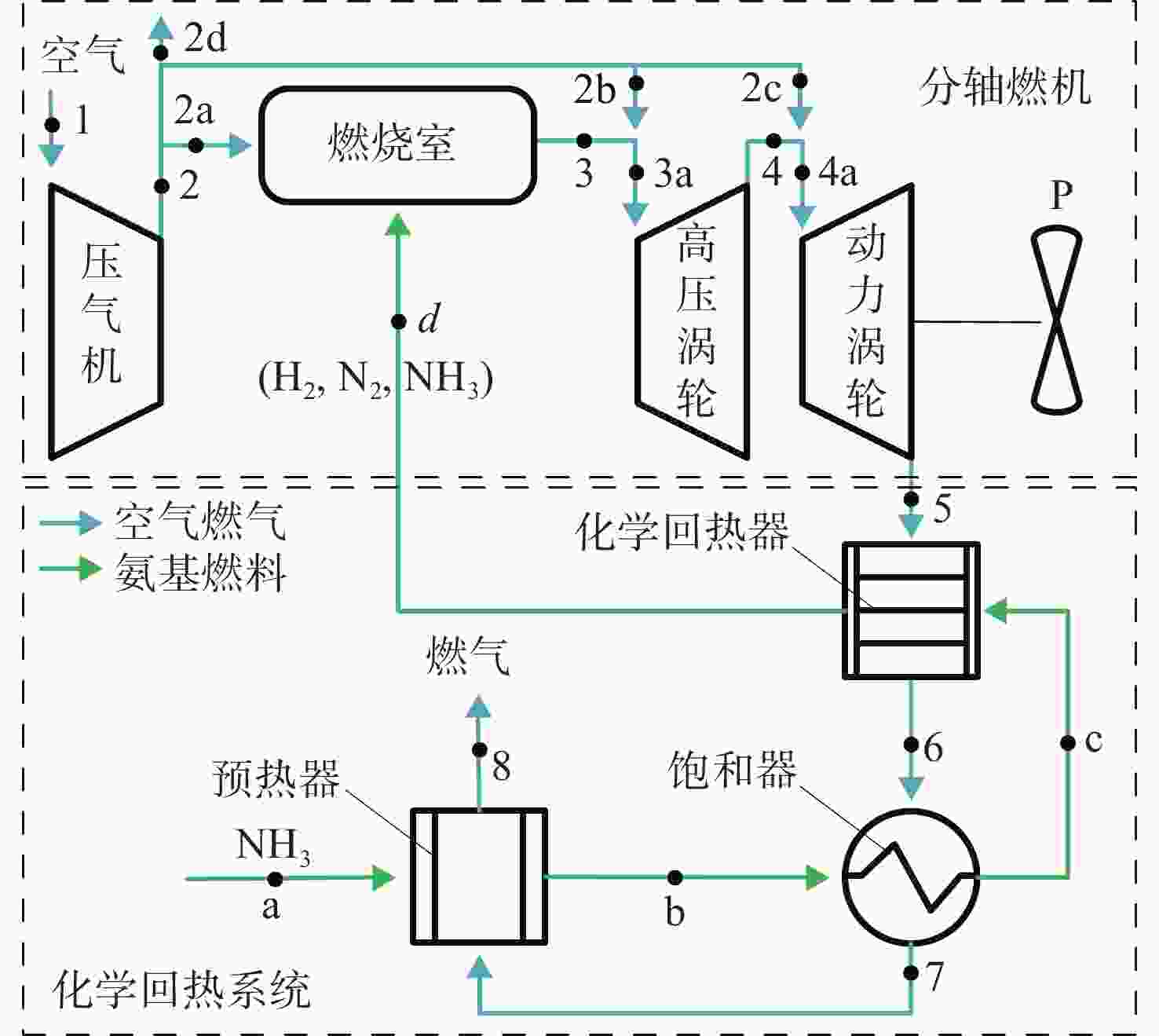
图 1 氨燃料化学回热循环分轴燃机示意图
Figure 1. Basic schematic diagram of a NH3-fueled chemically recuperated cycle two-shift gas turbine
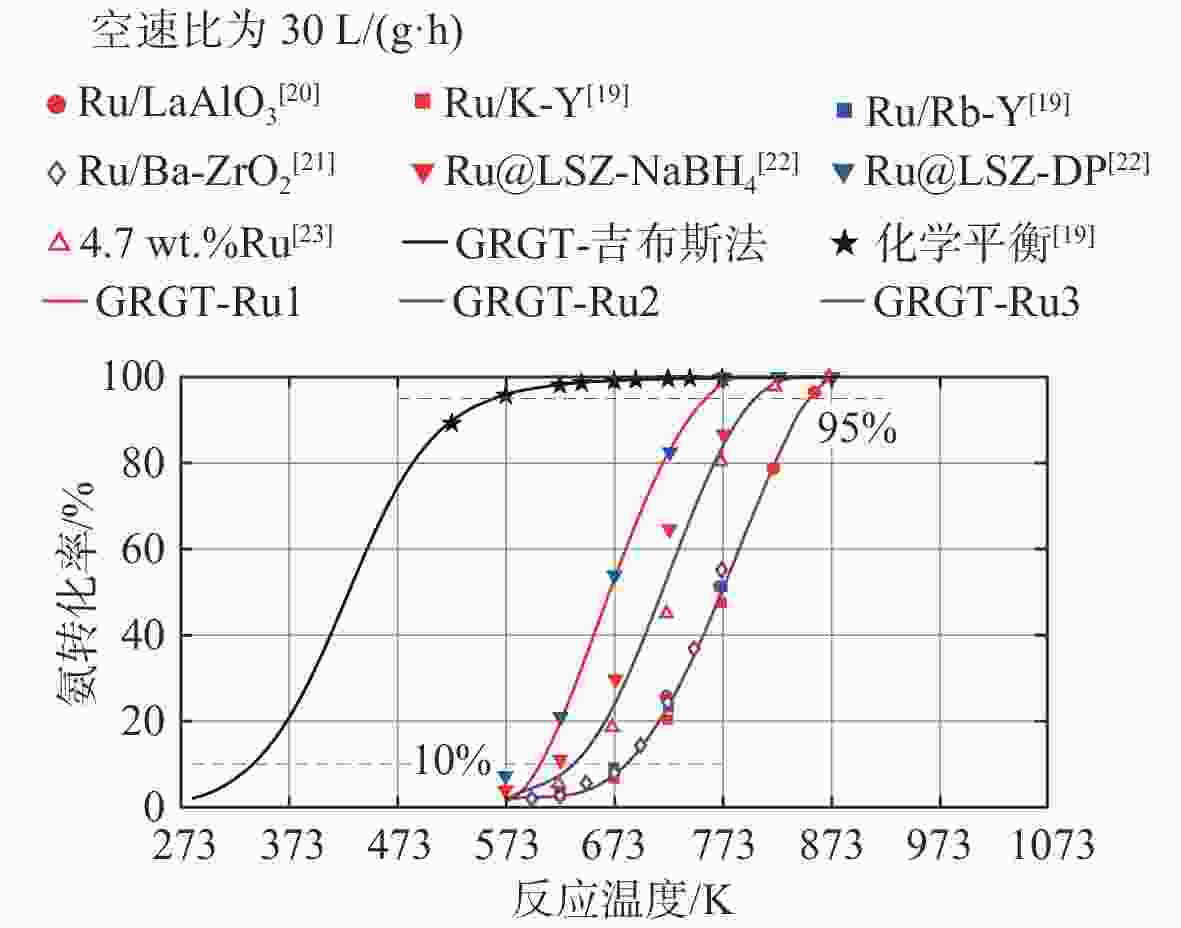
图 2 不同Ru基催化剂作用下氨转化率与反应温度的关系
Figure 2. Comparison of NH3 conversation vs. temperature of various Ru-based catalysts
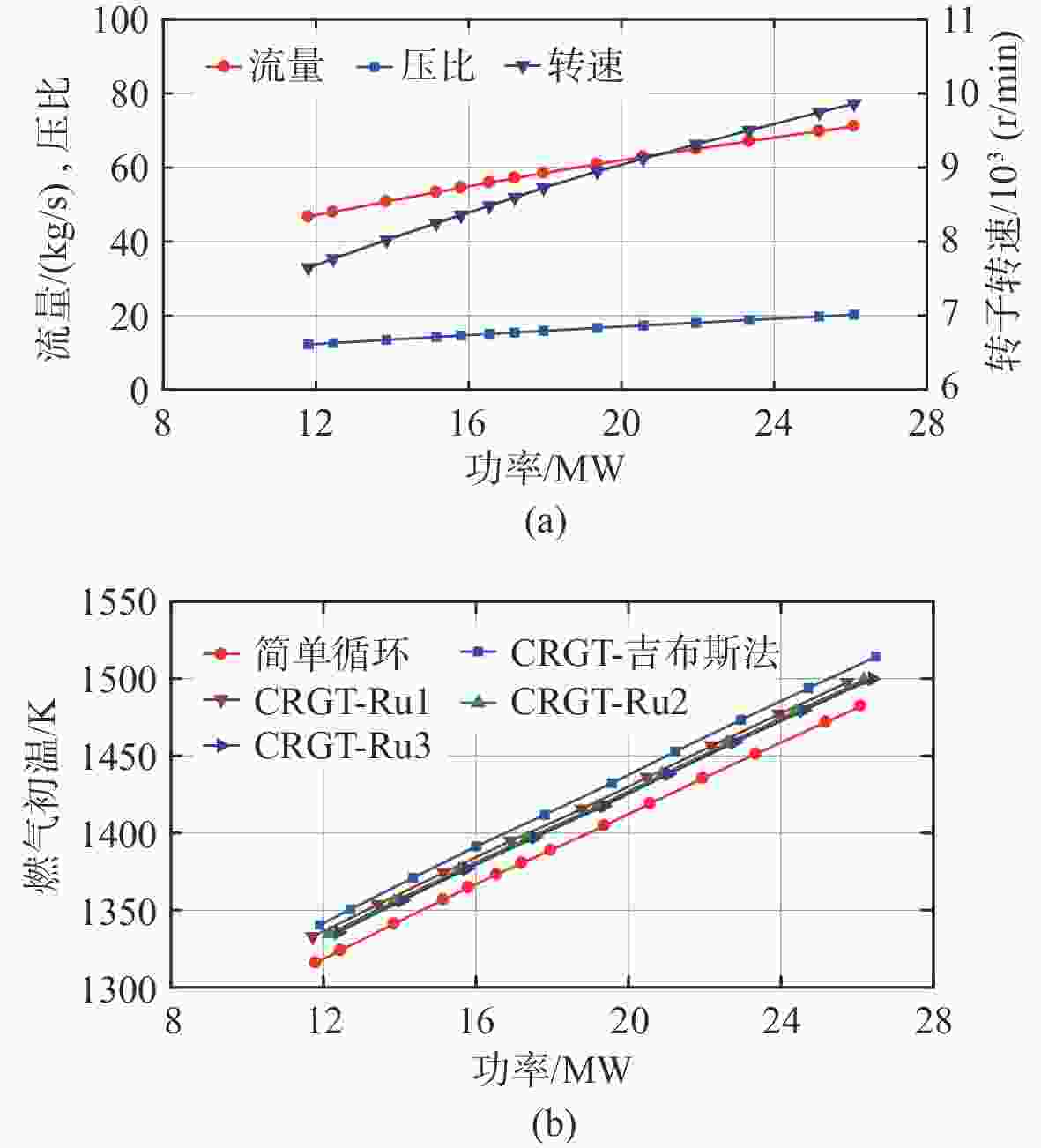
图 3 不同工况下NH3-CRGT循环热力参数与功率的关系
Figure 3. Relations of thermodynamic parameters and power at various off-design cases of NH3-CRGT cycle gas turbine
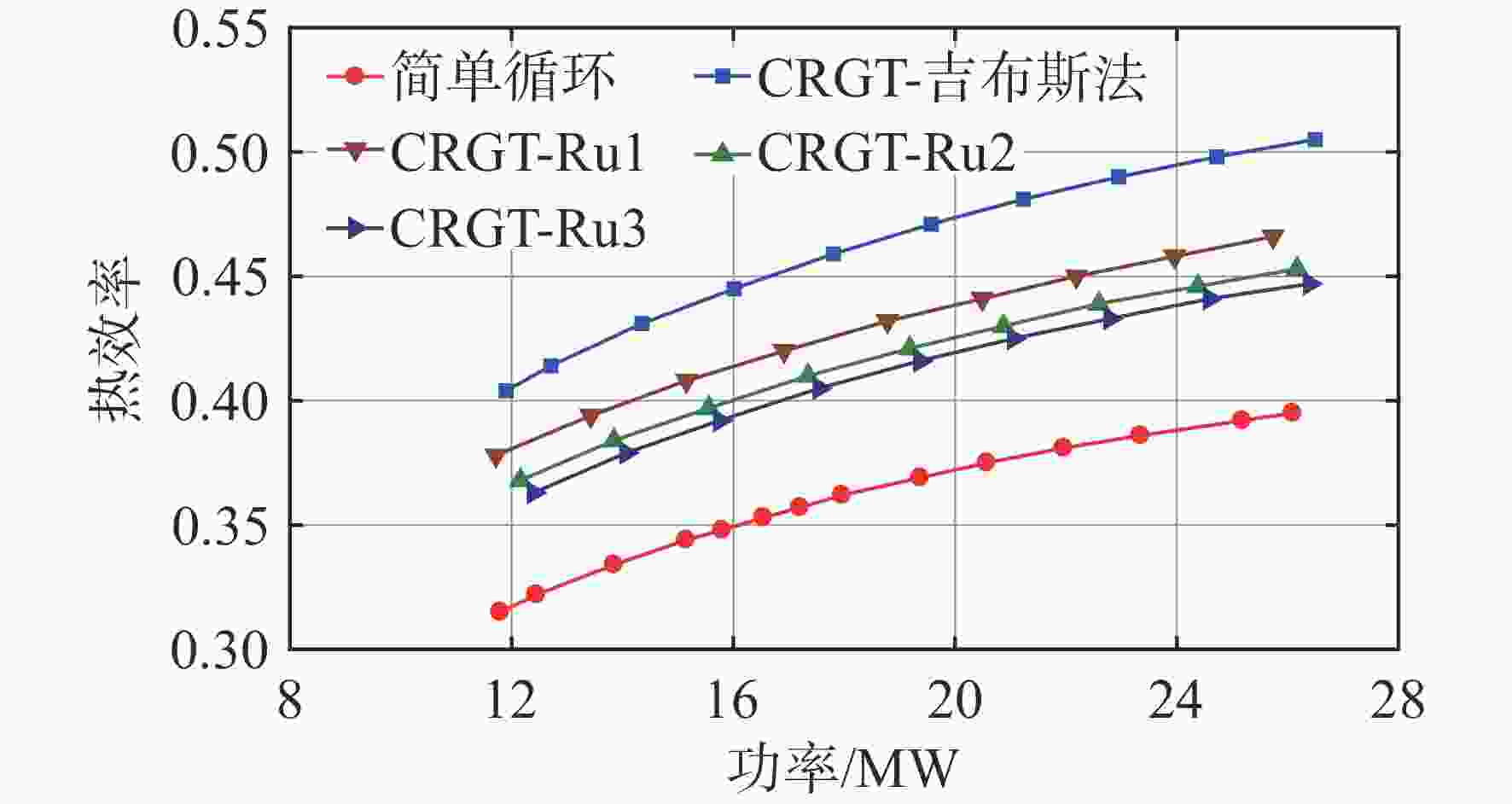
图 4 不同工况下NH3-CRGT循环的热效率与功率的关系
Figure 4. Relations of total thermal efficiency and power at various off-design cases of NH3-CRGT cycle gas turbine
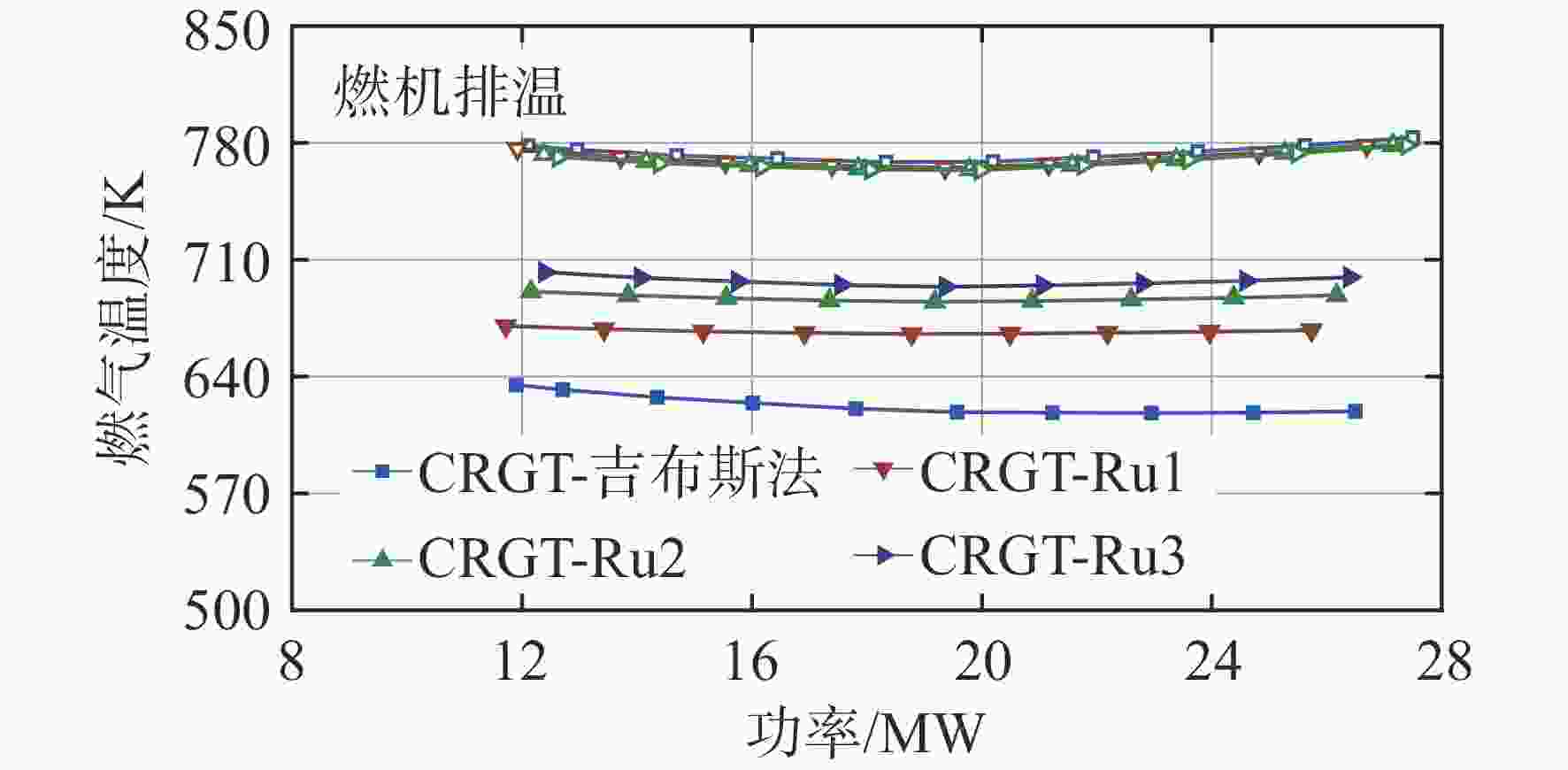
图 5 不同工况下NH3-CRGT循环燃气温度与功率的关系
Figure 5. Relations of outlet gas temperatures and power at various off-design cases of NH3-CRGT cycle gas turbine
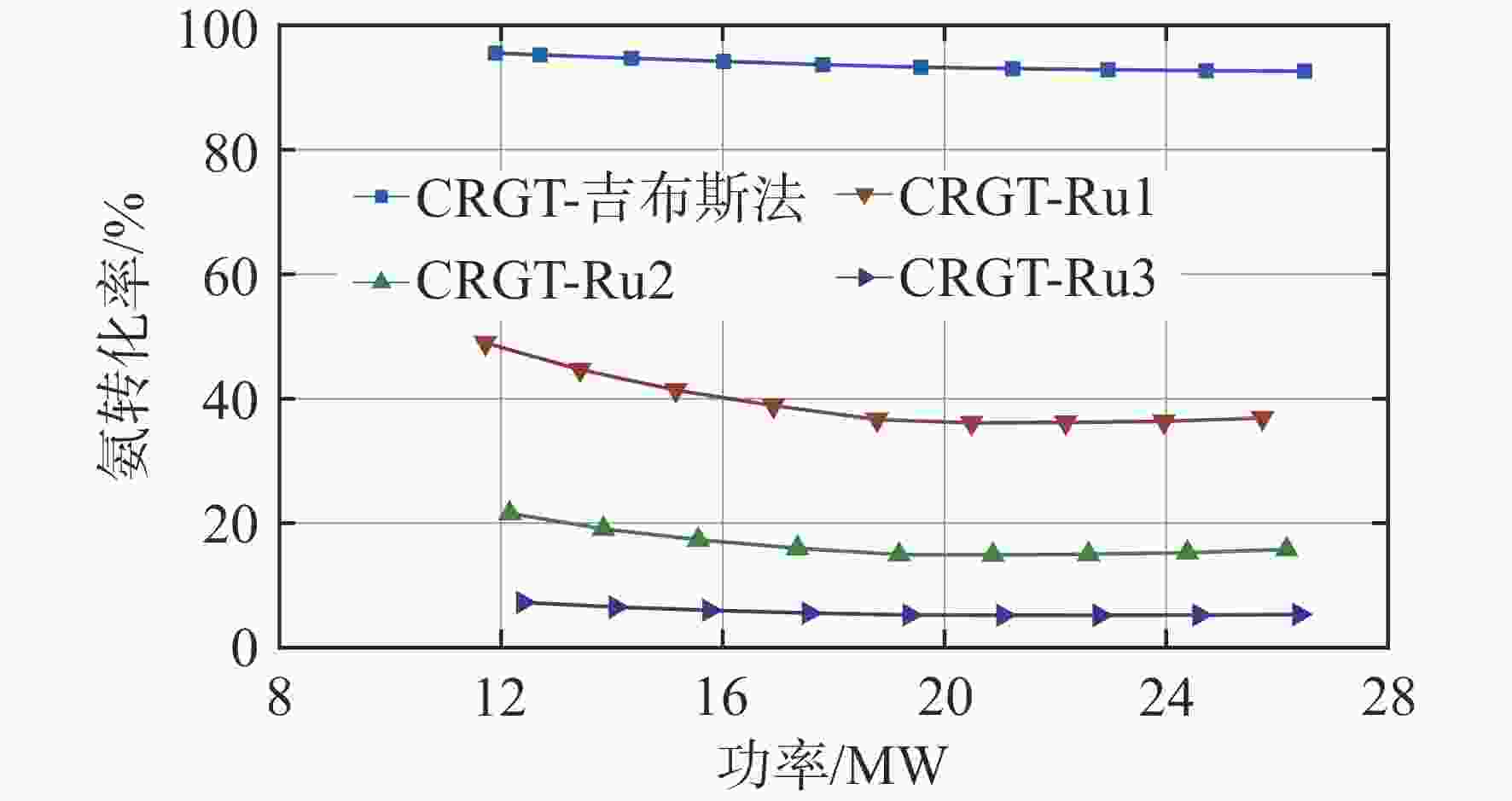
图 6 不同工况下NH3-CRGT循环氨转换率与功率的关系
Figure 6. Relations of NH3 conversation rate and power at various off-design cases of NH3-CRGT cycle gas turbine
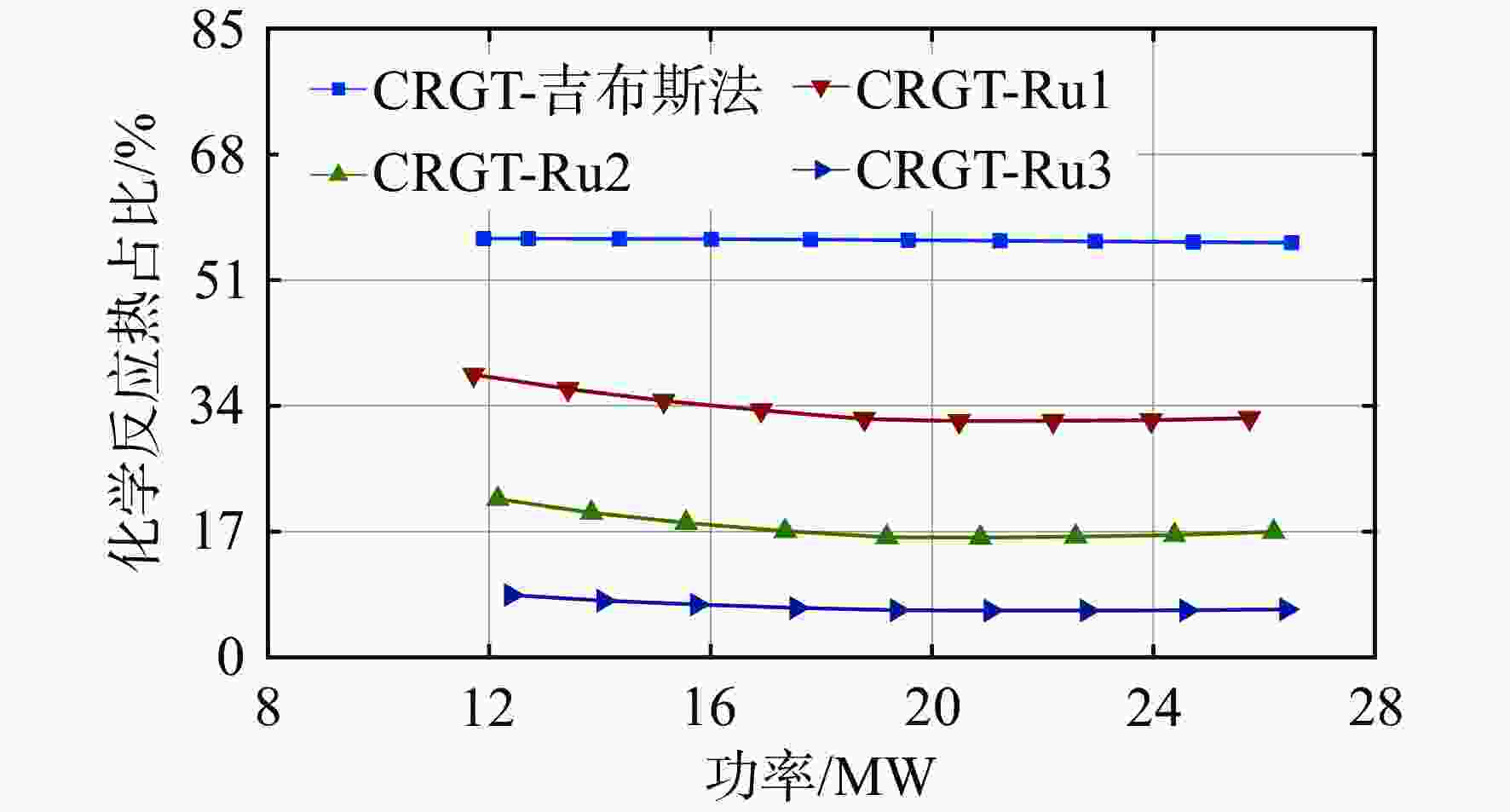
图 7 不同工况下NH3-CRGT循环的化学反应热占比
Figure 7. Relations of chemical reaction heat ratio at various off-design cases of NH3-CRGT cycle gas turbine

图 8 不同工况下NH3-CRGT循环的当量比关系图
Figure 8. Relations of equivalent ratio at various off-design cases of NH3-CRGT cycle gas turbine
表 1 设计工况下简单循环燃机参数表
Table 1. Main parameters of simple cycle gas turbine
主要参数 柴油 氨气 空气流量/(kg/s) 70.2 69.3 总压比 19.7 19.6 转子转速/(r/min) 9770 9697 燃料流量/(kg/s) 1.43 3.41 燃料热值/(MJ/kg) 44.9 18.6 燃气初温/K 1543.8 1467.8 热效率/% 38.7 39.1 输出功率/MW 24.8 24.8 排气温度/K 803.7 782.9  下载: 导出CSV
-
[1] SORRENTI I,RASMUSSEN T H,YOU S,et al. The role of power-to-X in hybrid renewable energy systems: a comprehensive review[J]. Renewable and Sustainable Energy Reviews,2022,165: 112380. doi: 10.1016/j.rser.2022.112380 [2] HASAN M H,MAHLIA T M I,MOFIJUR M,et al. A comprehensive review on the recent development of ammonia as a renewable energy carrier[J]. Energies,2021,14: 3732. doi: 10.3390/en14133732 [3] AYVAL T,TSANG S C E,VRIJALDENHOVEN T V. The position of ammonia in decarbonizing maritime industry: an overview and perspectives: Part I[J]. Johnson Matthey Technology Review,2021,65(2): 275-290. doi: 10.1595/205651321X16043240667033 [4] STÉPHANIE B,ARACELI F P,CHRISTOPHE M,et al. Net zero by 2050: a roadmap for the global energy sector[EB/OL]. (2021-05-18) [2022-12-18].https://www.iea.org/reports/net-zero-by-2050. [5] KOBAYASHI H,HAYAKAWA A,SOMARATHNE K A,et al. Science and technology of ammonia combustion[J]. Proceedings of the Combustion Institute,2019,37(1): 109-133. doi: 10.1016/j.proci.2018.09.029 [6] HAYAKAWA A,ARAKAWA Y,MIMOTO R,et al. Experimental investigation of stabilization and emission characteristics of ammonia/air premixed flames in a swirl combustor[J]. International Journal of Hydrogen Energy,2017,42(19): 14010-14018. doi: 10.1016/j.ijhydene.2017.01.046 [7] KURATA O,IKI N,INOUE T,et al. Development of a wide range-operable,rich-lean low-NOx combustor for NH3 fuel gas-turbine power generation[J]. Proceedings of the Combustion Institute,2019,37(4): 4587-4595. doi: 10.1016/j.proci.2018.09.012 [8] CHAI W S,BAO Y,JIN P,et al. A review on ammonia,ammonia-hydrogen and ammonia-methane fuels[J]. Renewable and Sustainable Energy Reviews,2021,147: 111254. doi: 10.1016/j.rser.2021.111254 [9] KURATA O,IKI N,MATSUNUMA T,et al. Performances and emission characteristics of NH3-air and NH3CH4-air combustion gas-turbine power generations[J]. Proceedings of the Combustion Institute,2017,36(3): 3351-3359. doi: 10.1016/j.proci.2016.07.088 [10] VALERA-MEDINA A,MORRIS S,RUNYON J,et al. Ammonia,methane and hydrogen for gas turbines[J]. Energy Procedia,2015,75: 118-123. doi: 10.1016/j.egypro.2015.07.205 [11] VALERA-MEDINA A,GUTESA M,XIAO H,et al. Premixed ammonia/hydrogen swirl combustion under rich fuel conditions for gas turbines operation[J]. International Journal of Hydrogen Energy,2019,44(16): 8615-8626. doi: 10.1016/j.ijhydene.2019.02.041 [12] PASHCHENKO D,MUSTAFIN R,KARPILOV I. Efficiency of chemically recuperated gas turbine fired with methane: effect of operating parameters[J]. Applied Thermal Engineering,2022,212: 118578. doi: 10.1016/j.applthermaleng.2022.118578 [13] VITTORIO T,FRANCESCO L. Low CO2 emissions chemically recuperated gas turbines fed by renewable methanol[J]. Applied Energy,2021,298: 117146. doi: 10.1016/j.apenergy.2021.117146 [14] 郑洪涛,张玉龙,杨仁. CRGT循环燃气轮机性能仿真[J]. 航空动力学报,2012,27(1): 118-123. ZHENG Hongtao,ZHANG Yulong,YANG Ren. Simulation research of the CRGT cycle gas turbine performance[J]. Journal of Aerospace Power,2012,27(1): 118-123. (in ChineseZHENG Hongtao, ZHANG Yulong, YANG Ren. Simulation research of the CRGT cycle gas turbine performance[J]. Journal of Aerospace Power, 2012, 27(1): 118-123. (in Chinese) [15] POPOV S K,SVISTUNOV I N,GARYAEV A B,et al. The use of thermochemical recuperation in an industrial plant[J]. Energy,2017,127: 44-51. doi: 10.1016/j.energy.2017.03.091 [16] MUKHERJEE S,DEVAGUPTAPU S V,SVIRIPA A,et al. Low-temperature ammonia decomposition catalysts for hydrogen generation[J]. Applied Catalysis: B Environmental,2018,226: 162-181. doi: 10.1016/j.apcatb.2017.12.039 [17] 杨晓红. 化学回热循环燃气轮机参数匹配和性能分析[D]. 哈尔滨: 哈尔滨工程大学,2019. YANG Xiaohong. Parameter matching and performance analysis of chemically recuperated gas turbine[D]. Harbin: Harbin Engineering University,2019. (in ChineseYANG Xiaohong. Parameter matching and performance analysis of chemically recuperated gas turbine[D]. Harbin: Harbin Engineering University, 2019. (in Chinese) [18] PASHCHENKO D,MUSTAFIN R. Ammonia decomposition in the thermochemical waste-heat recuperation systems: a view from low and high heating value[J]. Energy Conversion and Management,2022,251: 114959. doi: 10.1016/j.enconman.2021.114959 [19] CHA J,LEE T,LEE Y J,et al. Highly monodisperse sub-nanometer and nanometer Ru particles confined in alkali-exchanged zeolite Y for ammonia decomposition[J]. Applied Catalysis B: Environmental,2021,283: 119627. doi: 10.1016/j.apcatb.2020.119627 [20] CAO Chenfeng,WU Kai,ZHOU Chen,et al. Electronic metal-support interaction enhanced ammonia decomposition efficiency of perovskite oxide supported ruthenium[J]. Chemical Engineering Science,2022,257: 117719. doi: 10.1016/j.ces.2022.117719 [21] WANG Ziqing,QU Yingmin,SHEN Xiaolong,et al. Ruthenium catalyst supported on Ba modified ZrO2 for ammonia decomposition to COx-free hydrogen[J]. International Journal of Hydrogen Energy,2019,44(14): 7300-7307. doi: 10.1016/j.ijhydene.2019.01.235 [22] LORENZUT B,MONTINI T,PAVEL C C,et al. Embedded Ru@ZrO2 catalysts for H2 production by ammonia decomposition[J]. ChemCatChem,2010,2(9): 1096-1106. doi: 10.1002/cctc.201000097 [23] SU Q,GU L,YAO Y,et al. Layered double hydroxides derived Ni x(Mg yAl zO n) catalysts: enhanced ammonia decomposition by hydrogen spillover effect[J]. Applied Catalysis: B Environmental,2017,201: 451-460. doi: 10.1016/j.apcatb.2016.08.051 [24] LESMANA H,ZHU M,ZHANG Z,et al. Experimental and kinetic modelling studies of laminar flame speed in mixtures of partially dissociated NH3 in air[J]. Fuel,2020,278: 118428. doi: 10.1016/j.fuel.2020.118428 [25] MEI B,ZHANG J,SHI X,et al. Enhancement of ammonia combustion with partial fuel cracking strategy: laminar flame propagation and kinetic modeling investigation of NH3/H2/N2/air mixtures up to 10 atm[J]. Combustion and Flame,2021,231: 111472. doi: 10.1016/j.combustflame.2021.111472 [26] LESMANA H,ZHU M,ZHANG Z,et al. Experimental and kinetic modelling studies of flammability limits of partially dissociated NH3 and air mixtures[J]. Proceedings of the Combustion Institute,2021,38(2): 2023-2030. doi: 10.1016/j.proci.2020.06.248 [27] 范卫东,陈钧. 氨气燃烧强化措施及NOx控制策略研究进展[J]. 华中科技大学学报(自然科学版),2022,50(7): 14-23. FAN Weidong,CHEN Jun. Research progress of combustion enhancement and NOx control strategies for ammonia combustion[J]. Journal of Huazhong University of Science and Technology (Natural Science Edition),2022,50(7): 14-23. (in ChineseFAN Weidong, CHEN Jun. Research progress of combustion enhancement and NOx control strategies for ammonia combustion[J]. Journal of Huazhong University of Science and Technology (Natural Science Edition), 2022, 50(7): 14-23. (in Chinese) [28] KHATEEB A A,GUIBERTI T F,ZHU X,et al. Stability limits and NO emissions of technically-premixed ammonia-hydrogen-nitrogen-air swirl flames[J]. International Journal of Hydrogen Energy,2020,45(41): 22008-22018. doi: 10.1016/j.ijhydene.2020.05.236 [29] WISEMAN S,RIETH M,GRUBER A,et al. A comparison of the blow-out behavior of turbulent premixed ammonia/hydrogen/nitrogen-air and methane–air flames[J]. Proceedings of the Combustion Institute,2021,38(2): 2869-2876. doi: 10.1016/j.proci.2020.07.011 [30] JI C,WANG Z,WANG D,et al. Experimental and numerical study on premixed partially dissociated ammonia mixtures[J]. International Journal of Hydrogen Energy,2021,47: 4171-4184. [31] VERKAMP F,HARDIN M,WILLIAMS J. Ammonia combustion properties and performance in gas-turbine burners[J]. Symposium on Combustion,1967,11(1): 985-992. doi: 10.1016/S0082-0784(67)80225-X [32] GOLDMANN A,DINKELACKER F. Approximation of laminar flame characteristics on premixed ammonia/hydrogen/nitrogen/air mixtures at elevated temperatures and pressures[J]. Fuel,2018,224: 366-378. doi: 10.1016/j.fuel.2018.03.030 -


 点击查看大图

计量
- 文章访问数: 625
- HTML浏览量: 631
- PDF量: 64
- 被引次数: 0