






Numerical assessment of aerothermal environment of three-dimensional gap coupled with heat transfer of solid field
-
摘要:
为了研究高超声速飞行器表面缝隙或凹槽对飞行器表面热环境以及飞行器热防护系统的设计产生的影响,构建了耦合固体场传热的气动热数值模拟方法,对二维矩形缝隙和三维正、逆“T”形缝隙开展了等温壁完全气体、耦合固体场传热壁温分布完全气体数值模拟研究。结果表明:二维和三维缝隙后侧立面上拐角处受到的气动加热作用最明显。正、逆“T”形缝隙的横竖交叉点侧面位置都存在热流峰值。正“T”形交叉点缝隙后侧立面由于直接受到气流冲击,其产生一个值为26.18 W/cm2的最高的气动热峰值。逆“T”形交叉点缝隙前立面由于缝隙内涡结构的冲击作用,产生一个值为6.125 W/cm2局部热流峰值。考虑耦合固体温度场影响后,气动加热使壁温升高,流场中的高温气体对固体场热传导作用降低,缝隙内部、缝隙侧立面和缝隙上表面热流总体下降25%左右,后侧立面上拐点气动热峰值下降程度最高达32.04%。
Abstract:In order to study the influence of the surface gap or grooves on hypersonic aircraft the aerothermal environment and the thermal protection system design, a numerical simulation method coupled with heat transfer of solid field was constructed. The numerical simulation analysis of the perfect gas flow passing a two-dimensional gap, original and reversed “T”-shaped three-dimensional gaps was carried out for isotherm and distributed temperature surfaces coupled with heat transfer of solid field. It can be found from the numerical results that the aero-heating effect at the corner of the rear facade of the two-dimensional and three-dimensional gaps was the worst. There were heat flux peaks at the side of the horizontal and vertical intersections of the original and reversed “T” shaped gaps. The airflow directly impacted the rear facade on the horizontal and vertical intersections of the “T”-shape gap, where a peak of aerodynamic heat flux of 26.18 W/cm2 of the entire gap was produced. Due to the vortex structure in the gap, a local heat flux peak value of 6.125 W/cm2 was generated on the front facade at the horizontal and vertical intersections of the reversed “T”-shape gap. Considering the influence of the coupled heat transfer of solid field, the wall temperature roses under the action of aero-heating, which reduced the heat conduction effect of the high-temperature gas in the flow field on the wall. Therefore, the overall heat flux distributed inside the gap, on facade at the side of the gap and on the upper surface of the gap was reduced by about 25%, and the peak value at the inflection point on the rear elevation decreased the most by about 32.04%.
-
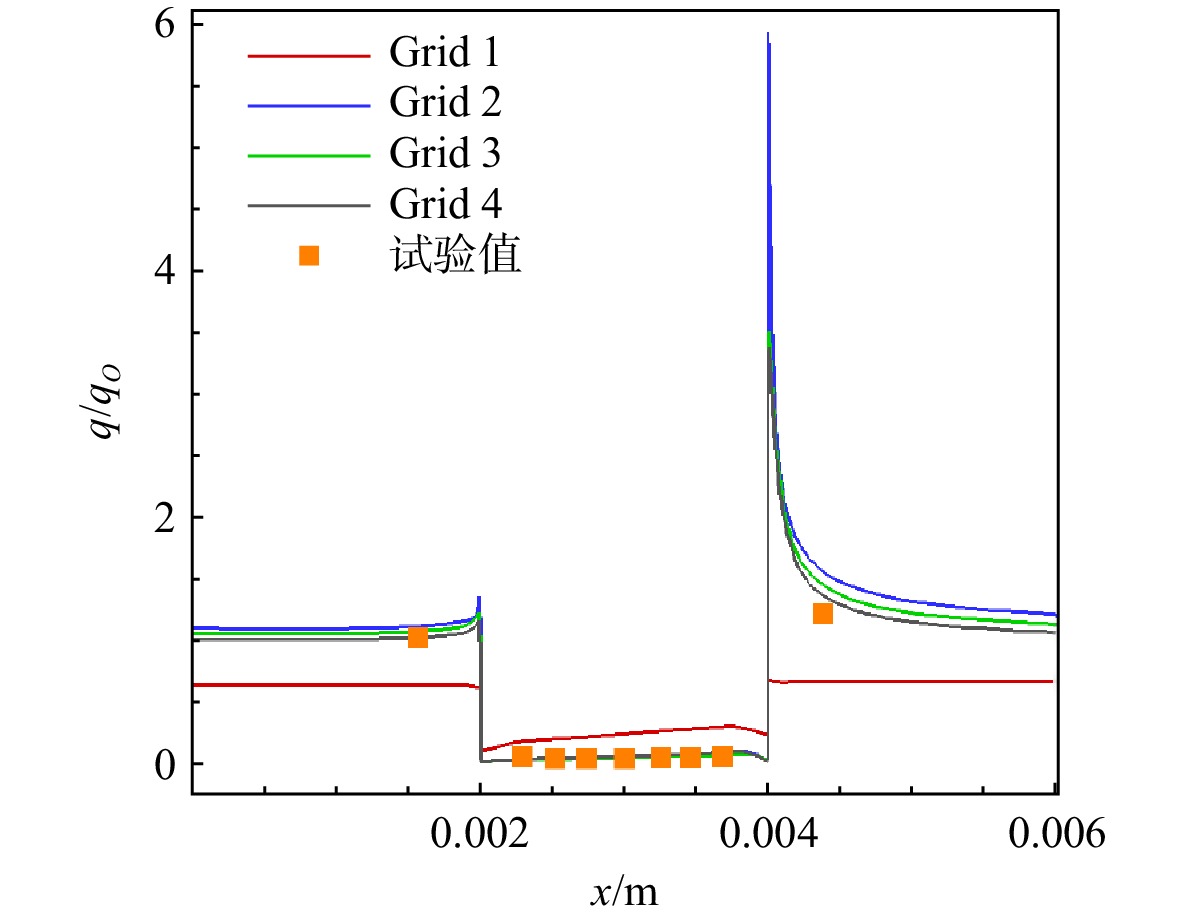
图 5 不同网格热流与试验值对比
Figure 5. Comparison of heat flux between different grids with experimental values
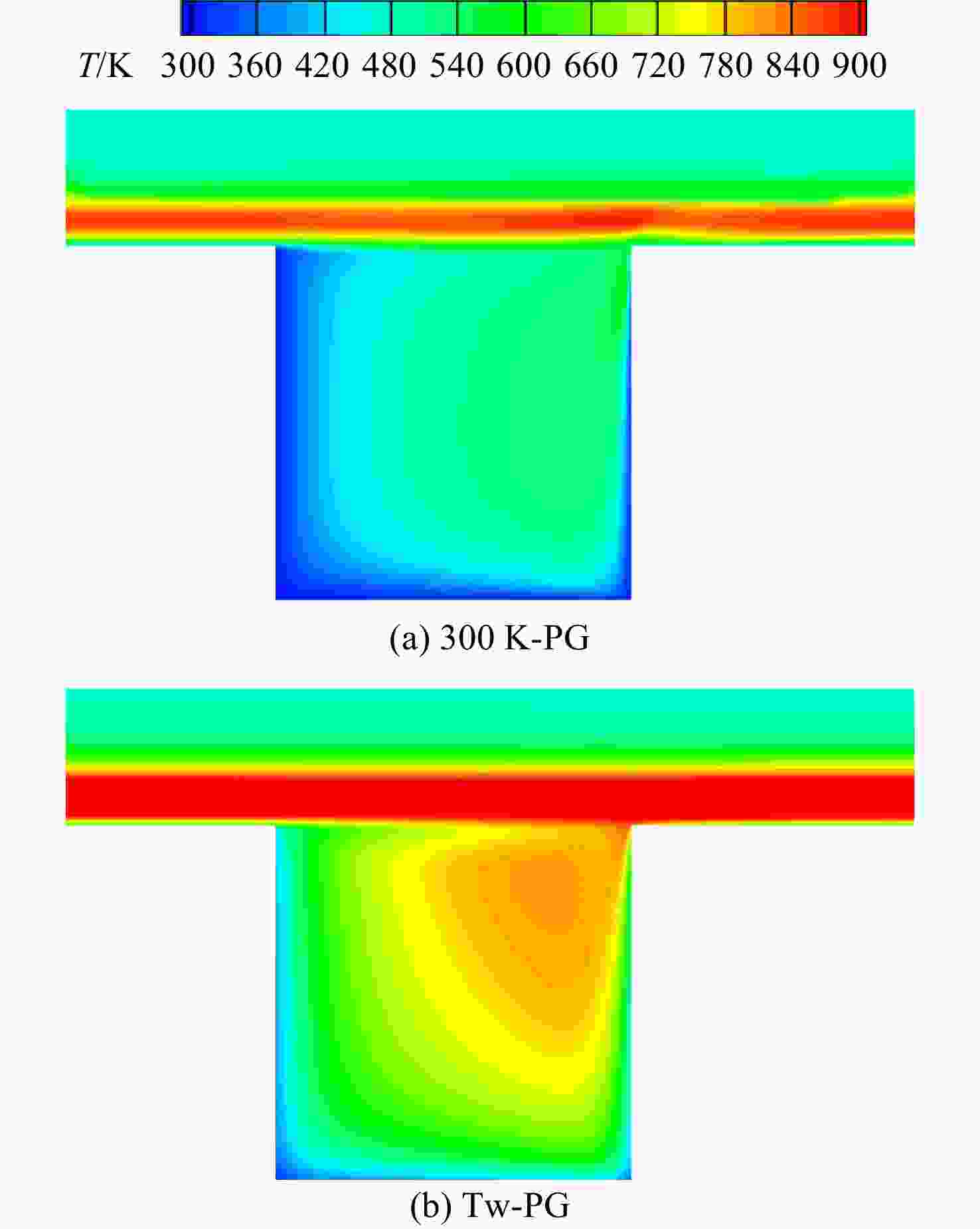
图 6 不同条件的缝隙附近流场温度分布
Figure 6. Temperature contours of flow field near gap under different inflow conditions
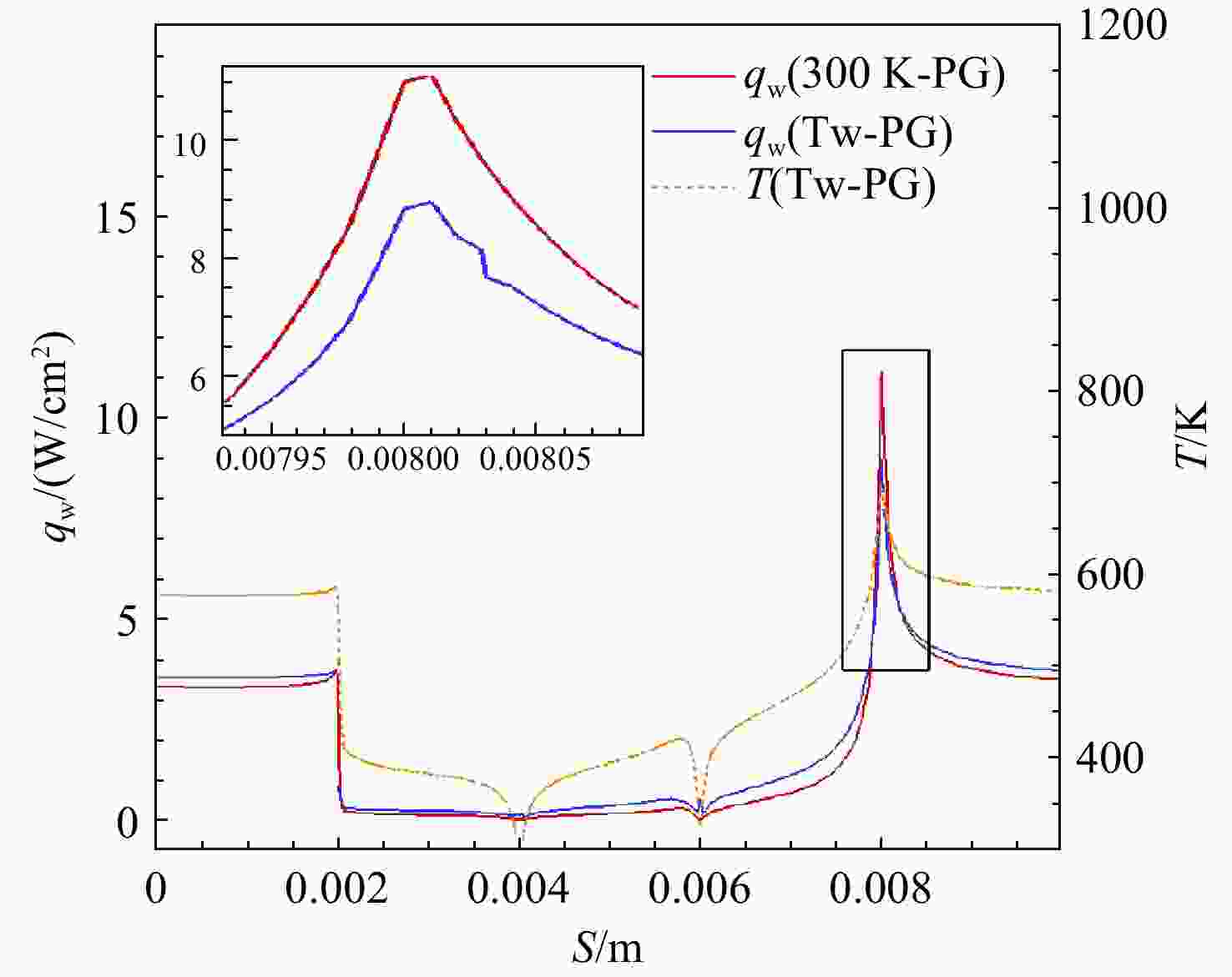
图 7 二维缝隙不同状态下的气动热与壁面温度分布
Figure 7. Heat flux and wall temperature distribution of two-dimensional gap under different conditions
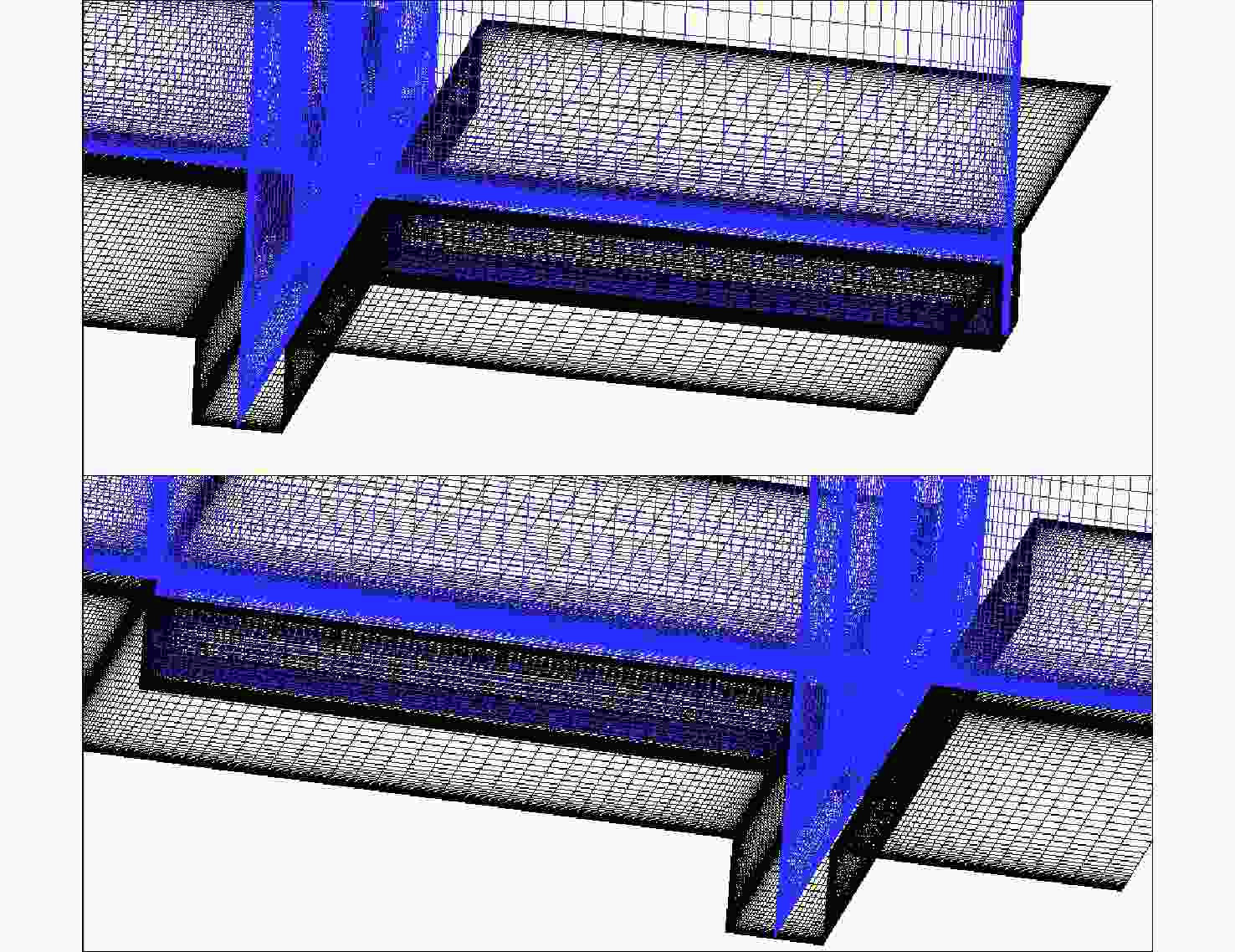
图 11 三维“T”形缝隙附近网格分布
Figure 11. Grid distribution near three-dimensional “T”-shaped gap

图 12 三维正“T”形缝隙附近温度分布、表面热流分布与固体场温度分布
Figure 12. Contours of temperature, surface heat flux and solid field temperature near the wall of forward “T”-shaped three dimensional gap
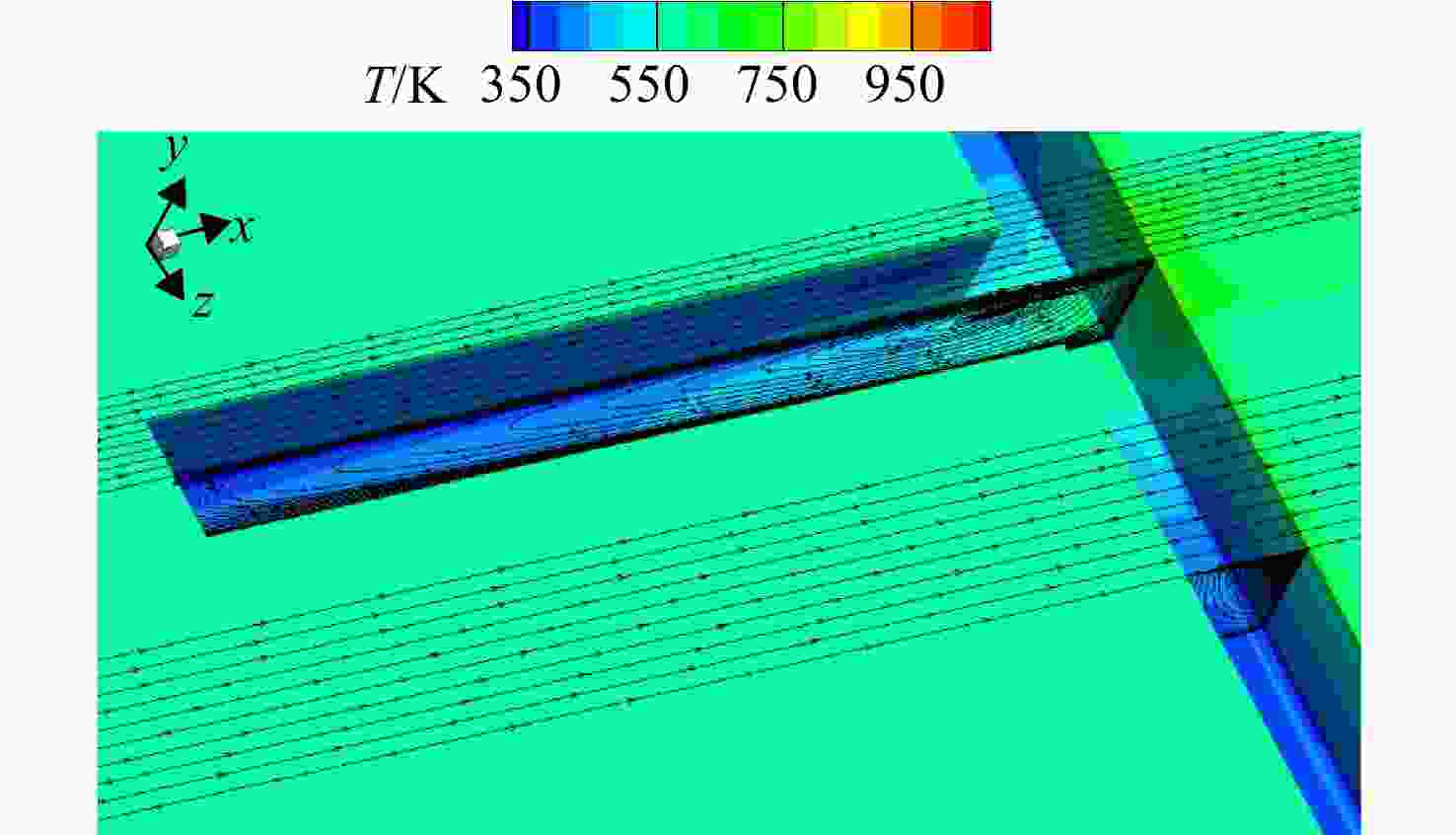
图 13 三维正“T”形缝隙附近z=0.005 m和z=0 m截面流线图
Figure 13. Streamline diagram of cross-section for z=0.005 m and z=0 m positions of forward “T”-shaped three dimensional gap
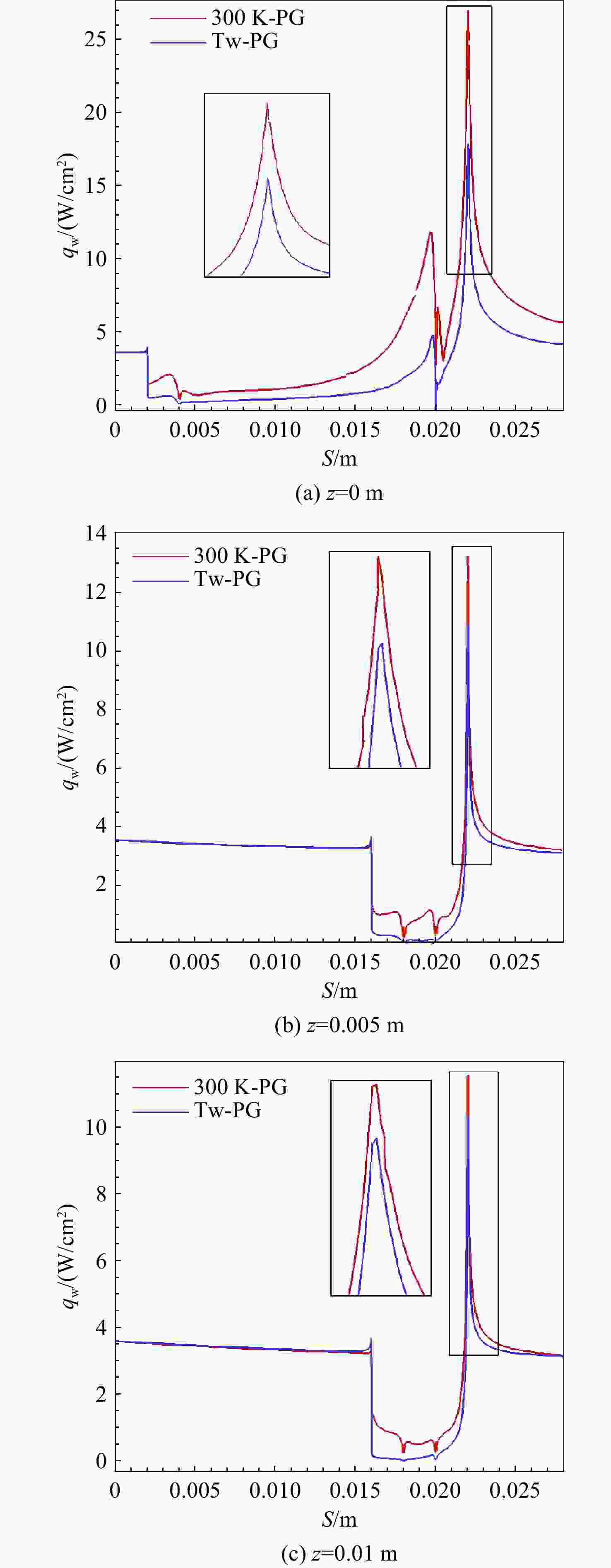
图 14 三维正“T”缝隙3个站位的热流对比
Figure 14. Comparison distribution of heat flux in forward “T”-shape three-dimensional gap of three positions
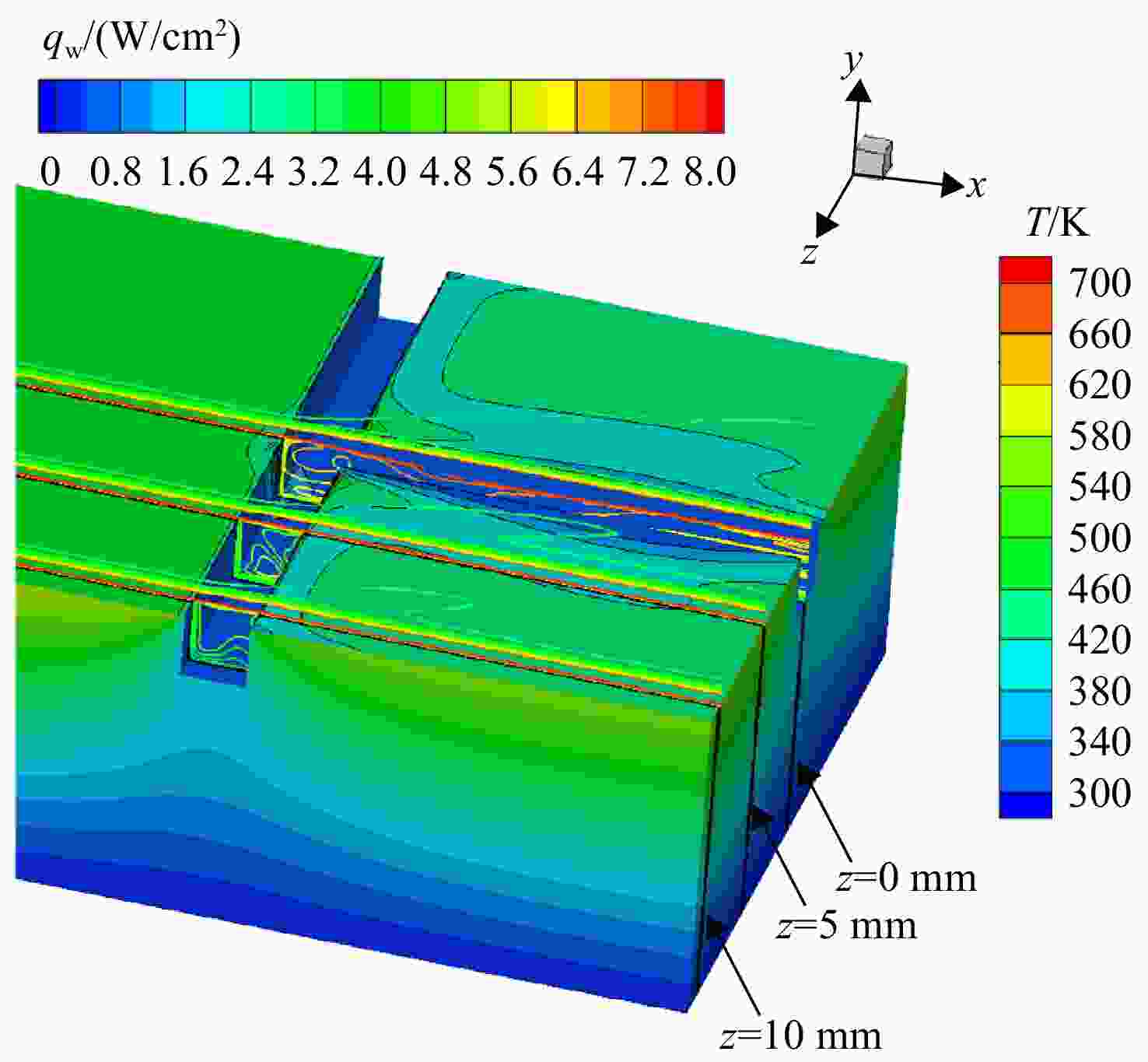
图 15 三维逆“T”形缝隙附近温度分布、表面热流分布与固体场温度分布
Figure 15. Contours of temperature, surface heat flux and solid field temperature near the wall of reverse “T”-shaped three dimensional gap
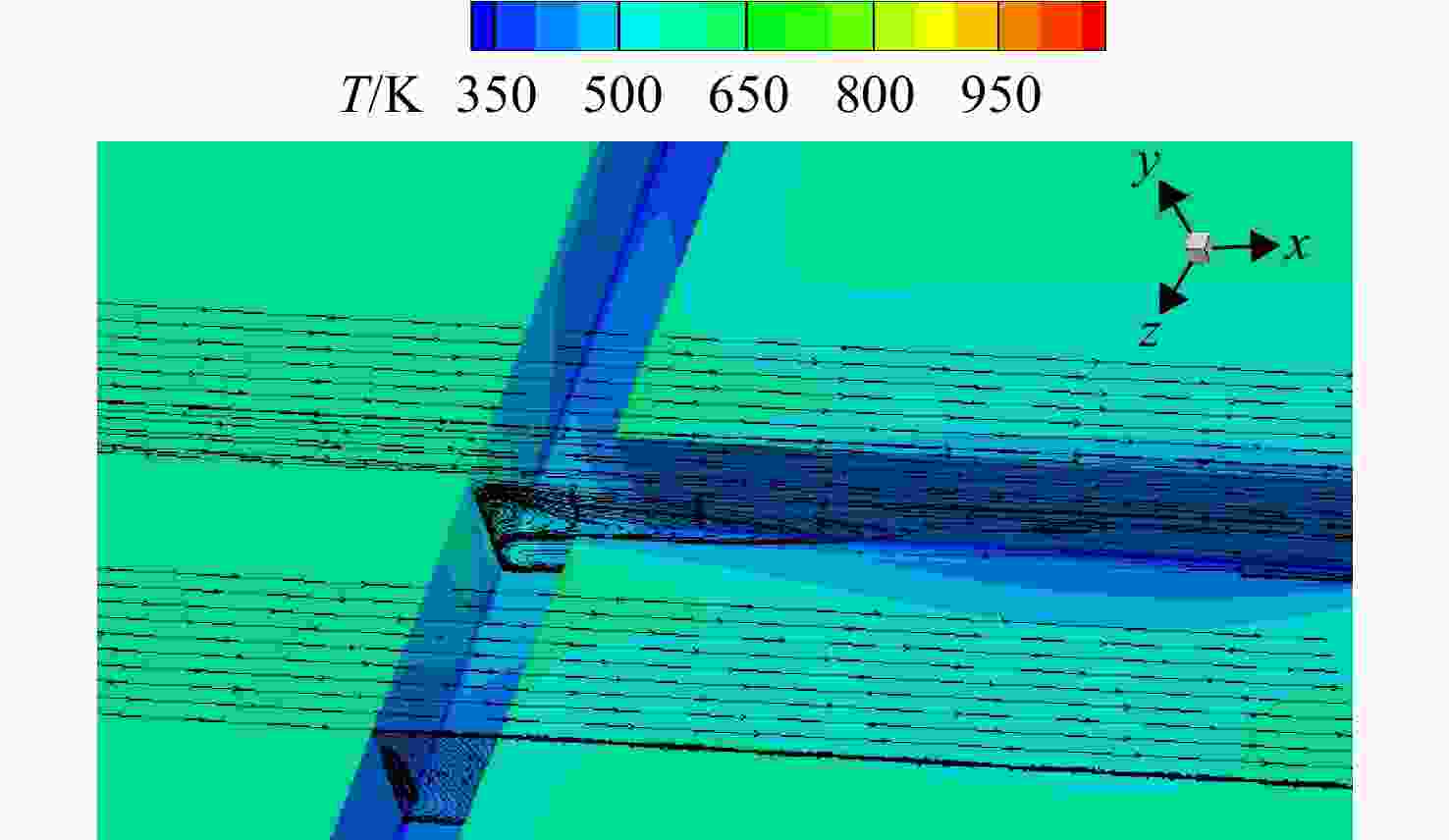
图 16 三维逆“T”形缝隙附近z=0.005 m和z=0 m截面流线图
Figure 16. Streamline diagram of cross-section for z=0.005 m and z=0 m positions of reverse “T”-shaped three dimensional gap
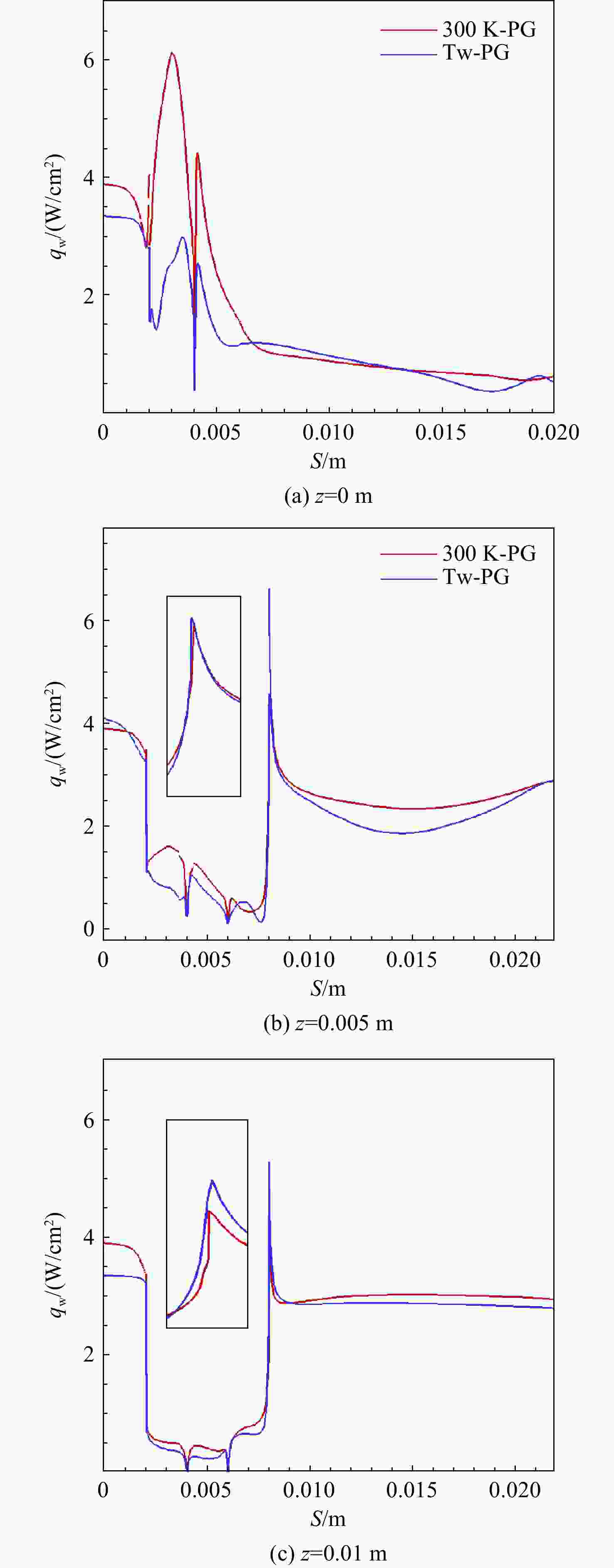
图 17 三维逆“T”缝隙3个站位的热流对比
Figure 17. Comparison distribution of heat flux in reverse“T”-shape three-dimensional gap of three positions
表 1 来流条件
Table 1. Inflow conditions
参数 数值 马赫数Ma 5.0 雷诺数Re/104 5.6 温度T/K 473.15 密度ρ/(kg/m3) 0.33  下载: 导出CSV
-
[1] MCNAMARA J J,FRIEDMANN P P. Aeroelastic and aerothermoelastic analysis in hypersonic flow: past,present,and future[J]. AIAA Journal,2011,49(6): 1089-1122. doi: 10.2514/1.J050882 [2] MILOS F S,SQUIRE T H. Thermostructural analysis of X-34 wing leading-edge tile thermal protection system[J]. Journal of Spacecraft and Rockets,1999,36(2): 189-198. doi: 10.2514/2.3449 [3] DWOYER D,NEWMAN P,THAMES F,et al. Flow through the tile gaps in the Space Shuttle Thermal Protection System[C]//Proceedings of the 20th Aerospace Sciences Meeting. Reston,US: AIAA,1982. [4] ECKERT E R G. Engineering relations for heat transfer and friction in high-velocity laminar and turbulent boundary-layer flow over surfaces with constant pressure and temperature[J]. Journal of Fluids Engineering,1956,78(6): 1273-1283. [5] NETTERFIELD M. Validation of a Navier-Stokes code for thermochemical non-equilibrium flows[R]. AIAA1992-2878,1992. [6] MUYLAERT J,WALPOT L,HAEUSER J,et al. Standard model testing in the European High Enthalpy Facility F4 andextrapolation to flight[R]. AIAA1992-3905,1992. [7] 董维中,高铁锁,丁明松,等. 高超声速飞行器表面温度分布与气动热耦合数值研究[J]. 航空学报,2015,36(1): 311-324. DONG Weizhong,GAO Tiesuo,DING Mingsong,et al. Numerical study of coupled surface temperature distribution and aerodynamic heat for hypersonic vehicles[J]. Acta Aeronautica et Astronautica Sinica,2015,36(1): 311-324. (in ChineseDONG Weizhong, GAO Tiesuo, DING Mingsong, et al. Numerical study of coupled surface temperature distribution and aerodynamic heat for hypersonic vehicles[J]. Acta Aeronautica et Astronautica Sinica, 2015, 36(1): 311-324. (in Chinese) [8] CHAPMAN D. A theoretical analysis of heat transfer in regions of separated flow[R]. NACA TN 3792,1956. [9] HINDERKS M,RADESPIEL R. Investigation of hypersonic gap flow of a reentry nosecap with consideration of fluid structure interaction[R]. AIAA2006-188,2006. [10] HINDERKS M,GÜLHAN A,RADESPIEL R. Simulation of hypersonic gap flow with consideration of fluid structure interaction[R]. AIAA2004-2238,2004. [11] SCOTT C D,MARAIA R J. Gap heating with pressure gradients[M]//Entry Heating and Thermal Protection. New York: AIAA,1980: 269-286. [12] HUANG Haiming,HUANG Guo. Effects of width-to-depth ratio on heat transfer coefficient for gap[J]. International Journal of Numerical Methods for Heat & Fluid Flow,2015,25(4): 803-809. [13] HUANG Guo,HUANG Haiming. Numerical investigation of heat flux distribution in a deep gap based on chemical equilibrium[J]. International Journal of Numerical Methods for Heat & Fluid Flow,2017,27(8): 1662-1674. [14] 许啸,张军,沈屹,等. 临近空间高超声速飞行器表面非规则缝隙流动及传热特性研究[J]. 航空工程进展,2019,10(5): 707-713. XU Xiao,ZHANG Jun,SHEN Yi,et al. Simulation of irregular slot flow and heat transfer characteristics on surface of near space hypersonic vehicle[J]. Advances in Aeronautical Science and Engineering,2019,10(5): 707-713. (in ChineseXU Xiao, ZHANG Jun, SHEN Yi, et al. Simulation of irregular slot flow and heat transfer characteristics on surface of near space hypersonic vehicle[J]. Advances in Aeronautical Science and Engineering, 2019, 10(5): 707-713. (in Chinese) [15] 靳旭红,黄飞,程晓丽,等. 稀薄流区高超声速飞行器表面缝隙流动结构及气动热环境的分子模拟[J]. 航空动力学报,2019,34(1): 201-209. JIN Xuhong,HUANG Fei,CHENG Xiaoli,et al. Monte Carlo simulation for the flow-field structure and aerodynamic heating due to cavities on hypersonic vehicle surfaces in the rarefied flow regime[J]. Journal of Aerospace Power,2019,34(1): 201-209. (in ChineseJIN Xuhong, HUANG Fei, CHENG Xiaoli, et al. Monte Carlo simulation for the flow-field structure and aerodynamic heating due to cavities on hypersonic vehicle surfaces in the rarefied flow regime[J]. Journal of Aerospace Power, 2019, 34(1): 201-209. (in Chinese) [16] 邱波,张昊元,国义军,等. 高超声速飞行器表面横缝旋涡结构及气动热环境数值模拟[J]. 航空学报,2015,36(11): 3515-3521. QIU Bo,ZHANG Haoyuan,GUO Yijun,et al. Numerical investigation for vortexes and aerodynamic heating environment on transverse gap on hypersonic vehicle surface[J]. Acta Aeronautica et Astronautica Sinica,2015,36(11): 3515-3521. (in ChineseQIU Bo, ZHANG Haoyuan, GUO Yijun, et al. Numerical investigation for vortexes and aerodynamic heating environment on transverse gap on hypersonic vehicle surface[J]. Acta Aeronautica et Astronautica Sinica, 2015, 36(11): 3515-3521. (in Chinese) [17] 张昊元,宗文刚,桂业伟. 高超声速飞行器前缘缝隙流动数值模拟研究[J]. 宇航学报,2014,35(8): 893-900. ZHANG Haoyuan,ZONG Wengang,GUI Yewei. Numerical investigation of flow in leading-edge gap of hypersonic vehicle[J]. Journal of Astronautics,2014,35(8): 893-900. (in Chinese doi: 10.3873/j.issn.1000-1328.2014.08.005ZHANG Haoyuan, ZONG Wengang, GUI Yewei. Numerical investigation of flow in leading-edge gap of hypersonic vehicle[J]. Journal of Astronautics, 2014, 35(8): 893-900. (in Chinese) doi: 10.3873/j.issn.1000-1328.2014.08.005 [18] 黄尚坤,肖素梅,庞宇飞,等. 高超声速飞行器钝舵缝隙流动数值模拟研究[J]. 航空工程进展,2019,10(2): 163-170,186. HUANG Shangkun,XIAO Sumei,PANG Yufei,et al. Numerical investigation of flow in blunt-fin gap of hypersonic vehicle[J]. Advances in Aeronautical Science and Engineering,2019,10(2): 163-170,186. (in ChineseHUANG Shangkun, XIAO Sumei, PANG Yufei, et al. Numerical investigation of flow in blunt-fin gap of hypersonic vehicle[J]. Advances in Aeronautical Science and Engineering, 2019, 10(2): 163-170, 186. (in Chinese) [19] 周佳. 高超声速飞行器钝舵缝隙气动热环境研究[D]. 四川绵阳: 西南科技大学,2017. ZHOU Jia. Study of aerodynamic heating environment on blunt-fin gap of hypersonic vehicle[D]. Mianyang,Sichuan: Southwest University of Science and Technology,2017. (in ChineseZHOU Jia. Study of aerodynamic heating environment on blunt-fin gap of hypersonic vehicle[D]. Mianyang, Sichuan: Southwest University of Science and Technology, 2017. (in Chinese) [20] 杨光,檀妹静,聂春生,等. 平板空气舵干扰区烧蚀凹陷对热环境影响[J]. 航空动力学报,2021,36(6): 1145-1155. YANG Guang,TAN Meijing,NIE Chunsheng,et al. Effect on heating environment of ablation recession in plate-rudder interaction region[J]. Journal of Aerospace Power,2021,36(6): 1145-1155. (in ChineseYANG Guang, TAN Meijing, NIE Chunsheng, et al. Effect on heating environment of ablation recession in plate-rudder interaction region[J]. Journal of Aerospace Power, 2021, 36(6): 1145-1155. (in Chinese) [21] APPAR A,KUMAR R. Effect of thermal ablation at the fluid-solid interface of a hypersonic reentry vehicle in rarefied flow regime[J]. International Journal of Computational Fluid Dynamics,2021,35(8): 610-631. doi: 10.1080/10618562.2021.2017900 [22] 钱海键,王洋,田文炳. 结构缝隙内热流分布实验研究[R]. 北京: 中国航天空气动力技术研究院,1996. QIAN Haijian,WANG Yang,TIAN Wenbing. Experimental study on heat flux distribution in structural gap[R]. Beijing: China Academy of Aerospace Aerodynamics,1996. (in ChineseQIAN Haijian, WANG Yang, TIAN Wenbing. Experimental study on heat flux distribution in structural gap[R]. Beijing: China Academy of Aerospace Aerodynamics, 1996. (in Chinese) [23] NORTON D J,WHITE R E. Experimental subsonic drag properties of the space shuttle orbiter TPS tiles[J]. Journal of Spacecraft and Rockets,1977,14(3): 149-154. doi: 10.2514/3.27960 -


 点击查看大图

计量
- 文章访问数: 1054
- HTML浏览量: 264
- PDF量: 63
- 被引次数: 0