






Study on the influences of temperature and salinity on ice adhesion
-
摘要:
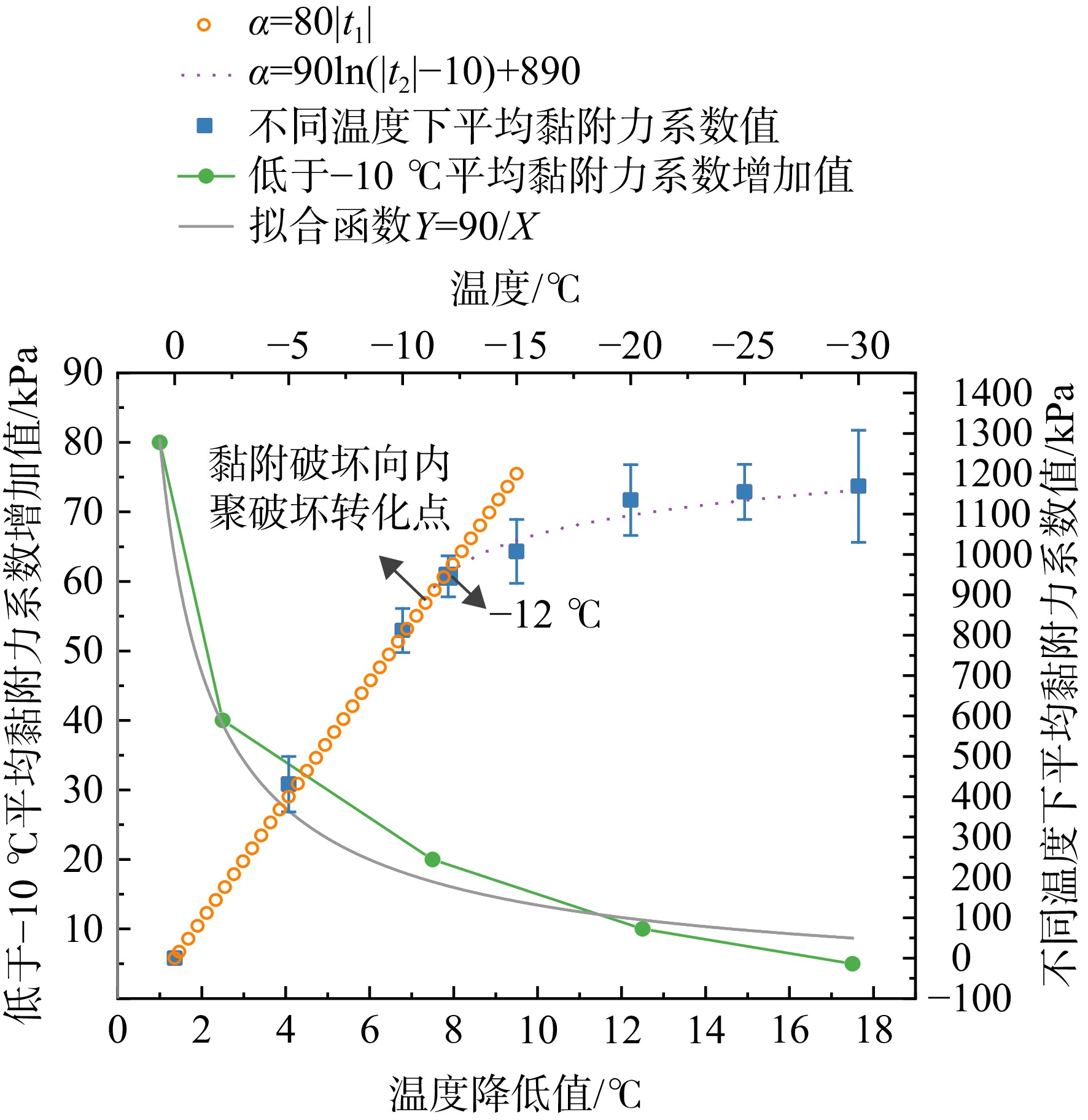
温度、盐度是影响冰黏附力的关键因素。利用可编程式高低温实验机,在不同温度、盐度下制静态淡水冰、含盐冰,并测量冰切向黏附力,对冰切向黏附力受温度影响的变化趋势、受盐度影响的原因进行了研究。结果表明:两种冰样的前期结冰黏附过程中,冰-基界面“类液层”起决定性作用。淡水冰在0~−11 ℃温度范围内,冰切向黏附力随温度降低线性增加,到达−11 ℃的温度临界值后,其增加速度随温度降低逐渐递减,并在−20 ℃后基本保持平稳。盐水冰-基界面形成有效黏附所需温度更低,切向黏附力较淡水冰更小,在1%~2.5%盐度的含盐区间内,冰切向黏附力主要受界面“冰盐”分布影响。结果为研究不同环境,特别是海洋低温条件下的结冰机理和防除冰方法研究提供了参考。
Abstract:Temperature and salinity are critical factors influencing ice adhesion strength. Utilizing a programmable high-low temperature test chamber, static freshwater ice and saline ice were prepared under varying temperature and salinity conditions, with tangential ice adhesion forces measured to investigate the temperature-dependent trends and salinity-influenced mechanisms. The results demonstrated that the quasi-liquid layer (QLL) at the ice-substrate interface played a decisive role in the initial ice adhesion process for both ice types. For freshwater ice, the tangential adhesion strength increased linearly as temperatures decreased from 0 ℃ to −11 ℃. Beyond this critical temperature threshold ( −11 ℃), the growth rate gradually decelerated with further cooling, stabilizing substantially below −20 ℃. Saline ice required lower temperatures to form effective interfacial adhesion, exhibiting weaker tangential adhesion compared with freshwater ice. Within the salinity range of 1%—2.5%, ice adhesion strength was predominantly governed by the interfacial ice-salt distribution. This study could provide theoretical and technical references for elucidating ice formation mechanisms and developing anti-/de-icing strategies under diverse environmental conditions, particularly in marine cryogenic environments.
-
Key words:
- adhesion /
- fresh water ice /
- salt ice /
- liquid layer /
- ice salt
-
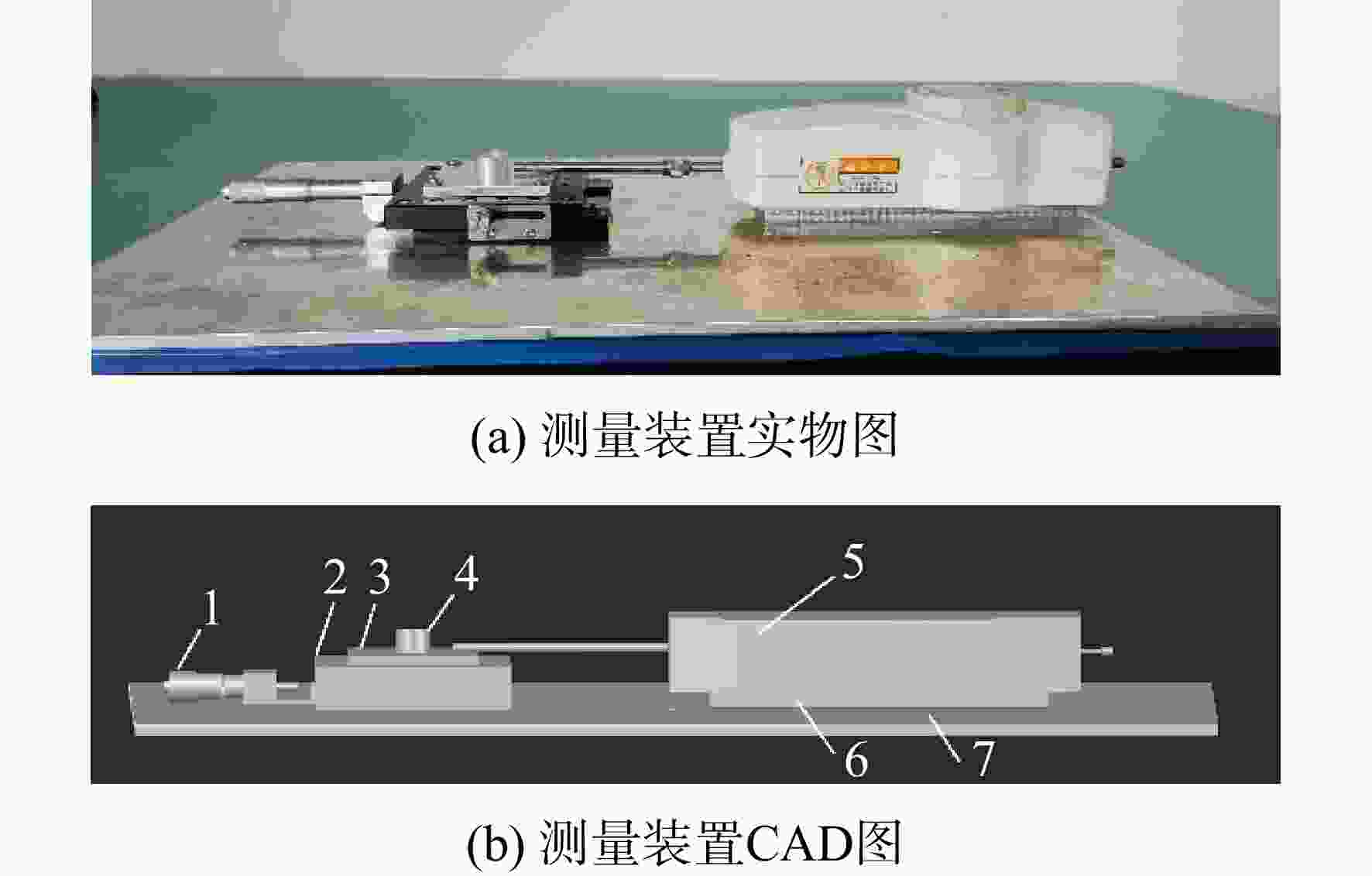
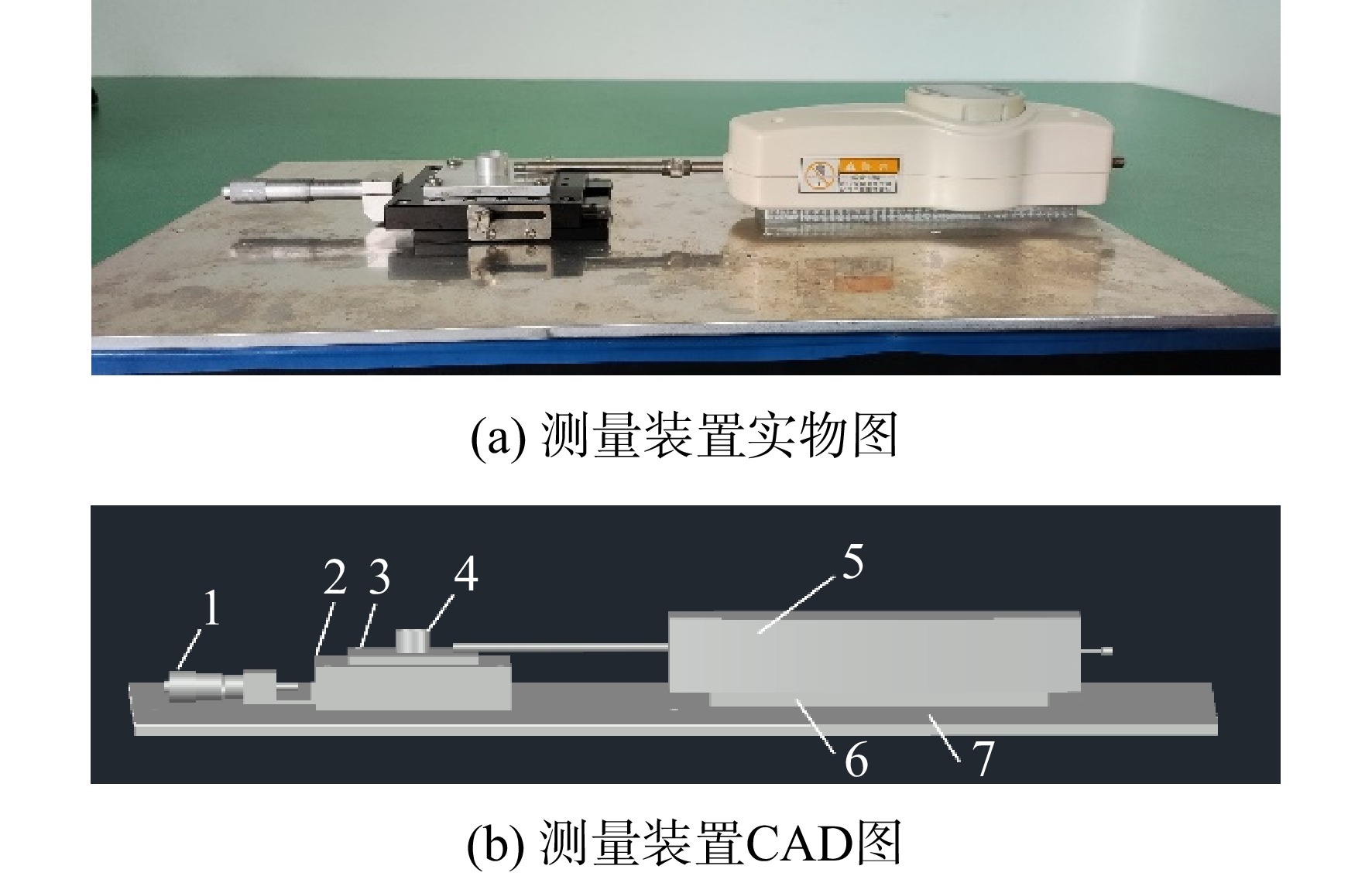
图 2 黏附力测量装置图
1 可移动千分尺;2 载重平台;3 方形基底;4 冰样模具;5 推拉力计;6 推拉力计矩形垫板;7 底座。
Figure 2. Drawing of adhesion measuring device

图 3 淡水冰黏附力系数值随温度变化曲线
Figure 3. Change curve of freshwater ice adhesion coefficient value with temperature

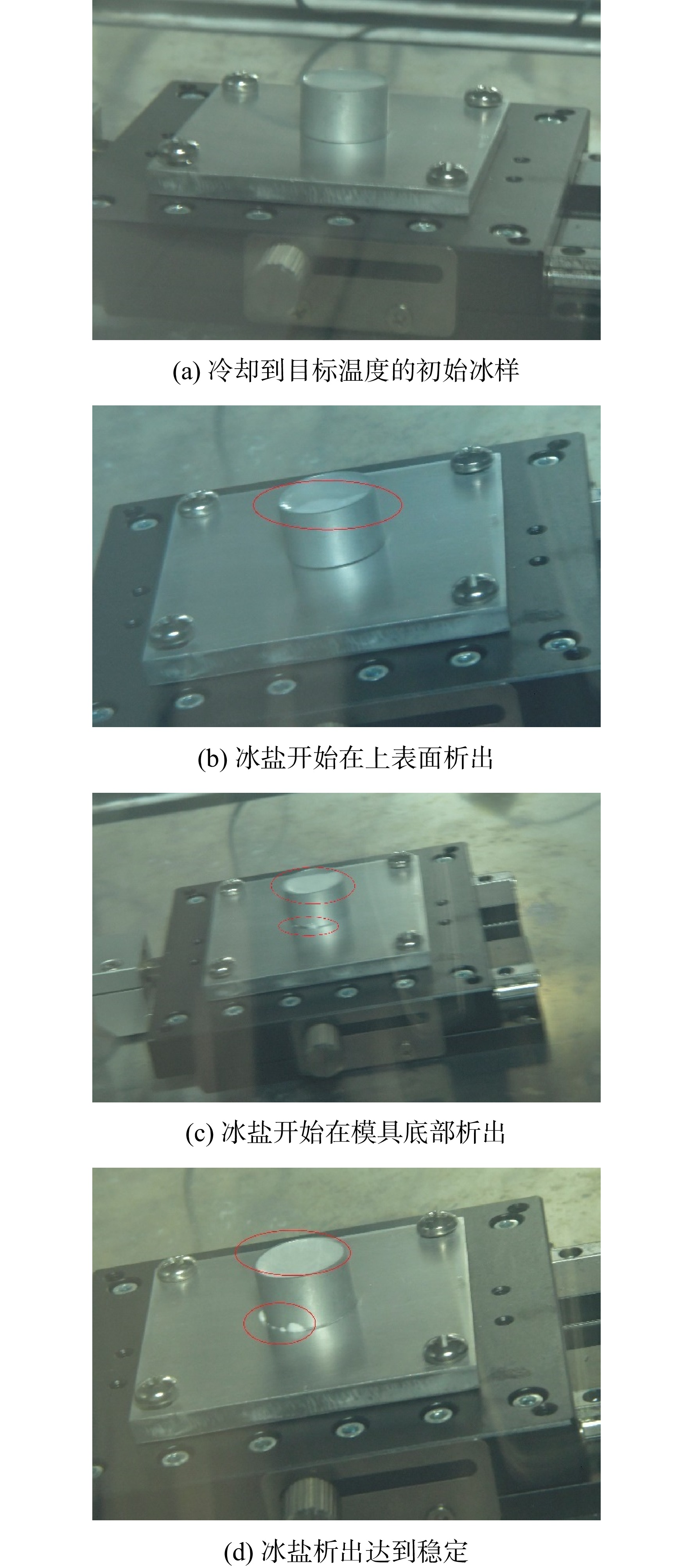
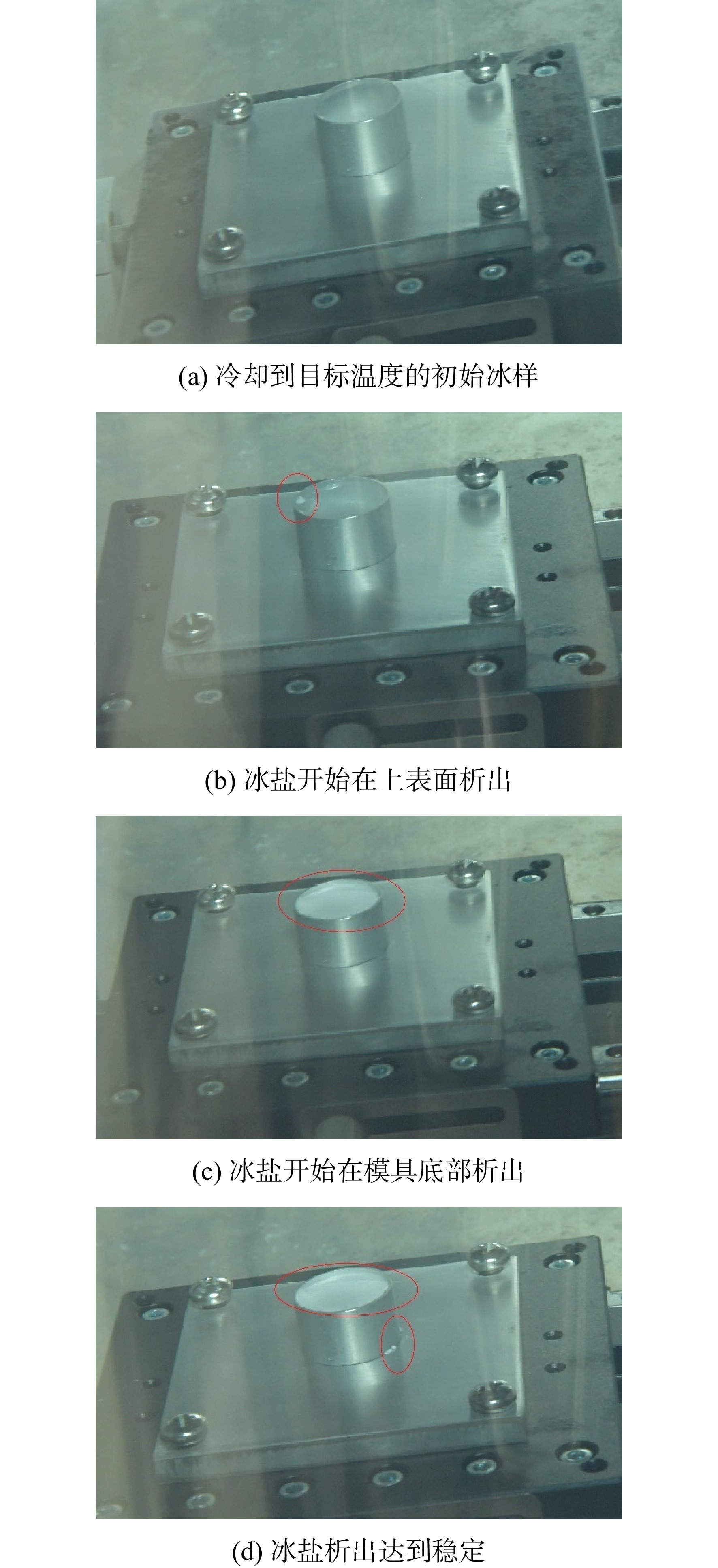
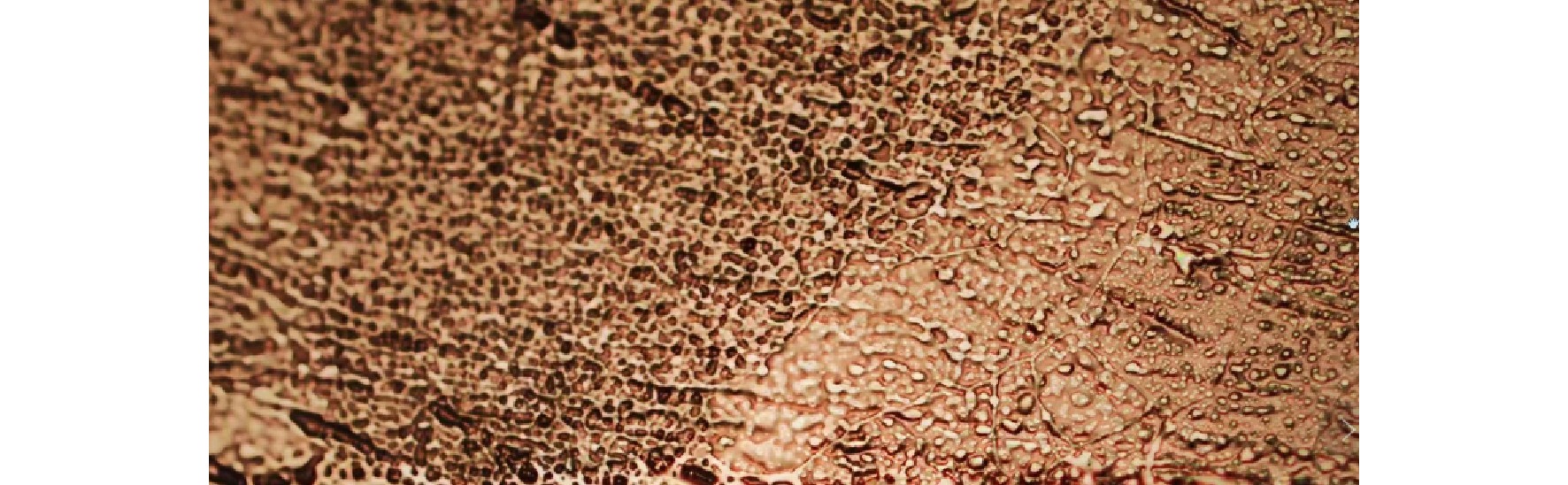
图 7 初始常温基底冰盐析出过程
Figure 7. Process of base ice salting out at initial normal temperature
表 1 不同温度下淡水冰黏附力系数
Table 1. Adhesion of fresh water ice at different temperature
kPa 实验
统计温度/℃ −5 −10 −15 −20 −25 −30 第1次 361.71 774.78 1032.54 1180.83 1086.78 1160.33 第2次 496.12 765.82 928.54 1154.46 1194.77 1108.68 第3次 411.03 809.61 980.79 1253.98 1157.59 1307.72 第4次 454.52 866.34 1057.42 1091.26 1133.56 1074.34 第5次 431.43 841.96 1037.02 994.23 1202.73 1194.77 均值 430.96 811.70 1007.62 1134.95 1155.09 1169.17 标准差 44.68 38.40 41.46 87.6 42.38 80.72 最大
偏差值69.27 54.64 79.08 138.32 68.31 138.55 最大
偏差率/%16 6.73 7.85 7.7 5.90 11.85  下载: 导出CSV
表 2 −12 ℃淡水冰黏附力
Table 2. −12 ℃ fresh water ice adhesion
kPa 第1次 第2次 第3次 第4次 第5次 均值 标准差 最大偏差值 最大偏差率/% 931.03 983.71 996.7 922.07 895.70 945.84 38.26 50.68 5.36
下载: 导出CSV
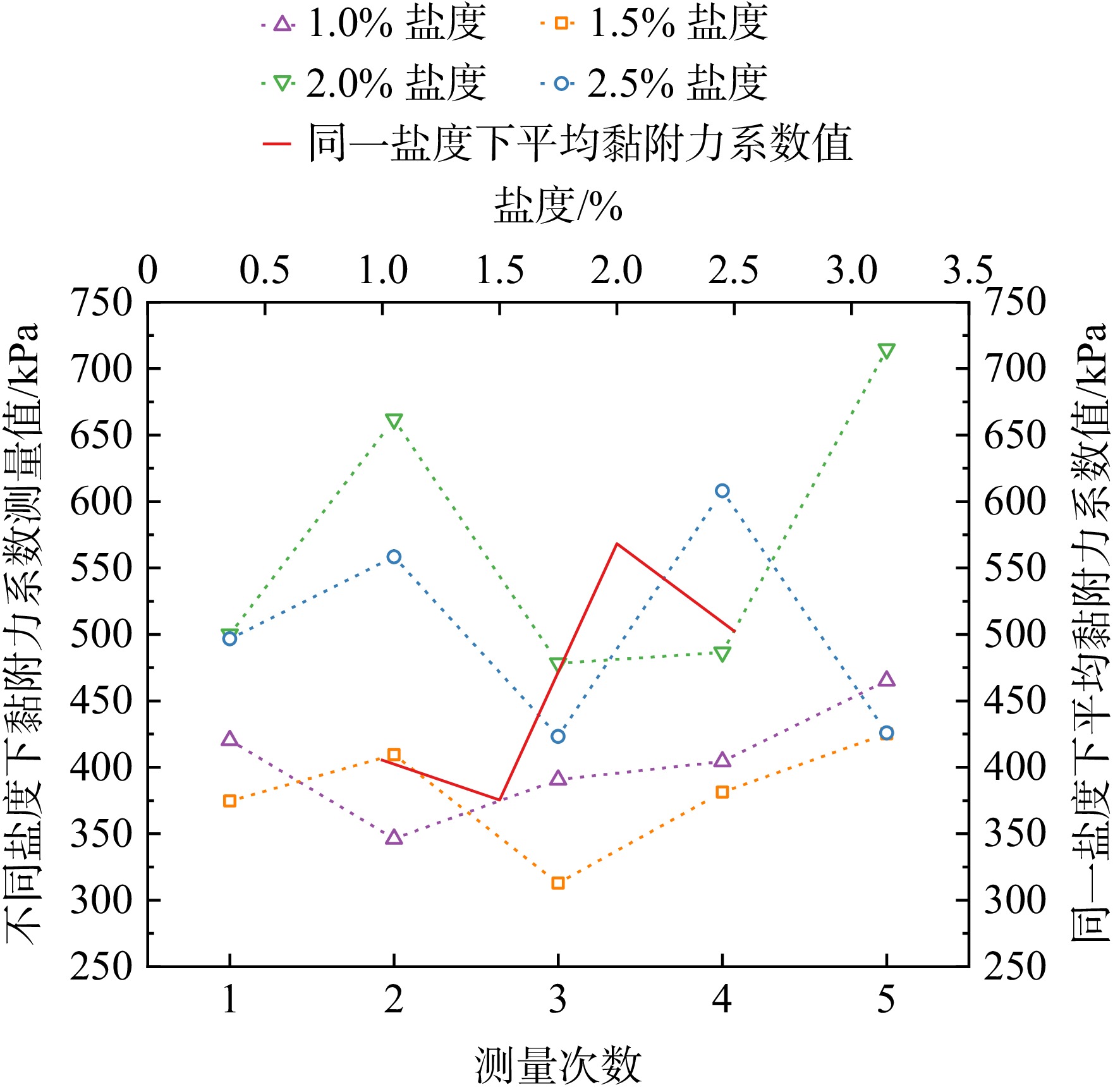
表 3 −30 ℃不同盐度下的含盐冰黏附力系数
Table 3. Salt water ice adhesion coefficient under different salinity at −30 ℃
kPa 实验统计 盐水浓度/% 1.0 1.5 2.0 2.5 第1次 420.38 374.68 500.10 496.67 第2次 346.19 409.48 661.82 558.32 第3次 390.67 312.9 478.30 423.22 第4次 404.41 381.27 486.51 608.08 第5次 465.27 425.26 714.57 425.85 均值 405.38 375.32 568.26 502.43 标准差 38.81 40.88 99.58 72.74 最大偏差值 59.89 62.42 146.31 105.65 最大偏差率/% 14.77 16.63 25.74 21.03
下载: 导出CSV
表 4 −25 ℃下2.0%浓度含盐冰黏附力系数
Table 4. Ice adhesion coefficient of 2.0% salt water at −25 ℃
kPa 第1次 第2次 第3次 第4次 第5次 均值 标准差 最大偏差值 最大偏差率/% 347.68 434.37 312.90 381.27 475.02 390.25 58.32 87.35 22.38
下载: 导出CSV
表 5 误差统计
Table 5. Error statistics
kPa 误差 t=−5 ℃ t=−10 ℃ t=−15 ℃ t=−20 ℃ t=−25 ℃ 摩擦力 4.976 4.976 4.976 4.976 4.976 拉力计 14.930 14.928 14.934 14.923 14.928 合计 19.906 19.904 19.911 19.899 19.904
下载: 导出CSV
-
[1] LV Jianyong,SONG Yanlin,JIANG Lei,et al. Bio-inspired strategies for anti-icing[J]. ACS Nano,2014,8(4): 3152-3169. doi: 10.1021/nn406522n [2] PETRENKO V F,WHITWORTH R W. Physics of ice[M]. Oxford: Oxford University Press,1999. [3] ITAGAKI K. Mechanical ice release processes. i. self-shedding from high-speed rotors[M]. Hanover: US Army Cold Regions Research and Engineering Laboratory,1983. [4] ANDREWS E H,MAJID H A,LOCKINGTON N A. Adhesion of ice to a flexible substrate[J]. Journal of Materials Science,1984,19(1): 73-81. doi: 10.1007/BF02403112 [5] NASELLO O B,LEVI L,PRODI F. Crystal structure of ice accreted on an ice substrate[J]. Journal of Glaciology,1987,33(113): 120-122. doi: 10.1017/S0022143000005426 [6] MAKKONEN L. Ice adhesion: theory,measurements and countermeasures[J]. Journal of Adhesion Science and Technology,2012,26(4/5): 413-445. [7] JELLINEK H H G. The influence of imperfections on the strength of ice[J]. Proceedings of the Physical Society,1958,71(5): 797-814. doi: 10.1088/0370-1328/71/5/311 [8] CHEN Jing,LIU Jie,HE Min,et al. Superhydrophobic surfaces cannot reduce ice adhesion[J]. Applied Physics Letters,2012,101(11): 111603. doi: 10.1063/1.4752436 [9] RØNNEBERG S,LAFORTE C,VOLAT C,et al. The effect of ice type on ice adhesion[J]. AIP Advances,2019,9(5): 055304. doi: 10.1063/1.5086242 [10] MATSUMOTO K,TSUBAKI D,SEKINE K,et al. Influences of number of hydroxyl groups and cooling solid surface temperature on ice adhesion force[J]. International Journal of Refrigeration,2017,75: 322-330. doi: 10.1016/j.ijrefrig.2016.12.007 [11] 李杨. 表面弹性对结冰附着界面稳定性影响规律的实验研究[D]. 长春: 吉林大学,2018. LI Yang. Experimental study on the influence of surface elasticity on the stability of icing adhesion interface[D]. Changchun: Jilin University,2018. (in ChineseLI Yang. Experimental study on the influence of surface elasticity on the stability of icing adhesion interface[D]. Changchun: Jilin University, 2018. (in Chinese) [12] RØNNEBERG S,ZHUO Yizhi,LAFORTE C,et al. Interlaboratory study of ice adhesion using different techniques[J]. Coatings,2019,9(10): 678. doi: 10.3390/coatings9100678 [13] WORK A,LIAN Yongsheng. A critical review of the measurement of ice adhesion to solid substrates[J]. Progress in Aerospace Sciences,2018,98: 1-26. doi: 10.1016/j.paerosci.2018.03.001 [14] ANDERSON D L,WEEKS W F. A theoretical analysis of sea-ice strength[J]. Eos,Transactions American Geophysical Union,1958,39(4): 632-640. doi: 10.1029/TR039i004p00632 [15] LAKE R A,LEWIS E L. Salt rejection by sea ice during growth[J]. Journal of Geophysical Research,1970,75(3): 583-597. doi: 10.1029/JC075i003p00583 [16] BENNINGTON K O. Some crystal growth features of sea ice[J]. Journal of Glaciology,1963,4(36): 669-688. doi: 10.3189/S0022143000028306 [17] RØNNEBERG S,HE Jianying,ZHANG Zhiliang. The need for standards in low ice adhesion surface research: a critical review[J]. Journal of Adhesion Science and Technology,2020,34(3): 319-347. doi: 10.1080/01694243.2019.1679523 [18] MAKKONEN L. Surface melting of ice[J/OL]. The Journal of Physical Chemistry B,1997,101(32): 6196-6200. [19] FLETCHER N H. Surface structure of water and ice[J]. Philosophical Magazine,1962,7(74): 255-269. doi: 10.1080/14786436208211860 [20] FURUKAWA Y,YAMAMOTO M,KURODA T. Ellipsometric study of the transition layer on the surface of an ice crystal[J]. Journal of Crystal Growth,1987,82(4): 665-677. doi: 10.1016/S0022-0248(87)80012-X [21] DOSCH H,LIED A,BILGRAM J H. Glancing-angle X-ray scattering studies of the premelting of ice surfaces[J]. Surface Science,1995,327(1): 145-164. [22] 金敬福,李杨,陈廷坤,等. 涂层弹性模量对结冰附着强度的影响[J]. 吉林大学学报(工学版),2017,47(5): 1548-1553. JIN Jingfu,LI Yang,CHEN Tingkun,et al. Effect of elastic modulus of coating on ice-adhesion strength on substrate[J]. Journal of Jilin University (Engineering and Technology Edition),2017,47(5): 1548-1553. (in ChineseJIN Jingfu, LI Yang, CHEN Tingkun, et al. Effect of elastic modulus of coating on ice-adhesion strength on substrate[J]. Journal of Jilin University (Engineering and Technology Edition), 2017, 47(5): 1548-1553. (in Chinese) [23] COLE D M. Modeling the cyclic loading response of sea ice[J]. International Journal of Solids and Structures,1998,35(31/32): 4067-4075. [24] 丁金波. 结冰表面冻粘特性的实验研究[D]. 上海: 上海交通大学,2012. DING Jinbo. Experimental study on freeze-viscosity characteristics of frozen surface[D]. Shanghai: Shanghai Jiao Tong University,2012. (in ChineseDING Jinbo. Experimental study on freeze-viscosity characteristics of frozen surface[D]. Shanghai: Shanghai Jiao Tong University, 2012. (in Chinese) [25] COX G F N,WEEKS W F. Changes in the salinity and porosity of sea-ice samples during shipping and storage[J]. Journal of Glaciology,1986,32(112): 371-375. doi: 10.3189/S0022143000012065 [26] DOU Renmei,CHEN Jing,ZHANG Yifan,et al. Anti-icing coating with an aqueous lubricating layer[J]. ACS Applied Materials & Interfaces,2014,6(10): 6998-7003. [27] LOU Decang,HAMMOND D,PERVIER M L. Investigation of the adhesive properties of the ice-aluminum interface[J]. Journal of Aircraft,2014,51(3): 1051-1056. doi: 10.2514/1.C032509 -




 点击查看大图

计量
- 文章访问数: 644
- HTML浏览量: 460
- PDF量: 44
- 被引次数: 0