






Research on hydrogen storage performance of adsorption hydrogen storage tank filled with metal foam
-
摘要:
基于数值模拟分别探究了以MOF-5和AX-21为吸附剂时,不同泡沫金属孔隙率对在充气和放气过程中储氢罐内温度、压力、吸附量和总吸附量的影响。在充气阶段,储氢罐内添加泡沫金属可显著提高储氢罐内的有效导热系数,显著降低储氢罐的平均温度,提高储氢罐内平均压力,有利于吸附反应的进行。在放气阶段,加入泡沫金属可增加储氢罐内平均温度,从而促进氢气的脱附。在放气过程中,随着泡沫金属孔隙率的减少,脱附反应显著区域逐渐向罐体中心扩展,从而加速氢气的脱附和释放。存在最优的泡沫金属填充孔隙率使储氢罐内总的氢气吸附量最大。对于MOF吸附剂而言,最优的泡沫金属填充孔隙率为0.8;对于AX-21吸附剂而言,最优的泡沫金属填充孔隙率为0.9。
Abstract:The effects of different foam metal porosities on the temperature, pressure, adsorption capacity and total adsorption capacity in the hydrogen storage tank during the filling and degassing processes were investigated by numerical simulations with MOF-5 and AX-21 as adsorbents, respectively. In the filling stage, the addition of foam metal into the hydrogen storage tank can significantly improve the effective thermal conductivity in the hydrogen storage tank, reduce the average temperature and increase the average pressure in the tank, contributing to the adsorption reaction. In the degassing stage, the addition of foam metal can increase the average temperature in the hydrogen storage tank, which promoted the desorption of hydrogen. During the degassing process, with the reduction of foam metal porosity, the obvious area of desorption reaction gradually expanded toward the center of the tank, helping to accelerate the desorption and release of hydrogen. There existed optimal filled foam metal porosity leading to the maximum total hydrogen adsorption in the hydrogen storage tank. For MOF adsorbent, the optimal porosity was 0.8; for AX-21 adsorbent, the optimal porosity was 0.9.
-
Key words:
- foam metal /
- metal-organic frameworks /
- activated carbon /
- adsorption hydrogen storage /
- porosity
-
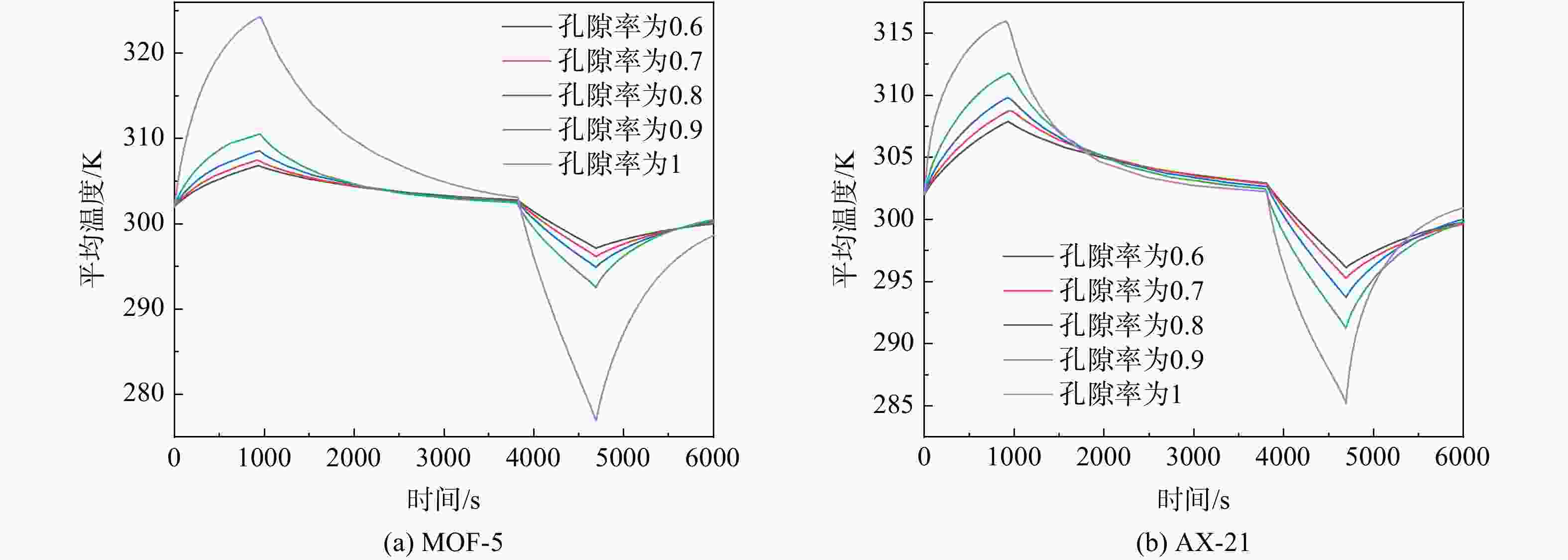
图 4 以MOF-5和AX-21为吸附剂的储氢罐内平均温度随时间的变化
Figure 4. Temporal variation of the average temperature in the hydrogen storage tank with MOF-5 and AX-21 as adsorbents
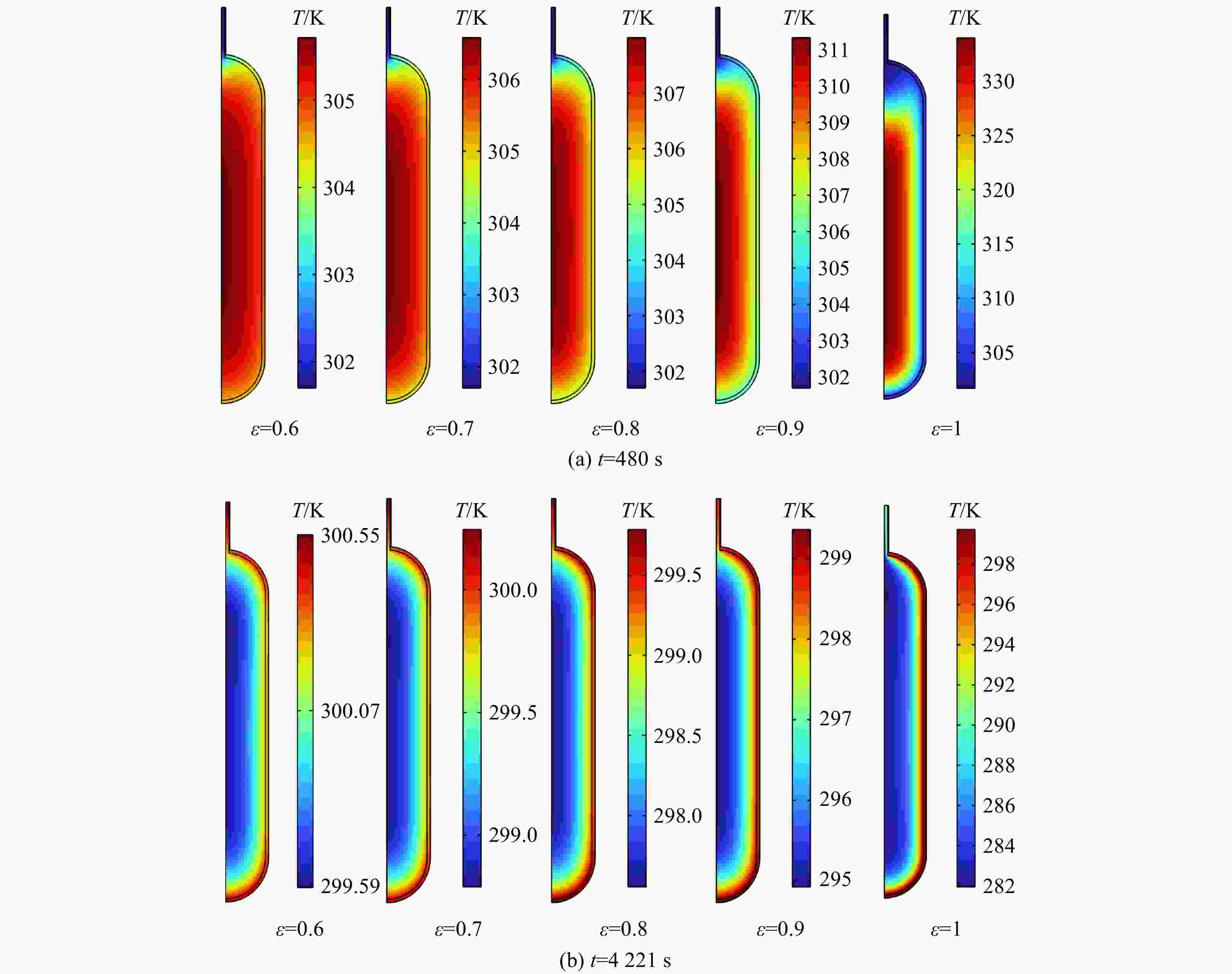
图 5 以MOF-5为吸附剂时,不同孔隙率泡沫金属填充下,在充气和放气过程中储氢罐内温度分布
Figure 5. Temperature distribution inside the hydrogen storage tank at different foam metal porosities during filling and degassing processes with MOF-5 as the adsorbent
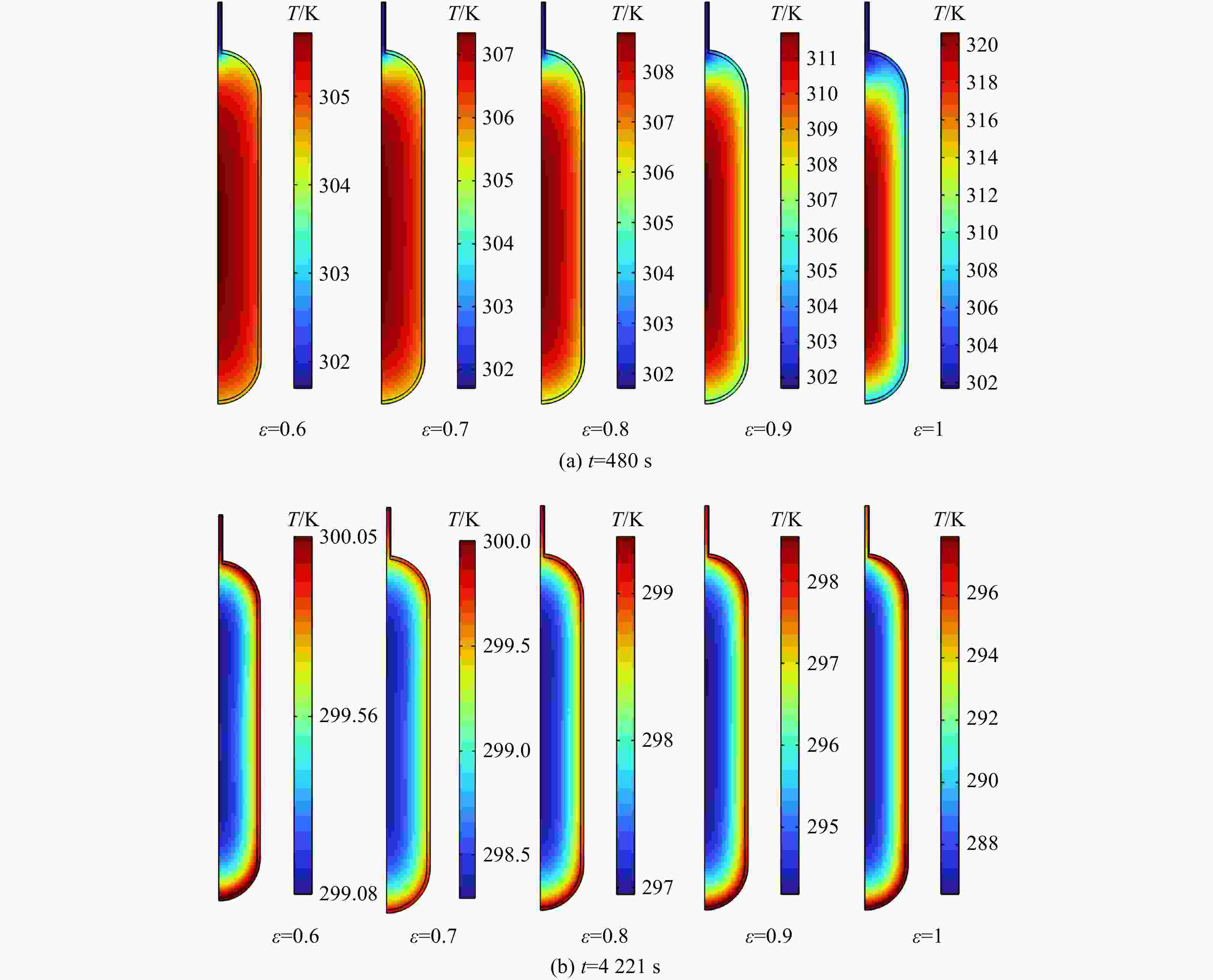
图 6 以AX-21为吸附剂时,不同孔隙率泡沫金属填充下在充气和放气过程中储氢罐内温度分布
Figure 6. Temperature distribution inside the hydrogen storage tank at different foam metal porosities during filling and degassing processes with AX-21 as the adsorbent
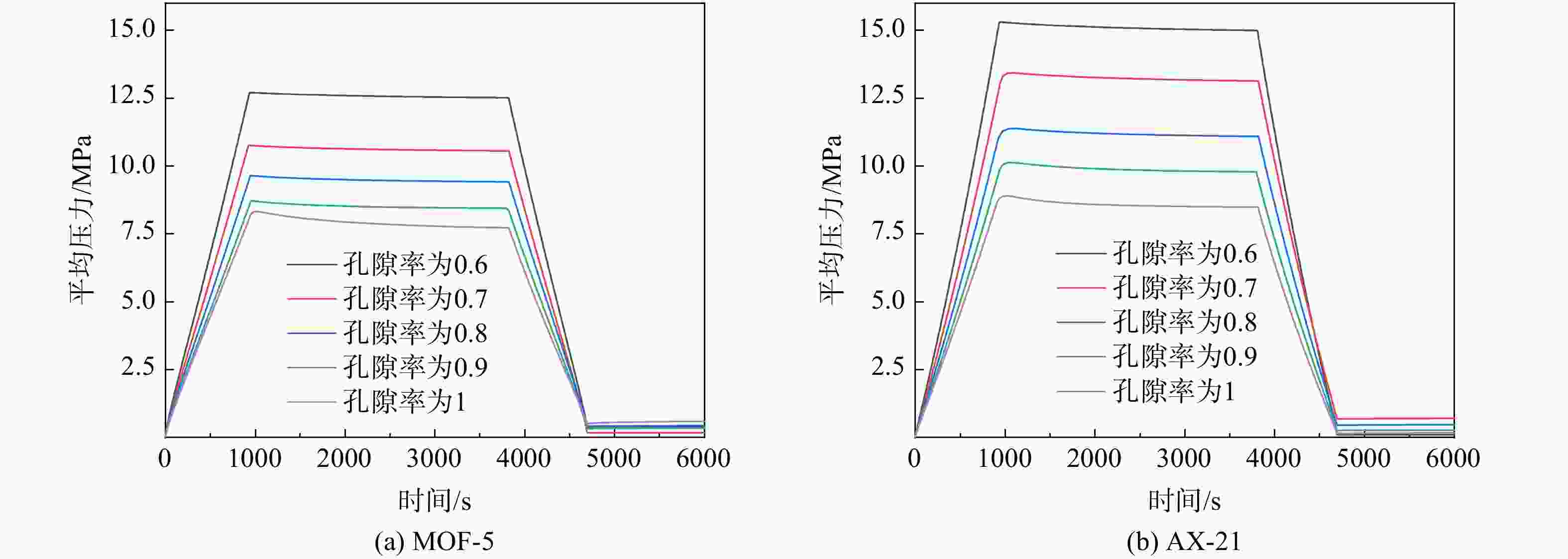
图 7 以MOF-5和AX-21为吸附剂的储氢罐内平均压力随时间的变化
Figure 7. Temporal variation of the average pressure in the hydrogen storage tank with MOF-5 and AX-21 as adsorbents
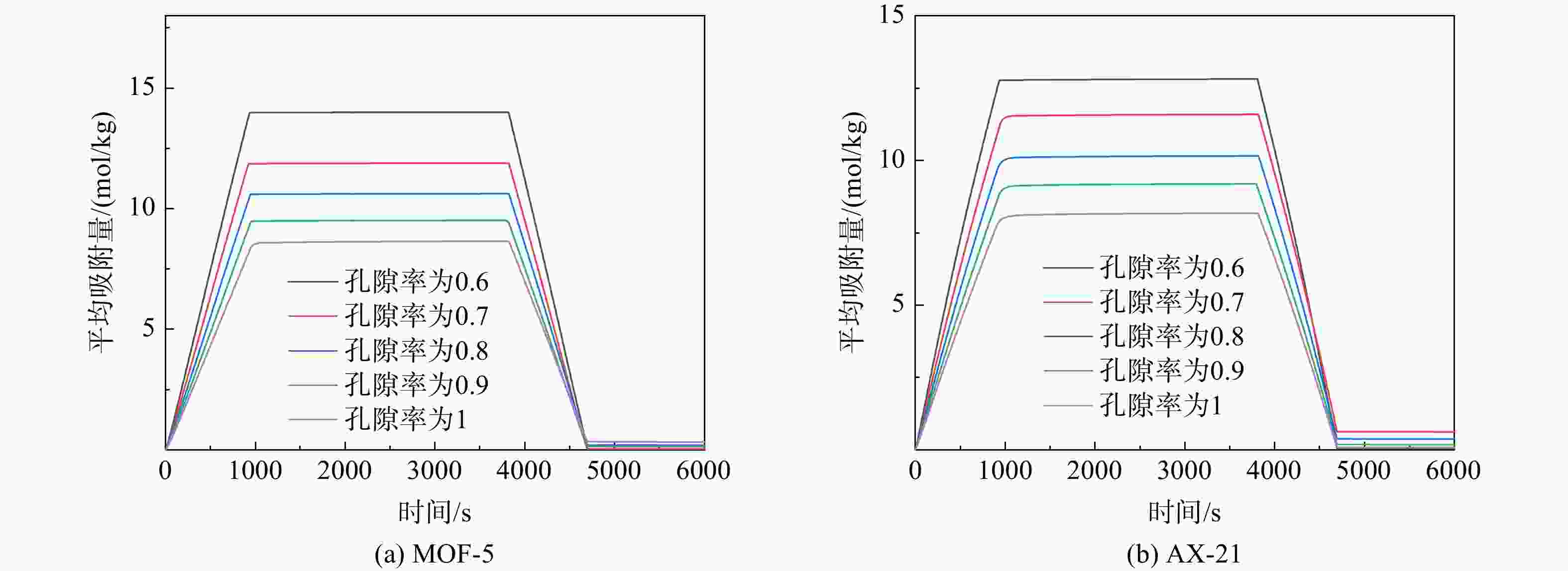
图 8 以MOF-5和AX-21为吸附剂的储氢罐内平均单位吸附量随时间的变化
Figure 8. Temporal variation of the average unit adsorption capactiy in the hydrogen storage tank with MOF-5 and AX-21 as adsorbents
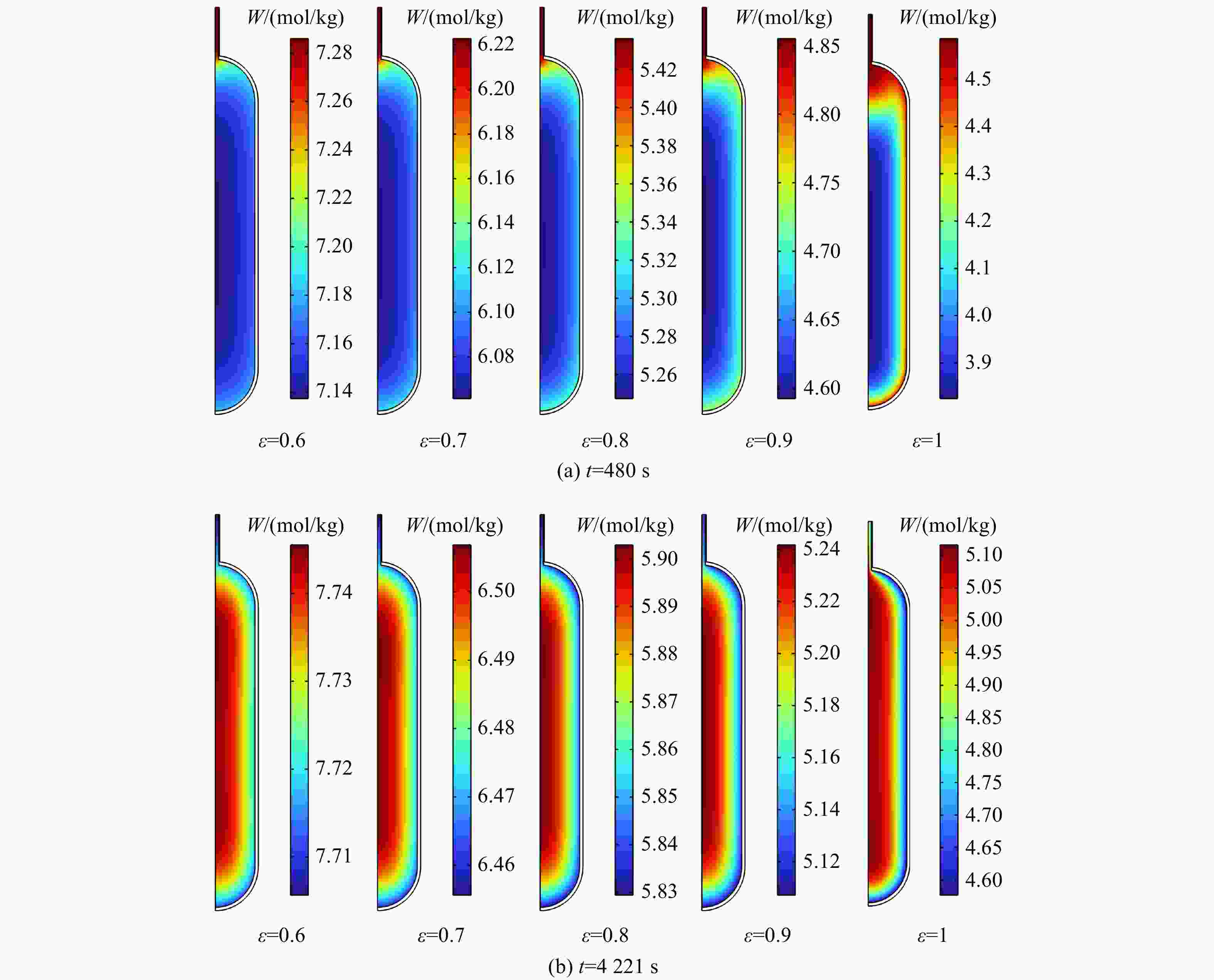
图 9 不同泡沫金属孔隙率下,以MOF-5为吸附剂时充气和放气过程中,储氢罐内单位吸附量分布
Figure 9. Unit adsorption capacity distribution in the hydrogen storage tank during filling and degassing processes with MOF-5 as adsorbent at different foam metal porosities
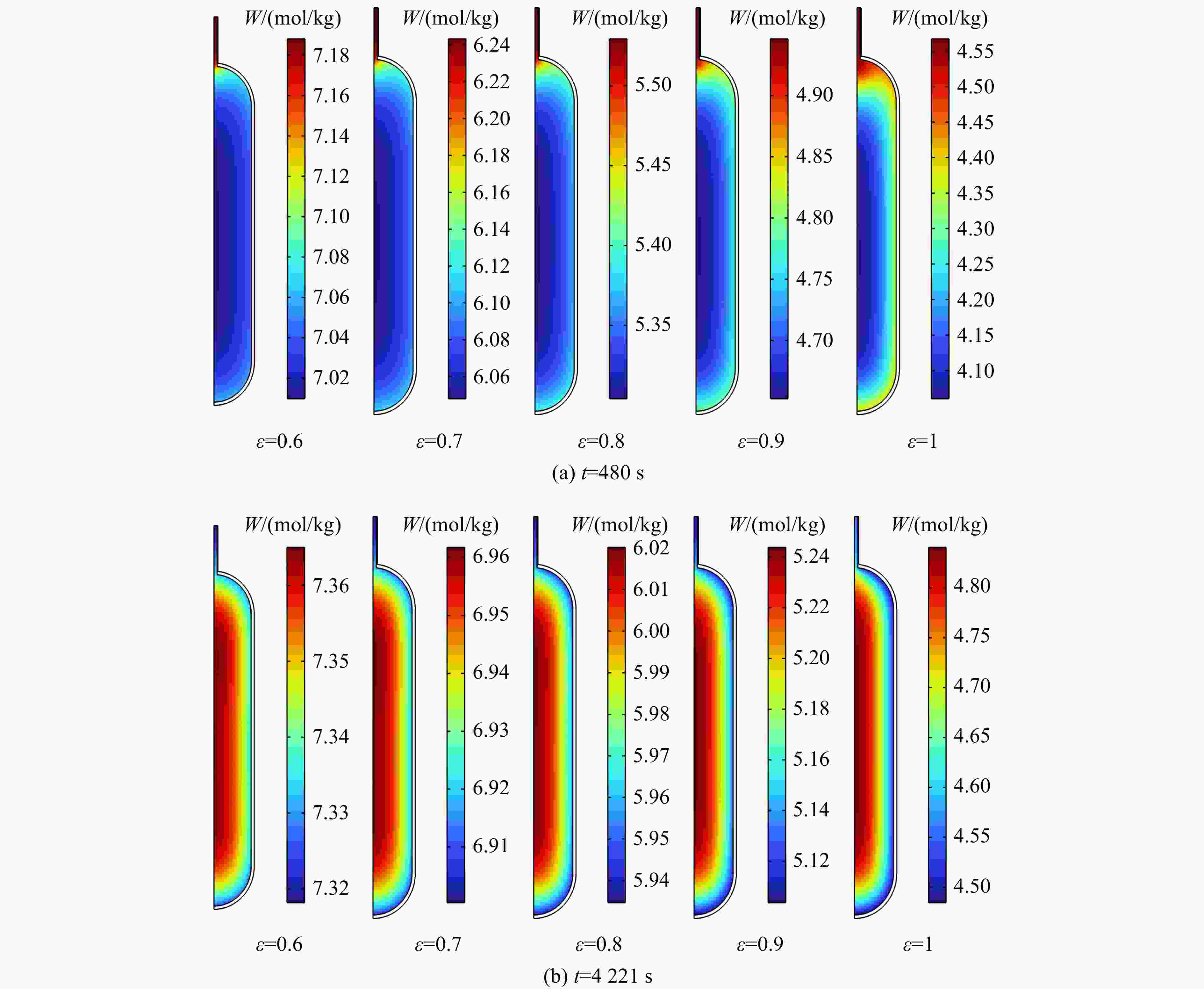
图 10 不同泡沫金属孔隙率下,以AX-21为吸附剂时充气和放气过程中,储氢罐内单位吸附量分布
Figure 10. Unit adsorption capacity distribution in the hydrogen storage tank during filling and degassing processes with AX-21 as adsorbent at different foam metal porosities
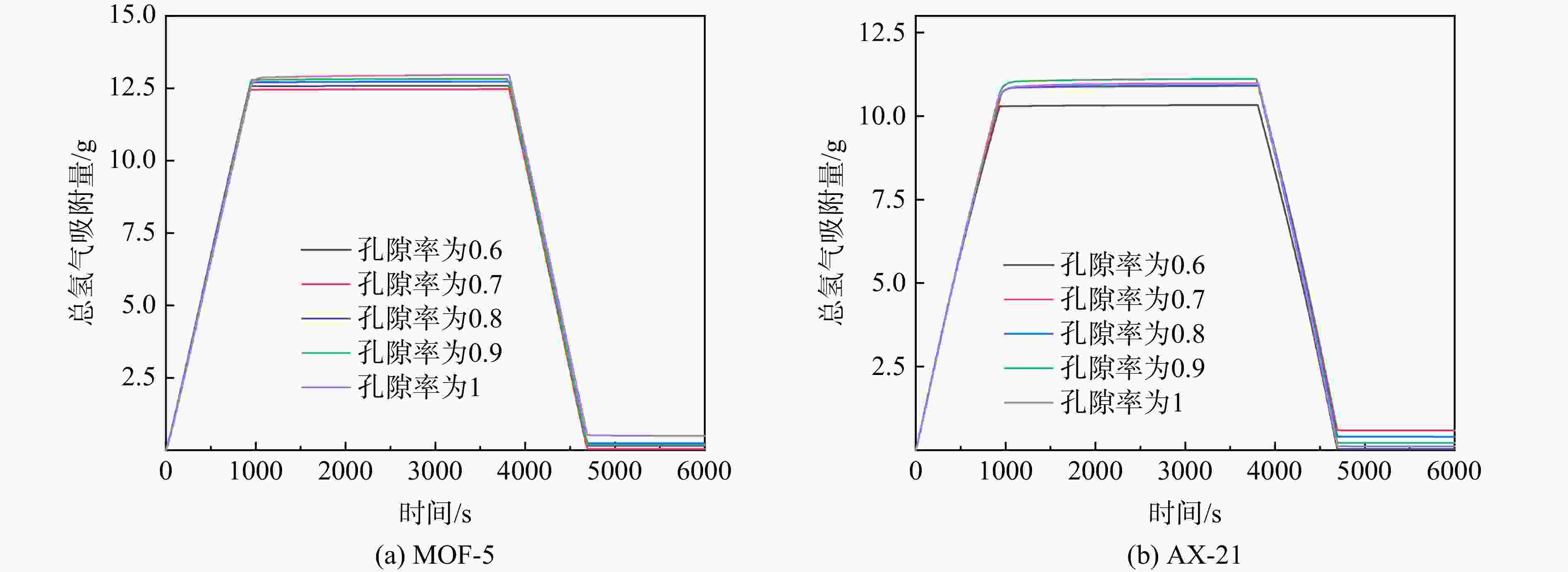
图 11 以MOF-5和AX-21为吸附剂的储氢罐内总氢气吸附量随时间的变化
Figure 11. Temporal variation of total hydrogen adsorption in the hydrogen storage tank with MOF-5 and AX-21 as adsorbents

图 12 充气与放气过程结束时,吸附剂总氢气吸附量随着泡沫金属孔隙率的变化关系
Figure 12. Variation of total hydrogen adsorption of adsorbent with foam metal porosities at the end of filling and degassing process
表 1 MOF-5与AX-21吸附剂的D-A模型参数
Table 1. D-A model parameters of MOF-5 and AX-21 adsorbents
吸附剂 W0/
(mol/kg)p0/
MPaα/
(J/mol)β/
(J/(mol·K))AX-21 71.6 1470 3080 18.9 MOF-5 139.6 1605 2123 19.6  下载: 导出CSV
表 2 材料物性
Table 2. Material physical properties
材料特性 AX-21 MOF-5 氢气 钢质壁面 密度/(kg/m3) 269 300 理想气体 7830 比热容/(J/(kg·K)) 825 760 12340 276 导热系数/(W/(m·K)) 0.764 0.088 0.206 13 孔隙率 0.49 0.4447 动力黏度/10−6 (Pa·s) 8.41
下载: 导出CSV
表 3 储氢罐入口边界条件
Table 3. Boundary conditions of hydrogen storage tank inlet
时间/s 质量通量/(kg/(m2·s)) 温度/K 0~953 0.407 301.7 953~ 3822 0 302.5 3822 ~4694 −0.434 297.7 4694 ~6000 0 298.6
下载: 导出CSV
-
[1] SWAIN G,SULTANA S,NAIK B,et al. Coupling of crumpled-type novel MoS2 with CeO2 nanoparticles: a noble-metal-free p-n heterojunction composite for visible light photocatalytic H2 production[J]. ACS Omega,2017,2(7): 3745-3753. doi: 10.1021/acsomega.7b00492 [2] AMICA G,ARNEODO LAROCHETTE P,GENNARI F C. Light metal hydride-based hydrogen storage system: economic assessment in Argentina[J]. International Journal of Hydrogen Energy,2020,45(38): 18789-18801. doi: 10.1016/j.ijhydene.2020.05.036 [3] CHEN H,SONG J,ZHAO J. Synergies between power and hydrogen carriers using fuel-cell hybrid electrical vehicle and power-to-gas storage as new coupling points[J]. Energy Conversion and Management,2021,246: 114670. doi: 10.1016/j.enconman.2021.114670 [4] SANCHEZ N,RUIZ R,HACKER V,et al. Impact of bioethanol impurities on steam reforming for hydrogen production: a review[J]. International Journal of Hydrogen Energy,2020,45(21): 11923-11942. doi: 10.1016/j.ijhydene.2020.02.159 [5] XIAO Jinsheng,PENG Rong,COSSEMENT D,et al. CFD model for charge and discharge cycle of adsorptive hydrogen storage on activated carbon[J]. International Journal of Hydrogen Energy,2013,38(3): 1450-1459. doi: 10.1016/j.ijhydene.2012.10.119 [6] MOHAN M,SHARMA V K,KUMAR E A,et al. Hydrogen storage in carbon materials: a review[J]. Energy Storage,2019,1(2): e35. doi: 10.1002/est2.35 [7] PASINI J M,CORGNALE C,VAN HASSEL B A,et al. Metal hydride material requirements for automotive hydrogen storage systems[J]. International Journal of Hydrogen Energy,2013,38(23): 9755-9765. doi: 10.1016/j.ijhydene.2012.08.112 [8] MERT H,DENIZ C U,BAYKASOGLU C. Monte Carlo simulations of hydrogen adsorption in fullerene pillared graphene nanocomposites[J]. Molecular Simulation,2020,46(8): 650-659. doi: 10.1080/08927022.2020.1758696 [9] DENIZ C U. Computational screening of zeolite templated carbons for hydrogen storage[J]. Computational Materials Science,2022,202: 110950. doi: 10.1016/j.commatsci.2021.110950 [10] MEEK S T,GREATHOUSE J A,ALLENDORF M D. Metal-organic frameworks: a rapidly growing class of versatile nanoporous materials[J]. Advanced Materials,2011,23(2): 249-267. doi: 10.1002/adma.201002854 [11] UBAID S,ZACHARIA R,XIAO Jinsheng,et al. Charge-discharge cycling,flowthrough cooling and Para-ortho conversion for cooling bulk hydrogen storage tank filled with MOF-5[J]. International Journal of Hydrogen Energy,2016,41(2): 1044-1052. doi: 10.1016/j.ijhydene.2015.10.056 [12] UBAID S,ZACHARIA R,XIAO Jinsheng,et al. Effect of flowthrough cooling heat removal on the performances of MOF-5 cryo-adsorptive hydrogen reservoir for bulk storage applications[J]. International Journal of Hydrogen Energy,2015,40(30): 9314-9325. doi: 10.1016/j.ijhydene.2015.05.097 [13] WU Mengbo,ZHENG Qingrong,SUN Tingquan,et al. Analysis of heat conducting enhancement measures on the composite for hydrogen storage by incorporation of activated carbon with MOFs[J]. International Journal of Hydrogen Energy,2023,48(10): 3994-4005. doi: 10.1016/j.ijhydene.2022.10.245 [14] PALLA S,KAISARE N S. Evaluating the impact of pellet densification and graphite addition for design of on-board hydrogen storage in a fixed bed of MOF-5 pellets[J]. International Journal of Hydrogen Energy,2020,45(48): 25875-25889. doi: 10.1016/j.ijhydene.2020.03.165 [15] SEMELSBERGER T A,VEENSTRA M,DIXON C. Room temperature thermal conductivity measurements of neat MOF-5 compacts with high pressure hydrogen and helium[J]. International Journal of Hydrogen Energy,2016,41(8): 4690-4702. doi: 10.1016/j.ijhydene.2015.12.059 [16] 程友良,周彬,李帅领. 金属有机骨架低温吸附储氢罐充气过程的数值模拟研究[J]. 载人航天,2020,26(2): 222-229. CHENG Youliang,ZHOU Bin,LI Shuailing. Numerical simulation of inflation process of MOF cryo-adsorptive hydrogen reservoir[J]. Manned Spaceflight,2020,26(2): 222-229. (in Chinese doi: 10.3969/j.issn.1674-5825.2020.02.013CHENG Youliang, ZHOU Bin, LI Shuailing. Numerical simulation of inflation process of MOF cryo-adsorptive hydrogen reservoir[J]. Manned Spaceflight, 2020, 26(2): 222-229. (in Chinese) doi: 10.3969/j.issn.1674-5825.2020.02.013 [17] 程友良,张盼,何传金. 小型储氢罐低温吸附特性影响因素及解决方案研究[J]. 力学与实践,2022,44(4): 809-817. CHENG Youliang,ZHANG Pan,HE Chuanjin. Research on the issues and solutions of low-temperature adsorption characteristics of small hydrogen storage tanks[J]. Mechanics in Engineering,2022,44(4): 809-817. (in Chinese doi: 10.6052/1000-0879-22-126CHENG Youliang, ZHANG Pan, HE Chuanjin. Research on the issues and solutions of low-temperature adsorption characteristics of small hydrogen storage tanks[J]. Mechanics in Engineering, 2022, 44(4): 809-817. (in Chinese) doi: 10.6052/1000-0879-22-126 [18] BAI Xiaoshuai,YANG Weiwei,YANG Yongjian,et al. Multi-variable optimization of metal hydride hydrogen storage reactor with gradient porosity metal foam and evaluation of comprehensive performance[J]. International Journal of Hydrogen Energy,2022,47(83): 35340-35351. doi: 10.1016/j.ijhydene.2022.08.123 [19] XIAO Jinsheng,WANG Jijuan,COSSEMENT D,et al. Finite element model for charge and discharge cycle of activated carbon hydrogen storage[J]. International Journal of Hydrogen Energy,2012,37(1): 802-810. doi: 10.1016/j.ijhydene.2011.04.055 [20] RICHARD M A,BÉNARD P,CHAHINE R. Gas adsorption process in activated carbon over awide temperature range above the critical point: Part 1 modified Dubinin-Astakhov model[J]. Adsorption,2009,15(1): 43-51. doi: 10.1007/s10450-009-9149-x [21] LI Mingliang,ZHAO Yanan,LONG Rui,et al. Metal foam packed adsorbent bed boosting the performance of the adsorption-based desalination and cooling system[J]. Energy Conversion and Management,2022,254: 115250. doi: 10.1016/j.enconman.2022.115250 [22] XIAO Jinsheng,TONG Liang,DENG Caihua,et al. Simulation of heat and mass transfer in activated carbon tank for hydrogen storage[J]. International Journal of Hydrogen Energy,2010,35(15): 8106-8116. doi: 10.1016/j.ijhydene.2010.01.021 [23] 胡敏. 多孔材料储氢的有限元模拟与优化[D]. 武汉: 武汉理工大学,2012. HU Min. Finite element simulation and optimization of hydrogen storage in porous materials[D]. Wuhan: Wuhan University of Technology,2012. (in ChineseHU Min. Finite element simulation and optimization of hydrogen storage in porous materials[D]. Wuhan: Wuhan University of Technology, 2012. (in Chinese) -


 点击查看大图

计量
- 文章访问数: 1059
- HTML浏览量: 242
- PDF量: 65
- 被引次数: 0