






Rapid design of dedicated turbofan engine for parallel hybrid propulsion system
-
摘要:
为解决航空并联混合动力系统直接使用传统涡扇发动机时存在的发动机效率下降与低压压气机喘振问题,提出了一种通过质量流量预测确定涵道比的并联混合动力专用涡扇发动机快速设计方法,使用PROOSIS搭建了并联混合动力涡扇发动机模型,对发动机设计结果进行了性能评估与能量利用分析。研究表明,在与基准发动机相同的涡轮前总温限制下,设计结果能够满足推力需求。与在并联混合动力系统中使用基准发动机相比,使用设计的专用发动机时的油耗、能耗、低压压气机防喘振性能更优。混合度越高,使用专用发动机产生的性能提升越大。由于能量利用历程不同,发动机外涵道电能利用率远高于内涵道电能利用率和燃油利用率,这是并联混合动力涡扇发动机节能的根本原因。
Abstract:In order to avoid the surge of low pressure compressor and decrease of efficiency when using directly conventional turbofan engine in the parallel hybrid propulsion system, a rapid design method of dedicated turbofan engine for parallel hybrid propulsion system was proposed based on the designed bypass ratio from prediction of flow rate. A parallel hybrid turbofan engine model was developed using PROOSIS to study the performance and energy utilization of the designed dedicated engines. It was found that under the constraint on turbine inlet temperature the same as the baseline engine, the dedicated engine can provide the needed thrust. Compared with the baseline engine in the parallel hybrid propulsion system, the anti-surge performance of low pressure compressor, fuel and energy consumption of the dedicated engine were better. As degree of hybridization increased, the benefits from using dedicated engine increased. Because of the difference in the energy utilization process, the energy utilization efficiency of electric power supplied to bypass was much higher than that of electric power supplied to core and fuel, serving as a fundamental reason of saving energy when using parallel hybrid turbofan engine.
-
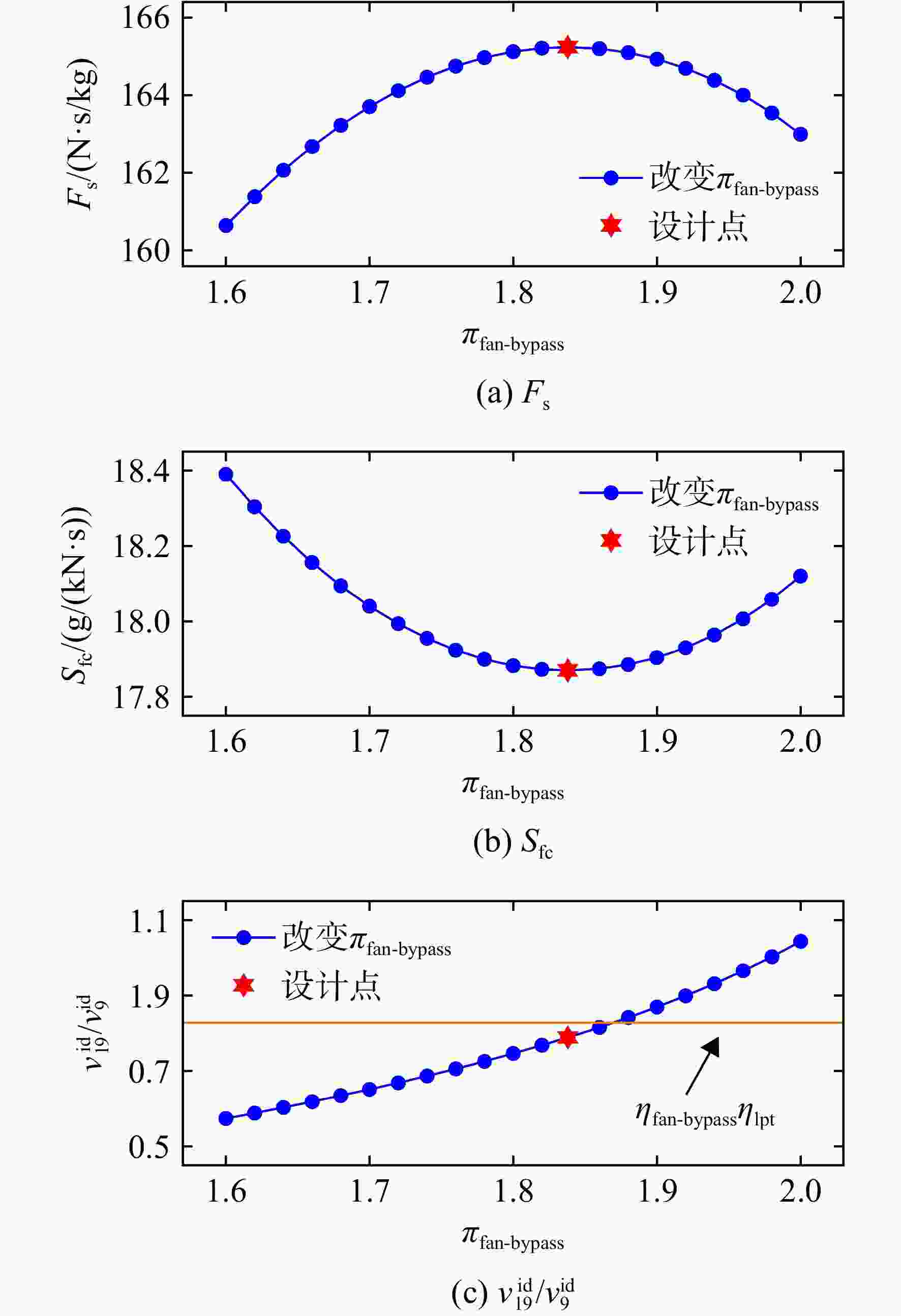
图 2 外涵道风扇压比对发动机性能参数的影响
Figure 2. Influence of bypass fan pressure ratio on engine performance
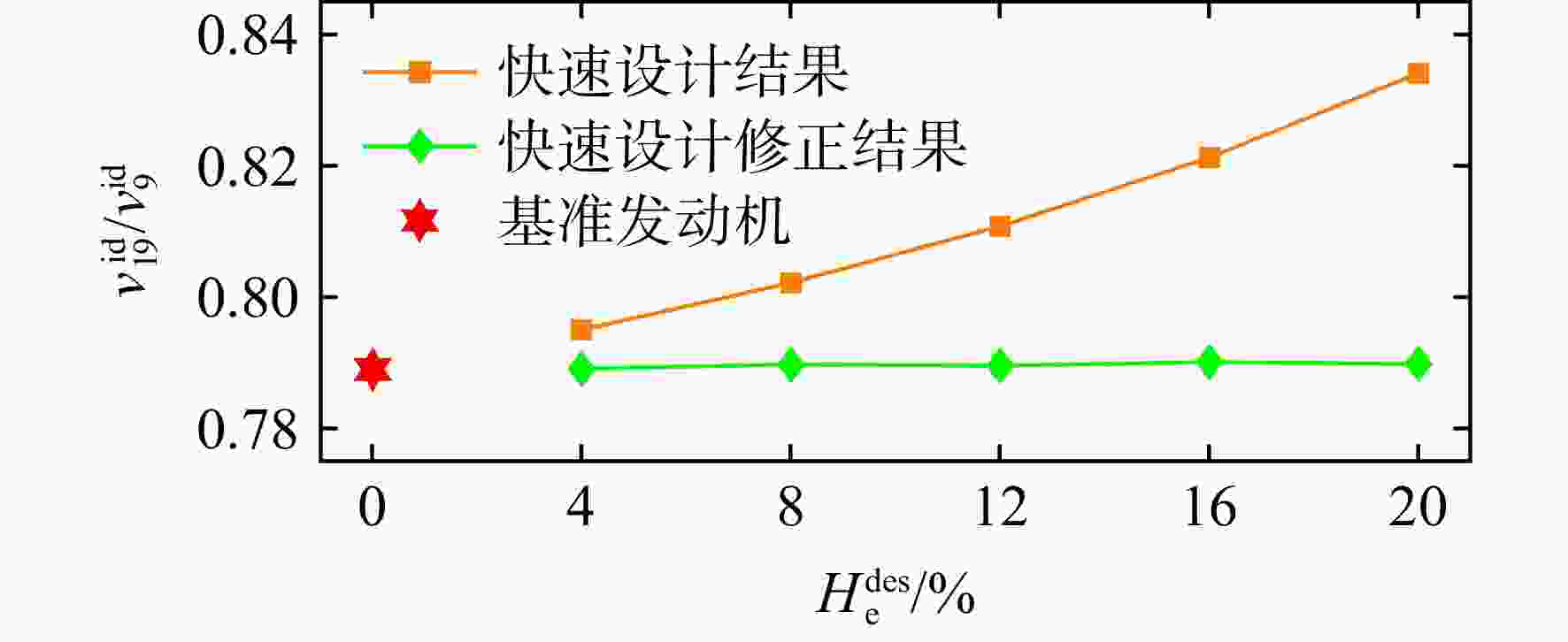
图 5 外涵道与内涵道理想排气速度之比的比较
Figure 5. Comparison of the ratio of bypass and core ideal exhaust velocity
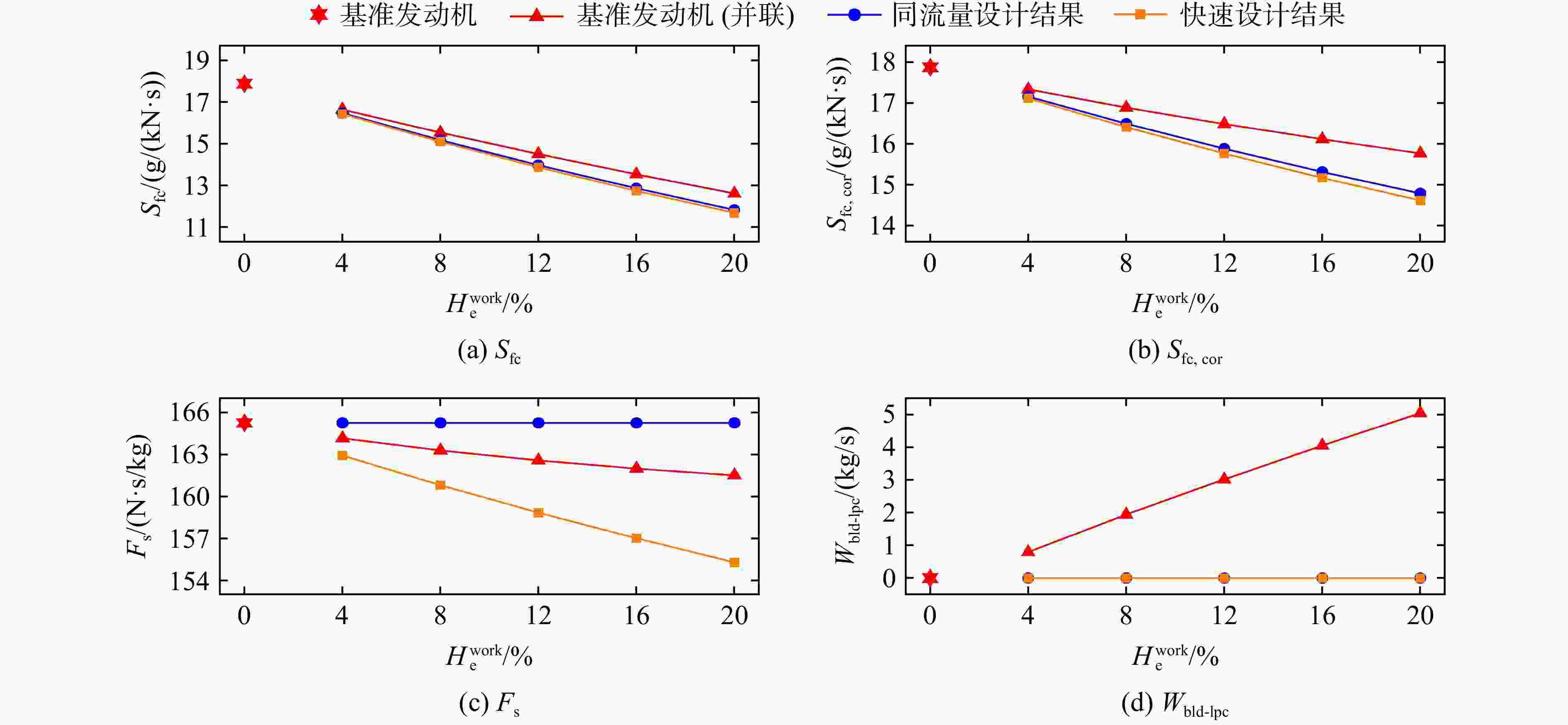
图 8 发动机性能参数的比较 (H=10668 m, Ma=0.8, F=30.15 kN, ISA)
Figure 8. Comparison of engine performance (H=10668 m, Ma=0.8, F=30.15 kN, ISA)
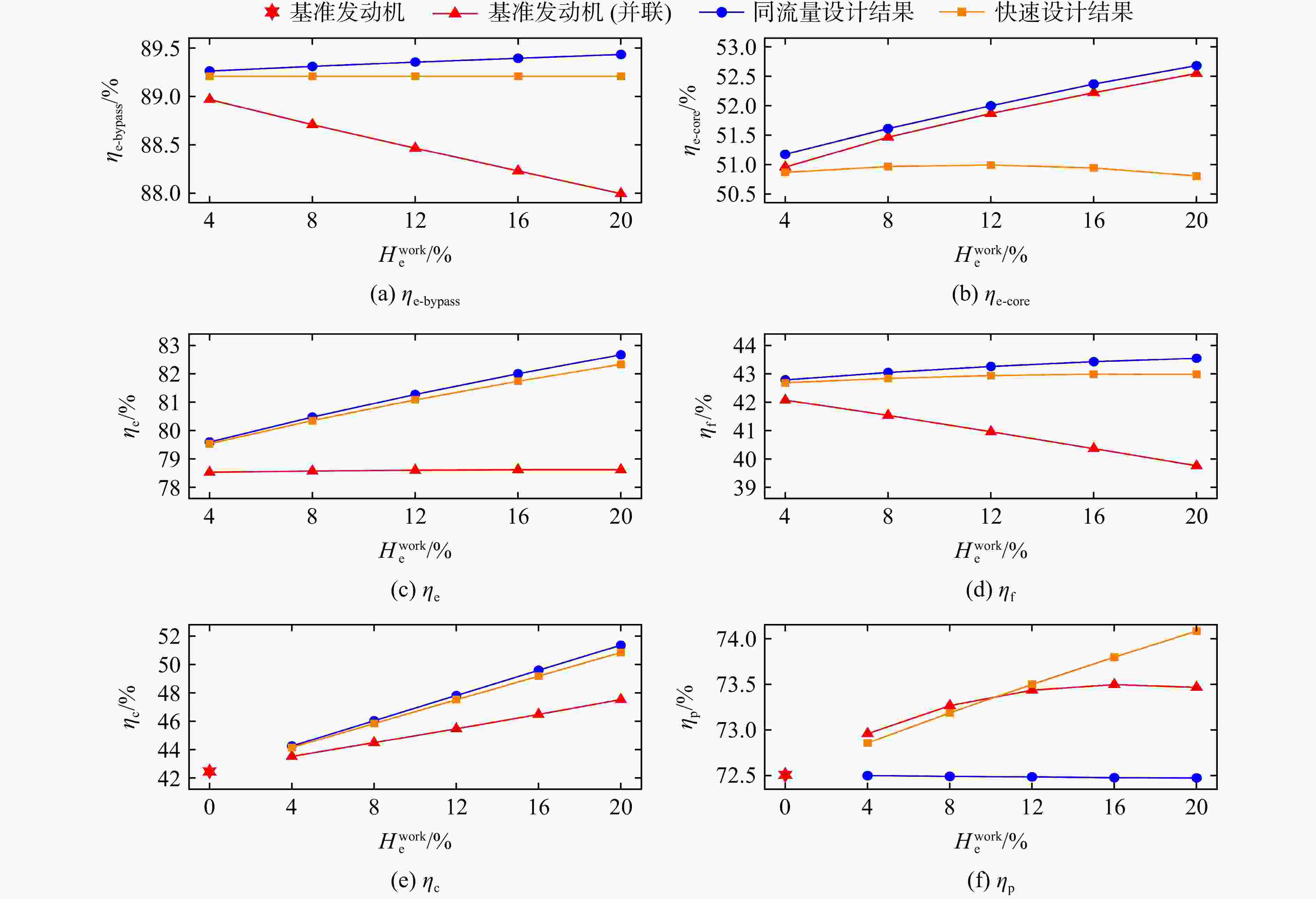
图 10 发动机效率的比较 (H=10668 m, Ma=0.8, F=30.15 kN, ISA)
Figure 10. Comparison of engine efficiency (H=10668 m, Ma=0.8, F=30.15 kN, ISA)
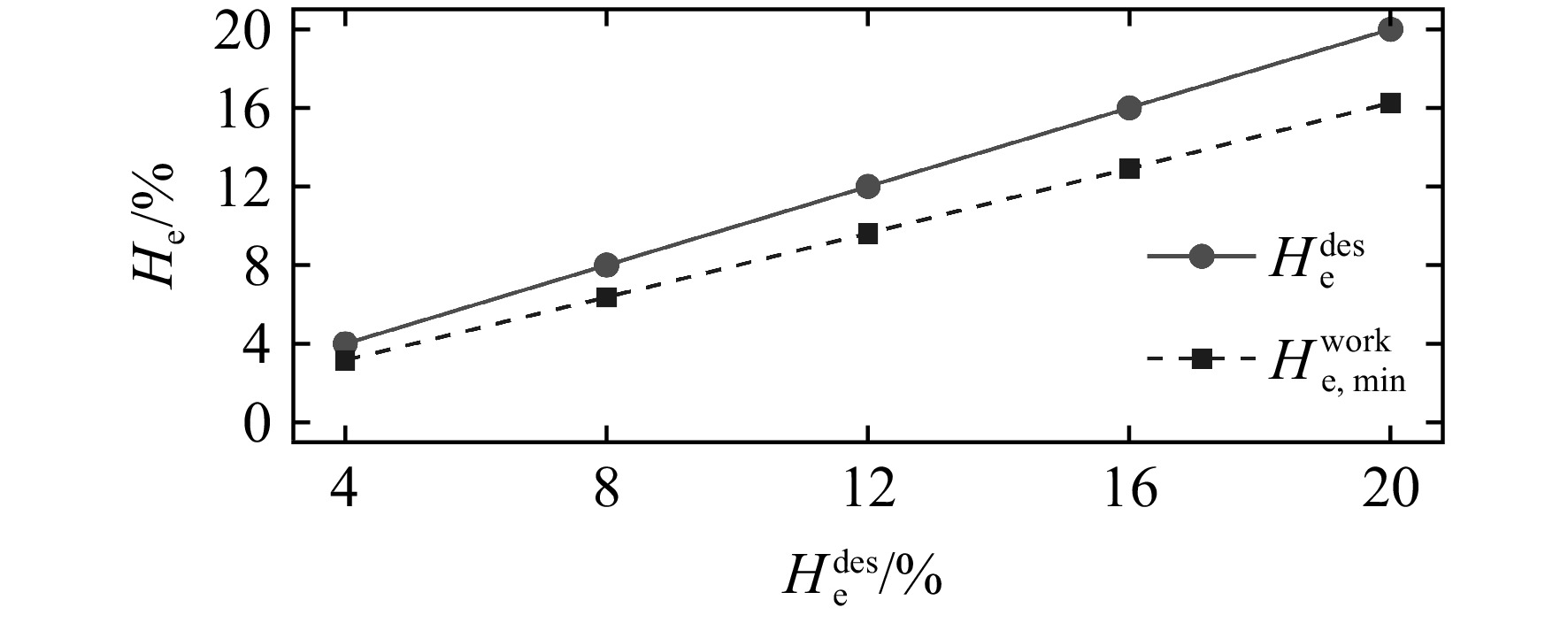
图 13
$H_{{\text{e}},\min }^{{\text{work}}}$ 与$H_{\text{e}}^{{\text{des}}}$ 的比较Figure 13. Comparison between
$H_{{\text{e}},\min }^{{\text{work}}}$ and$H_{\text{e}}^{{\text{des}}}$ 
图 16 起飞时的发动机性能比较(
$H_{\text{e}}^{{\text{work}}}{\text{ = 12\% }}$ )Figure 16. Comparison of engine performance in take-off (
$H_{\text{e}}^{{\text{work}}}{\text{ = 12\% }}$ )表 1 基准发动机主要工作点的参数
Table 1. Baseline engine parameters of main operating points
参数 数值 爬升
(设计点)起飞 巡航 高度H/m 10668 0 10668 马赫数Ma 0.8 0 0.8 进气量/(kg/s) 182.46 405.67 169.38 涵道比 4.9 5.17 5.22 总压比 34.6 27.25 29.23 涡轮前总温/K 1560 1625 1446.25 推力/kN 30.15 116.93 23.26 燃油流量/(kg/s) 0.539 1.191 0.421  下载: 导出CSV
表 2 基准发动机与CFM56-7B26发动机的参数对比(H = 0, Ma = 0)
Table 2. Comparison of parameters between baseline engine and CFM56-7B26 engine (H = 0, Ma = 0)
参数 数值 相对偏差/% 基准
发动机CFM56-7B26 涵道比 5.17 5.1 1.37 总压比 27.25 27.7 −1.62 推力/kN 116.93 116.99 −0.05 燃油流量/(kg/s) 1.191 1.213 −1.81
下载: 导出CSV
-
[1] National Academies of Sciences, Engineering, and Medicine. Commercial aircraft propulsion and energy systems research: reducing global carbon emissions[M]. Washington, US: National Academies Press, 2016. [2] 刘光璧,王步宇,王向阳,等. 航空并联混合动力涡扇发动机热力循环与工作特性研究[J]. 推进技术,2023,44(4): 37-51.LIU Guangbi,WANG Buyu,WANG Xiangyang,et al. Thermodynamic cycle and performance of parallel hybrid turbofan engine[J]. Journal of Propulsion Technology,2023,44(4): 37-51. (in Chinese) [3] LAMMEN W, VANKAN J. Energy optimization of single aisle aircraft with hybrid electric propulsion[R]. AIAA-2020-0505, 2020 [4] 中国民用航空局. “十四五”民航绿色发展专项规划[R]. 北京: 中国民用航空局, 2021. [5] JONES S M, HALLER W, TONG M. An N+3 technology level reference propulsion system[R]. NASA/TM-2017-219501, 2017 [6] Federal Aviation Administration. United States 2021 aviation climate action plan[R]. Washington, US: Federal Aviation Administration, 2021. [7] European Commission. Flightpath 2050 Europe’s vision for aviation: maintaining global leadership and serving society’s needs[R]. KI-31-11-098-EN-C, 2011. [8] European Commission. Fly the green deal Europe’s vision for sustainable aviation[R]. KI-05-21-325-EN-N, 2022. [9] Department for Transport. Jet zero strategy: delivering net zero aviation by 2050[R]. London, UK: Department for Transport, 2022. [10] International Air Transport Association. International air transport association annual report 2010[R]. Berlin, Germany: International Air Transport Association, 2010. [11] JANSEN R, BOWMAN C, JANKOVSKY A, et al. Overview of NASA electrified aircraft propulsion (EAP) research for large subsonic transports[R]. AIAA-2017-4701, 2017. [12] BRADLEY M, DRONEY C K. Subsonic ultra green aircraft research: phase 2. volume 2: hybrid electric design exploration[R]. NASA/CR-2015-218704/VOL2, 2015 [13] MADAVAN N, ROSARIO R, JANKOVSKY A. Hybrid-electric and distributed propulsion technologies for large commercial transports: a NASA perspective[R]. ARC-E-DAA-TN27231, 2015 [14] PERULLO C, TRAWICK D, ARMSTRONG M, et al. Cycle selection and sizing of a single-aisle transport with the electrically variable engine (TM) (EVE) for fleet level fuel optimization[R]. AIAA-2017-1923, 2017. [15] 陈佳杰,刘云霄,王继强,等. 并联混合动力齿轮传动涡扇发动机建模与性能分析[J]. 推进技术,2022,43(10): 496-507.CHEN Jiajie,LIU Yunxiao,WANG Jiqiang,et al. Modeling and performance analysis of parallel hybrid geared turbofan engine[J]. Journal of Propulsion Technology,2022,43(10): 496-507. (in Chinese) [16] GLADIN J C, PERULLO C, TAI J C, et al. A parametric study of hybrid electric gas turbine propulsion as a function of aircraft size class and technology level[R]. AIAA-2017-0338, 2017. [17] CARPENTIER T, ZHANG J N, VAN HEERDEN A S J, et al. Performance and economic assessment of mechanically integrated parallel hybrid aircraft[R]. Rotterdam, Netherlands: ASME Turbo Expo 2022: Turbomachinery Technical Conference and Exposition, 2022 [18] JAIN S, CROSSLEY W. Predicting fleet-level carbon emission reductions from future single-aisle hybrid electric aircraft[R]. AIAA-2020-3554, 2020. [19] TRAWICK D, PERULLO C, ARMSTRONG M, et al. Development and application of GT-HEAT for the electrically variable engine (TM) design[R]. AIAA-2017-1922, 2017. [20] SIELEMANN M, COÏC C, ZHAO Xin, et al. Multi-point design of parallel hybrid aero engines[R]. AIAA-2020-3556, 2020. [21] SAHOO S, ZHAO X, KYPRIANIDIS K G, et al. Performance assessment of an integrated parallel hybrid-electric propulsion system aircraft[R]. Phoenix, US: ASME Turbo Expo 2019: Turbomachinery Technical Conference and Exposition, 2019 [22] ANG A X,GANGOLI R A,KANAKIS T,et al. Performance analysis of an electrically assisted propulsion system for a short-range civil aircraft[J]. Proceedings of the Institution of Mechanical Engineers: Part G Journal of Aerospace Engineering,2019,233(4): 1490-1502. [23] LENTS C E, HARDIN L W, RHEAUME J, et al. Parallel hybrid gas-electric geared turbofan engine conceptual design and benefits analysis[R]. AIAA-2016-4610, 2016. [24] LENTS C E, HARDIN L W. Fuel burn and energy consumption reductions of a single-aisle class parallel hybrid propulsion system[R]. AIAA-2019-4396, 2019. [25] 曹铭栋,王占学,蔡元虎,等. 大涵道比涡扇发动机循环参数优化算法研究及应用[J]. 航空动力学报,2013,28(2): 372-378.CAO Mingdong,WANG Zhanxue,CAI Yuanhu,et al. Research and application of cycle parameter optimization algorithm for high bypass ratio turbofan engine[J]. Journal of Aerospace Power,2013,28(2): 372-378. (in Chinese) [26] 李刚团. 民用大涵道比涡扇发动机动态性能模拟研究[J]. 燃气涡轮试验与研究,2011,24(1): 8-14, 50.LI Gangtuan. Transient performance study of a civil high bypass ratio turbofan engine[J]. Gas Turbine Experiment and Research,2011,24(1): 8-14, 50. (in Chinese) [27] SCHOLZ D, SERESINHE R, STAACK I, et al. Fuel consumption due to shaft power off-takes from the engine[R]. Hamburg, Germany: 4th International Workshop on Aircraft System Technologies, 2013 [28] European Union Aviation Safety Agency. Type certificate data sheet No. E. 004 for CFM56-7B series engines[R]. TCDS No. E. 004, 2019. [29] Department of Transportation Federal Aviation Administration. Type certificate data sheet E00056EN[R]. TCDS Number E00056EN, 2016. [30] International Civil Aviation Organization. ICAO aircraft engine emissions databank[DB/OL]. [2022-08-19]. https://www.easa.europa.eu/domains/environment/icao-aircraft-engine-emissions-databank. [31] 朱之丽, 陈敏, 唐海龙. 航空燃气涡轮发动机工作原理及性能[M]. 2版. 上海: 上海交通大学出版社, 2018. [32] 杨锟,屠秋野,施洋,等. 分开排气涡扇发动机的热力循环分析[J]. 航空动力学报,2017,32(9): 2187-2192.YANG Kun,TU Qiuye,SHI Yang,et al. Analysis of thermodynamic cycle for separated flow turbofan engine[J]. Journal of Aerospace Power,2017,32(9): 2187-2192. (in Chinese) -


 点击查看大图

计量
- 文章访问数: 841
- HTML浏览量: 392
- PDF量: 106
- 被引次数: 0