






Investigation on thermodynamic damage of crack propagation at high temperature based on entropy generation
-
摘要:
为研究873 K下镍基高温合金GH4169裂纹扩展过程的热力学损伤响应,基于热力学理论提出了含裂纹试样的热力学熵产计算方法。开展了裂纹扩展有限元仿真,并针对含裂纹试样提出了热力学系统的定义方法。分析了应力幅值对循环熵产率(CEGR)和累积熵产的影响规律,将累积熵产与疲劳断裂熵(FFE)的比值定义为热力学系统的热力学损伤,探究了归一化疲劳寿命与热力学损伤的关系。结果表明:热力学系统应始终将裂纹和裂纹尖端塑性区域包含在内;当应力幅值不变,不同循环数时热力学系统的循环熵产率并非恒定值,应力幅值越小,循环熵产率的分散性越大;疲劳断裂熵与应力幅值之间存在近似二次函数关系;热力学系统的归一化剩余寿命随热力学损伤的累积呈现指数衰减。
Abstract:In order to investigate the thermodynamic damage response of nickel-based superalloy GH4169 during crack propagation process at 873 K, a method of calculating the thermodynamic entropy generation for specimen with a crack within the thermodynamic framework was proposed. The FEM simulation of crack propagation process was conducted, and the method of defining the thermodynamic system was proposed for specimen with a crack. Analyses were conducted to reveal the influence of stress amplitude on cyclic entropy generation rate (CEGR) and accumulated entropy generation, then the ratio of accumulated entropy generation to fatigue fracture entropy (FFE) was defined as the thermodynamic damage of thermodynamic system. The relationship between normalized fatigue life and thermodynamic damage was analyzed. Results showed that the thermodynamic system should include the crack and the crack tip plastic zone all the while. The CEGR of thermodynamic system was not constant at different cyclic numbers when the stress amplitude was kept constant, and the dispersion of CEGR increased as the stress amplitude decreased. The FFE had an approximate quadratic function relationship with stress amplitude. The normalized residual life of the thermodynamic system decreased exponentially with the accumulation of thermodynamic damage.
-
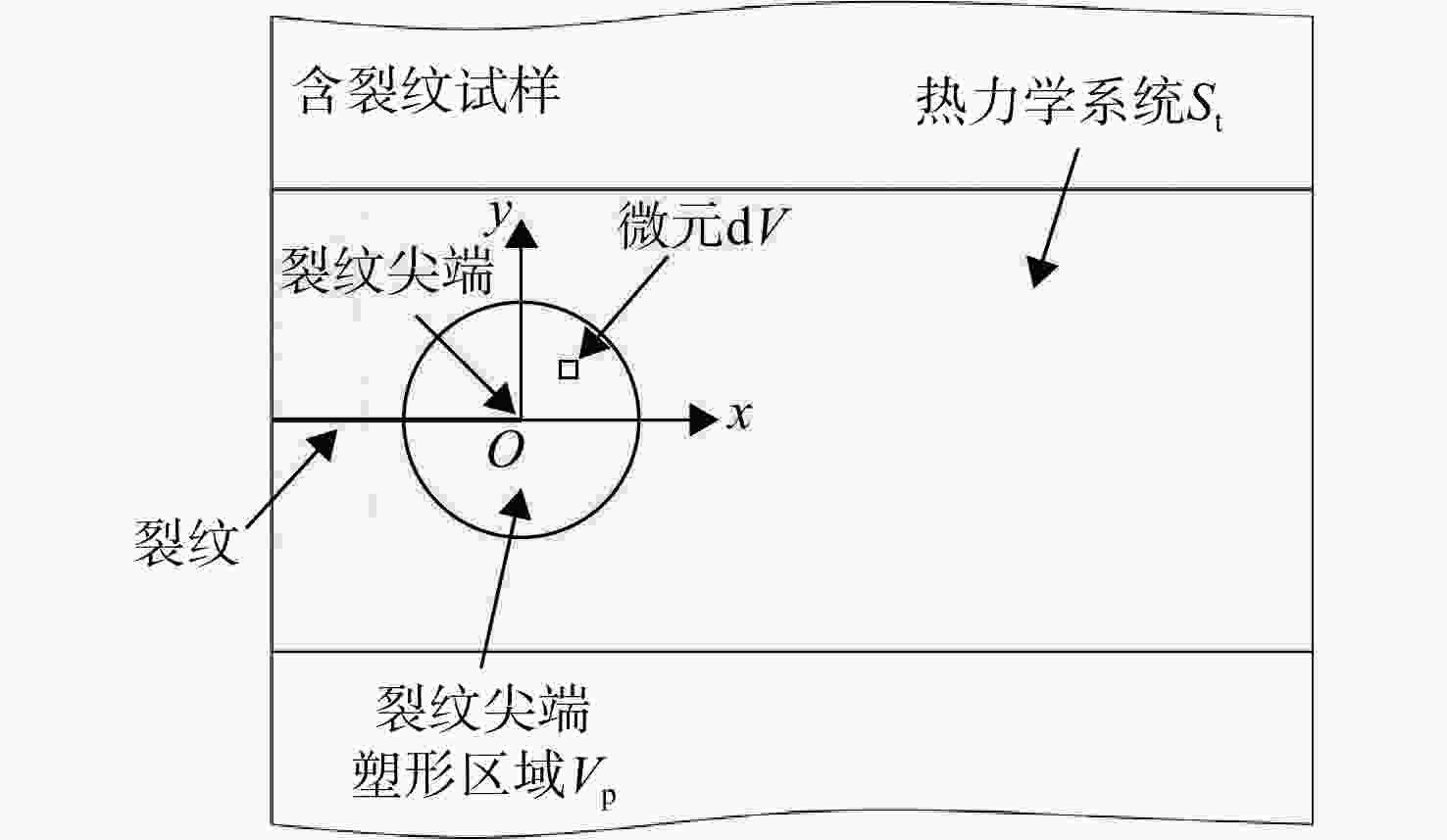
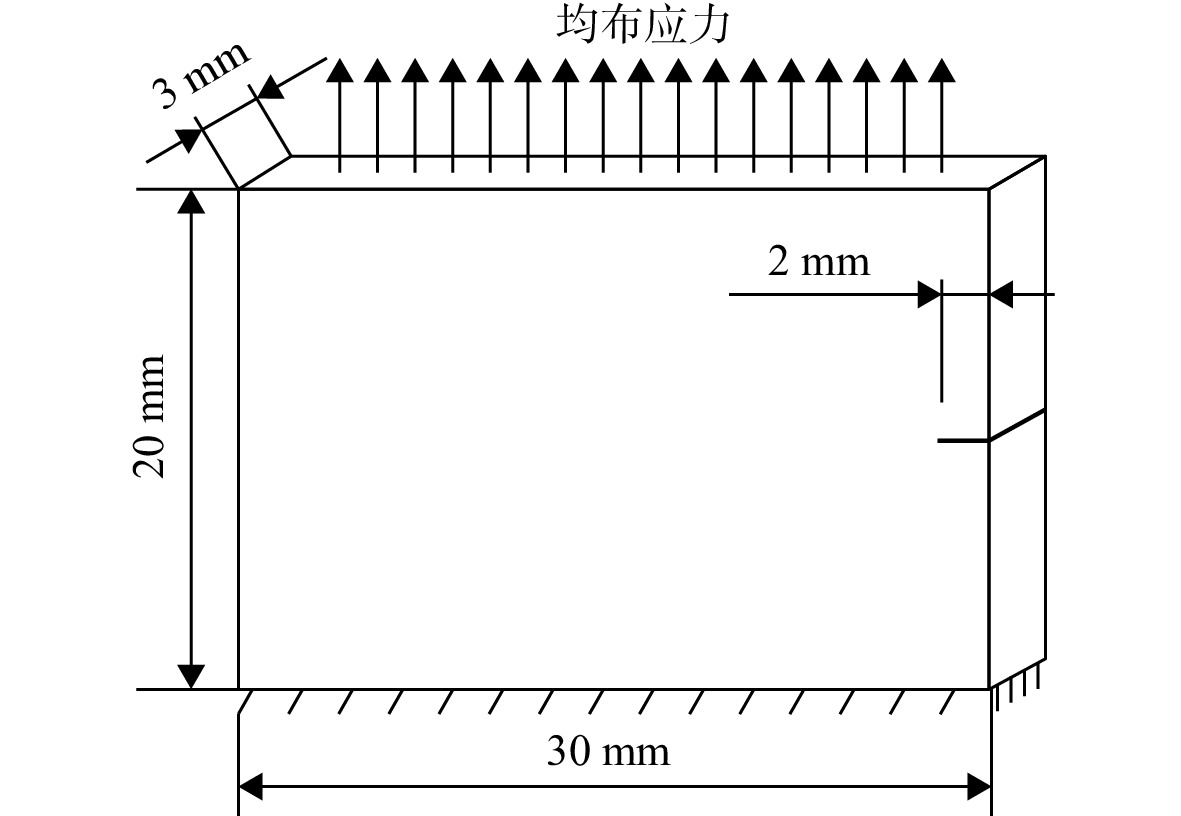
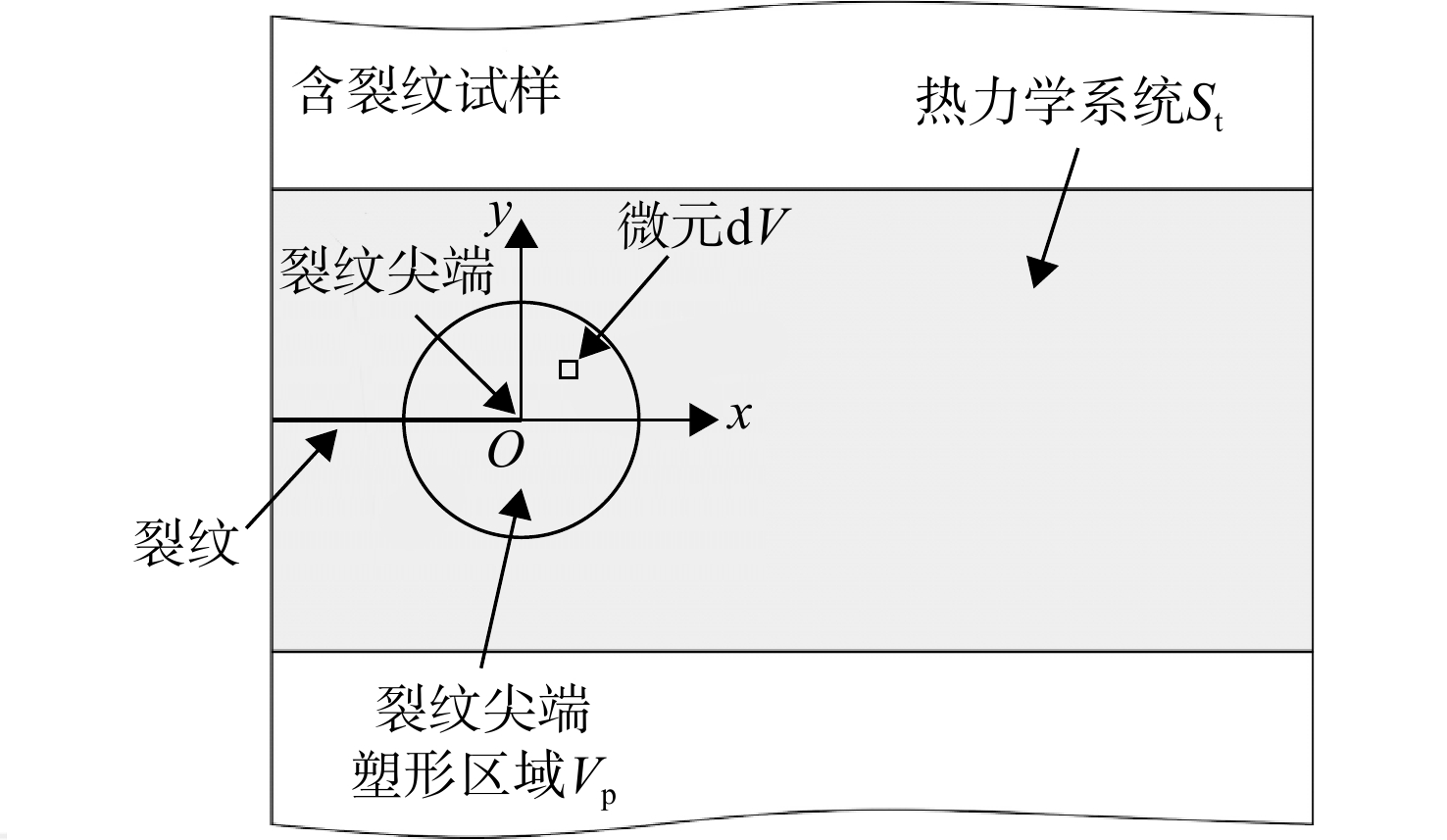
图 1 含裂纹试样与热力学系统
Figure 1. Schematic of specimen with a crack and the thermodynamic system
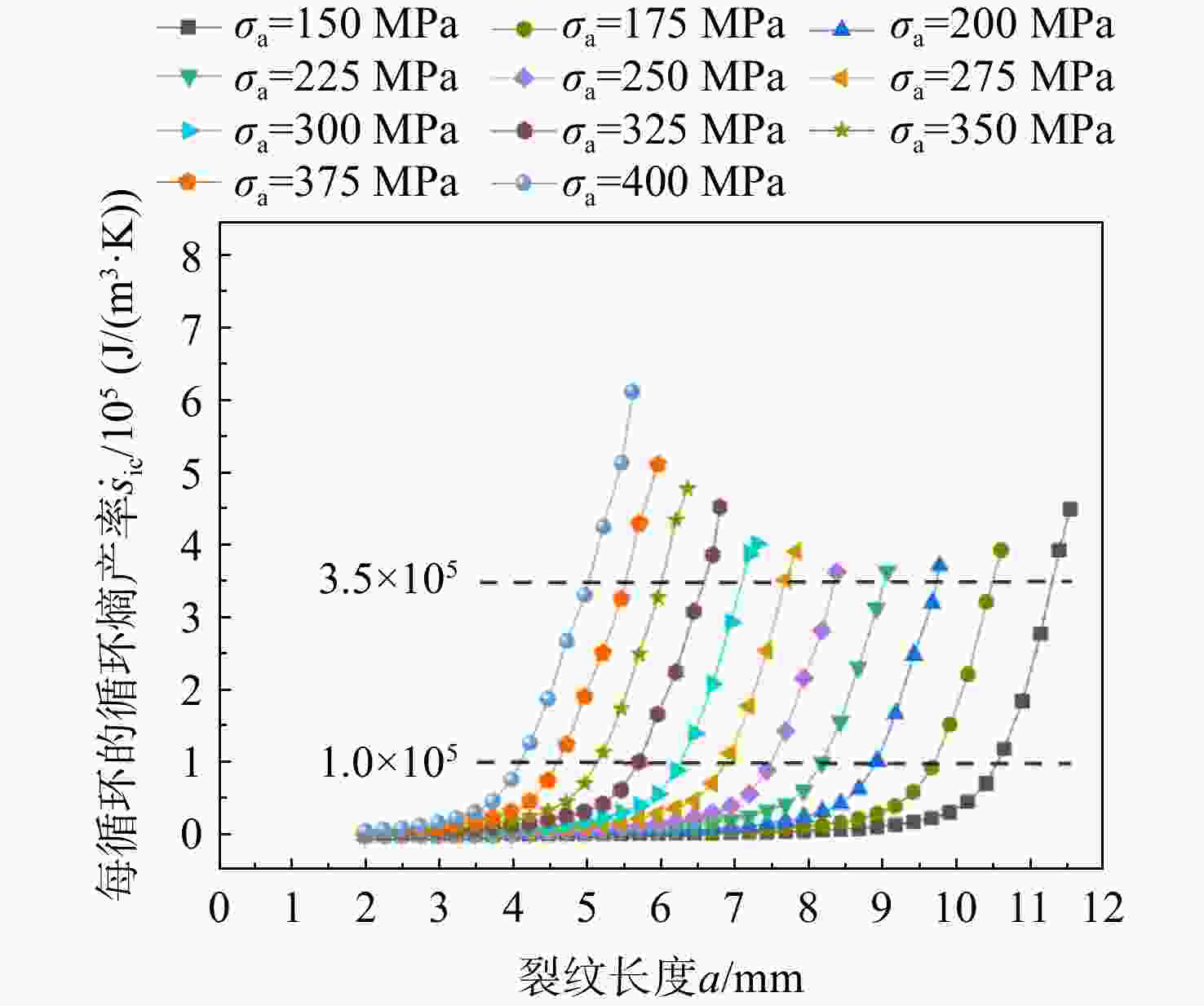
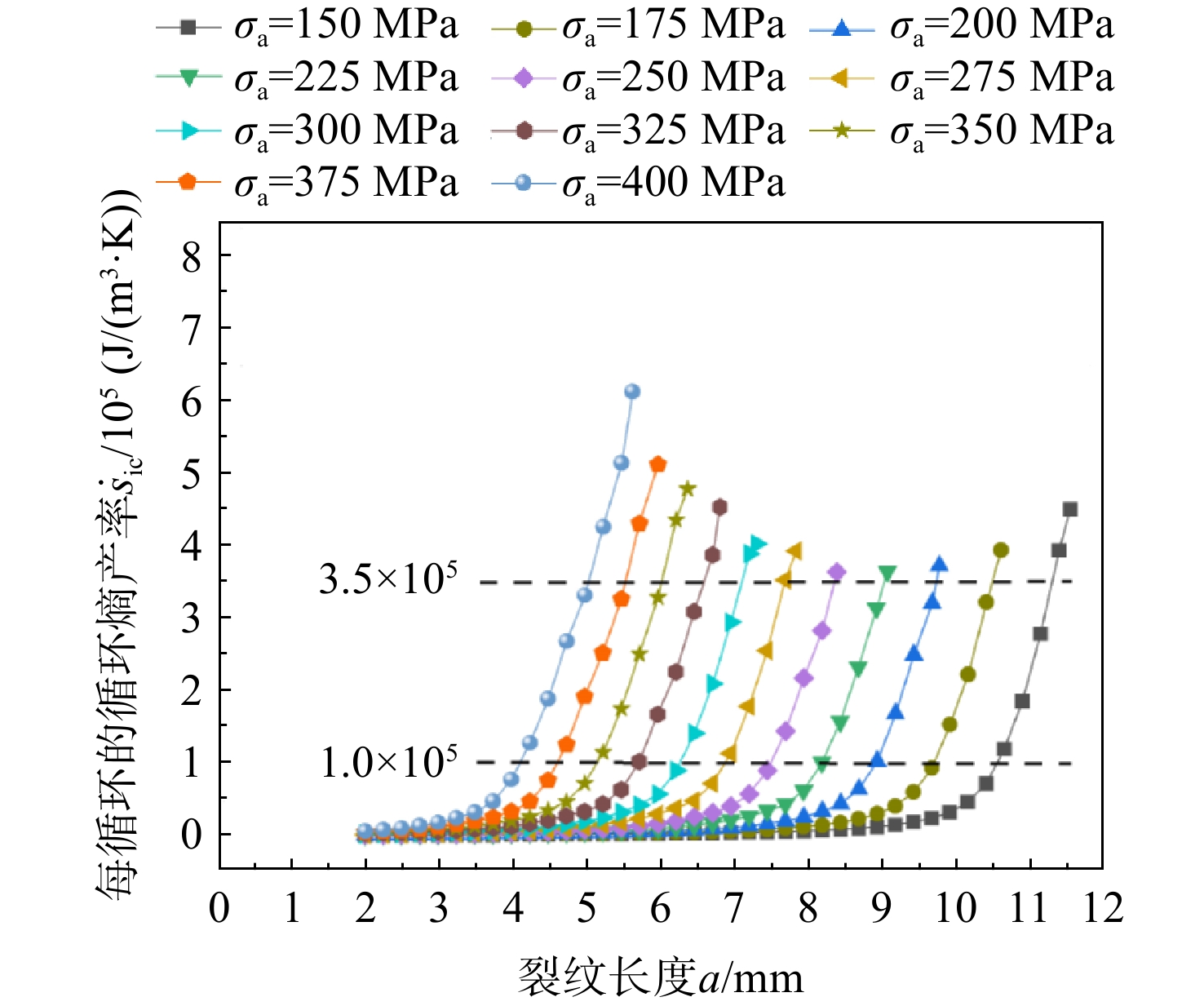
图 6 不同应力幅值下循环熵产率随裂纹长度演化曲线
Figure 6. Evolution curves of CEGR vs. crack length under different stress amplitudes
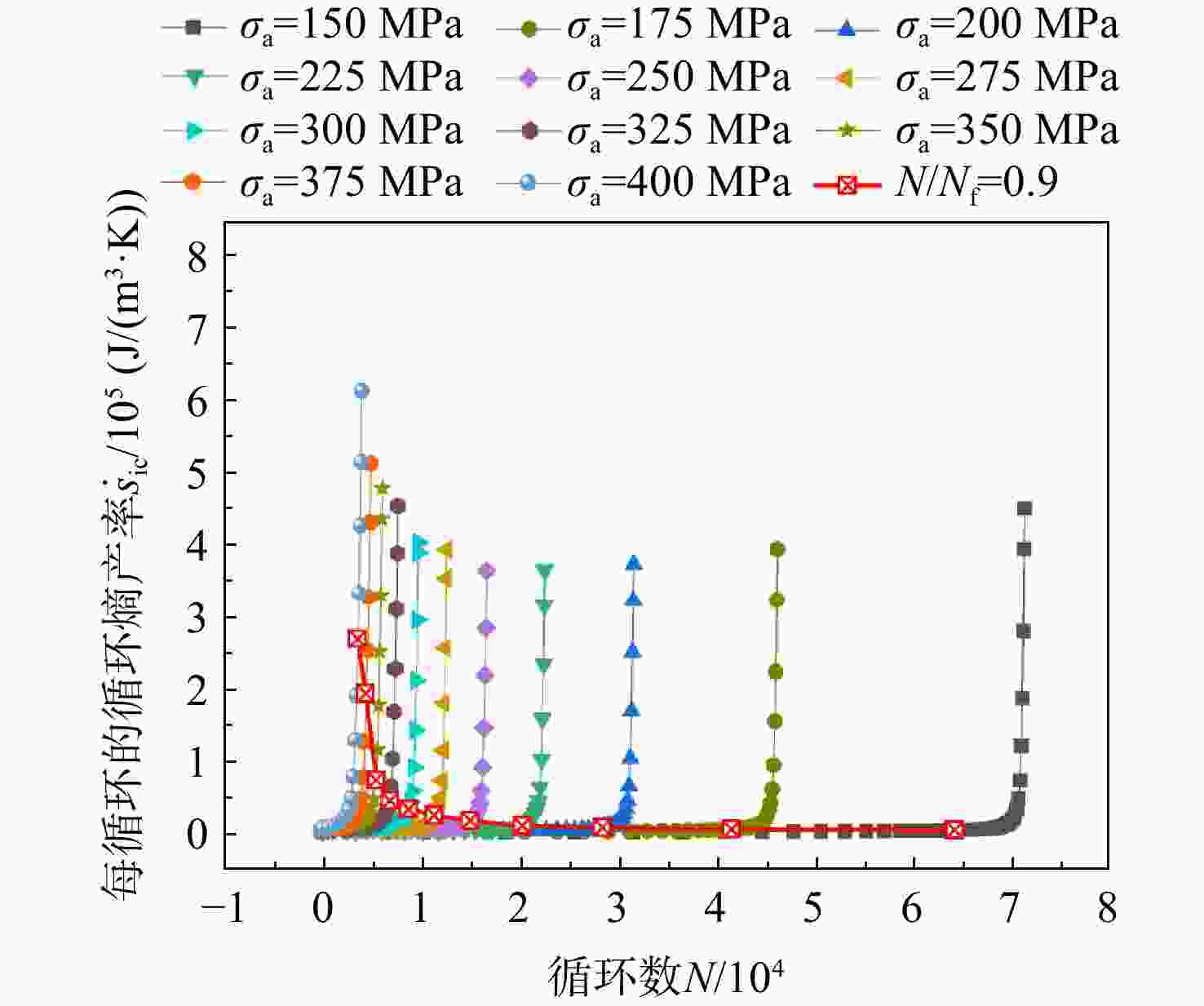
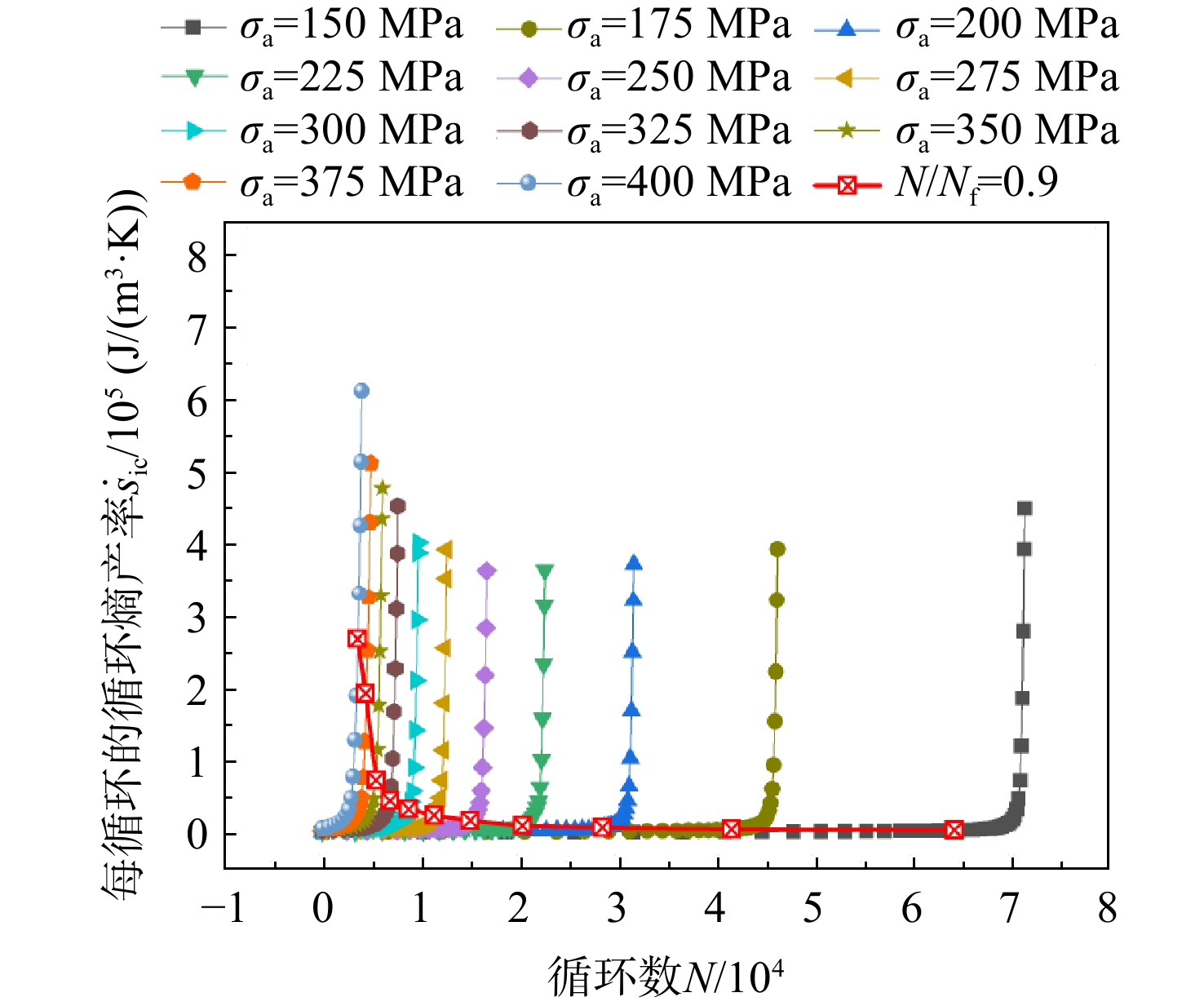
图 7 不同应力幅值下循环熵产率随循环数演化曲线
Figure 7. Evolution curves of CEGR vs cyclic number under different stress amplitudes
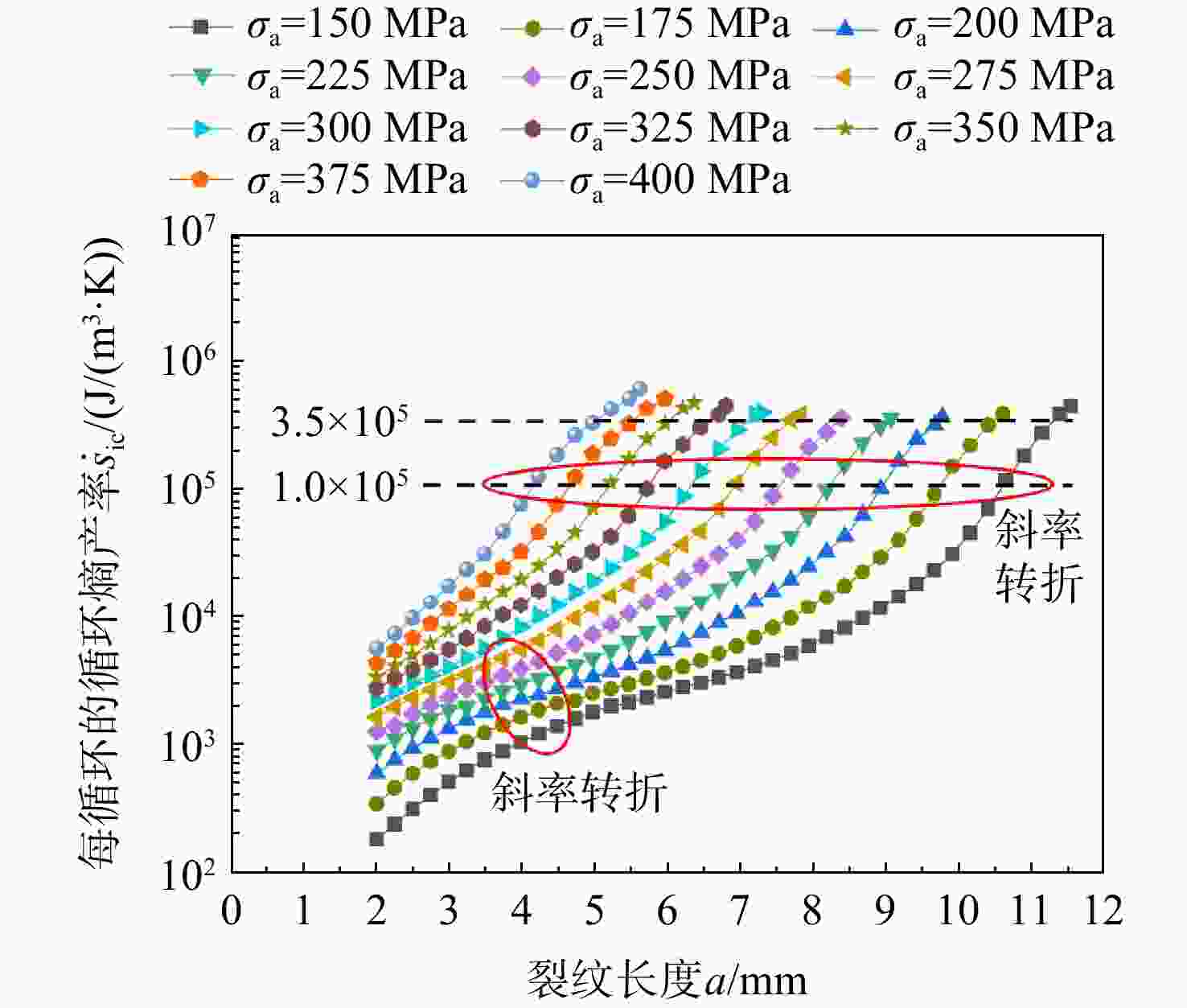
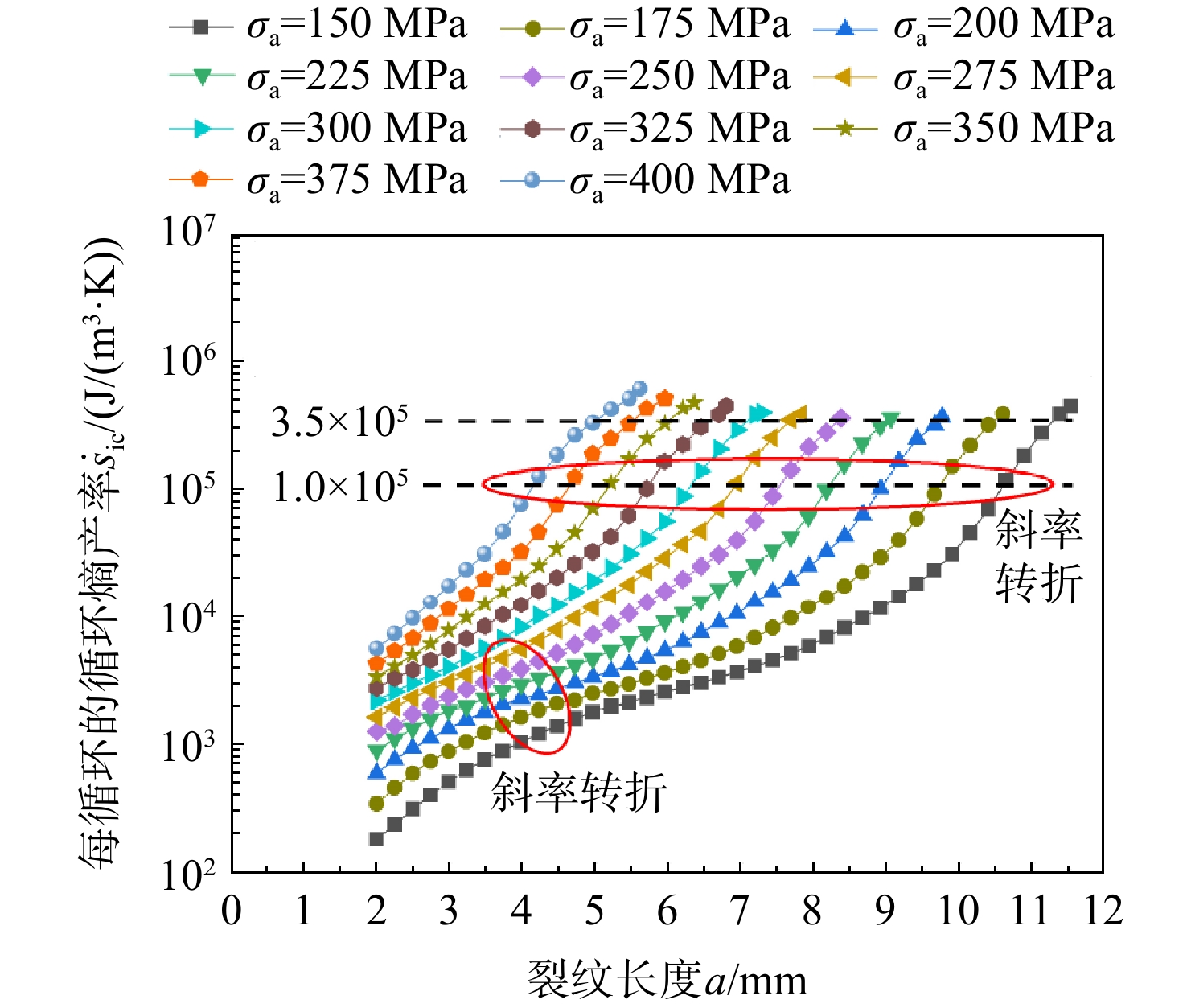
图 8 半对数坐标下循环熵产率与裂纹长度演化曲线
Figure 8. Evolution curves of CEGR vs crack length under different stress amplitudes in semi-logarithmic coordinates
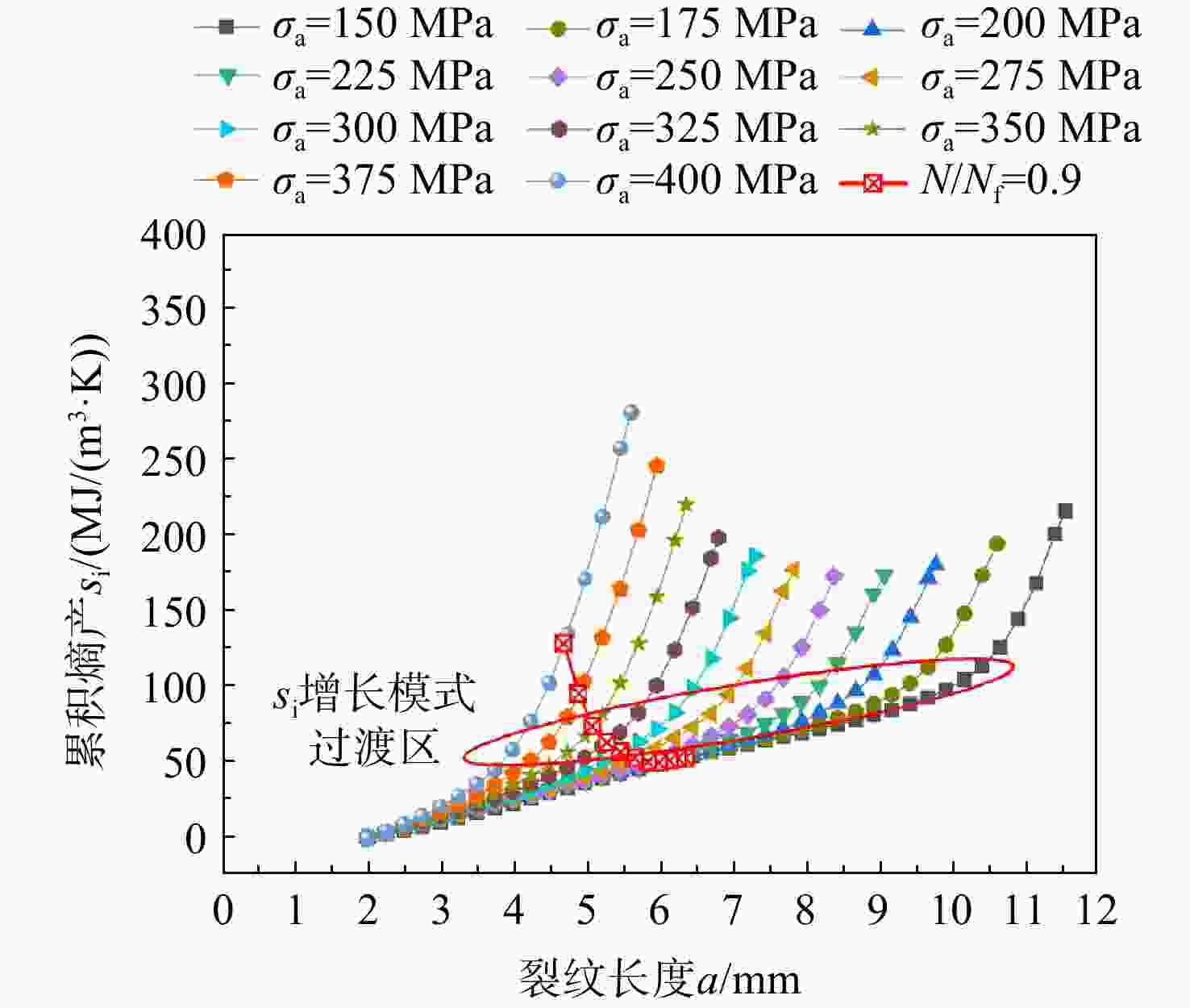
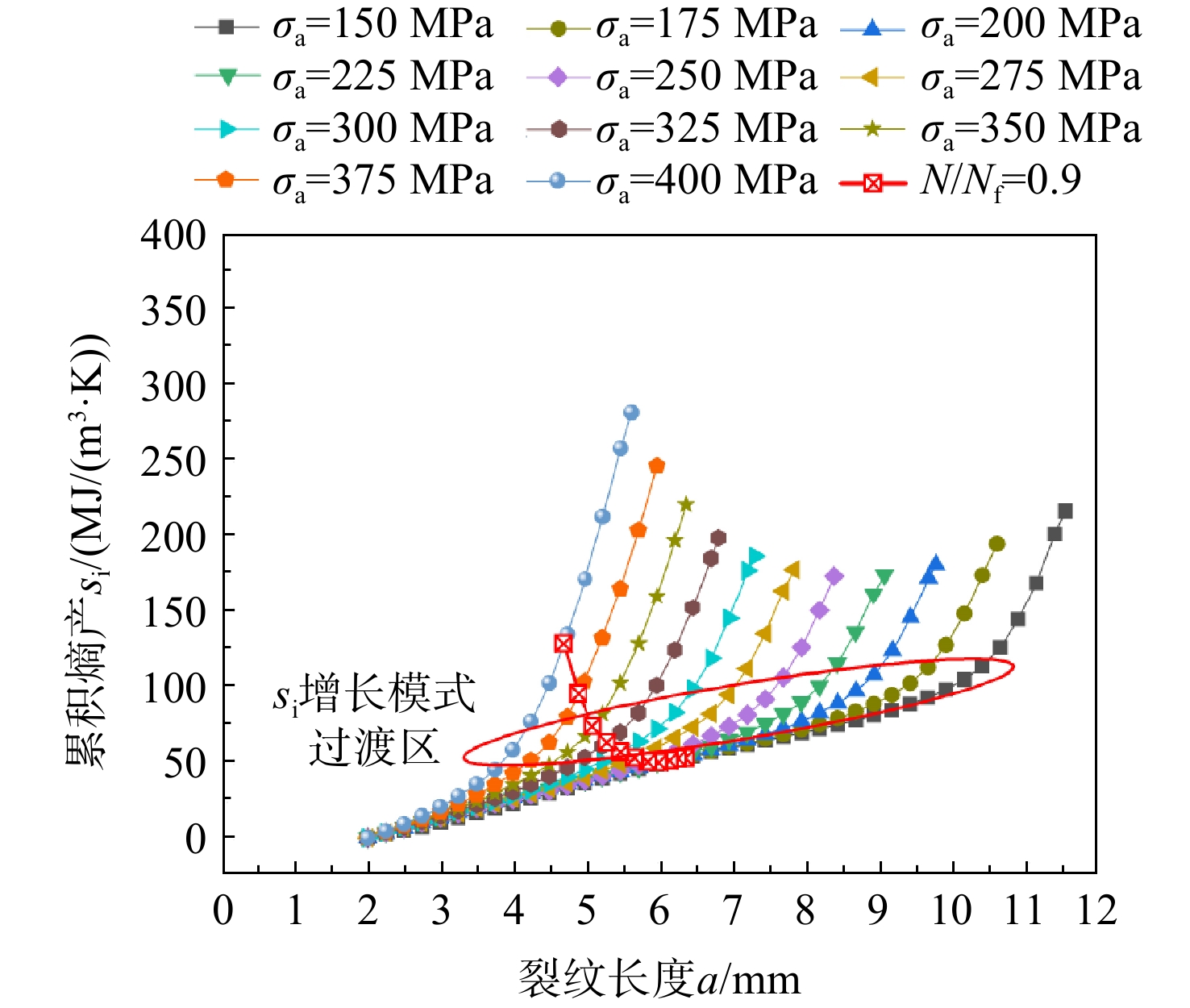
图 10 不同应力幅值下累积熵产$ {s}_{\rm{i}} $随裂纹长度a演化曲线
Figure 10. Evolution curves of accumulated entropy generation $ {{s}}_{\rm{i}} $ with crack length a under different stress amplitudes

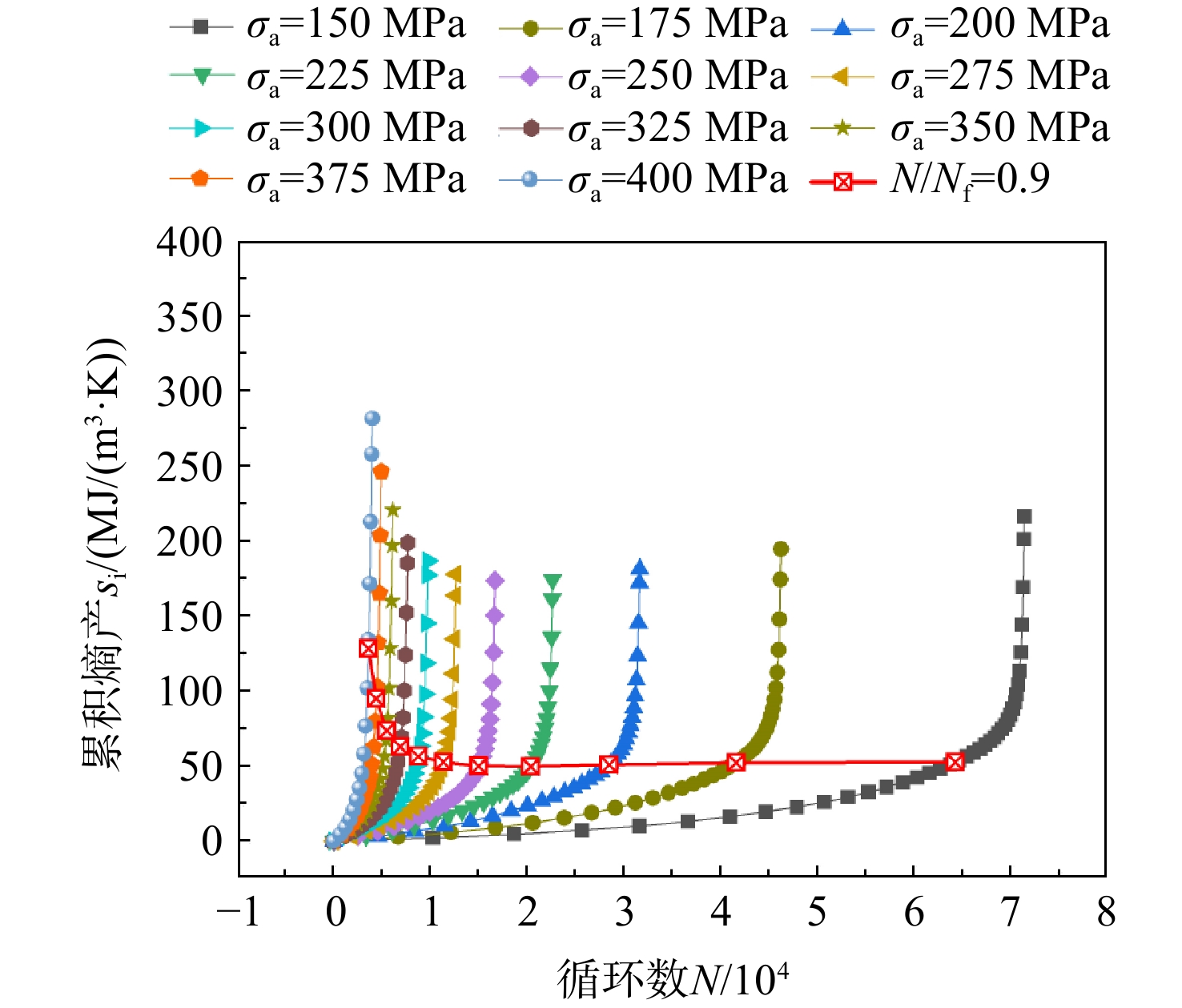
图 11 不同应力幅值下累积熵产$ {{s}}_{\rm{i}} $随循环数N的演化曲线
Figure 11. Evolution curves of cumulative entropy generation $ {{s}}_{\rm{i}} $ with fatigue life N under different stress amplitudes

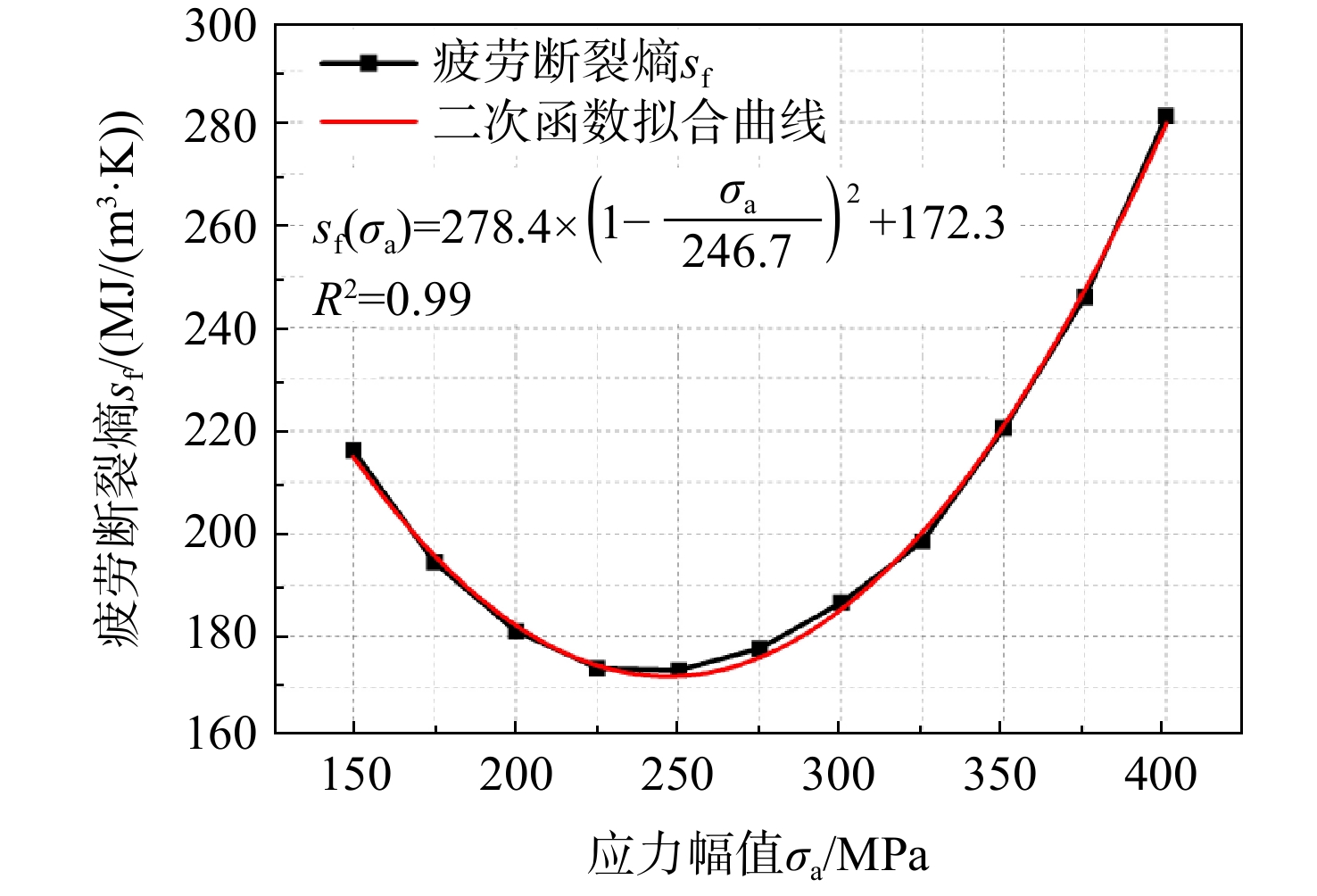
图 12 疲劳断裂熵$ {{s}}_{\rm{f}} $与应力幅值$ {{\sigma }}_{\rm{a}} $的拟合曲线
Figure 12. Fitting curve of accumulated entropy generation $ s_{\rm{f}} $ with stress amplitude $ {{\sigma }}_{\rm{a}} $
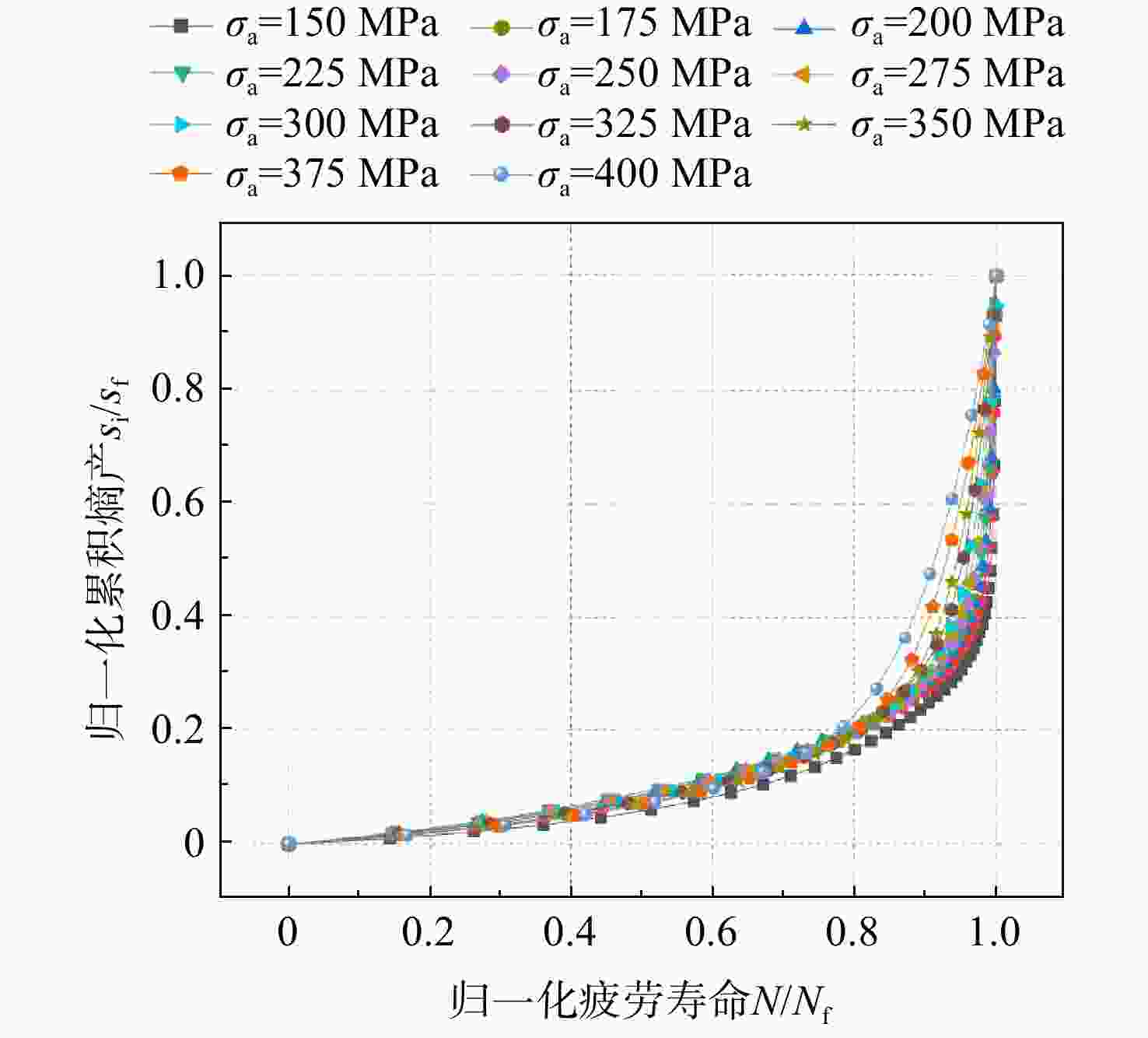
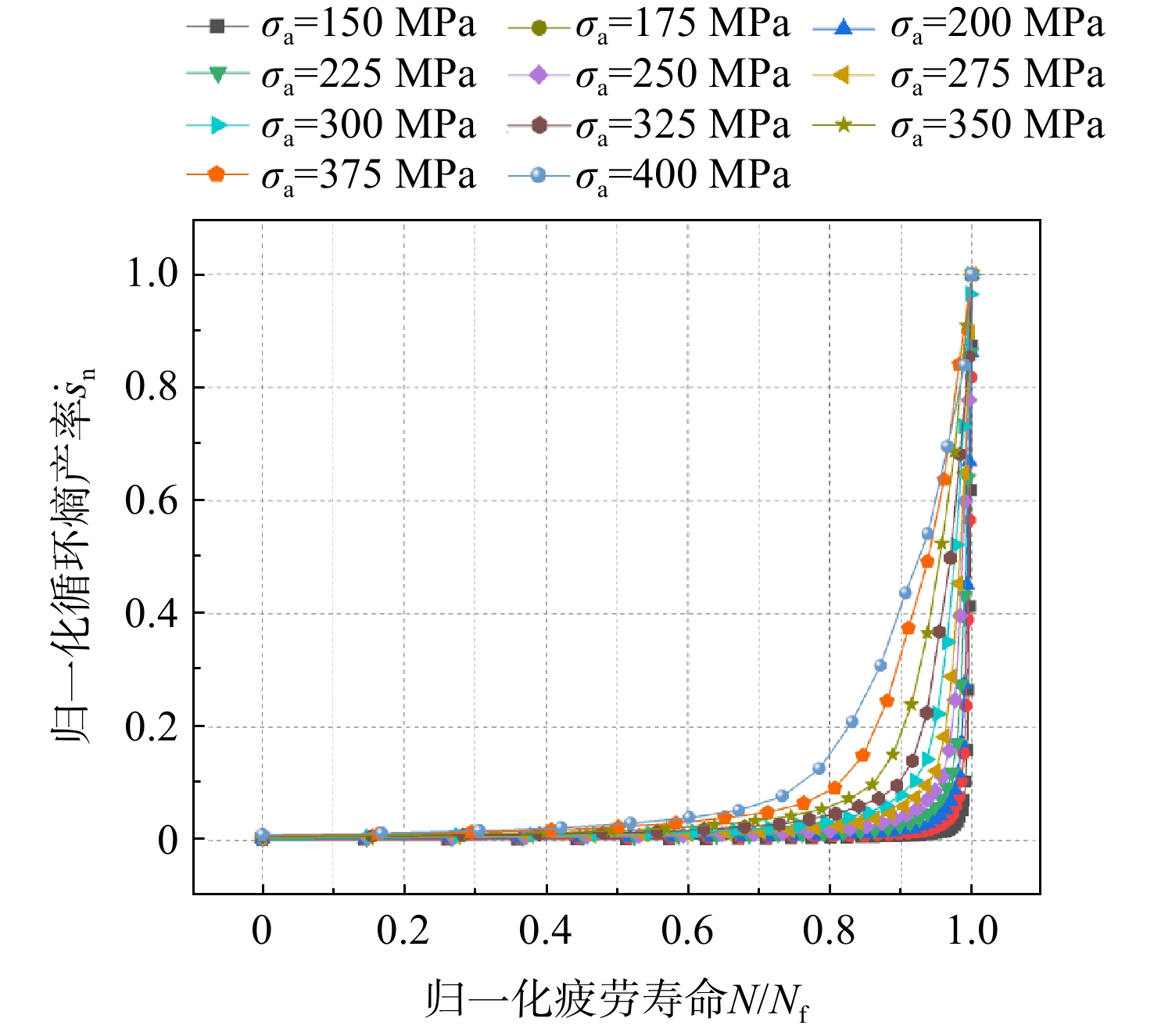
图 13 归一化累积熵产$ {{s}}_{\rm{i}}/{{s}}_{\rm{f}} $与归一化疲劳寿命N/Nf曲线
Figure 13. Curves of normalized accumulated entropy generation $ {{s}}_{\rm{i}}/{{s}}_{\rm{f}} $ with normalized fatigue life N/Nf
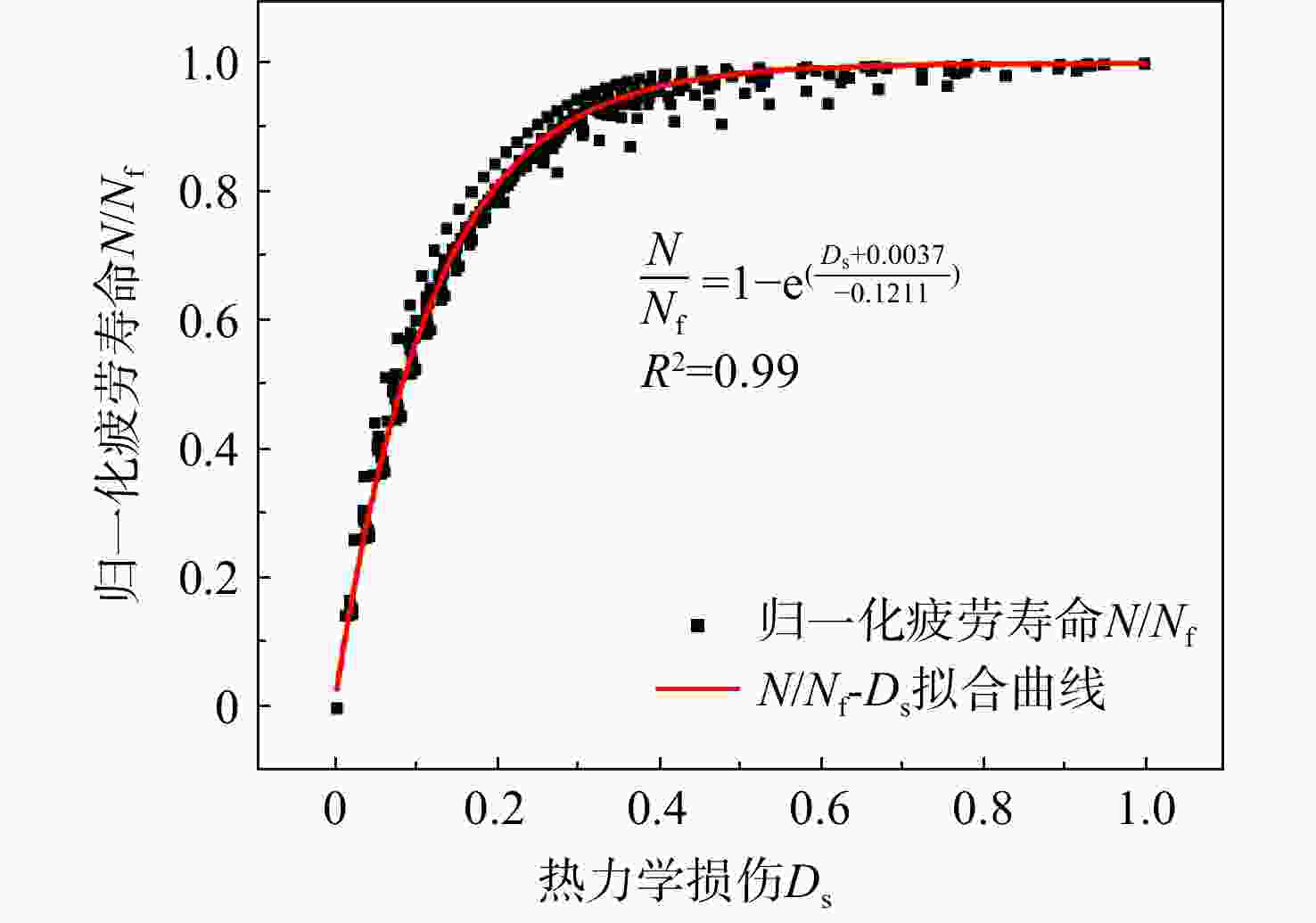
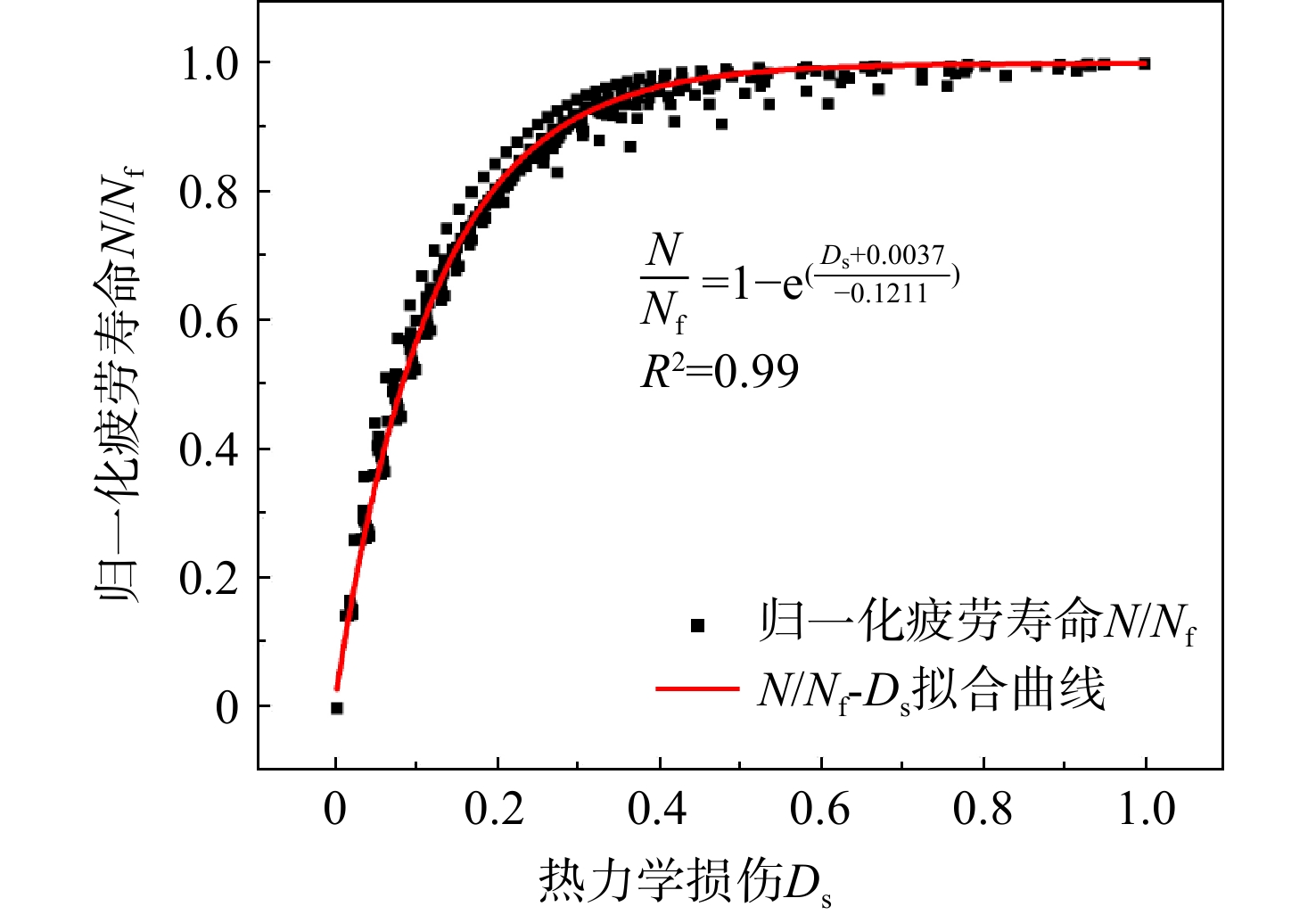
图 14 归一化疲劳寿命N/Nf与热力学损伤Ds拟合曲线
Figure 14. Fitting curve of normalized fatigue life N/Nf vs thermodynamic damage Ds
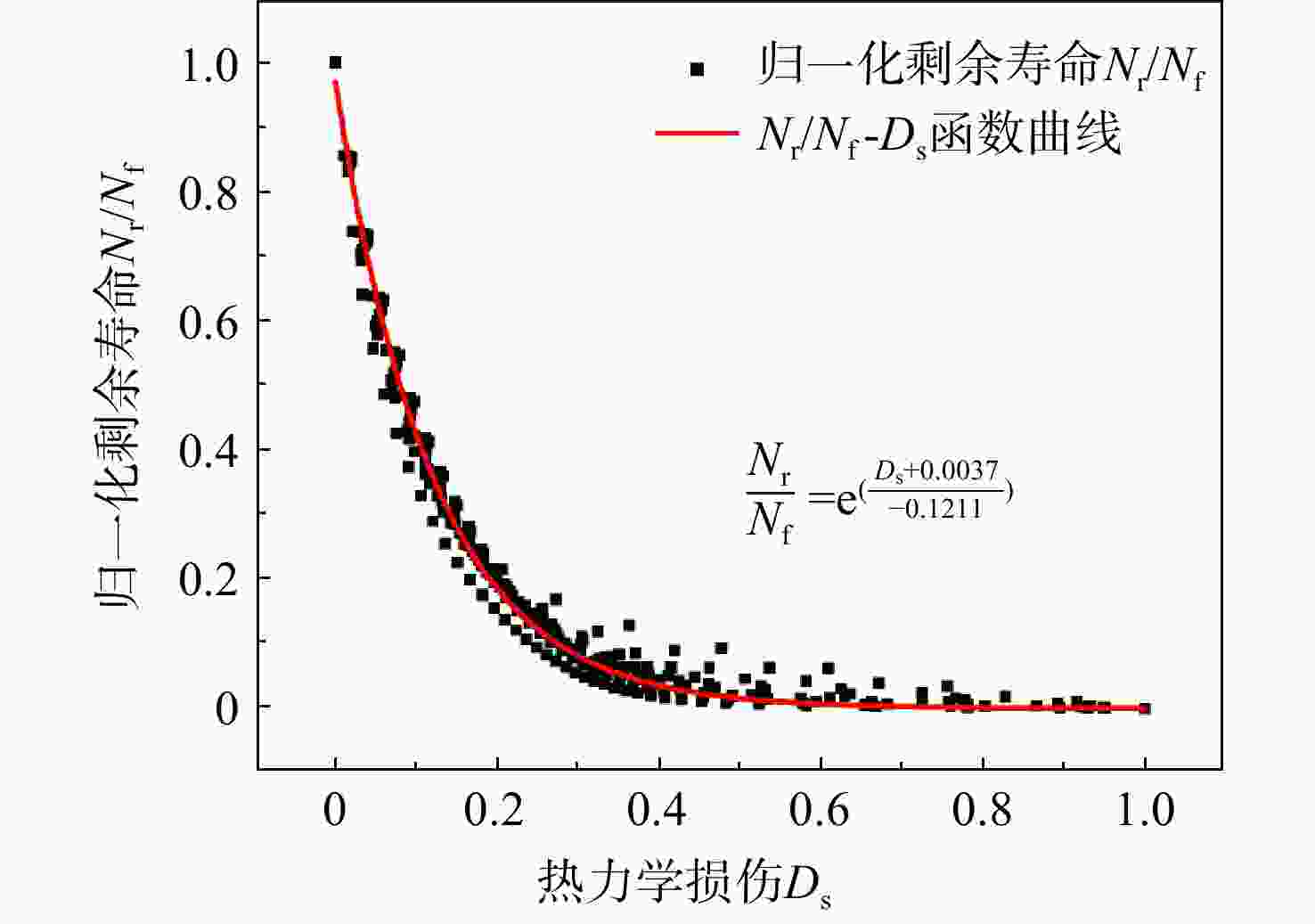
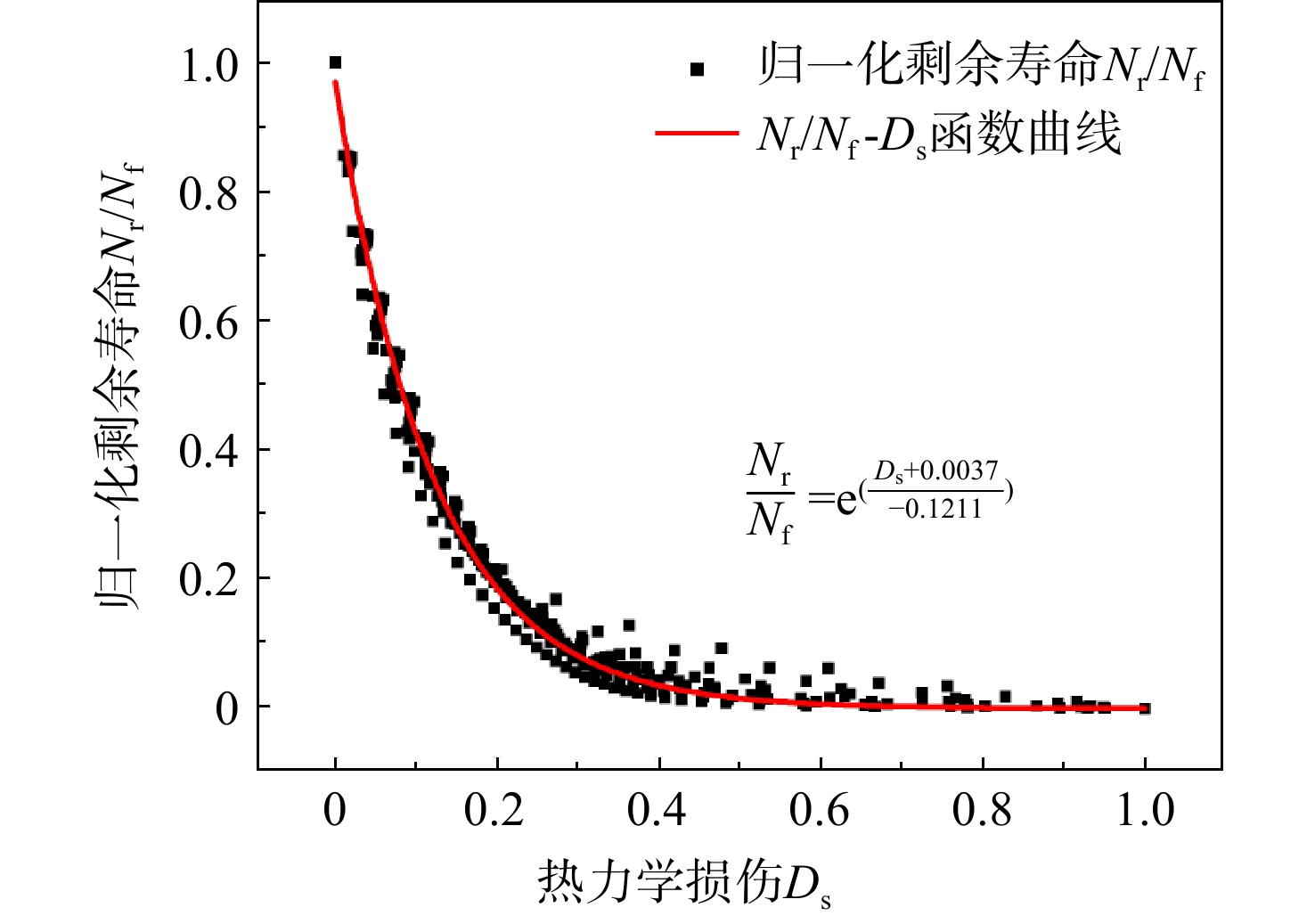
图 15 归一化剩余寿命Nr/Nf与热力学损伤Ds的演化曲线
Figure 15. Evolution curve of normalized residual life Nr/Nf vs thermodynamic damage Ds
参数 环境温度/K 823 923 E/MPa 184251 172724 Kc/MPa 4091 2642 nc 4.10 5.90 kc/MPa 343 241 bc 4.54 6.00 Qc −249.0 −283.9 $ {{\alpha }}_{{1}} $/MPa 571 130 $ {{c}}_{{1}} $ 4 56 $ {{m}}_{{1}} $ 0.0026 1.351 $ {\alpha }_{{2}} $/MPa 718 826 $ {{c}}_{{2}} $ 17 7 $ {{m}}_{{2}} $ 2.76 2.22  下载: 导出CSV
-
[1] National Transportation Safety Board. Aircraft accident report: United Airlines Flight 232 McDonnell Douglas DC-10-10 Sioux Gateway Airport,Sioux City,Iowa,July 19,1989[R]. Washington DC: National Transportation Safety Board,1990. [2] HAGHSHENAS A,JANG J Y,KHONSARI M M. On the intrinsic dissipation and fracture fatigue entropy of metals[J]. Mechanics of Materials,2021,155: 103734. doi: 10.1016/j.mechmat.2020.103734 [3] PINEAU A,BENZERG A A,PARDOEN T. Failure of metals: Ⅲ fracture and fatigue of nanostructured metallic materials[J]. Acta Materialia,2016,107: 508-544. doi: 10.1016/j.actamat.2015.07.049 [4] SALIMI H,POURGOL-MOHAMMAD M,YAZDANI M. Low-cycle fatigue assessment of metallic materials based on thermodynamic entropy generation-methodology and model development[J]. International Journal of Fatigue,2021,144: 106058. doi: 10.1016/j.ijfatigue.2020.106058 [5] AMIRI M,KHONSARI M M. On the role of entropy generation in processes involving fatigue[J]. Entropy,2011,14(1): 24-31. doi: 10.3390/e14010024 [6] KEENAN J H. Availability and irreversibility in thermodynamics[J]. British Journal of Applied Physics,1951,2(7): 183-192. doi: 10.1088/0508-3443/2/7/302 [7] LEE H W,BASARAN C. A review of damage,void evolution,and fatigue life prediction models[J]. Metals,2021,11(4): 609. doi: 10.3390/met11040609 [8] KHONSARI M M,AMIRI M. Introduction to thermodynamics of mechanical fatigue[M]. Boca Raton,US: CRC Press,2012. [9] LING F F,BRYANT M D,DOELLING K L. On irreversible thermodynamics for wear prediction[J]. Wear,2002,253(11/12): 1165-1172. [10] BASARAN C,YAN C Y. A thermodynamic framework for damage mechanics of solder joints[J]. Journal of Electronic Packaging,1998,120(4): 379-384. doi: 10.1115/1.2792650 [11] NADERI M,KHONSARI M M. An experimental approach to low-cycle fatigue damage based on thermodynamic entropy[J]. International Journal of Solids and Structures,2010,47(6): 875-880. doi: 10.1016/j.ijsolstr.2009.12.005 [12] NADERI M,KHONSARI M M. Real-time fatigue life monitoring based on thermodynamic entropy[J]. Structural Health Monitoring,2011,10(2): 189-197. doi: 10.1177/1475921710373295 [13] ONTIVEROS V L,MODARRES M,AMIRI M. Estimation of reliability of structures subject to fatigue loading using plastic strain energy and thermodynamic entropy generation[J]. Proceedings of the Institution of Mechanical Engineers,Part O: Journal of Risk and Reliability,2015,229(3): 220-236. doi: 10.1177/1748006X15574143 [14] 封硕. 基于热力学分析的疲劳损伤与寿命预测研究[D]. 西安: 西北工业大学,2015. FENG Shuo. Study on fatigue damage and life prediction based on thermodynamic analysis[D]. Xi’an: Northwestern Polytechnical University,2015. (in ChineseFENG Shuo. Study on fatigue damage and life prediction based on thermodynamic analysis[D]. Xi’an: Northwestern Polytechnical University, 2015. (in Chinese) [15] IDRIS R,ABDULLAH S,THAMBURAJA P,et al. Prediction of fatigue crack growth rate based on entropy generation[J]. Entropy,2019,22(1): 9. doi: 10.3390/e22010009 [16] LEMAITRE J,CHABOCHE J L. Mechanics of solid materials[M]. Cambridge,UK: Cambridge University Press,1990. [17] LIAKAT M,KHONSARI M M. Entropic characterization of metal fatigue with stress concentration[J]. International Journal of Fatigue,2015,70: 223-234. doi: 10.1016/j.ijfatigue.2014.09.014 [18] AMIRI M,NADERI M,KHONSARI M M. An experimental approach to evaluate the critical damage[J]. International Journal of Damage Mechanics,2011,20(1): 89-112. doi: 10.1177/1056789509343082 [19] NADERI M,AMIRI M,KHONSARI M M. On the thermodynamic entropy of fatigue fracture[J]. Proceedings of the Royal Society A: Mathematical,Physical and Engineering Sciences,2010,466(2114): 423-438. doi: 10.1098/rspa.2009.0348 [20] NADERI M,KHONSARI M M. A thermodynamic approach to fatigue damage accumulation under variable loading[J]. Materials Science and Engineering: A,2010,527(23): 6133-6139. doi: 10.1016/j.msea.2010.05.018 [21] 中国金属学会高温材料分会. 中国高温合金手册[M]. 北京: 中国标准出版社,2012. ACADEMIC COMMITTEE of the SUPERALLOYS,CSM. China superalloys handbooks[M]. Beijing: Standard Press of China,2012. (in ChineseACADEMIC COMMITTEE of the SUPERALLOYS, CSM. China superalloys handbooks[M]. Beijing: Standard Press of China, 2012. (in Chinese) [22] 魏洪亮,杨晓光,于慧臣. GH4169合金高温力学行为本构建模及参数识别[J]. 材料工程,2005,33(4): 42-45. WEI Hongliang,YANG Xiaoguang,YU Huichen. Constitutive modeling and parameter identification of mechanical behavior for GH4169 alloy at high temperature[J]. Journal of Materials Engineering,2005,33(4): 42-45. (in Chinese doi: 10.3969/j.issn.1001-4381.2005.04.011WEI Hongliang, YANG Xiaoguang, YU Huichen. Constitutive modeling and parameter identification of mechanical behavior for GH4169 alloy at high temperature[J]. Journal of Materials Engineering, 2005, 33(4): 42-45. (in Chinese) doi: 10.3969/j.issn.1001-4381.2005.04.011 -


 点击查看大图
计量
- 文章访问数: 1184
- HTML浏览量: 353
- PDF量: 69
- 被引次数: 0