






Plume flow field and base heating environment of the multi-nozzle rocket in ascent phase
-
摘要:
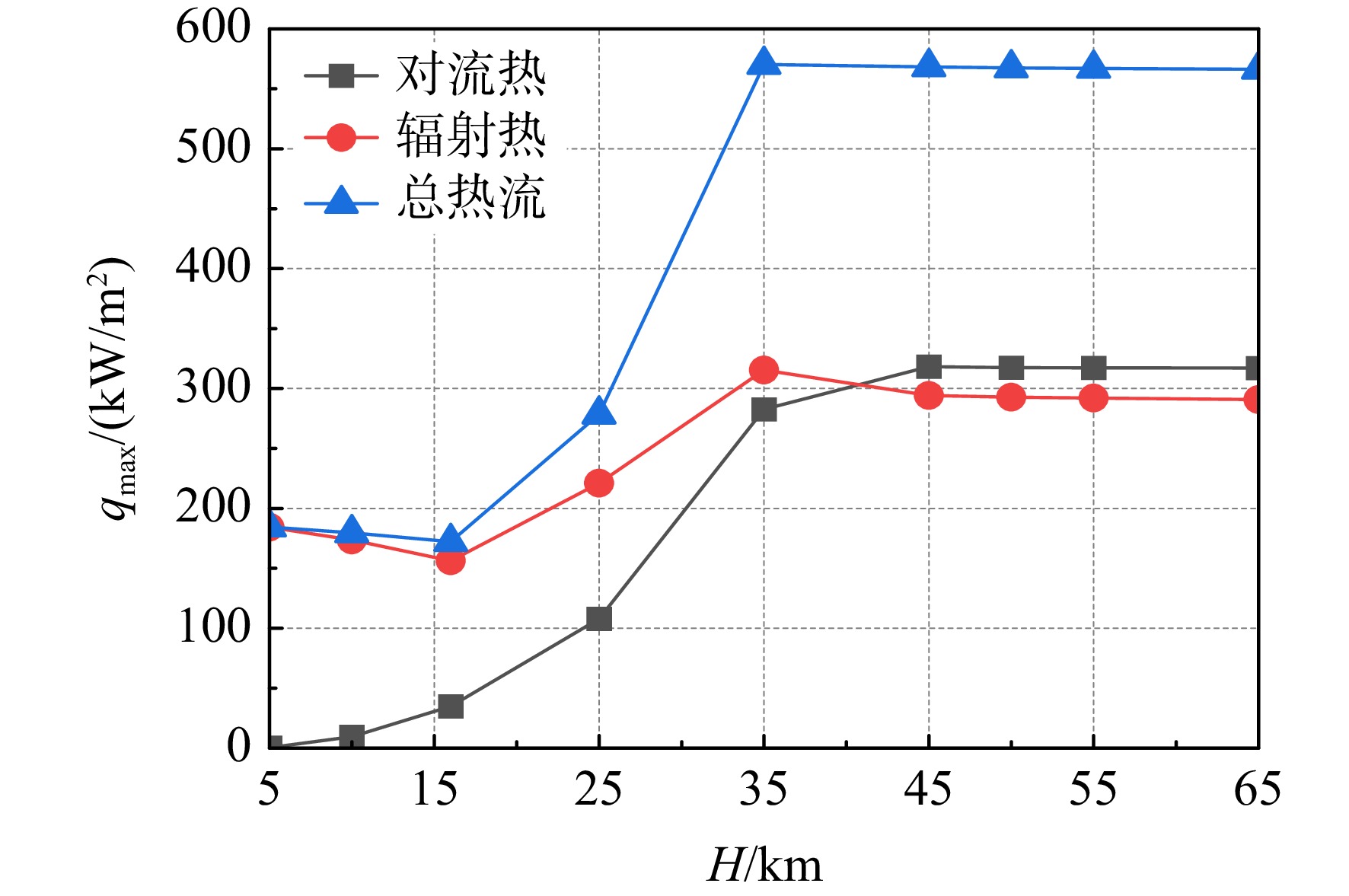
针对多喷管并联运载火箭上升段羽流流场结构与底部加热导致的火箭热防护问题,建立了九喷管构型运载火箭分析模型,通过数值仿真研究了不同高度下的羽流流场及底部热环境现象。通过与风洞试验数据对比,验证了数值方法的可靠性。分析结果表明:多喷管运载火箭上升段射流间发生碰撞,不同海拔高度分别出现了循环涡、燃气回流以及反溅等现象,高度越高,射流膨胀角越大。飞行高度较低时,箭体底部加热主要以辐射加热为主;随着高度增加,对流加热的影响增大。底部热流密度峰值出现在30~40 km范围内,对流热流密度最大为318.16 kW/m2,辐射热流密度最大为315.38 kW/m2,总热流密度最大为570.31 kW/m2 。底板温度梯度是对流加热的主要影响因素,辐射加热主要受辐射强度、距离及辐射微元面积影响。
Abstract:A nine-nozzle configuration rocket was established for the heating protection problem of the multi-nozzle rocket caused by the plume flow field structure and base heating in the ascent phase. Compared with the wind tunnel test data, the reliability of the numerical method was verified, and the numerical simulations were carried out for the plume flow field and the base heating environment at different altitudes. The results indicated that collisions occurred between gas jets, and there existed circulation vortices, gas backflow and back splash at different altitudes. The higher altitude indicated the greater expansion angle of the jet. At low flight altitudes, the base heating was mainly affected by radiation heating, and as the altitude increased, the effect of convection heating was enhanced. The peak of base heating flow density occurred within the range of 30 km to 40 km, with a maximum convective heating flow density of 318.16 kW/m2, a maximum radiant heating flow density of 315.38 kW/m2 and a maximum total heating flow density of 570.31 kW/m2. The temperature gradient of rocket base was the main influence on convection heating, while radiation heating was mainly influenced by the radiation intensity, distance and area of the radiation micro-element.
-
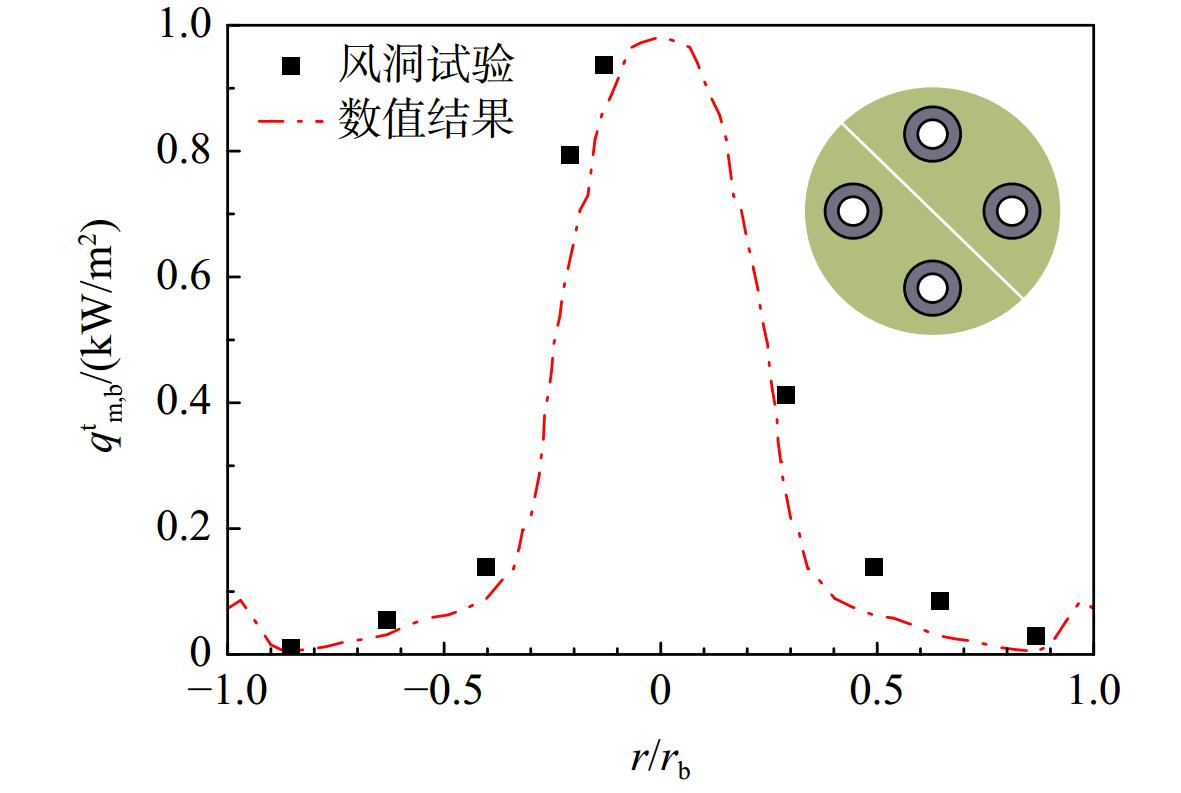
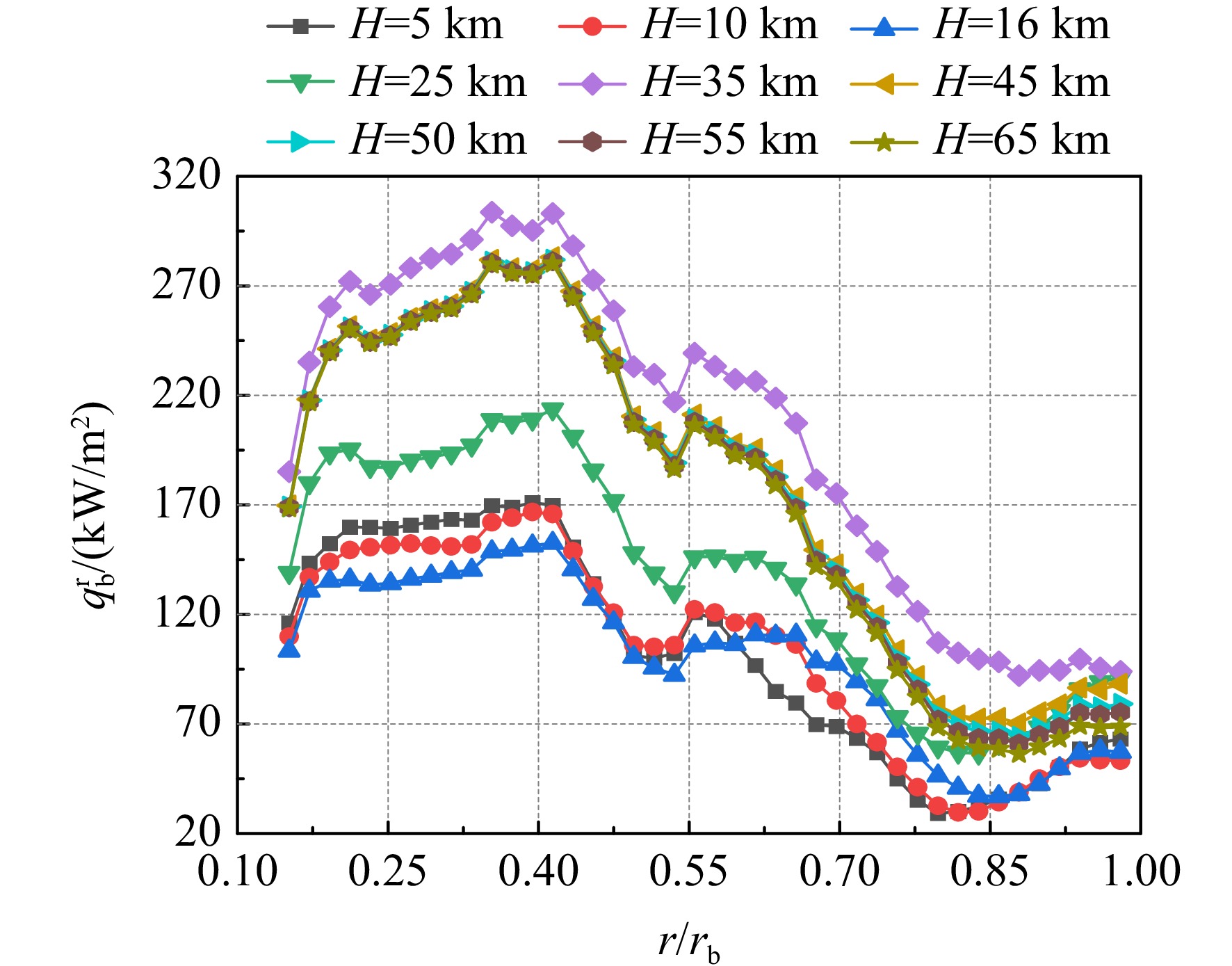
图 4 底部热流密度沿径向分布对比
Figure 4. Comparison of the radial distribution of heating flow density at the bottom
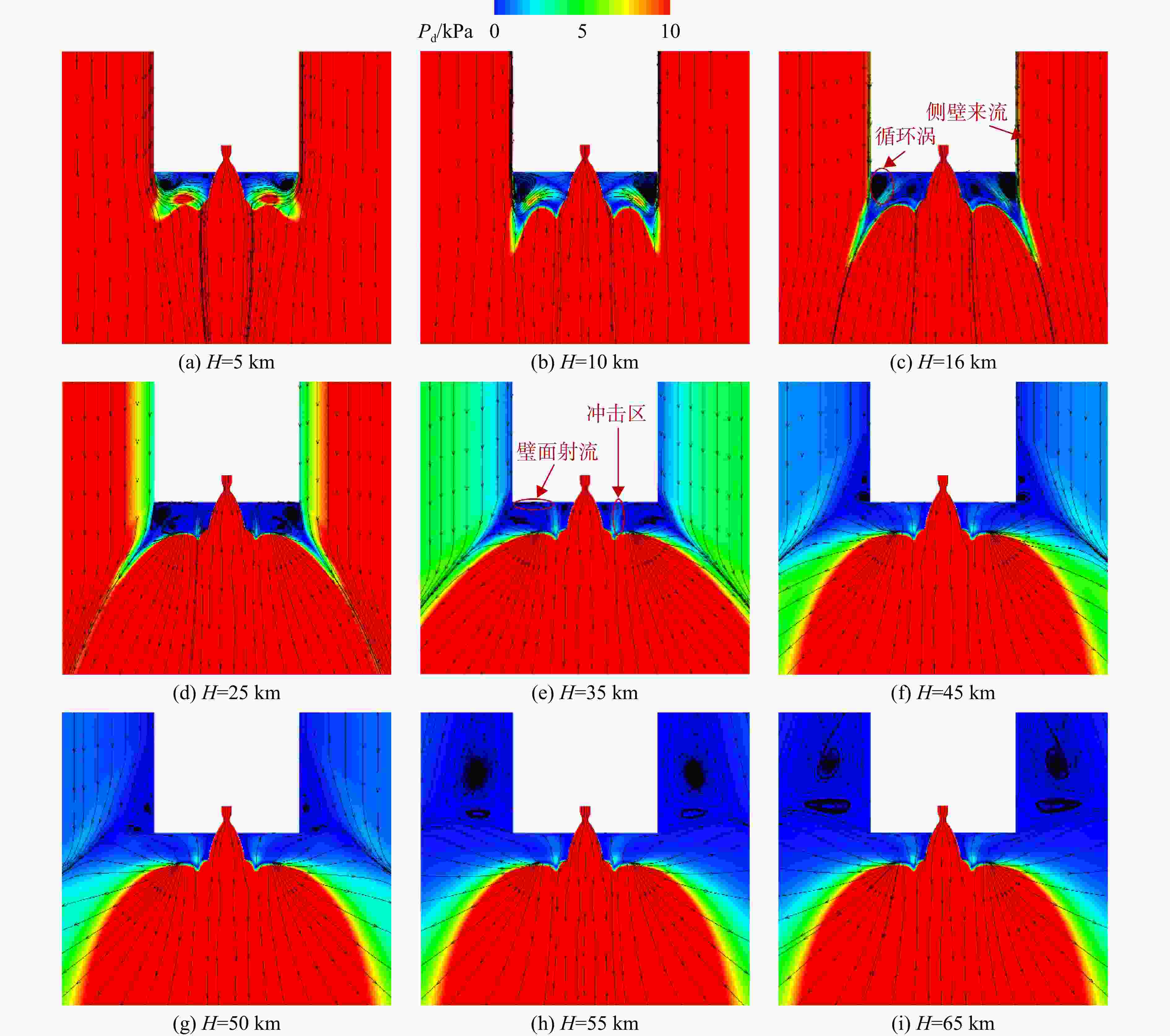
图 7 火箭底部流场动压云图
Figure 7. Contours of dynamic pressure distribution in the bottom of rocket
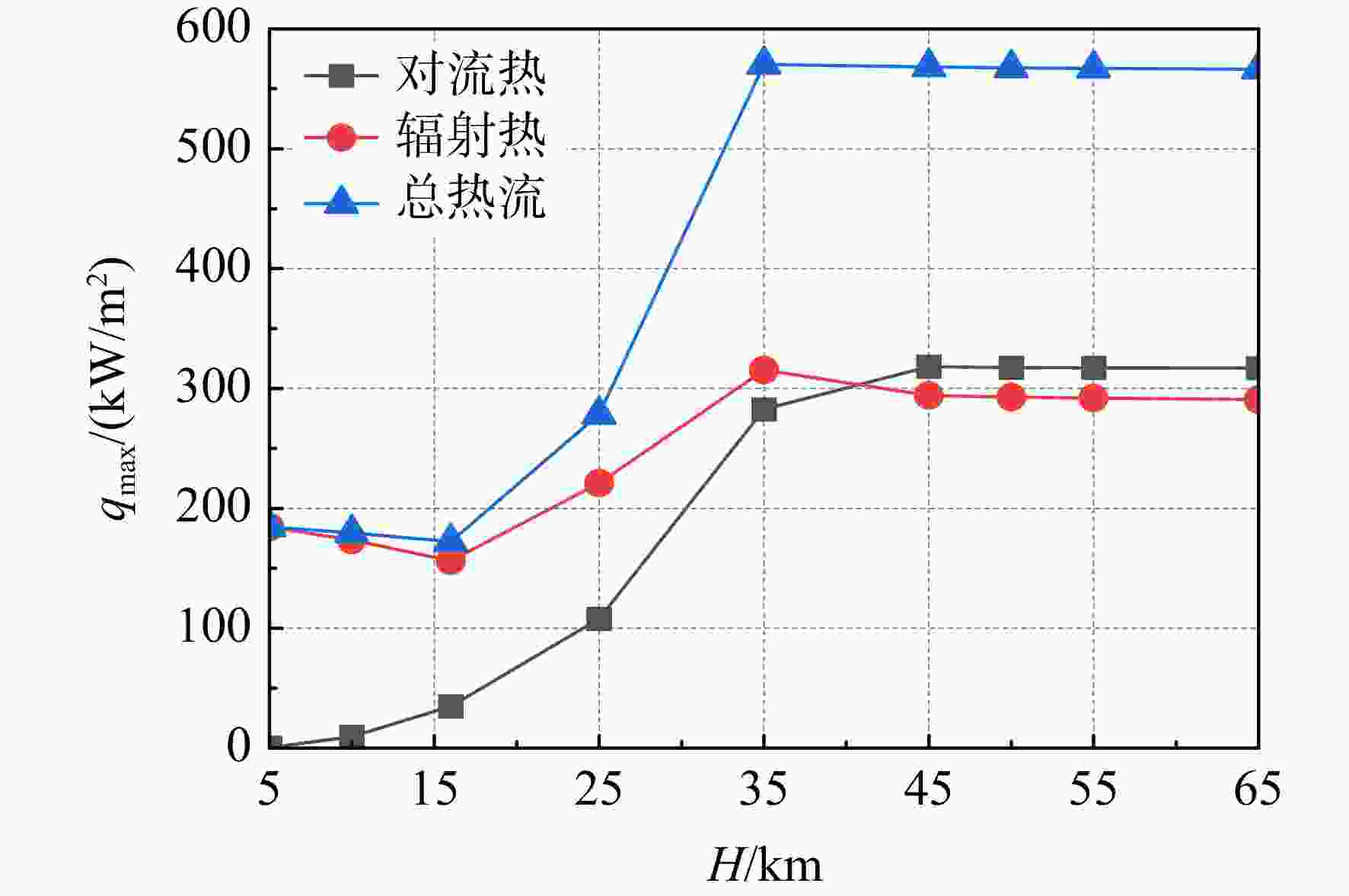
图 14 不同海拔热流密度最大值分布
Figure 14. Distribution of maximum heating flow density at different altitudes
表 1 气体摩尔分数
Table 1. Molar percentage of gases
气体组分 摩尔分数/% ${{\mathrm{H}}_2}{\mathrm{O}}$ 0.3741 ${\mathrm{C}}{{\mathrm{O}}_2}$ 0.2932 ${\mathrm{CO}}$ 0.2404 ${{\mathrm{H}}_2}$ 0.0301 ${\mathrm{OH}}$ 0.0229 ${{\mathrm{O}}_2}$ 0.0126 其他 0.0267  下载: 导出CSV
表 2 环境参数
Table 2. Atmospheric environmental parameters
工况 飞行高度/km 来流马赫数 压强/Pa 温度/K 1 5 0.65 54019.91 255.65 2 10 1.28 26436.23 223.15 3 16 1.81 12044.60 216.65 4 25 2.83 2511.02 221.65 5 35 3.62 558.92 237.05 6 45 4.24 143.13 265.05 7 50 4.87 75.94 270.65 8 55 5.70 39.97 259.45 9 65 7.25 9.92 231.45
下载: 导出CSV
-
[1] BENDER R. Saturn V/S-IC stage model and flight test base thermal environment[R]. AIAA 1969-318,1969. [2] STARK R,GÉNIN C,SCHNEIDER D,et al. Ariane 5 performance optimization using dual-bell nozzle extension[J]. Journal of Spacecraft and Rockets,2016,53(4): 743-750. doi: 10.2514/1.A33363 [3] GREENWOOD T F,LEE Y C,BENDER R L,et al. Space shuttle base heating[J]. Journal of Spacecraft and Rockets,1984,21(4): 339-345. doi: 10.2514/3.25660 [4] ZHOU Zhitan,BAO Yiying. Investigating the rocket base flow characteristics and thermal environment of different nozzle configurations considering afterburning[J]. International Journal of Thermal Sciences,2023,185: 108073. doi: 10.1016/j.ijthermalsci.2022.108073 [5] PATEL D. Antares liquid rocket engine convective base heating: AJ-26 to RD-181[R]. AIAA 2016-4415,2016. [6] WHITMORE S A,MERKLEY S. Radiation heating effects on oxidizer-to-fuel ratio of additively manufactured hybrid rocket fuels[J]. Journal of Propulsion and Power,2019,35(4): 863-878. doi: 10.2514/1.B37037 [7] CROSS P G. Radiative heat transfer in solid rocket nozzles[J]. Journal of Spacecraft and Rockets,2020,57(2): 247-260. doi: 10.2514/1.A34598 [8] MEHTA M,SEAFORD C M,KIRCHNER R D,et al. Space launch system core-stage rocket engine development for shock-tunnel testing[J]. Journal of Spacecraft and Rockets,2018,55(2): 382-402. doi: 10.2514/1.A33886 [9] FILIPSKIY M,SURZHIKOV S T. Discrete ordinates method for prediction of radiative heating of space vehicles[R]. AIAA 2005-4948,2005. [10] WADHAMS T,MACLEAN M,HOLDEN M,et al. Return to flight testing of a 3.5% scale space shuttle OTS and OT model at Mach numbers of 3.5 and 4.0[R]. AIAA 2006-720,2006. [11] GEORGE F,GREENWALD,李澄宙. 捆绑六枚固体助推器的德尔它火箭的底部热环境[J]. 国外导弹与航天运载器,1990(3): 39-49. GEORGE F GREENWALD,LI Chengzhou. Thermal environment at the bottom of a Delta rocket bundled with six solid boosters[J]. Missiles and Space Vehicles,1990(3): 39-49. (in ChineseGEORGE F GREENWALD, LI Chengzhou. Thermal environment at the bottom of a Delta rocket bundled with six solid boosters[J]. Missiles and Space Vehicles, 1990(3): 39-49. (in Chinese) [12] 杨学军,沈清,付继伟,等. 固体火箭尾舱热环境研究[J]. 宇航学报,2018,39(5): 578-584. YANG Xuejun,SHEN Qing,FU Jiwei,et al. Study on thermal environment of solid rocket tail compartment[J]. Journal of Astronautics,2018,39(5): 578-584. (in Chinese doi: 10.3873/j.issn.1000-1328.2018.05.013YANG Xuejun, SHEN Qing, FU Jiwei, et al. Study on thermal environment of solid rocket tail compartment[J]. Journal of Astronautics, 2018, 39(5): 578-584. (in Chinese) doi: 10.3873/j.issn.1000-1328.2018.05.013 [13] 赵晨耕,乐贵高,苏逸飞,等. 双喷管运载火箭起飞阶段发射平台热环境研究[J]. 航空动力学报,2024,39(9): 20220717. ZHAO Chengeng,LE Gaogui,SU Yifei. Investigations on thermal environment of launch pads during the two-nozzle launch vehicle launching[J]. Journal of Aerospace Power,2024,39(9): 20220717. (in ChineseZHAO Chengeng, LE Gaogui, SU Yifei. Investigations on thermal environment of launch pads during the two-nozzle launch vehicle launching[J]. Journal of Aerospace Power, 2024, 39(9): 20220717. (in Chinese) [14] 闫指江,沈丹,吴彦森,等. 多喷管运载火箭底部热环境研究[J]. 导弹与航天运载技术,2021(1): 105-109,114. YAN Zhijiang,SHEN Dan,WU Yansen,et al. Research on the base heating environment of a multi-nozzle heavy launch vehicle[J]. Missiles and Space Vehicles,2021(1): 105-109,114. (in ChineseYAN Zhijiang, SHEN Dan, WU Yansen, et al. Research on the base heating environment of a multi-nozzle heavy launch vehicle[J]. Missiles and Space Vehicles, 2021(1): 105-109, 114. (in Chinese) [15] 赵一霖,严立,来霄毅,等. 新一代四机并联火箭发动机喷流热环境数值研究[J]. 空天防御,2023,6(1): 109-116. ZHAO Yilin,YAN Li,LAI Xiaoyi,et al. Numerical study on thermal environment of a new generation of four-parallel rocket engine jet[J]. Air & Space Defense,2023,6(1): 109-116. (in Chinese doi: 10.3969/j.issn.2096-4641.2023.01.017ZHAO Yilin, YAN Li, LAI Xiaoyi, et al. Numerical study on thermal environment of a new generation of four-parallel rocket engine jet[J]. Air & Space Defense, 2023, 6(1): 109-116. (in Chinese) doi: 10.3969/j.issn.2096-4641.2023.01.017 [16] 赵晨耕,孙中一,苏逸飞,等. 高空飞行多级运载火箭基础热环境控制研究[J]. 航空动力学报,2024,39(12):20220439. ZHAO Chengeng, SUN Zhongyi, SU Yifei. Investigating the control of the base thermal environment of multi-stage launch vehicle at high altitude[J]. Journal of Aerospace Power,2024,39(12):20220439. (in ChineseZHAO Chengeng, SUN Zhongyi, SU Yifei. Investigating the control of the base thermal environment of multi-stage launch vehicle at high altitude[J]. Journal of Aerospace Power, 2024, 39(12): 20220439. (in Chinese) [17] 周志坛,丁逸夫,乐贵高,等. 高空飞行环境中液体运载火箭底部热环境研究[J]. 宇航学报,2019,40(5): 577-584. ZHOU Zhitan,DING Yifu,LE Guigao,et al. Studies on thermal environment of liquid launch vehicle tail compartmentat high altitude[J]. Journal of Astronautics,2019,40(5): 577-584. (in Chinese doi: 10.3873/j.issn.1000-1328.2019.05.011ZHOU Zhitan, DING Yifu, LE Guigao, et al. Studies on thermal environment of liquid launch vehicle tail compartmentat high altitude[J]. Journal of Astronautics, 2019, 40(5): 577-584. (in Chinese) doi: 10.3873/j.issn.1000-1328.2019.05.011 [18] 杨岩,田原,丁兆波,等. 多机并联火箭羽流流场及其底部热环境分析[J]. 宇航学报,2021,42(11): 1446-1452. YANG Yan,TIAN Yuan,DING Zhaobo,et al. Analysis of plume flow field and base heating environment of multi-engine cluster rocket[J]. Journal of Astronautics,2021,42(11): 1446-1452. (in Chinese doi: 10.3873/j.issn.1000-1328.2021.11.011YANG Yan, TIAN Yuan, DING Zhaobo, et al. Analysis of plume flow field and base heating environment of multi-engine cluster rocket[J]. Journal of Astronautics, 2021, 42(11): 1446-1452. (in Chinese) doi: 10.3873/j.issn.1000-1328.2021.11.011 [19] 蒲鹏宇. 多喷管运载火箭底部热环境研究[D]. 北京: 北京理工大学,2021. PU Pengyu. Research on the base heating of a two-nozzle LOx/kerosene launch vehicle [D]. Beijing: Beijing Institute of Technology,2021. (in ChinesePU Pengyu. Research on the base heating of a two-nozzle LOx/kerosene launch vehicle [D]. Beijing: Beijing Institute of Technology, 2021. (in Chinese) [20] MEHTA M,CANABAL F,TASHAKKOR S B,et al. Numerical base heating sensitivity study for a four-rocket engine core configuration[J]. Journal of Spacecraft and Rockets,2013,50(3): 509-526. doi: 10.2514/1.A32287 [21] RASETARINERA P,HUSSAINI M Y. An efficient implicit discontinuous spectral Galerkin method[J]. Journal of Computational Physics,2001,172(2): 718-738. doi: 10.1006/jcph.2001.6853 [22] RODIONOV A V. Artificial viscosity in Godunov-type schemes to cure the carbuncle phenomenon[J]. Journal of Computational Physics,2017,345: 308-329. doi: 10.1016/j.jcp.2017.05.024 [23] MEHTA M,DUFRENE A T,SEAFORD M,et al. Space launch system base heating test: environments and base flow physics[R]. AIAA 2016-0547,2016. [24] PU Pengyu,JIANG Yi. Analyzing the impact of nitrogen ejection on suppression of rocket base heating[J]. Aerospace Science and Technology,2020,107: 106275. doi: 10.1016/j.ast.2020.106275 [25] PU Pengyu,JIANG Yi. Assessing turbulence models on the simulation of launch vehicle base heating[J]. International Journal of Aerospace Engineering,2019,2019: 4240980. [26] ADCOCK C, HENRY DE FRAHAN M, MELVIN J, et al. Hy-brid RANS-LES of the atmospheric boundary layer for wind farmsimulations [R]. AIAA 2022-1922,2022. [27] WANG T S. Thermophysics characterization of kerosene combustion[R]. AIAA 2000-2511,2000. [28] ZHANG Xiaoxin,AI Qing,WANG Wenzhuo. Effects of hydrogen/methane on the thermal environment of heavy-duty gas turbine combustor[J]. Journal of Thermophysics and Heat Transfer,2023,37(4): 771-778. doi: 10.2514/1.T6798 [29] RAITHBY G D,CHUI E H. A finite-volume method for predicting a radiant heat transfer in enclosures with participating media[J]. ASME Journal of Heat Transfer,1990,112: 415-423. doi: 10.1115/1.2910394 [30] 钟嫄,张伟,尹兰,等. 结构瞬态热流及喷射热流热辐射仿真技术研究[J]. 强度与环境,2021,48(5): 58-64. ZHONG Yuan,ZHANG Wei,YIN Lan,et al. Research on transient heat transfer simulation of structural under transient heat flux and jet flow radiation boundary condition[J]. Structure & Environment Engineering,2021,48(5): 58-64. (in ChineseZHONG Yuan, ZHANG Wei, YIN Lan, et al. Research on transient heat transfer simulation of structural under transient heat flux and jet flow radiation boundary condition[J]. Structure & Environment Engineering, 2021, 48(5): 58-64. (in Chinese) [31] CASSOL F,BRITTES R,CENTENO F R,et al. Evaluation of the gray gas model to compute radiative transfer in non-isothermal,non-homogeneous participating medium containing CO2,H2O and soot[J]. Journal of the Brazilian Society of Mechanical Sciences and Engineering,2015,37(1): 163-172. doi: 10.1007/s40430-014-0168-5 [32] WANG Xu,XU Xu,YANG Qingchun. Base thermal environment on multinozzle rocket configurations[J]. Journal of Spacecraft and Rockets,2022,59(6): 1966-1975. doi: 10.2514/1.A35323 [33] MUSIAL N T,WARD J J. Base flow characteristics for several four-clustered rocket configurations at Mach numbers from 2.0 to 3.5[R]. NASA-TN-D-1093,1961. [34] O’MALLEY K,FITT A D,JONES T V,et al. Models for high-Reynolds-number flow down a step[J]. Journal of Fluid Mechanics,1991,222: 139-155. doi: 10.1017/S0022112091001039 [35] PEARCE B. Radiation base heating from solid propellant launch vehicle exhaust plumes[R]. AIAA 1972-1168,1972. -




 点击查看大图

计量
- 文章访问数: 823
- HTML浏览量: 547
- PDF量: 82
- 被引次数: 0