






Rolling bearing RUL prediction based on Pearson correlation coefficient statistical features
-
摘要:
为了得到能够准确描述退化过程的健康因子,提出一种基于包络谱统计特征和皮尔逊相关系数的新健康因子用于剩余使用寿命预测。首先,基于Boostrap抽样方法和3 sigma原则提出一种第一预测时间识别方法,得到合适的全寿命退化阈值。其次,计算不同时间点的包络谱概率分布,并基于皮尔逊相关系数得到健康因子。最后,通过指数与线性回归混合模型预测轴承剩余寿命。实验结果表明:提出的健康因子可以有效性反映轴承退化趋势,并且指数与线性回归混合模型相较于其他预测模型预测准确性提升了23.7%。
Abstract:To obtain health indicators that can accurately describe the degradation process, a new health indicator based on envelope spectrum statistical features and Pearson correlation coefficient was proposed for remaining useful life prediction. Firstly, a first prediction time identification method was proposed based on the Boostrap sampling method and the 3 sigma principle to obtain a suitable full-life degradation threshold. Secondly, the envelope spectrum probability distributions at different time points were calculated and the health index was obtained based on the Pearson correlation coefficient. Finally, the remaining useful life of bearing was predicted by a hybrid model of exponential and linear regression. The experimental results showed that the proposed health index can effectively reflect the bearing degradation trend, and the prediction accuracy of the hybrid exponential and linear regression model was improved by 23.7% compared with other prediction models.
-
表 1 数据集工况表
Table 1. Dataset working condition table
工况
编号转频/
Hz负载/
kN数据集
编号数据文件
数量故障类型 1 35 12 1-1 123 外圈故障 1-2 161 外圈故障 1-3 158 外圈故障 1-4 122 保持架故障 1-5 52 内圈外圈故障 2 37.5 11 2-1 491 内圈故障 2-2 161 外圈故障 2-3 533 保持架故障 2-4 42 外圈故障 2-5 339 外圈故障  下载: 导出CSV
表 2 时域特征计算
Table 2. Time domain feature calculation
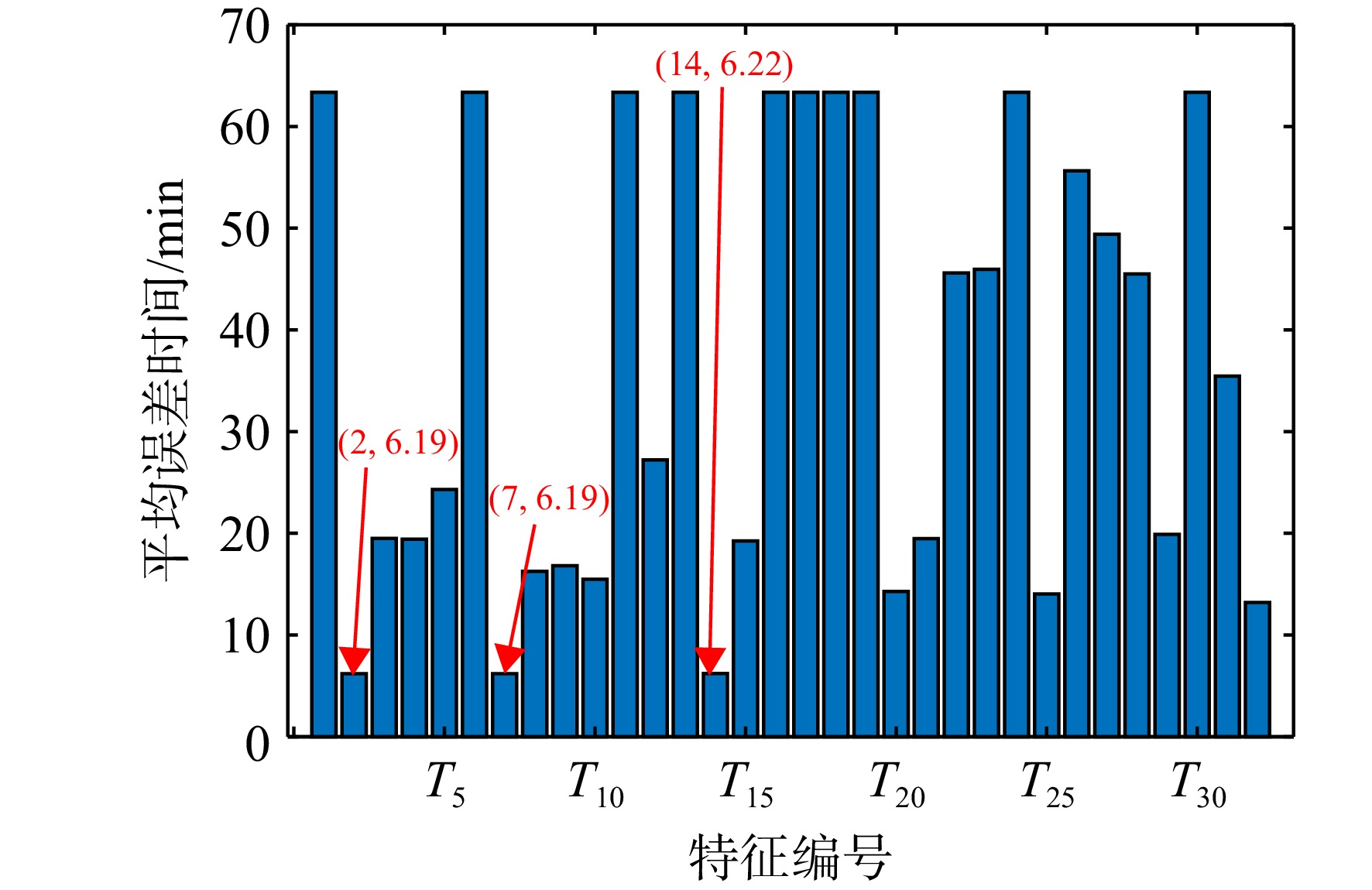
特征 计算公式 T1 $ \mathrm{m}\mathrm{e}\mathrm{a}\mathrm{n} (x) $ T2 $ \mathrm{s}\mathrm{t}\mathrm{d} (x) $ T3 $ (\mathrm{m}\mathrm{e}\mathrm{a}\mathrm{n}\sqrt{\mathrm{a}\mathrm{b}\mathrm{s} (x) }) ^{2} $ T4 $ \mathrm{m}\mathrm{e}\mathrm{a}\mathrm{n} (\mathrm{a}\mathrm{b}\mathrm{s} (x) ) $ T5 $ \mathrm{s}\mathrm{k}\mathrm{e}\mathrm{w}\mathrm{n}\mathrm{e}\mathrm{s}\mathrm{s} (x) $ T6 $ \mathrm{k}\mathrm{u}\mathrm{r}\mathrm{t}\mathrm{o}\mathrm{s}\mathrm{i}\mathrm{s} (x) $ T7 $ \mathrm{r}\mathrm{m}\mathrm{s} (x) $ T8 $ \mathrm{m}\mathrm{a}\mathrm{x} (\mathrm{a}\mathrm{b}\mathrm{s} (x) ) $ T9 $ \mathrm{m}\mathrm{i}\mathrm{n} (\mathrm{a}\mathrm{b}\mathrm{s} (x) ) $ T10 $ \mathrm{m}\mathrm{a}\mathrm{x} (x) -\mathrm{m}\mathrm{i}\mathrm{n} (x) $ T11 $ -\displaystyle\sum P (x) \mathrm{l}\mathrm{o}\mathrm{g} (2,P (x) ) $ T12 $ {T}_{7}/{T}_{4} $ T13 $ {T}_{8}/{T}_{7} $ T14 $ {T}_{8}/{T}_{4} $ T15 $ {T}_{6}/ ({T}_{4}) ^{4} $ T16 $ {T}_{8}/{T}_{3} $ T17 $ {T}_{5}/ ({T}_{4}) ^{3} $ T18 $ \mathrm{s}\mathrm{t}\mathrm{d} (\mathrm{l}\mathrm{o}\mathrm{g} (2,x+ ({x}^{2}-1) ^{1/2}) ) $ T19 $ \mathrm{s}\mathrm{t}\mathrm{d} (\mathrm{l}\mathrm{o}\mathrm{g} (2,x+ ({x}^{2}+1{) }^{1/2}) ) $
下载: 导出CSV
表 3 确定的FPT
Table 3. Determined FPT
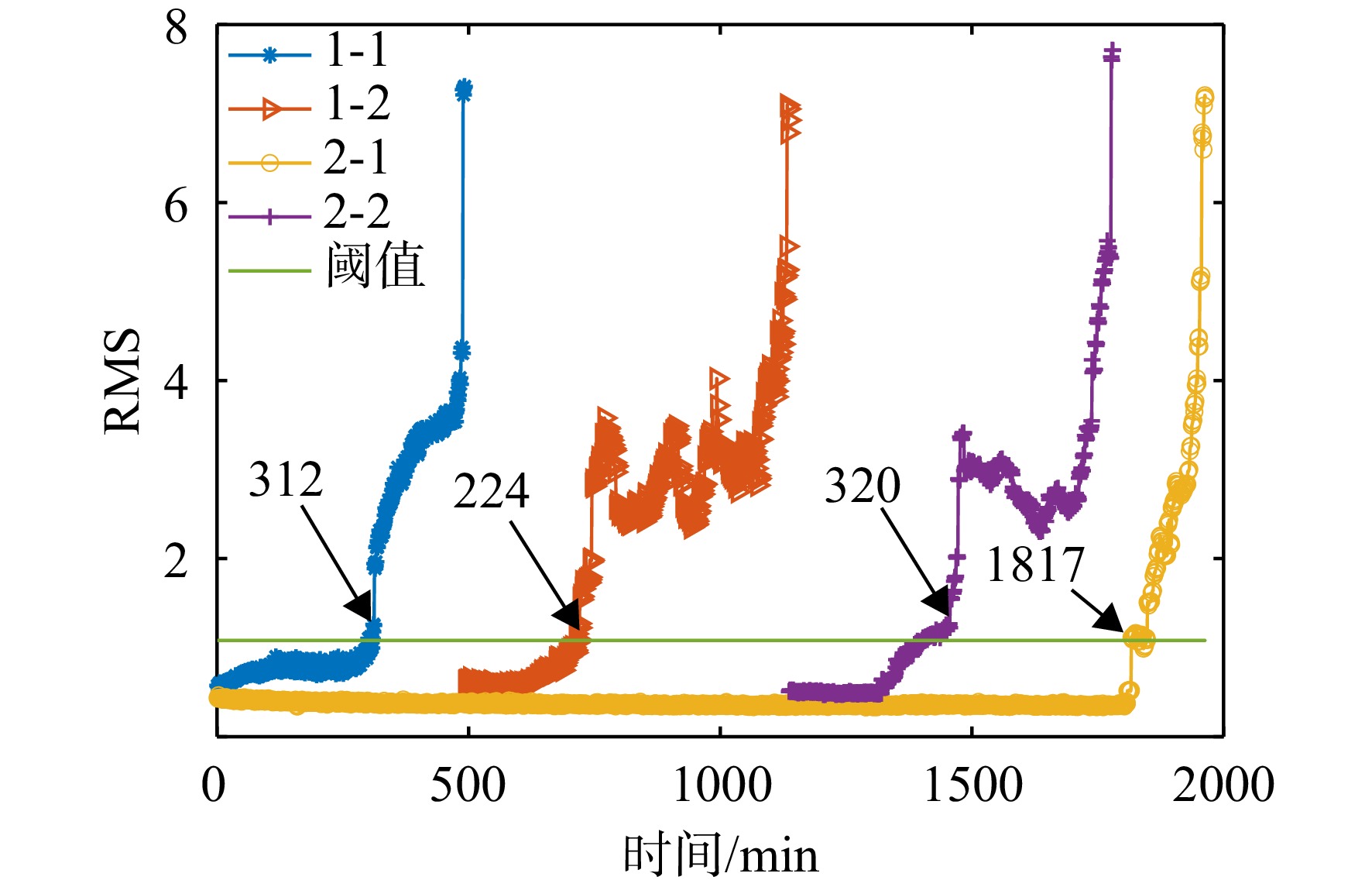
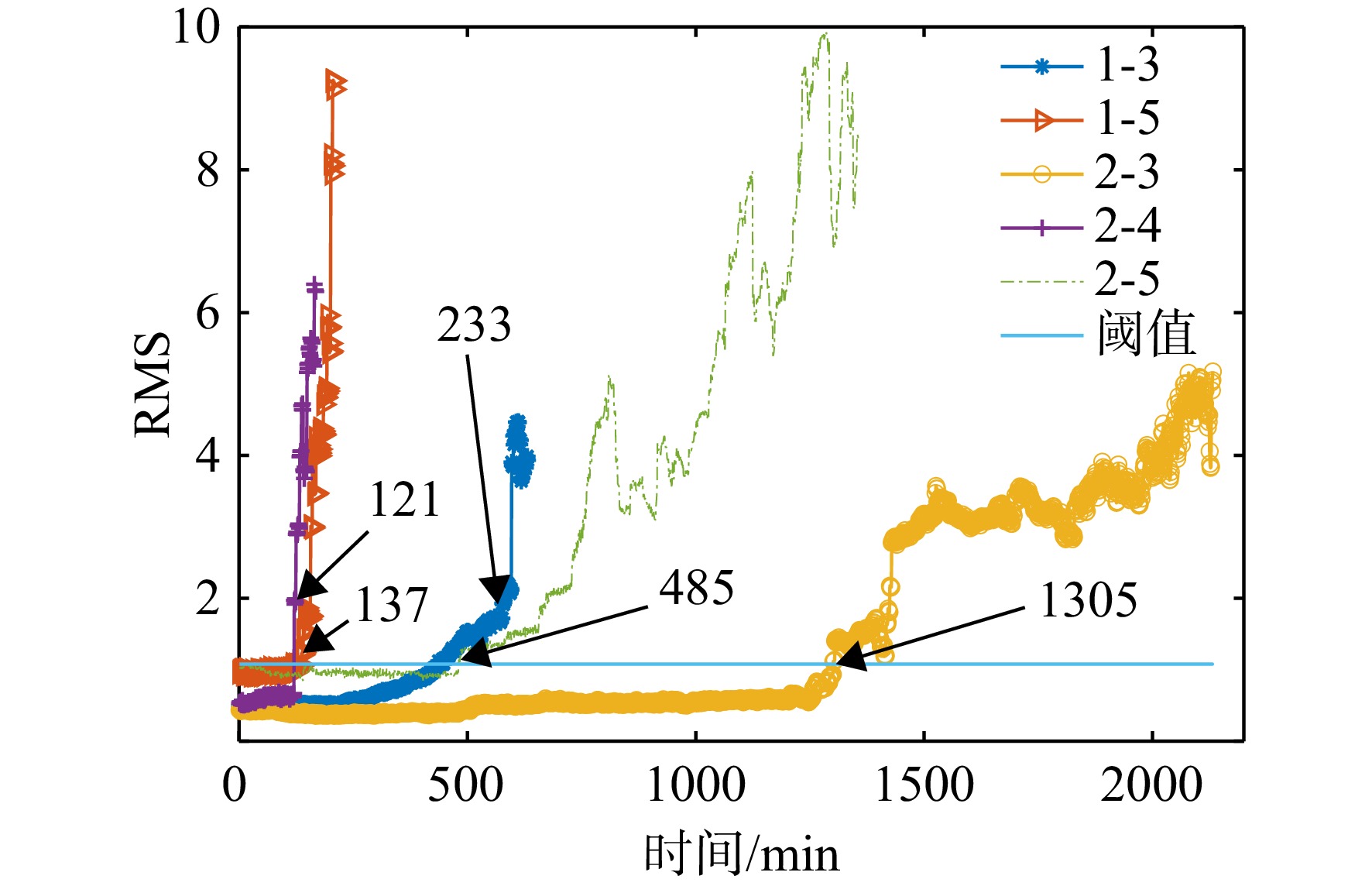
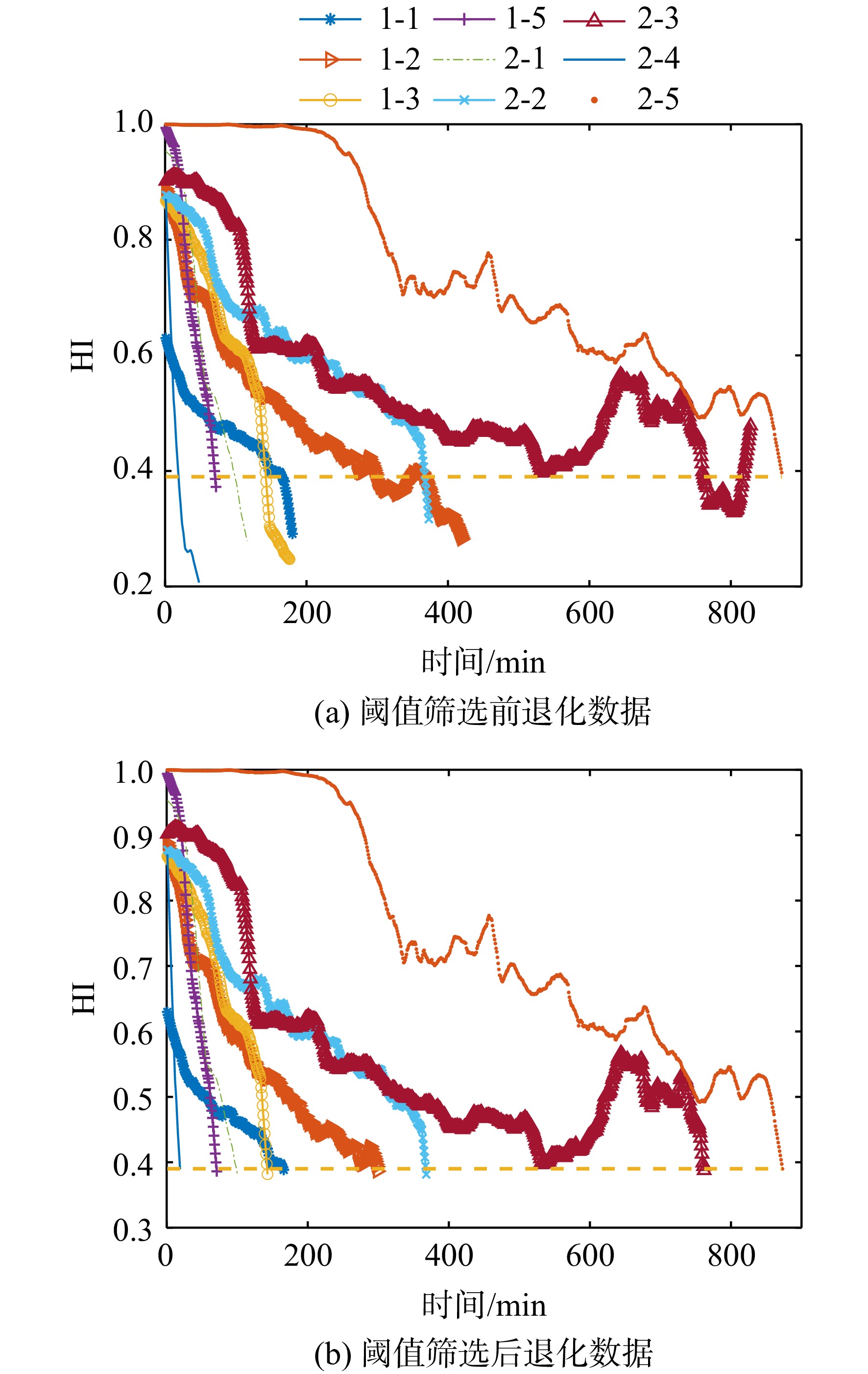
工况 编号 FPT/min 1 1 309 2 224 3 1817 5 269 2 1 448 2 137 3 1301 4 121 5 481
下载: 导出CSV
表 4 相关特征计算逻辑
Table 4. Correlation feature calculation logic
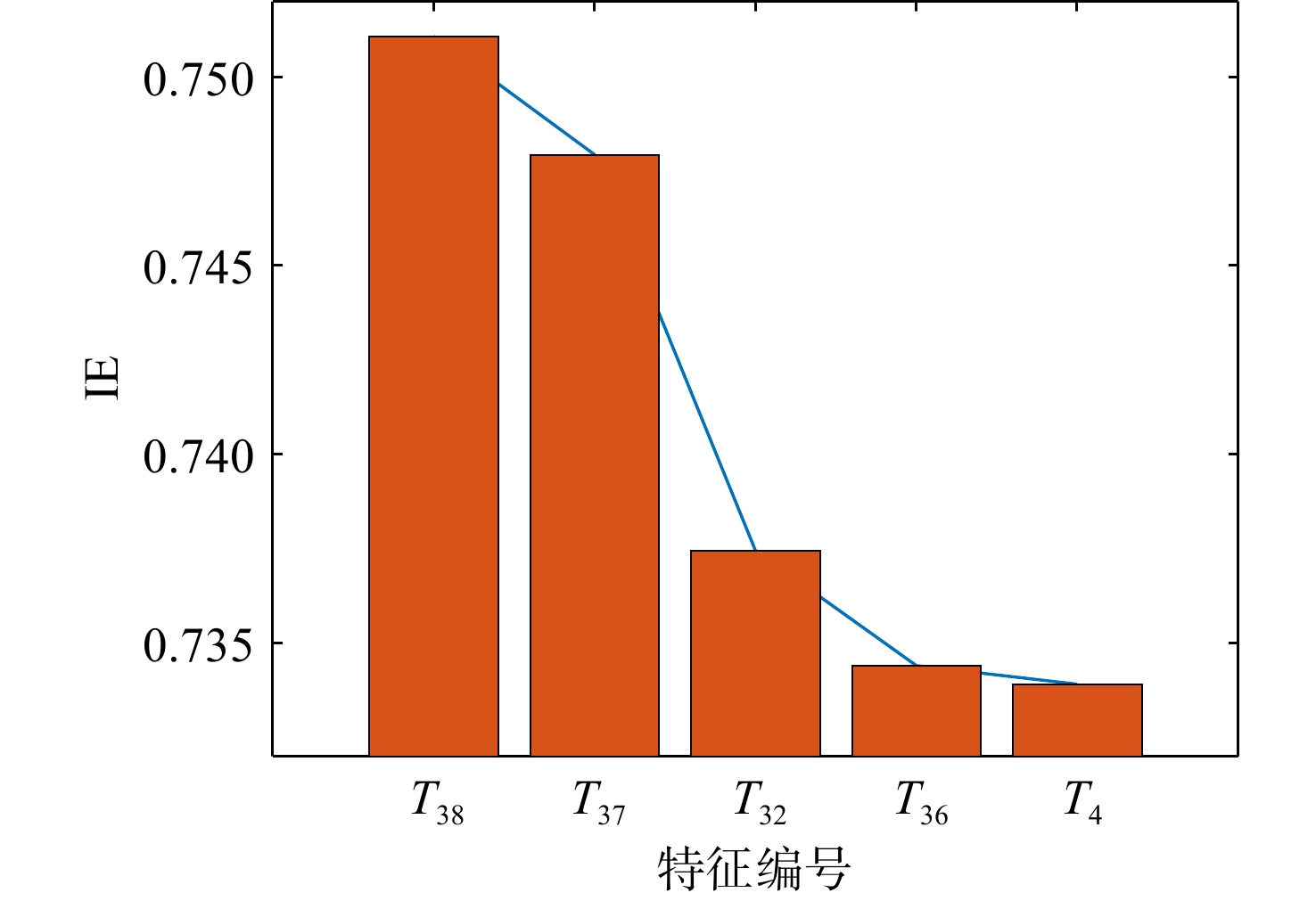
计算方法 时域 频域 包络谱 PCC T33原始信号 T34概率分布 T35原始信号 T36概率分布 T37原始信号 T38概率分布 互信息熵 T39原始信号 T40原始信号 T41原始信号
下载: 导出CSV
表 5 线性回归模型得分
Table 5. Linear regression model score
数据集
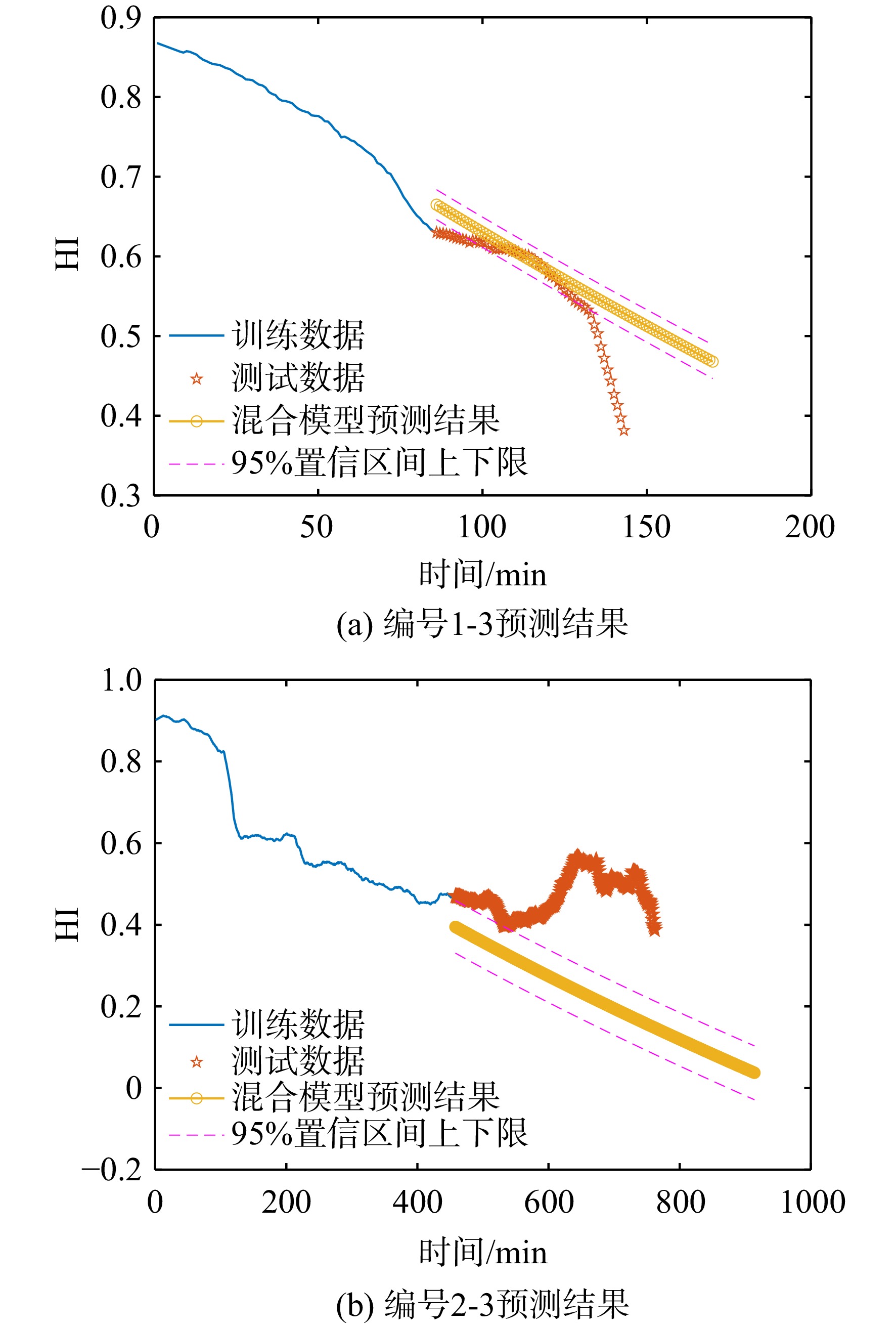
编号指数模型 线性模型 综合模型 误差率/% 得分 误差率/% 得分 误差率/% 得分 1-1 0.256 0.415 0.452 0.212 0.361 0.289 1-2 0.485 0.187 0.736 0.079 0.610 0.121 1-3 −0.5 0 −0.5 0 −0.5 0 1-5 −0.5 0 0.070 0.787 0.070 0.787 2-1 −0.050 0.500 0.350 0.297 0.150 0.595 2-2 −0.224 0.045 0.258 0.411 0.020 0.932 2-3 0.879 0.048 0.997 0.032 0.938 0.039 2-4 −0.132 0.177 0.263 0.420 0.132 0.648 2-5 −0.396 0.004 0.045 0.879 0.045 0.879 平均 0.197 0.445 0.613
下载: 导出CSV
表 6 对比模型得分结果
Table 6. Comparison of model score results
数据集
编号二次指数平滑模型 Winner模型 ARIMA模型 LSTM Bi_LSTM 综合模型 误差率/% 得分 误差率/% 得分 误差率/% 得分 误差率/% 得分 误差率/% 得分 误差率/% 得分 1-1 0.105 0.696 0.407 0.247 0 −0.5 0 −0.5 0 0.361 0.289 1-2 0.226 0.459 0.627 0.115 0 −0.226 0.044 −0.084 0.315 0.610 0.121 1-3 0.157 0.584 0 0.280 0.384 0.017 0.942 −0.105 0.238 −0.5 0 1-5 0.176 0.550 −0.035 0.620 −0.070 0.384 −0.5 0 −0.5 0 0.070 0.787 2-1 0.625 0.115 0.450 0.210 0.050 0.841 −0.5 0 −0.5 0 0.150 0.595 2-2 −0.5 0 −0.048 0.519 −0.272 0.024 −0.5 0 −0.5 0 0.020 0.932 2-3 −0.5 0 0.755 0.073 −0.5 0 −0.5 0 −0.5 0 0.938 0.039 2-4 −0.263 0.031 0.263 0.420 0 1.000 0.263 0.420 0.395 0.273 0.132 0.648 2-5 0.744 0.076 −0.143 0.197 0 −0.5 0 −0.5 0 0.045 0.879 综合得分 0.359 0.343 0.376 0.201 0.119 0.613
下载: 导出CSV
-
[1] QIAN Yuning,YAN Ruqiang. Remaining useful life prediction of rolling bearings using an enhanced particle filter[J]. IEEE Transactions on Instrumentation and Measurement,2015,64(10): 2696-2707. doi: 10.1109/TIM.2015.2427891 [2] ZOU Yisheng,ZHAO Shijiao,LIU Yongzhi,et al. The transfer prediction method of bearing remain use life based on dynamic benchmark[J]. IEEE Transactions on Instrumentation and Measurement,2021,70: 2516211. [3] KUNZELMANN B,RYCERZ P,XU Yilun,et al. Prediction of rolling contact fatigue crack propagation in bearing steels using experimental crack growth data and linear elastic fracture mechanics[J]. International Journal of Fatigue,2023,168: 107449. doi: 10.1016/j.ijfatigue.2022.107449 [4] ABBASI A,NAZARI F,NATARAJ C. Adaptive modeling of vibrations and structural fatigue for analyzing crack propagation in a rotating system[J]. Journal of Sound and Vibration,2022,541: 117276. doi: 10.1016/j.jsv.2022.117276 [5] SUN Jiankai,ZHANG Xin,WANG Jiaxu. Lightweight bidirectional long short-term memory based on automated model pruning with application to bearing remaining useful life prediction[J]. Engineering Applications of Artificial Intelligence,2023,118: 105662. doi: 10.1016/j.engappai.2022.105662 [6] GUPTA M,WADHVANI R,RASOOL A. A real-time adaptive model for bearing fault classification and remaining useful life estimation using deep neural network[J]. Knowledge-Based Systems,2023,259: 110070. doi: 10.1016/j.knosys.2022.110070 [7] 程立,马文锁,夏新涛,等. 基于融合灰色熵和自助马尔科夫链的滚动轴承振动性能退化趋势预测[J]. 航空动力学报,2023,38(9): 2221-2230. CHENG Li,MA Wensuo,XIA Xintao,et al. Degradation trend prediction of rolling bearing vibration performance based on fusion grey entropy and bootstrap Markov chain[J]. Journal of Aerospace Power,2023,38(9): 2221-2230. (in ChineseCHENG Li, MA Wensuo, XIA Xintao, et al. Degradation trend prediction of rolling bearing vibration performance based on fusion grey entropy and bootstrap Markov chain[J]. Journal of Aerospace Power, 2023, 38(9): 2221-2230. (in Chinese) [8] LEI Yaguo,LI Naipeng,GUO Liang,et al. Machinery health prognostics: a systematic review from data acquisition to RUL prediction[J]. Mechanical Systems and Signal Processing,2018,104: 799-834. doi: 10.1016/j.ymssp.2017.11.016 [9] LU Biliang,LIU Zhaohua,WEI Hualiang,et al. A deep adversarial learning prognostics model for remaining useful life prediction of rolling bearing[J]. IEEE Transactions on Artificial Intelligence,2021,2(4): 329-340. [10] MEDJAHER K,ZERHOUNI N,BAKLOUTI J. Data-driven prognostics based on health indicator construction: Application to PRONOSTIA’s data[R]. Zürich,Switzerland: 2013 European Control Conference,2013. [11] ZHANG Yong,SUN Jiahua,ZHANG Jing,et al. Health state assessment of bearing with feature enhancement and prediction error compensation strategy[J]. Mechanical Systems and Signal Processing,2023,182: 109573. [12] WANG Dong,TSE P W. Prognostics of slurry pumps based on a moving-average wear degradation index and a general sequential Monte Carlo method[J]. Mechanical Systems and Signal Processing,2015,56: 213-229. [13] ZHAO Minghang,TANG Baoping,TAN Qian. Bearing remaining useful life estimation based on time-frequency representation and supervised dimensionality reduction[J]. Measurement,2016,86: 41-55. doi: 10.1016/j.measurement.2015.11.047 [14] HAN Tian,PANG Jiachen,TAN A C C. Remaining useful life prediction of bearing based on stacked autoencoder and recurrent neural network[J]. Journal of Manufacturing Systems,2021,61: 576-591. doi: 10.1016/j.jmsy.2021.10.011 [15] 陈保家,郭凯敏,陈法法,等. 基于残差NLSTM网络和注意力机制的航空发动机剩余使用寿命预测[J]. 航空动力学报,2023,38(5): 1176-1184. CHEN Baojia,GUO Kaimin,CHEN Fafa,et al. Prediction of remaining useful life of aero-engine based on residual NLSTM neural network and attention mechanism[J]. Journal of Aerospace Power,2023,38(5): 1176-1184. (in ChineseCHEN Baojia, GUO Kaimin, CHEN Fafa, et al. Prediction of remaining useful life of aero-engine based on residual NLSTM neural network and attention mechanism[J]. Journal of Aerospace Power, 2023, 38(5): 1176-1184. (in Chinese) [16] EFRON B. Bootstrap methods: another look at the jackknife[M]//Breakthroughs in Statistics. New York,US: Springer New York,1992: 569-593. [17] PRESS W H,TEUKOLSKY S A. Savitzky-Golay smoothing filters[J]. Computers in Physics,1990,4(6): 669-672. doi: 10.1063/1.4822961 [18] SHEN Yizhe,TANG Baoping,LI Biao,et al. Remaining useful life prediction of rolling bearing based on multi-head attention embedded Bi-LSTM network[J]. Measurement,2022,202: 111803. doi: 10.1016/j.measurement.2022.111803 [19] WANG Biao,LEI Yaguo,LI Naipeng,et al. A hybrid prognostics approach for estimating remaining useful life of rolling element bearings[J]. IEEE Transactions on Reliability,2018,69(1): 401-412. [20] YAN Xiaoan,JIA Minping. A novel optimized SVM classification algorithm with multi-domain feature and its application to fault diagnosis of rolling bearing[J]. Neurocomputing,2018,313: 47-64. doi: 10.1016/j.neucom.2018.05.002 -

 点击查看大图

计量
- 文章访问数: 572
- HTML浏览量: 374
- PDF量: 60
- 被引次数: 0