






Large eddy simulation of effect of spray spatial distribution on ignition characteristics
-
摘要:
为了探究燃油喷雾空间分布对点火特性的影响,采用大涡模拟方法结合离散相模型、动态增厚火焰模型对轴径向旋流器燃烧室中的流动、燃烧过程进行模拟。结果表明:点火区域局部液滴质量浓度及高质量浓度分布范围决定了初始火核的生成、火焰的传播过程。尤其在火焰发展前期,空心锥形燃油喷雾火焰以周向和轴向传播为主,实心锥形燃油喷雾火焰则是周向、轴向和径向传播同时进行,并且不同喷射方式的燃油喷雾空间分布与稳定后的火焰形态相对应。用大涡模拟的方法再现了其他学者实验中观察到的燃油喷雾分布决定火焰分布的现象,同时也证明了仅靠索太尔平均直径(SMD)无法代表所有雾化特性对燃油喷雾燃烧过程影响的结论。
Abstract:In order to investigate the effect of fuel spray spatial distribution on ignition characteristics, large eddy simulation method combined with discrete phase model and dynamic thickening flame model was used to simulate the flow and combustion process in the axial-radial swirler combustion chamber. The results showed that the local droplet concentration and distribution range of the high concentration in the ignition area determined the formation of the initial flame kernel and the propagation process of the flame. Especially in the early stage of flame development, the hollow conical fuel spray flame mainly propagated in circumferential and axial directions, while the solid conical fuel spray flame propagated in circumferential, axial and radial directions at the same time, and the fuel spray spatial distribution of different injection modes corresponded to the flame morphology after stability. The large eddy simulation method was used for the first time in reproducing the phenomenon that the fuel spray distribution determined the flame distribution observed in other scholars’ experiments, proving that Sauter mean diameter (SMD) alone cannot represent all the effects of atomization characteristics on the fuel spray combustion process.
-
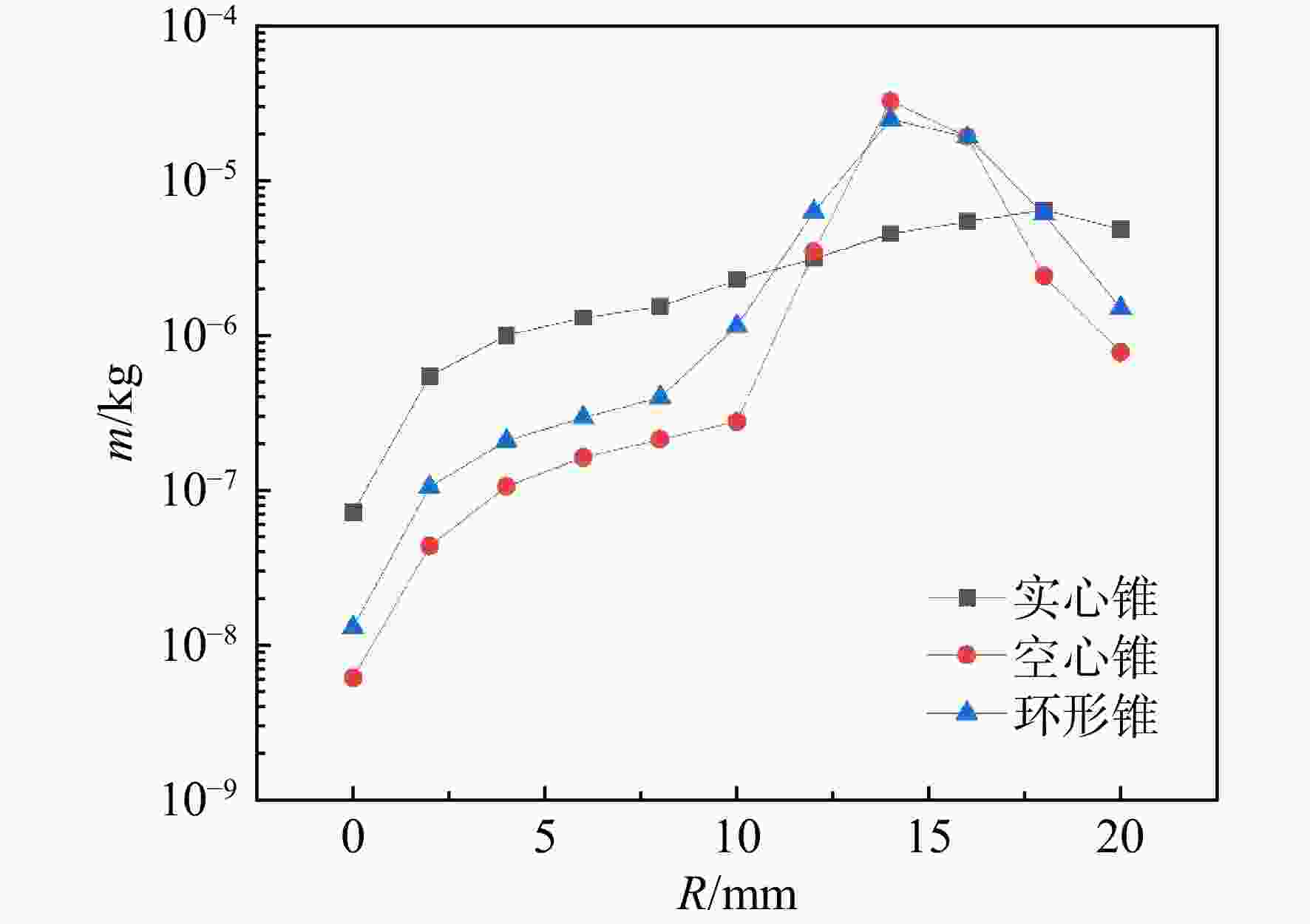
图 5 不同喷射方式套筒下游3 mm截面燃油质量径向分布
Figure 5. Radial distribution of fuel mass of 3 mm section downstream of sleeve under different injection modes
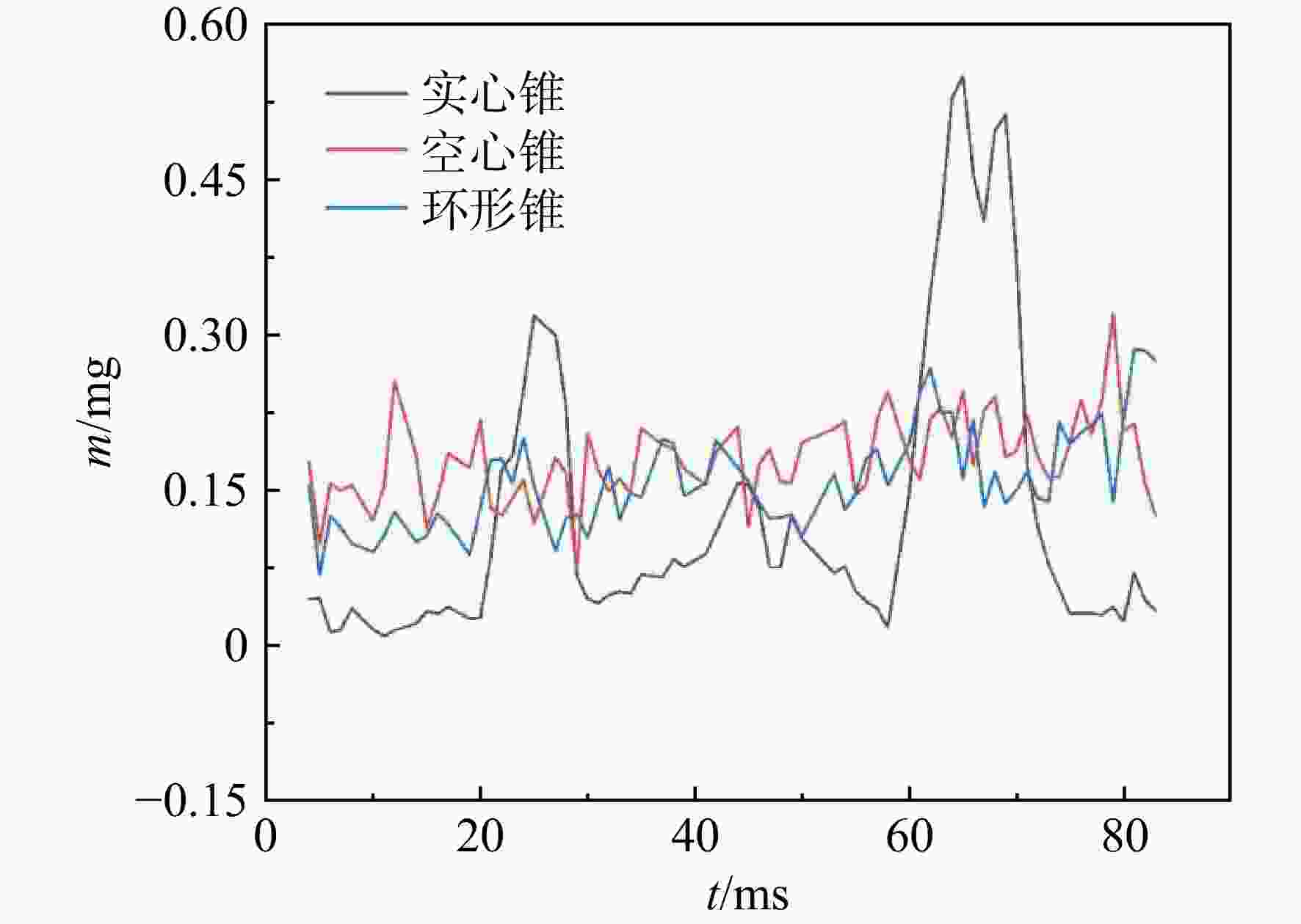
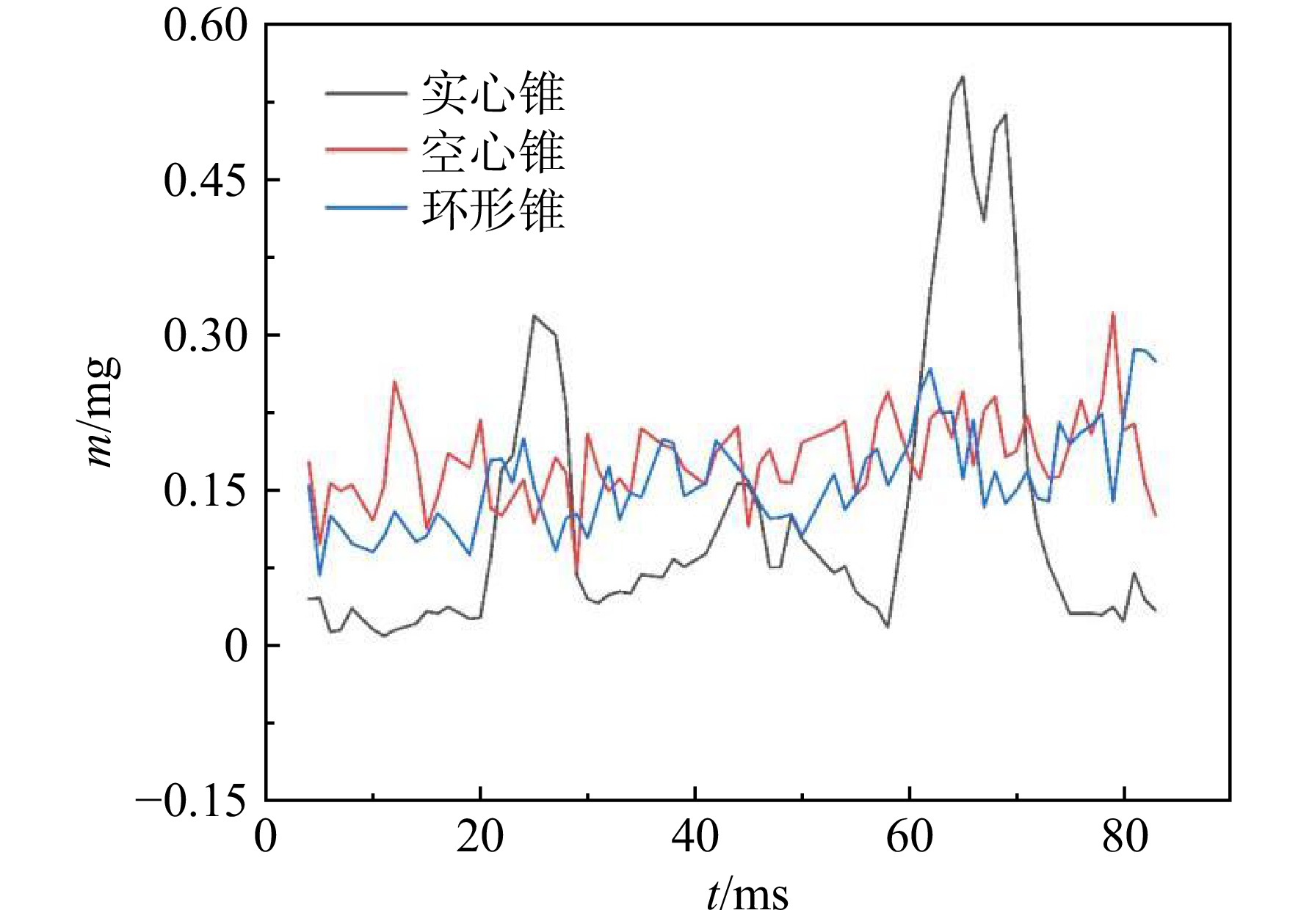
图 6 点火位置处半径8 mm球体内液体燃油质量
Figure 6. Liquid fuel mass in 8 mm radius sphere at ignition position
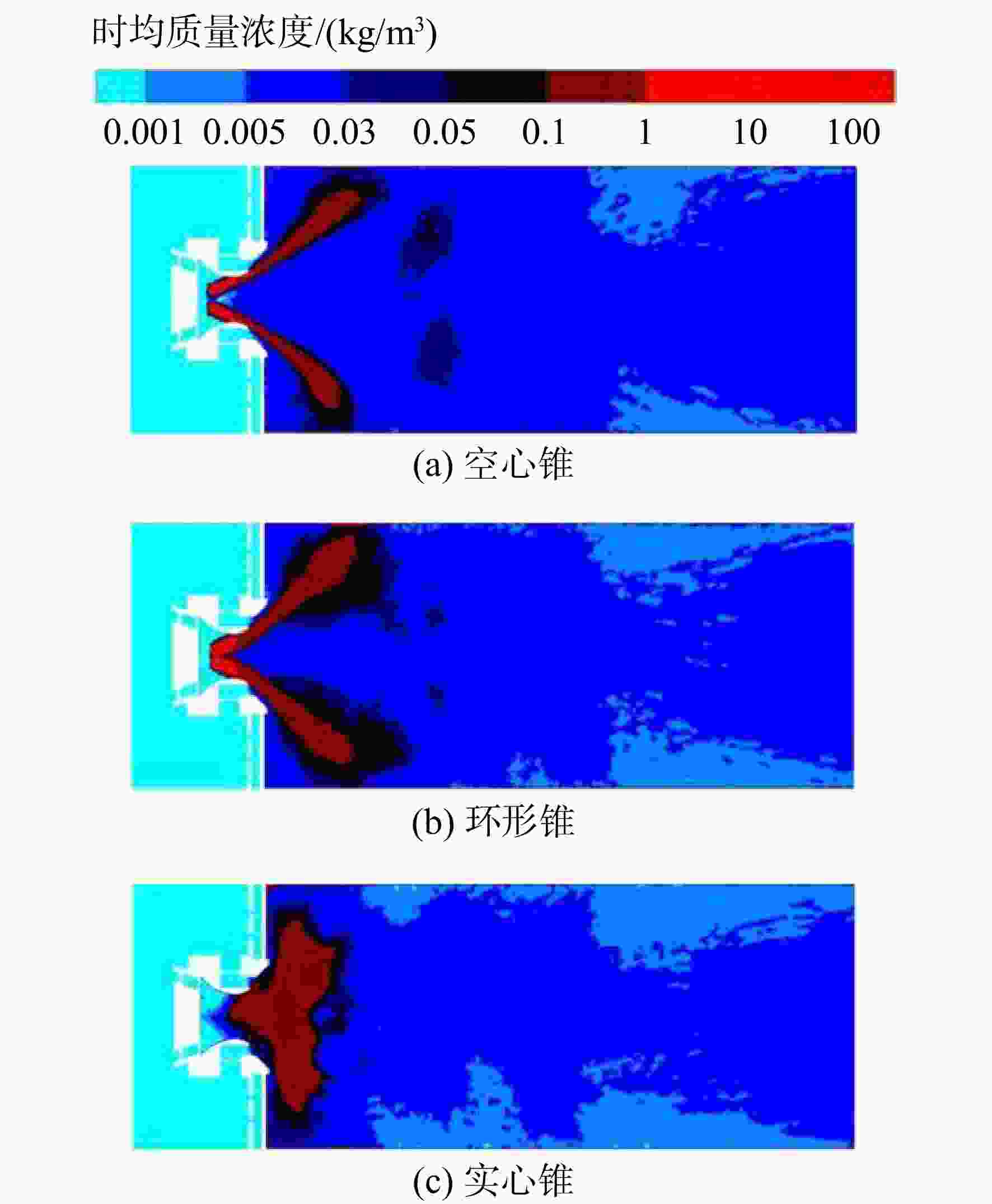
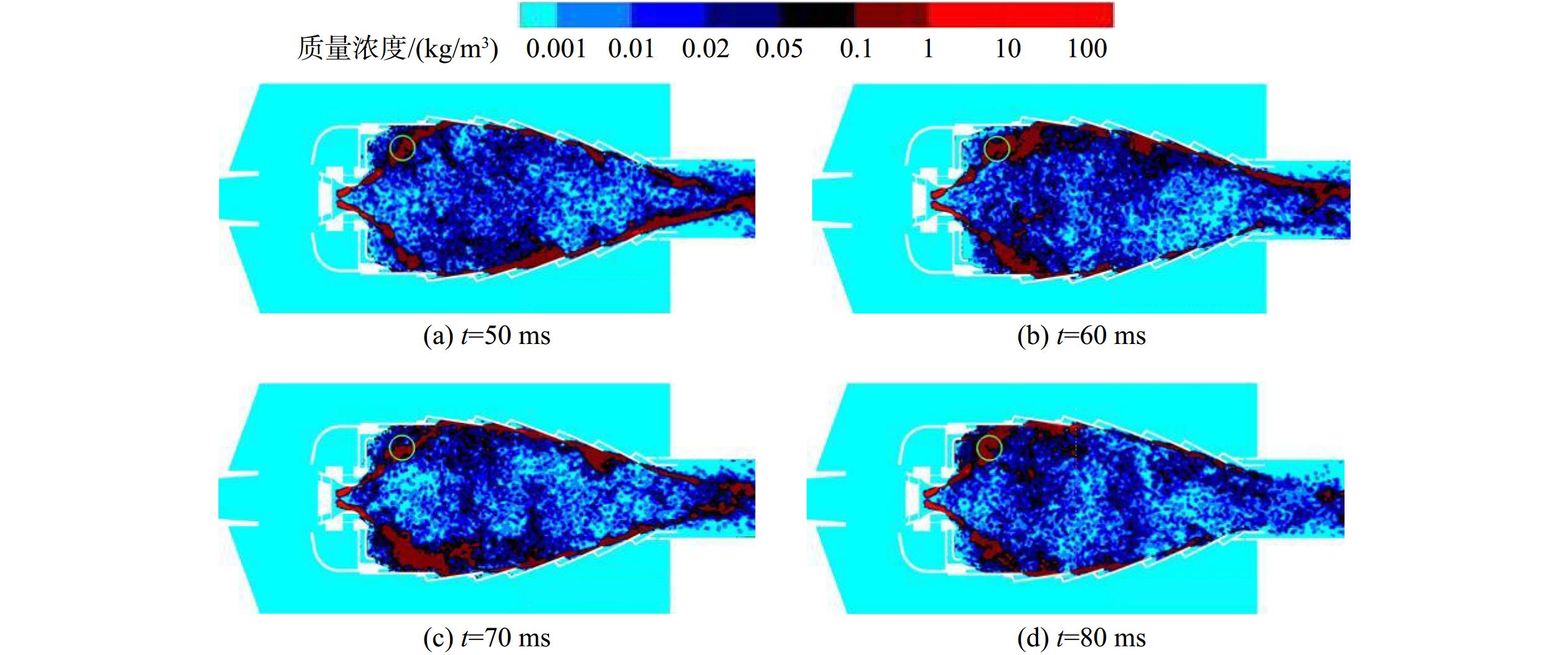
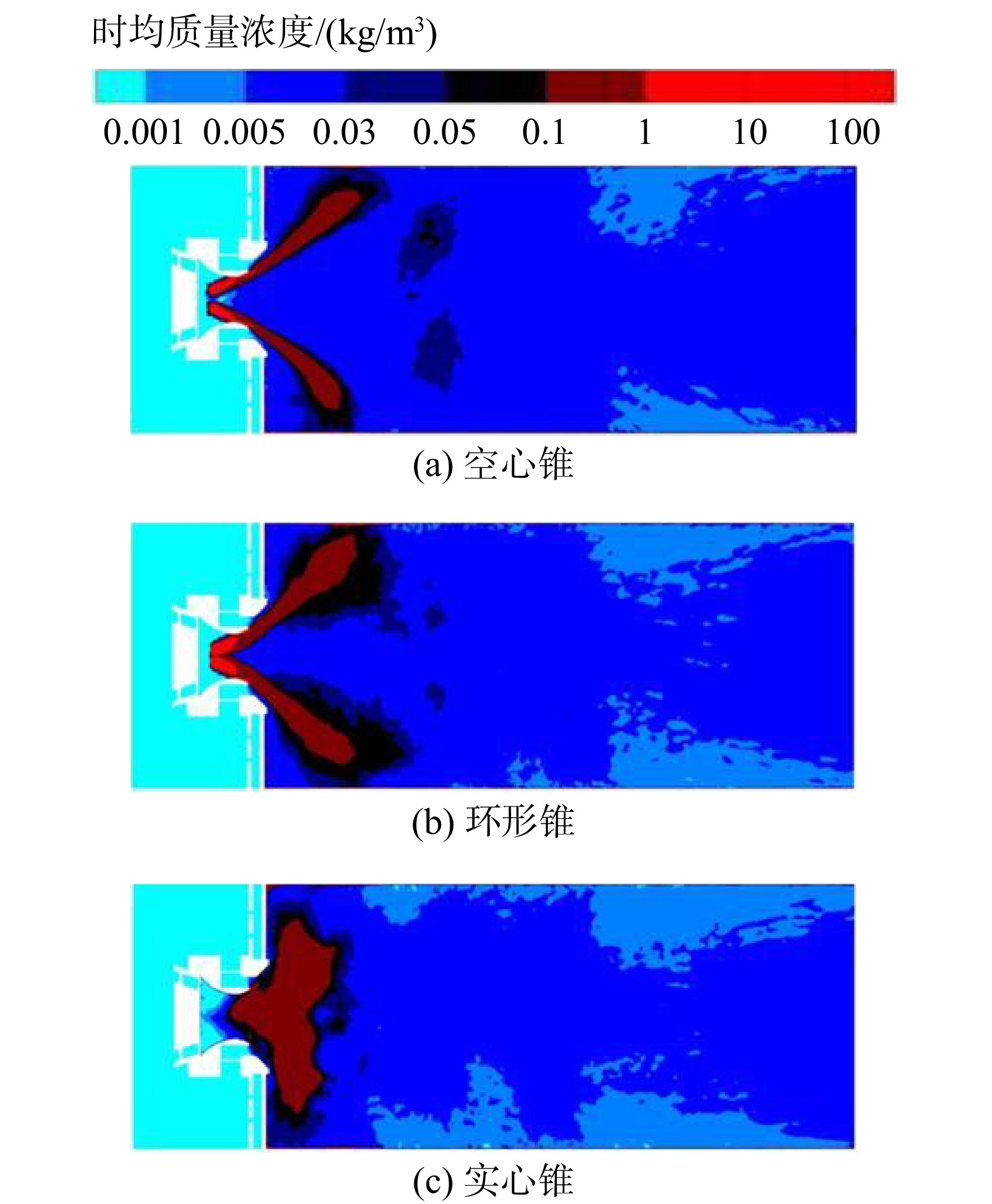
图 7 不同喷射方式下液滴喷雾空间分布
Figure 7. Spatial distribution of droplet spray under different injection modes

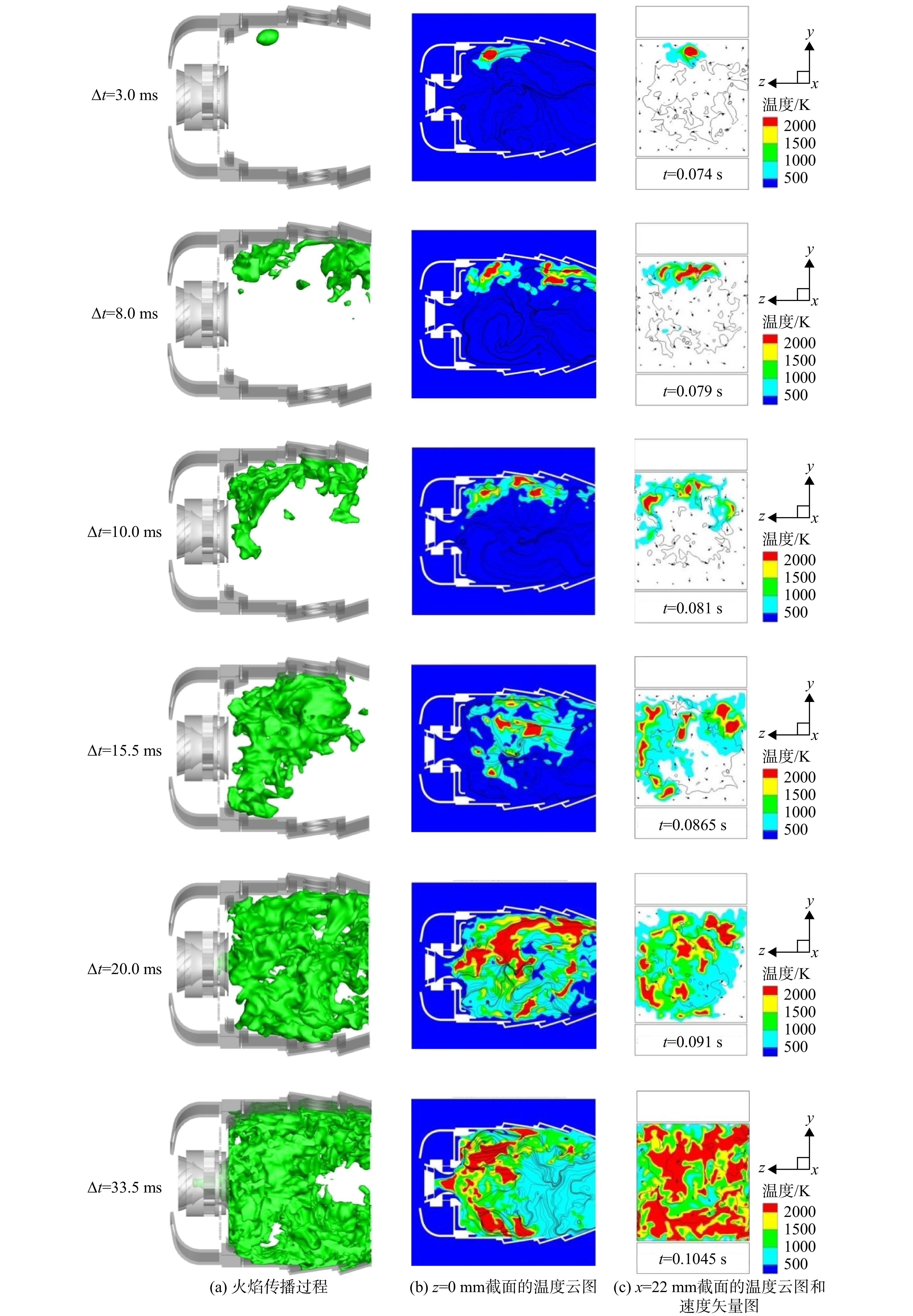
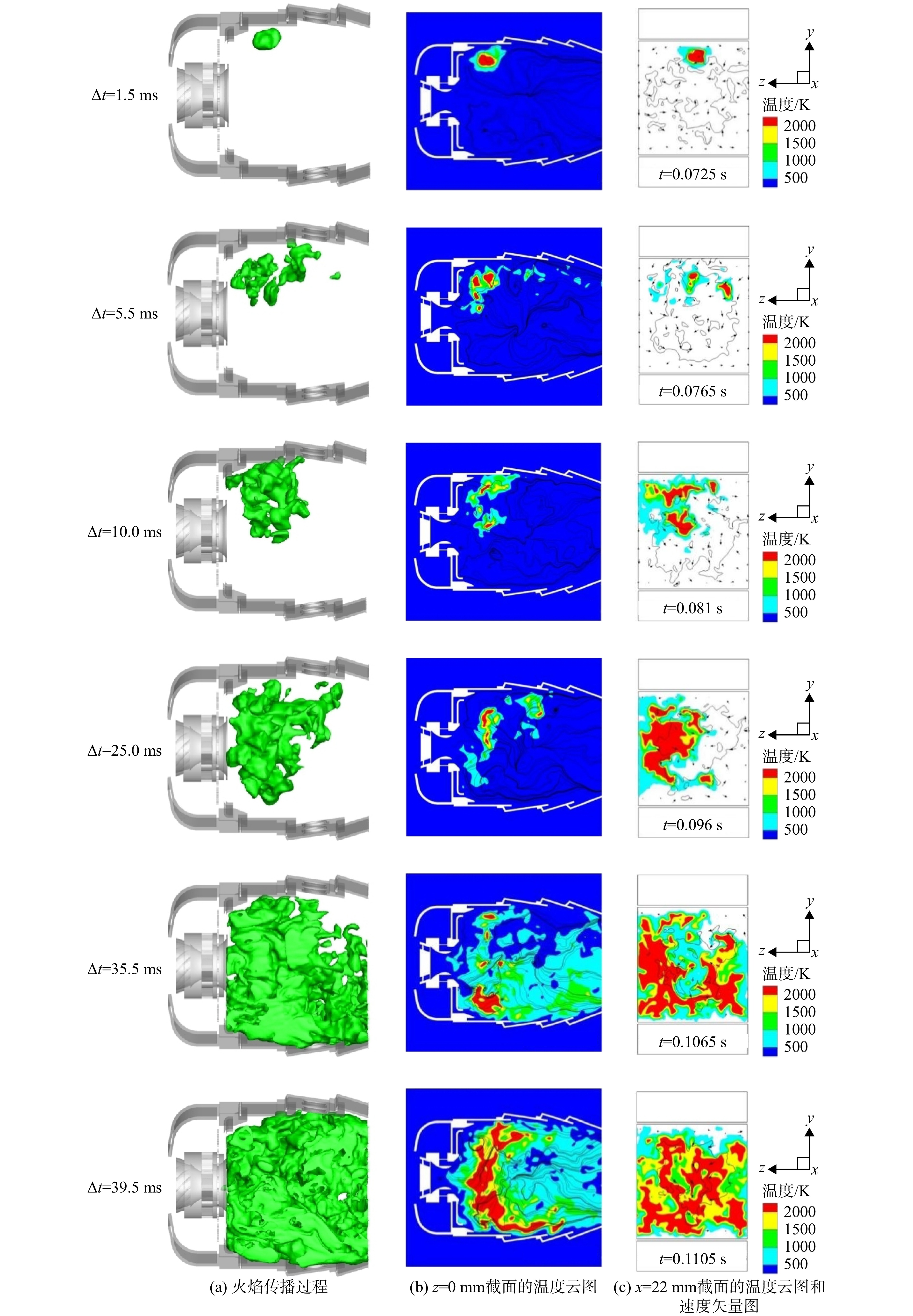
图 8 空心锥形燃油喷雾多脉冲动态点火过程
Figure 8. Hollow conical fuel spray multi-pulse dynamic ignition process
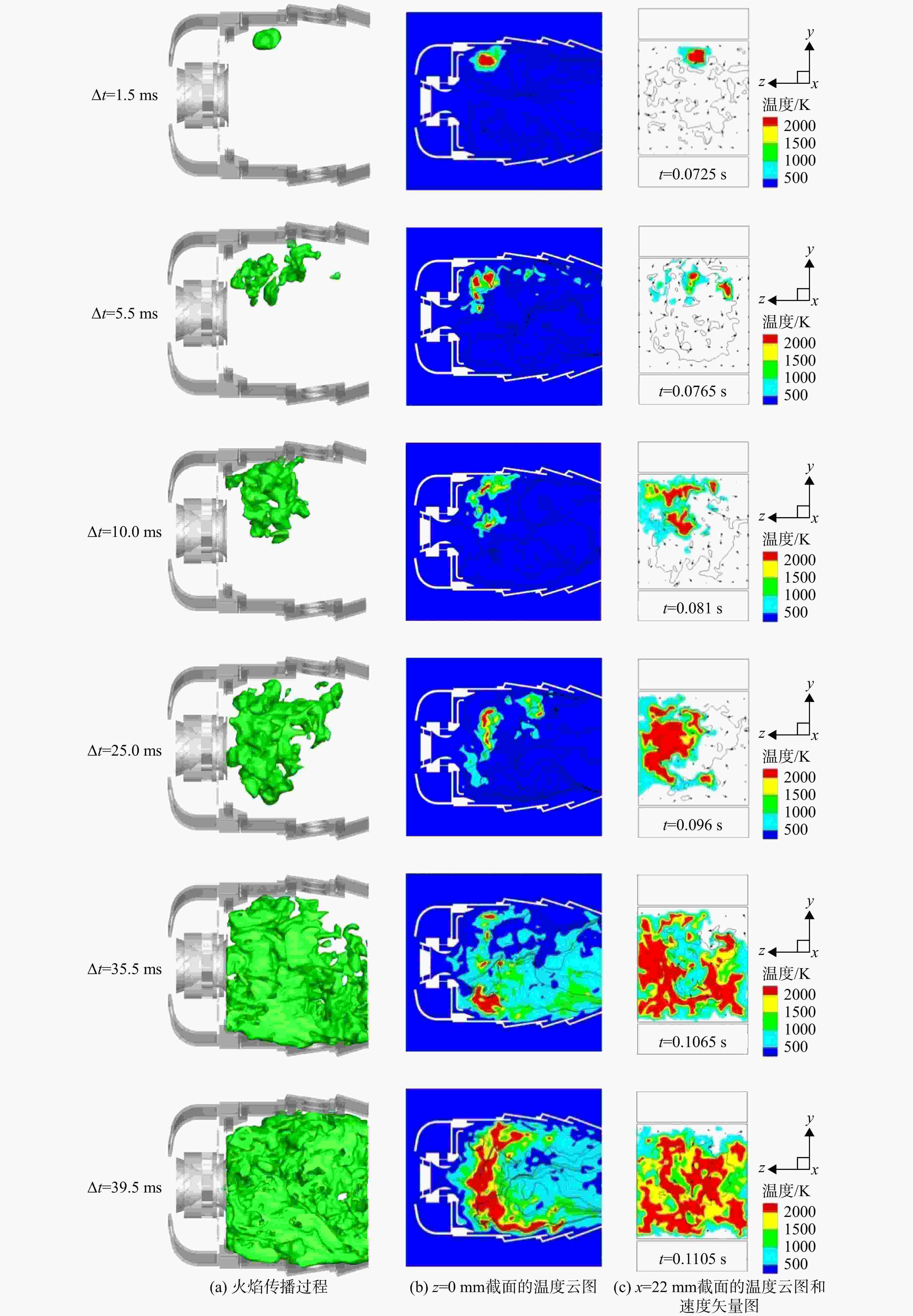
图 9 实心锥形燃油喷雾多脉冲动态点火过程
Figure 9. Solid conical fuel spray multi-pulse dynamic ignition process
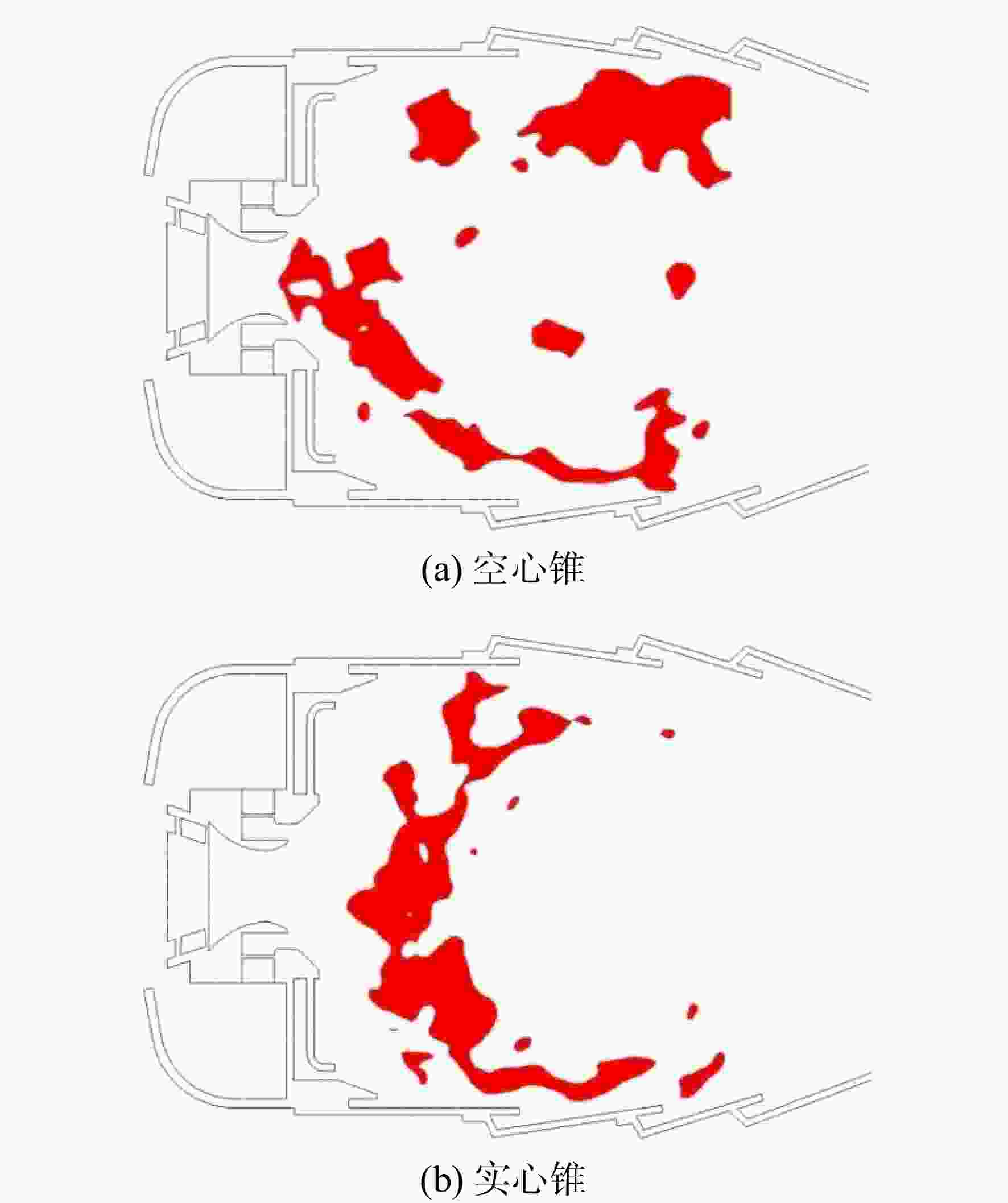
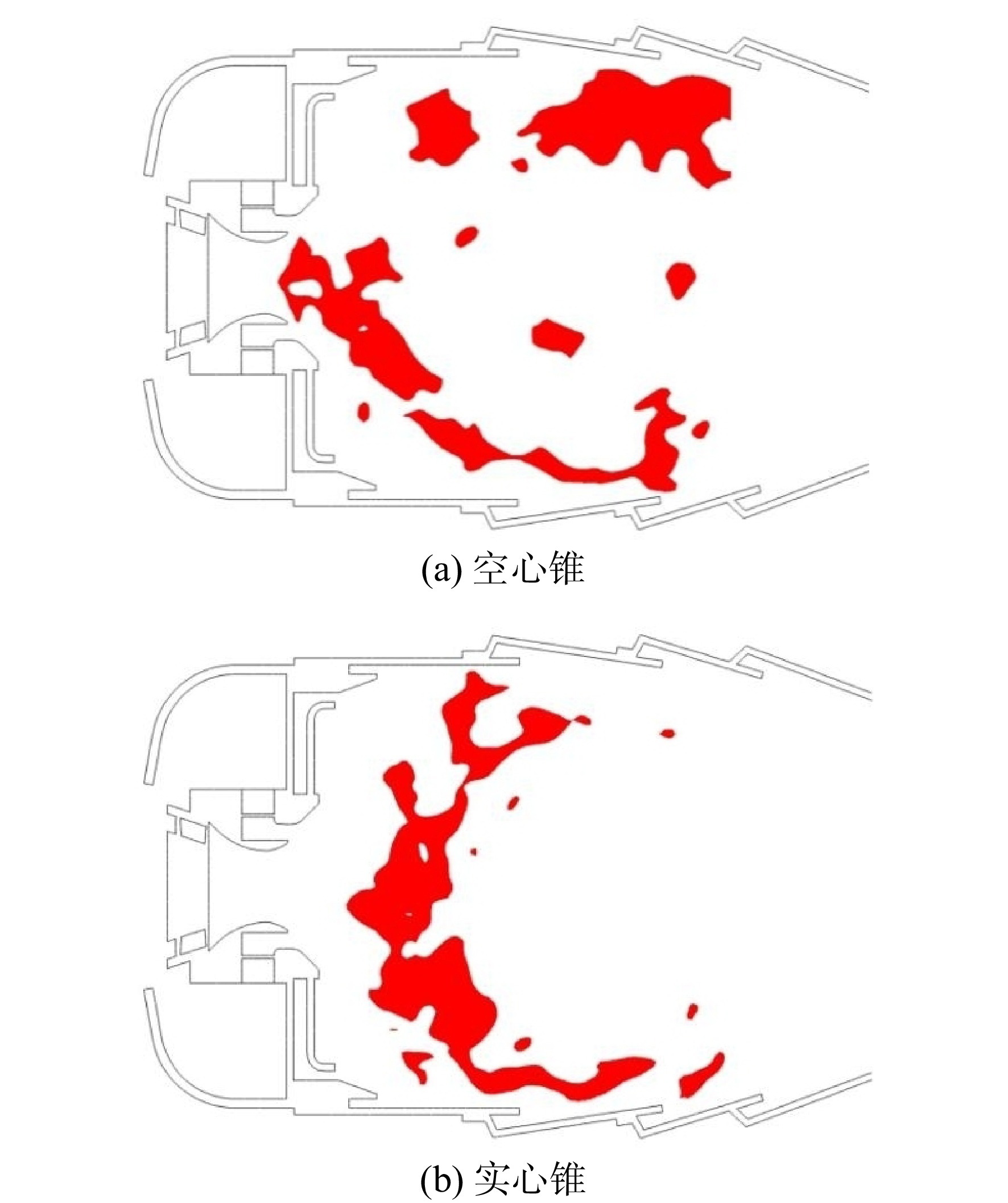
图 10 不同燃油喷雾稳定燃烧后火焰形态对比
Figure 10. Comparison of flame morphology after stable combustion of different fuel sprays

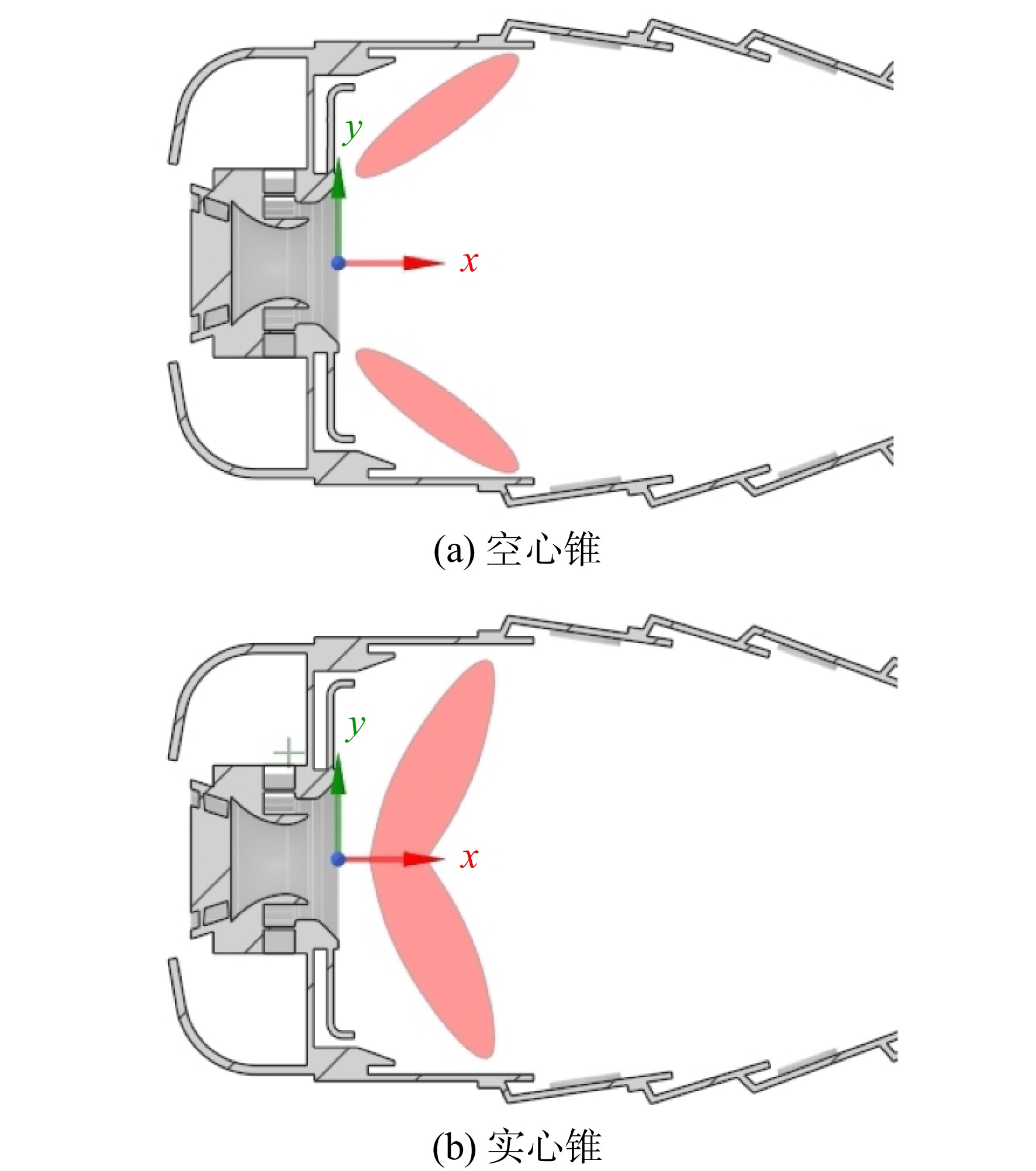
图 11 不同燃油喷雾火焰稳定根部示意图
Figure 11. Diagram of stable roots of different fuel spray flames
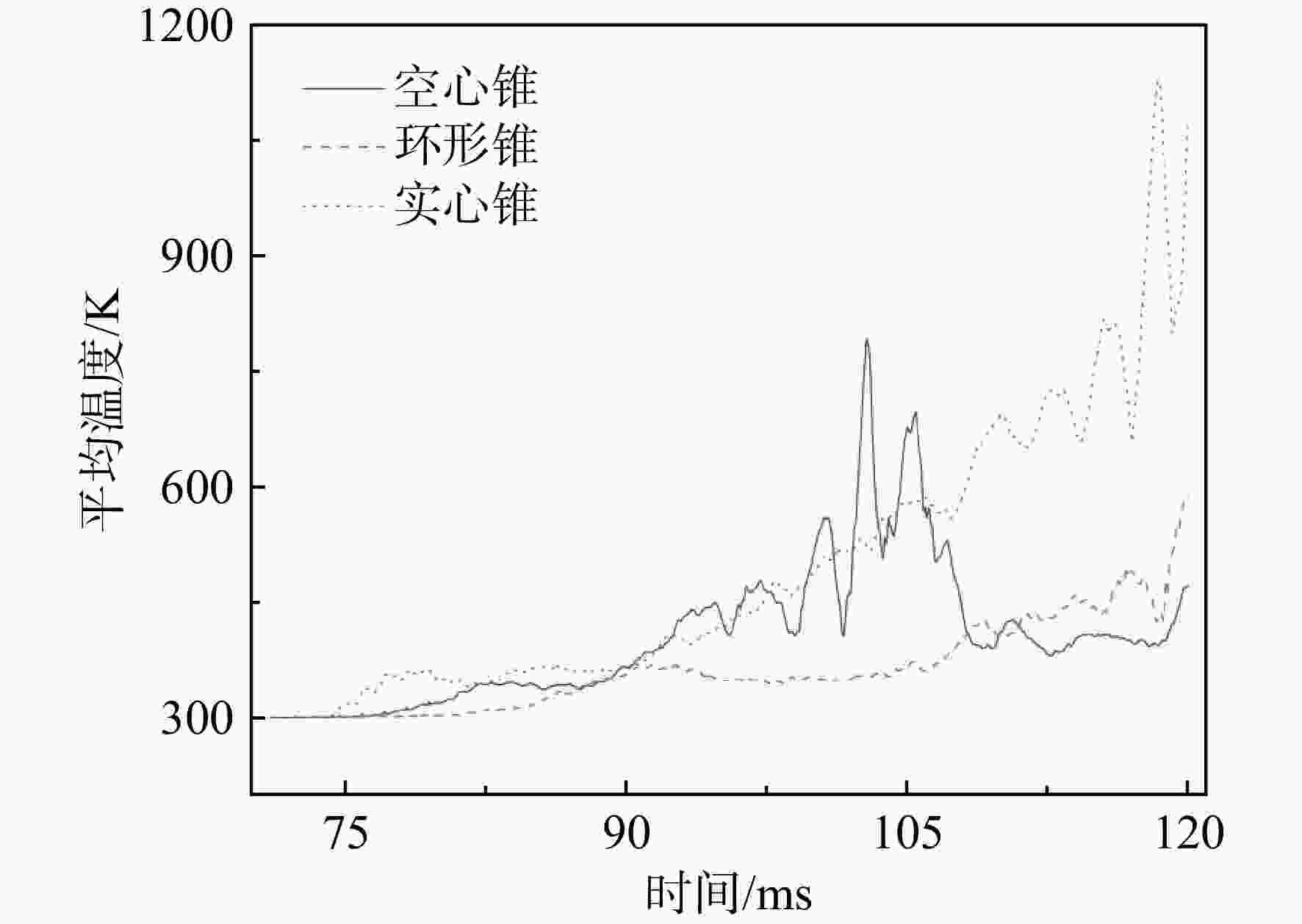
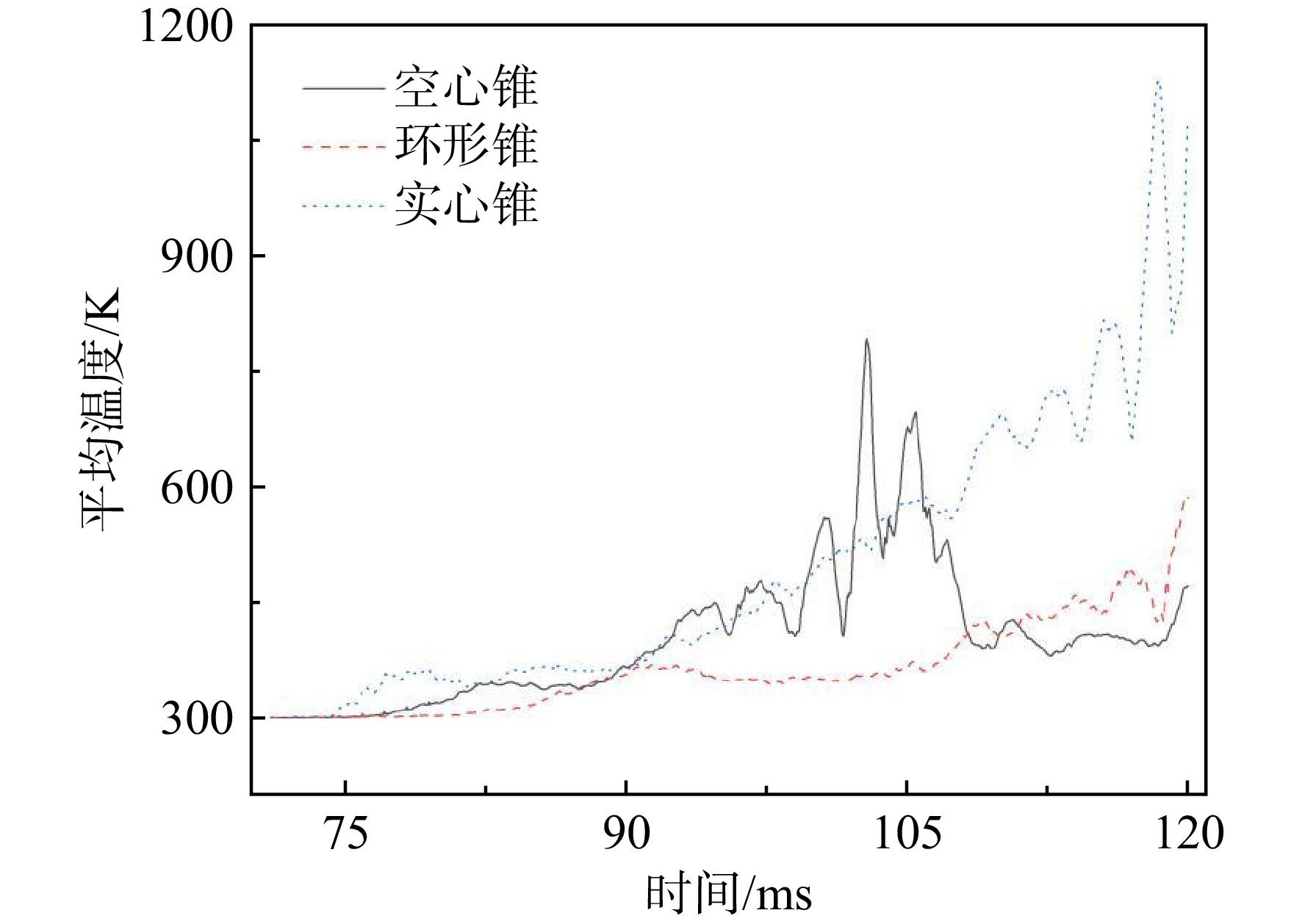
图 12 火焰筒头部截面(x=7.5 mm)平均温度变化
Figure 12. Average temperature change of flame cylinder head section (x=7.5 mm)
表 1 不同喷射方式详细参数
Table 1. Detailed parameters of different injection modes
喷射方式 速度/
(m/s)锥角/
(°)SMD/
μm燃油质量流量/
(g/s)空心锥 10.26 66 46 2.8 环形锥 10.26 66 46 2.8 实心锥 10.26 66 46 2.8  下载: 导出CSV
-
[1] GROHMANN J,O’LOUGHLIN W,MEIER W,et al. Comparison of the combustion characteristics of liquid single-component fuels in a gas turbine model combustor[R]. Seoul,South Korea: ASME Turbo Expo 2016: Turbomachinery Technical Conference and Exposition,2016. [2] GROHMANN J,RAUCH B,KATHROTIA T,et al. Influence of single-component fuels on gas-turbine model combustor lean blowout[J]. Journal of Propulsion and Power,2018,34(1): 97-107. doi: 10.2514/1.B36456 [3] ROCK N,CHTEREV I,SMITH T,et al. Reacting pressurized spray combustor dynamics: Part 1 fuel sensitivities and blowoff characterization[R]. Seoul,South Korea: ASME Turbo Expo 2016: Turbomachinery Technical Conference and Exposition,2016. [4] 陈坚,李建中,袁丽,等. 雾化特性对喷雾燃烧点火过程的影响[J]. 推进技术,2017,38(6): 1318-1326. CHEN Jian,LI Jianzhong,YUAN Li,et al. Effects of spray characteristics on ignition process in spray combustion[J]. Journal of Propulsion Technology,2017,38(6): 1318-1326. (in ChineseCHEN Jian, LI Jianzhong, YUAN Li, et al. Effects of spray characteristics on ignition process in spray combustion[J]. Journal of Propulsion Technology, 2017, 38(6): 1318-1326. (in Chinese) [5] MISHRA R K,KUMAR S K,CHANDEL S. Effect of spray cone angle on flame stability in an annular gas turbine combustor[J]. International Journal of Turbo & Jet-Engines,33(1): 35-44. [6] MISHRA R K,KISHORE KUMAR S,CHANDEL S. Effect of fuel particle size on the stability of swirl stabilized flame in a gas turbine combustor[J]. International Journal of Turbo and Jet Engines,2015,32(2): 129-141. [7] WANG Xiwei,HUANG Yong,SUN Lei. Investigation on the fluctuations of the spray angle generated from pressure-swirl atomizers[R]. Virtual: ASME Turbo Expo: Turbomachinery Technical Conference and Exposition,2021. [8] ALSULAMI R,WINDELL B,NATES S,et al. Investigating the role of atomization on flame stability of liquid fuels in an annular spray burner[J]. Fuel,2020,265: 116945. doi: 10.1016/j.fuel.2019.116945 [9] WANG X,HUANG Y,SUN L,et al. Influence of atomization characteristics on lean blow-out limits in a gas turbine combustor[R]. Virtual: ASME Turbo Expo: Turbomachinery Technical Conference and Exposition,2021. [10] LI Wei,DI Dong,LIU Yunpeng,et al. Effect of a head geometry structure on the ignition performance of a combustor[J]. Aerospace Science and Technology,2022,123: 107428. doi: 10.1016/j.ast.2022.107428 [11] LIU Cunxi,LIU Fuqiang,YANG Jinhu,et al. Investigations of the effects of spray characteristics on the flame pattern and combustion stability of a swirl-cup combustor[J]. Fuel,2015,139: 529-536. doi: 10.1016/j.fuel.2014.08.072 [12] MUTHUSELVAN G,SURYANARAYANA RAO M,IYENGAR V S,et al. Effect of atomization quality on lean blow-out limits and acoustic oscillations in a swirl stabilized burner[J]. Combustion Science and Technology,2020,192(6): 1028-1052. doi: 10.1080/00102202.2019.1607846 [13] NEOPHYTOU A,CUENOT B,DUCHAINE P. Large-eddy simulation of ignition and flame propagation in a trisector combustor[J]. Journal of Propulsion and Power,2016,32(2): 345-359. doi: 10.2514/1.B35792 [14] HAYASHI S,KUMAGAI S. Flame propagation in fuel droplet-vapor-air mixtures[J]. Symposium (International) on Combustion,1975,15(1): 445-452. doi: 10.1016/S0082-0784(75)80318-3 [15] LEVY Y,BULZAN D L. On the oscillation of combustion of a laminar spray[J]. Combustion and Flame,1995,100(4): 543-549. doi: 10.1016/0010-2180(94)00135-F [16] COLLIN-BASTIANI F,RIBER E,CUENOT B. Study of inter-sector spray flame propagation in a linear arrangement of swirled burners[J]. Proceedings of the Combustion Institute,2021,38(4): 6299-6308. doi: 10.1016/j.proci.2020.05.050 [17] LANCIEN T,PRIEUR K,DUROX D,et al. Large-eddy simulation of light-round in an annular combustor with liquid spray injection and comparison with experiments[R]. Charlotte,US: ASME Turbo Expo 2017: Turbomachinery Technical Conference and Exposition,2017. [18] ANDREINI A,AMERIGHI M,PALANTI L,et al. Large eddy simulation based computational fluid dynamics investigation of the ignition process in lean spray burner[J]. Journal of Engineering for Gas Turbines and Power,2022,144(6): 061016. doi: 10.1115/1.4053912 [19] ECKEL G,GROHMANN J,CANTU L,et al. LES of a swirl-stabilized kerosene spray flame with a multi-component vaporization model and detailed chemistry[J]. Combustion and Flame,2019,207: 134-152. doi: 10.1016/j.combustflame.2019.05.011 [20] WANG Xiwei,HUANG Yong,LIU Yunfeng,et al. Effect of the ignition location on lean light-off limits for a gas turbine combustor[J]. Combustion and Flame,2022,245: 112295. doi: 10.1016/j.combustflame.2022.112295 [21] 李晶茹,黄勇. 火花能量及相位对点火成功率影响的数值模拟[J]. 航空动力学报,2025,40(3):20230358. LI Jingru,HUANG Yong. Numerical simulation of the influence of spark energy and phase on ignition success rate[J]. Journal of Aerospace Power,2025,40(3):20230358. (in ChineseLI Jingru, HUANG Yong. Numerical simulation of the influence of spark energy and phase on ignition success rate[J]. Journal of Aerospace Power, 2025, 40(3): 20230358. (in Chinese) [22] FRANZELLI B,RIBER E,SANJOSÉ M,et al. A two-step chemical scheme for kerosene-air premixed flames[J]. Combustion and Flame,2010,157(7): 1364-1373. doi: 10.1016/j.combustflame.2010.03.014 [23] STÖHR M,ARNDT C M,MEIER W. Effects of Damköhler number on vortex-flame interaction in a gas turbine model combustor[J]. Proceedings of the Combustion Institute,2013,34(2): 3107-3115. doi: 10.1016/j.proci.2012.06.086 [24] 刘云峰,黄勇,王惜伟,等. 旋流器结构对点火性能影响的大涡模拟[J]. 航空动力学报,2022,37(10): 2286-2294. LIU Yunfeng,HUANG Yong,WANG Xiwei,et al. Large eddy simulation on influence of swirler structure on ignition performance[J]. Journal of Aerospace Power,2022,37(10): 2286-2294. (in ChineseLIU Yunfeng, HUANG Yong, WANG Xiwei, et al. Large eddy simulation on influence of swirler structure on ignition performance[J]. Journal of Aerospace Power, 2022, 37(10): 2286-2294. (in Chinese) -


 点击查看大图

计量
- 文章访问数: 492
- HTML浏览量: 330
- PDF量: 53
- 被引次数: 0