






Composite design of aero-engine components based on surrogate model
-
摘要:
结构复材化是航空发动机提高推质比的重要途径。针对反推叶栅复材化设计中,叶栅中各结构铺层方案设计因铺层角度和铺层顺序多变,难以确定最优铺层方案的问题,展开复合材料反推叶栅设计。采用遗传算法设计样本点,并对不同铺层方案的复合材料结构进行有限元分析,分析其变形、强度及刚度。其次建立代理模型,以反推叶栅中各特征结构工况载荷下变形、强度及刚度为目标,优化后对不同铺层方案进行有限元分析,综合对比得到最优铺层方案。以反推叶栅中各结构最优铺层方案为优化结果建立复合材料反推叶栅模型,并与铝合金反推叶栅的变形、强度及刚度进行对比,结果表明与铝合金反推叶栅差距仅为11%左右。验证了所选混合铺层反推叶栅的优越性。
Abstract:Composite design is an important way to improve the thrust to weight ratio of aero-engines. However, due to the variability in lay-up angles and sequences, it is difficult to determine the optimal lay-up scheme for each structure in the cascade. Therefore, the design of composite material reverse thrust cascades was carried out. The sample points were designed by genetic algorithm, and finite element analysis of composite structures with different lay-up schemes was performed. The surrogate model was established, the deformation, strength and stiffness under the working load of each characteristic structure in the reverse thrust cascade were taken as the targets, and finite element analysis was carried out for different lay-up schemes after optimization, and the optimal lay-up scheme was obtained by comprehensive comparison. The composite reverse thrust cascade models were modeled according to the optimal lay-up scheme and compared with the aluminum alloy reverse thrust cascade model. Result showed that the gap with the aluminum alloy cascades was only about 11%, verifying the superiority of the selected mixed lay-up scheme.
-
Key words:
- composite /
- reverse thrust cascade /
- lay-up angle /
- lay-up sequence /
- surrogate model /
- lay-up scheme
-
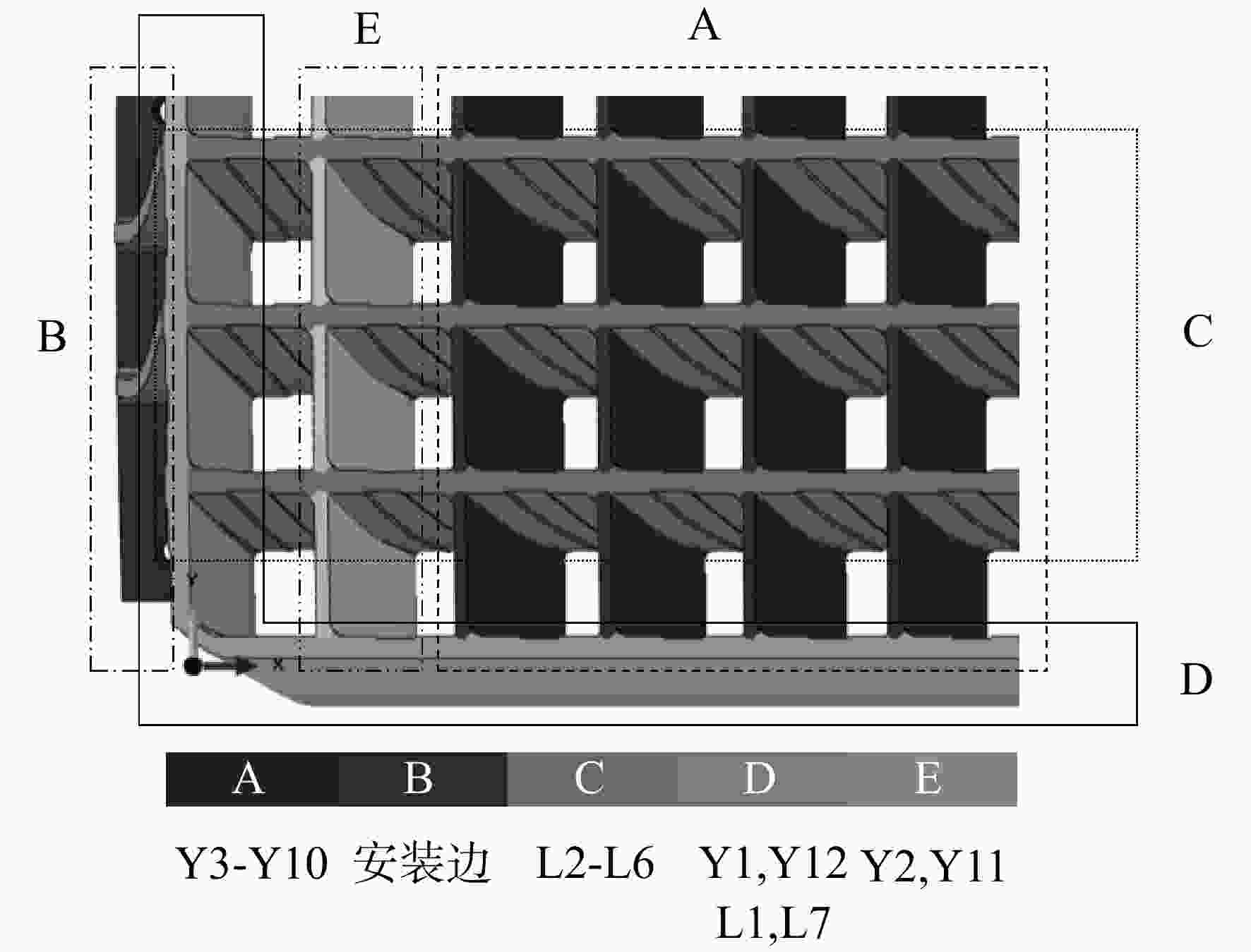
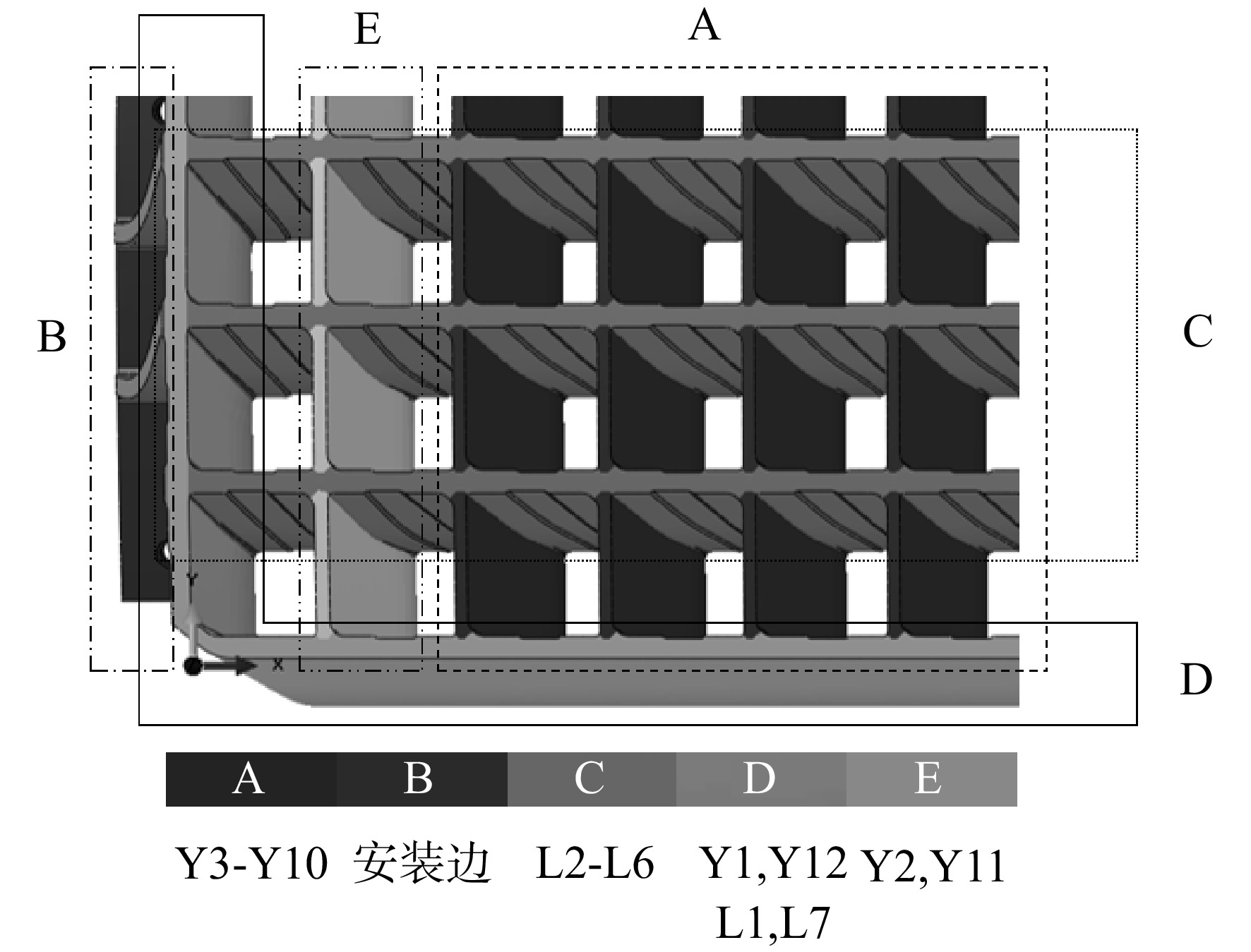
图 2 反推叶栅中各特征结构划分
Figure 2. Division of characteristic structures in the reverse thrust cascades

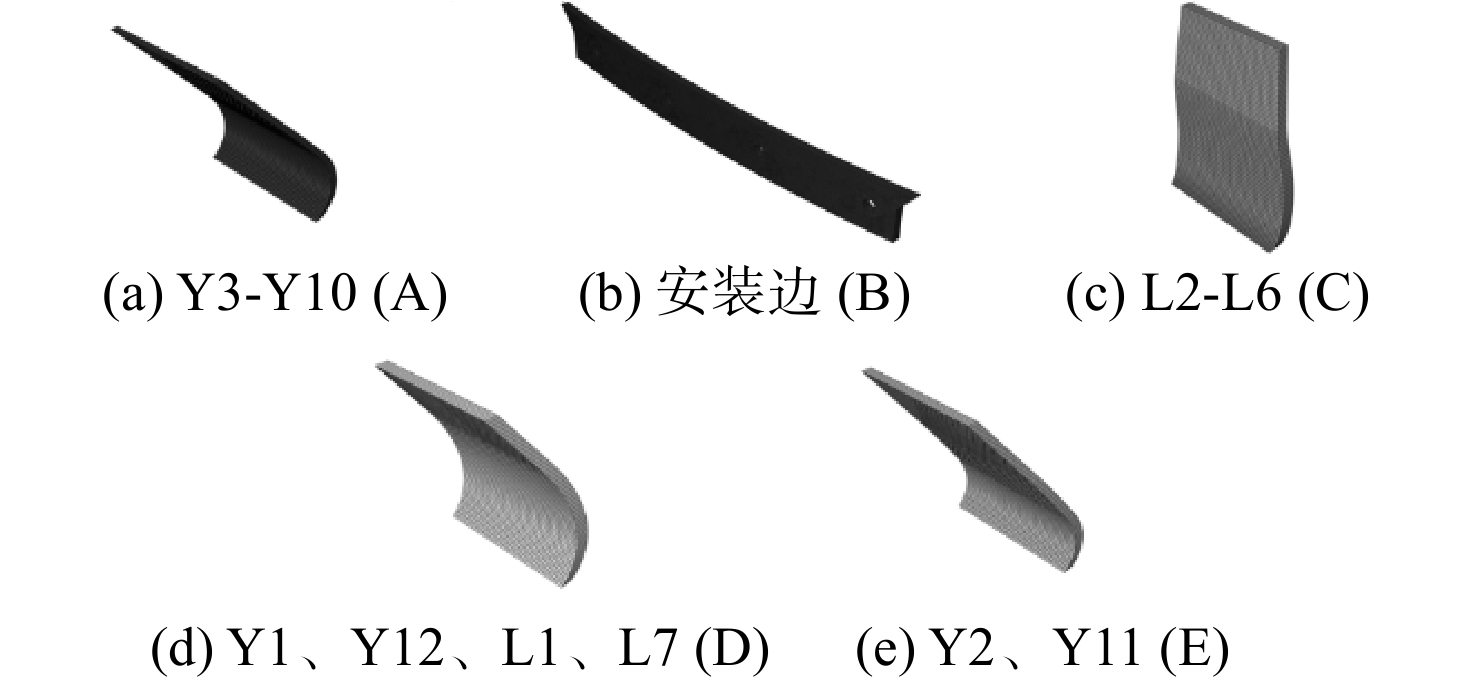
图 3 反推叶栅中5类结构代表模型
Figure 3. Representative model of five types in the reverse thrust cascade
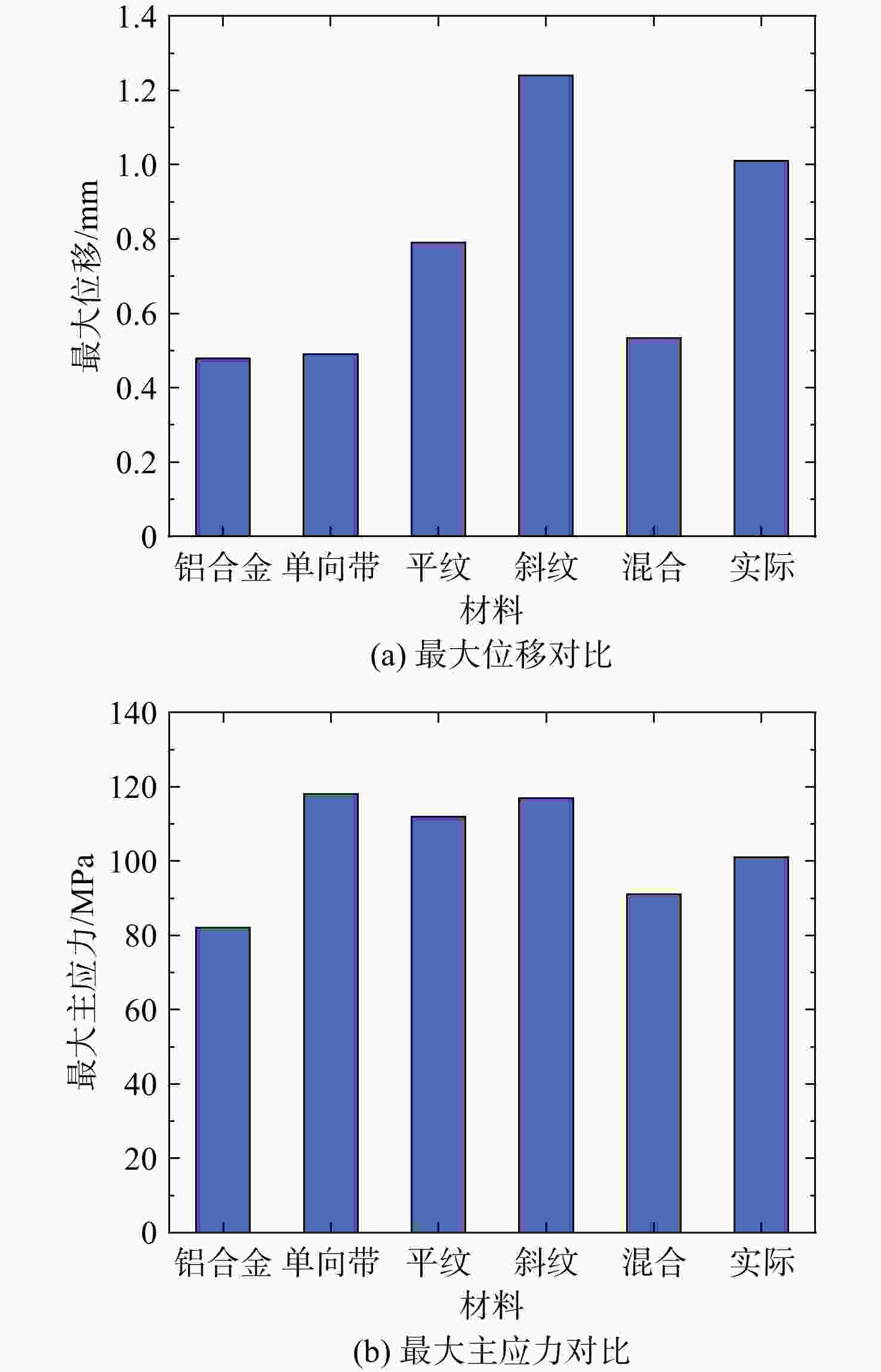
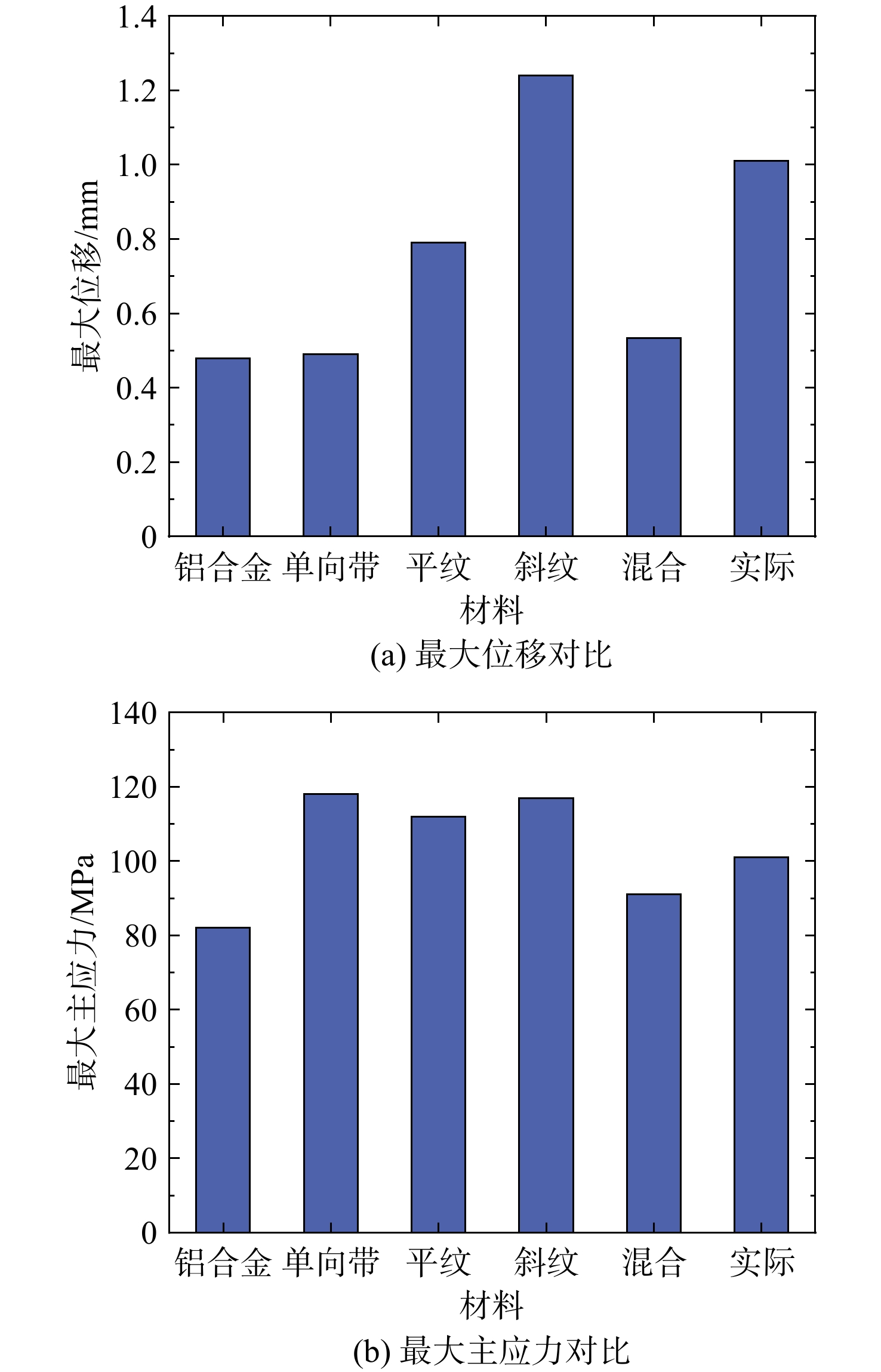
图 4 不同反推叶栅正常工况下最大位移及最大主应力对比
Figure 4. Comparison of maximum displacement and maximum principal stress of different reverse thrust cascades under normal working load
表 1 各结构受载下最大位移及最大主应力
Table 1. Maximum displacement and maximum principal stress of each structure under load
区域 最大位移/mm 最大主应力/MPa A 3.97×10⁻¹ 2.14×101 B 3.26×10⁻⁴ 3.34×10⁻¹ C 1.08×10⁻¹ 8.96 D 5.19×10⁻² 6.59 E 1.58×10⁻¹ 1.27×101  下载: 导出CSV
表 2 各结构单向带铺设铺层方案
Table 2. Unidirectional composite lay-up scheme of each structure
区域 铺层方案 A $ {\left[45/0/{-45}_{4}/\overline {0}\right]}_{{\mathrm{s}}} $ B $ {\left[{45}_{2}/-45/45/{-45}_{2}/{90/45}_{2}/{-45}_{2}/0/90\right]}_{{\mathrm{s}}} $ C $ {\left[0/45/0/45/-45/0/{-45}_{2}/0\right]}_{{\mathrm{s}}} $ D $ {\left[-45/90/{0}_{2}/-45/45/-45/{0}_{4}/\overline {0}\right]}_{{\mathrm{s}}} $ E $ {\left[{45}_{2}/0/-45/0/-45/45/-45/\overline {90}\right]}_{{\mathrm{s}}} $
下载: 导出CSV
表 3 各结构平纹织物铺设铺层方案
Table 3. Plain weave fabric lay-up scheme of each structure
区域 铺层方案 A $ {\left[{ (+/-45) }_{2}/{ (\mathrm{0,90}) }_{2}/{ (+/-45) }_{2}/\overline { (+/-45) }\right]}_{{\mathrm{s}}} $ B $ {\left[ (\mathrm{0,90}) /{ (+/-45) }_{4}/{ (\mathrm{0,90}) }_{4}/ (+/-45) /{ (\mathrm{0,90}) }_{2}/\overline { (+/-45) }\right]}_{{\mathrm{s}}} $ C $ {\left[ (+/-45) /{ (\mathrm{0,90}) }_{3}/ (+/-45) /{ (\mathrm{0,90}) }_{2}/{ (+/-45) }_{2}\right]}_{{\mathrm{s}}} $ D $ {\left[{ (\mathrm{0,90}) }_{4}/{ (+/-45) }_{7}/\overline { (+/-45) }\right]}_{{\mathrm{s}}} $ E $ {\left[ (+/-45) / (\mathrm{0,90}) /{ (+/-45) }_{4}/ (\mathrm{0,90}) / (+/-45) /\overline { (\mathrm{0,90}) }\right]}_{{\mathrm{s}}} $
下载: 导出CSV
表 4 各结构斜纹织物铺设铺层方案
Table 4. Twill weave fabric lay-up scheme of each structure
区域 铺层方案 A $ {\left[{ (+/-45) }_{2}/ (\mathrm{0,90}) /{ (+/-45) }_{2}/ (\mathrm{0,90}) /\overline { (+/-45) }\right]}_{{\mathrm{s}}} $ B $ {\left[{ (\mathrm{0,90}) }_{2}/{ (+/-45) }_{5}/ (\mathrm{0,90}) / (+/-45) /{ (\mathrm{0,90}) }_{2}/ (+/-45) / (\mathrm{0,90}) \right]}_{{\mathrm{s}}} $ C $ {\left[{ (+/-45)/ (\mathrm{0,90}) }_{7}/(+/-45)\right]}_{{\mathrm{s}}} $ D $ {\left[ (\mathrm{0,90}) /(+/-45)/{ (\mathrm{0,90}) }_{7}/(+/-45)/ (\mathrm{0,90}) /\overline { (\mathrm{0,90}) }\right]}_{{\mathrm{s}}} $ E $ {\left[ (+/-45) / (\mathrm{0,90}) /{ (+/-45) }_{5}/ (\mathrm{0,90}) /\overline { (+/-45) }\right]}_{{\mathrm{s}}} $
下载: 导出CSV
表 5 各结构单向带和平纹织物混合铺设铺层方案
Table 5. Unidirectional composite and plain weave fabric mixed lay-up scheme of each structure
区域 铺层方案 A $ {\left[ (+/-45) /0/{ (+/-45) }_{2}/0/ (\mathrm{0,90}) /\overline {0}\right]}_{{\mathrm{s}}} $ B $ {\left[ (+/-45) /-45/ (\mathrm{0,90}) /45/90/ (\mathrm{0,90}) /0/45/{ (+/-45) }_{2}/45/ (\mathrm{0,90}) / (+/-45) \right]}_{{\mathrm{s}}} $ C $ {\left[{ (\mathrm{0,90}) }_{2}/ (+/-45) /0/ (+/-45) /0/{ (+/-45) }_{2}/ (\mathrm{0,90}) \right]}_{{\mathrm{s}}} $ D $ {\left[{0}_{2}/-45/ (+/-45) /0/-45/ (\mathrm{0,90}) /0/ (+/-45) /{ (\mathrm{0,90}) }_{2}/\overline { (\mathrm{0,90}) }\right]}_{{\mathrm{s}}} $ E $ {\left[ (+/-45) / (\mathrm{0,90}) /{45}_{2}/{ (\mathrm{0,90}) }_{2}/ (+/-45) /45/\overline {0}\right]}_{{\mathrm{s}}} $
下载: 导出CSV
表 6 不同材料反推叶栅正常工况载荷下最大位移及最大主应力
Table 6. Maximum displacement and maximum principal stress of reverse thrust cascades made of different materials under normal working load
材料 最大位移/mm 最大主应力/MPa 铝合金 4.79×10⁻¹ 8.21×101 单向带 4.90×10⁻¹ 1.18×10² 平纹 7.91×10⁻¹ 1.12×10² 斜纹 1.24 1.17×10² 混合 5.34×10⁻¹ 9.11×101 实际 1.01 1.01×10²
下载: 导出CSV
表 7 复合材料反推叶栅相对于铝合金叶栅在工况下差距
Table 7. Difference between composite reverse thrust cascades and aluminum alloy cascades under working load
% 材料 最大位移 最大主应力 单向带 2.30 44.18 平纹 65.14 35.89 斜纹 158.87 42.72 混合 11.48 11.04 实际 110.86 22.97
下载: 导出CSV
-
[1] 杨洋, 代文猛, 年春波. 基于自适应遗传算法的层合板铺层优化设计[J]. 机械制造与自动化, 2020, 49(3): 22-25. YANG Yang, DAI Wenmeng, NIAN Chunbo. Optimum design of composite laminates based on adaptive genetic algorithms[J]. Machine Building & Automation, 2020, 49(3): 22-25. (in ChineseYANG Yang, DAI Wenmeng, NIAN Chunbo. Optimum design of composite laminates based on adaptive genetic algorithms[J]. Machine Building & Automation, 2020, 49(3): 22-25. (in Chinese) [2] 李军, 刘燕峰, 倪洪江, 等. 航空发动机用树脂基复合材料应用进展与发展趋势[J]. 材料工程, 2022, 50(6): 49-60. LI Jun, LIU Yanfeng, NI Hongjiang, et al. Application progress and development trend of resin matrix composites for aero engine[J]. Journal of Materials Engineering, 2022, 50(6): 49-60. (in Chinese doi: 10.11868/j.issn.1001-4381.2021.001242LI Jun, LIU Yanfeng, NI Hongjiang, et al. Application progress and development trend of resin matrix composites for aero engine[J]. Journal of Materials Engineering, 2022, 50(6): 49-60. (in Chinese) doi: 10.11868/j.issn.1001-4381.2021.001242 [3] 陈巍. 先进航空发动机树脂基复合材料技术现状与发展趋势[J]. 航空制造技术, 2016, 59(5): 68-72, 92. CHEN Wei. Status and development trends of polymer matrix composites on advanced aeroengine[J]. Aeronautical Manufacturing Technology, 2016, 59(5): 68-72, 92. (in ChineseCHEN Wei. Status and development trends of polymer matrix composites on advanced aeroengine[J]. Aeronautical Manufacturing Technology, 2016, 59(5): 68-72, 92. (in Chinese) [4] WILHELMSSON D, RIKEMANSON D, BRU T, et al. Compressive strength assessment of a CFRP aero-engine component: an approach based on measured fibre misalignment angles[J]. Composite Structures, 2020, 233: 111632. doi: 10.1016/j.compstruct.2019.111632 [5] GOPAL K V N. Product design for advanced composite materials in aerospace engineering[M]. Cambridge: Woodhead Publishing, 2016: 413-428. [6] 李红英, 汪冰峰. 航空航天用先进材料[M]. 北京: 化学工业出版社, 2019: 24-41. LI Hongying, WANG Bingfeng. Advanced materials for aerospace[M]. Beijing: Chemical Industry Press, 2019: 24-41. (in ChineseLI Hongying, WANG Bingfeng. Advanced materials for aerospace[M]. Beijing: Chemical Industry Press, 2019: 24-41. (in Chinese) [7] 杨际申. 反推装置格栅强度及其复材力学性能研究[D]. 北京: 北京航空航天大学, 2019. YANG Jishen. Research on the strength of the reverse thrust device grid and its composite material mechanical properties [D] Beijing: Beijing University of Aeronautics and Astronautics, 2019. (in ChineseYANG Jishen. Research on the strength of the reverse thrust device grid and its composite material mechanical properties [D] Beijing: Beijing University of Aeronautics and Astronautics, 2019. (in Chinese) [8] 杜刚, 金捷. 大型运输机发动机反推力装置[C]//大型飞机关键技术高层论坛暨中国航空学会2007年学术年会论文集. 深圳: 中国航空学会, 2007: 999-1009. DU Gang, JIN Jie. Large transport aircraft engine thrust reverser device[C]//High-level Forum on Key Technologies of Large Aircraft and Proceedings of the 2007 Academic Annual Conference of the Chinese Society of Aeronautics.Shen Zhen:Chinese Society of Aeronautics, 2007:999-1009.DU Gang, JIN Jie. Large transport aircraft engine thrust reverser device[C]//High-level Forum on Key Technologies of Large Aircraft and Proceedings of the 2007 Academic Annual Conference of the Chinese Society of Aeronautics.Shen Zhen:Chinese Society of Aeronautics, 2007:999-1009. [9] 王天龙. 反推力装置的复合材料叶栅结构强度设计及试验[D]. 北京: 北京航空航天大学, 2016. WANG Tianlong. Design and testing of composite cascade structure strength for reverse thrust devices [D] Beijing: Beijing University of Aeronautics and Astronautics, 2016. (in ChineseWANG Tianlong. Design and testing of composite cascade structure strength for reverse thrust devices [D] Beijing: Beijing University of Aeronautics and Astronautics, 2016. (in Chinese) [10] 梁春华, 李晓欣. 先进材料在战斗机发动机上的应用与研究趋势[J]. 航空材料学报, 2012, 32(6): 32-36. LIANG Chunhua, LI Xiaoxin. Application and development trend of advanced materials for fighter engine[J]. Journal of Aeronautical Materials, 2012, 32(6): 32-36. (in Chinese doi: 10.3969/j.issn.1005-5053.2012.6.004LIANG Chunhua, LI Xiaoxin. Application and development trend of advanced materials for fighter engine[J]. Journal of Aeronautical Materials, 2012, 32(6): 32-36. (in Chinese) doi: 10.3969/j.issn.1005-5053.2012.6.004 [11] 周何, 李小兵, 张婷, 等. 航空发动机复合材料风扇叶片制造工艺应用进展[J]. 航空制造技术, 2022, 65(13): 84-91. ZHOU He, LI Xiaobing, ZHANG Ting, et al. Application progress on manufacturing technology of composite fan blades for aero-engine[J]. Aeronautical Manufacturing Technology, 2022, 65(13): 84-91. (in ChineseZHOU He, LI Xiaobing, ZHANG Ting, et al. Application progress on manufacturing technology of composite fan blades for aero-engine[J]. Aeronautical Manufacturing Technology, 2022, 65(13): 84-91. (in Chinese) [12] 朱启晨, 陈勇, 肖贾光毅. 复合材料风扇叶片铺层设计方法研究[J]. 航空发动机, 2018, 44(3): 49-54. ZHU Qichen, CHEN Yong, XIAO Jiaguangyi. Study on laminate design method of composite fan blade[J]. Aeroengine, 2018, 44(3): 49-54. (in ChineseZHU Qichen, CHEN Yong, XIAO Jiaguangyi. Study on laminate design method of composite fan blade[J]. Aeroengine, 2018, 44(3): 49-54. (in Chinese) [13] 邢丽英, 包建文, 礼嵩明, 等. 先进树脂基复合材料发展现状和面临的挑战[J]. 复合材料学报, 2016, 33(7): 1327-1338. XING Liying, BAO Jianwen, LI Songming, et al. Development status and facing challenge of advanced polymer matrix composites[J]. Acta Materiae Compositae Sinica, 2016, 33(7): 1327-1338. (in ChineseXING Liying, BAO Jianwen, LI Songming, et al. Development status and facing challenge of advanced polymer matrix composites[J]. Acta Materiae Compositae Sinica, 2016, 33(7): 1327-1338. (in Chinese) [14] 薛忠民. 中国玻璃钢/复合材料发展回顾与展望[J]. 玻璃钢/复合材料, 2015(1): 5-12. XUE Zhongmin. Retrospect and prospect of development of FRP/CM in China[J]. Fiber Reinforced Plastics/Composites, 2015(1): 5-12. (in ChineseXUE Zhongmin. Retrospect and prospect of development of FRP/CM in China[J]. Fiber Reinforced Plastics/Composites, 2015(1): 5-12. (in Chinese) [15] 杜善义. 先进复合材料与航空航天[J]. 复合材料学报, 2007, 24(1): 1-12. DU Shanyi. Advanced composite materials and aerospace engineering[J]. Acta Materiae Compositae Sinica, 2007, 24(1): 1-12. (in Chinese doi: 10.3321/j.issn:1000-3851.2007.01.001DU Shanyi. Advanced composite materials and aerospace engineering[J]. Acta Materiae Compositae Sinica, 2007, 24(1): 1-12. (in Chinese) doi: 10.3321/j.issn:1000-3851.2007.01.001 [16] 亚历山大·I. J. 福瑞斯特, 安德瑞斯·索比斯特, 安迪·J. 肯尼. 基于代理模型的工程设计: 实用指南[M]. 韩忠华, 张科施译. 北京: 航空工业出版社, 2018. ALEXANDER I J F, ANDRAS S, ANDY J K. Engineering Design via Surrogate Modelling: A Practical Guide[M]. Translated by HAN Zhonghua, Zhang keshi. Beijing: Aviation Industry Press, 2018. (in ChineseALEXANDER I J F, ANDRAS S, ANDY J K. Engineering Design via Surrogate Modelling: A Practical Guide[M]. Translated by HAN Zhonghua, Zhang keshi. Beijing: Aviation Industry Press, 2018. (in Chinese) [17] WU Jinglai, LUO Zhen, ZHENG Jing, et al. Incremental modeling of a new high-order polynomial surrogate model[J]. Applied Mathematical Modelling, 2016, 40(7/8): 4681-4699. [18] CHEN Guodong, ZHANG Kai, XUE Xiaoming, et al. A radial basis function surrogate model assisted evolutionary algorithm for high-dimensional expensive optimization problems[J]. Applied Soft Computing, 2022, 116: 108353. doi: 10.1016/j.asoc.2021.108353 [19] PIETRENKO-DABROWSKA A, KOZIEL S. Cost-efficient surrogate modeling of high-frequency structures using nested Kriging with automated adjustment of model domain lateral dimensions[J]. AEU-International Journal of Electronics and Communications, 2020, 121: 153224. doi: 10.1016/j.aeue.2020.153224 [20] PFROMMER J, ZIMMERLING C, LIU Jinzhao, et al. Optimisation of manufacturing process parameters using deep neural networks as surrogate models[J]. Procedia CIRP, 2018, 72: 426-431. doi: 10.1016/j.procir.2018.03.046 [21] IRISARRI F X, PEETERS D M J, ABDALLA M M. Optimisation of ply drop order in variable stiffness laminates[J]. Composite Structures, 2016, 152: 791-799. doi: 10.1016/j.compstruct.2016.05.076 [22] PAN Zhouzhou, ZHANG Luwen, LIEW K M. Adaptive surrogate-based harmony search algorithm for design optimization of variable stiffness composite materials[J]. Computer Methods in Applied Mechanics and Engineering, 2021, 379: 113754. doi: 10.1016/j.cma.2021.113754 [23] LU Yifu, TONG Liyong. Concurrent optimization of topologies and fiber orientations for laminated composite structures[J]. Composite Structures, 2022, 295: 115749. doi: 10.1016/j.compstruct.2022.115749 [24] 张伟, 魏刚, 肖新科. 2A12铝合金本构关系和失效模型[J]. 兵工学报, 2013, 34(3): 276-282. ZHANG Wei, WEI Gang, XIAO Xinke. Constitutive relation and fracture criterion of 2A12 aluminum alloy[J]. Acta Armamentarii, 2013, 34(3): 276-282. (in ChineseZHANG Wei, WEI Gang, XIAO Xinke. Constitutive relation and fracture criterion of 2A12 aluminum alloy[J]. Acta Armamentarii, 2013, 34(3): 276-282. (in Chinese) [25] 黄心宇. 双向弯曲复合材料格栅结构静强度试验研究[D]. 北京: 北京航空航天大学, 2019. HUANG Xinyu. Experimental study on static strength of bidirectional bending composite material grid structure [D] Beijing: Beijing University of Aeronautics and Astronautics, 2019. (in ChineseHUANG Xinyu. Experimental study on static strength of bidirectional bending composite material grid structure [D] Beijing: Beijing University of Aeronautics and Astronautics, 2019. (in Chinese) [26] 刘强, 马小康, 宗志坚. 斜纹机织碳纤维/环氧树脂复合材料性能及其在电动汽车轻量化设计中的应用[J]. 复合材料学报, 2011, 28(5): 83-88. LIU Qiang, MA Xiaokang, ZONG Zhijian. Properties of twill-weave carbon fabric/epoxy composites and its application on light-weight design for electric vehicles[J]. Acta Materiae Compositae Sinica, 2011, 28(5): 83-88. (in ChineseLIU Qiang, MA Xiaokang, ZONG Zhijian. Properties of twill-weave carbon fabric/epoxy composites and its application on light-weight design for electric vehicles[J]. Acta Materiae Compositae Sinica, 2011, 28(5): 83-88. (in Chinese) -

 点击查看大图

计量
- 文章访问数: 468
- HTML浏览量: 242
- PDF量: 33
- 被引次数: 0