






Fatigue limit evaluation of repaired blades based on the theory of critical distance
-
摘要:
外物损伤是影响航空发动机风扇和压气机叶片服役安全的重要因素。对于尺寸较小的外物损伤缺口,通常采用机加或手工打磨方式进行维修。为了准确评估机加和打磨修复的缺口叶片疲劳性能,本文首先测试了机加和打磨修复叶片的高周疲劳极限,然后基于临界距离理论建立了疲劳极限评估模型,分析了不同应力选取方法对模型精度的影响,并与经典Peterson模型进行了对比。结果表明:基于临界距离理论建立的模型可以准确预测机加和手工打磨等修复工艺的缺口叶片疲劳极限;在临界距离模型中,使用主应力绝对值的最大值进行预测与使用沿叶片长度方向正应力进行预测差别很小;其模型精度(平均误差小于11%)远高于Peterson经典模型(平均误差26.03%)。
-
关键词:
- 钛合金叶片 /
- 修复处理 /
- 高周疲劳极限 /
- 临界距离理论 /
- Peterson模型
Abstract:Foreign object damage is an important factor affecting the service of aeroengine fan and compressor blades. Small foreign object damaged notch can be typically repaired by machining or polishing. To evaluate the fatigue properties of the machined and polished blades, the high-cycle fatigue strength of the machined and polished blades was tested, and the fatigue limit prediction model was built based on the theory of critical distance, and compared with the classical Peterson model. The influences of different stress selection methods on the accuracy of the model were analyzed. The results showed that the model based on the theory of critical distance can accurately predict the fatigue limit of repaired notched blades, including a variety of repair processes, such as machining and polishing. There was little difference between the prediction using the maximum absolute value of the principal stress and the normal stress along the blade length. The model accuracy from theory of critical distance (average error less than 11%) was much higher than the classical Peterson’s model (average error 26.03%).
-

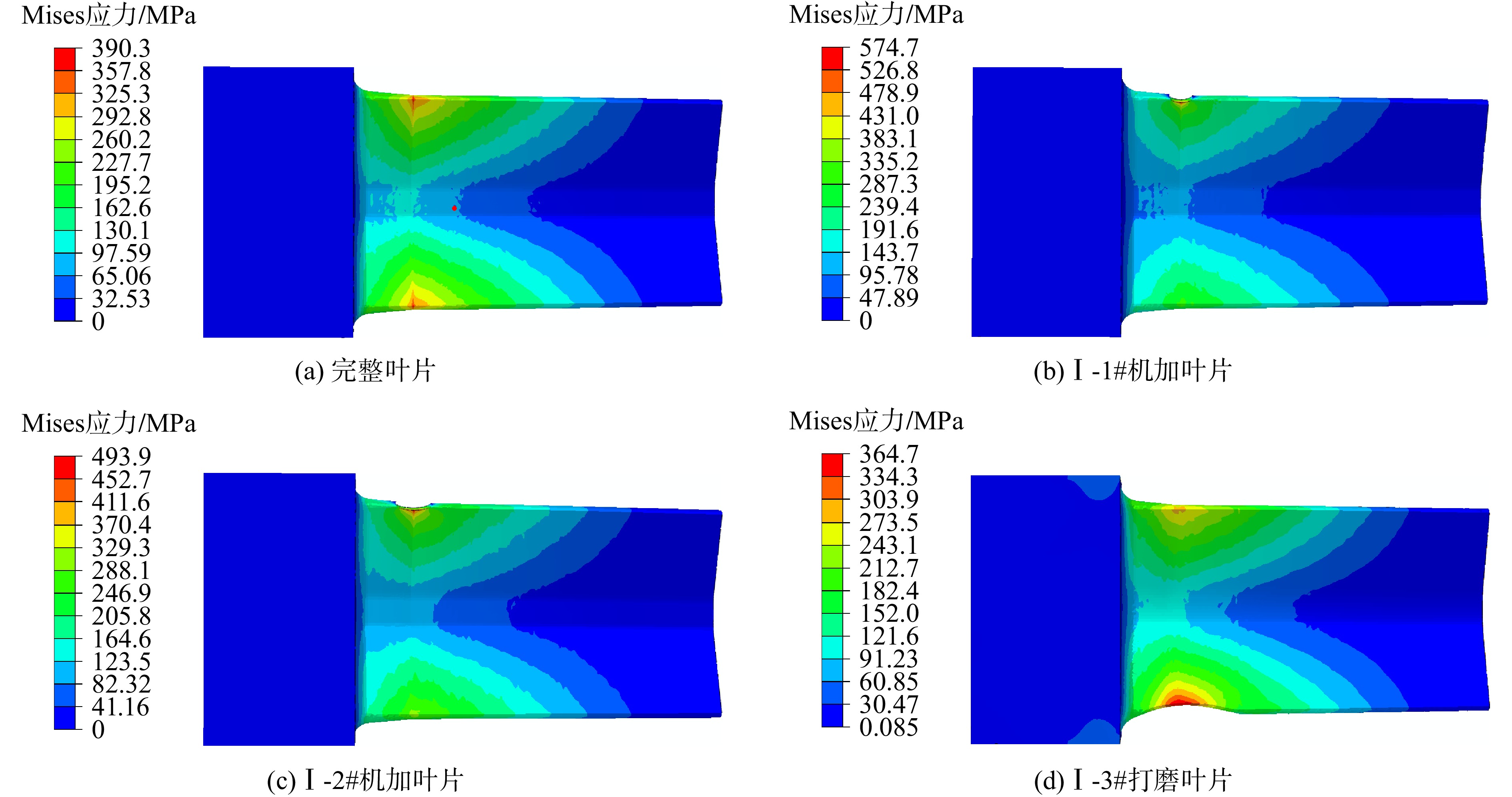
图 7 有限元仿真计算的Mises应力云图
Figure 7. Mises stress nephogram of the finite element simulation

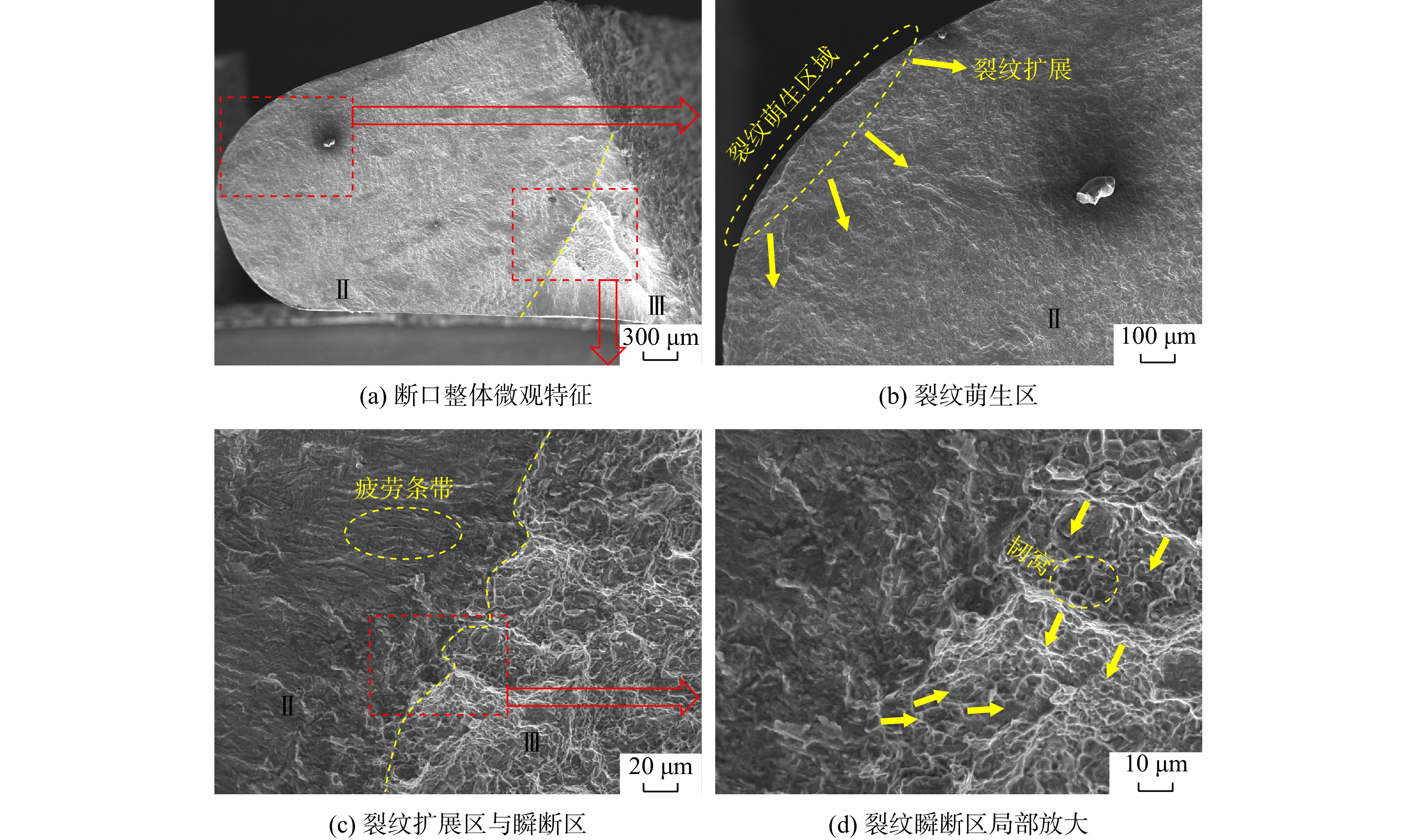
图 8 Ⅰ-3#打磨叶片振动疲劳断口的微观特征
Figure 8. Ⅰ-3# microscopic features of polished blade’ vibration fatigue fracture

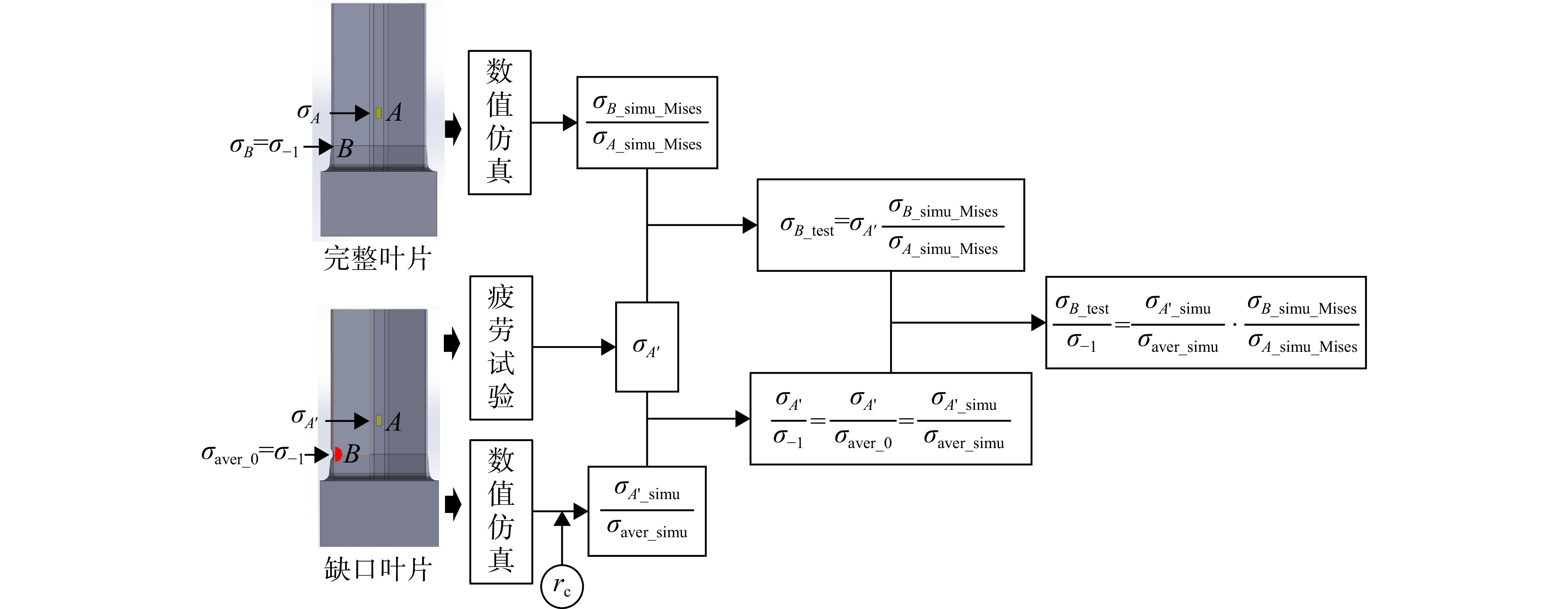
图 9 基于临界距离理论的缺口叶片疲劳极限评估模型建模过程
Figure 9. Modeling process of notched blade fatigue limit prediction based on the critical distance theory

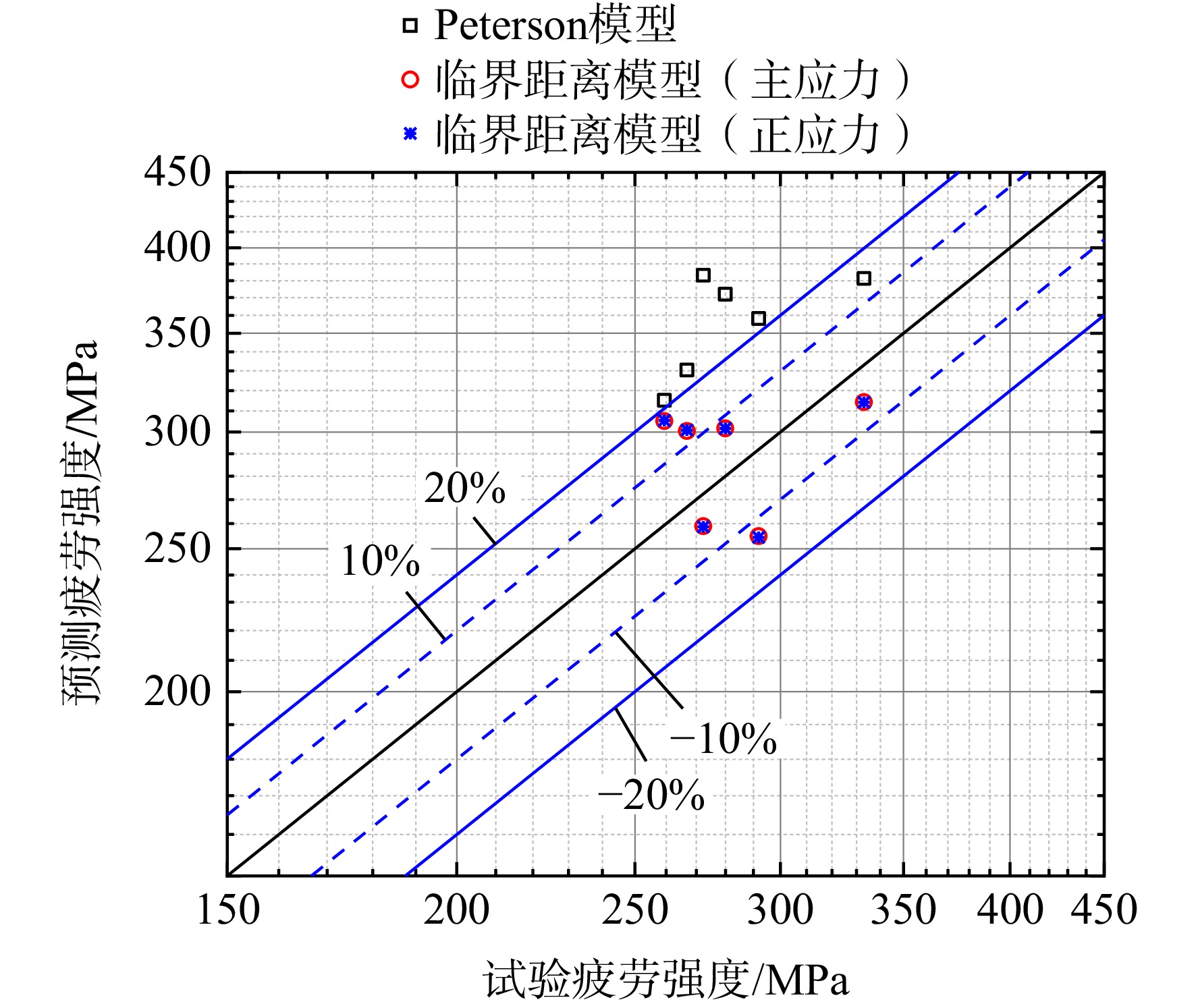
图 10 机加/打磨修复叶片的疲劳极限预测结果
Figure 10. Fatigue limit predicted results of machined/polished repaired blades
表 1 疲劳极限测试结果
Table 1. Results of fatigue limit tests
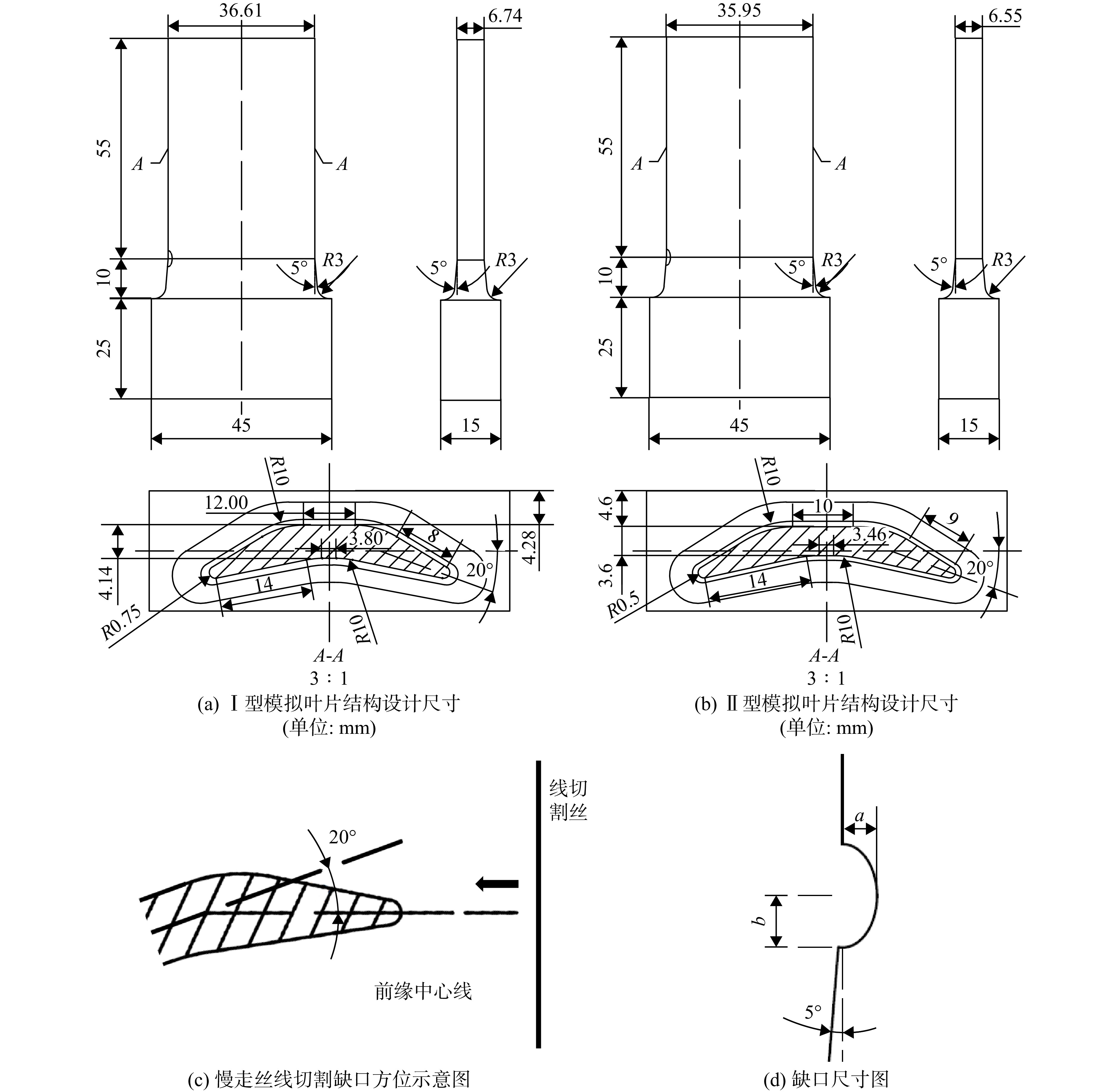
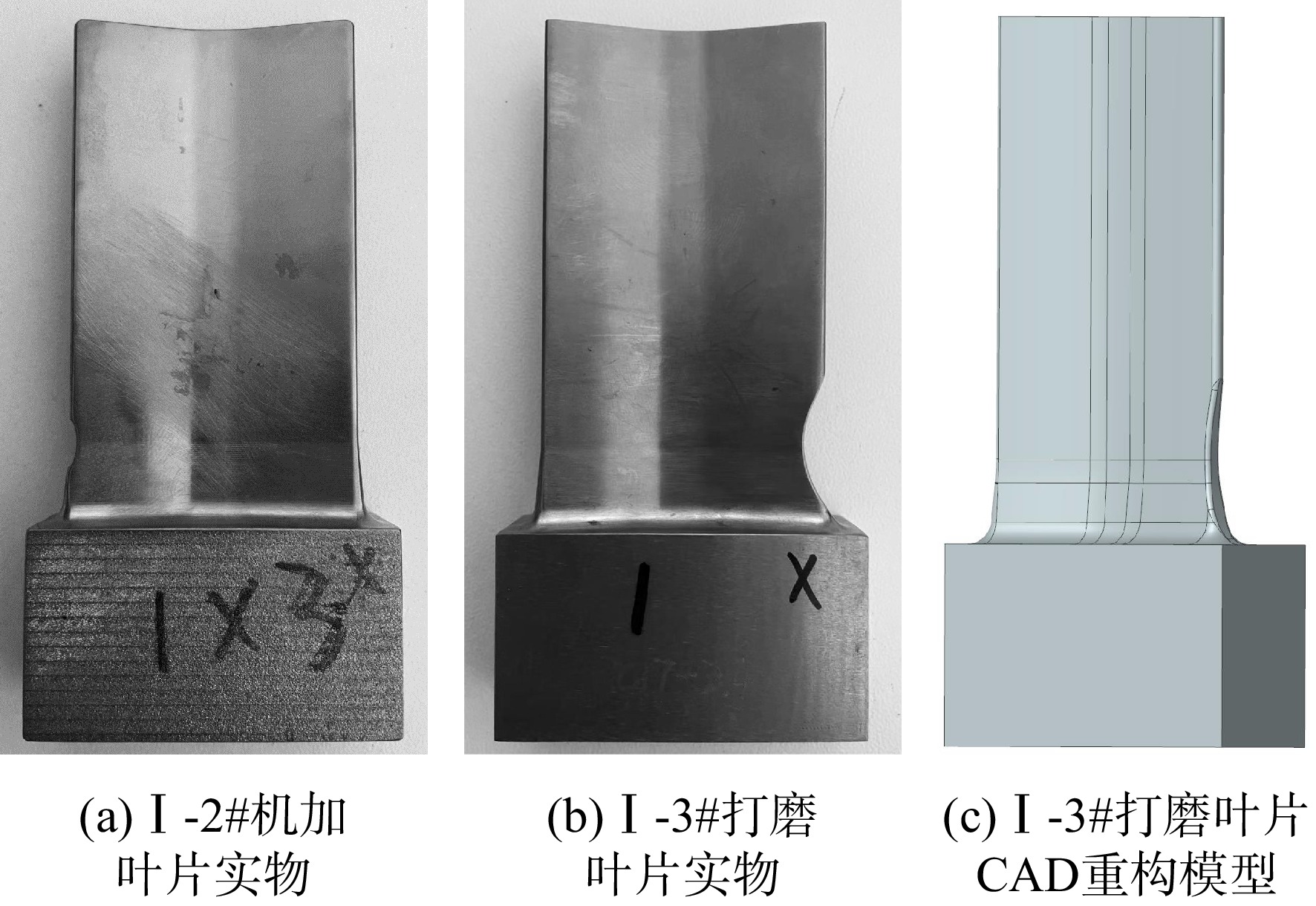
试件编号 类型 缺口宽度2b/mm 缺口深度a/mm 应力集中系数 测点处疲劳极限/MPa 结构疲劳极限/MPa Ⅰ-1# 机加 4 1 1.597 43.85 259.38 Ⅰ-2# 机加 6 1 1.314 56.31 333.05 Ⅰ-3# 打磨 17.05 1.662 1.306 54.88 272.33 Ⅱ-1# 机加 4 1 1.523 34.48 266.80 Ⅱ-2# 机加 6 1 1.347 36.18 279.97 Ⅱ-3# 打磨 16.13 2.12 1.397 47.55 291.92  下载: 导出CSV
表 2 模型的预测结果
Table 2. Predicted results of the model
参数 Ⅰ-1# Ⅰ-2# Ⅰ-3# Ⅱ-1# Ⅱ-2# Ⅱ-3# σe=259.38 MPa σe=333.05 MPa σe=272.33 MPa σe=266.80 MPa σe=279.97 MPa σe=291.92 MPa 临界距离模型
(主应力)rc/mm 0.86 1.59 1.62 1.01 1.07 1.92 rc平均值 η = 2.0,rc = 1.3558 mm预测值/MPa 305.18 314.30 258.95 300.44 301.67 254.94 误差/% 10.20±4.95 临界距离模型
(正应力)rc/mm 0.84 1.56 1.60 0.98 1.05 1.90 rc平均值 η = 2.0,rc = 1.3325 mm预测值/MPa 305.44 314.25 258.72 300.96 301.67 254.47 误差/% 10.30±4.99 Peterson
模型预测值/MPa 315.20 381.29 383.14 330.49 372.07 358.16 误差/% 26.03±8.48
下载: 导出CSV
-
[1] 杨百愚, 柴桥, 李春旺, 等. 外物撞击航空发动机转子叶片速度估算[J]. 航空动力学报, 2017, 32(12): 2842-2847. YANG Baiyu, CHAI Qiao, LI Chunwang, et al. Estimation of velocity for foreign object that impacting rotor blade of aero-engine[J]. Journal of Aerospace Power, 2017, 32(12): 2842-2847. (in ChineseYANG Baiyu, CHAI Qiao, LI Chunwang, et al. Estimation of velocity for foreign object that impacting rotor blade of aero-engine[J]. Journal of Aerospace Power, 2017, 32(12): 2842-2847. (in Chinese) [2] 关玉璞, 陈伟, 高德平. 航空发动机叶片外物损伤研究现状[J]. 航空学报, 2007, 28(4): 851-857. GUAN Yupu, CHEN Wei, GAO Deping. Present status of investigation of foreign object damage to blade in aeroengine[J]. Acta Aeronautica et Astronautica Sinica, 2007, 28(4): 851-857. (in ChineseGUAN Yupu, CHEN Wei, GAO Deping. Present status of investigation of foreign object damage to blade in aeroengine[J]. Acta Aeronautica et Astronautica Sinica, 2007, 28(4): 851-857. (in Chinese) [3] 黄云, 肖贵坚, 邹莱. 航空发动机叶片机器人精密砂带磨削研究现状及发展趋势[J]. 航空学报, 2019, 40(3): 022508. HUANG Yun, XIAO Guijian, ZOU Lai. Current situation and development trend of robot precise belt grinding for aero-engine blade[J]. Acta Aeronautica et Astronautica Sinica, 2019, 40(3): 022508. (in ChineseHUANG Yun, XIAO Guijian, ZOU Lai. Current situation and development trend of robot precise belt grinding for aero-engine blade[J]. Acta Aeronautica et Astronautica Sinica, 2019, 40(3): 022508. (in Chinese) [4] PETERS J O, BOYCE B L, THOMPSON A W, et al. Role of foreign-object damage on thresholds for high-cycle fatigue in Ti-6Al-4V[J]. Metallurgical and Materials Transactions A, 2000, 31(6): 1571-1583. doi: 10.1007/s11661-000-0167-2 [5] MARTINEZ C M, EYLON D, NICHOLAS T, et al. Effects of ballistic impact damage on fatigue crack initiation in Ti-6Al-4V simulated engine blades[J]. Materials Science and Engineering: A, 2002, 325(1/2): 465-477. [6] WITEK L. Numerical stress and crack initiation analysis of the compressor blades after foreign object damage subjected to high-cycle fatigue[J]. Engineering Failure Analysis, 2011, 18(8): 2111-2125. doi: 10.1016/j.engfailanal.2011.07.002 [7] 赵振华, 陈伟, 关玉璞, 等. 外物损伤对不锈钢疲劳强度的影响 [J]. 航空动力学报, 2016, 31(7): 1736-43. ZHAO Zhenhua, CHEN Wei, GUAN Yupu, et al. Effect of foreign object damage on fatigue strength of stainless steel[J]. Journal of Aerospace Power, 2016, 31(7): 1736-1743. (in ChineseZHAO Zhenhua, CHEN Wei, GUAN Yupu, et al. Effect of foreign object damage on fatigue strength of stainless steel[J]. Journal of Aerospace Power, 2016, 31(7): 1736-1743. (in Chinese) [8] NEUBER H. Theory of notch stresses: principles for exact stress calculation (Kerbspannungslehre: grundlagen für genaue spannungsrechnung)[M] Berlin, Julius Springer, 1937. [9] 李德勇, 姚卫星. 缺口件振动疲劳寿命分析的名义应力法[J]. 航空学报, 2011, 32(11): 2036-2041. LI Deyong, YAO Weixing. Nominal stress approach for life prediction of notched specimens under vibration loading[J]. Acta Aeronautica et Astronautica Sinica, 2011, 32(11): 2036-2041. (in ChineseLI Deyong, YAO Weixing. Nominal stress approach for life prediction of notched specimens under vibration loading[J]. Acta Aeronautica et Astronautica Sinica, 2011, 32(11): 2036-2041. (in Chinese) [10] HUDAK S J, CHAN K S, CHELL G G, et al. A damage tolerance approach for predicting the threshold stresses for high cycle fatigue in the presence of supplemental damage[J]. TMS Annual Meeting, 2002: 107-120. [11] BERTO F, LAZZARIN P. The volume-based strain energy density approach applied to static and fatigue strength assessments of notched and welded structures[J]. Procedia Engineering, 2009, 1(1): 155-158. doi: 10.1016/j.proeng.2009.06.036 [12] SCHUSCHA M, LEITNER M, STOSCHKA M, et al. Local strain energy density approach to assess the fatigue strength of sharp and blunt V-notches in cast steel[J]. International Journal of Fatigue, 2020, 132: 105334. doi: 10.1016/j.ijfatigue.2019.105334 [13] TAYLOR D. Geometrical effects in fatigue: a unifying theoretical model[J]. International Journal of Fatigue, 1999, 21(5): 413-420. doi: 10.1016/S0142-1123(99)00007-9 [14] ZHOU Liucheng, WANG Lingfeng, SHANG Yibo, et al. High cycle fatigue limit prediction of foreign object damaged aerofoil samples by the theory of critical distance[J]. Vacuum, 2022, 203: 111220. doi: 10.1016/j.vacuum.2022.111220 [15] HU Dianyin, YAN Lin, MAO Jianxing, et al. A life prediction model coupled with residual stress and initial damage on aerofoil specimens subjected to foreign object damage[J]. International Journal of Fatigue, 2022, 154: 106559. doi: 10.1016/j.ijfatigue.2021.106559 [16] BERTO F, LAZZARIN P. A review of the volume-based strain energy density approach applied to V-notches and welded structures[J]. Theoretical and Applied Fracture Mechanics, 2009, 52(3): 183-194. doi: 10.1016/j.tafmec.2009.10.001 [17] HU X T, WAN Y W, JIANG R, et al. Fatigue strength prediction of TC4 titanium alloy following foreign object damage based on contour feature[J]. Journal of Mechanical Science and Technology, 2019, 33(10): 4727-4734. doi: 10.1007/s12206-019-0819-7 [18] ZHAO Zhenhua, WANG Lingfeng, ZHANG Junhe, et al. Prediction of high-cycle fatigue strength in a Ti-17 alloy blade after foreign object damage[J]. Engineering Fracture Mechanics, 2021, 241: 107385. doi: 10.1016/j.engfracmech.2020.107385 [19] ULUTAN D, OZEL T. Machining induced surface integrity in titanium and nickel alloys: a review[J]. International Journal of Machine Tools and Manufacture, 2011, 51(3): 250-280. doi: 10.1016/j.ijmachtools.2010.11.003 [20] WANG Jinlong, PENG Wenjie, YU Jing, et al. Effect of surface roughness on the fatigue failure and evaluation of TC17 titanium alloy[J]. Materials Science and Technology, 2021, 37(3): 301-313. doi: 10.1080/02670836.2021.1885777 [21] MANJAIAH M, NARENDRANATH S, BASAVARAJAPPA S. A review on machining of titanium based alloys using EDM and WEDM[J]. Rev Adv Mater Sci, 2014, 36(2): 89-111. [22] SUSMEL L, TAYLOR D. An elasto-plastic reformulation of the theory of critical distances to estimate lifetime of notched components failing in the low/medium-cycle fatigue regime[J]. Journal of Engineering Materials and Technology, 2010, 132(2): 021002. doi: 10.1115/1.4000667 [23] SUSMEL L, TOVO R. Estimating fatigue damage under variable amplitude multiaxial fatigue loading[J]. Fatigue & Fracture of Engineering Materials & Structures, 2011, 34(12): 1053-1077. [24] BELLETT D, TAYLOR D, MARCO S, et al. The fatigue behaviour of three-dimensional stress concentrations[J]. International Journal of Fatigue, 2005, 27(3): 207-221. doi: 10.1016/j.ijfatigue.2004.07.006 [25] YAO Weixing, XIA Kaiquan, GU Yi. On the fatigue notch factor, Kf [J]. International Journal of Fatigue, 1995, 17(4): 245-251. doi: 10.1016/0142-1123(95)93538-D [26] STEPHENS R I, FATEMI A, STEPHENS R R, et al. Metal fatigue in engineering [M]. New York: John Wiley & Sons, 2000. -

 点击查看大图

计量
- 文章访问数: 595
- HTML浏览量: 301
- PDF量: 66
- 被引次数: 0