






Aerodynamic and discrete frequency noise characteristics of contra-rotating propfans under take-off conditions
-
摘要:
为在对转桨扇的气动设计反问题阶段进行气动优化设计与低噪声特性设计,基于Farassat推导的Ffowcs Williams-Hawkings方程时域解公式Formu 1A,全新编写了对转桨扇离散噪声计算程序FODNOPPa2。对一台用可压升力面理论设计的对转桨扇模型CRPFt,在飞行高度为300 m,飞行马赫数为0.24的起飞工况下,得到了分布在5条典型型线上与机身同步运动观测点处的对转桨扇气动离散噪声。其中用计算流体力学软件NUMECA FINE™/Turbo的非线性谐波求解器获得三维黏性准非定常流场,提取噪声计算的输入气动载荷。结果表明:非线性谐波法可准确地计算出CRPFt在起飞工况下的三维黏性准非定常流场。在两桨中间平面附近的观测点处转子谐波的声压级(SPL)较大,在距离中间平面较远的观测点处干涉谐波的声压级较大。
Abstract:To carry out the aerodynamic optimization design and the low-noise-characteristic design of the contra-rotating propfans in the aerodynamic design inverse problem phase, a program FODNOPPa2, specifically for predicting the discrete frequency noise, was recently developed. Based on the formulation Formu 1A derived by Farassat, this program offered the time-domain solutions of the Ffowcs Williams-Hawkings equation. By utilizing this program, the discrete frequency noise of a model contra-rotating propfans called CRPFt, which was designed using compressible lifting surface theory, was acquired under the take-off condition with a flying altitude 300 m and a Mach number 0.24. Observation points were synchronized with the movement of the fuselage and distributed across five representative lines or curves. Utilizing the nonlinear harmonic solver available in the computational fluid dynamics software NUMECA FINE™/Turbo, it tried to acquire a three-dimensional viscous quasi-unsteady flow field and to extract the aerodynamic loads as the input of the noise calculation. This study demonstrated that the nonlinear harmonic approach was capable of effectively simulating the three-dimensional viscous quasi-unsteady flow field of CRPFt under the take-off condition. Typically, the sound pressure level (SPL) of the rotor harmonics held a greater significance than the SPL of the interference harmonics at the observation points situated in close proximity to the middle plane between the two propfans. Nevertheless, the SPL of the interference harmonics had more significance when measured at the observation points located further away from the middle plane.
-

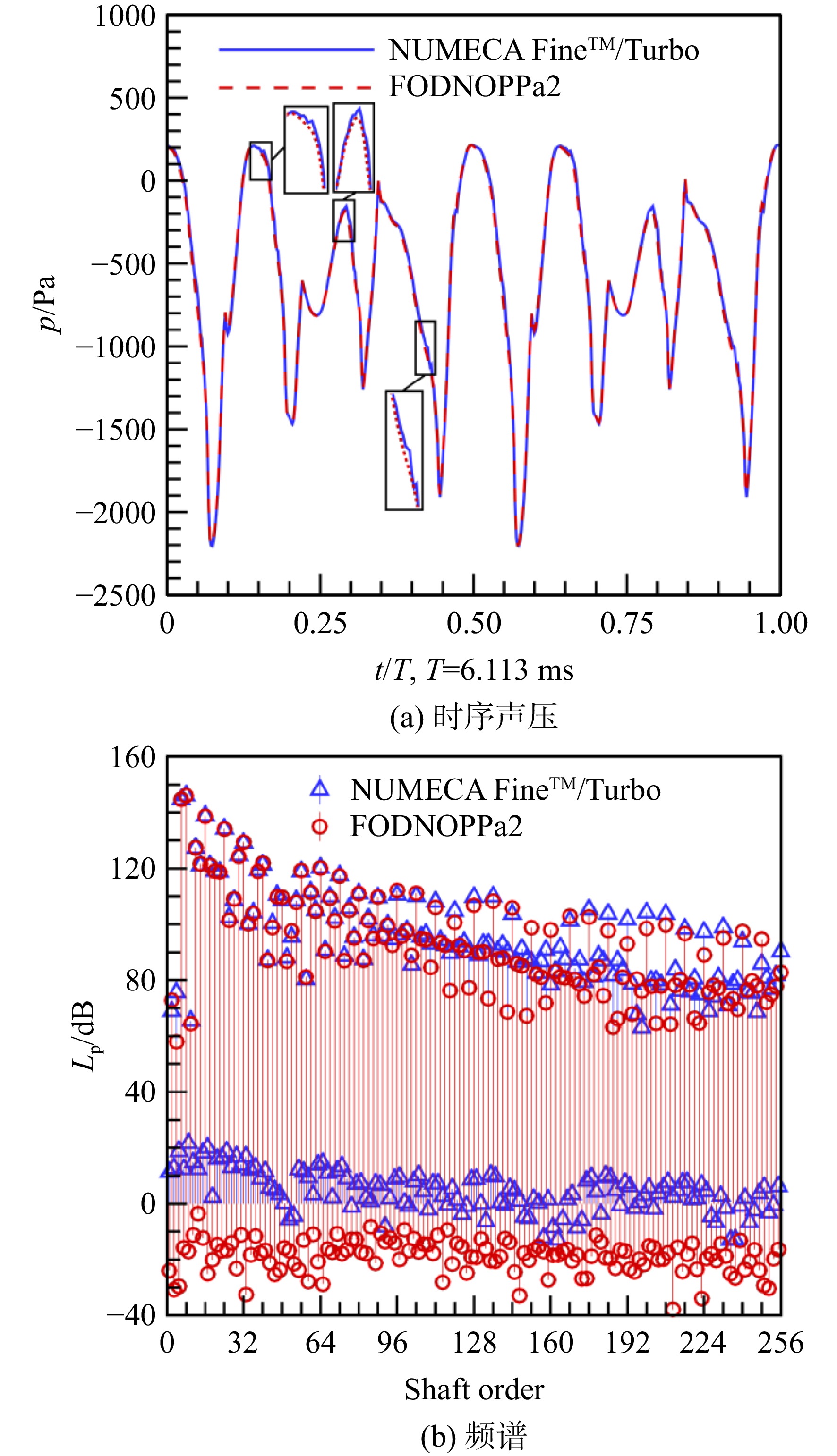
图 2 两种程序计算的CRPFt起飞工况下的总噪声
Figure 2. Overall noise of CRPFt under take-off condition calculated separately by two codes
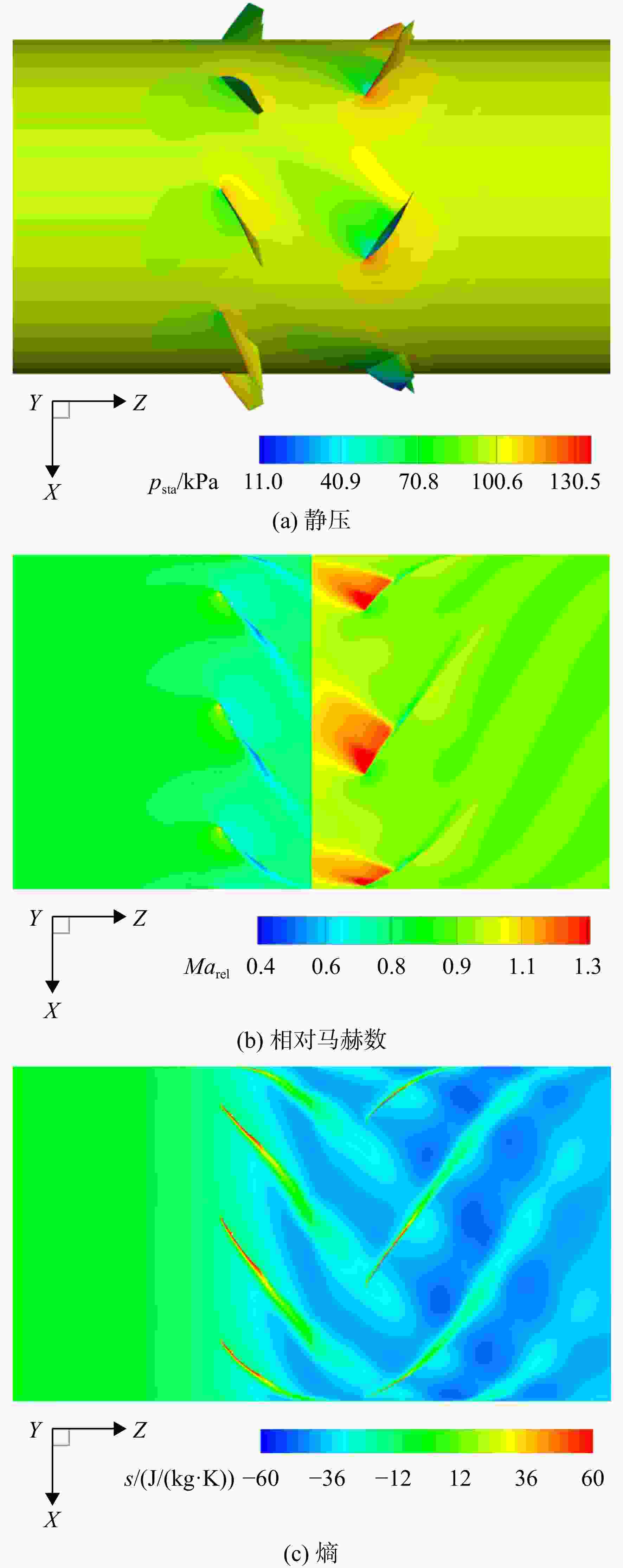
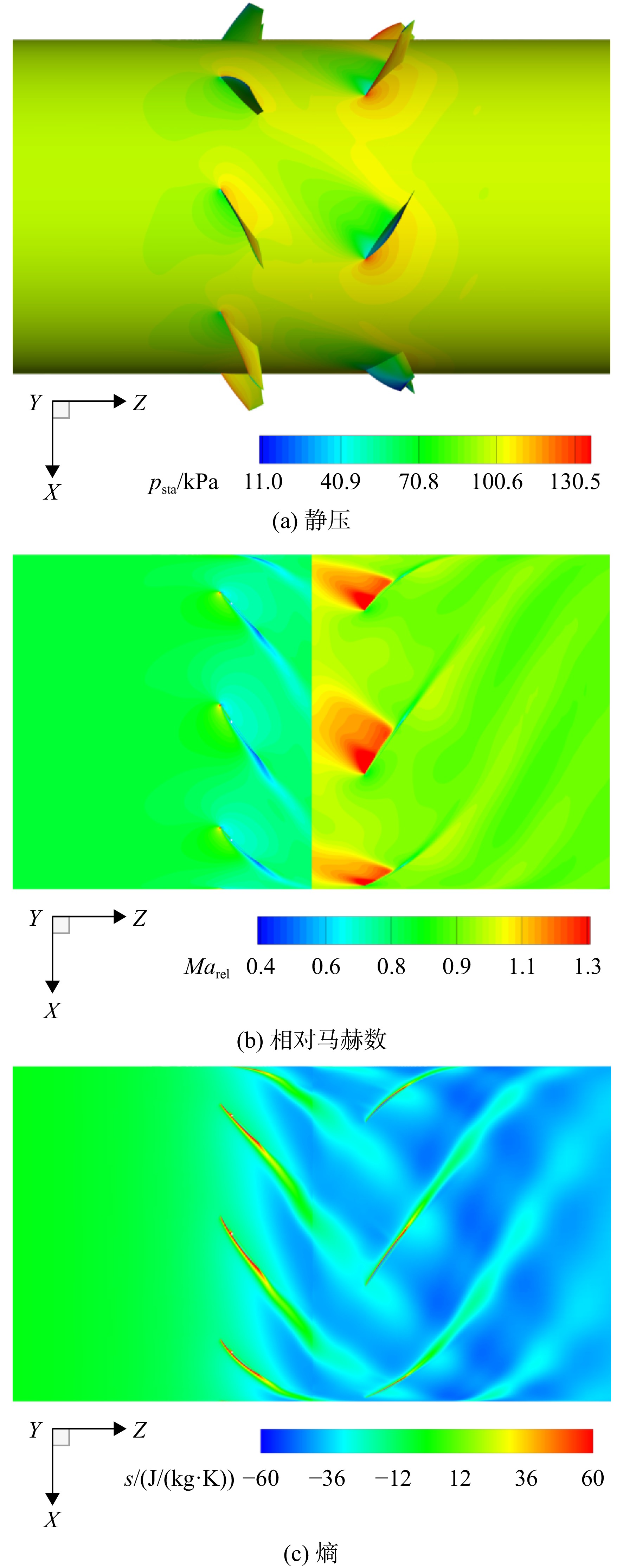
图 3 t = 0时刻CRPFt流场r/R = 0.8圆柱截面的静压、相对马赫数、熵的分布
Figure 3. Distribution of static pressure, relative Mach number and entropy of CRPFt at r/R = 0.8 cylindrical section at time t = 0
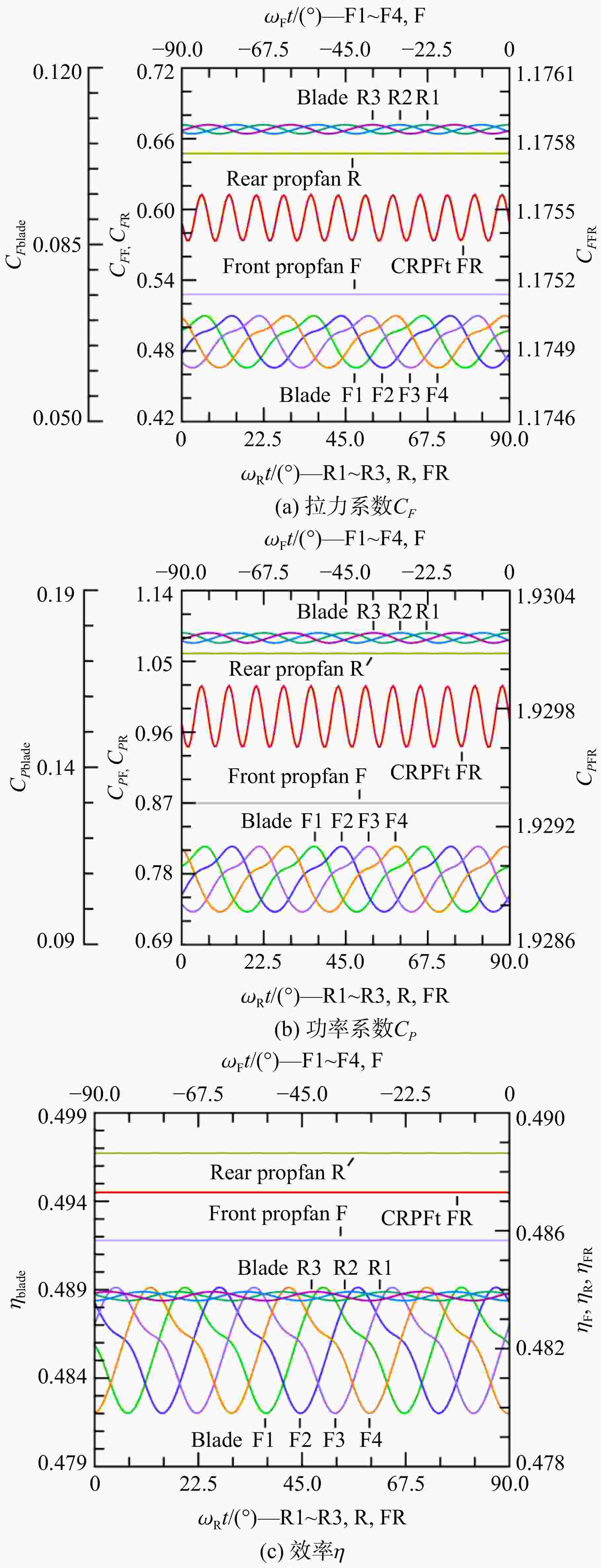
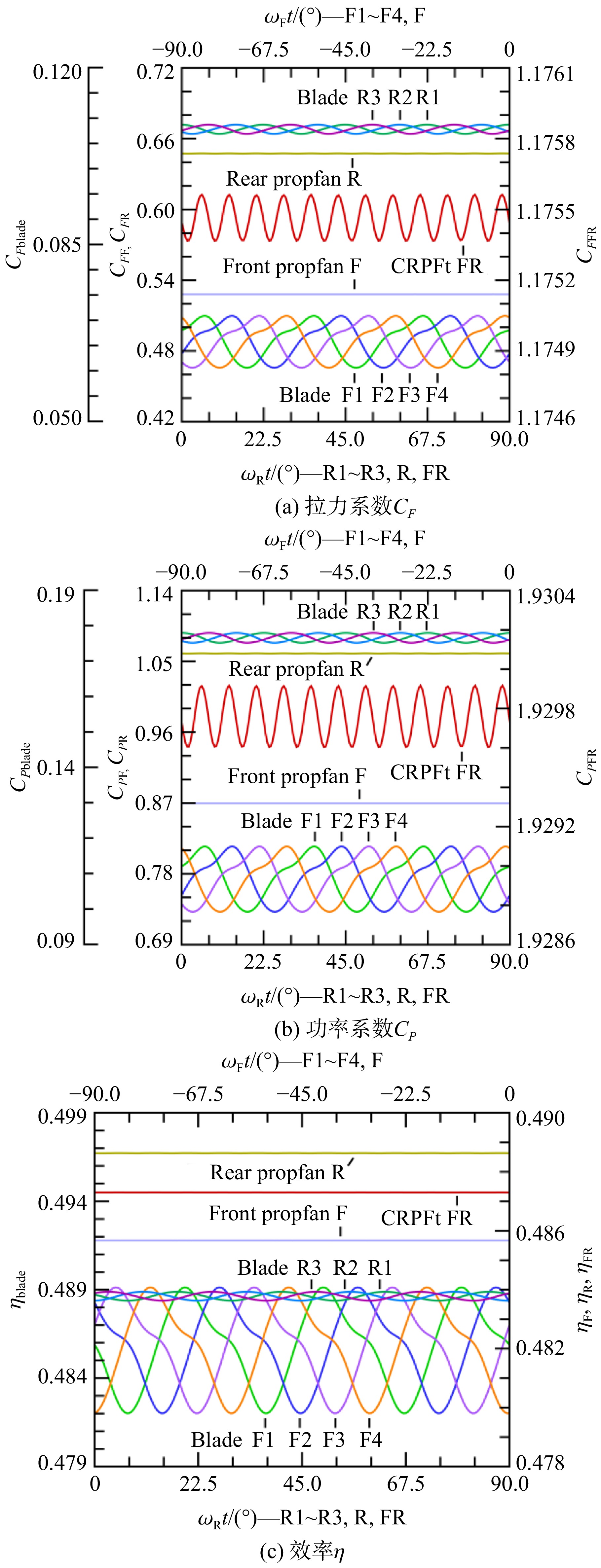
图 4 NUMECA NLH计算的CRPFt的性能变化曲线
Figure 4. Performance variation curves calculated with NUMECA NLH for CRPFt
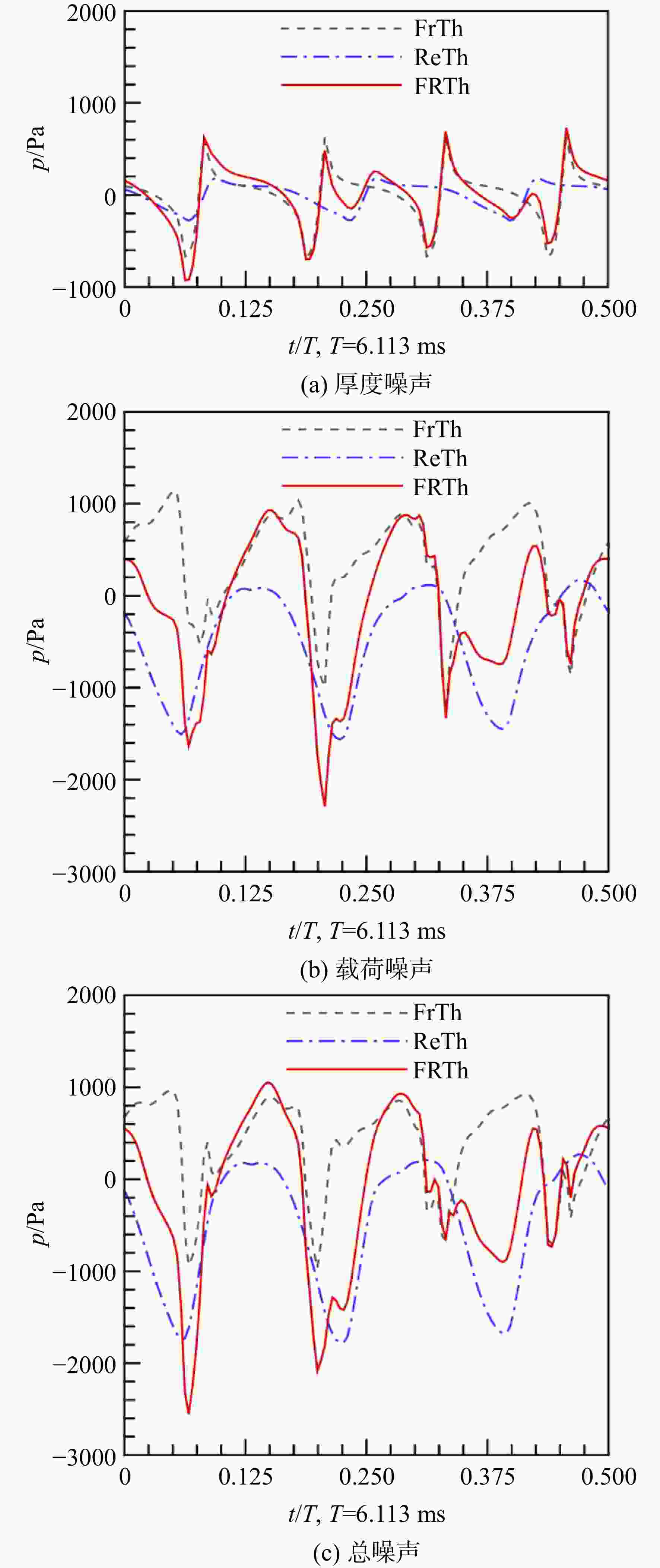
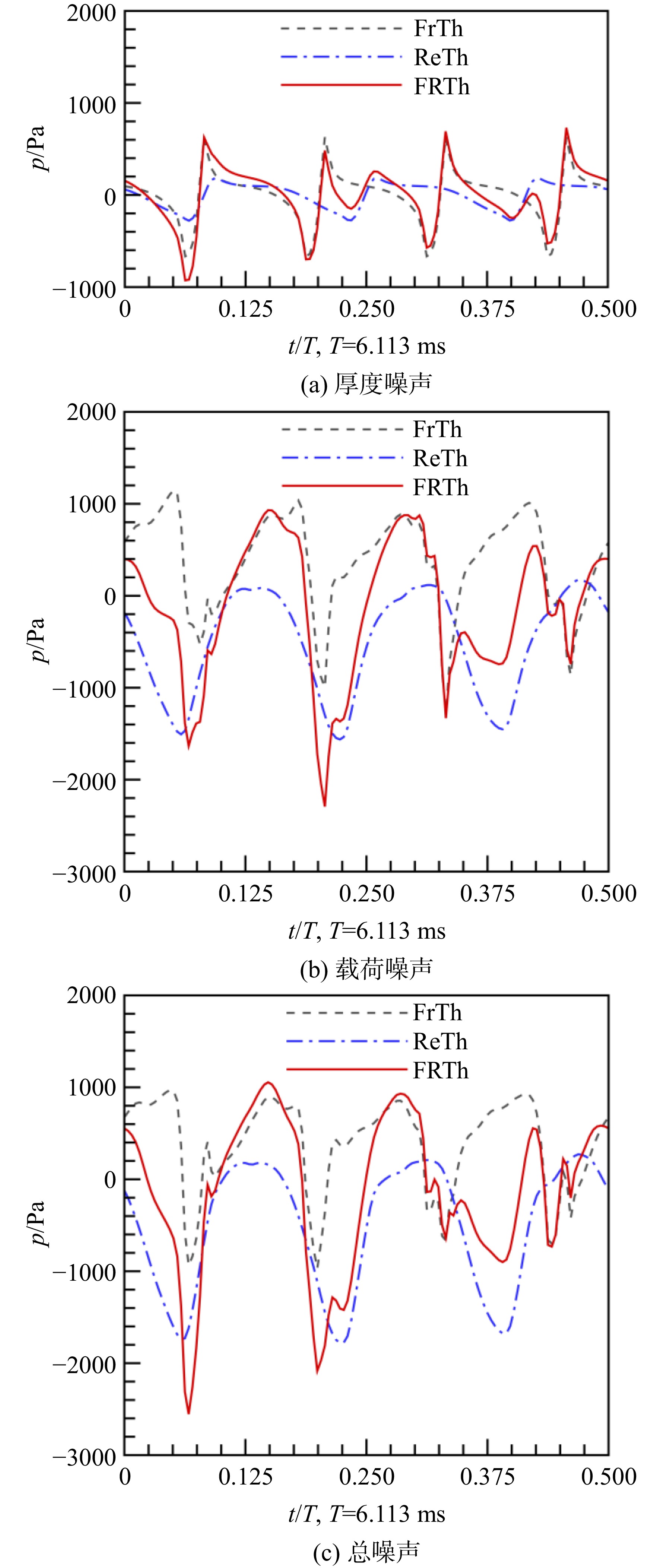
图 6 水平直线段LinH中间观测点处单个、两个转子产生离散噪声的时序声压变化曲线
Figure 6. Time series acoustics pressure variation curves of discrete noise generated by single and two rotors at middle observation point of horizontal line segment LinH

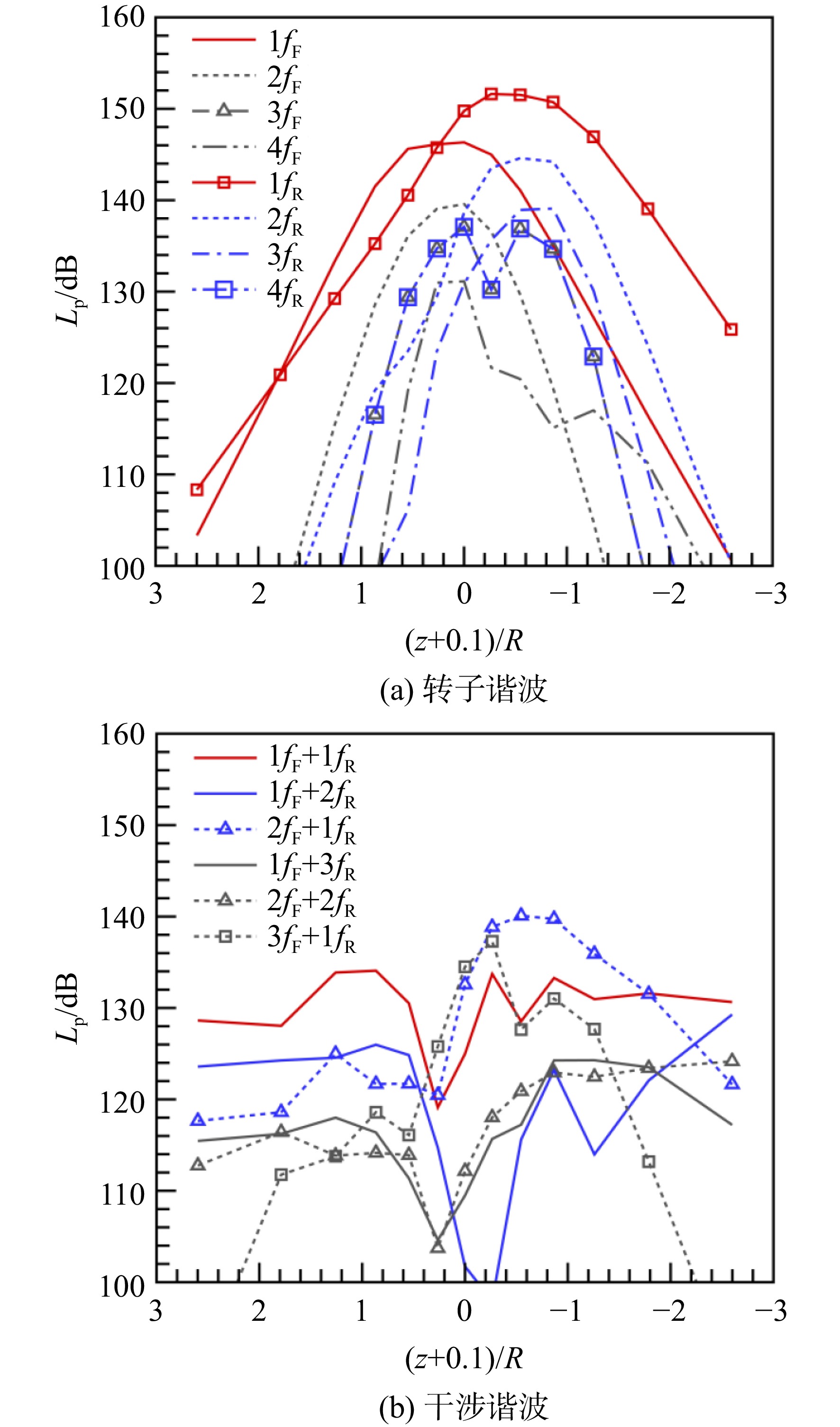
图 7 沿水平直线段LinH两个转子离散总噪声主要谐波声压级的变化
Figure 7. Sound pressure level variations of dominant harmonics of overall discrete noise of two rotors along horizontal line segment LinH
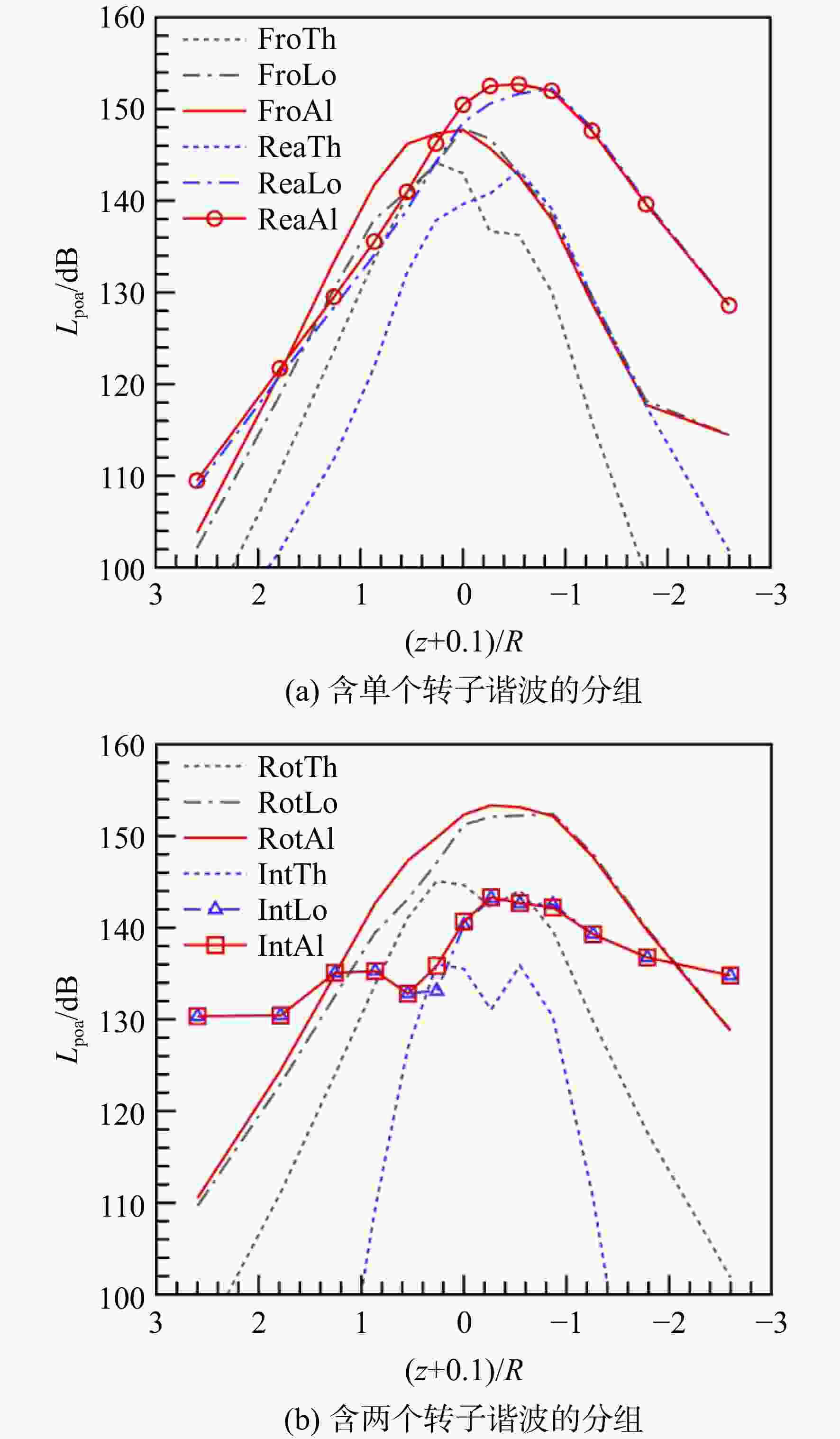
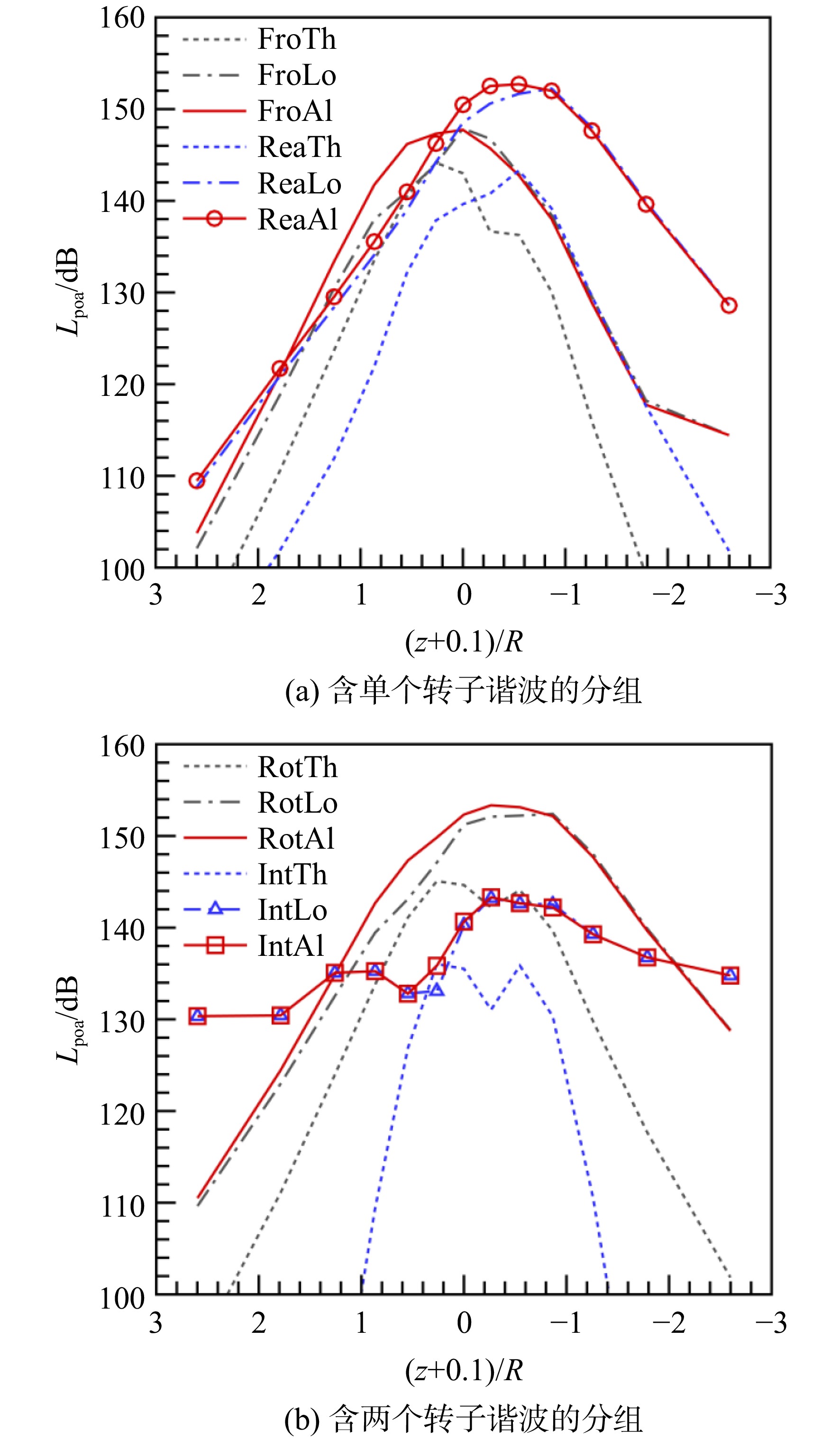
图 8 沿水平直线段LinH两个转子离散噪声的分组谐波总声压级的变化
Figure 8. Overall sound pressure level variations of grouped harmonics of discrete noise of two rotors along horizontal line segment LinH
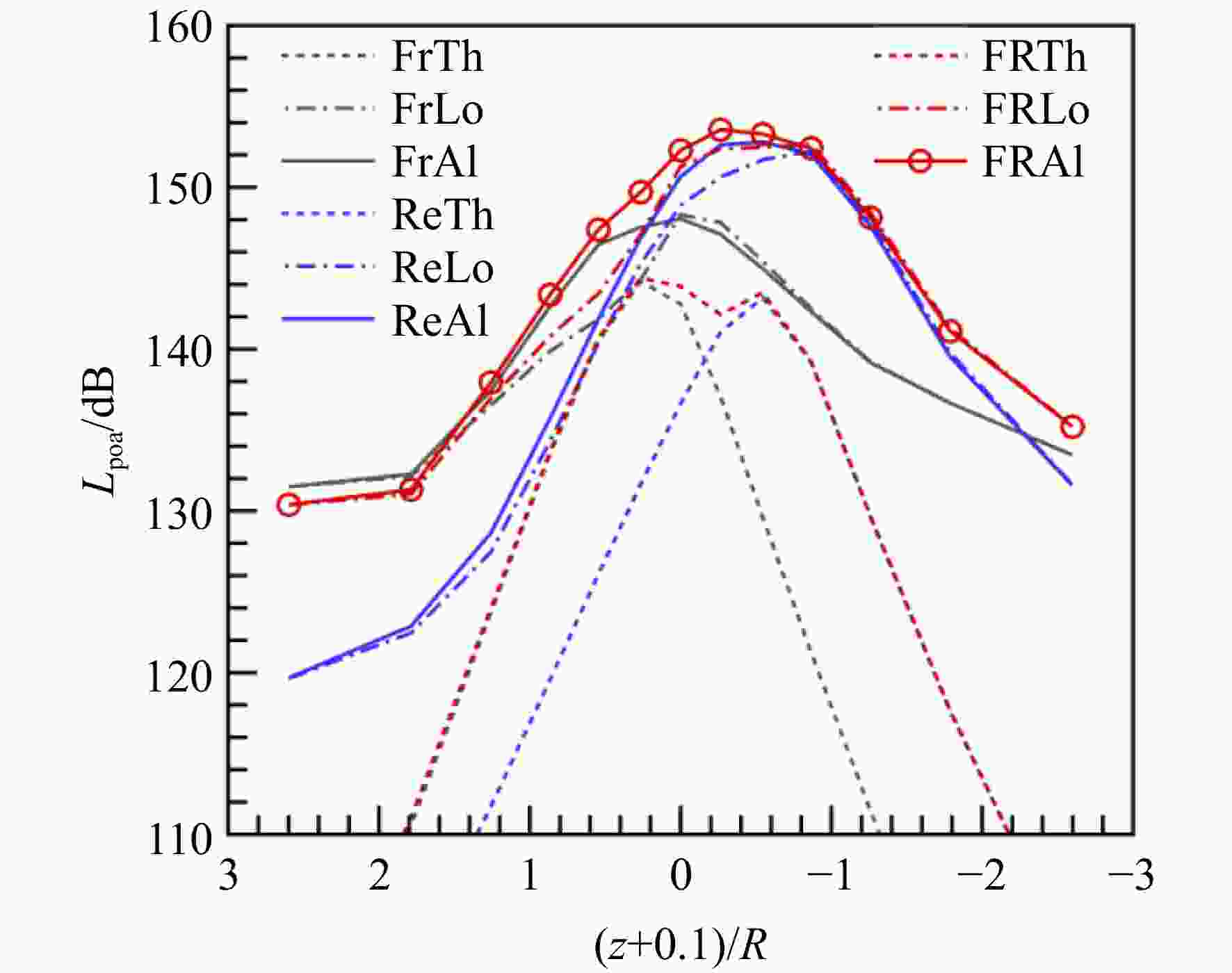
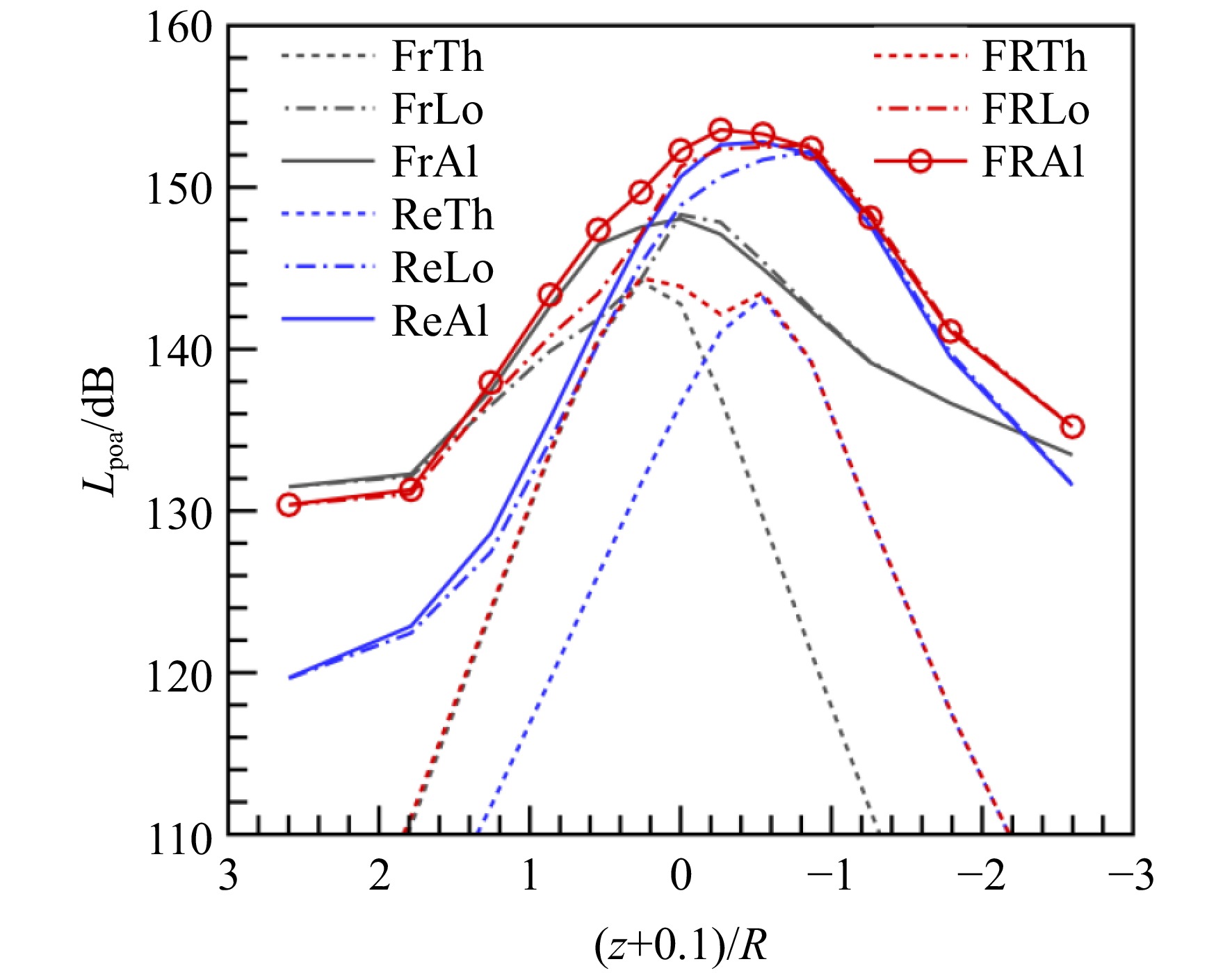
图 9 沿水平直线段LinH单个、两个转子离散噪声总声压级的变化
Figure 9. Overall sound pressure level variations of discrete noise of single and two rotors along horizontal line segment LinH

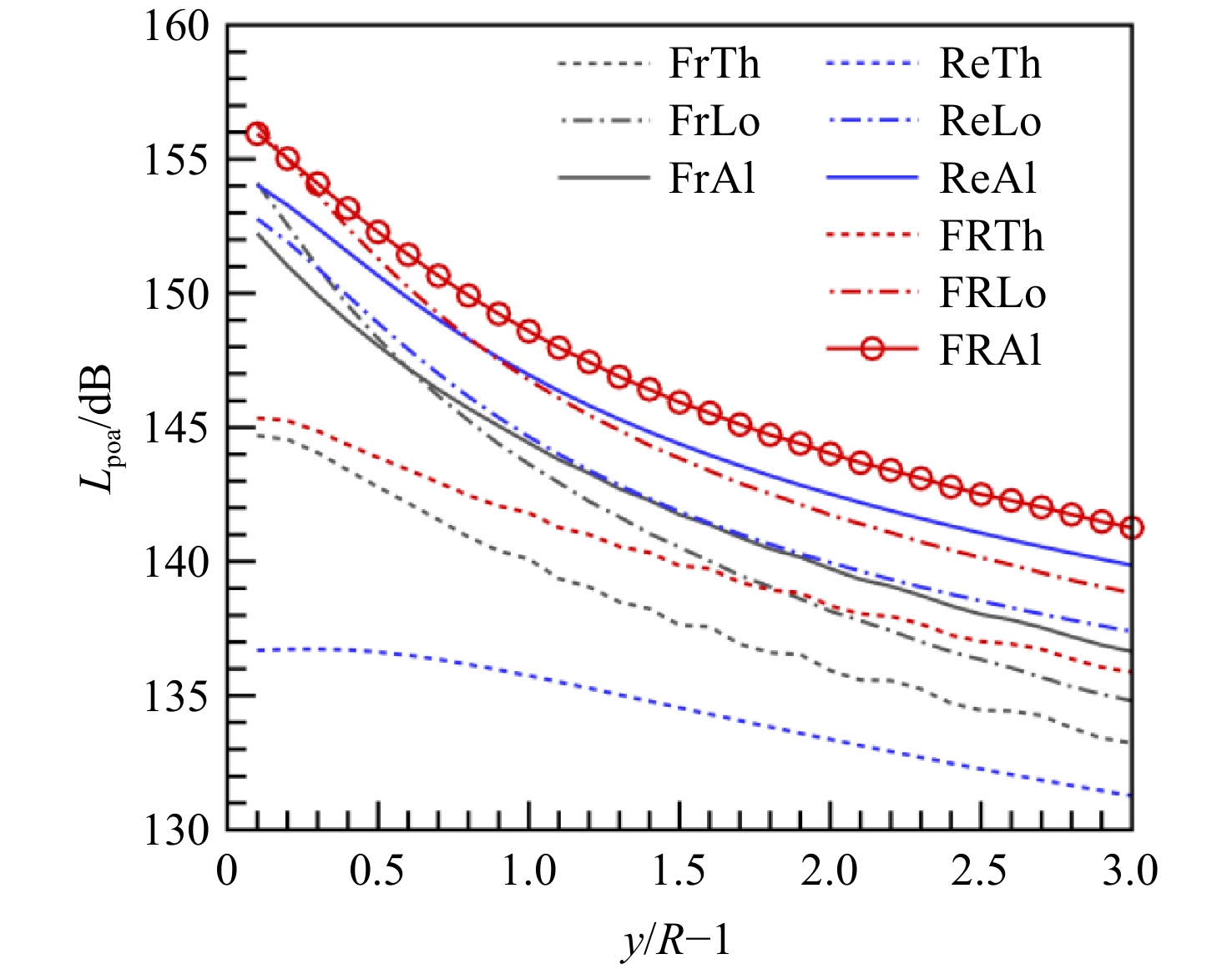
图 10 沿竖向直线段LinVU单个、两个转子离散噪声总声压级的变化
Figure 10. Overall sound pressure level variations of discrete noise of single and two rotors along vertical line segment LinVU
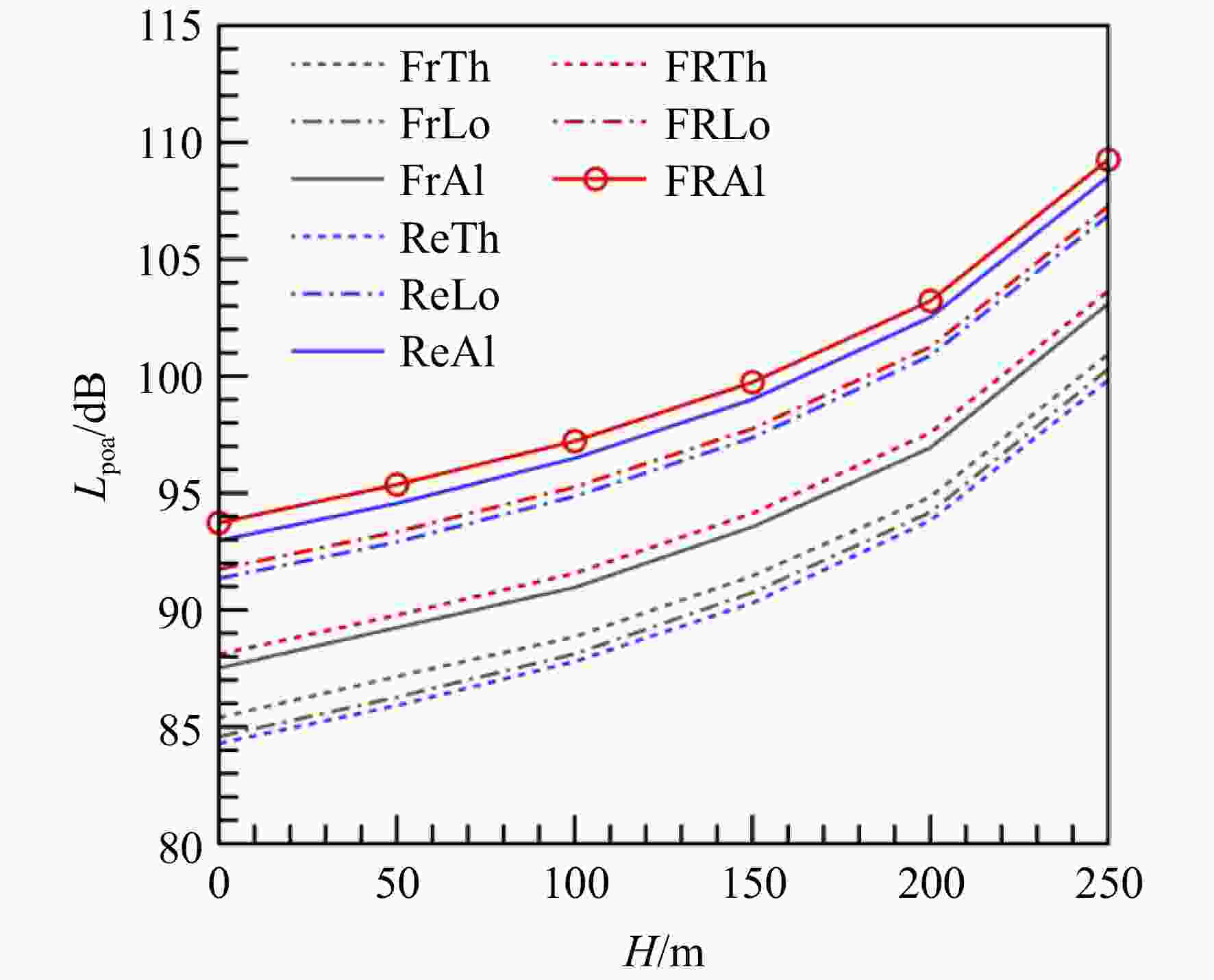
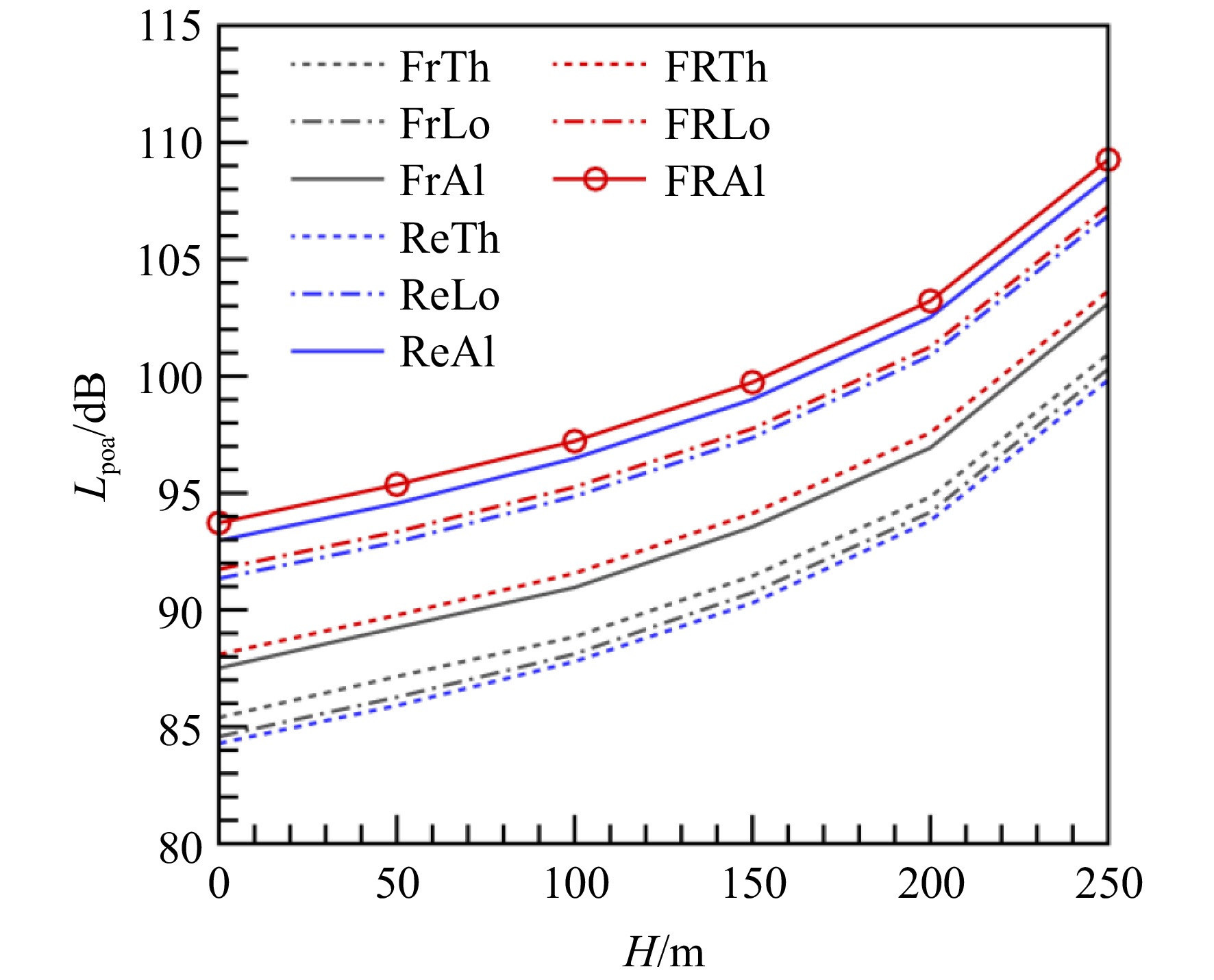
图 11 沿竖向直线段LinVD单个、两个转子离散噪声总声压级的变化
Figure 11. Overall sound pressure level variations of discrete noise of single and two rotors along vertical line segment LinVD
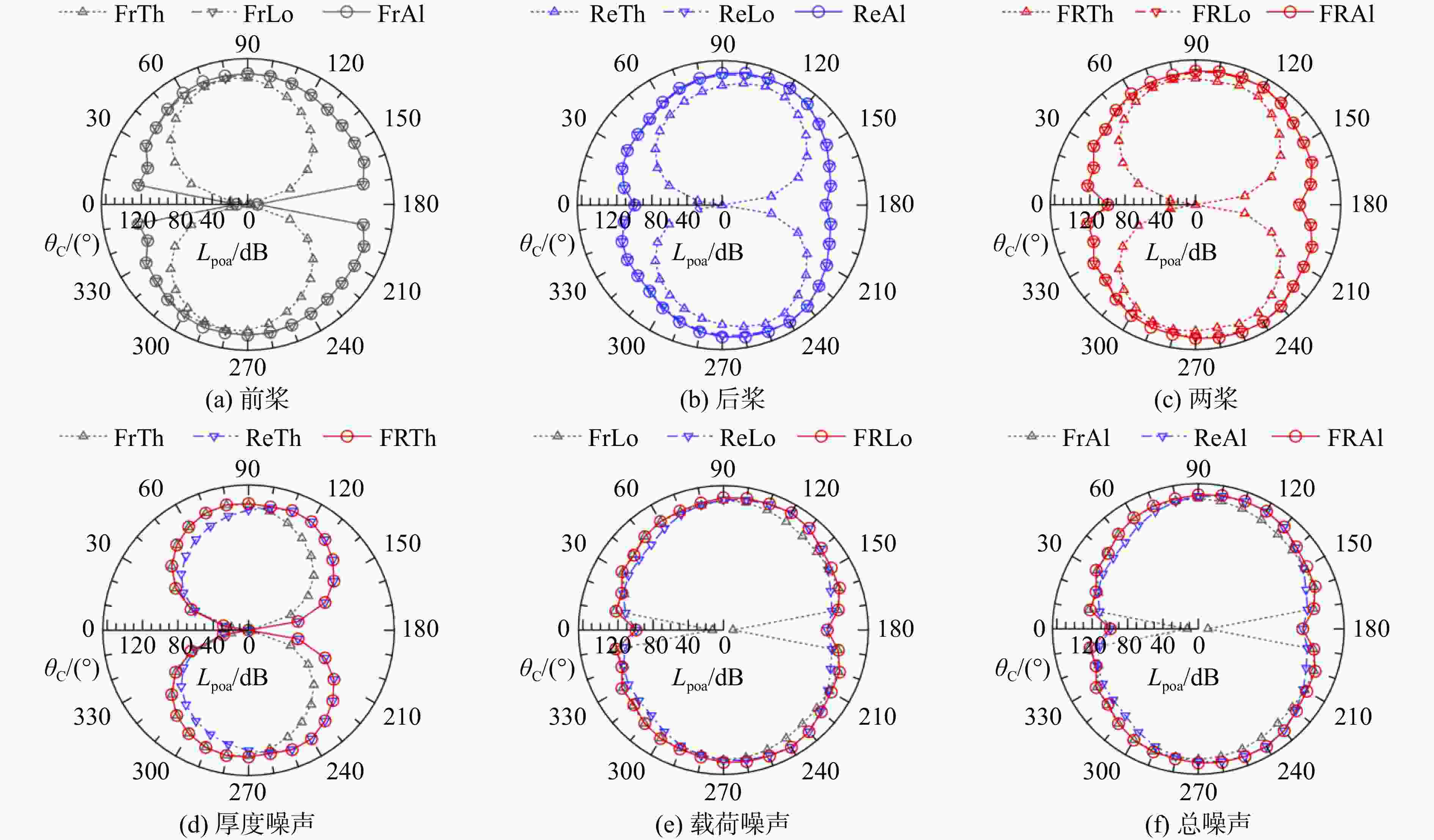
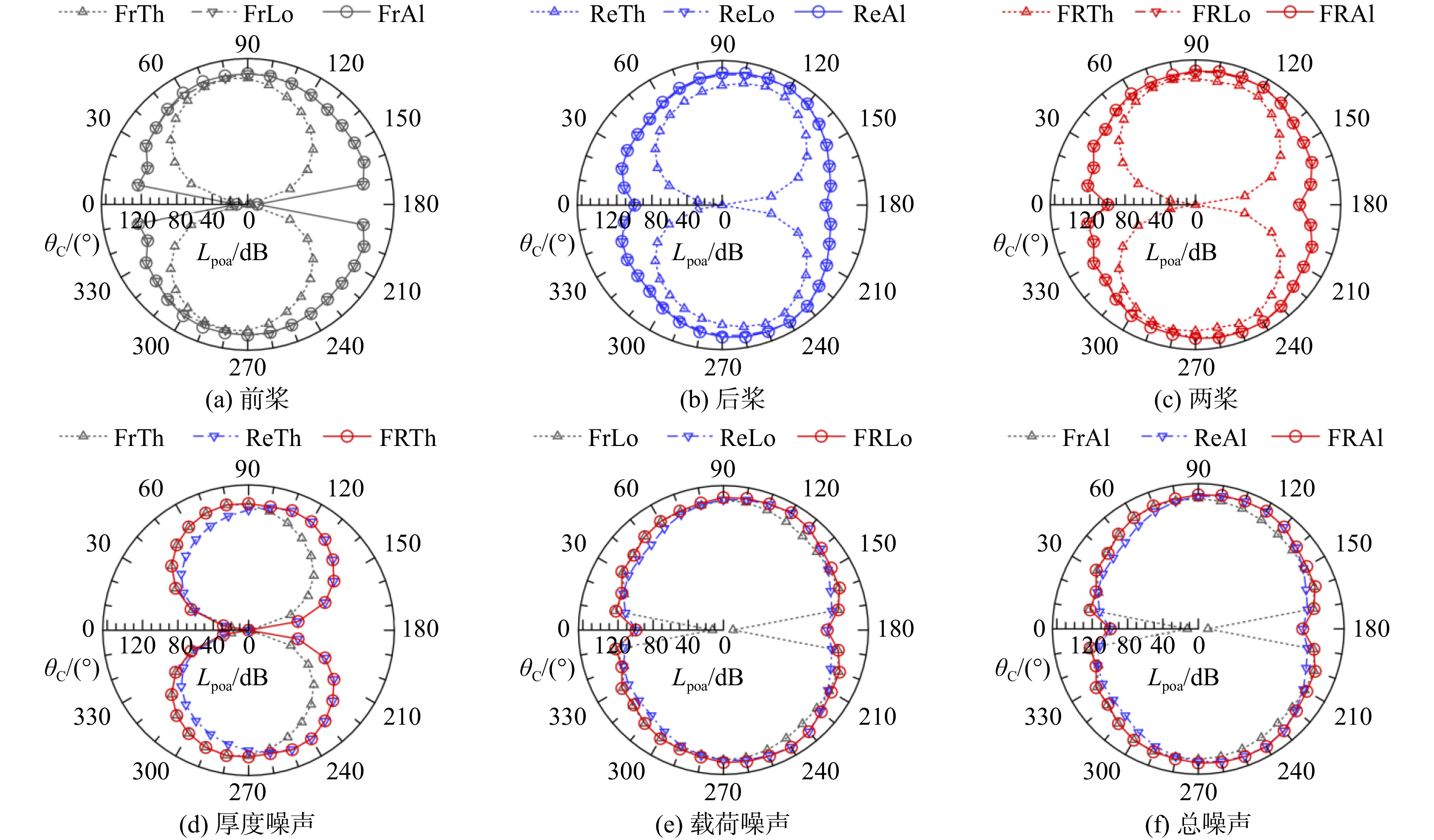
图 12 沿半径为1.5R的子午面内圆周CirC单个、两个转子离散噪声总声压级的指向性
Figure 12. Directivity of overall sound pressure level of discrete noise of single and two rotors along circle CirC of radius 1.5R in meridional plane
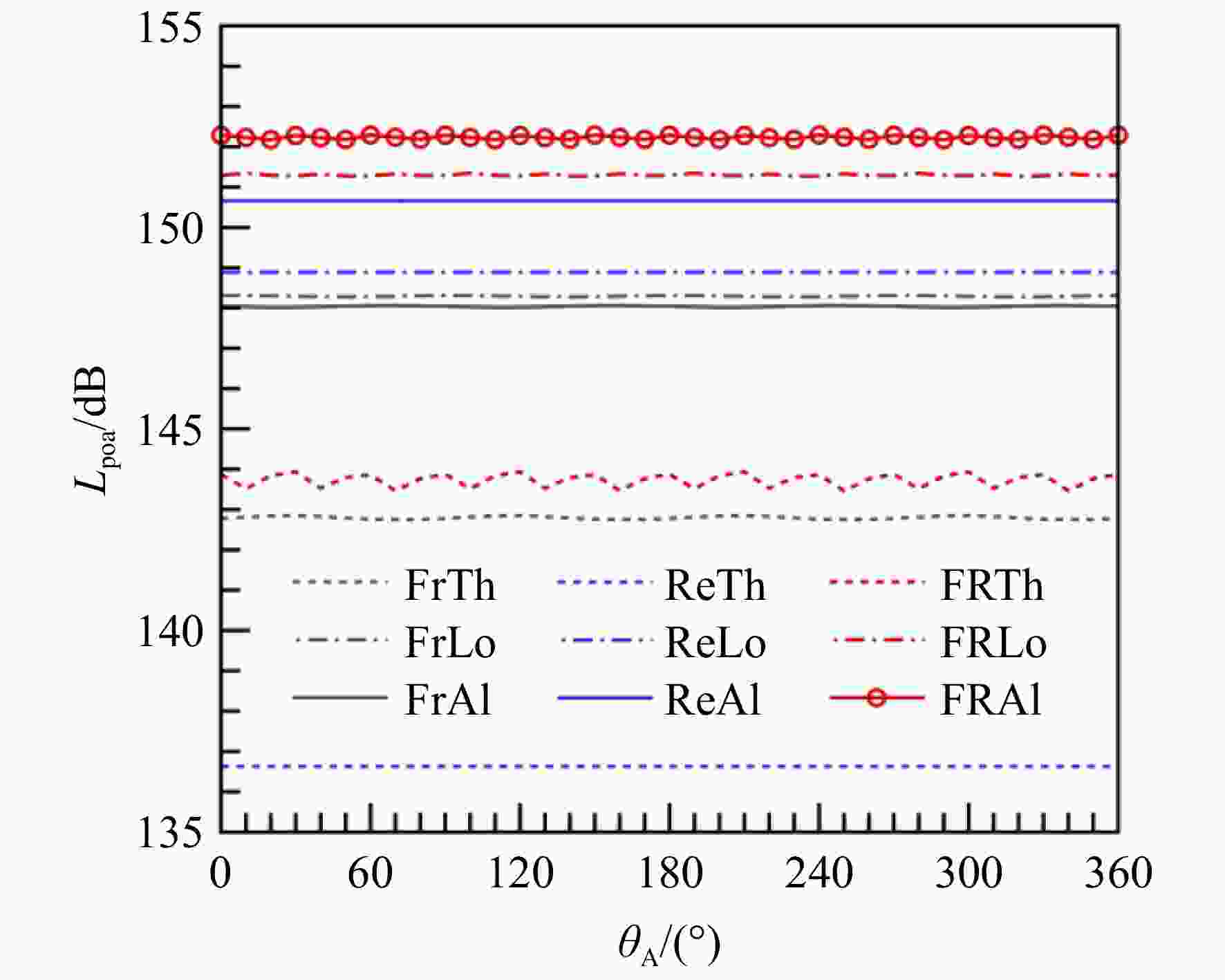
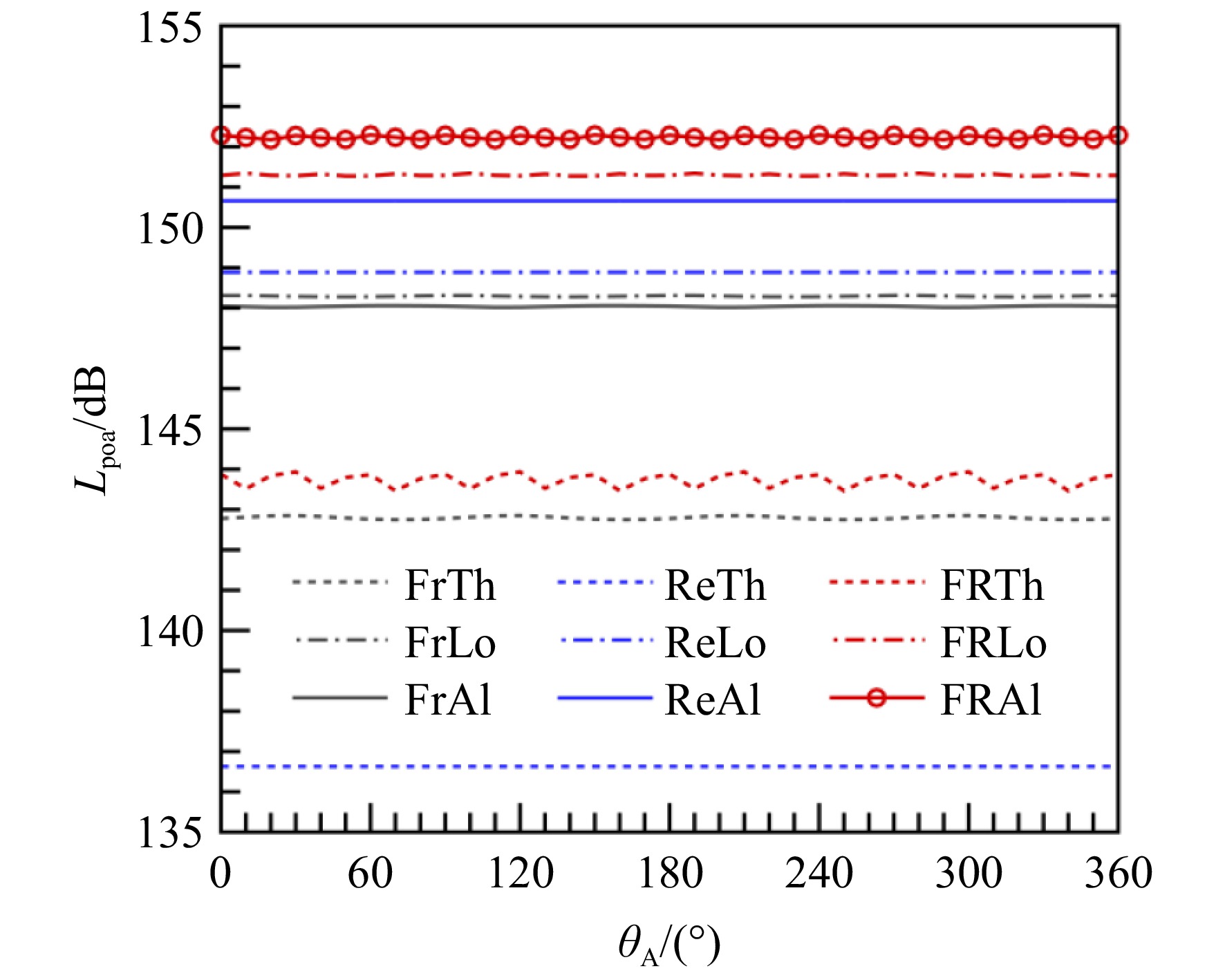
图 13 沿半径为1.5R的轴向横截面圆周CirA单个、两个转子离散噪声总声压级的指向性
Figure 13. Directivity of overall sound pressure level of discrete noise of single and two rotors along axial cross-sectional circle CirA of radius 1.5R
表 1 CRPFt的来流流场、几何和运动主要参数
Table 1. Key incoming flow field, geometry and kinematic parameters of CRPFt
参数 前桨 后桨 飞行高度H/m 300 飞行速度υx, υy, υz/(m/s) 0, 0, −81.39 未扰动空气密度ρ0/(kg/m3) 1.19 声速c0/(m/s) 339.141 叶片数NF、NR 8 6 叶尖直径D =2R/m 0.622 0.622 轮毂半径rh/m 0.072 0.072 相对半径$ \bar r $=r/R=0.75处
基元叶型桨距角ϕ0.75/(°)37.9 37.4 额线相对气流角β0.75/(°) 14.3 14.3 攻角α0.75/(°) 23.6 23.1 转速nF、nR/(r/min) − 9814.37 + 9814.37 角速度ωF、ωR/(rad/s) − 1027.76 + 1027.76 叶尖相对马赫数Mahel 0.97 0.97  下载: 导出CSV
表 2 流场边界条件
Table 2. Flow-field boundary conditions
边界 条件 进口
Inlet总压pt = 101772.35 Pa;
总温Tt = 289.5 K;
来流速度方向沿+z,与转轴平行出口Outlet 径向平衡;
径向位置r =1.9 m处静压p =97772.7 Pa远场External 静压p = 97772.7 Pa;
静温T = 286.2 K;
气流速度(υx, υy, υz) = (0, 0, 81.394) m/s叶片表面y+ 最大值<9;
除前缘附近,叶片表面绝大部分区域< 3
下载: 导出CSV
表 3 流场准非定常参数
Table 3. Flow-field quasi-unsteady parameters
参数 前桨 后桨 每个转子所受扰动个数Npertb 1 每个扰动的频率个数Nfreq 3 当前转子的叶片数Ncur 8 6 相邻转子的叶片数Nadj 6 8 当前转子的转速ncur/(r/min) − 9814.37 + 9814.37 相邻转子的转速nadj/(r/min) + 9814.37 − 9814.37 当前转子相对相邻转子的 转速|ncur−nadj|/(r/min) 19628.74 19628.74 扰动基础谐波的角频率
(2π×|ncur−nadj|/60×Nadj)/
(rad/s)12333.10 16444.14
下载: 导出CSV
表 4 桨扇CRPFt模拟与桨扇F7A7t试验性能参数对比
Table 4. Comparison of performance parameters between simulation of CRPFt and test of F7A7t
参数 CRPFt F7A7t 飞行高度H/m 300 0 飞行马赫数Ma 0.24 0.24 前后桨直径D/m 0.622 0.622 进距比J=υ/(Dns) 0.8 0.8 桨距角(ϕ0.75F/ϕ0.75R)/(°) 37.9/37.4 37.9/37.4 扭矩比QR/QF 1.22 1 功率系数CP 1.93 1.63 推进效率η 0.487 0.51
下载: 导出CSV
表 5 桨扇CRPFt与桨扇F7A7t的巡航设计点气动参数
Table 5. Aerodynamic parameters of CRPFc and F7A7c at cruise design point
参数 CRPFc F7A7c 设计方法 可压缩
升力面法与涵道风扇设计相仿的
准三维方法飞行高度H/km 11 10.668 飞行马赫数Ma 0.8 0.72 前后桨直径D/m 0.622 0.622 进距比J=υ/(Dns) 3.14 2.8 叶尖切向速度u/(m/s) 236 239.62 叶片数NF/NR 8/6 8/8 叶尖后掠角(ϕF/ϕR)/(°) 41.4/41.4 33/29 单位面积桨盘载荷(P/D2)/
(kW/m2)413.6 455.3 功率系数CP 2.67 2.70 轮毂比$ {\bar r_{\text{h}}} $= rh/R 0.23 0.42 总效用因子Taf 3010 2400
下载: 导出CSV
表 6 准非定常模拟的CRPFt在t = 0时刻的性能
Table 6. Performance of CRPFt at time t = 0 in quasi-unsteady simulation
参数 前桨 后桨 两桨 单位面积桨盘载荷
(P/D2)/(kW/m2)1090.1 1328.6 2418.7 功率P/kW 421.74 514.03 935.77 拉力F/N 2516.5 3085.9 5602.4 秒转速ns/(r/s) 163.57 163.57 功率系数CP=P/(ρ0$ n_{\text{s}}^3 $D5) 0.87 1.06 1.93 拉力系数CF=F/(ρ0$ n_{\text{s}}^2 $D4) 0.528 0.648 1.176 推进效率η 0.4857 0.4886 0.4873
下载: 导出CSV
表 7 CRPFt准非定常模拟的总体参数CF、CP、η 随时间变化曲线的周期
Table 7. Period of time-dependent curves of overall parameters CP, CF and η in quasi-unsteady simulation for CRPFt
类别 j阶谐波参数(j=1, 2, 3) 瞬时参数(平均参数与1阶、2阶、3阶
各谐波参数的和)以时间表示的周期 Tj/s 以角度表示的周期 Θj/(°) 以时间表示的周期T/s 以角度表示的周期Θ/(°) 前桨叶片F1~F8 TFj=60/(|nF-nR|/NR)/j=T/(12j) ΘFj=(360/12)/j=30/j TF=T/12 ΘF=30 后桨叶片R1~R6 TRj=60/(|nR-nF|/NF)/j=T/(16j) ΘRj=(360/16)/j=22.5/j TR=T/16 ΘR=22.5 F1~F8与
R1~R6的和TFRj=3TFj=4TRj=T/[(12,16
最大公约数)×j]=T/(4j)ΘFRj=3ΘFj=4ΘRj=(30,22.5
最小公倍数)/j=90/jTFR=3TF=4TR=T/4 ΘFR=3ΘF=4ΘR=90 前桨 T/(12×4j)=T/(48j) 30/(4j) T/48 7.5 后桨 T/(16×3j)=T/(48j) 22.5/(3j) T/48 7.5 两桨 T/(48j) 90/(12j) T/48 7.5
下载: 导出CSV
表 8 CRPFt准非定常模拟的叶片总体参数CF、CP、η随时间变化曲线的相位、波形
Table 8. Phase and waveform of time-dependent curves of blade overall parameters CP, CF and η in quasi-unsteady simulation for CRPFt
叶片 相位 波形 前桨 F2~F8比F1~F7对应滞后7.5° F5~F8与F1~F4对应相同 后桨 R2~R6比R1~R5对应超前7.5° R4~R6与R1~R3对应相同
下载: 导出CSV
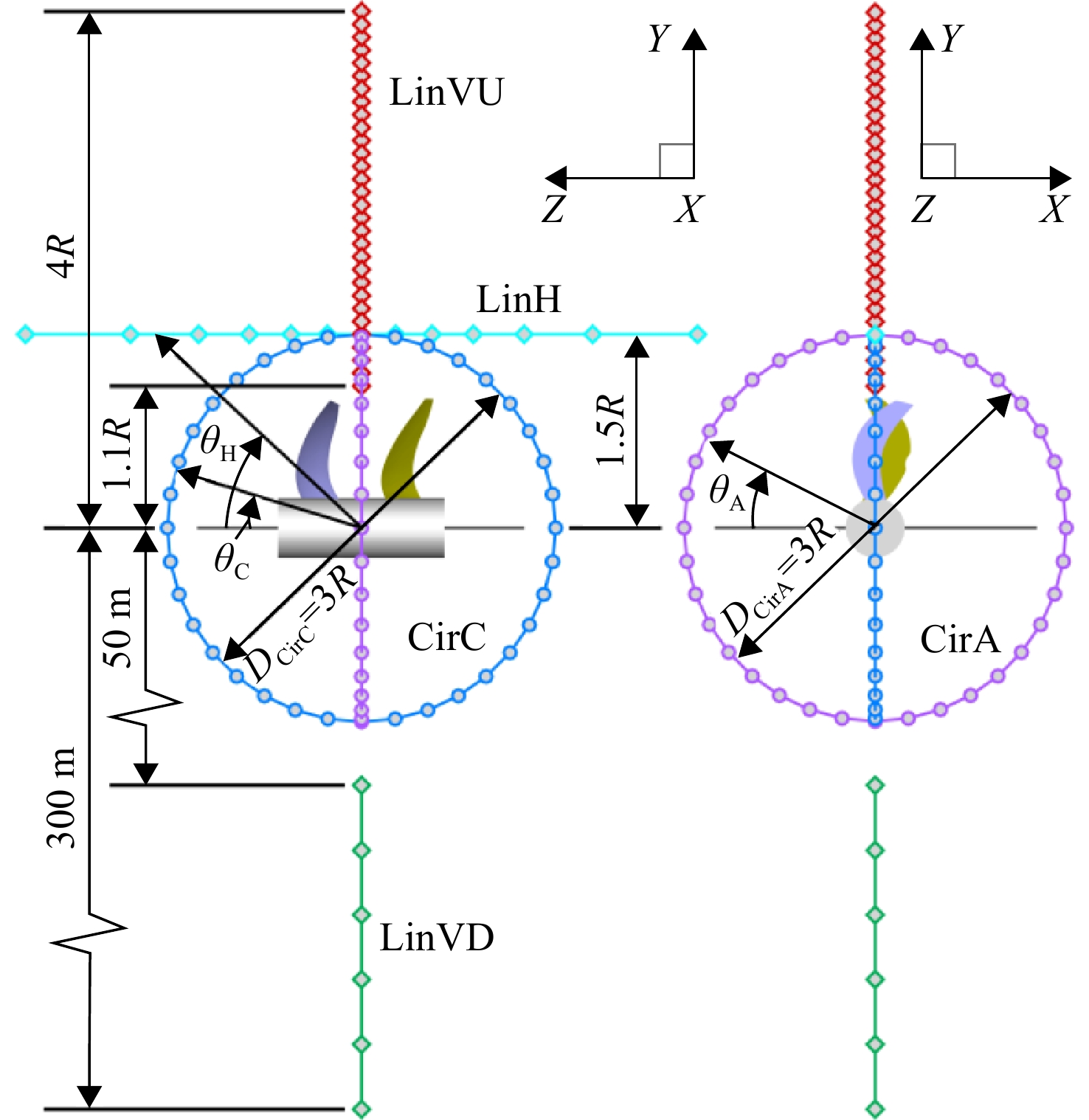
表 9 CRPFt噪声观测点的坐标
Table 9. Coordinates of noise observation points for CRPFt
观测点分布型线 x/m y/m z/m θ/(°), i 轴平行线段(LinH) 0 1.5R 1.5Rcot θH−0.1 θH =10i+20, i=1~13 上部直线段(LinVU) 0 (1+0.1i)R −0.1 i=1, 2, ···, 30 下部直线段(LinVD) 0 −350+50i −0.1 i=1, 2, ···, 6 子午截面圆(CirC) 0 1.5Rsin θC 1.5Rcos θC−0.1 θC=10i−10, i=1~37 轴向截面圆(CirA) −1.5Rcos θA 1.5Rsin θA −0.1 θA=10i−10, i=1~37
下载: 导出CSV
-
[1] ROHRBACH C, METZGER F B. The prop-fan-a new look in propulsors: AIAA-1975-1208[R]. Anaheim, US: American Institute of Aeronautics and Astronautics, 1975. [2] STRACK W C, KNIP G, WEISBRICH A L, et al. Technology and benefits of aircraft counter rotation propellers: NASA TM-82983[R]. Anaheim, US: National Aeronautics and Space Administration, 1982. [3] HANSON D B. Helicoidal surface theory for harmonic noise of propellers in the far field[J]. AIAA Journal, 1980, 18(10): 1213-1220. doi: 10.2514/3.50873 [4] HANSON D B. Near-field frequency-domain theory for propeller noise[J]. AIAA Journal, 1985, 23(4): 499-504. doi: 10.2514/3.8943 [5] HANSON D B. Noise of counter-rotation propellers[J]. Journal of Aircraft, 1985, 22(7): 609-617. doi: 10.2514/3.45173 [6] DUNN M H, TINETTI A F, NARK D M. Open rotor noise prediction using the time domain formulations of Farassat[J]. International Journal of Aeroacoustics, 2015, 14(1/2): 51-86. [7] AMIET R K. Thickness noise of a propeller and its relation to blade sweep[J]. Journal of Fluid Mechanics, 1988, 192: 535-560. doi: 10.1017/S0022112088001971 [8] FARASSAT F. Theory of noise generation from moving bodies with an application to helicopter rotors: NASA TR R-451[R]. Washington DC, US: National Aeronautics and Space Administration, 1975. [9] FARASSAT F, SUCCI G P. The prediction of helicopter rotor discrete frequency noise[J]. Vertica, 1983, 7(4): 309-320. [10] FARASSAT F. The prediction of the noise of supersonic propellers in time domain—new theoretical results: AIAA-1983-0743[R]. Atlanta, US: American Institute of Aeronautics and Astronautics, 1983. [11] NYSTROM P A, FARASSAT F. A numerical technique for calculation of the noise of high-speed propellers with advanced blade geometry: NASA TP-1662[R]. Washington DC, US: National Aeronautics and Space Administration, 1980. [12] BRENTNER K S. Prediction of helicopter rotor discrete frequency noise—a computer program incorporating realistic blade motions and advanced acoustic formulation: NASA TM-87721[R]. Washington DC, US: National Aeronautics and Space Administration, 1986. [13] DUNN M H, TARKENTON G M. Computational methods in the prediction of advanced subsonic and supersonic propeller induced noise—ASSPIN users’ manual: NASA CR-4434[R]. Washington DC, US: National Aeronautics and Space Administration, 1992. [14] ZORUMSKI W E, WEIR D S. Aircraft noise prediction program theoretical manual: Part 3 propeller aerodynamics and noise: NASA TM-83199[R]. Washington DC, US: National Aeronautics and Space Administration, 1986. [15] DUNN M H, TARKENTON G M. Users’ manual for the Langley high speed propeller noise prediction program (DFP-ATP): NASA CR-4208[R]. Washington DC, US: National Aeronautics and Space Administration, 1989. [16] FARASSAT F, DUNN M H, SPENCE P L. Advanced propeller noise prediction in the time domain[J]. AIAA Journal, 1992, 30(9): 2337-2340. doi: 10.2514/3.11224 [17] STUERMER A, YIN J. Low-speed aerodynamics and aeroacoustics of CROR propulsion systems: AIAA-2009-3134[R]. Miami, US: American Institute of Aeronautics and Astronautics, 2009. [18] ZACHARIADIS A, HALL C, PARRY A B. Contrarotating open rotor operation for improved aerodynamics and noise at takeoff[J]. Journal of Turbomachinery, 2013, 135(3): 031010. doi: 10.1115/1.4006778 [19] 稂仿玉, 杨晰琼, 贺象, 等. 对转桨扇设计参数对噪声水平影响的数值研究[J]. 航空精密制造技术, 2022, 58(3): 37-40, 43. LANG Fangyu, YANG Xiqiong, HE Xiang, et al. Numerical investigation on influence of design parameters of counter rotating prop-fan on aero-acoustics level[J]. Aviation Precision Manufacturing Technology, 2022, 58(3): 37-40, 43. (in Chinese doi: 10.3969/j.issn.1003-5451.2022.03.010LANG Fangyu, YANG Xiqiong, HE Xiang, et al. Numerical investigation on influence of design parameters of counter rotating prop-fan on aero-acoustics level[J]. Aviation Precision Manufacturing Technology, 2022, 58(3): 37-40, 43. (in Chinese) doi: 10.3969/j.issn.1003-5451.2022.03.010 [20] 贺象, 赵振国, 舒太波, 等. 桨扇后掠降噪规律及声学机理数值研究[J]. 航空动力学报, 2023, 38(4): 939-948. HE Xiang, ZHAO Zhenguo, SHU Taibo, et al. Numerical investigation of noise reduction law and acoustic mechanism of the sweepback propfan[J]. Journal of Aerospace Power, 2023, 38(4): 939-948. (in ChineseHE Xiang, ZHAO Zhenguo, SHU Taibo, et al. Numerical investigation of noise reduction law and acoustic mechanism of the sweepback propfan[J]. Journal of Aerospace Power, 2023, 38(4): 939-948. (in Chinese) [21] HE L, NING W. Efficient approach for analysis of unsteady viscous flows in turbomachines[J]. AIAA Journal, 1998, 36(11): 2005-2012. doi: 10.2514/2.328 [22] GHORBANIASL G, HIRSCH C. Validation of a time domain formulation for propeller noise prediction[J]. International Journal of Aeroacoustics, 2006, 5(4): 295-310. doi: 10.1260/147547206779379895 [23] NUMECA International. FINE™/Turbo 14.2 user guide [M]. Brussels: NUMECA International, 2020. [24] 周亦成. 涡轮增压活塞螺旋桨部件法与对转桨扇可压升力面法反问题[D]. 北京: 北京航空航天大学, 2016. ZHOU Yicheng. Component-level model for turbocharging reciprocating engine propeller propulsion system and compressible lifting surface inverse method for contra-rotating propfan[D]. Beijing: Beijing University of Aeronautics and Astronautics, 2016. (in ChineseZHOU Yicheng. Component-level model for turbocharging reciprocating engine propeller propulsion system and compressible lifting surface inverse method for contra-rotating propfan[D]. Beijing: Beijing University of Aeronautics and Astronautics, 2016. (in Chinese) [25] SULLIVAN T J. Aerodynamic performance of a scale-model, counterrotating unducted fan[J]. Journal of Turbomachinery, 1990, 112: 579-586. doi: 10.1115/1.2927696 [26] SMITH L H Jr. Unducted fan aerodynamic design[J]. Journal of Turbomachinery, 1987, 109: 313-324. doi: 10.1115/1.3262108 -

 点击查看大图

计量
- 文章访问数: 622
- HTML浏览量: 385
- PDF量: 45
- 被引次数: 0