






Injection characteristics of sub- to super-critical kerosene in subsonic air crossflow
-
摘要:
对亚/超临界RP-3航空煤油在亚声速空气横流中的射流特性进行了试验研究。在恒定的空气参数与燃油质量流量条件下,采用阴影成像技术对352~750 K燃油喷射温度范围内的横向射流结构进行了可视化观测。结果表明:随着喷射温度的升高,RP-3横向射流的破碎/解体机制会由机械破碎逐步转变为未壅塞闪蒸、壅塞闪蒸和超临界机制。在此过程中,射流稠密核心和雾化区横向长度分别缩短超过11倍和52倍喷口直径,稠密核心和雾化区覆盖面积分别缩小超过6 mm2和141 mm2。此外,随着喷射温度的升高,射流穿透深度在机械破碎机制主导下逐渐增大,在未壅塞闪蒸机制下逐渐减小,在壅塞闪蒸和超临界机制下基本保持不变。
Abstract:The jet behaviors of sub- and super-critical RP-3 aviation kerosene in a subsonic air crossflow were experimentally investigated. Under constant air parameters and fuel mass flow rate conditions, shadowgraph imaging technology was used to visualize the transverse jet structure within the fuel injection temperature range of 352 K to 750 K. The results showed that the breakup/disintegration regime of RP-3 jet gradually changed from mechanical breakup to unchocked flash-boiling, chocked flash-boiling and supercritical regime as the fuel injection temperature increased. During this process, the jet dense core and atomization zone underwent a decrease in length of over 11 and 52 times the nozzle diameter, respectively, and a decrease in coverage of over 6 mm2 and 141 mm2, respectively. Furthermore, with the increase of the injection temperature, the penetration depth of the jet gradually increased in the mechanical breakup regime, decreased in the unchocked flash-boiling regime, and remained essentially unchanged in both the chocked flash-boiling and supercritical regimes.
-
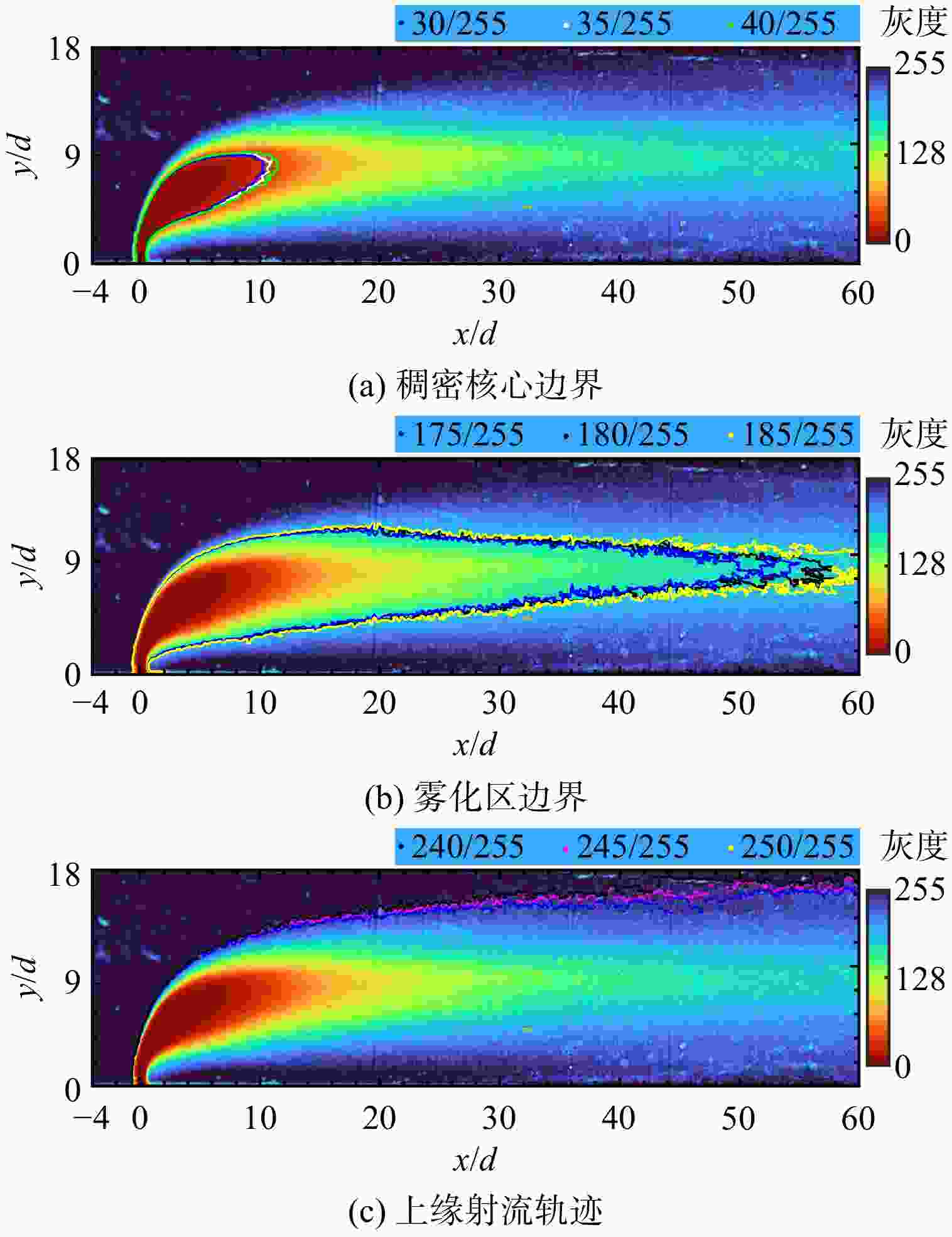
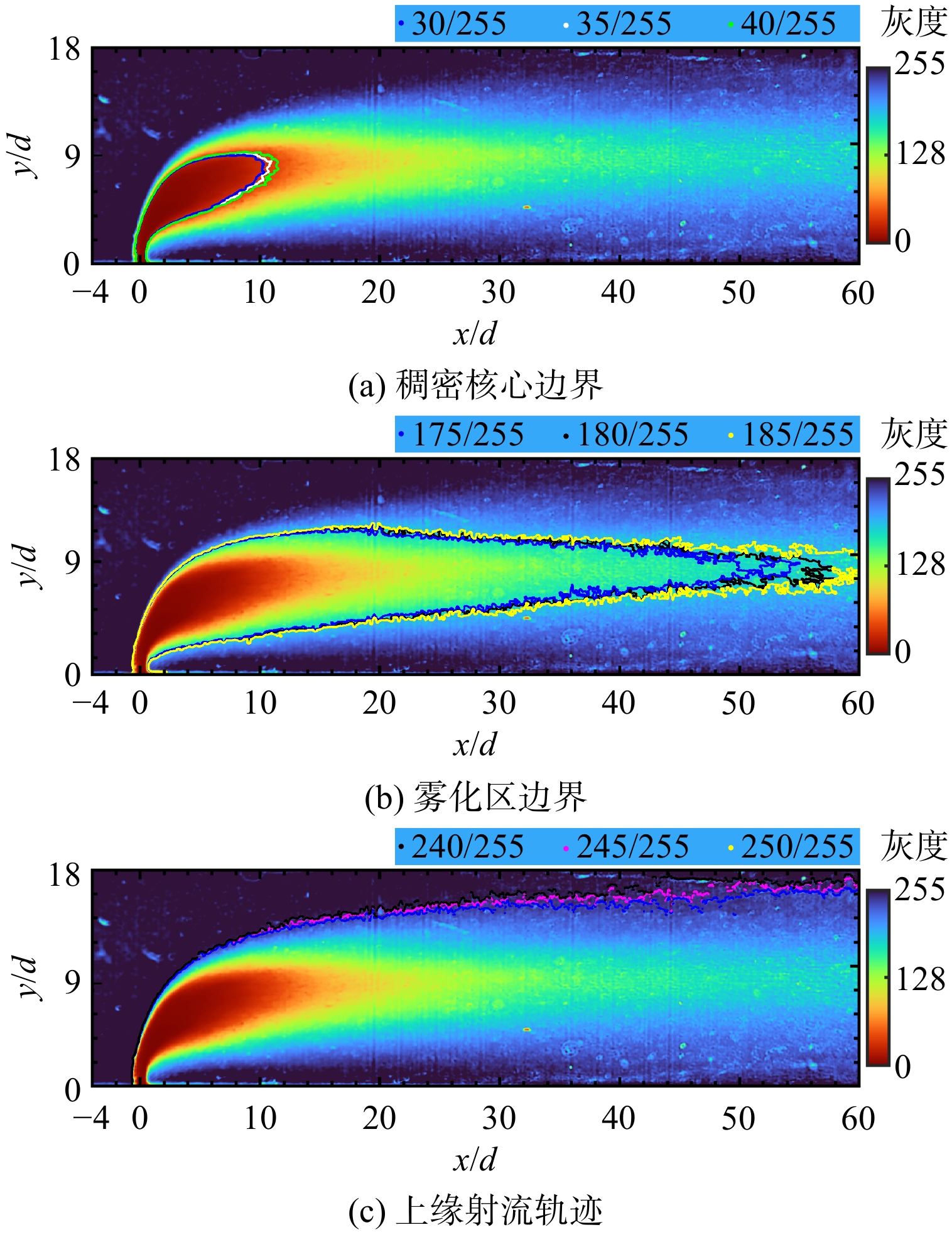
图 3 稠密核心边界、雾化区边界和上缘射流轨迹检测阈值敏感性分析
Figure 3. Sensitivity analysis of threshold for detecting dark red core boundary, atomization region boundary and jet trajectory
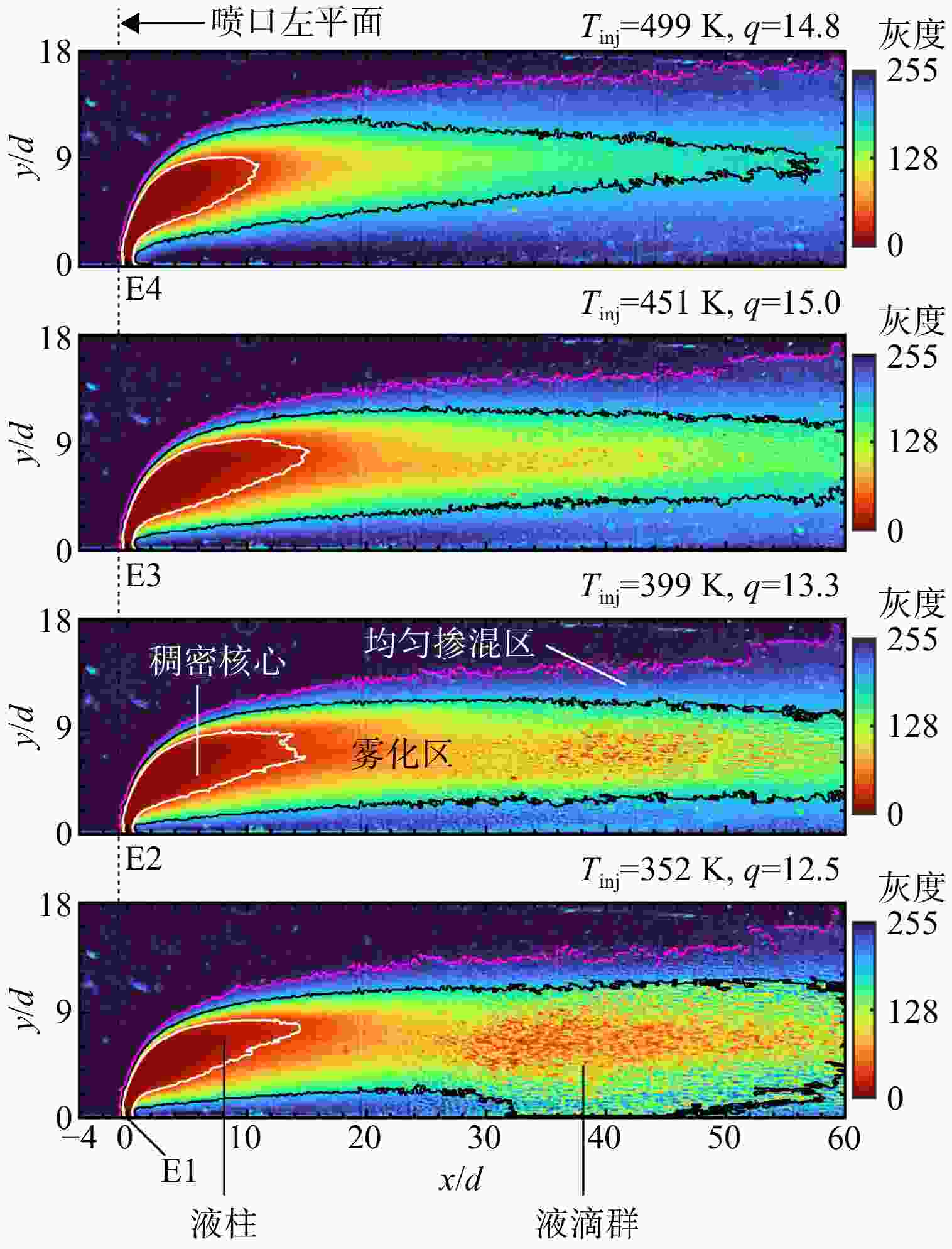
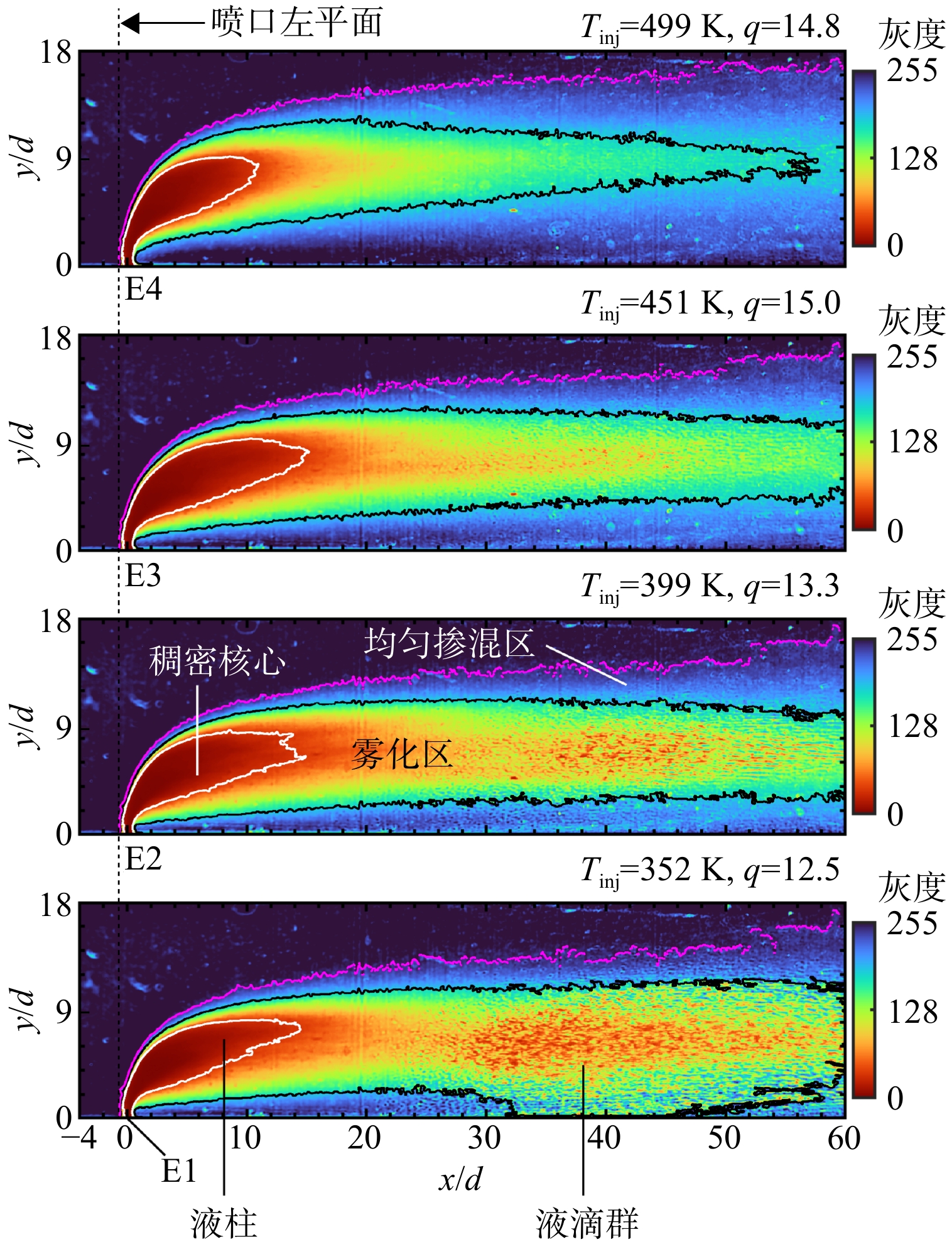
图 4 空气横流中Tinj<Td的RP-3射流阴影图像
Figure 4. Shadowgraph images of RP-3 jets at Tinj<Td in air crossflow

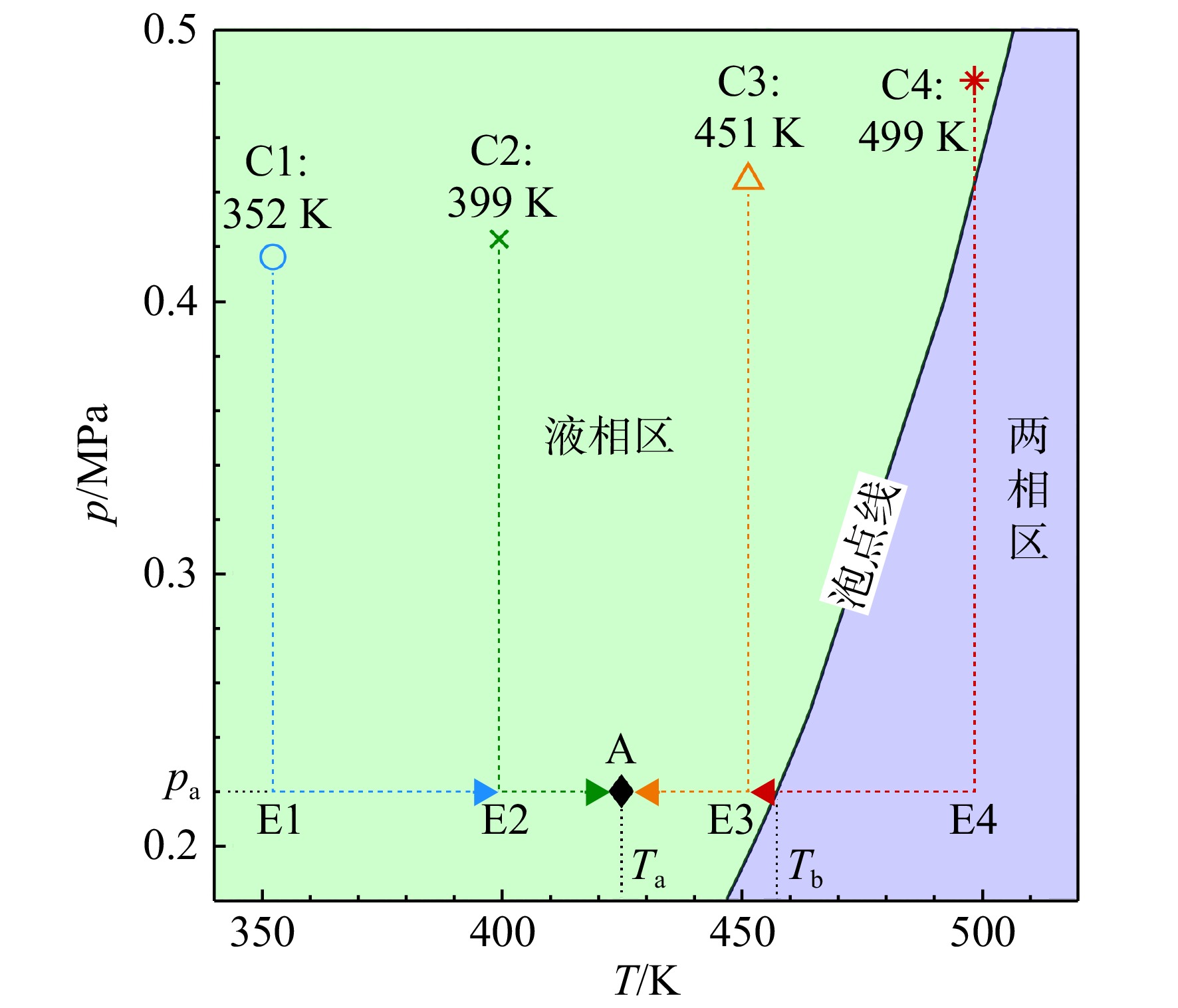
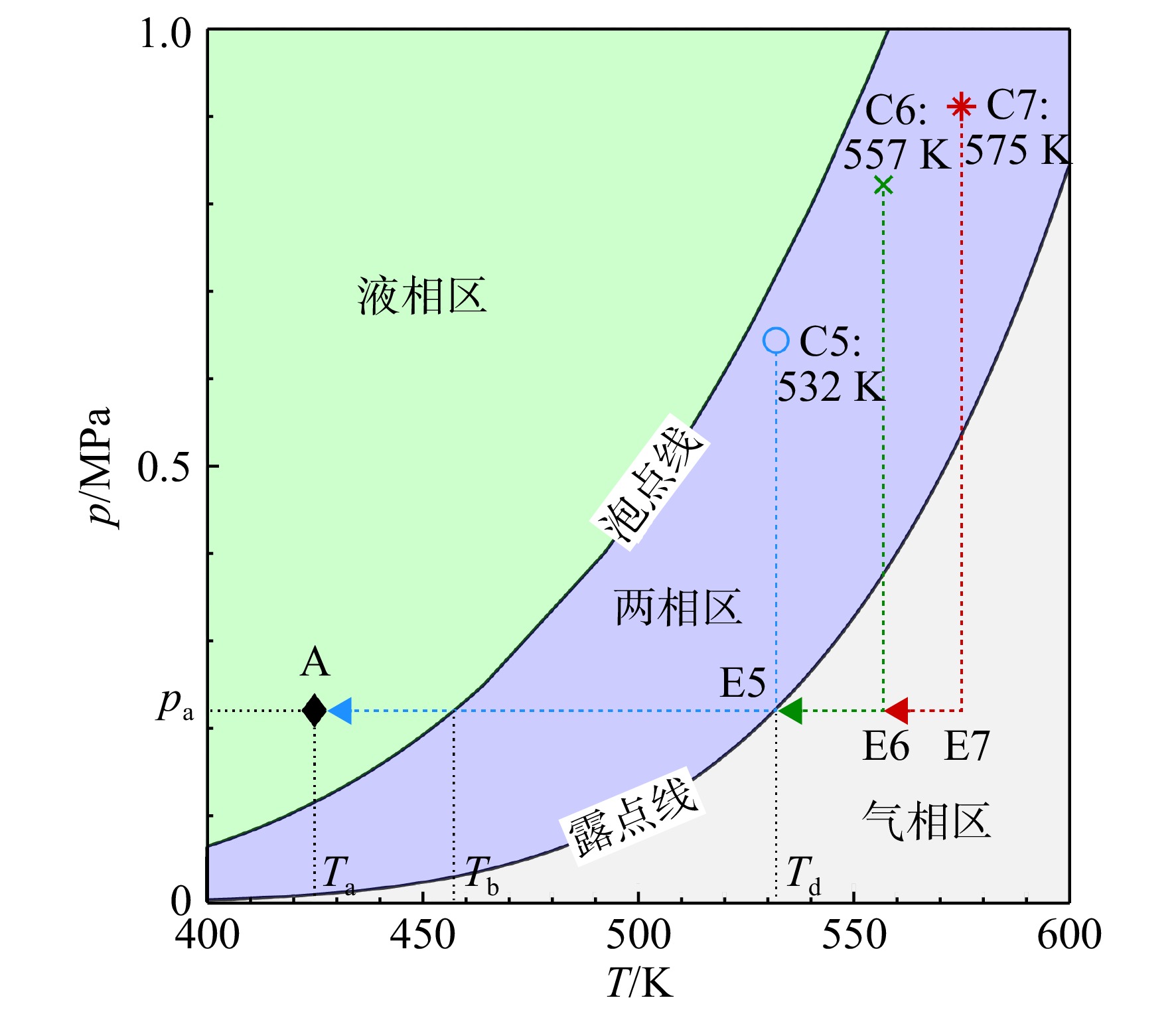
图 5 显示Tinj<Td 的RP-3射流喷射路径的p-T图
Figure 5. p-T diagram with injection path for RP-3 jets at Tinj<Td
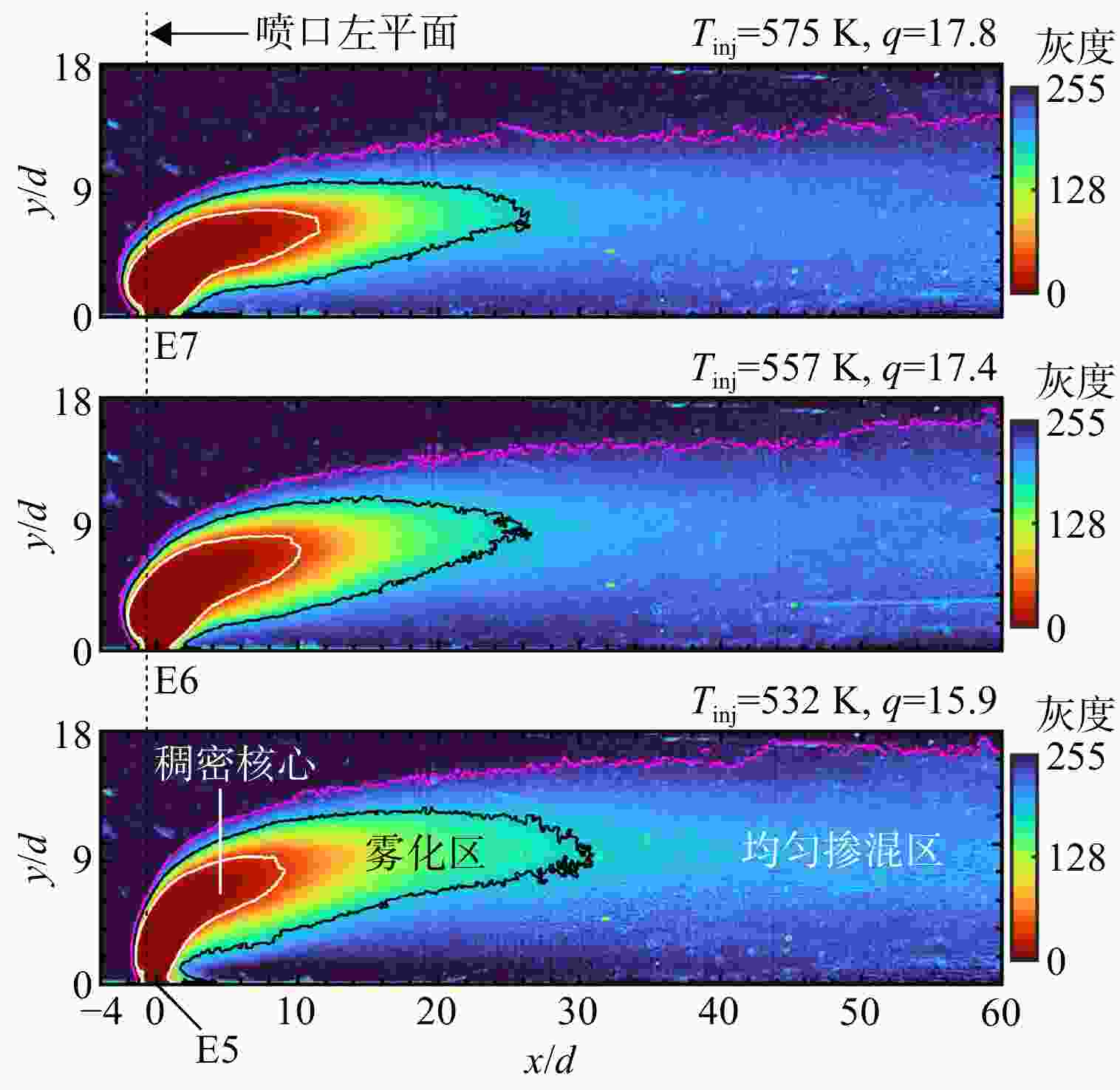
图 6 空气横流中未壅塞RP-3闪蒸射流阴影图像
Figure 6. Shadowgraph images of unchocked RP-3 flash-boiling jets in air crossflow
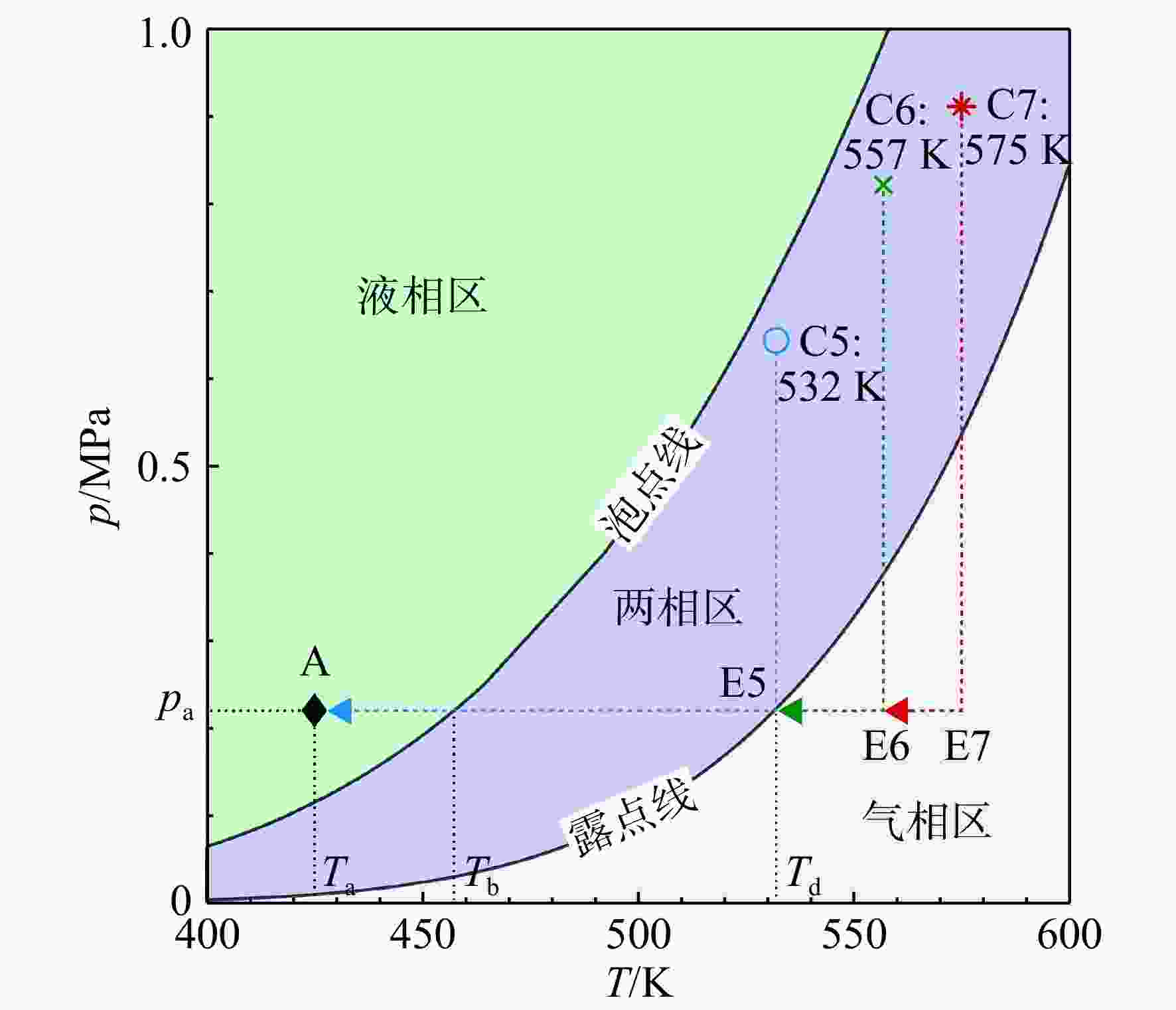
图 7 显示未壅塞RP-3闪蒸射流喷射路径的p-T图
Figure 7. p-T diagram with injection path for unchocked RP-3 flash-boiling jets
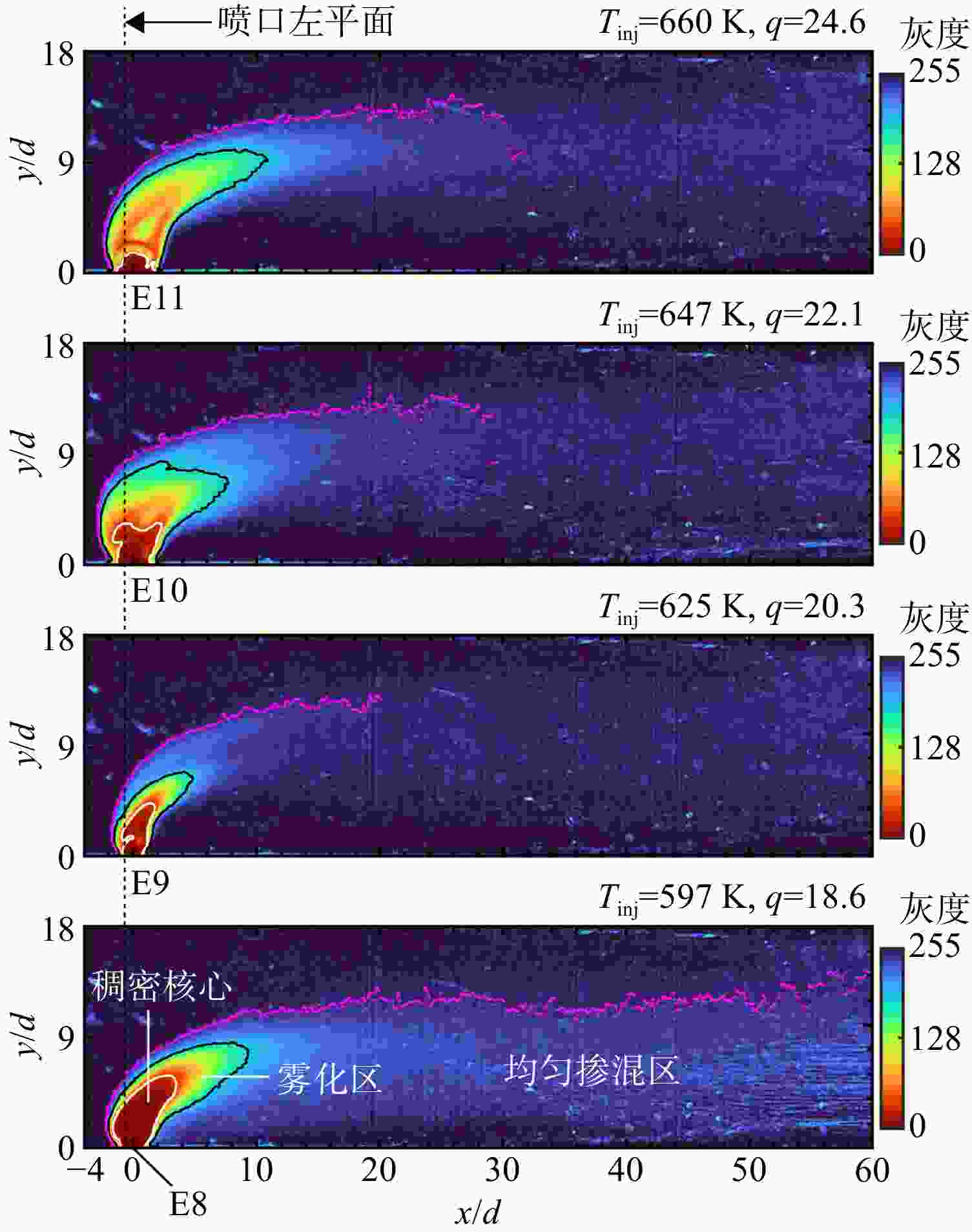
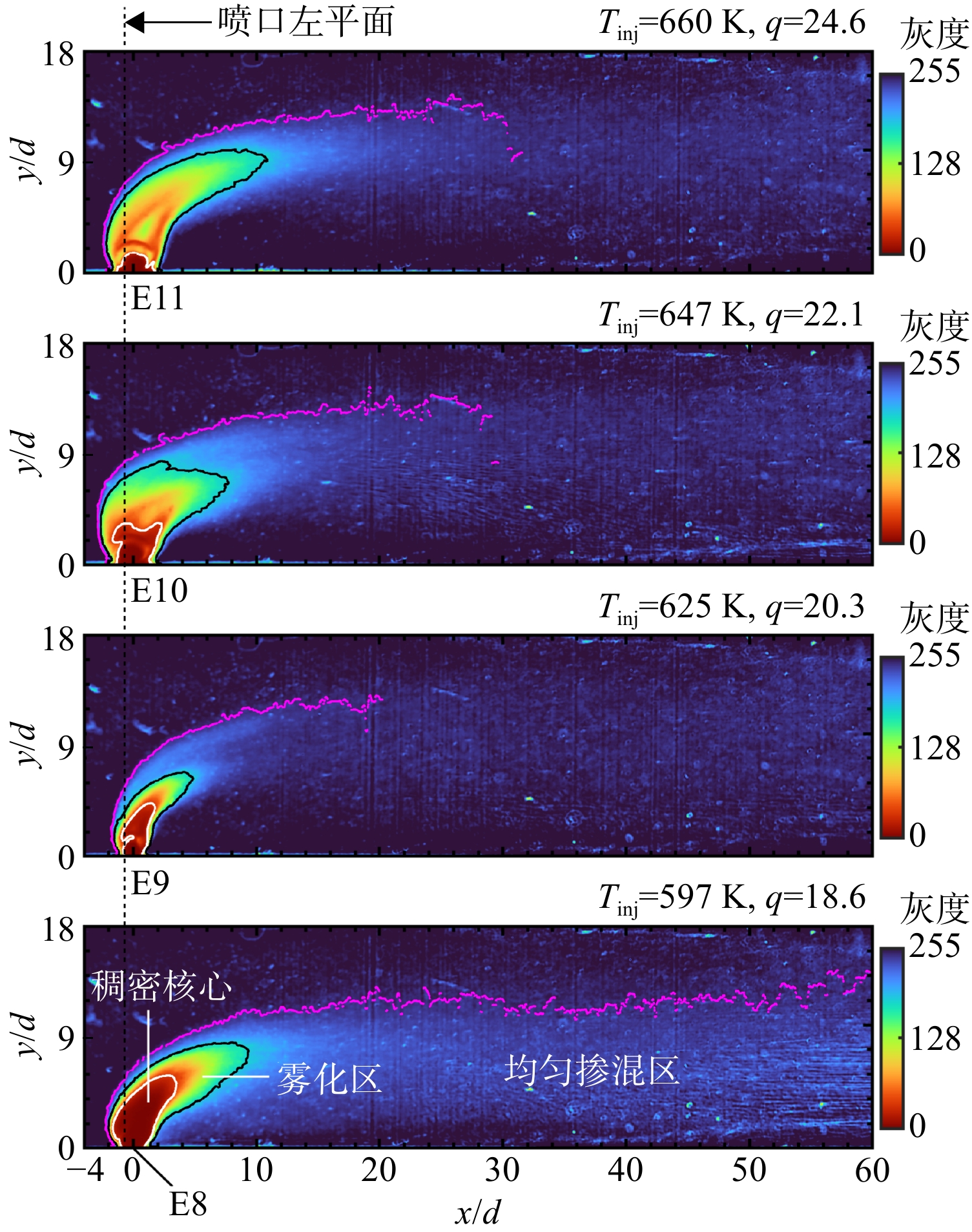
图 8 空气横流中壅塞RP-3闪蒸射流阴影图像
Figure 8. Shadowgraph images of chocked RP-3 flash-boiling jets in air crossflow
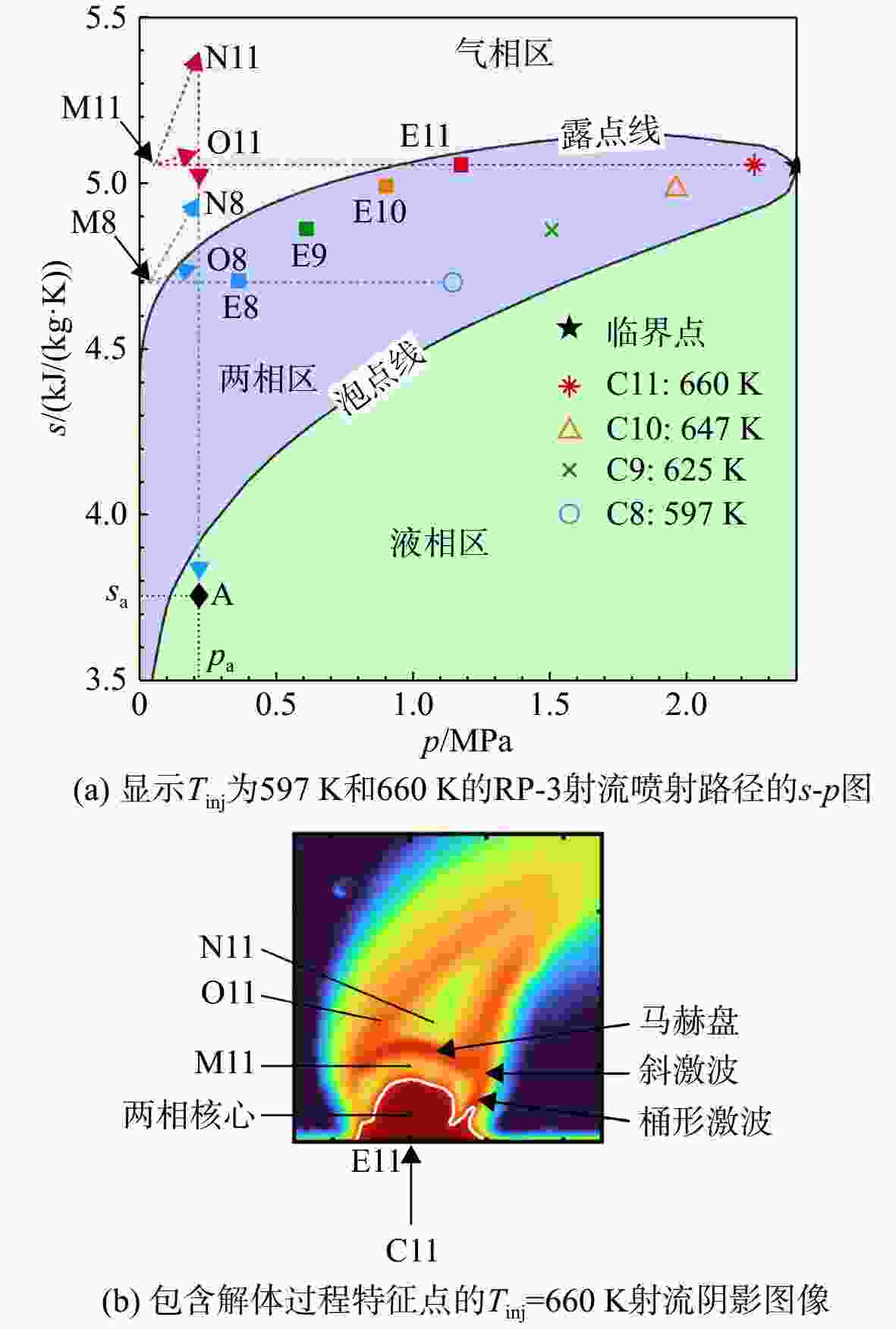
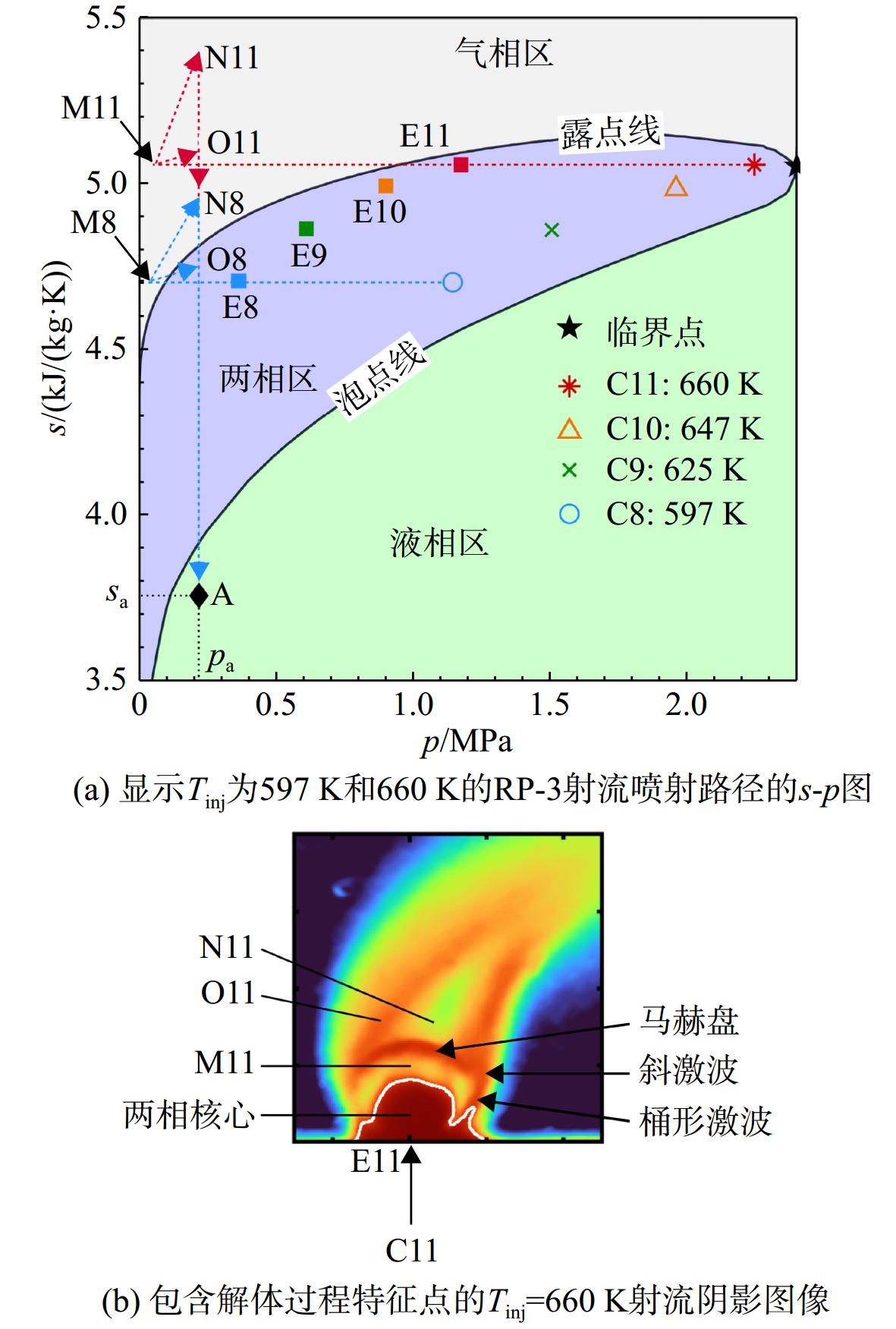
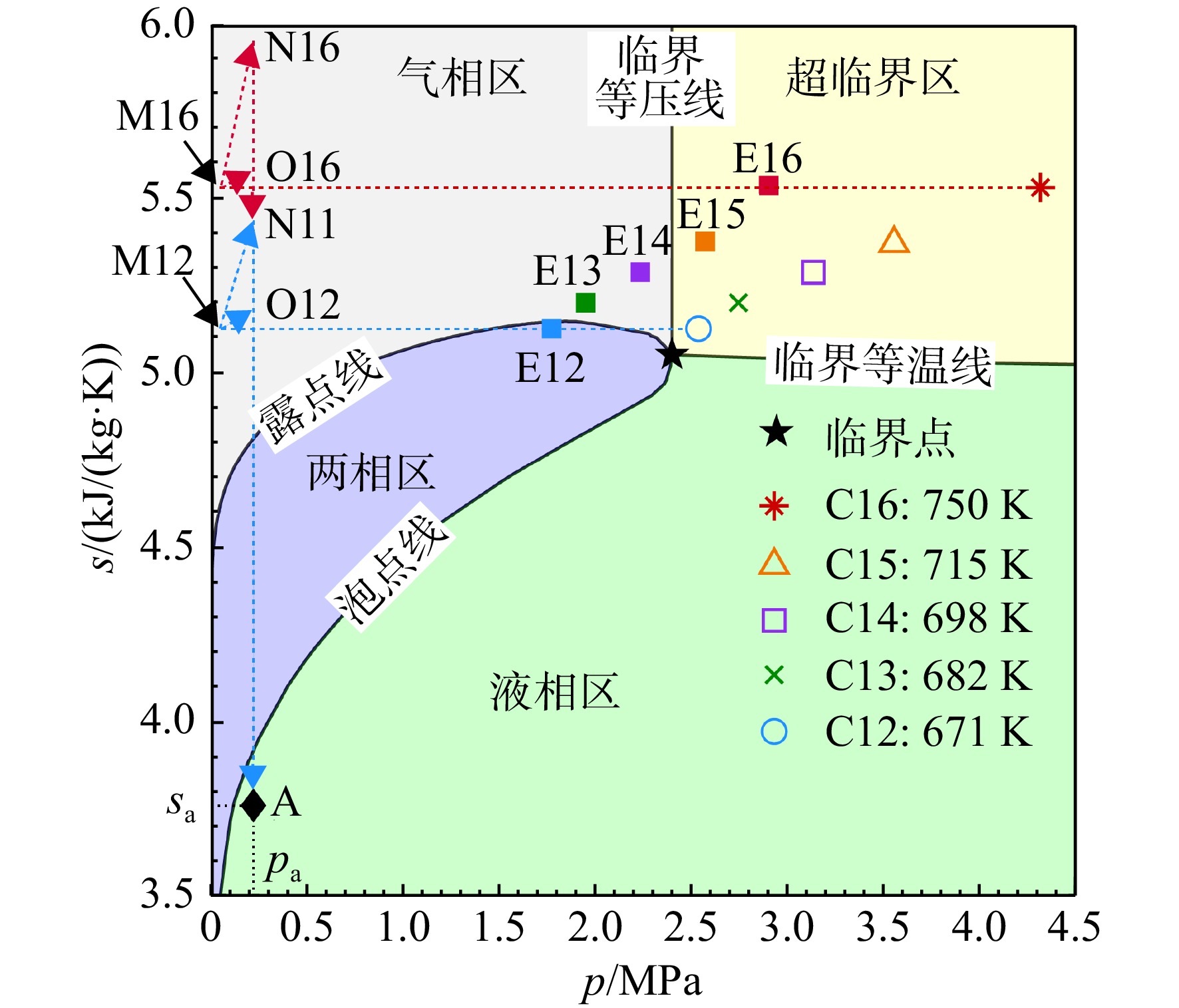
图 9 显示Tinj = 597 K和660 K的RP-3射流喷射路径的s-p图和包含解体过程特征点的Tinj = 660 K射流阴影图像
Figure 9. s-p diagram with injection path for RP-3 jets atTinj = 597 K and 660 K and shadowgraph image for jet at Tinj = 660 K including characteristic points within the disintegration process

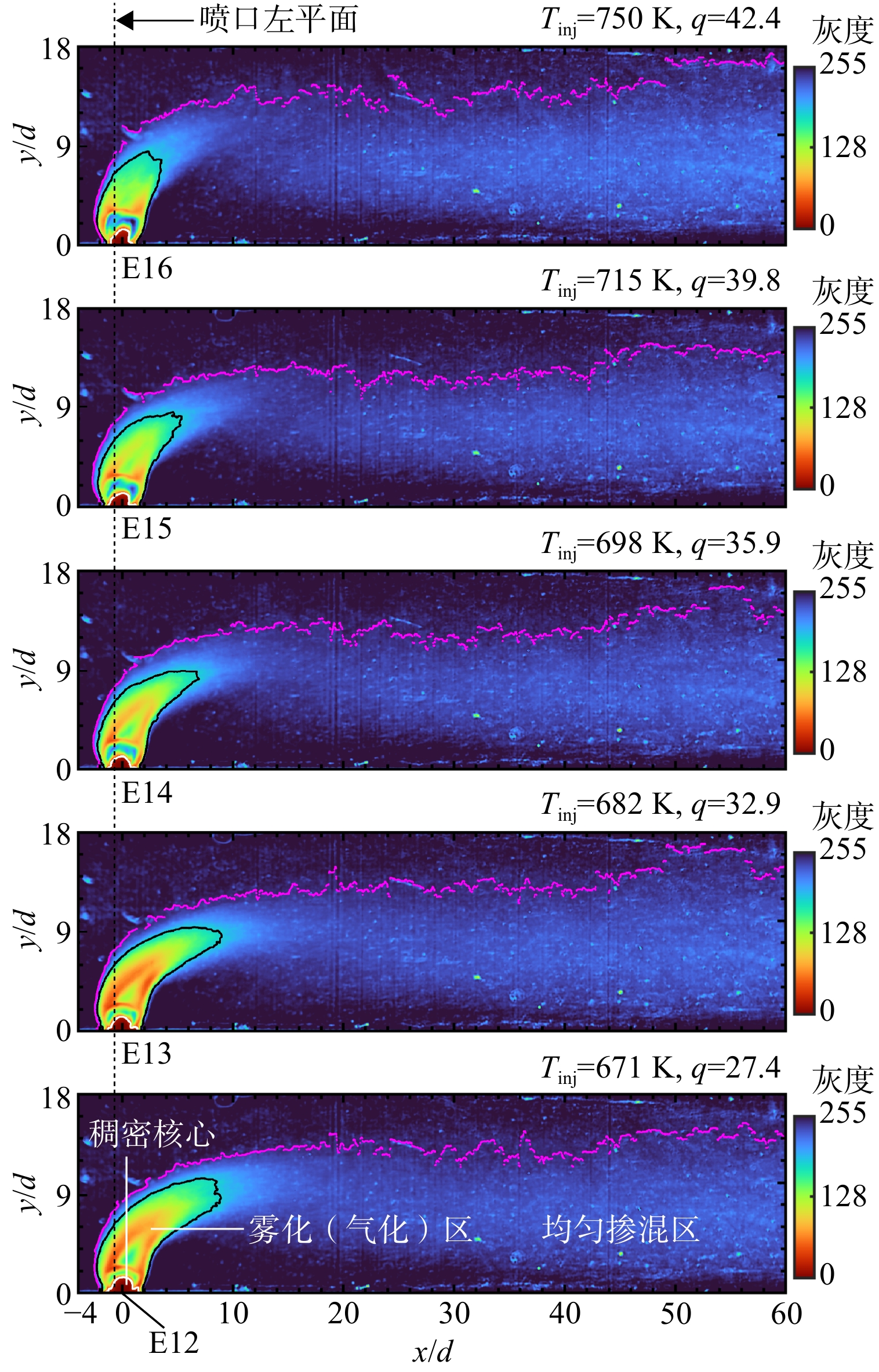
图 10 空气横流中超临界RP-3欠膨胀射流阴影图像
Figure 10. Shadowgraph images of supercritical RP-3 under-expanded jets in air crossflow
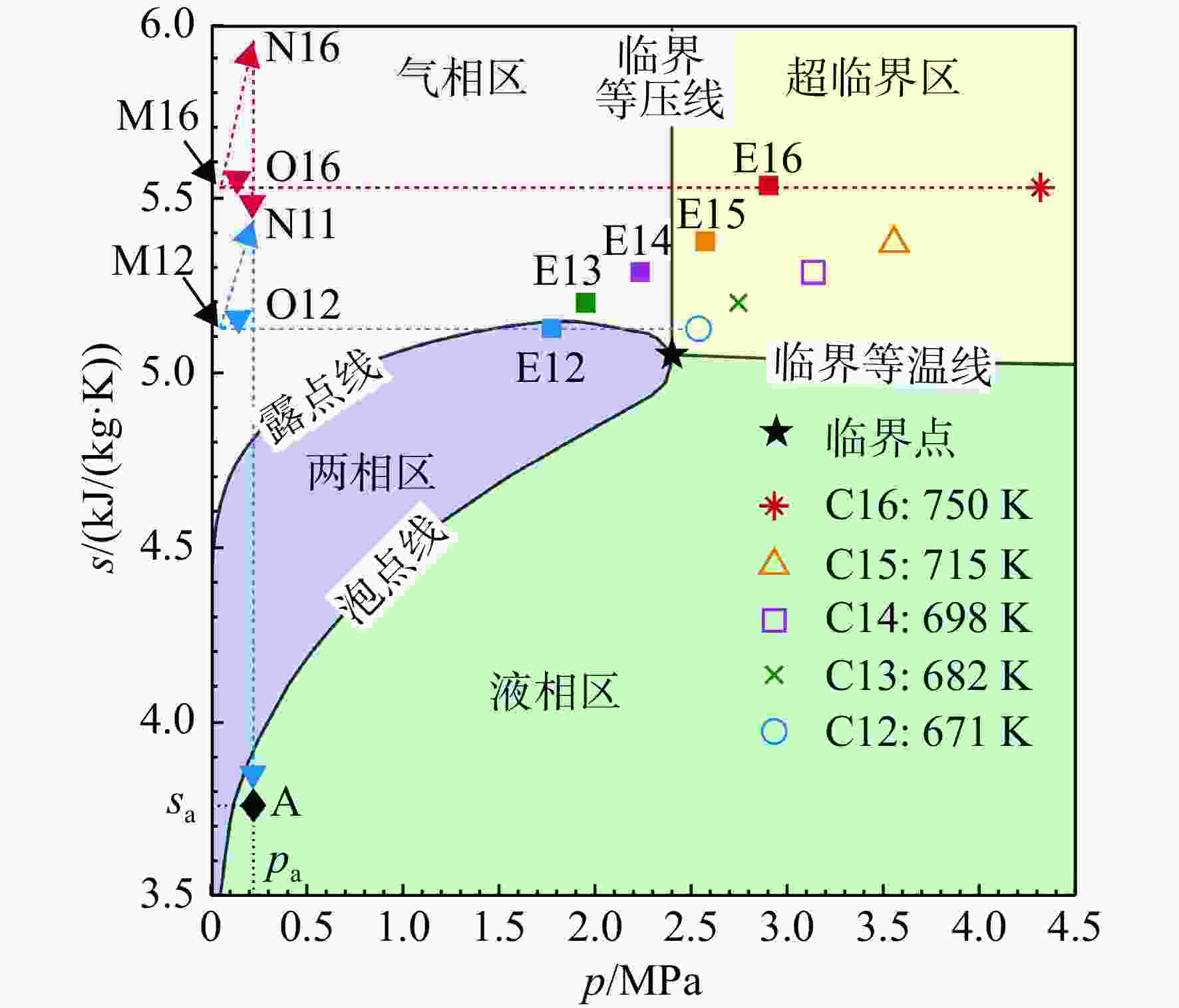
图 11 带有超临界RP-3欠膨胀射流喷射路径的s-p图
Figure 11. s-p diagram with injection path for supercritical RP-3 under-expanded jets
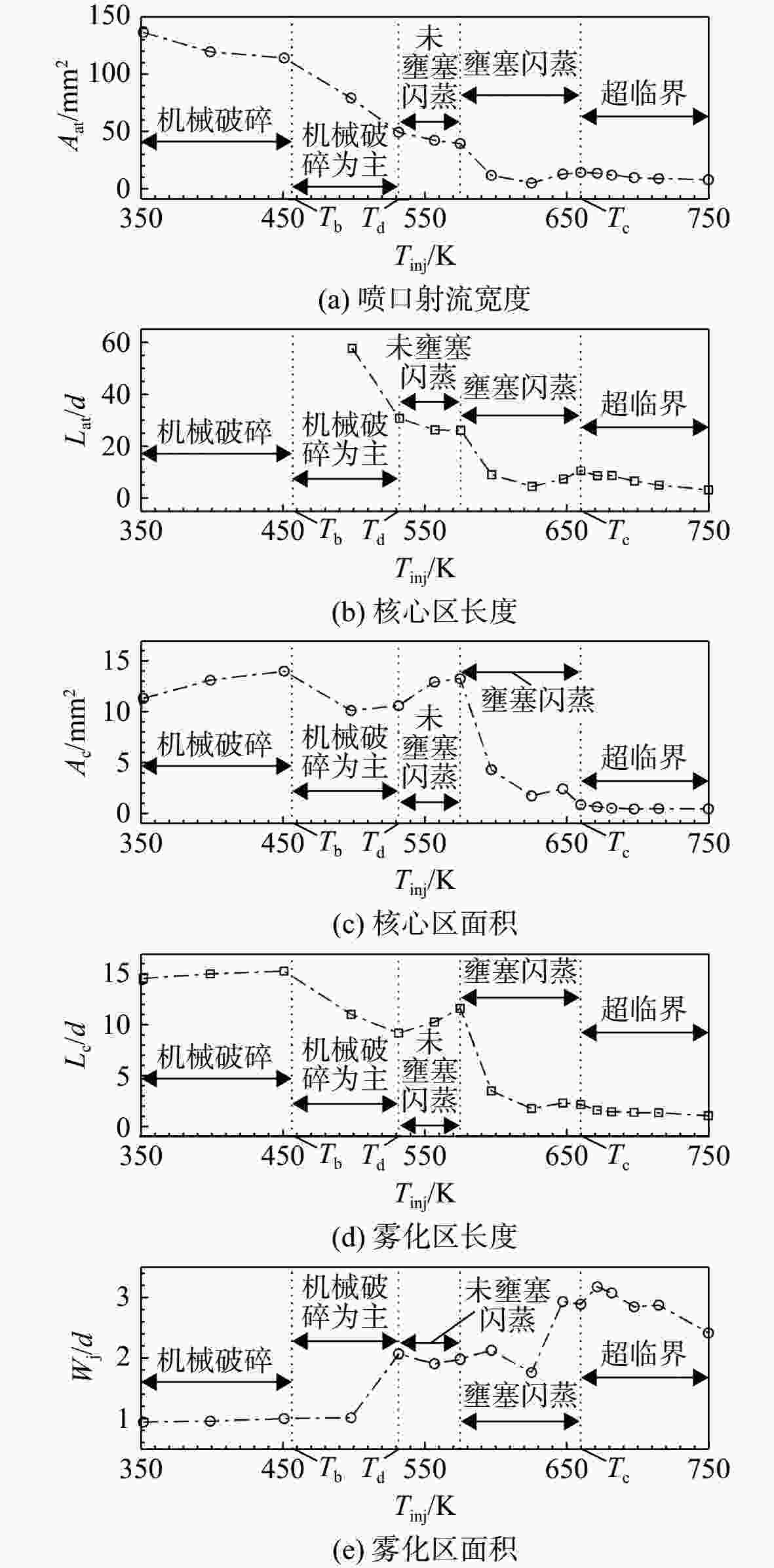
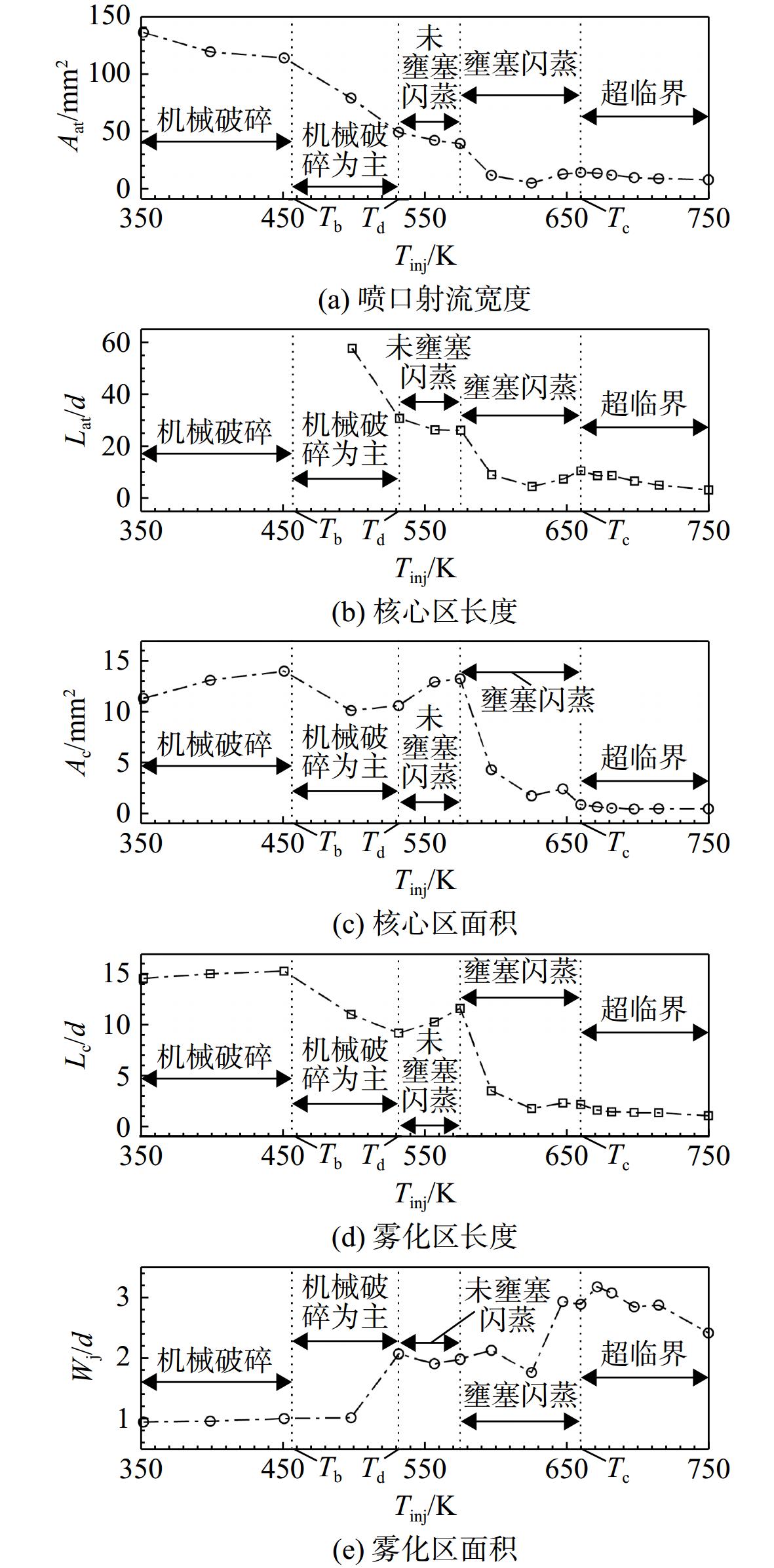
图 12 空气横流中RP-3射流的喷口射流宽度、核心区长度、核心区面积、雾化区长度和雾化区面积随喷射温度的变化
Figure 12. Variation of jet width at nozzle exit, core length, core area, atomization length and atomization area of RP-3 jet in air crossflow with the injection temperature
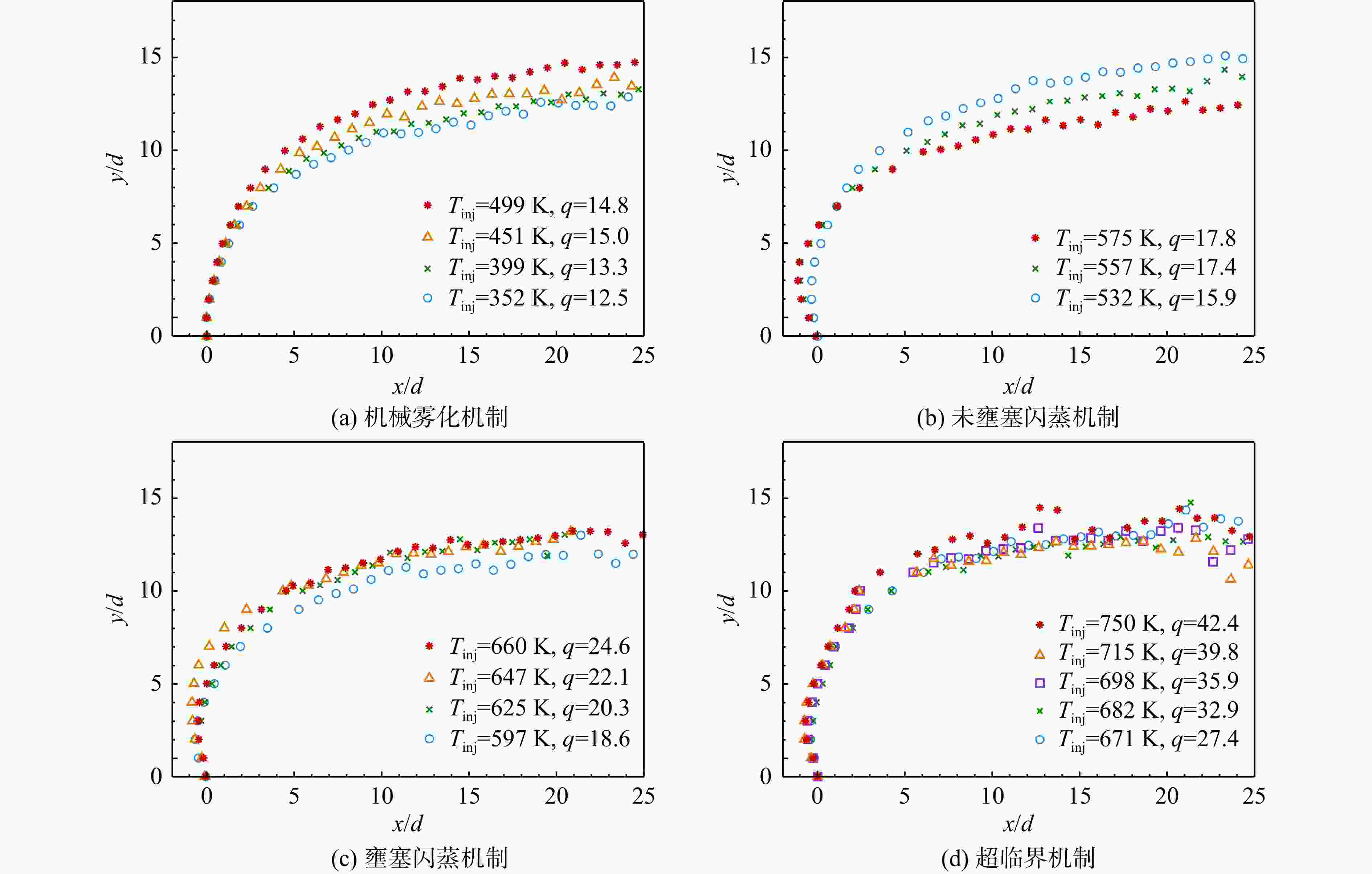
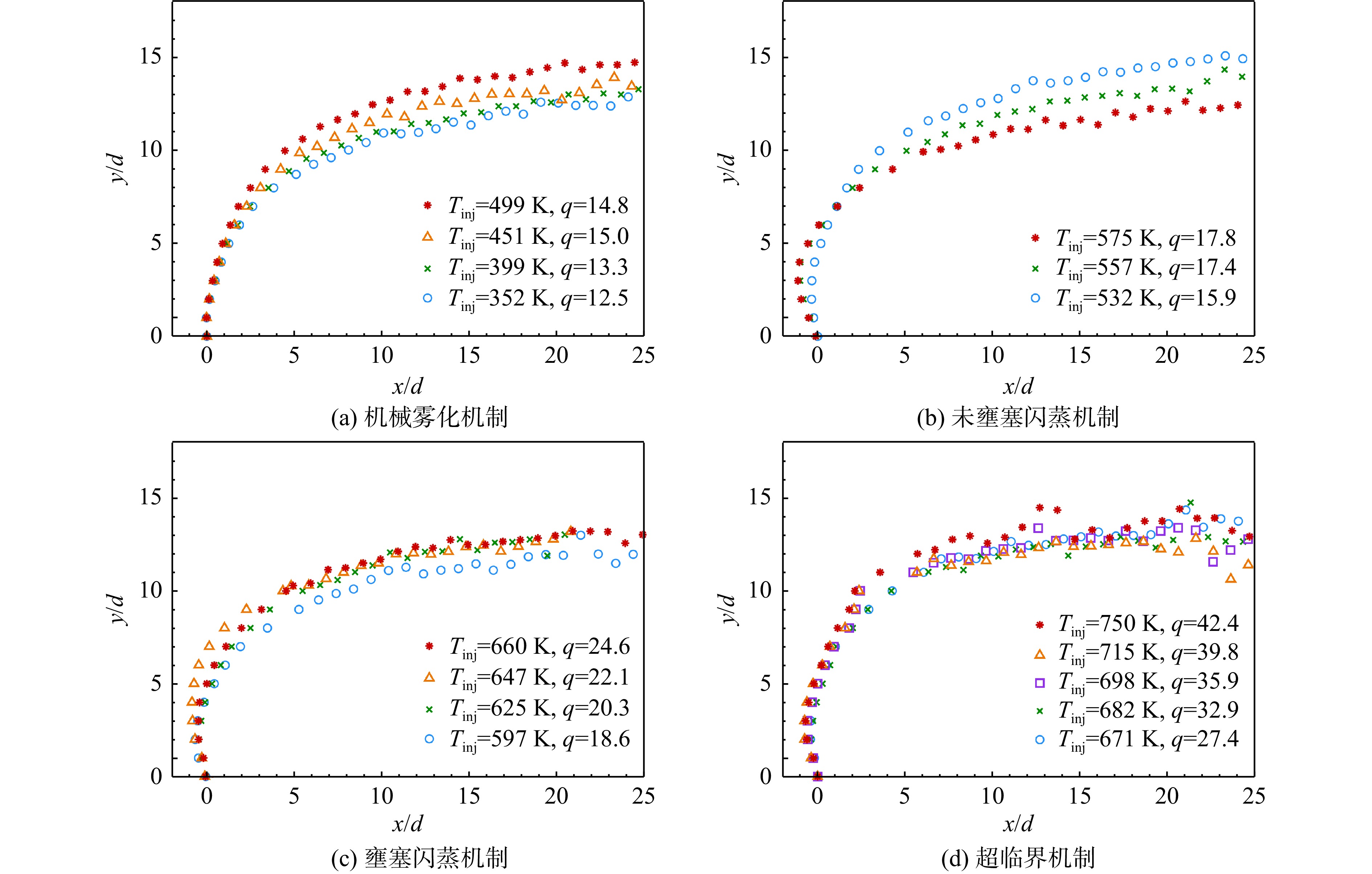
图 13 空气横流中RP-3射流轨迹随喷射温度的变化
Figure 13. Variation of jet trajectory of RP-3 jet in air crossflow with injection temperature
表 1 试验工况
Table 1. Test conditions
射流类型 工况序号 Tinj/K pinj/MPa q 加热液态 1 352 0.416 12.5 2 399 0.423 13.3 3 451 0.445 15.0 4 499 0.481 14.8 未壅塞闪蒸 5 532 0.644 15.9 6 557 0.822 17.4 7 575 0.822 17.8 壅塞闪蒸 8 597 1.145 18.6 9 625 1.506 20.3 10 647 1.960 22.1 11 660 2.246 24.6 超临界欠膨胀 12 672 2.538 27.4 13 682 2.745 32.9 14 698 3.136 35.9 15 715 3.556 39.8 16 750 4.318 42.4  下载: 导出CSV
-
[1] BELLOFIORE A, RAGUCCI R. Air density effect on the atomization of liquid jets in crossflow[J]. Combustion Science and Technology, 2007, 179(1/2): 319-342. [2] BEHZAD M, ASHGRIZ N, MASHAYEK A. Azimuthal shear instability of a liquid jet injected into a gaseous cross-flow[J]. Journal of Fluid Mechanics, 2015, 767: 146-172. doi: 10.1017/jfm.2015.36 [3] LEE K, AALBURG C, DIEZ F J, et al. Primary breakup of turbulent round liquid jets in uniform crossflows[J]. AIAA Journal, 2007, 45(8): 1907-1916. doi: 10.2514/1.19397 [4] LEONG M Y, MCDONELL V G, SAMUELSEN G S. Effect of ambient pressure on an airblast spray injected into a crossflow[J]. Journal of Propulsion and Power, 2001, 17(5): 1076-1084. doi: 10.2514/2.5846 [5] RAGUCCI R, BELLOFIORE A, CAVALIERE A. Breakup and breakdown of bent kerosene jets in gas turbine conditions[J]. Proceedings of the Combustion Institute, 2007, 31(2): 2231-2238. doi: 10.1016/j.proci.2006.07.204 [6] STENZLER J, LEE J, SANTAVICCA D. Penetration of liquid jets in a crossflow[R]. AIAA-2003-1327, 2003. [7] CORN M L, COHEN J M, LEE J C, et al. Characterization of a superheated fuel jet in a crossflow[J]. Journal of Engineering for Gas Turbines and Power, 2011, 133(1): 011501. doi: 10.1115/1.4001978 [8] SOBEL D R, SPADACCINI L J. Hydrocarbon fuel cooling technologies for advanced propulsion[J]. Journal of Engineering for Gas Turbines and Power, 1997, 119(2): 344-351. doi: 10.1115/1.2815581 [9] HUANG He, SPADACCINI L J, SOBEL D R. Fuel-cooled thermal management for advanced aeroengines[J]. Journal of Engineering for Gas Turbines and Power, 2004, 126(2): 284-293. doi: 10.1115/1.1689361 [10] YANG V. Modeling of supercritical vaporization, mixing, and combustion processes in liquid-fueled propulsion systems[J]. Proceedings of the Combustion Institute, 2000, 28(1): 925-942. doi: 10.1016/S0082-0784(00)80299-4 [11] BELLAN J. Supercritical (and subcritical) fluid behavior and modeling: drops, streams, shear and mixing layers, jets and sprays[J]. Progress in Energy and Combustion Science, 2000, 26(4/5/6): 329-366. [12] GERBER V, BAAB S, FÖRSTER F J, et al. Fluid injection with supercritical reservoir conditions: Overview on morphology and mixing[J]. The Journal of Supercritical Fluids, 2021, 169: 105097. doi: 10.1016/j.supflu.2020.105097 [13] FAN Xuejun, et al. Effects of entry conditions on cracked kerosene-fueled supersonic combustor performance[J]. Combustion Science and Technology, 2007, 179(10): 2199-2217. doi: 10.1080/00102200701386198 [14] XUE Xin, GAO Wei, XU Quanhong, et al. Injection of subcritical and supercritical aviation kerosene into a high-temperature and high-pressure crossflow[R]. Vancouver, Canada: ASME Turbo Expo: Power for Land, Sea, and Air. 2011. [15] YANG Kai, LI Chenyang, PAN Yu, et al. Investigation of the evaporation characteristics of a transverse vaporized kerosene jet in supersonic flow[J]. Acta Astronautica, 2021, 185: 257-263. doi: 10.1016/j.actaastro.2021.04.046 [16] ZHONG Fengquan, FAN Xuejun, YU Gong, et al. Heat transfer of aviation kerosene at supercritical conditions[R]. AIAA-2008-4615, 2008. [17] HUBER M L. NIST thermophysical properties of hydrocarbon mixtures database (SUPERTRAPP), version 3.2[M]. Gaithersburg, US: National Institute of Standards and Technology, 2007. [18] JACOBSEN R T, STEWART R B. Thermodynamic properties of nitrogen including liquid and vapor phases from 63 K to 2000 K with pressures to 10, 000 bar[J]. Journal of Physical and Chemical Reference Data, 1973, 2(4): 757-922. doi: 10.1063/1.3253132 [19] FISHER G D, LELAND T W Jr. Corresponding states principle using shape factors[J]. Industrial & Engineering Chemistry Fundamentals, 1970, 9(4): 537-544. [20] GAO Wei, LIN Yuzhen, HUI Xin, et al. Injection characteristics of near critical and supercritical kerosene into quiescent atmospheric environment[J]. Fuel, 2019, 235: 775-781. doi: 10.1016/j.fuel.2018.08.048 [21] LIU Guigui, LIN Yuzhen, LI Jiaju, et al. Flow characteristics and phase transition of subcritical to supercritical kerosene injections in a convergent nozzle[J]. Fuel, 2023, 334: 126518. doi: 10.1016/j.fuel.2022.126518 [22] SETTLES G, COVERT E. Schlieren and shadowgraph techniques: visualizing phenomena in transport media[J]. Applied Mechanics Reviews, 2002, 55(4): B76-B77. [23] LUO Meng, HAIDN O J. Characterization of flashing phenomena with cryogenic fluid under vacuum conditions[J]. Journal of Propulsion and Power, 2016, 32(5): 1253-1263. doi: 10.2514/1.B35963 [24] BAAB S, LAMANNA G, WEIGAND B. Two-phase disintegration of high-pressure retrograde fluid jets at near-critical injection temperature discharged into a subcritical pressure atmosphere[J]. International Journal of Multiphase Flow, 2018, 107: 116-130. doi: 10.1016/j.ijmultiphaseflow.2018.04.021 -



 点击查看大图

计量
- 文章访问数: 697
- HTML浏览量: 528
- PDF量: 128
- 被引次数: 0