






Dual-channel remaining useful life prediction method based on dilated convolution and regression features
-
摘要:
设计了一种双通道航空发动机剩余寿命(remaining useful life,RUL)预测模型。第1条通道使用膨胀卷积并引入注意力机制,减少了模型参数量,加强了对RUL关键特征信息的表达;第2条通道使用了平均回归特征对原始信号进行去噪和平滑处理,降低噪声对RUL预测的影响;最后将两条通道特征融合并输入至全连接网络得到最终的RUL预测结果。为了验证本文的模型有效性,在美国航空航天局公布的C-MAPSS(commercial modular aero propulsion system simulation)数据集上进行了实验。研究表明该方法相比于CNN-LSTM(convolutional neural network & long short-term memory network)、AdaBN-DCNN(adaptive batch normalization-deep convolutional neural network)、RCNN-ABi-LSTM(region-based convolutional neural network & attention bi-directional long short-term memory network)模型的方均根误差分别降低了32.1%、7.8%、6.3%,双通道模型的预测精度得到了显著提升。
Abstract:A two-channel aero-engine remaining useful life (RUL) prediction model was developed. The first channel utilized dilation convolution and incorporated the attention mechanism, which decreased the model parameters and enhanced the representation of crucial feature information of RUL. The second channel employed average regression features to denoise and smooth the original signal, reducing the influence of noise on RUL prediction. Ultimately, the features from both channels were combined and fed into the fully connected network to generate the ultimate RUL prediction results. In order to verify the effectiveness of the model, experiments were conducted on the C-MAPSS (commercial modular aero propulsion system simulation) dataset published by National Aeronautics and Space Administration. It was shown that the root-mean-square error of this method was reduced by 32.1%, 7.8%, and 6.3% compared with the CNN-LSTM (convolutional neural network & long short-term memory network), AdaBN-DCNN (adaptive batch normalization-deep convolutional neural network) and RCNN-ABi-LSTM (region-based convolutional neural network & attention bi-directional long short-term memory network) models, respectively. Additionally, the prediction accuracy of the two-channel model was significantly enhanced.
-
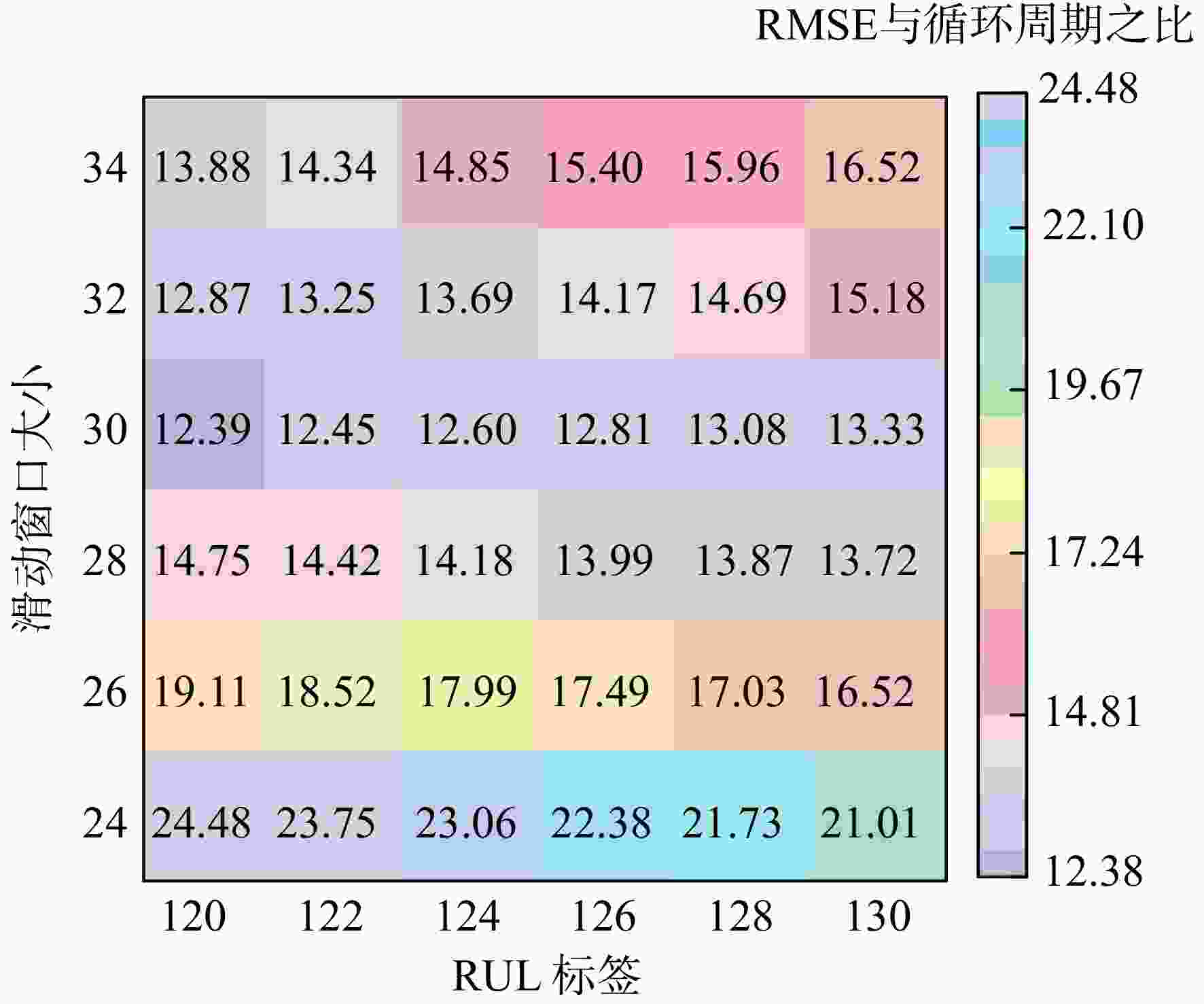
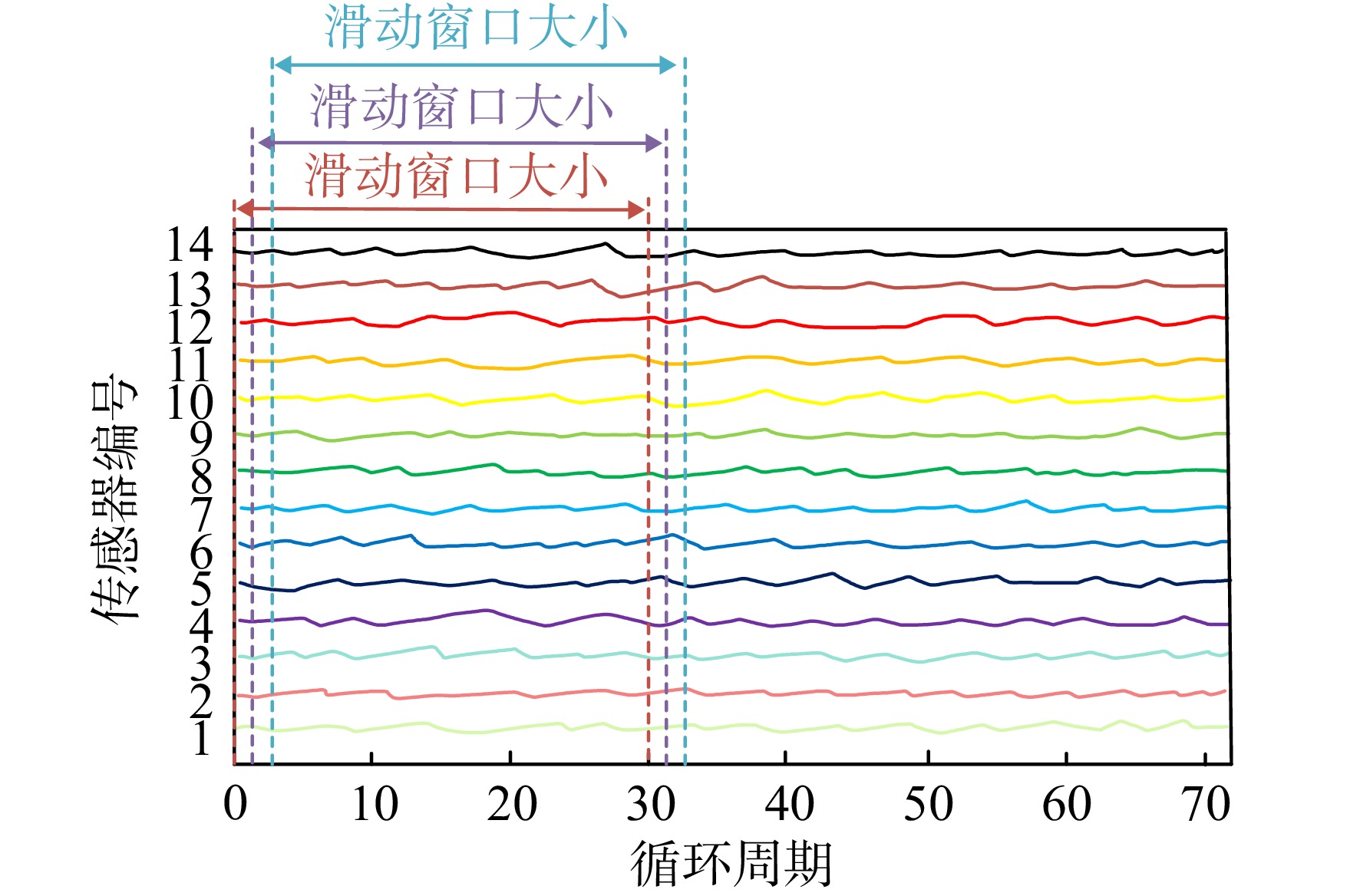
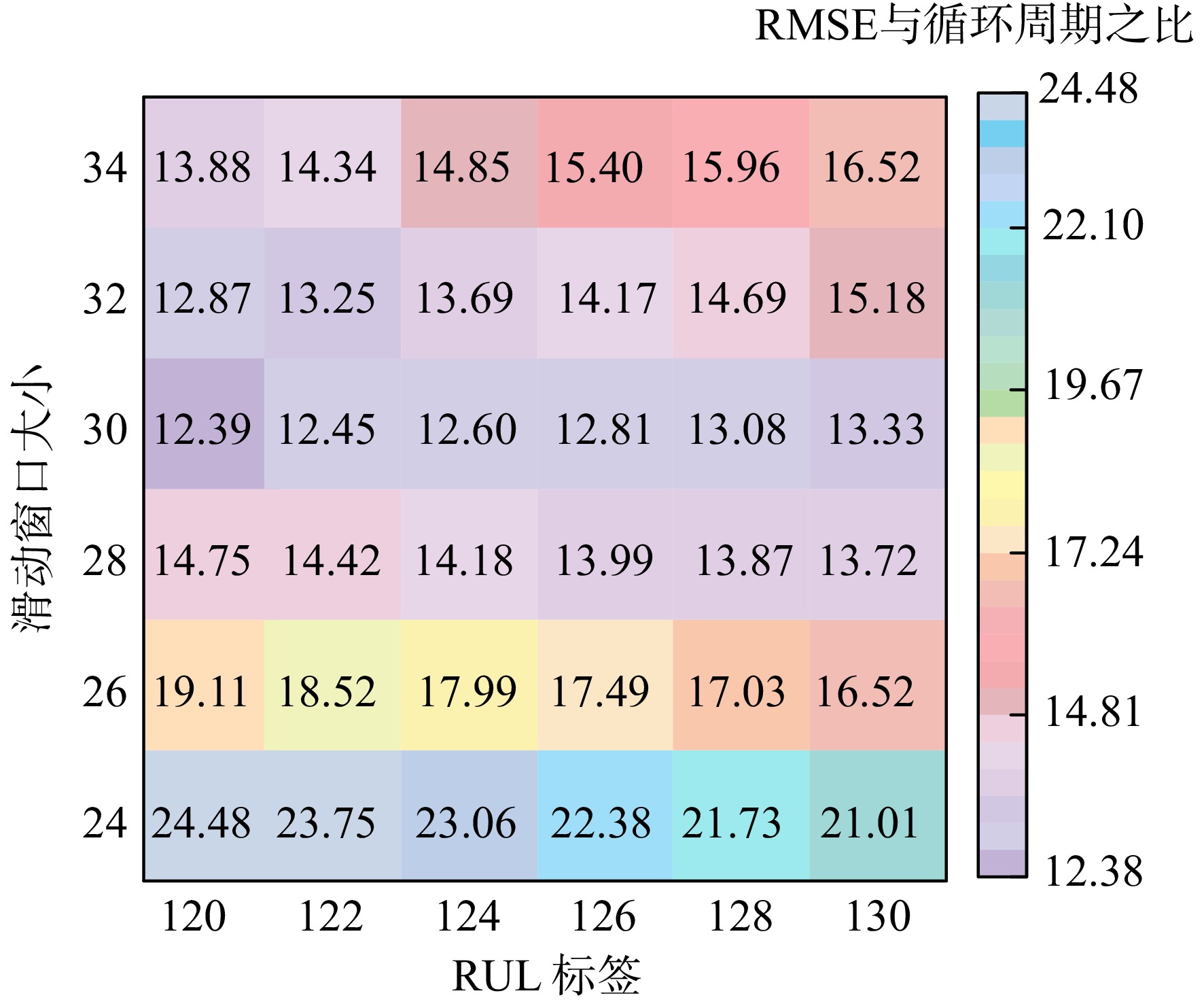
图 7 滑动窗口与剩余寿命标签关系示意图
Figure 7. Schematic diagram of relationship between sliding window and remaining useful life label
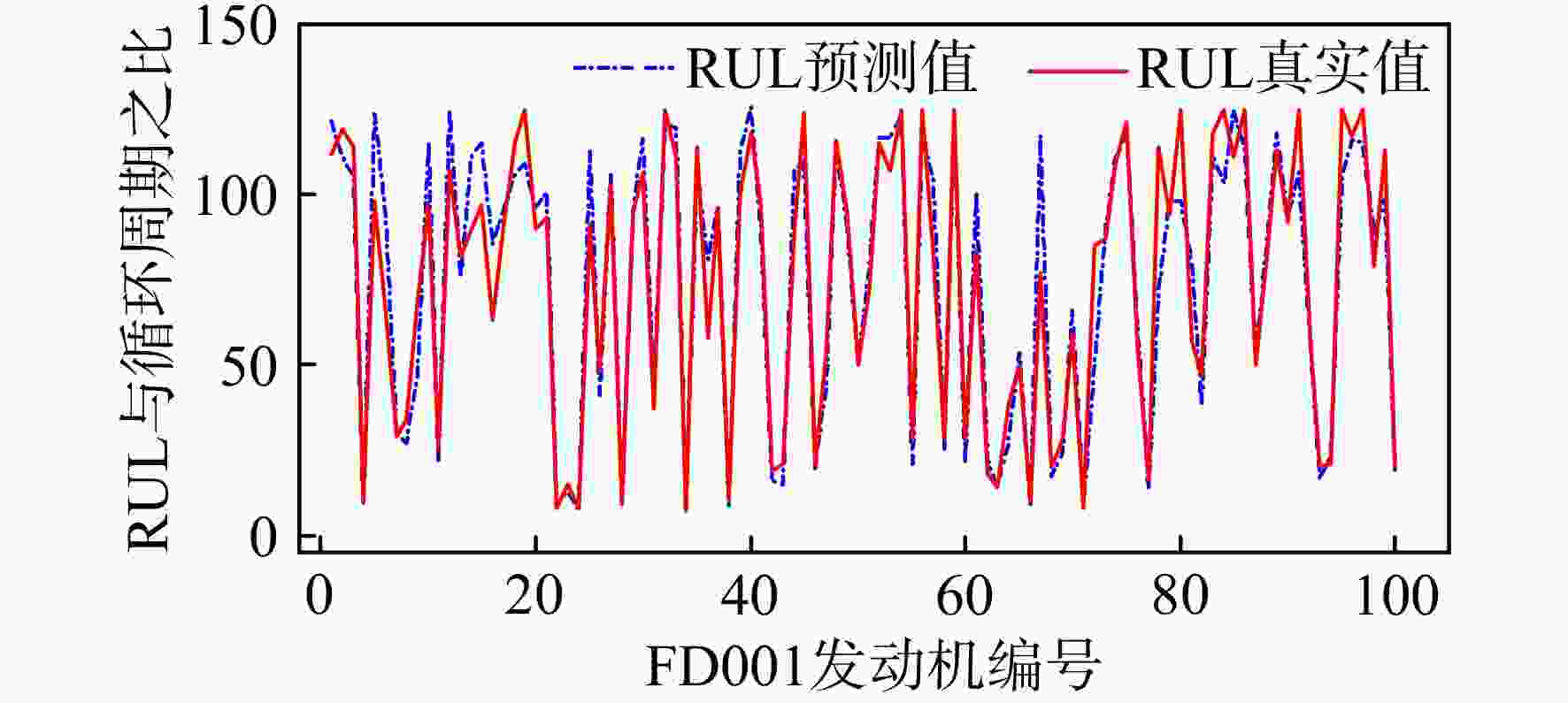
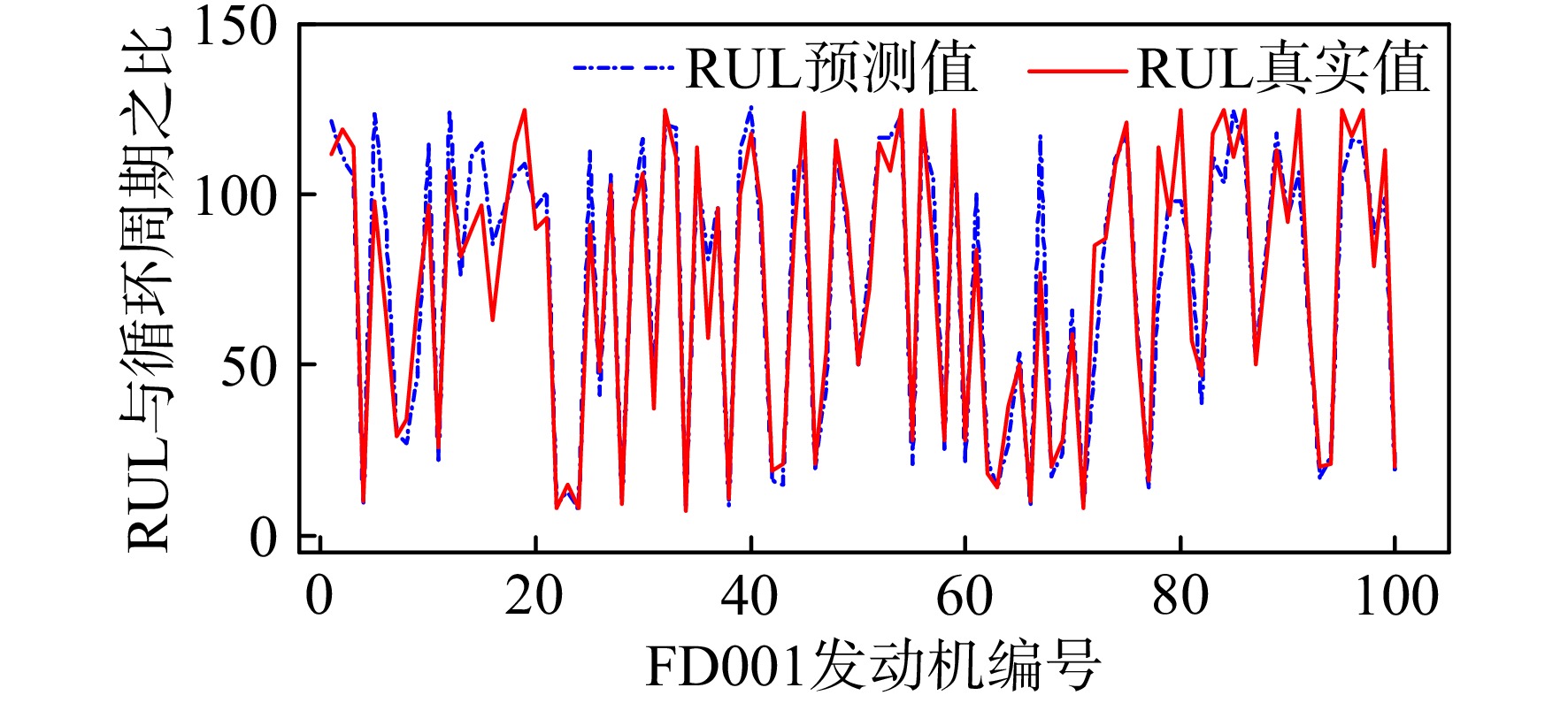
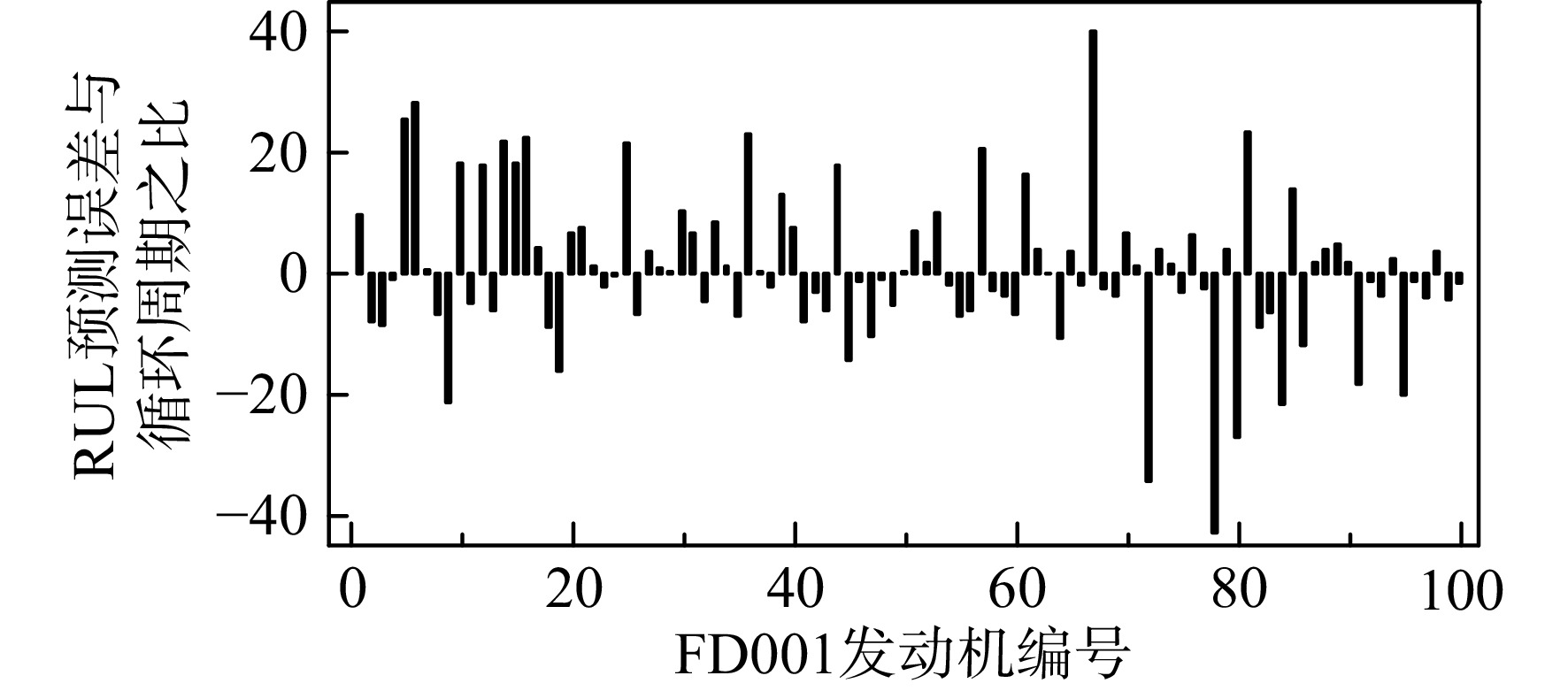
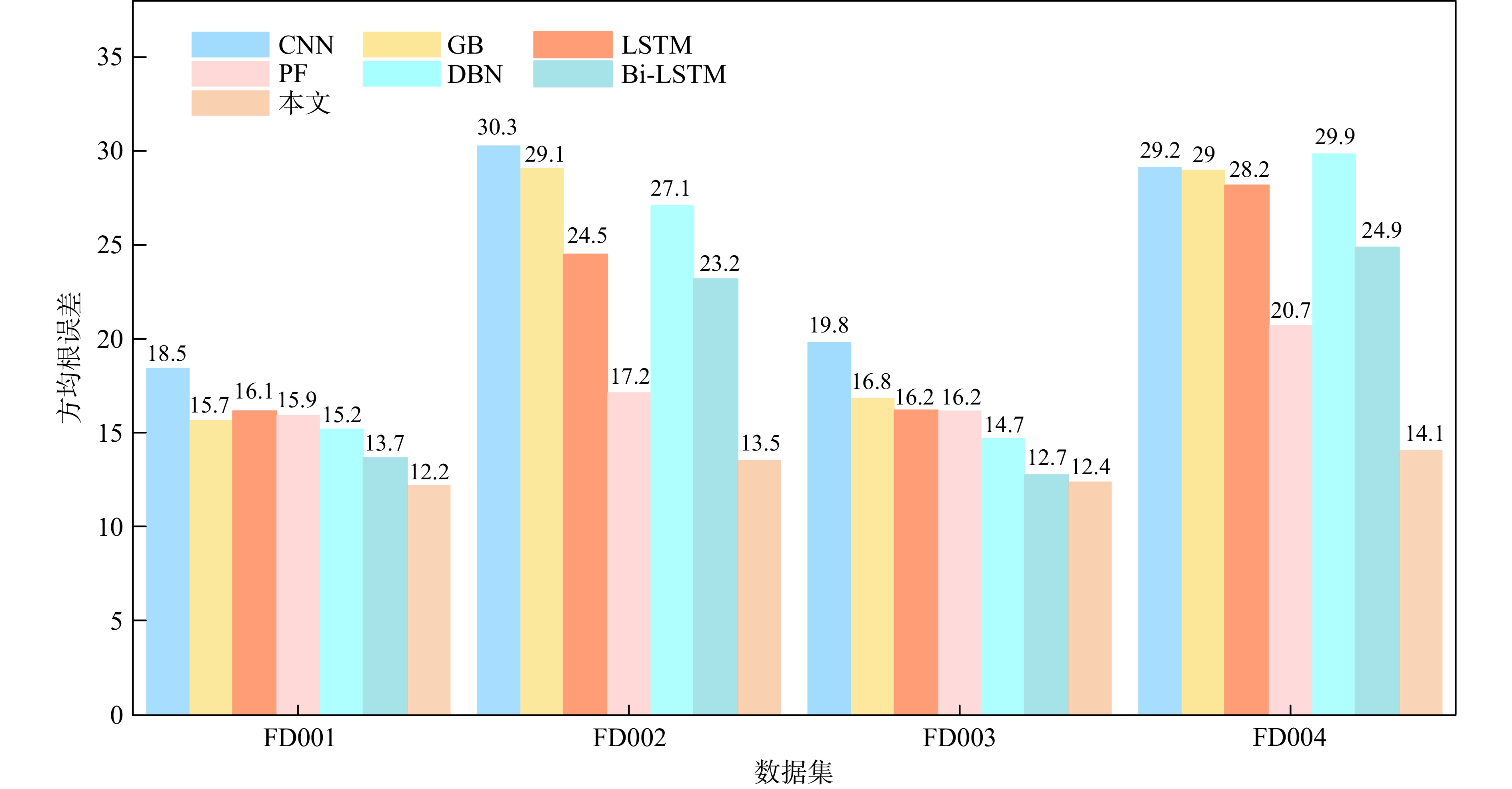
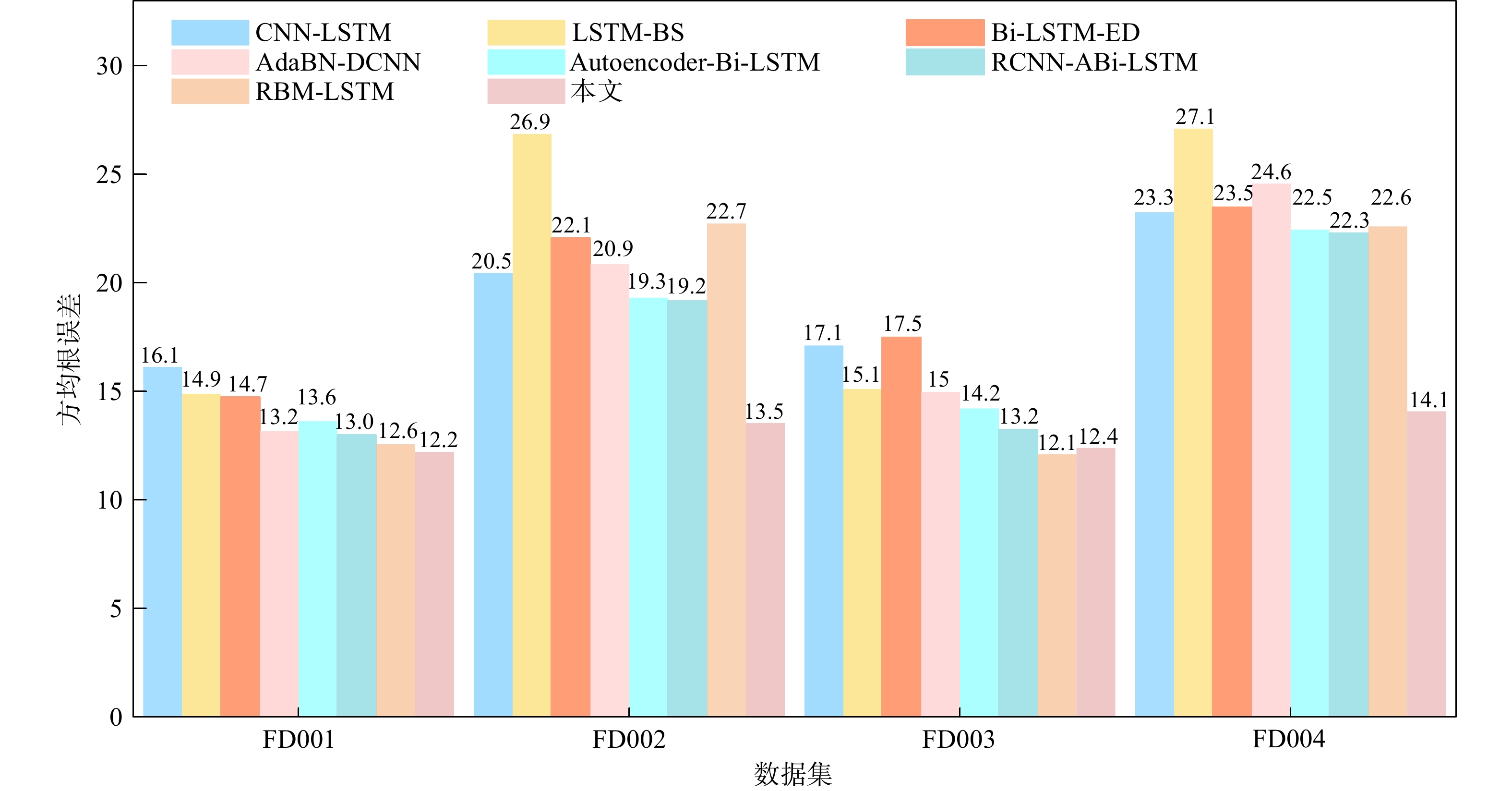
图 9 FD001测试集RUL预测结果对比
Figure 9. Comparison of RUL prediction results for FD001 test set
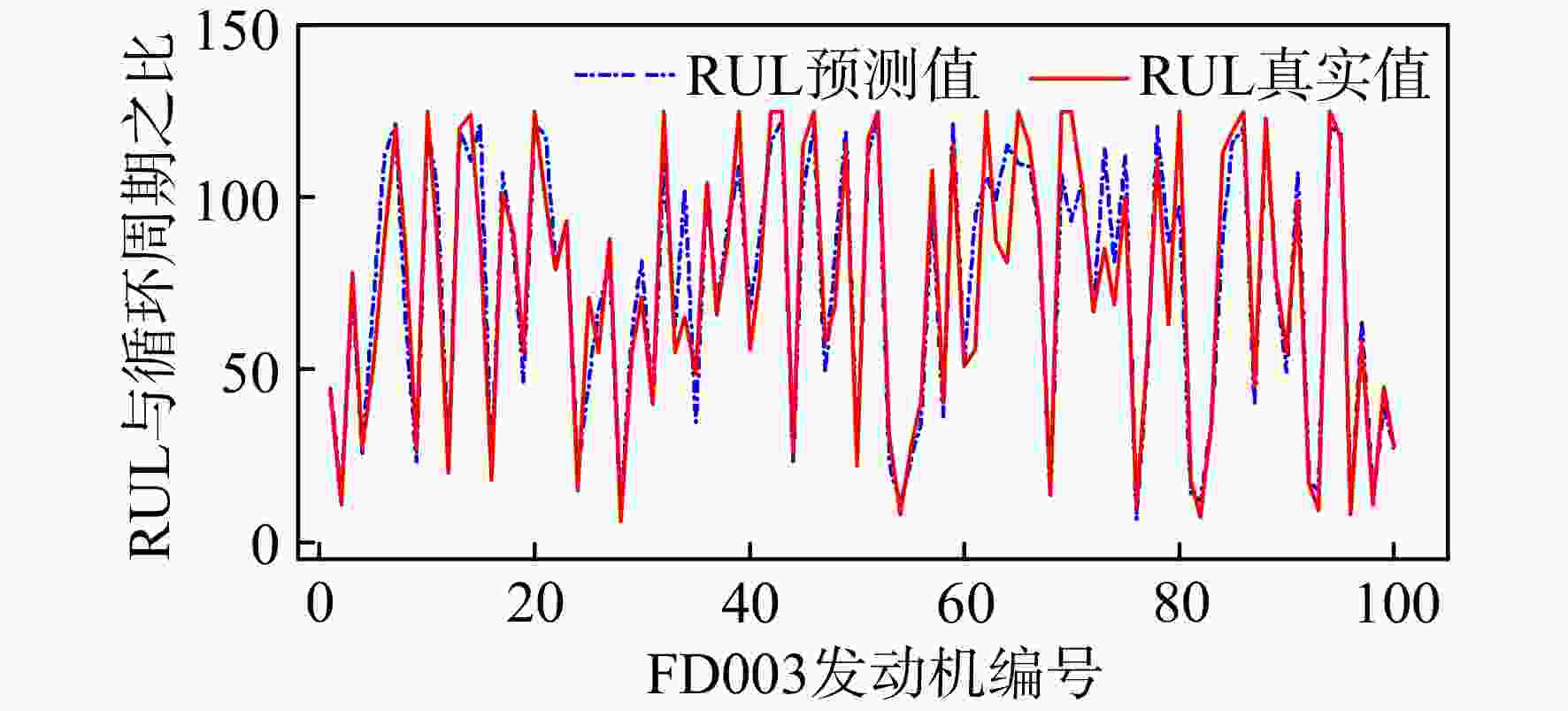
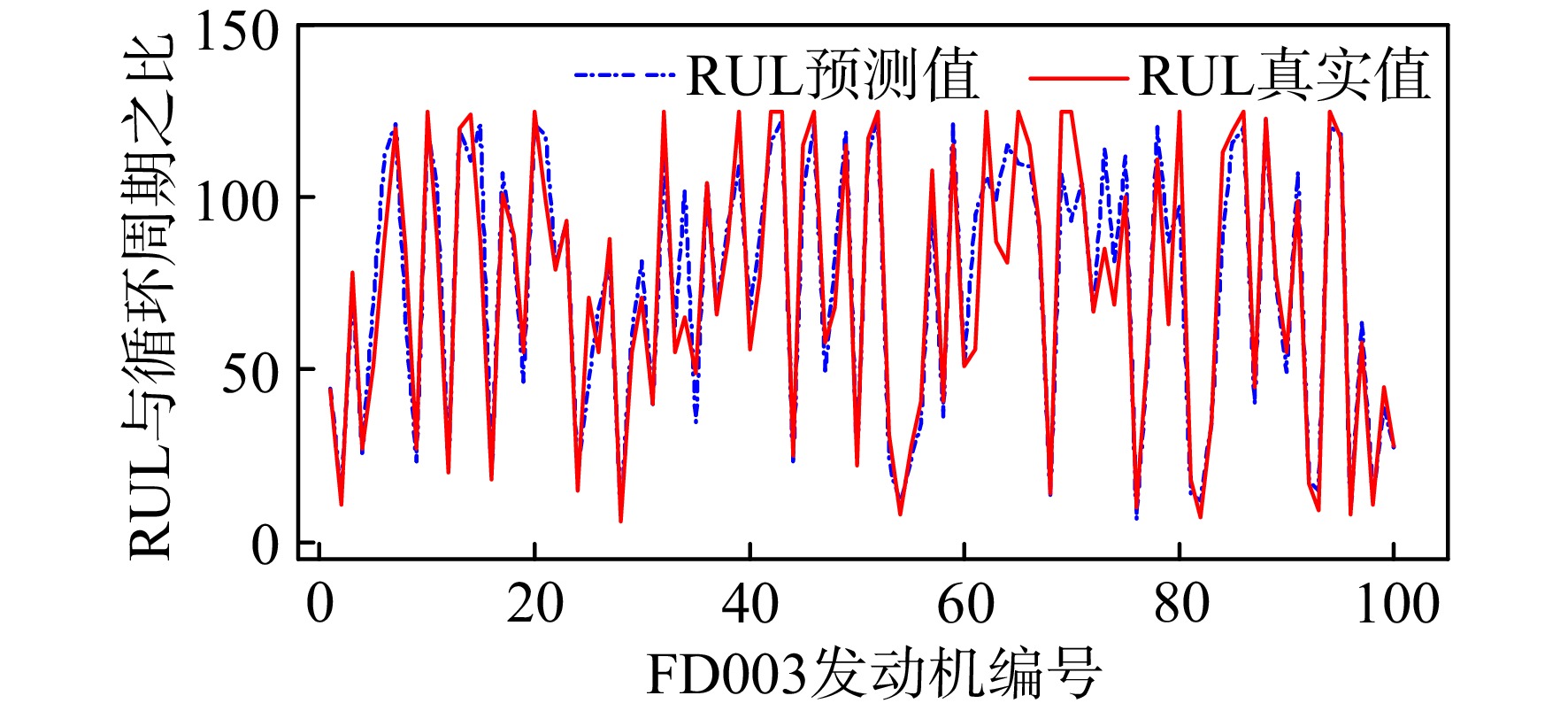
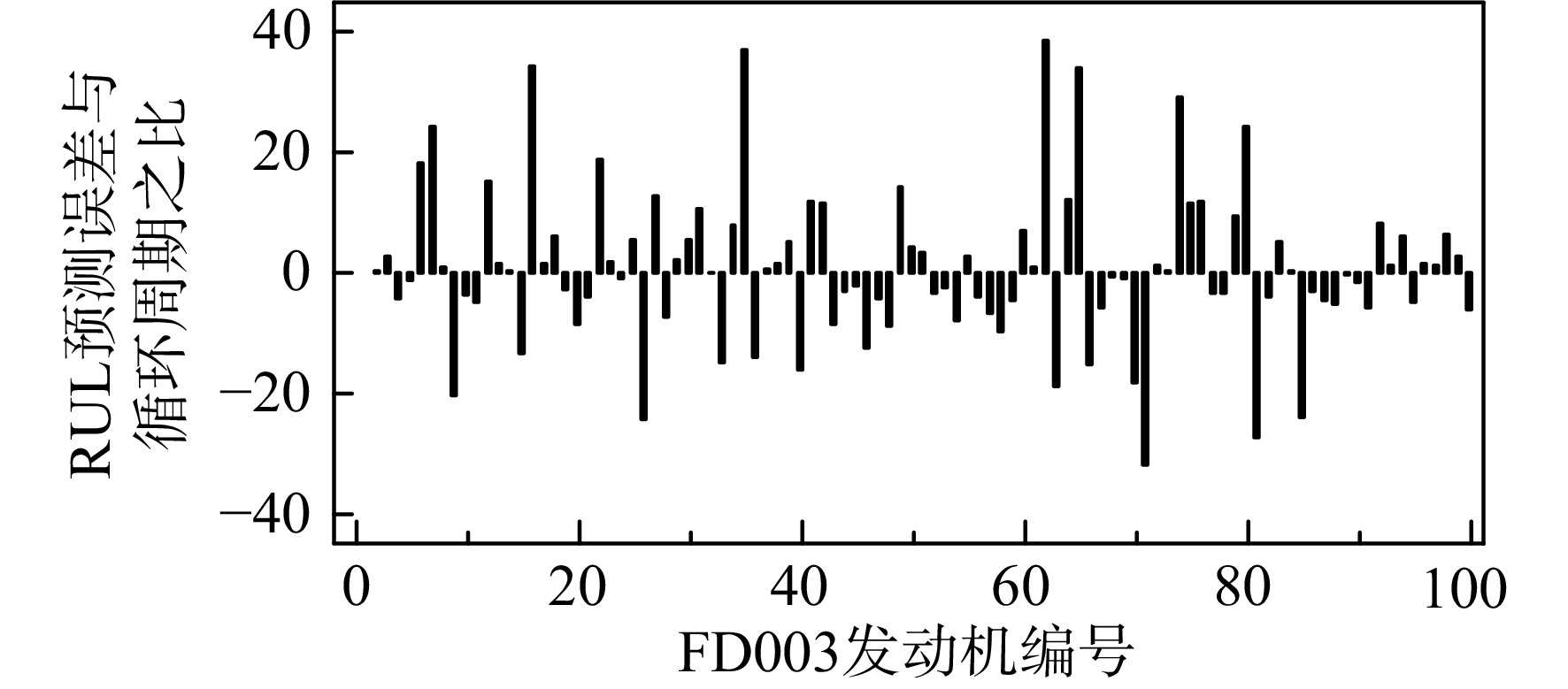
图 10 FD003测试集RUL预测结果对比
Figure 10. Comparison of RUL prediction results for FD003 test set
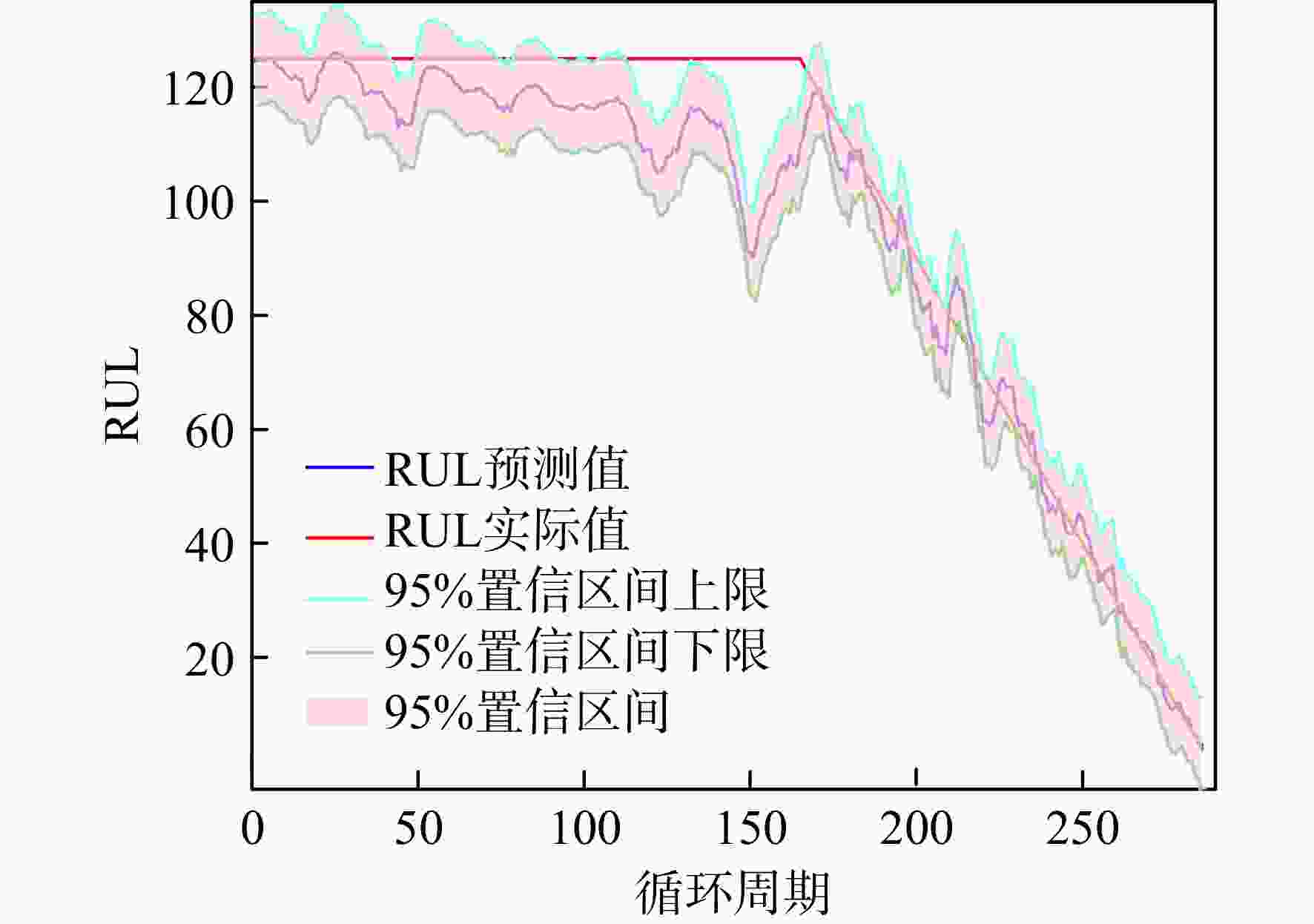
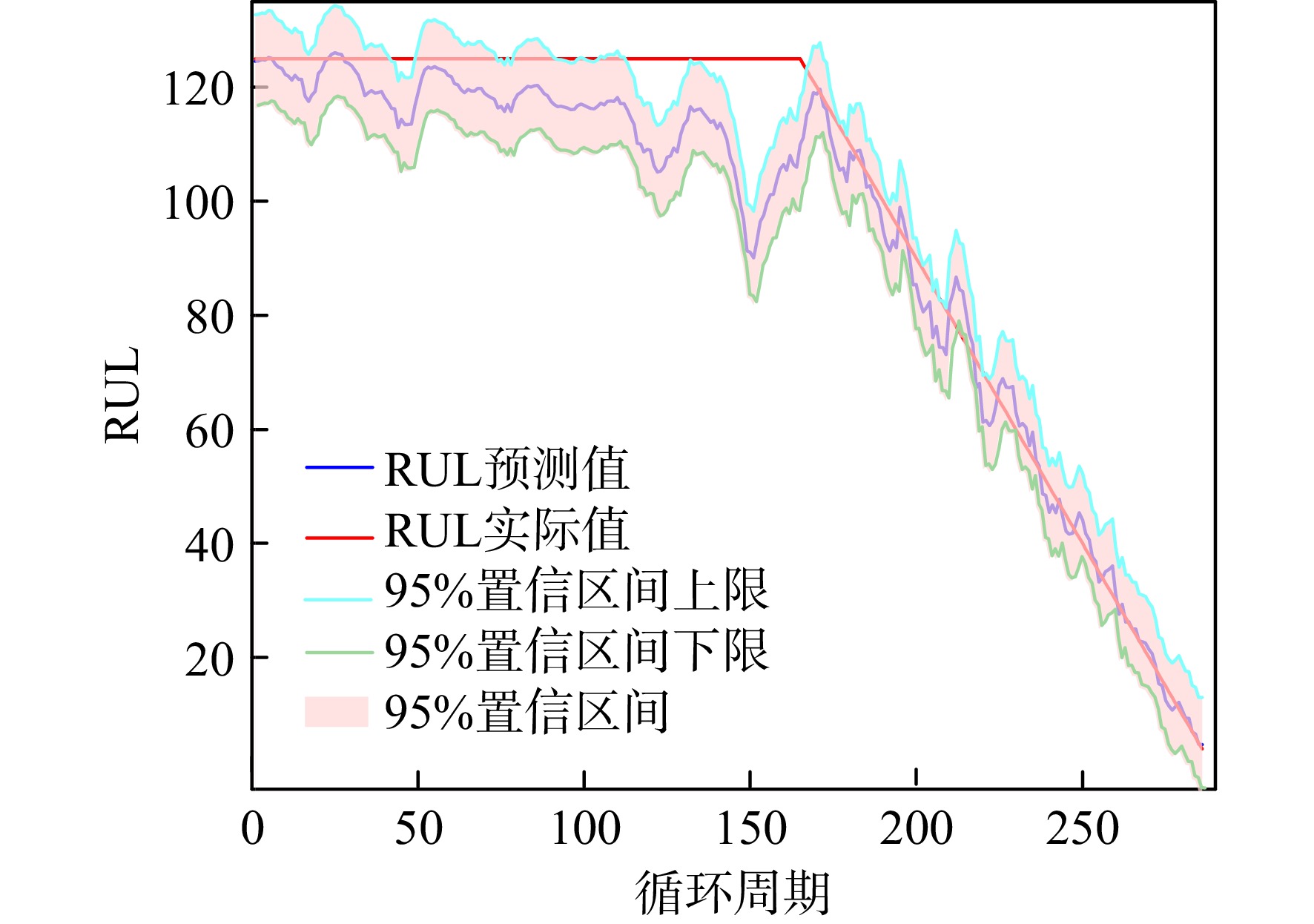
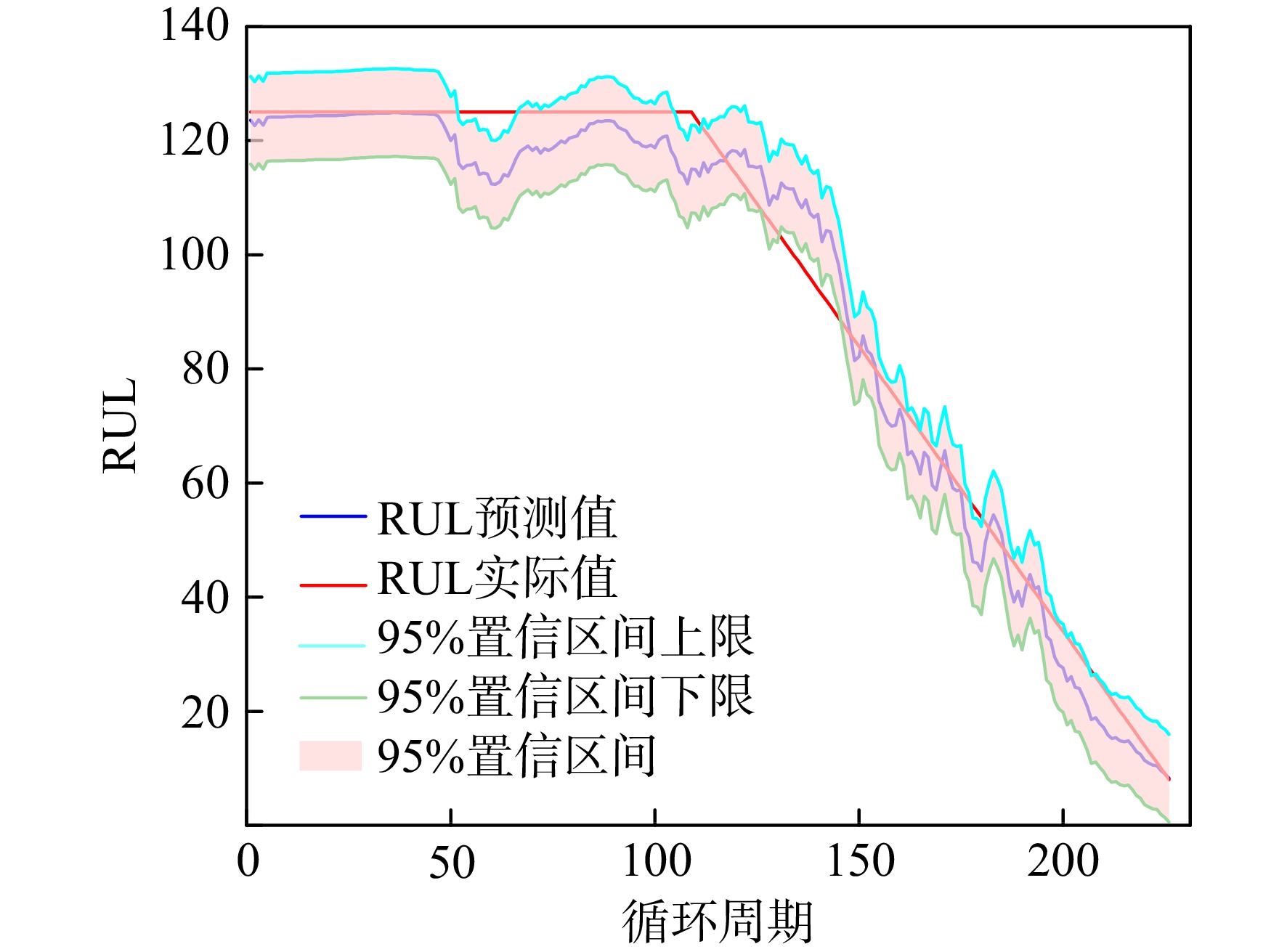
图 13 FD002#91号发动机95%置信区间退化结果
Figure 13. 95% confidence interval degradation results for engine FD002#91

图 14 FD004#13号发动机95%置信区间退化结果
Figure 14. 95% confidence interval degradation results for engine FD004#13
表 1 CMPASS数据集介绍
Table 1. Introduction to the CMPASS data set
数据集 FD001 FD002 FD003 FD004 训练集 100 260 100 249 测试集 100 259 100 248 故障模式种类 1 1 2 2 工况 1 6 1 6  下载: 导出CSV
表 2 网络参数配置
Table 2. Network parameter configuration
模型 参数 数值 膨胀卷积 输入通道 18 卷积率 2 填充 1 卷积核大小 3 输出通道 16 Bi-LSTM1 输入尺寸 16 隐藏层 16 丢失率 0.2 Bi-LSTM2 输入尺寸 16 隐藏层 21 丢失率 0.2 Bi-LSTM3 输入尺寸 28 隐藏层 16 丢失率 0.2 Bi-LSTM4 输入尺寸 32 隐藏层 32 丢失率 0.2
下载: 导出CSV
表 3 超参数网络配置
Table 3. Hyperparametric network configuration
超参数 数值 滑动窗口 29, 30, 30, 34 RUL标签 120, 120, 120, 121 学习次数 1000 学习率 0.001 优化器 Adamw
下载: 导出CSV
表 4 消融实验对比
Table 4. Comparison of ablation experiments
预测模型 RMSE DC-MR/without DC 13.15 DC-MR/without attention 13.63 DC-MR/without MR 13.95 DC-MR/with single Bi-LSTM 12.97 DC-MR 12.39
下载: 导出CSV
-
[1] MO Yu, WU Qianhui, LI Xiu, et al. Remaining useful life estimation via transformer encoder enhanced by a gated convolutional unit[J]. Journal of Intelligent Manufacturing, 2021, 32(7): 1997-2006. doi: 10.1007/s10845-021-01750-x [2] LIU Hui, LIU Zhenyu, JIA Weiqiang, et al. Remaining useful life prediction using a novel feature-attention-based end-to-end approach[J]. IEEE Transactions on Industrial Informatics, 2021, 17(2): 1197-1207. doi: 10.1109/TII.2020.2983760 [3] ZHANG Jiusi, LI Xiang, TIAN Jilun, et al. An integrated multi-head dual sparse self-attention network for remaining useful life prediction[J]. Reliability Engineering & System Safety, 2023, 233: 109096. [4] LEI Yaguo, LI Naipeng, GUO Liang, et al. Machinery health prognostics: a systematic review from data acquisition to RUL prediction[J]. Mechanical Systems and Signal Processing, 2018, 104: 799-834. doi: 10.1016/j.ymssp.2017.11.016 [5] 王永华, 李本威. 发动机历程数据自动处理与部件循环寿命监控研究[J]. 海军航空工程学院学报, 2004, 19(2): 287-290. WANG Yonghua, LI Benwei. Research on automatic processing of engine history data and monitoring of component cycle life[J]. Journal of Naval Aeronautical Engineering Institute, 2004, 19(2): 287-290. (in ChineseWANG Yonghua, LI Benwei. Research on automatic processing of engine history data and monitoring of component cycle life[J]. Journal of Naval Aeronautical Engineering Institute, 2004, 19(2): 287-290. (in Chinese) [6] 葛治美, 张恩和, 蔚夺魁. 航空发动机寿命分析与监测方法[J]. 航空发动机, 2006, 32(1): 25-28. GE Zhimei, ZHANG Enhe, YU Duokui. Life analysis and monitoring methods for aeroengine[J]. Aeroengine, 2006, 32(1): 25-28. (in ChineseGE Zhimei, ZHANG Enhe, YU Duokui. Life analysis and monitoring methods for aeroengine[J]. Aeroengine, 2006, 32(1): 25-28. (in Chinese) [7] CHEN Yuanhang, PENG Gaoliang, ZHU Zhiyu, et al. A novel deep learning method based on attention mechanism for bearing remaining useful life prediction[J]. Applied Soft Computing, 2020, 86: 105919. doi: 10.1016/j.asoc.2019.105919 [8] CHEN Jiaxian, LI Dongpeng, HUANG Ruyi, et al. Aero-engine remaining useful life prediction method with self-adaptive multimodal data fusion and cluster-ensemble transfer regression[J]. Reliability Engineering & System Safety, 2023, 234: 109151. [9] ZHOU Kai, TANG Jiong. A wavelet neural network informed by time-domain signal preprocessing for bearing remaining useful life prediction[J]. Applied Mathematical Modelling, 2023, 122: 220-241. doi: 10.1016/j.apm.2023.05.042 [10] LI Yuanfu, CHEN Yao, HU Zhenchao, et al. Remaining useful life prediction of aero-engine enabled by fusing knowledge and deep learning models[J]. Reliability Engineering & System Safety, 2023, 229: 108869. [11] LIAO Linxia, JIN Wenjing, PAVEL R. Enhanced restricted Boltzmann machine with prognosability regularization for prognostics and health assessment[J]. IEEE Transactions on Industrial Electronics, 2016, 63(11): 7076-7083. doi: 10.1109/TIE.2016.2586442 [12] LI Xiang, DING Qian, SUN Jianqiao. Remaining useful life estimation in prognostics using deep convolution neural networks[J]. Reliability Engineering & System Safety, 2018, 172: 1-11. [13] 赵志宏, 李晴, 李乐豪, 等. LSTM Encoder-Decoder方法预测设备剩余使用寿命[J]. 交通运输工程学报, 2021, 21(6): 269-277. ZHAO Zhihong, LI Qing, LI Lehao, et al. Remaining useful life prediction for equipment based on LSTM encoder-decoder method[J]. Journal of Traffic and Transportation Engineering, 2021, 21(6): 269-277. (in ChineseZHAO Zhihong, LI Qing, LI Lehao, et al. Remaining useful life prediction for equipment based on LSTM encoder-decoder method[J]. Journal of Traffic and Transportation Engineering, 2021, 21(6): 269-277. (in Chinese) [14] ZHANG Jiusi, TIAN Jilun, LI Minglei, et al. A parallel hybrid neural network with integration of spatial and temporal features for remaining useful life prediction in prognostics[J]. IEEE Transactions on Instrumentation and Measurement, 2022, 72: 3501112. [15] ZHENG Shuai, RISTOVSKI K, FARAHAT A, et al. Long short-term memory network for remaining useful life estimation[C]//2017 IEEE International Conference on Prognostics and Health Management. Piscataway, US: IEEE, 2017: 88-95. [16] JIANG Yijie, LYU Yi, WANG Yonghua, et al. Fusion network combined with bidirectional LSTM network and multiscale CNN for remaining useful life estimation[C]//2020 12th International Conference on Advanced Computational Intelligence. Piscataway, US: IEEE, 2020: 620-627. [17] LI Jie, JIA Yuanjie, NIU Mingbo, et al. Remaining useful life prediction of turbofan engines using CNN-LSTM-SAM approach[J]. IEEE Sensors Journal, 2023, 23(9): 10241-10251. doi: 10.1109/JSEN.2023.3261874 [18] XU Xin, WU Qianhui, LI Xiu, et al. Dilated convolution neural network for remaining useful life prediction[J]. Journal of Computing and Information Science in Engineering, 2020, 20(2): 021004. doi: 10.1115/1.4045293 [19] 刘月峰, 张小燕, 郭威, 等. 基于优化混合模型的航空发动机剩余寿命预测方法[J]. 计算机应用, 2022, 42(9): 2960-2968. LIU Yuefeng, ZHANG Xiaoyan, GUO Wei, et al. Remaining useful life prediction method of aero-engine based on optimized hybrid model[J]. Journal of Computer Applications, 2022, 42(9): 2960-2968. (in ChineseLIU Yuefeng, ZHANG Xiaoyan, GUO Wei, et al. Remaining useful life prediction method of aero-engine based on optimized hybrid model[J]. Journal of Computer Applications, 2022, 42(9): 2960-2968. (in Chinese) [20] CHEN Zhenghua, WU Min, ZHAO Rui, et al. Machine remaining useful life prediction via an attention-based deep learning approach[J]. IEEE Transactions on Industrial Electronics, 2021, 68(3): 2521-2531. doi: 10.1109/TIE.2020.2972443 [21] SAXENA A, GOEBEL K, SIMON D, et al. Damage propagation modeling for aircraft engine Run-to-failure simulation[C]//2008 International Conference on Prognostics and Health Management. Piscataway, US: IEEE, 2008: 1-9. [22] LIM P, GOH C K, TAN K C, et al. Estimation of remaining useful life based on switching Kalman filter neural network ensemble[R]. Fort Worth, US: Annual Conference of the PHM Society, 2014. [23] SATEESH BABU G, ZHAO Peilin, LI Xiaoli. Deep convolutional neural network based regression approach for estimation of remaining useful life[M]//Database Systems for Advanced Applications. Cham: Springer International Publishing, 2016: 214-228. [24] ZHANG Chong, LIM P, QIN A K, et al. Multiobjective deep belief networks ensemble for remaining useful life estimation in prognostics[J]. IEEE Transactions on Neural Networks and Learning Systems, 2017, 28(10): 2306-2318. doi: 10.1109/TNNLS.2016.2582798 [25] CAI Haoshu, FENG Jianshe, LI Wenzhe, et al. Similarity-based Particle Filter for Remaining Useful Life prediction with enhanced performance[J]. Applied Soft Computing, 2020, 94: 106474. doi: 10.1016/j.asoc.2020.106474 [26] 赖儒杰, 范启富. 基于指数平滑和XGBoost的航空发动机剩余寿命预测[J]. 化工自动化及仪表, 2020, 47(3): 243-247, 250. LAI Rujie, FAN Qifu. Residual life prediction of aircraft engines based on exponential smoothing and XGBoost[J]. Control and Instruments in Chemical Industry, 2020, 47(3): 243-247, 250. (in ChineseLAI Rujie, FAN Qifu. Residual life prediction of aircraft engines based on exponential smoothing and XGBoost[J]. Control and Instruments in Chemical Industry, 2020, 47(3): 243-247, 250. (in Chinese) [27] WANG Jiujian, WEN Guilin, YANG Shaopu, et al. Remaining useful life estimation in prognostics using deep bidirectional LSTM neural network[C]//2018 Prognostics and System Health Management Conference. Piscataway, US: IEEE, 2018: 1037-1042. [28] KONG Zhengmin, CUI Yande, XIA Zhou, et al. Convolution and long short-term memory hybrid deep neural networks for remaining useful life prognostics[J]. Applied Sciences, 2019, 9(19): 4156. doi: 10.3390/app9194156 [29] LIAO Yuan, ZHANG Linxuan, LIU Chongdang. Uncertainty prediction of remaining useful life using long short-term memory network based on bootstrap method[C]//2018 IEEE International Conference on Prognostics and Health Management. Piscataway, US: IEEE, 2018: 1-8. [30] LI Jialin, LI Xueyi, HE D. Domain adaptation remaining useful life prediction method based on AdaBN-DCNN[C]//2019 Prognostics and System Health Management Conference. Piscataway, US: IEEE, 2019: 1-6. [31] YU Wennian, KIM I Y, MECHEFSKE C. Remaining useful life estimation using a bidirectional recurrent neural network based autoencoder scheme[J]. Mechanical Systems and Signal Processing, 2019, 129: 764-780. doi: 10.1016/j.ymssp.2019.05.005 [32] 宋亚, 夏唐斌, 郑宇, 等. 基于Autoencoder-BLSTM的涡扇发动机剩余寿命预测[J]. 计算机集成制造系统, 2019, 25(7): 1611-1619. SONG Ya, XIA Tangbin, ZHENG Yu, et al. Remaining useful life prediction of turbofan engine based on Autoencoder-BLSTM[J]. Computer Integrated Manufacturing Systems, 2019, 25(7): 1611-1619. (in ChineseSONG Ya, XIA Tangbin, ZHENG Yu, et al. Remaining useful life prediction of turbofan engine based on Autoencoder-BLSTM[J]. Computer Integrated Manufacturing Systems, 2019, 25(7): 1611-1619. (in Chinese) [33] 闫啸家, 梁伟阁, 张钢, 等. 基于RCNN-ABiLSTM的机械设备剩余寿命预测方法[J]. 系统工程与电子技术, 2023, 45(3): 931-940. YAN Xiaojia, LIANG Weige, ZHANG Gang, et al. Prediction method for mechanical equipment based on RCNN-ABiLSTM[J]. Systems Engineering and Electronics, 2023, 45(3): 931-940. (in ChineseYAN Xiaojia, LIANG Weige, ZHANG Gang, et al. Prediction method for mechanical equipment based on RCNN-ABiLSTM[J]. Systems Engineering and Electronics, 2023, 45(3): 931-940. (in Chinese) [34] LISTOU ELLEFSEN A, BJØRLYKHAUG E, ÆSØY V, et al. Remaining useful life predictions for turbofan engine degradation using semi-supervised deep architecture[J]. Reliability Engineering & System Safety, 2019, 183: 240-251. -

 点击查看大图

计量
- 文章访问数: 727
- HTML浏览量: 424
- PDF量: 33
- 被引次数: 0