






Simulation research of Pogo suppression of liquid rocket based on fluid active control method
-
摘要:
针对传统Pogo被动抑制方法难以满足新型运载火箭由于运载能力提升带来的新的脉动抑制需求,研究液体火箭Pogo主动抑制的方案与控制方法,并开展仿真验证工作。首先建立液体火箭流体-结构闭环耦合模型,利用Matlab/Simulink在时域上仿真了液体火箭Pogo振动现象。提出了高压溢流式和低压活塞式两种主动抑制方案,研究了基于次级通道在线辨识的自适应滤波控制方法。搭建了基于AMESim和Matlab/Simulink联合仿真环境的仿真验证模型,开展Pogo主动抑制仿真。仿真结果表明:高压溢流式和低压活塞式均能对流体压力脉动实现90%以上的幅值衰减,同时消除了火箭的Pogo振动,验证了主动抑制方案的有效性。
Abstract:The conventional Pogo suppression method uses the installation of accumulators in the fluid system, however, the improvement of the carrying capacity of new launch vehicles is a challenge to the conventional passive accumulator, since it is unable to meet the suppression needs of larger flow pulsations. Therefore, the scheme and control method of Pogo active suppression were studied, and simulation validation was achieved. Firstly, a closed-loop coupling model of propulsion system and structural system of liquid rocket was established by using software Matlab/Simulink, and the Pogo vibration was reproduced in the time domain. Secondly, two active suppression schemes, including piston type control for low-pressure pulsation and relief type control for high pressure pulsation, were proposed. The control method of adaptive filtering algorithm based on secondary path online identification was studied. The simulation validation was modelled with software AMESim and Matlab/Simulink, and active suppression of Pogo was achieved. The simulation results showed that both relief scheme for high-pressure pulsation and piston scheme for low-pressure pulsation can achieve more than 90% amplitude attenuation, and eliminate the Pogo vibration of liquid rocket, verifying the effectiveness of the active suppression scheme.
-
Key words:
- Pogo /
- liquid rocket /
- vibration suppression /
- active control /
- adaptive filter
-
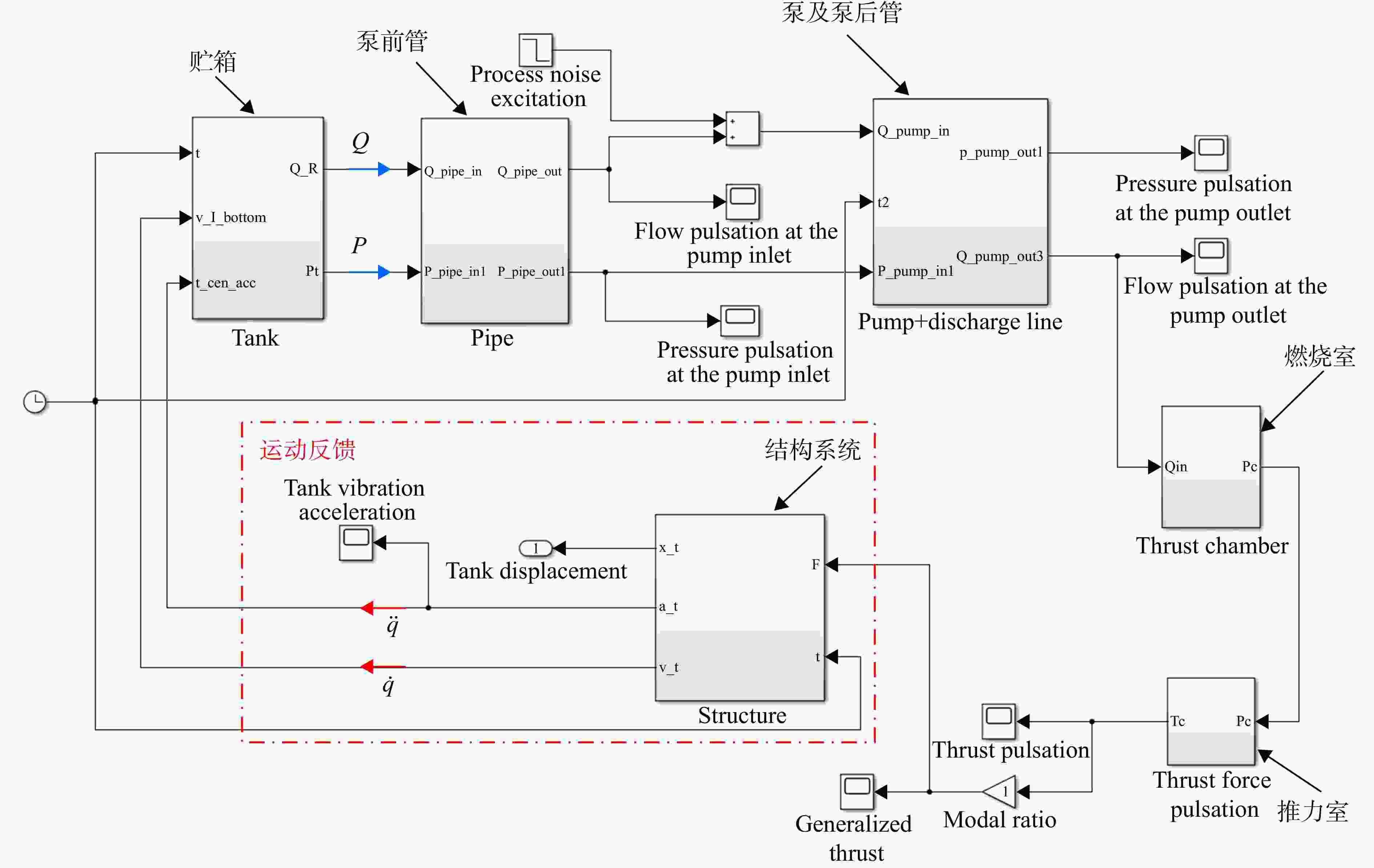
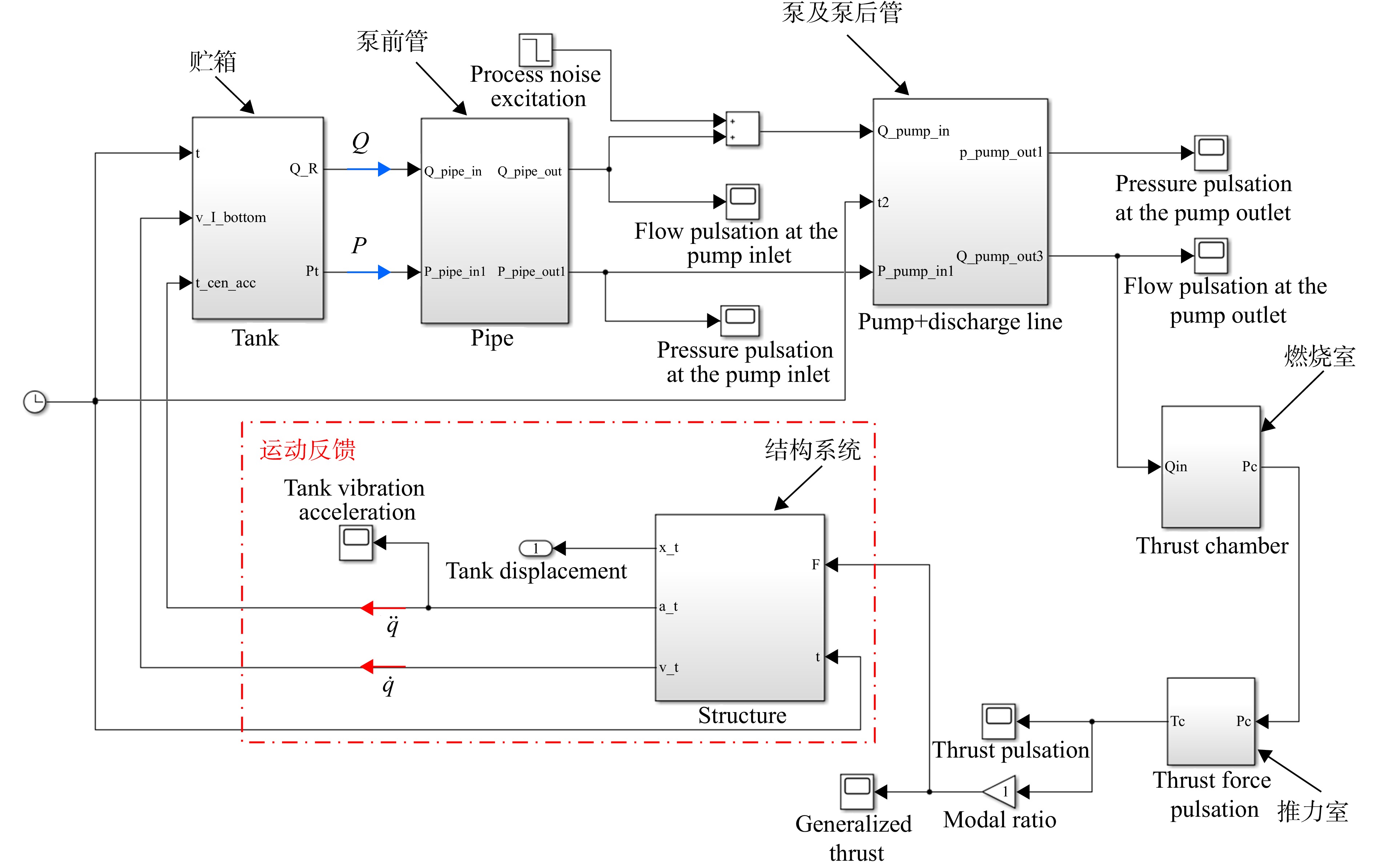
图 9 Pogo闭环耦合系统振动仿真模型
Figure 9. Simulation model of the Pogo closed-loop coupled system

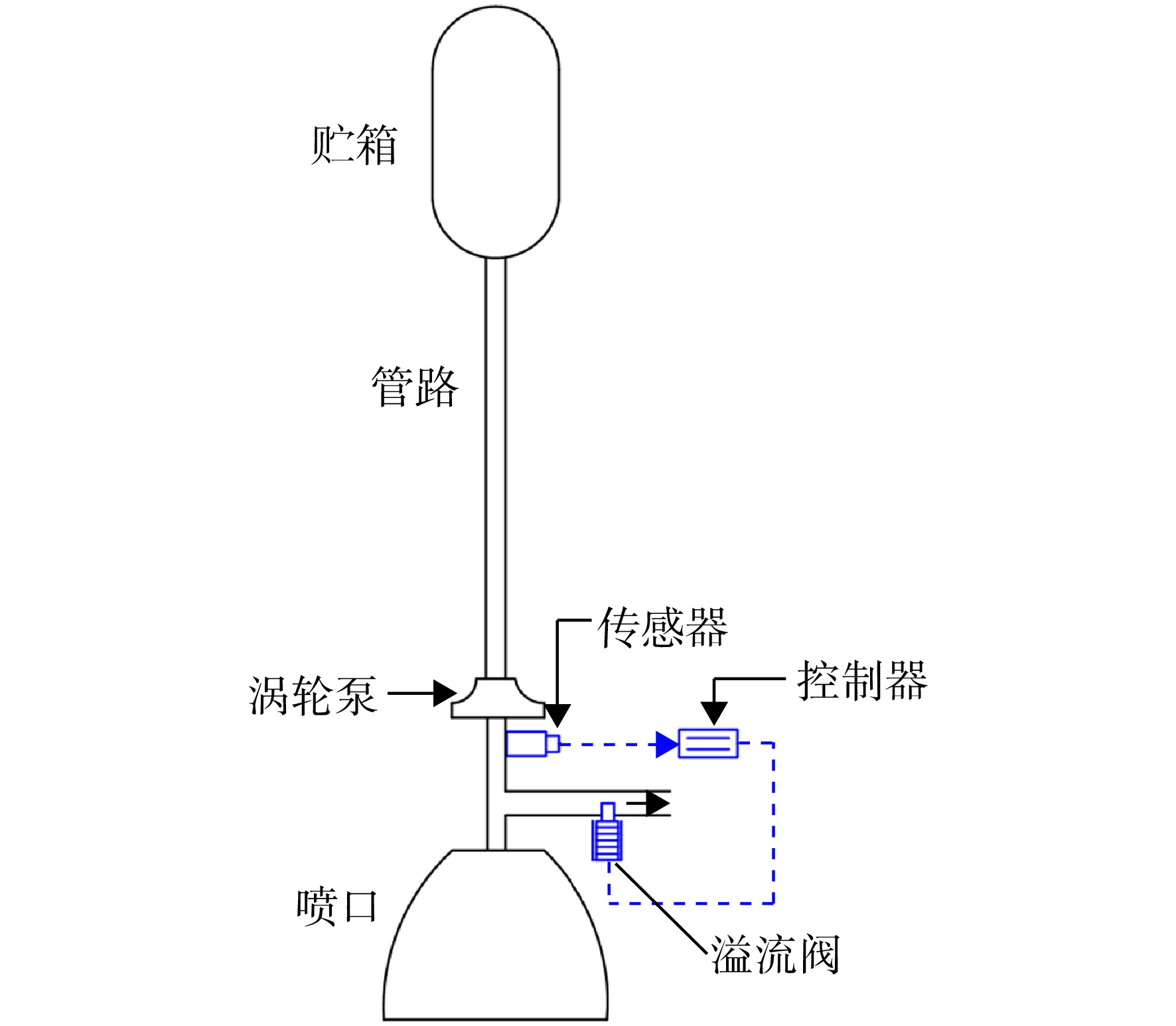
图 12 高压溢流式Pogo主动抑制方案示意图
Figure 12. Schematic diagram of active Pogo suppression using high pressure relief control

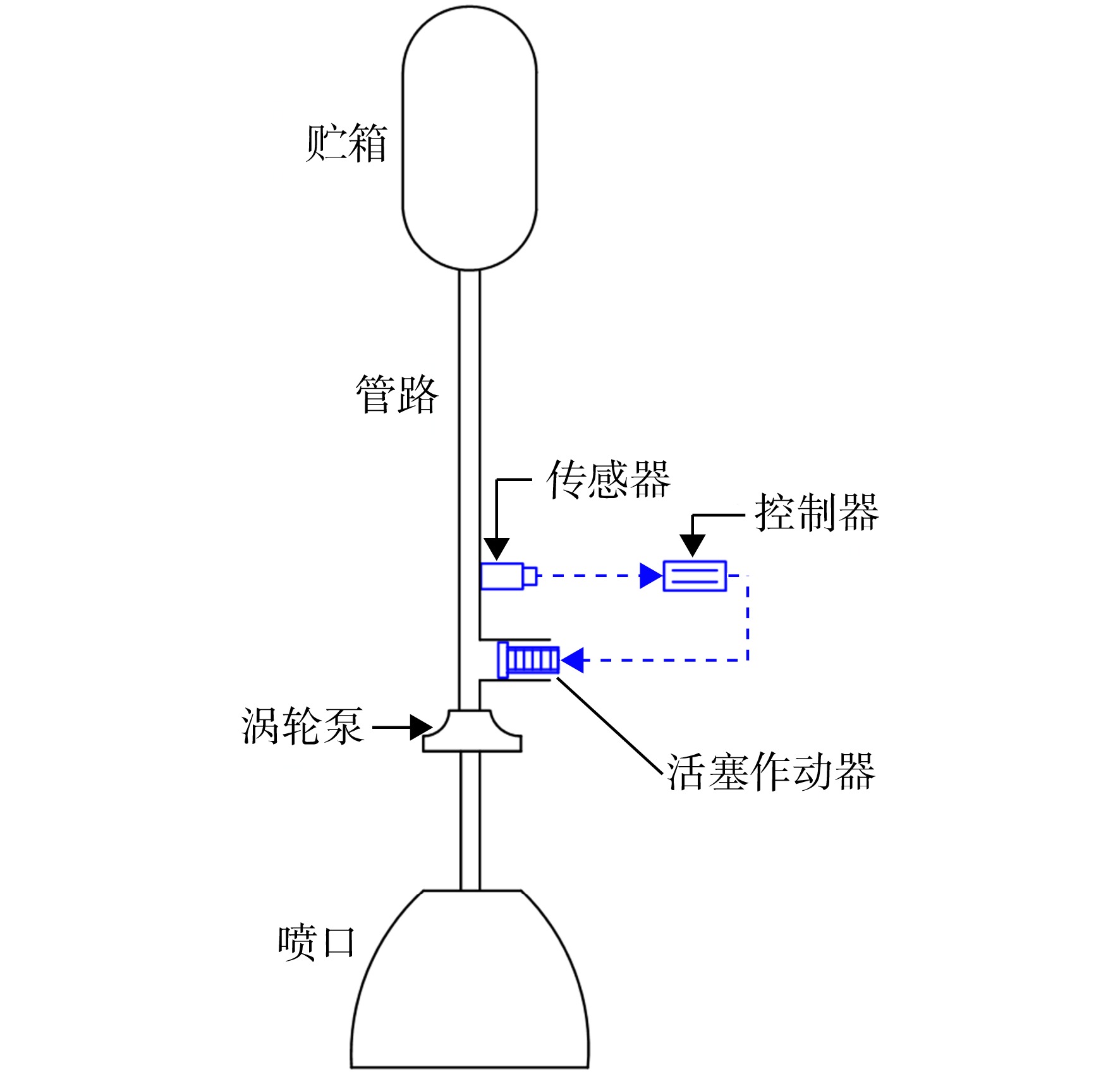
图 13 低压活塞式Pogo主动抑制方案示意图
Figure 13. Schematic diagram of active Pogo suppression using piston-type control

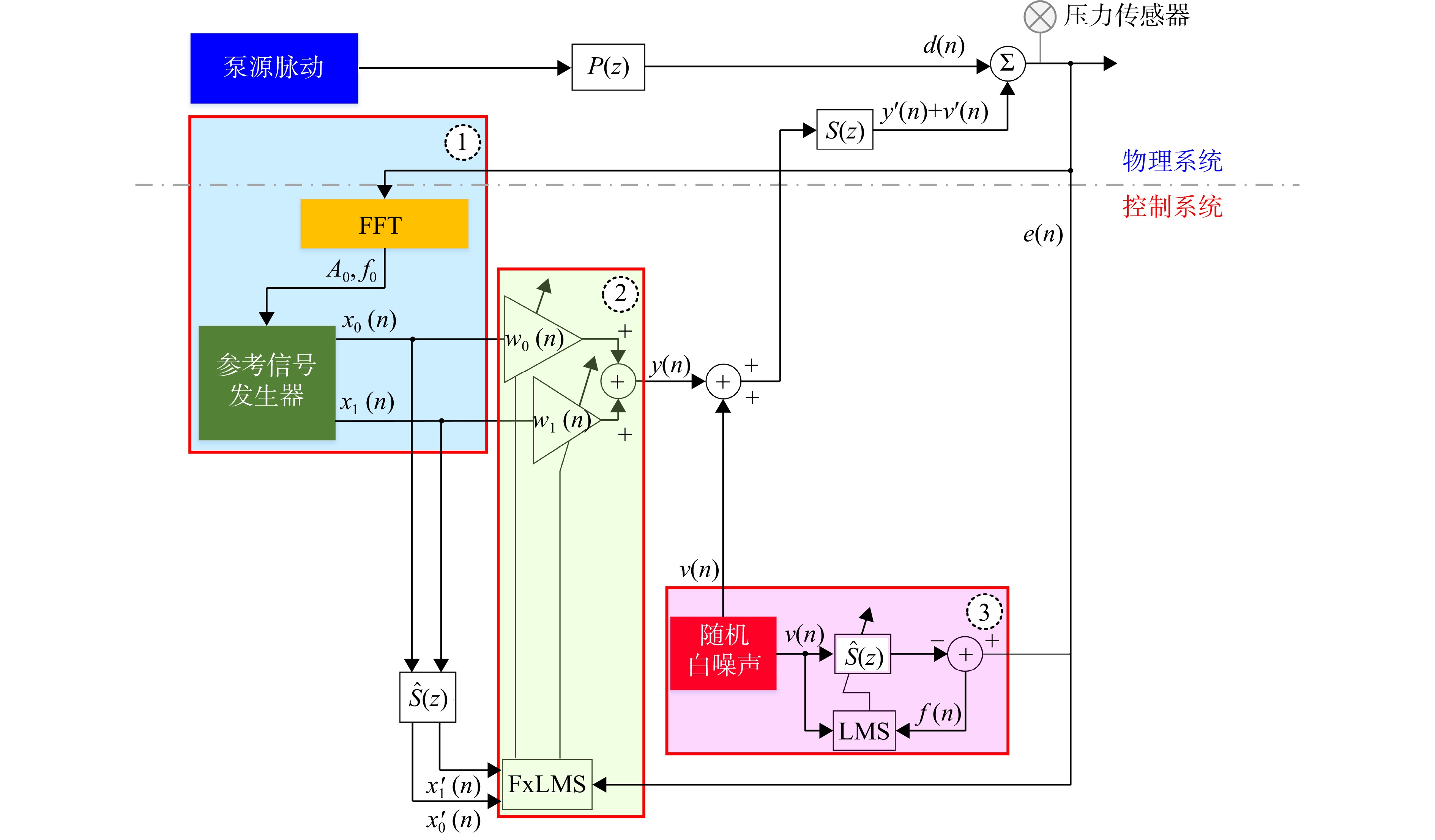
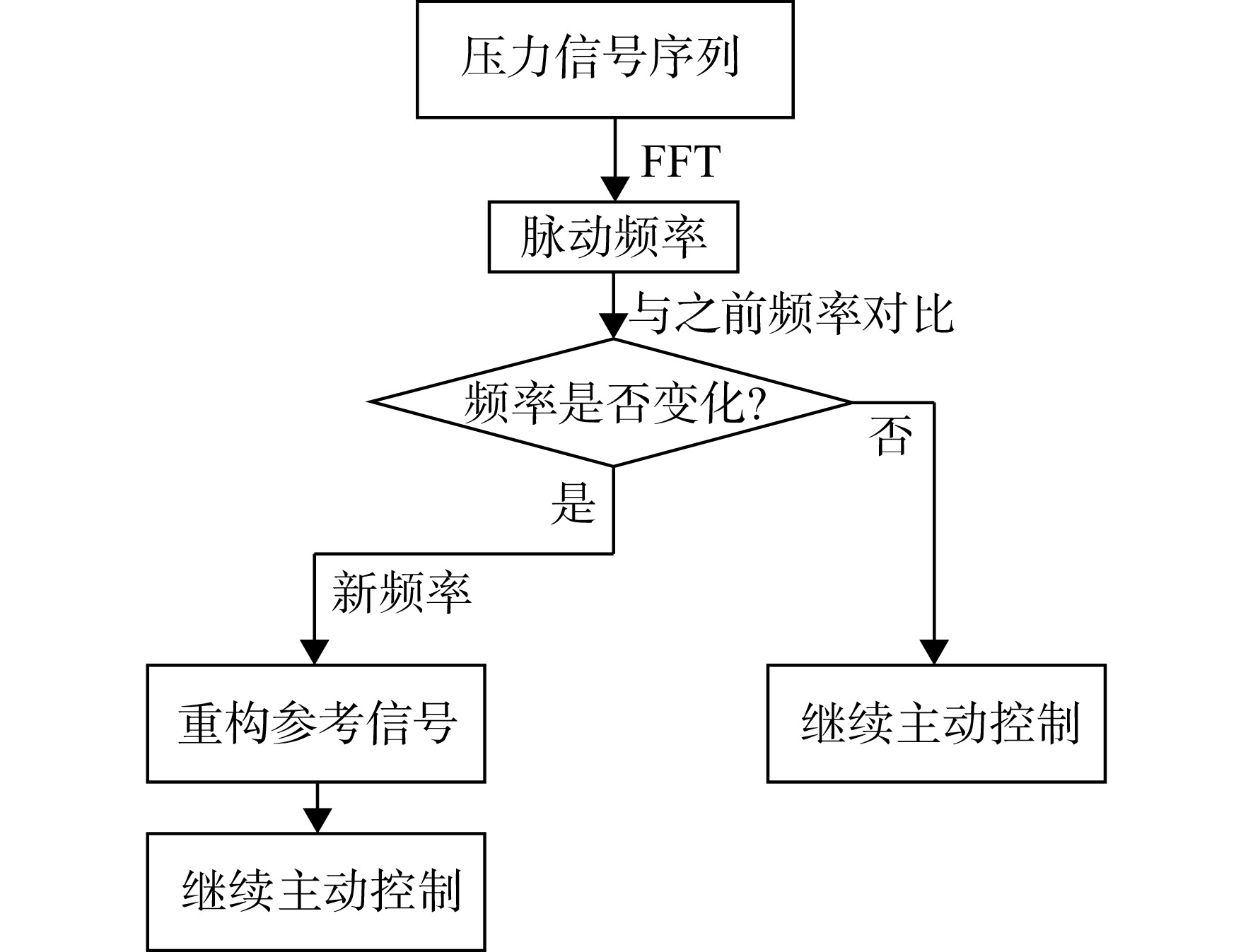
图 15 变频工况主动控制参考信号频率更新流程图
Figure 15. Flow chart of reference signal frequency update for active control under variable frequency operation

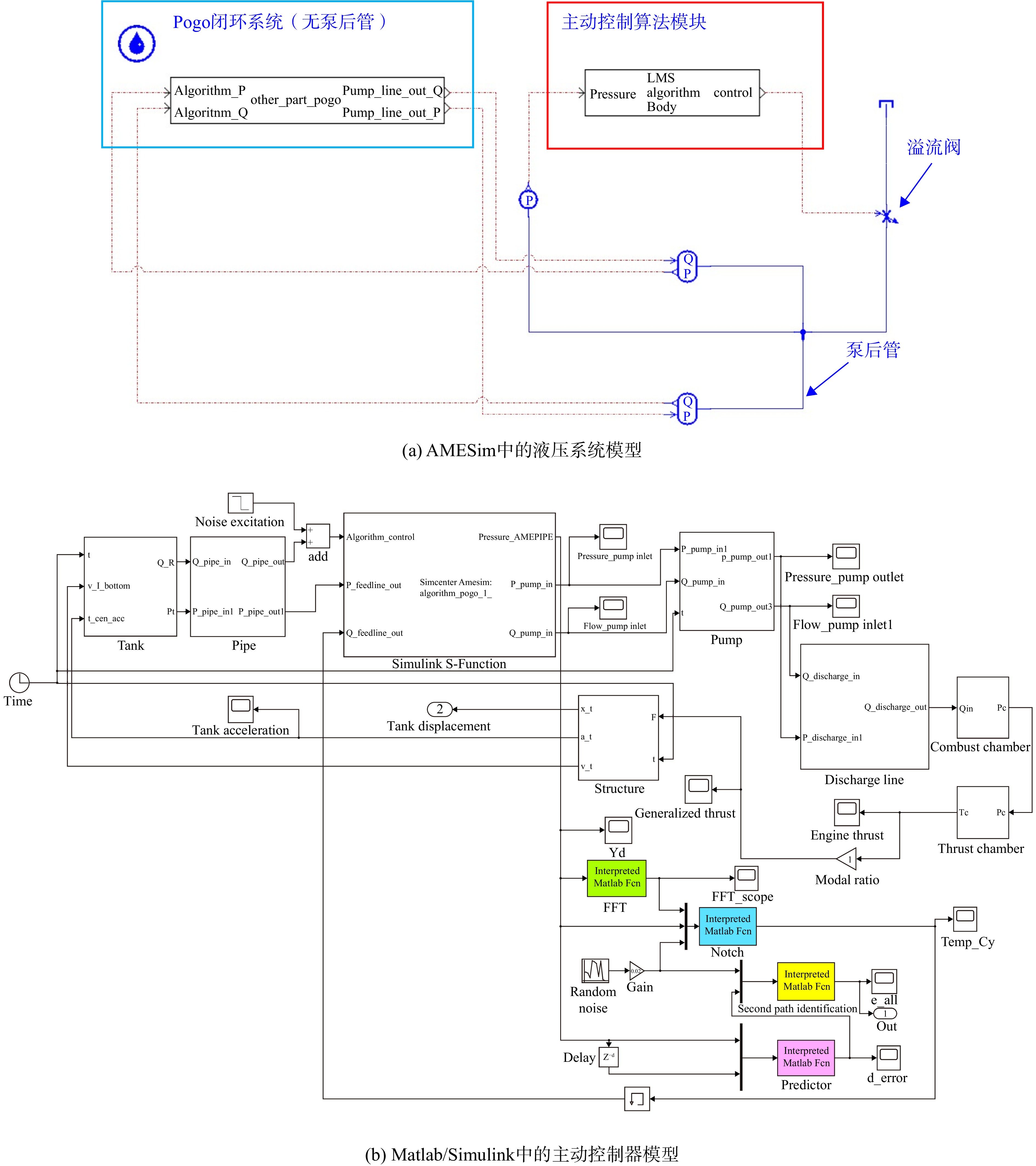
图 16 高压溢流式主动抑制仿真模型
Figure 16. Simulation model of active control of high pressure relief control

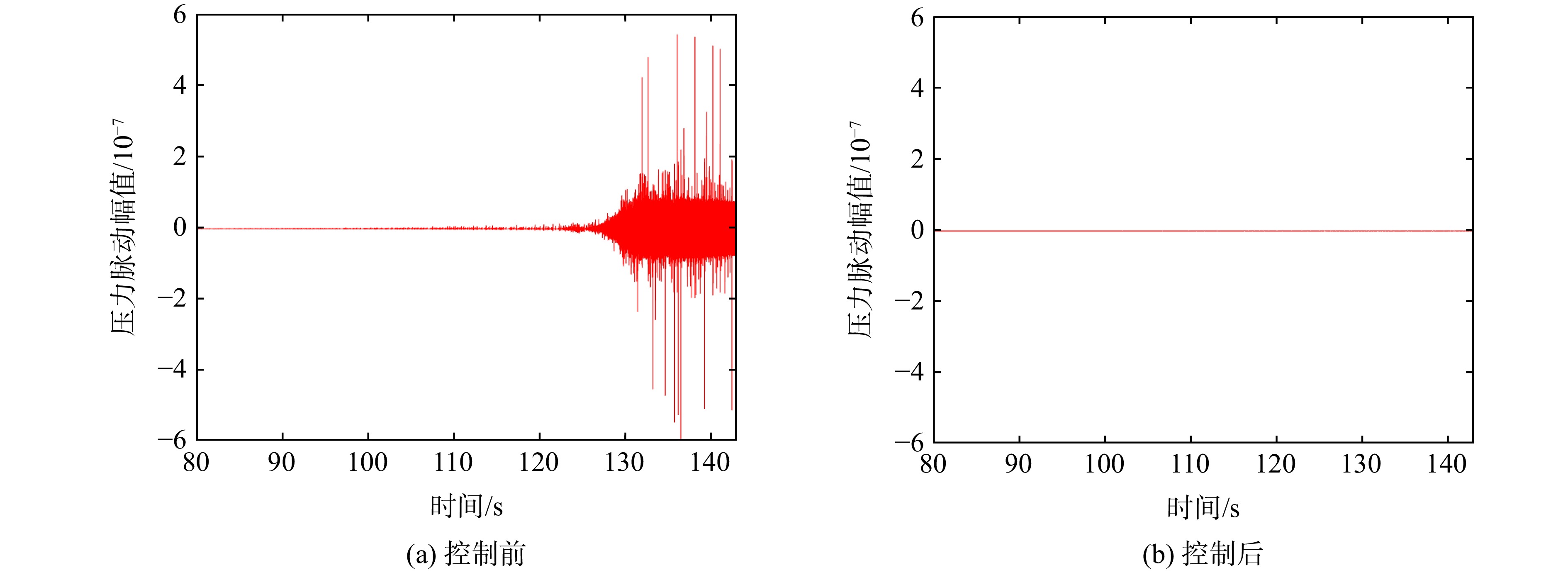
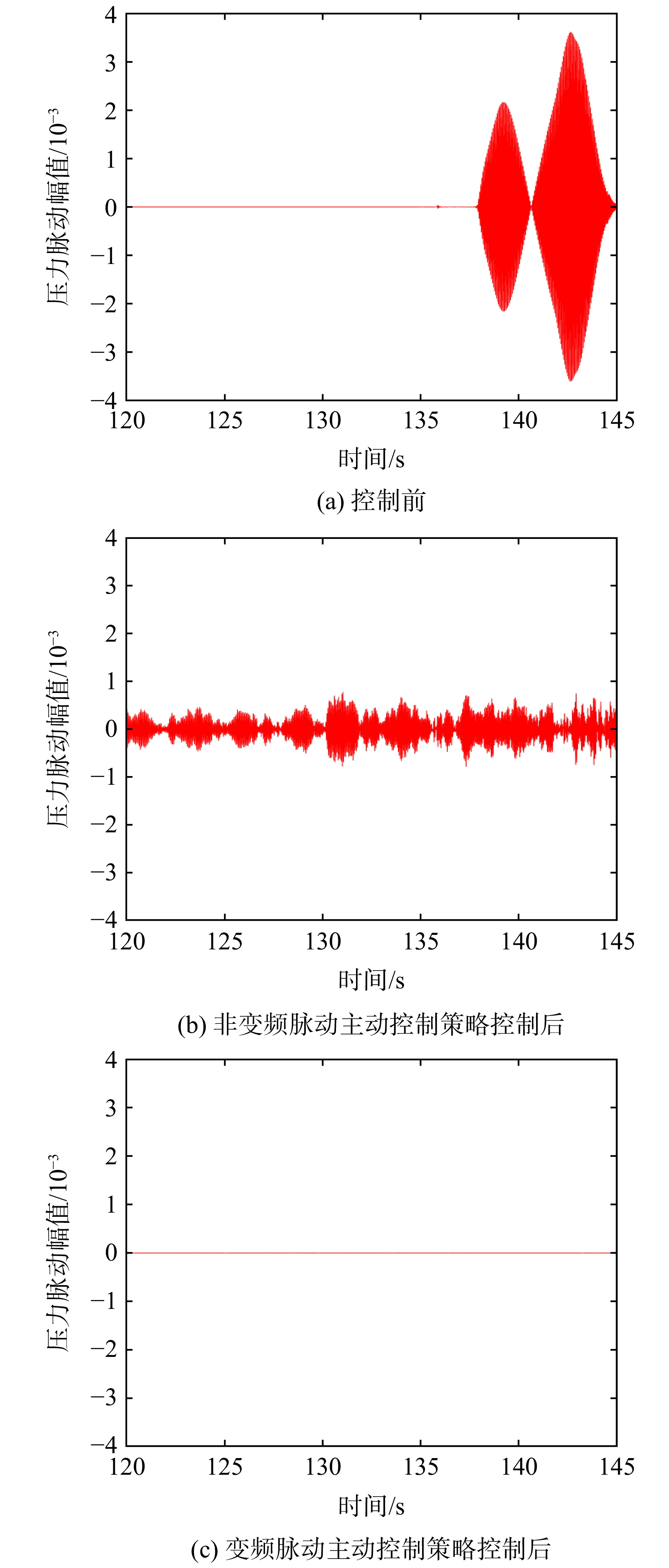
图 17 高压溢流式Pogo抑制仿真泵出口处压力脉动曲线
Figure 17. Simulation result of pump outlet pressure pulsation using high pressure relief control for Pogo suppression

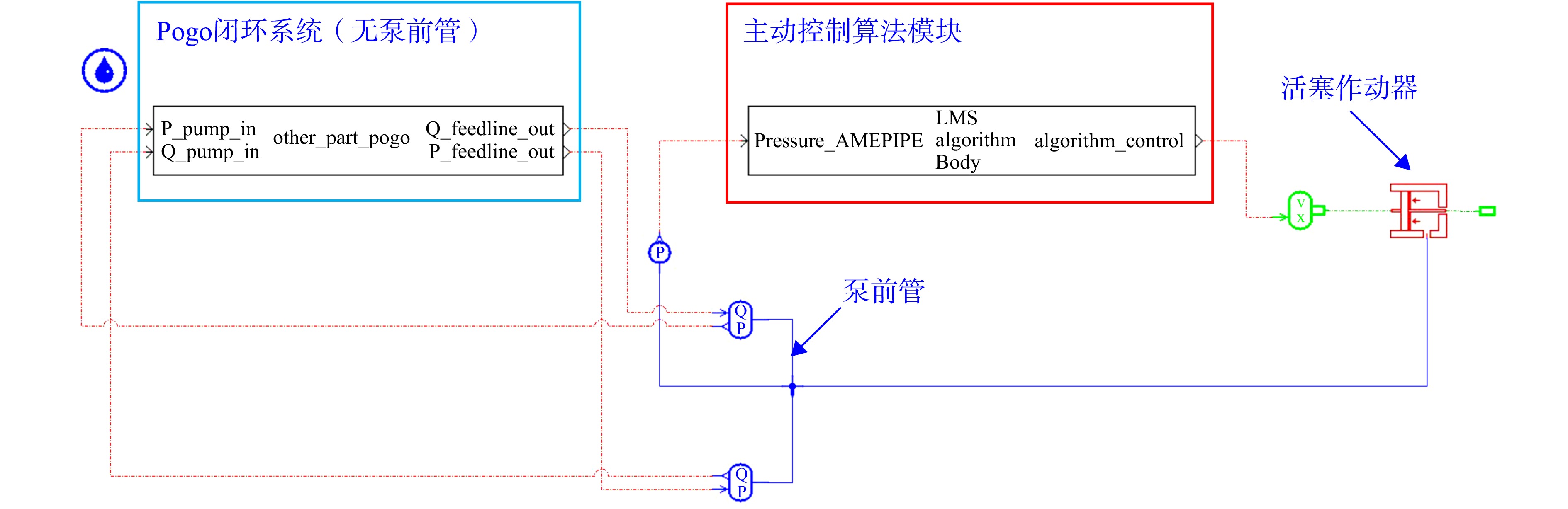
图 18 低压活塞式主动抑制仿真模型(AMESim中的液压系统模型)
Figure 18. Simulation model of piston active suppression for low pressure operation (hydraulic system model in AMESim)

图 19 低压活塞式Pogo抑制仿真泵入口处压力脉动曲线
Figure 19. Simulation result of pump inlet pressure pulsation using low pressure piston control for Pogo suppression
表 1 液体火箭推进系统参数
Table 1. Parameters of liquid rocket propulsion system
参数 数值 参数 数值 推进剂密度$ \rho $/10−3 (kg/cm3) 1.115 燃烧室阻抗$ [{C^*}/ ({A_{\mathrm{t}}}g) ] $/10−4 (N·s/cm5) 1.459 泵前管路横截面积$ {A_{\mathrm{s}}} $/cm2 92 燃烧室特征系数$ {A_{{\mathrm{th}}}}{C_{\mathrm{f}}} $/cm2 1838.6 泵前管路长度$l$/cm 104 燃烧室时滞$ {\tau _{\mathrm{c}}} $/s 0.0025 泵及泵后管组件阻抗$ {R_{\text{p}}} + {R_{\text{d}}} $/10−4 (kg·s/cm5) 4.719 贮箱、泵、燃烧室模态比 1 泵及泵后管组件惯性$ {L_{\text{p}}} + {L_{\text{d}}} $/10−6 (kg·s/cm5) 3.861 模态阻尼比$ \xi $ 0.01  下载: 导出CSV
表 2 飞行过程时变参数
Table 2. Time-varying parameter during the flight
燃烧时间
百分比/%模态频率
$ \omega $/(rad/s)广义质量
$ M $/(kg·s2·cm)泵增益系数
m+1贮箱液位高度
${h_{\text{t}}}$/cm泵汽蚀柔度
$ {C_{\mathrm{b}}} $/(cm5/kg)0 72 464.31 1.0 634.99 9.322 60 92 89.29 1.3 279.39 46.61 80 104 32.14 1.8 160.02 93.32 95 126 8.929 3.0 68.58 174.49 100 148 4.466 5.4 38.1 349.58
下载: 导出CSV
表 3 高压溢流式主动控制算法参数
Table 3. Parameters of active control algorithm of high pressure relief control
滤波器 滤波器阶数 迭代步长 控制滤波器$W ({\textit{z}}) $ 2 0.0006 辨识滤波器$\hat S ({\textit{z}}) $ 4 0.01
下载: 导出CSV
-
[1] LARSEN C E. NASA experience with Pogo in human spaceflight vehicles[R]. RTO-MP-AVT-15, 2008. [2] WU Chujun, XU Yuanzhi, JIAO Zongxia, et al. Developments in Pogo suppression methods for liquid rockets[J]. Progress in Aerospace Sciences, 2023, 140: 100931. doi: 10.1016/j.paerosci.2023.100931 [3] RUBIN S. Prevention of coupled structure-propulsion instability (Pogo)[R]. NASA SP-8055, 1970. [4] 王小军, 于子文, 张兵, 等. 国内外运载火箭POGO抑制技术研究进展[J]. 中国科学: 技术科学, 2014, 44(5): 492-503. WANG Xiaojun, YU Ziwen, ZHANG Bing, et al. Progress of POGO suppression technology of launch vehicles at home and abroad[J]. Scientia Sinica (Technologica), 2014, 44(5): 492-503. (in Chinese doi: 10.1360/N092014-00034WANG Xiaojun, YU Ziwen, ZHANG Bing, et al. Progress of POGO suppression technology of launch vehicles at home and abroad[J]. Scientia Sinica (Technologica), 2014, 44(5): 492-503. (in Chinese) doi: 10.1360/N092014-00034 [5] FARREL E, FENWICK J. POGO instabilities suppression evaluation[R]. NASA-CR-134500, 1973. [6] MARCUS J, NORQUIST L, RUSCIO D. Development of close-coupled accumulators for suppressing missile longitudinal oscillations (POGO)[R]. AIAA-1969-0547, 1969. [7] 黄怀德. 防POGO振动[J]. 中国航天, 1980(6): 1-10. HUANG Huaide. POGO vibration prevention[J]. Aerospace China, 1980(6): 1-10. (in ChineseHUANG Huaide. POGO vibration prevention[J]. Aerospace China, 1980(6): 1-10. (in Chinese) [8] RUBIN S, WAGNER R G, PAYNE J G. Pogo suppression on space shuttle-early studies[R]. AIAA-CR-2210, 1973. [9] SEIDEL R C, LORENZO C F, LEHTINEN B. Space shuttle Pogo active controller design using frequency domain optimization[R]. NASA-TM-X-3368, 1976. [10] DOIRON H H. Space shuttle Pogo prevention[R]. Los Angeles, US: SAE Aerospace Meeting, 1977. [11] JEWELL R, JONES J, FENWICK J. Space shuttle main engine Pogo testing and results[J]. The Journal of the Acoustical Society of America, 1981, 70(Suppl. 1): S75. [12] LOCK M H, RUBIN S. Active suppression of Pogo on the space shuttle[R]. NASA-CR-134749, 1974. [13] SEIDEL R C, LETINEN B. Control system design using frequency domain models and parameter optimization, with application to supersonic inlet controls[R]. NASA-TM-X-3108, 1974. [14] LEHTINEN B, LORENZO C F. Space shuttle active-Pogo suppressor control design using linear quadratic regulator techniques[R]. NASA-TP-1217, 1979. [15] MARIUS J T. Investigations on active suppression of Pogo[R]. AIAA-1995-3311, 1995. [16] 胡久辉, 唐一华, 张青松, 等. 基于振动加速度反馈的POGO主动抑制方法研究[J]. 强度与环境, 2016, 43(5): 7-16. HU Jiuhui, TANG Yihua, ZHANG Qingsong, et al. Investigation of active POGO suppression based on vibration-acceleration feedback[J]. Structure & Environment Engineering, 2016, 43(5): 7-16. (in Chinese doi: 10.3969/j.issn.1006-3919.2016.05.002HU Jiuhui, TANG Yihua, ZHANG Qingsong, et al. Investigation of active POGO suppression based on vibration-acceleration feedback[J]. Structure & Environment Engineering, 2016, 43(5): 7-16. (in Chinese) doi: 10.3969/j.issn.1006-3919.2016.05.002 [17] 赵旺, 刘锦凡, 谭述君, 等. 运载火箭POGO主动抑制的LQR控制器设计[J]. 强度与环境, 2021, 48(1): 47-56. ZHAO Wang, LIU Jinfan, TAN Shujun, et al. Design of LQR controller for active POGO suppression of launch vehicle[J]. Structure & Environment Engineering, 2021, 48(1): 47-56. (in ChineseZHAO Wang, LIU Jinfan, TAN Shujun, et al. Design of LQR controller for active POGO suppression of launch vehicle[J]. Structure & Environment Engineering, 2021, 48(1): 47-56. (in Chinese) [18] JIA Su, TANG Ye, WANG Tao, et al. A novel active control on Pogo vibration in liquid rockets based on data-driven theory[J]. Acta Astronautica, 2021, 182: 350-360. doi: 10.1016/j.actaastro.2021.02.021 [19] TAN Shujun, ZHAO Wang, LIU Jinfan, et al. Adaptive control design for active Pogo suppression of large strap-on liquid launch vehicles[J]. Acta Astronautica, 2023, 206: 43-56. doi: 10.1016/j.actaastro.2023.02.004 [20] 王其政. 结构耦合动力学[M]. 北京: 宇航出版社, 1999. [21] DOTSON K, RUBIN S, SAKO B. Effects of unsteady pump cavitation on propulsion-structure interaction (Pogo) in liquid rockets[R]. AIAA-2004-2027, 2004. [22] OPPENHEIM B W, RUBIN S. Advanced Pogo stability analysis for liquid rockets[J]. Journal of Spacecraft and Rockets, 1993, 30(3): 360-373. doi: 10.2514/3.25524 [23] MCKENNA K J, WALKER J H, WINJE R A. Engine-airframe coupling in liquid rocket systems[J]. Journal of Spacecraft and Rockets, 1965, 2(2): 254-256. doi: 10.2514/3.28160 [24] HOLSTER J L, ASTLEFORD W J. Analytical model for liquid rocket propellant feedline dynamics[J]. Journal of Spacecraft and Rockets, 1974, 11(3): 180-187. doi: 10.2514/3.62035 [25] LEWIS W. Simplified analytical model for use in design of pump-inlet accumulators for the prevention of liquid-rocket longitudinal oscillation (POGO)[R]. NASA-TN-D-5394, 1969. [26] GOLDMAN R L. Elimination of the Pogo instability from the gemini launch vehicle[M]//Dynamic Stability of Structures. Evanston, US: Northwestern University, 1967: 157-166. [27] 严海, 方勃, 黄文虎. 液体火箭的POGO振动研究与参数分析[J]. 导弹与航天运载技术, 2009(6): 35-40. YAN Hai, FANG Bo, HUANG Wenhu. Research and parameter analysis of POGO vibration in liquid rocket[J]. Missiles and Space Vehicles, 2009(6): 35-40. (in ChineseYAN Hai, FANG Bo, HUANG Wenhu. Research and parameter analysis of POGO vibration in liquid rocket[J]. Missiles and Space Vehicles, 2009(6): 35-40. (in Chinese) [28] 王楠, 容易, 胡久辉, 等. 注气式POGO抑制系统模型研究[J]. 导弹与航天运载技术, 2020(5): 32-37. WANG Nan, RONG Yi, HU Jiuhui, et al. Model study on gas-injected POGO suppression system[J]. Missiles and Space Vehicles, 2020(5): 32-37. (in ChineseWANG Nan, RONG Yi, HU Jiuhui, et al. Model study on gas-injected POGO suppression system[J]. Missiles and Space Vehicles, 2020(5): 32-37. (in Chinese) [29] 任辉, 任革学, 荣克林, 等. 液体火箭Pogo振动蓄压器非线性仿真研究[J]. 强度与环境, 2006, 33(3): 1-6. REN Hui, REN Gexue, RONG Kelin, et al. A nonlinear model on the simulation of Pogo vibrations in liquid rockets[J]. Structure & Environment Engineering, 2006, 33(3): 1-6. (in Chinese doi: 10.3969/j.issn.1006-3919.2006.03.001REN Hui, REN Gexue, RONG Kelin, et al. A nonlinear model on the simulation of Pogo vibrations in liquid rockets[J]. Structure & Environment Engineering, 2006, 33(3): 1-6. (in Chinese) doi: 10.3969/j.issn.1006-3919.2006.03.001 [30] HILL R, MURPHY G, WORLUND A. Saturn V longitudinal oscillation (POGO) solution[R]. Reston, US: American Institute of Aerospace and Astronautics 5th Propulsion Joint Specialist, 1969. [31] LOCK M H, RUBIN S. Analysis of Pogo on the space shuttle: accumulator design guidelines and planar multiengine model development[R]. NASA-CR-151135, 1976. [32] 黄怀德. 液体火箭的POGO振动研究[J]. 振动工程学报, 1987(1): 5-13. HUANG Huaide. Research into POGO vibration of liquid rockets[J]. Journal of Vibration Engineering, 1987(1): 5-13. (in ChineseHUANG Huaide. Research into POGO vibration of liquid rockets[J]. Journal of Vibration Engineering, 1987(1): 5-13. (in Chinese) [33] ZHAO Zhihua, REN Gexue, YU Ziwen, et al. Parameter study on Pogo stability of liquid rockets[J]. Journal of Spacecraft and Rockets, 2011, 48(3): 537-541. doi: 10.2514/1.51877 [34] GOLDMAN R L, MIESSNER W W. Longitudinal oscillation instability study POGO[J]. Simulation, 1966, 6(1): 48-52. doi: 10.1177/003754976600600117 [35] RILEY G, STERETT J. Saturn V/Apollo vehicle POGO stability problems and solutions[R]. AIAA-1970-1236, 1970. [36] 万屹仑, 付欣毓, 张黎辉, 等. 注气式蓄压器系统工作特性仿真分析[J]. 火箭推进, 2018, 44(3): 37-42. WAN Yilun, FU Xinyu, ZHANG Lihui, et al. Simulation analysis on operating characteristics of gas-filled accumulator system[J]. Journal of Rocket Propulsion, 2018, 44(3): 37-42. (in Chinese doi: 10.3969/j.issn.1672-9374.2018.03.007WAN Yilun, FU Xinyu, ZHANG Lihui, et al. Simulation analysis on operating characteristics of gas-filled accumulator system[J]. Journal of Rocket Propulsion, 2018, 44(3): 37-42. (in Chinese) doi: 10.3969/j.issn.1672-9374.2018.03.007 [37] 马道远, 王其政, 荣克林. 液体捆绑火箭POGO稳定性分析的闭环传递函数法[J]. 强度与环境, 2010, 37(1): 1-7. MA Daoyuan, WANG Qizheng, RONG Kelin. Close-loop transfer function of POGO stability analysis for binding liquid-propellant rocket[J]. Structure & Environment Engineering, 2010, 37(1): 1-7. (in Chinese doi: 10.3969/j.issn.1006-3919.2010.01.001MA Daoyuan, WANG Qizheng, RONG Kelin. Close-loop transfer function of POGO stability analysis for binding liquid-propellant rocket[J]. Structure & Environment Engineering, 2010, 37(1): 1-7. (in Chinese) doi: 10.3969/j.issn.1006-3919.2010.01.001 [38] 王其政, 高万镛, 顾永春, 等. 跷振(POGO)稳定性可靠性算法与参数分析[J]. 宇航学报, 1986, 7(2): 29-47. WANG Qizheng, GAO Wanyong GU Yongchun, et al. Pogo stability, reliability and parameters analyses[J]. Journal of Astronautics, 1986, 7(2): 29-47. (in ChineseWANG Qizheng, GAO Wanyong GU Yongchun, et al. Pogo stability, reliability and parameters analyses[J]. Journal of Astronautics, 1986, 7(2): 29-47. (in Chinese) [39] 严海. 液体火箭的纵向耦合振动(POGO)研究[D]. 哈尔滨: 哈尔滨工业大学, 2009. YAN Hai. Study on longitudinal coupled vibration (POGO) of liquid rocket[D]. Harbin: Harbin Institute of Technology, 2009. (in ChineseYAN Hai. Study on longitudinal coupled vibration (POGO) of liquid rocket[D]. Harbin: Harbin Institute of Technology, 2009. (in Chinese) [40] 杨明, 杨智春, 史淑娟. 液体火箭POGO振动时域分析方法研究[J]. 强度与环境, 2010, 37(2): 29-36. YANG Ming, YANG Zhichun, SHI Shujuan. Method research of time domain analysis of POGO vibration of the liquid rocket[J]. Structure & Environment Engineering, 2010, 37(2): 29-36. (in Chinese doi: 10.3969/j.issn.1006-3919.2010.02.005YANG Ming, YANG Zhichun, SHI Shujuan. Method research of time domain analysis of POGO vibration of the liquid rocket[J]. Structure & Environment Engineering, 2010, 37(2): 29-36. (in Chinese) doi: 10.3969/j.issn.1006-3919.2010.02.005 [41] 赵治华. 液体火箭POGO振动的多体动力学建模及稳定性分析[D]. 北京: 清华大学, 2011. ZHAO Zhihua. Multibody dynamic approach of modeling liquid rocket for POGO stability analysis[D]. Beijing: Tsinghua University, 2011. (in ChineseZHAO Zhihua. Multibody dynamic approach of modeling liquid rocket for POGO stability analysis[D]. Beijing: Tsinghua University, 2011. (in Chinese) [42] 牛泽雄, 董朝阳, 黄喜元. POGO振动研究的一种新建模方法[J]. 强度与环境, 2012, 39(5): 28-33. NIU Zexiong, DONG Chaoyang, HUANG Xiyuan. A new method of modeling for POGO analysis[J]. Structure & Environment Engineering, 2012, 39(5): 28-33. (in ChineseNIU Zexiong, DONG Chaoyang, HUANG Xiyuan. A new method of modeling for POGO analysis[J]. Structure & Environment Engineering, 2012, 39(5): 28-33. (in Chinese) [43] 张铜, 邢誉峰. POGO振动机理及其时域分析[C]//中国计算力学大会. 北京: 中国力学学会, 2012: 1-8. ZHANG Tong, XiNG Yufeng. The mechanism analysis and time domain analysis of POGO [C]//Chinese Conference on Computational Mechanics. Beijing: Chinese Society of Theoretical and Applied Mechanics, 2012: 1-8. (in ChineseZHANG Tong, XiNG Yufeng. The mechanism analysis and time domain analysis of POGO [C]//Chinese Conference on Computational Mechanics. Beijing: Chinese Society of Theoretical and Applied Mechanics, 2012: 1-8. (in Chinese) [44] 徐得元, 郝雨, 杨琼梁, 等. 液体火箭纵向耦合振动特性的快速求解方法[J]. 宇航学报, 2014, 35(1): 21-27. XU Deyuan, HAO Yu, YANG Qiongliang, et al. Fast matrix algorithm for POGO instability prediction in liquid rocket[J]. Journal of Astronautics, 2014, 35(1): 21-27. (in ChineseXU Deyuan, HAO Yu, YANG Qiongliang, et al. Fast matrix algorithm for POGO instability prediction in liquid rocket[J]. Journal of Astronautics, 2014, 35(1): 21-27. (in Chinese) [45] 欧阳平超, 焦宗夏, 刘红梅. 分布式液压流体脉动主动控制方法[J]. 北京航空航天大学学报, 2007, 33(9): 1060-1063. OUYANG Pingchao, JIAO Zongxia, LIU Hongmei. Study on distributed active control of fluid pulsation in hydraulic piping[J]. Journal of Beijing University of Aeronautics and Astronautics, 2007, 33(9): 1060-1063. (in Chinese doi: 10.3969/j.issn.1001-5965.2007.09.014OUYANG Pingchao, JIAO Zongxia, LIU Hongmei. Study on distributed active control of fluid pulsation in hydraulic piping[J]. Journal of Beijing University of Aeronautics and Astronautics, 2007, 33(9): 1060-1063. (in Chinese) doi: 10.3969/j.issn.1001-5965.2007.09.014 [46] KUO S M, MORGAN D. Active noise control systems: algorithms and DSP implementations[M]. New York, US: John Wiley & Sons, 1996. [47] MORGAN D R. Analysis of multiple correlation cancellation loops with a filter in the auxiliary path[C]//IEEE International Conference on Acoustics, Speech & Signal Processing. Colorado, US: IEEE, 1980: 456-467. [48] ERIKSSON L J, ALLIE M C. Use of random noise for on-line transducer modeling in an adaptive active attenuation system[J]. Acoustical Society of America Journal, 1989, 85(2): 797-802. doi: 10.1121/1.397552 [49] BAO C, SAS P, BRUSSEL H V. Comparison of two on-line identification algorithms for active noise control [R]. Blacksburg, US: Conference on Recent Advances in Active Control of Sound & Vibration, 1993. -



 点击查看大图

计量
- 文章访问数: 948
- HTML浏览量: 480
- PDF量: 67
- 被引次数: 0