






Lightweight aero-engine surface defect detection algorithm fused with attention mechanism
-
摘要:
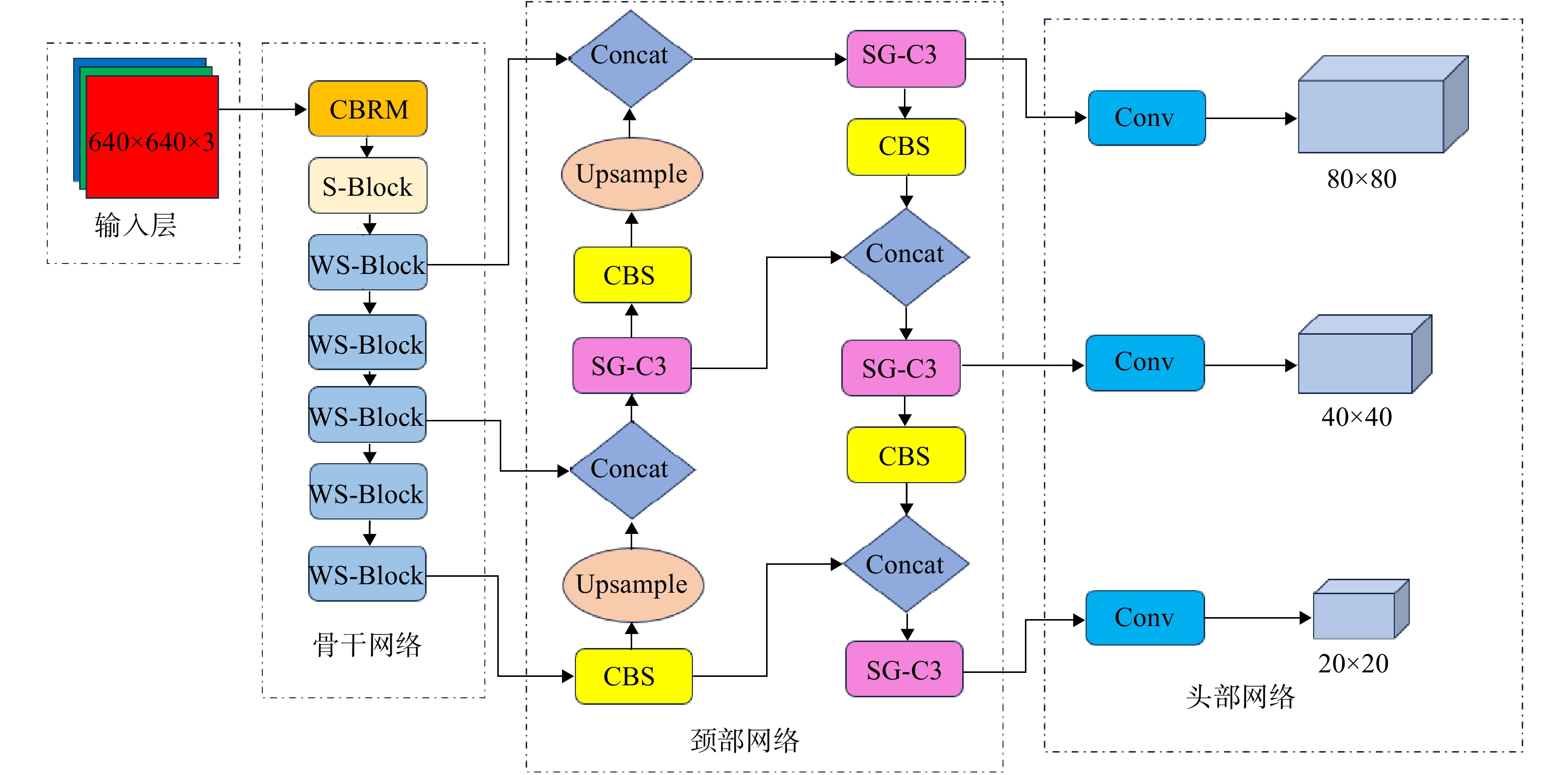
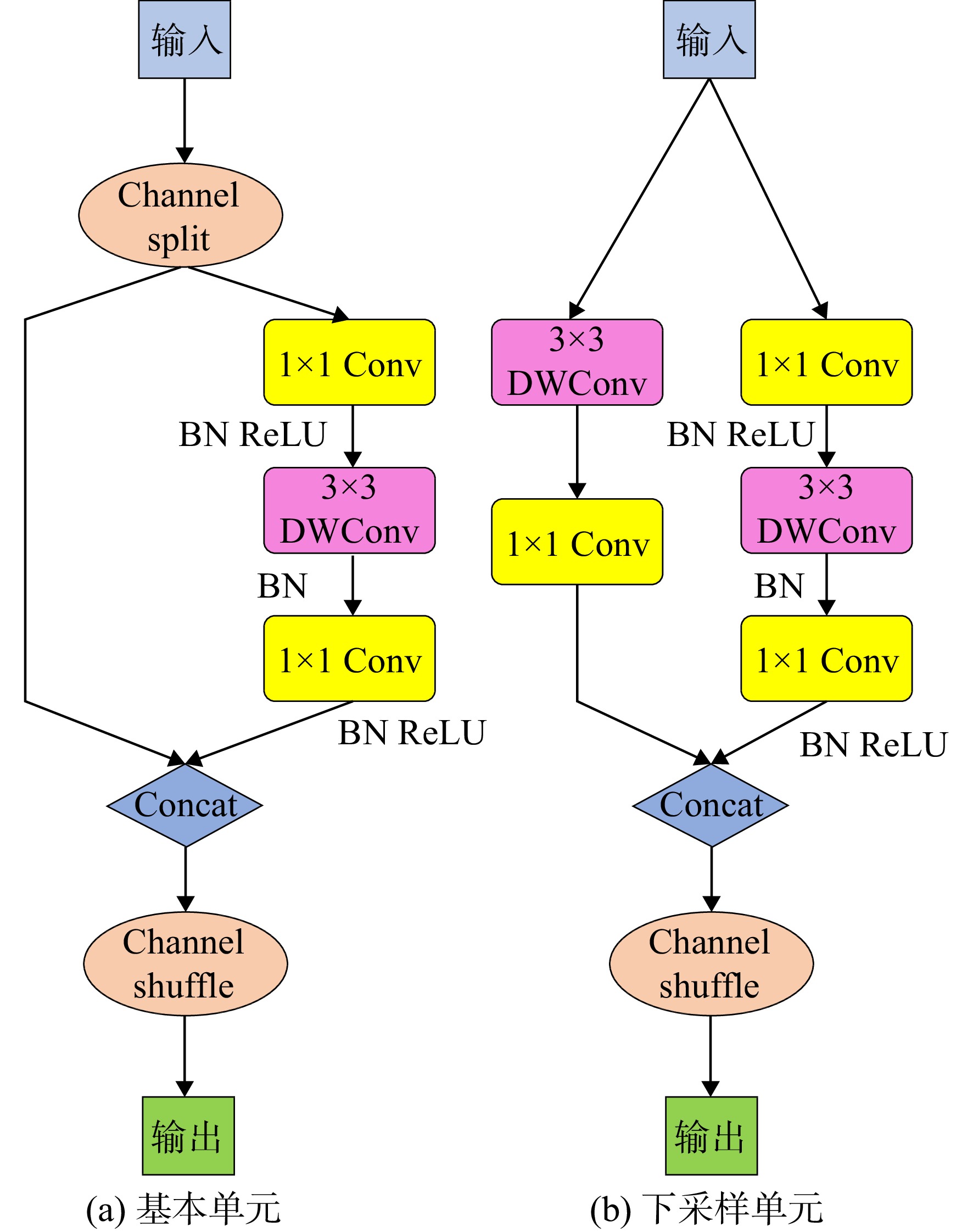
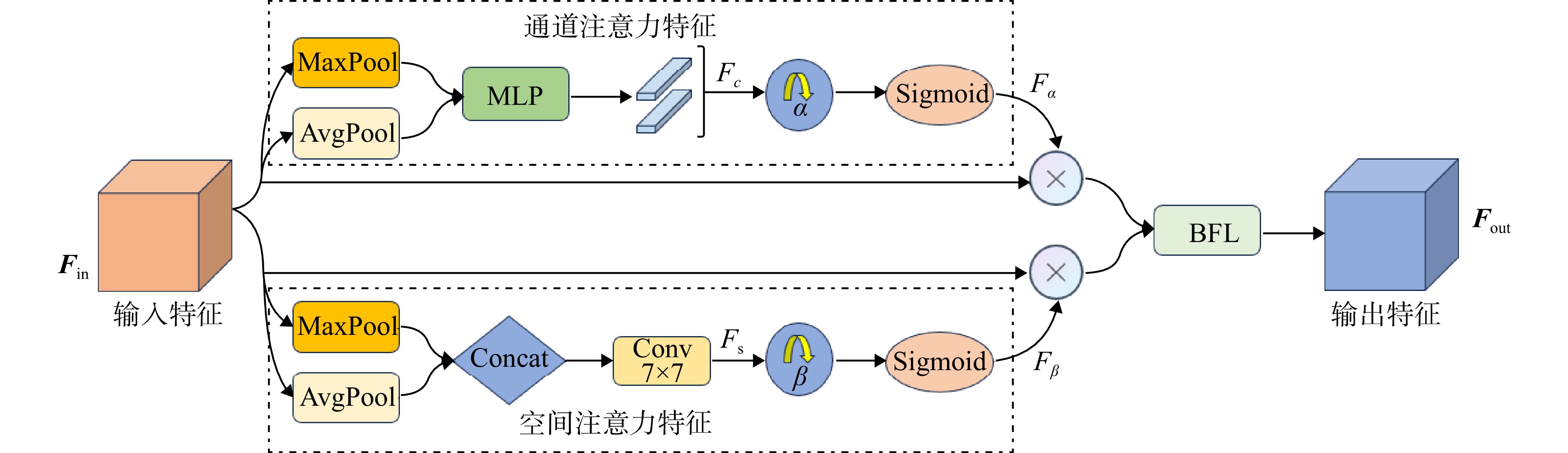
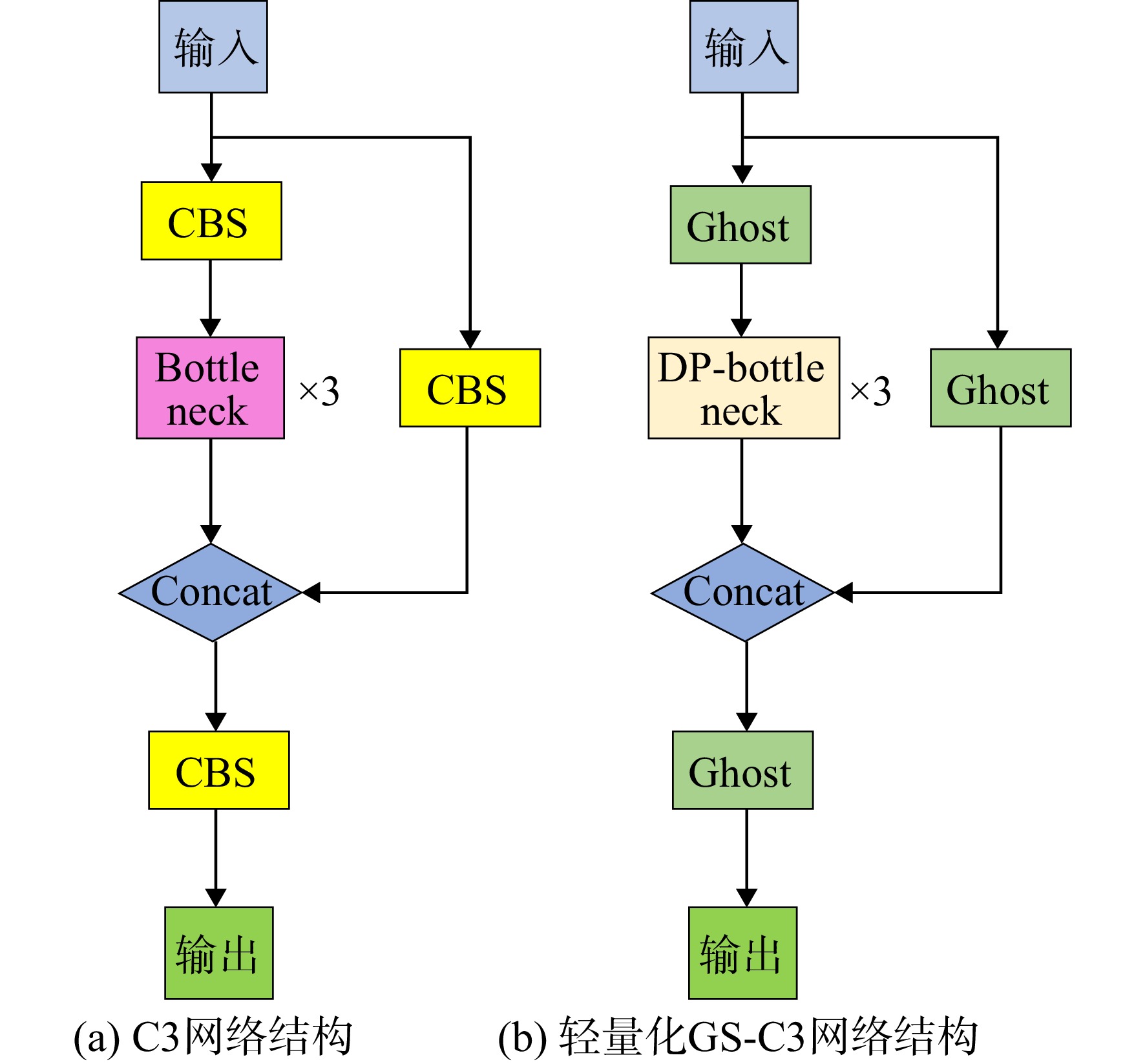
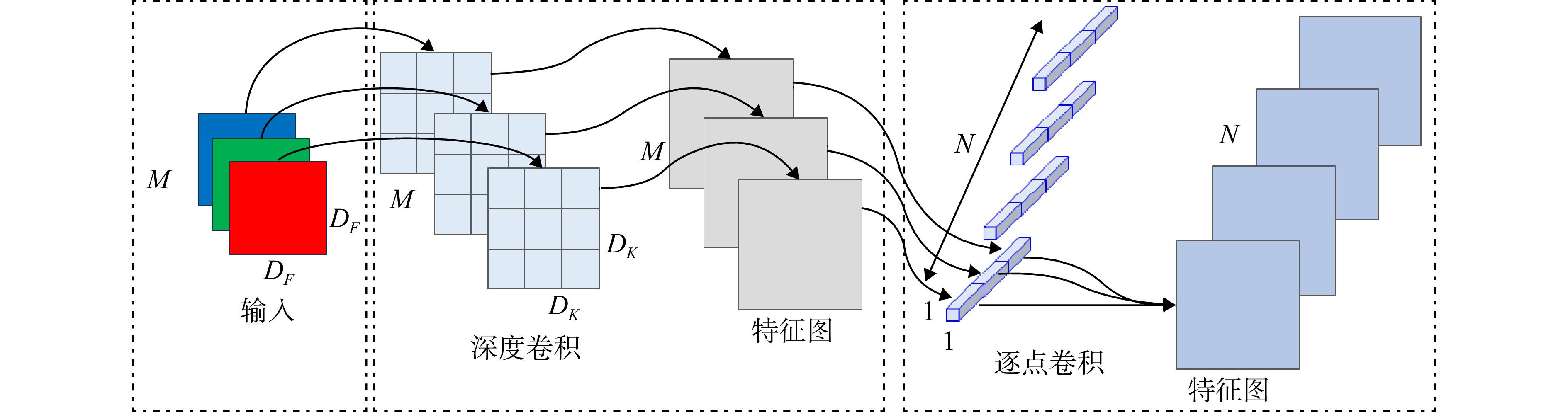
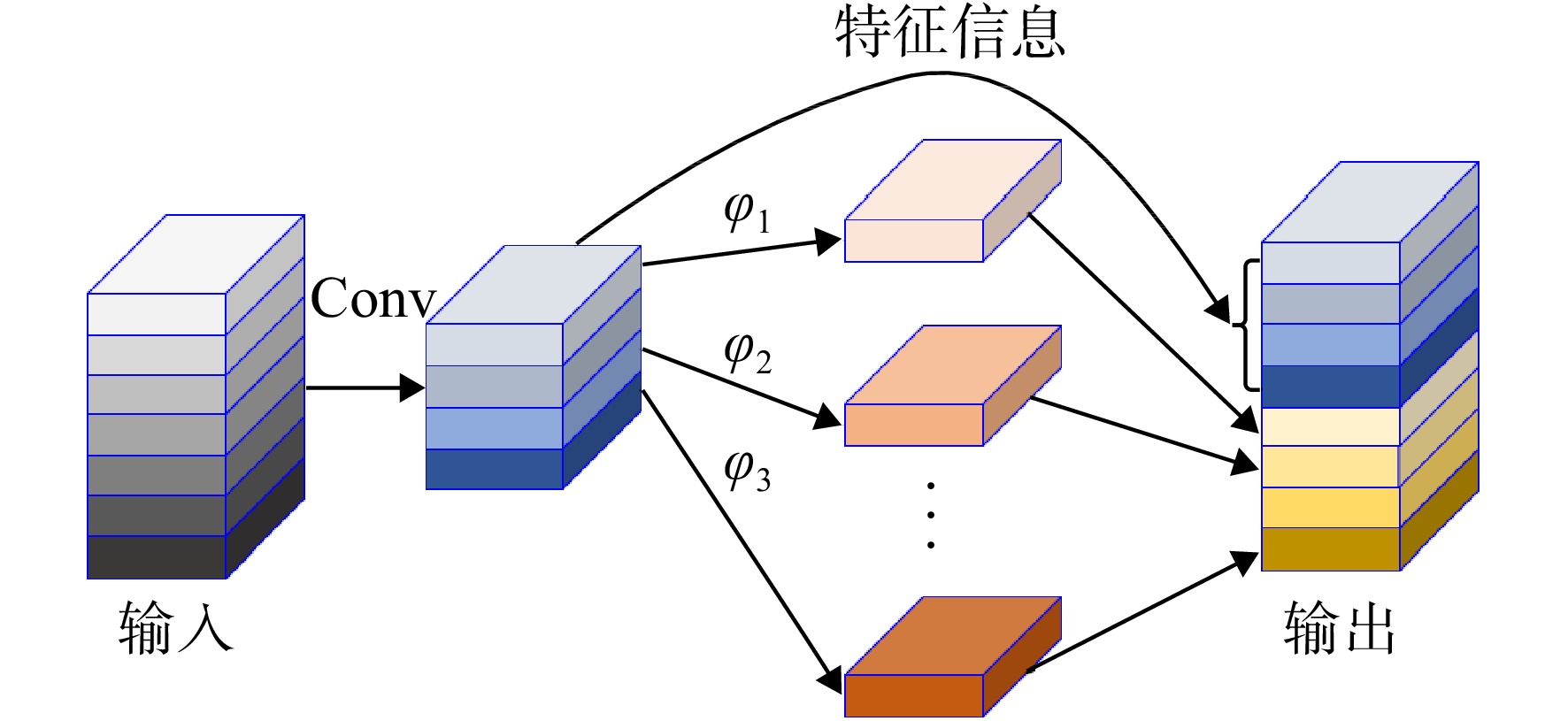
针对航空发动机表面缺陷检测算法参数量大、网络复杂度高以及可移植性低的问题,基于YOLOv5s(you only look once version 5 small)提出一种融合注意力机制的轻量化WGS-YOLO缺陷检测算法。算法使用ShuffleNet V2网络构建单元重构骨干网络,降低网络复杂度;提出可自适应调节权重的CBAM(AW-CBAM)注意力机制,能够同时分别提取通道注意力特征和空间注意力特征,并通过可学习权重系数动态调节两种特征的权重占比,使网络更加关注输入特征图的全局信息,将其应用在骨干网络中,以提升网络的表征能力和泛化能力;在颈部网络中通过引入深度可分离卷积和Ghost卷积设计了轻量化GS-C3模块,实现对输入特征图的特征浓缩,有效捕捉输入特征中的重要信息。实验结果表明:WGS-YOLO算法识别精确度为92.0%,相较于基准网络提高了2.1%,而网络参数量减少了55.3%,计算量降低了57%。因此,所提算法满足网络轻量化的设计需求,可有效检测航空发动机主要表面缺陷。
Abstract:In response to the problems of large parameters, high network complexity, and low portability of aero-engine surface defect detection algorithms, a lightweight defect detection algorithm WGS-YOLO combined with attention mechanism based on YOLOv5s (you only look once version 5 small) was proposed. The algorithm utilized the ShuffleNet V2 network to construct the unit-reconstructed backbone network, reducing network complexity. The presented AW-CBAM attention mechanism (CBAM attention mechanism with adaptive adjustment of weights) was capable of simultaneously extracting channel attention features and spatial attention features, and dynamically adjusting the weight proportion of the two features through adaptive weight coefficients, which enabled the network to pay more attention to the global information of the input feature map, and apply it into the backbone network to enhance the network’s representation and generalization capabilities. A lightweight GS-C3 module was designed in the neck network by introducing depthwise separable convolution and Ghost convolution to achieve feature condensation of the input feature map, efficiently capturing important information in input features. The experimental results showed that the recognition precision of the WGS-YOLO algorithm reached 92.0%, 2.1% higher than the baseline. Meanwhile, the network parameters were reduced by 55.3%, and the computational load decreased by 57%. Therefore, the proposed algorithm can meet the design requirements of lightweight network and effectively detect major surface defects in aero-engines.
-
Key words:
- aero-engine defect /
- surface defect detection /
- YOLOv5s /
- lightweight /
- attention mechanism
-
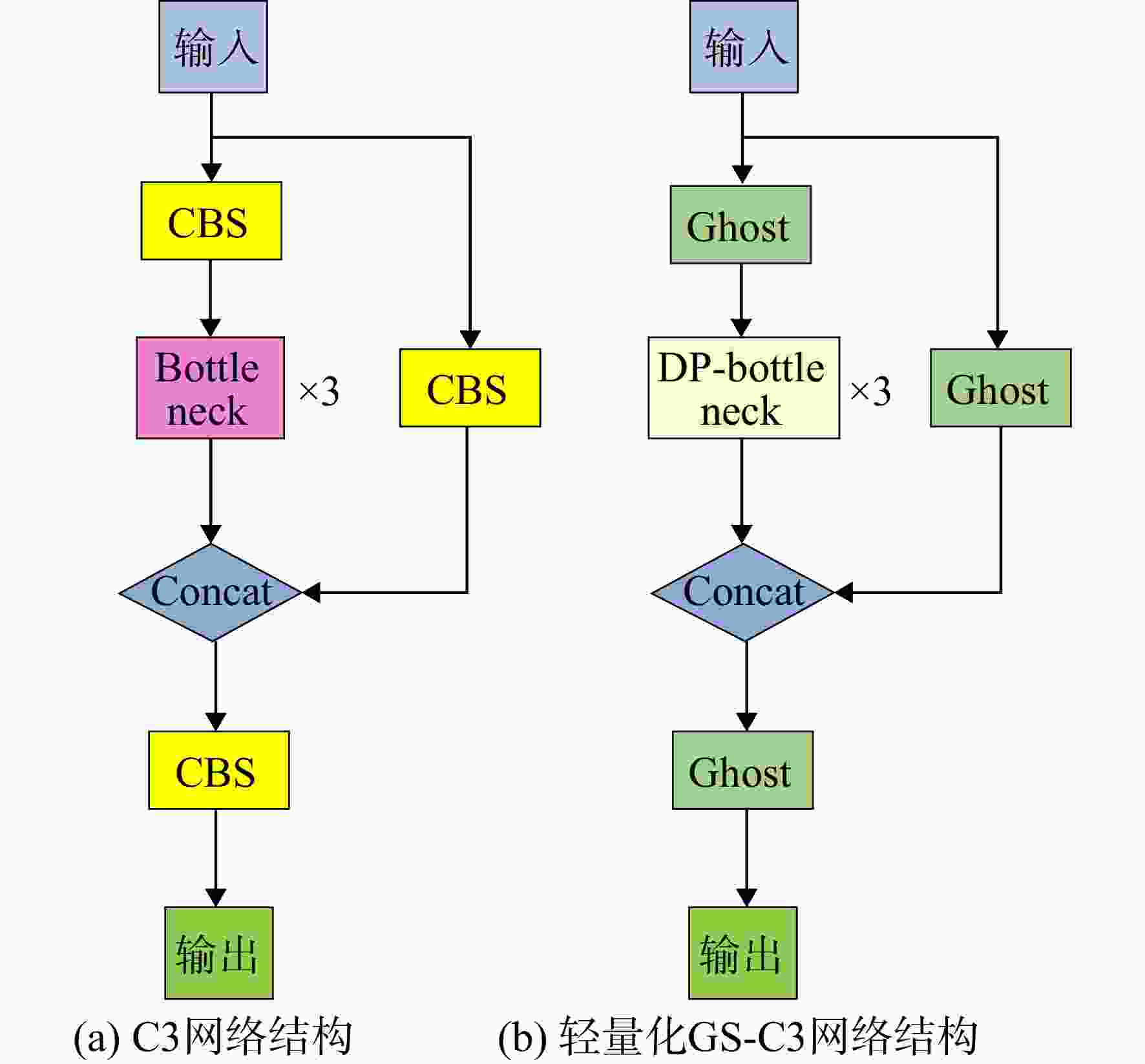
图 5 改进前后网络结构对比图
Figure 5. Comparison diagram of network structure before and after improvement
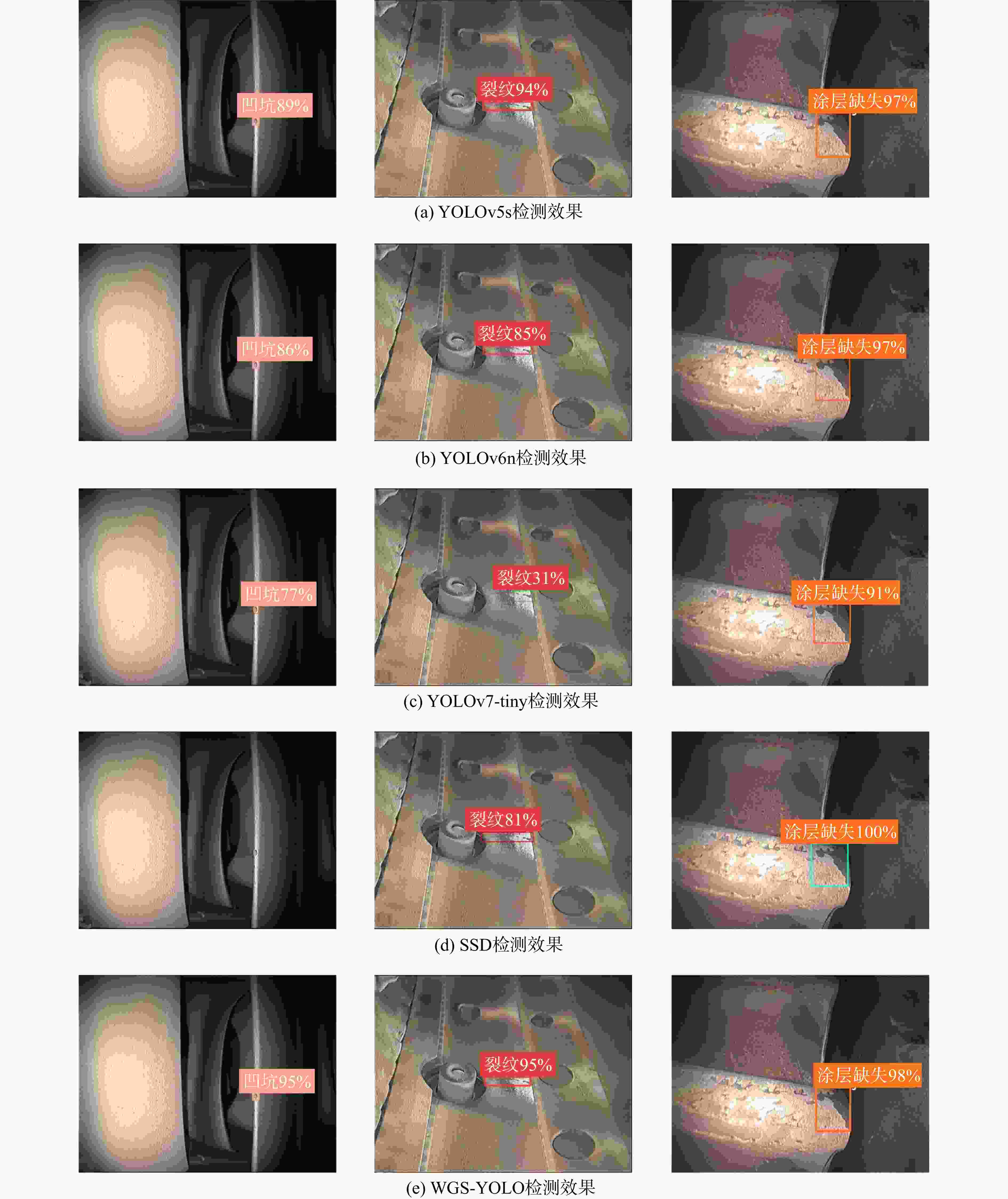
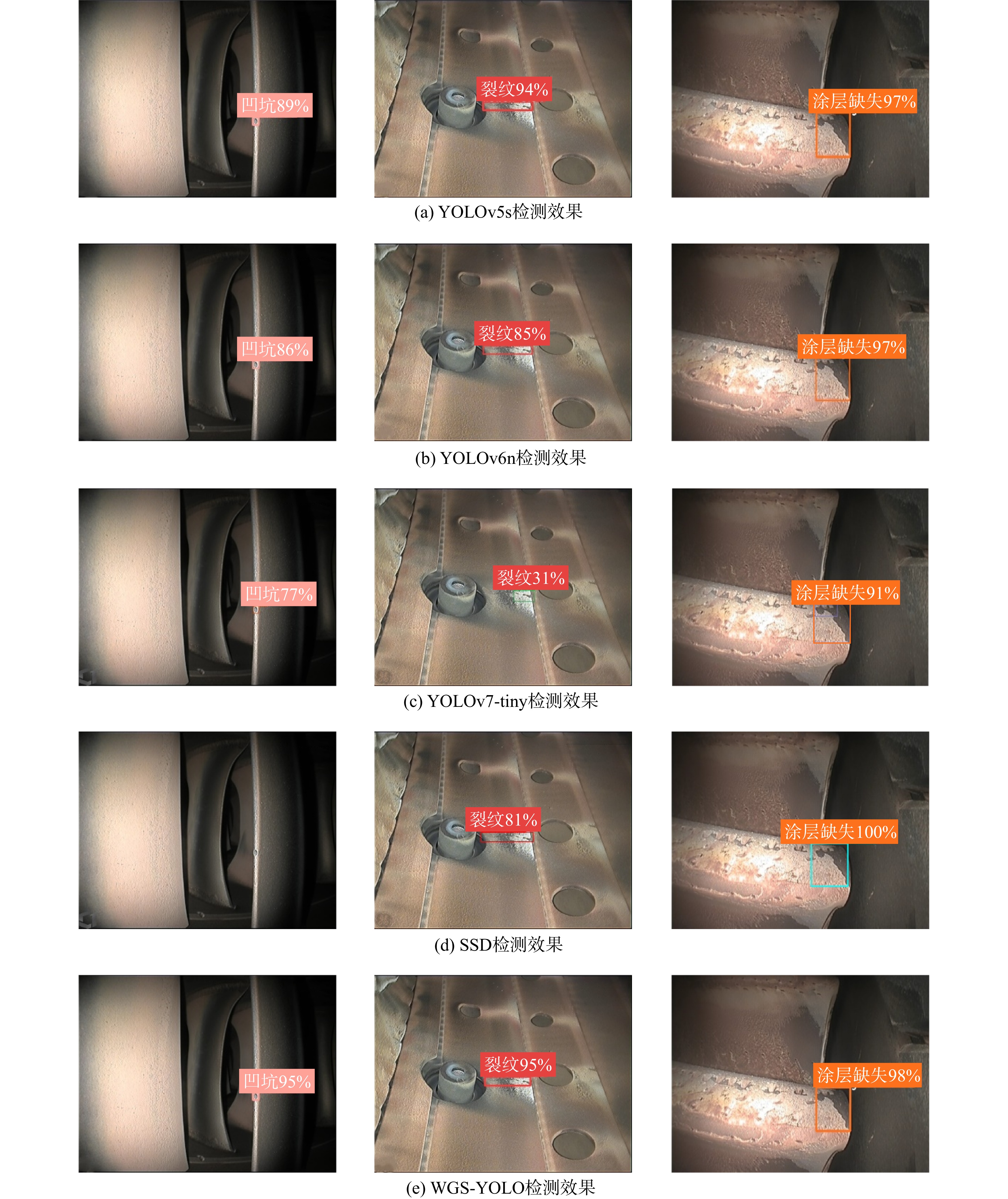
图 10 WGS-YOLO与其他算法检测效果对比
Figure 10. Comparison of detection performance between WGS-YOLO and other algorithms
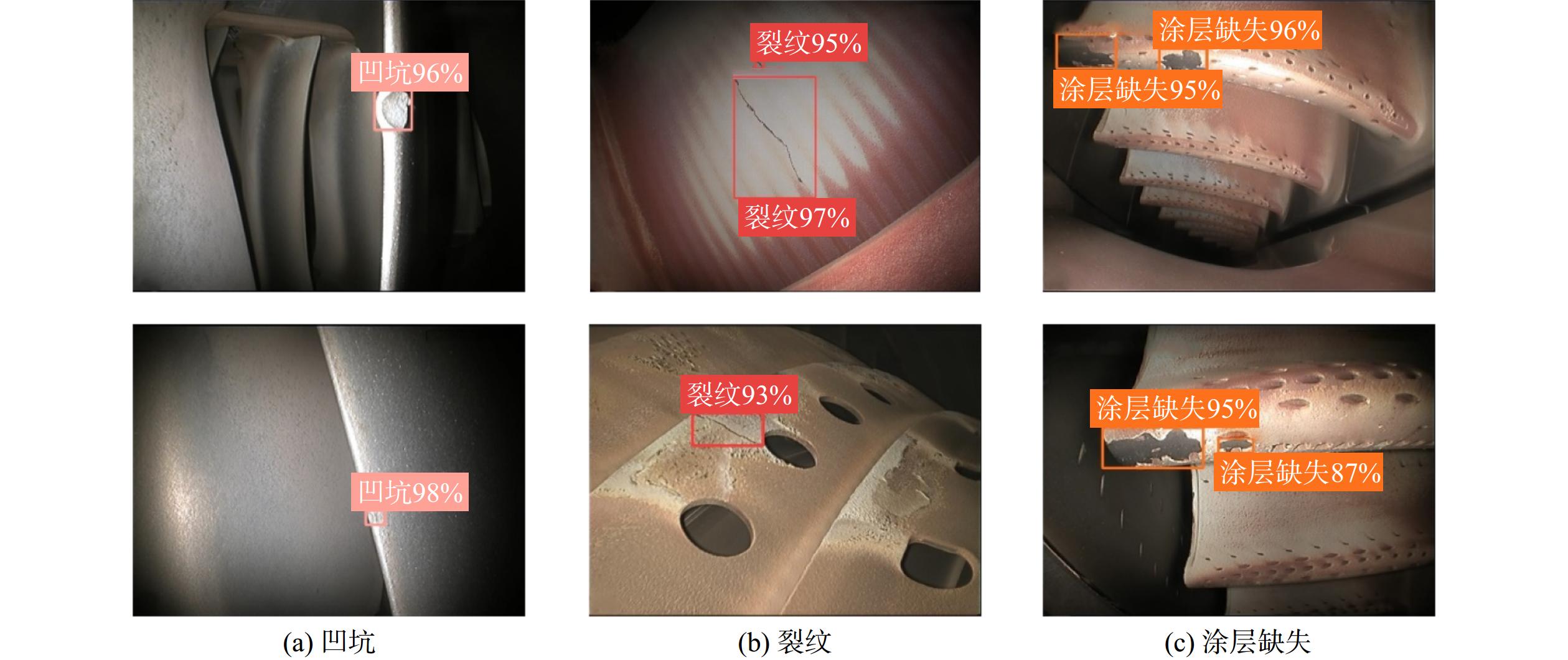
表 1 数据集具体数量
Table 1. Specific numbers of dataset
数据集 凹坑 裂纹 涂层丢失 总计 训练集数量 1451 794 682 2927 验证集数量 190 97 95 382 测试集数量 185 96 87 368 总计 1826 987 864 3677  下载: 导出CSV
表 2 3种缺陷检测性能
Table 2. Detection performance of three defects
类别 P/% mAP@0.5/% 裂纹 94.7 82.6 凹坑 93.3 85.3 涂层丢失 88.0 83.7
下载: 导出CSV
表 3 轻量化网络消融实验结果
Table 3. Ablation experiment results of lightweight network
模型 P/% mAP@0.5/% 参数量/106 计算量/109 flops 权重大小/MB ①YOLOv5s 89.9 83.2 7.02 15.8 14.4 ②S- YOLOv5s 87.7 81.2 3.34 7.3 7.4 ③SC-YOLOv5s 88.5 82.3 3.58 7.6 7.7 ④WSC-YOLOv5s 90.7 83.6 4.17 8.7 8.6 ⑤GS -YOLOv5s 90.9 84.3 5.96 13.8 12.4 ⑥WGS-YOLO 92.0 83.9 3.14 6.8 6.7
下载: 导出CSV
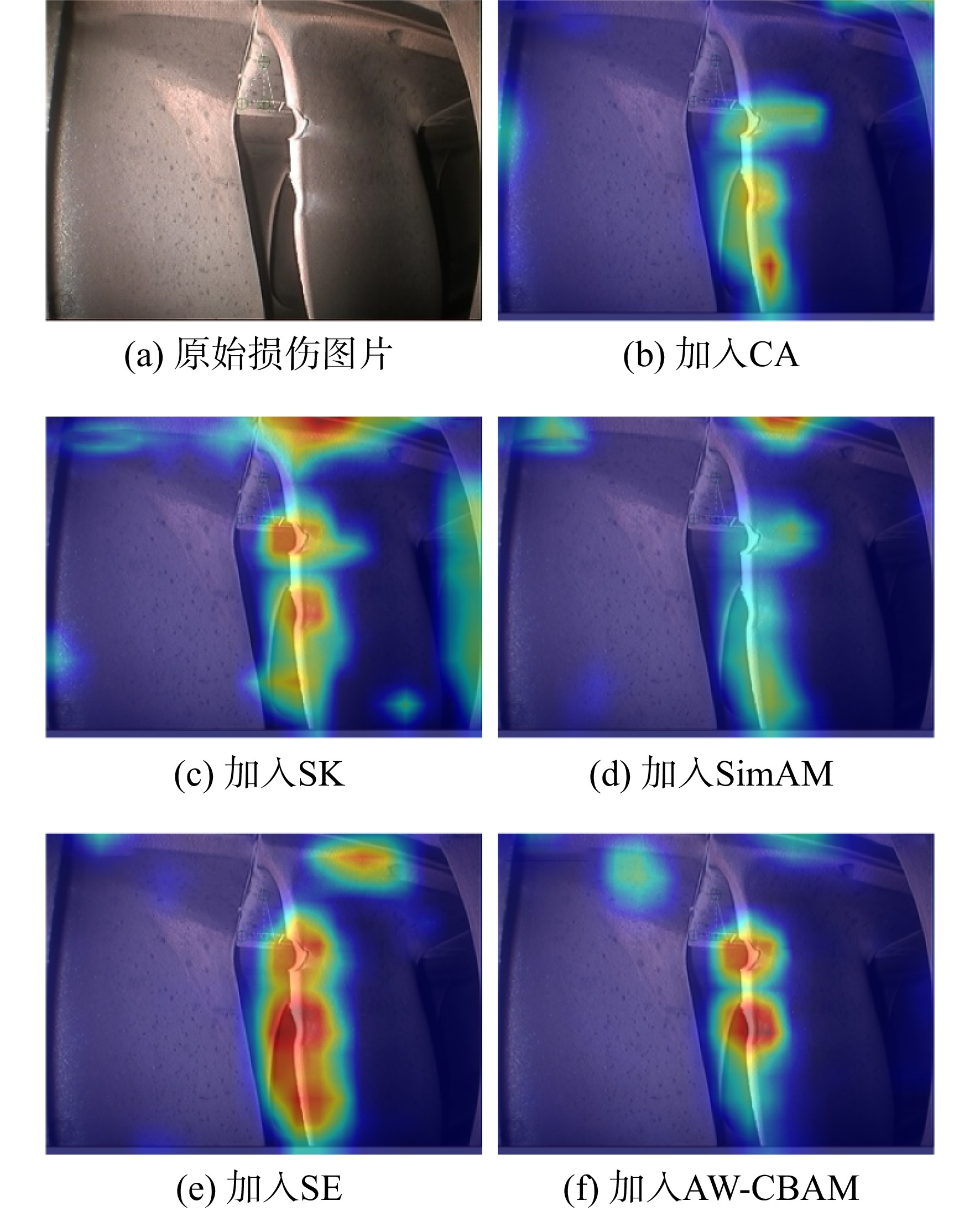
表 4 AW-CBAM与其他注意力机制实验结果对比
Table 4. Comparison of experimental results between AW-CBAM and other attention mechanisms
注意力机制 P/% mAP@0.5/% 参数量/106 CA 91.1 77.4 2.71 SE 89.2 80.0 2.75 ECA 87.7 79.6 2.56 SimAM 90.1 78.8 2.56 SK 92.3 83.5 64.6 AW-CBAM 92.0 83.9 3.14
下载: 导出CSV
表 5 WGS-YOLO与多种检测算法实验结果对比
Table 5. Comparison of experimental results between WGS-YOLO and various detection algorithms
模型 P/% FPS 参数量/106 计算量/109 flops 权重大小/MB SSD 91.5 118 23.6 273.8 91.6 Faster R-CNN 50.5 39 28.3 947.3 108.2 YOLOv4 59.5 56 64.4 143.3 244.4 YOLOv5s 89.9 101 7.02 15.8 14.4 YOLOv6n 82.4 208 4.7 11.4 9.94 YOLOv7-tiny 84.6 97 6.02 13.2 12.3 YOLOv8n 88.7 114 3.22 8.7 6.6 WGS-YOLO 92.0 106 3.14 6.8 6.7
下载: 导出CSV
-
[1] 李续博,王文庆,王凯,等. 人工智能技术在航空发动机孔探检测中的应用进展[J]. 航空工程进展,2023,14(2): 12-23. LI Xubo,WANG Wenqing,WANG Kai,et al. Application advances of artificial intelligence technology in aero-engine bore-scope inspection[J]. Advances in Aeronautical Science and Engineering,2023,14(2): 12-23. (in ChineseLI Xubo, WANG Wenqing, WANG Kai, et al. Application advances of artificial intelligence technology in aero-engine bore-scope inspection[J]. Advances in Aeronautical Science and Engineering, 2023, 14(2): 12-23. (in Chinese) [2] LI Xubo,WANG Wenqing,SUN Lihua,et al. Deep learning-based defects detection of certain aero-engine blades and vanes with DDSC-YOLOv5s[J]. Scientific Reports,2022,12(1): 13067. doi: 10.1038/s41598-022-17340-7 [3] ZOU Fuqun. Review of aero-engine defect detection technology[C]//2020 IEEE 4th Information Technology,Networking,Electronic and Automation Control Conference. Piscataway,US: IEEE,2020: 1524-1527. [4] JANG J,AN H,LEE J H,et al. Construction of faster R-CNN deep learning model for surface damage detection of blade systems[J]. Journal of the Korea Institute for Structural Maintenance and Inspection,2019,23(7): 80-81. [5] LECUN Y,BENGIO Y,HINTON G. Deep learning[J]. Nature,2015,521(7553): 436-444. doi: 10.1038/nature14539 [6] 何超,陈果,王雨薇. 基于深度学习的航空发动机内部损伤实时检测方法[J]. 航空动力学报,2023,38(8): 1857-1864. HE Chao,CHEN Guo,WANG Yuwei. Real-time detection method of aero-engine internal damage based on deep learning[J]. Journal of Aerospace Power,2023,38(8): 1857-1864. (in ChineseHE Chao, CHEN Guo, WANG Yuwei. Real-time detection method of aero-engine internal damage based on deep learning[J]. Journal of Aerospace Power, 2023, 38(8): 1857-1864. (in Chinese) [7] MALEKZADEH T,ABDOLLAHZADEH M,NEJATI H,et al. Aircraft fuselage defect detection using deep neural networks[EB/OL]. [2024-02-23]. http://arxiv.org/abs/1712.09213. [8] LI Yadan,HAN Zhenqi,XU Haoyu,et al. YOLOv3-lite: a light-weight crack detection network for aircraft structure based on dep-thwise separable convolutions[J]. Applied Sciences,2019,9(18): 3781. doi: 10.3390/app9183781 [9] LI Dawei,LI Yida,XIE Qian,et al. Tiny defect detection in high-resolution aero-engine blade images via a coarse-to-fine framework[J]. IEEE Transactions on Instrumentation and Measurement,2021,70: 3512712. [10] 黄睿,段博坤,陈望,等. 检测器和分类器级联的飞机发动机损伤检测[J]. 中国图象图形学报,2022,27(11): 3232-3242. HUANG Rui,DUAN Bokun,CHEN Wang,et al. Detector and classifier cascaded aero-engine detection method[J]. Journal of Image and Graphics,2022,27(11): 3232-3242. (in Chinese doi: 10.11834/jig.210734HUANG Rui, DUAN Bokun, CHEN Wang, et al. Detector and classifier cascaded aero-engine detection method[J]. Journal of Image and Graphics, 2022, 27(11): 3232-3242. (in Chinese) doi: 10.11834/jig.210734 [11] 蔡舒妤,闫子砚. 基于改进YOLOv4的航空发动机小目标损伤检测研究[J]. 航空动力学报,2023,38(2): 445-452. CAI Shuyu,YAN Ziyan. Research on small target damage detection of aero-engine based on improved YOLOv4[J]. Journal of Aerospace Power,2023,38(2): 445-452. (in ChineseCAI Shuyu, YAN Ziyan. Research on small target damage detection of aero-engine based on improved YOLOv4[J]. Journal of Aerospace Power, 2023, 38(2): 445-452. (in Chinese) [12] SHANG Hongbing,SUN Chuang,LIU Jinxin,et al. Deep learning-based borescope image processing for aero-engine blade in situ damage detection[J]. Aerospace Science and Technology,2022,123: 107473. doi: 10.1016/j.ast.2022.107473 [13] 何宇豪,曹学国,刘信良,等. 基于SW-YOLO模型的航空发动机叶片损伤实时检测[J]. 推进技术,2024,45(2): 2302058. HE Yuhao,CAO Xueguo,LIU Xinliang,et al. Real time detection of aircraft engine blade damage based on SW-YOLO model[J]. Journal of Propulsion Technology,2024,45(2): 2302058. (in ChineseHE Yuhao, CAO Xueguo, LIU Xinliang, et al. Real time detection of aircraft engine blade damage based on SW-YOLO model[J]. Journal of Propulsion Technology, 2024, 45(2): 2302058. (in Chinese) [14] KUMAR S,GUPTA H,YADAV D,et al. YOLOv4 algorithm for the real-time detection of fire and personal protective equipments at construction sites[J]. Multimedia Tools and Applications,2022,81(16): 22163-22183. doi: 10.1007/s11042-021-11280-6 [15] GUO Gege,ZHANG Zhenyu. Road damage detection algorithm for improved YOLOv5[J]. Scientific Reports,2022,12: 15523. doi: 10.1038/s41598-022-19674-8 [16] 邢洁洁,谢定进,杨然兵,等. 基于YOLOv5s的农田垃圾轻量化检测方法[J]. 农业工程学报,2022,38(19): 153-161. XING Jiejie,XIE Dingjin,YANG Ranbing,et al. Lightweight detection method for farmland waste based on YOLOv5s[J]. Transactions of the Chinese Society of Agricultural Engineering,2022,38(19): 153-161. (in Chinese doi: 10.11975/j.issn.1002-6819.2022.19.017XING Jiejie, XIE Dingjin, YANG Ranbing, et al. Lightweight detection method for farmland waste based on YOLOv5s[J]. Transactions of the Chinese Society of Agricultural Engineering, 2022, 38(19): 153-161. (in Chinese) doi: 10.11975/j.issn.1002-6819.2022.19.017 [17] MA Ningning,ZHANG Xiangyu,ZHENG Haitao,et al. ShuffleNet V2: practical guidelines for efficient CNN architecture design[C]//European Conference on Computer Vision. Cham: Sprin-ger,2018: 122-138. [18] WOO S,PARK J,LEE J Y,et al. CBAM: convolutional block attention module[C]//European Conference on Computer Vision. Cham: Springer,2018: 3-19. [19] XIANG Xinyuan,LIU Meiqin,ZHANG Senlin,et al. Multi-scale attention and dilation network for small defect detection[J]. Pattern Recognition Letters,2023,172: 82-88. doi: 10.1016/j.patrec.2023.06.010 [20] HOWARD A G,ZHU Menglong,CHEN Bo,et al. MobileNets: efficient convolutional neural networks for mobile vision applications[EB/OL]. [2024-02-23]. https://arxiv.org/abs/1704.04861. [21] HAN Kai,WANG Yunhe,TIAN Qi,et al. GhostNet: more features from cheap operations[C]//2020 IEEE/CVF Conference on Computer Vision and Pattern Recognition. Piscataway,US: IEEE,2020: 1577-1586. -

 点击查看大图

计量
- 文章访问数: 641
- HTML浏览量: 574
- PDF量: 72
- 被引次数: 0