






Cavitation characteristics of rotary vane pump in aeroengine lubricating oil system and their effects on pump performance
-
摘要:
为满足大推力、高转速航空发动机滑油系统对高性能滑油泵的需求,针对新型高速旋板式滑油泵开展了数值模拟研究,采用Mixture多相流模型,Singhal全空化模型和renormalization group(RNG)
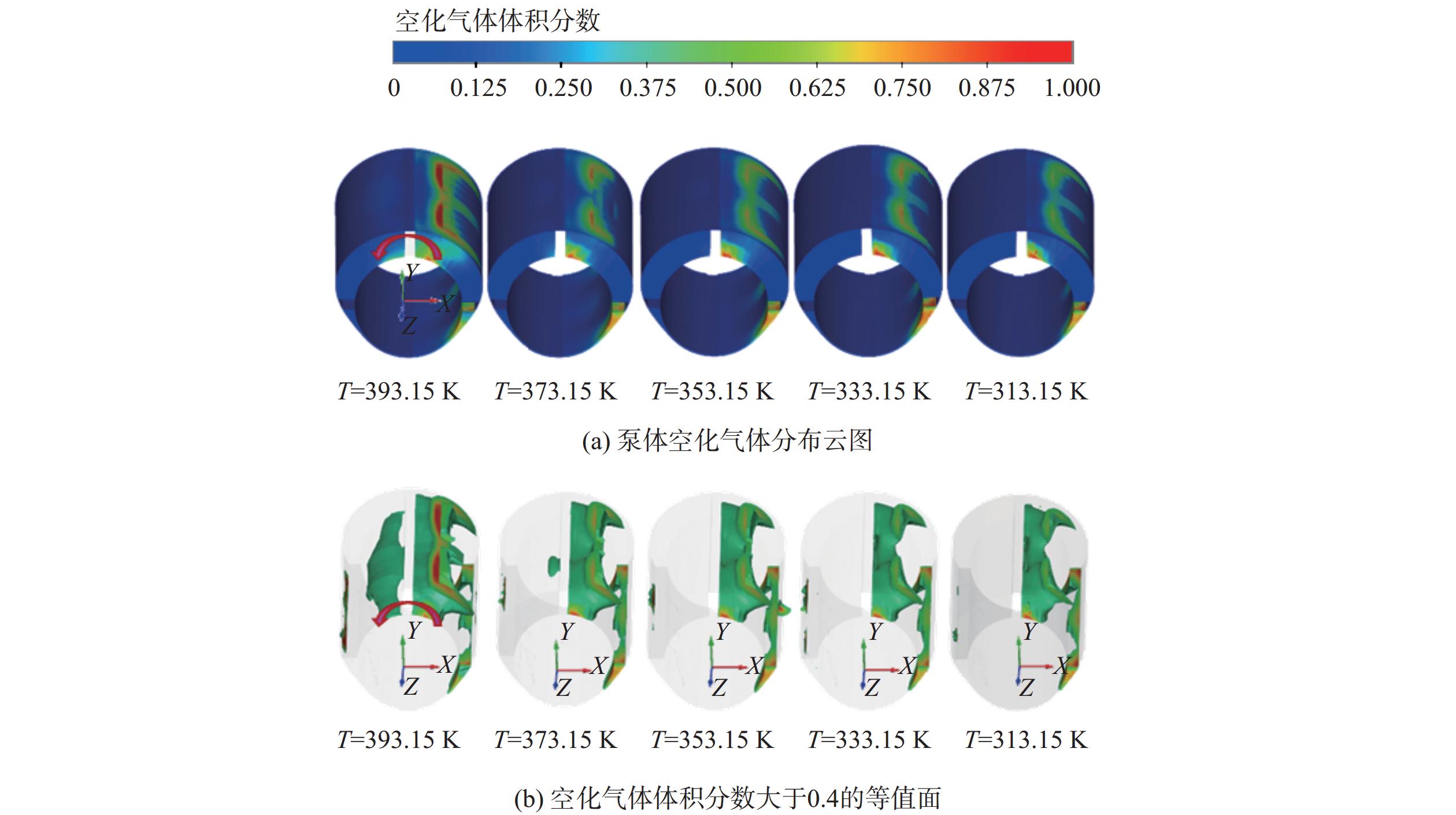
k-ε 湍流模型开展数值计算,并通过实验验证数值模拟方法的可靠性,进而分析不同入口压力和油液温度条件下旋板泵空化特性及对泵性能影响规律。结果表明:空化气体主要分布在吸油侧容积腔内,以及旋板吸力面和贴近转子内壁处。随着入口压力的降低和油液温度的升高,旋板泵内空化现象加剧,空化气体增多,进而使得泵出口平均排油流量减小,容积效率降低;当入口压力降低至40 kPa,温度升至373.15 K时,泵出口平均排油流量和容积效率均显著降低;监测点压力脉动呈现低频高幅脉动的特点。旋板泵的空化不仅影响其排油量和容积效率,而且也直接影响泵的稳定可靠工作。Abstract:To meet the demand for high-performance oil pumps in the lubricating oil system of high thrust and high-speed aeroengines, numerical simulation was conducted on a new high-speed rotary vane oil pump. The Mixture multiphase flow model, Singhal full cavitation model, and renormalization group(RNG)
k -ε turbulence model were employed for numerical calculation, and the reliability of the numerical simulation method was verified through experiments. Then, cavitation characteristics of the rotary vane pump and its impact on pump performance under different inlet pressure and oil temperature conditions were analyzed. The results showed that the cavitation gas was mainly distributed in the volume chamber on the oil suction side, as well as on the suction surface of the rotary vane and near the inner wall of the rotor. With the decrease of inlet pressure and the increase of oil temperature, the cavitation phenomenon inside the rotary vane pump intensified, and the cavitation gas increased, which in turn led to a decrease in the average oil discharge flow rate at the pump outlet and a decrease in volumetric efficiency. When the inlet pressure dropped to 40 kPa and the temperature rose to 373.15 K, the average oil discharge flow rate and volumetric efficiency at the pump outlet both significantly decreased. The pressure pulsation at the monitoring point exhibited low-frequency and high-amplitude pulsation characteristics. The cavitation of the rotary vane pump affected not only its oil discharge and volumetric efficiency, but also the stable and reliable operation of the pump. -
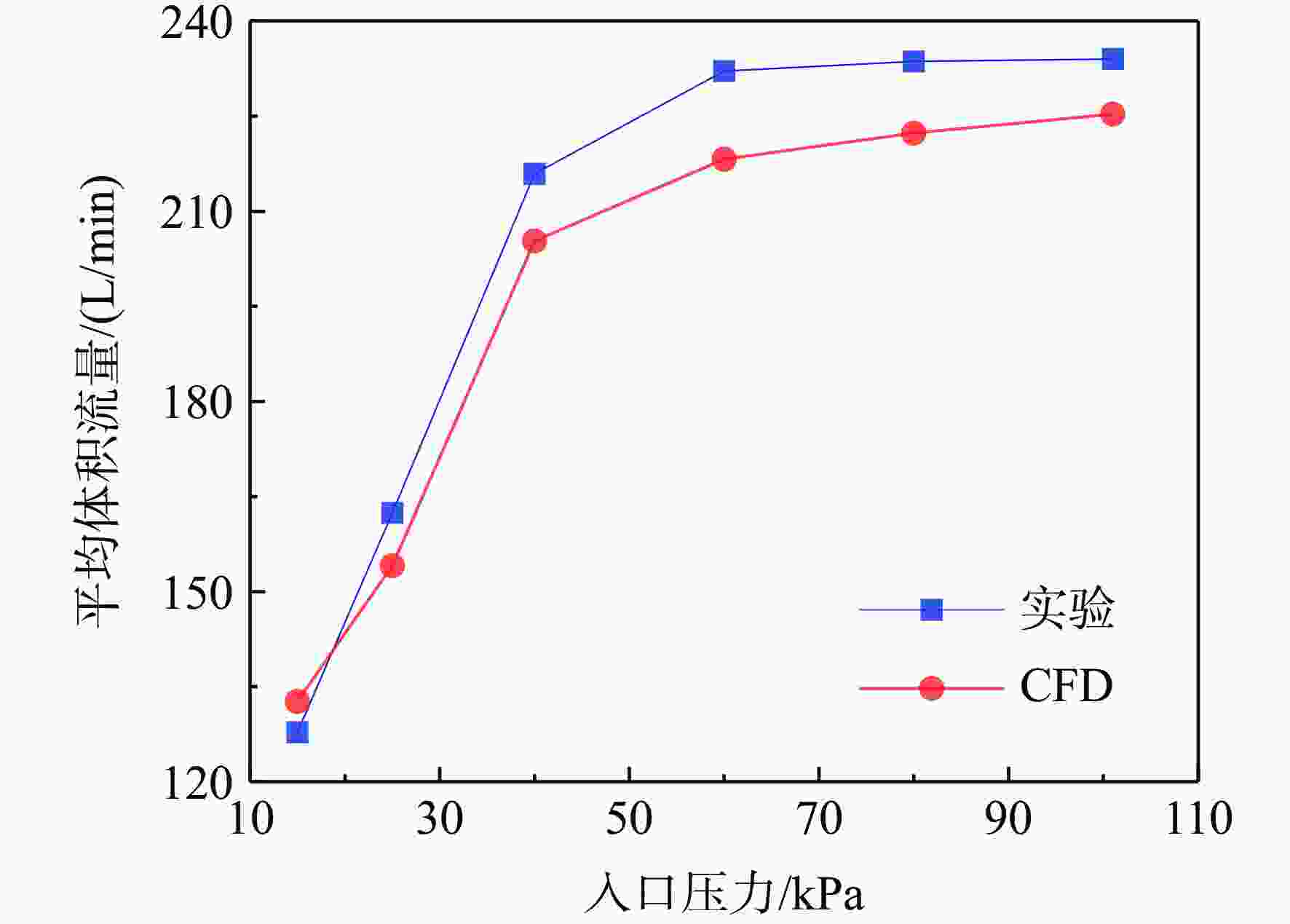
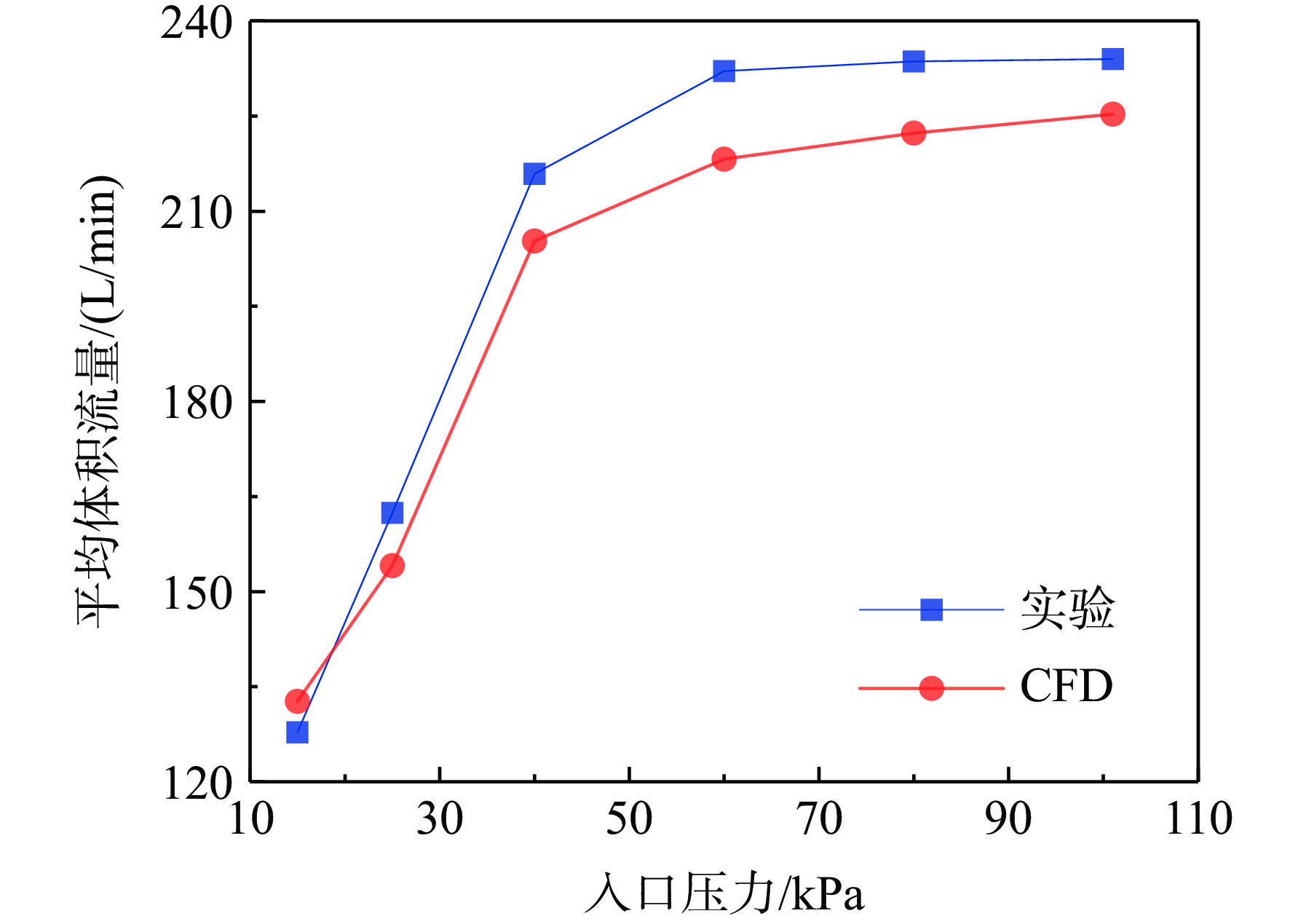
图 5 出口流量的数值模拟结果与实验对比
Figure 5. Comparison of outlet flowrate between numerical simulation and experimental results
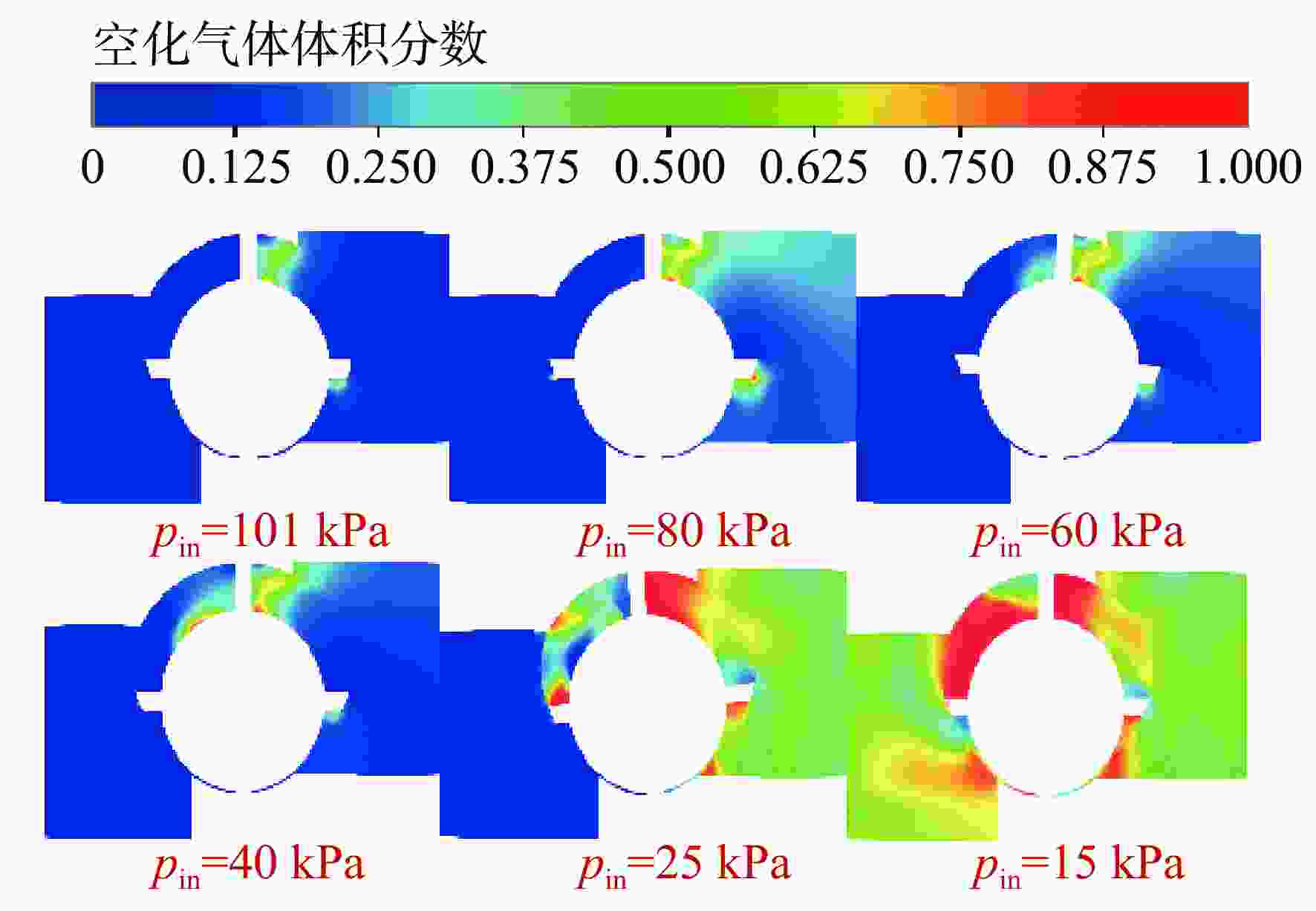
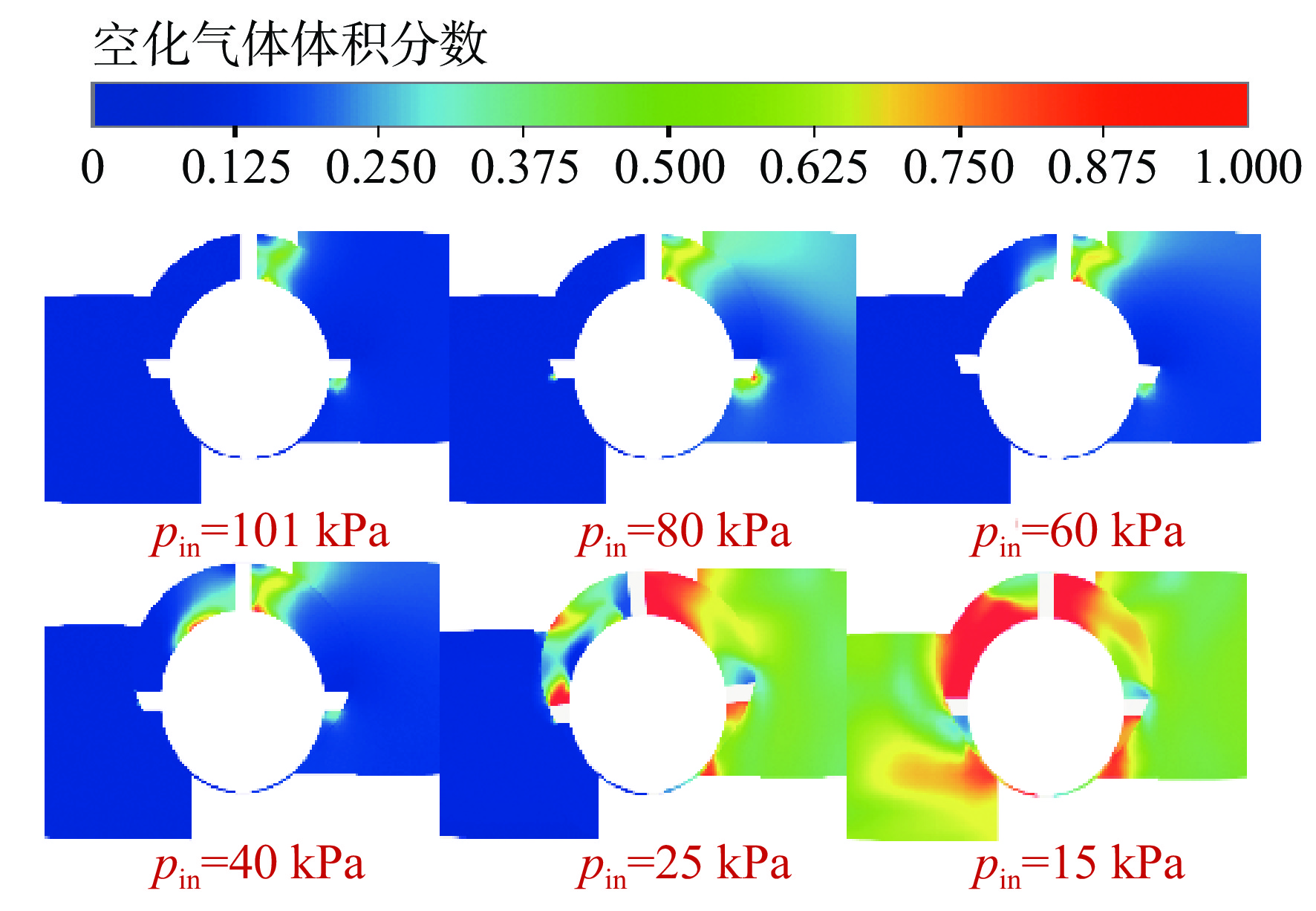
图 7 不同入口压力下特征截面空化云图
Figure 7. Characteristic cross-section cavitation cloud map under different inlet pressures
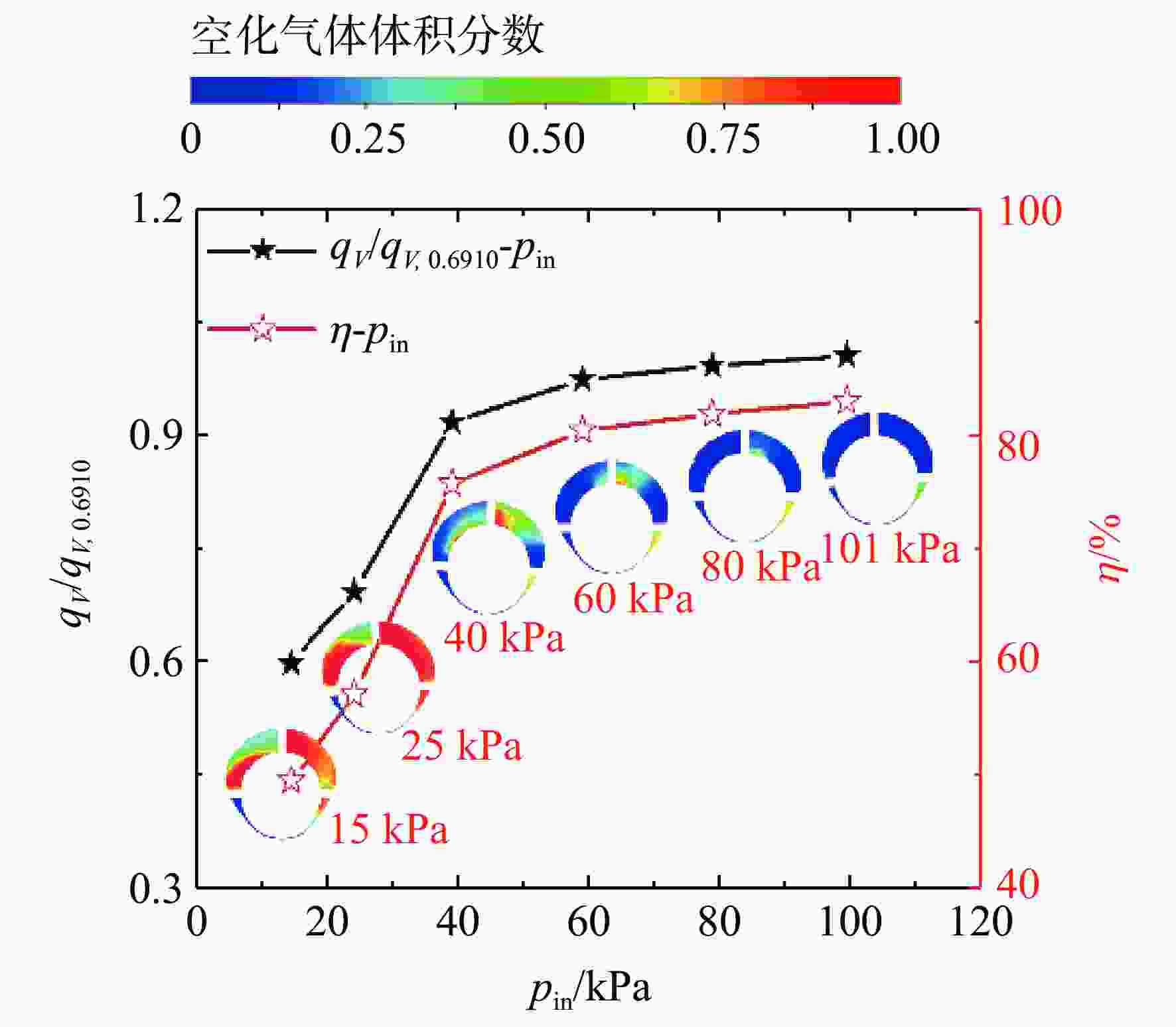
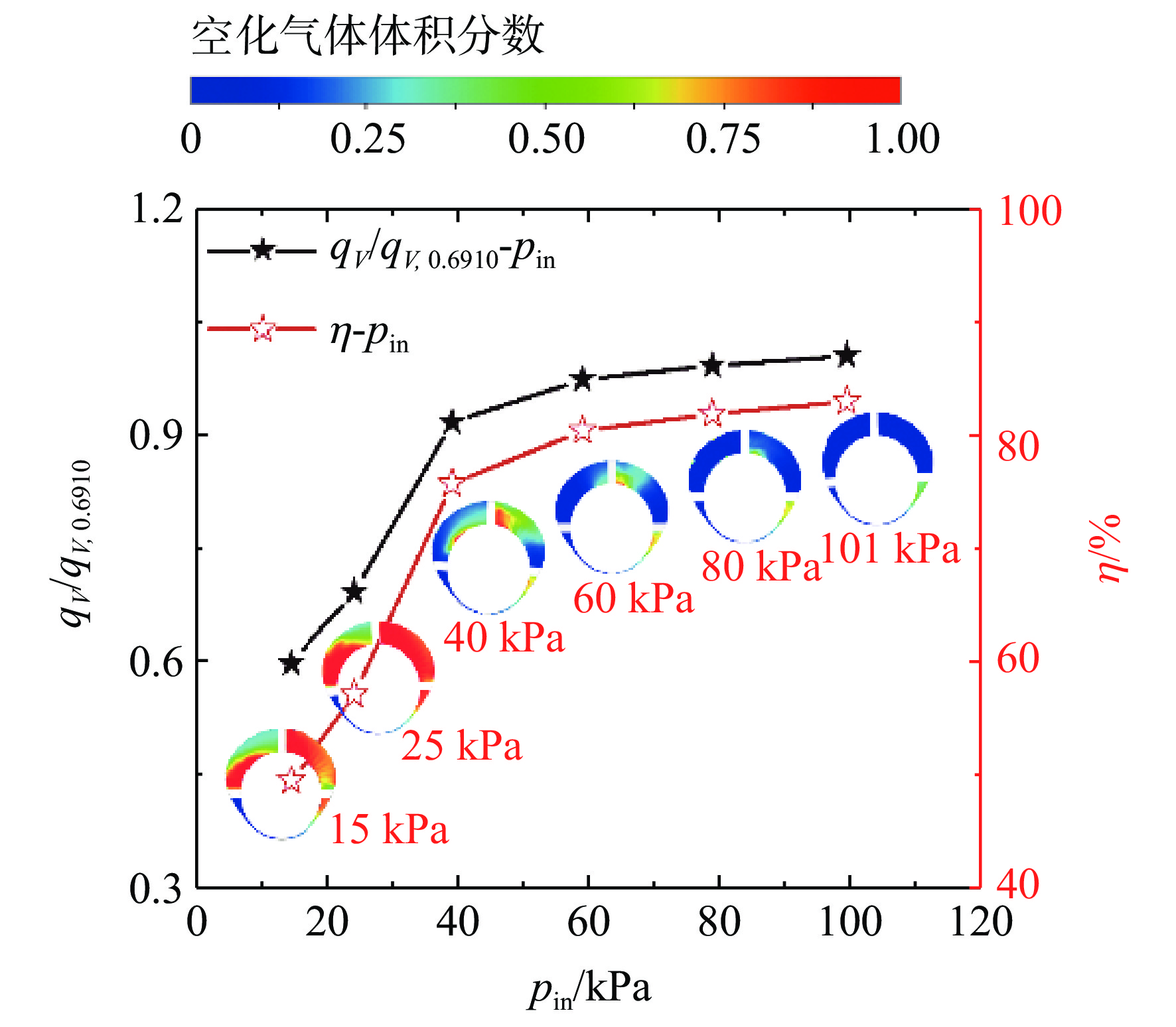
图 8 不同入口压力下旋板泵出口平均流量-效率曲线
Figure 8. Average outlet flowrate-efficiency curves of rotary vane pump under different inlet pressures
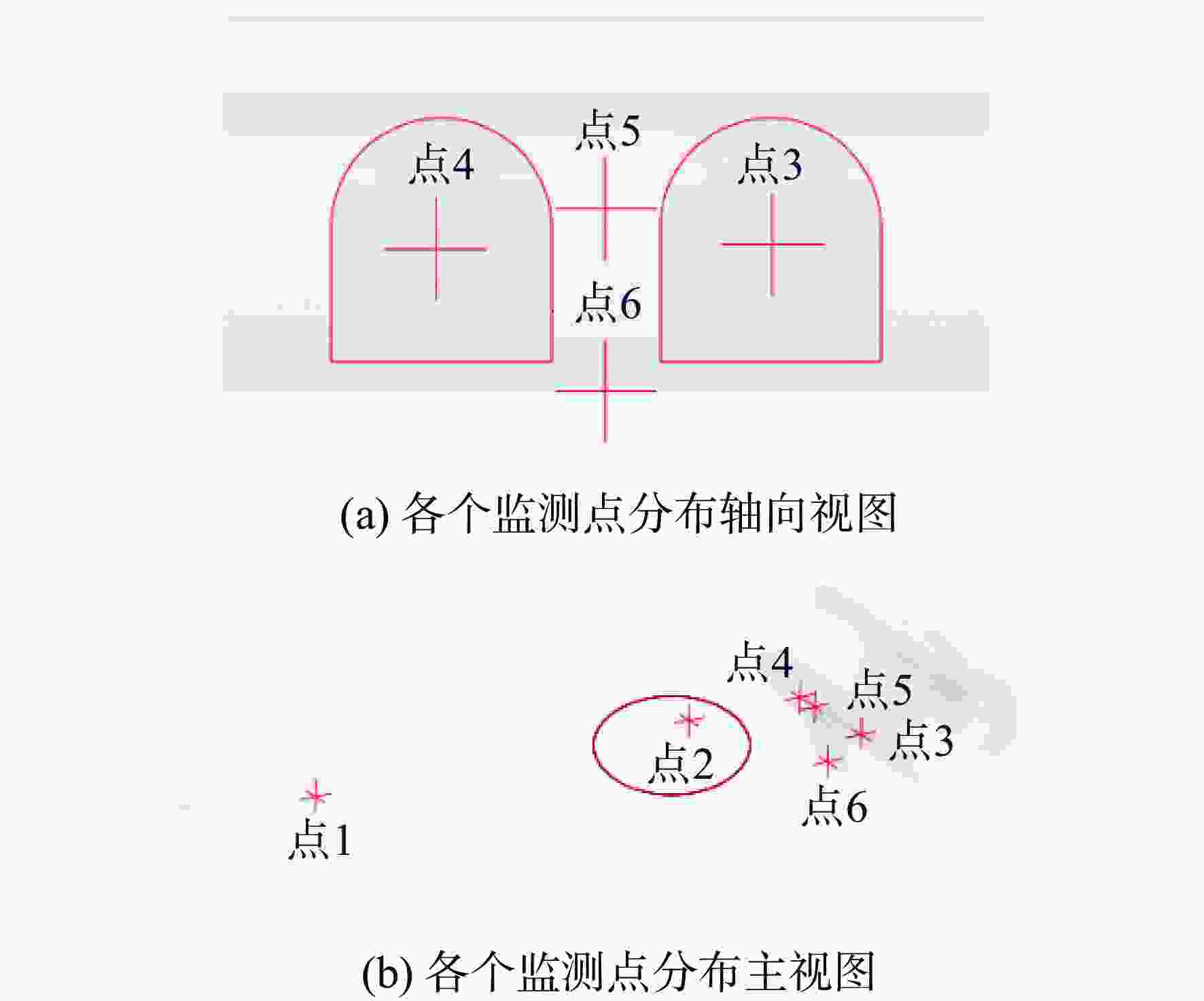
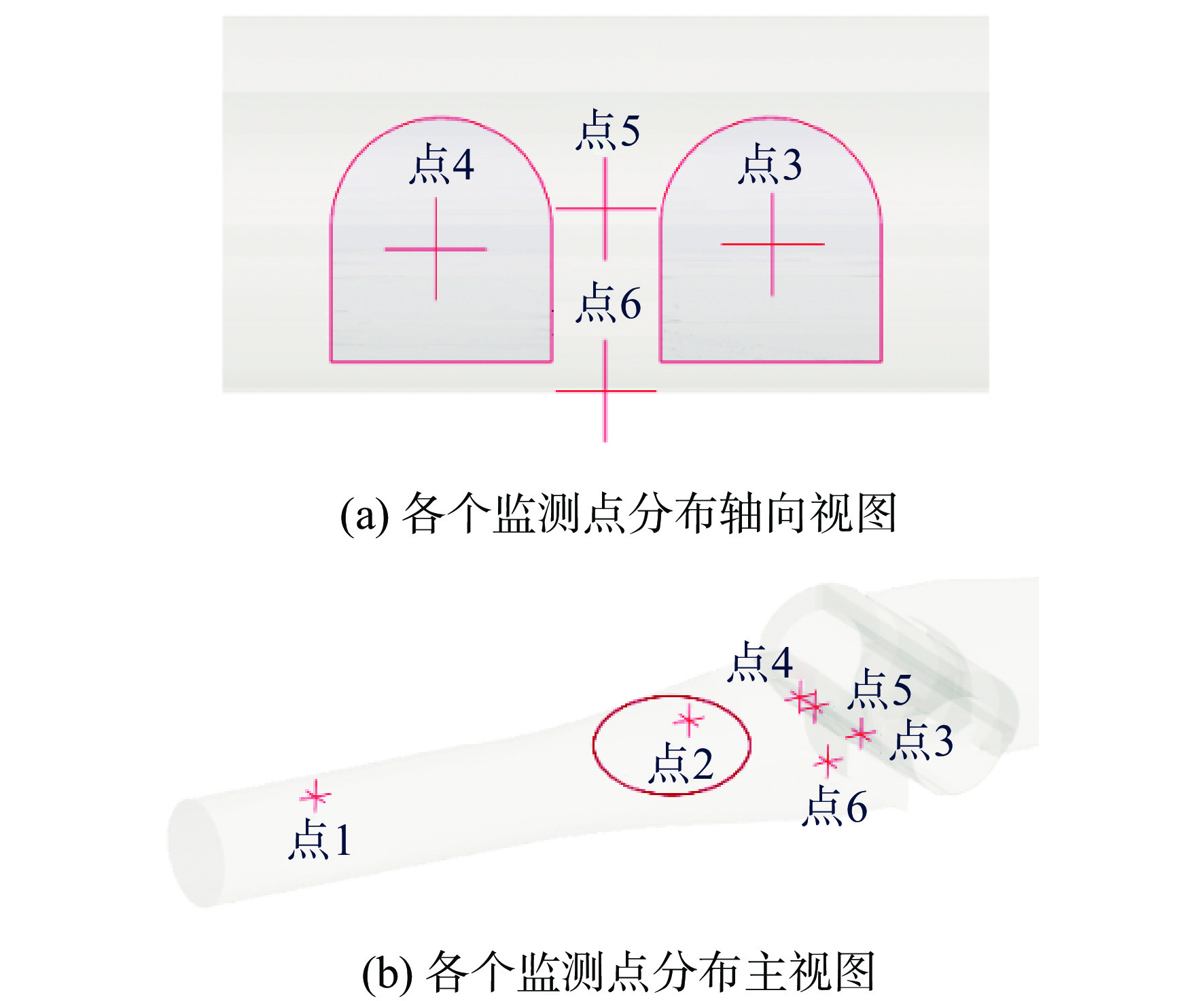
图 9 出油侧压力脉动监测点分布示意图
Figure 9. Distribution of pressure fluctuation monitoring points on the oil outlet side
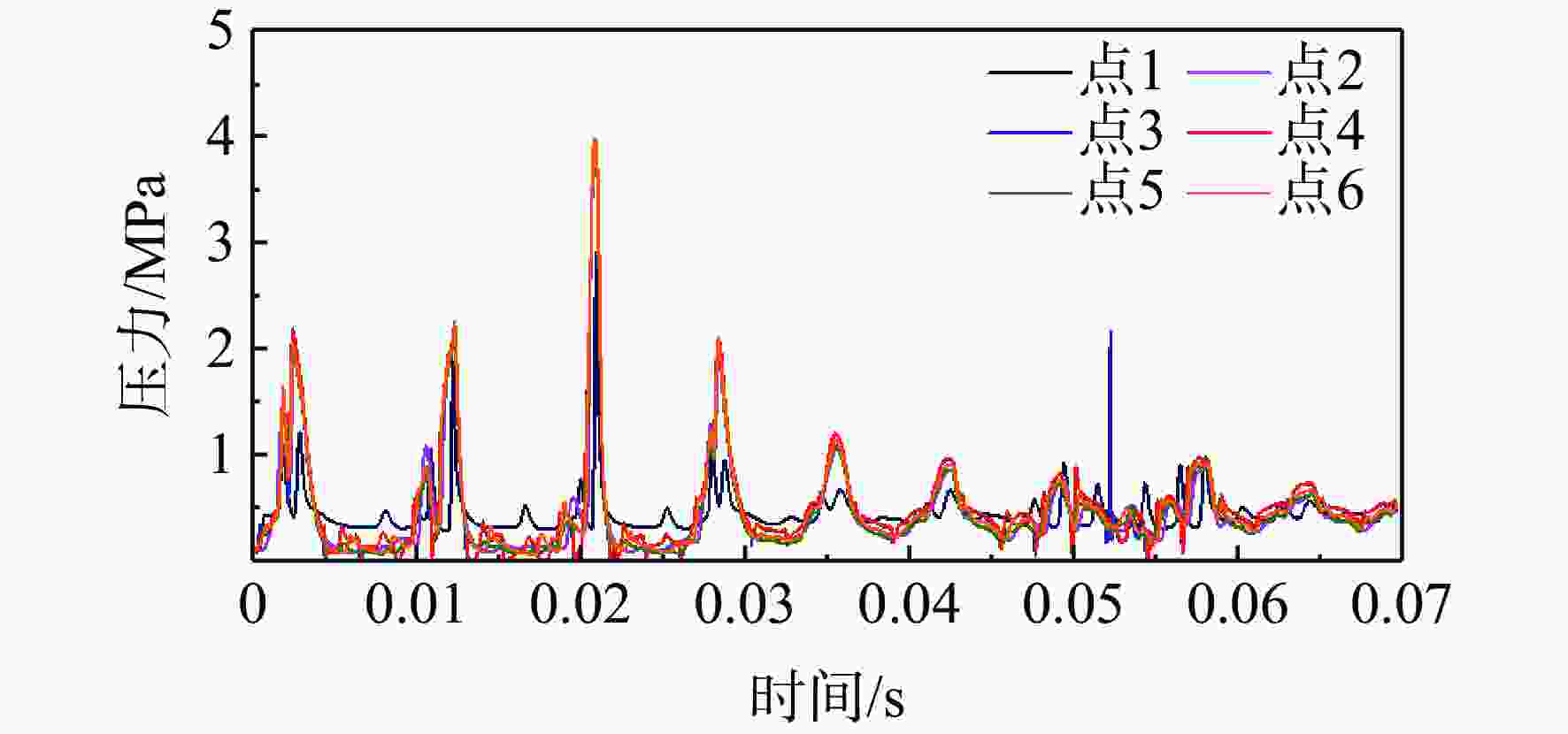
图 10 各个压力监测点压力脉动曲线(101 kPa, 393.15 K)
Figure 10. Pressure fluctuation of different monitoring points (101 kPa, 393.15 K)
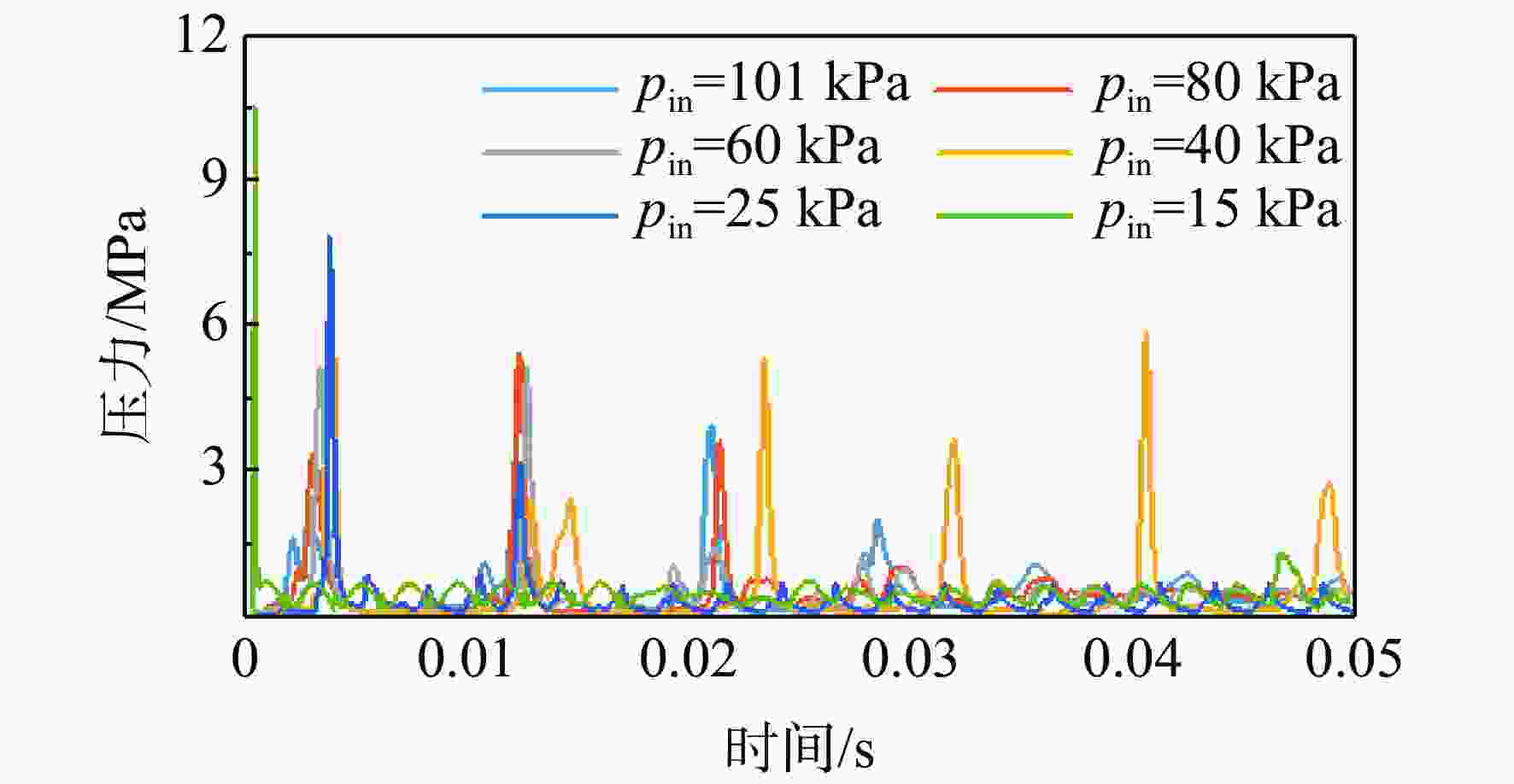
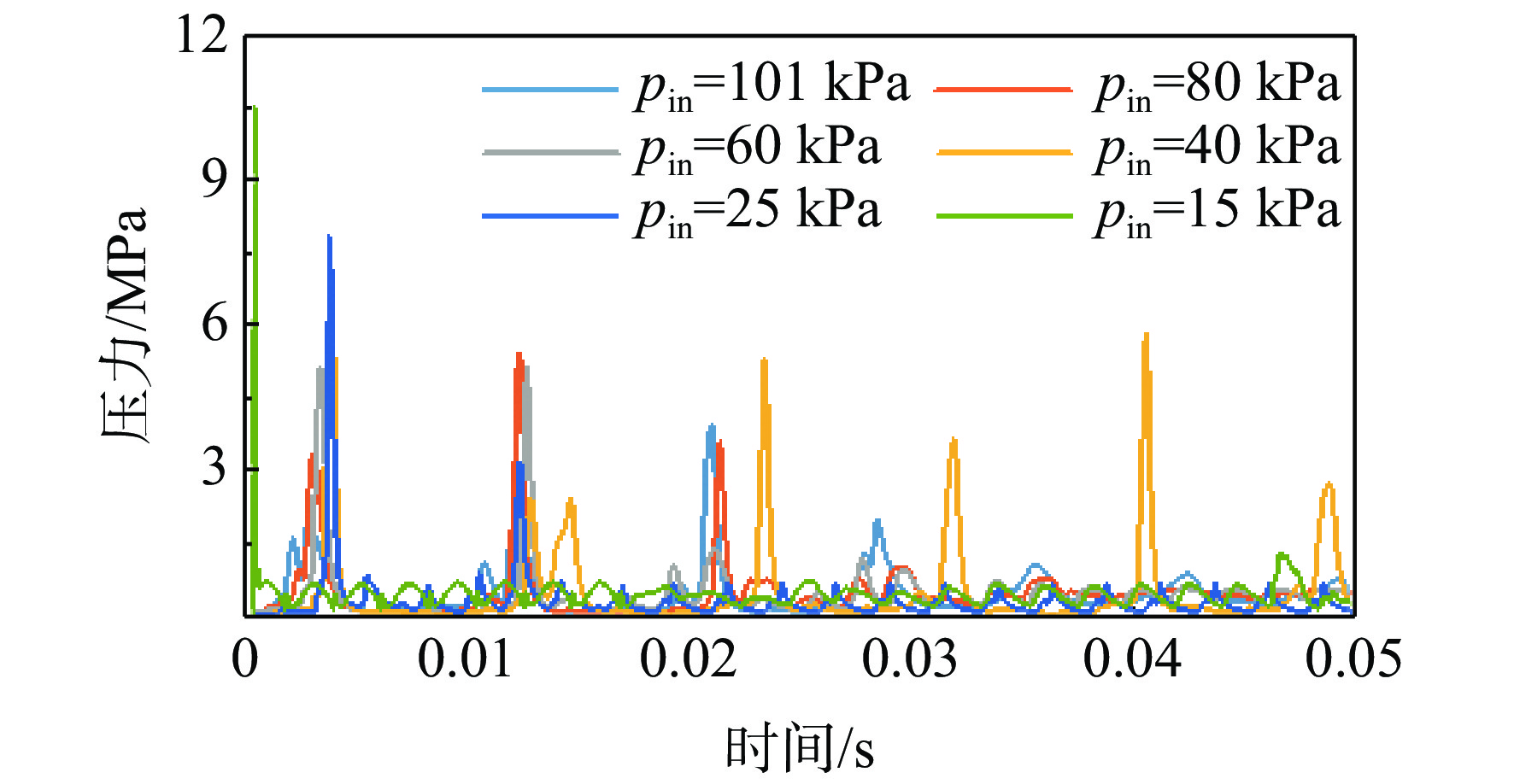
图 11 不同入口压力下监测点2压力脉动时域曲线
Figure 11. Time domain diagram of pressure pulsation at monitoring point 2 under different inlet pressures
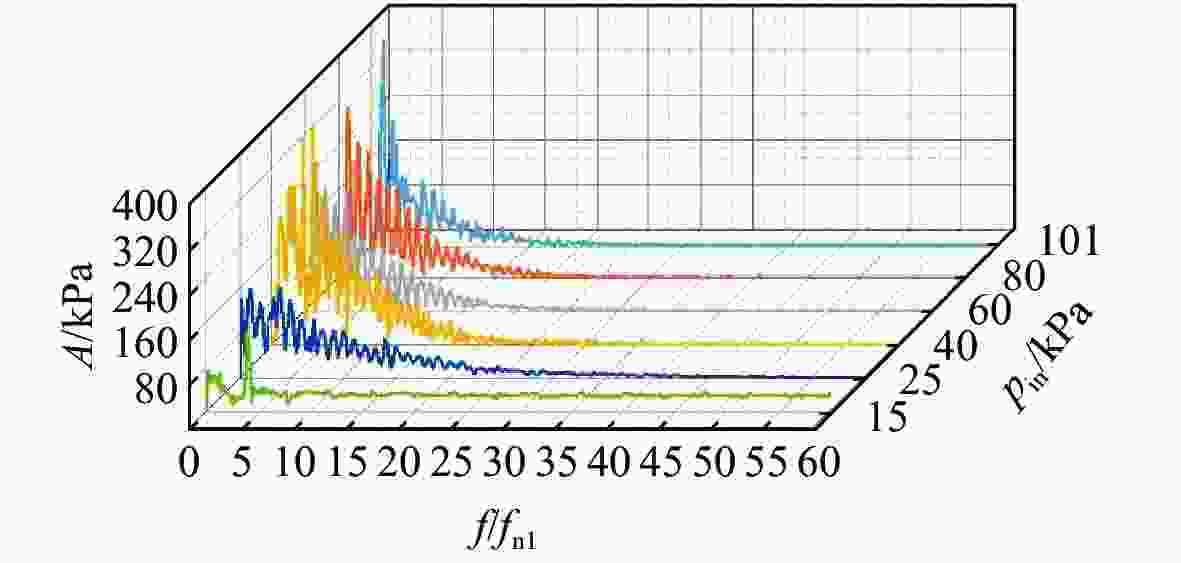
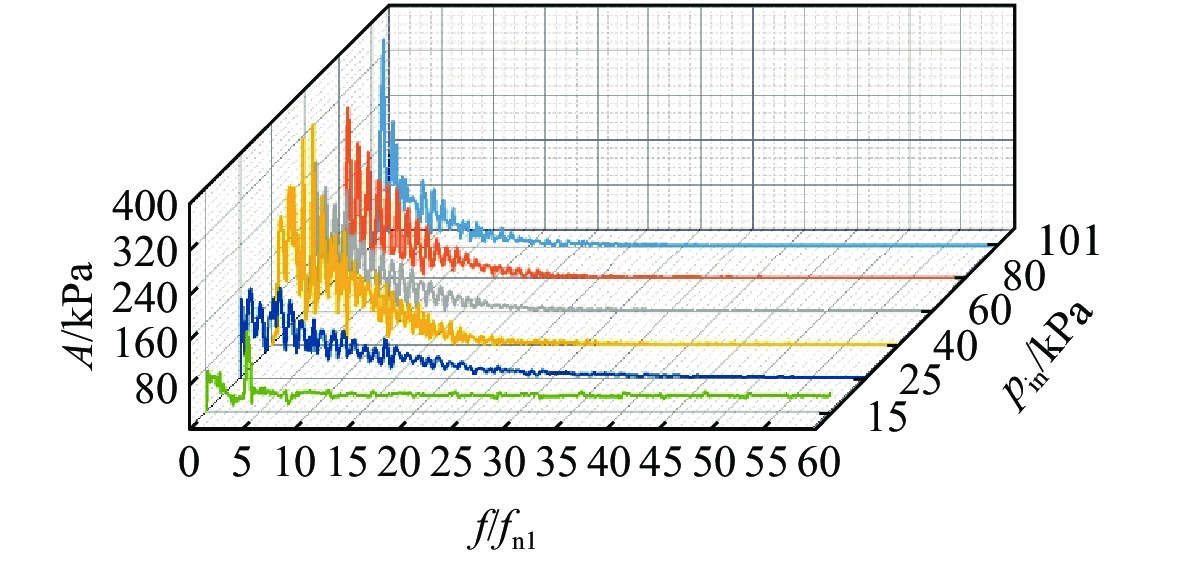
图 12 不同入口压力下监测点2压力脉动频域曲线
Figure 12. Frequency domain diagram of pressure pulsation at monitoring point 2 under different inlet pressures

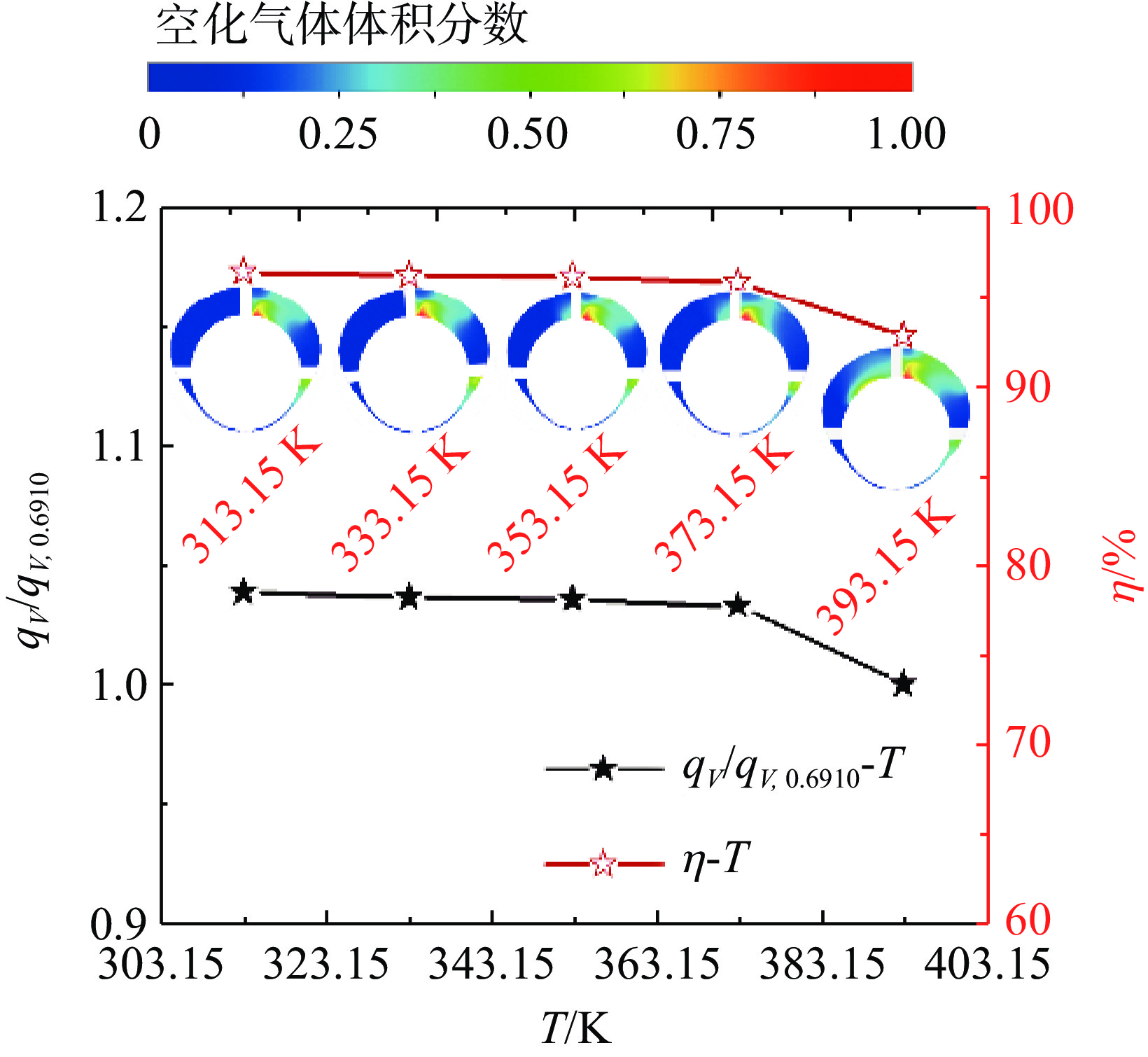
图 14 不同油液温度下旋板泵出口平均流量-效率曲线
Figure 14. Average outlet flowrate-efficiency curves of rotary vane pump under different temperature
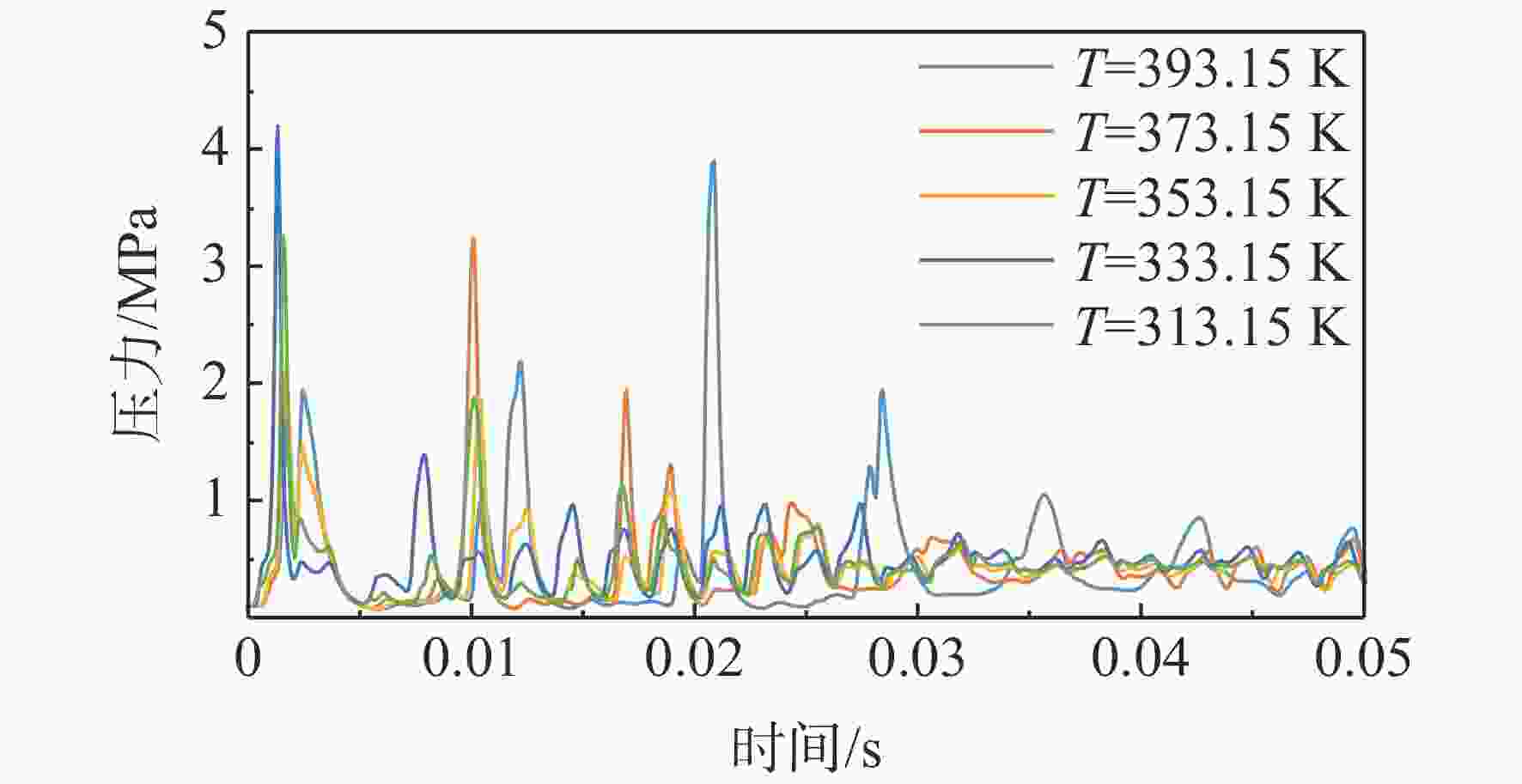
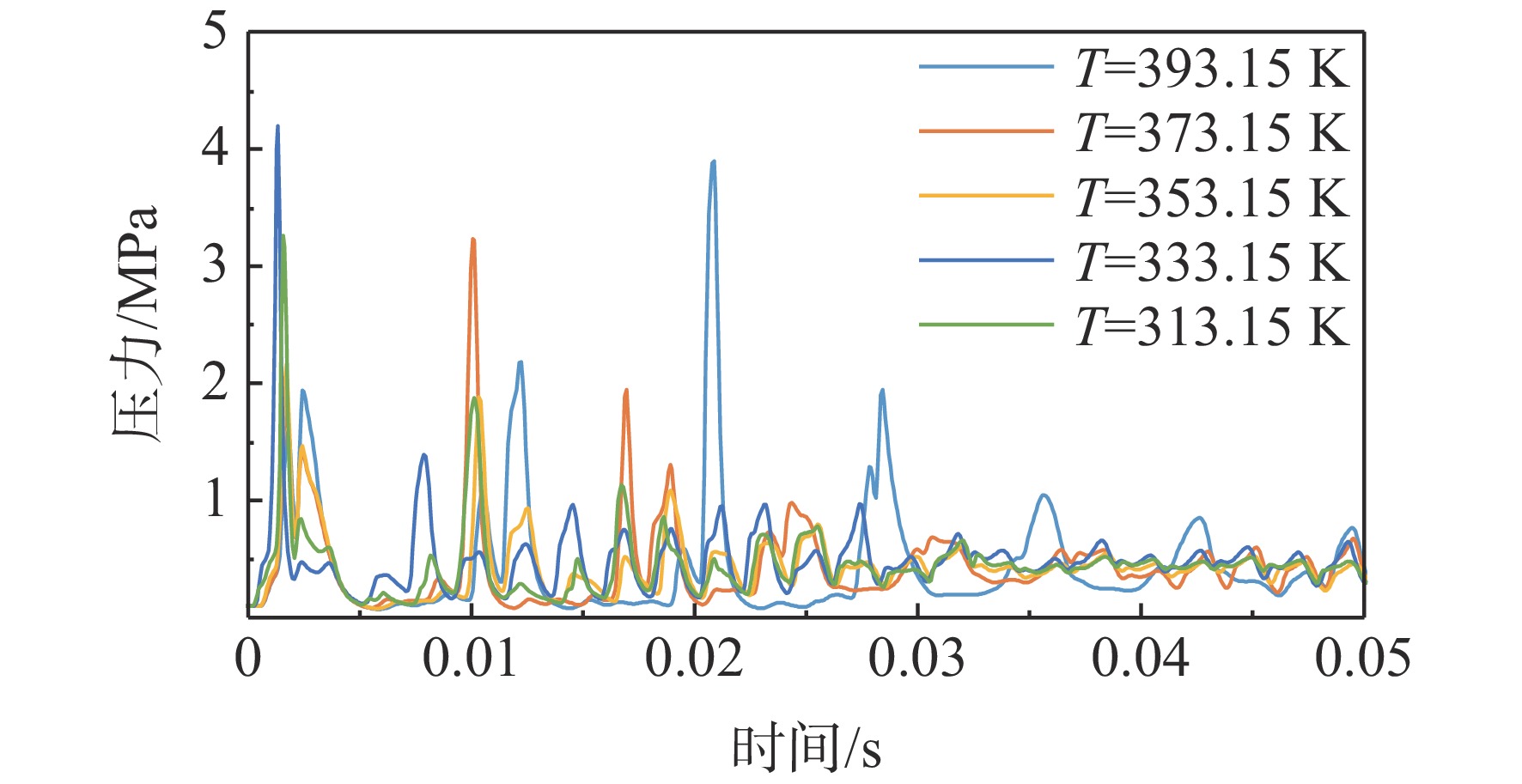
图 15 不同油液温度下监测点2压力脉动时域曲线
Figure 15. Time domain diagram of pressure pulsation at monitoring point 2 under different temperatures

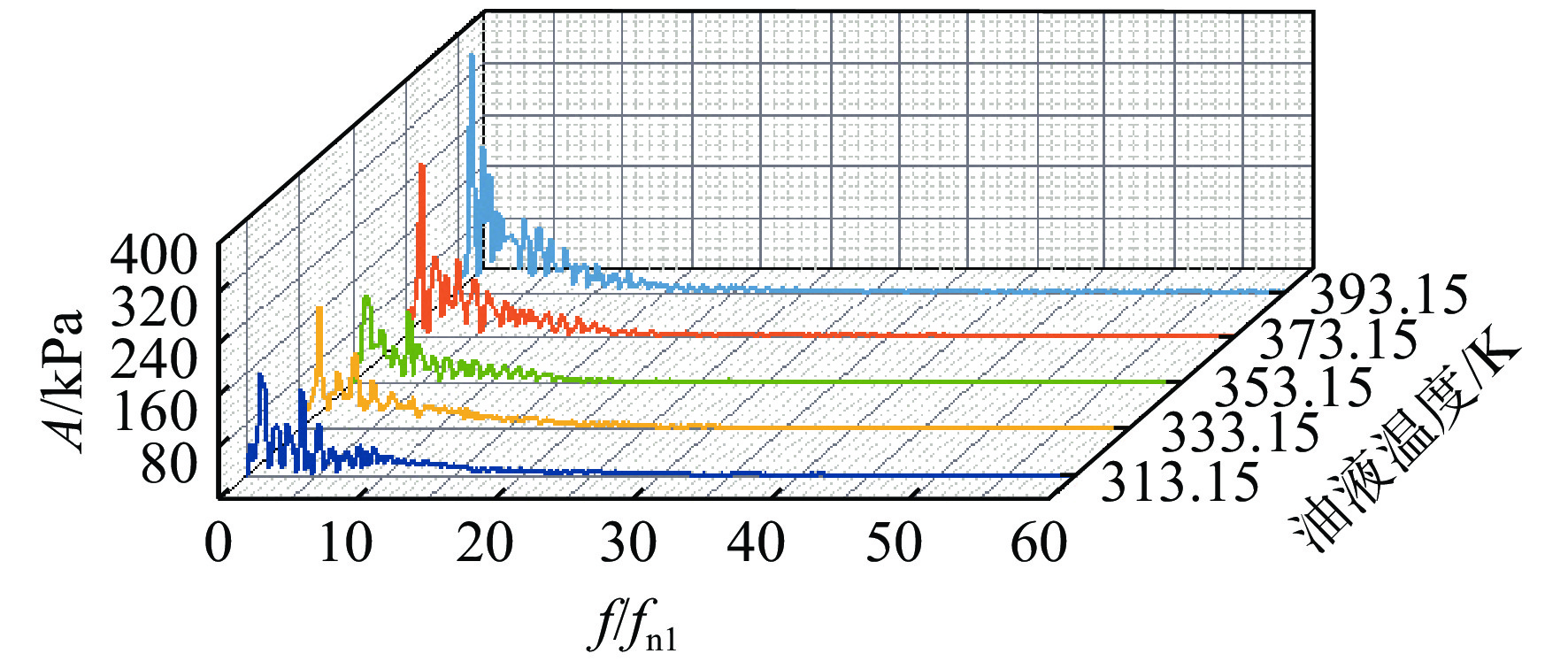
图 16 不同油液温度监测点2压力脉动频域曲线
Figure 16. Frequency domain diagram of pressure pulsation at monitoring point 2 under different temperatures
表 1 润滑油物性
Table 1. Physical properties of lubricating oil
温度/K 密度/(kg/m3) 动力黏度/(Pa·s) 饱和蒸汽压/Pa 393.15 918.7 0.00349 4716 373.15 933.7 0.00502 3665 353.15 948.7 0.0078 2359 333.15 963.7 0.01333 1391.05 313.15 978.7 0.02574 594.42  下载: 导出CSV
表 2 计算工况表
Table 2. Calculation conditions
影响因素 数值 入口压力/kPa 101、80、60、40、25、15 油液温度/K 393.15、373.15、353.15、333.15、313.15
下载: 导出CSV
表 3 不同入口压力对应的主频
Table 3. Main frequencies corresponding to different inlet pressures
入口压力/kPa 101 80 60 40 25 15 主频/Hz 1fn1 1fn1 1fn1 4fn1 4fn1 4fn1
下载: 导出CSV
表 4 不同油液温度对应的主频
Table 4. Main frequencies corresponding to different inlet pressures
油液温度/K 393.15 373.15 353.15 333.15 313.15 主频/Hz 1fn1 1fn1 1fn1 1fn1 1fn1
下载: 导出CSV
-
[1] 林基. 航空发动机设计手册: 第12册 传动及润滑系统[M]. 北京: 航空工业出版社,2002. LIN Ji. Aircraft engine design manual: Vol. 12 transmission and lubrication systems[M]. Beijing:Aviation Industry Press,2002. (in ChineseLIN Ji. Aircraft engine design manual: Vol. 12 transmission and lubrication systems[M]. Beijing: Aviation Industry Press, 2002. (in Chinese) [2] 李国权. 航空发动机滑油系统的现状及未来发展[J]. 航空发动机,2011,37(6): 49-52,62. LI Guoquan. Present and future of aeroengin oil system[J]. Aeroengine,2011,37(6): 49-52,62. (in ChineseLI Guoquan. Present and future of aeroengin oil system[J]. Aeroengine, 2011, 37(6): 49-52, 62. (in Chinese) [3] CIPOLLONE R,DI BATTISTA D. Sliding vane rotary pump in engine cooling system for automotive sector[J]. Applied Thermal Engineering,2015,76: 157-166. doi: 10.1016/j.applthermaleng.2014.11.001 [4] 王兴坤,胡东方,商建东. 双作用滑片泵流场的数值模拟及特性分析[J]. 液压与气动,2013(5): 23-26. WANG Xingkun,HU Dongfang,SHANG Jiandong. Numerical simulation and characteristic analysis of flow field in double-acting vane pump[J]. Chinese Hydraulics & Pneumatics,2013(5): 23-26. (in ChineseWANG Xingkun, HU Dongfang, SHANG Jiandong. Numerical simulation and characteristic analysis of flow field in double-acting vane pump[J]. Chinese Hydraulics & Pneumatics, 2013(5): 23-26. (in Chinese) [5] 张斌,程国赞,洪昊岑,等. 基于计算流体仿真的双作用叶片泵气蚀机理分析[J]. 吉林大学学报(工学版),2021,51(3): 831-839. ZHANG Bin,CHENG Guozan,HONG Haocen,et al. Cavitation mechanism of double acting vane pump based on computational fluid dynamics simulation method[J]. Journal of Jilin University (Engineering and Technology Edition),2021,51(3): 831-839. (in ChineseZHANG Bin, CHENG Guozan, HONG Haocen, et al. Cavitation mechanism of double acting vane pump based on computational fluid dynamics simulation method[J]. Journal of Jilin University (Engineering and Technology Edition), 2021, 51(3): 831-839. (in Chinese) [6] CHEN Zhikai,WANG Jun,CUI Shujie,et al. Numerical simulation and design methodology of a novel asymmetric cylinder profile for sliding vane vacuum pumps[J]. Vacuum,2019,169: 108945. doi: 10.1016/j.vacuum.2019.108945 [7] 张群峰,闫盼盼,单建平,等. 航空发动机滑片泵数值模拟[J]. 航空动力学报,2014,29(11): 2537-2542. ZHANG Qunfeng,YAN Panpan,SHAN Jianping,et al. Numerical simulation on an aero-engine vane pump[J]. Journal of Aerospace Power,2014,29(11): 2537-2542. (in ChineseZHANG Qunfeng, YAN Panpan, SHAN Jianping, et al. Numerical simulation on an aero-engine vane pump[J]. Journal of Aerospace Power, 2014, 29(11): 2537-2542. (in Chinese) [8] 张群峰,闫盼盼,单建平,等. 滑片泵进出口压力对其内流特性影响的数值模拟[J]. 兵工学报,2014,35(8): 1223-1229. ZHANG Qunfeng,YAN Panpan,SHAN Jianping,et al. Numerical Simulation of Inlet and Outlet Pressures Influencing Internal flow of a Vane Pump[J]. Acta Armamentarii,2014,35(8): 1223-1229. (in ChineseZHANG Qunfeng, YAN Panpan, SHAN Jianping, et al. Numerical Simulation of Inlet and Outlet Pressures Influencing Internal flow of a Vane Pump[J]. Acta Armamentarii, 2014, 35(8): 1223-1229. (in Chinese) [9] YE Fanghua,BIANCHI G,RANE S,et al. Analytical grid generation and numerical assessment of tip leakage flows in sliding vane rotary machines[J]. Advances in Engineering Software,2021,159: 103030. doi: 10.1016/j.advengsoft.2021.103030 [10] YE Fanghua,DENG Jianqiang,LIU Kai. CFD simulation on cavitation in a rotary vane energy recovery device[J]. Energy Procedia,2019,158: 4785-4790. doi: 10.1016/j.egypro.2019.01.720 [11] BIANCHI G,RANE S,KOVACEVIC A,et al. Deforming grid generation for numerical simulations of fluid dynamics in sliding vane rotary machines[J]. Advances in Engineering Software,2017,112: 180-191. doi: 10.1016/j.advengsoft.2017.05.010 [12] BIANCHI G,FATIGATI F,MURGIA S,et al. Design and analysis of a sliding vane pump for waste heat to power conversion systems using organic fluids[J]. Applied Thermal Engineering,2017,124: 1038-1048. doi: 10.1016/j.applthermaleng.2017.06.083 [13] LOBSINGER T,HIERONYMUS T,BRENNER G. A CFD investigation of a 2D balanced vane pump focusing on leakage flows and multiphase flow characteristics[J]. Energies,2020,13(13): 3314. doi: 10.3390/en13133314 [14] STUPPIONI U,BLUM A,SUMAN A,et al. Computational fluid dynamics modeling of gaseous cavitation in lubricating vane pumps: on metering grooves for pressure ripple optimization[J]. Journal of Fluids Engineering,2023,145(3): 031402. doi: 10.1115/1.4056416 [15] YE Fanghua,BIANCHI G,RANE S,et al. Numerical methodology and CFD simulations of a rotary vane energy recovery device for seawater reverse osmosis desalination systems[J]. Applied Thermal Engineering,2021,190: 116788. doi: 10.1016/j.applthermaleng.2021.116788 [16] 毛阳,孙永宾,裴鑫,等. 简析航空高转速滑油泵关键技术[J]. 兵工自动化,2015,34(12): 38-41. MAO Yang,SUN Yongbin,PEI Xin,et al. Brief analysis of aviation high speed oil pump key technology[J]. Ordnance Industry Automation,2015,34(12): 38-41. (in ChineseMAO Yang, SUN Yongbin, PEI Xin, et al. Brief analysis of aviation high speed oil pump key technology[J]. Ordnance Industry Automation, 2015, 34(12): 38-41. (in Chinese) [17] 冯瑞诗,朱鹏飞,刘振侠,等. 基于图像处理的回油管油气两相流型辨识模型[J]. 航空动力学报,2025,40(1):20230362. FENG Ruishi,ZHU Pengfei,LIU Zhenxia,et al. Image processing based identification model for oil and gas two-phase flow patterns in return pipes[J]. Journal of Aerospace Power,2025,40(1):20230362. (in ChineseFENG Ruishi, ZHU Pengfei, LIU Zhenxia, et al. Image processing based identification model for oil and gas two-phase flow patterns in return pipes[J]. Journal of Aerospace Power, 2025, 40(1): 20230362. (in Chinese) [18] LUO Xianwu,JI Bin,TSUJIMOTO Y. A review of cavitation in hydraulic machinery[J]. Journal of Hydrodynamics,2016,28(3): 335-358. doi: 10.1016/S1001-6058(16)60638-8 [19] MANNIEN M,TAIVASSALO V,KALLIO S. On the mixture model for multiphase flow[R]. Espoo,Finland: Technical Research Centre of Finland,1996. [20] SINGHAL A K,ATHAVALE M M,LI Huiying,et al. Mathematical basis and validation of the full cavitation model[J]. Journal of Fluids Engineering,2002,124(3): 617-624. doi: 10.1115/1.1486223 [21] YAKHOT V,ORSZAG S A. Renormalization group analysis of turbulence:Ⅰ basic theory[J]. Journal of Scientific Computing,1986,1(1): 3-51. doi: 10.1007/BF01061452 [22] BASHA N,KOVACEVIC A,RANE S. User defined nodal displacement of numerical mesh for analysis of screw machines in FLUENT[J]. IOP Conference Series: Materials Science and Engineering,2019,604(1): 012012. doi: 10.1088/1757-899X/604/1/012012 [23] 易方,孟浩龙,李胜强,等. 基于PumpLinx的两型滑片泵高原性能仿真研究[J]. 农业装备与车辆工程,2019,57(4): 90-93. YI Fang,MENG Haolong,LI Shengqiang,et al. Simulation study on plateau performance of two types of sliding vane pump based on PumpLinx[J]. Agricultural Equipment & Vehicle Engineering,2019,57(4): 90-93. (in ChineseYI Fang, MENG Haolong, LI Shengqiang, et al. Simulation study on plateau performance of two types of sliding vane pump based on PumpLinx[J]. Agricultural Equipment & Vehicle Engineering, 2019, 57(4): 90-93. (in Chinese) [24] BRENNEN C E. Cavitation and bubble dynamics[M]. Cambridge,UK: Cambridge University Press,2013. -


 点击查看大图

计量
- 文章访问数: 692
- HTML浏览量: 323
- PDF量: 62
- 被引次数: 0