






Data-driven engine performance digital twin modeling and interpretability analysis
-
摘要:
提出了一种数据驱动的航空发动机性能数字孪生(PDT)模型及应用框架,用于发动机的性能监测和健康评估。该框架采用半监督深度学习方法构建数据驱动的性能数字孪生模型,用于计算多维特征表征气路性能状态、增强气路性能监测和健康评估的输入特征空间,在此基础上建立基于XGBoost的气路故障监测和隔离模型、基于时序特征的健康状态评估模型。分别在某型民用航空发动机quick access recorder(QAR)数据以及在NASA N-CMAPSS公开数据上验证所提方法的有效性,并结合Shapley加合解释(SHAP)方法探讨PDT模型可解释性。验证结果表明:PDT模型及应用框架气路关键性能参数预测相对误差小于0.6%,基于NASA N-CMAPSS数据的故障检测率达到95%以上且故障隔离准确率达到86%。
Abstract:A data-driven gas turbine performance digital twin (PDT) model and its application framework for performance monitoring and health assessment were proposed. In this framework, a data-driven performance digital twin was constructed using semi-supervised deep learning methods, which were used to calculate multidimensional features to characterize the performance status of gas pipelines, and to enhance the input feature space for gas path component fault diagnosis and performance monitoring. Based on this, a gas path fault monitoring and isolation model, a health state assessment model were developed utilizing the XGBoost method. The integrated framework’s performance was tested on quick access recorder (QAR) data from a civil aviation engine model, and NASA N-CMAPSS dataset and relevant indicators were introduced to evaluate the proposed method. The interpretability of the data-driven performance digital twin model was explored using the Shapley additive explanations (SHAP) method. The verification results showed that the proposed data-driven PDT modeling and application framework had a relative error of less than 0.6% in the prediction of key performance parameters of gas paths, and can successfully detect more than 95% faults based on NASA N-CMAPSS data, with the fault isolation accuracy reaching 86%.
-
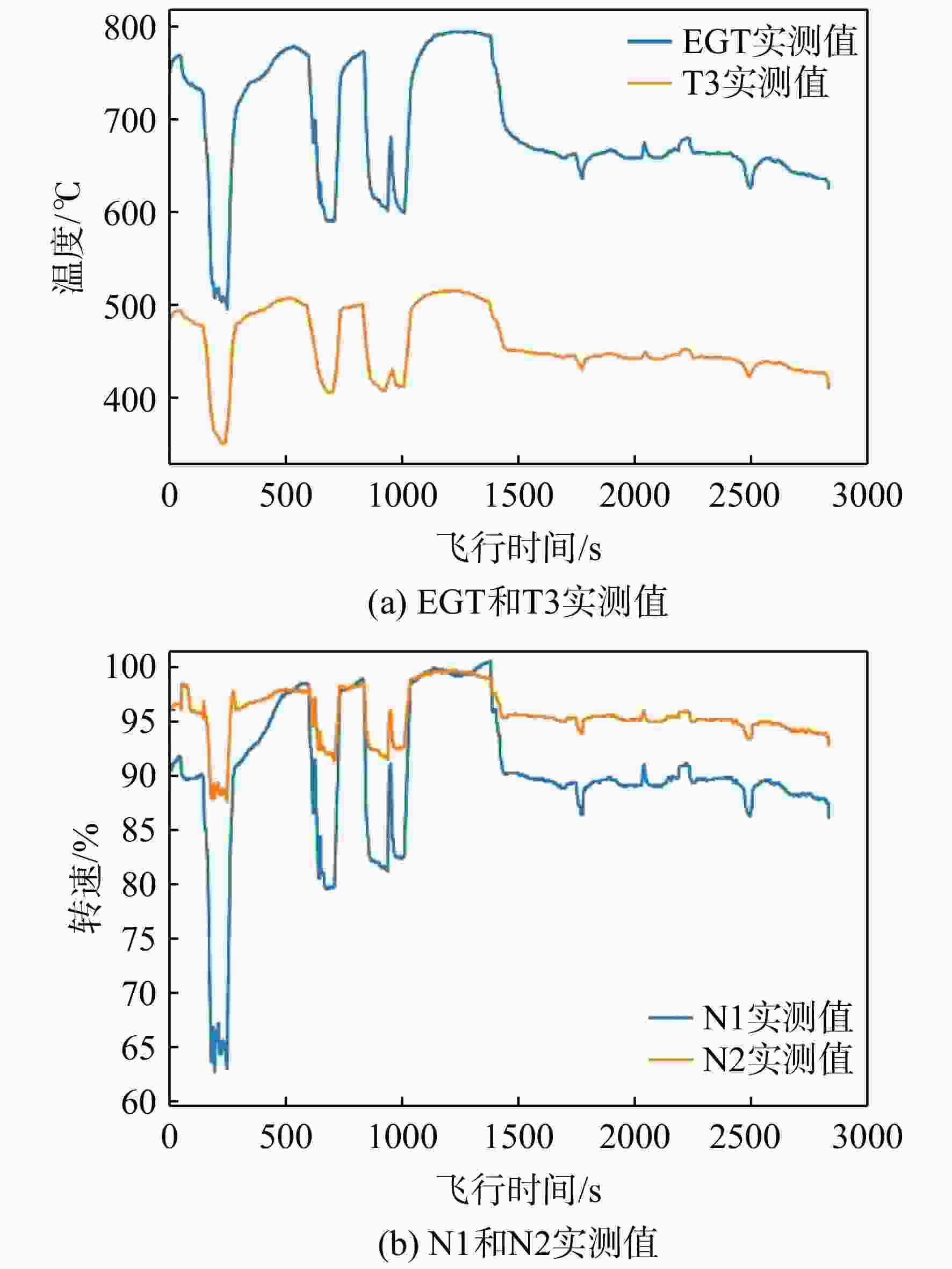
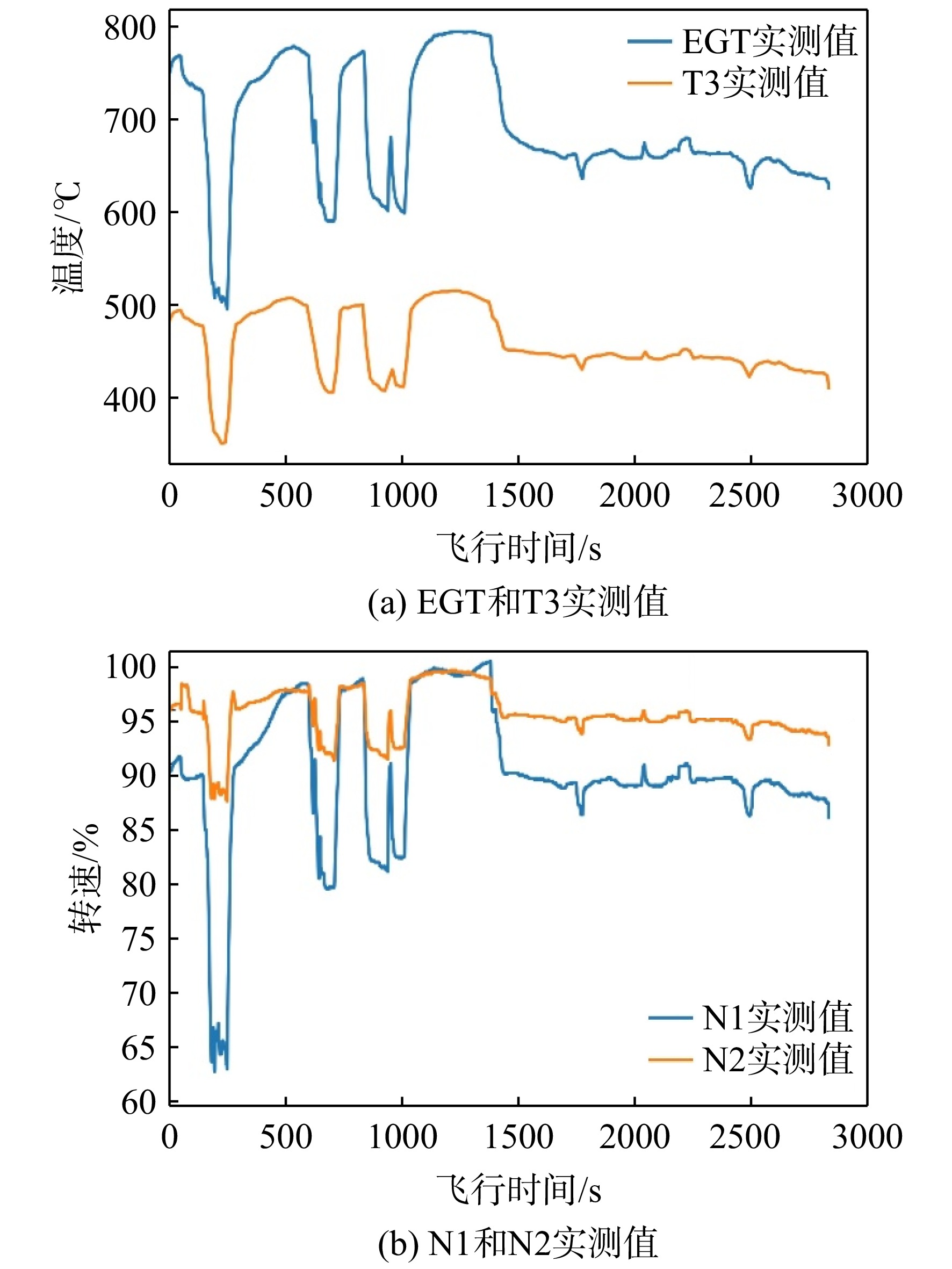
图 3 一次飞行任务中典型参数的时序数据
Figure 3. Time-series data of typical parameters during one flight
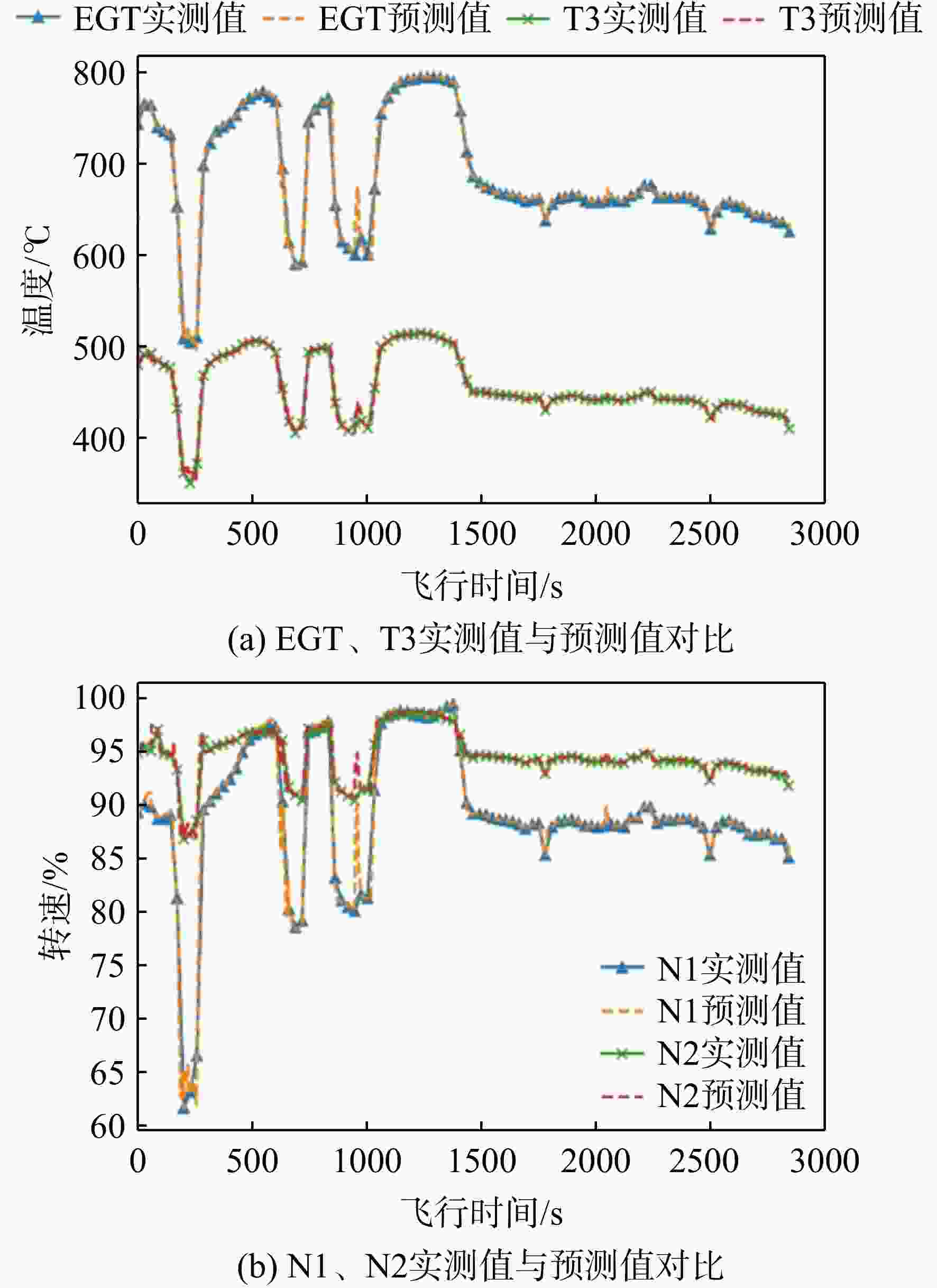
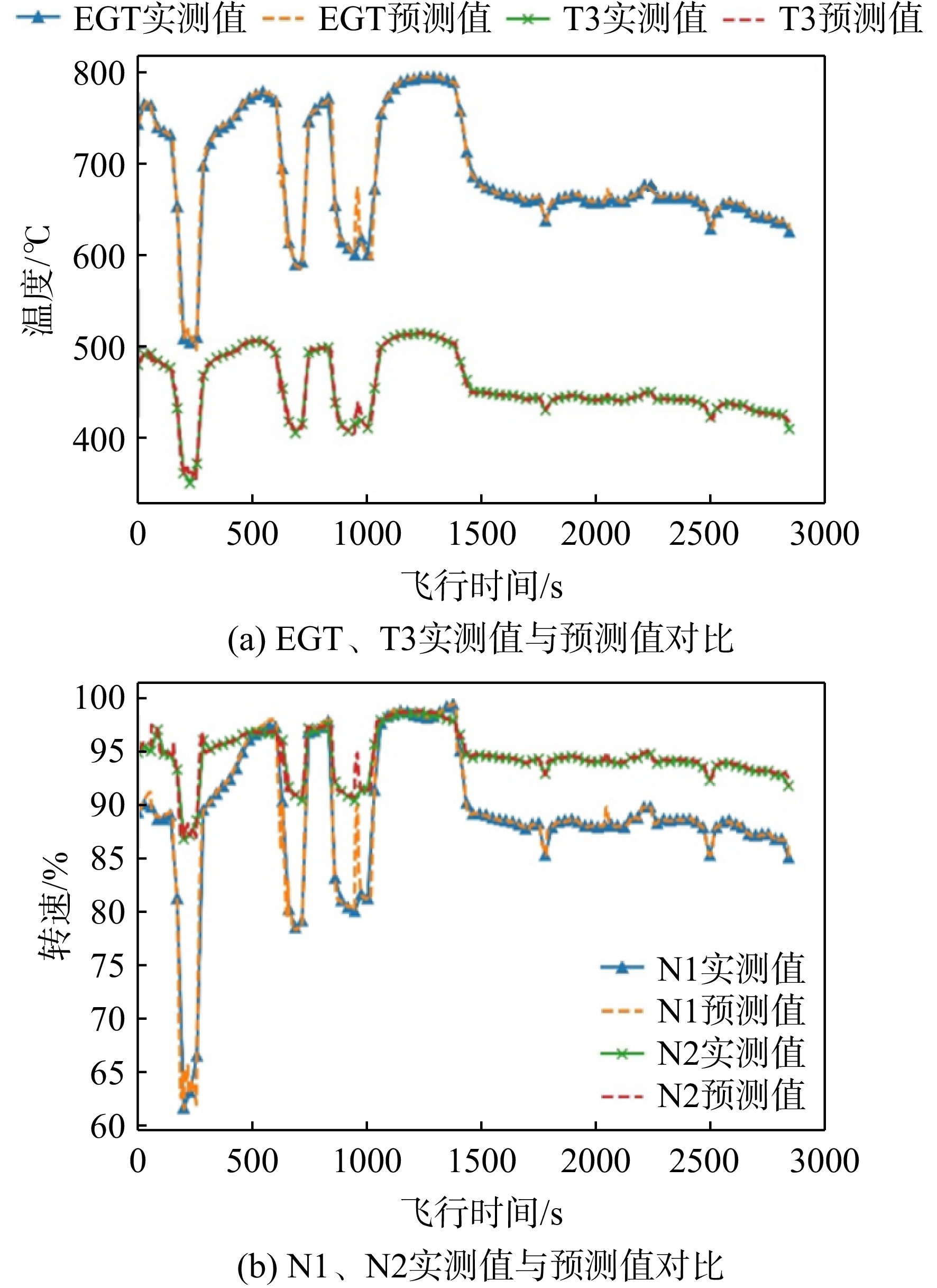
图 4 基于PDT的关键性能参数重构结果
Figure 4. Key performance parameters reconstruction results based on PDT

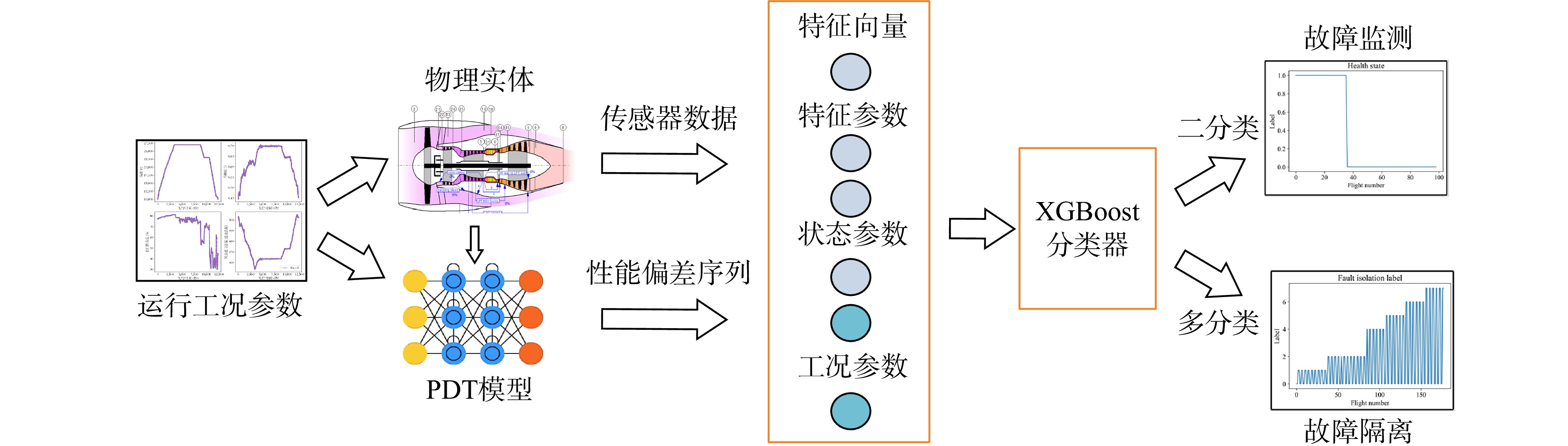
图 5 基于PDT的发动机故障监测与隔离流程
Figure 5. Engine fault monitoring and isolation process based on PDT

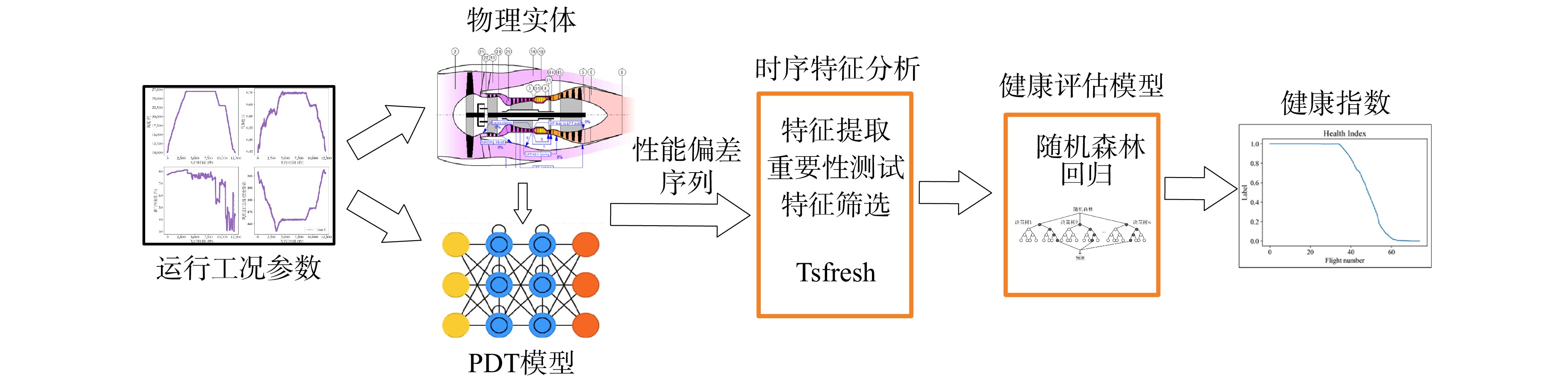
图 8 基于PDT的发动机性能退化状态评估流程
Figure 8. Process for evaluating engine performance degradation status based on PDT
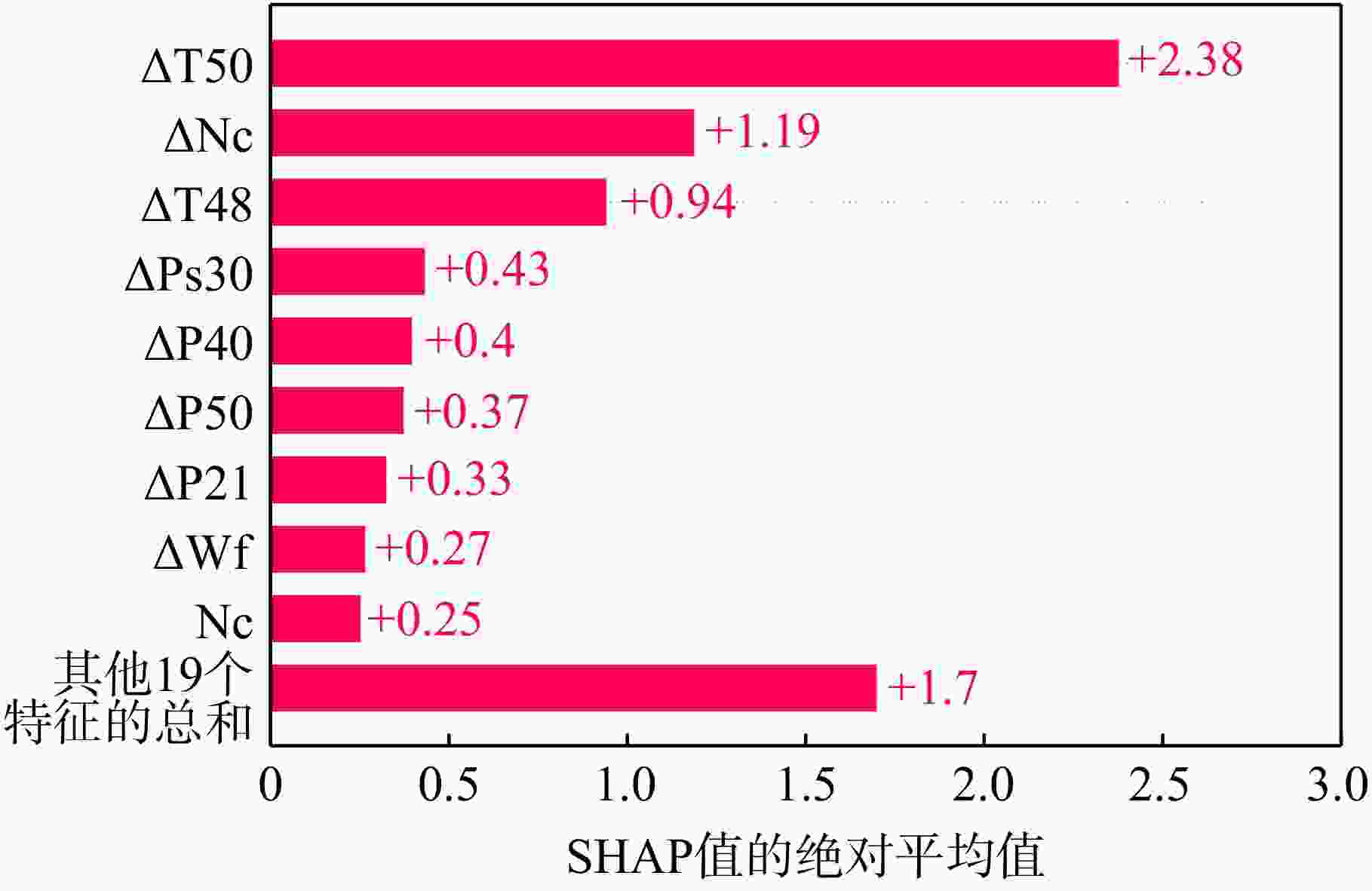
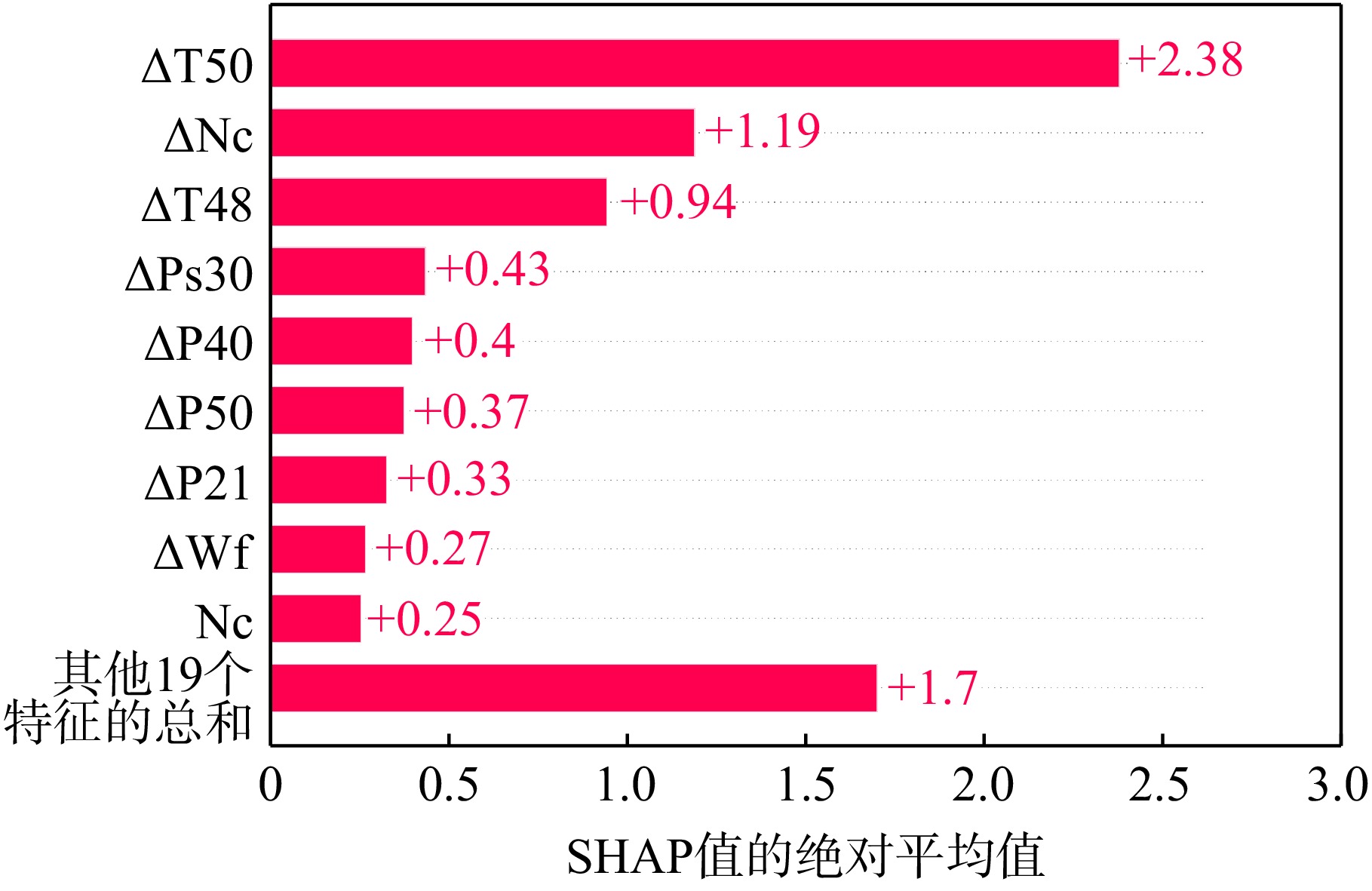
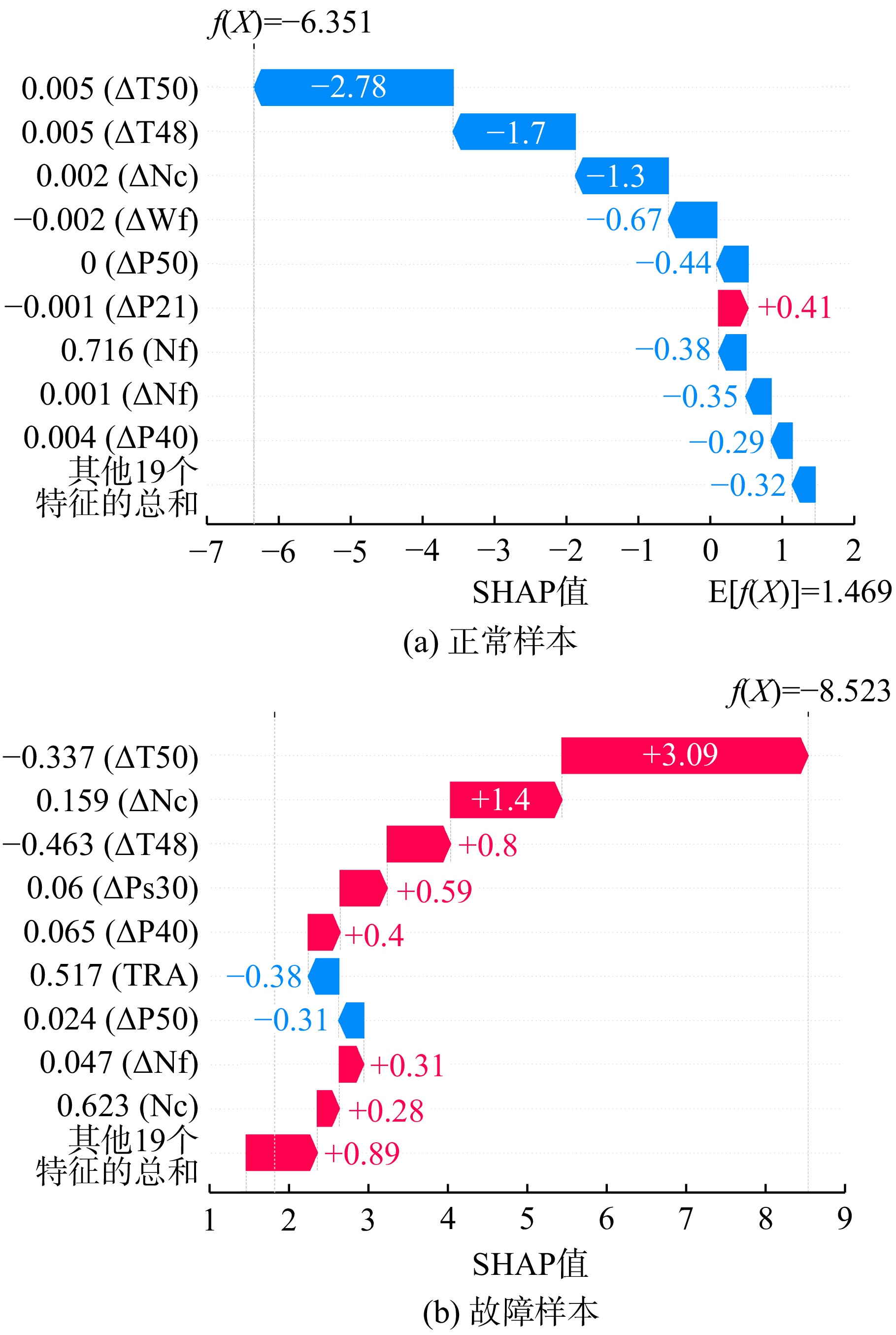
图 10 各参数的SHAP值(DS01故障监测模型)
Figure 10. SHAP value of each parameter (DS01 fault monitoring model)
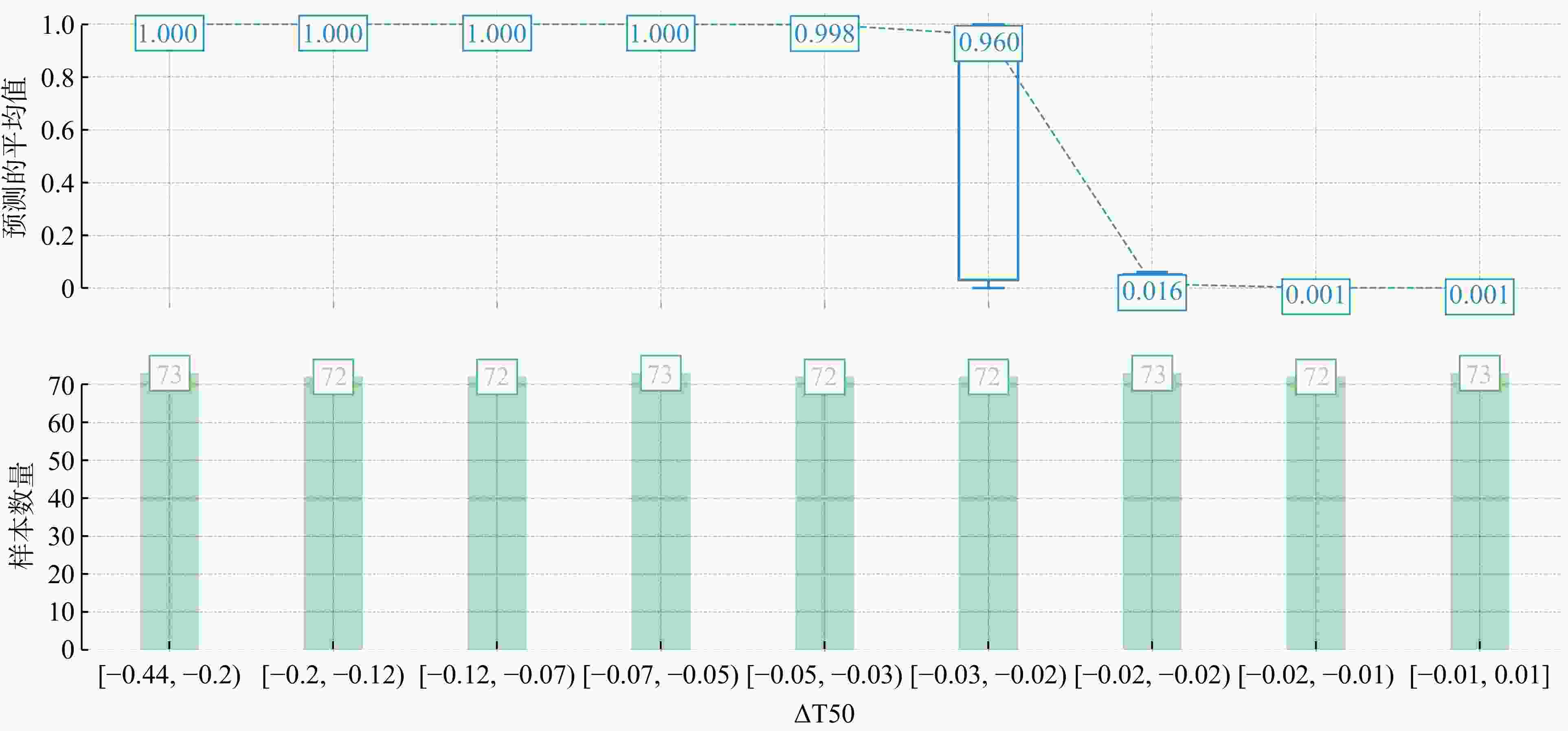
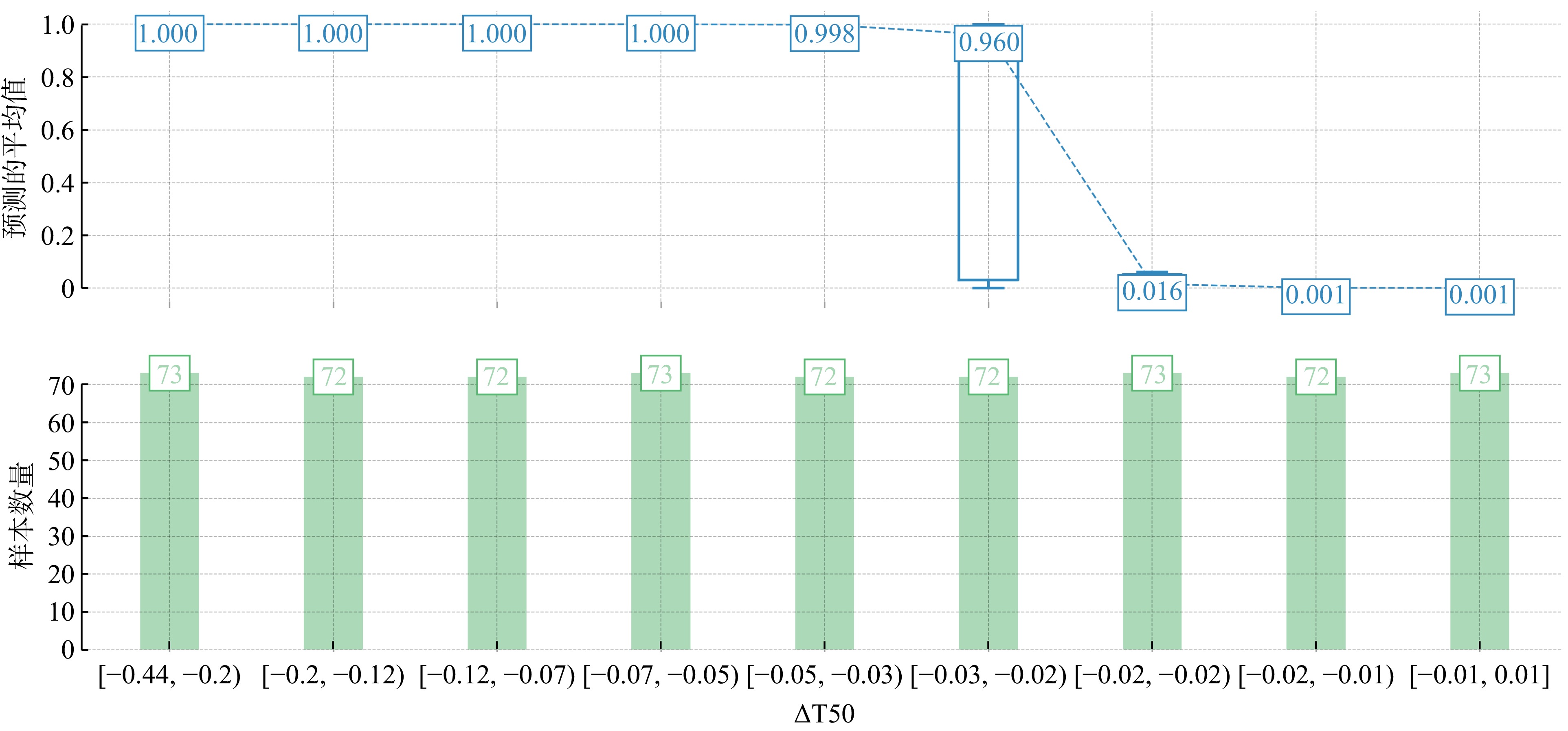
图 12 ∆T50的变化对故障概率预测值分布的影响
Figure 12. Impact of changes in ∆T50 on distribution of predicted fault probability values
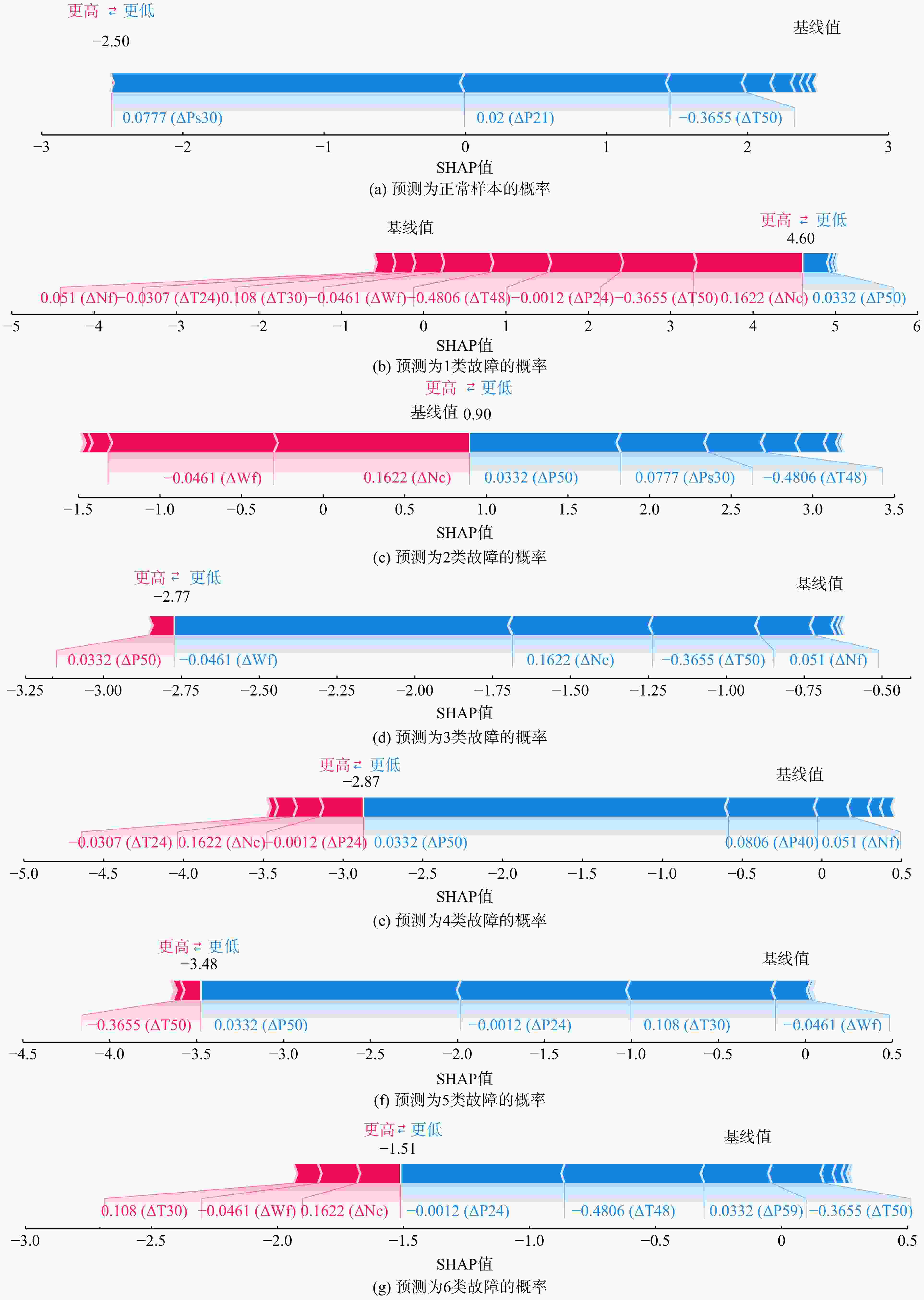
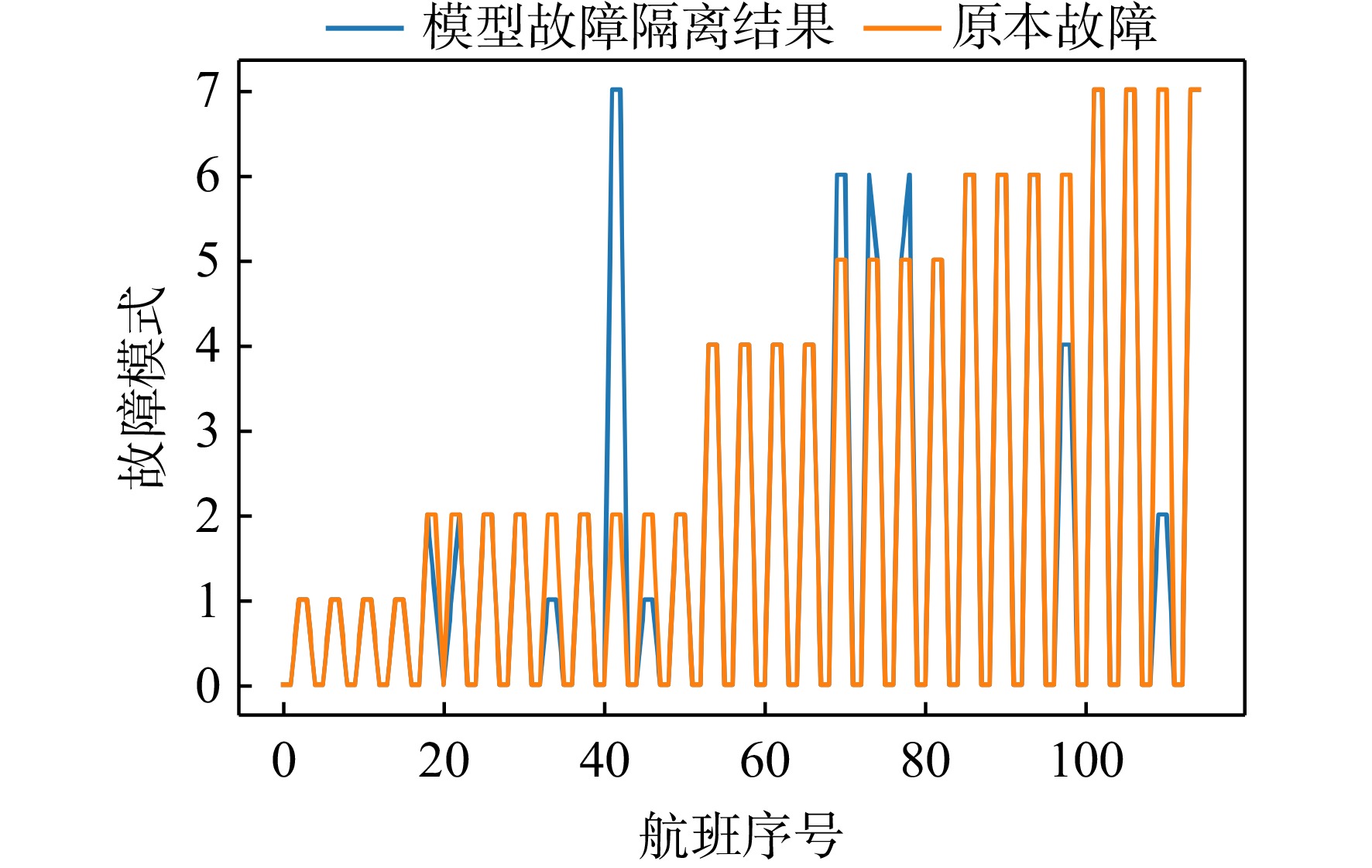
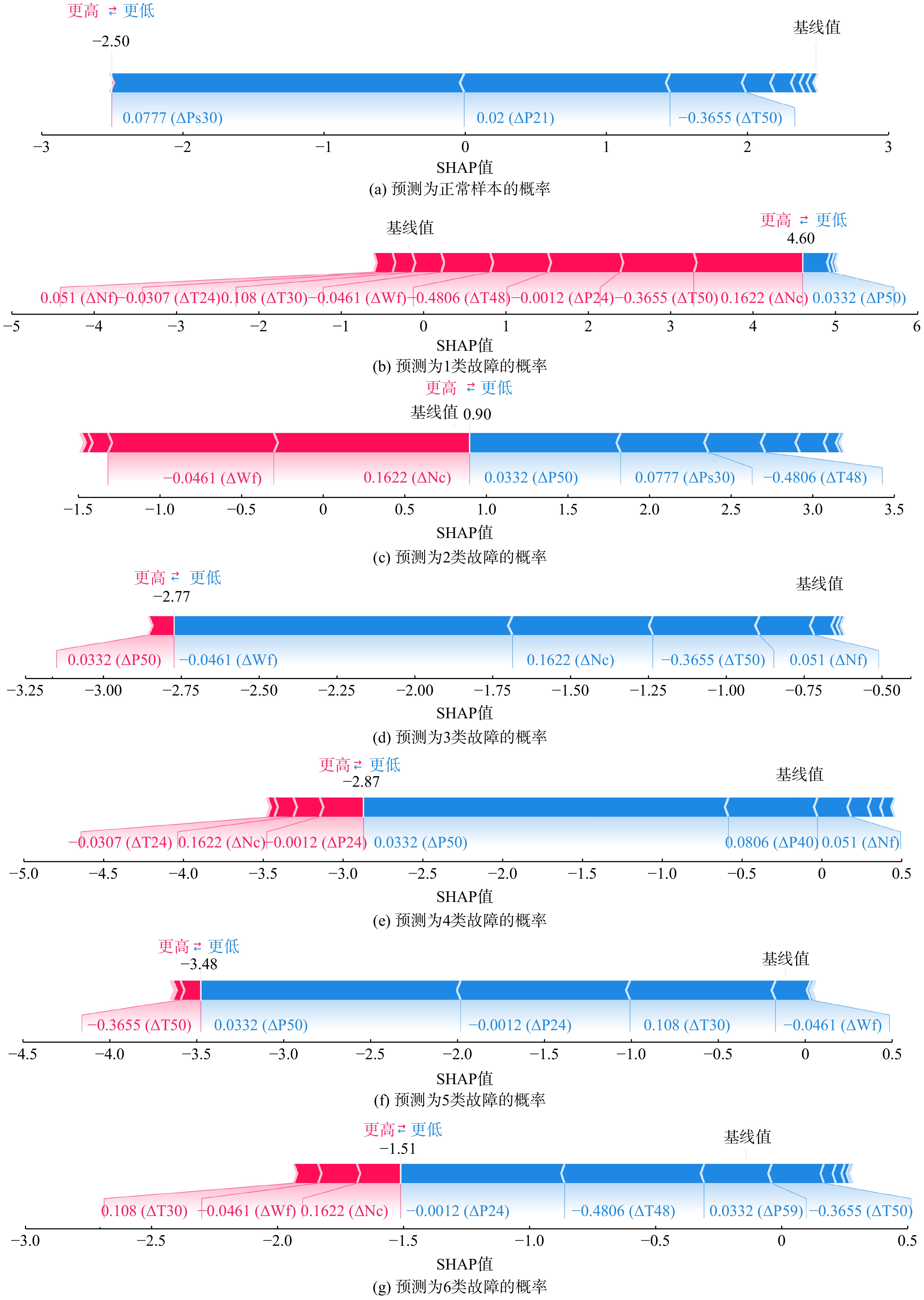
图 13 故障隔离模型预测结果的解释
Figure 13. Explanation of prediction results for fault isolation model
表 1 发动机PDT模型输入参数
Table 1. PDT model input parameters of engine
参数名称及简写符号 单位 大气静温(SAT) ℃ 飞行高度(ALT) ft 马赫数(MH) 发动机低压转子转速(N1) % 发动机高压转子转速(N2) % HPC进口温度(T25) ℃ HPC出口温度(T3) ℃ HPC出口压力(PS3) kPa 发动机排气温度(EGT) ℃ 燃油计量活门开度(FMV) % 燃油质量流量(FFKG) kg/h 油门杆角度(TRA) (°) 滑油压力选择(OILP) 可调静子叶片位置(VSVP) (°) 可变放气活门位置(VBV) (°)  下载: 导出CSV
表 2 LSTM-AE 网络结构
Table 2. LSTM-AE network structure
网络层 输入维度 激活函数 输入层 (None, 20, 15) 0 LSTM (None, 20, 150) Sigmoid LSTM (None, 20, 50) Sigmoid LSTM (None, 20, 50) Sigmoid LSTM (None, 20, 150) Sigmoid LSTM (None, 1) Linear
下载: 导出CSV
表 3 关键性能参数的重构误差
Table 3. Reconstruction errors of key performance parameters
参数 数值 EGY RMSE/℃ 3.0578 RE/% 0.36 N1 RMSE/% 0.0795 RE/% 0.07 N2 RMSE/% 0.0836 RE/% 0.06 PS3 RMSE/kPa 0.8036 RE/% 0.42 T3 RMSE/℃ 3.0931 RE/% 0.28 T25 RMSE/℃ 1.0146 RE/% 0.57
下载: 导出CSV
表 4 工况条件及其物理量
Table 4. Operating conditions and physical measurement
参数名称及简写符号 单位 高度(ALT) ft 马赫数(MH) 油门杆角度(TRA) % 风扇进口总温(T2) °R 燃油质量流量(Wf) pph 风扇转速(Nf) r/min 核心机转速(Nc) r/min LPC出口总温(T24) °R HPC出口总温(T30) °R HPT出口总温(T48) °R LPT出口总温(T50) °R 风扇出口总压(P21) psia LPC出口总压(P24) psia HPC出口总压(Ps30) psia 燃烧室出口总压(P40) psia LPT出口总压(P50) psia
下载: 导出CSV
表 5 N-CMAPSS部分关键性能参数重构误差
Table 5. Reconstruction error of partial key performance parameters for N-CMAPSS
参数 数值 T48 RMSE/°R 1.27 RE/% 0.05 Wf RMSE/pps 0.006 RE/% 0.1 Nf RMSE/(r/min) 0.30 RE/% 0.01 Nc RMSE/(r/min) 1.55 RE/% 0.02
下载: 导出CSV
表 6 N-CMAPSS数据集故障模式
Table 6. N-CMAPSS dataset failure modes
故障
模式数据集 单元
数量运行
条件Fan LPC HPC HPT LPT E F E F E F E F E F 1 DS01 10 1, 2, 3 √ 2 DS02 9 1, 2, 3 √ √ √ 3 DS03 15 1, 2, 3 √ √ √ 4 DS04 10 2, 3 √ √ 5 DS05 10 1, 2, 3 √ √ 6 DS06 10 1, 2, 3 √ √ √ √ 7 DS07 10 1, 2, 3 √ √ 8 DS08 54 1, 2, 3 √ √ √ √ √ √ √ √ √ √
下载: 导出CSV
表 7 混淆矩阵
Table 7. Confusion matrix
真实标签 预测标签 阴性(Negative) 阳性(Positive) 阴性(Negative) 真阴性(TN) 假阳性(FP) 阳性(Positive) 假阴性(FN) 真阳性(TP)
下载: 导出CSV
表 8 故障监测模型评价结果
Table 8. Evaluation results of fault monitoring model
数据集 故障监测
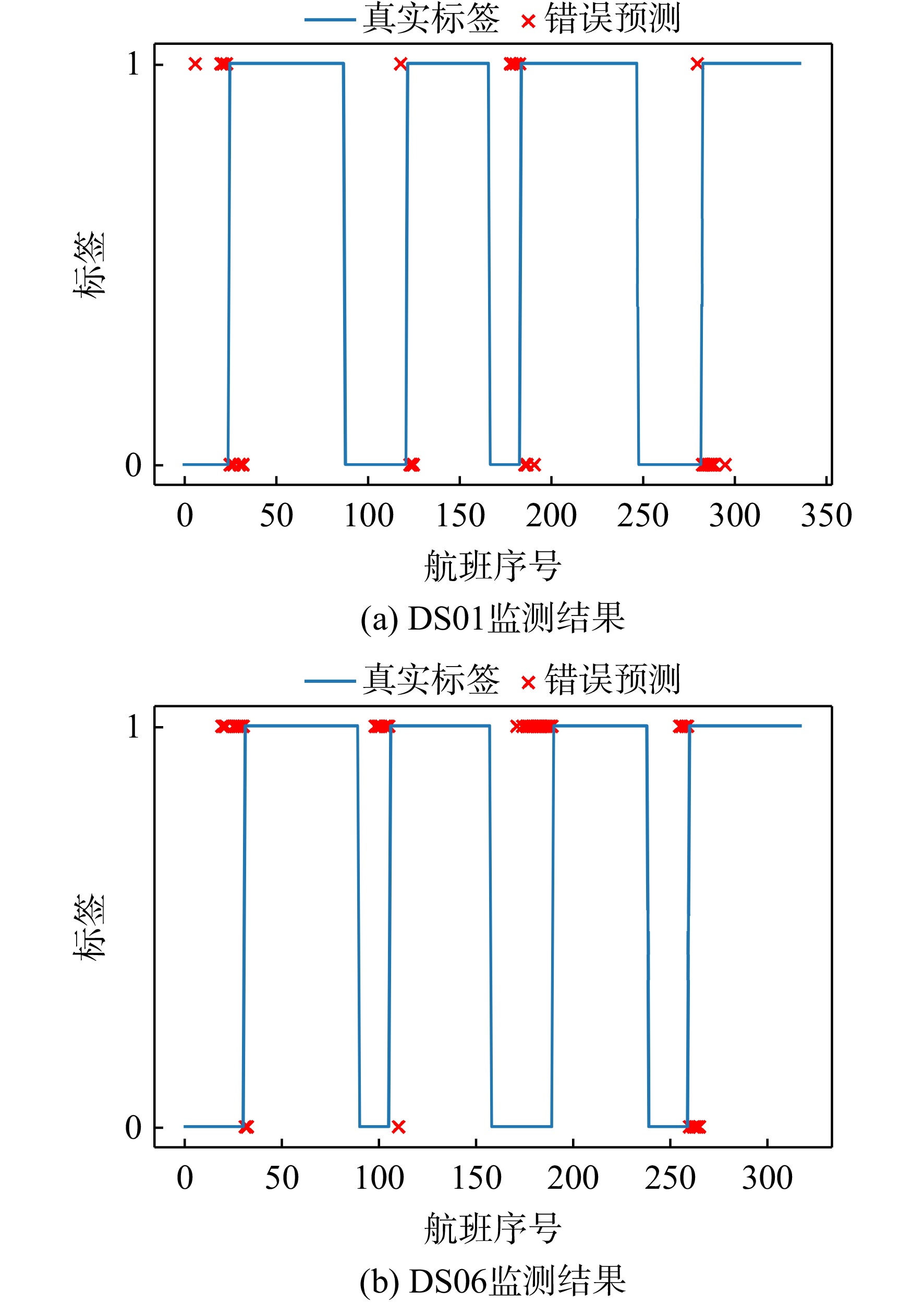
准确率(FDA)AUC 精确率(PPV) 灵敏度(TPR) 虚警率(FPR) 漏警率(FNR) DS01 0.92 0.92 0.95 0.92 0.09 0.08 DS02 0.78 0.7 0.75 1 0.61 0 DS03 0.88 0.86 0.9 0.92 0.20 0.08 DS04 0.82 0.75 0.88 0.89 0.4 0.11 DS05 0.86 0.81 0.84 0.97 0.35 0.03 DS06 0.86 0.80 0.85 0.96 0.36 0.04 DS07 0.9 0.87 0.90 0.96 0.21 0.04 平均结果 0.86 0.82 0.87 0.95 0.32 0.05
下载: 导出CSV
表 9 Tsfresh输入参数
Table 9. Input parameters of Tsfresh
序号 参数名称 1 T30 偏差值 2 T48偏差值 3 P40偏差值 4 P50偏差值 5 Nf偏差值 6 Nc偏差值 7 Wf偏差值 8 Id编号 9 爬升时间
下载: 导出CSV
表 10 利用Tsfresh提取并筛选的时序特征
Table 10. Extracting and filtering temporal features using Tsfresh
特征名称 描述 p值/10−30 T48_delta__abs_energy T48偏差值的平方和 1.37 T48_delta__mean_n_absolute_max__number_of_maxima_7 T48偏差值绝对最大值的算术平均值 1.37 T48_delta__absolute_maximum T48偏差值的最大值 1.57 T48_delta__root_mean_square T48偏差值的方均根值 2.52 P40_delta__cwt_coefficients__coeff_12__w_10__widths_(2, 5, 10, 20) P40偏差值的时频率分析(连续小波变换) 3.52 P40_delta__cwt_coefficients__coeff_11__w_10__widths_(2, 5, 10, 20) 3.64 P40_delta__cwt_coefficients__coeff_9__w_10__widths_(2, 5, 10, 20) 3.64 P40_delta__cwt_coefficients__coeff_10__w_10__widths_(2, 5, 10, 20) 3.64 P40_delta__cwt_coefficients__coeff_8__w_10__widths_(2, 5, 10, 20) 3.76 P40_delta__cwt_coefficients__coeff_13__w_10__widths_(2, 5, 10, 20) 4.02
下载: 导出CSV
表 11 HI计算模型评估结果
Table 11. Evaluation results of HI calculation model
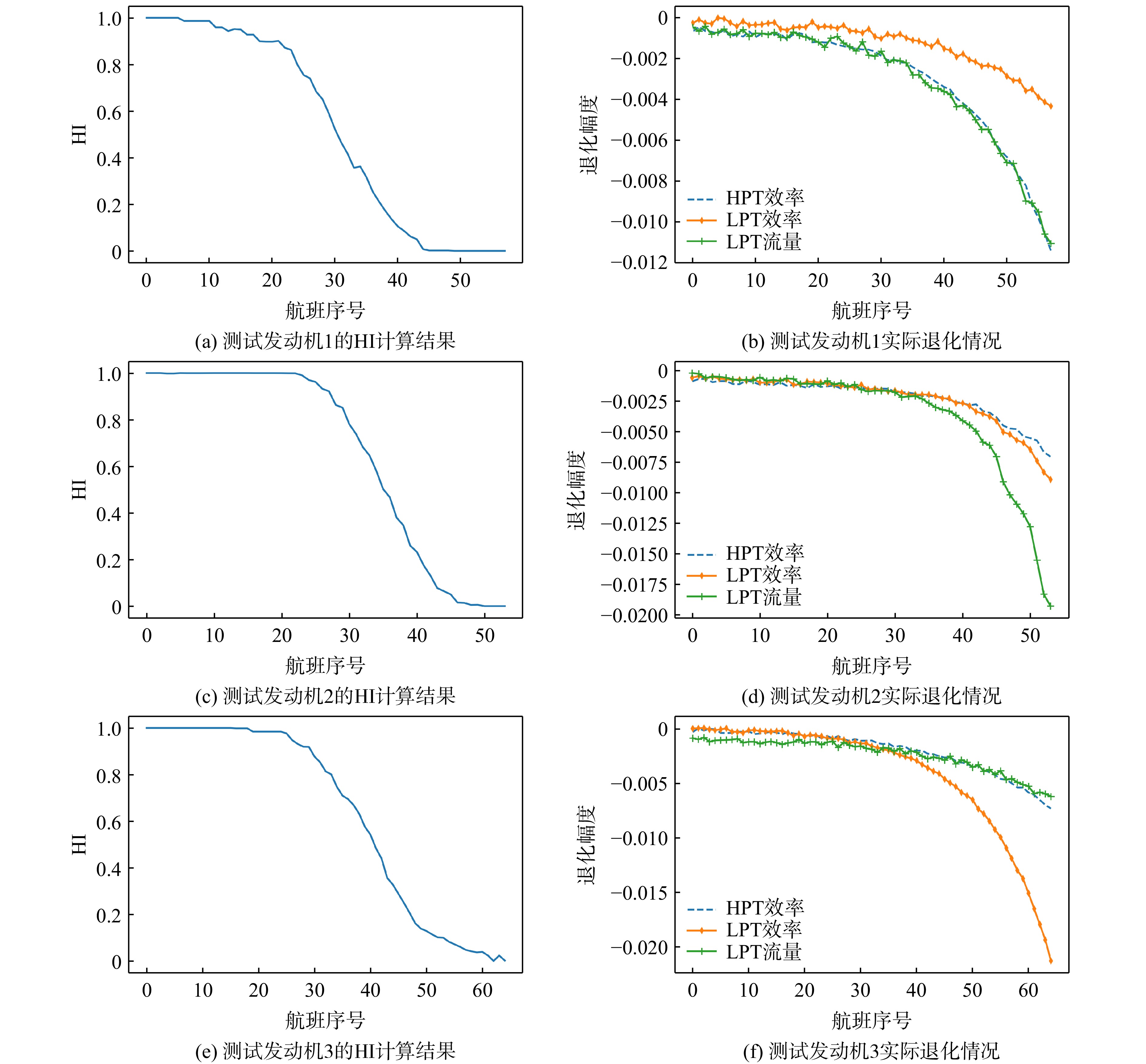
测试用数据集 单调性 可预测性 趋势性 DS03(涡轮故障) 0.5 1 0.94 DS04(风扇故障) 0.33 0.88 0.86 DS05(压气机故障) 0.39 1 0.97 总体水平(均值) 0.4 0.96 0.92
下载: 导出CSV
表 12 不同故障模式监测模型的参数贡献度(SHAP值)
Table 12. Parameter contribution of different fault mode monitoring models (SHAP value)
DS01 DS02 DS03 DS04 DS05 DS06 DS07 2.38 (∆T50) 2.27 (∆T48) 2.84 (∆T48) 2.26 (∆P40) 1.73 (∆Nf) 1.77 (∆P40) 3.17 (∆T50) 1.19 (∆Nc) 1.21 (∆Nc) 0.99 (∆T50) 1.22 (∆P50) 1.5 (∆T48) 1.58 (∆T50) 1.49 (∆T48) 0.94 (∆T48) 0.88 (∆T50) 0.81 (∆Nf) 0.75 (∆P21) 1.02 (∆P40) 1.12 (∆P24) 0.73 (∆P24) 0.43 (∆Ps30) 0.74 (∆P40) 0.71 (∆P40) 0.66 (∆T50) 0.99 (∆Nc) 0.91 (∆T48) 0.5 (∆P21) 0.4 (∆P40) 0.41 (∆P24) 0.61 (∆P40) 0.55 (∆T48) 0.7 (∆T50) 0.9 (∆Nc) 0.42 (∆T30) 0.37 (∆P50) 0.4 (∆P21) 0.59 (∆P24) 0.46 (∆Ps30) 0.63 (∆Ps30) 0.49 (∆Nf) 0.4 (∆Nc) 0.33 (∆P21) 0.28 (∆Nf) 0.49 (∆P50) 0.39 (∆Wf) 0.55 (∆T30) 0.35 (TRA) 0.38 (∆Wf) 0.27 (∆Wf) 0.26 (∆Ps30) 0.46 (T48) 0.35 (∆T30) 0.35 (Nf) 0.29 (∆T30) 0.31 (∆Ps30) 0.25 (Nc) 0.24 (TRA) 0.3 (∆Ps30) 0.34 (∆Nf) 0.24 (T24) 0.25 (Nf) 0.3 (∆P40)
下载: 导出CSV
表 13 故障隔离模型的参数贡献度(SHAP值)
Table 13. Parameter contribution of fault isolation model (SHAP value)
正常样本 DS01 DS02和DS03 DS04 DS05 DS06 DS07 0类 1类 2类 3类 4类 5类 6类 1.9 (∆Ps30) 0.73 (∆Wf) 1.51 (∆Nc) 1.07 (∆Wf) 2.29 (∆P50) 1.48 (∆P50) 0.93 (∆P50) 0.93 (∆P21) 0.55 (∆Nc) 1.11 (∆Wf) 0.51 (∆Nc) 0.46 (∆P40) 1.03 (∆P24) 0.89 (∆Wf) 0.47 (∆T50) 0.48 (∆P24) 0.65 (∆T50) 0.29 (∆T50) 0.37 (∆P24) 0.76 (∆T30) 0.57 (∆P24) 0.11 (∆T30) 0.4 (∆T30) 0.4 (∆P50) 0.24 (∆P50) 0.19 (∆Nf) 0.28 (∆Wf) 0.48 (∆Nc) 0.08 (∆T48) 0.32 (∆T50) 0.3 (∆T24 0.14 (∆Nf) 0.17 (∆P21) 0.07 (∆T50) 0.41 (∆T48) 0.06 (∆T24) 0.31 (∆T48) 0.29 (∆T48)) 0.07 (∆P24) 0.16 (∆Nc) 0.06 (∆P21) 0.36 (∆T50) 0.03 (∆Nf) 0.28 (∆T24) 0.24 (∆P24) 0.05 (∆P21) 0.09 (∆Ps30) 0.02 (∆Nc) 0.14 (∆Ps30) 0.03 (∆P40) 0.24 (∆P50) 0.23 (∆Ps30) 0.04 (∆T48) 0.08 (∆T48) 0.02 (∆T24) 0.12 (∆T30) 0.02 (∆Wf) 0.08 (∆P21) 0.09 (∆Nf) 0.02 (∆T24) 0.08 (∆T24) 0.02 (∆Ps30) 0.08 (∆Nf)
下载: 导出CSV
-
[1] TAHAN M, TSOUTSANIS E, MUHAMMAD M, et al. Performance-based health monitoring, diagnostics and prognostics for condition-based maintenance of gas turbines: a review[J]. Applied Energy, 2017, 198: 122-144. doi: 10.1016/j.apenergy.2017.04.048 [2] 曹明, 王鹏, 左洪福, 等. 民用航空发动机故障诊断与健康管理现状、 挑战与机遇Ⅱ: 地面综合诊断、寿命管理和智能维护维修决策[J]. 航空学报, 2022, 43(9): 34-73. CAO Ming, WANG Peng, ZUO Hongfu, et al. Current status, challenges and opportunities of civil aero-engine diagnostics & health management Ⅱ: comprehensive off-board diagnosis, life management and intelligent condition based MRO[J]. Acta Aeronautica et Astronautica Sinica, 2022, 43(9): 34-73. (in Chinese doi: 10.7527/j.issn.1000-6893.2022.9.hkxb202209002CAO Ming, WANG Peng, ZUO Hongfu, et al. Current status, challenges and opportunities of civil aero-engine diagnostics & health management Ⅱ: comprehensive off-board diagnosis, life management and intelligent condition based MRO[J]. Acta Aeronautica et Astronautica Sinica, 2022, 43(9): 34-73. (in Chinese) doi: 10.7527/j.issn.1000-6893.2022.9.hkxb202209002 [3] 曹增义, 单继东, 王昭阳, 等. 面向航空发动机制造的数字孪生应用架构探索与实践[J]. 航空制造技术, 2022, 65(19): 40-49. CAO Zengyi, SHAN Jidong, WANG Zhaoyang, et al. Exploration and practice of digital twin architecture for aero-engine manufacturing[J]. Aeronautical Manufacturing Technology, 2022, 65(19): 40-49. (in ChineseCAO Zengyi, SHAN Jidong, WANG Zhaoyang, et al. Exploration and practice of digital twin architecture for aero-engine manufacturing[J]. Aeronautical Manufacturing Technology, 2022, 65(19): 40-49. (in Chinese) [4] ZACCARIA V, STENFELT M, ASLANIDOU I, et al. Fleet monitoring and diagnostics based on digital twin of aero-engines[R]. Oslo, Norway: ASME Turbo Expo: Power for Land, Sea, and Air, 2018. [5] LIU Zuming, KARIMI I A. Gas turbine performance prediction via machine learning[J]. Energy, 2020, 192: 116627. doi: 10.1016/j.energy.2019.116627 [6] 黄金泉, 王启航, 鲁峰. 航空发动机气路故障诊断研究现状与展望[J]. 南京航空航天大学学报, 2020, 52(4): 507-522. HUANG Jinquan, WANG Qihang, LU Feng. Research status and prospect of gas path fault diagnosis for aeroengine[J]. Journal of Nanjing University of Aeronautics & Astronautics, 2020, 52(4): 507-522. (in ChineseHUANG Jinquan, WANG Qihang, LU Feng. Research status and prospect of gas path fault diagnosis for aeroengine[J]. Journal of Nanjing University of Aeronautics & Astronautics, 2020, 52(4): 507-522. (in Chinese) [7] PANOV V, CRUZ-MANZO S. Gas turbine performance digital twin for real-time embedded systems[R]. Virtual: ASME Turbo Expo: Power for Land, Sea, and Air, 2020. [8] HANACHI H, LIU Jie, BANERJEE A, et al. A physics-based performance indicator for gas turbine engines under variable operating conditions[R]. Düsseldorf, Germany: 2014: ASME Turbo Expo 2014: Turbine Technical Conference and Exposition. [9] HU Minghui, HE Ya, LIN Xinzhi, et al. Digital twin model of gas turbine and its application in warning of performance fault[J]. Chinese Journal of Aeronautics, 2023, 36(3): 449-470. doi: 10.1016/j.cja.2022.07.021 [10] DALLA VEDOVA M D L, GERMANÀ A, BERRI P C, et al. Model-based fault detection and identification for prognostics of electromechanical actuators using genetic algorithms[J]. Aerospace, 2019, 6(9): 94. doi: 10.3390/aerospace6090094 [11] CHAO M A, KULKARNI C, GOEBEL K, et al. Hybrid deep fault detection and isolation: combining deep neural networks and system performance models[EB/OL]. (2019-12-28)[2024-03-21]. https://arxiv.org/pdf/1908.01529v2. [12] 李天梅, 司小胜, 张建勋. 多源传感监测线性退化设备数模联动的剩余寿命预测方法[J]. 航空学报, 2023, 44(8): 227190. LI Tianmei, SI Xiaosheng, ZHANG Jianxun. Data-model interactive remaining useful life prediction method for multi-sensor monitored linear stochastic degrading devices[J]. Acta Aeronautica et Astronautica Sinica, 2023, 44(8): 227190. (in ChineseLI Tianmei, SI Xiaosheng, ZHANG Jianxun. Data-model interactive remaining useful life prediction method for multi-sensor monitored linear stochastic degrading devices[J]. Acta Aeronautica et Astronautica Sinica, 2023, 44(8): 227190. (in Chinese) [13] GUO Xiaojie, CHEN Liang, SHEN Changqing. Hierarchical adaptive deep convolution neural network and its application to bearing fault diagnosis[J]. Measurement, 2016, 93: 490-502. doi: 10.1016/j.measurement.2016.07.054 [14] FU Song, ZHONG Shisheng, LIN Lin, et al. A re-optimized deep auto-encoder for gas turbine unsupervised anomaly detection[J]. Engineering Applications of Artificial Intelligence, 2021, 101: 104199. doi: 10.1016/j.engappai.2021.104199 [15] SONG Tao, LIU Chao, WU Rui, et al. A hierarchical scheme for remaining useful life prediction with long short-term memory networks[J]. Neurocomputing, 2022, 487: 22-33. doi: 10.1016/j.neucom.2022.02.032 [16] CUI Langfu, ZHANG Chaoqi, ZHANG Qingzhen, et al. A method for aero-engine gas path anomaly detection based on Markov transition field and multi-LSTM[J]. Aerospace, 2021, 8(12): 374. doi: 10.3390/aerospace8120374 [17] PARK D, HOSHI Y, KEMP C C. A multimodal anomaly detector for robot-assisted feeding using an LSTM-based variational autoencoder[J]. IEEE Robotics and Automation Letters, 2018, 3(3): 1544-1551. doi: 10.1109/LRA.2018.2801475 [18] GULATI A, GHORAI J. Prognostic health management for turbofan engines[EB/OL]. [2024-03-21]. https://cs230.stanford.edu/projects_spring_2021/reports/15.pdf. [19] ARIAS CHAO M, KULKARNI C, GOEBEL K, et al. Aircraft engine Run-to-failure dataset under real flight conditions for prognostics and diagnostics[J]. Data, 2021, 6(1): 5. doi: 10.3390/data6010005 [20] DONG Yuanbo, MAO Dajun, ZHANG Mingming. Research on optimization and adjustment of gas turbine combustion based on XGBoost and NSGA-Ⅱ[R]. Shanghai, China: 6th International Conference on Power and Renewable Energy, 2021. [21] COBLE J B. Merging data sources to predict remaining useful life: an automated method to identify prognostic parameters[R]. Knoxville, US: University of Tennessee, 2010. [22] CHRIST M, BRAUN N, NEUFFER J, et al. Time series feature extraction on basis of scalable hypothesis tests (tsfresh: a Python package)[J]. Neurocomputing, 2018, 307: 72-77. doi: 10.1016/j.neucom.2018.03.067 [23] ROADMAP E A I. EASA concept paper: first usable guidance for Level 1 machine learning applications[R]. Cologne, Germany: European Union Aviation Safety Agency, 2021. [24] DOSHI-VELEZ F, KIM B. Towards a rigorous science of interpretable machine learning[EB/OL]. (2017-03-02)[2024-03-21]. https://arxiv.org/pdf/1702.08608. [25] 陈曦泽, 贾俊峰, 白玉磊, 等. 基于XGBoost-SHAP的钢管混凝土柱轴向承载力预测模型[J]. 浙江大学学报(工学版), 2023, 57(6): 1061-1070. CHEN Xize, JIA Junfeng, BAI Yulei, et al. Prediction model of axial bearing capacity of concrete-filled steel tube columns based on XGBoost-SHAP[J]. Journal of Zhejiang University (Engineering Science), 2023, 57(6): 1061-1070. (in ChineseCHEN Xize, JIA Junfeng, BAI Yulei, et al. Prediction model of axial bearing capacity of concrete-filled steel tube columns based on XGBoost-SHAP[J]. Journal of Zhejiang University (Engineering Science), 2023, 57(6): 1061-1070. (in Chinese) [26] RIBEIRO M, SINGH S, GUESTRIN C. “Why should I trust you”: explaining the predictions of any classifier[R]. San Francisco, US: 22nd ACM SIGKDD International Conference on Knowledge Discovery and Data Mining, 2016. -


 点击查看大图

计量
- 文章访问数: 784
- HTML浏览量: 581
- PDF量: 93
- 被引次数: 0