






Calibration method of high bypass turbofan engine starter assisted air start thermodynamic model
-
摘要:
基于部件特性匹配的涡扇发动机起动模型存在计算精度和收敛性两方面的问题。提出了一种基于骨架特性、转子机械损失和吸放热参数等修正的空中辅助起动(SAAS)模型的修正方法,包括修正目标、修正变量、求解器和修正流程等。给出了空中辅助起动修正的案例,修正结果表明:修正后起动时间的仿真结果误差在2 s以内,发动机排气温度最大值的误差为5 K;高压转子加速率、高压压气机出口静压、发动机排气温度等关键参数分布与试验结果吻合良好;风车状态下高压转子相对换算转速误差为1%,高压压气机出口总压误差约为3.5%。最后运用修正后的模型在起动包线内进行算例验证,结果显示修正后的空中辅助起动模型在全包线内的仿真精度显著改善。
Abstract:The full thermodynamic engine start model based on component matching still needs to be improved in terms of accuracy and numerical convergence. A calibration method of starter assisted air start (SAAS) model based on backbone characteristics, spool losses and heat soakage parameters was proposed, including the target, design of freedom, solver and calibration procedure. Both calibration and validation cases were demonstrated. Results showed that the prediction of start time after calibration was within 2 s compared with the test results, and the error of maximum exhaust gas temperature was 5 K; critical parameter distribution, such as the high pressure spool acceleration rate, high pressure compressor exit static pressure, exhaust gas temperature etc., matched well with test data for the whole start process; the error of high pressure spool relative corrected speed was 1% and the error of high pressure compressor exit total pressure was about 3.5% under windmilling condition. The accuracy of the calibrated model was testified by the validation cases in the start envelope and improved significantly.
-
Key words:
- turbofan /
- starter assisted air start /
- backbone map /
- spool mechanical loss /
- heat soakage
-
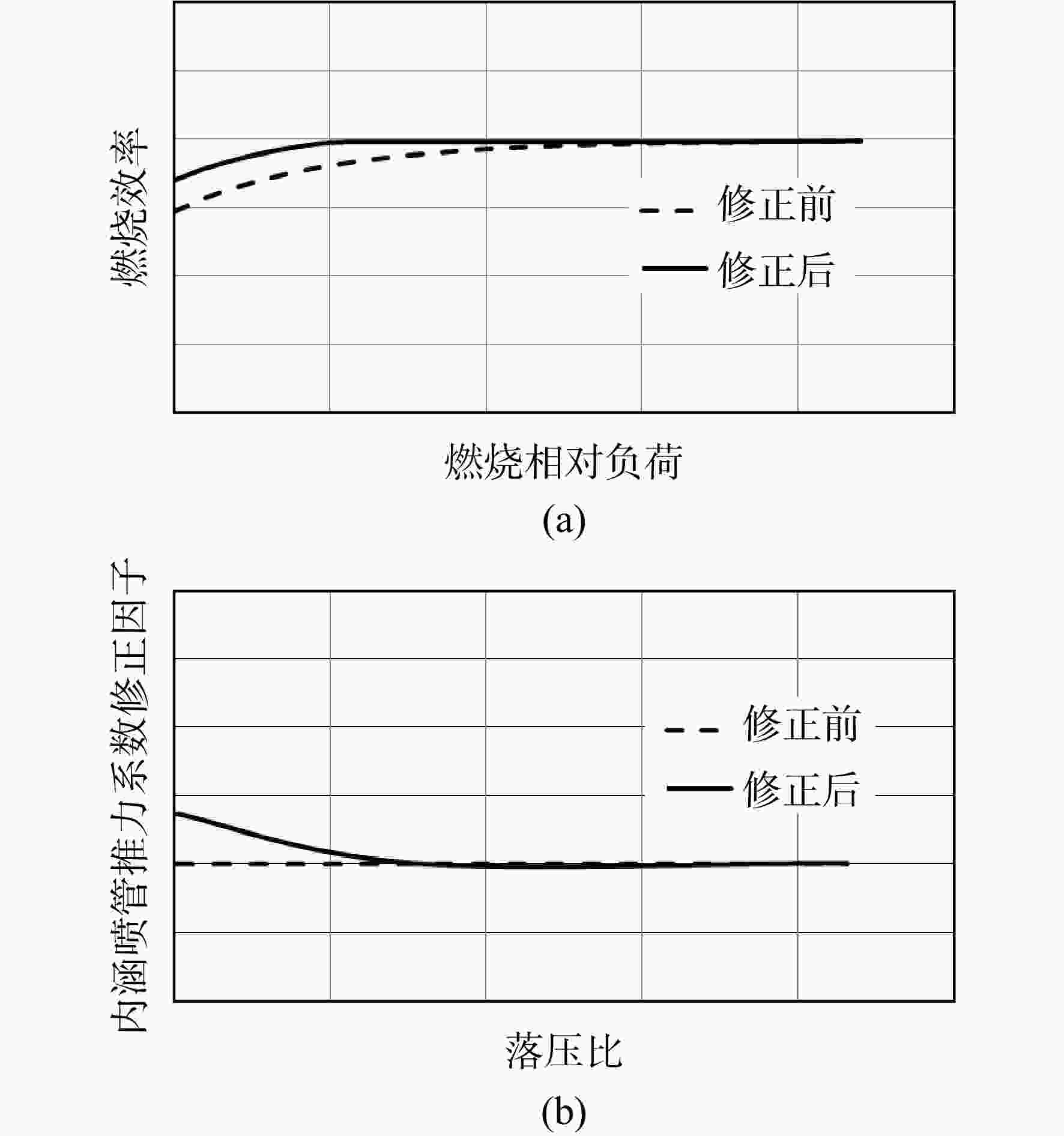
图 7 修正前后对比(燃烧效率和内涵喷管推力系数)
Figure 7. Comparision of parameters before and aftercalibration (combustion efficiency and core nozzle thrust coefficient)
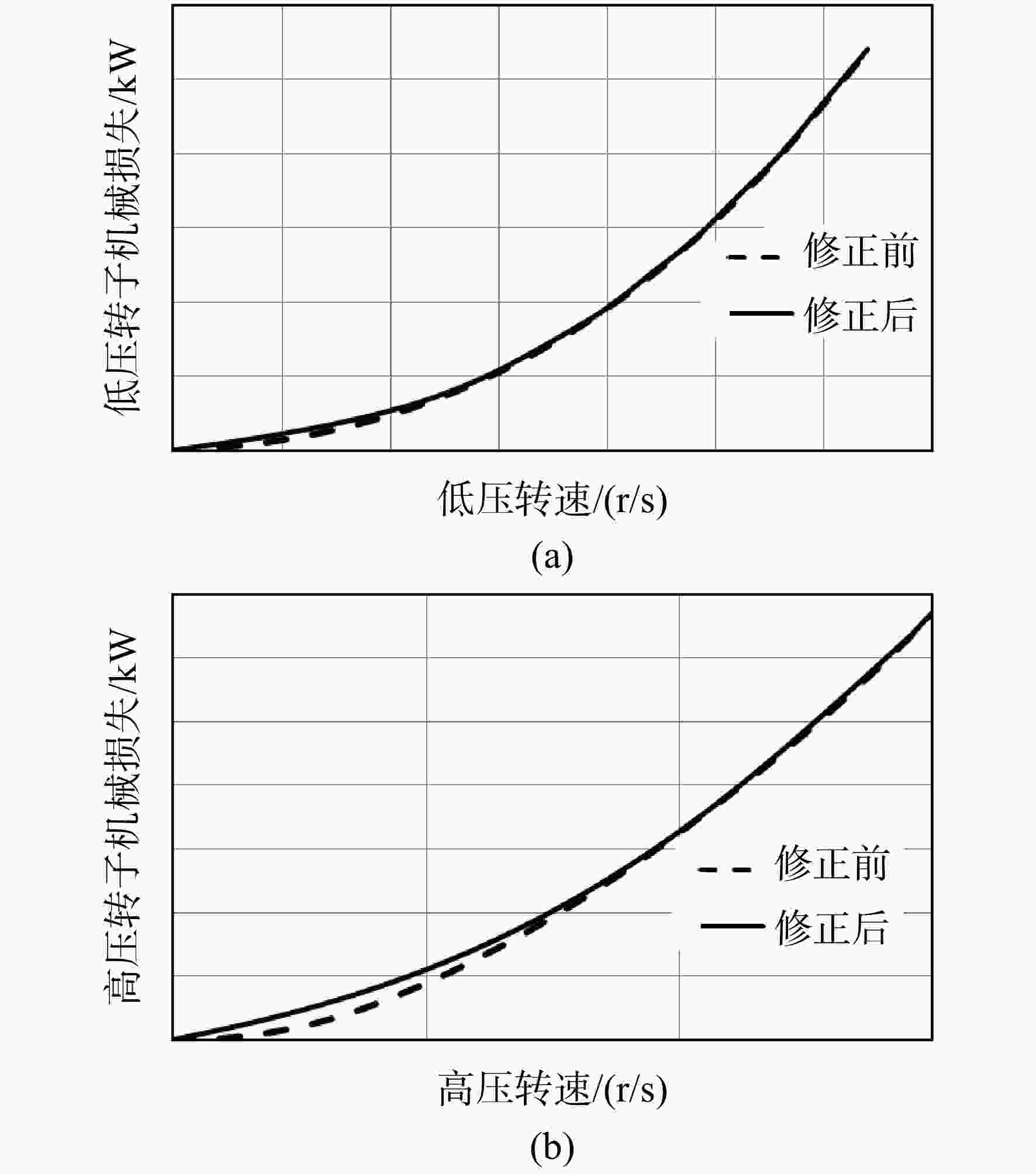
图 8 修正前后对比(高低压转子机械损失)
Figure 8. Comparision of parameters before and after calibration (low speed and high speed spool mechanical losses)
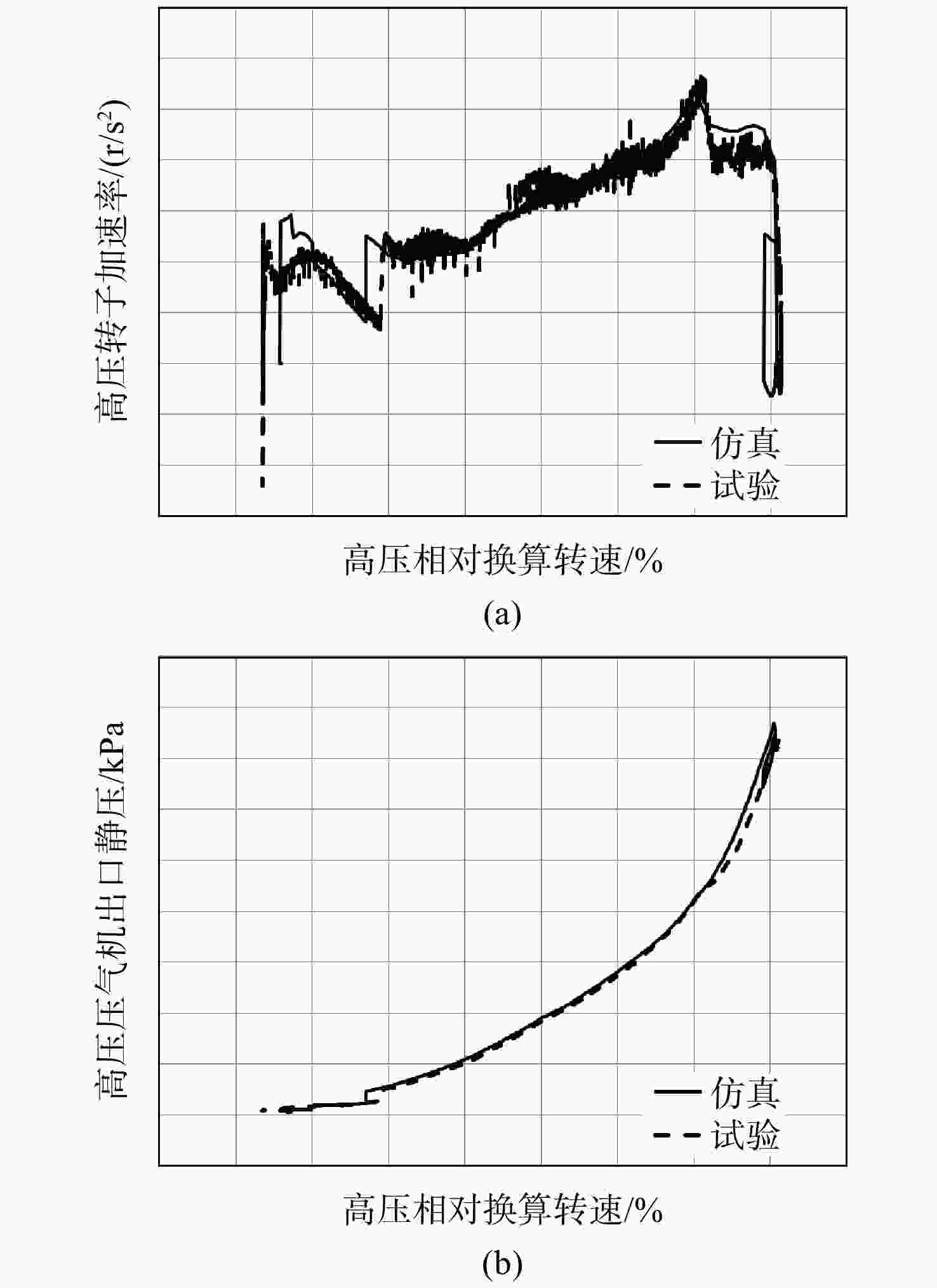
图 10 SAAS模型验证结果(H=
3048 m, ΔT=2 K, Ma=0.54)Figure 10. SAAS model validation results (H=
3048 m, ΔT=2 K, Ma=0.54)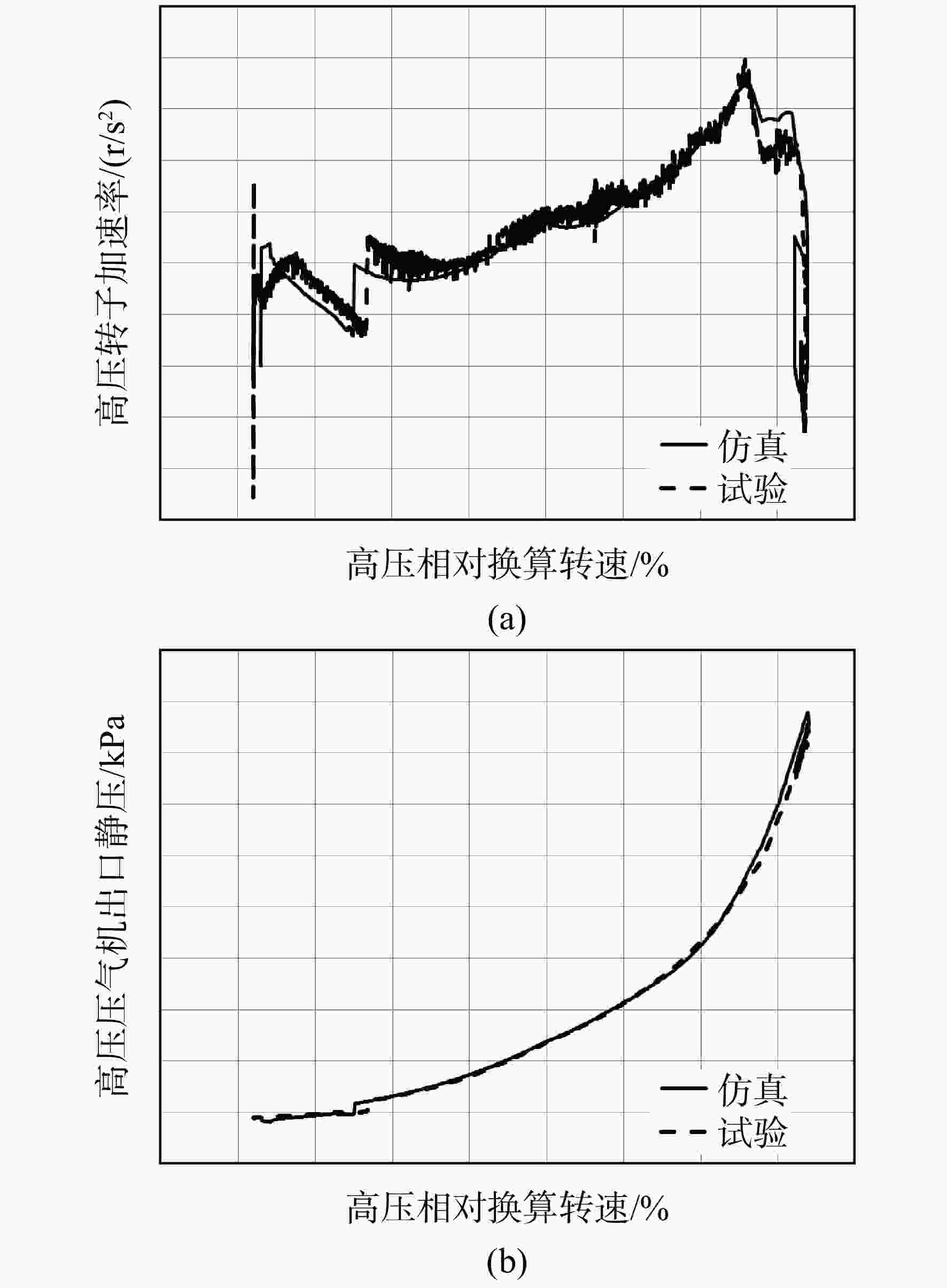
图 11 SAAS模型验证结果(H=
4572 m, ΔT=40 K, Ma=0.53)Figure 11. SAAS model validation results (H=
4572 m, ΔT=40 K, Ma=0.53)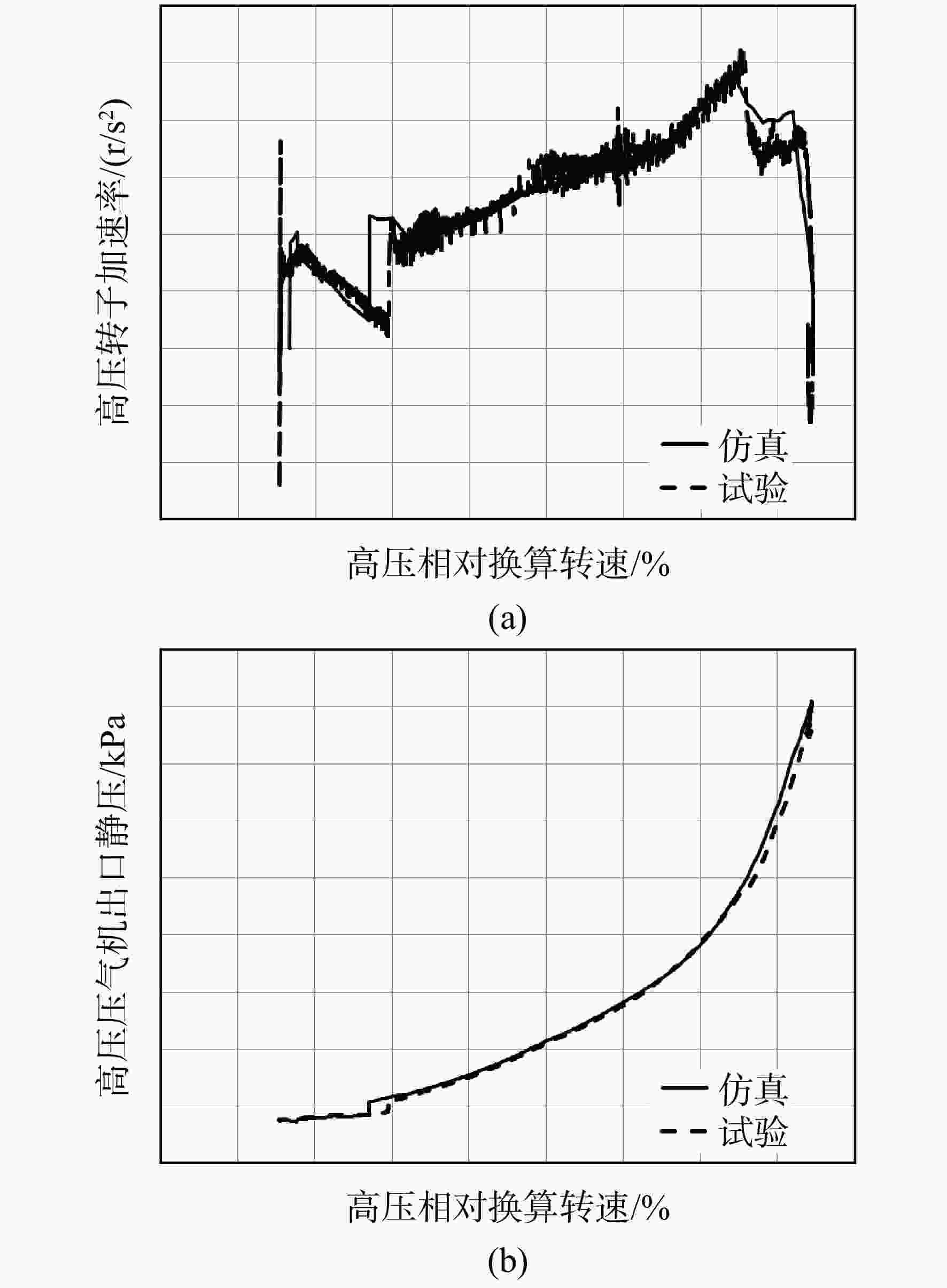
图 12 SAAS模型验证结果(H=
6096 m, ΔT=0 K, Ma=0.65)Figure 12. SAAS model validation results (H=
6096 m, ΔT=0 K, Ma=0.65)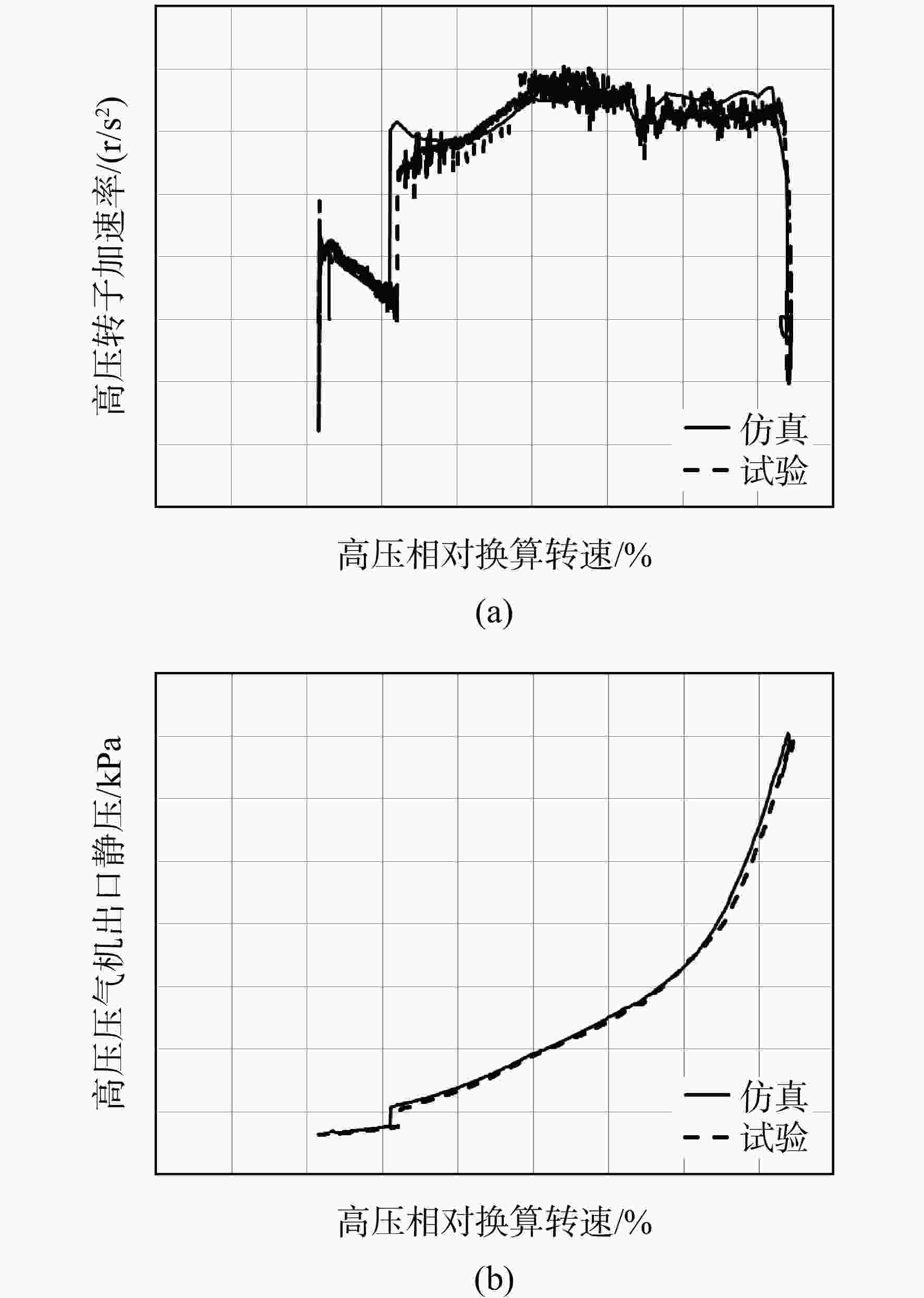
图 13 SAAS模型验证结果(H=
8382 m, ΔT=−15 K, Ma=0.85)Figure 13. SAAS model validation results (H=
8382 m, ΔT=−15 K, Ma=0.85)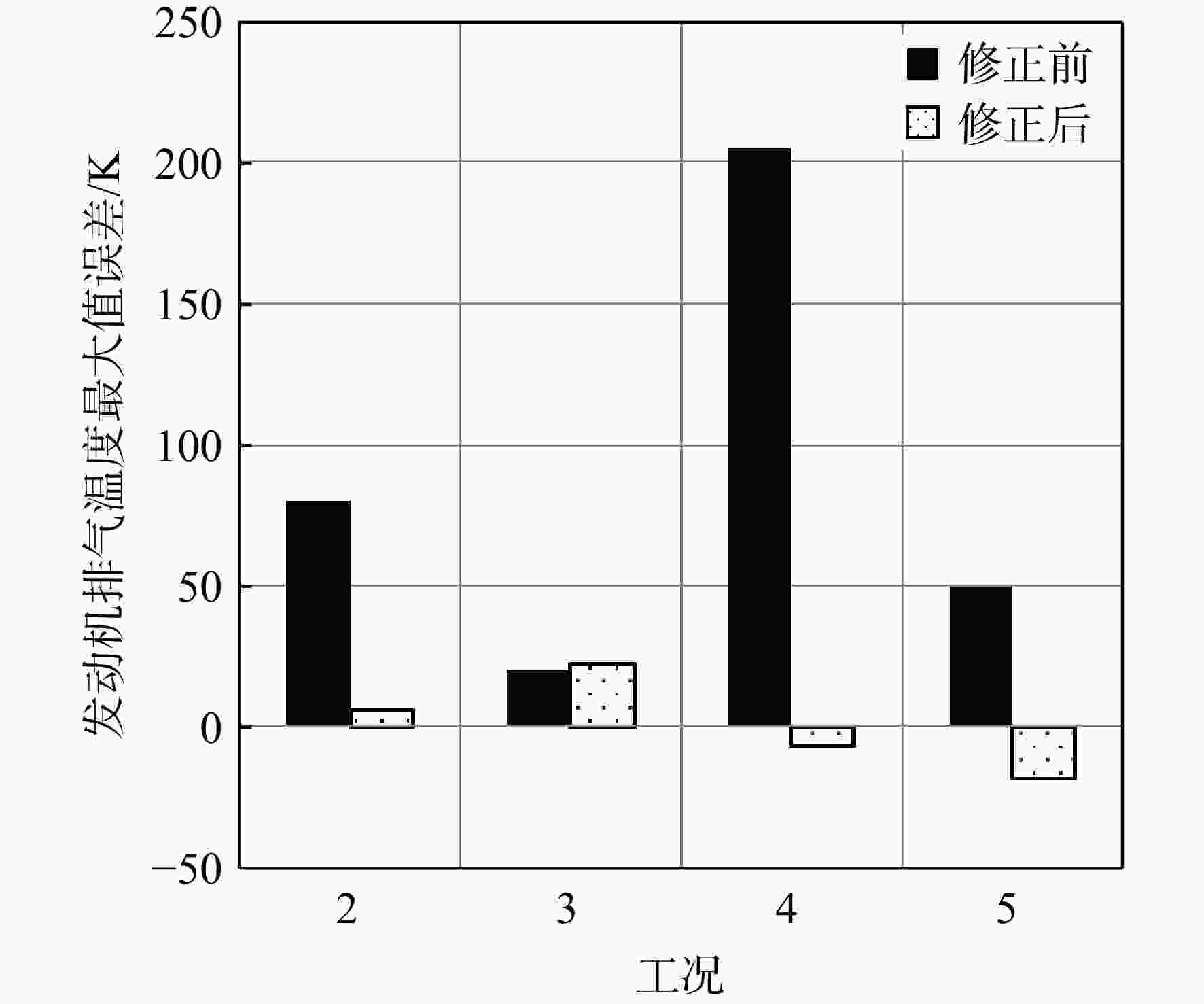
图 14 验证结果(发动机排气温度最大值误差)
Figure 14. Validation results (error of exhaust gas temperature max)
表 1 模型修正阶段与修正目标
Table 1. Model calibrationphases and objective
修正内容 修正目标类型 风车特性修正 稳态 慢车特性修正 稳态 风车至慢车特性修正 瞬态 吸放热参数修正 瞬态  下载: 导出CSV
表 2 修正变量
Table 2. Calibration parameters
修正变量 修正
变量
数量风车
修正慢车
修正风车至
慢车
修正吸放热
修正风扇骨架特性 6 √ √ √ × 增压级骨架特性 6 √ √ √ × 压气机骨架特性 6 √ √ √ × 高压涡轮骨架特性 6 √ √ √ × 低压涡轮骨架特性 6 √ √ √ × 转子机械损失 2 √ √ √ × 内涵喷管推力系数 1 √ √ √ × 燃烧效率特性 1 × × √ × 吸放热参数 10 × × × √
下载: 导出CSV
表 3 风车和慢车稳态修正误差
Table 3. Steady state error after modelcalibration: windmill and idle condition
参数 风车误差 慢车误差 风扇进口总温 0 0 风扇进口总压 0 −0.001 风扇进口流量 0.010 风扇出口总温 0.005 风扇出口总压 0.003 低压转子相对
换算转速−0.004 0 安装推力 0.008 高压压气机进口总温 0.01 −0.004 高压压气机进口总压 0.018 0.009 高压压气机进口流量 −0.005 高压压气机出口总温 0.008 0.010 高压压气机出口总压 0.035 −0.010 高压转子相对
换算转速0.01 0.001 物理燃油量 0.001 高压涡轮出口总温 −0.005 高压涡轮出口总压 0.002 低压涡轮出口总压 −0.008 低压涡轮出口总温 −0.017 内涵喷管进口总压 −0.005 环境压力 0 0
下载: 导出CSV
表 4 模型验证工况
Table 4. Working conditions for model validation
工况编号 高度/m 进口温差/K 马赫数 2 3048 2 0.54 3 4572 40 0.53 4 6096 0 0.65 5 8382 −15 0.87
下载: 导出CSV
-
[1] 张绍基. 涡扇发动机空中风车起动特性分析[J]. 航空发动机, 2004, 30(4): 1-3, 9. ZHANG Shaoji. Analysis of windmilling start characteristics for a typical turbofan engine[J]. Aeroengine, 2004, 30(4): 1-3, 9. (in ChineseZHANG Shaoji. Analysis of windmilling start characteristics for a typical turbofan engine[J]. Aeroengine, 2004, 30(4): 1-3, 9. (in Chinese) [2] DAVIS J B, POLLAK R R. Criteria for optimizing starting cycles for high performance fighter engine [R]. AIAA-83-1127, 1983. [3] WALSH P P, FLETCHER P. Gas turbine performance[M]. Oxford: Blackwell Publishing Company, 2004. [4] MORINI M, CATALDI G, PINELLI M, et al. A model for the simulation of large-size single-shaft gas turbine start-up based on operating data fitting[C]// ASME Turbo Expo: Power for Land, Sea, & Air. Montreal: ASME, 2007: 1849-1856. [5] CHAPPELL M A, MCLAUGHLIN P W. Approach of modeling continuous turbine engine operation from startup to shutdown[J]. Journal of Propulsion and Power, 1993, 9(3): 466-471. doi: 10.2514/3.23645 [6] AGARWAL H, KALE A, AKKARAM S, et al. Inverse modeling techniques for application to engine transient performance data matching[C]// ASME Turbo Expo: Power for Land, Sea, & Air. Berlin: ASME, 2008: 207-214. [7] CONVERSE G L, GIFFIN R G. Extended parametric representation of compressor fans and turbines[R]. NASA-CR-174645, 1984. [8] SETHI V, DOULGERIS G, PILIDIS P, et al. The map fitting tool methodology: gas turbine compressor off-design performance modeling[J]. Journal of Turbomachinery, 2013, 135(6): 061010.1-061010.15. [9] CONVERSE G L. Extended parametric representation of compressor fans and turbines[R]. NASA-CR-174646, 1984. [10] 王占学, 乔渭阳, 李文兰. 基于部件匹配技术的涡扇发动机起动过程数值模拟[J]. 航空动力学报, 2004, 19(4): 444-448. WANG Zhanxue, QIAO Weiyang, LI Wenlan. Modeling turbofan engine startup based on component matching principles[J]. Journal of Aerospace Power, 2004, 19(4): 444-448. (in ChineseWANG Zhanxue, QIAO Weiyang, LI Wenlan. Modeling turbofan engine startup based on component matching principles[J]. Journal of Aerospace Power, 2004, 19(4): 444-448. (in Chinese) [11] ZHOU Wenxiang, HUANG Jinquan. Research on the startup model of turbofan engine at high altitude[J]. Journal of Aerospace Power, 2007, 22(8): 1384-1390. (in Chinese) [12] VIEWEG M, WOLTERS F, BECKER R G. Comparison of a heat soakage model with turbofan transient engine data[C]// ASME IGTI 2017 Turbo Expo. Charlotte, North Carolina: American Society of Mechanical Engineers, 2017: 63641. [13] 唐海龙, 张津. 面向对象的航空发动机性能仿真程序设计方法研究[J]. 航空动力学报, 1999, 14(4): 421-424, 455-456. TANG Hailong, ZHANG Jin. A study of object-oriented approach for aeroengine performance simulation[J]. Journal of Aerospace Power, 1999, 14(4): 421-424, 455-456. (in ChineseTANG Hailong, ZHANG Jin. A study of object-oriented approach for aeroengine performance simulation[J]. Journal of Aerospace Power, 1999, 14(4): 421-424, 455-456. (in Chinese) [14] HUMPHRIES A R. Spurious solutions of numerical methods for initial value problems[J]. IMA Journal of Numerical Analysis, 1993, 13(2): 263-290. doi: 10.1093/imanum/13.2.263 [15] RIEGLER C, BAUER M, SCHULTE H. Validation of a mixed flow turbofan performance model in the sub-idle operating range[C]//ASME Turbo Expo, Collocated with the International Joint Power Generation Conference. Georgia: ASME, 2003: 470-477. [16] TRELEA I C. The particle swarm optimization algorithm: convergence analysis and parameter selection[J]. Information Processing Letters, 2003, 85(6): 317-325. doi: 10.1016/S0020-0190(02)00447-7 [17] EBERHART, SHI Yuhui. Particle swarm optimization: developments, applications and resources[C]//Proceedings of the 2001 Congress on Evolutionary Computation. Seoul: IEEE, 2002: 81-86. [18] ZACHOS P K. Modelling and analysis of turbofan engines under windmilling conditions[J]. Journal of Propulsion and Power, 2013, 29(4): 882-890. doi: 10.2514/1.B34729 -


 点击查看大图

计量
- 文章访问数: 571
- HTML浏览量: 329
- PDF量: 30
- 被引次数: 0