






Effect of thermophysical property of the mainstream on the cooling performance evaluation of gas turbine vane with conjugate heat transfer methods
-
摘要:
针对不同的主流物性参数设置对涡轮叶片冷却性能数值评估结果的影响,以及涡轮叶片气热耦合计算中主流物性参数的选取应遵循何种原则的问题,以某燃气涡轮导向器叶片冷却方案设计阶段的全三维气热耦合评估为例,通过对比主流不同比热容、动力黏度、导热系数下的叶片表面温度分布与平均综合冷却效率差异,分析总结了涡轮叶片气热耦合计算中主流物性参数的影响机制与选取方法。结果表明:不同主流物性参数下的涡轮进口雷诺数、通道马赫数及贝克来数等不同,导致叶片表面附近的流动与传热特性存在差异。其中,贝克来数对于获取准确的涡轮叶片表面温度分布尤为关键。相比于比热容和动力黏度,保证高温燃气的导热系数能获得更可靠的涡轮叶片冷却性能评估结果。
Abstract:In an attempt to clarify the effect of thermophysical property settings of the mainstream working fluid on the turbine vane cooling effectiveness assessment and their definition principles in the conjugate heat transfer numerical simulation, three-dimensional conjugate heat transfer analysis of the preliminary cooling design of a gas turbine vane was conducted in this study, wherein both the vane surface temperature distribution and the average cooling effectiveness discrepancies with distinct defining methods of the mainstream specific heat capacity, dynamic viscosity and thermal conductivity were carefully examined. Moreover, the influencing mechanism and selection principle of the mainstream thermophysical properties were also analyzed and proposed. Results showed that the mainstream flow and heat transfer characteristics around the vane were dissimilar, resulting from the unequal turbine inlet Reynolds number, passage Mach number and Peclet number of different thermophysical properties, among which the Peclet number was found to play a key role in deriving more accurate temperature profile for the turbine vane. Meanwhile, compared with the specific heat capacity and dynamic viscosity, keeping the thermal conductivity of mainstream consistent with the hot gas could guarantee a more reliable evaluation of the cooling performance for turbine vane.
-
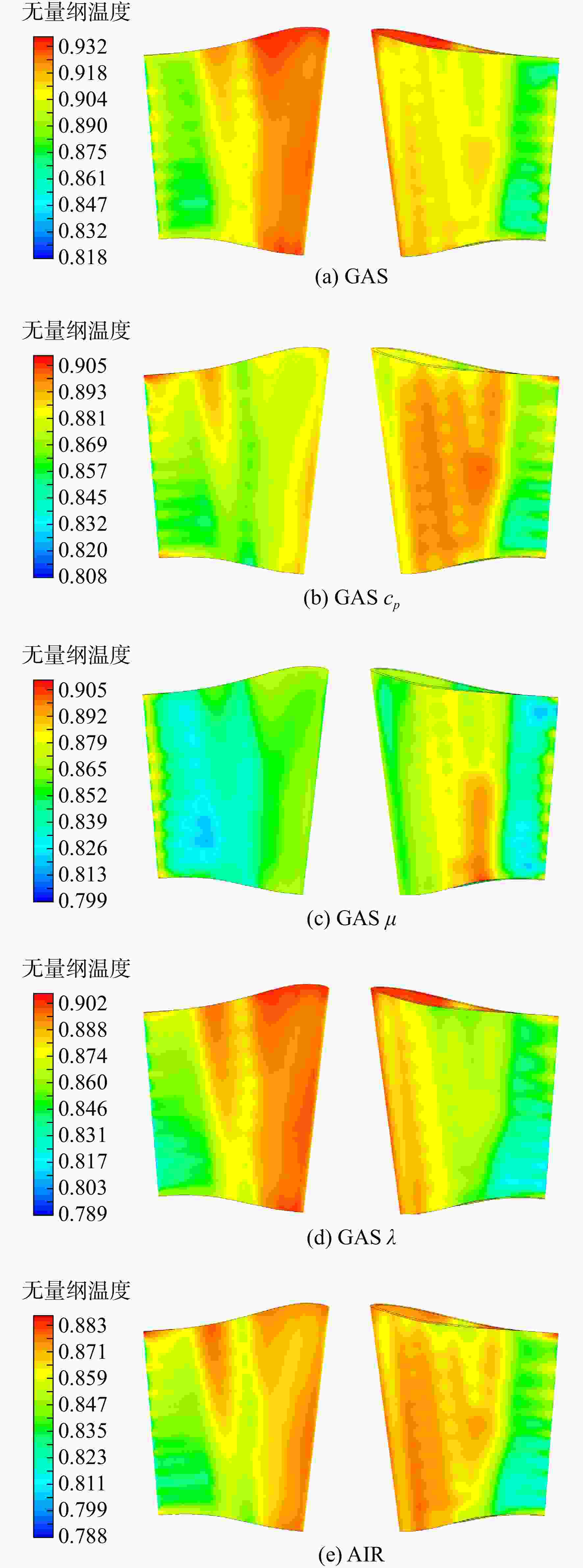
图 4 不同主流工质下的涡轮叶片表面温度分布
Figure 4. Surface temperature distribution of the vane under different mainstream working fluid
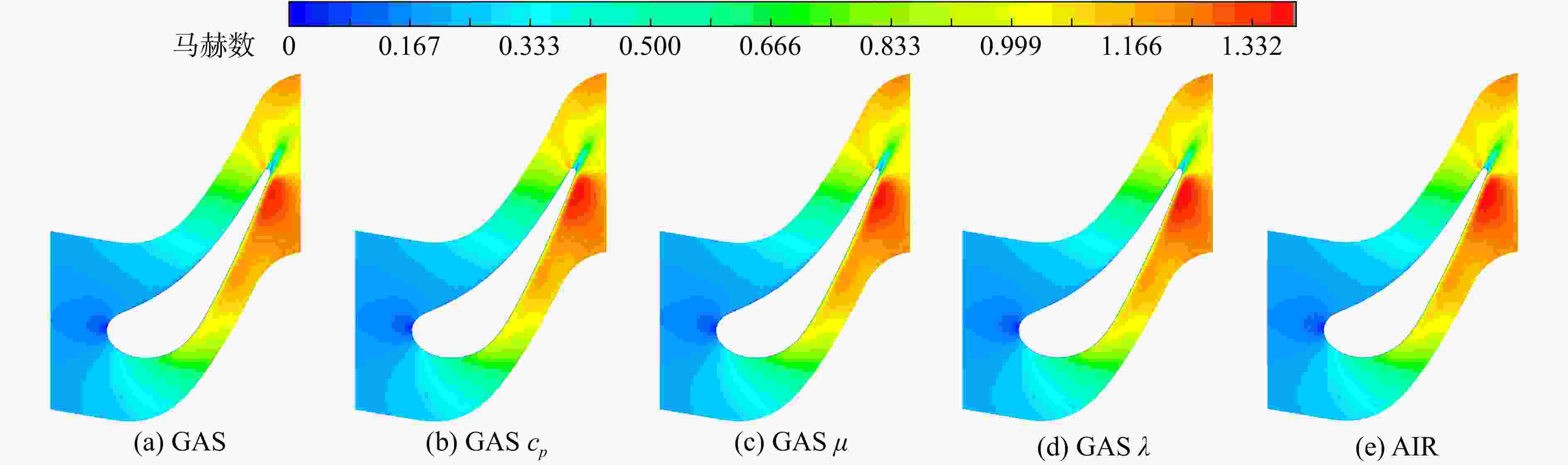
图 5 不同主流工质下的涡轮叶栅通道中截面马赫数分布
Figure 5. Mach number distribution at the midspan under different mainstream working fluid
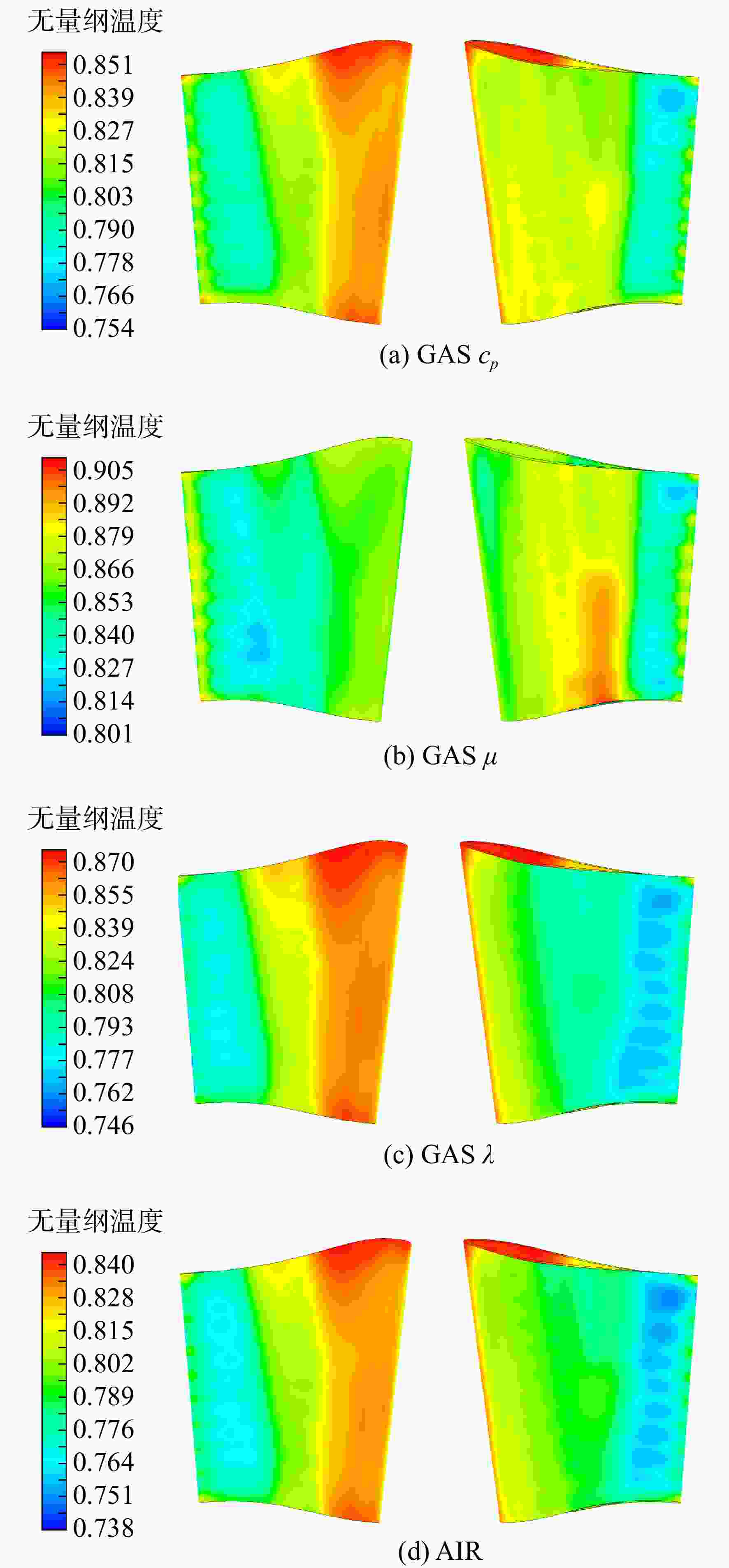
图 6 边界条件按照Ma、Re模化后不同主流工质下的涡轮叶片表面温度分布
Figure 6. Surface temperature distribution of the vane after boundary condition modeling

图 7 边界条件按照Ma、Re模化后不同主流工质下的涡轮叶栅通道中截面马赫数Ma分布
Figure 7. Midspan Mach number distribution of different mainstream working fluid after the boundary condition modeling
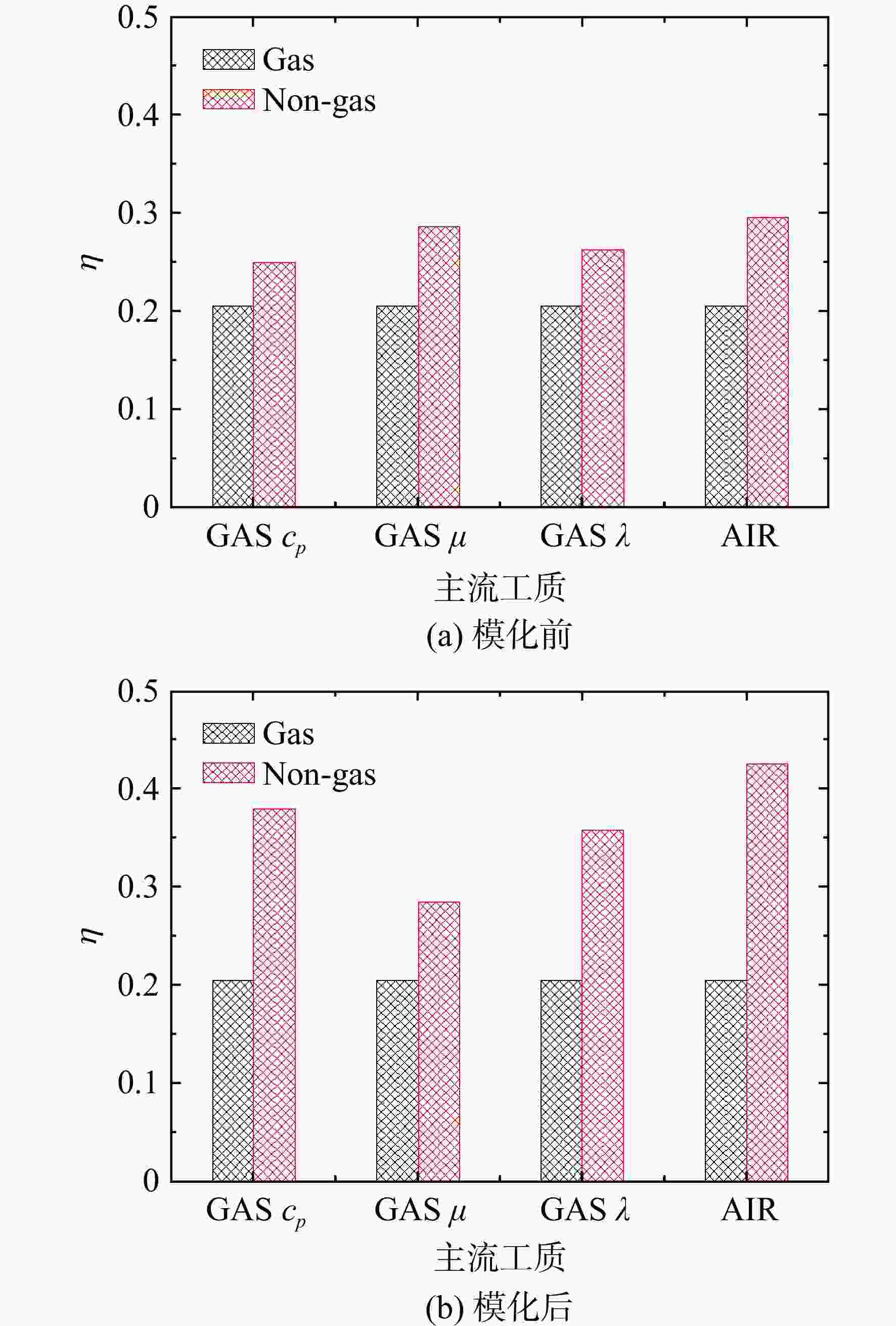
图 8 不同主流工质下的涡轮叶片综合冷却效率对比(数值结果)
Figure 8. Comparison of the integrated cooling effectiveness under different mainstream working fluid (numerical calculation)

图 9 不同主流工质下的涡轮叶片综合冷却效率对比(简化模型结果)
Figure 9. Comparison of the integrated cooling effectiveness under different mainstream working fluid (simplified theoretical model analysis)
表 1 主流工质类型及其物性参数
Table 1. Working fluid type of the mainstream and its properties
简称 主流工质 物性参数 GAS 高温燃气
(hot gas)$ {R_{{\text{ggas}}}} = 287.401\;{{ {\mathrm{J}}/ ({\mathrm{kg}}}} \cdot {{{\mathrm{K}}}} ) $
$ {c_{p{\text{gas}}}} = {a_{\text{0}}} + {a_1}T + {a_2}{T^2} + {a_3}{T^3} + {a_4}{T^4} $
$ {\mu _{{\text{gas}}}} = {\mu _0}{\left( {\dfrac{T}{{{T_0}}}} \right)^{3/2}}\dfrac{{{T_0} + S}}{{T + S}} $
$ {\lambda _{{\text{gas}}}} = {\lambda _0}{\left( {\dfrac{T}{{{T_0}}}} \right)^{3/2}}\dfrac{{{T_0} + S}}{{T + S}} $AIR 理想空气
(air ideal gas)$ {R_{{\text{gair}}}} = 287.103\;{{ {\mathrm{J}}/ ({\mathrm{kg}}}} \cdot {{{\mathrm{K}}}} ) $
$ {c_{p{\text{air}}}} = 1\;004.4\;{{ {\mathrm{J}}/ ({\mathrm{kg}}}} \cdot {{{\mathrm{K}}}} ) $
$ {\mu _{{\text{air}}}} = 1.831 \times {10^{ - 5}}\;{\text{ Pa}} \cdot {\text{s}} $
$ {\lambda _{{\text{air}}}} = 0.026\;1\;{{ {\mathrm{W}}/ ({\mathrm{m}}}} \cdot {\rm{K}} ) $GAS cp 理想空气+
高温燃气cp$ {R_{{\text{ggas}}}} $, $ {c_{p{\text{gas}}}} $, $ {\mu _{{\text{air}}}} $, $ {\lambda _{{\text{air}}}} $ GAS μ 理想空气+
高温燃气μ$ {R_{{\text{gair}}}} $, $ {c_{p{\text{air}}}} $, $ {\mu _{{\text{gas}}}} $, $ {\lambda _{{\text{air}}}} $ GAS λ 理想空气+
高温燃气λ$ {R_{{\text{gair}}}} $, $ {c_{p{\text{air}}}} $, $ {\mu _{{\text{air}}}} $, $ {\lambda _{{\text{gas}}}} $  下载: 导出CSV
表 2 不同主流工质下的涡轮进口特征准则数对比
Table 2. Turbine inlet criterion parameters under different mainstream working fluid
主流工质 γ Pr Re Pe GAS 1.3 0.831 187737 156009 GAS cp 1.3 0.850 487746 414584 GAS μ 1.4 1.746 194710 339964 GAS λ 1.4 0.278 505233 140455 AIR 1.4 0.705 505239 356193
下载: 导出CSV
表 3 按照Ma、Re模化后不同主流工质下的涡轮进口特征准则数对比
Table 3. Turbine inlet criterion parameters of different mainstream working fluid after the boundary condition modeling
主流工质 γ Pr Re Pe GAS 1.3 0.831 187737 156009 GAS cp 1.3 0.850 187342 159241 GAS μ 1.4 1.746 187969 328194 GAS λ 1.4 0.278 187424 52104 AIR 1.4 0.705 187361 132090
下载: 导出CSV
-
[1] 王强. 提高气冷涡轮气热耦合计算精度方法的研究[D]. 哈尔滨: 哈尔滨工业大学, 2009. WANG Qiang. Study on improving the accuracy of gas-heat coupling calculation of air-cooled turbine[D]. Harbin: Harbin Institute of Technology, 2009. (in ChineseWANG Qiang. Study on improving the accuracy of gas-heat coupling calculation of air-cooled turbine[D]. Harbin: Harbin Institute of Technology, 2009. (in Chinese) [2] 薛钰, 刘景源. 燃气热力参数计算方法及在涡轮叶栅对流换热中的应用[J]. 航空动力学报, 2020, 35(9): 1831-1844. XUE Yu, LIU Jingyuan. Thermodynamic parameters calculating method of gas and its application in convective heat transfer over turbine cascade[J]. Journal of Aerospace Power, 2020, 35(9): 1831-1844. (in ChineseXUE Yu, LIU Jingyuan. Thermodynamic parameters calculating method of gas and its application in convective heat transfer over turbine cascade[J]. Journal of Aerospace Power, 2020, 35(9): 1831-1844. (in Chinese) [3] 张鹏飞, 李星, 许开富, 等. 高压下真实气体效应对涡轮性能影响的仿真[J]. 火箭推进, 2022, 48(2): 94-104. ZHANG Pengfei, LI Xing, XU Kaifu, et al. Influence of real gas effect on turbine performance under high pressure with simulation[J]. Journal of Rocket Propulsion, 2022, 48(2): 94-104. (in ChineseZHANG Pengfei, LI Xing, XU Kaifu, et al. Influence of real gas effect on turbine performance under high pressure with simulation[J]. Journal of Rocket Propulsion, 2022, 48(2): 94-104. (in Chinese) [4] 张晓东, 段明冲, 曾蕴涛, 等. 考虑组分影响的涡轮气动特性计算方法研究[J]. 航空动力学报, 2025, 40(1): 20230098. ZHANG Xiaodong, DUAN Mingchong, ZENG Yuntao, et al. Study on aerodynamic characteristics computation method for turbine considering component effects[J]. Journal of Aerospace Power, 2025, 40(1): 20230098. (in ChineseZHANG Xiaodong, DUAN Mingchong, ZENG Yuntao, et al. Study on aerodynamic characteristics computation method for turbine considering component effects[J]. Journal of Aerospace Power, 2025, 40(1): 20230098. (in Chinese) [5] AKRAM W, SANJAY S, HASSAN M A, et al. Thermodynamic investigation of effect of variation in thermo-physical properties of gas turbine working fluid on cycle performance[C]//Recent Trends in Thermal Engineering. Singapore: Springer Singapore, 2022: 209-228. [6] FILIPPOV P S, TOLMACHEV E M, BOGATOVA T F, et al. Influence of the working fluid thermophysical parameters variation on the gas turbine cycle performance[J]. Journal of Physics: Conference Series, 2019, 1359(1): 012124. doi: 10.1088/1742-6596/1359/1/012124 [7] ZHENG Shaofei, SONG Yidan, XIE Gongnan, et al. An assessment of turbulence models for predicting conjugate heat transfer for a tubine vane with internal cooling channels[J]. Heat Transfer Research, 2015, 46(11): 1039-1064. doi: 10.1615/HeatTransRes.2015007514 [8] 曾军, 张维涛, 王鹏飞, 等. 空心气冷低压涡轮动叶气热耦合数值模拟[J]. 推进技术, 2020, 41(6): 1268-1275. ZENG Jun, ZHANG Weitao, WANG Pengfei, et al. Conjugate heat transfer analysis for cooled low pressure turbine rotor blade[J]. Journal of Propulsion Technology, 2020, 41(6): 1268-1275. (in ChineseZENG Jun, ZHANG Weitao, WANG Pengfei, et al. Conjugate heat transfer analysis for cooled low pressure turbine rotor blade[J]. Journal of Propulsion Technology, 2020, 41(6): 1268-1275. (in Chinese) [9] 李心语, 刘火星. 气冷涡轮导叶流热耦合计算及机理[J]. 北京航空航天大学学报, 2021, 47(11): 2378-2386. LI Xinyu, LIU Huoxing. Conjugate heat transfer simulation and mechanism of air-cooled turbine guide vanes[J]. Journal of Beijing University of Aeronautics and Astronautics, 2021, 47(11): 2378-2386. (in ChineseLI Xinyu, LIU Huoxing. Conjugate heat transfer simulation and mechanism of air-cooled turbine guide vanes[J]. Journal of Beijing University of Aeronautics and Astronautics, 2021, 47(11): 2378-2386. (in Chinese) [10] JIN W, JIA Y X, LEI J, et al. Coupled heat transfer analysis of internal and film cooling of turbine blade under medium temperature conditions[J]. Applied Thermal Engineering, 2022, 214: 118792. doi: 10.1016/j.applthermaleng.2022.118792 [11] 于飞龙, 上官博, 李园园, 等. 重型燃气轮机透平第一级动叶复合冷却数值研究[J]. 中国电机工程学报, 2016, 36(1): 179-186. YU Feilong, SHANGGUAN Bo, LI Yuanyuan, et al. Numerical investigation on compound cooling effect of the heavy-duty gas turbine first stage blade[J]. Proceedings of the CSEE, 2016, 36(1): 179-186. (in ChineseYU Feilong, SHANGGUAN Bo, LI Yuanyuan, et al. Numerical investigation on compound cooling effect of the heavy-duty gas turbine first stage blade[J]. Proceedings of the CSEE, 2016, 36(1): 179-186. (in Chinese) [12] 王孟君, 薛伟鹏, 陈阿龙, 等. 基于参数化建模的涡轮叶片气热耦合分析方法研究[J]. 推进技术, 2024, 45(4): 2210066. WANG Mengjun, XUE Weipeng, CHEN Along, et al. Turbine blade conjugated heat transfer analysis method based on parametric modeling[J]. Journal of Propulsion Technology, 2024, 45(4): 2210066. (in ChineseWANG Mengjun, XUE Weipeng, CHEN Along, et al. Turbine blade conjugated heat transfer analysis method based on parametric modeling[J]. Journal of Propulsion Technology, 2024, 45(4): 2210066. (in Chinese) [13] 吴琛琦, 何坤, 晏鑫. 透平级带压力侧小翼凹槽叶顶的传热与气膜冷却性能研究[J]. 西安交通大学学报, 2022, 56(3): 147-159. WU Chenqi, HE Kun, YAN Xin. Investigation into heat transfer and film cooling performance at pressure-side winglet-squealer tip in a turbine stage[J]. Journal of Xi’an Jiaotong University, 2022, 56(3): 147-159. (in ChineseWU Chenqi, HE Kun, YAN Xin. Investigation into heat transfer and film cooling performance at pressure-side winglet-squealer tip in a turbine stage[J]. Journal of Xi’an Jiaotong University, 2022, 56(3): 147-159. (in Chinese) [14] WANG Mingrui, ZHU Huiren, LIU Cunliang, et al. Structure improvement on turbine guided vane cooling system based on conjugate heat transfer[J]. International Journal of Thermal Sciences, 2022, 172: 107332. [15] 郭亮亮, 朱惠人, 王铭睿, 等. 涡轮叶片内部冷却结构流动换热特性的数值研究[J]. 推进技术, 2022, 43(12): 210551. GUO Liangliang, ZHU Huiren, WANG Mingrui, et al. Numerical study on flow and heat transfer characteristics of internal cooling configurations of turbine vane[J]. Journal of Propulsion Technology, 2022, 43(12): 210551. (in ChineseGUO Liangliang, ZHU Huiren, WANG Mingrui, et al. Numerical study on flow and heat transfer characteristics of internal cooling configurations of turbine vane[J]. Journal of Propulsion Technology, 2022, 43(12): 210551. (in Chinese) [16] FATHI M, NEJAT A. Conjugate heat transfer investigation of impingement cooling for ribbed internal passage of a turbine vane[J]. International Journal of Thermal Sciences, 2022, 178: 107589. doi: 10.1016/j.ijthermalsci.2022.107589 [17] 魏宽, 苗辉, 秦绪山, 等. 带冲击-气膜双层壁结构的涡轮导叶冷却特性源项法数值研究[J]. 推进技术, 2022, 43(6): 210027. WEI Kuan, MIAO Hui, QIN Xushan, et al. Numerical study on cooling characteristics of turbine guide vanes with impingement/film double wall structure using source term method[J]. Journal of Propulsion Technology, 2022, 43(6): 210027. (in ChineseWEI Kuan, MIAO Hui, QIN Xushan, et al. Numerical study on cooling characteristics of turbine guide vanes with impingement/film double wall structure using source term method[J]. Journal of Propulsion Technology, 2022, 43(6): 210027. (in Chinese) [18] JIANG Shijie, LI Zhigang, LI Jun. Effect of casing purge flow on heat transfer and cooling performance of blade squealer tip for a gas turbine stage[J]. Proceedings of the Institution of Mechanical Engineers, Part A: Journal of Power and Energy, 2022, 236(2): 224-240. doi: 10.1177/09576509211040328 [19] 王磊, 李海旺, 谢刚, 等. 涡轮动叶吸力面气膜冷却径向差异对比[J]. 航空动力学报, 2024, 39(4): 20220349. WANG Lei, LI Haiwang, XIE Gang, et al. Comparison for radial difference of film cooling performance on suction surface of a rotor blade[J]. Journal of Aerospace Power, 2024, 39(4): 20220349. (in ChineseWANG Lei, LI Haiwang, XIE Gang, et al. Comparison for radial difference of film cooling performance on suction surface of a rotor blade[J]. Journal of Aerospace Power, 2024, 39(4): 20220349. (in Chinese) [20] 高庆, 朱蓬勃, 石慧, 等. 轮缘密封导流段轴向相对位置对涡轮级气动冷却特性影响的数值研究[J]. 汽轮机技术, 2021, 63(4): 264-267, 272. GAO Qing, ZHU Pengbo, SHI Hui, et al. Numerical investigations for effects of the rim seal position on aerodynamic performance of turbine stage and film cooling performance on rotor hub platform[J]. Turbine Technology, 2021, 63(4): 264-267, 272. (in ChineseGAO Qing, ZHU Pengbo, SHI Hui, et al. Numerical investigations for effects of the rim seal position on aerodynamic performance of turbine stage and film cooling performance on rotor hub platform[J]. Turbine Technology, 2021, 63(4): 264-267, 272. (in Chinese) [21] 栗智宇, 张垲垣, 李志刚, 等. 燃烧室出口旋流对静叶栅端壁流动型态和传热冷却特性的影响[J]. 西安交通大学学报, 2022, 56(4): 72-82. LI Zhiyu, ZHANG Kaiyuan, LI Zhigang, et al. Effect of combustion chamber outlet swirling flow on flow pattern, heat transfer and cooling characteristics of turbine vane endwall[J]. Journal of Xi’an Jiaotong University, 2022, 56(4): 72-82. (in ChineseLI Zhiyu, ZHANG Kaiyuan, LI Zhigang, et al. Effect of combustion chamber outlet swirling flow on flow pattern, heat transfer and cooling characteristics of turbine vane endwall[J]. Journal of Xi’an Jiaotong University, 2022, 56(4): 72-82. (in Chinese) [22] 白波, 李志刚, 李军. 轴向收敛造型对燃气涡轮叶栅端壁气膜冷却性能的影响[J]. 航空动力学报, 2022, 37(5): 1042-1053. BAI Bo, LI Zhigang, LI Jun. Influence of axially-convergent contouring on cascade endwall film cooling characteristics in gas turbine[J]. Journal of Aerospace Power, 2022, 37(5): 1042-1053. (in ChineseBAI Bo, LI Zhigang, LI Jun. Influence of axially-convergent contouring on cascade endwall film cooling characteristics in gas turbine[J]. Journal of Aerospace Power, 2022, 37(5): 1042-1053. (in Chinese) [23] 谢柏森, 张燕峰, 张子卿. 端壁造型对高压涡轮封严流和主流的影响[J]. 航空动力学报, 2023, 38(9): 2241-2250. XIE Bosen, ZHANG Yanfeng, ZHANG Ziqing. Influence of endwall profiling on purge flow and mainstream flow in the high-pressure turbine[J]. Journal of Aerospace Power, 2023, 38(9): 2241-2250. (in ChineseXIE Bosen, ZHANG Yanfeng, ZHANG Ziqing. Influence of endwall profiling on purge flow and mainstream flow in the high-pressure turbine[J]. Journal of Aerospace Power, 2023, 38(9): 2241-2250. (in Chinese) [24] HYLTON L D, MIHELC M S, TURNER E R, et al. Analytical and experimental evaluation of the heat transfer distribution over the surfaces of turbine vanes[R]. NASA-CR-168015, 1983. [25] 董爱华. 重型燃气涡轮高温动叶冷却结构换热机理的数值研究[D]. 哈尔滨: 哈尔滨工业大学, 2021. DONG Aihua. Numerical study on heat transfer mechanism of cooling structure of high temperature rotor blade of heavy gas turbine[D]. Harbin: Harbin Institute of Technology, 2021. (in ChineseDONG Aihua. Numerical study on heat transfer mechanism of cooling structure of high temperature rotor blade of heavy gas turbine[D]. Harbin: Harbin Institute of Technology, 2021. (in Chinese) [26] 曹玉璋. 航空发动机传热学[M]. 北京: 北京航空航天大学出版社, 2005. CAO Yuzhang. Aeroengine heat transfer[M]. Beijing: Beijing University of Aeronautics & Astronautics Press, 2005. (in ChineseCAO Yuzhang. Aeroengine heat transfer[M]. Beijing: Beijing University of Aeronautics & Astronautics Press, 2005. (in Chinese) -


 点击查看大图

计量
- 文章访问数: 552
- HTML浏览量: 577
- PDF量: 66
- 被引次数: 0