






Prediction of full-condition vibration trend of aero-engine based on combined model
-
摘要:
航空发动机运行过程中稳态与过渡态相互交织,导致振动趋势数据具有强非线性及高时变性。针对现有振动趋势预测研究中工况单一、预测精度低的问题,提出一种基于组合模型的航空发动机全工况振动趋势预测模型。首先使用改进变分模态分解算法(IVMD)进行振动数据分解处理以弱化其非线性与时变性;其次采用融合多策略改进的麻雀搜索算法(ISSA)对IVMD-BiLSTM(bidirectional long and short-term memory)预测模型的网络参数设置开展了优化计算;最后以航空发动机振动趋势数据为基础,检验预测模型在稳态工况和过渡态工况下的预测性能。模型验证结果表明:对于全工况振动趋势数据,在进行数据分解处理以及ISSA优化组合模型参数后,预测效果综合提升指标(CEI)可达55.13%;此外组合模型对于不同状态下的稳态与过渡态振动趋势预测性能优异,模型泛化性良好。
Abstract:The steady state and transition state are intertwined during the operation of aero-engine, resulting in strong nonlinearity and high time variability of vibration trend data. In view of the problems of single working condition and low prediction accuracy in the existing vibration trend prediction research, a combined model was proposed to predict the vibration trend of an aero-engine based on the full-condition. The improved variational modal decomposition algorithm (IVMD) was used to decompose the vibration data to weaken the nonlinearity and time-varying nature; the improved sparrow search algorithm (ISSA) was used to optimize the network parameters of the IVMD-BiLSTM (bidirectional long and short-term memory) prediction model; and the prediction performance of the prediction model was examined based on the vibration trend data of the aircraft engine under the steady state and transition state conditions. Finally, the prediction performance of the model was examined under steady state and transitional conditions based on aero-engine vibration trend data. The model validation results showed that: for the vibration trend data in full-conditions, after data decomposition and optimization of the combined model parameters by the ISSA, the comprehensive evaluation indicators (CEI) of the prediction effect can be up to 55.13%; besides, the combined model had excellent prediction performance for the vibration trend of steady state and transition state in different states, and the model had good generalization.
-
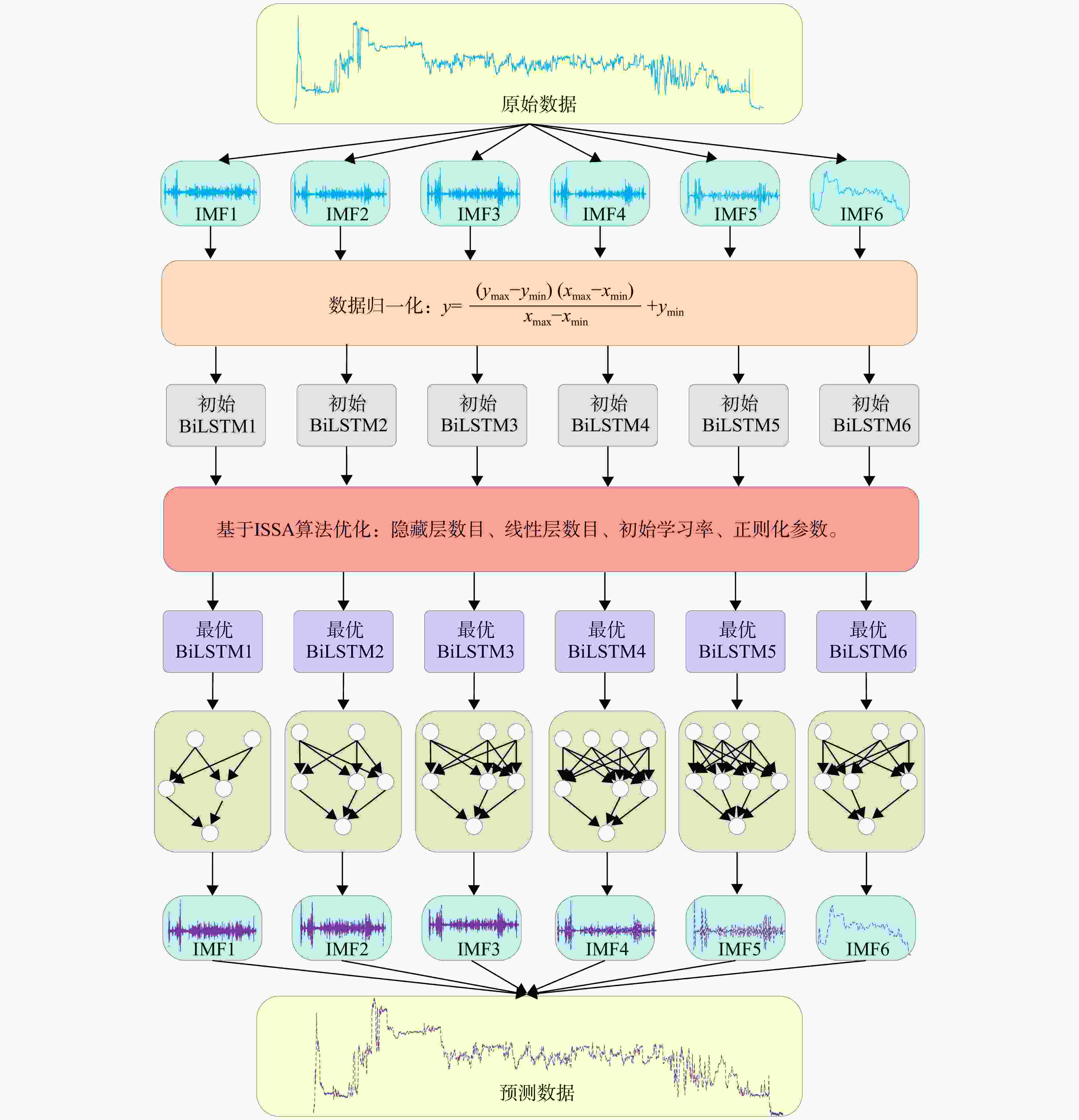
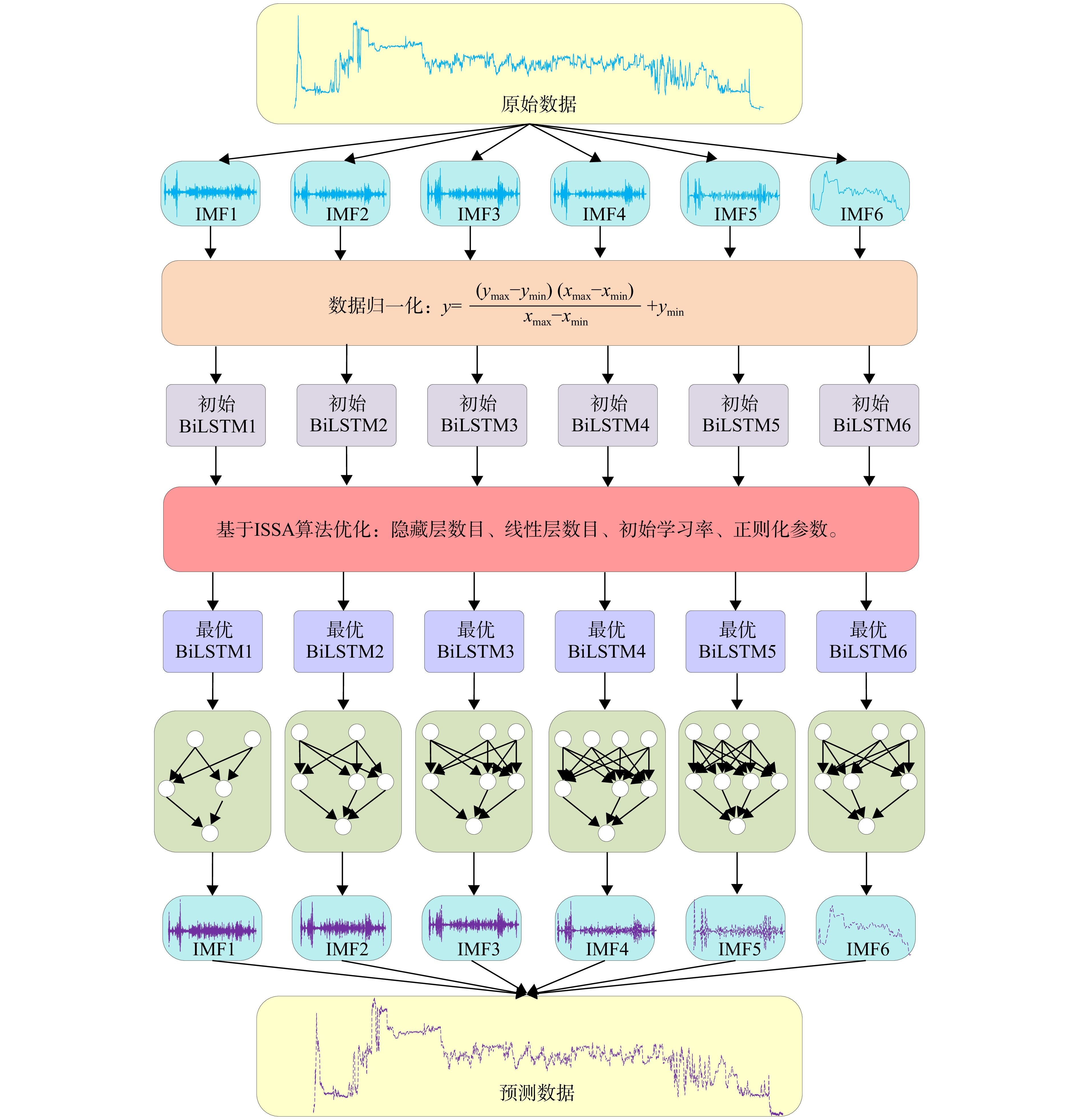
图 5 全工况振动趋势预测模型结构图
Figure 5. Structure of the full-condition vibration trend prediction model

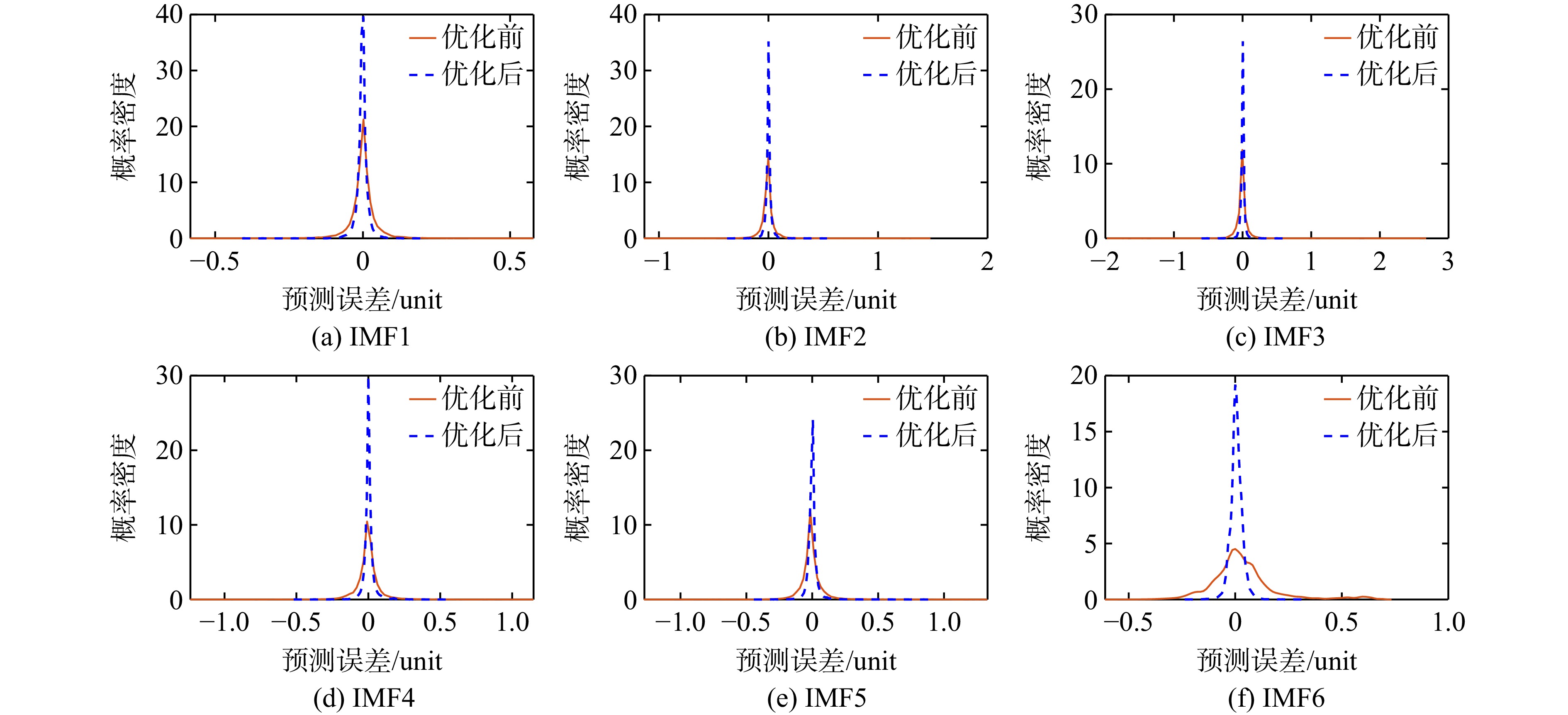
图 9 优化前后预测误差核密度分布曲线
Figure 9. Kernel density distribution curve of prediction error before and after optimization
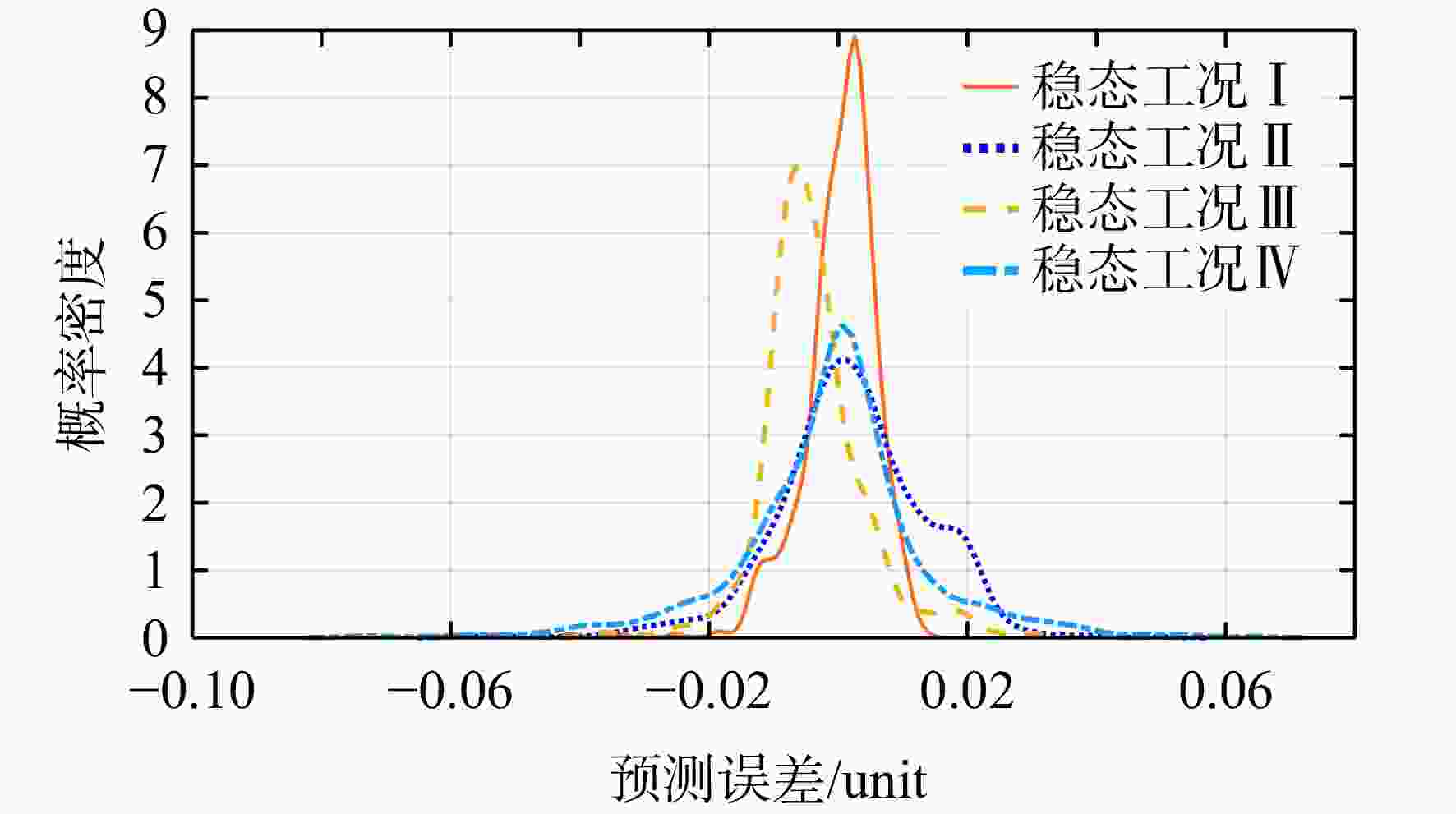
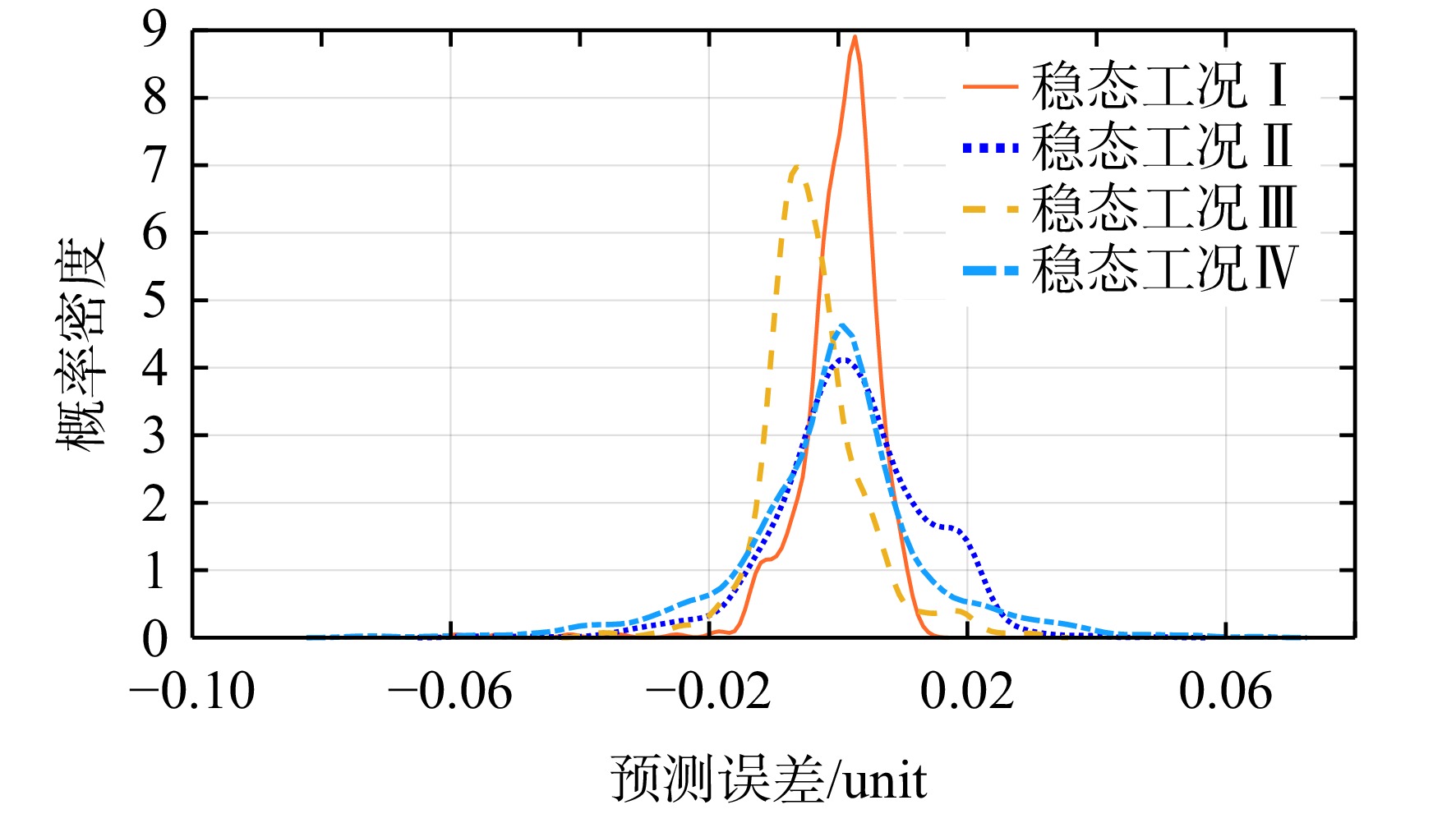
图 10 不同稳态工况预测结果误差分布
Figure 10. Error distribution of prediction results for different steady state conditions
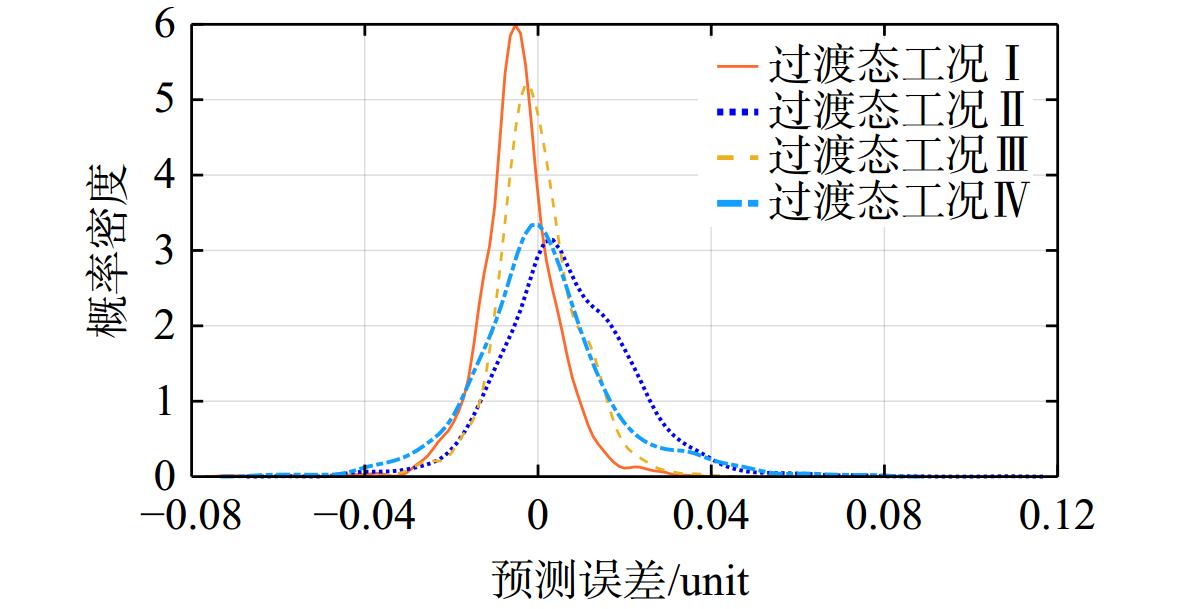
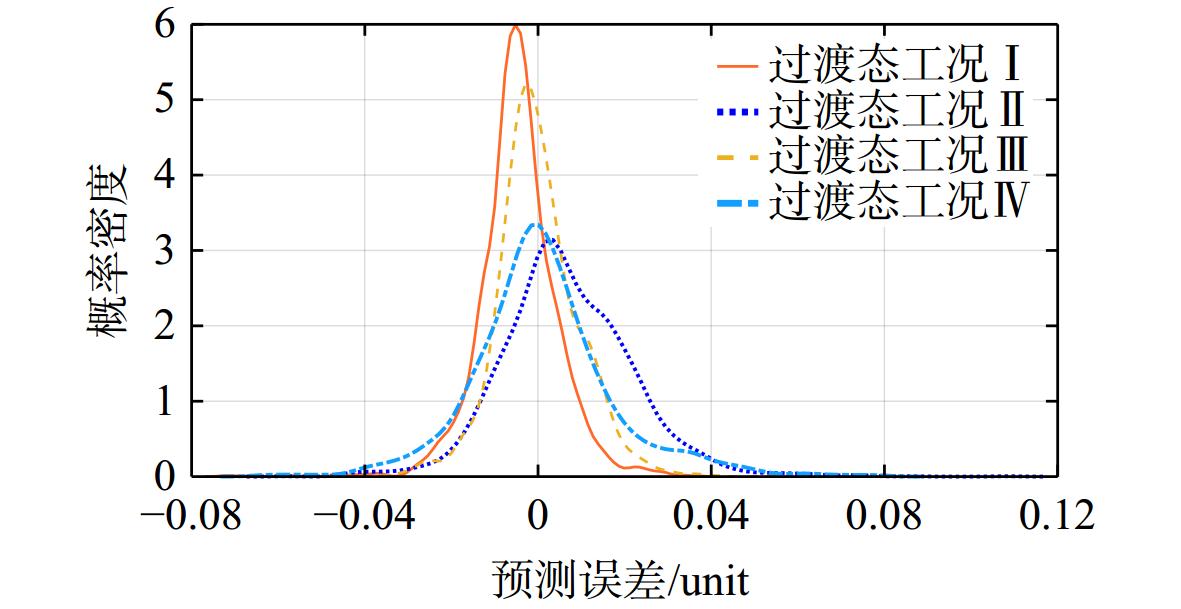
图 11 不同过渡态工况预测结果误差分布
Figure 11. Evaluation of the results of the transitional state prediction
表 1 振动预测数据集统计分析
Table 1. Statistical analysis of vibration prediction data sets
数据集 最大值 最小值 均值 方差 峭度 偏度 A 1.94 0.03 0.62 6.61 2.73 −0.26 B 1.39 0.04 0.59 17.58 1.45 −0.14 C 1.28 0.03 0.69 9.14 2.18 0.27 D 1.42 0.03 0.73 7.96 2.92 0.08 E 0.78 0.03 0.41 2.75 2.86 −0.28  下载: 导出CSV
表 2 参数上下限
Table 2. Upper and lower limits of the parameters
待优化参数 参数上下限 隐藏层数目 [10, 256] 线性层数目 [5, 128] 初始学习率 [ 0.00001 , 0.001]正则化参数 [ 0.00001 , 0.001]
下载: 导出CSV
表 3 各分量预测模型最优参数
Table 3. Optimal parameters for each component prediction model
网络名称 隐藏层数 线性层数 学习率 正则化
参数/10−5BiLSTM1 251 125 0.001 1.0000 BiLSTM2 250 36 0.00074855 1.012 5 BiLSTM3 178 73 0.00069849 1.499 4 BiLSTM4 134 55 0.00043259 1.132 9 BiLSTM5 246 123 0.00096299 1.0000 BiLSTM6 202 88 0.00048237 1.084 5
下载: 导出CSV
表 4 模型参数优化后各分量预测效果提升程度
Table 4. Degree of improvement in the prediction of each component after parameter optimization
IMF $ I_{e_{\mathrm{rms}}} $/% $ I_{e_{\mathrm{ma}}} $/% $ I_{e_{\mathrm{smap}}} $/% $ I_{R^2} $/% $I_{\mathrm{ce}} $/% 1 57.5190 56.2200 44.8224 85.4961 57.7331 2 61.3824 56.0861 40.7828 47.4189 51.3059 3 73.896 64.3452 42.1355 43.8050 56.7022 4 60.1360 60.5181 50.0117 9.3235 48.3561 5 61.6954 62.2857 58.9645 2.8067 51.0687 6 81.0553 79.4395 84.4930 0.4337 68.4949
下载: 导出CSV
表 5 优化前后最终预测结果评价指标
Table 5. Evaluation indicators of final forecast results before and after optimization
评估指标 优化前 优化后 RMSE/unit 0.0985 0.0353 MAE/unit 0.1958 0.0711 SMAPE/% 5.7002 1.7823 R2/% 98.52 99.81
下载: 导出CSV
表 6 稳态工况预测结果评估
Table 6. Result evaluation of steady state condition prediction
稳态工况 RMSE/unit MAE/unit SMAPE/% R2/% Ⅰ 0.0066 0.0044 0.4981 99.642 Ⅱ 0.0118 0.0088 0.8301 99.463 Ⅲ 0.0089 0.0070 1.1062 79.2925 Ⅳ 0.0149 0.0101 2.1134 91.7732
下载: 导出CSV
表 7 过渡态工况预测结果评估
Table 7. Result evaluation of transitional state condition prediction
过渡态工况 RMSE/unit MAE/unit SMAPE/% R2/% Ⅰ 0.0104 0.0079 1.6068 99.4703 Ⅱ 0.0166 0.0124 1.2857 99.4504 Ⅲ 0.0096 0.0072 0.9610 99.2389 Ⅳ 0.0165 0.0117 3.3387 92.2184
下载: 导出CSV
-
[1] 尉询楷. 航空发动机预测与健康管理[M]. 北京: 国防工业出版社,2014. YU Xunkai. Aeroengine prognostics and health management[M]. Beijing: National Defense Industry Press,2014. (in ChineseYU Xunkai. Aeroengine prognostics and health management[M]. Beijing: National Defense Industry Press, 2014. (in Chinese) [2] 王俨剀,廖明夫,丁小飞. 航空发动机故障诊断[M]. 北京: 科学出版社,2020. [3] SAFETY A. Statistical summary of commercial jet airplane accidents[R]. Chicago,US:Boeing Commercial Airplanes,2011. [4] REVELEY M S,BRIGGS J L,EVANS J K,et al. Commercial aircraft integrated vehicle health management study[R]. NASA/TM-2010-215808,2010. [5] STOLZER A J,GOGLIA J J. Safety management systems in aviation[M]. London: Routledge,2016. [6] ELSAID A,WILD B,HIGGINS J,et al. Using LSTM recurrent neural networks to predict excess vibration events in aircraft engines[C]//2016 IEEE 12th International Conference on e-Science. Piscataway,US: IEEE,2016: 260-269. [7] 夏存江,詹于游. 基于改进的SENet航空发动机振动预测[J]. 航空动力学报,2022,37(12): 2807-2817. XIA Cunjiang,ZHAN Yuyou. Vibration prediction of aeroengines based on enhanced SENet model[J]. Journal of Aerospace Power,2022,37(12): 2807-2817. (in ChineseXIA Cunjiang, ZHAN Yuyou. Vibration prediction of aeroengines based on enhanced SENet model[J]. Journal of Aerospace Power, 2022, 37(12): 2807-2817. (in Chinese) [8] 张瑞成,曹志新. 基于EEMD-LSTM的冷连轧机振动预测研究[J]. 锻压技术,2022,47(9): 174-181. ZHANG Ruicheng,CAO Zhixin. Research on vibration prediction for tandem cold rolling mill based on EEMD-LSTM[J]. Forging & Stamping Technology,2022,47(9): 174-181. (in ChineseZHANG Ruicheng, CAO Zhixin. Research on vibration prediction for tandem cold rolling mill based on EEMD-LSTM[J]. Forging & Stamping Technology, 2022, 47(9): 174-181. (in Chinese) [9] WANG Huiyun,GUO Maozu,TIAN Le. A deep learning model with signal decomposition and informer network for equipment vibration trend prediction[J]. Sensors,2023,23(13): 5819. doi: 10.3390/s23135819 [10] 王晓燕,白贤明,宋辞,等. 基于EMD-LSTM模型的APU排气温度预测[J]. 航空动力学报,2024,39(8): 20220076. WANG Xiaoyan,BAI Xianming,SONG Ci,et al. APU exhaust temperature prediction based on EMD-LSTM model[J]. Journal of Aerospace Power,2024,39(8): 20220076. (in Chinese doi: 10.13224/j.cnki.jasp.20220076WANG Xiaoyan, BAI Xianming, SONG Ci, et al. APU exhaust temperature prediction based on EMD-LSTM model[J]. Journal of Aerospace Power, 2024, 39(8): 20220076. (in Chinese) doi: 10.13224/j.cnki.jasp.20220076 [11] TONG Kaixuan,ZHANG Genge,HUANG Huade,et al. A novel combined model for vibration trend prediction of a hydropower generator unit[J]. Insight-Non-Destructive Testing and Condition Monitoring,2023,65(1): 43-51. doi: 10.1784/insi.2023.65.1.43 [12] FU Wenlong,WANG Kai,LI Chaoshun,et al. Vibration trend measurement for a hydropower generator based on optimal variational mode decomposition and an LSSVM improved with chaotic sine cosine algorithm optimization[J]. Measurement Science and Technology,2019,30(1): 015012. doi: 10.1088/1361-6501/aaf377 [13] 王璞,姬联涛,陈龙翔,等. 基于WOA-VMD-TCN的水电机组振动趋势预测[J]. 水电能源科学,2023,41(6): 175-179. WANG Pu,JI Liantao,CHEN Longxiang,et al. Prediction of vibration trend of hydroelectric unit based on WOA-VMD-TCN[J]. Water Resources and Power,2023,41(6): 175-179. (in ChineseWANG Pu, JI Liantao, CHEN Longxiang, et al. Prediction of vibration trend of hydroelectric unit based on WOA-VMD-TCN[J]. Water Resources and Power, 2023, 41(6): 175-179. (in Chinese) [14] 王继选,胡润志,管一,等. 基于RFOA优化GRNN的水电机组振动预测[J]. 振动与冲击,2021,40(21): 120-126. WANG Jixuan,HU Runzhi,GUAN Yi,et al. Vibration prediction of hydropower unit based on RFOA-GRNN[J]. Journal of Vibration and Shock,2021,40(21): 120-126. (in ChineseWANG Jixuan, HU Runzhi, GUAN Yi, et al. Vibration prediction of hydropower unit based on RFOA-GRNN[J]. Journal of Vibration and Shock, 2021, 40(21): 120-126. (in Chinese) [15] ELSAID A,EL JAMIY F,HIGGINS J,et al. Optimizing long short-term memory recurrent neural networks using ant colony optimization to predict turbine engine vibration[J]. Applied Soft Computing,2018,73: 969-991. doi: 10.1016/j.asoc.2018.09.013 [16] 潘洛华. 基于SSA-CNN-BILSTM的电力短期负荷数据预测方法[D]. 杭州: 浙江大学,2022. PAN Luohua. Power short-term load data forecasting method based on SSA-CNN-BILSTM[D]. Hangzhou: Zhejiang University,2022. (in ChinesePAN Luohua. Power short-term load data forecasting method based on SSA-CNN-BILSTM[D]. Hangzhou: Zhejiang University, 2022. (in Chinese) [17] DRAGOMIRETSKIY K,ZOSSO D. Variational mode decomposition[J]. IEEE Transactions on Signal Processing,2014,62(3): 531-544. doi: 10.1109/TSP.2013.2288675 [18] 龚凤乾. 等级相关系数公式的证明应用及统计显著性检验[J]. 现代财经-天津财经学院学报,1987,7(1): 33-36. GONG Fengqian. Proof application of rank correlation coefficient formula and statistical significance test[J]. Modern Finance and Economics-Journal of Tianjin University of Finance and Economics,1987,7(1): 33-36. (in chineseGONG Fengqian. Proof application of rank correlation coefficient formula and statistical significance test[J]. Modern Finance and Economics-Journal of Tianjin University of Finance and Economics, 1987, 7(1): 33-36. (in chinese) [19] XUE Jiankai,SHEN Bo. A novel swarm intelligence optimization approach: sparrow search algorithm[J]. Systems Science & Control Engineering,2020,8(1): 22-34. [20] TIZHOOSH H R. Opposition-based learning: a new scheme for machine intelligence[C]//International Conference on Computational Intelligence for Modelling,Control and Automation and International Conference on Intelligent Agents,Web Technologies and Internet Commerce. Piscataway,US: IEEE,2005: 695-701. [21] SIAMI-NAMINI S,TAVAKOLI N,NAMIN A S. The performance of LSTM and BiLSTM in forecasting time series[C]//2019 IEEE International Conference on Big Data. Piscataway,US: IEEE,2019: 3285-3292. [22] 陈少龙,屠征音. 关于CFM56-5B发动机高压转子振动监控的若干思考[J]. 航空维修与工程,2014(3): 49-51. CHEN Shaolong,TU Zhengyin. Exploration about vibration monitoring of the high pressure rotor on CFM56-5B[J]. Aviation Maintenance & Engineering,2014(3): 49-51. (in ChineseCHEN Shaolong, TU Zhengyin. Exploration about vibration monitoring of the high pressure rotor on CFM56-5B[J]. Aviation Maintenance & Engineering, 2014(3): 49-51. (in Chinese) -

 点击查看大图

计量
- 文章访问数: 671
- HTML浏览量: 488
- PDF量: 81
- 被引次数: 0