






Aero-engine life prediction method based on multi-scale CNN and Transformer
-
摘要:
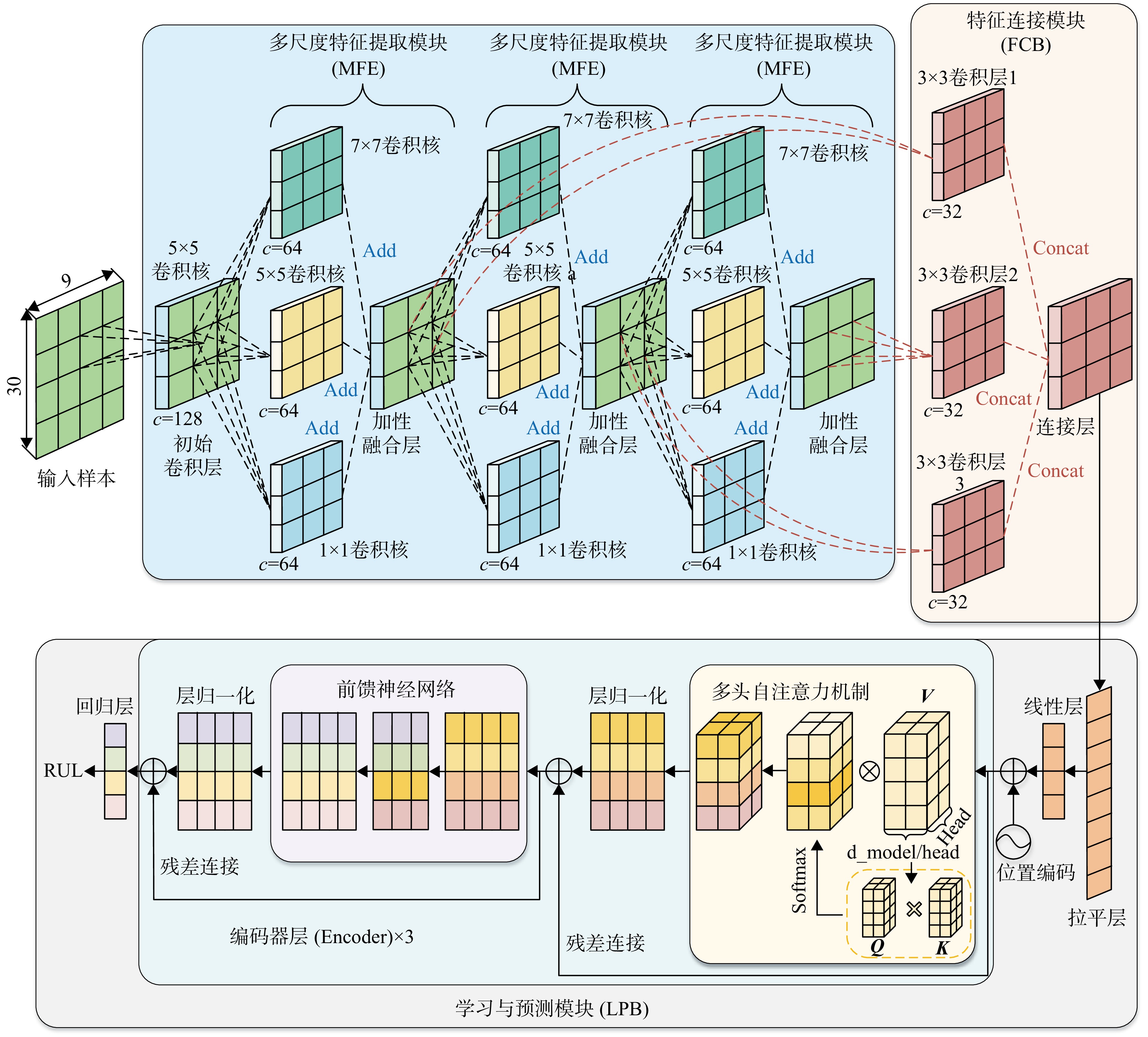
目前在航空发动机剩余寿命预测中,通常仅考虑了单一尺度退化特征,并且在处理具有长期依赖关系的时序数据时效率低下。提出了一种基于多尺度CNN和Transformer的航空发动机剩余寿命预测方法。在传统CNN的基础上设计了多尺度特征提取模块,挖掘并融合了不同尺度下的退化特征;构造了特征连接模块,弥补了传统特征提取模块只能从同一层面提取特征的不足;基于Transformer的位置编码、多头自注意力机制和前馈神经网络实现了时序数据长期依赖特征的学习,利用多头注意力机制的并行计算能力降低了网络的运行时间。在C-MAPSS数据集上进行了实验验证,结果表明:所提方法与未提取多尺度特征的网络相比误差更小;并且相对于按顺序处理时序数据的RNN、LSTM和GRU等网络,运算时间分别降低了65.77%、48.41%和45.02%。
-
关键词:
- 剩余寿命预测 /
- 卷积神经网络 /
- Transformer架构 /
- 多尺度特征提取 /
- 注意力机制
Abstract:Multi-scale degradation features are seldom considered in remaining life prediction for aero-engine, and it is inefficient in dealing with time-series data with long-term dependencies. A remaining life prediction method is proposed based on multi-scale CNN and Transformer. A multi-scale feature extraction module is designed by traditional CNN, which extracts and integrates degradation features at different scales. A feature connection module is constructed to make up for the shortage that traditional feature extraction module can only extract features from the same level. The learning of long-term dependency features for time-series data is realized based on the position encoding, the multi-head self-attention mechanism and the feed-forward neural network of the Transformer. The parallel computing of the multi-head attention mechanism is utilized to reduce network runtime. Experimental validation is carried out on the C-MAPSS dataset, and the results show that our proposed method has less error compared with the network without extracting multi-scale features. Compared with RNN, LSTM and GRU, the operation time is reduced by 65.77%, 48.41%, and 45.02%, respectively.
-
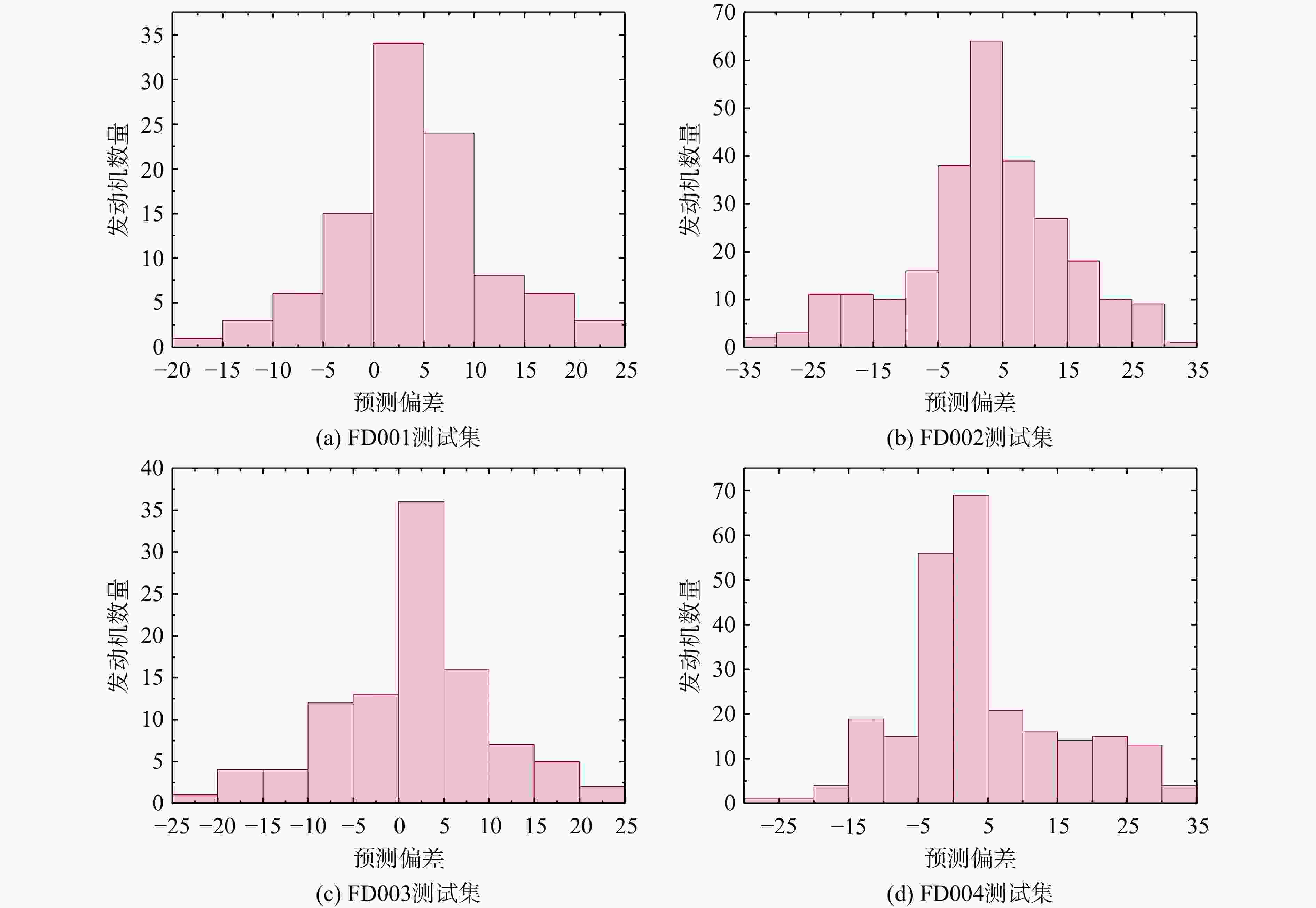
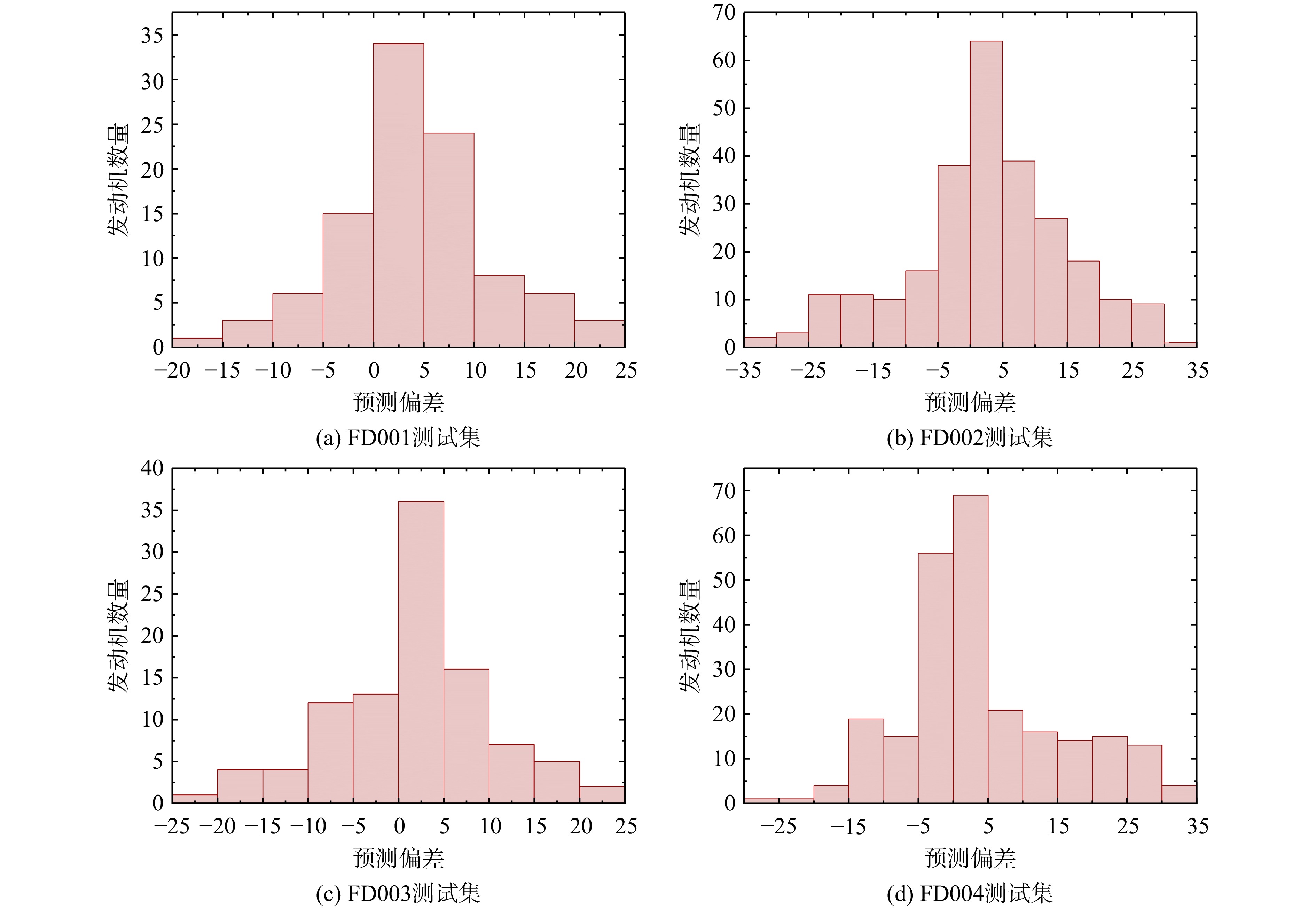
图 8 测试集的预测偏差分布(FD001~FD004)
Figure 8. Prediction deviation distribution of the test set (FD001—FD004)
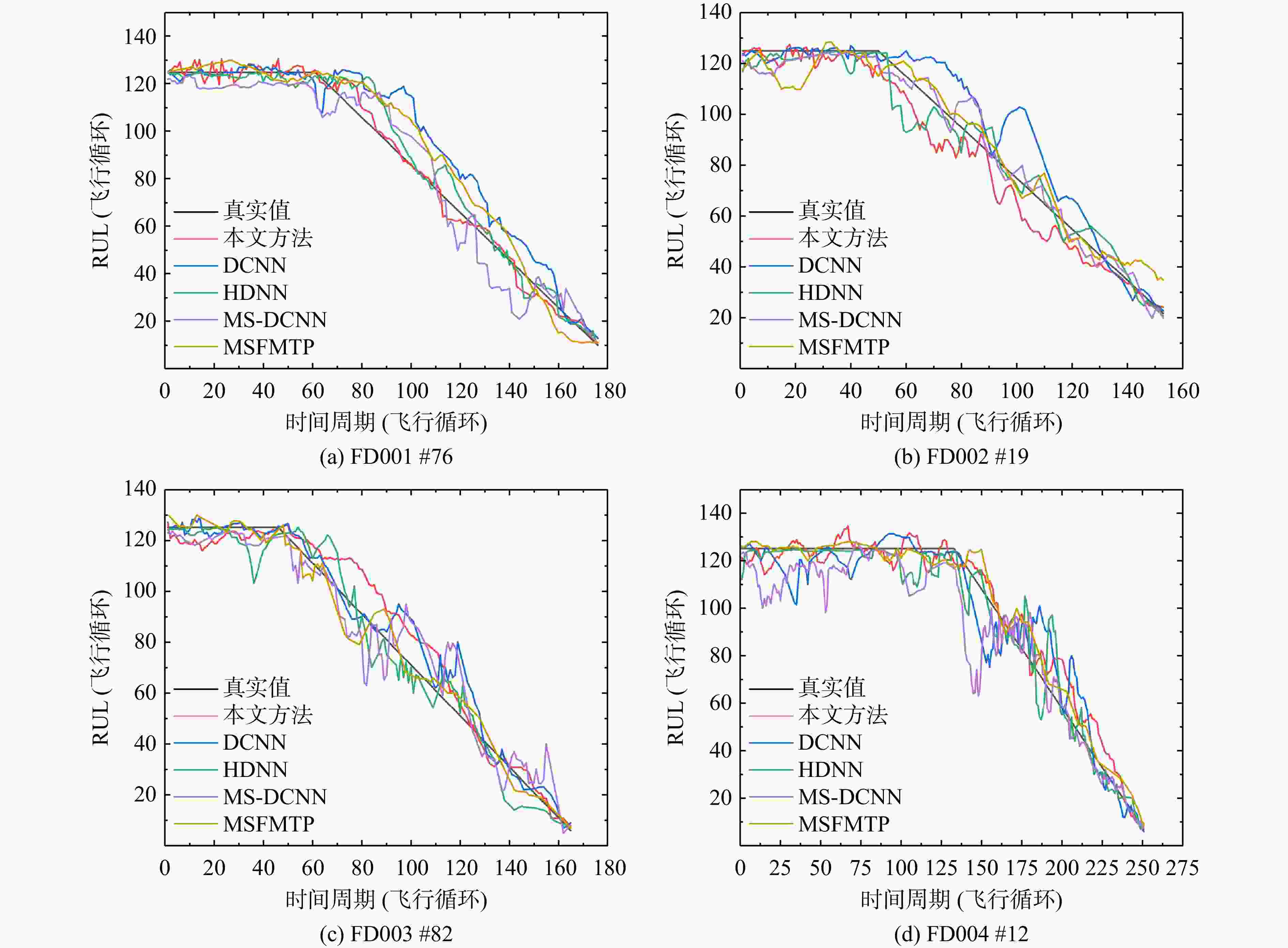
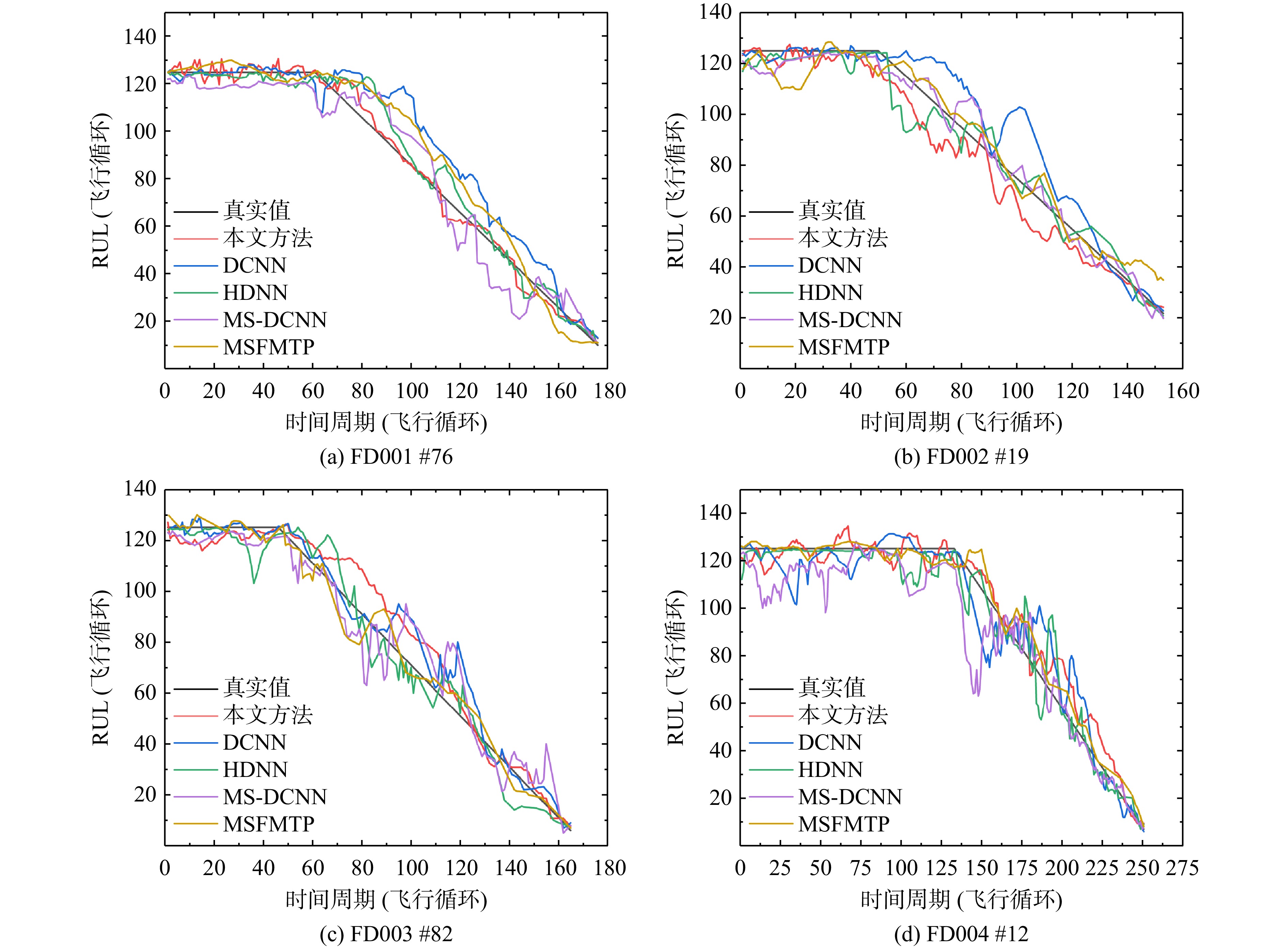
图 9 单台发动机的RUL预测结果(FD001~FD004)
Figure 9. RUL prediction for a single engine (FD001—FD004)
表 1 预处理后的输入样本基本情况
Table 1. Preprocessed input sample details and labels
数据集 FD001 FD002 FD003 FD004 训练集中发动机数 100 260 100 249 训练集中样本数 17731 48819 21820 56518 测试集中发动机数 100 259 100 248 运行工况 1 6 1 6 故障模式 HPC HPC HPC&FAN HPC&FAN 输入时间窗尺寸 30×9 20×10 30×9 20×10  下载: 导出CSV
表 2 不同网络的训练时间
Table 2. Training time of different network
方法 时间/s 本文 1241.41 RNN 3627.04 LSTM 2257.98 Bi-LSTM 2846.60 GRU 2406.51 Bi-GRU 2657.36
下载: 导出CSV
表 3 本文网络的最优参数
Table 3. Optimal parameters of the network
参数 FD001 FD002 FD003 FD004 最大周期数 100 100 100 100 批大小 512 512 512 512 窗口长度T 30 20 30 20 L2正则化 0.001 0.001 0.0006 0.008 Rearly 125 125 125 125 dmodel 512 512 512 512 头的数量 8 8 8 8 学习率 0.0001 0.0001 0.0003 0.0001 等待周期数 10 10 10 10 激活函数 ReLU ReLU ReLU ReLU 前馈层上的神经元数量 512/128 512/128 512/128 512/128
下载: 导出CSV
-
[1] ORSAGH R F, SHELDON J, KLENKE C J. Prognostics/diagnostics for gas turbine engine bearings[M]. Atlanta, US: American Society of Mechanical Engineers. 2003. [2] CHIACHÍO J, CHIACHÍO M, SANKARARAMAN S, et al. Condition-based prediction of time-dependent reliability in composites[J]. Reliability Engineering & System Safety, 2015, 142: 134-147. [3] SATEESH B G, ZHAO Peilin, Li Xiaoli. Deep convolutional neural network based regression approach for estimation of remaining useful life[C]// Database Systems for Advanced Applications. 21st International Conference. Dallas, USA: Springer International Publishing, 2016: 214-228. [4] LI Xiang, DING Qian, SUN Jianqiao. Remaining useful life estimation in prognostics using deep convolution neural networks[J]. Reliability Engineering & System Safety, 2018, 172: 1-11. [5] LIU Zhenyu, LIU Hui, JIA Weiqiang, et al. A multi-head neural network with unsymmetrical constraints for remaining useful life prediction[J]. Advanced Engineering Informatics, 2021, 50: 101396. doi: 10.1016/j.aei.2021.101396 [6] 陈保家, 郭凯敏, 陈法法, 等. 基于残差NLSTM网络和注意力机制的航空发动机剩余使用寿命预测[J]. 航空动力学报, 2023, 38(5): 1176-1184. CHEN Baojia, GUO Kaimin, CHEN Fafa, et al. Prediction of remaining useful life of aero-engine based on residual NLSTM neural network and attention mechanism[J]. Journal of Aerospace Power, 2023, 38(5): 1176-1184. (in Chinese doi: 10.13224/j.cnki.jasp.20210728CHEN Baojia, GUO Kaimin, CHEN Fafa, et al. Prediction of remaining useful life of aero-engine based on residual NLSTM neural network and attention mechanism[J]. Journal of Aerospace Power, 2023, 38(5): 1176-1184. (in Chinese) doi: 10.13224/j.cnki.jasp.20210728 [7] AL-DULAIMI A, ZABIHI S, ASIF A, et al. A multimodal and hybrid deep neural network model for Remaining Useful Life estimation[J]. Computers in Industry, 2019, 108: 186-196. doi: 10.1016/j.compind.2019.02.004 [8] 郭晓静, 徐晓慧, 郭佳豪. 基于改进GRU的航空发动机寿命预测自注意力优化算法[J]. 航空动力学报, 2024, 39(12): 20220984. GUO Xiaojing, XU Xiaohui, GUOJIA Hao. Improved GRU-based self-attention optimization algorithm for aero-engine remaining useful life prediction[J]. Journal of Aerospace Power, 2024, 39(12): 20220984. (in Chinese doi: 10.13224/j.cnki.jasp.20220984GUO Xiaojing, XU Xiaohui, GUOJIA Hao. Improved GRU-based self-attention optimization algorithm for aero-engine remaining useful life prediction[J]. Journal of Aerospace Power, 2024, 39(12): 20220984. (in Chinese) doi: 10.13224/j.cnki.jasp.20220984 [9] SONG J W, PARK Y I, HONG J J, et al. Attention-based bidirectional LSTM-CNN model for remaining useful life estimation[C]//2021 IEEE International Symposium on Circuits and Systems. Daegu, Korea: IEEE, 2021: 1-5. [10] ZHANG Jiusi, JIANG Yuchen, WU Shimeng, et al. Prediction of remaining useful life based on bidirectional gated recurrent unit with temporal self-attention mechanism[J]. Reliability Engineering & System Safety, 2022, 221: 108297. [11] LI Han, ZHAO Wei, ZHANG Yuxi, et al. Remaining useful life prediction using multi-scale deep convolutional neural network[J]. Applied Soft Computing, 2020, 89: 106113. doi: 10.1016/j.asoc.2020.106113 [12] MO Yu, WU Qianhui, LI Xiu, et al. Remaining useful life estimation via transformer encoder enhanced by a gated convolutional unit[J]. Journal of Intelligent Manufacturing, 2021, 32(7): 1997-2006. doi: 10.1007/s10845-021-01750-x [13] SAXENA A, GOEBEL K, SIMON D, et al. Damage propagation modeling for aircraft engine Run-to-failure simulation[C]//2008 International Conference on Prognostics and Health Management. Denver, US: IEEE, 2008: 1-9. [14] FREDERICK D K, DECASTRO J A, LITT J S. User's guide for the commercial modular aero-propulsion system simulation (C-MAPSS): E-16205 [R]. Cleveland, USA: Glenn Research Center, 2007. [15] XU Dan, XIAO Xiaoqi, LIU Jie, et al. Spatio-temporal degradation modeling and remaining useful life prediction under multiple operating conditions based on attention mechanism and deep learning[J]. Reliability Engineering & System Safety, 2023, 229: 108886. [16] ADNAN R M, KHOSRAVINIA P, KARIMI B, et al. Prediction of hydraulics performance in drain envelopes using Kmeans based multivariate adaptive regression spline[J]. Applied Soft Computing, 2021, 100: 107008. doi: 10.1016/j.asoc.2020.107008 [17] 车畅畅, 王华伟, 倪晓梅, 等. 基于1D-CNN和Bi-LSTM的航空发动机剩余寿命预测[J]. 机械工程学报, 2021, 57(14): 304-312. CHE Changchang, WANG Huawei, NI Xiaomei, et al. Residual life prediction of aeroengine based on 1D-CNN and Bi-LSTM[J]. Journal of Mechanical Engineering, 2021, 57(14): 304-312. (in Chinese doi: 10.3901/JME.2021.14.304CHE Changchang, WANG Huawei, NI Xiaomei, et al. Residual life prediction of aeroengine based on 1D-CNN and Bi-LSTM[J]. Journal of Mechanical Engineering, 2021, 57(14): 304-312. (in Chinese) doi: 10.3901/JME.2021.14.304 [18] AL-DULAIMI A, ZABIHI S, ASIF A, et al. NBLSTM: noisy and hybrid convolutional neural network and BLSTM-based deep architecture for remaining useful life estimation[J]. Journal of Computing and Information Science in Engineering, 2020, 20(2): 021012. doi: 10.1115/1.4045491 [19] VASWANI A, SHAZIER N, PARMAR N, et al. Attention is all you need[J]. Advances in Neural Information Processing Systems, 2017, 30: 6000-6010. [20] ZHOU Liang, WANG Huawei, XU Shanshan. Aero-engine prognosis strategy based on multi-scale feature fusion and multi-task parallel learning[J]. Reliability Engineering & System Safety, 2023, 234: 109182. -

 点击查看大图

计量
- 文章访问数: 930
- HTML浏览量: 587
- PDF量: 59
- 被引次数: 0