






Aeroengine baseline prediction model based on improved ADDA
-
摘要:
针对现有领域自适应方法在不同型号航空发动机基线迁移预测中存在预测精度较低的问题,提出了一种基于改进对抗性判别域自适应(ADDA)的新型预测模型。在ADDA模型的基础上,引入了Transformer结构和自注意力机制,以提取航空发动机性能数据的长时序特征,增强模型对动态特征的捕获能力。在领域对抗模块分别设计了最大均值差异和信息噪声对比估计优化结构,充分利用有限输入数据的信息并减少冗余信息的干扰,提高了模型在跨型号航空发动机基线预测中的准确性。结果表明:改进后的ADDA模型对发动机排气温度基线预测的平均绝对误差和方均根误差分别降低19.3%和16.2%,相关系数平方提高4.4%。对燃油流量基线预测的平均绝对误差和方均根误差分别降低26.8%和30.1%,相关系数平方提高6.4%。高压转子转速的平均绝对误差和方均根误差分别降低19.6%和20.0%,相关系数平方提高6.5%。改进方法能够更精确地进行不同型号航空发动机基线预测。
-
关键词:
- 航空发动机基线预测 /
- 领域自适应 /
- Transformer模型 /
- 最大均值差异 /
- 信息噪声对比估计
Abstract:The challenge of low prediction accuracy in cross-model aeroengine baseline transfer prediction with existing domain adaptation methods was addressed by proposing a novel prediction model based on improved adversarial discriminative domain adaptation (ADDA). The proposed approach incorporated Transformer architecture and self-attention mechanisms to extract long-term features from aeroengine performance data, and enhanced the model’s capacity to capture dynamic features. Additionally, in the domain adversarial module, maximum mean discrepancy and information noise contrast estimation optimization structures were introduced to better leverage the information from limited input data and mitigate interference from redundant information. Consequently the model achieved enhanced accuracy in cross-model aeroengine baseline prediction. Experimental results demonstrated that the improved ADDA model reduced the mean absolute error and root mean square error of baseline prediction for engine gas temperature by 19.3% and 16.2% respectively, while increasing the coefficient of determination by 4.4%. For the baseline of fuel flow, the mean absolute error and root mean square error were reduced by 26.8% and 30.1%, while the coefficient of determination increased by 6.4%. For the baseline of high-pressure rotor speed, the mean absolute error and root mean square error were reduced by 19.6% and 20.0%, while the coefficient of determination increased by 6.5%. This improvement enabled more precise prediction of baselines across different aeroengine models.
-
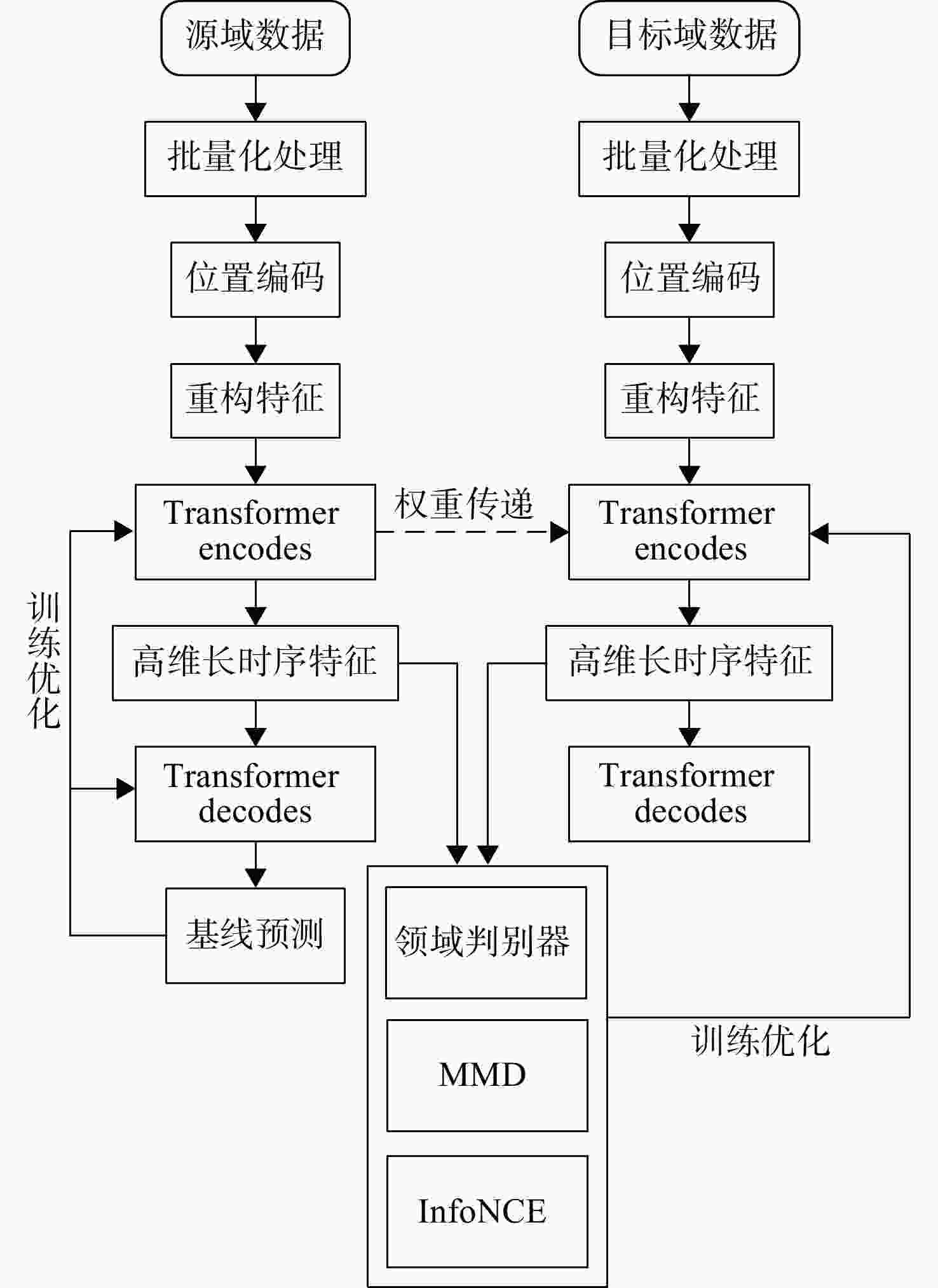
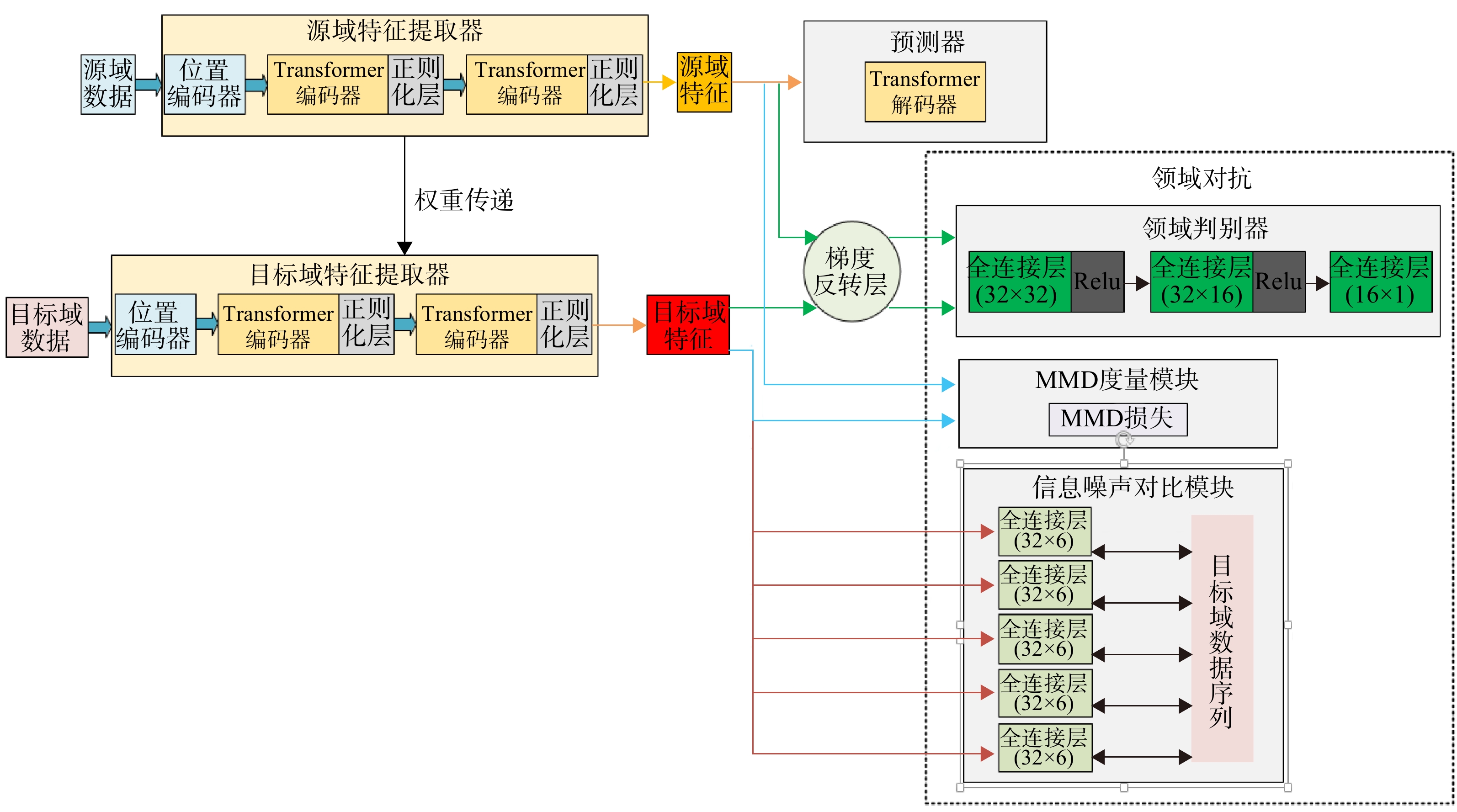
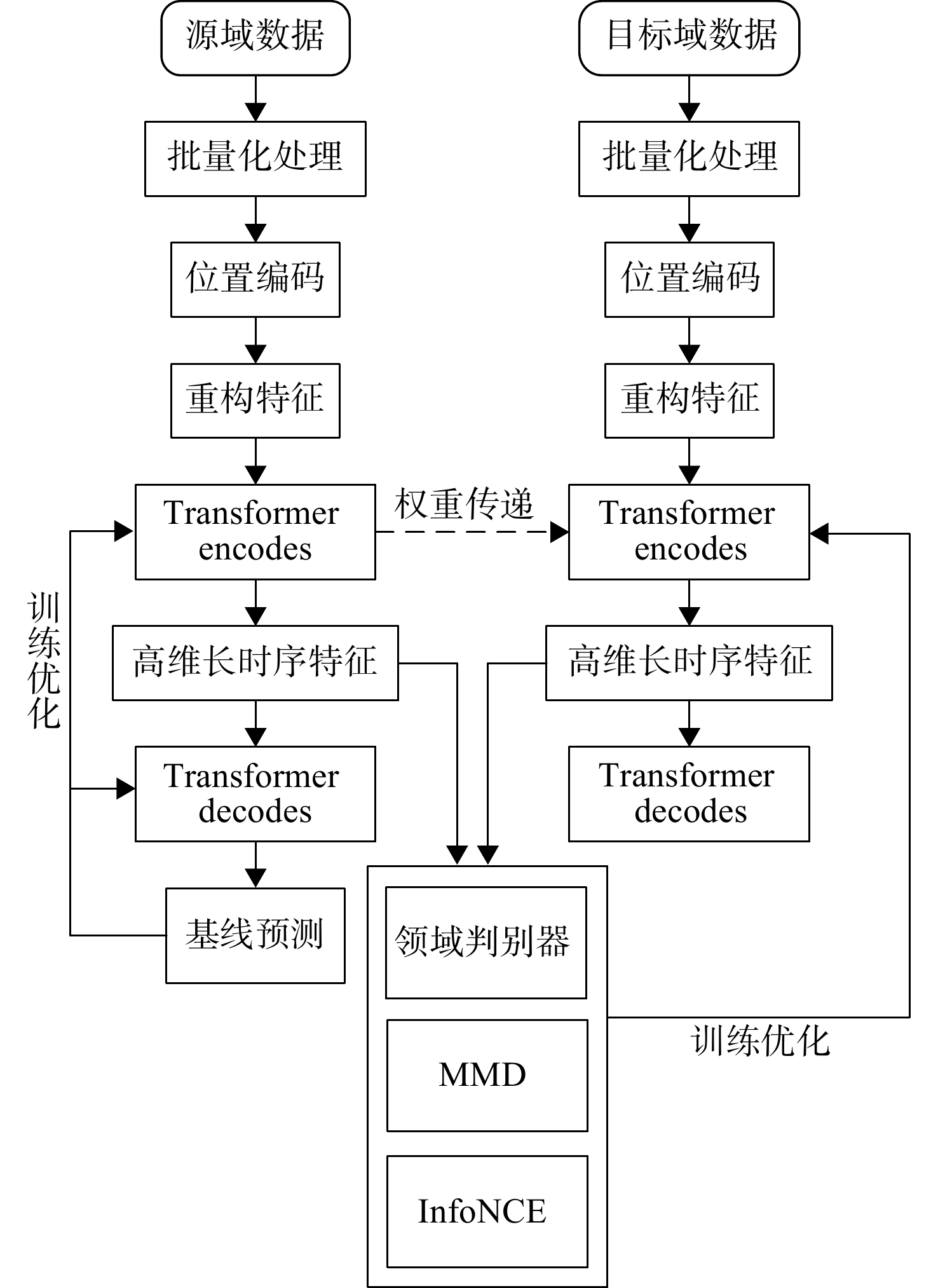
图 5 基于改进ADDA的航空发动机基线预测流程
Figure 5. Process of aeroengine baseline prediction based on an improved ADDA
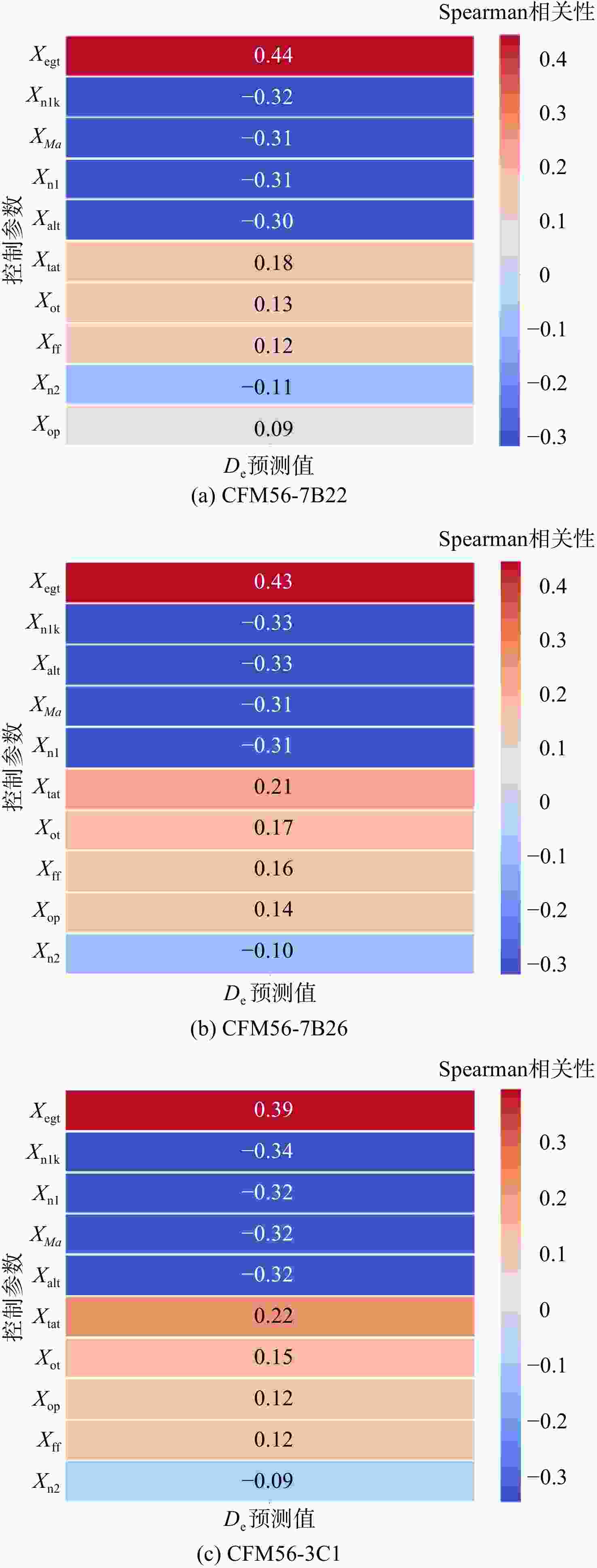
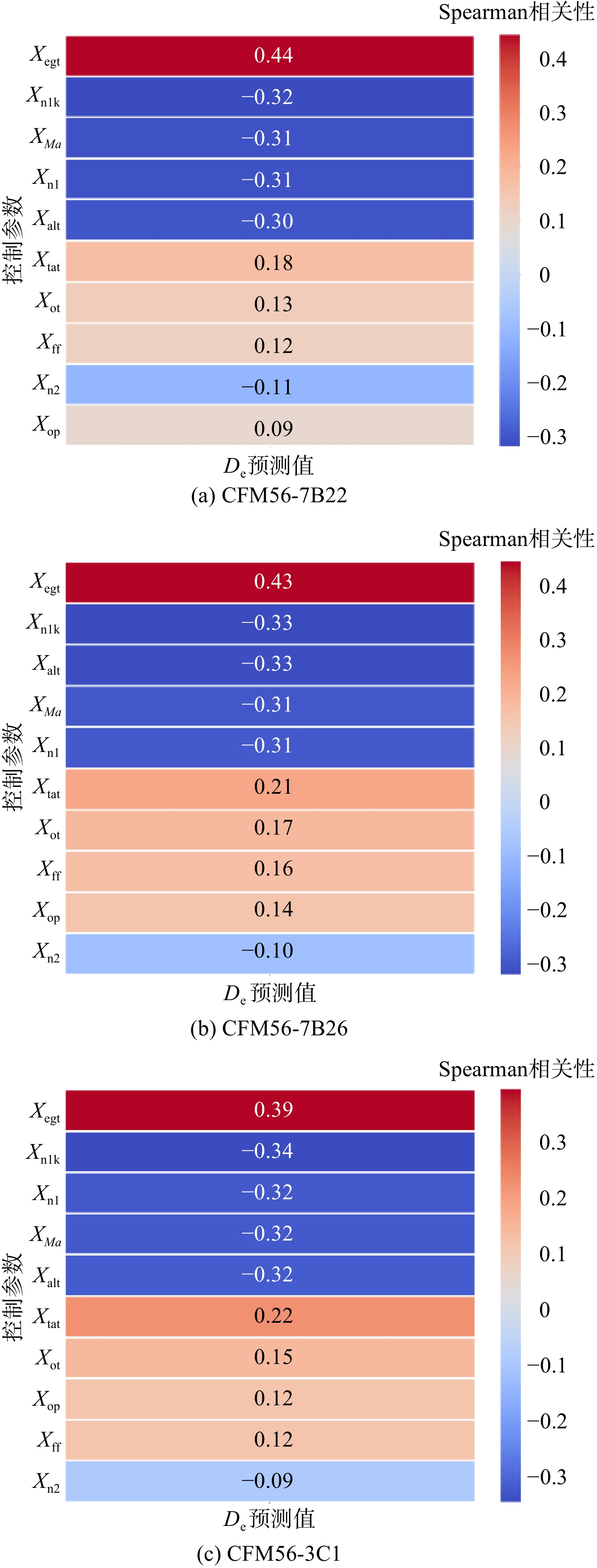
图 6 3种型号航空发动机$ {{D}}_{\text{e}} $的Spearman相关性热图
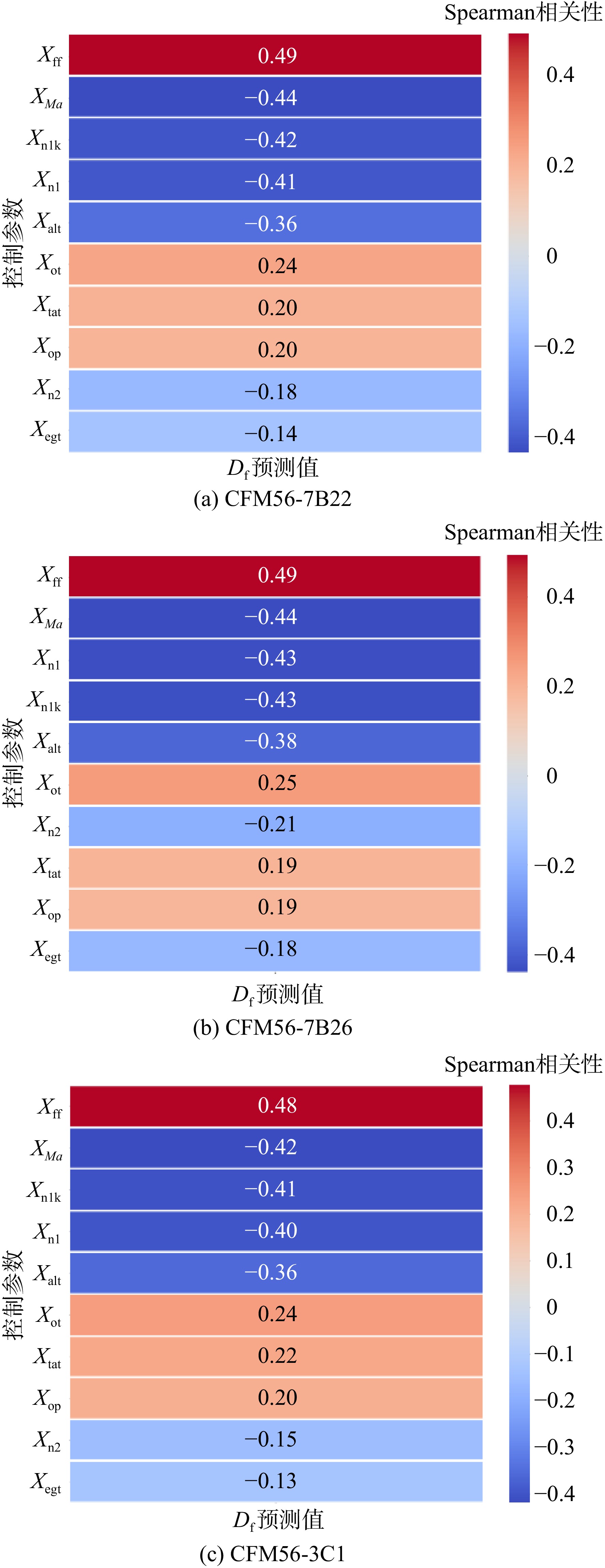
Figure 6. Spearman correlation between control parameters and $ {{D}}_{\text{e}} $
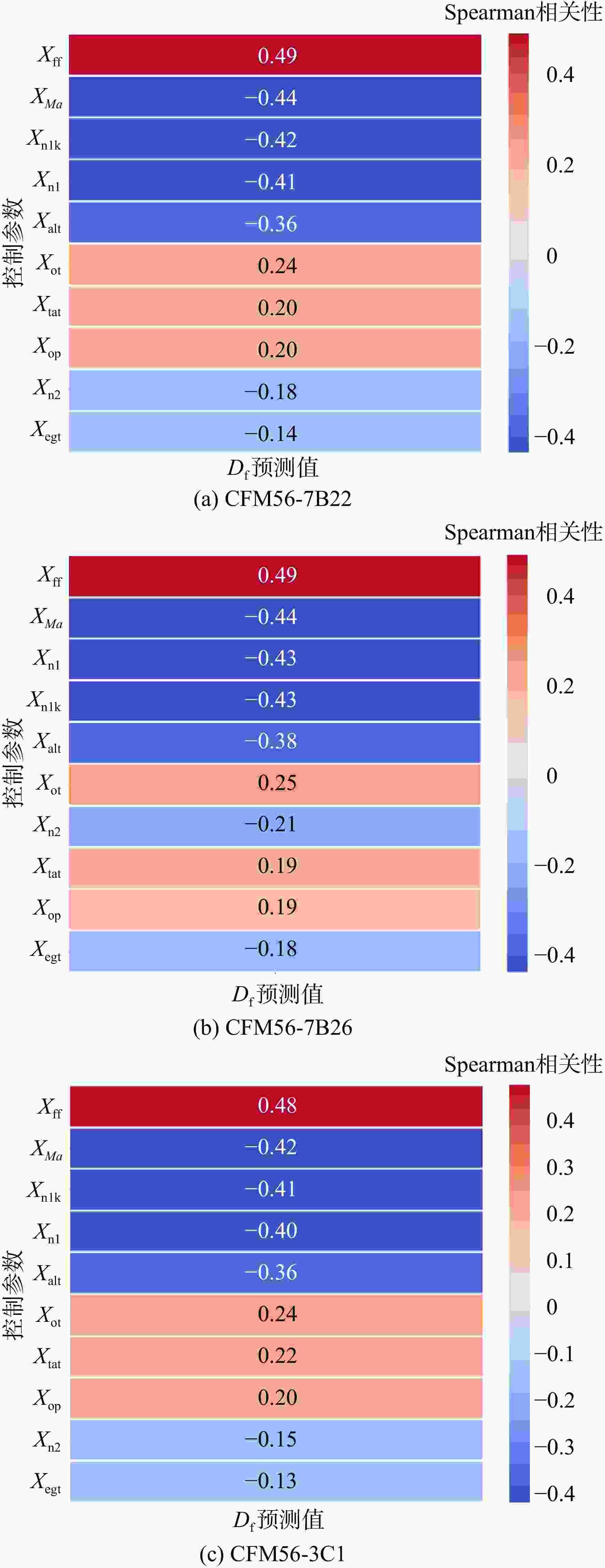
图 7 3种型号航空发动机$ {{D}}_{\text{f}} $的Spearman相关性热图
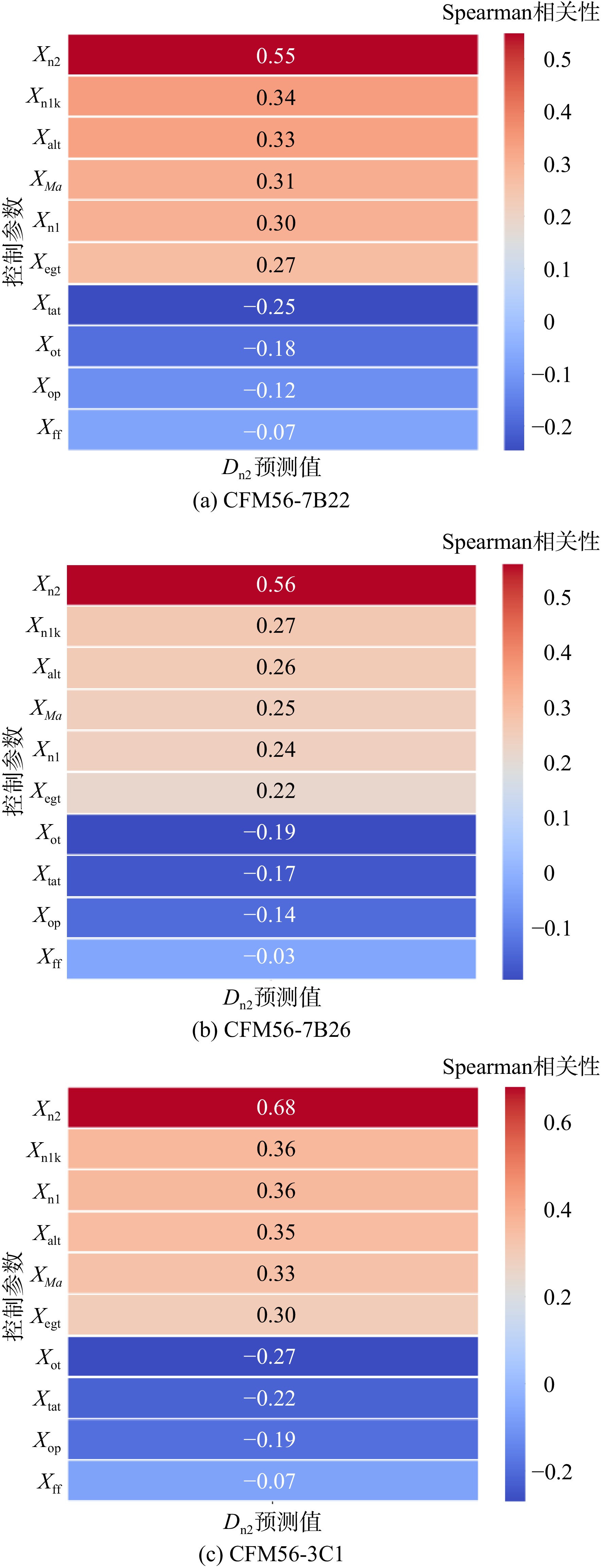
Figure 7. Spearman correlation between control parameters and $ {{D}}_{\text{f}} $
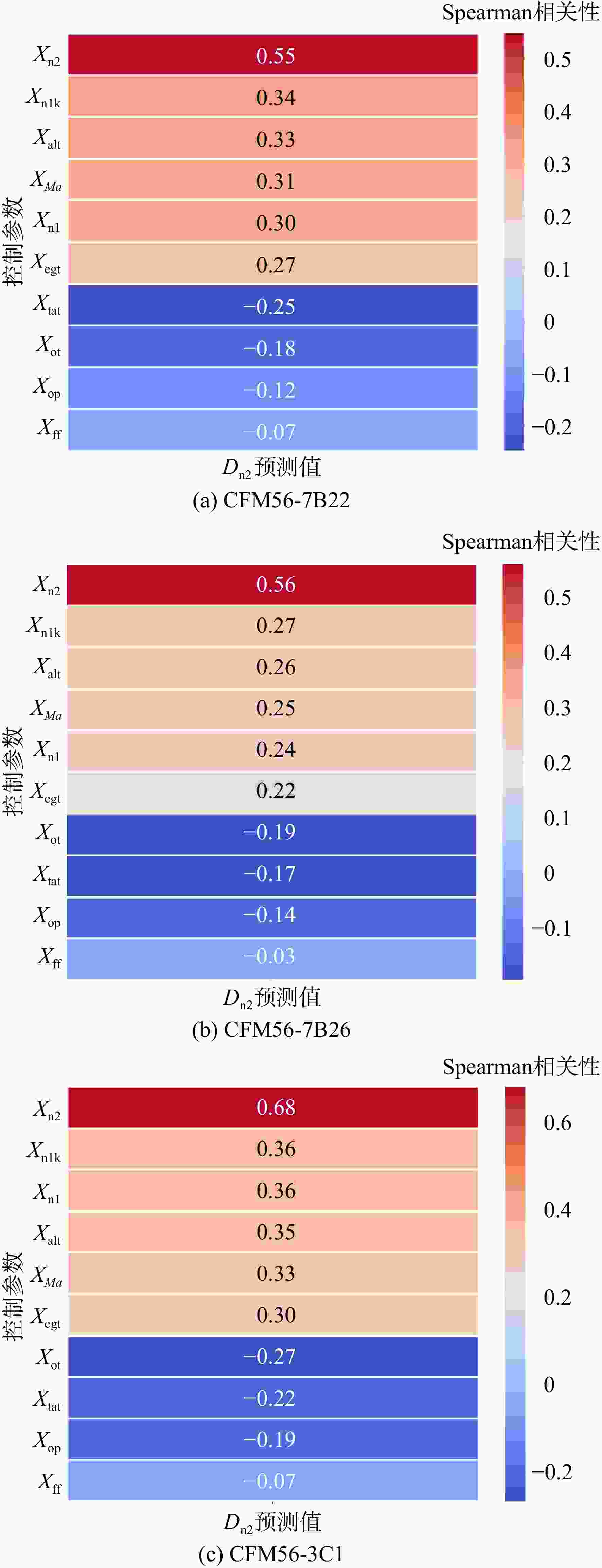
图 8 3种型号航空发动机$ {{D}}_{\text{n2}} $的Spearman相关性热图
Figure 8. Spearman correlation between control parameters and $ {{D}}_{\text{n2}} $
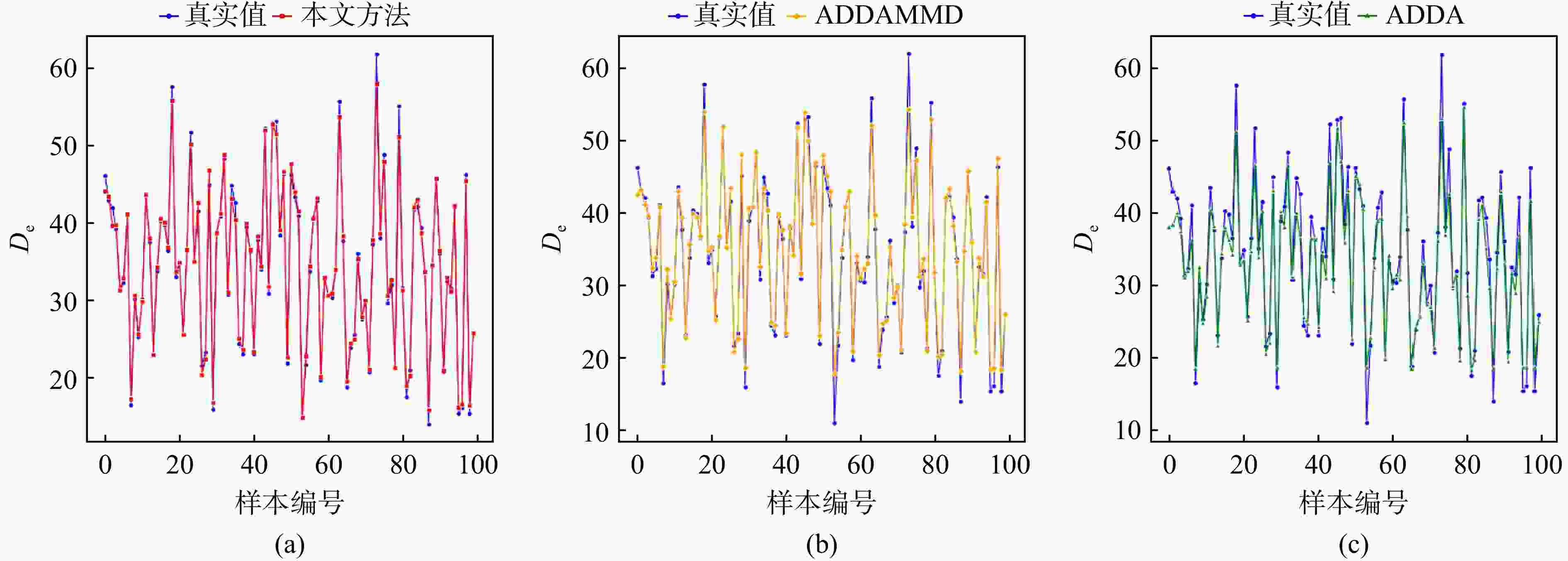
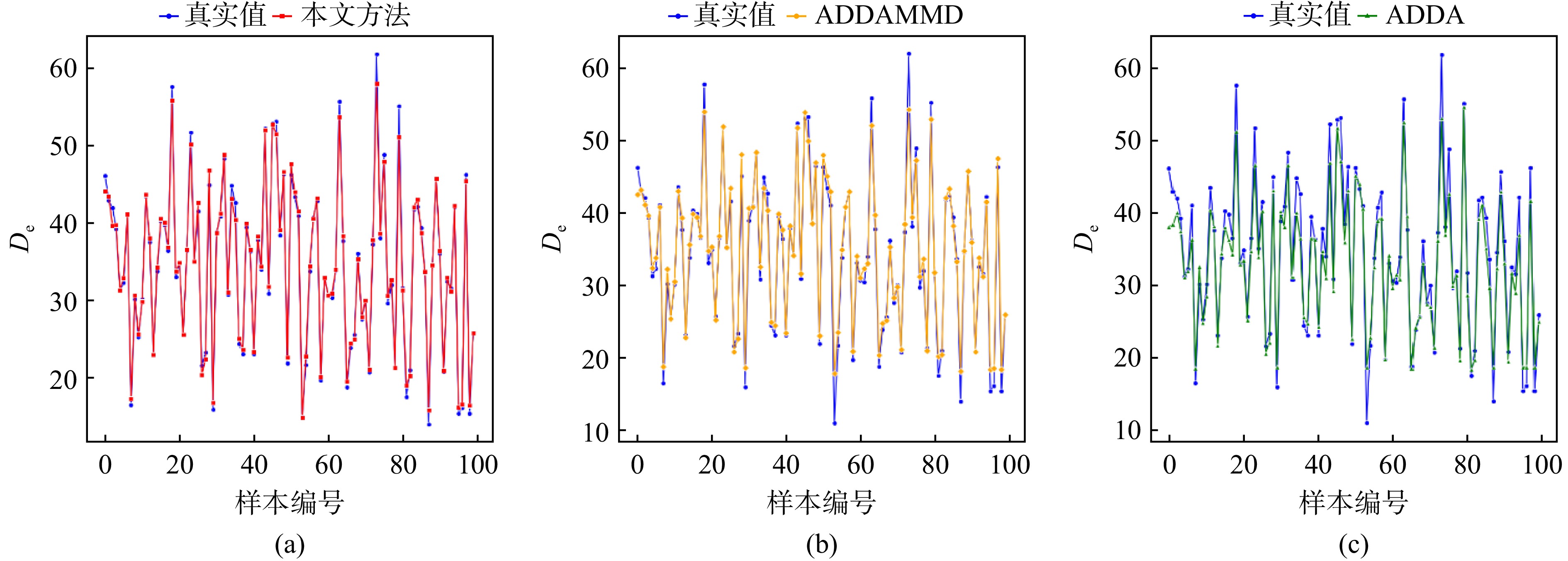
图 9 3种领域自适应方法对7B22-7B26的$ {{D}}_{\text{e}} $预测结果
Figure 9. Three domain adaptation methods for predicting $ {{D}}_{\text{e}} $ from 7B22-7B26
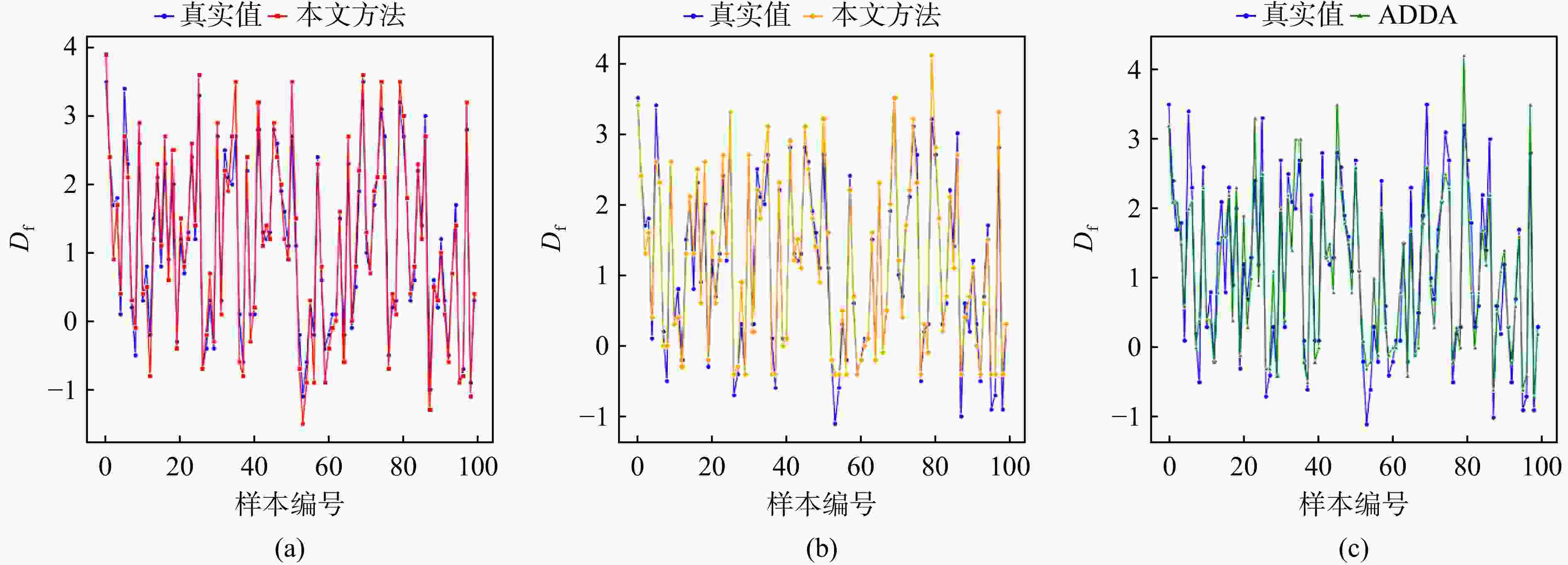
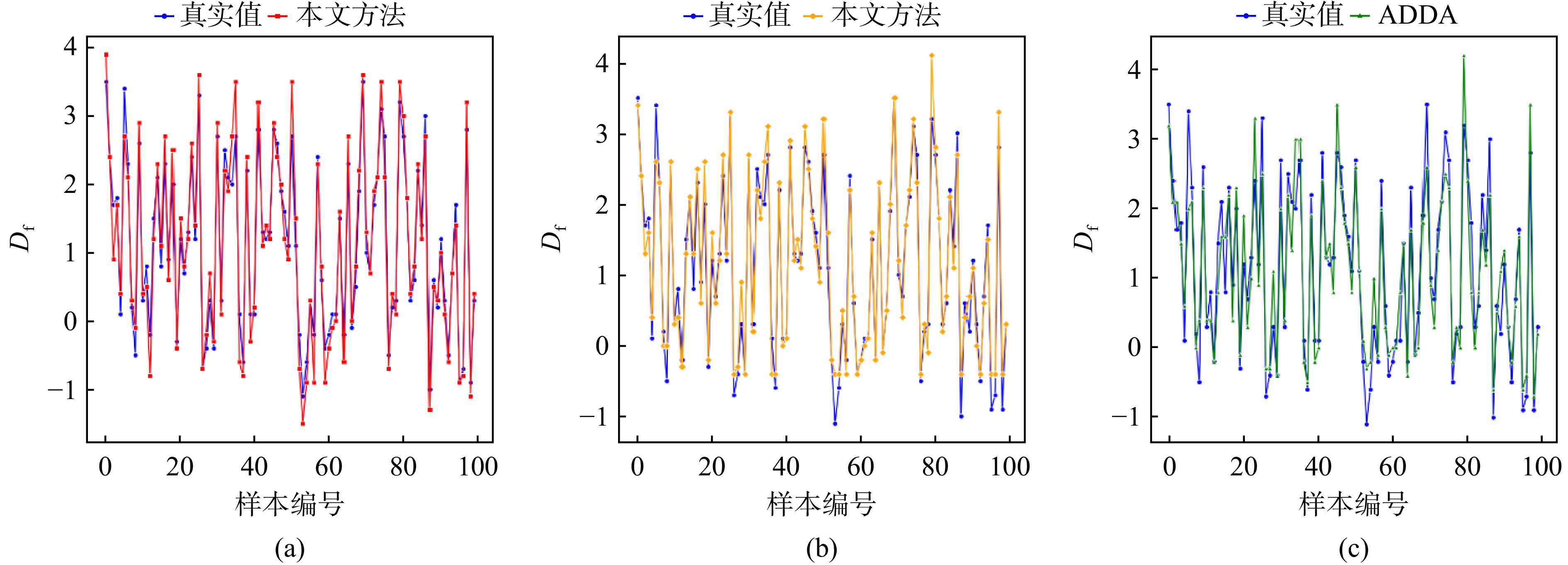
图 10 3种领域自适应方法对7B22-7B26的$ {{D}}_{\text{f}} $预测结果
Figure 10. Three domain adaptation methods for predicting $ {{D}}_{\text{f}} $ from 7B22-7B26
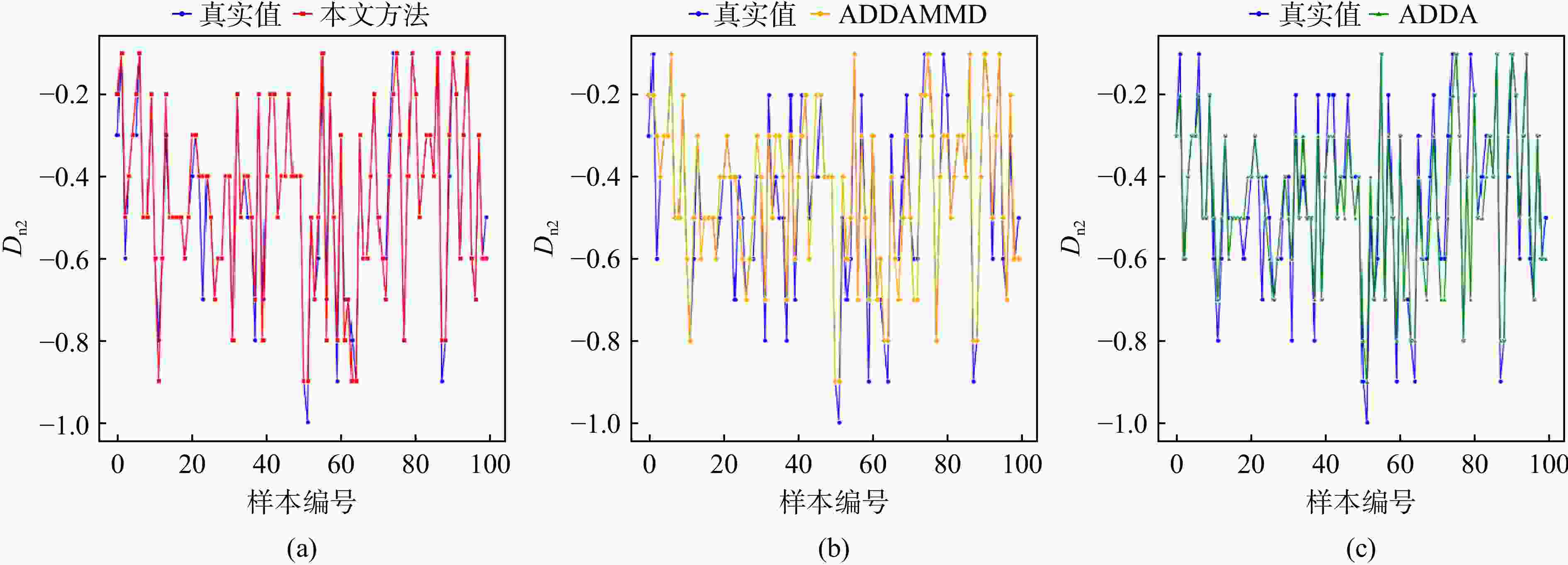
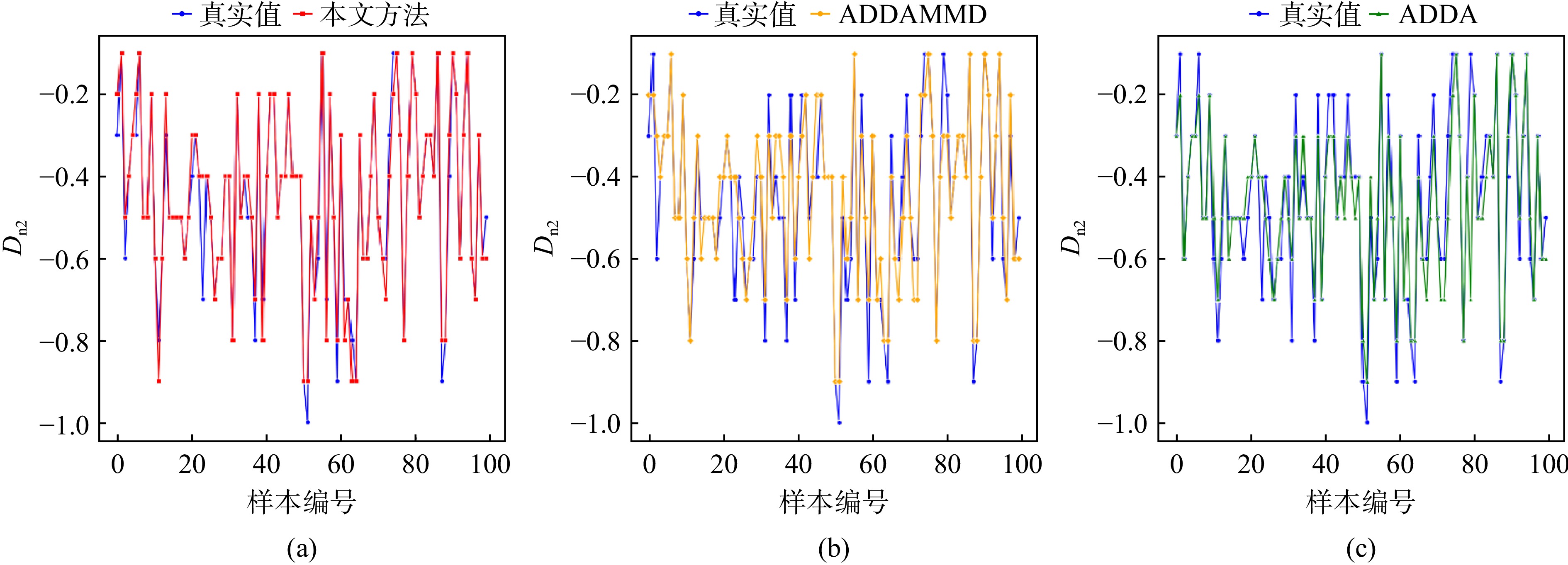
图 11 3种领域自适应方法对7B22-7B26的$ {{D}}_{\text{n2}} $预测结果
Figure 11. Three domain adaptation methods for predicting $ {{D}}_{\text{n2}} $ from 7B22-7B26
表 1 数据集相关参数
Table 1. Dataset-related parameters
基线参数 控制参数 $ {{D}}_{\text{e}} $, $ {{D}}_{\text{f}} $, $ {{D}}_{\text{n2}} $ $ {{X}}_{\text{tat}} $, $ {{X}}_{\text{alt}} $, $ {{X}}_{Ma} $, $ {{X}}_{\text{n1}} $, $ {{X}}_{\text{op}} $,
$ {{X}}_{\text{ff}} $, $ {{X}}_{\text{n2}} $, $ {{X}}_{\text{egt}} $, $ {{X}}_{\text{n1k}} $, $ {{X}}_{\text{ot}} $注:表中$ {{D}}_{\text{e}} $为排气温度偏差值,$ {{D}}_{\text{f}} $燃油流量偏差值,$ {{D}}_{\text{n}\text{2}} $为高压转子转速偏差值,$ {{X}}_{\text{tat}} $为大气总温,$ {{X}}_{\text{alt}} $为飞行高度,$ {{X}}_{Ma} $为马赫数,$ {{X}}_{\text{n1}} $为低压转子转速,$ {{X}}_{\text{op}} $为燃油压力,$ {{X}}_{\text{ff}} $燃油流量,$ {{X}}_{\text{n2}} $为高压转子转速,$ {{X}}_{\text{egt}} $为排气温度,$ {{X}}_{\text{n1k}} $低压转子转速极值,$ {{X}}_{\text{ot}} $为燃油温度。  下载: 导出CSV
表 2 不同迁移模型介绍
Table 2. Introduction of different transfer models
模型 释义 CNN 卷积神经网络,特征提取器使用CNN,
其余部分保持不变LSTM 长短期记忆神经网络,特征提取器
使用LSTM,其余部分保持不变ADDA 对抗迁移 ADDAMMD 对抗迁移+MMD 本文方法 对抗迁移+MMD+InfoNCE
下载: 导出CSV
表 3 未迁移模型De实验结果
Table 3. Experimental results of the non-transfer model for De
训练集 测试集 $ {{e}}_{\text{ma}} $ $ {{e}}_{\text{rms}} $ R2 7B22 7B22 1.113 1.572 0.980 7B22 7B26 2.912 3.215 0.752 7B22 3C1 3.149 3.438 0.718 7B26 7B26 0.986 1.232 0.983 7B26 7B22 2.865 3.191 0.802 7B26 3C1 3.215 3.549 0.725 3C1 3C1 1.218 1.652 0.973 3C1 7B22 3.307 3.765 0.692 3C1 7B26 3.216 3.658 0.684
下载: 导出CSV
表 4 未迁移模型Df实验结果
Table 4. Experimental results of the non-transfer model for Df
训练集 测试集 $ {{e}}_{\text{ma}} $ $ {{e}}_{\text{rms}} $ R2 7B22 7B22 0.212 0.257 0.952 7B22 7B26 0.974 1.135 0.693 7B22 3C1 1.210 1.382 0.617 7B26 7B26 0.158 0.230 0.968 7B26 7B22 0.920 1.153 0.690 7B26 3C1 1.028 1.214 0.622 3C1 3C1 0.236 0.301 0.944 3C1 7B22 1.145 1.294 0.572 3C1 7B26 1.162 1.311 0.563
下载: 导出CSV
表 5 未迁移模型Dn2实验结果
Table 5. Experimental results of the non-transfer model for Dn2
训练集 测试集 $ {{e}}_{\text{ma}} $ $ {{e}}_{\text{rms}} $ R2 7B22 7B22 0.028 0.035 0.980 7B22 7B26 0.083 0.113 0.703 7B22 3C1 0.087 0.116 0.675 7B26 7B26 0.030 0.036 0.953 7B26 7B22 0.082 0.107 0.702 7B26 3C1 0.090 0.124 0.645 3C1 3C1 0.032 0.039 0.931 3C1 7B22 0.085 0.117 0.626 3C1 7B26 0.090 0.122 0.617
下载: 导出CSV
表 6 不同特征提取器De实验结果
Table 6. Experimental results of different feature extractor models for De
源域 目标域 $ {{e}}_{\text{ma}} $ $ {{e}}_{\text{rms}} $ R2 CNN LSTM 本文方法 CNN LSTM 本文方法 CNN LSTM 本文方法 7B22 7B26 2.118 1.899 1.562 2.991 2.493 2.039 0.892 0.923 0.952 7B22 3C1 2.554 2.027 1.721 3.225 2.724 2.305 0.842 0.905 0.930 7B26 7B22 2.296 1.917 1.608 2.757 2.537 2.144 0.873 0.916 0.943 7B26 3C1 2.577 2.108 1.743 3.246 2.762 2.410 0.838 0.902 0.929 3C1 7B22 2.710 2.275 1.825 3.359 2.951 2.501 0.821 0.878 0.921 3C1 7B26 2.771 2.265 1.903 3.405 2.986 2.668 0.818 0.886 0.919
下载: 导出CSV
表 7 不同特征提取器Df实验结果
Table 7. Experimental results of different feature extractor models for Df
源域 目标域 $ {{e}}_{\text{ma}} $ $ {{e}}_{\text{rms}} $ R2 CNN LSTM 本文方法 CNN LSTM 本文方法 CNN LSTM 本文方法 7B22 7B26 0.533 0.412 0.309 0.665 0.548 0.364 0.814 0.860 0.908 7B22 3C1 0.645 0.525 0.397 0.790 0.621 0.463 0.779 0.826 0.878 7B26 7B22 0.506 0.474 0.368 0.656 0.603 0.432 0.831 0.835 0.889 7B26 3C1 0.613 0.582 0.415 0.762 0.742 0.493 0.786 0.808 0.856 3C1 7B22 0.747 0.610 0.502 0.886 0.742 0.584 0.729 0.808 0.832 3C1 7B26 0.701 0.629 0.493 0.850 0.772 0.568 0.762 0.802 0.842
下载: 导出CSV
表 8 不同特征提取器Dn2实验结果
Table 8. Experimental results of different feature extractor models for Dn2
源域 目标域 $ {{e}}_{\text{ma}} $ $ {{e}}_{\text{rms}} $ R2 CNN LSTM 本文方法 CNN LSTM 本文方法 CNN LSTM 本文方法 7B22 7B26 0.062 0.053 0.038 0.081 0.067 0.048 0. 807 0.861 0.925 7B22 3C1 0.074 0.066 0.051 0.085 0.078 0.060 0.758 0.801 0.880 7B26 7B22 0.067 0.055 0.048 0.084 0.070 0.056 0.781 0.843 0.883 7B26 3C1 0.078 0.059 0.052 0.096 0.074 0.064 0.742 0.829 0.871 3C1 7B22 0.077 0.064 0.061 0.096 0.078 0.074 0.745 0.810 0.820 3C1 7B26 0.075 0.069 0.058 0.095 0.088 0.066 0.750 0.768 0.835
下载: 导出CSV
表 9 不同领域自适应模型De实验结果
Table 9. Experimental results of different domain adaptation models for De
源域 目标域 $ {{e}}_{\text{ma}} $ $ {{e}}_{\text{rms}} $ R2 ADDA ADDAMMD 本文方法 ADDA ADDAMMD 本文方法 ADDA ADDAMMD 本文方法 7B22 7B26 2.065 1.908 1.562 2.605 2.587 2.039 0.903 0.919 0.952 7B22 3C1 2.381 2.108 1.721 3.101 2.709 2.305 0.855 0.902 0.930 7B26 7B22 2.121 2.026 1.608 2.721 2.591 2.144 0.898 0.908 0.943 7B26 3C1 2.471 2.163 1.743 3.025 2.846 2.410 0.850 0.888 0.929 3C1 7B22 2.570 2.343 1.825 3.193 3.035 2.501 0.839 0.862 0.921 3C1 7B26 2.525 2.289 1.903 3.154 2.993 2.668 0.841 0.880 0.919
下载: 导出CSV
表 10 不同领域自适应模型Df实验结果
Table 10. Experimental results of different domain adaptation models for Df
源域 目标域 $ {{e}}_{\text{ma}} $ $ {{e}}_{\text{rms}} $ R2 ADDA ADDAMMD 本文方法 ADDA ADDAMMD 本文方法 ADDA ADDAMMD 本文方法 7B22 7B26 0.500 0.438 0.309 0.642 0.564 0.364 0.821 0.852 0.908 7B22 3C1 0.621 0.560 0.397 0.781 0.693 0.463 0.803 0.818 0.878 7B26 7B22 0.493 0.479 0.368 0.638 0.598 0.432 0.826 0.839 0.889 7B26 3C1 0.605 0.588 0.415 0.737 0.715 0.493 0.808 0.814 0.856 3C1 7B22 0.733 0.672 0.502 0.874 0.798 0.584 0.725 0.775 0.832 3C1 7B26 0.692 0.651 0.493 0.823 0.773 0.568 0.768 0.794 0.842
下载: 导出CSV
表 11 不同领域自适应模型Dn2实验结果
Table 11. Experimental results of different domain adaptation models for Dn2
源域 目标域 $ {{e}}_{\text{ma}} $ $ {{e}}_{\text{rms}} $ R2 ADDA ADDAMMD 本文方法 ADDA ADDAMMD 本文方法 ADDA ADDAMMD 本文方法 7B22 7B26 0.060 0.054 0.038 0.078 0.069 0.048 0.810 0.860 0.925 7B22 3C1 0.072 0.068 0.051 0.090 0.080 0.060 0.772 0.800 0.880 7B26 7B22 0.065 0.057 0.048 0.082 0.069 0.056 0.793 0.832 0.883 7B26 3C1 0.077 0.064 0.052 0.096 0.076 0.064 0.751 0.818 0.871 3C1 7B22 0.074 0.068 0.061 0.091 0.081 0.074 0.764 0.798 0.820 3C1 7B26 0.075 0.071 0.058 0.093 0.084 0.066 0.758 0.786 0.835
下载: 导出CSV
表 12 不同领域自适应模型Dn2运行时间
Table 12. Running time of different domain adaptation models for Dn2
参数 运行时间/s ADDA ADDAMMD 本文方法 $ {{D}}_{\text{e}} $ 1359.3 1512.4 1864.7 $ {{D}}_{\text{f}} $ 1304.1 1493.3 1731.5 $ {{D}}_{\text{n2}} $ 1287.3 1425.7 1722.9
下载: 导出CSV
-
[1] QIU Xiaojie, ZHENG Wenhua, TANG Yuting, et al. The test verification design method based on rapid prototyping technology of aero-engine[J]. Procedia Engineering, 2015, 99: 981-990. doi: 10.1016/j.proeng.2014.12.631 [2] SHANMUGANATHAN V, HARAN D A, RAGAVENDRAN S, et al. Aero-engine maintenance cost optimization by RCM[J]. Life Science Journal, 2013, 10(1): 2891-2896. [3] 曹惠玲, 徐文迪, 汤鑫豪, 等. 航空发动机基线挖掘方法对比分析[J]. 中国民航大学学报, 2019, 37(6): 12-17. CAO Huiling, XU Wendi, TANG Xinhao, et al. Comparison and analysis of aero-engine baseline detection approaches[J]. Journal of Civil Aviation University of China, 2019, 37(6): 12-17. (in ChineseCAO Huiling, XU Wendi, TANG Xinhao, et al. Comparison and analysis of aero-engine baseline detection approaches[J]. Journal of Civil Aviation University of China, 2019, 37(6): 12-17. (in Chinese) [4] YILDIRIM M T, KURT B. Aircraft gas turbine engine health monitoring system by real flight data[J]. International Journal of Aerospace Engineering, 2018, 2018(1): 9570873. [5] 王奕首, 余映红, 卿新林, 等. 基于KPCA和DBN的航空发动机排气温度基线模型[J]. 航空发动机, 2020, 46(1): 54-60. WANG Yishou, YU Yinghong, QING Xinlin, et al. Exhaust gas temperature baseline model of aeroengine based on kernel principal component analysis and deep belief network[J]. Aeroengine, 2020, 46(1): 54-60. (in ChineseWANG Yishou, YU Yinghong, QING Xinlin, et al. Exhaust gas temperature baseline model of aeroengine based on kernel principal component analysis and deep belief network[J]. Aeroengine, 2020, 46(1): 54-60. (in Chinese) [6] 王聃. 基于多方法的CFM56-7B发动机基线挖掘研究[D]. 四川 广汉: 中国民用航空飞行学院, 2016. WANG Dan. Research on baseline mining of CFM56-7B engine based on multi-methods[D]. Guanghan, Sichuan: Civil Aviation Flight University of China, 2016. (in ChineseWANG Dan. Research on baseline mining of CFM56-7B engine based on multi-methods[D]. Guanghan, Sichuan: Civil Aviation Flight University of China, 2016. (in Chinese) [7] JIN Xiangyang, SUN Zhihui, WANG Heteng, et al. Application of improved support vector machine regression analysis for medium- and long-term vibration trend prediction[J]. Journal of Vibroengineering, 2013, 15(2): 942-950. [8] 庄福振, 罗平, 何清, 等. 迁移学习研究进展[J]. 软件学报, 2015, 26(1): 26-39. ZHUANG Fuzhen, LUO Ping, HE Qing, et al. Survey on transfer learning research[J]. Journal of Software, 2015, 26(1): 26-39. (in ChineseZHUANG Fuzhen, LUO Ping, HE Qing, et al. Survey on transfer learning research[J]. Journal of Software, 2015, 26(1): 26-39. (in Chinese) [9] ZHANG Ansi, WANG Honglei, LI Shaobo, et al. Transfer learning with deep recurrent neural networks for remaining useful life estimation[J]. Applied Sciences, 2018, 8(12): 2416. doi: 10.3390/app8122416 [10] 陈佳鲜. 多工况轴承退化序列的时序深度迁移学习预测及剩余寿命评估[D]. 河南 新乡: 河南师范大学, 2022. CHEN Jiaxian. Time series depth migration learning prediction and residual life evaluation of multi-condition bearing degradation sequence[D]. Xinxiang Henan: Henan Normal University, 2022. (in ChineseCHEN Jiaxian. Time series depth migration learning prediction and residual life evaluation of multi-condition bearing degradation sequence[D]. Xinxiang Henan: Henan Normal University, 2022. (in Chinese) [11] 胡若晖, 张敏, 许文鑫. 基于DCGAN和DANN网络的滚动轴承跨域故障诊断[J]. 振动与冲击, 2022, 41(6): 21-29. HU Ruohui, ZHANG Min, XU Wenxin. Cross-domain fault diagnosis of rolling element bearings using DCGAN and DANN[J]. Journal of Vibration and Shock, 2022, 41(6): 21-29. (in ChineseHU Ruohui, ZHANG Min, XU Wenxin. Cross-domain fault diagnosis of rolling element bearings using DCGAN and DANN[J]. Journal of Vibration and Shock, 2022, 41(6): 21-29. (in Chinese) [12] RAGAB M, CHEN Zhenghua, WU Min, et al. Contrastive adversarial domain adaptation for machine remaining useful life prediction[J]. IEEE Transactions on Industrial Informatics, 2021, 17(8): 5239-5249. doi: 10.1109/TII.2020.3032690 [13] HUANG Min, YIN Jinghan. Research on adversarial domain adaptation method and its application in power load forecasting[J]. Mathematics, 2022, 10(18): 3223. [14] DONG Xingjun, ZHANG Changsheng, LIU Hanrui, et al. A multi-constrained domain adaptation network for remaining useful life prediction of bearings[J]. Mechanical Systems and Signal Processing, 2024, 206: 110900. [15] 周星杰. 民航发动机气路参数偏差值挖掘及其在异常检测中的应用[D]. 哈尔滨: 哈尔滨工业大学, 2020. ZHOU Xingjie. Deviation value mining of civil aviation engine gas path parameters and its application in anomaly detection[D]. Harbin: Harbin Institute of Technology, 2020. (in ChineseZHOU Xingjie. Deviation value mining of civil aviation engine gas path parameters and its application in anomaly detection[D]. Harbin: Harbin Institute of Technology, 2020. (in Chinese) [16] 徐嘉杰, 沈艳霞. 基于改进DANN迁移学习的轴承寿命预测方法[J]. 化工自动化及仪表, 2023, 50(4): 493-499, 594. XU Jiajie, SHEN Yanxia. A bearing life prediction method based on improved DANN transfer learning[J]. Control and Instruments in Chemical Industry, 2023, 50(4): 493-499, 594. (in ChineseXU Jiajie, SHEN Yanxia. A bearing life prediction method based on improved DANN transfer learning[J]. Control and Instruments in Chemical Industry, 2023, 50(4): 493-499, 594. (in Chinese) [17] LI Xinyao, LI Jingjing, ZUO Lin, et al. Domain adaptive remaining useful life prediction with transformer[J]. IEEE Transactions on Instrumentation and Measurement, 2022, 71: 3521213. [18] ZHU Jun, CHEN Nan, SHEN Changqing. A new deep transfer learning method for bearing fault diagnosis under different working conditions[J]. IEEE Sensors Journal, 2019, 20(15): 8394-8402. [19] KANG Shouqiang, QIAO Chunyang, WANG Yujing, et al. Fault diagnosis method of rolling bearings under varying working conditions based on deep feature transfer[J]. Journal of Mechanical Science and Technology, 2020, 34(11): 4383-4391. doi: 10.1007/s12206-020-1003-9 [20] LI Yibin, SONG Yan, JIA Lei, et al. Intelligent fault diagnosis by fusing domain adversarial training and maximum mean discrepancy via ensemble learning[J]. IEEE Transactions on Industrial Informatics, 2021, 17(4): 2833-2841. doi: 10.1109/TII.2020.3008010 [21] VASWANI V, SHAZEER N, PARMAR N, et al. Attention is all you need [EB/OL]. (2023-08-02)[2023-12-10]. http://arxiv.org/abs/1706.03762 [22] BORGWARDT K M, GRETTON A, RASCH M J, et al. Integrating structured biological data by kernel maximum mean discrepancy[J]. Bioinformatics, 2006, 22(14): 49-57. doi: 10.1093/bioinformatics/btl242 [23] OORD A, LI Y, VINYALS O. Representation learning with contrastive predictive coding[EB/OL]. (2019-01-22)[2023-12-16]. http://arxiv.org/abs/1807.03748. [24] 刘渊, 余映红, 田彦云, 等. 航空发动机排气温度基线建模新方法研究[J]. 推进技术, 2022, 43(4): 200511. LIU Yuan, YU Yinghong, TIAN Yanyun, et al. Investigation on new method for baseline modelling of aeroengine exhaust gas temperature[J]. Journal of Propulsion Technology, 2022, 43(4): 200511. (in ChineseLIU Yuan, YU Yinghong, TIAN Yanyun, et al. Investigation on new method for baseline modelling of aeroengine exhaust gas temperature[J]. Journal of Propulsion Technology, 2022, 43(4): 200511. (in Chinese) -

 点击查看大图

计量
- 文章访问数: 727
- HTML浏览量: 374
- PDF量: 39
- 被引次数: 0